CBSE Class 10 Mathematics Theory (Std) Question Paper 2020 Set 30-3-3
Finished viewing? Save it for later —
Download CBSE Class 10 Mathematics Theory (Std) Question Paper 2020 Set 30-3-3 (PDF · 16 pages)About CBSE Class 10 Mathematics Theory (Std) Question Paper 2020 Set 30-3-3
CBSE Class 10 Mathematics Theory (Std) Question Paper 2020 Set 30-3-3 is available here for free download. Published by CBSE for Class 10, this question paper can be viewed online or downloaded as a PDF (16 pages). Candidates preparing for Class 10 can use CBSE Class 10 Mathematics Theory (Std) Question Paper 2020 Set 30-3-3 to understand the exam pattern, the type of questions asked, and the overall difficulty level.
Frequently Asked Questions
How can I download CBSE Class 10 Mathematics Theory (Std) Question Paper 2020 Set 30-3-3?
Open this page and click the Download button to save CBSE Class 10 Mathematics Theory (Std) Question Paper 2020 Set 30-3-3 as a PDF. It is completely free on AglaSem Docs.
Is CBSE Class 10 Mathematics Theory (Std) Question Paper 2020 Set 30-3-3 free to download?
Yes. CBSE Class 10 Mathematics Theory (Std) Question Paper 2020 Set 30-3-3 can be viewed online and downloaded as a PDF free of cost on AglaSem Docs.
How many pages does CBSE Class 10 Mathematics Theory (Std) Question Paper 2020 Set 30-3-3 have?
CBSE Class 10 Mathematics Theory (Std) Question Paper 2020 Set 30-3-3 contains 16 pages, which you can read online or download together as a single PDF.
Where can I find more Class 10 study material?
You can find more Class 10 question papers, sample papers, syllabus, and answer keys on AglaSem Docs.
CBSE Class 10 Mathematics Theory (Std) Question Paper 2020 Set 30-3-3 – Text
Read the full text of this question paper below — useful to quickly search, copy and reference the content online without downloading the PDF.
📄 View text version (16 pages)
Page 1
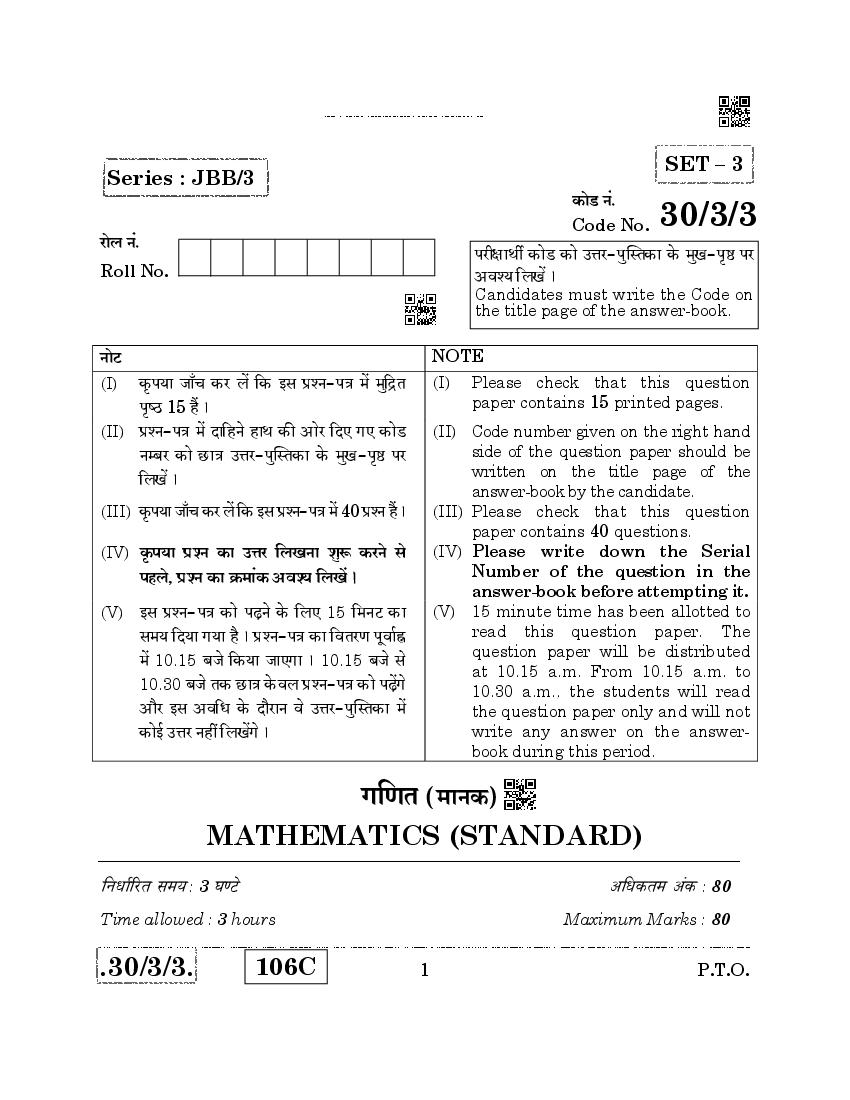
Series : JBB/3
.
Code No. 30/3/3
.
- -
Roll No.
Candidates must write the Code on
the title page of the answer-book.
NOTE
(I) - (I) Please check that this question
15 paper contains 15 printed pages.
(II) - (II) Code number given on the right hand
- - side of the question paper should be
written on the title page of the
answer-book by the candidate.
(III) - 40 (III) Please check that this question
paper contains 40 questions.
(IV) (IV) Please write down the Serial
, Number of the question in the
answer-book before attempting it.
(V) - 15 (V) 15 minute time has been allotted to
- read this question paper. The
question paper will be distributed
10.15 10.15
at 10.15 a.m. From 10.15 a.m. to
10.30 - 10.30 a.m., the students will read
- the question paper only and will not
write any answer on the answer-
book during this period.
()
MATHEMATICS (STANDARD)
{ZYm©[aV g‘¶ : 3 KÊQ>o A{YH$V‘ A§H$ : 80
Time allowed : 3 hours Maximum Marks : 80
.30/3/3. 106C 1 P.T.O.
Page 2
(i) - – , ,
- 40
(ii) - 1 20 20
(iii) - 21 26 6
(iv) - 27 34 8
(v) - 35 40 6
(vi) - - , -
, - , -
(vii) , ,
(viii)
–
1 – 10 1
1. 144 2
(a) 2 (b) 4 (c) 1 (d) 6
2. , n an = (3n + 7) ,
(a) 3 (b) 7 (c) 10 (d) 6
3. 135 225 .. (HCF)
(a) 15 (b) 75 (c) 45 (d) 5
.30/3/3. 2
Page 3
Read the following instructions very carefully and strictly follow them :
(i) This question paper comprises four sections – A, B, C and D.
This question paper carries 40 questions. All questions are compulsory.
(ii) Section A – Question no. 1 to 20 comprises of 20 questions of one mark
each.
(iii) Section B – Question no. 21 to 26 comprises of 6 questions of two
marks each.
(iv) Section C – Question no. 27 to 34 comprises of 8 questions of three
marks each.
(v) Section D – Question no. 35 to 40 comprises of 6 questions of four
marks each.
(vi) There is no overall choice in the question paper. However, an internal
choice has been provided in 2 questions of one mark each, 2 questions of
two marks each, 3 questions of three marks each and 3 questions of four
marks each. You have to attempt only one of the choices in such
questions.
(vii) In addition to this, separate instructions are given with each section
and question, wherever necessary.
(viii) Use of calculators is not permitted.
Section – A
Question numbers 1 to 10 are multiple choice questions of 1 mark each.
You have to select the correct choice :
1. The exponent of 2 in the prime factorization of 144, is
(a) 2 (b) 4 (c) 1 (d) 6
2. The common difference of an AP, whose n th term is an = (3n + 7), is
(a) 3 (b) 7 (c) 10 (d) 6
3. The HCF of 135 and 225 is
(a) 15 (b) 75 (c) 45 (d) 5
.30/3/3. 3 P.T.O.
Page 4
ABC DEF
(a) 49 : 36 (b) 6 : 7 (c) 7 : 6 (d) 36 : 49
5. (x2 + 4x + ) ,
(a) 16 (b) 9 (c) 1 (d) 4
6. k kx + y = k2 x + ky = 1
,
(a) + 1 (b) 1 (c) –1 (d) 2
7. k A (0, 1), B (2, k) C(4, –5) ,
(a) 2 (b) –2 (c) 0 (d) 4
8. p (2p + 1), 10 (5p + 5) ,
(a) –1 (b) –2 (c) 1 (d) 2
5, 9, 13, ......, 185 ?
(a) 31 (b) 51 (c) 41 (d) 40
9.
A(10, –6) B(k, 4) - (a, b) ,
a – 2b = 18 , k
(a) 30 (b) 22 (c) 4 (d) 40
10. 1 p(x)
-1
(a) 1 (b) 2 (c) 3 (d) 0
.30/3/3. 4
Page 5
areas of ABC and DEF is
(a) 49 : 36 (b) 6 : 7 (c) 7 : 6 (d) 36 : 49
5. The value of for which (x2 + 4x + ) is a perfect square, is
(a) 16 (b) 9 (c) 1 (d) 4
6. The value of k, for which the pair of linear equations kx + y = k2 and
x + ky = 1 have infinitely many solutions is
(a) + 1 (b) 1 (c) –1 (d) 2
7. The value of k for which the points A (0, 1), B (2, k) and C(4, –5) are
collinear is
(a) 2 (b) –2 (c) 0 (d) 4
8. The value of p for which (2p + 1), 10 and (5p + 5) are three consecutive
terms of an AP is
(a) –1 (b) –2 (c) 1 (d) 2
OR
The number of terms of an AP 5, 9, 13, …. 185 is
(a) 31 (b) 51 (c) 41 (d) 40
9. If (a, b) is the mid-point of the line segment joining the points A(10, –6)
and B(k, 4) and a – 2b = 18, the value of k is
(a) 30 (b) 22 (c) 4 (d) 40
10. In fig. 1, the graph of the polynomial p(x) is given. The number of zeroes of
the polynomial is
Fig. 1
(a) 1 (b) 2 (c) 3 (d) 0
.30/3/3. 5 P.T.O.
Page 6
11. 2 , O PA PB APB = 50°
, OAB _________
-2
3 PQ PT, P QPT = 60 ,
PRQ _________
-3
3 cot 40º 1 cos 35°
12. – = _________.
tan 50º 2 sin 55°
13. 4 _________
14. (–3, 4) Y- _________
2 tan2 60°
15.
1 + tan2 30°
_________
.30/3/3. 6
Page 7
11. In Fig. 2, PA and PB are tangents to the circle with centre O such that
APB = 50°, then the measure of OAB is _________.
Fig. 2
OR
In Fig. 3, PQ is a chord of a circle and PT is tangent at P such that
QPT = 60, then the measure of PRQ is _________.
Fig. 3
3 cot 40º 1 cos 35°
12. – = _________.
tan 50º 2 sin 55°
13. The distance between two parallel tangents of a circle of radius 4 cm is
_________.
14. The distance of the point (–3, 4) from Y – axis is _________.
2 tan2 60°
15. Value of is _________.
1 + tan2 30°
.30/3/3. 7 P.T.O.
Page 8
16. 0.85 , ?
17. n ?
18.
1 : 3 3 : 1 ,
?
19. , 8.32
8.05
20. A = 60° (sec A + tan A) . (1 – sin A)
–
21 26 2
21. 7.5 p
2-4 4-6 6-8 8-10 10-12 12-14
6 8 15 p 8 4
22. :
XII
21 3.5
(i) ` 5 100 cm2 ?
(ii) ?
.30/3/3. 8
Page 9
16. The probability that it will rain tomorrow is 0.85. What is the probability that
it will not rain tomorrow ?
17. What is the arithmetic mean of first n natural numbers ?
18. Two right circular cones have their heights in the ratio 1 : 3 and radii in
the ratio 3 : 1, what is the ratio of their volumes ?
19. Using the empirical formula, find the mode of a distribution whose mean
is 8.32 and the median is 8.05.
20. Evaluate (sec A + tan A) . (1 – sin A) for A = 60°.
Section – B
Q. Nos. 21 to 26 carry 2 marks each.
21. Find the value of p, if the mean of the following distribution is 7 .5.
Classes 2-4 4-6 6-8 8-10 10-12 12-14
Frequency (fi) 6 8 15 p 8 4
22. Read the following passage and answer the questions given at the end :
Students of Class XII presented a gift to their school in the form of
an electric lamp in the shape of a glass hemispherical base surmounted by
a metallic cylindrical top of same radius 21 cm and height 3.5 cm. The top
was silver coated and the glass surface was painted red.
(i) What is the cost of silver coating the top at the rate of ` 5 per 100 cm2 ?
(ii) What is the surface area of glass to be painted red ?
.30/3/3. 9 P.T.O.
Page 10
:
1 + 5 + 9 + 13 + … + x = 1326
3 1 – cos2
24. tan = 4 , 1 + cos2
2 sec
tan = 3 , 1 + tan2
25.
26. , 9
–
27 34 3
27. 500 80 . 50 .
0.04 . ,
?
28. sin + cos = p sec + cosec = q , q (p2 – 1) = 2p.
29.
.30/3/3. 10
Page 11
12, 8, 4, …, –84.
OR
Solve the equation :
1 + 5 + 9 + 13 + … + x = 1326
3 1 – cos2
24. If tan = , find the value of
4 1 + cos2
OR
2 sec
If tan = 3, find the value of
1 + tan2
25. Prove that the tangents at the extremities of any chord of a circle make
equal angles with the chord.
26. Two dice are thrown together once. Find the probability of getting a sum
of more than 9.
Section – C
Q. Nos. 27 to 34 carry 3 marks each.
27. 500 persons are taking dip into a cuboidal pond which is 80 m long and
50 m broad. What is the rise of water level in the pond, if the average
displacement of the water by a person is 0.04 m 3 ?
28. If sin + cos = p and sec + cosec = q, show that q (p2 – 1) = 2p.
29. Prove that, a tangent to a circle is perpendicular to the radius through the
point of contact.
OR
Prove that the angle between the two tangents drawn from an external
point to a circle is supplementary to the angle subtended by the line
segment joining the points of contact at the centre.
.30/3/3. 11 P.T.O.
Page 12
x – 2 –2x + 4 g(x)
f(x) = x2 – 8x + k 40 , k
31. a, 7, b, 23, c , a, b c
m m , n n ,
(m + n)
32. k A(k+1, 2k), B(3k, 2k+3) C(5k–1,5k)
33.
34. k kx2 + 1 – 2(k – 1) x + x2 = 0
–
35 40 4
1
35. ABC , D BC BD = 3 BC
9 AD2 = 7 AB2
.30/3/3. 12
Page 13
remainder were x – 2 and –2x + 4 respectively. Find g(x).
OR
If the sum of the squares of zeros of the quadratic polynomial
f(x) = x2 – 8x + k is 40, find the value of k.
31. Find a, b and c if it is given that the numbers a, 7, b, 23, c are in AP.
OR
If m times the mth term of an AP is equal to n times its nth term, show that
the (m + n)th term of the AP is zero.
32. Find the values of k for which the points A(k + 1, 2k), B(3k, 2k + 3) and
C(5k – 1,5k) are collinear.
33. Prove that the ratio of the areas of two similar triangles is equal to the
ratio of squares of their corresponding medians.
34. Find the value of k for which the quadratic equation
kx2 + 1 – 2 (k – 1) x + x2 = 0 has equal roots. Hence find the roots of the
equation.
Section – D
Q. Nos. 35 to 40 carry 4 marks each.
35. In an equilateral triangle ABC, D is a point on the side BC such that
1
BD = BC. Prove that 9 AD2 = 7 AB2.
3
OR
Prove that the sum of squares of the sides of a rhombus is equal to the
sum of the squares of its diagonals.
.30/3/3. 13 P.T.O.
Page 14
60° ,
20 . h .
45° 60°
h
37. n (12)n, 0 5
( 2 + 5)
38. ‘ ’
: 0-10 10-20 20-30 30-40 40-50 50-60 60-70
: 5 15 20 23 17 11 9
39. 1 1 1
1
1 2 ?
40. 7
__________
.30/3/3. 14
Page 15
30° and the angle of depression of its reflection in the lake is 60°, find the
height of the cloud from the surface of lake.
OR
A vertical tower of height 20 m stands on a horizontal plane and is
surmounted by a vertical flag – staff of height h. At a point on the plane,
the angle of elevation of the bottom and top of the flag staff are 45° and
60° respectively. Find the value of h.
37. Show that (12)n cannot end with digit 0 or 5 for any natural number n.
OR
Prove that ( 2 + 5) is irrational.
38. For the following frequency distribution, draw a cumulative frequency
curve of ‘more than’ type and hence obtain the median value.
Classes 0-10 10-20 20-30 30-40 40-50 50-60 60-70
Frequency 5 15 20 23 17 11 9
39. If we add 1 to the numerator and subtract 1 from the denominator, a
1
fraction reduces to 1. It becomes if we only add 1 to the denominator.
2
What is the fraction ?
40. A hemispherical depression is cut out from one face of a cuboidal block of
side 7 cm such that the diameter of the hemisphere is equal to the edge of
the cube. Find the surface area of the remaining solid.
__________
.30/3/3. 15 P.T.O.
Page 16
Document Details
| Board / Org | CBSE |
| Exam | Class 10 |
| Type | Question Paper |
| Pages | 16 |
| Updated | 22 Jul 2026 |