CBSE Class 10 Question Paper 2025 Solution Introducation to Financial Markets
Finished viewing? Save it for later —
Download CBSE Class 10 Question Paper 2025 Solution Introducation to Financial Markets (PDF · 8 pages)About CBSE Class 10 Question Paper 2025 Solution Introducation to Financial Markets
CBSE Class 10 Question Paper 2025 Solution Introducation to Financial Markets is available here for free download. Published by CBSE for Class 10, this solution can be viewed online or downloaded as a PDF (8 pages). Candidates preparing for Class 10 can use CBSE Class 10 Question Paper 2025 Solution Introducation to Financial Markets to understand the exam pattern, the type of questions asked, and the overall difficulty level.
Frequently Asked Questions
How can I download CBSE Class 10 Question Paper 2025 Solution Introducation to Financial Markets?
Open this page and click the Download button to save CBSE Class 10 Question Paper 2025 Solution Introducation to Financial Markets as a PDF. It is completely free on AglaSem Docs.
Is CBSE Class 10 Question Paper 2025 Solution Introducation to Financial Markets free to download?
Yes. CBSE Class 10 Question Paper 2025 Solution Introducation to Financial Markets can be viewed online and downloaded as a PDF free of cost on AglaSem Docs.
How many pages does CBSE Class 10 Question Paper 2025 Solution Introducation to Financial Markets have?
CBSE Class 10 Question Paper 2025 Solution Introducation to Financial Markets contains 8 pages, which you can read online or download together as a single PDF.
Where can I find more Class 10 study material?
You can find more Class 10 question papers, sample papers, syllabus, and answer keys on AglaSem Docs.
CBSE Class 10 Question Paper 2025 Solution Introducation to Financial Markets – Text
Read the full text of this solution below — useful to quickly search, copy and reference the content online without downloading the PDF.
📄 View text version (8 pages)
Page 1
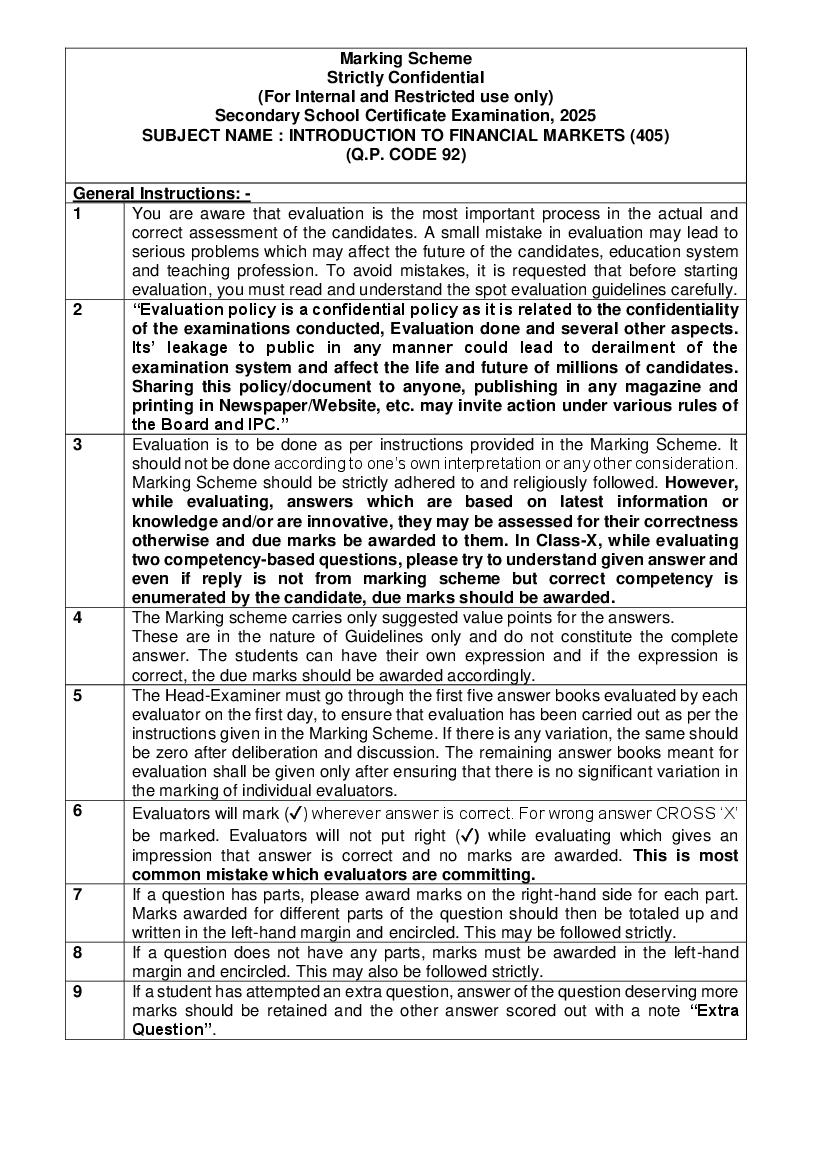
Strictly Confidential
(For Internal and Restricted use only)
Secondary School Certificate Examination, 2025
SUBJECT NAME : INTRODUCTION TO FINANCIAL MARKETS (405)
(Q.P. CODE 92)
General Instructions: -
1 You are aware that evaluation is the most important process in the actual and
correct assessment of the candidates. A small mistake in evaluation may lead to
serious problems which may affect the future of the candidates, education system
and teaching profession. To avoid mistakes, it is requested that before starting
evaluation, you must read and understand the spot evaluation guidelines carefully.
2 “Evaluation policy is a confidential policy as it is related to the confidentiality
of the examinations conducted, Evaluation done and several other aspects.
Its’ leakage to public in any manner could lead to derailment of the
examination system and affect the life and future of millions of candidates.
Sharing this policy/document to anyone, publishing in any magazine and
printing in Newspaper/Website, etc. may invite action under various rules of
the Board and IPC.”
3 Evaluation is to be done as per instructions provided in the Marking Scheme. It
should not be done according to one’s own interpretation or any other consideration.
Marking Scheme should be strictly adhered to and religiously followed. However,
while evaluating, answers which are based on latest information or
knowledge and/or are innovative, they may be assessed for their correctness
otherwise and due marks be awarded to them. In Class-X, while evaluating
two competency-based questions, please try to understand given answer and
even if reply is not from marking scheme but correct competency is
enumerated by the candidate, due marks should be awarded.
4 The Marking scheme carries only suggested value points for the answers.
These are in the nature of Guidelines only and do not constitute the complete
answer. The students can have their own expression and if the expression is
correct, the due marks should be awarded accordingly.
5 The Head-Examiner must go through the first five answer books evaluated by each
evaluator on the first day, to ensure that evaluation has been carried out as per the
instructions given in the Marking Scheme. If there is any variation, the same should
be zero after deliberation and discussion. The remaining answer books meant for
evaluation shall be given only after ensuring that there is no significant variation in
the marking of individual evaluators.
6 Evaluators will mark (✓) wherever answer is correct. For wrong answer CROSS ‘X’
be marked. Evaluators will not put right (✓) while evaluating which gives an
impression that answer is correct and no marks are awarded. This is most
common mistake which evaluators are committing.
7 If a question has parts, please award marks on the right-hand side for each part.
Marks awarded for different parts of the question should then be totaled up and
written in the left-hand margin and encircled. This may be followed strictly.
8 If a question does not have any parts, marks must be awarded in the left-hand
margin and encircled. This may also be followed strictly.
9 If a student has attempted an extra question, answer of the question deserving more
marks should be retained and the other answer scored out with a note “Extra
Question”.
Page 2
only once.
11 A full scale of marks 50 (example 0 to 80/70/60/50/40/30 marks as given in Question
Paper) has to be used. Please do not hesitate to award full marks if the answer
deserves it.
12 Every examiner has to necessarily do evaluation work for full working hours i.e., 8
hours every day and evaluate 20 answer books per day in main subjects and 25
answer books per day in other subjects (Details are given in Spot Guidelines).This
is in view of the reduced syllabus and number of questions in question paper.
13 Ensure that you do not make the following common types of errors committed by
the Examiner in the past: -
● Leaving answer or part thereof unassessed in an answer book.
● Giving more marks for an answer than assigned to it.
● Wrong totaling of marks awarded on an answer.
● Wrong transfer of marks from the inside pages of the answer book to the title
page.
● Wrong question wise totaling on the title page.
● Wrong totaling of marks of the two columns on the title page.
● Wrong grand total.
● Marks in words and figures not tallying/not same.
● Wrong transfer of marks from the answer book to online award list.
● Answers marked as correct, but marks not awarded. (Ensure that the right tick
mark is correctly and clearly indicated. It should merely be a line. Same is with
the X for incorrect answer.)
● Half or a part of answer marked correct and the rest as wrong, but no marks
awarded.
14 While evaluating the answer books if the answer is found to be totally incorrect, it
should be marked as cross (X) and awarded zero (0)Marks.
15 Any unassessed portion, non-carrying over of marks to the title page, or totaling
error detected by the candidate shall damage the prestige of all the personnel
engaged in the evaluation work as also of the Board. Hence, in order to uphold the
prestige of all concerned, it is again reiterated that the instructions be followed
meticulously and judiciously.
16 The Examiners should acquaint themselves with the guidelines given in the
“Guidelines for Spot Evaluation” before starting the actual evaluation.
17 Every Examiner shall also ensure that all the answers are evaluated, marks carried
over to the title page, correctly totaled and written in figures and words.
18 The candidates are entitled to obtain photocopy of the Answer Book on request on
payment of the prescribed processing fee. All Examiners/Additional Head
Examiners/Head Examiners are once again reminded that they must ensure that
evaluation is carried out strictly as per value points for each answer as given in the
Marking Scheme.
Page 3
MARKING SCHEME
INTRODUCTION TO FINANCIAL MARKETS (405)
SECTION A
OBJECTIVE-TYPE QUESTIONS
A. Question Mar
No. ks
Q.1 Answer any 4 out of the given 6 questions on Employability Skills. (14=4)
i. (D) Channel - 1
ii. (B) Adaptability - 1
iii. (C) Unrealistic goal - 1
iv. (C) ENTER - 1
v. (A) Making Decisions - 1
vi (C) Population - 1
Q.2 Answer any 5 out of the given 6 questions (15=5)
i. (B) The concept of Compounding - 1
ii. (D) Fixed Deposit Receipts - 1
iii. (C) Book Building - 1
iv. (C) Growth Stock - 1
v. Forward Contract OR Future Contract - 1
vi. (D) Professional Management - 1
Q.3 Answer any 5 out of the given 6 questions (15=5)
i. (D) Post Office monthly income scheme - 1
ii. The market participants can be issuers, investors and 1
2
1
intermediaries.
Entity name is Securities and Exchange Board of India/ SEBI. 1
2
(1/2 marks for any one correct participant)
(1/2 mark for correct answer.)
iii. (D) The system increases the time taken for completion of the - 1
issue process.
iv. (A) Dividends - 1
v. (D) Commodity - 1
vi. (A) Total Debt /Total Equity - 1
Q.4 Answer and 5 out of the given 6 questions (15=5)
i. Interest - 1
ii. (C) Cut-off Price - 1
Page 1 of 6
Page 4
iv. (B) National Securities Depository Limited (NSDL) - 1
v. The benefits of dividends, bonus issues, rights issues, accrued to - 1
investors whose name appears on the company’s records as on
given date which is known as the record date.
vi. (A) Both (A) and (R) are true and (R) is the correct explanation of - 1
(A).
Q.5 Answer any 5 out of the given 6 questions (15=5)
i. (B) Depository - 1
ii. (B) 21 days - 1
iii. (A) Equity market, Debt markets - 1
iv. (D) Custodian - 1
v. (D) Both Statement-I and Statement-II are true - 1
vi. (C) The present value of annuity - 1
SECTION B : SUBJECTIVE-TYPE QUESTIONS
Answer any 3 out of the given 5 questions on Employability Skills in 20 – 30 words
(23 = 6)
Q.6 The types of barriers of communication are as given: ½x4 2
(i) Physical Barriers
(ii) Linguistic Barriers
(iii) Interpersonal Barriers
(iv) Organisational Barriers
(v) Cultural Barriers
(Any four barriers or any other correct barriers apart from the
mentioned ones. No explanation required.)
Q.7 Points to manage Emotional Intelligence are as given below 1x2 2
(any 2):
(a) Understand your emotions: Observe your behaviour and ½ for
note the things you need to work on. You can then work on the heading
things you need to improve. and
(b)Rationalise: Do not take decisions abruptly; be rational in your ½ for
explanat
thinking. ion.
(c)Practise: Do meditation and yoga to keep yourself calm.
If headings are not written and explanation is correct, full marks
to be awarded.
Q.8 Files: All information stored in a computer is kept in files. 1x2 2
Folders: A folder is a location where a group of files can be
stored.
Q.9 Roles of Ramya and Ramu 1x2 2
Ramya is an entrepreneur and she used a new/innovative idea to
grow her business.
Ramu acts like a businessman. Ramu sits in his shop and he sells
the things when customers come to his shop.
Page 2 of 6
Page 5
(any 2):
1. Reduces Deforestation – Minimizes the cutting of trees
used for making paper cups, promoting environmental
sustainability.
2. Job Creation for Potters – Supports traditional pottery,
providing employment and contributing to the rural economy.
3. Eco-Friendly – Biodegradable and non-polluting, helping
reduce waste and environmental damage.
4. Promotes Local Artisans – Encourages indigenous
craftsmanship under the Make in India initiative.
5. Hygienic and Natural – Made from clay, ‘Kulhads’ are free
from toxic chemicals and plastics.
6. Enhances Flavor – The earthy aroma of clay adds a unique,
traditional taste to beverages.
Answer any 4 out of the given 6 questions in 20-30 words (24=8)
Q.11 Most companies are usually started privately by their promoter(s). - 2
However, the promoters’ capital and the borrowing from banks
and financial institutions may not be sufficient for setting up or
running the business over a long-term. So companies invite the
public to contribute towards the equity and issue shares to
individual investors.
Q.12 Maturity of a bond refers to the date on which the bond matures, - 2
which is the date on which the borrower has agreed to repay the
principal amount.
Q.13 Banks, Financial Institutions and SEBI registered trading ½ x2 2
members can become Depository Participants.
+
There are two depositories in India:
(a) National Securities Depository Ltd/ NSDL ½ x2
(b) Central Depository Services Ltd/ CDSL
Q.14 Nifty is a scientifically developed, 50 stock index, accurately - 2
reflecting the market movement of the Indian Market. It comprises
of the largest and most liquid stocks traded on the NSE.
Q.15 Applications of Funds: ½ x2 2
(i) Fixed Assets
(ii) Investments
(iii) Current Assets, Loan and Advances
Less: Current Liabilities & Provisions +
Net Current Asset
(iv) Miscellaneous Expenditure
Sources of Funds: ½ x2
(i) Shareholders’ Fund
(a) Share Capital
(b) Reserves and Surplus
Page 3 of 6
Page 6
(iii) Unsecured Loans
Q.16 The current ratio of a firm measures the ability to pay its current 1 2
or short-term liabilities with its current or short-term assets.
+
Cu r r en t Asset s
Formula of Current Ratio =
Cu r r en t Lia bilit ies 1
Answer any 3 out of the given 5 questions in 50-80 words (43=12 marks)
Q.17 1. Foreign Currency Convertible Bonds (FCCBs): 1 4
Foreign Currency Convertible Bonds (FCCBs) are commonly
known as ‘Euro’ issues.
2. American Depository Receipts (ADRs): +1 ½
American Depository Receipts is a physical certificate
evidencing ownership of American Depository Shares (ADS).
The terms ADR and ADS are often used interchangeably.
They are issued by a US Bank representing a specific number
of shares in a foreign company that trades in US financial
markets.
3. Global Depository Receipts (GDRs):
Global Depository Receipts (GDRs) are defined as a global +1 ½
finance vehicle that allows an issuer to raise capital
simultaneously in two or more markets through a global
offering. GDRs may be used in public or private markets inside
or outside US. GDR, a negotiable certificate usually
represents a company’s traded equity/debt.
Q.18 Stock Exchange: A stock exchange refers to a market place 1 4
where securities, such as stocks and bonds, are bought and sold.
It is a platform where buyers and sellers come together to trade +
financial tools during specific hours of a business day while
adhering to SEBI’s well defined guidelines.
The role of stock exchanges in securities markets (any 3):
1. Mobilization of Savings: Attracts small investors, boosting 1x3
confidence and channeling savings into stock markets.
2. Capital Formation: Funds from investors are directed into
industries, aiding economic growth and asset development.
3. Liquidity of Investment: Investors can buy or sell securities
anytime during trading hours, ensuring liquidity.
4. Safe Transactions: Regulated trading ensures investor
protection and market integrity.
5. Price Determination: Security prices are driven by demand
and supply dynamics.
6. Transparency: Screen-based trading ensures fair and
transparent transactions.
Q.19 Some of the risks to which Mutual Funds are exposed are given 1x4 4
below:
Page 4 of 6
Page 7
account of overall economic factors, the value of stock or bond
holdings in the fund’s portfolio can drop, thereby impacting the ½ for
fund’s performance. heading
2. Non-Market Risk: Bad news about an individual company can and
pull down its stock price, which can negatively affect fund ½ for
explanat
holdings. This risk can be reduced by having a diversified
ion.
portfolio that consists of a wide variety of stocks drawn from
different industries.
3. Interest Rate Risk: Bond prices and interest rates move in
opposite directions. When interest rate rises, bond prices fall
and this decline in underlying securities affects the funds
negatively.
4. Credit Risk: Bonds are debt obligations. So when the funds
invest in corporate bonds, they run the risk of the corporate
defaulting on their interest and principal payment obligations
and when risk crystallizes, it leads to a fall in the value of the
bond causing the NAV of the fund to take a beating.
Q.20 (a) Clearing Corporation performs following functions (any two): 1x2 4
(i) It clears and settles all transactions.
(ii) It completes the process of receiving and delivering shares/
funds to the buyers and sellers in the market. +
(iii) It provides financial guarantee for all transactions executed
on the exchange and provides risk management functions.
(b) Types of returns received by investors in equities.
1x2
(i) Growth in value of share
(ii) Dividends
Q.21 I would choose to receive the ₹10,000 now instead of waiting for - 4
three years to get the same amount.
So, the time value of money demonstrates that, all things being
equal, it is better to have money now rather than later. By
receiving 10,000 today, you are poised to increase the future
value of your money by investing and gaining interest over a
period of time.
For option B, you do not have time on your side, and the payment
received in three years would be your future value. To illustrate,
we have provided a timeline
Future Value
3 Years
Option A: 10,000 ₹ 10,000 + interest
Option B: 10,000 ₹ 10,000
Page 5 of 6
Page 8
₹10,000 plus interest acquired over the three years. The future
value for option B, on the other hand, would only be ₹10,000. This
clearly illustrates that value of money received today is worth
more than the same amount received in future since the amount
can be invested today and generate returns.
Page 6 of 6
Document Details
| Board / Org | CBSE |
| Exam | Class 10 |
| Type | Solution |
| Pages | 8 |
| Updated | 24 Sep 2026 |