Edudel Syllabus 2025 Class 11 Chemistry
Finished viewing? Save it for later —
Download Edudel Syllabus 2025 Class 11 Chemistry (PDF · 5 pages)About Edudel Syllabus 2025 Class 11 Chemistry
Edudel Syllabus 2025 Class 11 Chemistry is available here for free download. Published by Delhi Board for Class 11, this syllabus can be viewed online or downloaded as a PDF (5 pages). Candidates preparing for Class 11 can use Edudel Syllabus 2025 Class 11 Chemistry to understand the exam pattern, the type of questions asked, and the overall difficulty level.
Frequently Asked Questions
How can I download Edudel Syllabus 2025 Class 11 Chemistry?
Open this page and click the Download button to save Edudel Syllabus 2025 Class 11 Chemistry as a PDF. It is completely free on AglaSem Docs.
Is Edudel Syllabus 2025 Class 11 Chemistry free to download?
Yes. Edudel Syllabus 2025 Class 11 Chemistry can be viewed online and downloaded as a PDF free of cost on AglaSem Docs.
How many pages does Edudel Syllabus 2025 Class 11 Chemistry have?
Edudel Syllabus 2025 Class 11 Chemistry contains 5 pages, which you can read online or download together as a single PDF.
Where can I find more Class 11 study material?
You can find more Class 11 question papers, sample papers, syllabus, and answer keys on AglaSem Docs.
Edudel Syllabus 2025 Class 11 Chemistry – Text
Read the full text of this syllabus below — useful to quickly search, copy and reference the content online without downloading the PDF.
📄 View text version (5 pages)
Page 1
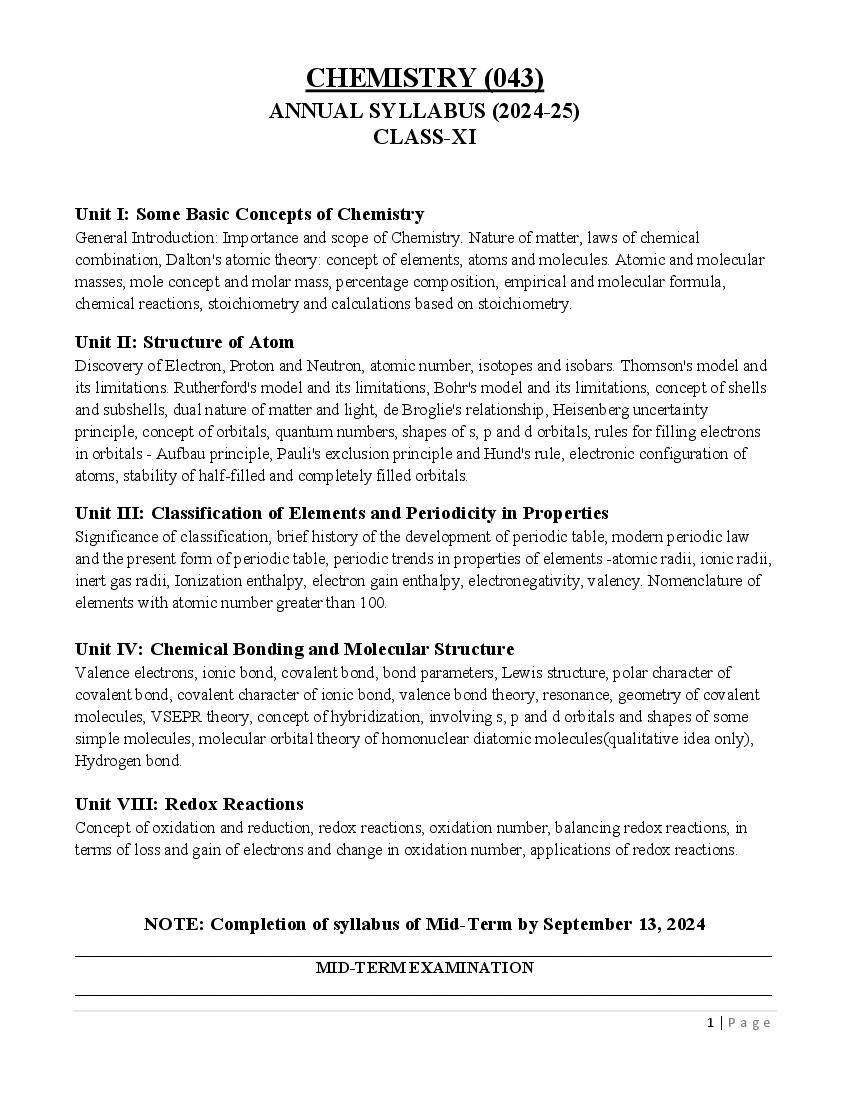
ANNUAL SYLLABUS (2024-25)
CLASS-XI
Unit I: Some Basic Concepts of Chemistry
General Introduction: Importance and scope of Chemistry. Nature of matter, laws of chemical
combination, Dalton's atomic theory: concept of elements, atoms and molecules. Atomic and molecular
masses, mole concept and molar mass, percentage composition, empirical and molecular formula,
chemical reactions, stoichiometry and calculations based on stoichiometry.
Unit II: Structure of Atom
Discovery of Electron, Proton and Neutron, atomic number, isotopes and isobars. Thomson's model and
its limitations. Rutherford's model and its limitations, Bohr's model and its limitations, concept of shells
and subshells, dual nature of matter and light, de Broglie's relationship, Heisenberg uncertainty
principle, concept of orbitals, quantum numbers, shapes of s, p and d orbitals, rules for filling electrons
in orbitals - Aufbau principle, Pauli's exclusion principle and Hund's rule, electronic configuration of
atoms, stability of half-filled and completely filled orbitals.
Unit III: Classification of Elements and Periodicity in Properties
Significance of classification, brief history of the development of periodic table, modern periodic law
and the present form of periodic table, periodic trends in properties of elements -atomic radii, ionic radii,
inert gas radii, Ionization enthalpy, electron gain enthalpy, electronegativity, valency. Nomenclature of
elements with atomic number greater than 100.
Unit IV: Chemical Bonding and Molecular Structure
Valence electrons, ionic bond, covalent bond, bond parameters, Lewis structure, polar character of
covalent bond, covalent character of ionic bond, valence bond theory, resonance, geometry of covalent
molecules, VSEPR theory, concept of hybridization, involving s, p and d orbitals and shapes of some
simple molecules, molecular orbital theory of homonuclear diatomic molecules(qualitative idea only),
Hydrogen bond.
Unit VIII: Redox Reactions
Concept of oxidation and reduction, redox reactions, oxidation number, balancing redox reactions, in
terms of loss and gain of electrons and change in oxidation number, applications of redox reactions.
NOTE: Completion of syllabus of Mid-Term by September 13, 2024
____________________________________________________________________________________
MID-TERM EXAMINATION
____________________________________________________________________________________
1|Page
Page 2
Concepts of System and types of systems, surroundings, work, heat, energy, extensive and intensive
properties, state functions.
First law of thermodynamics -internal energy and enthalpy, heat capacity and specific heat,
measurement of ∆U and ∆H, Hess's law of constant heat summation, enthalpy of bond dissociation,
combustion, formation, atomization, sublimation, phase transition, ionization, solution and dilution.
Second law of Thermodynamics (brief introduction)
Introduction of entropy as a state function, Gibb's energy change for spontaneous and non-spontaneous
processes, criteria for equilibrium.
Third law of thermodynamics (brief introduction).
Unit VII: Equilibrium
Equilibrium in physical and chemical processes, dynamic nature of equilibrium, law of mass action,
equilibrium constant, factors affecting equilibrium - Le Chatelier's principle, ionic equilibrium-
ionization of acids and bases, strong and weak electrolytes, degree of ionization, ionization of poly basic
acids, acid strength, concept of pH, hydrolysis of salts (elementary idea), buffer solution, Henderson
Equation, solubility product, common ion effect (with illustrative examples).
Unit XII: Organic Chemistry -Some Basic Principles and Techniques
General introduction, methods of purification, qualitative and quantitative analysis, classification and
IUPAC nomenclature of organic compounds. Electronic displacements in a covalent bond: inductive
effect, electromeric effect, resonance and hyper conjugation. Homolytic and heterolytic fission of a
covalent bond: free radicals, carbocations, carbanions, electrophiles and nucleophiles, types of organic
reactions.
Unit XIII: Hydrocarbons
Classification of Hydrocarbons
Aliphatic Hydrocarbons: Alkanes - Nomenclature, isomerism, conformation (ethane only), physical
properties, chemical reactions including free radical mechanism of halogenation, combustion and
pyrolysis.
Alkenes - Nomenclature, structure of double bond (ethene), geometrical isomerism, physical properties,
methods of preparation, chemical reactions: addition of hydrogen, halogen, water, hydrogen halides
(Markovnikov's addition and peroxide effect), ozonolysis, oxidation, mechanism of electrophilic
addition.
Alkynes - Nomenclature, structure of triple bond (ethyne), physical properties, methods of preparation,
chemical reactions: acidic character of alkynes, addition reaction of - hydrogen, halogens, hydrogen
halides and water.
Aromatic Hydrocarbons: Introduction, IUPAC nomenclature, benzene: resonance, aromaticity,
chemical properties: mechanism of electrophilic substitution. Nitration, sulphonation, halogenation,
Friedel Craft's alkylation and acylation, directive influence of functional group in monosubstituted
benzene. Carcinogenicity and toxicity.
2|Page
Page 3
Complete the annual syllabus by January 31, 2025.
Whole syllabus will be covered in Common Annual School Examination.
Chapter wise weightage for Common Annual School Examination is as follows:
Sr. No. Name of the Unit Marks
1. Some Basic Concepts of Chemistry 7
2. Structure of Atom 9
3. Classification of Elements and Periodicity in Properties 6
4. Chemical Bonding and Molecular Structure 7
5. Chemical Thermodynamics 9
6. Equilibrium 7
7. Redox Reactions 4
8. Organic Chemistry: Some basic Principles and Techniques 11
9. Hydrocarbons 10
Total 70
Sr. No. Domain Total Marks Percentage
1. Remembering and Understanding: Exhibit memory of 28 40
previously learned material by recalling facts, terms, basic
concepts and answers. Demonstrate understanding of facts
and ideas by organizing, comparing, translating, interpreting,
giving descriptions and stating main ideas.
2. Applying: Solve problems to new situations by applying 21 30
acquired knowledge, facts, techniques and rules in a different
way.
3. Analysing, Evaluating and Creating: Examine and break 21 30
information into parts by identifying motives or causes. Make
inferences and find evidence to support generalizations.
Present and defend opinions by making judgments about
information, validity of ideas or quality of work based on a
set of criteria. Compile information together in a different
way by combining elements in a new pattern or proposing
alternative solutions.
3|Page
Page 4
Micro-chemical methods are available for several of the practical experiments, wherever possible such
techniques should be used.
A. Basic Laboratory Techniques
1. Cutting glass tube and glass rod
2. Bending a glass tube
3. Drawing out a glass jet
4. Boring a cork
B. Characterization and Purification of Chemical Substances
1. Determination of melting point of an organic compound.
2. Determination of boiling point of an organic compound.
3. Crystallization of impure sample of any one of the following: Alum, Copper Sulphate, Benzoic Acid.
E. Quantitative Estimation
i. Using a mechanical balance/electronic balance.
ii. Preparation of standard solution of Oxalic acid.
iii. Determination of strength of a given solution of Sodium hydroxide by titrating it against standard
solution of Oxalic acid.
iv. Preparation of standard solution of Sodium carbonate.
v. Determination of strength of a given solution of hydrochloric acid by titrating it against standard
Sodium carbonate solution.
NOTE: Completion of syllabus of Mid-Term by September 13, 2024
____________________________________________________________________________________
MID-TERM EXAMINATION
____________________________________________________________________________________
C. Experiments based on pH
a) Any one of the following experiments:
• Determination of pH of some solutions obtained from fruit juices, solution of known and varied
concentrations of acids, bases and salts using pH paper or universal indicator.
• Comparing the pH of solutions of strong and weak acids of same concentration. Study the pH change
in the titration of a strong base using universal indicator.
b) Study the pH change by common-ion in case of weak acids and weak bases.
D. Chemical Equilibrium One of the following experiments:
a) Study the shift in equilibrium between ferric ions and thiocyanate ions by increasing/decreasing the
concentration of either of the ions.
b) Study the shift in equilibrium between [Co(H2O)6]2+ and chloride ions by changing the concentration
of either of the ions.
4|Page
Page 5
a) Determination of one anion and one cation in a given salt
Cations- Pb2+, Cu2+, As3+, Al3+, Fe3+, Mn2+, Ni2+, Zn2+, Co2+ , Ca2+, Sr2+, Ba2+, Mg2+, NH4+
Anions - CO32- , S2- , NO2- , SO32-, SO42-, NO3 - , Cl- , Br-, I-, PO43-, CH3COO-
(Note: Insoluble salts excluded)
b) Detection of -Nitrogen, Sulphur, Chlorine in organic compounds.
PROJECTS
Scientific investigations involving laboratory testing and collecting information from other
sources. A few suggested Projects
• Checking the bacterial contamination in drinking water by testing sulphide ion
• Study of the methods of purification of water
• Testing the hardness, presence of Iron, Fluoride, Chloride, etc., depending upon the regional variation
in drinking water and study of causes of presence of these ions above permissible limit (if any).
• Investigation of the foaming capacity of different washing soaps and the effect of addition of Sodium
carbonate on it
• Study the acidity of different samples of tea leaves.
• Determination of the rate of evaporation of different liquids Study the effect of acids and bases on the
tensile strength of fibers.
• Study of acidity of fruit and vegetable juices.
Note: Any other investigatory project, which involves about 10 periods of work, can be chosen with the
approval of the teacher.
Evaluation Scheme for Examination Marks
Volumetric Analysis 08
Salt Analysis 08
Content Based Experiment 06
Project Work 04
Class record and viva 04
Total 30
5|Page
Document Details
| Board / Org | Delhi Board |
| Exam | Class 11 |
| Type | Syllabus |
| Pages | 5 |
| Updated | 22 Jul 2026 |