NIOS Class 10 Question Paper 2023 Science & Technology
Finished viewing? Save it for later —
Download NIOS Class 10 Question Paper 2023 Science & Technology (PDF · 36 pages)About NIOS Class 10 Question Paper 2023 Science & Technology
NIOS Class 10 Question Paper 2023 Science & Technology is available here for free download. Published by NIOS for National Institute of Open Schooling Class 10, this question paper can be viewed online or downloaded as a PDF (36 pages). Candidates preparing for National Institute of Open Schooling Class 10 can use NIOS Class 10 Question Paper 2023 Science & Technology to understand the exam pattern, the type of questions asked, and the overall difficulty level.
Frequently Asked Questions
How can I download NIOS Class 10 Question Paper 2023 Science & Technology?
Open this page and click the Download button to save NIOS Class 10 Question Paper 2023 Science & Technology as a PDF. It is completely free on AglaSem Docs.
Is NIOS Class 10 Question Paper 2023 Science & Technology free to download?
Yes. NIOS Class 10 Question Paper 2023 Science & Technology can be viewed online and downloaded as a PDF free of cost on AglaSem Docs.
How many pages does NIOS Class 10 Question Paper 2023 Science & Technology have?
NIOS Class 10 Question Paper 2023 Science & Technology contains 36 pages, which you can read online or download together as a single PDF.
Where can I find more National Institute of Open Schooling Class 10 study material?
You can find more National Institute of Open Schooling Class 10 question papers, sample papers, syllabus, and answer keys on AglaSem Docs.
NIOS Class 10 Question Paper 2023 Science & Technology – Text
Read the full text of this question paper below — useful to quickly search, copy and reference the content online without downloading the PDF.
📄 View text version (36 pages)
Page 1
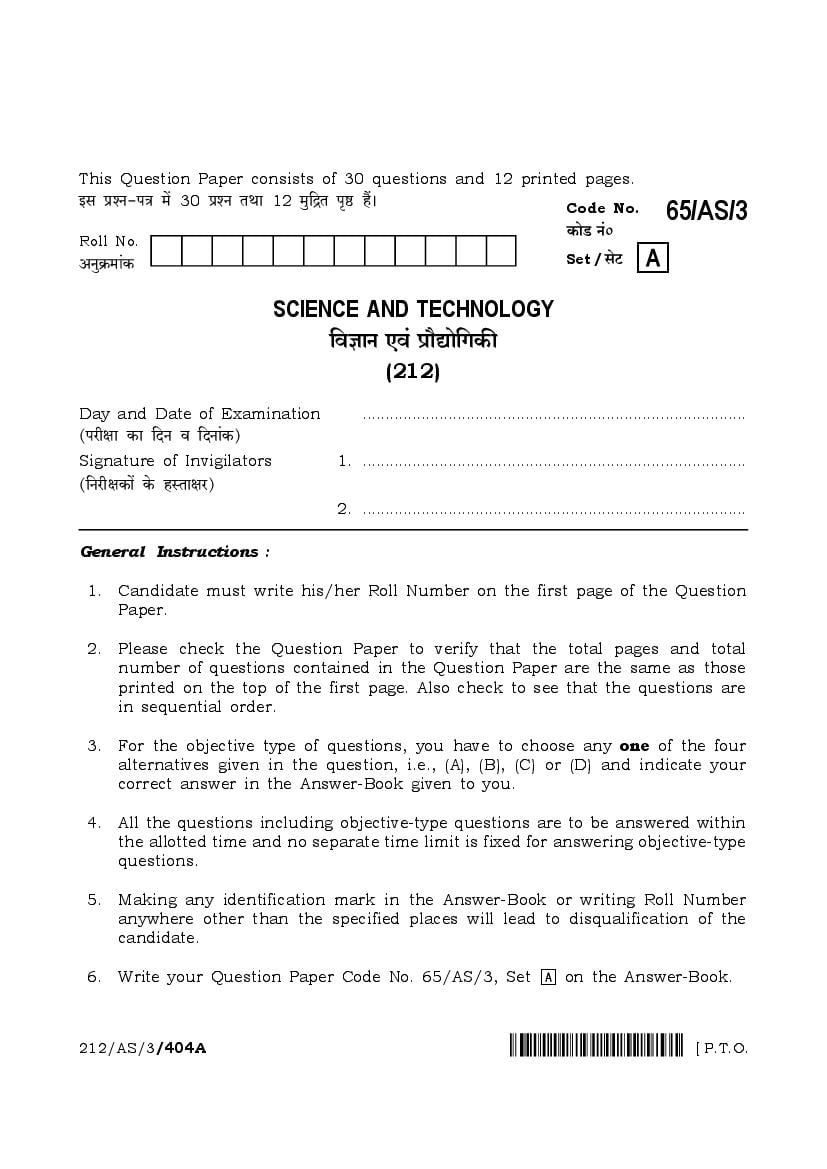
Bg àíZ-nÌ ‘| 30 àíZ VWm 12 ‘w{ÐV n¥ð> h¢& Code No. 65/AS/3
u
H$moS> Z§0
Roll No.
AZwH«$‘m§H$ Set / goQ>
SCIENCE AND TECHNOLOGY
{dkmZ Ed§ àm¡Úmo{JH$s
(212)
Day and Date of Examination .....................................................................................
(narjm H$m {XZ d {XZm§H$)
Signature of Invigilators 1. .....................................................................................
({ZarjH$m| Ho$ hñVmja)
2. .....................................................................................
General Instructions :
1. Candidate must write his/her Roll Number on the first page of the Question
Paper.
2. Please check the Question Paper to verify that the total pages and total
number of questions contained in the Question Paper are the same as those
printed on the top of the first page. Also check to see that the questions are
in sequential order.
3. For the objective type of questions, you have to choose any one of the four
alternatives given in the question, i.e., (A), (B), (C) or (D) and indicate your
correct answer in the Answer-Book given to you.
4. All the questions including objective-type questions are to be answered within
the allotted time and no separate time limit is fixed for answering objective-type
questions.
5. Making any identification mark in the Answer-Book or writing Roll Number
anywhere other than the specified places will lead to disqualification of the
candidate.
6. Write your Question Paper Code No. 65/AS/3, Set u on the Answer-Book.
212/AS/3/404A [ P.T.O.
Page 2
wish, you can answer in any one of the languages listed below :
English, Hindi, Urdu, Punjabi, Bengali, Tamil, Malayalam, Kannada,
Telugu, Marathi, Odia, Gujarati, Konkani, Manipuri, Assamese, Nepali,
Kashmiri, Sanskrit and Sindhi.
You are required to indicate the language you have chosen to answer in
the box provided in the Answer-Book.
(b) If you choose to write the answer in the language other than Hindi and
English, the responsibility for any errors/mistakes in understanding the
questions will be yours only.
gm‘mݶ AZwXoe …
1. narjmWu àíZ-nÌ Ho$ nhbo n¥ð> na AnZm AZwH«$‘m§H$ Adí¶ {bI|&
2. H¥$n¶m àíZ-nÌ H$mo Om±M b| {H$ àíZ-nÌ Ho$ Hw$b n¥ð>m| VWm àíZm| H$s CVZr hr g§»¶m h¡ {OVZr àW‘ n¥ð> Ho$ g~go
D$na N>nr h¡& Bg ~mV H$s Om±M ^r H$a b| {H$ àíZ H«${‘H$ ê$n ‘| h¢&
3. dñVw{Zð> àíZm| _o§ AmnH$mo Mma {dH$ënm| (A), (B), (C) VWm (D) _| go H$moB© EH$ CÎma MwZZm h¡ VWm Xr JB©
CÎma-nwpñVH$m _| Amn ghr CÎma {bI|Ÿ&
4. dñVw{Zð> àíZm| Ho$ gmW-gmW g^r àíZm| Ho$ CÎma {ZYm©[aV Ad{Y Ho$ ^rVa hr XoZo h¢Ÿ& dñVw{Zð> àíZm| Ho$ {bE AbJ
go g_` Zht {X`m OmEJmŸ&
5. CÎma-nwpñVH$m ‘| nhMmZ-{M• ~ZmZo AWdm {Z{X©ï> ñWmZm| Ho$ A{V[aº$ H$ht ^r AZwH«$‘m§H$ {bIZo na narjmWu H$mo
A¶mo½¶ R>ham¶m OmEJm&
6. AnZr CÎma-nwpñVH$m na àíZ-nÌ H$m H$moS> Z§0 65/AS/3, goQ u, {bI|&
7. (H$) n«íZ-nÌ Ho$db {hÝXr/A§J«oOr ‘| h¡& {’$a ^r, ¶{X Amn Mmh| Vmo ZrMo Xr JB© {H$gr EH$ ^mfm ‘| CÎma Xo
gH$Vo h¢ …
A§J«oOr, {hÝXr, CXÿ©, n§Om~r, ~§Jbm, V{‘b, ‘b¶mb‘, H$Þ‹S>, VobwJy, ‘amR>r, C{‹S>¶m, JwOamVr, H$m|H$Ur,
‘{Unwar, Ag{‘¶m, Zonmbr, H$í‘rar, g§ñH¥$V Am¡a {gÝYr&
H¥$n¶m CÎma-nwpñVH$m ‘| {XE JE ~m°³g ‘| {bI| {H$ Amn {H$g ^mfm ‘| CÎma {bI aho h¢&
(I) ¶{X Amn {hÝXr Ed§ A§J«oOr Ho$ A{V[aº$ {H$gr Aݶ ^mfm ‘| CÎma {bIVo h¢, Vmo àíZm| H$mo g‘PZo ‘| hmoZo dmbr
Ìw{Q>¶m|/Jb{V¶m| H$s {Oå‘oXmar Ho$db AmnH$s hmoJr&
212/AS/3/404A 2
Page 3
{dkmZ Ed§ àm¡Úmo{JH$s
(212)
Time : 2½ Hours ] [ Maximum Marks : 85
g‘¶ … 2½ KÊQ>o ] [ nyUmªH$ … 85
Note : (i) All questions are compulsory.
(ii) Marks are indicated against each question.
{ZX}e … (i) g^r àíZ A{Zdm¶© h¢¢&
(ii) à˶oH$ àíZ Ho$ A§H$ CgHo$ gm‘Zo {XE JE h¢&
1. Which one of the following is not a homogeneous mixture? 1
(A) Brass
(B) Milk
(C) Soda water
(D) Tincture iodine
{ZåZ{b{IV ‘| go H$m¡Z-gm EH$ g‘m§Jr {‘lU Zht h¡?
(A) nrVb
(B) XÿY
(C) gmoS>m dm°Q>a
(D) qQ>Ma Am¶moS>rZ
2. Which of the following is not an exothermic process? 1
(A) Dissolution of ammonium chloride in water
(B) Dissolution of sodium hydroxide in water
(C) Dilution of sulphuric acid
(D) Condensation of water vapours
212/AS/3/404A 3 [ P.T.O.
Page 4
(A) A‘mo{Z¶‘ ³bmoamBS> H$m Ob ‘| KwbZm
(B) gmo{S>¶‘ hmBS´>m°³gmBS> H$m Ob ‘| KwbZm
(C) gëâ¶y[aH$ Aåb H$m VZwH$aU
(D) Obdmîn H$m g§KZZ
3. The weight of a body in air is 8 N. It floats when put in water and sinks
when put in kerosene. The buoyant force exerted on the body in the two
cases is
(A) 8 N in water and more than 8 N in kerosene
(B) 8 N in water and less than 8 N in kerosene
(C) more than 8 N in kerosene and less than 8 N in water
(D) more than 8 N both in kerosene and water 1
{H$gr dñVw H$m dm¶w ‘| ^ma 8 N h¡& O~ Bgo nmZr ‘| aIm OmVm h¡, Vmo ¶h V¡aVr h¡ Am¡a O~ Ho$amogrZ
‘| aIm OmVm h¡, Vmo ¶h Sy>~ OmVr h¡& BZ Xmo AdñWmAm| ‘| dñVw na bJZo dmbm CËßbmdZ ~b h¡
(A) Ob ‘| 8 N VWm Ho$amogrZ ‘| 8 N go A{YH$
(B) Ob ‘| 8 N VWm Ho$amogrZ ‘| 8 N go H$‘
(C) Ho$amogrZ ‘| 8 N go A{YH$ VWm Ob ‘| 8 N go H$‘
(D) Ho$amogrZ VWm Ob XmoZmo§ ‘| 8 N go A{YH$
4. Sunita has two thermometers, one calibrated in celsius and the other in
fahrenheit. Both the thermometers are dipped in hot milk. The Fahrenheit
thermometer reads 140 ºF. The temperature registered by the Celsius
thermometer will be
(A) 50 ºC (B) 60 ºC
(C) 70 ºC (D) 80 ºC 1
212/AS/3/404A 4
Page 5
h¡& XmoZm| Vmn‘m{n¶m| Ho$ ~ë~ EH$ hr J‘© XyY ‘| Sw>~moE JE h¢& ’$maoZhmBQ> Vmn‘mnr H$m nmR>²¶m§H$ 140 ºF
h¡& gopëg¶g Vmn‘mnr H$m nmR²>¶m§H$ hmoJm
(A) 50 ºC (B) 60 ºC
(C) 70 ºC (D) 80 ºC
5. Which of the following parts is not found in plant cell? 1
(A) Vacuole (B) Cell wall
(C) Centrosome (D) Mitochondria
{ZåZ{b{IV ‘|§ go H$m¡Z-gm ^mJ nmXn H$mo{eH$m ‘| Zht nm¶m OmVm h¡?
(A) [a{º$H$m (B) H$mo{eH$m {^{Îm
(C) g|Q´>mogmo‘ (D) ‘mBQ>moH$m°pÝS´>¶m
6. The layer of atmosphere farthest from the earth’s surface is
(A) mesosphere (B) stratosphere
(C) thermosphere (D) troposphere 1
n¥Ïdr H$s gVh go g~go Xÿa H$s dm¶w‘§S>b H$s naV H$m Zm‘ h¡
(A) ‘rOmopñ’$¶a (B) ñQ´>¡Q>mopñ’$¶a
(C) W‘m}pñ’$¶a (D) Q´>monmopñ’$¶a
7. Which one of the following statements is correct? 1
(A) Water has the lowest density at 4 ºC.
(B) When temperature of water rises from 0 ºC to 4 ºC, it expands.
(C) From 4 ºC upwards water contracts.
(D) When the temperature of water rises from 0 ºC to 4 ºC, it contracts.
212/AS/3/404A 5 [ P.T.O.
Page 6
(A) Ob H$m KZËd 4 ºC na ݶyZV‘ hmoVm h¡&
(B) O~ Ob H$m Vmn 0 ºC go 4 ºC VH$ ~‹T>Vm h¡, Vmo BgH$m àgma hmoVm h¡&
(C) 4 ºC go D$na Ob {gHw$‹S>Vm h¡&
(D) O~ Ob H$m Vmn 0 ºC go 4 ºC VH$ ~‹T>Vm h¡, Vmo ¶h {gHw$‹S>Vm h¡&
8. Ozone hole means
(A) thinning of ozone layer
(B) thickening of ozone in ozone layer
(C) small holes scattered in the ozone layer
(D) a large sized hole in the ozone layer 1
AmoOmoZ {N>Ð H$m AW© h¡
(A) AmoOmoZ naV H$m nVbm hmoZm
(B) AmoOmoZ naV ‘| AmoOmoZ H$m ‘moQ>m hmoZm
(C) AmoOmoZ naV ‘| {N>Vao hþE N>moQ>o-N>moQ>o {N>Ð
(D) AmoOmoZ naV ‘| EH$ ~‹S>o AmH$ma H$m {N>Ð
9. Which of the following is not an organic manure? 1
(A) Urea (B) Compost
(C) Vermicompost (D) Farmyard manure
{ZåZ{b{IV ‘| go H$m¡Z-gm H$m~©{ZH$ ImX Zht h¡?
(A) ¶y[a¶m (B) H$ånmoñQ>
(C) d‘uH$ånmoñQ> (D) ’$m‘©¶mS>© ImX
212/AS/3/404A 6
Page 7
(a) 4·5 × 10–15 m
(b) 20 × 1020 kg
(c) 34 × 1011 s
(d) 2·5 × 10–24 m
{ZåZ{b{IV ‘mnZmo§ H$mo Cn¶wº$ nyd©b¾ bJmH$a nwZ… {b{IE :
(H$) 4·5 × 10–15 m
(I) 20 × 1020 kg
(J) 34 × 1011 s
( K) 2·5 × 10–24 m
11. Which two of the following statements are not correct for representing SI
units? 2
(a) The symbols of the units are always followed by a full stop.
(b) The symbols of the units derived from proper names are represented
by using capital letters.
(c) The symbols of the units are not written in plural.
(d) In writing the SI unit obtained as a combination of two units, no space
should be given between the symbols.
SI ‘mÌH$m| H$mo {Zê${nV H$aZo Ho$ g§X^© ‘|, {ZåZ{b{IV ‘| go H$m¡Z-go Xmo H$WZ ghr Zht h¢?
(H$) ‘mÌH$m| Ho$ àVrH$ Ho$ níMmV² gX¡d nyU© {dam‘ bJmZm Mm{hE&
(I) ¶{X ‘mÌH$ {H$gr ì¶{º$ Ho$ Zm‘ na MwZm J¶m h¡, Vmo CgHo$ àVrH$ H$mo A§J«oOr Ho$ ~‹S>o Ajamo§
go 춺$ {H$¶m OmVm h¡&
(J) ‘mÌH$m| Ho$ àVrH$ ~hþdMZ ‘| Zht {bIo OmVo&
(K) Xmo ‘mÌH$m| Ho$ g§¶moOZ go ~Zo SI ‘mÌH$ H$mo {bIVo g‘¶ àVrH$m| Ho$ ‘ܶ [aº$ ñWmZ Zht N>mo‹S>Zm
Mm{hE&
212/AS/3/404A 7 [ P.T.O.
Page 8
comes back to her initial position. Her displacement-time graph is shown
in the given figure. Plot a velocity-time graph for the same. 2
gwZrVm {H$gr gab aoIr¶ nW Ho$ AZw{Xe MbH$a nÌ noQ>r (boQ>a-~m°³g) ‘| nÌ S>mbVr h¡ Am¡a dmng
AnZr Ama§{^H$ pñW{V na bm¡Q> AmVr h¡& CgH$s J{V H$m {dñWmnZ-g‘¶ J«m’$ {XE JE {MÌ ‘| Xem©¶m
J¶m h¡& Bg J{V Ho$ {bE doJ-g‘¶ J«m’$ It{ME&
13. Calculate the mass of (a) 10 mol of oxygen and (b) 12 mol of sodium in
gram. (Molar mass of oxygen is 32 g mol–1 and molar mass of sodium is
23 g mol–1). 2
(a) 10 ‘mob Am°³grOZ VWm (b) 12 ‘mob gmo{S>¶‘ H$m Ð춑mZ J«m‘ ‘| n[aH${bV H$s{OE& (Am°³grOZ
H$m ‘moba Ð춑mZ = 32 g mol–1 VWm gmo{S>¶‘ H$m ‘moba Ð춑mZ = 23 g mol–1)
212/AS/3/404A 8
Page 9
object is placed between F and 2F. Also, state the nature and size of the
image. 2
{H$gr CÎmb Xn©U Ûmam à{Vq~~ H$m ~ZZm Xem©Vo hþE aoIm{MÌ It{ME, O~{H$ q~~ H$mo Xn©U Ho$ gm‘Zo
F VWm 2F Ho$ ~rM aIm J¶m h¡& à{Vq~~ H$s àH¥${V VWm AmH$ma ^r ~VmBE&
15. Calculate the potential energy possessed by a bag of rice of mass 15 kg when
it is placed at a height of 4 m above the ground. (Given, g = 10·0 m s–2) 2
n¥Ïdr H$s gVh go 4 m D±$MmB© na aIo 15 kg Ð춑mZ Ho$ Mmdb Ho$ EH$ W¡bo H$s pñW{VO D$Om©
H$m n[aH$bZ H$s{OE& ({X¶m h¡, g = 10·0 m s–2)
16. Explain with the help of suitable examples, the role of biodiversity in
maintaining harmony in nature. 2
Cn¶wº$ CXmhaUm| H$s ghm¶Vm go, àH¥${V ‘| gm‘§Oñ¶ ~ZmE aIZo ‘| O¡d {d{dYVm H$s ^y{‘H$m H$s ì¶m»¶m
H$s{OE&
17. Write any four defects of Mendeleev’s periodic table. 4
‘oÝS>obr’$ H$s AmdV© gmaUr Ho$ H$moB© Mma Xmof {b{IE&
18. Write the postulates of Bohr’s model of atom. What is the maximum
number of electrons that can be accommodated in a shell of the atom?
Show diagrammatically the distribution of electrons of sulphur atom.
(Atomic number of sulphur is 16) 4
~moa Ho$ na‘mUw ‘m°S>b H$s AdYmaUmAm| H$mo {b{IE& na‘mUw Ho$ {H$gr H$moe ‘| g‘m¶mo{OV {H$E Om
gH$Zo dmbo A{YH$V‘ Bbo³Q´>mZm| H$s g§»¶m {H$VZr hmoJr? gë’$a Ho$ na‘mUw ‘| Bbo³Q´>m°Zm| Ho$ {dVaU
H$mo {MÌ H$s ghm¶Vm go Xem©BE& (gë’$a H$m na‘mUw H«$‘m§H$ 16 h¡)
19. Describe the characteristic properties of covalent compounds. 4
ghg§¶moOr ¶m¡{JH$m| Ho$ A{^bmj{UH$ JwUY‘m] H$m dU©Z H$s{OE&
212/AS/3/404A 9 [ P.T.O.
Page 10
(b) An object of mass 1 kg travelling in a straight line with a velocity of
10 m s–1 undergoes elastic collision with a stationary body of mass
5 kg and sticks to it. Calculate the total momentum of the system just
after the collision. 4
(H$) g§doJ-g§ajU Ho$ {Z¶‘ H$mo Xem©Zo Ho$ {bE EH$ {H«$¶mH$bmn H$m dU©Z H$s{OE&
(I) EH$ dñVw {OgH$m Ð춑mZ 1 kg h¡, 10 m s–1 Ho$ doJ go gab aoIr¶ nW na MbVo hþE
{dam‘mdñWm ‘| aIo 5 kg Ð춑mZ Ho$ EH$ qnS> go à˶mñWV… Q>H$amVr h¡& g§KÅ> Ho$ R>rH$ ~mX
Bg {ZH$m¶ Ho$ Hw$b g§doJ H$s JUZm H$s{OE&
21. State and explain Fleming’s left hand rule with the help of a diagram.
Apply the rule to find the direction of force acting on a current-carrying
wire placed perpendicular to magnetic field as shown in the figure : 4
âboq‘J Ho$ ~mE± hmW H$m {Z¶‘ {b{IE Am¡a EH$ {MÌ H$s ghm¶Vm go BgH$s ì¶m»¶m H$s{OE& {MÌ
‘| Xem©E AZwgma {H$gr Mwå~H$s¶ joÌ Ho$ bå~dV² aIo Ymamdmhr MmbH$ na bJZo dmbo ~b H$s {Xem
Bg {Z¶‘ H$mo bmJy H$aHo$ kmV H$s{OE&
22. Draw a diagram of alimentary canal of human beings and label the
following parts : 4
Oesophagus, stomach, small intestine and large intestine
‘mZd H$s AmhmaZmb H$m {MÌ ~ZmBE Am¡a {ZåZ{b{IV ^mJm| H$mo Zm‘m§{H$V H$s{OE :
J«{gH$m, Am‘me¶, N>moQ>r Am±V VWm ~‹S>r Am±V
23. What are reflex actions? Give one example. Describe briefly two types of
reflexes. 4
à{VdV© {H«$¶mE± ³¶m hmoVr h¢? EH$ CXmhaU Xr{OE& Xmo àH$ma Ho$ à{VdVm] H$m g§jon ‘| dU©Z H$s{OE&
212/AS/3/404A 10
Page 11
replication. 4
EH$ {MÌ H$s ghm¶Vm go S>r0 EZ0 E0 à{VH¥${V Ho$ ‘w»¶ MaUm| H$m dU©Z H$s{OE&
25. Write any four chemical properties of metals. Give the chemical equations
of the reactions involved in each case. 4
YmVwAm| Ho$ H$moB© Mma amgm¶{ZH$ JwUY‘© {b{IE& à˶oH$ JwUY‘© Ho$ g§JV A{^{H«$¶m Ho$ {bE amgm¶{ZH$
g‘rH$aU Xr{OE&
26. What is a functional group? Identify and name the functional group
present in the following compounds : 4
(a) CH3OH
(b) CH3CHO
(c) CH3COOH
{H«$¶merb g‘yh ³¶m hmoVm h¡? {ZåZ{b{IV ¶m¡{JH$mo§ ‘| {dÚ‘mZ {H«$¶merb g‘yh H$mo nhMm{ZE Am¡a
CZH$m Zm‘ ~VmBE :
(H$) CH3OH
(I) CH3CHO
(J) CH3COOH
27. Describe any four adaptations in desert animals. 4
‘éX²{^X² OÝVwAm| ‘| hþE {H$Ýht Mma AZwHy$bZm| H$m dU©Z H$s{OE&
28. What is pH? With the help of a diagram, show pH scale. Describe the
importance of pH in the following cases : 6
(a) Acid rain
(b) Tooth decay
pH ³¶m h¡? EH$ {MÌ H$s ghm¶Vm go pH ñHo$b Xem©BE& {ZåZ{b{IV àH$aUmo§ ‘| pH Ho$ ‘hÎd
H$m dU©Z H$s{OE :
(H$) Aåbr¶ dfm©
(I) X§V j¶
212/AS/3/404A 11 [ P.T.O.
Page 12
electric current. Hence, state Joule’s law of heating.
150 J of heat is produced each second in a 6 resistor. Find the potential
difference across the resistor. 6
{H$gr MmbH$ ‘| {dÚwV²-Ymam àdm{hV H$aZo na CËnÞ D$î‘m H$m 춧OH$ ì¶wËnÞ H$s{OE& Bg àH$ma àmá
gyÌ Ho$ AmYma na Oyb H$m D$î‘Z {Z¶‘ {b{IE&
{H$gr 6 Ho$ à{VamoYH$ go à{V goH§$S> 150 J D$î‘m CËnÞ hmo ahr h¡& à{VamoYH$ Ho$ {gam| na {d^dmÝVa
kmV H$s{OE&
30. State the causative agent and mode of transmission of amoebiasis.
Mention its any four symptoms, any four preventive measures and
treatment. 6
A‘r~m¶{gg amoJ H$m H$maU VWm g§H«$‘U {d{Y ~VmBE& BgHo$ {H$Ýht Mma bjUm|, {H$Ýht Mma amoH$Wm‘
Ho$ Cnm¶m| VWm CnMma H$s {d{Y ~VmBE&
212/AS/3/404A [V23] 12
Page 13
Bg àíZ-nÌ ‘| 30 àíZ VWm 12 ‘w{ÐV n¥ð> h¢& Code No. 65/AS/3
v
H$moS> Z§0
Roll No.
AZwH«$‘m§H$ Set / goQ>
SCIENCE AND TECHNOLOGY
{dkmZ Ed§ àm¡Úmo{JH$s
(212)
Day and Date of Examination .....................................................................................
(narjm H$m {XZ d {XZm§H$)
Signature of Invigilators 1. .....................................................................................
({ZarjH$m| Ho$ hñVmja)
2. .....................................................................................
General Instructions :
1. Candidate must write his/her Roll Number on the first page of the Question
Paper.
2. Please check the Question Paper to verify that the total pages and total
number of questions contained in the Question Paper are the same as those
printed on the top of the first page. Also check to see that the questions are
in sequential order.
3. For the objective type of questions, you have to choose any one of the four
alternatives given in the question, i.e., (A), (B), (C) or (D) and indicate your
correct answer in the Answer-Book given to you.
4. All the questions including objective-type questions are to be answered within
the allotted time and no separate time limit is fixed for answering objective-type
questions.
5. Making any identification mark in the Answer-Book or writing Roll Number
anywhere other than the specified places will lead to disqualification of the
candidate.
6. Write your Question Paper Code No. 65/AS/3, Set v on the Answer-Book.
212/AS/3/404B [ P.T.O.
Page 14
wish, you can answer in any one of the languages listed below :
English, Hindi, Urdu, Punjabi, Bengali, Tamil, Malayalam, Kannada,
Telugu, Marathi, Odia, Gujarati, Konkani, Manipuri, Assamese, Nepali,
Kashmiri, Sanskrit and Sindhi.
You are required to indicate the language you have chosen to answer in
the box provided in the Answer-Book.
(b) If you choose to write the answer in the language other than Hindi and
English, the responsibility for any errors/mistakes in understanding the
questions will be yours only.
gm‘mݶ AZwXoe …
1. narjmWu àíZ-nÌ Ho$ nhbo n¥ð> na AnZm AZwH«$‘m§H$ Adí¶ {bI|&
2. H¥$n¶m àíZ-nÌ H$mo Om±M b| {H$ àíZ-nÌ Ho$ Hw$b n¥ð>m| VWm àíZm| H$s CVZr hr g§»¶m h¡ {OVZr àW‘ n¥ð> Ho$ g~go
D$na N>nr h¡& Bg ~mV H$s Om±M ^r H$a b| {H$ àíZ H«${‘H$ ê$n ‘| h¢&
3. dñVw{Zð> àíZm| _o§ AmnH$mo Mma {dH$ënm| (A), (B), (C) VWm (D) _| go H$moB© EH$ CÎma MwZZm h¡ VWm Xr JB©
CÎma-nwpñVH$m _| Amn ghr CÎma {bI|Ÿ&
4. dñVw{Zð> àíZm| Ho$ gmW-gmW g^r àíZm| Ho$ CÎma {ZYm©[aV Ad{Y Ho$ ^rVa hr XoZo h¢Ÿ& dñVw{Zð> àíZm| Ho$ {bE AbJ
go g_` Zht {X`m OmEJmŸ&
5. CÎma-nwpñVH$m ‘| nhMmZ-{M• ~ZmZo AWdm {Z{X©ï> ñWmZm| Ho$ A{V[aº$ H$ht ^r AZwH«$‘m§H$ {bIZo na narjmWu H$mo
A¶mo½¶ R>ham¶m OmEJm&
6. AnZr CÎma-nwpñVH$m na àíZ-nÌ H$m H$moS> Z§0 65/AS/3, goQ v, {bI|&
7. (H$) n«íZ-nÌ Ho$db {hÝXr/A§J«oOr ‘| h¡& {’$a ^r, ¶{X Amn Mmh| Vmo ZrMo Xr JB© {H$gr EH$ ^mfm ‘| CÎma Xo
gH$Vo h¢ …
A§J«oOr, {hÝXr, CXÿ©, n§Om~r, ~§Jbm, V{‘b, ‘b¶mb‘, H$Þ‹S>, VobwJy, ‘amR>r, C{‹S>¶m, JwOamVr, H$m|H$Ur,
‘{Unwar, Ag{‘¶m, Zonmbr, H$í‘rar, g§ñH¥$V Am¡a {gÝYr&
H¥$n¶m CÎma-nwpñVH$m ‘| {XE JE ~m°³g ‘| {bI| {H$ Amn {H$g ^mfm ‘| CÎma {bI aho h¢&
(I) ¶{X Amn {hÝXr Ed§ A§J«oOr Ho$ A{V[aº$ {H$gr Aݶ ^mfm ‘| CÎma {bIVo h¢, Vmo àíZm| H$mo g‘PZo ‘| hmoZo dmbr
Ìw{Q>¶m|/Jb{V¶m| H$s {Oå‘oXmar Ho$db AmnH$s hmoJr&
212/AS/3/404B 2
Page 15
{dkmZ Ed§ àm¡Úmo{JH$s
(212)
Time : 2½ Hours ] [ Maximum Marks : 85
g‘¶ … 2½ KÊQ>o ] [ nyUmªH$ … 85
Note : (i) All questions are compulsory.
(ii) Marks are indicated against each question.
{ZX}e … (i) g^r àíZ A{Zdm¶© h¢¢&
(ii) à˶oH$ àíZ Ho$ A§H$ CgHo$ gm‘Zo {XE JE h¢&
1. Which one of the following statements is correct? 1
(A) Water has the lowest density at 4 ºC.
(B) When temperature of water rises from 0 ºC to 4 ºC, it expands.
(C) From 4 ºC upwards water contracts.
(D) When the temperature of water rises from 0 ºC to 4 ºC, it contracts.
{ZåZ{b{IV ‘| go H$m¡Z-gm H$WZ ghr h¡?
(A) Ob H$m KZËd 4 ºC na ݶyZV‘ hmoVm h¡&
(B) O~ Ob H$m Vmn 0 ºC go 4 ºC VH$ ~‹T>Vm h¡, Vmo BgH$m àgma hmoVm h¡&
(C) 4 ºC go D$na Ob {gHw$‹S>Vm h¡&
(D) O~ Ob H$m Vmn 0 ºC go 4 ºC VH$ ~‹T>Vm h¡, Vmo ¶h {gHw$‹S>Vm h¡&
2. The layer of atmosphere farthest from the earth’s surface is
(A) mesosphere (B) stratosphere
(C) thermosphere (D) troposphere 1
212/AS/3/404B 3 [ P.T.O.
Page 16
(A) ‘rOmopñ’$¶a (B) ñQ´>¡Q>mopñ’$¶a
(C) W‘m}pñ’$¶a (D) Q´>monmopñ’$¶a
3. Which of the following is not an organic manure? 1
(A) Urea (B) Compost
(C) Vermicompost (D) Farmyard manure
{ZåZ{b{IV ‘| go H$m¡Z-gm H$m~©{ZH$ ImX Zht h¡?
(A) ¶y[a¶m (B) H$ånmoñQ>
(C) d‘uH$ånmoñQ> (D) ’$m‘©¶mS>© ImX
4. Ozone hole means
(A) thinning of ozone layer
(B) thickening of ozone in ozone layer
(C) small holes scattered in the ozone layer
(D) a large sized hole in the ozone layer 1
AmoOmoZ {N>Ð H$m AW© h¡
(A) AmoOmoZ naV H$m nVbm hmoZm
(B) AmoOmoZ naV ‘| AmoOmoZ H$m ‘moQ>m hmoZm
(C) AmoOmoZ naV ‘| {N>Vao hþE N>moQ>o-N>moQ>o {N>Ð
(D) AmoOmoZ naV ‘| EH$ ~‹S>o AmH$ma H$m {N>Ð
212/AS/3/404B 4
Page 17
(A) Brass
(B) Milk
(C) Soda water
(D) Tincture iodine
{ZåZ{b{IV ‘| go H$m¡Z-gm EH$ g‘m§Jr {‘lU Zht h¡?
(A) nrVb
(B) XÿY
(C) gmoS>m dm°Q>a
(D) qQ>Ma Am¶moS>rZ
6. The weight of a body in air is 8 N. It floats when put in water and sinks
when put in kerosene. The buoyant force exerted on the body in the two
cases is
(A) 8 N in water and more than 8 N in kerosene
(B) 8 N in water and less than 8 N in kerosene
(C) more than 8 N in kerosene and less than 8 N in water
(D) more than 8 N both in kerosene and water 1
{H$gr dñVw H$m dm¶w ‘| ^ma 8 N h¡& O~ Bgo nmZr ‘| aIm OmVm h¡, Vmo ¶h V¡aVr h¡ Am¡a O~ Ho$amogrZ
‘| aIm OmVm h¡, Vmo ¶h Sy>~ OmVr h¡& BZ Xmo AdñWmAm| ‘| dñVw na bJZo dmbm CËßbmdZ ~b h¡
(A) Ob ‘| 8 N VWm Ho$amogrZ ‘| 8 N go A{YH$
(B) Ob ‘| 8 N VWm Ho$amogrZ ‘| 8 N go H$‘
(C) Ho$amogrZ ‘| 8 N go A{YH$ VWm Ob ‘| 8 N go H$‘
(D) Ho$amogrZ VWm Ob XmoZmo§ ‘| 8 N go A{YH$
212/AS/3/404B 5 [ P.T.O.
Page 18
The above reaction is an example of a
(A) combination reaction
(B) decomposition reaction
(C) displacement reaction
(D) double displacement reaction 1
Pb(s) + CuCl2(aq) PbCl2(aq) + Cu(s)
Cnamoº$ A{^{H«$¶m EH$ CXmhaU h¡
(A) g§¶moOZ A{^{H«$¶m H$m
(B) AnKQ>Z A{^{H«$¶m H$m
(C) {dñWmnZ A{^{H«$¶m H$m
(D) {Û{dñWmnZ A{^{H«$¶m H$m
8. Alka has two thermometers, one calibrated in celsius and the other in
fahrenheit. Bulbs of both the thermometers are dipped in same hot water.
The Celsius thermometer reads 50 ºC. The temperature registered by the
Fahrenheit thermometer will be
(A) 92 ºF
(B) 112 ºF
(C) 122 ºF
(D) 142 ºF 1
AbH$m Ho$ nmg Xmo Vmn‘mnr h¢, EH$ gopëg¶g Am¡a Xÿgam ’$maoZhmBQ> ‘| A§em§{H$V h¡& XmoZm| Vmn‘m{n¶m|
Ho$ ~ë~m| H$mo EH$ g‘mZ J‘© nmZr ‘| Sw>~mo¶m J¶m& gopëg¶g Vmn‘mnr 50 ºC Vmn Xem©Vm h¡& ’$maoZhmBQ>
Vmn‘mnr Ûmam n‹T>m OmZo dmbm Vmn h¡
(A) 92 ºF
(B) 112 ºF
(C) 122 ºF
(D) 142 ºF
212/AS/3/404B 6
Page 19
(A) Nucleus
(B) Plastid
(C) Cytoplasm
(D) Mitochondria
{ZåZ{b{IV ‘| go H$m¡Z-gm ^mJ OÝVw H$mo{eH$m ‘| Zht nm¶m OmVm?
(A) Ho$ÝÐH$
(B) ßbmpñQ>S>
(C) gmBQ>moßbmÁ‘
(D) ‘mBQ>moH$m°pÝS´>¶m
10. Which two of the following statements are not correct for representing SI
units? 2
(a) The symbols of the units are always followed by a full stop.
(b) The symbols of the units derived from proper names are represented
by using capital letters.
(c) The symbols of the units are not written in plural.
(d) In writing the SI unit obtained as a combination of two units, no space
should be given between the symbols.
SI ‘mÌH$m| H$mo {Zê${nV H$aZo Ho$ g§X^© ‘|, {ZåZ{b{IV ‘| go H$m¡Z-go Xmo H$WZ ghr Zht h¢?
(H$) ‘mÌH$m| Ho$ àVrH$ Ho$ níMmV² gX¡d nyU© {dam‘ bJmZm Mm{hE&
(I) ¶{X ‘mÌH$ {H$gr ì¶{º$ Ho$ Zm‘ na MwZm J¶m h¡, Vmo CgHo$ àVrH$ H$mo A§J«oOr Ho$ ~‹S>o Ajamo§
go 춺$ {H$¶m OmVm h¡&
(J) ‘mÌH$m| Ho$ àVrH$ ~hþdMZ ‘| Zht {bIo OmVo&
(K) Xmo ‘mÌH$m| Ho$ g§¶moOZ go ~Zo SI ‘mÌH$ H$mo {bIVo g‘¶ àVrH$m| Ho$ ‘ܶ [aº$ ñWmZ Zht N>mo‹S>Zm
Mm{hE&
212/AS/3/404B 7 [ P.T.O.
Page 20
it is placed at a height of 4 m above the ground. (Given, g = 10·0 m s–2) 2
n¥Ïdr H$s gVh go 4 m D±$MmB© na aIo 15 kg Ð춑mZ Ho$ Mmdb Ho$ EH$ W¡bo H$s pñW{VO D$Om©
H$m n[aH$bZ H$s{OE& ({X¶m h¡, g = 10·0 m s–2)
12. Draw diagram showing formation of image by a convex mirror, when the
object is placed between F and 2F. Also, state the nature and size of the
image. 2
{H$gr CÎmb Xn©U Ûmam à{Vq~~ H$m ~ZZm Xem©Vo hþE aoIm{MÌ It{ME, O~{H$ q~~ H$mo Xn©U Ho$ gm‘Zo
F VWm 2F Ho$ ~rM aIm J¶m h¡& à{Vq~~ H$s àH¥${V VWm AmH$ma ^r ~VmBE&
13. Rewrite the following measurements by using suitable prefixes : 2
(a) 4·5 × 10–15 m
(b) 20 × 1020 kg
(c) 34 × 1011 s
(d) 2·5 × 10–24 m
{ZåZ{b{IV ‘mnZmo§ H$mo Cn¶wº$ nyd©b¾ bJmH$a nwZ… {b{IE :
(H$) 4·5 × 10–15 m
(I) 20 × 1020 kg
(J) 34 × 1011 s
(K) 2·5 × 10–24 m
14. Explain with the help of suitable examples, the role of biodiversity in
maintaining harmony in nature. 2
Cn¶wº$ CXmhaUm| H$s ghm¶Vm go, àH¥${V ‘| gm‘§Oñ¶ ~ZmE aIZo ‘| O¡d {d{dYVm H$s ^y{‘H$m H$s ì¶m»¶m
H$s{OE&
212/AS/3/404B 8
Page 21
ribbon weighing 12 g. (Atomic mass of magnesium = 24 u) 2
12 g Ð춑mZ dmbo ‘¡¾r{e¶‘ [a~Z ‘| ‘¡¾r{e¶‘ Ho$ ‘mobm| H$s g§»¶m n[aH${bV H$s{OE& (‘¡¾r{e¶‘
H$m na‘mpÊdH$ Ð춑mZ 24 u h¡)
16. The velocity-time graph for the motion of a cyclist is shown in the given
figure. Find (a) its velocity and (b) the distance covered by the cyclist in
20 seconds. 2
{H$gr gmB{H$b gdma H$s J{V H$m g‘¶-doJ J«m’$ {XE JE {MÌ ‘| Xem©¶m J¶m h¡& (a) Bg J{V H$m doJ
VWm (b) 20 goH§$S> ‘| gmB{H$b gdma Ûmam V¶ H$s JB© Xÿar kmV H$s{OE&
212/AS/3/404B 9 [ P.T.O.
Page 22
Apply the rule to find the direction of force acting on a current-carrying
wire placed perpendicular to magnetic field as shown in the figure : 4
âboq‘J Ho$ ~mE± hmW H$m {Z¶‘ {b{IE Am¡a EH$ {MÌ H$s ghm¶Vm go BgH$s ì¶m»¶m H$s{OE& {MÌ
‘| Xem©E AZwgma {H$gr Mwå~H$s¶ joÌ Ho$ bå~dV² aIo Ymamdmhr MmbH$ na bJZo dmbo ~b H$s {Xem
Bg {Z¶‘ H$mo bmJy H$aHo$ kmV H$s{OE&
18. With the help of a diagram, describe the main steps in DNA
replication. 4
EH$ {MÌ H$s ghm¶Vm go S>r0 EZ0 E0 à{VH¥${V Ho$ ‘w»¶ MaUm| H$m dU©Z H$s{OE&
19. What is a functional group? Identify and name the functional group
present in the following compounds : 4
(a) CH3OH
(b) CH3CHO
(c) CH3COOH
{H«$¶merb g‘yh ³¶m hmoVm h¡? {ZåZ{b{IV ¶m¡{JH$mo§ ‘| {dÚ‘mZ {H«$¶merb g‘yh H$mo nhMm{ZE Am¡a
CZH$m Zm‘ ~VmBE :
(H$) CH3OH
(I) CH3CHO
(J) CH3COOH
212/AS/3/404B 10
Page 23
reflexes. 4
à{VdV© {H«$¶mE± ³¶m hmoVr h¢? EH$ CXmhaU Xr{OE& Xmo àH$ma Ho$ à{VdVm] H$m g§jon ‘| dU©Z H$s{OE&
21. Write any four chemical properties of metals. Give the chemical equations
of the reactions involved in each case. 4
YmVwAm| Ho$ H$moB© Mma amgm¶{ZH$ JwUY‘© {b{IE& à˶oH$ JwUY‘© Ho$ g§JV A{^{H«$¶m Ho$ {bE amgm¶{ZH$
g‘rH$aU Xr{OE&
22. Describe the characteristic properties of covalent compounds. 4
ghg§¶moOr ¶m¡{JH$m| Ho$ A{^bmj{UH$ JwUY‘m] H$m dU©Z H$s{OE&
23. Describe the adaptations in animals to survive in extreme cold conditions
and in scarcity of water. 4
A{V erV n[apñW{V¶mo§ VWm Obm^md ‘| Or{dV ahZo Ho$ {bE àm{U¶m| ‘| AZwHy$bZ H$m dU©Z H$s{OE&
24. Describe any four merits of modern periodic table. 4
AmYw{ZH$ AmdV© gmaUr Ho$ H$moB© Mma JwU ~VmBE&
25. Draw a diagram of alimentary canal of human beings and label the
following parts : 4
Oesophagus, stomach, small intestine and large intestine
‘mZd H$s AmhmaZmb H$m {MÌ ~ZmBE Am¡a {ZåZ{b{IV ^mJm| H$mo Zm‘m§{H$V H$s{OE :
J«{gH$m, Am‘me¶, N>moQ>r Am±V VWm ~‹S>r Am±V
26. (a) Describe an activity to show the law of conservation of momentum.
(b) An object of mass 1 kg travelling in a straight line with a velocity of
10 m s–1 undergoes elastic collision with a stationary body of mass
5 kg and sticks to it. Calculate the total momentum of the system just
after the collision. 4
(H$) g§doJ-g§ajU Ho$ {Z¶‘ H$mo Xem©Zo Ho$ {bE EH$ {H«$¶mH$bmn H$m dU©Z H$s{OE&
(I) EH$ dñVw {OgH$m Ð춑mZ 1 kg h¡, 10 m s–1 Ho$ doJ go gab aoIr¶ nW na MbVo hþE
{dam‘mdñWm ‘| aIo 5 kg Ð춑mZ Ho$ EH$ qnS> go à˶mñWV… Q>H$amVr h¡& g§KÅ> Ho$ R>rH$ ~mX
Bg {ZH$m¶ Ho$ Hw$b g§doJ H$s JUZm H$s{OE&
212/AS/3/404B 11 [ P.T.O.
Page 24
number of electrons that can be accommodated in a shell of the atom?
Show diagrammatically the distribution of electrons of sulphur atom.
(Atomic number of sulphur is 16) 4
~moa Ho$ na‘mUw ‘m°S>b H$s AdYmaUmAm| H$mo {b{IE& na‘mUw Ho$ {H$gr H$moe ‘| g‘m¶mo{OV {H$E Om
gH$Zo dmbo A{YH$V‘ Bbo³Q´>mZm| H$s g§»¶m {H$VZr hmoJr? gë’$a Ho$ na‘mUw ‘| Bbo³Q´>m°Zm| Ho$ {dVaU
H$mo {MÌ H$s ghm¶Vm go Xem©BE& (gë’$a H$m na‘mUw H«$‘m§H$ 16 h¡)
28. State the causative agent and mode of transmission of malaria. Mention
its any two symptoms, any four preventive measures and treatment. 6
‘bo[a¶m amoJ H$m H$maU VWm g§H«$‘U {d{Y ~VmBE& BgHo$ H$moB© Xmo bjU, H$moB© Mma amoH$Wm‘ Ho$ Cnm¶
VWm CnMma H$s {d{Y ~VmBE&
29. What is pH? With the help of a diagram, show pH scale. Describe the
importance of pH in the following cases : 6
(a) Acid rain
(b) Tooth decay
pH ³¶m h¡? EH$ {MÌ H$s ghm¶Vm go pH ñHo$b Xem©BE& {ZåZ{b{IV àH$aUmo§ ‘| pH Ho$ ‘hÎd
H$m dU©Z H$s{OE :
(H$) Aåbr¶ dfm©
(I) X§V j¶
30. Derive an expression for the heat produced in a conductor on passing
electric current. Hence, state Joule’s law of heating.
150 J of heat is produced each second in a 6 resistor. Find the potential
difference across the resistor. 6
{H$gr MmbH$ ‘| {dÚwV²-Ymam àdm{hV H$aZo na CËnÞ D$î‘m H$m 춧OH$ ì¶wËnÞ H$s{OE& Bg àH$ma àmá
gyÌ Ho$ AmYma na Oyb H$m D$î‘Z {Z¶‘ {b{IE&
{H$gr 6 Ho$ à{VamoYH$ go à{V goH§$S> 150 J D$î‘m CËnÞ hmo ahr h¡& à{VamoYH$ Ho$ {gam| na {d^dmÝVa
kmV H$s{OE&
212/AS/3/404B [V23] 12
Page 25
Bg àíZ-nÌ ‘| 30 àíZ VWm 12 ‘w{ÐV n¥ð> h¢& Code No. 65/AS/3
w
H$moS> Z§0
Roll No.
AZwH«$‘m§H$ Set / goQ>
SCIENCE AND TECHNOLOGY
{dkmZ Ed§ àm¡Úmo{JH$s
(212)
Day and Date of Examination .....................................................................................
(narjm H$m {XZ d {XZm§H$)
Signature of Invigilators 1. .....................................................................................
({ZarjH$m| Ho$ hñVmja)
2. .....................................................................................
General Instructions :
1. Candidate must write his/her Roll Number on the first page of the Question
Paper.
2. Please check the Question Paper to verify that the total pages and total
number of questions contained in the Question Paper are the same as those
printed on the top of the first page. Also check to see that the questions are
in sequential order.
3. For the objective type of questions, you have to choose any one of the four
alternatives given in the question, i.e., (A), (B), (C) or (D) and indicate your
correct answer in the Answer-Book given to you.
4. All the questions including objective-type questions are to be answered within
the allotted time and no separate time limit is fixed for answering objective-type
questions.
5. Making any identification mark in the Answer-Book or writing Roll Number
anywhere other than the specified places will lead to disqualification of the
candidate.
6. Write your Question Paper Code No. 65/AS/3, Set w on the Answer-Book.
212/AS/3/404C [ P.T.O.
Page 26
wish, you can answer in any one of the languages listed below :
English, Hindi, Urdu, Punjabi, Bengali, Tamil, Malayalam, Kannada,
Telugu, Marathi, Odia, Gujarati, Konkani, Manipuri, Assamese, Nepali,
Kashmiri, Sanskrit and Sindhi.
You are required to indicate the language you have chosen to answer in
the box provided in the Answer-Book.
(b) If you choose to write the answer in the language other than Hindi and
English, the responsibility for any errors/mistakes in understanding the
questions will be yours only.
gm‘mݶ AZwXoe …
1. narjmWu àíZ-nÌ Ho$ nhbo n¥ð> na AnZm AZwH«$‘m§H$ Adí¶ {bI|&
2. H¥$n¶m àíZ-nÌ H$mo Om±M b| {H$ àíZ-nÌ Ho$ Hw$b n¥ð>m| VWm àíZm| H$s CVZr hr g§»¶m h¡ {OVZr àW‘ n¥ð> Ho$ g~go
D$na N>nr h¡& Bg ~mV H$s Om±M ^r H$a b| {H$ àíZ H«${‘H$ ê$n ‘| h¢&
3. dñVw{Zð> àíZm| _o§ AmnH$mo Mma {dH$ënm| (A), (B), (C) VWm (D) _| go H$moB© EH$ CÎma MwZZm h¡ VWm Xr JB©
CÎma-nwpñVH$m _| Amn ghr CÎma {bI|Ÿ&
4. dñVw{Zð> àíZm| Ho$ gmW-gmW g^r àíZm| Ho$ CÎma {ZYm©[aV Ad{Y Ho$ ^rVa hr XoZo h¢Ÿ& dñVw{Zð> àíZm| Ho$ {bE AbJ
go g_` Zht {X`m OmEJmŸ&
5. CÎma-nwpñVH$m ‘| nhMmZ-{M• ~ZmZo AWdm {Z{X©ï> ñWmZm| Ho$ A{V[aº$ H$ht ^r AZwH«$‘m§H$ {bIZo na narjmWu H$mo
A¶mo½¶ R>ham¶m OmEJm&
6. AnZr CÎma-nwpñVH$m na àíZ-nÌ H$m H$moS> Z§0 65/AS/3, goQ w, {bI|&
7. (H$) n«íZ-nÌ Ho$db {hÝXr/A§J«oOr ‘| h¡& {’$a ^r, ¶{X Amn Mmh| Vmo ZrMo Xr JB© {H$gr EH$ ^mfm ‘| CÎma Xo
gH$Vo h¢ …
A§J«oOr, {hÝXr, CXÿ©, n§Om~r, ~§Jbm, V{‘b, ‘b¶mb‘, H$Þ‹S>, VobwJy, ‘amR>r, C{‹S>¶m, JwOamVr, H$m|H$Ur,
‘{Unwar, Ag{‘¶m, Zonmbr, H$í‘rar, g§ñH¥$V Am¡a {gÝYr&
H¥$n¶m CÎma-nwpñVH$m ‘| {XE JE ~m°³g ‘| {bI| {H$ Amn {H$g ^mfm ‘| CÎma {bI aho h¢&
(I) ¶{X Amn {hÝXr Ed§ A§J«oOr Ho$ A{V[aº$ {H$gr Aݶ ^mfm ‘| CÎma {bIVo h¢, Vmo àíZm| H$mo g‘PZo ‘| hmoZo dmbr
Ìw{Q>¶m|/Jb{V¶m| H$s {Oå‘oXmar Ho$db AmnH$s hmoJr&
212/AS/3/404C 2
Page 27
{dkmZ Ed§ àm¡Úmo{JH$s
(212)
Time : 2½ Hours ] [ Maximum Marks : 85
g‘¶ … 2½ KÊQ>o ] [ nyUmªH$ … 85
Note : (i) All questions are compulsory.
(ii) Marks are indicated against each question.
{ZX}e … (i) g^r àíZ A{Zdm¶© h¢¢&
(ii) à˶oH$ àíZ Ho$ A§H$ CgHo$ gm‘Zo {XE JE h¢&
1. Ozone hole means
(A) thinning of ozone layer
(B) thickening of ozone in ozone layer
(C) small holes scattered in the ozone layer
(D) a large sized hole in the ozone layer 1
AmoOmoZ {N>Ð H$m AW© h¡
(A) AmoOmoZ naV H$m nVbm hmoZm
(B) AmoOmoZ naV ‘| AmoOmoZ H$m ‘moQ>m hmoZm
(C) AmoOmoZ naV ‘| {N>Vao hþE N>moQ>o-N>moQ>o {N>Ð
(D) AmoOmoZ naV ‘| EH$ ~‹S>o AmH$ma H$m {N>Ð
2. Which of the following is not an organic manure? 1
(A) Urea (B) Compost
(C) Vermicompost (D) Farmyard manure
212/AS/3/404C 3 [ P.T.O.
Page 28
(A) ¶y[a¶m (B) H$ånmoñQ>
(C) d‘uH$ånmoñQ> (D) ’$m‘©¶mS>© ImX
3. Which one of the following statements is correct? 1
(A) Water has the lowest density at 4 ºC.
(B) When temperature of water rises from 0 ºC to 4 ºC, it expands.
(C) From 4 ºC upwards water contracts.
(D) When the temperature of water rises from 0 ºC to 4 ºC, it contracts.
{ZåZ{b{IV ‘| go H$m¡Z-gm H$WZ ghr h¡?
(A) Ob H$m KZËd 4 ºC na ݶyZV‘ hmoVm h¡&
(B) O~ Ob H$m Vmn 0 ºC go 4 ºC VH$ ~‹T>Vm h¡, Vmo BgH$m àgma hmoVm h¡&
(C) 4 ºC go D$na Ob {gHw$‹S>Vm h¡&
(D) O~ Ob H$m Vmn 0 ºC go 4 ºC VH$ ~‹T>Vm h¡, Vmo ¶h {gHw$‹S>Vm h¡&
4. The layer of atmosphere farthest from the earth’s surface is
(A) mesosphere (B) stratosphere
(C) thermosphere (D) troposphere 1
n¥Ïdr H$s gVh go g~go Xÿa H$s dm¶w‘§S>b H$s naV H$m Zm‘ h¡
(A) ‘rOmopñ’$¶a (B) ñQ´>¡Q>mopñ’$¶a
(C) W‘m}pñ’$¶a (D) Q´>monmopñ’$¶a
212/AS/3/404C 4
Page 29
Which of the following statements about the above reaction are correct? 1
(i) Copper is getting oxidized.
(ii) Copper is getting reduced.
(iii) Hydrogen is being oxidized.
(iv) Hydrogen is being reduced.
(A) (i) and (iii)
(B) (i) and (iv)
(C) (ii) and (iv)
(D) (ii) and (iii)
CuO(s) + H2(g) Cu(s) + H2O(l)
{ZåZ{b{IV ‘| go H$m¡Z-go H$WZ Cnamoº$ A{^{H«$¶m Ho$ {bE ghr h¢?
(i) H$m°na H$m CnM¶Z hmoVm h¡&
(ii) H$m°na H$m AnM¶Z hmoVm h¡&
(iii) hmBS´>moOZ H$m CnM¶Z hmoVm h¡&
(iv) hmBS´>moOZ H$m AnM¶Z hmoVm h¡&
(A) (i) VWm (iii)
(B) (i) VWm (iv)
(C) (ii) VWm (iv)
(D) (ii) VWm (iii)
212/AS/3/404C 5 [ P.T.O.
Page 30
C F 32
(A)
100 180
C F 273
(B)
100 180
C F 32
(C)
180 100
C F 273
(D) 1
180 100
gopëg¶g VWm ’$maoZhmBQ> ‘mnH«$‘ {ZåZ{b{IV ‘| go {H$g gyÌ Ûmam g§~§{YV h¢?
C F 32
(A)
100 180
C F 273
(B)
100 180
C F 32
(C)
180 100
C F 273
(D)
180 100
7. Which of the following parts is common to both animal cells and plant
cells? 1
(A) Cell wall
(B) Plastid
(C) Centrosome
(D) Cytoplasm
212/AS/3/404C 6
Page 31
(A) H$mo{eH$m {^{Îm
(B) ßbmpñQ>S>
(C) g|Q´>mogmo‘
(D) gmBQ>moßbmÁ‘
8. The weight of a body in air is 8 N. It floats when put in water and sinks
when put in kerosene. The buoyant force exerted on the body in the two
cases is
(A) 8 N in water and more than 8 N in kerosene
(B) 8 N in water and less than 8 N in kerosene
(C) more than 8 N in kerosene and less than 8 N in water
(D) more than 8 N both in kerosene and water 1
{H$gr dñVw H$m dm¶w ‘| ^ma 8 N h¡& O~ Bgo nmZr ‘| aIm OmVm h¡, Vmo ¶h V¡aVr h¡ Am¡a O~ Ho$amogrZ
‘| aIm OmVm h¡, Vmo ¶h Sy>~ OmVr h¡& BZ Xmo AdñWmAm| ‘| dñVw na bJZo dmbm CËßbmdZ ~b h¡
(A) Ob ‘| 8 N VWm Ho$amogrZ ‘| 8 N go A{YH$
(B) Ob ‘| 8 N VWm Ho$amogrZ ‘| 8 N go H$‘
(C) Ho$amogrZ ‘| 8 N go A{YH$ VWm Ob ‘| 8 N go H$‘
(D) Ho$amogrZ VWm Ob XmoZmo§ ‘| 8 N go A{YH$
9. Which one of the following is not a homogeneous mixture? 1
(A) Brass
(B) Milk
(C) Soda water
(D) Tincture iodine
212/AS/3/404C 7 [ P.T.O.
Page 32
(A) nrVb
(B) XÿY
(C) gmoS>m dm°Q>a
(D) qQ>Ma Am¶moS>rZ
10. A ball is thrown vertically upwards. After attaining the maximum height,
it comes down. Draw a velocity-time graph for the journey of the ball. 2
EH$ J|X H$mo D$Üdm©YaV… D$na H$s Amoa ’|$H$m J¶m& A{YH$V‘ D±$MmB© VH$ nhþ±MH$a dh ZrMo dmng Am
OmVr h¡& J|X H$s ¶mÌm H$m doJ-g‘¶ J«m’$ It{ME&
11. Najma took 8 moles of carbon atoms in a container and Sujata took 8 moles
of sodium atoms in another container of same weight. Whose container
is heavier? (Molar mass : carbon = 12 g mol–1; sodium = 23 g mol–1) 2
ZµO‘m Zo H$m~©Z na‘mUwAm| Ho$ 8 ‘mob EH$ nmÌ ‘| {bE Am¡a gwOmVm Zo gmo{S>¶‘ na‘mUwAm| Ho$ 8 ‘mob
g‘mZ ^ma dmbo Xÿgao nmÌ ‘| {bE& {H$gH$m nmÌ A{YH$ ^mar h¡? (H$m~©Z H$m ‘moba Ð춑mZ
12 g mol–1 VWm gmo{S>¶‘ H$m ‘moba Ð춑mZ 23 g mol–1 h¡)
12. Explain with the help of suitable examples, the role of biodiversity in
maintaining harmony in nature. 2
Cn¶wº$ CXmhaUm| H$s ghm¶Vm go àH¥${V ‘| gm‘§Oñ¶ ~ZmE aIZo ‘| O¡d {d{dYVm H$s ^y{‘H$m H$s ì¶m»¶m
H$s{OE&
13. Draw diagram showing formation of image by a convex mirror, when the
object is placed between F and 2F. Also, state the nature and size of the
image. 2
{H$gr CÎmb Xn©U Ûmam à{Vq~~ H$m ~ZZm Xem©Vo hþE aoIm{MÌ It{ME, O~{H$ q~~ H$mo Xn©U Ho$ gm‘Zo
F VWm 2F Ho$ ~rM aIm J¶m h¡& à{Vq~~ H$s àH¥${V VWm AmH$ma ^r ~VmBE&
14. Calculate the potential energy possessed by a bag of rice of mass 15 kg when
it is placed at a height of 4 m above the ground. (Given, g = 10·0 m s–2) 2
n¥Ïdr H$s gVh go 4 m D±$MmB© na aIo 15 kg Ð춑mZ Ho$ Mmdb Ho$ EH$ W¡bo H$s pñW{VO D$Om©
H$m n[aH$bZ H$s{OE& ({X¶m h¡, g = 10·0 m s–2)
212/AS/3/404C 8
Page 33
units? 2
(a) The symbols of the units are always followed by a full stop.
(b) The symbols of the units derived from proper names are represented
by using capital letters.
(c) The symbols of the units are not written in plural.
(d) In writing the SI unit obtained as a combination of two units, no space
should be given between the symbols.
SI ‘mÌH$m| H$mo {Zê${nV H$aZo Ho$ g§X^© ‘|, {ZåZ{b{IV ‘| go H$m¡Z-go Xmo H$WZ ghr Zht h¢?
(H$) ‘mÌH$m| Ho$ àVrH$ Ho$ níMmV² gX¡d nyU© {dam‘ bJmZm Mm{hE&
(I) ¶{X ‘mÌH$ {H$gr ì¶{º$ Ho$ Zm‘ na MwZm J¶m h¡, Vmo CgHo$ àVrH$ H$mo A§J«oOr Ho$ ~‹S>o Ajamo§
go 춺$ {H$¶m OmVm h¡&
(J) ‘mÌH$m| Ho$ àVrH$ ~hþdMZ ‘| Zht {bIo OmVo&
(K) Xmo ‘mÌH$m| Ho$ g§¶moOZ go ~Zo SI ‘mÌH$ H$mo {bIVo g‘¶ àVrH$m| Ho$ ‘ܶ [aº$ ñWmZ Zht N>mo‹S>Zm
Mm{hE&
16. Rewrite the following measurements by using suitable prefixes : 2
(a) 4·5 × 10–15 m
(b) 20 × 1020 kg
(c) 34 × 1011 s
(d) 2·5 × 10–24 m
{ZåZ{b{IV ‘mnZmo§ H$mo Cn¶wº$ nyd©b¾ bJmH$a nwZ… {b{IE :
(H$) 4·5 × 10–15 m
(I) 20 × 1020 kg
(J) 34 × 1011 s
( K) 2·5 × 10–24 m
212/AS/3/404C 9 [ P.T.O.
Page 34
of the reactions involved in each case. 4
YmVwAm| Ho$ H$moB© Mma amgm¶{ZH$ JwUY‘© {b{IE& à˶oH$ JwUY‘© Ho$ g§JV A{^{H«$¶m Ho$ {bE amgm¶{ZH$
g‘rH$aU Xr{OE&
18. What are reflex actions? Give one example. Describe briefly two types of
reflexes. 4
à{VdV© {H«$¶mE± ³¶m hmoVr h¢? EH$ CXmhaU Xr{OE& Xmo àH$ma Ho$ à{VdVm] H$m g§jon ‘| dU©Z H$s{OE&
19. Describe any four aerial adaptations in animals. 4
Ordm| ‘| {H$Ýhr§ Mma dm¶dr¶ AZwHy$bZm| H$m dU©Z H$s{OE&
20. Describe the features of long form of periodic table in terms of groups and
periods. 4
AmdV© gmaUr Ho$ XrK© ê$n H$s {deofVmAm| H$m dU©Z g‘yhm| Am¡a AmdVm] Ho$ nXm| ‘| H$s{OE&
21. With the help of a diagram, describe the main steps in DNA
replication. 4
EH$ {MÌ H$s ghm¶Vm go S>r0 EZ0 E0 à{VH¥${V Ho$ ‘w»¶ MaUm| H$m dU©Z H$s{OE&
22. Write the postulates of Bohr’s model of atom. What is the maximum
number of electrons that can be accommodated in a shell of the atom?
Show diagrammatically the distribution of electrons of sulphur atom.
(Atomic number of sulphur is 16) 4
~moa Ho$ na‘mUw ‘m°S>b H$s AdYmaUmAm| H$mo {b{IE& na‘mUw Ho$ {H$gr H$moe ‘| g‘m¶mo{OV {H$E Om
gH$Zo dmbo A{YH$V‘ Bbo³Q´>mZm| H$s g§»¶m {H$VZr hmoJr? gë’$a Ho$ na‘mUw ‘| Bbo³Q´>m°Zm| Ho$ {dVaU
H$mo {MÌ H$s ghm¶Vm go Xem©BE& (gë’$a H$m na‘mUw H«$‘m§H$ 16 h¡)
23. (a) Describe an activity to show the law of conservation of momentum.
(b) An object of mass 1 kg travelling in a straight line with a velocity of
10 m s–1 undergoes elastic collision with a stationary body of mass
5 kg and sticks to it. Calculate the total momentum of the system just
after the collision. 4
212/AS/3/404C 10
Page 35
(I) EH$ dñVw {OgH$m Ð춑mZ 1 kg h¡, 10 m s–1 Ho$ doJ go gab aoIr¶ nW na MbVo hþE
{dam‘mdñWm ‘| aIo 5 kg Ð춑mZ Ho$ EH$ qnS> go à˶mñWV… Q>H$amVr h¡& g§KÅ> Ho$ R>rH$ ~mX
Bg {ZH$m¶ Ho$ Hw$b g§doJ H$s JUZm H$s{OE&
24. What is a functional group? Identify and name the functional group
present in the following compounds : 4
(a) CH3OH
(b) CH3CHO
(c) CH3COOH
{H«$¶merb g‘yh ³¶m hmoVm h¡? {ZåZ{b{IV ¶m¡{JH$mo§ ‘| {dÚ‘mZ {H«$¶merb g‘yh H$mo nhMm{ZE Am¡a
CZH$m Zm‘ ~VmBE :
(H$) CH3OH
(I) CH3CHO
(J) CH3COOH
25. Describe the characteristic properties of covalent compounds. 4
ghg§¶moOr ¶m¡{JH$m| Ho$ A{^bmj{UH$ JwUY‘m] H$m dU©Z H$s{OE&
26. State and explain Fleming’s left hand rule with the help of a diagram.
Apply the rule to find the direction of force acting on a current-carrying
wire placed perpendicular to magnetic field as shown in the figure : 4
âboq‘J Ho$ ~mE± hmW H$m {Z¶‘ {b{IE Am¡a EH$ {MÌ H$s ghm¶Vm go BgH$s ì¶m»¶m H$s{OE& {MÌ
‘| Xem©E AZwgma {H$gr Mwå~H$s¶ joÌ Ho$ bå~dV² aIo Ymamdmhr MmbH$ na bJZo dmbo ~b H$s {Xem
Bg {Z¶‘ H$mo bmJy H$aHo$ kmV H$s{OE&
212/AS/3/404C 11 [ P.T.O.
Page 36
following parts : 4
Oesophagus, stomach, small intestine and large intestine
‘mZd H$s AmhmaZmb H$m {MÌ ~ZmBE Am¡a {ZåZ{b{IV ^mJm| H$mo Zm‘m§{H$V H$s{OE :
J«{gH$m, Am‘me¶, N>moQ>r Am±V VWm ~‹S>r Am±V
28. Derive an expression for the heat produced in a conductor on passing
electric current. Hence, state Joule’s law of heating.
150 J of heat is produced each second in a 6 resistor. Find the potential
difference across the resistor. 6
{H$gr MmbH$ ‘| {dÚwV²-Ymam àdm{hV H$aZo na CËnÞ D$î‘m H$m 춧OH$ ì¶wËnÞ H$s{OE& Bg àH$ma àmá
gyÌ Ho$ AmYma na Oyb H$m D$î‘Z {Z¶‘ {b{IE&
{H$gr 6 Ho$ à{VamoYH$ go à{V goH§$S> 150 J D$î‘m CËnÞ hmo ahr h¡& à{VamoYH$ Ho$ {gam| na {d^dmÝVa
kmV H$s{OE&
29. State the causative agent and mode of transmission of tuberculosis (TB).
Mention its symptoms, prevention and treatment. 6
Vno{XH$ (Q>r.~r.) amoJ H$m H$maU VWm g§H«$‘U {d{Y ~VmBE& BgHo$ bjU, amoH$Wm‘ VWm CnMma H$s
{d{Y ^r ~VmBE&
30. What is pH? With the help of a diagram, show pH scale. Describe the
importance of pH in the following cases : 6
(a) Acid rain
(b) Tooth decay
pH ³¶m h¡? EH$ {MÌ H$s ghm¶Vm go pH ñHo$b Xem©BE& {ZåZ{b{IV àH$aUmo§ ‘| pH Ho$ ‘hÎd
H$m dU©Z H$s{OE :
(H$) Aåbr¶ dfm©
(I) X§V j¶
212/AS/3/404C [V23] 12
Document Details
| Board / Org | NIOS |
| Exam | National Institute of Open Schooling Class 10 |
| Type | Question Paper |
| Pages | 36 |
| Updated | 22 Jul 2026 |