NIOS Class 10 Question Paper 2023 Social Science
Finished viewing? Save it for later —
Download NIOS Class 10 Question Paper 2023 Social Science (PDF · 33 pages)About NIOS Class 10 Question Paper 2023 Social Science
NIOS Class 10 Question Paper 2023 Social Science is available here for free download. Published by NIOS for National Institute of Open Schooling Class 10, this question paper can be viewed online or downloaded as a PDF (33 pages). Candidates preparing for National Institute of Open Schooling Class 10 can use NIOS Class 10 Question Paper 2023 Social Science to understand the exam pattern, the type of questions asked, and the overall difficulty level.
Frequently Asked Questions
How can I download NIOS Class 10 Question Paper 2023 Social Science?
Open this page and click the Download button to save NIOS Class 10 Question Paper 2023 Social Science as a PDF. It is completely free on AglaSem Docs.
Is NIOS Class 10 Question Paper 2023 Social Science free to download?
Yes. NIOS Class 10 Question Paper 2023 Social Science can be viewed online and downloaded as a PDF free of cost on AglaSem Docs.
How many pages does NIOS Class 10 Question Paper 2023 Social Science have?
NIOS Class 10 Question Paper 2023 Social Science contains 33 pages, which you can read online or download together as a single PDF.
Where can I find more National Institute of Open Schooling Class 10 study material?
You can find more National Institute of Open Schooling Class 10 question papers, sample papers, syllabus, and answer keys on AglaSem Docs.
NIOS Class 10 Question Paper 2023 Social Science – Text
Read the full text of this question paper below — useful to quickly search, copy and reference the content online without downloading the PDF.
📄 View text version (33 pages)
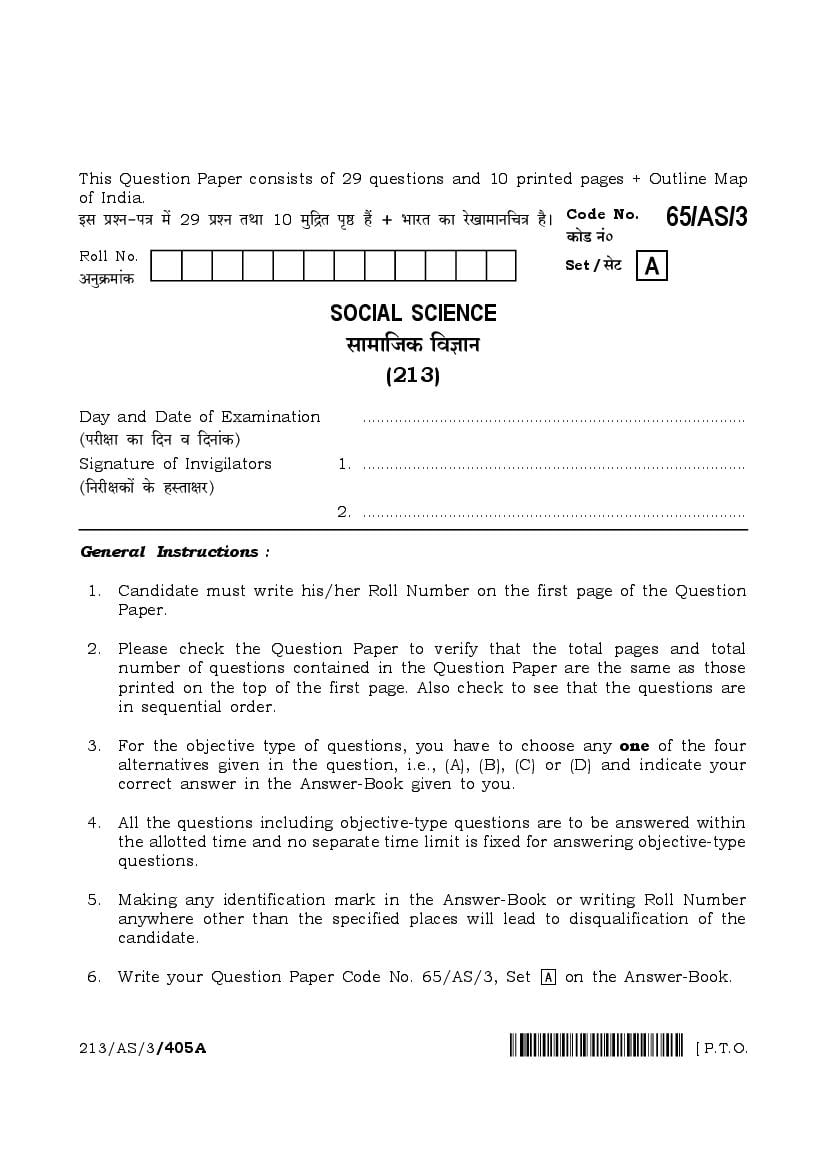
Page 1
of India.
Bg àíZ-nÌ ‘| 29 àíZ VWm 10 ‘w{ÐV n¥ð> h¢ + ^maV H$m aoIm‘mZ{MÌ h¡& Code No. 65/AS/3
u
H$moS> Z§0
Roll No.
Set / goQ>
AZwH«$‘m§H$
SOCIAL SCIENCE
gm‘m{OH$ {dkmZ
(213)
Day and Date of Examination .....................................................................................
(narjm H$m {XZ d {XZm§H$)
Signature of Invigilators 1. .....................................................................................
({ZarjH$m| Ho$ hñVmja)
2. .....................................................................................
General Instructions :
1. Candidate must write his/her Roll Number on the first page of the Question
Paper.
2. Please check the Question Paper to verify that the total pages and total
number of questions contained in the Question Paper are the same as those
printed on the top of the first page. Also check to see that the questions are
in sequential order.
3. For the objective type of questions, you have to choose any one of the four
alternatives given in the question, i.e., (A), (B), (C) or (D) and indicate your
correct answer in the Answer-Book given to you.
4. All the questions including objective-type questions are to be answered within
the allotted time and no separate time limit is fixed for answering objective-type
questions.
5. Making any identification mark in the Answer-Book or writing Roll Number
anywhere other than the specified places will lead to disqualification of the
candidate.
6. Write your Question Paper Code No. 65/AS/3, Set u on the Answer-Book.
213/AS/3/405A [ P.T.O.
Page 2
wish, you can answer in any one of the languages listed below :
English, Hindi, Urdu, Punjabi, Bengali, Tamil, Malayalam, Kannada,
Telugu, Marathi, Odia, Gujarati, Konkani, Manipuri, Assamese, Nepali,
Kashmiri, Sanskrit and Sindhi.
You are required to indicate the language you have chosen to answer in
the box provided in the Answer-Book.
(b) If you choose to write the answer in the language other than Hindi and
English, the responsibility for any errors/mistakes in understanding the
questions will be yours only.
gm‘mݶ AZwXoe …
1. narjmWu àíZ-nÌ Ho$ nhbo n¥ð> na AnZm AZwH«$‘m§H$ Adí¶ {bI|&
2. H¥$n¶m àíZ-nÌ H$mo Om±M b| {H$ àíZ-nÌ Ho$ Hw$b n¥ð>m| VWm àíZm| H$s CVZr hr g§»¶m h¡ {OVZr àW‘ n¥ð> Ho$ g~go
D$na N>nr h¡& Bg ~mV H$s Om±M ^r H$a b| {H$ àíZ H«${‘H$ ê$n ‘| h¢&
3. dñVw{Zð> àíZm| _o§ AmnH$mo Mma {dH$ënm| (A), (B), (C) VWm (D) _| go H$moB© EH$ CÎma MwZZm h¡ VWm Xr JB©
CÎma-nwpñVH$m _| Amn ghr CÎma {bI|Ÿ&
4. dñVw{Zð> àíZm| Ho$ gmW-gmW g^r àíZm| Ho$ CÎma {ZYm©[aV Ad{Y Ho$ ^rVa hr XoZo h¢Ÿ& dñVw{Zð> àíZm| Ho$ {bE AbJ
go g_` Zht {X`m OmEJmŸ&
5. CÎma-nwpñVH$m ‘| nhMmZ-{M• ~ZmZo AWdm {Z{X©ï> ñWmZm| Ho$ A{V[aº$ H$ht ^r AZwH«$‘m§H$ {bIZo na narjmWu H$mo
A¶mo½¶ R>ham¶m OmEJm&
6. AnZr CÎma-nwpñVH$m na àíZ-nÌ H$m H$moS> Z§0 65/AS/3, goQ u, {bI|&
7. (H$) n«íZ-nÌ Ho$db {hÝXr/A§J«oOr ‘| h¡& {’$a ^r, ¶{X Amn Mmh| Vmo ZrMo Xr JB© {H$gr EH$ ^mfm ‘| CÎma Xo
gH$Vo h¢ …
A§J«oOr, {hÝXr, CXÿ©, n§Om~r, ~§Jbm, V{‘b, ‘b¶mb‘, H$Þ‹S>, VobwJy, ‘amR>r, C{‹S>¶m, JwOamVr, H$m|H$Ur,
‘{Unwar, Ag{‘¶m, Zonmbr, H$í‘rar, g§ñH¥$V Am¡a {gÝYr&
H¥$n¶m CÎma-nwpñVH$m ‘| {XE JE ~m°³g ‘| {bI| {H$ Amn {H$g ^mfm ‘| CÎma {bI aho h¢&
(I) ¶{X Amn {hÝXr Ed§ A§J«oOr Ho$ A{V[aº$ {H$gr Aݶ ^mfm ‘| CÎma {bIVo h¢, Vmo àíZm| H$mo g‘PZo ‘| hmoZo dmbr
Ìw{Q>¶m|/Jb{V¶m| H$s {Oå‘oXmar Ho$db AmnH$s hmoJr&
213/AS/3/405A 2
Page 3
gm‘m{OH$ {dkmZ
(213)
Time : 3 Hours ] [ Maximum Marks : 100
g‘¶ … 3 KÊQ>o ] [ nyUmªH$ … 100
Note : (i) All questions are compulsory and carry marks as indicated against each
question.
(ii) For Multiple Choice Questions four options are given. You have to choose
the right option and indicate it in your Answer-Book.
(iii) Attach the map with your Answer-Book.
{ZX}e … (i) g^r àíZ A{Zdm¶© h¢ Am¡a à˶oH$ àíZ Ho$ A§H$ CgHo$ gm‘Zo {X¶o J¶o h¢&
(ii) ~hþ{dH$ënr¶ àíZm| Ho$ Mma {dH$ën {X¶o J¶o h¢& Amn ghr {dH$ën Mw{ZE Am¡a AnZr CÎma-nwpñVH$m
‘| {b{IE&
(iii) {X¶o J¶o aoIm‘mZ{MÌm| H$mo CÎma-nwpñVH$m Ho$ gmW g§b¾ H$s{OE&
1. Which one of the following subjects is included in the ‘Union List’? 1
(A) Defence (B) Police
(C) Education (D) Electricity
{ZåZ{b{IV {df¶m| ‘| go H$m¡Z-gm "g§K gyMr' ‘| em{‘b h¡?
(A) gwajm (B) nw{bg
(C) {ejm (D) [~Obr
2. Which one of the following disasters comes under the ‘human-made’
category? 1
(A) Volcano (B) Earthquake
(C) Flood (D) Bhopal Gas Tragedy
{ZåZ{b{IV AmnXmAm| ‘| go H$m¡Z-gr "‘mZd-{Z{‘©V' loUr ‘| AmVr h¡?
(A) Ádmbm‘wIr (B) ^yH§$n
(C) ~m‹T> (D) ^monmb J¡g ÌmgXr
213/AS/3/405A 3 [ P.T.O.
Page 4
Column—A Column—B
(Administration) (Administrator)
1. Gram Panchayats (a) Mayor
2. Municipal Corporations (b) Sarpanch
3. States (c) Prime Minister
4. Centre (d) Governor
Options :
(A) 1–(b), 2–(a), 3–(d), 4–(c)
(B) 1–(a), 2–(b), 3–(c), 4–(d)
(C) 1–(d), 2–(c), 3–(b), 4–(a)
(D) 1–(c), 2–(d), 3–(a), 4–(b)
ñV§^ A H$m {‘bmZ, ñV§^ B go H$s{OE Am¡a ghr {dH$ën H$m M¶Z H$s{OE :
ñV§^—A ñV§^—B
(àemgZ) (àemgH$)
1. J«m‘ n§Mm¶V (a) ‘o¶a
2. ZJa {ZJ‘ (b) gan§M
3. amÁ¶ (c) àYmZ‘§Ìr
4. Ho$ÝÐ (d) amÁ¶nmb
{dH$ën :
(A) 1–(b), 2–(a), 3–(d), 4–(c)
(B) 1–(a), 2–(b), 3–(c), 4–(d)
(C) 1–(d), 2–(c), 3–(b), 4–(a)
(D) 1–(c), 2–(d), 3–(a), 4–(b)
213/AS/3/405A 4
Page 5
in India? 1
(A) Hinduism (B) Islam
(C) Christianity (D) Sikhism
^maV ‘| {ZåZ{b{IV Y‘m] ‘| go {H$gHo$ g~go ~‹S>r g§»¶m ‘| AnZo AZw¶m¶r h¢?
(A) {hÝXþËd (B) Bñbm‘
(C) B©gmB© (D) {gI
5. Which are the two most important food crops of India? 1+1=2
^maV H$s Xmo g~go ‘hÎdnyU© ImÚ ’$gb| H$m¡Z-gr h¢?
6. Explain the role of Raja Ram Mohan Roy as a socio-religious reformer. 2
gm‘m{OH$-Ym{‘©H$ gwYmaH$ Ho$ ê$n ‘| amOm am‘ ‘mohZ am¶ H$s ^y{‘H$m H$mo ñnï> H$s{OE&
7. Explain the meaning of a political party. 2
amOZr{VH$ Xb H$m AW© ñnï> H$s{OE&
8. Explain with examples the two broad categories of programmes which have
been implemented for alleviation of poverty in India. 2
^maV ‘| Jar~r H$mo H$‘ H$aZo Ho$ {bE ‘moQ>o Vm¡a na bmJy {H$E JE Xmo àH$ma Ho$ H$m¶©H«$‘m| H$s CXmhaUm|
g{hV ì¶m»¶m H$s{OE&
9. Define the term ‘density of population’. Describe the three physical factors
that influence the distribution and density of population. 1+3=4
"OZg§»¶m KZËd' eãX H$mo n[a^m{fV H$s{OE& OZg§»¶m Ho$ {dVaU Am¡a KZËd H$mo à^m{dV H$aZo dmbo
VrZ ^m¡{VH$ H$maH$m| H$m dU©Z H$s{OE&
10. Describe any four functions of the Election Commission of India. 4
^maV Ho$ MwZmd Am¶moJ Ho$ {H$Ýht Mma H$m¶m] H$m dU©Z H$s{OE&
11. Describe the role of ‘public opinion’ in a democracy. 4
bmoH$V§Ì ‘| "OZ‘V' H$s ^y{‘H$m H$m dU©Z H$s{OE&
213/AS/3/405A 5 [ P.T.O.
Page 6
^maVr¶ amï´>r¶ H$m§J«og H$s ‘w»¶ Zr{V¶m| H$m dU©Z H$s{OE&
13. Why were the early Congress leaders referred to as ‘Moderates’? Explain. 4
àmapå^H$ H$m§J«og Ho$ ZoVm "Za‘n§Wr' ³¶m| H$hbmVo Wo? ñnï> H$s{OE&
14. Why was the Muslim League formed? Explain. 4
‘wpñb‘ brJ H$s ñWmnZm ³¶m| H$s JB© Wr? ñnï> H$s{OE&
15. Explain any four economic causes of the Revolt of 1857. 4
1857 Ho$ {dÐmoh Ho$ {H$Ýht Mma Am{W©H$ H$maUm| H$s ì¶m»¶m H$s{OE&
16. Explain the main features of ‘hot weather season’. 4
"J«rî‘ F$Vw' H$s ‘w»¶ {deofVmAm| H$mo ñnï> H$s{OE&
17. Explain the geographical conditions required for growing sugarcane. 4
JÞo H$s CnO Ho$ {bE Amdí¶H$ ^m¡Jmo{bH$ XemAm| H$s ì¶m»¶m H$s{OE&
18. “Prime Minister is the real head of the Union in India.” Support the
statement. 4
“^maV ‘| àYmZ‘§Ìr hr g§K H$m¶©nm{bH$m Ho$ dmñV{dH$ à‘wI h¢&” Bg H$WZ H$s nw{ï> H$s{OE&
19. Explain the composition and functions of the Union Council of Ministers. 4
g§Kr¶ ‘§{Ìn[afX² Ho$ JR>Z Am¡a H$m¶m] H$mo ñnï> H$s{OE&
213/AS/3/405A 6
Page 7
n¶m©daUr¶ jaU Ho$ J§^ra n[aUm‘m| H$s ì¶m»¶m H$s{OE&
21. How did revolutionaries contribute in Independence of India? Explain. 4
^maV H$s ñdV§ÌVm ‘| {dÐmo{h¶m| Zo {H$g àH$ma ¶moJXmZ {H$¶m? ñnï> H$s{OE&
22. Explain the impact of the Reform Movement on the Indian society. 4
^maVr¶ g‘mO na gwYma Am§XmobZm| Ho$ à^md H$mo ñnï> H$s{OE&
23. Explain with examples the functions of the ‘State Legislature’. 4
"amÁ¶ {dYm{¶H$m' Ho$ H$m¶m] H$s CXmhaUm| g{hV ì¶m»¶m H$s{OE&
24. Describe the progress made in different aspects of life during the Gupta
Age. 5
Jwá H$mb Ho$ Xm¡amZ OrdZ Ho$ {d{^Þ nhbwAm| ‘| H$s JB© àJ{V H$m dU©Z H$s{OE&
25. Describe any five major challenges to National Integration. 1×5=5
amï´>r¶ EH$sH$aU Ho$ g‘j {H$Ýht nm±M à‘wI MwZm¡{V¶m| H$m dU©Z H$s{OE&
26. “The innovation had maximum impact in textile and transport industries
during the Industrial Revolution.” Support the statement. 5
“Am¡Úmo{JH$ H«$m§{V Ho$ Xm¡amZ dó Am¡a n[adhZ CÚmoJm| ‘| A{YH$V‘ A{^Zd n[adV©Z hþE&” Bg H$WZ
H$s nw{ï> H$s{OE&
27. Explain any five salient features of Indian agriculture. 1×5=5
^maVr¶ H¥${f H$s {H$Ýht nm±M à‘wI {deofVmAm| H$mo ñnï> H$s{OE&
213/AS/3/405A 7 [ P.T.O.
Page 8
(A), (B), (C) and (D) on the given Political Outline Map of India. Identify
them and write their correct names in your Answer-Book : 1×4=4
CÎma-X{jU Am¡a nyd©-npíM‘ J{b¶mam| Ho$ {gam| Ho$ ñQ>oeZm| H$mo ^maV Ho$ amOZr{VH$ aoIm‘mZ{MÌ na
(A), (B), (C) Am¡a (D) go A§{H$V {H$¶m J¶m h¡& CÝh| nhMm{ZE Am¡a CZHo$ ghr Zm‘ AnZr
CÎma-nwpñVH$m ‘| {b{IE&
213/AS/3/405A 8
Page 9
Political Outline Map of India with appropriate symbols : 1×4=4
(a) Satpura Range
(b) Mahanadi
(c) Nanda Devi Biosphere Reserve
(d) The State having the highest literacy rate
{XE JE ^maV Ho$ amOZr{VH$ aoIm‘mZ{MÌ ‘| {ZåZ{b{IV Mma ^m¡Jmo{bH$ bjUm| H$mo Cn¶wº$ {M•m| Ho$
gmW A§{H$V H$s{OE Am¡a CZHo$ Zm‘ {b{IE …
(H$) gVnw‹S>m loUr
(I) ‘hmZXr
(J) Z§Xm Xodr ~m¶moñ’$s¶a [aOd©
(K) gdm©{YH$ gmjaVm Xa dmbm amÁ¶
Note : The following questions are for the Visually Impaired Candidates
only in lieu of Question Nos. 28 and 29 : 2×4=8
(a) Name the terminal stations of North-South Corridor.
(b) Name the terminal stations of East-West Corridor.
(c) Name any two east-flowing major rivers of Himalayas.
(d) Name any two west-flowing major rivers of Himalayas.
213/AS/3/405A 9 [ P.T.O.
Page 10
(H$) CÎma-X{jU J{b¶mao Ho$ ApÝV‘ {gam| Ho$ ñQ>oeZmo§ Ho$ Zm‘ {b{IE&
(I) nyd©-npíM‘ J{b¶mao Ho$ ApÝV‘ {gam| Ho$ ñQ>oeZmo§ Ho$ Zm‘ {b{IE&
(J) {h‘mb¶ H$s nyd© H$s Amoa àdm{hV hmo ahr {H$Ýht Xmo à‘wI Z{X¶m| Ho$ Zm‘ {b{IE&
(K) {h‘mb¶ H$s npíM‘ H$s Amoa àdm{hV hmo ahr {H$Ýht Xmo à‘wI Z{X¶m| Ho$ Zm‘ {b{IE&
213/AS/3/405A [V23] 10
Page 11
àíZ g§0 29 Ho$ {bE aoIm‘mZ{MÌ
Roll No.
AZwH«$‘m§H$
213/AS/3/405A 11
Page 12
of India.
Bg àíZ-nÌ ‘| 29 àíZ VWm 10 ‘w{ÐV n¥ð> h¢ + ^maV H$m aoIm‘mZ{MÌ h¡& Code No. 65/AS/3
v
H$moS> Z§0
Roll No.
Set / goQ>
AZwH«$‘m§H$
SOCIAL SCIENCE
gm‘m{OH$ {dkmZ
(213)
Day and Date of Examination .....................................................................................
(narjm H$m {XZ d {XZm§H$)
Signature of Invigilators 1. .....................................................................................
({ZarjH$m| Ho$ hñVmja)
2. .....................................................................................
General Instructions :
1. Candidate must write his/her Roll Number on the first page of the Question
Paper.
2. Please check the Question Paper to verify that the total pages and total
number of questions contained in the Question Paper are the same as those
printed on the top of the first page. Also check to see that the questions are
in sequential order.
3. For the objective type of questions, you have to choose any one of the four
alternatives given in the question, i.e., (A), (B), (C) or (D) and indicate your
correct answer in the Answer-Book given to you.
4. All the questions including objective-type questions are to be answered within
the allotted time and no separate time limit is fixed for answering objective-type
questions.
5. Making any identification mark in the Answer-Book or writing Roll Number
anywhere other than the specified places will lead to disqualification of the
candidate.
6. Write your Question Paper Code No. 65/AS/3, Set v on the Answer-Book.
213/AS/3/405B [ P.T.O.
Page 13
wish, you can answer in any one of the languages listed below :
English, Hindi, Urdu, Punjabi, Bengali, Tamil, Malayalam, Kannada,
Telugu, Marathi, Odia, Gujarati, Konkani, Manipuri, Assamese, Nepali,
Kashmiri, Sanskrit and Sindhi.
You are required to indicate the language you have chosen to answer in
the box provided in the Answer-Book.
(b) If you choose to write the answer in the language other than Hindi and
English, the responsibility for any errors/mistakes in understanding the
questions will be yours only.
gm‘mݶ AZwXoe …
1. narjmWu àíZ-nÌ Ho$ nhbo n¥ð> na AnZm AZwH«$‘m§H$ Adí¶ {bI|&
2. H¥$n¶m àíZ-nÌ H$mo Om±M b| {H$ àíZ-nÌ Ho$ Hw$b n¥ð>m| VWm àíZm| H$s CVZr hr g§»¶m h¡ {OVZr àW‘ n¥ð> Ho$ g~go
D$na N>nr h¡& Bg ~mV H$s Om±M ^r H$a b| {H$ àíZ H«${‘H$ ê$n ‘| h¢&
3. dñVw{Zð> àíZm| _o§ AmnH$mo Mma {dH$ënm| (A), (B), (C) VWm (D) _| go H$moB© EH$ CÎma MwZZm h¡ VWm Xr JB©
CÎma-nwpñVH$m _| Amn ghr CÎma {bI|Ÿ&
4. dñVw{Zð> àíZm| Ho$ gmW-gmW g^r àíZm| Ho$ CÎma {ZYm©[aV Ad{Y Ho$ ^rVa hr XoZo h¢Ÿ& dñVw{Zð> àíZm| Ho$ {bE AbJ
go g_` Zht {X`m OmEJmŸ&
5. CÎma-nwpñVH$m ‘| nhMmZ-{M• ~ZmZo AWdm {Z{X©ï> ñWmZm| Ho$ A{V[aº$ H$ht ^r AZwH«$‘m§H$ {bIZo na narjmWu H$mo
A¶mo½¶ R>ham¶m OmEJm&
6. AnZr CÎma-nwpñVH$m na àíZ-nÌ H$m H$moS> Z§0 65/AS/3, goQ v, {bI|&
7. (H$) n«íZ-nÌ Ho$db {hÝXr/A§J«oOr ‘| h¡& {’$a ^r, ¶{X Amn Mmh| Vmo ZrMo Xr JB© {H$gr EH$ ^mfm ‘| CÎma Xo
gH$Vo h¢ …
A§J«oOr, {hÝXr, CXÿ©, n§Om~r, ~§Jbm, V{‘b, ‘b¶mb‘, H$Þ‹S>, VobwJy, ‘amR>r, C{‹S>¶m, JwOamVr, H$m|H$Ur,
‘{Unwar, Ag{‘¶m, Zonmbr, H$í‘rar, g§ñH¥$V Am¡a {gÝYr&
H¥$n¶m CÎma-nwpñVH$m ‘| {XE JE ~m°³g ‘| {bI| {H$ Amn {H$g ^mfm ‘| CÎma {bI aho h¢&
(I) ¶{X Amn {hÝXr Ed§ A§J«oOr Ho$ A{V[aº$ {H$gr Aݶ ^mfm ‘| CÎma {bIVo h¢, Vmo àíZm| H$mo g‘PZo ‘| hmoZo dmbr
Ìw{Q>¶m|/Jb{V¶m| H$s {Oå‘oXmar Ho$db AmnH$s hmoJr&
213/AS/3/405B 2
Page 14
gm‘m{OH$ {dkmZ
(213)
Time : 3 Hours ] [ Maximum Marks : 100
g‘¶ … 3 KÊQ>o ] [ nyUmªH$ … 100
Note : (i) All questions are compulsory and carry marks as indicated against each
question.
(ii) For Multiple Choice Questions four options are given. You have to choose
the right option and indicate it in your Answer-Book.
(iii) Attach the map with your Answer-Book.
{ZX}e … (i) g^r àíZ A{Zdm¶© h¢ Am¡a à˶oH$ àíZ Ho$ A§H$ CgHo$ gm‘Zo {X¶o J¶o h¢&
(ii) ~hþ{dH$ënr¶ àíZm| Ho$ Mma {dH$ën {X¶o J¶o h¢& Amn ghr {dH$ën Mw{ZE Am¡a AnZr CÎma-nwpñVH$m
‘| {b{IE&
(iii) {X¶o J¶o aoIm‘mZ{MÌm| H$mo CÎma-nwpñVH$m Ho$ gmW g§b¾ H$s{OE&
1. Which one of the following religions has the largest number of its followers
in India? 1
(A) Hinduism (B) Islam
(C) Christianity (D) Sikhism
^maV ‘| {ZåZ{b{IV Y‘m] ‘| go {H$gHo$ g~go ~‹S>r g§»¶m ‘| AnZo AZw¶m¶r h¢?
(A) {hÝXþËd (B) Bñbm‘
(C) B©gmB© (D) {gI
2. Match the Column—A with Column—B and choose the correct option : 1
Column—A Column—B
(Administration) (Administrator)
1. Gram Panchayats (a) Mayor
2. Municipal Corporations (b) Sarpanch
3. States (c) Prime Minister
4. Centre (d) Governor
213/AS/3/405B 3 [ P.T.O.
Page 15
(A) 1–(b), 2–(a), 3–(d), 4–(c)
(B) 1–(a), 2–(b), 3–(c), 4–(d)
(C) 1–(d), 2–(c), 3–(b), 4–(a)
(D) 1–(c), 2–(d), 3–(a), 4–(b)
ñV§^ A H$m {‘bmZ, ñV§^ B go H$s{OE Am¡a ghr {dH$ën H$m M¶Z H$s{OE :
ñV§^—A ñV§^—B
(àemgZ) (àemgH$)
1. J«m‘ n§Mm¶V (a) ‘o¶a
2. ZJa {ZJ‘ (b) gan§M
3. amÁ¶ (c) àYmZ‘§Ìr
4. Ho$ÝÐ (d) amÁ¶nmb
{dH$ën :
(A) 1–(b), 2–(a), 3–(d), 4–(c)
(B) 1–(a), 2–(b), 3–(c), 4–(d)
(C) 1–(d), 2–(c), 3–(b), 4–(a)
(D) 1–(c), 2–(d), 3–(a), 4–(b)
3. Which one of the following disasters comes under the ‘human-made’
category? 1
(A) Volcano (B) Earthquake
(C) Flood (D) Bhopal Gas Tragedy
{ZåZ{b{IV AmnXmAm| ‘| go H$m¡Z-gr "‘mZd-{Z{‘©V' loUr ‘| AmVr h¡?
(A) Ádmbm‘wIr (B) ^yH§$n
(C) ~m‹T> (D) ^monmb J¡g ÌmgXr
213/AS/3/405B 4
Page 16
(A) Defence (B) Police
(C) Education (D) Electricity
{ZåZ{b{IV {df¶m| ‘| go H$m¡Z-gm "g§K gyMr' ‘| em{‘b h¡?
(A) gwajm (B) nw{bg
(C) {ejm (D) [~Obr
5. Explain with examples the two broad categories of programmes which have
been implemented for alleviation of poverty in India. 2
^maV ‘| Jar~r H$mo H$‘ H$aZo Ho$ {bE ‘moQ>o Vm¡a na bmJy {H$E JE Xmo àH$ma Ho$ H$m¶©H«$‘m| H$s CXmhaUm|
g{hV ì¶m»¶m H$s{OE&
6. Explain the contribution of Sir Syed Ahmad Khan in the field of education. 2
{ejm Ho$ joÌ ‘| ga g¡¶X Ah‘X Im± Ho$ ¶moJXmZ H$mo ñnï> H$s{OE&
7. Why do we need political parties? 2
h‘| amOZr{VH$ Xbm| H$s Amdí¶H$Vm ³¶m| hmoVr h¡?
8. Which are the two most important food crops of India? 1+1=2
^maV H$s Xmo g~go ‘hÎdnyU© ImÚ ’$gb| H$m¡Z-gr h¢?
9. Explain the composition and functions of the Union Council of Ministers. 4
g§Kr¶ ‘§{Ìn[afX² Ho$ JR>Z Am¡a H$m¶m] H$mo ñnï> H$s{OE&
10. Why was the Muslim League formed? Explain. 4
‘wpñb‘ brJ H$s ñWmnZm ³¶m| H$s JB© Wr? ñnï> H$s{OE&
213/AS/3/405B 5 [ P.T.O.
Page 17
àmapå^H$ H$m§J«og Ho$ ZoVm "Za‘n§Wr' ³¶m| H$hbmVo Wo? ñnï> H$s{OE&
12. Define the term ‘density of population’. Describe the three physical factors
that influence the distribution and density of population. 1+3=4
"OZg§»¶m KZËd' eãX H$mo n[a^m{fV H$s{OE& OZg§»¶m Ho$ {dVaU Am¡a KZËd H$mo à^m{dV H$aZo dmbo
VrZ ^m¡{VH$ H$maH$m| H$m dU©Z H$s{OE&
13. Describe any four functions of the Election Commission of India. 4
^maV Ho$ MwZmd Am¶moJ Ho$ {H$Ýht Mma H$m¶m] H$m dU©Z H$s{OE&
14. Describe the role of ‘public opinion’ in a democracy. 4
bmoH$V§Ì ‘| "OZ‘V' H$s ^y{‘H$m H$m dU©Z H$s{OE&
15. Explain the impact of the Revolt of 1857. 4
1857 Ho$ {dÐmoh Ho$ à^md H$mo ñnï> H$s{OE&
16. Explain the characteristics of ‘cold weather season’. 1×4=4
"erV F$Vw' H$s {deofVmAm| H$s ì¶m»¶m H$s{OE&
17. Explain the geographical conditions required for the cultivation of cotton
crop. 4
H$nmg H$s ’$gb H$s IoVr Ho$ {bE Amdí¶H$ ^m¡Jmo{bH$ XemAm| H$mo ñnï> H$s{OE&
18. “There is a close relationship between the Legislature and the Executive.”
Support the statement. 4
“{dYm{¶H$m Am¡a H$m¶©nm{bH$m Ho$ ~rM K{Zð> g§~§Y h¡&” Bg H$WZ H$s nw{ï> H$s{OE&
213/AS/3/405B 6
Page 18
^maVr¶ amï´>r¶ H$m§J«og H$s ‘w»¶ Zr{V¶m| H$m dU©Z H$s{OE&
20. Explain with examples the functions of the ‘State Legislature’. 4
"amÁ¶ {dYm{¶H$m' Ho$ H$m¶m] H$s CXmhaUm| g{hV ì¶m»¶m H$s{OE&
21. Explain the impact of the Reform Movement on the Indian society. 4
^maVr¶ g‘mO na gwYma Am§XmobZm| Ho$ à^md H$mo ñnï> H$s{OE&
22. How did revolutionaries contribute in Independence of India? Explain. 4
^maV H$s ñdV§ÌVm ‘| {dÐmo{h¶m| Zo {H$g àH$ma ¶moJXmZ {H$¶m? ñnï> H$s{OE&
23. Explain the serious consequences of environmental degradation. 4
n¶m©daUr¶ jaU Ho$ J§^ra n[aUm‘m| H$s ì¶m»¶m H$s{OE&
24. Describe the features of Buddhism. 5
~m¡Õ Y‘© H$s {deofVmAm| H$m dU©Z H$s{OE&
25. “The innovation had maximum impact in textile and transport industries
during the Industrial Revolution.” Support the statement. 5
“Am¡Úmo{JH$ H«$m§{V Ho$ Xm¡amZ dó Am¡a n[adhZ CÚmoJm| ‘| A{YH$V‘ A{^Zd n[adV©Z hþE&” Bg H$WZ
H$s nw{ï> H$s{OE&
26. Explain any five salient features of Indian agriculture. 1×5=5
^maVr¶ H¥${f H$s {H$Ýht nm±M à‘wI {deofVmAm| H$mo ñnï> H$s{OE&
27. Describe any five major challenges to National Integration. 1×5=5
amï´>r¶ EH$sH$aU Ho$ g‘j {H$Ýht nm±M à‘wI MwZm¡{V¶m| H$m dU©Z H$s{OE&
213/AS/3/405B 7 [ P.T.O.
Page 19
(A), (B), (C) and (D) on the given Political Outline Map of India. Identify
them and write their correct names in your Answer-Book : 1×4=4
CÎma-X{jU Am¡a nyd©-npíM‘ J{b¶mam| Ho$ {gam| Ho$ ñQ>oeZm| H$mo ^maV Ho$ amOZr{VH$ aoIm‘mZ{MÌ na
(A), (B), (C) Am¡a (D) go A§{H$V {H$¶m J¶m h¡& CÝh| nhMm{ZE Am¡a CZHo$ ghr Zm‘ AnZr
CÎma-nwpñVH$m ‘| {b{IE&
213/AS/3/405B 8
Page 20
Political Outline Map of India with appropriate symbols : 1×4=4
(a) Satpura Range
(b) Mahanadi
(c) Nanda Devi Biosphere Reserve
(d) The State having the highest literacy rate
{XE JE ^maV Ho$ amOZr{VH$ aoIm‘mZ{MÌ ‘| {ZåZ{b{IV Mma ^m¡Jmo{bH$ bjUm| H$mo Cn¶wº$ {M•m| Ho$
gmW A§{H$V H$s{OE Am¡a CZHo$ Zm‘ {b{IE …
(H$) gVnw‹S>m loUr
(I) ‘hmZXr
(J) Z§Xm Xodr—~m¶moñ’$s¶a [aOd©
(K) gdm©{YH$ gmjaVm Xa dmbm amÁ¶
Note : The following questions are for the Visually Impaired Candidates
only in lieu of Question Nos. 28 and 29 : 2×4=8
(a) Name the terminal stations of North-South Corridor.
(b) Name the terminal stations of East-West Corridor.
(c) Name any two east-flowing major rivers of Himalayas.
(d) Name any two west-flowing major rivers of Himalayas.
213/AS/3/405B 9 [ P.T.O.
Page 21
(H$) CÎma-X{jU J{b¶mao Ho$ ApÝV‘ {gam| Ho$ ñQ>oeZmo§ Ho$ Zm‘ {b{IE&
(I) nyd©-npíM‘ J{b¶mao Ho$ ApÝV‘ {gam| Ho$ ñQ>oeZmo§ Ho$ Zm‘ {b{IE&
(J) {h‘mb¶ H$s nyd© H$s Amoa àdm{hV hmo ahr {H$Ýht Xmo à‘wI Z{X¶m| Ho$ Zm‘ {b{IE&
(K) {h‘mb¶ H$s npíM‘ H$s Amoa àdm{hV hmo ahr {H$Ýht Xmo à‘wI Z{X¶m| Ho$ Zm‘ {b{IE&
213/AS/3/405B [V23] 10
Page 22
àíZ g§0 29 Ho$ {bE aoIm‘mZ{MÌ
Roll No.
AZwH«$‘m§H$
213/AS/3/405B 11
Page 23
of India.
Bg àíZ-nÌ ‘| 29 àíZ VWm 10 ‘w{ÐV n¥ð> h¢ + ^maV H$m aoIm‘mZ{MÌ h¡& Code No. 65/AS/3
w
H$moS> Z§0
Roll No.
Set / goQ>
AZwH«$‘m§H$
SOCIAL SCIENCE
gm‘m{OH$ {dkmZ
(213)
Day and Date of Examination .....................................................................................
(narjm H$m {XZ d {XZm§H$)
Signature of Invigilators 1. .....................................................................................
({ZarjH$m| Ho$ hñVmja)
2. .....................................................................................
General Instructions :
1. Candidate must write his/her Roll Number on the first page of the Question
Paper.
2. Please check the Question Paper to verify that the total pages and total
number of questions contained in the Question Paper are the same as those
printed on the top of the first page. Also check to see that the questions are
in sequential order.
3. For the objective type of questions, you have to choose any one of the four
alternatives given in the question, i.e., (A), (B), (C) or (D) and indicate your
correct answer in the Answer-Book given to you.
4. All the questions including objective-type questions are to be answered within
the allotted time and no separate time limit is fixed for answering objective-type
questions.
5. Making any identification mark in the Answer-Book or writing Roll Number
anywhere other than the specified places will lead to disqualification of the
candidate.
6. Write your Question Paper Code No. 65/AS/3, Set w on the Answer-Book.
213/AS/3/405C [ P.T.O.
Page 24
wish, you can answer in any one of the languages listed below :
English, Hindi, Urdu, Punjabi, Bengali, Tamil, Malayalam, Kannada,
Telugu, Marathi, Odia, Gujarati, Konkani, Manipuri, Assamese, Nepali,
Kashmiri, Sanskrit and Sindhi.
You are required to indicate the language you have chosen to answer in
the box provided in the Answer-Book.
(b) If you choose to write the answer in the language other than Hindi and
English, the responsibility for any errors/mistakes in understanding the
questions will be yours only.
gm‘mݶ AZwXoe …
1. narjmWu àíZ-nÌ Ho$ nhbo n¥ð> na AnZm AZwH«$‘m§H$ Adí¶ {bI|&
2. H¥$n¶m àíZ-nÌ H$mo Om±M b| {H$ àíZ-nÌ Ho$ Hw$b n¥ð>m| VWm àíZm| H$s CVZr hr g§»¶m h¡ {OVZr àW‘ n¥ð> Ho$ g~go
D$na N>nr h¡& Bg ~mV H$s Om±M ^r H$a b| {H$ àíZ H«${‘H$ ê$n ‘| h¢&
3. dñVw{Zð> àíZm| _o§ AmnH$mo Mma {dH$ënm| (A), (B), (C) VWm (D) _| go H$moB© EH$ CÎma MwZZm h¡ VWm Xr JB©
CÎma-nwpñVH$m _| Amn ghr CÎma {bI|Ÿ&
4. dñVw{Zð> àíZm| Ho$ gmW-gmW g^r àíZm| Ho$ CÎma {ZYm©[aV Ad{Y Ho$ ^rVa hr XoZo h¢Ÿ& dñVw{Zð> àíZm| Ho$ {bE AbJ
go g_` Zht {X`m OmEJmŸ&
5. CÎma-nwpñVH$m ‘| nhMmZ-{M• ~ZmZo AWdm {Z{X©ï> ñWmZm| Ho$ A{V[aº$ H$ht ^r AZwH«$‘m§H$ {bIZo na narjmWu H$mo
A¶mo½¶ R>ham¶m OmEJm&
6. AnZr CÎma-nwpñVH$m na àíZ-nÌ H$m H$moS> Z§0 65/AS/3, goQ w, {bI|&
7. (H$) n«íZ-nÌ Ho$db {hÝXr/A§J«oOr ‘| h¡& {’$a ^r, ¶{X Amn Mmh| Vmo ZrMo Xr JB© {H$gr EH$ ^mfm ‘| CÎma Xo
gH$Vo h¢ …
A§J«oOr, {hÝXr, CXÿ©, n§Om~r, ~§Jbm, V{‘b, ‘b¶mb‘, H$Þ‹S>, VobwJy, ‘amR>r, C{‹S>¶m, JwOamVr, H$m|H$Ur,
‘{Unwar, Ag{‘¶m, Zonmbr, H$í‘rar, g§ñH¥$V Am¡a {gÝYr&
H¥$n¶m CÎma-nwpñVH$m ‘| {XE JE ~m°³g ‘| {bI| {H$ Amn {H$g ^mfm ‘| CÎma {bI aho h¢&
(I) ¶{X Amn {hÝXr Ed§ A§J«oOr Ho$ A{V[aº$ {H$gr Aݶ ^mfm ‘| CÎma {bIVo h¢, Vmo àíZm| H$mo g‘PZo ‘| hmoZo dmbr
Ìw{Q>¶m|/Jb{V¶m| H$s {Oå‘oXmar Ho$db AmnH$s hmoJr&
213/AS/3/405C 2
Page 25
gm‘m{OH$ {dkmZ
(213)
Time : 3 Hours ] [ Maximum Marks : 100
g‘¶ … 3 KÊQ>o ] [ nyUmªH$ … 100
Note : (i) All questions are compulsory and carry marks as indicated against each
question.
(ii) For Multiple Choice Questions four options are given. You have to choose
the right option and indicate it in your Answer-Book.
(iii) Attach the map with your Answer-Book.
{ZX}e … (i) g^r àíZ A{Zdm¶© h¢ Am¡a à˶oH$ àíZ Ho$ A§H$ CgHo$ gm‘Zo {X¶o J¶o h¢&
(ii) ~hþ{dH$ënr¶ àíZm| Ho$ Mma {dH$ën {X¶o J¶o h¢& Amn ghr {dH$ën Mw{ZE Am¡a AnZr CÎma-nwpñVH$m
‘| {b{IE&
(iii) {X¶o J¶o aoIm‘mZ{MÌm| H$mo CÎma-nwpñVH$m Ho$ gmW g§b¾ H$s{OE&
1. Match the Column—A with Column—B and choose the correct option : 1
Column—A Column—B
(Administration) (Administrator)
1. Gram Panchayats (a) Mayor
2. Municipal Corporations (b) Sarpanch
3. States (c) Prime Minister
4. Centre (d) Governor
Options :
(A) 1–(b), 2–(a), 3–(d), 4–(c)
(B) 1–(a), 2–(b), 3–(c), 4–(d)
(C) 1–(d), 2–(c), 3–(b), 4–(a)
(D) 1–(c), 2–(d), 3–(a), 4–(b)
213/AS/3/405C 3 [ P.T.O.
Page 26
ñV§^—A ñV§^—B
(àemgZ) (àemgH$)
1. J«m‘ n§Mm¶V (a) ‘o¶a
2. ZJa {ZJ‘ (b) gan§M
3. amÁ¶ (c) àYmZ‘§Ìr
4. Ho$ÝÐ (d) amÁ¶nmb
{dH$ën :
(A) 1–(b), 2–(a), 3–(d), 4–(c)
(B) 1–(a), 2–(b), 3–(c), 4–(d)
(C) 1–(d), 2–(c), 3–(b), 4–(a)
(D) 1–(c), 2–(d), 3–(a), 4–(b)
2. Which one of the following religions has the largest number of its followers
in India? 1
(A) Hinduism (B) Islam
(C) Christianity (D) Sikhism
^maV ‘| {ZåZ{b{IV Y‘m] ‘| go {H$gHo$ g~go ~‹S>r g§»¶m ‘| AnZo AZw¶m¶r h¢?
(A) {hÝXþËd (B) Bñbm‘
(C) B©gmB© (D) {gI
3. Which one of the following subjects is included in the ‘Union List’? 1
(A) Defence (B) Police
(C) Education (D) Electricity
{ZåZ{b{IV {df¶m| ‘| go H$m¡Z-gm "g§K gyMr' ‘| em{‘b h¡?
(A) gwajm (B) nw{bg
(C) {ejm (D) [~Obr
213/AS/3/405C 4
Page 27
category? 1
(A) Volcano (B) Earthquake
(C) Flood (D) Bhopal Gas Tragedy
{ZåZ{b{IV AmnXmAm| ‘| go H$m¡Z-gr "‘mZd-{Z{‘©V' loUr ‘| AmVr h¡?
(A) Ádmbm‘wIr (B) ^yH§$n
(C) ~m‹T> (D) ^monmb J¡g ÌmgXr
5. Which are the two most important food crops of India? 1+1=2
^maV H$s Xmo g~go ‘hÎdnyU© ImÚ ’$gb| H$m¡Z-gr h¢?
6. Explain the role of Swami Vivekananda as a socio-religious reformer. 2
gm‘m{OH$-Ym{‘©H$ gwYmaH$ Ho$ ê$n ‘| ñdm‘r {ddoH$mZ§X H$s ^y{‘H$m ñnï> H$s{OE&
7. Explain the importance of Elections. 2
MwZmdm| Ho$ ‘hÎd H$s ì¶m»¶m H$s{OE&
8. Explain with examples the two broad categories of programmes which have
been implemented for alleviation of poverty in India. 2
^maV ‘| Jar~r H$mo H$‘ H$aZo Ho$ {bE ‘moQ>o Vm¡a na bmJy {H$E JE Xmo àH$ma Ho$ H$m¶©H«$‘m| H$s CXmhaUm|
g{hV ì¶m»¶m H$s{OE&
9. Describe the main policies of the Indian National Congress. 4
^maVr¶ amï´>r¶ H$m§J«og H$s ‘w»¶ Zr{V¶m| H$m dU©Z H$s{OE&
10. Describe the role of ‘public opinion’ in a democracy. 4
bmoH$V§Ì ‘| "OZ‘V' H$s ^y{‘H$m H$m dU©Z H$s{OE&
213/AS/3/405C 5 [ P.T.O.
Page 28
^maV Ho$ MwZmd Am¶moJ Ho$ {H$Ýht Mma H$m¶m] H$m dU©Z H$s{OE&
12. Why were the early Congress leaders referred to as ‘Moderates’? Explain. 4
àmapå^H$ H$m§J«og Ho$ ZoVm "Za‘n§Wr' ³¶m| H$hbmVo Wo? ñnï> H$s{OE&
13. Why was the Muslim League formed? Explain. 4
‘wpñb‘ brJ H$s ñWmnZm ³¶m| H$s JB© Wr? ñnï> H$s{OE&
14. Explain the composition and functions of the Union Council of Ministers. 4
g§Kr¶ ‘§{Ìn[afX² Ho$ JR>Z Am¡a H$m¶m] H$mo ñnï> H$s{OE&
15. Explain immediate consequences of the First World War. 4
àW‘ {díd¶wÕ Ho$ VmËH$m{bH$ n[aUm‘m| H$s ì¶m»¶m H$s{OE&
16. Explain the characteristics of ‘Advancing South-West Monsoon Season’. 4
"AmJo ~‹T>Vo hþE X{jU-npíM‘ ‘mZgyZ F$Vw' H$s {deofVmAm| H$mo ñnï>> H$s{OE&
17. Explain the geographical conditions required for the cultivation of tea. 4
Mm¶ H$s IoVr Ho$ {bE Amdí¶H$ ^m¡Jmo{bH$ XemAm| H$s ì¶m»¶m H$s{OE&
18. Explain the executive powers of the President of India. 4
^maV Ho$ amï´>n{V H$s H$m¶©nm{bH$m-g§~§Yr e{º$¶m| H$mo ñnï> H$s{OE&
19. Define the term ‘density of population’. Describe the three physical factors
that influence the distribution and density of population. 1+3=4
"OZg§»¶m KZËd' eãX H$mo n[a^m{fV H$s{OE& OZg§»¶m Ho$ {dVaU Am¡a KZËd H$mo à^m{dV H$aZo dmbo
VrZ ^m¡{VH$ H$maH$m| H$m dU©Z H$s{OE&
213/AS/3/405C 6
Page 29
^maVr¶ g‘mO na gwYma Am§XmobZm| Ho$ à^md H$mo ñnï> H$s{OE&
21. Explain with examples the functions of the ‘State Legislature’. 4
"amÁ¶ {dYm{¶H$m' Ho$ H$m¶m] H$s CXmhaUm| g{hV ì¶m»¶m H$s{OE&
22. Explain the serious consequences of environmental degradation. 4
n¶m©daUr¶ jaU Ho$ J§^ra n[aUm‘m| H$s ì¶m»¶m H$s{OE&
23. How did revolutionaries contribute in Independence of India? Explain. 4
^maV H$s ñdV§ÌVm ‘| {dÐmo{h¶m| Zo {H$g àH$ma ¶moJXmZ {H$¶m? ñnï> H$s{OE&
24. Describe the main features of Jainism. 5
O¡Z Y‘© H$s ‘w»¶ {deofVmAm| H$m dU©Z H$s{OE&
25. Explain any five salient features of Indian agriculture. 1×5=5
^maVr¶ H¥${f H$s {H$Ýht nm±M à‘wI {deofVmAm| H$mo ñnï> H$s{OE&
26. Describe any five major challenges to National Integration. 1×5=5
amï´>r¶ EH$sH$aU Ho$ g‘j {H$Ýht nm±M à‘wI MwZm¡{V¶m| H$m dU©Z H$s{OE&
27. “The innovation had maximum impact in textile and transport industries
during the Industrial Revolution.” Support the statement. 5
“Am¡Úmo{JH$ H«$m§{V Ho$ Xm¡amZ dó Am¡a n[adhZ CÚmoJm| ‘| A{YH$V‘ A{^Zd n[adV©Z hþE&” Bg H$WZ
H$s nw{ï> H$s{OE&
213/AS/3/405C 7 [ P.T.O.
Page 30
(A), (B), (C) and (D) on the given Political Outline Map of India. Identify
them and write their correct names in your Answer-Book : 1×4=4
CÎma-X{jU Am¡a nyd©-npíM‘ J{b¶mam| Ho$ {gam| Ho$ ñQ>oeZm| H$mo ^maV Ho$ amOZr{VH$ aoIm‘mZ{MÌ na
(A), (B), (C) Am¡a (D) go A§{H$V {H$¶m J¶m h¡& CÝh| nhMm{ZE Am¡a CZHo$ ghr Zm‘ AnZr
CÎma-nwpñVH$m ‘| {b{IE&
213/AS/3/405C 8
Page 31
Political Outline Map of India with appropriate symbols : 1×4=4
(a) Satpura Range
(b) Mahanadi
(c) Nanda Devi Biosphere Reserve
(d) The State having the highest literacy rate
{XE JE ^maV Ho$ amOZr{VH$ aoIm‘mZ{MÌ ‘| {ZåZ{b{IV Mma ^m¡Jmo{bH$ bjUm| H$mo Cn¶wº$ {M•m| Ho$
gmW A§{H$V H$s{OE Am¡a CZHo$ Zm‘ {b{IE …
(H$) gVnw‹S>m loUr
(I) ‘hmZXr
(J) Z§Xm Xodr ~m¶moñ’$s¶a [aOd©
(K) gdm©{YH$ gmjaVm Xa dmbm amÁ¶
Note : The following questions are for the Visually Impaired Candidates
only in lieu of Question Nos. 28 and 29 : 2×4=8
(a) Name the terminal stations of North-South Corridor.
(b) Name the terminal stations of East-West Corridor.
(c) Name any two east-flowing major rivers of Himalayas.
(d) Name any two west-flowing major rivers of Himalayas.
213/AS/3/405C 9 [ P.T.O.
Page 32
(H$) CÎma-X{jU J{b¶mao Ho$ ApÝV‘ {gam| Ho$ ñQ>oeZmo§ Ho$ Zm‘ {b{IE&
(I) nyd©-npíM‘ J{b¶mao Ho$ ApÝV‘ {gam| Ho$ ñQ>oeZmo§ Ho$ Zm‘ {b{IE&
(J) {h‘mb¶ H$s nyd© H$s Amoa àdm{hV hmo ahr {H$Ýht Xmo à‘wI Z{X¶m| Ho$ Zm‘ {b{IE&
(K) {h‘mb¶ H$s npíM‘ H$s Amoa àdm{hV hmo ahr {H$Ýht Xmo à‘wI Z{X¶m| Ho$ Zm‘ {b{IE&
213/AS/3/405C [V23] 10
Page 33
àíZ g§0 29 Ho$ {bE aoIm‘mZ{MÌ
Roll No.
AZwH«$‘m§H$
213/AS/3/405C 11
Document Details
| Board / Org | NIOS |
| Exam | National Institute of Open Schooling Class 10 |
| Type | Question Paper |
| Pages | 33 |
| Updated | 22 Jul 2026 |