Maharashtra SSC Syllabus 2022 Sanskrit
Finished viewing? Save it for later —
Download Maharashtra SSC Syllabus 2022 Sanskrit (PDF · 4 pages)About Maharashtra SSC Syllabus 2022 Sanskrit
Maharashtra SSC Syllabus 2022 Sanskrit is available here for free download. Published by Maharashtra Board for Class 10, this syllabus can be viewed online or downloaded as a PDF (4 pages). Candidates preparing for Class 10 can use Maharashtra SSC Syllabus 2022 Sanskrit to understand the exam pattern, the type of questions asked, and the overall difficulty level.
Frequently Asked Questions
How can I download Maharashtra SSC Syllabus 2022 Sanskrit?
Open this page and click the Download button to save Maharashtra SSC Syllabus 2022 Sanskrit as a PDF. It is completely free on AglaSem Docs.
Is Maharashtra SSC Syllabus 2022 Sanskrit free to download?
Yes. Maharashtra SSC Syllabus 2022 Sanskrit can be viewed online and downloaded as a PDF free of cost on AglaSem Docs.
How many pages does Maharashtra SSC Syllabus 2022 Sanskrit have?
Maharashtra SSC Syllabus 2022 Sanskrit contains 4 pages, which you can read online or download together as a single PDF.
Where can I find more Class 10 study material?
You can find more Class 10 question papers, sample papers, syllabus, and answer keys on AglaSem Docs.
Maharashtra SSC Syllabus 2022 Sanskrit – Text
Read the full text of this syllabus below — useful to quickly search, copy and reference the content online without downloading the PDF.
📄 View text version (4 pages)
Page 1
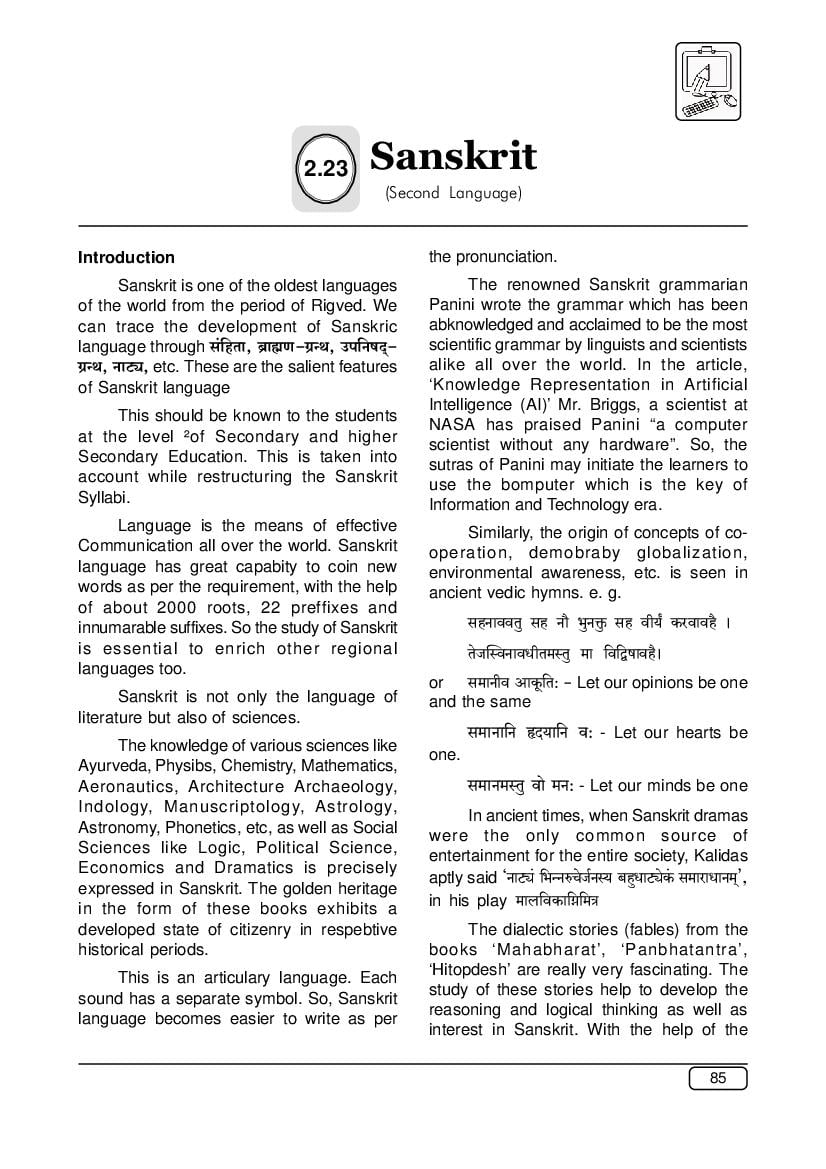
(Second Language)
Introduction the pronunciation.
Sanskrit is one of the oldest languages The renowned Sanskrit grammarian
of the world from the period of Rigved. We Panini wrote the grammar which has been
can trace the development of Sanskric abknowledged and acclaimed to be the most
language through g§{hVm, ~«m÷U-J«ÝW, Cn{ZfX²- scientific grammar by linguists and scientists
J«ÝW, ZmQ>ç, etc. These are the salient features alike all over the world. In the article,
of Sanskrit language ‘Knowledge Representation in Artificial
Intelligence (AI)’ Mr. Briggs, a scientist at
This should be known to the students
NASA has praised Panini “a computer
at the level ²of Secondary and higher scientist without any hardware”. So, the
Secondary Education. This is taken into sutras of Panini may initiate the learners to
account while restructuring the Sanskrit use the bomputer which is the key of
Syllabi. Information and Technology era.
Language is the means of effective Similarly, the origin of concepts of co-
Communication all over the world. Sanskrit operation, demobraby globalization,
language has great capabity to coin new environmental awareness, etc. is seen in
words as per the requirement, with the help ancient vedic hymns. e. g.
of about 2000 roots, 22 preffixes and
innumarable suffixes. So the study of Sanskrit ghZmddVw gh Zm¡ ^wZºw$ gh dr¶ª H$admdh¡ &
is essential to enrich other regional VoOpñdZmdYrV_ñVw _m {d{Ûfmdh¡&
languages too.
or g_mZrd AmHy${V: - Let our opinions be one
Sanskrit is not only the language of and the same
literature but also of sciences.
g_mZm{Z öX¶m{Z d: - Let our hearts be
The knowledge of various sciences like
one.
Ayurveda, Physibs, Chemistry, Mathematics,
Aeronautics, Architecture Archaeology, g_mZ_ñVw dmo _Z: - Let our minds be one
Indology, Manuscriptology, Astrology,
In ancient times, when Sanskrit dramas
Astronomy, Phonetics, etc, as well as Social were the only common source of
Sciences like Logic, Political Science, entertainment for the entire society, Kalidas
Economics and Dramatics is precisely
aptly said "ZmQ>ç§ {^ÝZéMoOZ© ñ` ~hþYmQ>çHo $§ g_mamYmZ_²',
expressed in Sanskrit. The golden heritage
in the form of these books exhibits a in his play _mb{dH$m{¾{‘Ì
developed state of citizenry in respebtive The dialectic stories (fables) from the
historical periods. books ‘Mahabharat’, ‘Panbhatantra’,
This is an articulary language. Each ‘Hitopdesh’ are really very fascinating. The
study of these stories help to develop the
sound has a separate symbol. So, Sanskrit
reasoning and logical thinking as well as
language becomes easier to write as per
interest in Sanskrit. With the help of the
85
Page 2
for good career in the field of animation. the help of the knowledge of Sanskrit.
N> Ý X _mÌm d¥ Î m are the characteristic 4. understand simple passages in
features of Sanskrit poetry. The knowledge Sanskrit
of meters like AZwïw>^², Am`m© etc. help the 5. answer the questions in Sanskrit orally.
students to recite the verses properly. Its
6. read and recite Sanskrit shlokas and
rhythm also conveys the sentiments and the
stotras fluently
expressions.
7. participate in different cultural
The noble charabters from ancient
programmes in Sanskrit
scripture like sage Agastya, sage Vasishtha,
eminent scholars like Varahamihir, 8. translate the Sanskrit passage into their
Aryabhatta, the king Bhagiratha etc. would mother tongue
certainly provide an idol to the students. 9. know the terminology of Indian
The syllabi at the Secondary level as languages such as Marathi, Hindi also
well as the graduate and postgraduate levels of Maths, Science and Social Science.
have been taken into consideration for the 10. enrich their Sanskrit vocaculary.
sake of proper integration. A serious thought
has been given to the New Educational 11. develop skills in reading aloud Sanskrit
approach of Maharashtra State Board. passages fluently with proper
Modern teaching aids would play an articulation, intonation, pronunciation
important role in the achievement of these and understanding.
objectives. 12. acquire skills in writing short
The knowledge of Sanskrit promotes compositions, passages and stories
the interdisciplinary studies e.g. Bhagvad 13. develop more interest in Sanskrit
Gita, the world famous book is the science literature.
of ‘Personality Development’, as well as 14. acquaint them with the cultural, spiritual
“Stress management”. So, the study of this and moral heritage of India.
book is essential in the study of Psychology,
Management ect, Kautilya Arthshastra and Specific Objectives
Political Science, Leelavati and Mathematics. To enable the students to
Moreover, the Study of Sanskrit 1. take interest in listening Sanskrit songs,
Literature helps to broaden the outlook of the hymns and Subhashitas.
learners.
2. understand programmes on Radio, T.V.
General Objectives
3. speak grammatically correct sentences.
To enable the students to
4. read various types of literature with
1. understand the basic structure of correct pause.
Sanskrit grammar.
5. use nouns, verbs, adjectives correctly.
2. speak simple sentences using proper
intonation 6. write answer in correct Sanskrit.
3. add to their vocabulary and modes of 7. translate unseen passages in Sanskrit
into the medium offered.
86
Page 3
subjects.
E) Voice- Active, Passive, Impersonal (^mdo
9. write correct compounds, sandhis and
à`moJ)
verb forms.
F) Participles.
Std. IX
1. Past Participles (ŠV,$ ŠVdVw)
1. Prose
2. Potential passive participles
About 200 lines
H$_©{U {dÜ`W©H$ Ym. gm. {deofU (`, Vì`, AZr`a²)
One lesson should be in the form of a
letter (formal or informal) 3. Gerunds ËdmÝV, ë`~ÝV (ŠËdm, ë`n²)
2. Poetry 4. Infinitive of purpose VwÝV (VwZ²)
About 120 lines. 60 lines for Recitation G) CnnX{d^{ŠV
120 H) Compounds g_mg - Aì``r^md, Û§Û, {d^{ŠV
One lesson should comprise of VËnwéf
following meters I) Numbers (1 to 20, 30, 40, 50, 60, 70,80,
AZwïw>^², ^wO§Jà`mV, Am`m© 90, 100)
3. Rapid Reading about 60 lines. J) Composition
(Prose and Poetry) 1. Answer in Sanskrit to the questions
4. Grammar based on text or - Arrange the
sentences chronologically
A) Nouns
2. Translation of unseen passages into
^mZw, YoZw, dYw, {nV¥, _mV¥, MÝÐ`g², n`g², _éV², the medium offered (Prose, Poetry,
OJV² Drama)
B) Pronouns 3. Translation of Sentences into
Sanskrit
gd©, AÝ`, ^dV², BX² (All genders)
or - Writing a Paragraph of 5 lines
C) Roots (A) in Sanskrit on a given topic
The roots belonging to 1, 4, 6, 10 or Gap Story (around 10 gaps)
classes of nañ_¡nX, AmË_ZonX Std. X
`m (`m{V) 2 P. P. Ag² (ApñV) 2 P.P. 1. Prose
H¥$. (H$amo{V, Hw$éVo) 8 U.P. About 200 lines
Uses of roots with prefixes. One lesson should be in the form of
Present Tense, past Tense, Imperative letter (formal or informal)
mood- Potential mood. 2. Poetry
D) gpÝY About 120 lines. 60 lines for Recitation
1) ñdagpÝY : JwU, d¥{Õ, Revision `U², One lesson should comprising of
following meters
A`m{X
87
Page 4
3. Rapid Reading 60 lines. (Prose and superlative degree)
Poetry) 7. Absolute Locative, g{V gá_r
4. Grammar
8. Causal à`moOH$ ({UM²)
1. Nouns - ^JdV², e{eZ², ^m{dZ², AmË_Z², 9. Numerals 1 to 20 (Cardinals and
Zm_Z², amOZ², H$_©Z², dmM², {Xe² Ordinals) g§»`m VWm H«$_dmMH$
2. Pronouns - Revision of pronouns
10. Present Participles dV©_mZ H$mbdmMH$
studied in VIII, IX Std. and AXg²
YmVwgm{YV {deofU (eV¥, emZM²)
3. Roots (A) - ~«y (2 U. P.), Xm (3 U. P.),
11. ì`§OZg§Yr
Amn² (5 P. P.), e¥ ( 5 P. P.), ^wO² (7 U. P.),
VZ² (8 U. P.), km, J«h ( 9 U. P.), 12. Compounds – VËnwéf g_mg, ~hþd«rhr
(remaining types)
Present Tense, Imperfect past tense
dV©_mZ H$mi (bQ>² bH$ma) àW_ ^yVH$mi (bS²>. 13. Uses of CnnX{d^{ŠV
bH$ma) 5. Composition
Imperative Potential 1. Answer in Sanskrit to the questions
based on text or Arrange the
AmkmW© (bmoQ²> bH$ma) {dÜ`W© ({d{Y {bS²>.) sentences chronologically
Second future, perfect past tense 2. Translation of unseen passages into
{ÛVr` ^{dî` H$mi (b¥Q>² bH$ma) namoj ^yVH$mi the medium offered (Prose, Poetry,
([bQ>² bH$ma) Drama)
of the above mentioned roots 3. Translation of sentences into
Sanskrit or - Writing a paragraph
4. (Denominative) Zm‘YmVy of about 5 lines in Sanskrit on a
5. pÀd ê$n, given topic or A gap story (8 gaps)
88
Document Details
| Board / Org | Maharashtra Board |
| Exam | Class 10 |
| Type | Syllabus |
| Pages | 4 |
| Updated | 09 Jun 2026 |