Maharashtra SSC Syllabus 2022 Social Science
Finished viewing? Save it for later —
Download Maharashtra SSC Syllabus 2022 Social Science (PDF · 7 pages)About Maharashtra SSC Syllabus 2022 Social Science
Maharashtra SSC Syllabus 2022 Social Science is available here for free download. Published by Maharashtra Board for Class 10, this syllabus can be viewed online or downloaded as a PDF (7 pages). Candidates preparing for Class 10 can use Maharashtra SSC Syllabus 2022 Social Science to understand the exam pattern, the type of questions asked, and the overall difficulty level.
Frequently Asked Questions
How can I download Maharashtra SSC Syllabus 2022 Social Science?
Open this page and click the Download button to save Maharashtra SSC Syllabus 2022 Social Science as a PDF. It is completely free on AglaSem Docs.
Is Maharashtra SSC Syllabus 2022 Social Science free to download?
Yes. Maharashtra SSC Syllabus 2022 Social Science can be viewed online and downloaded as a PDF free of cost on AglaSem Docs.
How many pages does Maharashtra SSC Syllabus 2022 Social Science have?
Maharashtra SSC Syllabus 2022 Social Science contains 7 pages, which you can read online or download together as a single PDF.
Where can I find more Class 10 study material?
You can find more Class 10 question papers, sample papers, syllabus, and answer keys on AglaSem Docs.
Maharashtra SSC Syllabus 2022 Social Science – Text
Read the full text of this syllabus below — useful to quickly search, copy and reference the content online without downloading the PDF.
📄 View text version (7 pages)
Page 1
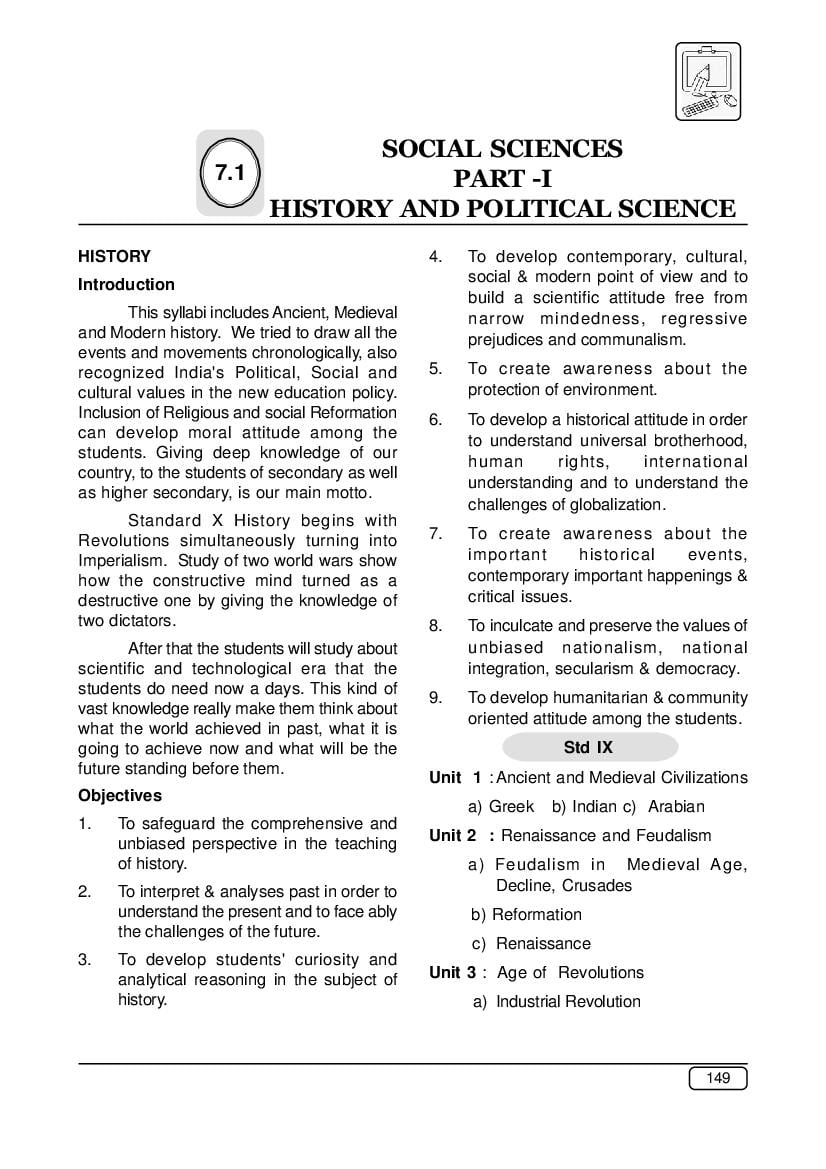
7.1 PART -I
HISTORY AND POLITICAL SCIENCE
HISTORY 4. To develop contemporary, cultural,
Introduction social & modern point of view and to
build a scientific attitude free from
This syllabi includes Ancient, Medieval narrow mindedness, regressive
and Modern history. We tried to draw all the prejudices and communalism.
events and movements chronologically, also
recognized India's Political, Social and 5. To create awareness about the
cultural values in the new education policy. protection of environment.
Inclusion of Religious and social Reformation 6. To develop a historical attitude in order
can develop moral attitude among the to understand universal brotherhood,
students. Giving deep knowledge of our
human rights, international
country, to the students of secondary as well
understanding and to understand the
as higher secondary, is our main motto.
challenges of globalization.
Standard X History begins with
Revolutions simultaneously turning into 7. To create awareness about the
Imperialism. Study of two world wars show important historical events,
how the constructive mind turned as a contemporary important happenings &
destructive one by giving the knowledge of critical issues.
two dictators. 8. To inculcate and preserve the values of
After that the students will study about unbiased nationalism, national
scientific and technological era that the integration, secularism & democracy.
students do need now a days. This kind of
9. To develop humanitarian & community
vast knowledge really make them think about
oriented attitude among the students.
what the world achieved in past, what it is
going to achieve now and what will be the Std IX
future standing before them.
Unit 1 : Ancient and Medieval Civilizations
Objectives
a) Greek b) Indian c) Arabian
1. To safeguard the comprehensive and
Unit 2 : Renaissance and Feudalism
unbiased perspective in the teaching
of history. a) Feudalism in Medieval Age,
2. To interpret & analyses past in order to Decline, Crusades
understand the present and to face ably b) Reformation
the challenges of the future.
c) Renaissance
3. To develop students' curiosity and
analytical reasoning in the subject of Unit 3 : Age of Revolutions
history. a) Industrial Revolution
149
Page 2
society. Basically all political activities are
c) French Revolution
studied in Political Science.
Std. X
Political Science is one of the
Unit 1 : Imperialism important Social Science. It deals with
a) Geographical discoveries and fundamental rights and duties of citizen,
colonization Electrical process, Constitution etc. Political
Science basically deals with Democracy,
b) Asia: India, China, Japan
political parties, Social diversity and its
c) Africa relationship with democracy. Through the
Unit 2 : 20th Century Age of conflict syllabus of political science an attempt is
made to explain the challenges to democracy.
a) First world war
Political Science trains students to
b) Russian Revolution
study actual day to day problem to identify
c) The League of Nations and analyse them.
d) Dictatorships in Europe, Second Objectives
World War and world
1. To introduce to students importance of
e) United Nations Organization Political Science in human life from
Unit 3 : Emancipation of Asia and Africa primitive age to modern times.
a) Asia 2. To introduce to students political
concepts and political ideologies.
b) Africa
3. To introduce India's political system to
Unit 4 : World after World War II
students.
a) Cold war
4. To introduce to students attitudes and
b) Scientific and Technological values strengthening healthy civic and
Progress political life.
c) Globalization 5. To develop sense of responsibility
POLITICAL SCIENCE regarding voting process for developing
participatory democracy.
Introduction
6. To strengthen awareness about
This subject was earlier known as
Fundamental Rights and Duties listed
civics. The students were learning basically
in constitution.
about rights and duties in this subject.
Students are also expected to learn political 7. To introduce to the students social
concepts like democracy, political parties, etc. diversity in Democracy.
Therefore, the students will learn Political Std. IX
Science at this stage.
1. Introduction to Political Science
Political Science is a Social Science. Meaning, Nature and Scope.
We all live in a society. So we must learn
2. Making of the Constitution of India
150
Page 3
Assembly Preamble to the constitution Need, Types of Political Parties -
of India National and Regional
3. Fundamental Rights and Duties, Need 3 Social Diversity and Democracy.
of Fundamental Rights, Fundamental What is social diversity?
Rights mentioned in Indian Constitution
i) Caste/race and Democracy
What are Duties?
ii) Language and Democracy
4. Electoral Process
iii) Religion and Democracy
What is election? Voter, Constituency,
iv) Gender and Democracy
Candidate,
4. Challenges to Democracy Remedial
Adult franchise, Direct and Indirect
measures to the challenges
election
5. Internal work
5. Internal Work
Std. X
1. Democracy
Meaning, Types and characteristics
151
Page 4
7.2 Part - II
GEOGRAPHY AND ECONOMICS
GEOGRAPHY Objectives
Introduction To enable the students to
Students at early state are very corious, 1. Develop an understanding of man and
so while observing they learn geography environment, their interrelationship at
unknowingly. Hence Geography is introduced the global level
in their syllabus at early stage. Gradually from 2. Develop awareness to protect the
their doorstep they are taken to the world environment
through curriculum. At 9th and 10th level
students are well equipped with information 3. Protect and improve the natural
about natural processes operating in different resources including forests, water, soils
parts of the world. At this stage they are being and wild life
exposed to aerial differentiation and 4. Understand and appreciate the diversity
problems arising out of them. The regional of land and people of the country with
differentiations are basically because of its unity underlying
differences in natural resources as well as
5. Enhance & deepen the knowledge and
the ability and efficiency of the people to utilize
understanding of Indian environment in
them and hence at this level they are
its totality. Their interactive processes
introduced to understand the resource base
and effects on the quality of life in future
and analyse the reasons of regional
imbalance. 6. Develop an understanding and concern
about the growing population and its
Maharashtra being a home state of the
impact on the environment
students, these concepts are introduced with
Maharashtra and then in the next step to 7. Develop an appreciation of the
India. interdependence of nations and regions
of the world in general and India in
The SCF (State Curriculum Frame
particular.
work) has been introduced in 2010 by
Government of Maharashtra is very much in 8. Develop scientific knowledge by
line with NCERT ( National Council for promoting the spirit of enquiry and
Educational and Research Training ) Which following a rational and objective
gives emphasis on students participation in approach
creation of knowledge as well as active 9. Develop skills and abilities to read,
learning for the syllabus for geography to understand and analyse geographical
promote these Objectives outlined in the data presented in various forms such
SCF2010 as photographs, maps, graphs,
diagrams and charts
152
Page 5
Std. IX Std. X
Unit 1: Concept of Region Unit 1: Physical Divisions of India
1.1 Concept of Region 1.1 Identification of Physical divisions
1.2 Identification of a region Unit 2: North Indian Mountains
Unit 2: Natural resources 2.1 Himalayas
2.1 Land 2.2 Associated mountains
2.2 Water Unit 3: North Indian Plain Region
2.3 Soil 3.1 Deserts
2.4 Forests 3.2 Western Plains
2.5 Minerals
3.3 Central Plains
Unit 3: Occupations
3.4 Eastern Plains
3.1 Classification of occupations
3.5 Delta region
Unit 4: Agriculture
Unit 4: Peninsular Plateau Region
4.1 Types of agriculture
4.1 Malwa Plateau
4.2 Major crops
4.2 Chhotta Nagpur Plateau
Unit 5: Industries
4.3 Maharashtra Plateau
5.1 Agro-based industries
4.4 Karnataka Plateau
5.2 Other industries
4.5 Telangana Plateau
Unit 6 : Transportation, Communication
and Tourism Unit 5: Western Ghats and Eastern Ghats
6.1 Types of transportation 5.1 Sahyadries
6.2 Means of Communication 5.2 Eastern Ghats
6.3 Tourism Unit 6: Coastal Region
Unit 7: Population 6.1 Eastern coastal plain
7.1 Growth of population 6.2 Western coastal plain
7.2 Structure of population Unit 7: Indian Islands
Unit 8: Regional development 7.1 Western Islands
8.1 Human development Index 7.2 Eastern Islands
8.2 Regional development in Maharashtra Unit 8: Practical
Unit 9: Practical 8.1 Cartography
9.1 Cartography Unit 9: Practical
9.2 Isopleths maps 9.1 One dimensional diagrams
9.3 Field study 9.2 Two dimensional diagrams
153
Page 6
Introduction students with the help of local level
projects.
According to the National Educational
Policy 1986, Economics has been included 9. To develop awareness among the
in Social Science faculty to be taught at IX students about the co-relationship
and X standard. Keeping in view the between economy and environment.
Objectives of NCF 2005 to provide 10. Creation, construction and application
information of Economics and Nature of?” of knowledge among the students
Economy through constructivism to the through self realization & action.
students of Secondary Section, the subject
Objectives
Economics has been included in SCF 2010
for the students of IX & X standard. While The study of Economics as a part of
preparing the curriculum and the Objectives Social Science starts from Std. IX to
of Economics, Consideration has been made introduce Economics to these students and
of Recent Events and Future changes in the make them easy to understand, the following
economy and also to develop the potentials objectives are determined.
of the students.
1. To introduce subject of economics to
General Objectives the students.
1. Economics is one of the important 2. To develop Self Study with the help of
subjects in Social Science. The subject Basic Economic concepts.
should be taught with scientific methods
so that it becomes easy and simple for 3. With the help of the concept of Family
the students to understand. Budget, explain the students concepts
of Family Income & Expenditure.
2. To provide primary information to the
students about Economics & Nature of 4. To explain the concept of Want.
Economy with changing time. Std IX
3. To develop skills & abilities of the 1. INTROCUCTION OF ECONOMICS
students to use the scarce resources
(Natural and human resources) in 1.1 Introduction
efficient and optimum manner. 1.2 Concept of Economics, Meaning &
4. To develop creativity among the Definition
students to solve the economic 1.3 Importance of Economics
problem.
2. BASIC ECONOMIC CONCEPTS
5. To create awareness among the
students about local Economic 2.1 Human wants & classification of wants
problems and challenges. 2.2 Commodity - Economic goods & Free
6. To introduce to the students Economic goods.
concepts, economic planning and new 2.3 Resources & Scarcity of resources.
economic policies.
2.4 Utility, value & Price.
7. To develop potential of self study
among the students.
154
Page 7
solution
3. SOURCES OF INCOME
2.1) Introduction
3.1 Personal Income - Agriculture, Industry,
2.2) Problems
Trade, Agro allied Industry- Allutedar,
Balutedar, Small Scale & Cottage For whom to produce?
Industry. How much to produce?
3.2 Modern Sources of Income- By whom to produce?
Income from Service Sector- Transport, How best are the resources being
Communication, used?
Doctor, Lawyer, Chartered Accountant, 2.3) Solutions
Cyber Café.
Capitalism
4. FAMILY BUDGET
Socialism
4.1 Income & Expenditure, Explanation with
the help of Examples. Mixed Economy
Inflation
4.2 Project on Income & Expenditure of
family (local level) 3.1 Introduction
Std X 3.2. Causes of inflation
Objectives 3.3. Effects of inflation
1) To give information about Indian 3.4. Measures
Economy to the students. 4) Public distribution system &
2) To make the students realize the consumer protection
problems of Indian Economy. 4.1. Introduction
3) To inform the students about different 4.2. Public Distribution system - meaning &
sectors of economy. explanation
4) To make the students aware of 4.3. Objectives of P.D.S.
consumer's rights.
4.4. Progress of P.D.S.
Std X
4.5. Drawbacks of P.D.S.
Topics
4.6. Remedial Measures
1.1) Introduction of an Economy
4.7. Consumer Protection - Rights & duties
1.2) What is an economy? of cunsumer, food adulteration.
1.3) Types of Economy
1.4) Main features of Economy
155
Document Details
| Board / Org | Maharashtra Board |
| Exam | Class 10 |
| Type | Syllabus |
| Pages | 7 |
| Updated | 22 Jul 2026 |