Maharashtra 12th Std Model Question Paper 2027 Economics
Finished viewing? Save it for later —
Download Maharashtra 12th Std Model Question Paper 2027 Economics (PDF · 3 pages)About Maharashtra 12th Std Model Question Paper 2027 Economics
Maharashtra 12th Std Model Question Paper 2027 Economics is available here for free download. Published by Maharashtra Board for Class 12, this sample paper can be viewed online or downloaded as a PDF (3 pages). Candidates preparing for Class 12 can use Maharashtra 12th Std Model Question Paper 2027 Economics to understand the exam pattern, the type of questions asked, and the overall difficulty level.
Frequently Asked Questions
How can I download Maharashtra 12th Std Model Question Paper 2027 Economics?
Open this page and click the Download button to save Maharashtra 12th Std Model Question Paper 2027 Economics as a PDF. It is completely free on AglaSem Docs.
Is Maharashtra 12th Std Model Question Paper 2027 Economics free to download?
Yes. Maharashtra 12th Std Model Question Paper 2027 Economics can be viewed online and downloaded as a PDF free of cost on AglaSem Docs.
How many pages does Maharashtra 12th Std Model Question Paper 2027 Economics have?
Maharashtra 12th Std Model Question Paper 2027 Economics contains 3 pages, which you can read online or download together as a single PDF.
Where can I find more Class 12 study material?
You can find more Class 12 question papers, sample papers, syllabus, and answer keys on AglaSem Docs.
Maharashtra 12th Std Model Question Paper 2027 Economics – Text
Read the full text of this sample paper below — useful to quickly search, copy and reference the content online without downloading the PDF.
📄 View text version (3 pages)
Page 1
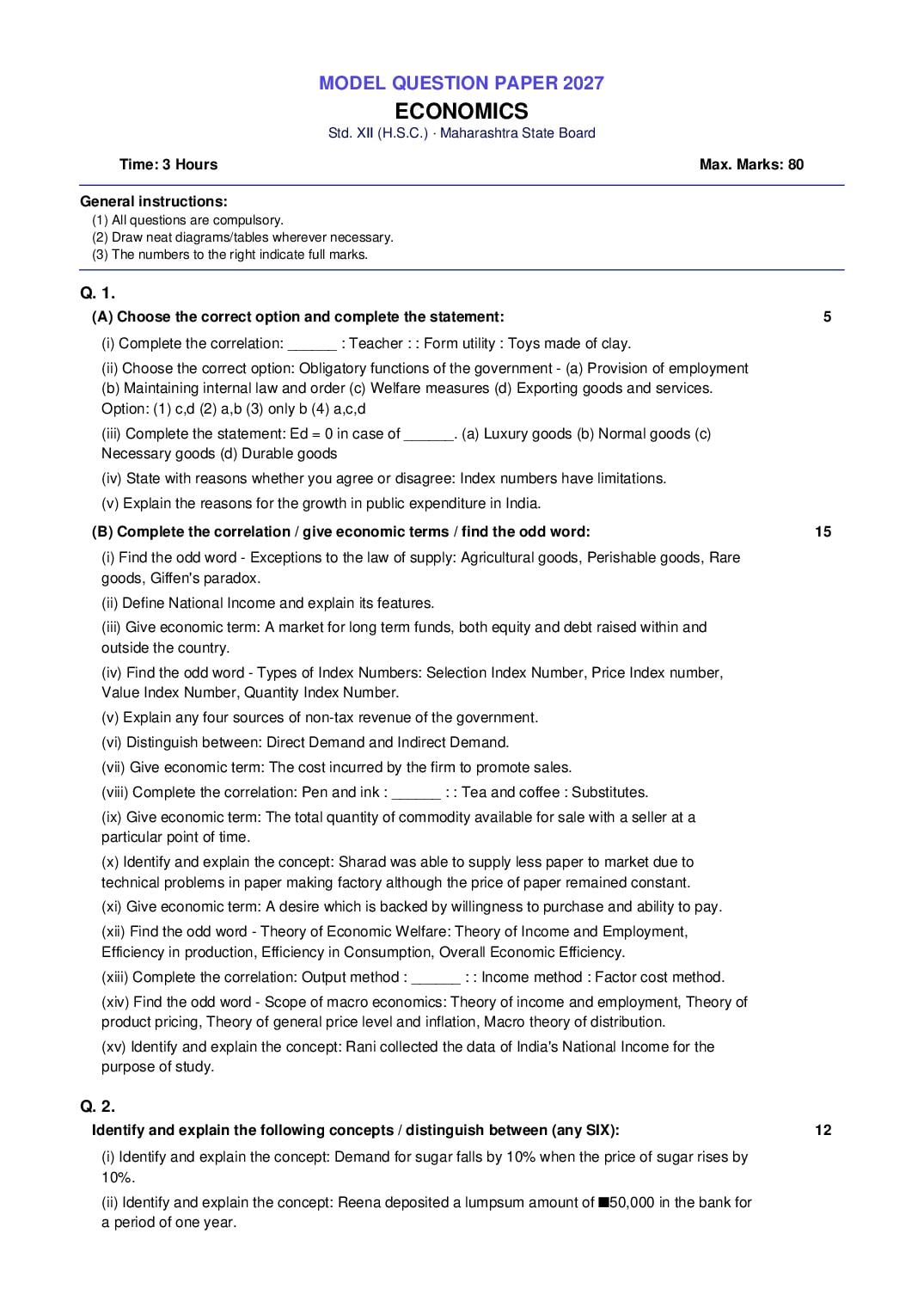
ECONOMICS
Std. XII (H.S.C.) · Maharashtra State Board
Time: 3 Hours Max. Marks: 80
General instructions:
(1) All questions are compulsory.
(2) Draw neat diagrams/tables wherever necessary.
(3) The numbers to the right indicate full marks.
Q. 1.
(A) Choose the correct option and complete the statement: 5
(i) Complete the correlation: ______ : Teacher : : Form utility : Toys made of clay.
(ii) Choose the correct option: Obligatory functions of the government - (a) Provision of employment
(b) Maintaining internal law and order (c) Welfare measures (d) Exporting goods and services.
Option: (1) c,d (2) a,b (3) only b (4) a,c,d
(iii) Complete the statement: Ed = 0 in case of ______. (a) Luxury goods (b) Normal goods (c)
Necessary goods (d) Durable goods
(iv) State with reasons whether you agree or disagree: Index numbers have limitations.
(v) Explain the reasons for the growth in public expenditure in India.
(B) Complete the correlation / give economic terms / find the odd word: 15
(i) Find the odd word - Exceptions to the law of supply: Agricultural goods, Perishable goods, Rare
goods, Giffen's paradox.
(ii) Define National Income and explain its features.
(iii) Give economic term: A market for long term funds, both equity and debt raised within and
outside the country.
(iv) Find the odd word - Types of Index Numbers: Selection Index Number, Price Index number,
Value Index Number, Quantity Index Number.
(v) Explain any four sources of non-tax revenue of the government.
(vi) Distinguish between: Direct Demand and Indirect Demand.
(vii) Give economic term: The cost incurred by the firm to promote sales.
(viii) Complete the correlation: Pen and ink : ______ : : Tea and coffee : Substitutes.
(ix) Give economic term: The total quantity of commodity available for sale with a seller at a
particular point of time.
(x) Identify and explain the concept: Sharad was able to supply less paper to market due to
technical problems in paper making factory although the price of paper remained constant.
(xi) Give economic term: A desire which is backed by willingness to purchase and ability to pay.
(xii) Find the odd word - Theory of Economic Welfare: Theory of Income and Employment,
Efficiency in production, Efficiency in Consumption, Overall Economic Efficiency.
(xiii) Complete the correlation: Output method : ______ : : Income method : Factor cost method.
(xiv) Find the odd word - Scope of macro economics: Theory of income and employment, Theory of
product pricing, Theory of general price level and inflation, Macro theory of distribution.
(xv) Identify and explain the concept: Rani collected the data of India's National Income for the
purpose of study.
Q. 2.
Identify and explain the following concepts / distinguish between (any SIX): 12
(i) Identify and explain the concept: Demand for sugar falls by 10% when the price of sugar rises by
10%.
(ii) Identify and explain the concept: Reena deposited a lumpsum amount of ■50,000 in the bank for
a period of one year.
Page 2
government.
(iv) Complete the statement: When a government borrows from its citizens, banks, central bank,
industries, etc. it is known as ______. (a) Internal Debt (b) Personal Debt (c) External Debt (d)
International Debt
(v) Distinguish between: Micro Economics and Macro Economics.
(vi) State with reasons whether you agree or disagree: Marginal utility and total utility are the same.
Q. 3.
Answer the following (any THREE): 12
(i) Explain any four features of utility.
(ii) In the following diagram AE is the linear demand curve of a commodity. State whether True or
False: (1) Demand at point 'C' is relatively elastic demand. (2) Demand at point 'B' is unitary elastic
demand. (3) Demand at point 'D' is perfectly inelastic. (4) Demand at point 'A' is perfectly elastic
demand.
(iii) State with reasons whether you agree or disagree: There are many assumptions to the law of
supply.
(iv) Explain the practical difficulties involved in the measurement of national income.
(v) Explain any four features of micro economics.
Q. 4.
State with reasons whether you agree or disagree (any THREE): 12
(i) Explain any four factors influencing elasticity of demand.
(ii) Explain the role of money market in India.
(iii) Calculate Price Index Number from the given data: Commodity A, B, C, D; Price in 2015 (■): 6,
16, 24, 4; Price in 2020 (■): 8, 18, 28, 6.
(iv) Choose the correct options: Under perfect competition, sellers are. (a) Price makers (b) Price
takers (c) Price discriminators (d) None of these. Options: (1) a,b and c (2) Only b (3) Only c (4) a
and c
(v) Complete the statement: The Price Index number is used ______. (a) to measure the general
changes in the prices of goods (b) as a geographical tool (c) to measure the air pressure (d) in
measurements of goods
Q. 5.
Study the table / figure / passage and answer the questions (any TWO): 8
(i) Explain the types of demand.
(ii) Explain Ratio method of measuring elasticity of demand.
(iii) State with reasons whether you agree or disagree: There are no real exceptions to the law of
Diminishing Marginal Utility.
Q. 6.
Answer the following questions in detail (any TWO): 16
(i) State and explain the law of demand with its exceptions.
(ii) State with reasons whether you agree or disagree: Price maker is the only feature of monopoly
market.
(iii) Explain the functions of Reserve Bank of India.
Page 3
purpose only.
Document Details
| Board / Org | Maharashtra Board |
| Exam | Class 12 |
| Type | Question Paper |
| Pages | 3 |
| Language | english |
| Updated | 24 Sep 2026 |