Maharashtra 12th Std Model Question Paper 2027 Chemistry
Finished viewing? Save it for later —
Download Maharashtra 12th Std Model Question Paper 2027 Chemistry (PDF · 3 pages)About Maharashtra 12th Std Model Question Paper 2027 Chemistry
Maharashtra 12th Std Model Question Paper 2027 Chemistry is available here for free download. Published by Maharashtra Board for Class 12, this sample paper can be viewed online or downloaded as a PDF (3 pages). Candidates preparing for Class 12 can use Maharashtra 12th Std Model Question Paper 2027 Chemistry to understand the exam pattern, the type of questions asked, and the overall difficulty level.
Frequently Asked Questions
How can I download Maharashtra 12th Std Model Question Paper 2027 Chemistry?
Open this page and click the Download button to save Maharashtra 12th Std Model Question Paper 2027 Chemistry as a PDF. It is completely free on AglaSem Docs.
Is Maharashtra 12th Std Model Question Paper 2027 Chemistry free to download?
Yes. Maharashtra 12th Std Model Question Paper 2027 Chemistry can be viewed online and downloaded as a PDF free of cost on AglaSem Docs.
How many pages does Maharashtra 12th Std Model Question Paper 2027 Chemistry have?
Maharashtra 12th Std Model Question Paper 2027 Chemistry contains 3 pages, which you can read online or download together as a single PDF.
Where can I find more Class 12 study material?
You can find more Class 12 question papers, sample papers, syllabus, and answer keys on AglaSem Docs.
Maharashtra 12th Std Model Question Paper 2027 Chemistry – Text
Read the full text of this sample paper below — useful to quickly search, copy and reference the content online without downloading the PDF.
📄 View text version (3 pages)
Page 1
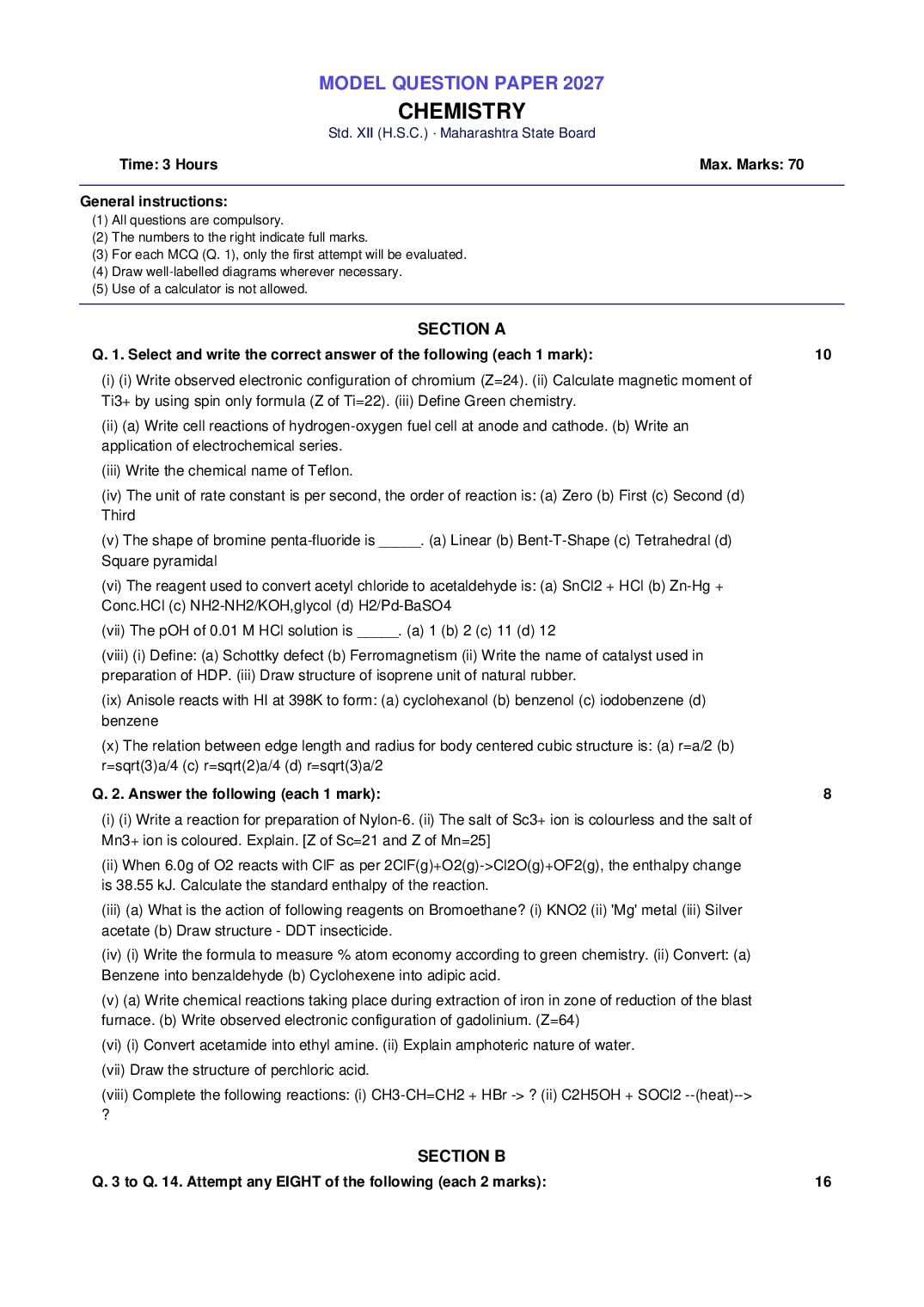
CHEMISTRY
Std. XII (H.S.C.) · Maharashtra State Board
Time: 3 Hours Max. Marks: 70
General instructions:
(1) All questions are compulsory.
(2) The numbers to the right indicate full marks.
(3) For each MCQ (Q. 1), only the first attempt will be evaluated.
(4) Draw well-labelled diagrams wherever necessary.
(5) Use of a calculator is not allowed.
SECTION A
Q. 1. Select and write the correct answer of the following (each 1 mark): 10
(i) (i) Write observed electronic configuration of chromium (Z=24). (ii) Calculate magnetic moment of
Ti3+ by using spin only formula (Z of Ti=22). (iii) Define Green chemistry.
(ii) (a) Write cell reactions of hydrogen-oxygen fuel cell at anode and cathode. (b) Write an
application of electrochemical series.
(iii) Write the chemical name of Teflon.
(iv) The unit of rate constant is per second, the order of reaction is: (a) Zero (b) First (c) Second (d)
Third
(v) The shape of bromine penta-fluoride is _____. (a) Linear (b) Bent-T-Shape (c) Tetrahedral (d)
Square pyramidal
(vi) The reagent used to convert acetyl chloride to acetaldehyde is: (a) SnCl2 + HCl (b) Zn-Hg +
Conc.HCl (c) NH2-NH2/KOH,glycol (d) H2/Pd-BaSO4
(vii) The pOH of 0.01 M HCl solution is _____. (a) 1 (b) 2 (c) 11 (d) 12
(viii) (i) Define: (a) Schottky defect (b) Ferromagnetism (ii) Write the name of catalyst used in
preparation of HDP. (iii) Draw structure of isoprene unit of natural rubber.
(ix) Anisole reacts with HI at 398K to form: (a) cyclohexanol (b) benzenol (c) iodobenzene (d)
benzene
(x) The relation between edge length and radius for body centered cubic structure is: (a) r=a/2 (b)
r=sqrt(3)a/4 (c) r=sqrt(2)a/4 (d) r=sqrt(3)a/2
Q. 2. Answer the following (each 1 mark): 8
(i) (i) Write a reaction for preparation of Nylon-6. (ii) The salt of Sc3+ ion is colourless and the salt of
Mn3+ ion is coloured. Explain. [Z of Sc=21 and Z of Mn=25]
(ii) When 6.0g of O2 reacts with ClF as per 2ClF(g)+O2(g)->Cl2O(g)+OF2(g), the enthalpy change
is 38.55 kJ. Calculate the standard enthalpy of the reaction.
(iii) (a) What is the action of following reagents on Bromoethane? (i) KNO2 (ii) 'Mg' metal (iii) Silver
acetate (b) Draw structure - DDT insecticide.
(iv) (i) Write the formula to measure % atom economy according to green chemistry. (ii) Convert: (a)
Benzene into benzaldehyde (b) Cyclohexene into adipic acid.
(v) (a) Write chemical reactions taking place during extraction of iron in zone of reduction of the blast
furnace. (b) Write observed electronic configuration of gadolinium. (Z=64)
(vi) (i) Convert acetamide into ethyl amine. (ii) Explain amphoteric nature of water.
(vii) Draw the structure of perchloric acid.
(viii) Complete the following reactions: (i) CH3-CH=CH2 + HBr -> ? (ii) C2H5OH + SOCl2 --(heat)-->
?
SECTION B
Q. 3 to Q. 14. Attempt any EIGHT of the following (each 2 marks): 16
Page 2
Calculate the density of gold. Molar mass of gold is 197 g mol-1.
(ii) What is the action of following reagents on ethyl amine? (Indicate by reaction) (a) Nitrous acid (b)
Chloroform and KOH
(iii) (a) Explain anomalous behaviour of oxygen with respect to (i) Atomicity (ii) Magnetic property
(iii) Oxidation state (iv) Nature of hydride (b) Write any two uses of helium.
(iv) Explain aldol condensation reaction with respect to ethanal.
(v) (a) State Raoult's law. (b) Derive the relationship to determine molar mass of non volatile solute
by depression of freezing point.
(vi) (a) Mention the names of four principles of green chemistry. (b) Write advantages of
nanoparticles and nanotechnology in the field of energy sector.
(vii) How many coulombs of electricity is required to produce 1g of sodium metal by reduction of
sodium ion?
(viii) (i) Convert ethanoic acid to ethanol. (ii) Explain the mechanism of alkaline hydrolysis of
bromomethane.
(ix) (a) Write general electronic configuration of 3d series elements. (b) Write any two points which
explain about the colour of a transition metal ion.
(x) Explain Cannizzaro reaction with suitable example.
(xi) Write two similarities and two differences between lanthanoids and actinoids.
(xii) (i) Define: Common ion effect. (ii) Write preparation of glucose from starch.
SECTION C
Q. 15 to Q. 26. Attempt any EIGHT of the following (each 3 marks): 24
(i) Convert the following: (a) Acetic acid to ethyl alcohol (b) Acetic acid to acetic anhydride (c) Acetyl
chloride to acetamide
(ii) (a) Write the representation of sodium hexacyanoferrate (III). (b) Write type of hybridization and
magnetic behaviour of: (i) [Co(NH3)6]3+ (ii) [NiCl4]2-
(iii) (i) What is peptide linkage? (ii) Write general characteristics of interhalogen compounds.
(iv) A solution has hydrogen ion concentration 0.01M. Calculate pOH of the same solution.
(v) (i) Acetic acid is 5% ionised in its decimolar solution. Calculate the dissociation constant of acetic
acid. (ii) Write chemical formula of epsom salt. Give two uses of H2SO4.
(vi) Derive the relation between half life and rate constant for a first order reaction.
(vii) Write the names of the metal elements in brass alloy.
(viii) Calculate maximum work done when 32 g of oxygen expanded isothermally and reversibly
from pressure 2 bar to 1 bar at 298 K.
(ix) Write preparation of glucose from sucrose.
(x) (a) State second law of thermodynamics. (b) Define - Nucleotides. (c) Write chemical reaction for
conversion of benzene diazonium chloride into benzene.
(xi) The standard potential of electrode Cu++ (0.02 M) | Cu(s) is 0.337 volt. Calculate its potential in
volt.
(xii) Derive Ostwald's dilution law equation for a weak acid.
SECTION D
Q. 27 to Q. 31. Attempt any THREE of the following (each 4 marks): 12
(i) (a) Derive relationship between dH and dU for a gaseous chemical reaction. (b) Give reason -
Ozone is a good bleaching agent. (c) Write any two uses of SO2.
(ii) Define the following terms: (a) Intensive property (b) Standard enthalpy of combustion
(iii) (a) Define: (i) Co-ordination numbers (ii) Ambidentate ligand (b) Write a note on Clemmensen
reduction of propanone.
Page 3
Isochoric process (b) Adiabatic process
(v) (a) Define - Polymorphism. (b) State and explain Hess's law of constant summation. Write its one
application.
This is a model / practice paper built by AglaSem from an analysis of past MSBSHSE board papers. It follows the current board pattern for practice
purpose only.
Document Details
| Board / Org | Maharashtra Board |
| Exam | Class 12 |
| Type | Question Paper |
| Pages | 3 |
| Language | english |
| Updated | 24 Sep 2026 |