Maharashtra 12th Std Model Question Paper 2027 Biology
Finished viewing? Save it for later —
Download Maharashtra 12th Std Model Question Paper 2027 Biology (PDF · 3 pages)About Maharashtra 12th Std Model Question Paper 2027 Biology
Maharashtra 12th Std Model Question Paper 2027 Biology is available here for free download. Published by Maharashtra Board for Class 12, this sample paper can be viewed online or downloaded as a PDF (3 pages). Candidates preparing for Class 12 can use Maharashtra 12th Std Model Question Paper 2027 Biology to understand the exam pattern, the type of questions asked, and the overall difficulty level.
Frequently Asked Questions
How can I download Maharashtra 12th Std Model Question Paper 2027 Biology?
Open this page and click the Download button to save Maharashtra 12th Std Model Question Paper 2027 Biology as a PDF. It is completely free on AglaSem Docs.
Is Maharashtra 12th Std Model Question Paper 2027 Biology free to download?
Yes. Maharashtra 12th Std Model Question Paper 2027 Biology can be viewed online and downloaded as a PDF free of cost on AglaSem Docs.
How many pages does Maharashtra 12th Std Model Question Paper 2027 Biology have?
Maharashtra 12th Std Model Question Paper 2027 Biology contains 3 pages, which you can read online or download together as a single PDF.
Where can I find more Class 12 study material?
You can find more Class 12 question papers, sample papers, syllabus, and answer keys on AglaSem Docs.
Maharashtra 12th Std Model Question Paper 2027 Biology – Text
Read the full text of this sample paper below — useful to quickly search, copy and reference the content online without downloading the PDF.
📄 View text version (3 pages)
Page 1
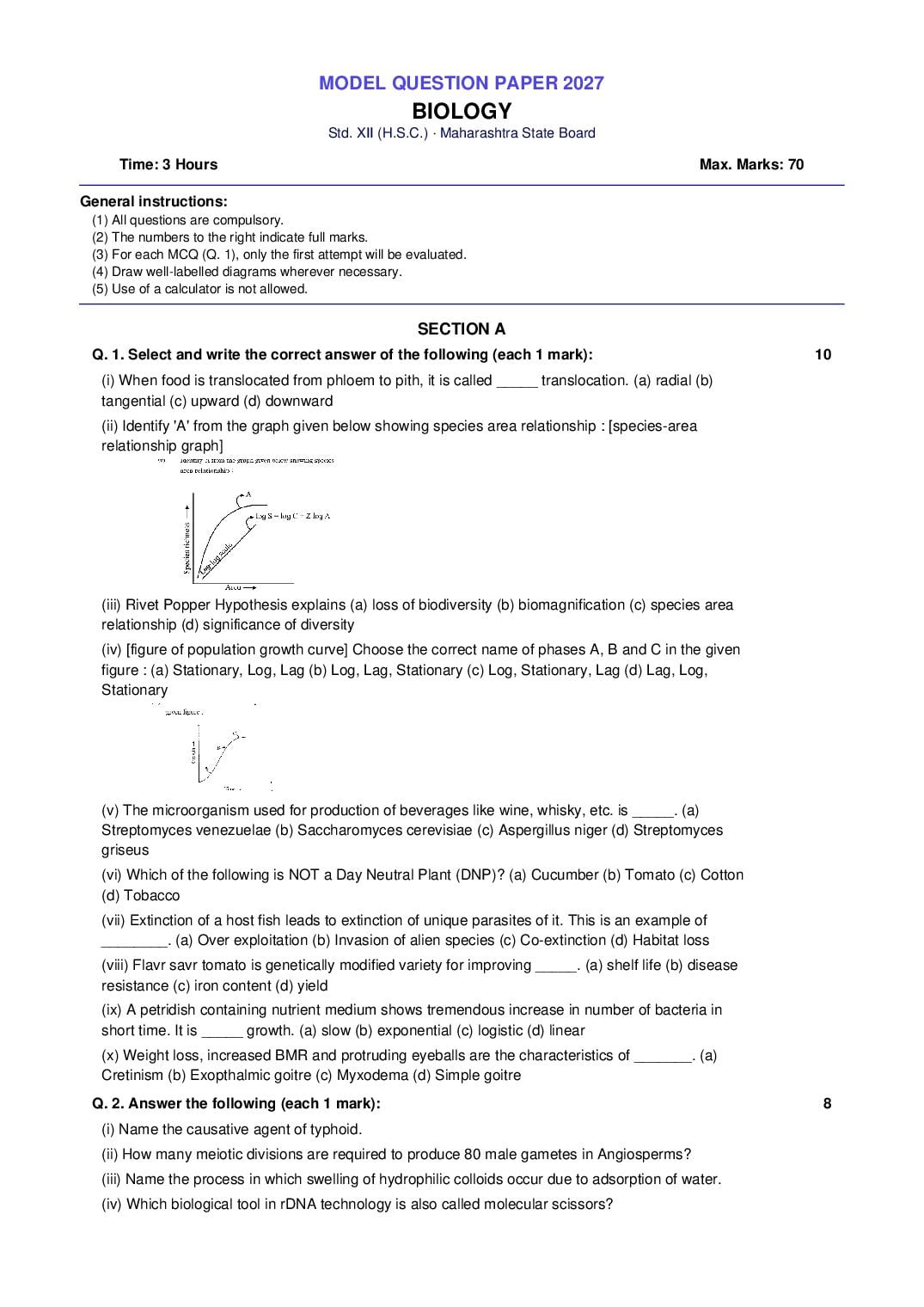
BIOLOGY
Std. XII (H.S.C.) · Maharashtra State Board
Time: 3 Hours Max. Marks: 70
General instructions:
(1) All questions are compulsory.
(2) The numbers to the right indicate full marks.
(3) For each MCQ (Q. 1), only the first attempt will be evaluated.
(4) Draw well-labelled diagrams wherever necessary.
(5) Use of a calculator is not allowed.
SECTION A
Q. 1. Select and write the correct answer of the following (each 1 mark): 10
(i) When food is translocated from phloem to pith, it is called _____ translocation. (a) radial (b)
tangential (c) upward (d) downward
(ii) Identify 'A' from the graph given below showing species area relationship : [species-area
relationship graph]
(iii) Rivet Popper Hypothesis explains (a) loss of biodiversity (b) biomagnification (c) species area
relationship (d) significance of diversity
(iv) [figure of population growth curve] Choose the correct name of phases A, B and C in the given
figure : (a) Stationary, Log, Lag (b) Log, Lag, Stationary (c) Log, Stationary, Lag (d) Lag, Log,
Stationary
(v) The microorganism used for production of beverages like wine, whisky, etc. is _____. (a)
Streptomyces venezuelae (b) Saccharomyces cerevisiae (c) Aspergillus niger (d) Streptomyces
griseus
(vi) Which of the following is NOT a Day Neutral Plant (DNP)? (a) Cucumber (b) Tomato (c) Cotton
(d) Tobacco
(vii) Extinction of a host fish leads to extinction of unique parasites of it. This is an example of
________. (a) Over exploitation (b) Invasion of alien species (c) Co-extinction (d) Habitat loss
(viii) Flavr savr tomato is genetically modified variety for improving _____. (a) shelf life (b) disease
resistance (c) iron content (d) yield
(ix) A petridish containing nutrient medium shows tremendous increase in number of bacteria in
short time. It is _____ growth. (a) slow (b) exponential (c) logistic (d) linear
(x) Weight loss, increased BMR and protruding eyeballs are the characteristics of _______. (a)
Cretinism (b) Exopthalmic goitre (c) Myxodema (d) Simple goitre
Q. 2. Answer the following (each 1 mark): 8
(i) Name the causative agent of typhoid.
(ii) How many meiotic divisions are required to produce 80 male gametes in Angiosperms?
(iii) Name the process in which swelling of hydrophilic colloids occur due to adsorption of water.
(iv) Which biological tool in rDNA technology is also called molecular scissors?
Page 2
pressure deficit?
(vi) What are Long Day Plants (LDP)?
(vii) Which part of human brain is responsible for maintaining body balance?
(viii) What is the approximate volume of blood pumped out during one cardiac cycle in adult human?
SECTION B
Q. 3 to Q. 14. Attempt any EIGHT of the following (each 2 marks): 16
(i) Interpret the given diagrams A and B. Enlist the changes occuring during inspiration and
expiration. [diagrams A and B of breathing mechanism]
(ii) Match the following from Column-A and Column-B. Write the correct pairs. Column A: (i)
Anaemia (ii) Atherosclerosis (iii) Parturition (iv) Blood clots (v) Cancer (vi) Diabetes. Column B: (1)
Platelet derived growth factor (2) Relaxin (3) Insulin (4) Erythropoietin (5) Tissue plasminogen
activator (TPA) (6) Interferons, tumour necrosis factor interleukins.
(iii) With the help of a labelled diagram, describe the structure of root-hair.
(iv) Give the skeletal features of Homo erectus.
(v) Identify A, B and C from the given diagram of Graafian follicle and mention their significance :
[diagram of Graafian follicle]
(vi) Match the respiratory surface to the organism in which it is found : Organisms: (1) Limulus (2)
Protists (3) Tadpoles of frog (4) Fishes (5) Reptiles (6) Spiders. Respiratory surface/organs: (a)
Lungs (b) Internal gills (c) Book lungs (d) External gills (e) Plasma membrane (f) Book gills (g)
Cloaca.
(vii) (a) What is DNA profiling? (b) Arrange the following steps of DNA profiling in correct sequence:
(i) Selection of DNA probe (ii) Isolation of DNA (iii) Gel electrophoresis (iv) Hybridization (v)
Southern blotting (vi) Restriction digestion
(viii) Mention any four factors affecting water absorption.
(ix) Enlist the names of VI, VII, VIII and IX cranial nerves.
(x) Mention any six symptoms of disorder caused by trisomy of 21st chromosome.
(xi) Enlist any four uses of gene therapy.
(xii) Identify the disorders showing following symptoms : (a) Constriction of bronchioles, mucus build
up in bronchioles, periodic wheezing, difficulty in breathing. (b) Inflammation of sinuses and mucous
discharge.
SECTION C
Q. 15 to Q. 26. Attempt any EIGHT of the following (each 3 marks): 24
(i) Explain leaching, humification and mineralization as the steps of decomposition process.
(ii) Give location and function of any four valves present in human heart.
(iii) (a) Enlist any four mineral deficiency symptoms seen in plants. (b) Give the function of
molybdenum as mineral nutrient.
(iv) What is transpiration? Explain stomatal opening and closing mechanism with reference to
starch-sugar interconversion theory.
Page 3
(vi) Write any three characters each of Archaeopteryx showing Reptilian and Avian features.
(vii) (a) Give the composition of biogas. (b) Enlist the benefits of biogas.
(viii) Describe the transcription and processing of hnRNA to mRNA in Eukaryotes.
(ix) (a) Following are the diagrams of entry of pollen tube into ovule. Identify the type A and B.
[diagrams of pollen tube entry into ovule] (b) Give any four points of significance of double
fertilization.
(x) Explain different steps involved in PCR technique.
(xi) Give an account of cutting and grafting as vegetative reproduction methods.
(xii) Describe commensalism giving two examples.
SECTION D
Q. 27 to Q. 31. Attempt any THREE of the following (each 4 marks): 12
(i) Explain nuclear and helobial type of endosperm with suitable examples.
(ii) With the help of labelled diagram describe the structure of human sperm.
(iii) With the help of a suitable diagram describe histology of testis.
(iv) Identify A, B, C and D parts in the given diagram of an Angiospermic ovule and give the fate of
each part after fertilization: [diagram of angiosperm ovule]
(v) Give an account of different functional areas of cerebrum.
This is a model / practice paper built by AglaSem from an analysis of past MSBSHSE board papers. It follows the current board pattern for practice
purpose only.
Document Details
| Board / Org | Maharashtra Board |
| Exam | Class 12 |
| Type | Question Paper |
| Pages | 3 |
| Language | english |
| Updated | 24 Sep 2026 |