KSET Syllabus Life Science
Finished viewing? Save it for later —
Download KSET Syllabus Life Science (PDF · 9 pages)About KSET Syllabus Life Science
KSET Syllabus Life Science is available here for free download. Published by Karnataka Exams for Karnataka State Eligibility Test, this syllabus can be viewed online or downloaded as a PDF (9 pages). Candidates preparing for Karnataka State Eligibility Test can use KSET Syllabus Life Science to understand the exam pattern, the type of questions asked, and the overall difficulty level.
Frequently Asked Questions
How can I download KSET Syllabus Life Science?
Open this page and click the Download button to save KSET Syllabus Life Science as a PDF. It is completely free on AglaSem Docs.
Is KSET Syllabus Life Science free to download?
Yes. KSET Syllabus Life Science can be viewed online and downloaded as a PDF free of cost on AglaSem Docs.
How many pages does KSET Syllabus Life Science have?
KSET Syllabus Life Science contains 9 pages, which you can read online or download together as a single PDF.
Where can I find more Karnataka State Eligibility Test study material?
You can find more Karnataka State Eligibility Test question papers, sample papers, syllabus, and answer keys on AglaSem Docs.
KSET Syllabus Life Science – Text
Read the full text of this syllabus below — useful to quickly search, copy and reference the content online without downloading the PDF.
📄 View text version (9 pages)
Page 1
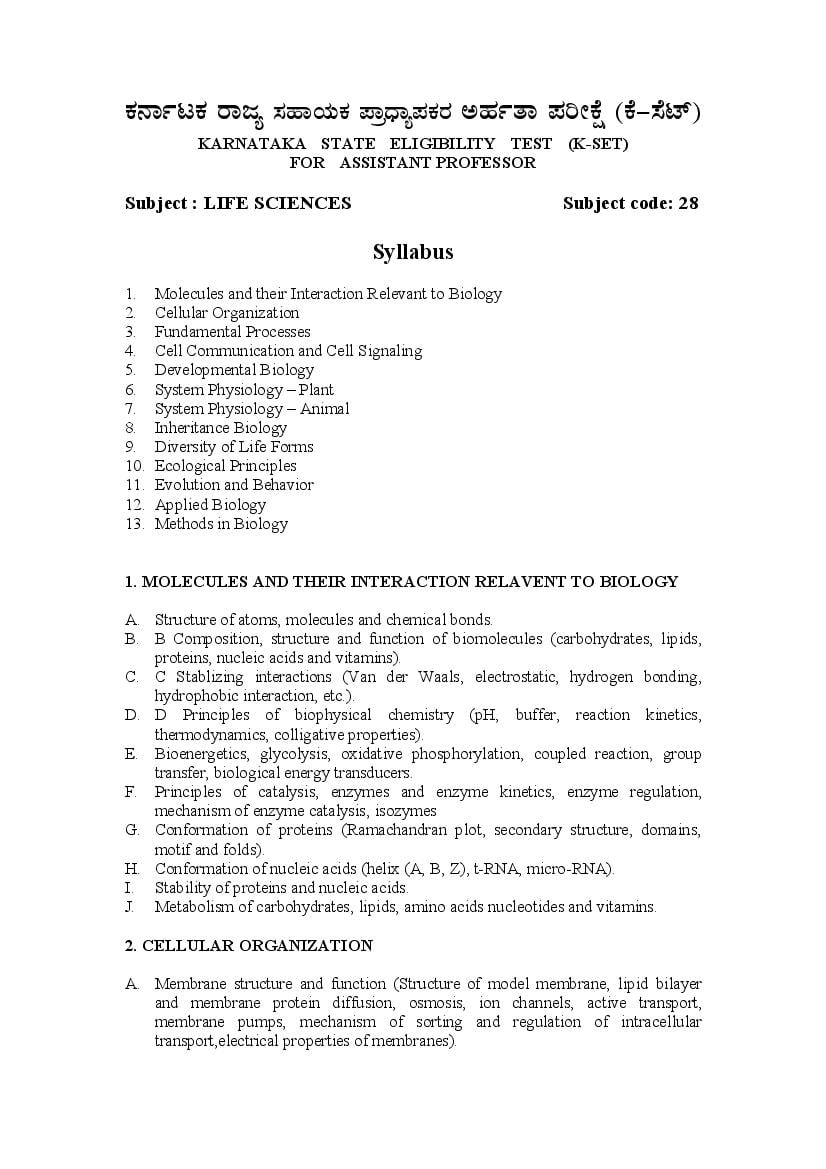
KARNATAKA STATE ELIGIBILITY TEST (K-SET)
FOR ASSISTANT PROFESSOR
Subject : LIFE SCIENCES Subject code: 28
Syllabus
1. Molecules and their Interaction Relevant to Biology
2. Cellular Organization
3. Fundamental Processes
4. Cell Communication and Cell Signaling
5. Developmental Biology
6. System Physiology – Plant
7. System Physiology – Animal
8. Inheritance Biology
9. Diversity of Life Forms
10. Ecological Principles
11. Evolution and Behavior
12. Applied Biology
13. Methods in Biology
1. MOLECULES AND THEIR INTERACTION RELAVENT TO BIOLOGY
A. Structure of atoms, molecules and chemical bonds.
B. B Composition, structure and function of biomolecules (carbohydrates, lipids,
proteins, nucleic acids and vitamins).
C. C Stablizing interactions (Van der Waals, electrostatic, hydrogen bonding,
hydrophobic interaction, etc.).
D. D Principles of biophysical chemistry (pH, buffer, reaction kinetics,
thermodynamics, colligative properties).
E. Bioenergetics, glycolysis, oxidative phosphorylation, coupled reaction, group
transfer, biological energy transducers.
F. Principles of catalysis, enzymes and enzyme kinetics, enzyme regulation,
mechanism of enzyme catalysis, isozymes
G. Conformation of proteins (Ramachandran plot, secondary structure, domains,
motif and folds).
H. Conformation of nucleic acids (helix (A, B, Z), t-RNA, micro-RNA).
I. Stability of proteins and nucleic acids.
J. Metabolism of carbohydrates, lipids, amino acids nucleotides and vitamins.
2. CELLULAR ORGANIZATION
A. Membrane structure and function (Structure of model membrane, lipid bilayer
and membrane protein diffusion, osmosis, ion channels, active transport,
membrane pumps, mechanism of sorting and regulation of intracellular
transport,electrical properties of membranes).
Page 2
nucleus, mitochondria, Golgi bodies, lysosomes, endoplasmic reticulum,
peroxisomes, plastids, vacuoles, chloroplast, structure & function of cytoskeleton
and its role in motility).
C. Organization of genes and chromosomes (Operon, unique and repetitive DNA,
interrupted genes, gene families, structure of chromatin and chromosomes,
heterochromatin, euchromatin, transposons).
D. Cell division and cell cycle (Mitosis and meiosis, their regulation, steps in cell
cycle, regulation and control of cell cycle).
E. Microbial Physiology (Growth yield and characteristics, strategies of cell
division, stress response)
3. FUNDAMENTAL PROCESSES
A. DNA replication, repair and recombination (Unit of replication, enzymes
involved, replication origin and replication fork, fidelity of replication,
extrachromosomal replicons, DNA damage and repair mechanisms, homologous
and site-specific recombination).
B. RNA synthesis and processing (transcription factors and machinery, formation
of initiation complex, transcription activator and repressor, RNA polymerases,
capping, elongation, and termination, RNA processing, RNA editing, splicing,
and polyadenylation, structure and function of different types of RNA, RNA
transport).
C. Protein synthesis and processing (Ribosome, formation of initiation complex,
initiation factors and their regulation, elongation and elongation factors,
termination, genetic code, aminoacylation of tRNA, tRNA-identity, aminoacyl
tRNA synthetase, and translational proof-reading, translational inhibitors, Post-
translational modification of proteins).
D. Control of gene expression at transcription and translation level (regulating
the expression of phages, viruses, prokaryotic and eukaryotic genes, role of
chromatin in gene expression and gene silencing).
4. Cell communication and cell signaling
A. Host parasite interaction Recognition and entry processes of different
pathogens like bacteria, viruses into animal and plant host cells, alteration of host
cell behavior by pathogens, virus-induced cell transformation, pathogen-induced
diseases in animals and plants, cell-cell fusion in both normal and abnormal cells.
B. Cell signaling Hormones and their receptors, cell surface receptor, signaling
through G-protein coupled receptors, signal transduction pathways, second
messengers, regulation of signaling pathways, bacterial and plant twocomponent
systems, light signaling in plants, bacterial chemotaxis and quorum sensing.
C. Cellular communication Regulation of hematopoiesis, general principles of cell
communication, cell adhesion and roles of different adhesion molecules, gap
junctions, extracellular matrix, integrins, neurotransmission and its regulation.
Page 3
Genetic rearrangements in progenitor cells, oncogenes, tumor suppressor genes,
cancer and the cell cycle, virus-induced cancer, metastasis, interaction of cancer
cells with normal cells, apoptosis, therapeutic interventions of uncontrolled cell
growth.
E. Innate and adaptive immune system Cells and molecules involved in innate
and adaptive immunity, antigens, antigenicity and immunogenicity. B and T cell
epitopes, structure and function of antibody molecules. generation of antibody
diversity, monoclonal antibodies, antibody engineering, antigen-antibody
interactions, MHC molecules, antigen processing and presentation, activation and
differentiation of B and T cells, B and T cell receptors, humoral and cellmediated
immune responses, primary and secondary immune modulation, the complement
system, Toll-like receptors, cell-mediated effector functions, inflammation,
hypersensitivity and autoimmunity, immune response during bacterial
(tuberculosis), parasitic (malaria) and viral (HIV) infections, congenital and
acquired immunodeficiencies, vaccines.
5. DEVELOPMENTAL BIOLOGY
A. Basic concepts of development : Potency, commitment, specification, induction,
competence, determination and differentiation; morphogenetic gradients; cell fate
and cell lineages; stem cells; genomic equivalence and the cytoplasmic
determinants; imprinting; mutants and transgenics in analysis of development
B. Gametogenesis, fertilization and early development: Production of gametes,
cell surface molecules in sperm-egg recognition in animals; embryo sac
development and double fertilization in plants; zygote formation, cleavage,
blastula formation, embryonic fields, gastrulation and formation of germ layers in
animals; embryogenesis, establishment of symmetry in plants; seed formation and
germination.
C. Morphogenesis and organogenesis in animals : Cell aggregation and
differentiation in Dictyostelium; axes and pattern formation in Drosophila,
amphibia and chick; organogenesis – vulva formation in Caenorhabditis elegans,
eye lens induction, limb development and regeneration in vertebrates;
differentiation of neurons, post embryonic development- larval formation,
metamorphosis; environmental regulation of normal development; sex
determination.
D. Morphogenesis and organogenesis in plants: Organization of shoot and root
apical meristem; shoot and root development; leaf development and phyllotaxy;
transition to flowering, floral meristems and floral development in Arabidopsis
and Antirrhinum
E. Programmed cell death, aging and senescence
Page 4
A. Photosynthesis - Light harvesting complexes; mechanisms of electron transport;
photoprotective mechanisms; CO2 fixation-C3, C4 and CAM pathways.
B. Respiration and photorespiration – Citric acid cycle; plant mitochondrial
electron transport and ATP synthesis; alternate oxidase; photorespiratory
pathway.
C. Nitrogen metabolism - Nitrate and ammonium assimilation; amino acid
biosynthesis.
D. Plant hormones – Biosynthesis, storage, breakdown and transport; physiological
effects and mechanisms of action.
E. Sensory photobiology - Structure, function and mechanisms of action of
phytochromes, cryptochromes and phototropins; stomatal movement;
photoperiodism and biological clocks.
F. Solute transport and photoassimilate translocation – uptake, transport and
translocation of water, ions, solutes and macromolecules from soil, through cells,
across membranes, through xylem and phloem; transpiration; mechanisms of
loading and unloading of photoassimilates.
G. Secondary metabolites - Biosynthesis of terpenes, phenols and nitrogenous
compounds and their roles.
H. Stress physiology – Responses of plants to biotic (pathogen and insects) and
abiotic (water, temperature and salt) stresses.
7. SYSTEM PHYSIOLOGY - ANIMAL
A. Blood and circulation - Blood corpuscles, haemopoiesis and formed elements,
plasma function, blood volume, blood volume regulation, blood groups,
haemoglobin, immunity, haemostasis.
B. Cardiovascular System: Comparative anatomy of heart structure, myogenic
heart, specialized tissue, ECG – its principle and significance, cardiac cycle, heart
as a pump, blood pressure, neural and chemical regulation of all above.
C. Respiratory system - Comparison of respiration in different species, anatomical
considerations, transport of gases, exchange of gases, waste elimination, neural
and chemical regulation of respiration.
D. Nervous system - Neurons, action potential, gross neuroanatomy of the brain and
spinal cord, central and peripheral nervous system, neural control of muscle tone
and posture.
Page 5
F. Excretory system - Comparative physiology of excretion, kidney, urine
formation, urine concentration, waste elimination, micturition, regulation of water
balance, blood volume, blood pressure, electrolyte balance, acid-base balance.
G. Thermoregulation - Comfort zone, body temperature – physical, chemical,
neural regulation, acclimatization.
H. Stress and adaptation
I. Digestive system - Digestion, absorption, energy balance, BMR.
J. Endocrinology and reproduction - Endocrine glands, basic mechanism of
hormone action, hormones and diseases; reproductive processes, gametogenesis,
ovulation, neuroendocrine regulation
8. INHERITANCE BIOLOGY
A. Mendelian principles : Dominance, segregation, independent assortment.
B. Concept of gene : Allele, multiple alleles, pseudoallele, complementation test
C. Extensions of Mendelian principles : Codominance, incomplete dominance,
gene interactions, pleiotropy, genomic imprinting, penetrance and expressivity,
phenocopy, linkage and crossing over, sex linkage, sex limited and sex influenced
characters.
D. Gene mapping methods : Linkage maps, tetrad analysis, mapping with
molecular markers, mapping by using somatic cell hybrids, development of
mapping population in plants.
E. Extra chromosomal inheritance : Inheritance of Mitochondrial and chloroplast
genes, maternal inheritance.
F. Microbial genetics : Methods of genetic transfers – transformation, conjugation,
transduction and sex-duction, mapping genes by interrupted mating, fine structure
analysis of genes.
G. Human genetics : Pedigree analysis, lod score for linkage testing, karyotypes,
genetic disorders.
H. Quantitative genetics : Polygenic inheritance, heritability and its measurements,
QTL mapping.
I. Mutation : Types, causes and detection, mutant types – lethal, conditional,
biochemical, loss of function, gain of function, germinal verses somatic mutants,
insertional mutagenesis.
Page 6
inversion, translocation, ploidy and their genetic implications.
K. Recombination : Homologous and non-homologous recombination including
transposition.
9. DIVERSITY OF LIFE FORMS:
A. Principles & methods of taxonomy: Concepts of species and hierarchical taxa,
biological nomenclature, classical & quantititative methods of taxonomy of
plants, animals and microorganisms.
B. Levels of structural organization: Unicellular, colonial and multicellular forms.
Levels of organization of tissues, organs & systems. Comparative anatomy,
adaptive radiation, adaptive modifications.
C. Outline classification of plants, animals & microorganisms: Important criteria
used for classification in each taxon. Classification of plants, animals and
microorganisms. Evolutionary relationships among taxa.
D. Natural history of Indian subcontinent: Major habitat types of the
subcontinent, geographic origins and migrations of species. Comman Indian
mammals, birds. Seasonality and phenology of the subcontinent.
E. Organisms of health & agricultural importance: Common parasites and
pathogens of humans, domestic animals and crops.
F. Organisms of conservation concern: Rare, endangered species. Conservation
strategies.
10. ECOLOGICAL PRINCIPLES
The Environment: Physical environment; biotic environment; biotic and abiotic
interactions.
Habitat and Niche: Concept of habitat and niche; niche width and overlap;
fundamental and realized niche; resource partitioning; character displacement.
Population Ecology: Characteristics of a population; population growth curves;
population regulation; life history strategies (r and K selection); concept of
metapopulation – demes and dispersal, interdemic extinctions, age structured
populations.
Species Interactions: Types of interactions, interspecific competition, herbivory,
carnivory, pollination, symbiosis.
Community Ecology: Nature of communities; community structure and attributes;
levels of species diversity and its measurement; edges and ecotones.
Page 7
concept of climax.
Ecosystem Ecology: Ecosystem structure; ecosystem function; energy flow and
mineral cycling (C,N,P); primary production and decomposition; structure and
function of some Indian ecosystems: terrestrial (forest, grassland) and aquatic (fresh
water, marine, eustarine)
Biogeography: Major terrestrial biomes; theory of island biogeography;
biogeographical zones of India.
Applied Ecology: Environmental pollution; global environmental change;
biodiversity: status, monitoring and documentation; major drivers of biodiversity
change; biodiversity management approaches.
Conservation Biology: Principles of conservation, major approaches to
management, Indian case studies on conservation/management strategy (Project
Tiger, Biosphere reserves).
11. EVOLUTION AND BEHAVIOUR
A. Emergence of evolutionary thoughts
Lamarck; Darwin–concepts of variation, adaptation, struggle, fitness and natural
selection; Mendelism; Spontaneity of mutations; The evolutionary synthesis.
B. Origin of cells and unicellular evolution:
Origin of basic biological molecules; Abiotic synthesis of organic monomers and
polymers; Concept of Oparin and Haldane; Experiement of Miller (1953); The
first cell; Evolution of prokaryotes; Origin of eukaryotic cells; Evolution of
unicellular eukaryotes; Anaerobic metabolism, photosynthesis and aerobic
metabolism.
C. Paleontology and Evolutionary History:
The evolutionary time scale; Eras, periods and epoch; Major events in the
evolutionary time scale; Origins of unicellular and multi cellular organisms;
Major groups of plants and animals; Stages in primate evolution including
Homo.
D. Molecular Evolution:
Concepts of neutral evolution, molecular divergence and molecular clocks;
Molecular tools in phylogeny, classification and identification; Protein and
nucleotide sequence analysis; origin of new genes and proteins; Gene duplication
and divergence.
E. The Mechanisms:
Population genetics – Populations, Gene pool, Gene frequency; Hardy-Weinberg
Law; concepts and rate of change in gene frequency through natural selection,
migration and random genetic drift; Adaptive radiation; Isolating mechanisms;
Speciation; Allopatricity and Sympatricity; Convergent evolution; Sexual
selection; Co-evolution.
Page 8
Approaches and methods in study of behavior; Proximate and ultimate causation;
Altruism and evolution-Group selection, Kin selection, Reciprocal altruism;
Neural basis of learning, memory, cognition, sleep and arousal; Biological
clocks; Development of behavior; Social communication; Social dominance; Use
of space and territoriality; Mating systems, Parental investment and
Reproductive success; Parental care; Aggressive behavior; Habitat selection and
optimality in foraging; Migration, orientation and navigation; Domestication and
behavioral changes.
12. APPLIED BIOLOGY:
A. Microbial fermentation and production of small and macro molecules.
B. Application of immunological principles, vaccines, diagnostics. Tissue and cell
culture methods for plants and animals.
C. Transgenic animals and plants, molecular approaches to diagnosis and strain
identification.
D. Genomics and its application to health and agriculture, including gene therapy.
E. E. Bioresource and uses of biodiversity.
F. Breeding in plants and animals, including marker – assisted selection
G. Bioremediation and phytoremediation
H. Biosensors
13. METHODS IN BIOLOGY
A. Molecular Biology and Recombinant DNA methods:
Isolation and purification of RNA , DNA (genomic and plasmid) and proteins,
different separation methods.
Analysis of RNA, DNA and proteins by one and two dimensional gel electrophoresis,
Isoelectric focusing gels
Molecular cloning of DNA or RNA fragments in bacterial and eukaryotic systems.
Expression of recombinant proteins using bacterial, animal and plant vectors.
Isolation of specific nucleic acid sequences
Generation of genomic and cDNA libraries in plasmid, phage, cosmid, BAC and
YAC vectors.
In vitro mutagenesis and deletion techniques, gene knock out in bacterial and
eukaryotic organisms.
Protein sequencing methods, detection of post translation modification of proteins.
DNA sequencing methods, strategies for genome sequencing
Methods for analysis of gene expression at RNA and protein level, large scale
Page 9
Isolation, separation and analysis of carbohydrate and lipid molecules RFLP, RAPD
and AFLP techniques
B. Histochemical and Immunotechniques
Antibody generation, Detection of molecules using ELISA, RIA, western blot,
immunoprecipitation, fluocytometry and immunofluorescence microscopy, detection
of molecules in living cells, in situ localization by techniques such as FISH and GISH.
C . Biophysical Method:
Molecular analysis using UV/visible, fluorescence, circular dichroism, NMR and ESR
spectroscopy Molecular structure determination using X-ray diffraction and NMR,
Molecular analysis using light scattering, different types of mass spectrometry and
surface plasma resonance methods.
D. Statisitcal Methods:
Measures of central tendency and dispersal; probability distributions (Binomial,
Poisson and normal); Sampling distribution; Difference between parametric and
non-parametric statistics; Confidence Interval; Errors; Levels of significance;
Regression and Correlation; t-test; Analysis of variance; X2 test;; Basic introduction
to Muetrovariate statistics, etc.
F. Radiolabeling techniques:
Detection and measurement of different types of radioisotopes normally used in
biology, incorporation of radioisotopes in biological tissues and cells, molecular
imaging of radioactive material, safety guidelines.
F .Microscopic techniques:
Visulization of cells and subcellular components by light microscopy, resolving
powers of different microscopes, microscopy of living cells, scanning and
transmission microscopes, different fixation and staining techniques for EM,
freeze-etch and freezefracture methods for EM, image processing methods in
microscopy.
G. Electrophysiological methods:
Single neuron recording, patch-clamp recording, ECG, Brain activity recording,
lesion and stimulation of brain, pharmacological testing, PET, MRI, fMRI, CAT .
H. Methods in field biology:
Methods of estimating population density of animals and plants, ranging patterns
through direct, indirect and remote observations, sampling methods in the study of
behavior, habitat characterization: ground and remote sensing methods.
Document Details
| Board / Org | Karnataka Exams |
| Exam | Karnataka State Eligibility Test |
| Type | Syllabus |
| Pages | 9 |
| Updated | 24 Sep 2026 |