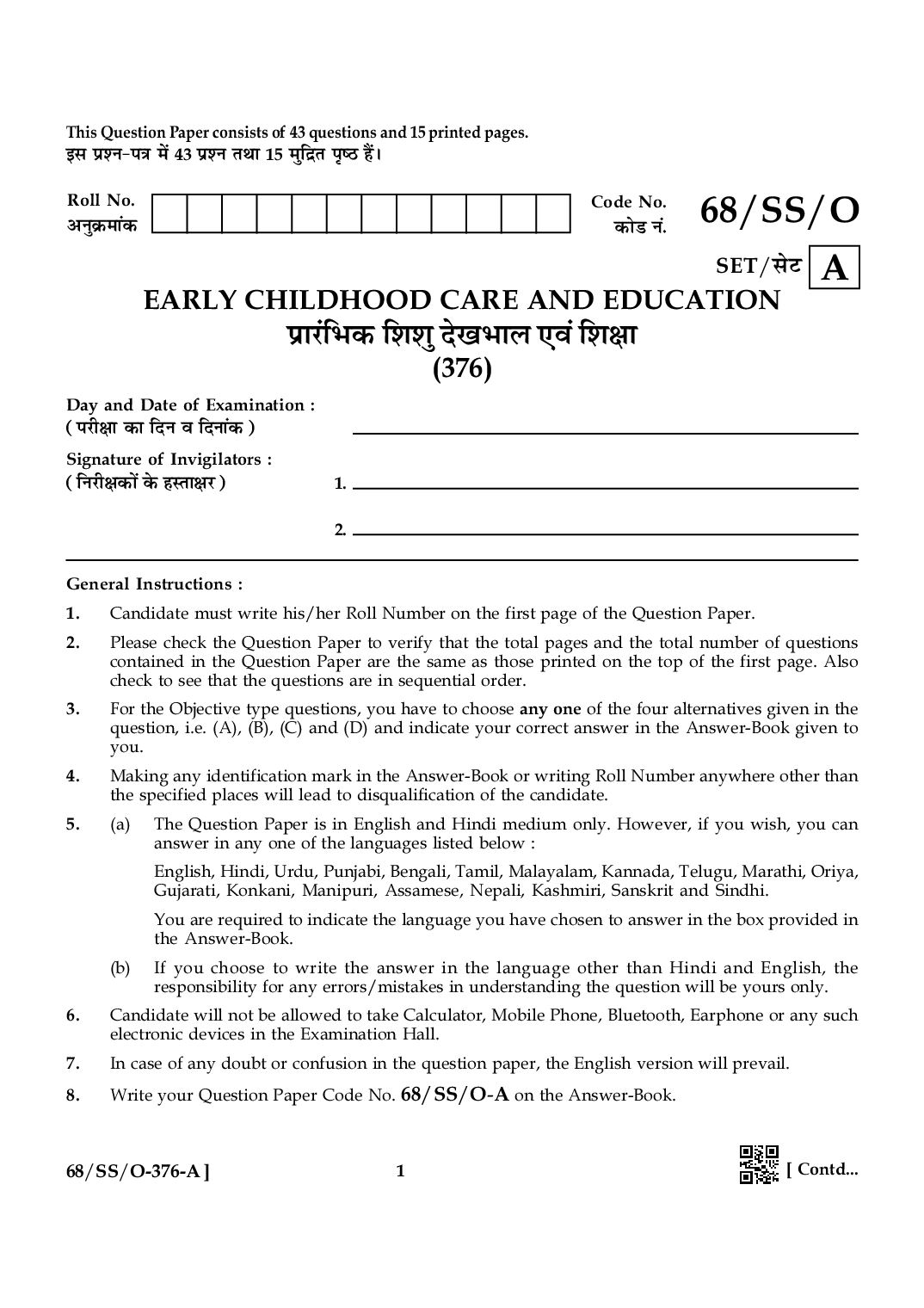
NIOS Class 12 October 2024 Question Paper Early Childhood Care and Education
Finished viewing? Save it for later —
Download NIOS Class 12 October 2024 Question Paper Early Childhood Care and Education (PDF · 15 pages)About NIOS Class 12 October 2024 Question Paper Early Childhood Care and Education
NIOS Class 12 October 2024 Question Paper Early Childhood Care and Education is available here for free download. Published by NIOS for National Institute of Open Schooling Class 12, this question paper can be viewed online or downloaded as a PDF (15 pages). Candidates preparing for National Institute of Open Schooling Class 12 can use NIOS Class 12 October 2024 Question Paper Early Childhood Care and Education to understand the exam pattern, the type of questions asked, and the overall difficulty level.
Frequently Asked Questions
How can I download NIOS Class 12 October 2024 Question Paper Early Childhood Care and Education?
Open this page and click the Download button to save NIOS Class 12 October 2024 Question Paper Early Childhood Care and Education as a PDF. It is completely free on AglaSem Docs.
Is NIOS Class 12 October 2024 Question Paper Early Childhood Care and Education free to download?
Yes. NIOS Class 12 October 2024 Question Paper Early Childhood Care and Education can be viewed online and downloaded as a PDF free of cost on AglaSem Docs.
How many pages does NIOS Class 12 October 2024 Question Paper Early Childhood Care and Education have?
NIOS Class 12 October 2024 Question Paper Early Childhood Care and Education contains 15 pages, which you can read online or download together as a single PDF.
Where can I find more National Institute of Open Schooling Class 12 study material?
You can find more National Institute of Open Schooling Class 12 question papers, sample papers, syllabus, and answer keys on AglaSem Docs.
NIOS Class 12 October 2024 Question Paper Early Childhood Care and Education – Text
Read the full text of this question paper below — useful to quickly search, copy and reference the content online without downloading the PDF.
📄 View text version (15 pages)
Page 1
ß‚ ¬˝‡Ÿ-¬òÊ ◊¥ 43 ¬˝‡Ÿ ÃÕÊ 15 ◊ÈÁŒ˝Ã ¬Îc∆U „Ò¥–
Roll No. Code No.
•ŸÈ∑˝§◊Ê¥∑§ ∑§Ê«U Ÿ¥.
68/SS/O
SET/‚ ≈ A
EARLY CHILDHOOD CARE AND EDUCATION
¬˝Ê⁄¥UÁ÷∑§ Á‡Ê‡ÊÈ Œπ÷Ê‹ ∞fl¥ Á‡ÊˇÊÊ
(376)
Day and Date of Examination :
(¬⁄UˡÊÊ ∑§Ê ÁŒŸ fl ÁŒŸÊ¥∑§)
Signature of Invigilators :
(ÁŸ⁄UˡÊ∑§Ê¥ ∑§ „SÃÊˇÊ⁄U) 1.
2.
General Instructions :
1. Candidate must write his/her Roll Number on the first page of the Question Paper.
2. Please check the Question Paper to verify that the total pages and the total number of questions
contained in the Question Paper are the same as those printed on the top of the first page. Also
check to see that the questions are in sequential order.
3. For the Objective type questions, you have to choose any one of the four alternatives given in the
question, i.e. (A), (B), (C) and (D) and indicate your correct answer in the Answer-Book given to
you.
4. Making any identification mark in the Answer-Book or writing Roll Number anywhere other than
the specified places will lead to disqualification of the candidate.
5. (a) The Question Paper is in English and Hindi medium only. However, if you wish, you can
answer in any one of the languages listed below :
English, Hindi, Urdu, Punjabi, Bengali, Tamil, Malayalam, Kannada, Telugu, Marathi, Oriya,
Gujarati, Konkani, Manipuri, Assamese, Nepali, Kashmiri, Sanskrit and Sindhi.
You are required to indicate the language you have chosen to answer in the box provided in
the Answer-Book.
(b) If you choose to write the answer in the language other than Hindi and English, the
responsibility for any errors/mistakes in understanding the question will be yours only.
6. Candidate will not be allowed to take Calculator, Mobile Phone, Bluetooth, Earphone or any such
electronic devices in the Examination Hall.
7. In case of any doubt or confusion in the question paper, the English version will prevail.
8. Write your Question Paper Code No. 68/SS/O-A on the Answer-Book.
68/SS/O-376-A ] 1 [ Contd...
Page 2
1. ¬⁄UˡÊÊÕ˸ ¬˝‡Ÿ-¬òÊ ∑§ §¬„‹ ¬Îc∆U ¬⁄U •¬ŸÊ •ŸÈ∑˝§◊Ê¥∑§ •fl‡ÿU Á‹π¥–
2. ∑Χ¬ÿÊ ¬˝‡Ÿ-¬òÊ ∑§Ê ¡ÊÚ°ø ‹¥ Á∑§ ¬˝‡Ÿ-¬òÊ ∑§ ∑ȧ‹ ¬Îc∆UÊ¥ ÃÕÊ ¬˝‡ŸÊ¥ ∑§Ë ‚¥ÅUÿÊ ©ÃŸË „Ë „Ò Á¡ÃŸË ¬˝Õ◊ ¬Îc∆ ∑ §‚’‚ ™§¬⁄U
¿U¬Ë „Ò– ß‚ ’Êà ∑§Ë ¡ÊÚ°ø ÷Ë ∑§⁄U ‹¥ Á∑§ ¬˝‡Ÿ ∑˝ Á◊∑§ UM§¬ ◊¥ „Ò¥–
3. § flSÃÈÁŸc∆U ¬˝‡ŸÊ¥ ◊¥ •Ê¬∑§Ê øÊ⁄U Áfl∑§À¬Ê¥ (A), (B), (C) ÃÕÊ (D) ◊¥ ‚ ∑§Ê߸ ∞∑§ ©ûÊ⁄U øÈŸŸÊ „Ò ÃÕÊ ŒË ªß¸ ©ûÊ⁄U-¬ÈÁSÃ∑§Ê ◊¥
•Ê¬ ‚„Ë ©ûÊ⁄U Á‹Áπ∞–
4. § ©ûÊ⁄U-¬ÈÁSUÃ∑§Ê ◊¥ ¬„øÊŸ-Áøq ’ŸÊŸ •ÕflÊ ÁŸÁŒ¸c≈U SÕÊŸÊ¥ ∑§§•ÁÃÁ⁄UÄà ∑§„Ë¥ ÷Ë •ŸÈ∑˝§◊Ê¥∑§ Á‹πŸ ¬⁄U ¬⁄UˡÊÊÕ˸ ∑§Ê •ÿÊÇÿ
∆U„⁄UÊÿÊ ¡ÊÿªÊ–
5. (∑§) ÿ„ ¬˝‡Ÿ-¬òÊ ŒÊ ÷Ê·Ê•Ê¥ ◊¥ „Ò •ÕʸØ •¥ª˝¡Ë ∞fl¥ Á„¥ŒË– Á»§⁄U ÷Ë, ÿÁŒ •Ê¬ øÊ„¥ ÃÊ ŸËø ŒË ªß¸ Á∑§‚Ë ∞∑§ ÷Ê·Ê ◊¥
©ûÊ⁄ Œ ‚∑§Ã „Ò¥ —
•¥ª˝¡Ë, Á„¥ŒË, ©ŒÍ¸, ¬¥¡Ê’Ë, ’¥ª‹Ê, ÃÁ◊‹, ◊‹ÿÊ‹◊, ∑§ãŸ«∏, ËȪÈ, ◊⁄UÊ∆UË, ©Á«∏ÿÊ, ªÈ¡⁄UÊÃË, ∑§Ê¥∑§áÊË, ◊ÁáʬÈ⁄UË,
•‚Á◊ÿÊ, Ÿ¬Ê‹Ë, ∑§‡◊Ë⁄UË, ‚¥S∑Χç•ÊÒ⁄U Á‚¥œË–
∑Χ¬ÿÊ ©ûÊ⁄U-¬ÈÁSÃ∑§Ê ◊¥ ÁŒ∞ ª∞ ’ÊÚÄ‚ ◊¥ Á‹π¥ Á∑§ •Ê¬ Á∑§‚ ÷Ê·Ê ◊¥ ©ûÊ⁄U Á‹π ⁄U„ „Ò¥–
(π) ÿÁŒ •Ê¬ Á„¥ŒË ∞fl¥ •¥ª˝¡Ë ∑§ •ÁÃÁ⁄UÄà Á∑§‚Ë •ãÿ ÷Ê·Ê ◊¥ ©ûÊ⁄U Á‹πà „Ò¥, ÃÊ ¬˝‡ŸÊ¥ ∑§Ê ‚◊¤ÊŸ ◊¥ „ÊŸ flÊ‹Ë
òÊÈÁ≈UÿÊ¥/ª‹ÁÃÿÊ¥ ∑§Ë Á¡ê◊UŒÊ⁄Ë ∑ fl‹ •Ê¬∑§Ë „ʪ˖
6. ¬⁄UˡÊÊÕ˸ ∑§Ê ¬⁄UˡÊÊ „ÊÚ‹ ◊¥ ∑Ò§À∑ȧ‹≈U⁄U, ◊Ê’Êß‹ »§ÊŸ, é‹Í≈ÍUÕ, ßÿ⁄U»§ÊŸ ¡Ò‚ Á∑§‚Ë ÷Ë ß‹Ä≈˛UÊÚÁŸ∑§ ©¬∑§⁄UáÊ ∑§Ê ‹ ¡ÊŸ ∑§Ë
•ŸÈ◊Áà Ÿ„Ë¥ „Ò–
7. ¬˝‡Ÿ-¬òÊ ◊¥ Á∑§‚Ë ÷Ë ¬˝∑§Ê⁄U ∑§ ‚¥Œ„ •ÕflÊ ŒÈÁflœÊ ∑§Ë ÁSÕÁà ◊¥ •¥ª˝¡Ë •ŸÈflÊŒ „Ë ◊Êãÿ „ʪʖ
8. •¬ŸË ©ûÊ⁄U-¬ÈÁSUÃ∑§Ê ◊¥ ¬˝‡Ÿ-¬òÊ ∑§Ë ∑§Ê«U ‚¥ÅÿÊ 68/SS/O-A Á‹π¥–
68/SS/O-376-A ] 2 [ Contd...
Page 3
¬˝Ê⁄¥UÁ÷∑§ Á‡Ê‡ÊÈ Œπ÷Ê‹ ∞fl¥ Á‡ÊˇÊÊ
(376)
Time : 3 Hours ] [ Maximum Marks : 80
‚◊ÿ — 3 ÉÊá≈U ] [ ¬ÍáÊÊZ∑§ — 80
Note : (i) This question paper consists of 43 questions in all.
(ii) All questions are compulsory.
(iii) Marks are given against each question.
(iv) Q. No. 1 to 16 - Multiple Choice Questions (MCQs) carrying 1 mark each. Select and
write the most appropriate option out of the four options given in each of these questions.
(v) Q. No. 17 to 29 - Objective type questions including Reading Comprehension Passage
(Q. No. 17 to 19), Match the Column (Q. No. 20), True/False (Q. No. 21 to 23), Fill in
the Blanks (Q. No. 24 to 26) and One Word Answer Question (Q. No. 27 to 29). Attempt
questions based on specific instructions for each part.
(vi) (a) Q. No. 30 to 35 - Very Short Answer type questions carrying 2 marks each to be
answered in the range of 30 to 50 words.
(b) Q. No. 36 to 41 - Short Answer type questions carrying 3 marks each to be
answered in the range of 50 to 80 words.
(c) Q. No. 42 and 43 - Long Answer type questions carrying 5 marks each to be
answered in the range of 80 to 120 words.
ÁŸŒ¸‡Ê — (i) ß‚ ¬˝‡Ÿ-¬òÊ ◊¥ ∑ȧ‹ 43 ¬˝‡Ÿ „Ò¥–
(ii) ‚÷Ë ¬˝‡Ÿ •ÁŸflÊÿ¸ „Ò¥–
(iii) ¬˝àÿ∑§ ¬˝‡Ÿ ∑§ ‚Ê◊Ÿ •¥∑§ ÁŒÿ ªÿ „Ò¥–
(iv) ¬˝‡Ÿ ‚¥ÅÿÊ 1 ‚ 16 - ’„ÈÁfl∑§À¬Ëÿ ¬˝∑§Ê⁄U ∑§ ¬˝‡Ÿ „Ò¥, ¡Ê ¬˝àÿ∑§ 1 •¥∑§ ∑§Ê „Ò– ߟ ¬˝‡ŸÊ¥ ◊¥ ¬˝àÿ∑§ ◊¥ ÁŒÿ
ªÿ øÊ⁄U Áfl∑§À¬Ê¥ ◊¥ ‚ ‚’‚ ©¬ÿÈÄà Áfl∑§À¬ øÈÁŸÿ •ÊÒ⁄U Á‹Áπ∞–
(v) ¬˝‡Ÿ ‚¥ÅÿÊ 17 ‚ 29 - flSÃÈÁŸc∆U ¬˝‡Ÿ „Ò, Á¡‚◊¥ ªlÊ¥‡Ê •ÊœÊÁ⁄Uà (¬˝‡Ÿ ‚¥ÅÿÊ 17 ‚ 19), ‚„Ë ¡Ê«∏Ë
(¬˝‡Ÿ ‚¥. 20), ‚„Ë/ª‹Ã (¬˝. ‚¥. 21 ‚ 23), Á⁄UÄà SÕÊŸ ∑§Ë ¬ÍÁø (¬˝‡Ÿ ‚¥. 24 ‚ 26) •ÊÒ⁄U ∞∑§ ‡ÊéŒ ◊¥
©ûÊ⁄U (¬˝‡Ÿ ‚¥ÅÿÊ 27 ‚ 29) ‚Áê◊Á‹Ã „Ò¥– ¬˝àÿ∑§ ÷ʪ ∑§ Á‹∞ ÁŒ∞ ª∞ ÁflÁ‡Êc≈U ÁŸŒ¸‡ÊÊ¥ ∑§ •ÊœÊ⁄U ¬⁄U ¬˝‡ŸÊ¥
∑§Ê ©ûÊ⁄U ŒËÁ¡∞–
(vi) (a) ¬˝‡Ÿ ‚¥ÅÿÊ 30 ‚ 35 - •Áà ‹ÉÊÈ ©ûÊ⁄UËÿ ¬˝∑§Ê⁄U ∑§ ¬˝‡Ÿ „Ò¥, ¬˝àÿ∑§ ∑§ 2 •¥∑§ „Ò¥ •ÊÒ⁄U ©ûÊ⁄U ∑§Ë ‚Ë◊Ê
30 ‚ 50 ‡ÊéŒ „Ò–
(b) ¬˝‡Ÿ ‚¥ÅÿÊ 36 ‚ 41 - ‹ÉÊÈ ©ûÊ⁄UËÿ ¬˝∑§Ê⁄U ∑§ ¬˝‡Ÿ „Ò¥, ¬˝àÿ∑§ ∑§ 3 •¥∑§ „Ò¥ •ÊÒ⁄U ©ûÊ⁄U ∑§Ë ‚Ë◊Ê
50 ‚ 80 ‡ÊéŒÊ¥ „Ò–
(c) ¬˝‡Ÿ ‚¥ÅÿÊ 42 ‚ 43 - ŒËÉʸ ©ûÊ⁄UËÿ ¬˝∑§Ê⁄U ∑§ ¬˝‡Ÿ „Ò¥, ¬˝àÿ∑§ ∑§ 5 •¥∑§ „Ò¥ •ÊÒ⁄U ©ûÊ⁄U ∑§Ë ‚Ë◊Ê
80 ‚ 120 ‡ÊéŒ „Ò–
68/SS/O-376-A ] 3 [ Contd...
Page 4
(1) Answers of all questions are to be given in the Answer-Book given to you.
‚÷Ë ¬˝‡ŸÊ¥ ∑§ ©ûÊ⁄U •Ê¬∑§Ê ŒË ªÿË ©ûÊ⁄U-¬ÈÁSÃ∑§Ê ◊¥ „Ë Á‹π¥–
(2) 15 minutes time has been allotted to read this question paper. The question paper will be
distributed at 02.15 p.m. From 02.15 p.m. to 02.30 p.m., the students will read the question
paper only and will not write any answer on the answer-book during this period.
ß‚ ¬˝‡Ÿ-¬òÊ ∑§Ê ¬…∏Ÿ ∑§ Á‹∞ 15 Á◊Ÿ≈U ∑§Ê ‚◊ÿ ÁŒÿÊ ªÿÊ „Ò– ¬˝‡Ÿ-¬òÊ ∑§Ê ÁflÃ⁄UáÊ ŒÊ¬„⁄U ◊¥ 02.15 ’¡ Á∑§ÿÊ
¡Ê∞ªÊ– 02.15 ’¡ ‚ 02.30 ’¡ Ã∑§ ¿UÊòÊ ∑§fl‹ ¬˝‡Ÿ-¬òÊ ∑§Ê ¬…∏¥ª •ÊÒ⁄U ß‚ •flÁœ ∑§ ŒÊÒ⁄UÊŸ fl ©ûÊ⁄U-¬ÈÁSÃ∑§Ê ¬⁄U
∑§Ê߸ ©ûÊ⁄U Ÿ„Ë¥ Á‹π¥ª–
Select and write the correct answers from the options given below :
ŸËø ÁŒ∞ ª∞ Áfl∑§À¬Ê¥ ◊¥ ‚ ‚„Ë ©ûÊ⁄U øÈŸ¥ •ÊÒ⁄U Á‹π¥ —
1. At what age do babies typically start weaning from breast milk to semi-solid foods ? 1
(A) 3 months (B) 6 months (C) 9 months (D) 12 months
Á‡Ê‡ÊÈ •Ê◊ÃÊÒ⁄U ¬⁄U Á∑§‚ ©◊˝ ◊¥ ◊Ê° ∑§Ê ŒÍœ ¿UÊ«∏∑§⁄U •œ¸-∆UÊ‚ •Ê„Ê⁄U πÊŸÊ ‡ÊÈM§ ∑§⁄U ŒÃ „Ò¥?
(A) 3 ◊„ËŸ (B) 6 ◊„ËŸ (C) 9 ◊„ËŸ (D) 12 ◊„ËŸ
2. How does play contribute to language development in children ? 1
(A) By limiting interaction with peers
(B) By restricting the exchange of ideas
(C) By encouraging discussion and sharing
(D) By avoiding emotional development
π‹ ’ëøÊ¥ ◊¥ ÷Ê·Ê ∑§ Áfl∑§Ê‚ ◊¥ Á∑§‚ ¬˝∑§Ê⁄U ÿʪŒÊŸ ŒÃÊ „Ò?
(A) ‚ÊÁÕÿÊ¥ ∑§ ‚ÊÕ ’ÊÃøËà ∑§Ê ‚ËÁ◊à ∑§⁄U∑§
(B) ÁfløÊ⁄UÊ¥ ∑§ •ÊŒÊŸ-¬˝ŒÊŸ ∑§Ê ¬˝ÁÃ’¥ÁœÃ ∑§⁄U∑§
(C) øøʸ •ÊÒ⁄U ‚ʤÊÊ∑§⁄UáÊ ∑§Ê ¬˝Êà‚ÊÁ„à ∑§⁄U∑§
(D) ÷ÊflŸÊà◊∑§ Áfl∑§Ê‚ ‚ ’ø∑§⁄U
68/SS/O-376-A ] 4 [ Contd...
Page 5
Curriculum Framework, 2013 ?
(A) English Language proficiency (B) Financial Literacy
(C) Physical-Motor Development (D) Political Awareness
⁄UÊc≈˛UËÿ ߸‚Ë‚Ë߸ ¬Ê∆U˜ÿ∑˝§◊ M§¬⁄UπÊ, 2013 ◊¥ Áfl∑§Ê‚ ∑§ ÁŸêŸÁ‹Áπà ◊¥ ‚ Á∑§‚ ˇÊòÊ ¬⁄U ¡Ê⁄U ÁŒÿÊ ªÿÊ „Ò?
(A) •¥ª˝¡Ë ÷Ê·Ê ◊¥ ¬˝flËáÊÃÊ (B) ÁflûÊËÿ ‚ÊˇÊ⁄UÃÊ
(C) ‡ÊÊ⁄UËÁ⁄U∑§-◊Ê≈U⁄U Áfl∑§Ê‚ (D) ⁄UÊ¡ŸËÁÃ∑§ ¡ÊªM§∑§ÃÊ
4. What is the purpose of weaning ? 1
(A) To develop immunity
(B) To introduce babies to solid foods
(C) To encourage babies to drink more water
(D) To reduce infant morbidity
•¬Sߟ (Sß ∑§ ŒÍœ ∑§Ê ¿ÈU«∏ÊŸÊ) ∑§Ê ©g‡ÿ ÄÿÊ „Ò?
(A) ¬˝ÁÃ⁄UˇÊÊ Áfl∑§Á‚à ∑§⁄UŸ ∑§ Á‹∞
(B) ’ëøÊ¥ ∑§Ê ∆UÊ‚ •Ê„Ê⁄U ‚ ¬Á⁄UÁøà ∑§⁄UÊŸÊ
(C) ’ëøÊ¥ ∑§Ê •Áœ∑§ ¬ÊŸË ¬ËŸ ∑§ Á‹∞ ¬˝Êà‚ÊÁ„à ∑§⁄UŸÊ
(D) Á‡Ê‡ÊÈ L§ÇáÊÃÊ ∑§Ê ∑§◊ ∑§⁄UŸ ∑§ Á‹∞
5. What is one of the cognitive values of play ? 1
(A) Limiting observation opportunities
(B) Restricting experimentation
(C) Developing problem-solving skills
(D) Discouraging creativity
π‹ ∑§ ‚¥ôÊÊŸÊà◊∑§ ◊ÍÀÿÊ¥ ◊¥ ‚ ∞∑§ ÄÿÊ „Ò?
(A) •fl‹Ê∑§Ÿ •fl‚⁄UÊ¥ ∑§Ê ‚ËÁ◊à ∑§⁄UŸÊ
(B) ¬˝ÿʪ ¬⁄U ⁄UÊ∑§
(C) ‚◊SÿÊ ‚◊ʜʟ ∑§Ê҇ʋ Áfl∑§Á‚à ∑§⁄UŸÊ
(D) ⁄UøŸÊà◊∑§ÃÊ ∑§Ê ÁŸL§à‚ÊÁ„à ∑§⁄UŸÊ
68/SS/O-376-A ] 5 [ Contd...
Page 6
diets ?
(A) Playing outdoor games
(B) Reading books
(C) Giving nutritional supplements in ECCE centres
(D) By eating fast foods regularly
ÁŸêŸÁ‹Áπà ◊¥ ‚ ∑§ÊÒŸ ‚Ë ªÁÃÁflÁœÿÊ° ’ëøÊ¥ ∑§ •Ê„Ê⁄U ◊¥ ¬Ê·∑§ ÃàflÊ¥ ∑§Ë ∑§◊Ë ∑§Ë ÷⁄U¬Ê߸ ∑§⁄UŸ ◊¥ ◊ŒŒ ∑§⁄U ‚∑§ÃË
„Ò¥?
(A) •Ê©≈U«UÊ⁄ ª◊ π‹ŸÊ
(B) Á∑§ÃÊ’¥ ¬…∏ŸÊ
(C) ߸‚Ë‚Ë߸ ∑¥§Œ˝Ê¥ ◊¥ ¬Ê·∑§ ÃàflÊ¥ ∑§Ë πÈ⁄UÊ∑§ ŒŸÊ
(D) ÁŸÿÁ◊à M§¬ ‚ »§ÊS≈U »Í§«U πÊŸ ‚
7. How do individuals learn to adapt their behaviour to different social situations ? 1
(A) Through genetic inheritance
(B) Through formal education only
(C) Through observation, experience and socialization
(D) Through innate instincts
√ÿÁÄà ÁflÁ÷㟠‚Ê◊ÊÁ¡∑§ ¬Á⁄UÁSÕÁÃÿÊ¥ ∑§ •ŸÈ‚Ê⁄U •¬Ÿ √ÿfl„Ê⁄U ∑§Ê •ŸÈ∑ͧÁ‹Ã ∑§⁄UŸÊ ∑Ò§‚ ‚Ëπà „Ò¥?
(A) •ÊŸÈfl¥Á‡Ê∑§ fl¥‡ÊÊŸÈ∑˝§◊ ∑§ ◊Êäÿ◊ ‚
(B) ∑§fl‹ •ÊÒ¬øÊÁ⁄U∑§ Á‡ÊˇÊÊ ∑§ ◊Êäÿ◊ ‚
(C) •fl‹Ê∑§Ÿ, •ŸÈ÷fl •ÊÒ⁄U ‚◊Ê¡Ë∑§⁄UáÊ ∑§ ◊Êäÿ◊ ‚
(D) ¡ã◊¡Êà ¬˝flÎÁûÊ ∑§ ◊Êäÿ◊ ‚
8. What is the primary focus of the embryonic stage of prenatal development ? 1
(A) Formation of major organs
(B) Rapid growth of bones and muscles
(C) Development of sex organs
(D) Brain enlargement
¬˝‚fl¬Ífl¸ Áfl∑§Ê‚ ∑§ ÷˝ÍáÊËÿ ø⁄UáÊ ∑§Ê ¬˝ÊÕÁ◊∑§ »§Ê∑§‚ ÄÿÊ „Ò?
(A) ¬˝◊Èπ •¥ªÊ¥ ∑§Ê ÁŸ◊ʸáÊ
(B) „«˜UÁ«UÿÊ¥ •ÊÒ⁄U ◊Ê¥‚¬Á‡ÊÿÊ¥ ∑§Ê Ã¡Ë ‚ Áfl∑§Ê‚
(C) ÿÊÒŸ •¥ªÊ¥ ∑§Ê Áfl∑§Ê‚
(D) ◊ÁSÃc∑§ ∑§Ê ÁflSÃÊ⁄U
68/SS/O-376-A ] 6 [ Contd...
Page 7
(A) 1-2 months (B) 3-4 months (C) 4-6 months (D) 6-9 months
Á∑§‚ ©◊˝ ◊¥ Á‡Ê‡ÊÈ •Ê◊ÃÊÒ⁄U ¬⁄U ‡Êʥà ÿÊ ◊ÈS∑ȧ⁄UÊà „È∞ äflÁŸÿÊ¥ ∑§Ê ¡flÊ’ ŒŸÊ ‡ÊÈM§ ∑§⁄Uà „Ò¥?
(A) 1-2 ◊„ËŸ (B) 3-4 ◊„ËŸ (C) 4-6 ◊„ËŸ (D) 6-9 ◊„ËŸ
10. What is the primary aim of ECCE ? 1
(A) Providing advanced academic education
(B) Ensuring children feel safe, secure, accepted and respected
(C) Preparing children for competitive exams
(D) Offering vocational training
߸‚Ë‚Ë߸ ∑§Ê ¬˝ÊÕÁ◊∑§ ©g‡ÿ ÄÿÊ „Ò?
(A) ©ãŸÃ ‡ÊÒˇÊÁáÊ∑§ Á‡ÊˇÊÊ ¬˝ŒÊŸ ∑§⁄UŸÊ
(B) ÿ„ ‚ÈÁŸÁ‡øà ∑§⁄UŸÊ Á∑§ ’ëø ‚È⁄UÁˇÊÃ, •Ê‡flSÃ, SflË∑Χà •ÊÒ⁄U ‚ê◊ÊÁŸÃ ◊„‚Í‚ ∑§⁄¥U
(C) ’ëøÊ¥ ∑§Ê ¬˝ÁÃÿÊªË ¬⁄UˡÊÊ•Ê¥ ∑§ Á‹∞ ÃÒÿÊ⁄U ∑§⁄UŸÊ
(D) √ÿfl‚ÊÁÿ∑§ ¬˝Á‡ÊˇÊáÊ ¬˝ŒÊŸ ∑§⁄UŸÊ
11. Why is the period from birth to six years considered crucial for development ? 1
(A) Because it’s the time when children start formal education
(B) Because it’s time for rapid development
(C) Because children are fully independent during this period
(D) Because children are less vulnerable during this time
Áfl∑§Ê‚ ∑§ Á‹∞ ¡ã◊ ‚ ‹∑§⁄U ¿U— ‚Ê‹ Ã∑§ ∑§Ë •flÁœ ∑§Ê ÄÿÊ¥ ◊„àfl¬Íáʸ ◊ÊŸÊ ¡ÊÃÊ „Ò?
(A) ÄÿÊ¥Á∑§ ÿ„ ‚◊ÿ „Ò ¡’ ’ëø •ÊÒ¬øÊÁ⁄U∑§ Á‡ÊˇÊÊ ‡ÊÈM§ ∑§⁄Uà „Ò¥
(B) ÄÿÊ¥Á∑§ ÿ„ Ã¡Ë ‚ Áfl∑§Ê‚ ∑§Ê ‚◊ÿ „Ò
(C) ÄÿÊ¥Á∑§ ß‚ •flÁœ ∑§ ŒÊÒ⁄UÊŸ ’ëø ¬Í⁄UË Ã⁄U„ ‚ SflÃ¥òÊ „Ò¥
(D) ÄÿÊ¥Á∑§ ß‚ ‚◊ÿ ’ëø ∑§◊ •‚È⁄UÁˇÊà „Ò¥
12. When was the first National Policy for Children (NPC) adopted in India ? 1
(A) 1974 (B) 1980 (C) 1990 (D) 2000
÷Ê⁄Uà ◊¥ ’ëøÊ¥ ∑§ Á‹∞ ¬„‹Ë ⁄UÊc≈˛UËÿ ŸËÁà ∑§’ •¬ŸÊ߸ ªß¸?
(A) 1974 (B) 1980 (C) 1990 (D) 2000
68/SS/O-376-A ] 7 [ Contd...
Page 8
(A) Teaching children
(B) Managing people and their work
(C) Making the best utilization of resources
(D) Supervising the work of staff
¬˝Ê⁄¥UÁ÷∑§ ’ø¬Ÿ ∑¥§Œ˝ ¬˝‡ÊÊ‚∑§ ∑§Ë ¬˝ÊÕÁ◊∑§ Á¡ê◊ŒÊ⁄UË ÄÿÊ „Ò?
(A) ’ëøÊ¥ ∑§Ê ¬…∏ÊŸÊ
(B) ‹ÊªÊ¥ •ÊÒ⁄U ©Ÿ∑§ ∑§Ê◊ ∑§Ê ¬˝’¥œŸ ∑§⁄UŸÊ
(C) ‚¥‚ÊœŸÊ¥ ∑§Ê ‚flʸûÊ◊ ©¬ÿʪ ∑§⁄UŸÊ
(D) ∑§◊¸øÊÁ⁄UÿÊ¥ ∑§ ∑§Ê◊ ∑§Ë ÁŸª⁄UÊŸË ∑§⁄UŸÊ
14. What term describes the ability to understand and feel the problems or situations of another 1
person ?
(A) Sympathy (B) Empathy (C) Apathy (D) Antipathy
∑§ÊÒŸ ‚Ê ‡ÊéŒ Á∑§‚Ë •ãÿ √ÿÁÄà ∑§Ë ‚◊SÿÊ•Ê¥ ÿÊ ÁSÕÁÃÿÊ¥ ∑§Ê ‚◊¤ÊŸ •ÊÒ⁄U ◊„‚Í‚ ∑§⁄UŸ ∑§Ë ˇÊ◊ÃÊ ∑§Ê fláʸŸ ∑§⁄UÃÊ
„Ò?
(A) ‚„ÊŸÈ÷ÍÁà (B) ÃŒŸÈ÷ÍÁà (C) ©ŒÊ‚ËŸÃÊ (D) Áflm·
15. What does a transition refer to in the context of early childhood ? 1
(A) A period of stability
(B) A process of change from one situation to another
(C) A period of regression
(D) A static state of being
¬˝Ê⁄¥UÁ÷∑§ ’ø¬Ÿ ∑§ ‚¥Œ÷¸ ◊¥ ∞∑§ ‚¥∑˝§◊áÊ ÄÿÊ ‚¥ŒÁ÷¸Ã ∑§⁄UÃÊ „Ò?
(A) ÁSÕ⁄UÃÊ ∑§Ë •flÁœ
(B) ∞∑§ ÁSÕÁà ‚ ŒÍ‚⁄UË ÁSÕÁà ◊¥ ¬Á⁄UfløŸ ∑§Ë ¬˝Á∑˝§ÿÊ
(C) ¬˝Áê◊Ÿ ∑§Ë •flÁœ
(D) „ÊŸ ∑§Ë ∞∑§ ÁSÕ⁄U •flSÕÊ
16. What opportunities does the presence of diverse groups in a school provide ? 1
(A) Opportunities for isolation and exclusion
(B) Opportunities for mutual learning, exploration and celebrations
(C) Opportunities for uniformity and conformity
(D) Opportunities for discrimination and bias
Á∑§‚Ë ÁfllÊ‹ÿ ◊¥ ÁflÁflœ ‚◊Í„Ê¥ ∑§Ë ©¬ÁSÕÁà ÄÿÊ •fl‚⁄U ¬˝ŒÊŸ ∑§⁄UÃË „Ò?
(A) •‹ªÊfl •ÊÒ⁄U ’Á„c∑§Ê⁄U ∑§ •fl‚⁄U
(B) •Ê¬‚Ë ‚ËπŸ, •ãfl·áÊ •ÊÒ⁄U ©à‚fl ◊ŸÊŸ ∑§ •fl‚⁄U
(C) ∞∑§M§¬ÃÊ •ÊÒ⁄U •ŸÈM§¬ÃÊ ∑§ •fl‚⁄U
(D) ÷Œ÷Êfl •ÊÒ⁄U ¬Íflʸª˝„ ∑§ •fl‚⁄U
68/SS/O-376-A ] 8 [ Contd...
Page 9
understanding of the paragraph : (17 - 19)
India is a multilingual country. Its Constitution is committed to protect the multilingual
nature of India. The home and school language divide indicates the situation where medium
of instruction at school is different from the language used at home. NCF, 2005 respects the
multilingual character of Indian society and suggests it should be seen as a resource to promote
multilingual proficiency in a child. All languages including tribal as well as English should
be valued equally. All mother tongues are appreciated as an important link between the
young child and the school. In case of first generation learner, teaching in the initial years
should be in mother tongue and less stress on the learning of second and third language as
support may not be available to the child at home to learn these languages. Inclusive education
is a process that increase the Participation of all children, including those with special needs,
in school. The Salamanca Statement and Framework for Action on Special Needs Education
has advocated the need for inclusive education. India is a signatory to all such statements
and has endorsed the concept of inclusive education. The Statement has urged all
governments to adopt as a matter of law or policy the principles of inclusive education and
emphasised that children with special needs must have access to regular schools. Early
Identification refers to the process of recognizing any disability or developmental variations
in early childhood years and to understand the need of early intervention. Early Identification
of learning difficulty or any related developmental delays can make a huge and a positive
difference in the life of children and their families. Early identification can significantly
minimize the social, behavioural or learning difficulties the child experience.
ŸËø ÁŒ∞ ª∞ ¬Ò⁄Uʪ˝Ê»§ ∑§Ê ¬…∏¥ •ÊÒ⁄U ¬Ò⁄Uʪ˝Ê»§ ∑§Ë •¬ŸË ‚◊¤Ê ∑§ •ÊœÊ⁄U ¬⁄U ¬˝‡ŸÊ¥ ∑§ ©ûÊ⁄U Á‹π¥ — (17 - 19)
÷Ê⁄Uà ∞∑§ ’„È÷Ê·Ë Œ‡Ê „Ò ß‚∑§Ê ‚¥ÁflœÊŸ ÷Ê⁄Uà ∑§Ë ’„È÷Ê·Ë ¬˝∑ΧÁà ∑§Ë ⁄UˇÊÊ ∑§ Á‹∞ ¬˝ÁÃ’h „Ò– ÉÊ⁄U •ÊÒ⁄U
S∑ͧ‹ ∑§Ë ÷Ê·Ê ∑§Ê Áfl÷Ê¡Ÿ ©‚ ÁSÕÁà ∑§Ê ߥÁªÃ ∑§⁄UÃÊ „Ò ¡„Ê° S∑ͧ‹ ◊¥ Á‡ÊˇÊÊ ∑§Ê ◊Êäÿ◊ ÉÊ⁄U ◊¥ ßSÃ◊Ê‹ ∑§Ë ¡ÊŸ
flÊ‹Ë ÷Ê·Ê ‚ Á÷ÛÊ „ÊÃÊ „Ò– ∞Ÿ.‚Ë.∞»§, 2005 ÷Ê⁄UÃËÿ ‚◊Ê¡ ∑§ ’„È÷Ê·Ë øÁ⁄UòÊ ∑§Ê ‚ê◊ÊŸ ∑§⁄UÃÊ „Ò •ÊÒ⁄U ‚ȤÊÊfl ŒÃÊ
„Ò Á∑§ ß‚ ∞∑§ ’ëø ◊¥ ’„È÷Ê·Ë ŒˇÊÃÊ ∑§Ê ’…∏ÊflÊ ŒŸ ∑§ Á‹∞ ∞∑§ ‚¥‚ÊœŸ ∑§ M§¬ ◊¥ ŒπÊ ¡ÊŸÊ øÊÁ„∞– •ÊÁŒflÊ‚Ë
•ÊÒ⁄U •¥ª˝¡Ë ‚Á„à ‚÷Ë ÷Ê·Ê•Ê¥ ∑§Ê ‚◊ÊŸ M§¬ ‚ ◊„àfl ÁŒÿÊ ¡ÊŸÊ øÊÁ„∞– ‚÷Ë ◊ÊÃÎ÷Ê·Ê•Ê¥ ∑§Ê ¿UÊ≈U ’ìÊ •ÊÒ⁄U
S∑ͧ‹ ∑§ ’Ëø ∞∑§ ◊„àfl¬Íáʸ ∑§«∏Ë ∑§ M§¬ ◊¥ ‚⁄UÊ„Ê ¡ÊÃÊ „Ò– ¬„‹Ë ¬Ë…∏Ë ∑§ Á‡ÊˇÊÊÕ˸ ∑§ ◊Ê◊‹ ◊¥, ¬˝Ê⁄¥UÁ÷∑§ fl·Ê¥¸ ◊¥
Á‡ÊˇÊáÊ ◊ÊÃÎ÷Ê·Ê ◊¥ „ÊŸÊ øÊÁ„∞ •ÊÒ⁄U ŒÍ‚⁄UË •ÊÒ⁄U ÃË‚⁄UË ÷Ê·Ê ‚ËπŸ ¬⁄U ∑§◊ ¡Ê⁄U ŒŸÊ øÊÁ„∞ ÄÿÊ¥Á∑§ ߟ ÷Ê·Ê•Ê¥ ∑§Ê
‚ËπŸ ∑§ Á‹∞ ’ìÊ ∑§Ê ÉÊ⁄U ¬⁄U ‚„ÊÿÃÊ ©¬‹éœ Ÿ„Ë¥ „Ê ‚∑§ÃË „Ò– ‚◊Êfl‡ÊË Á‡ÊˇÊÊ ∞∑§ ∞‚Ë ¬˝Á∑˝§ÿÊ „Ò ¡Ê S∑ͧ‹ ◊¥
Áfl‡Ê· •Êfl‡ÿ∑§ÃÊ flÊ‹ ’ìÊÊ¥ ‚Á„à ‚÷Ë ’ìÊÊ¥ ∑§Ë ÷ʪˌÊ⁄UË ∑§Ê ’…∏ÊÃË „Ò– Áfl‡Ê· •Êfl‡ÿ∑§ÃÊ Á‡ÊˇÊÊ ¬⁄U ∑§Ê⁄¸UflÊ߸ ∑§
Á‹∞ ‚‹Ê◊Ê¥∑§Ê flÄÃ√ÿ •ÊÒ⁄U M§¬⁄UπÊ Ÿ ‚◊Êfl‡ÊË Á‡ÊˇÊÊ ∑§Ë •Êfl‡ÿ∑§ÃÊ ∑§Ë fl∑§Ê‹Ã ∑§Ë „Ò– ÷Ê⁄Uà ∞‚ ‚÷Ë ’ÿÊŸÊ¥
∑§Ê „SÃÊˇÊ⁄U∑§Ãʸ „Ò •ÊÒ⁄U ©‚Ÿ ‚◊Êfl‡ÊË Á‡ÊˇÊÊ ∑§Ë •flœÊ⁄UáÊÊ ∑§Ê ‚◊Õ¸Ÿ Á∑§ÿÊ „Ò– flÄÃ√ÿ ◊¥ ‚÷Ë ‚⁄U∑§Ê⁄UÊ¥ ‚ ∑§ÊŸÍŸ
ÿÊ ŸËÁà ∑§ M§¬ ◊¥ ‚◊Êfl‡ÊË Á‡ÊˇÊÊ ∑§ Á‚hÊ¥ÃÊ¥ ∑§Ê •¬ŸÊŸ ∑§Ê •Êª˝„ Á∑§ÿÊ ªÿÊ „Ò •ÊÒ⁄U ß‚ ’Êà ¬⁄U ¡Ê⁄U ÁŒÿÊ ªÿÊ „Ò
Á∑§ Áfl‡Ê· •Êfl‡ÿ∑§ÃÊ flÊ‹ ’ìÊÊ¥ ∑§Ê ÁŸÿÁ◊à S∑ͧ‹Ê¥ Ã∑§ ¬„È°ø Á◊‹ŸË øÊÁ„∞– ¬˝Ê⁄¥UÁ÷∑§ ¬„øÊŸ ‚ ÃÊà¬ÿ¸ ’ø¬Ÿ
∑§ ‡ÊÈL§•ÊÃË fl·ÊZ ◊¥ Á∑§‚Ë ÷Ë Áfl∑§‹Ê¥ªÃÊ ÿÊ Áfl∑§Ê‚Êà◊∑§ ÁflÁflœÃÊ ∑§Ê ¬„øÊŸŸ •ÊÒ⁄U ¬˝Ê⁄¥UÁ÷∑§ „SÃÊˇÊ¬ ∑§Ë
•Êfl‡ÿ∑§ÃÊ ∑§Ê ‚◊¤ÊŸ ∑§Ë ¬˝Á∑˝§ÿÊ ‚ „Ò– ‚ËπŸ ◊¥ ∑§Á∆UŸÊ߸ ÿÊ Á∑§‚Ë ÷Ë ‚¥’¥ÁœÃ Áfl∑§Ê‚Êà◊∑§ Œ⁄UË ∑§Ë ‡ÊËÉÊ˝
¬„øÊŸ ’ìÊÊ¥ •ÊÒ⁄U ©Ÿ∑§ ¬Á⁄UflÊ⁄UÊ¥ ∑§ ¡ËflŸ ◊¥ ∞∑§ ’«∏Ê •ÊÒ⁄U ‚∑§Ê⁄UÊà◊∑§ ’Œ‹Êfl ‹Ê ‚∑§ÃË „Ò– ‡ÊËÉÊ˝ ¬„øÊŸ ‚ ’ìÊ
mÊ⁄UÊ •ŸÈ÷fl ∑§Ë ¡ÊŸ flÊ‹Ë ‚Ê◊ÊÁ¡∑§, √ÿfl„ÊÁ⁄U∑§ ÿÊ ‚ËπŸ ∑§Ë ∑§Á∆UŸÊßÿÊ¥ ∑§Ê ∑§Ê»§Ë „Œ Ã∑§ ∑§◊ Á∑§ÿÊ ¡Ê ‚∑§ÃÊ
„Ò–
68/SS/O-376-A ] 9 [ Contd...
Page 10
(ii) The Indian Constitution aim to protect __________ nature of India.
(i) ∞Ÿ.‚Ë.∞»§, 2005 ∑§ •ŸÈ‚Ê⁄U, ÷Ê⁄Uà ∑§Ë ÷Ê·Ê߸ ÁflÁflœÃÊ ∑§Ê Á∑§‚ ¬˝∑§Ê⁄U ŒπÊ ¡ÊŸÊ øÊÁ„∞ ?
(ii) ÷Ê⁄UÃËÿ ‚¥ÁflœÊŸ ∑§Ê ©g‡ÿ ÷Ê⁄Uà ∑§Ë __________ ¬˝∑ΧÁà ∑§Ë ⁄UˇÊÊ ∑§⁄UŸÊ „Ò–
18. (i) How does NCF, 2005 propose to handle first-generation learners ? 2x1=2
(ii) What is the goal of inclusive education ?
(i) ∞Ÿ.‚Ë.∞»§, 2005 ¬„‹Ë ¬Ë…∏Ë ∑§ Á‡ÊˇÊÊÁÕ¸ÿÊ¥ ∑§Ê ∑Ò§‚ ‚¥÷Ê‹Ÿ ∑§Ê ¬˝SÃÊfl ∑§⁄UÃÊ „Ò?
(ii) ‚◊Êfl‡ÊË Á‡ÊˇÊÊ ∑§Ê ‹ˇÿ ÄÿÊ „Ò?
19. (i) What does “Early Identification” refer to ? 2x1=2
(ii) How can early identification benefit children and their families ?
(i) ““¬˝Ê⁄¥UÁ÷∑§ ¬„øÊŸ”” ‚ ÄÿÊ ÃÊà¬ÿ¸ „Ò?
(ii) ‡ÊËÉÊ˝ ¬„øÊŸ ‚ ’ìÊÊ¥ •ÊÒ⁄U ©Ÿ∑§ ¬Á⁄UflÊ⁄UÊ¥ ∑§Ê ∑Ò§‚ ‹Ê÷ „Ê ‚∑§ÃÊ „Ò?
20. Match the column : 4x1=4
Column A Column B
(a) Early Years (i) Focuses on providing childcare
facilities at workplaces
(b) NFHS-4 data (ii) Rapid brain development
(c) Maternity Benefit Amendment Act 2017 (iii) Nature
(d) Genes (iv) Indicates improvements in school
attendance
∑§ÊÚ‹◊ Á◊‹ÊŸ ∑§⁄¥U —
∑§ÊÚ‹◊ A ∑§ÊÚ‹◊ B
(a) ¬˝Ê⁄¥UÁ÷∑§ fl·¸ (i) ∑§Êÿ¸SÕ‹Ê¥ ¬⁄U ’Ê‹ Œπ÷Ê‹ ‚ÈÁflœÊ∞° ¬˝ŒÊŸ
∑§⁄UŸ ¬⁄U äÿÊŸ ∑¥§ÁŒ˝Ã
(b) ∞Ÿ.∞»§.∞ø.∞‚.-4 «U≈UÊ (ii) ÃËfl˝ ◊ÁSÃc∑§ Áfl∑§Ê‚
(c) ◊ÊÃÎàfl ‹Ê÷ ‚¥‡ÊÊœŸ •ÁœÁŸÿ◊, 2017 (iii) ¬˝∑ΧÁÃ
(d) •ÊŸÈfl¥Á‡Ê∑§ (iv) S∑ͧ‹ ◊¥ ©¬ÁSÕÁà ◊¥ ‚ÈœÊ⁄U ∑§Ê ‚¥∑§Ã ŒÃÊ „Ò
68/SS/O-376-A ] 10 [ Contd...
Page 11
¬˝‡Ÿ ‚¥ÅÿÊ 21 ‚ 23 ∑§ Á‹∞ ‚„Ë ÿÊ ª‹Ã Á‹πÊ–
21. (i) According to research in neuroscience, 90% of brain development has occurred by the
time a child reaches six years old. 2x1=2
(ii) Lack of a healthy home and school environment can contribute to developmental delays
in children.
(i) Ã¥ÁòÊ∑§Ê ÁflôÊÊŸ ◊¥ •ŸÈ‚¥œÊŸ ∑§ •ŸÈ‚Ê⁄U, ◊ÁSÃc∑§ Áfl∑§Ê‚ ∑§Ê 90% Ã’ Ã∑§ „È•Ê „Ò ¡’ Ã∑§ ∞∑§ ’ìÊÊ ¿U„
‚Ê‹ ∑§Ê „Ê ¡ÊÃÊ „Ò–
(ii) SflSÕ ÉÊ⁄U •ÊÒ⁄U S∑ͧ‹ flÊÃÊfl⁄UáÊ ∑§Ê •÷Êfl ’ìÊÊ¥ ∑§ Áfl∑§Ê‚ ◊¥ Œ⁄UË ◊¥ ÿʪŒÊŸ Œ ‚∑§ÃÊ „Ò–
22. Quality early care and education provided through ECCE programs help children adjust 1
better in a formal school environment.
߸.‚Ë.‚Ë.߸ ∑§Êÿ¸∑˝§◊Ê¥ ∑§ ◊Êäÿ◊ ‚ ªÈáÊflûÊʬÍáʸ ¬˝Ê⁄¥UÁ÷∑§ Œπ÷Ê‹ •ÊÒ⁄U Á‡ÊˇÊÊ ’ìÊÊ¥ ∑§Ê ∞∑§ •ÊÒ¬øÊÁ⁄U∑§ S∑ͧ‹ ∑§
◊Ê„ÊÒ‹ ◊¥ ’„Ã⁄U ‚◊ÊÿÊÁ¡Ã ∑§⁄UŸ ◊¥ ◊ŒŒ ∑§⁄UÃË „Ò–
23. ECCE primarily focuses on the care of children aged three to six years old. 1
߸.‚Ë.‚Ë.߸. ◊ÈÅÿ M§¬ ‚ ÃËŸ ‚ ¿U„ ‚Ê‹ ∑§Ë ©◊˝ ∑§ ’ìÊÊ¥ ∑§Ë Œπ÷Ê‹ ¬⁄U äÿÊŸ ∑¥§ÁŒ˝Ã ∑§⁄UÃÊ „Ò–
24. Fill in the blanks : 2x1=2
Á⁄UÄà SÕÊŸÊ¥ ∑§Ë ¬ÍÁø ∑§ËÁ¡∞–
(i) Physical development occurs proximodistally and __________.
(ii) Fine motor skills involve __________.
(i) ‡ÊÊ⁄UËÁ⁄U∑§ Áfl∑§Ê‚ ‚◊ˬ - ŒÈ⁄UÊÁ÷◊Èπ •ÊÒ⁄U __________ M§¬ ‚ „ÊÃÊ „Ò–
(ii) •ë¿U ‚͡◊ ªàÿÊà◊∑§ ∑§Ê҇ʋ ◊¥ __________‡ÊÊÁ◊‹ „Ò–
25. Fill in the blank : 1
Á⁄UÄà SÕÊŸ ÷Á⁄U∞ —
As children reach their first birthday, their actions become __________ oriented.
¡Ò‚-¡Ò‚ ’ìÊ •¬Ÿ ¬„‹ ¡ã◊ÁŒŸ ¬⁄U ¬„È¥øà „Ò¥, ©Ÿ∑§ ∑§Êÿ¸ __________ ©ã◊Èπ „Ê ¡Êà „Ò¥–
26. Fill in the blank : 1
Á⁄UÄà SÕÊŸ ÷Á⁄U∞ —
Pre-schoolers learn __________ skills necessary for interacting with other children.
¬Ífl¸ ÁfllÊ‹ÿË ’ìÊ •ãÿ ’ìÊÊ¥ ∑§ ‚ÊÕ ’ÊÃøËà ∑§ Á‹∞ •Êfl‡ÿ∑§ __________ ∑§Ê҇ʋ ‚Ëπà „Ò¥–
68/SS/O-376-A ] 11 [ Contd...
Page 12
∞∑§ ‡ÊéŒ ◊¥ ©ûÊ⁄U ŒËÁ¡ÿ– (27 - 29)
27. (i) What is the aim of ECCE ? 3x1=3
(ii) What does “early stimulation” refer to ?
(iii) How do bones contribute to the overall structure of the body ?
(i) ߸.‚Ë.‚Ë.߸. ∑§Ê ©g‡ÿ ÄÿÊ „Ò?
(ii) ““¬˝Ê⁄¥UÁ÷∑§ ©ûÊ¡ŸÊ”” ‚ ÄÿÊ ÃÊà¬ÿ¸ „Ò?
(iii) ‡Ê⁄UË⁄U ∑§Ë ‚◊ª˝ ‚¥⁄UøŸÊ ◊¥ „«˜UÁ«UÿÊ° Á∑§‚ ¬˝∑§Ê⁄U ÿʪŒÊŸ ∑§⁄UÃË „Ò¥?
28. (i) How is India described in terms of religion ? 2x1=2
(ii) What does the Constitution of India forbid regarding religion ?
(i) ÷Ê⁄Uà ∑§Ê œ◊¸ ∑§Ë ŒÎÁc≈U ‚ Á∑§‚ ¬˝∑§Ê⁄U flÁáʸà Á∑§ÿÊ ªÿÊ „Ò?
(ii) ÷Ê⁄Uà ∑§Ê ‚¥ÁflœÊŸ œ◊¸ ∑§ ‚¥’¥œ ◊¥ ÄÿÊ ◊ŸÊ ∑§⁄UÃÊ „Ò?
29. What is the focus of the National Policy on Education (NPE), 1986 ? 1
⁄UÊc≈˛UËÿ Á‡ÊˇÊÊ ŸËÁà (∞Ÿ.¬Ë.߸.), 1986 ∑§Ê Á∑§‚ ¬⁄U ∑¥§ÁŒ˝Ã (»§Ê∑§‚) „Ò?
30. What are the key functions shared by both management and administration ? 2
¬˝’¥œŸ •ÊÒ⁄U ¬˝‡ÊÊ‚Ÿ ŒÊŸÊ¥ mÊ⁄UÊ ‚ʤÊÊ Á∑§∞ ¡ÊŸ flÊ‹ ¬˝◊Èπ ∑§Êÿ¸ ÄÿÊ „Ò¥?
OR / •ÕflÊ
What are the three levels of management typically found in an ECCE centre ?
߸.‚Ë.‚Ë.߸. ∑¥§Œ˝ ◊¥ •Ê◊ÃÊÒ⁄U ¬⁄U ¬˝’¥œŸ ∑§ ∑§ÊÒŸ-∑§ÊÒÒŸ ‚ ÃËŸ SÃ⁄U ¬Ê∞ ¡Êà „Ò¥?
31. How does being loving and caring contribute to children’s development in an ECCE setting ? 2
߸.‚Ë.‚Ë.߸. ‚Á≈¥Uª ◊¥ åÿÊ⁄U •ÊÒ⁄U Œπ÷Ê‹ ∑§⁄UŸÊ ’ìÊÊ¥ ∑§ Áfl∑§Ê‚ ◊¥ ∑Ò§‚ ÿʪŒÊŸ ŒÃÊ „Ò?
32. What are the two stages of moral development according to Jean Piaget ? 2
¡ËŸ Á¬ÿÊ¡ ∑§ •ŸÈ‚Ê⁄U ŸÒÁÃ∑§ Áfl∑§Ê‚ ∑§ ŒÊ ø⁄UáÊ ∑§ÊÒŸ ‚ „Ò¥?
68/SS/O-376-A ] 12 [ Contd...
Page 13
¡ã◊ ∑§ ‚◊ÿ Á‡Ê‡ÊÈ•Ê¥ mÊ⁄UÊ ¬˝ŒÁ‡Ê¸Ã ∑ȧ¿U fl¥‡ÊʟȪà ¬˝ÁÃÁ∑˝§ÿÊ∞° ÄÿÊ „Ò¥?
34. How does the physical growth of children aged three to six years compare to infants ? 2
ÃËŸ ‚ ¿U„ fl·¸ ∑§Ë •ÊÿÈ ∑§ ’ìÊÊ¥ ∑§Ê ‡ÊÊ⁄UËÁ⁄U∑§ Áfl∑§Ê‚ Á‡Ê‡ÊÈ•Ê¥ ∑§Ë ÃÈ‹ŸÊ ◊¥ ∑Ò§‚Ê „ÊÃÊ „Ò?
35. What are some examples of gross motor skills acquired by children aged three to six years ? 2
ÃËŸ ‚ ¿U„ fl·¸ ∑§Ë •ÊÿÈ ∑§ ’ìÊÊ¥ mÊ⁄UÊ •Á¡¸Ã SÕÍ‹ ªàÿÊà◊∑§ ∑§Ê҇ʋ ∑§ ∑ȧ¿U ©ŒÊ„⁄UáÊ ÄÿÊ „Ò¥?
36. How can children from financially disadvantaged families, children who have a disability 3
and culturally and linguistically diverse families experience challenges during the transition
to school ?
•ÊÁÕ¸∑§ M§¬ ‚ fl¥Áøà ¬Á⁄UflÊ⁄UÊ¥ ∑§ ’ìÊ, Áfl∑§‹Ê¥ª ’ìÊ •ÊÒ⁄U ‚Ê¥S∑ΧÁÃ∑§ •ÊÒ⁄U ÷Ê·Ê߸ M§¬ ‚ ÁflÁflœ ¬Á⁄UflÊ⁄UÊ¥ ∑§ ’ìÊ
S∑ͧ‹ ¡ÊŸ ∑§ ŒÊÒ⁄UÊŸ øÈŸÊÒÁÃÿÊ¥ ∑§Ê •ŸÈ÷fl ∑Ò§‚ ∑§⁄U ‚∑§Ã „Ò¥?
OR / •ÕflÊ
How can successful transitions from early learning environments be facilitated ?
¬˝Ê⁄¥UÁ÷∑§ ‚ËπŸ ∑§ ◊Ê„ÊÒ‹ ‚ ‚»§‹ ¬Ê⁄Uª◊Ÿ ‚Ȫ◊ ∑Ò§‚ ’ŸÊÿÊ ¡Ê ‚∑§ÃÊ „Ò?
37. Why is it important to address diversity within the school environment ? 3
S∑ͧ‹Ë ¬Á⁄Ufl‡Ê ◊¥ ÁflÁflœÃÊ ¬⁄U äÿÊŸ ŒŸÊ ÄÿÊ¥ ◊„àfl¬Íáʸ „Ò?
OR / •ÕflÊ
How can teacher demonstrate an understanding of diversity in the classroom ?
Á‡ÊˇÊ∑§ ∑§ˇÊÊ ◊¥ ÁflÁflœÃÊ ∑§Ë ‚◊¤Ê ∑Ò§‚ ¬˝ŒÁ‡Ê¸Ã ∑§⁄U ‚∑§ÃÊ „Ò?
38. How does maternal mortality affect child survival and development, according to the 3
information provided ?
‚ÍøŸÊ ∑§ •ŸÈ‚Ê⁄U ◊ÊÃÎ ◊ÎàÿÈ Œ⁄U ’ìÊ ∑§ •ÁSÃàfl •ÊÒ⁄U Áfl∑§Ê‚ ∑§Ê ∑Ò§‚ ¬˝÷ÊÁflà ∑§⁄UÃË „Ò?
OR / •ÕflÊ
Why is breastfeeding considered important for the health of both mother and child ?
S߬ʟ ∑§Ê ◊Ê° •ÊÒ⁄U ’ìÊ ŒÊŸÊ¥ ∑§ SflÊSâÿ ∑§ Á‹∞ ÄÿÊ¥ ◊„àfl¬Íáʸ ◊ÊŸÊ ¡ÊÃÊ „Ò?
68/SS/O-376-A ] 13 [ Contd...
Page 14
do they face ?
¬Á⁄UflÊ⁄UÊ¥ ∑§Ê Áfl‡Ê· ¬Á⁄UÁSÕÁÃÿÊ¥ flÊ‹ ’ìÊÊ¥ ∑§Ê ∑Ò§‚ ‚◊ÊÿÊÁ¡Ã ∑§⁄UŸ ∑§Ë •Êfl‡ÿ∑§ÃÊ „Ò, •ÊÒ⁄U ©ã„¥ Á∑§Ÿ øÈŸÊÒÁÃÿÊ¥ ∑§Ê
‚Ê◊ŸÊ ∑§⁄UŸÊ ¬«∏ÃÊ „Ò?
OR / •ÕflÊ
What are the challenges faced by migrant children, particularly those employed in the
unorganized sector ?
¬˝flÊ‚Ë ’ìÊÊ¥, Áfl‡Ê·∑§⁄U •‚¥ªÁ∆Uà ˇÊòÊ ◊¥ ∑§Êÿ¸⁄Uà ’ìÊÊ¥ ∑§ ‚Ê◊Ÿ ÄÿÊ øÈŸÊÒÁÃÿÊ° „Ò¥?
40. How does physical-motor development contribute to overall growth and development in 3
children ?
‡ÊÊ⁄UËÁ⁄U∑§-ªàÿÊà◊∑§ Áfl∑§Ê‚ ’ìÊÊ¥ ◊¥ ‚◊ª˝ flÎÁh •ÊÒ⁄U Áfl∑§Ê‚ ◊¥ ∑Ò§‚ ÿʪŒÊŸ ŒÃÊ „Ò?
41. How do developmental milestones help in identifying developmental delays ? 3
Áfl∑§Ê‚ ‚¥’¥œË Œ⁄UË ∑§Ë ¬„øÊŸ ∑§⁄UŸ ◊¥ Áfl∑§Ê‚Êà◊∑§ ¬«∏Êfl ∑Ò§‚ ◊ŒŒ ∑§⁄Uà „Ò¥?
42. How can parents and teachers work together to support children’s development ? 5
◊ÊÃÊ-Á¬ÃÊ •ÊÒ⁄U Á‡ÊˇÊ∑§ ’ìÊÊ¥ ∑§ Áfl∑§Ê‚ ◊¥ ‚„ÊÿÃÊ ∑§ Á‹∞ ∑Ò§‚ Á◊‹∑§⁄U ∑§Ê◊ ∑§⁄U ‚∑§Ã „Ò¥?
OR / •ÕflÊ
Explain the Principles of development with relevant examples
Áfl∑§Ê‚ ∑§ Á‚hʥà ∑§Ê ‚¥ªÃ ©ŒÊ„⁄UáÊÊ¥ ‚ ‚◊¤ÊÊß∞–
68/SS/O-376-A ] 14 [ Contd...
Page 15
•Ê⁄¥UÁ÷∑§ ‚ËπŸ ∑§ ¬Á⁄UŒ‡Ê ◊¥ ÁflÁflœ ˇÊ◊ÃÊ•Ê¥ flÊ‹ ’ìÊÊ¥ ∑§Ê Á‡ÊˇÊ∑§ Á∑§‚ ¬˝∑§Ê⁄U ‚„ÊÿÃÊ ∑§⁄U ‚∑§ÃÊ „Ò?
OR / •ÕflÊ
State the difference between growth and development with examples.
flÎÁh •ÊÒ⁄U Áfl∑§Ê‚ ∑§ •¥Ã⁄U ∑§Ê ©ŒÊ„⁄UáÊ ‚Á„à ‚◊¤ÊÊß∞–
-oOo-
68/SS/O-376-A ] 15 [ Contd...
Document Details
| Board / Org | NIOS |
| Exam | National Institute of Open Schooling Class 12 |
| Type | Question Paper |
| Pages | 15 |
| Language | english |
| Updated | 24 Sep 2026 |