NIOS Class 12 October 2024 Question Paper Economics
Finished viewing? Save it for later —
Download NIOS Class 12 October 2024 Question Paper Economics (PDF · 12 pages)About NIOS Class 12 October 2024 Question Paper Economics
NIOS Class 12 October 2024 Question Paper Economics is available here for free download. Published by NIOS for National Institute of Open Schooling Class 12, this question paper can be viewed online or downloaded as a PDF (12 pages). Candidates preparing for National Institute of Open Schooling Class 12 can use NIOS Class 12 October 2024 Question Paper Economics to understand the exam pattern, the type of questions asked, and the overall difficulty level.
Frequently Asked Questions
How can I download NIOS Class 12 October 2024 Question Paper Economics?
Open this page and click the Download button to save NIOS Class 12 October 2024 Question Paper Economics as a PDF. It is completely free on AglaSem Docs.
Is NIOS Class 12 October 2024 Question Paper Economics free to download?
Yes. NIOS Class 12 October 2024 Question Paper Economics can be viewed online and downloaded as a PDF free of cost on AglaSem Docs.
How many pages does NIOS Class 12 October 2024 Question Paper Economics have?
NIOS Class 12 October 2024 Question Paper Economics contains 12 pages, which you can read online or download together as a single PDF.
Where can I find more National Institute of Open Schooling Class 12 study material?
You can find more National Institute of Open Schooling Class 12 question papers, sample papers, syllabus, and answer keys on AglaSem Docs.
NIOS Class 12 October 2024 Question Paper Economics – Text
Read the full text of this question paper below — useful to quickly search, copy and reference the content online without downloading the PDF.
📄 View text version (12 pages)
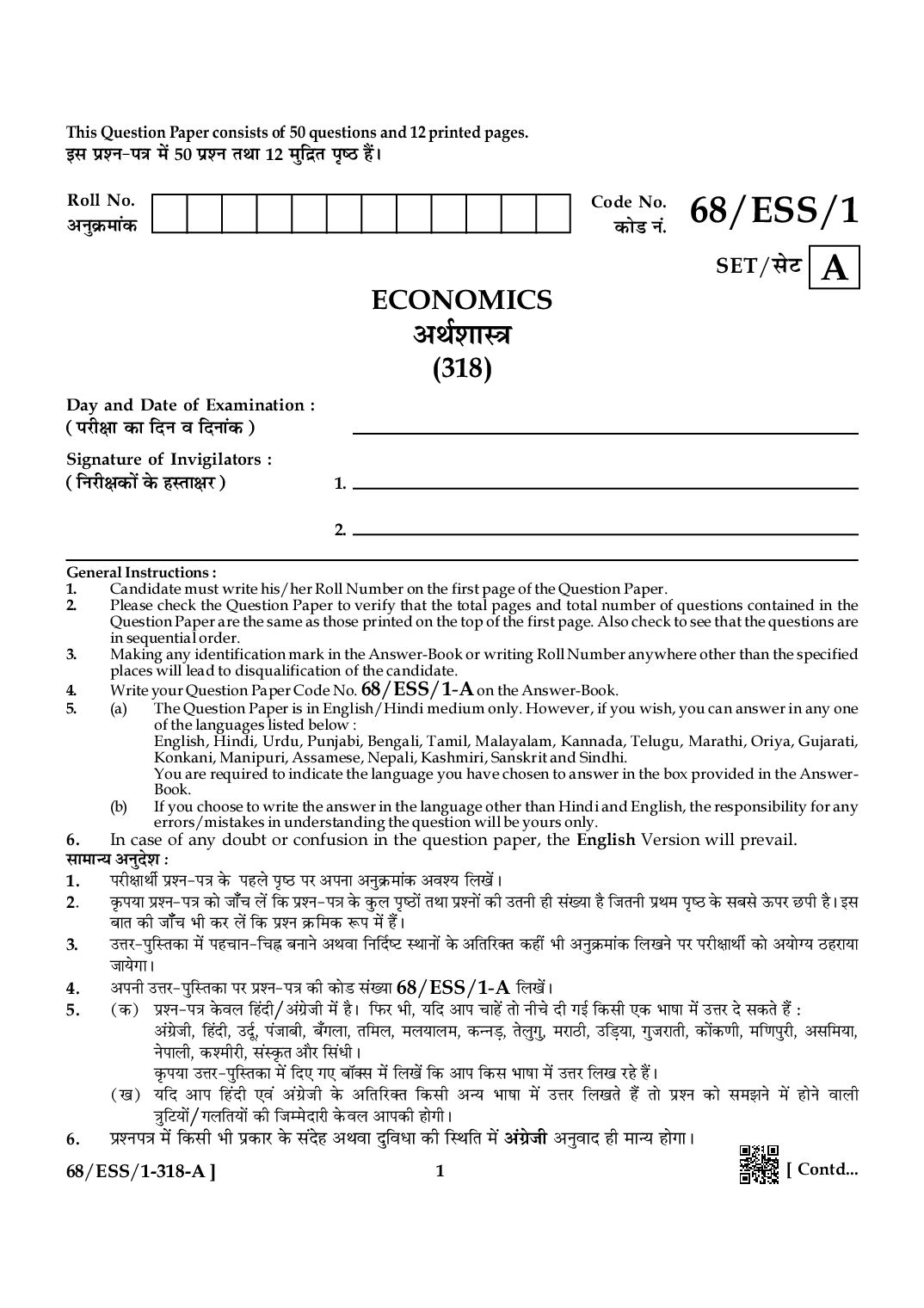
Page 1
ß‚ ¬˝‡Ÿ-¬òÊ ◊¥ 50 ¬˝‡Ÿ ÃÕÊ 12 ◊ÈÁŒ˝Ã ¬Îc∆U „Ò¥–
Roll No. Code No.
•ŸÈ∑˝§◊Ê¥∑§ ∑§Ê«U Ÿ¥.
68/ESS/1
SET/‚ ≈ A
ECONOMICS
•Õ¸‡ÊÊSòÊ
(318)
Day and Date of Examination :
(¬⁄UˡÊÊ ∑§Ê ÁŒŸ fl ÁŒŸÊ¥∑§)
Signature of Invigilators :
(ÁŸ⁄UˡÊ∑§Ê¥ ∑§ „SÃÊˇÊ⁄U) 1.
2.
General Instructions :
1. Candidate must write his/her Roll Number on the first page of the Question Paper.
2. Please check the Question Paper to verify that the total pages and total number of questions contained in the
Question Paper are the same as those printed on the top of the first page. Also check to see that the questions are
in sequential order.
3. Making any identification mark in the Answer-Book or writing Roll Number anywhere other than the specified
places will lead to disqualification of the candidate.
4. Write your Question Paper Code No. 68/ESS/1-A on the Answer-Book.
5. (a) The Question Paper is in English/Hindi medium only. However, if you wish, you can answer in any one
of the languages listed below :
English, Hindi, Urdu, Punjabi, Bengali, Tamil, Malayalam, Kannada, Telugu, Marathi, Oriya, Gujarati,
Konkani, Manipuri, Assamese, Nepali, Kashmiri, Sanskrit and Sindhi.
You are required to indicate the language you have chosen to answer in the box provided in the Answer-
Book.
(b) If you choose to write the answer in the language other than Hindi and English, the responsibility for any
errors/mistakes in understanding the question will be yours only.
6. In case of any doubt or confusion in the question paper, the English Version will prevail.
‚Ê◊Êãÿ •ŸÈŒ‡Ê —
1. ¬⁄UˡÊÊÕ˸ ¬˝‡Ÿ-¬òÊ ∑§ §¬„‹ ¬Îc∆U ¬⁄U •¬ŸÊ •ŸÈ∑˝§◊Ê¥∑§ •fl‡ÿU Á‹π¥–
2. ∑Χ¬ÿÊ ¬˝‡Ÿ-¬òÊ ∑§Ê ¡ÊÚ°ø ‹¥ Á∑§ ¬˝‡Ÿ-¬òÊ ∑§ ∑ȧ‹ ¬Îc∆UÊ¥ ÃÕÊ ¬˝‡ŸÊ¥ ∑§Ë ©ÃŸË „Ë ‚¥ÅUÿÊ „Ò Á¡ÃŸË ¬˝Õ◊ ¬Îc∆ ∑ §‚’‚ ™§¬⁄U ¿U¬Ë „Ò– ß‚
’Êà ∑§Ë ¡ÊÚ°ø ÷Ë ∑§⁄U ‹¥ Á∑§ ¬˝‡Ÿ ∑˝ Á◊∑§ UM§¬ ◊¥ „Ò¥–
3. § ©ûÊ⁄U-¬ÈÁSUÃ∑§Ê ◊¥ ¬„øÊŸ-Áøq ’ŸÊŸ •ÕflÊ ÁŸÁŒ¸c≈U SÕÊŸÊ¥ ∑§§•ÁÃÁ⁄UÄà ∑§„Ë¥ ÷Ë •ŸÈ∑˝§◊Ê¥∑§ Á‹πŸ ¬⁄U ¬⁄UˡÊÊÕ˸ ∑§Ê •ÿÊÇÿ ∆U„⁄UÊÿÊ
¡ÊÿªÊ–
4. •¬ŸË ©ûÊ⁄U-¬ÈÁSUÃ∑§Ê ¬⁄U ¬˝‡Ÿ-¬òÊ ∑§Ë ∑§Ê«U ‚¥ÅÿÊ 68/ESS/1-A Á‹π¥–
5. (∑§) ¬˝‡Ÿ-¬òÊ ∑§fl‹ Á„¥ŒË/•¥ª˝¡Ë ◊¥ „Ò– Á»§⁄U ÷Ë, ÿÁŒ •Ê¬ øÊ„¥ ÃÊ ŸËø ŒË ªß¸ Á∑§‚Ë ∞∑§ ÷Ê·Ê ◊¥ ©ûÊ⁄ Œ ‚∑§Ã „Ò¥ —
•¥ª˝¡Ë, Á„¥ŒË, ©ŒÍ¸, ¬¥¡Ê’Ë, ’°ª‹Ê, ÃÁ◊‹, ◊‹ÿÊ‹◊, ∑§ãŸ«∏, ËȪÈ, ◊⁄UÊ∆UË, ©Á«∏ÿÊ, ªÈ¡⁄UÊÃË, ∑§Ê¥∑§áÊË, ◊ÁáʬÈ⁄UË, •‚Á◊ÿÊ,
Ÿ¬Ê‹Ë, ∑§‡◊Ë⁄UË, ‚¥S∑Χç•ÊÒ⁄U Á‚¥œË–
∑Χ¬ÿÊ ©ûÊ⁄U-¬ÈÁSÃ∑§Ê ◊¥ ÁŒ∞ ª∞ ’ÊÚÄ‚ ◊¥ Á‹π¥ Á∑§ •Ê¬ Á∑§‚ ÷Ê·Ê ◊¥ ©ûÊ⁄U Á‹π ⁄U„ „Ò¥–
(π) ÿÁŒ •Ê¬ Á„¥ŒË ∞fl¥ •¥ª˝¡Ë ∑§ •ÁÃÁ⁄UÄà Á∑§‚Ë •ãÿ ÷Ê·Ê ◊¥ ©ûÊ⁄U Á‹πà „Ò¥ ÃÊ ¬˝‡Ÿ ∑§Ê ‚◊¤ÊŸ ◊¥ „ÊŸ flÊ‹Ë
òÊÈÁ≈UÿÊ¥/ª‹ÁÃÿÊ¥ ∑§Ë Á¡ê◊UŒÊ⁄Ë ∑ fl‹ •Ê¬∑§Ë „ʪ˖
6. ¬˝‡Ÿ¬òÊ ◊¥ Á∑§‚Ë ÷Ë ¬˝∑§Ê⁄U ∑§ ‚¥Œ„ •ÕflÊ ŒÈÁflœÊ ∑§Ë ÁSÕÁà ◊¥ •¥ª˝¡Ë •ŸÈflÊŒ „Ë ◊Êãÿ „ʪʖ
68/ESS/1-318-A ] 1 [ Contd...
Page 2
•Õ¸‡ÊÊSòÊ
(318)
Time : 3 Hours ] [ Maximum Marks : 100
‚◊ÿ — 3 ÉÊá≈U ] [ ¬ÍáÊÊZ∑§ — 100
Notes :
(i) This question paper consists of 50 questions in all.
(ii) All questions are compulsory.
(iii) Marks are given against each question.
(iv) Section - A consists of :
(a) Q.No. 1 to 20 - Multiple Choice type questions (MCQs) carrying 1 mark each. Select
and write the most appropriate option out of the four options given in each of these
questions.
(b) Q.No. 21 to 35 - Objective type questions carrying 2 marks each (with 2 sub-parts of 1
mark each). Attempt these questions as per the instructions given for each of the
questions 21 to 35.
(v) Section - B consists of :
(a) Q.No. 36 to 42 - Very Short Answer type questions carrying 2 marks each
to be answered in the range of 30 to 50 words.
(b) Q.No. 43 to 48 - Short Answer type questions carrying 4 marks each to be answered in
the range of 50 to 80 words.
(c) Q.No. 49 and 50 - Long Answer type questions carrying 6 marks each to be answered
in the range of 80 to 120 words.
ÁŸŒ¸‡Ê —
(i) ß‚ ¬˝‡Ÿ-¬òÊ ◊¥ ∑ȧ‹ 50 ¬˝‡Ÿ „Ò¥–
(ii) ‚÷Ë ¬˝‡Ÿ •ÁŸflÊÿ¸ „Ò¥–
(iii) ¬˝àÿ∑§ ¬˝‡Ÿ ∑§ ‚Ê◊Ÿ ©‚∑§ •¥∑§ ÁŒ∞ ª∞ „Ò¥–
(iv) πá«U - A ◊¥ -
(a) ¬˝‡Ÿ ‚¥ÅÿÊ 1 ‚ 20 ’„ÈÁfl∑§À¬Ëÿ ¬˝∑§Ê⁄U ∑§ ¬˝‡Ÿ „Ò¥, ¡Ê ¬˝àÿ∑§ 1 •¥∑§ ∑§Ê „Ò– ߟ ¬˝‡ŸÊ¥ ◊¥ ¬˝àÿ∑§ ◊¥ ÁŒÿ ªÿ
øÊ⁄U Áfl∑§À¬Ê¥ ◊¥ ‚ ‚’‚ ©¬ÿÈÄà Áfl∑§À¬ øÈÁŸÿ.
(b) ¬˝‡Ÿ ‚¥ÅÿÊ 21 ‚ 35 flSÃÈÁŸc∆U ¬˝‡Ÿ „Ò¥, ¬˝àÿ∑§ ¬˝‡Ÿ 2 •¥∑§Ê¥ ∑§Ê „Ò (ŒÊ ©¬÷ʪ ∑§ ‚ÊÕ ¬˝àÿ∑§ ∑§Ê 1 •¥∑§)
¬˝‡Ÿ ‚¥ÅÿÊ 21 ‚ 35 ◊¥ ¬˝àÿ∑§ ¬˝‡Ÿ ◊¥ ŒË ªß¸ ‚ÍøŸÊ •ŸÈ‚Ê⁄U ¬˝‡ŸÊ¥ ∑§ ©ûÊ⁄U ŒËÁ¡∞–
(v) πá«U - B§◊¥ -
(a) ¬˝‡Ÿ ‚¥ÅÿÊ 36 ‚ 42 •ÁËÉÊÈ-©ûÊ⁄UËÿ ¬˝∑§Ê⁄U ∑§ ¬˝‡Ÿ „Ò¥, ¬˝àÿ∑§ ∑§ 2 •¥∑§ „Ò¥ •ÊÒ⁄U ©ûÊ⁄U ∑§Ë ‚Ë◊Ê 30 ‚ 50
‡ÊéŒ „Ò–
(b) ¬˝‡Ÿ ‚¥ÅÿÊ 43 ‚ 48 ‹ÉÊÈ-©ûÊ⁄UËÿ ¬˝∑§Ê⁄U ∑§ ¬˝‡Ÿ „Ò¥, ¬˝àÿ∑§ ∑§ 4 •¥∑§ „Ò¥ •ÊÒ⁄U ©ûÊ⁄U ∑§Ë ‚Ë◊Ê 50 ‚ 80 ‡ÊéŒ
„Ò–
(c) ¬˝‡Ÿ ‚¥ÅÿÊ 49 •ÊÒ⁄U 50 ŒËÉʸ-©ûÊ⁄UËÿ ¬˝∑§Ê⁄U ∑§ ¬˝‡Ÿ „Ò¥, ¬˝àÿ∑§ ∑§ 6 •¥∑§ „Ò¥ •ÊÒ⁄U ©ûÊ⁄U ∑§Ë ‚Ë◊Ê 80 ‚ 120
‡ÊéŒ „Ò–
68/ESS/1-318-A ] 2 [ Contd...
Page 3
(1) Answers of all questions are to be given in the Answer-Book given to you.
‚÷Ë ¬˝‡ŸÊ¥ ∑§ ©ûÊ⁄U •Ê¬∑§Ê ŒË ªß¸ ©ûÊ⁄U-¬ÈÁSÃ∑§Ê ◊¥ „Ë Á‹π¥–
(2) 15 minutes time has been allotted to read this question paper. The question paper will be distributed
at 02.15 p.m. From 02.15 p.m. to 02.30 p.m., the students will read the question paper only and
will not write any answer on the answer-book during this period.
ß‚ ¬˝‡Ÿ-¬òÊ ∑§Ê ¬…∏Ÿ ∑§ Á‹∞ 15 Á◊Ÿ≈U ∑§Ê ‚◊ÿ ÁŒÿÊ ªÿÊ „Ò– ¬˝‡Ÿ-¬òÊ ∑§Ê ÁflÃ⁄UáÊ ŒÊ¬„⁄U ◊¥ 02.15 ’¡ Á∑§ÿÊ ¡Ê∞ªÊ–
02.15 ’¡ ‚ 02.30 ’¡ Ã∑§ ¿UÊòÊ ∑§fl‹ ¬˝‡Ÿ-¬òÊ ∑§Ê ¬…∏¥ª •ÊÒ⁄U ß‚ •flÁœ ∑§ ŒÊÒ⁄UÊŸ fl ©ûÊ⁄U-¬ÈÁSÃ∑§Ê ¬⁄U ∑§Ê߸ ©ûÊ⁄U Ÿ„Ë¥
Á‹π¥ª–
SECTION - A / πá«U - A
1. A and B are substitute goods. An increase in price of A will lead to __________ 1
(A) increase in demand for B.
(B) decrease in demand for B.
(C) a very little change in demand for B.
(D) no change in demand for B.
A •ÊÒ⁄U B ¬˝ÁÃSÕʬŸ flSÃÈ∞° „Ò– A ∑§Ë ∑§Ë◊à ’…∏Ÿ ‚ __________
(A) B ∑§Ë ◊Ê°ª ’…∏ªË–
(B) B ∑§Ë ◊Ê°ª ÉÊ≈UªË–
(C) B ∑§Ë ◊Ê°ª ◊¥ ’„Èà ∑§◊ ¬Á⁄UfløŸ „ʪʖ
(D) B ∑§Ë ◊Ê°ª ◊¥ ∑§Ê߸ ¬Á⁄UfløŸ Ÿ„Ë¥ „ʪʖ
2. Supply curve of a commodity is normally : 1
(A) positively sloped (B) negatively sloped
(C) parallel to OX-axis (D) parallel to OY-axis
∞∑§ flSÃÈ ∑§Ë ¬ÍÁø fl∑˝§ ‚Ê◊Êãÿ× —
(A) œŸÊà◊∑§ …∏‹ÊŸ flÊ‹Ë „ÊÃË „Ò– (B) ´§áÊÊà◊∑§ …∏‹ÊŸ flÊ‹Ë „ÊÃË „Ò–
(C) OX-•ˇÊ ∑§ U‚◊ÊŸÊ¥Ã⁄U „ÊÃË „Ò– (D) OY-•ˇÊ ∑§ ‚◊ÊŸÊ¥Ã⁄U „ÊÃË „Ò–
3. If A and B are complementary goods then increase in price of A will lead to : 1
(A) increase in demand for B (B) decrease in demand for B
(C) no change in demand for B (D) any one of the above
ÿÁŒ A •ÊÒ⁄ B ¬Í⁄U∑§ flSÃÈ∞° „Ò¥, ÃÊ A ∑§Ë ∑§Ë◊à ’…∏Ÿ ¬⁄U —
(A) B ∑§Ë ◊Ê°ª ’…∏ªË– (B) B ∑§Ë ◊Ê°ª ÉÊ≈UªË–
(C) B ∑§Ë ◊Ê°ª ◊¥ ∑§Ê߸ ¬Á⁄UfløŸ Ÿ„Ë¥ „ʪʖ (D) ©¬⁄UÊÄà ◊¥ ∑§Ê߸ ÷Ë–
4. Average propensity to consume is equal to : 1
C Y ∆C ∆Y
(A) (B) (C) (D)
Y C ∆Y ∆C
•ÊÒ‚Ã ©¬ÿʪ ¬˝flÎÁûÊ ’⁄UÊ’⁄U „ÊÃË „Ò —
C Y ∆C ∆Y
(A)
Y
∑§ (B)
C
∑§ (C)
∆Y
∑§ (D)
∆C
∑§
68/ESS/1-318-A ] 3 [ Contd...
Page 4
(A) Receipts from sale of old newspapers (B) Sale of old house
(C) Gifts received from employer (D) None of the above
ÁŸêŸÁ‹Áπà ◊¥ ‚ Á∑§‚ ⁄UÊc≈˛UËÿ •Êÿ ◊¥ ‡ÊÊÁ◊‹ ∑§⁄Uà „Ò¥ ?
(A) ¬È⁄UÊŸ •π’Ê⁄U ’øŸ ∑§ ’ÊŒ ¬˝Êåà ⁄UÊÁ‡Ê (B) ¬È⁄UÊŸ ◊∑§ÊŸ ∑§Ê Áfl∑˝§ÿ
(C) ÁŸÿÊ¡∑§Ê¥ ‚ ¬ÊÿÊ ©¬„Ê⁄U (D) ©¬⁄UÊÄà ◊¥ ‚ ∑§Ê߸ Ÿ„Ë¥–
6. Which of the following is a country’s National Income ? 1
(A) GNP @ f.c (B) NNP @ mp
(C) NDP @ f.c (D) NNP @ f.c
ÁŸêŸÁ‹Áπà ◊¥ ‚ Á∑§‚ ⁄UÊc≈˛UËÿ •Êÿ ∑§„¥ª¥?
(A) ‚ÊœŸ ‹ÊªÃ ¬⁄U ‚∑§‹ ⁄UÊc≈˛UËÿ ©à¬ÊŒ (B) ’Ê¡Ê⁄U ∑§Ë◊à ¬⁄U ÁŸfl‹ ⁄UÊc≈˛UËÿ ©à¬ÊŒ
(C) ‚ÊœŸ ‹ÊªÃ ¬⁄U ÁŸfl‹ ÉÊ⁄U‹Í ©à¬ÊŒ (D) ‚ÊœŸ ‹ÊªÃ ¬⁄U ÁŸfl‹ ⁄UÊc≈˛UËÿ ©à¬ÊŒ
7. Which of the following statements are true ? 1
(A) Consumption expenditure can never be zero.
(B) Value of investment multiplier (k) can never be less than 1.
(C) Consumption curve touches OY-axis.
(D) All the above.
ÁŸêŸÁ‹Áπà ∑§ÕŸÊ¥ ◊¥ ∑§ÊÒŸ ‚ ‚„Ë „Ò¥ ?
(A) ©¬÷ʪ √ÿÿ ∑§÷Ë ‡ÊÍãÿ Ÿ„Ë¥ „Ê ‚∑§ÃÊ–
(B) ÁŸfl‡Ê ªÈáÊ∑§ (k) ∑§Ê ◊ÍÀÿ ∑§÷Ë 1 ‚ ∑§◊ Ÿ„Ë¥ „Ê ‚∑§ÃÊ–
(C) ©¬÷ʪ fl∑˝§ OY-•ˇÊ ∑§Ê ¿ÍUÃË „Ò–
(D) ©¬⁄UÊÄà ‚÷Ë–
8. Which of the following equations is correct ? 1
(A) Indirect Taxes−Direct Taxes=Subsidies
(B) Indirect Taxes−Subsidies=Net Indirect Taxes
(C) Direct Taxes+Subsidies=Net Direct Taxes
(D) None of the above
ÁŸêŸÁ‹Áπà ◊¥ ‚ ∑§ÊÒŸ ‚Ê ‚◊Ë∑§⁄UáÊ ‚„Ë „Ò?
(A) •¬˝àÿˇÊ ∑§⁄U−¬˝àÿˇÊ ∑§⁄U=•ÊÁÕ¸∑§ ‚„ÊÿÃÊ
(B) •¬˝àÿˇÊ ∑§⁄U−•ÊÁÕ¸∑§ ‚„ÊÿÃÊ=ÁŸfl‹ •¬˝àÿˇÊ ∑§⁄
(C) ¬˝àÿˇÊ ∑§⁄+•ÊÁÕ¸∑§ ‚„ÊÿÃÊ=ÁŸfl‹ ¬˝àÿˇÊ ∑§⁄
(D) ©¬⁄UÊÄà ◊¥ ‚ ∑§Ê߸ Ÿ„Ë¥–
9. Revenue expenditure creates : 1
(A) Liability (B) Asset
(C) Both asset and liability (D) None of the above
⁄UÊ¡Sfl √ÿÿ ‚ —
(A) ŒŸŒÊ⁄UË ©à¬ãŸ „ÊÃË „Ò– (B) ¬Á⁄U‚¥¬ÁûÊ ’…∏ÃË „Ò–
(C) ŒŸŒÊ⁄UË •ÊÒ⁄U ¬Á⁄U‚¥¬ÁûÊ ŒÊŸÊ¥ ©à¬ãŸ „ÊÃË „Ò– (D) ©¬⁄UÊÄà ◊¥ ‚ ∑§Ê߸ Ÿ„Ë¥–
68/ESS/1-318-A ] 4 [ Contd...
Page 5
(A) Income (B) Savings
(C) Wealth (D) None of the above
ÁŸêŸÁ‹Áπà ◊¥ ‚ ∑§ÊÒŸ ‚Ê S≈UÊÚ∑§ „Ò ?
(A) •Êÿ (B) ’øÃ
(C) ‚ê¬ÁûÊ (D) ©¬⁄UÊÄà ◊¥ ‚ ∑§Ê߸ Ÿ„Ë¥
11. Which of the following supply curves have elasticity of supply > 1 ? 1
(A) Supply curve passing through the origin
(B) Supply curve cutting OX-axis
(C) Supply curve cutting OY-axis
(D) None of the above
ÁŸêŸÁ‹Áπà ◊¥ ‚ Á∑§‚ ¬ÍÁø fl∑˝§ ∑§Ë ‹Êø 1 ‚ •Áœ∑§ „ʪË?
(A) ©Œ˜ª◊ Á’¥ŒÈ ‚ ªÈ¡⁄UÃË ¬ÍÁø fl∑˝§
(B) OX-•ˇÊ ∑§Ê ∑§Ê≈UUÃË „È߸ ¬ÍÁø fl∑˝§
(C) OY-•ˇÊ ∑§Ê ∑§Ê≈UÃË „È߸ ¬ÍÁø fl∑˝§
(D) ©¬⁄UÊÄà ◊¥ ‚ ∑§Ê߸ Ÿ„Ë¥
12. Product is homogenous under : 1
(A) Perfect competition. (B) Monopolistic competition.
(C) Both (A) and (B). (D) None of the above.
©à¬ÊŒ ‚◊M§¬ „ÊÃÊ „Ò —
(A) ¬Íáʸ ¬˝ÁÃÿÊÁªÃÊ ◊¥– (B) ∞∑§ÊÁœ∑§Ê⁄UÊà◊∑§ ¬˝ÁÃÿÊÁªÃÊ ◊¥–
(C) (A) •ÊÒ⁄U (B) ŒÊŸÊ¥– (D) ©¬⁄UÊÄà ◊¥ ‚ Á∑§‚Ë ◊¥ Ÿ„Ë¥–
13. When the demand of a goods ‘increases’, demand curve : 1
(A) shifts to the right.
(B) shifts to the left.
(C) does not shifts but there is downward movement along the curve.
(D) there is no change in demand curve.
¡’ flSÃÈ ∑§Ë ◊Ê°ª ◊¥ “flÎÁh” „ÊÃË „Ò, ÃÊ ◊Ê°ª fl∑˝§ —
(A) ŒÊ°ÿË •Ê⁄U Áπ‚∑§ÃË „Ò–
(B) ’Ê°ÿË •Ê⁄U Áπ‚∑§ÃË „Ò–
(C) Ÿ„Ë¥ Áπ‚∑§ÃË ’ÁÀ∑§ fl∑˝§ ∑§ ‚¥ªÃU ŸËø ∑§Ë •Ê⁄U •Êà „Ò¥–
(D) ◊Ê°ª fl∑˝ ◊¥ ∑§Ê߸ ¬Á⁄UfløŸ Ÿ„Ë¥ „ÊÃÊ–
14. A supply curve parallel to OY-axis is : 1
(A) elastic supply curve. (B) inelastic supply curve.
(C) perfectly elastic supply curve. (D) perfectly inelastic supply curve.
OY-•ˇÊ ∑§ ‚◊ÊŸÊãÃ⁄UU ¬ÍÁø fl∑˝ —
(A) ‹ÊøŒÊ⁄U ¬ÍÁø fl∑˝ „ÊÃË „Ò– (B) ’‹ÊøŒÊ⁄U ¬ÍÁø fl∑˝ „ÊÃË „Ò–
(C) ¬ÍáʸÃÿÊ ‹ÊøŒÊ⁄U ¬ÍÁø fl∑˝ „ÊÃË „Ò– (D) ¬ÍáʸÃÿÊ ’‹ÊøŒÊ⁄U ¬ÍÁø fl∑˝ „ÊÃË „Ò–
68/ESS/1-318-A ] 5 [ Contd...
Page 6
(A) Oligopoly (B) Perfect competition
(C) Monopolistic competition (D) All the above
ß‚◊¥ »§◊¸ ∑§Ê ©lʪ mÊ⁄UÊ ÁŸœÊ¸Á⁄Uà ∑§Ë◊à ∑§Ê SflË∑§Ê⁄U ∑§⁄UŸË ¬«∏ÃË „Ò —
(A) •À¬ÊÁœ∑§Ê⁄U ◊¥– (B) ¬Íáʸ ¬˝ÁÃÿÊÁªÃÊ ◊¥–
(C) ∞∑§ÊÁœ∑§Ê⁄UÊà◊∑§ ¬˝ÁÃÿÊÁªÃÊ ◊¥– (D) ©¬⁄UÊÄà ‚÷Ë ◊¥–
16. Which of the following is a direct tax ? 1
(A) Excise duty (B) Wealth tax
(C) Income Tax (D) All of the above
ÁŸêŸÁ‹Áπà ◊¥ ‚ ∑§ÊÒŸ ‚Ê ¬˝àÿˇÊ ∑§⁄U „Ò?
(A) ©à¬ÊŒŸ ‡ÊÈÀ∑§ (B) ‚¥¬ÁûÊ ∑§⁄U
(C) •Êÿ ∑§⁄U (D) ©¬⁄UÊÄà ‚÷Ë
17. The value of Investment Multiplier (k) depends upon : 1
(A) value of APC. (B) value of APS.
(C) value of MPC. (D) savings.
ÁŸfl‡Ê ªÈáÊ∑§ (k) ∑§Ê ◊ÍÀÿ ÁŸ÷¸⁄U ∑§⁄UÃÊ „Ò —
(A) •ÊÒ‚Ã ©¬÷ʪ ¬˝flÎÁûÊ ∑§ ◊ÍÀÿ ¬⁄U– (B) •ÊÒ‚Ã ’øà ¬˝flÎÁûÊ ∑§ ◊ÍÀÿ ¬⁄U–
(C) ‚Ë◊ʥà ©¬÷ʪ ¬˝flÎÁûÊ ∑§ ◊ÍÀÿ ¬⁄U– (D) ’øà ¬⁄U–
18. A point inside a production possibility curve shows : 1
(A) growth of resources (B) under utilisation of resources
(C) overutilisation of resources (D) change in technique of productions
©à¬ÊŒŸ ‚¥÷ÊflŸÊ fl∑˝§ ∑§ •¥Œ⁄U ∑§Ê߸ Á’¥ŒÈ Œ‡ÊʸÃÊ „Ò —
(A) ‚¥‚ÊœŸÊ¥ ∑§Ë ‚¥flÎÁh (B) ‚¥‚ÊœŸÊ¥ ∑§Ê •À¬ ©¬ÿʪ
(C) ‚¥‚ÊœŸÊ¥ ∑§Ê ˇÊ◊ÃÊ ‚ •Áœ∑§ ©¬ÿʪ (D) ©à¬ÊŒŸ ¬˝áÊÊ‹Ë ◊¥ ¬Á⁄UfløŸ
68/ESS/1-318-A ] 6 [ Contd...
Page 7
(A) When price falls demand rises.
(B) Price and demand of a good are inversely related.
(C) Price and demand move in same direction.
(D) Other things remaining the same, there is inverse relationship between price and
demand of a commodity.
ÁŸêŸÁ‹Áπà ◊¥ ‚ ◊Ê°ª ∑§ ÁŸÿ◊ ∑§Ë ‚„Ë ¬Á⁄U÷Ê·Ê ∑§ÊÒŸ ‚Ë „Ò?
(A) ∑§Ë◊à ∑§◊ „ÊŸ ¬⁄U ◊Ê°ª ’…∏ÃË „Ò–
(B) flSÃÈ ∑§Ë ∑§Ë◊à •ÊÒ⁄U ◊Ê°ª ◊¥ Áfl¬⁄UËà ‚¥’¥œ „ÊÃÊ „Ò–
(C) flSÃÈ ∑§Ë ∑§Ë◊à •ÊÒ⁄U ◊Ê°ª ∞∑§ „Ë ÁŒ‡ÊÊ ◊¥ ¬Á⁄UflÁøà „Êà „Ò¥–
(D) •ãÿ ’ÊÃ¥ ¬Ífl¸flØ ⁄U„Ÿ ¬⁄U flSÃÈ ∑§Ë ∑§Ë◊à •ÊÒ⁄U ◊Ê°ª ◊¥ Áfl¬⁄UËà ‚¥’¥œ „ÊÃÊ „Ò–
20. ‘Inter-dependence’ is the feature of this type of market : 1
(A) Perfect competition (B) Monopoly
(C) Monopolistic competition (D) Oligopoly
“•¥ÃÁŸ¸÷¸⁄UÃÊ” ß‚ ¬˝∑§Ê⁄U ∑§ ’Ê¡Ê⁄U ∑§Ë Áfl‡Ê·ÃÊ „Ò —
(A) ¬Íáʸ ¬˝ÁÃÿÊÁªÃÊ (B) ∞∑§ÊÁœ∑§Ê⁄U
(C) ∞∑§ÊÁœ∑§Ê⁄UÊà◊∑§ ¬˝ÁÃÿÊÁªÃÊ (D) •À¬ÊÁœ∑§Ê⁄U
21. Fill in the blanks : 2
πÊ‹Ë SÕÊŸ ÷Á⁄U∞ —
In a government budget, the receipt that either creates a liability or reduces assets is called
__________ receipt, while the one which neither creates a liability nor reduces assets is called
__________.
‚⁄U∑§Ê⁄UË ’¡≈U ◊¥, ¡Ê ¬˝ÊÁ# ŒŸŒÊ⁄UË ©à¬ãŸ ∑§⁄UÃË ÿÊ ¬Á⁄U‚¥¬ÁûÊ ÉÊ≈UÊÃË fl„ __________ ¬˝ÊÁ# ∑§„‹ÊÃË „Ò ¡’Á∑§ ¡Ê
Ÿ ÃÊ ŒŸŒÊ⁄ËU ©à¬ãŸ ∑§⁄UÃË „Ò •ÊÒ⁄U Ÿ „Ë ¬Á⁄U‚ê¬ÁûÊ ÉÊ≈UÊÃË „Ò, __________ ¬˝ÊÁ# ∑§„‹ÊÃË „Ò–
22. __________ is an example of direct tax while __________ is an example of indirect tax. 2
__________ ¬˝àÿˇÊ-∑§⁄U ∑§Ê ∞∑§ ©ŒÊ„⁄UáÊ „Ò ¡’Á∑§ __________ ¬⁄UÊˇÊ-∑§⁄U ∑§Ê ∞∑§ ©ŒÊ„⁄UáÊ „Ò–
23. Measure of value is the __________ function while store of value is the __________ function 2
of money.
◊ÍÀÿ ∑§Ê ◊ʬ∑§ __________ ∑§Êÿ¸ „Ò ¡’Á∑§ ◊ÍÀÿ „Ò ‚¥ª˝„ ◊ÈŒ˝Ê ∑§Ê ∞∑§ __________∑§Êÿ¸ „Ò–
24. __________ is an example of real flow while __________ is an example of money flow in an 2
economy.
∞∑§ •Õ¸√ÿflSÕÊ ◊¥ __________ flÊSÃÁfl∑§ ¬˝flÊ„ „Ò ¡’Á∑§ __________ ◊ÊÒÁŒ˝∑§ ¬˝flÊ„ ∑§Ê ©ŒÊ„⁄UáÊ „Ò–
25. State True or False : 2
(i) Stationary purchased by an office is a final good.
(ii) Sugar purchased by a shopkeeper is an intermediate good.
’ÃÊß∞ ‚„Ë ÿÊ ª‹Ã —
(i) ∞∑§ •ÊÚÁ»§‚ mÊ⁄UÊ S≈U‡ÊŸ⁄UË ∑§Ë π⁄UËŒ •¥ÁÃ◊ flSÃÈ „Ò–
(ii) ∞∑§ ŒÈ∑§ÊŸŒÊ⁄U mÊ⁄UÊ øËŸË ∑§Ë π⁄UËŒ ◊äÿflÃ˸ flSÃÈ „Ò–
68/ESS/1-318-A ] 7 [ Contd...
Page 8
(i) Gross Indirect Tax−Net Indirect Tax=__________
(ii) Gross Domestic Product−Net Domestic Product=__________
πÊ‹Ë SÕÊŸ ÷Á⁄U∞ —
(i) ‚∑§‹ •¬˝àÿˇÊ ∑§⁄U−‡ÊÈh •¬˝àÿˇÊ ∑§⁄U=__________
(ii) ‚∑§‹ ÉÊ⁄U‹Í ©à¬ÊŒ−‡ÊÈh ÉÊ⁄U‹Í ©à¬ÊŒ=__________
27. ‘Increase’ in demand of a good leads to __________ in equilibrium price and __________ in 2
equilibrium demand.
Á∑§‚Ë flSÃÈ ∑§ ◊Ê°ª ◊¥ “flÎÁh” ‚¥ÃÈ‹Ÿ ∑§Ë◊à ◊¥ __________ ‹ÊÃË „Ò •ÊÒ⁄U ‚¥ÃÈ‹Ÿ ◊Ê°ª ◊¥ __________ ‹ÊÃË „Ò–
28. State True or False :
(i) Demand curve of a firm under perfect competition is perfectly inelastic. 2
(ii) Demand curve of a firm under monopolistic competition is perfectly elastic.
’ÃÊß∞ ‚„Ë ÿÊ ª‹Ã —
(i) ¬Íáʸ ¬˝ÁÃÿÊÁªÃÊ ◊¥ ∞∑§ »§◊¸ ∑§Ê ◊Ê°ª fl∑˝§ ¬ÍáʸÃÿÊ ’‹Êø „ÊÃÊ „Ò–
(ii) ∞∑§ÊÁœ∑§ÊÁ⁄U∑§ ¬˝ÁÃÿÊÁªÃÊ ◊¥ ∞∑§ »§◊¸ ∑§Ê ◊Ê°ª fl∑˝§ ¬ÍáʸÃÿÊ ‹ÊøŒÊ⁄U „ÊÃÊ „Ò–
29. Excess demand in a perfectly competitive market occurs __________ the equilibrium price 2
while excess supply occurs __________ the equilibrium price.
¬Íáʸ ¬˝ÁÃÿÊÁªÃÊ ’Ê¡Ê⁄U ◊¥ ◊Ê°ª •ÊÁœÄÿ ∑§Ë ÁSÕÁà ‚¥ÃÈ‹Ÿ ∑§Ë◊à ‚ __________ ∑§Ë ∑§Ë◊à ¬⁄U „ÊÃË „Ò ¡’Á∑§ ¬ÍÁø
•ÊÁœÄÿ ∑§Ë ÁSÕÁà ‚¥ÃÈ‹Ÿ ∑§Ë◊à ‚ __________∑§Ë ∑§Ë◊à ¬⁄U „ÊÃË „Ò–
30. State True or False : 2
(i) Giffen goods do not follow the Law of Demand.
(ii) Normal goods follow the Law of Demand.
’ÃÊß∞ ‚„Ë ÿÊ ª‹Ã —
(i) ◊Ê°ª ∑§Ê ÁŸÿ◊ ÁªÁ继Ÿ flSÃÈ•Ê¥ ¬⁄U ‹ÊªÍ Ÿ„Ë¥ „ÊÃÊ–
(ii) ◊Ê°ª ∑§Ê ÁŸÿ◊ ‚Ê◊Êãÿ flSÃÈ•Ê¥ ¬⁄U ‹ÊªÍ „ÊÃÊ „Ò–
31. When price of a commodity falls __________ income of the consumer __________. 2
¡’ ∞∑§ flSÃÈ ∑§Ë ∑§Ë◊à Áª⁄UÃË „Ò __________ ©¬÷ÊÄÃÊ ∑§Ë •Êÿ __________ ¡ÊÃË „Ò–
32. Goods which are used together are called __________ goods, while the goods which can be 2
used in place of one another are called __________ goods.
¡Ê flSÃÈ∞° ∞∑§ ‚ÊÕ ¬˝ÿʪ ◊¥ •ÊÃË „Ò __________ flSÃÈ∞° ∑§„‹ÊÃË „Ò, ¡’Á∑§ fl flSÃÈ∞° ¡Ê ∞∑§ ŒÍ‚⁄U ∑§ SÕÊŸ ◊¥
¬˝ÿʪ ◊¥ •ÊÃË „Ò¥ __________ flSÃÈ∞° ∑§„‹ÊÃË „Ò–
33. Fill in the blanks : 2
(i) Demand curve parallel to X-axis shows perfectly __________ demand.
(ii) Degree of responsiveness of demand to a price change is called price __________ of
demand.
πÊ‹Ë SÕÊŸ ÷Á⁄U∞ —
(i) X-•ˇÊ ∑§ ‚◊ÊŸÊ¥Ã⁄U ◊Ê°ª fl∑˝§ ¬ÍáʸÃÿÊ __________ ◊Ê°ª Œ‡ÊʸÃÊ „Ò–
(ii) ∑§Ë◊à ¬Á⁄UfløŸ ‚ ◊Ê°ª ∑§Ë •ŸÈÁ∑˝§ÿÊ ◊ÊòÊÊ ◊Ê°ª ∑§Ë ∑§Ë◊à __________ ∑§„‹ÊÃË „Ò–
68/ESS/1-318-A ] 8 [ Contd...
Page 9
(i) If with change in price total expenditure on the good also moves in the same direction,
the demand for the good is elastic.
(ii) Price elasticity of demand (−2) is higher than price elasticity (−1).
’ÃÊß∞ ‚„Ë ÿÊ ª‹Ã —
(i) ÿÁŒ flSÃÈ ∑§Ë ∑§Ë◊à ◊¥ ¬Á⁄UfløŸ ∑§ ∑§Ê⁄UáÊ ©‚ ¬⁄U „ÊŸ flÊ‹ √ÿÿ ◊¥ ∞∑§ „Ë ÁŒ‡ÊÊ ◊¥ ¬Á⁄UfløŸ „Ê ÃÊ ©‚ flSÃÈ
∑§Ë ◊Ê°ª ‹ÊøŒÊ⁄U „ʪ˖
(ii) ◊Ê°ª ∑§Ë ∑§Ë◊à ‹Êø (−2), ◊Ê°ª ∑§Ë ∑§Ë◊à ‹Êø (−1) ‚ •Áœ∑§ „ÊÃË „Ò–
35. Fill in the Blanks : 2
πÊ‹Ë SÕÊŸ ÷Á⁄U∞ —
Supply of a commodity is the __________ offered for sale at a price during a __________ of
time.
Á∑§‚Ë flSÃÈ ∑§Ë •Ê¬ÍÁø flSÃÈ ∑§Ë fl„ __________ „Ò ¡Ê ∞∑§ __________ ∑§Ë •flÁœ ∑§ ŒÊÒ⁄UÊŸ Á’∑˝§Ë ∑§ ¬˝SÃÈÃ
∑§Ë ¡ÊÃË „Ò–
SECTION - B / πá«U - B
36. State the assumptions of law of Supply. 2
•Ê¬ÍÁø ∑§ ÁŸÿ◊ ∑§Ë ◊ÊãÿÃÊ∞° ’ÃÊß∞–
37. State any four factors that can came a rightward shift of supply curve. 2
∞‚ ∑§Ê߸ øÊ⁄U ∑§Ê⁄U∑§ ’ÃÊß∞ Á¡Ÿ‚ ∞∑§ flSÃÈ ∑§Ë ¬ÍÁø fl∑˝ ŒÊ°ÿË •Ê⁄U Áπ‚∑§ ‚∑§ÃË „Ò–
38. Draw : (i) Total cost curve. 2
(ii) Total variable cost curve of a firm in a single diagram.
∞∑§ »§◊¸ ∑§Ë — (i) ∑ȧ‹ ‹ÊªÃ fl∑˝§ •ÊÒ⁄U
(ii) ∑ȧ‹ ¬Á⁄UflÃ˸ ‹ÊªÃ fl∑˝ ∞∑§ „Ë ⁄UπÊÁøòÊ ◊¥ ’ŸÊß∞–
39. Explain the meaning of optimum utilisation resources. 2
‚¥‚ÊœŸÊ¥ ∑§ ∑ȧ‡Ê‹Ã◊ ©¬ÿʪ ∑§Ê •Õ¸ ‚◊¤ÊÊß∞–
OR/•ÕflÊ
Explain the meaning of growth of resources.
‚¥‚ÊœŸÊ¥ ∑ ‚¥flÎÁh ∑§Ê •Õ¸ ‚◊¤ÊÊß∞–
40. Define Median. Write the formula to calculate it in individual and Discrete series. 2
◊ÊÁäÿ∑§Ê ∑§Ë ¬Á⁄U÷Ê·Ê ŒËÁ¡∞– √ÿÁQ§ªÃ •ÊÒ⁄U ¬ÎÕ∑§ üÊáÊË ◊¥ ß‚∑§Ê ªáÊŸÊ ∑§⁄UŸ ∑§Ê ‚ÍòÊ ’ÃÊß∞–
OR/•ÕflÊ
Explain two characteristic of Index Number.
‚Íø∑§Ê¥∑§ ∑§Ë ∑§Ê߸ ŒÊ Áfl‡Ê·ÃÊ∞° ’ÃÊß∞–
41. In a factory, there are 15 skilled and 10 unskilled workers. Their daily wage is Rs. 500 and 2
Rs. 400 respectively. Find the average daily wage of these 25 workers.
∞∑§ »Ò§Ä≈˛UË ◊¥ 15 ∑ȧ‡Ê‹ •ÊÒ⁄U 10 •∑ȧ‡Ê‹ ◊¡ŒÍ⁄U ∑§Ê◊ ∑§⁄Uà „Ò– ߟ∑§Ë ŒÒÁŸ∑§ ◊¡ŒÍ⁄UË ∑˝§◊‡Ê— 500 M§. •ÊÒ⁄U 400 M§.
„Ò– ‚÷Ë 25 üÊÁ◊∑§Ê¥ ∑§Ë ŒÒÁŸ∑§ •ÊÒ‚Ã ◊¡ŒÍ⁄UË ôÊÊà ∑§ËÁ¡∞–§
68/ESS/1-318-A ] 9 [ Contd...
Page 10
∞∑§ ©à¬ÊŒŸ ‚¥÷ÊflŸÊ fl∑˝§ ‚ËœË ⁄UπÊ ∑§’ „Ê ‚∑§ÃÊ „Ò? ‚◊¤ÊÊß∞–
43. State any four precautions that should be taken while estimating National Income by 4
production method.
©à¬ÊŒŸ ÁflÁœ ‚ ⁄UÊc≈˛UËÿ •Êÿ ∑§Ë ªáÊŸÊ ∑§⁄Uà ‚◊ÿ ’⁄UÃË ¡ÊŸ flÊ‹Ë ∑§Ê߸ øÊ⁄U ‚ÊflœÊÁŸÿÊ° ’ÃÊß∞–
44. Calculate National Income : (` 000) 4
(i) Interest 100
(ii) Wages and Salaries 900
(iii) Compensation of Employees 1050
(iv) Rent 300
(v) Net Indirect Taxes 100
(vi) Net factor Income from abroad (−)50
(vii) Profits 400
(viii) Consumption of fixed capital 50
(ix) Employees contribution to
social security 150
⁄UÊc≈˛UËÿ •Êÿ ∑§Ê ¬Á⁄U∑§‹Ÿ ∑§ËÁ¡∞ — (` 000)
(i) éÿÊ¡ 100
(ii) ◊¡ŒÍ⁄UË •ÊÒ⁄U flß 900
(iii) ∑§◊¸øÊÁ⁄UÿÊ¥ ∑§Ê ¬ÊÁ⁄UüÊÁ◊∑§ 1050
(iv) Á∑§⁄UÊÿÊ 300
(v) ÁŸfl‹ •¬˝àÿˇÊ ∑§⁄U 100
(vi) ÁflŒ‡ÊÊ¥ ‚ ÁŸfl‹ ‚ÊœŸ •Êÿ (−)50
(vii) ‹Ê÷ 400
(viii) ÁSÕ⁄U ¬Í°¡Ë ∑§Ê ©¬÷ʪ 50
(ix) ÁŸÿÊ¡∑§Ê¥ ∑§Ê ‚Ê◊ÊÁ¡∑§ ‚È⁄UˇÊÊ ◊¥ ÿʪŒÊŸ 150
45. Calculate arithmetic mean from the following data : 4
ÁŸêŸÁ‹Áπà •Ê°∑§«∏Ê¥ ‚ •¥∑§ªÁáÊÃËÿ ◊Êäÿ ∑§Ê ¬Á⁄U∑§‹Ÿ ∑§ËÁ¡∞ —
Marks Number of Students
•¥∑§ ÁfllÊÁÕ¸ÿÊ¥ ∑§Ë ‚¥ÅÿÊ
0 - 20 10
20 - 40 20
40 - 60 15
60 - 80 5
68/ESS/1-318-A ] 10 [ Contd...
Page 11
ÁŸêŸÁ‹Áπà ÃÊÁ‹∑§Ê ∑§Ê ¬Í⁄UÊ ∑§ËÁ¡∞ —
Output Total cost Marginal cost Average variable cost
©à¬ÊŒŸ (units) ∑ȧ‹ ‹ÊªÃ (Rs.) ‚Ë◊Êãà ‹ÊªÃ (Rs.) •ÊÒ‚Ã ¬Á⁄UflÃ˸ ‹ÊªÃ (Rs.)
0 20 ___ ___
1 30 ___ ___
2 38 ___ ___
3 44 ___ ___
4 52 ___ ___
OR/•ÕflÊ
Draw a diagram showing AC curve, MC curve and AFC curve. Explain their relationship.
•ÊÒ‚Ã ‹ÊªÃ fl∑˝§, ‚Ë◊Êãà ‹ÊªÃ •ÊÒ⁄U •ÊÒ‚Ã ÁSÕ⁄U ‹ÊªÃ fl∑˝§ ∞∑§ ⁄UπÊÁøòÊ ◊¥ ÁŒπÊß∞– ©Ÿ∑§Ê ‚¥’¥œ ÷Ë ’ÃÊß∞–
47. Explain the role of the Central bank as banker : 4
(i) To the Government
(ii) To the Commercial banks
∑§ãŒ˝Ëÿ ’Ò¥∑§ ∑§Ê ÁŸêŸÁ‹Áπà ÷ÍÁ◊∑§Ê ∑§Ë √ÿÊÅÿÊ ∑§ËÁ¡∞–
(i) ‚⁄U∑§Ê⁄U ∑§Ê ’Ò¥∑§⁄U
(ii) flÊÁáÊÁíÿ∑§ ’Ò¥∑§Ê¥ ∑§Ê ’Ò¥∑§⁄U
OR/•ÕflÊ
Explain ‘providing employment’ objective of Budgetary policy.
’¡≈UËÿ ŸËÁà ∑§Ê “⁄UÊ¡ªÊ⁄U ∑§ •fl‚⁄U ¬˝ŒÊŸ ∑§⁄ŸÊ” ©g‡ÿ ‚◊¤ÊÊß∞–
48. In an economy mpc = 0.8 and autonomous consumption is Rs. 500. Calculate its consumption 4
expenditure if its level of income (Y) is Rs. 10,000.
∞∑§ •Õ¸√ÿflSÕÊ ◊¥ ‚Ë.©.¬˝.= 0.8 „Ò, •ÊÒ⁄U SflÊÿûÊ ©¬÷ʪ = 500 M§. ÿÁŒ ß‚∑§Ê •Êÿ ∑§Ê SÃ⁄U (Y) 10,000U M§.
„Ò, ÃÊ ©¬÷ʪ √ÿÿ Á∑§ÃŸÊ „ʪÊ?
OR/•ÕflÊ
Show the situation of excess demand in an economy with the help of a diagram.
∞∑§ ⁄UπÊÁøòÊ ∑§Ë ‚„ÊÿÃÊ ‚ ∞∑§ •Õ¸√ÿflSÕÊ ◊¥ ◊Ê°ª •ÊÁœÄÿ ∑§Ë ÁSÕÁà Œ‡Êʸß∞–
49. Following table shows the marks obtained by 5 students in English and Economics. 6
1 2 3 4 5
Marks in English 14 11 10 18 9
Marks in Economics 12 15 8 16 10
Calculate Rank correlation.
ÁŸêŸÁ‹Áπà ÃÊÁ‹∑§Ê 5 ÁfllÊÁÕ¸ÿÊ¥ mÊ⁄UÊ •¥ª˝¡Ë •ÊÒ⁄U •Õ¸‡ÊÊSòÊ ◊¥ ¬˝Ê# •¥∑§ Œ‡ÊʸÃË „Ò–
1 2 3 4 5
•¥ª˝¡Ë ◊¥ •¥∑§ 14 11 10 18 9
•Õ¸‡ÊÊSòÊ ◊¥ •¥∑§ 12 15 8 16 10
∑˝§◊ ‚„‚ê’㜠¬Á⁄U∑§‹Ÿ ∑§ËÁ¡∞–
68/ESS/1-318-A ] 11 [ Contd...
Page 12
‹ÊS¬ÿ⁄U ∑§ Á∑§◊à ‚Èø∑§Ê¥∑§ ∑§Ê ¬Á⁄U∑§‹Ÿ ∑§ËÁ¡∞ —
Base Year/ •ÊœÊ⁄U fl·¸ Current Year/øÊ‹Í fl·¸
Commodity Price Quantity Price Quantity
flSÃÈ ∑§Ë◊à (Rs.) ◊ÊòÊÊ ∑§Ë◊à (Rs.) ◊ÊòÊÊ
A 2 8 4 10
B 4 12 5 14
C 6 10 2 8
D 8 22 6 12
OR/•ÕflÊ
Calculate Consumer Price Index for the year 2010 on the basis of year 2005.
fl·¸ 2010 ∑§ Á‹∞, 2005 ∑§Ê •ÊœÊ⁄U ◊ÊŸ ∑§⁄U ©¬÷ÊQ§Ê ‚Íø∑§Ê¥∑§ ∑§Ê ¬Á⁄U∑§‹Ÿ ∑§ËÁ¡∞ —
Commodity Weight Price (2005) Price (2010)
flSÃÈ ÷Ê⁄ ∑§Ë◊à (2005) ∑§Ë◊à (2010)
A 20 30 45
B 30 20 25
C 50 10 15
-oOo-
68/ESS/1-318-A ] 12 [ Contd...
Document Details
| Board / Org | NIOS |
| Exam | National Institute of Open Schooling Class 12 |
| Type | Question Paper |
| Pages | 12 |
| Language | english |
| Updated | 24 Sep 2026 |