NIOS Class 12 October 2024 Question Paper Sociology
Finished viewing? Save it for later —
Download NIOS Class 12 October 2024 Question Paper Sociology (PDF · 16 pages)About NIOS Class 12 October 2024 Question Paper Sociology
NIOS Class 12 October 2024 Question Paper Sociology is available here for free download. Published by NIOS for National Institute of Open Schooling Class 12, this question paper can be viewed online or downloaded as a PDF (16 pages). Candidates preparing for National Institute of Open Schooling Class 12 can use NIOS Class 12 October 2024 Question Paper Sociology to understand the exam pattern, the type of questions asked, and the overall difficulty level.
Frequently Asked Questions
How can I download NIOS Class 12 October 2024 Question Paper Sociology?
Open this page and click the Download button to save NIOS Class 12 October 2024 Question Paper Sociology as a PDF. It is completely free on AglaSem Docs.
Is NIOS Class 12 October 2024 Question Paper Sociology free to download?
Yes. NIOS Class 12 October 2024 Question Paper Sociology can be viewed online and downloaded as a PDF free of cost on AglaSem Docs.
How many pages does NIOS Class 12 October 2024 Question Paper Sociology have?
NIOS Class 12 October 2024 Question Paper Sociology contains 16 pages, which you can read online or download together as a single PDF.
Where can I find more National Institute of Open Schooling Class 12 study material?
You can find more National Institute of Open Schooling Class 12 question papers, sample papers, syllabus, and answer keys on AglaSem Docs.
NIOS Class 12 October 2024 Question Paper Sociology – Text
Read the full text of this question paper below — useful to quickly search, copy and reference the content online without downloading the PDF.
📄 View text version (16 pages)
Page 1
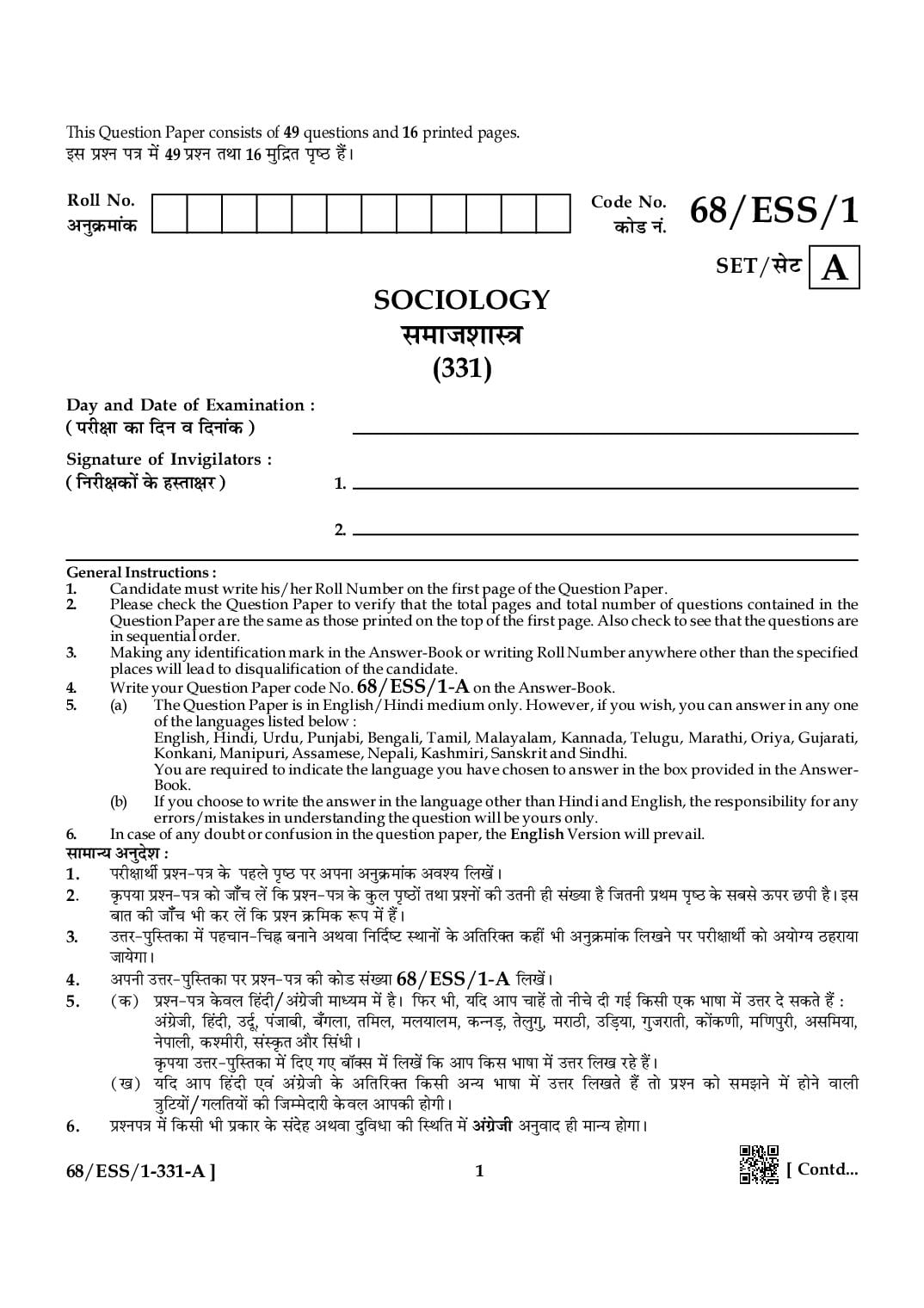
ß‚ ¬˝‡Ÿ ¬òÊ ◊¥ 49 ¬˝‡Ÿ ÃÕÊ 16 ◊ÈÁŒ˝Ã ¬Îc∆U „Ò¥–
Roll No. Code No.
•ŸÈ∑˝§◊Ê¥∑§ ∑§Ê«U Ÿ¥.
68/ESS/1
SET/‚ ≈ A
SOCIOLOGY
‚◊Ê¡‡ÊÊSòÊ
(331)
Day and Date of Examination :
(¬⁄UˡÊÊ ∑§Ê ÁŒŸ fl ÁŒŸÊ¥∑§)
Signature of Invigilators :
(ÁŸ⁄UˡÊ∑§Ê¥ ∑§ „SÃÊˇÊ⁄U) 1.
2.
General Instructions :
1. Candidate must write his/her Roll Number on the first page of the Question Paper.
2. Please check the Question Paper to verify that the total pages and total number of questions contained in the
Question Paper are the same as those printed on the top of the first page. Also check to see that the questions are
in sequential order.
3. Making any identification mark in the Answer-Book or writing Roll Number anywhere other than the specified
places will lead to disqualification of the candidate.
4. Write your Question Paper code No. 68/ESS/1-A on the Answer-Book.
5. (a) The Question Paper is in English/Hindi medium only. However, if you wish, you can answer in any one
of the languages listed below :
English, Hindi, Urdu, Punjabi, Bengali, Tamil, Malayalam, Kannada, Telugu, Marathi, Oriya, Gujarati,
Konkani, Manipuri, Assamese, Nepali, Kashmiri, Sanskrit and Sindhi.
You are required to indicate the language you have chosen to answer in the box provided in the Answer-
Book.
(b) If you choose to write the answer in the language other than Hindi and English, the responsibility for any
errors/mistakes in understanding the question will be yours only.
6. In case of any doubt or confusion in the question paper, the English Version will prevail.
‚Ê◊Êãÿ •ŸÈŒ‡Ê —
1. ¬⁄UˡÊÊÕ˸ ¬˝‡Ÿ-¬òÊ ∑§ §¬„‹ ¬Îc∆U ¬⁄U •¬ŸÊ •ŸÈ∑˝§◊Ê¥∑§ •fl‡ÿU Á‹π¥–
2. ∑Χ¬ÿÊ ¬˝‡Ÿ-¬òÊ ∑§Ê ¡ÊÚ°ø ‹¥ Á∑§ ¬˝‡Ÿ-¬òÊ ∑§ ∑ȧ‹ ¬Îc∆UÊ¥ ÃÕÊ ¬˝‡ŸÊ¥ ∑§Ë ©ÃŸË „Ë ‚¥ÅUÿÊ „Ò Á¡ÃŸË ¬˝Õ◊ ¬Îc∆ ∑ §‚’‚ ™§¬⁄U ¿U¬Ë „Ò– ß‚
’Êà ∑§Ë ¡ÊÚ°ø ÷Ë ∑§⁄U ‹¥ Á∑§ ¬˝‡Ÿ ∑˝ Á◊∑§ UM§¬ ◊¥ „Ò¥–
3. § ©ûÊ⁄U-¬ÈÁSUÃ∑§Ê ◊¥ ¬„øÊŸ-Áøq ’ŸÊŸ •ÕflÊ ÁŸÁŒ¸c≈U SÕÊŸÊ¥ ∑§§•ÁÃÁ⁄UÄà ∑§„Ë¥ ÷Ë •ŸÈ∑˝§◊Ê¥∑§ Á‹πŸ ¬⁄U ¬⁄UˡÊÊÕ˸ ∑§Ê •ÿÊÇÿ ∆U„⁄UÊÿÊ
¡ÊÿªÊ–
4. •¬ŸË ©ûÊ⁄U-¬ÈÁSUÃ∑§Ê ¬⁄U ¬˝‡Ÿ-¬òÊ ∑§Ë ∑§Ê«U ‚¥ÅÿÊ 68/ESS/1-A Á‹π¥–
5. (∑§) ¬˝‡Ÿ-¬òÊ ∑§fl‹ Á„¥ŒË/•¥ª˝¡Ë ◊Êäÿ◊ ◊¥ „Ò– Á»§⁄U ÷Ë, ÿÁŒ •Ê¬ øÊ„¥ ÃÊ ŸËø ŒË ªß¸ Á∑§‚Ë ∞∑§ ÷Ê·Ê ◊¥ ©ûÊ⁄ Œ ‚∑§Ã „Ò¥ —
•¥ª˝¡Ë, Á„¥ŒË, ©ŒÍ¸, ¬¥¡Ê’Ë, ’°ª‹Ê, ÃÁ◊‹, ◊‹ÿÊ‹◊, ∑§ãŸ«∏, ËȪÈ, ◊⁄UÊ∆UË, ©Á«∏ÿÊ, ªÈ¡⁄UÊÃË, ∑§Ê¥∑§áÊË, ◊ÁáʬÈ⁄UË, •‚Á◊ÿÊ,
Ÿ¬Ê‹Ë, ∑§‡◊Ë⁄UË, ‚¥S∑Χç•ÊÒ⁄U Á‚¥œË–
∑Χ¬ÿÊ ©ûÊ⁄U-¬ÈÁSÃ∑§Ê ◊¥ ÁŒ∞ ª∞ ’ÊÚÄ‚ ◊¥ Á‹π¥ Á∑§ •Ê¬ Á∑§‚ ÷Ê·Ê ◊¥ ©ûÊ⁄U Á‹π ⁄U„ „Ò¥–
(π) ÿÁŒ •Ê¬ Á„¥ŒË ∞fl¥ •¥ª˝¡Ë ∑§ •ÁÃÁ⁄UÄà Á∑§‚Ë •ãÿ ÷Ê·Ê ◊¥ ©ûÊ⁄U Á‹πà „Ò¥ ÃÊ ¬˝‡Ÿ ∑§Ê ‚◊¤ÊŸ ◊¥ „ÊŸ flÊ‹Ë
òÊÈÁ≈UÿÊ¥/ª‹ÁÃÿÊ¥ ∑§Ë Á¡ê◊UŒÊ⁄Ë ∑ fl‹ •Ê¬∑§Ë „ʪ˖
6. ¬˝‡Ÿ¬òÊ ◊¥ Á∑§‚Ë ÷Ë ¬˝∑§Ê⁄U ∑§ ‚¥Œ„ •ÕflÊ ŒÈÁflœÊ ∑§Ë ÁSÕÁà ◊¥ •¥ª˝¡Ë •ŸÈflÊŒ „Ë ◊Êãÿ „ʪʖ
68/ESS/1-331-A ] 1 [ Contd...
Page 2
‚◊Ê¡‡ÊÊSòÊ
(331)
Time : 3 Hours ] [ Maximum Marks : 100
‚◊ÿ — 3 ÉÊá≈U ] [ ¬ÍáÊÊZ∑§ — 100
Note : (i) This question paper consists of 49 questions in all.
(ii) All questions are compulsory.
(iii) Marks are given against each question.
(iv) For Optional Module, attempt all questions either from Optional Module I or Optional
Module II.
(v) Section - A consists of Question Numbers 1 to 25 and 41 to 47, as follows :
(a) Q. No. 1 to 17 and 41 to 43 - are Multiple Choice Questions (MCQs) carrying 1
mark each (1x20=20). Select and write the most appropriate option
(A, B, C or D).
(b) Q. No. 18 to 25 and 44 to 47 - are Other Objective Type Questions. Q. No. 18, 19
and 21 carries 2 marks (with 2 sub parts of 1 mark each) and Q. No. 20 carries 5
marks (with 5 sub parts of 1 mark each), Q. No. 22 carries 3 marks (with 3 sub
parts of 1 mark each), Q. No. 23, 24 and 25 carries 4 marks (with 4 sub parts of 1
mark each), as well as Q. No. 44 to 47 carries 1 mark each. Attempt as per
instructions given therein with each such question at 18 to 25 and 44 to 47.
(vi) Section - B at number 26 to 40 and 48 to 49 consists of Descriptive Type Questions as
follows :
(a) Q. No. 26 to 31 and 48 - are Very Short Answer Type Questions, carries 2 marks
each (2x7=14), to be answered in the range of 80 to 120 words.
(b) Q. No. 32 to 38 - are Short Answer Type Questions, carries 3 marks each (3x7=21),
to be answered in the range of 150 to 200 words.
(c) Q. No. 39 and 40 and 49 - are Long Answer Type Questions, carries 5 marks each
(5x3=15), to be answered in the range of 400 to 500 words.
ÁŸŒ¸‡Ê — (i) ß‚ ¬˝‡Ÿ-¬òÊ ◊¥ ∑ȧ‹ 49 ¬˝‡Ÿ „Ò¥–
(ii) ‚÷Ë ¬˝‡Ÿ •ÁŸflÊÿ¸ „Ò¥–
(iii) ¬˝àÿ∑§ ¬˝‡Ÿ ∑§ ‚Ê◊Ÿ •¥∑§ ÁŒÿ ªÿ „Ò¥–
(iv) flÒ∑§ÁÀ¬∑§ ◊ÊÚ«KÍ‹ ◊¥ •Ê¬∑§Ê ÿÊ ÃÊ flÒ∑§ÁÀ¬∑§ ◊ÊÚ«KÍ‹ I ÿÊ flÒ∑§ÁÀ¬∑§ ◊ÊÚ«KÍ‹ II ∑§ ‚÷Ë ¬˝‡Ÿ ∑§⁄UŸ „Ê¥ª–
(v) πá«U - A ◊¥ ¬˝‡Ÿ ‚¥ÅÿÊ 1 ‚ 25 •ÊÒ⁄ 41 ‚ 47 ÁŸêŸ ¬˝∑§Ê⁄U „Ò¥ —
(a) ¬˝‡Ÿ ‚¥ÅÿÊ 1 ‚ 17 •ÊÒ⁄U 41 ‚ 43 - ’„ÈÁfl∑§À¬Ëÿ ¬˝∑§Ê⁄U ∑§ ¬˝‡Ÿ „Ò¥, ¡Ê ¬˝àÿ∑§ 1 •¥∑§ ∑§Ê „Ò
(1x20=20)– ߟ ¬˝‡ŸÊ¥ ◊¥ ‚’‚ ©¬ÿÈÄà Áfl∑§À¬ (A, B, C ÿÊ D) øÈÁŸÿ •ÊÒ⁄U Á‹Áπ∞–
(b) ¬˝‡Ÿ ‚¥ÅÿÊ 18 ‚ 25 •ÊÒ⁄U 44 ‚ 47 - •ãÿ flSÃÈÁŸc∆U ¬˝‡Ÿ „Ò¥– ¬˝‡Ÿ ‚¥ÅÿÊ 18, 19 •ÊÒ⁄U 21 ¬˝àÿ∑§ 2
•¥∑§Ê¥ ∑§Ê „Ò (ŒÊ ©¬÷ʪ ∑§ ‚ÊÕ ¬˝àÿ∑§ ∑§Ê 1 •¥∑§), ¬˝‡Ÿ ‚¥ÅÿÊ 20 ∑§ 5 •¥∑§ „Ò (¬Ê°ø ©¬÷ʪ ∑§
‚ÊÕ ¬˝àÿ∑§ ∑§Ê 1 •¥∑§), ¬˝‡Ÿ ‚¥ÅÿÊ 22 ∑§ 3 •¥∑§ „Ò (ÃËŸ ©¬÷ʪ ∑§ ‚ÊÕ ¬˝àÿ∑§ ∑§Ê 1 •¥∑§), ¬˝‡Ÿ
‚¥ÅÿÊ 23, 24 •ÊÒ⁄U 25 ¬˝àÿ∑§ 4 •¥∑§ ∑§Ê „Ò (øÊ⁄U ©¬÷ʪ ∑§ ‚ÊÕ ¬˝àÿ∑§ ∑§Ê 1 •¥∑§), ß‚Ë ¬˝∑§Ê⁄U
¬˝‡Ÿ ‚¥ÅÿÊ 44 ‚ 47 ¬˝àÿ∑§ 1 •¥∑§ ∑§Ê „Ò– ¬˝‡Ÿ ‚¥ÅÿÊ 18 ‚ 25 •ÊÒ⁄U 44 ‚ 47 ∑§ ©ûÊ⁄U ŒË ªß¸ ‚ÍøŸÊ
∑§ •ŸÈ‚Ê⁄U ŒËÁ¡∞–
(vi) πá«U - B ◊¥ ¬˝‡Ÿ ‚¥ÅÿÊ 26 ‚ 40 •ÊÒ⁄U 48 ‚ 49 ÁŸêŸ ¬˝∑§Ê⁄ ∑§ fláʸŸÊà◊∑§ ¬˝‡Ÿ „Ò¥ —
(a) ¬˝‡Ÿ ‚¥ÅÿÊ 26 ‚ 31 •ÊÒ⁄U 48 - •ÁËÉÊÈ ©ûÊ⁄UËÿ ¬˝∑§Ê⁄U ∑§ ¬˝‡Ÿ, ¬˝àÿ∑§ ∑§Ê 2 •¥∑§ (2x7=14), •ÊÒ⁄U
©ûÊ⁄U ∑§Ë ‡ÊéŒ ‚Ë◊Ê 80 ‚ 120 ‡ÊéŒ „Ò¥–
(b) ¬˝‡Ÿ ‚¥ÅÿÊ 32 ‚ 38 - ‹ÉÊÈ ©ûÊ⁄UËÿ ¬˝∑§Ê⁄U ∑§ ¬˝‡Ÿ, ¬˝àÿ∑§ ∑§Ê 3 •¥∑§ (3x7=21), •ÊÒ⁄U ©ûÊ⁄U ∑§Ë ‡ÊéŒ
‚Ë◊Ê 150 ‚ 200 ‡ÊéŒ „Ò¥–
(c) ¬˝‡Ÿ ‚¥ÅÿÊ 39 •ÊÒ⁄U 40 ÃÕÊ 49 - ŒËÉʸ ©ûÊ⁄UËÿ ¬˝∑§Ê⁄U ∑§ ¬˝‡Ÿ „Ò, ¬˝àÿ∑§ ∑§Ê 5 •¥∑§ (5x3=15), •ÊÒ⁄U
©ûÊ⁄U ∑§Ë ‡ÊéŒ ‚Ë◊Ê 400 ‚ 500 ‡ÊéŒ „Ò¥–
68/ESS/1-331-A ] 2 [ Contd...
Page 3
(1) Answers of all questions are to be given in the Answer-Book given to you.
‚÷Ë ¬˝‡ŸÊ¥ ∑§ ©ûÊ⁄U •Ê¬∑§Ê ŒË ªÿË ©ûÊ⁄U ¬ÈÁSÃ∑§Ê ◊¥ „Ë Á‹π¥–
(2) 15 minutes time has been allotted to read this question paper. The question paper will be distributed
at 02.15 p.m. From 02.15 p.m. to 02.30 p.m., the students will read the question paper only and
will not write any answer on the answer-book during this period.
ß‚ ¬˝‡Ÿ-¬òÊ ∑§Ê ¬…∏Ÿ ∑§ Á‹∞ 15 Á◊Ÿ≈U ∑§Ê ‚◊ÿ ÁŒÿÊ ªÿÊ „Ò– ¬˝‡Ÿ-¬òÊ ∑§Ê ÁflÃ⁄UáÊ ŒÊ¬„⁄U ◊¥ 02.15 ’¡ Á∑§ÿÊ ¡Ê∞ªÊ–
02.15 ’¡ ‚ 02.30 ’¡ Ã∑§ ¿UÊòÊ ∑§fl‹ ¬˝‡Ÿ-¬òÊ ∑§Ê ¬…∏¥ª •ÊÒ⁄U ß‚ •flÁœ ∑§ ŒÊÒ⁄UÊŸ fl ©ûÊ⁄U-¬ÈÁSÃ∑§Ê ¬⁄U ∑§Ê߸ ©ûÊ⁄U Ÿ„Ë¥
Á‹π¥ª–
SECTION - A / πá«U - A
Answer all Multiple Choice Questions.
‚÷Ë ’„ÈÁfl∑§À¬Ëÿ ¬˝‡ŸÊ¥ ∑§ ©ûÊ⁄U ŒËÁ¡∞–
1. A neighbourhood or a village are good examples of which of the following ? 1
(A) Community (B) Society
(C) Urbanization (D) Association
∞∑§ ¬«∏Ê‚ ÿÊ ªÊ°fl ÁŸêŸÁ‹Áπà ◊¥ ‚ Á∑§‚∑§ •ë¿U ©ŒÊ„⁄UáÊ „Ò¥ ?
(A) ‚◊ÈŒÊÿ (B) ‚◊Ê¡
(C) ‡Ê„⁄U (D) ‚¥ÉÊ
2. The Industrial Revolution that started in Europe in the late 17th century gradually impacted 1
the entire globe. Identify the factor that cannot be associated with this phenomenon :
(A) Production moved out of households to factories.
(B) The role of capital in the production process increased.
(C) People from all strata took to agricultural activities.
(D) Many women entered the work force.
ÿÍ⁄Uʬ ◊¥ 17 flË¥ ‚ŒË ◊¥ „È߸ •ÊÒlÊÁª∑§ ∑˝§Ê°Áà œË⁄U-œË⁄U ‚¥¬Íáʸ Áfl‡fl ◊¥ »Ò§‹ ªß¸– ©‚ ∑§Ê⁄U∑§ ∑§Ë ¬„øÊŸ ∑§⁄¥U ¡Ê ß‚
¬Á⁄UÉÊ≈UŸÊ ‚ ¡È«UÊ „È•Ê Ÿ„Ë¥ „Ò —
(A) ©à¬ÊŒŸ ÉÊ⁄UÊ¥ ‚ ÁŸ∑§‹∑§⁄U ∑§Ê⁄UπÊŸÊ¥ ◊¥ ø‹Ê ªÿÊ–
(B) ©à¬ÊŒŸ ¬˝Á∑˝§ÿÊ ◊¥ ¬Í¥¡Ë ∑§Ë ÷ÍÁ◊∑§Ê ’…∏ ªß¸–
(C) ‚÷Ë flªÊZ ∑§ ‹ÊªÊ¥ Ÿ ∑ΧÁ· ªÁÃÁflÁœÿÊ¥ ∑§Ê •¬ŸÊÿÊ–
(D) ‚÷Ë ◊Á„‹Ê•Ê¥ Ÿ ∑§Êÿ¸ ˇÊòÊ ◊¥ ¬˝fl‡Ê Á∑§ÿÊ–
3. Karl Marx was the chief architect of the economic theory of social change. Pick the view that 1
does not match with the Marxian view :
(A) Capitalism emerged because of contradictions in feudalism.
(B) There would be a class struggle between the farmers and the workers.
(C) A revolution would be carried out by the workers.
(D) Socialism would emerge as a result of the ills of capitalism.
∑§Ê‹¸ ◊ÊÄ‚¸ ‚Ê◊ÊÁ¡∑§ ¬Á⁄UfløŸ ∑§ •ÊÁÕ¸∑§ Á‚hʥà ∑§ ◊ÈÅÿ ⁄UøŸÊ∑§Ê⁄U Õ– ÁŸêŸ ◊¥ ‚ ∑§ÕŸ øÈŸ¥ ¡Ê ◊ÊÄ‚¸flÊŒË
ŒÎÁc≈U∑§ÊáÊ ‚ ◊‹ Ÿ„Ë¥ πÊÃÊ —
(A) ¬Í°¡ËflÊŒ ∑§Ê ©Œÿ ‚Ê◊¥ÃflÊŒ ◊¥ Áfl⁄UÊœÊ÷Ê‚Ê¥ ∑§ ∑§Ê⁄áÊ „È•Ê–
(B) Á∑§‚ÊŸÊ¥ •ÊÒ⁄U ◊$¡ŒÍ⁄UÊ¥ ∑§ ’Ëø flª¸-‚¥ÉÊ·¸ „ÊŸÊ–
(C) üÊÁ◊∑§Ê¥ mÊ⁄UÊ ¿U«∏Ë ªß¸ ∑˝§Ê°ÁÖ
(D) ¬Í¥¡ËflÊŒ ∑§Ë ’È⁄UÊßÿÊ¥ ∑§ ¬Á⁄UáÊÊ◊SflM§¬ ‚◊Ê¡flÊŒ ∑§Ê ©Œÿ „ʪʖ
68/ESS/1-331-A ] 3 [ Contd...
Page 4
(A) Has territorial affiliation and no specialization function
(B) Is exogamous in nature
(C) Is conscious of territorial and ethnic homogeneity
(D) Only (A) and (C) are correct
‚⁄U‹ ‚◊¤Ê ∑§ Á‹∞, ◊ÊŸfl‡ÊÊSòÊË •ÊÁŒflÊ‚Ë √ÿÊÅÿÊ ∞∑§ ∞‚ ‚Ê◊ÊÁ¡∑§ ‚◊Í„ ‚ ∑§⁄Uà „Ò¥ Á¡‚∑§Ê —
(A) ∞∑§ ÁŸÁ‡øà ˇÊòÊ ◊¥ ÁŸflÊ‚ ¬ÊÿÊ ¡ÊÃÊ „Ò •ÊÒ⁄U ∑§Ê߸ ÁflÁ‡Êc≈UË∑§⁄UáÊ Ÿ„Ë¥ „ÊÃÊ–
(B) ¬˝∑ΧÁà ◊¥ ’Á„Áfl¸flÊ„Ë „Ò¥–
(C) ÿ ‹Êª •¬ŸË ŸÎ¡ÊÃËÿ ∞fl¥ ˇÊòÊËÿ ∞∑§ÃÊ ∑§ ’Ê⁄U ◊¥ ¡ÊªM§∑§ „Êà „Ò¥–
(D) ∑§fl‹ (A) •ÊÒ⁄U (C) ‚„Ë „Ò¥–
5. Sociologists have identified certain essential attributes of society. Which of the following is 1
not an attribute ?
(A) Inter-dependence
(B) Likeness with no difference
(C) Co-operation among members
(D) Can have conflicting relations
‚◊Ê¡‡ÊÊÁSòÊÿÊ¥ Ÿ ‚◊Ê¡ ∑§ ∑§Áìÿ ‹ˇÊáÊÊ¥ ∑§Ê ¬„øÊŸÊ „Ò– ÁŸêŸ ◊¥ ‚ ∑§ÊÒŸ ‚Ê ‹ˇÊáÊ Ÿ„Ë¥ „Ò ?
(A) ∞∑§ ŒÍ‚⁄U ¬⁄U •ÊÁüÊà „ÊŸÊ (•Êà◊ÁŸ÷¸⁄UÃÊ)
(B) Á’ŸÊ Á∑§‚Ë Áfl÷Œ ∑§ ‚◊ÊŸÃÊ
(C) ‚ŒSÿÊ¥ ∑§ ’Ëø ◊¥ ‚„ÿʪ
(D) ¬⁄US¬⁄U Áfl⁄UÊœË ‚¥’¥œÊ¥ ∑§Ê „ÊŸÊ
6. Which one of the following will not fall under consanguineal kinship ? 1
(A) Relationship between child and parents
(B) Relationship between uncles and niece/nephews
(C) Relationship between father and mother
(D) Relationship between siblings with same set of parents
ÁŸêŸÁ‹Áπà ◊¥ ‚ ∑§ÊÒŸ ‚Ê ‚◊⁄UÄà ŸÊÃŒÊ⁄UË ∑§ •¥Ãª¸Ã Ÿ„Ë¥ •ÊÃÊ ?
(A) ’ìÊ •ÊÒ⁄U ◊ÊÃÊ-Á¬ÃÊ ∑§ ’Ëø ‚¥’¥œ
(B) øÊøÊ •ÊÒ⁄U ÷ÃË¡Ë / ÷ÃË¡Ê¥ ∑§ ’Ëø ‚¥’¥œ
(C) Á¬ÃÊ •ÊÒ⁄U ◊Ê° ∑§ ’Ëø ‚¥’¥œ
(D) ‚◊ÊŸ ◊ÊÃÊ-Á¬ÃÊ flÊ‹ ÷Ê߸-’„ŸÊ¥ ∑§ ’Ëø ‚¥’¥œ
7. Identify the factor that cannot be associated with poverty faced by a number of families in 1
our country.
(A) They are landless and are dependent on others for work and wages
(B) They have to work at low wages
(C) They get work all the year round
(D) They have to take loans at high rates of interest
©‚ ∑§Ê⁄U∑§ ∑§Ë ¬„øÊŸ ∑§⁄¥U Á¡‚ „◊Ê⁄U Œ‡Ê ◊¥ ∑§ß¸ ¬Á⁄UflÊ⁄UÊ¥ mÊ⁄UÊ ‚Ê◊ŸÊ ∑§Ë ¡Ê ⁄U„Ë „Ò Á¡‚ ª⁄UË’Ë ‚ Ÿ„Ë¥ ¡Ê«∏Ê ¡Ê
‚∑§ÃÊ —
(A) fl ÷ÍÁ◊„ËŸ „Ò •ÊÒ⁄U ∑§Ê◊ fl ◊$¡ŒÍ⁄UË ∑§ Á‹∞ ŒÍ‚⁄UÊ¥ ¬⁄U ÁŸ÷¸⁄U „Ò–
(B) ©ã„¥ ∑§◊ flß ¬⁄U ∑§Ê◊ ∑§⁄UŸÊ ¬«∏ÃÊ „Ò
(C) ©ã„¥ ¬Í⁄U fl·¸ ∑§Ê◊ Á◊‹ÃÊ „Ò
(D) ©ã„¥ ©ìÊ éÿÊ¡ Œ⁄UÊ¥ ¬⁄U ´§áÊ ‹ŸÊ ¬«∏ÃÊ „Ò
68/ESS/1-331-A ] 4 [ Contd...
Page 5
(A) Ignorance
(B) Deprivation
(C) Often wrong thoughts and actions
(D) All of the above is true
ÁŸ⁄UˇÊ⁄UÃÊ •ÊœÈÁŸ∑§ ‚◊Ê¡ ∑§ Á‹∞ ∞∑§ •Á÷‡Êʬ „Ò, ÄÿÊ¥Á∑§ ÿ„ ÁŸêŸ ∑§Ë •Ê⁄U ‹ ¡ÊÃÊ „Ò —
(A) •ôÊÊŸÃÊ
(B) •÷Êfl„ËŸÃÊ
(C) ª‹Ã ÁfløÊ⁄U •ÊÒ⁄U ∑Χàÿ
(D) ©¬⁄UÊÄà ‚÷Ë ‚àÿ „Ò
9. Identify the factor that is not linked to membership of a caste. 1
(A) Ascribed (B) Hereditary
(C) Transferable (D) Assigns a social status
©‚ ∑§Ê⁄U∑§ ∑§Ë ¬„øÊŸ ∑§⁄¥U ¡Ê Á∑§‚Ë ¡ÊÁà ∑§Ë ‚ŒSÿÃÊ ‚ ¡È«∏Ê Ÿ„Ë¥ „Ò —
(A) ¬˝ŒûÊ (B) fl¥‡ÊʟȪÃ
(C) SÕÊŸÊ¥ÃÁ⁄Uà (D) ‚Ê◊ÊÁ¡∑§ ¬˝ÁSÕÃË ¬˝ŒÊŸ ∑§⁄UŸÊ
10. Which fact is not considered by sociologists in their understanding of Institutions ? 1
(A) They are basic constituents of society
(B) Important for survival of society
(C) Is simply an organization like a school or a hospital
(D) Six primary institutions are found in almost every society
‚¥SÕÊ•Ê¥ ∑§ ‚¥’¥œ ◊¥ ‚◊Ê¡‡ÊÊÁSòÊÿÊ¥ mÊ⁄UÊ Á∑§‚ Ãâÿ ¬⁄U ÁfløÊ⁄U Ÿ„Ë¥ Á∑§ÿÊ ¡ÊÃÊ ?
(A) fl ‚◊Ê¡ ∑§ ’ÈÁŸÿÊŒË ÉÊ≈U∑§ „Ò¥
(B) fl ‚◊Ê¡ ∑§ •ÁSÃàfl ∑§ Á‹∞ ◊„àfl¬Íáʸ „Ò¥
(C) ÿ„ ∑§fl‹ ÁfllÊ‹ÿ •ÊÒ⁄U •S¬ÃÊ‹ ¡Ò‚Ë ∞∑§ ‚¥SÕÊ „Ò
(D) ‹ª÷ª „⁄U ‚◊Ê¡ ◊¥ ¿U„ ¬˝ÊÕÁ◊∑§ ‚¥SÕÊ∞° ¬Ê߸ ¡ÊÃË „Ò¥
11. Favouritism, dowry, foeticide, immorality etc. will all fall into which form of corruption ? 1
(A) Social (B) Political
(C) Religious (D) Professional
¬ˇÊ¬ÊÃ, Œ„¡, ÷˝ÍáÊ„àÿÊ, •ŸÒÁÃ∑§ÃÊ •ÊÁŒ ÷˝c≈UÊøÊ⁄U ∑§ Á∑§‚ M§¬ ◊¥ •Êÿ¥ª?
(A) ‚Ê◊ÊÁ¡∑§ (B) ⁄UÊ¡ŸÒÁÃ∑§
(C) œÊÁ◊¸∑§ (D) ¬‡Êfl⁄U
12. Which of the following is not a feature of caste system ? 1
(A) Segmental division of society (B) Restrictions on occupation, food
(C) Endogamy (D) Non-hereditary
ÁŸêŸÁ‹Áπà ◊¥ ‚ ∑§ÊÒŸ ‚Ë ¡ÊÁÃ-√ÿflSÕÊ ∑§Ê ‹ˇÊáÊ Ÿ„Ë¥ „Ò ?
(A) ‚◊Ê¡ ∑§Ê πá«UÊà◊∑§ Áfl÷Ê¡Ÿ (B) √ÿfl‚Êÿ •ÊÒ⁄U ÷Ê¡Ÿ ¬⁄U ¬˝ÁÃ’ãœ
(C) •ãÃÁfl¸flÊ„ (D) ªÒ⁄U-fl¥‡ÊʟȪÃ
68/ESS/1-331-A ] 5 [ Contd...
Page 6
(A) Evaluative (B) Predictive
(C) Explanatory (D) All of the above
‚Ê◊ÊÁ¡∑§ •ŸÈ‚¥œÊŸ ∑§Ë ‚fl¸ˇÊáÊ ÁflÁœ ∑§Ê ß‚ ¬˝∑§Ê⁄U flªË¸∑Χà Á∑§ÿÊ ¡Ê ‚∑§ÃÊ „Ò —
(A) ◊ÍÀÿÊ¥∑§ŸÊà◊∑§ (B) ÷Áflcÿ Œ‡Ê¸∑§
(C) √ÿÊÅÿÊà◊∑§ (D) ©¬⁄UÊÄà ‚÷Ë
14. Modernisation is a broad concept. Which of the ideas mentioned below brings out its essence ? 1
(A) Any culture can modernise without adapting to western values.
(B) It does not imply abandoning the traditions totally.
(C) Requires integration of rational aspects of tradition with suitable aspects of modernity.
(D) All of the above ideas are true.
•ÊœÈÁŸ∑§Ë∑§⁄UáÊ ∞∑§ √ÿʬ∑§ •flœÊ⁄UáÊÊ „Ò– ÁŸêŸÁ‹Áπà ◊¥ ∑§ÊÒŸ ‚Ê ÁfløÊ⁄U •¬ŸÊ ‚Ê⁄U ¬˝SÃÈà ∑§⁄UÃÊ „Ò ?
(A) ∑§Ê߸ ÷Ë ‚¥S∑ΧÁà ¬Á‡ø◊Ë ◊ÍÀÿÊ¥ ∑§Ê •¬ŸÊ∞ Á’ŸÊ •ÊœÈÁŸ∑§Ë∑§⁄UáÊ ∑§⁄U ‚∑§ÃË „Ò–
(B) ß‚∑§Ê ◊Ë’ ¬⁄¥U¬⁄UÊ•Ê¥ ∑§Ê ¬Í⁄UË Ã⁄U„ ‚ àÿʪŸÊ Ÿ„Ë¥ „Ò–
(C) •ÊœÈÁŸ∑§ÃÊ ∑§ ©¬ÿÈÄà ¬„‹È•Ê¥ ∑§ ‚ÊÕ ¬⁄Uê¬⁄UÊ ∑§ Ã∑¸§‚¥ªÃ ¬„‹È•Ê¥ ∑§ ∞∑§Ë∑§⁄UáÊ ∑§Ë •Êfl‡ÿ∑§ÃÊ „Ò–
(D) ©¬⁄UÊÄà ‚÷Ë ÁfløÊ⁄U ‚àÿ „Ò¥–
15. Scheduled Tribes have been conscious of their identity since long and have organized 1
movements against :
(A) Zamindars (B) Jagirdars
(C) British rule (D) All of the above
•ŸÈ‚ÍÁøà ¡Ÿ¡ÊÁÃÿÊ° ‹ê’ ‚◊ÿ ‚ •¬ŸË ¬„øÊŸ ∑§ ¬˝Áà ‚øà ⁄U„Ë „Ò¥ •ÊÒ⁄U ©ã„Ê¥Ÿ ß‚∑§ Áπ‹Ê»§ •Ê¥ŒÊ‹Ÿ
•ÊÿÊÁ¡Ã Á∑§∞ „Ò¥ —
(A) ¡◊Ë¥ŒÊ⁄U (B) ¡ÊªË⁄UŒÊ⁄U
(C) Á’˝≈UË‡Ê ‡ÊÊ‚Ÿ (D) ©¬⁄UÊÄà ‚÷Ë
16. Traditional occupation system known as the Jajmani system is gradually eroding. What has 1
been the main reason of this trend ?
(A) Land reforms has altered traditional land ownership structure
(B) Market economy has spread
(C) Nature of inter-caste relationship is changing
(D) All of the above
¬Ê⁄Uê¬Á⁄U∑§ √ÿfl‚Êÿ ¬˝áÊÊ‹Ë Á¡‚ ¡¡◊ÊŸË √ÿflSÕÊ ∑§ ŸÊ◊ ‚ ¡ÊŸÊ ¡ÊÃÊ „Ò, œË⁄U-œË⁄U ‚◊Êåà „Ê ⁄U„Ë „Ò– ß‚∑§Ê ◊ÈÅÿ
∑§Ê⁄UáÊ „Ò¥ —
(A) ÷ÍÁ◊ ‚ÈœÊ⁄UÊ¥ Ÿ ¬Ê⁄¥U¬Á⁄U∑§ ÷ÍÁ◊ SflÊÁ◊àfl ‚¥⁄UøŸÊ ∑§Ê ’Œ‹ ÁŒÿÊ „Ò–
(B) ’Ê$¡Ê⁄U •Õ¸√ÿflSÕÊ ∑§Ê ¬˝fl‡Ê
(C) •ãáʸÃËÿ ‚¥’¥œÊ¥ ∑§Ë ¬˝∑ΧÁà ’Œ‹ ⁄U„Ë „Ò
(D) ©¬⁄UÊÄà ‚÷Ë
68/ESS/1-331-A ] 6 [ Contd...
Page 7
(A) Audience clapping after watching an interesting play
(B) A crowd witnessing a protest rally passing by
(C) Residents welfare association meeting every week in the colony common room
(D) Random people at a railway platform waiting to board
ÁŸêŸÁ‹Áπà ◊¥ ‚ ∑§ÊÒŸ ‚Ê ‚Ê◊ÊÁ¡∑§ ‚◊Í„ „Ò ?
(A) ∞∑§ ÁŒ‹øS¬ ŸÊ≈U∑§ ŒπŸ ∑§ ’ÊŒ Œ‡Ê¸∑§ ÃÊ‹Ë ’¡Ê ⁄U„ „Ò¥–
(B) ∞∑§ Áfl⁄UÊœ ⁄ÒU‹Ë Œπ ⁄U„Ë ÷Ë«∏ ¬Ê‚ ‚ ªÈ¡⁄U ⁄U„Ë „Ò
(C) ∑§ÊÚ‹ÊŸË ∑§ ∑§ÊÚ◊Ÿ M§◊ ◊¥ „⁄U „çà ⁄UÁ‚«¥U≈˜‚ flÒ‹»§ÿ⁄U ∞‚ÊÁ‚∞‡ÊŸ ∑§Ë ’Ò∆U∑§ „ÊÃË „Ò
(D) ⁄U‹fl å‹≈U»§ÊÚ◊¸ ¬⁄U ø…∏Ÿ ∑§ ߥáÊ⁄U ◊¥ ’Ã⁄UÃË’ ‹Êª
18. Fill in the blanks. 1x2=2
(i) Kinship terms help us in understanding the __________ (interrelationship/friendship/
problems) between various members of a family and their status and role within it.
(ii) The relationship between mother and child is the starting point of __________ (affinal/
consanguineal/fictive) kinship.
Á⁄UÄà SÕÊŸ ÷⁄¥U–
(i) ŸÊÃŒÊ⁄UË ∑§ ¬Œ ¬Á⁄UflÊ⁄U ∑§ ÁflÁ÷㟠‚ŒSÿÊ¥ ∑§ __________ (•ã¸ê’ãœÊ¥ / ŒÊSÃË / ‚◊SÿÊ∞°) •ÊÒ⁄U ©Ÿ∑§Ë
ÁSÕÁà ∞fl¥ ÷ÍÁ◊∑§Ê ∑§Ê ‚◊¤ÊŸ ◊¥ ◊ŒŒ ∑§⁄UÃË „Ò–
(ii) ◊Ê° •ÊÒ⁄U ’ìÊ ∑§ ’Ëø ∑§Ê Á⁄U‡ÃÊ __________ (flÒflÊÁ„∑§ / ‚◊⁄UÄà / ∑§ÊÀ¬ÁŸ∑§) ‚¥’¥œÊ¥ ∑§Ë ‡ÊÈL§•Êà „Ò–
19. Fill in the blanks. 1x2=2
(i) Rural societies have a relatively __________ (developed/self-sufficient/professional)
economy particularly in terms of production and consumption.
(ii) __________ (Pull/Push/Resource) factor means the relatives in the town invite their
close people and try to give them jobs.
Á⁄UÄà SÕÊŸ ÷⁄¥U–
(i) ªÊ°flÊ¥ ∑§Ë •Õ¸√ÿflSÕÊ __________ (Áfl∑§Á‚à / •Êà◊ÁŸ÷¸⁄U / ¬‡Êfl⁄U) „Ò, πÊ‚ÃÊÒ⁄U ‚ ©à¬ÊŒŸ ∞fl¥ ©¬÷ʪ ∑§
ˇÊòÊ ◊¥ –
(ii) __________ (πË¥øŸ / œ∑§‹ŸU / ‚¥‚ÊœŸU) ∑§Ë ÁSÕÁà ∑§Ê •Ê‡Êÿ ª˝Ê◊flÊÁ‚ÿÊ¥ ∑§Ê ©Ÿ∑§ ‡Ê„⁄UÊ¥ ◊¥ ’‚ „È∞
ÁŸ∑§≈U ‚¥’¥œË ∑§Ê ∑§Ê◊ ÁŒ‹ÊŸ ∑§ Á‹∞ ‡Ê„⁄UÊ¥ ◊¥ •Ê◊¥ÁòÊà ∑§⁄UŸÊ „Ò–
20. Define One Word. 1x5=5
(i) Kinship terms that cannot be further reduced or broken down into simpler words are
referred to as -
(ii) A joint family system where the extension of family is along vertical lines is known as -
(iii) When the descent is traced through the female line, it is called -
(iv) Kinship behaviour under which kinsmen do not address each other directly is referred
to as -
(v) A person who is the basic point of reference in determining and tracing kinship is -
∞∑§ ‡ÊéŒ ◊¥ ¬Á⁄U÷ÊÁ·Ã ∑§ËÁ¡∞–
(i) fl ŸÊÃŒÊ⁄UË ¬Œ Á¡ã„¥ •ÊÒ⁄U ¿UÊ≈U ‡ÊéŒÊ¥ ◊¥ Ÿ„Ë¥ ’Œ‹Ê ÿÊ ÃÊ«∏Ê ¡Ê ‚∑§ÃÊ ©‚ ∑§„à „Ò -
(ii) ‚¥ÿÈÄà ¬Á⁄UflÊ⁄U ¬˝áÊÊ‹Ë ¡„Ê° ¬Á⁄UflÊ⁄U ∑§Ê ÁflSÃÊ⁄U ™§äflʸœ⁄UU ⁄UπÊ•Ê¥ ∑§ ‚ÊÕ „ÊÃÊ „Ò, fl ∑§„‹Êà „Ò¥ -
(iii) ¡’ fl¥‡Ê∑˝§◊ ∑§Ê SòÊË ∑§Ë •Ê⁄U ‚ Œπà „¥Ò Ã’ ©‚ ∑§„à „Ò¥ -
(iv) ŸÊÃŒÊ⁄UÊ¥ ∑§ ’Ëø ◊¥ ¡’ Á∑§‚Ë ◊Êäÿ◊ ‚ ‚ê’ÊœŸ Á∑§ÿÊ ¡ÊÃÊ „Ò ÃÊ fl„ „Ò -
(v) fl„ √ÿÁÄà Á¡‚∑§ •ÊœÊ⁄U ¬⁄U ŸÊÃŒÊ⁄UË ÁŸÁ‡øà ∑§Ë ¡ÊÃË „Ò, ∑§„‹ÊÃË „Ò -
68/ESS/1-331-A ] 7 [ Contd...
Page 8
(i) Movements that aim at restoration or reinforcement of old, traditional systems can be
termed as counter-revolution.
(ii) Functionalist theory states that every pattern of action, belief and interaction tends to
generate an opposing reaction.
‚„Ë ÿÊ ª‹Ã Á‹Áπ∞–
(i) fl •Á÷ÿÊŸ ¡Ê ¬È⁄UÊŸË, ¬⁄¥U¬⁄Uʪà ¬hÁÃÿÊ¥ ∑§Ë ’„Ê‹Ë •ÕflÊ ¬ÈŸ⁄USÕʬŸÊ ∑§ ©g‡ÿ ‚ ø‹Ê∞ ¡Êà „Ò¥, fl
“¬˝ÁÃ-∑˝§Ê¥ÁÔ ∑§„‹Êà „Ò¥–
(ii) ∑§Êÿʸà◊∑§ÃÊ ∑§ Á‚hÊãà ∑§ •ŸÈ‚Ê⁄U Á∑˝§ÿÊ, Áfl‡flÊ‚ •ÊÒ⁄U •ãÃÁ∑˝¸§ÿÊ ∞∑§ Áfl¬⁄UËUà ¬˝ÁÃÁ∑˝§ÿÊ ∑§Ê ¡ã◊ ŒŸ ∑§Ê
¬˝ÿàŸ ∑§⁄UÃË „Ò¥–
22. State True/False. 1x3=3
(i) Every group is structurally organized.
(ii) Based on the presence or absence of formal rules, groups can be defined as formal or
informal.
(iii) Family as an association is a group whereas an institution, is not a group.
‚„Ë ÿÊ ª‹Ã Á‹Áπ∞–
(i) ¬˝àÿ∑§ ‚◊Í„ ‚¥⁄UøŸÊà◊∑§ M§¬ ‚ ‚¥ªÁ∆Uà „Ò–
(ii) Á∑§‚Ë •ÊÒ¬øÊÁ⁄U∑§ ÁŸÿ◊ ∑§Ë ©¬ÁSÕÁà •ÕflÊ •ŸÈȬÁSÕÁà ◊¥ ‚◊Í„ ∑§Ê •ÊÒ¬øÊÁ⁄U∑§ ÿÊ •ŸÊÒ¬øÊÁ⁄U∑§ ‚◊Í„ ◊¥
¬Á⁄U÷ÊÁ·Ã Á∑§ÿÊ ¡Ê ‚∑§ÃÊ „Ò–
(iii) ∞∑§ ‚¥ÉÊ ∑§ M§¬ ◊¥ ¬Á⁄UflÊ⁄U ∞∑§ ‚◊Í„ „Ò, ¡’∑§Ë ∞∑§ ‚¥SÕÊ ∑§ M§¬ ◊¥ ‚◊Í„ Ÿ„Ë¥ „Ò–
23. Answer the following Assertion Reasoning Questions. 1x4=4
ÁŸêŸÁ‹Áπà ¬˝‡ŸÊ¥ ∑§ ©ûÊ⁄U ŒËÁ¡∞–
(i) Based on the following identify the correct option.
Assertion (A) : The direction of evolution can easily be reversed from the complex
stage to the simple stage.
Reason (R) : Evolution is an irreversible process.
(A) (A) is true, but (R) is false
(B) (A) is false, but (R) is true
(C) Both (A) and (R) are true
(D) Both (A) and (R) are false
ÁŸêŸ ∑§ •ÊœÊ⁄U ¬⁄U ‚„Ë Áfl∑§À¬ ∑§Ê øÈÁŸ∞–
ŒÊflÊ (A) — Áfl∑§Ê‚ ∑§Ë ÁŒ‡ÊÊ ∑§Ê •Ê‚ÊŸË ‚ ¡Á≈U‹ ‚ ‚⁄U‹ ∑§Ë •Ê⁄U ¬Á⁄UflÁøà Á∑§ÿÊ ¡Ê ‚∑§ÃÊ „Ò–
∑§Ê⁄UáÊ (R) — Áfl∑§Ê‚ ∞∑§ •¬Á⁄UfløŸËÿ ¬˝Á∑˝§ÿÊ „Ò–
(A) (A) ‚„Ë, ‹Á∑§Ÿ (R) ª‹Ã „Ò
(B) (A) ª‹Ã, ‹Á∑§Ÿ (R) ‚„Ë „Ò
(C) ŒÊŸÊ¥ (A) •ÊÒ⁄U (R) ‚„Ë „Ò¥
(D) ŒÊŸÊ¥ (A) •ÊÒ⁄U (R) ª‹Ã „Ò¥
68/ESS/1-331-A ] 8 [ Contd...
Page 9
Assertion (A) : Revolution is a sudden and abrupt overthrow of the existing social
order.
Reason (R) : In French revolution the rule of the emperor came to an end suddenly.
(A) (A) is true, but (R) is false
(B) (A) is false, but (R) is true
(C) Both (A) and (R) are true
(D) Both (A) and (R) are false
ÁŸêŸ ∑§ •ÊœÊ⁄U ¬⁄U ‚„Ë Áfl∑§À¬ ∑§Ê øÈÁŸ∞–
ŒÊflÊ (A) — ◊ÊÒ¡ÍŒÊ ‚Ê◊ÊÁ¡∑§ √ÿflSÕÊ •ÊÒ⁄U ¬hÁà ∑§Ê •øÊŸ∑§ •ÊÒ⁄U •Ê∑§ÁS◊∑§ ©πÊ«∏ »¥§∑§ ¡ÊŸ ∑§Ë
ÁSÕÁà ∑˝§Ê¥Áà „ÊÃË „Ò–
∑§Ê⁄UáÊ (R) — »˝§Ê¥‚ ∑§Ë ⁄UÊíÿ∑˝§Ê¥Áà ∑§ »§‹SflM§¬ ‚◊˝Ê≈U ∑§Ë ‚ûÊÊ ∞∑§Œ◊ ‚◊Êåà „Ê ªß¸ ÕË–
(A) (A) ‚„Ë, ‹Á∑§Ÿ (R) ª‹Ã „Ò
(B) (A) ª‹Ã, ‹Á∑§Ÿ (R) ‚„Ë „Ò
(C) ŒÊŸÊ¥ (A) •ÊÒ⁄U (R) ‚„Ë „Ò¥
(D) ŒÊŸÊ¥ (A) •ÊÒ⁄U (R) ª‹Ã „Ò¥
(iii) Based on the following identify the correct option.
Assertion (A) : Socialization is an ongoing process.
Reason (R) : It helps the child to grow and develop physically and mentally.
(A) (A) is true, but (R) is false
(B) (A) is false, but (R) is true
(C) Both (A) and (R) are true
(D) Both (A) and (R) are false
ÁŸêŸ ∑§ •ÊœÊ⁄U ¬⁄U ‚„Ë Áfl∑§À¬ ∑§Ê øÈÁŸ∞–
ŒÊflÊ (A) — ‚◊Ê¡Ë∑§⁄UáÊ ‹ªÊÃÊ⁄U ø‹Ÿ flÊ‹Ë ∞∑§ ¬˝Á∑˝§ÿÊ „Ò–
∑§Ê⁄UáÊ (R) — ÿ„ ’ìÊ ∑§Ë ‡ÊÊ⁄UËÁ⁄U∑§ •ÊÒ⁄U ◊ÊŸÁ‚∑§ flÎÁh •ÊÒ⁄U Áfl∑§Ê‚ ◊¥ ‚„ÊÿÃÊ ∑§⁄UÃË „Ò–
(A) (A) ‚„Ë, ‹Á∑§Ÿ (R) ª‹Ã „Ò
(B) (A) ª‹Ã, ‹Á∑§Ÿ (R) ‚„Ë „Ò
(C) ŒÊŸÊ¥ (A) •ÊÒ⁄U (R) ‚„Ë „Ò¥
(D) ŒÊŸÊ¥ (A) •ÊÒ⁄U (R) ª‹Ã „Ò¥
(iv) Based on the following identify the correct option.
Assertion (A) : Human society has rarely experienced changes.
Reason (R) : Social institutions have undergone tremendous modifications from
the times of our forefathers.
(A) (A) is true, but (R) is false
(B) (A) is false, but (R) is true
(C) Both (A) and (R) are true
(D) Both (A) and (R) are false
ÁŸêŸ ∑§ •ÊœÊ⁄U ¬⁄U ‚„Ë Áfl∑§À¬ ∑§Ê øÈÁŸ∞–
ŒÊflÊ (A) — ◊ÊŸfl ‚◊Ê¡ Ÿ ‡ÊÊÿŒ „Ë ∑§÷Ë ¬Á⁄UfløŸÊ¥ ∑§Ê •ŸÈ÷fl Á∑§ÿÊ „Ò–
∑§Ê⁄UáÊ (R) — ‚Ê◊ÊÁ¡∑§ ‚¥SÕÊ•Ê¥ ◊¥ ¬Ífl¸¡Ê¥ ∑§ ‚◊ÿ ‚ •Œ˜÷Èà ‚¥‡ÊÊœŸ „Ê ⁄U„ „Ò¥–
(A) (A) ‚„Ë, ‹Á∑§Ÿ (R) ª‹Ã „Ò
(B) (A) ª‹Ã, ‹Á∑§Ÿ (R) ‚„Ë „Ò
(C) ŒÊŸÊ¥ (A) •ÊÒ⁄U (R) ‚„Ë „Ò¥
(D) ŒÊŸÊ¥ (A) •ÊÒ⁄U (R) ª‹Ã „Ò¥
68/ESS/1-331-A ] 9 [ Contd...
Page 10
1 mark each. 1x4=4
(i) Nuclear Family (a) Implies that the interest of the family as a whole is
more important than individual interest
(ii) Matriarchal Families (b) Is basically a bilateral grouping made up of husband,
wife and relatives on both sides
(iii) In Western Countries (c) Is a type of family based on size
(iv) Familistic Interest (d) Examples, Nayars of Kerala and Garo tribes of
Assam
(e) Married couple reside in the wife’s parental
household or community
(f) Young couples mainly prefer Neolocal family
ß‚ ¬˝‡Ÿ ◊¥ ∑ȧ‹ 4 Á◊‹ÊŸ ¬˝‡Ÿ „Ò, ¬˝àÿ∑§ ¬˝‡Ÿ ∞∑§ •¥∑§ ∑§Ê „Ò–
(i) ∞∑§‹ ¬Á⁄UflÊ⁄U (a) ÃÊà¬ÿ¸ ÿ„ „Ò Á∑§ ‚◊ª˝ M§¬ ‚ ¬Á⁄UflÊ⁄U ∑§Ê Á„à √ÿÁÄêà Á„à ‚
•Áœ∑§ ◊„ûfl¬Íáʸ „Ò–
(ii) ◊ÊÃ΂ûÊÊà◊∑§ ¬Á⁄UflÊ⁄U (b) ◊Í‹ M§¬ ‚ ¬ÁÃ-¬àŸË •ÊÒ⁄U ŒÊŸÊ¥ ¬ˇÊÊ¥ ∑§ Á⁄U‡ÃŒÊ⁄UÊ¥ ‚ ’ŸÊ ∞∑§
Ám¬ˇÊËÿ ‚◊Í„ „Ò–
(iii) ¬Á‡ø◊Ë Œ‡ÊÊ¥ ◊¥ (c) •Ê∑§Ê⁄U ∑§ •ÊœÊ⁄U ¬⁄U •ÊœÊÁ⁄Uà ¬Á⁄UflÊ⁄U–
(iv) ¬Á⁄UflÊ⁄UflÊŒË Á„à (d) ©ŒÊ„⁄UáÊ ∑§ Á‹∞ ∑§⁄U‹ ∑§ ŸÊÿ⁄U •ÊÒ⁄U •‚◊ ∑§Ë ªÊ⁄UÊ ¡Ÿ¡ÊÁÃÿÊ°
(e) ÁflflÊÁ„à ¡Ê«∏Ë ¬àãÊË ∑§ Á¬ÃÊ ∑§ ÉÊ⁄U •ÕflÊ ‚◊ÈŒÊÿ ◊¥ ÁŸflÊ‚
∑§⁄UÃÊ „Ò–
(f) ŸÊÒ¡flÊŸ ¡Ê«∏ ◊ÈÅÿ M§¬ ‚ ŸflSÕÊŸ flÊ‹ ¬Á⁄UflÊ⁄ ∑§ÊU ’„Ã⁄U ◊ÊŸÃ
„Ò–¥
25. Read the passage carefully and then answer the questions which follows. (1 Mark each) 4
The followers of Judaism are known as Jews. The ancient Indian settlements of Jews
are in Cochin and Maharashtra. Both the settlements are small in number having a combined
population of not more than twenty thousand.
The Jews of Cochin have maintained their religious identity for at least a millennium. It
was in 1020 AD that the king of Cochin gave the Jews the right to live and enjoy privileges,
such as the right to ride elephants and to go with a state umbrella etc. Later, the Jews came
to be divided into two groups-the white Jews, who were lighter in their skin color and traced
their kinship to the original migrants and the Black Jews who were dark skinned. Between
these two groups of Jews there was no similarity in food habits and marriages.
By contrast the Jews in Maharashtra are large in number. The Jews of Cochin were
different from the Jews of Maharashtra. These Jews are known as Bene Israel i.e. Sons of
Israel. They live in several Konkani-speaking villages as oil pressers, since oil pressing is not a
prestigious occupation, they do not rank high in their villages. As they do not work on
Saturdays, they are also known as Saturday Oilmen.
(i) What were the Jews of Maharashtra called ?
(ii) Mention the rights and privileges granted by the King of Cochin for the Jews.
(iii) Which religion is followed by the Jews ? Where had they mainly settled down in
India ?
(iv) Write a brief note on the ‘Bene Israel’.
68/ESS/1-331-A ] 10 [ Contd...
Page 11
ÿ„ÍŒË œ◊¸ ∑§Ê ◊ÊŸŸ flÊ‹Ê¥ ∑§Ê ÿ„ÍŒË ∑§„à „Ò¥– ¬È⁄UÊŸ ÷Ê⁄UÃËÿ ÿ„ÍÁŒÿÊ¥ ∑§ ÉÊ⁄U ÿÊ •ÊflÊ‚ ∑§ÊøËŸ ∞fl¥ ◊„Ê⁄UÊc≈˛U
◊¥ „Ò¥– ߟ ŒÊŸÊ¥ SÕÊŸÊ¥ ∑§Ë ’ÁSÃÿÊ° ’„Èà ¿UÊ≈UË ‚¥ÅÿÊ ◊¥ „Ò¥– ߟ∑§ ‹ª÷ª 20,000 •Ê’ÊŒË „Ò¥–
∑§ÊøËŸ ∑§ ÿ„ÍÁŒÿÊ¥ Ÿ •¬ŸË ¬„øÊŸ ¬˝ÊøËŸ ‚◊ÿ (‚„SòÊ fl·¸) ‚ ’ŸÊ ⁄UπË „Ò– ∑§„à „Ò¥ Á∑§ 1020 ‡ÊÃÊéŒË
◊¥ ∑§ÊøËŸ ∑§ ⁄UÊ¡Ê Ÿ ÿ„ÍÁŒÿÊ¥ ∑§Ê ∑ȧ¿U Áfl‡Ê· •Áœ∑§Ê⁄U ÁŒÿ Õ– ߟ Áfl‡Ê· •Áœ∑§Ê⁄UÊ¥ ◊¥ „ÊÕË ∑§Ë ‚flÊ⁄UË •ÊÒ⁄U ⁄UÊ¡∑§Ëÿ
¿UÃ⁄UË ∑§Ê ‹∑§⁄U ø‹ŸÊ ÕÊ– ’ÊŒ ◊¥ ÿ ÿ„ÍŒË ŒÊ ‚◊Í„Ê¥ ◊¥ ’¥≈U ªÿ, ‡flà ÿ„ÍŒË Á¡Ÿ∑§Ë àfløÊ ‚»§Œ ÕË •ÊÒ⁄U ¡Ê •¬Ÿ
•Ê¬∑§Ê ◊ÊÒÁ‹∑§ ÿ„ÍŒË ◊ÊŸÃ Õ, ŒÍ‚⁄UÊ ‚◊Í„ fl„ Á¡Ÿ∑§Ê ⁄¥Uª ∑§Ê‹Ê ÕÊ– ÿ„ÍÁŒÿÊ¥ ∑§ ߟ ŒÊŸÊ¥ ‚◊Í„Ê¥ ◊¥ πÊŸ-¬ÊŸ •ÊÒ⁄U
ÁflflÊ„ ∑§ ∑§Ê߸ ‚ê’㜠Ÿ„Ë¥ Õ–
ß‚∑§ Áfl¬⁄UËà ◊„Ê⁄UÊc≈˛U ◊¥ ÿ„ÍÁŒÿÊ¥ ∑§Ë ‚¥ÅÿÊ ’«∏Ë „Ò– U∑§ÊøËŸ ∑§ ÿ„ÍŒË, ◊„Ê⁄UÊc≈˛U ∑§ ÿ„ÍÁŒÿÊ¥ ‚ Á÷㟠„Ò¥–
◊„Ê⁄UÊc≈˛U ∑§ ÿ„ÍÁŒÿÊ¥ ∑§Ê ’Ÿß¡˝Êß‹ ÿÊŸË ß$¡⁄UÊß‹ ∑§ ¬ÈòÊ ∑§„à „Ò¥– ∑§Ê¥∑§áÊË ÷Ê·Ê ’Ê‹Ÿ flÊ‹ ªÊ°flÊ¥ ◊¥ ÿ ÿ„ÍŒË Ã‹
∑§Ê œãœÊ ∑§⁄Uà „Ò¥ ÄÿÊ¥Á∑§ Ã‹Ë ∑§Ê œãœÊ ¬˝ÁÃÁc∆Uà √ÿfl‚Êÿ Ÿ„Ë¥ „Ò¥– •Ã— •¬Ÿ ªÊ°fl ◊¥ ©Ÿ∑§Ê SÕÊŸ ©ìÊ Ÿ„Ë¥ „Ò– fl
‡ÊÁŸflÊ⁄U ∑§Ê ∑§Ê◊ Ÿ„Ë¥ ∑§⁄UÃ, ©ã„¥ ‡ÊÁŸflÊ⁄U •Êÿ‹ ◊ÒŸ ÷Ë ∑§„Ê ¡ÊÃÊ „Ò–
(i) ◊„Ê⁄UÊc≈˛U ∑§ ÿ„ÍÁŒÿÊ¥ ∑§Ê ÄÿÊ ∑§„Ê ¡ÊÃÊ ÕÊ ?
(ii) ∑§ÊøËŸ ∑§ ⁄UÊ¡Ê mÊ⁄UÊ ÿ„ÍÁŒÿÊ¥ ∑§Ê ÁŒ∞ ªÿ •Áœ∑§Ê⁄UÊ¥ ∞fl¥ Áfl‡Ê·ÊÁœ∑§Ê⁄UÊ¥ ∑§Ê ©À‹π ∑§ËÁ¡∞–
(iii) ÿ„ÍŒË Á∑§‚ œ◊¸ ∑§Ê ¬Ê‹Ÿ ∑§⁄Uà „Ò¥? ÿ ÷Ê⁄Uà ◊¥ ◊ÈÅÿ M§¬ ‚ ∑§„Ê° ’‚ Õ ?
(iv) “’Ÿß¡˝Êß‹” ¬⁄U ∞∑§ ‚¥ÁˇÊåà Á≈Uå¬áÊË Á‹Áπ∞–
SECTION - B / πá«U - B
Answer the following questions in around 100 words. 2x6=12
ÁŸêŸÁ‹Áπà ◊¥ ‚ ¬˝àÿ∑§ ¬˝‡Ÿ ∑§Ê ©ûÊ⁄U ‹ª÷ª 100 ‡ÊéŒÊ¥ ◊¥ Á‹Áπ∞–
26. What perspective is adopted by the functionalists in their attempt to analyse society ? 2
¬˝∑§Êÿ¸flÊÁŒÿÊ¥ mÊ⁄UÊ ‚◊Ê¡ ∑§Ê Áfl‡‹·áÊ ∑§⁄UŸ ∑§ ¬˝ÿÊ‚ ◊¥ ∑§ÊÒŸ ‚Ê ¬Á⁄U¬˝ˇÿ •¬ŸÊÿÊ ¡ÊÃÊ „Ò?
27. (a) Distinguish between ‘natural inequalities between people’ and ‘inequalities in their 2
conditions of existence’.
“¬˝Ê∑ΧÁÃ∑§ ªÒ⁄U ’⁄UÊ’⁄UË” •ÊÒ⁄U ©Ÿ∑§ “•ÁSÃàfl ∑§Ë Œ‡ÊÊ•Ê¥ ∑§Ë ªÒ⁄U ’⁄UÊ’⁄UË” ◊¥ •¥Ã⁄U S¬c≈U ∑§⁄¥U –
OR / •ÕflÊ
(b) How is Hypergamy different from Hypogamy ?
•ŸÈ‹Ê◊ ÁflflÊ„ •ÊÒ⁄U ¬˝ÁËÊ◊ ÁflflÊ„ ◊¥ ÄÿÊ •¥Ã⁄U „Ò?
28. Discuss how does Karl Marx understand the ruling class and the service class. 2
øøʸ ∑§⁄¥U Á∑§ ∑§Ê‹¸ ◊ÊÄ‚¸ ‡ÊÊ‚∑§ flª¸ •ÊÒ⁄U ‚flÊ flª¸ ∑§Ê ∑Ò§‚ ‚◊¤Êà „Ò?
29. What is dowry ? Why is it regarded as an evil practice ? 2
Œ„¡ ÄÿÊ „Ò? ß‚ ∞∑§ ∑ȧ¬˝ÕÊ ÄÿÊ¥ ◊ÊŸÊ ¡ÊÃÊ „Ò?
30. Highlight the role of Public Opinion as an agency of social control. 2
‚Ê◊ÊÁ¡∑§ ÁŸÿ¥òÊáÊ ∑§Ë ∞¡¥‚Ë ∑§ M§¬ ◊¥ ¡Ÿ◊à ∑§Ë ÷ÍÁ◊∑§Ê ¬⁄U ¬˝∑§Ê‡Ê «UÊÁ‹∞–
31. (a) What is corruption ? Mention some of the manifestations of corruption in daily life. 2
÷˝c≈UÊøÊ⁄U ÄÿÊ „Ò? ŒÒÁŸ∑§ ¡ËflŸ ◊¥ ÷˝c≈UÊøÊ⁄U ∑§Ë ∑ȧ¿U •Á÷√ÿÁÄÃÿÊ¥ ∑§Ê ©À‹π ∑§⁄¥U–
OR / •ÕflÊ
(b) What is poverty ? How does illiteracy contribute to poverty ?
ª⁄UË’Ë ÄÿÊ „Ò? ÁŸ⁄UˇÊ⁄UÃÊ ª⁄UË’Ë ◊¥ ∑Ò§‚ ÿʪŒÊŸ ∑§⁄UÃË „Ò?
68/ESS/1-331-A ] 11 [ Contd...
Page 12
ÁŸêŸÁ‹Áπà ¬˝‡ŸÊ¥ ∑§ ©ûÊ⁄U ‹ª÷ª 200 ‡ÊéŒÊ¥ ◊¥ ŒËÁ¡∞–
32. (a) Describe how the subject matter of Political Science is different from that of Sociology ? 3
fláʸŸ ∑§⁄¥U Á∑§ ⁄UÊ¡ŸËÁà ÁflôÊÊŸ ∑§Ë Áfl·ÿflSÃÈ ‚◊Ê¡‡ÊÊSòÊ ‚ Á∑§‚ ¬˝∑§Ê⁄U Á÷㟠„Ò?
OR / •ÕflÊ
(b) How do the concepts of status and role establish a connection between Sociology and
Psychology ?
¬˝ÁSÕÁà •ÊÒ⁄U ÷ÍÁ◊∑§Ê ∑§Ë •flœÊ⁄UáÊÊ ◊ŸÊÁflôÊÊŸ •ÊÒ⁄U ‚◊Ê¡‡ÊÊSòÊ ∑§ ’Ëø ∑Ò§‚ ‚¥’¥œ SÕÊÁ¬Ã ∑§⁄Uà „Ò¥?
33. What are challenges of using participant observation technique of data collection ? 3
÷ʪˌÊ⁄U ’Ÿ∑§⁄U ¬˝ˇÊáÊ ÁflÁœ mÊ⁄UÊ •Ê°∑§«∏ ß∑§≈˜∆UÊ ∑§⁄UŸ ◊¥ ÄÿÊ øÈŸÊÒÁÃÿÊ° „Ò¥?
34. Discuss how caste and economy is linked ? 3
øøʸ ∑§⁄¥U Á∑§ ¡ÊÁà •ÊÒ⁄U •Õ¸√ÿflSÕÊ Á∑§‚ ¬˝∑§Ê⁄U ‚¥’¥ÁœÃ „Ò?
35. (a) Explain the relationship between Assimilation and Socialisation. 3
SflÊ¥ªË∑§⁄UáÊ ÃÕÊ ‚◊Ê¡Ë∑§⁄UáÊ ∑§ ‚¥’¥œ S¬c≈U ∑§⁄¥U–
OR / •ÕflÊ
(b) What are basic principles of role theory ? How does the process of role taking help in
developing personal identity ?
÷ÍÁ◊∑§Ê ÁŸflʸ„ ∑§ Á‚hʥà ∑§ ◊Í‹÷Íà ÁŸÿ◊ ÄÿÊ „Ò? ÷ÍÁ◊∑§Ê ÁŸ÷ÊŸ ∑§Ë ¬˝Á∑˝§ÿÊ Á∑§‚ ¬˝∑§Ê⁄U √ÿÁÄÃàfl Áfl∑§Ê‚
◊¥ ‚„Êÿ∑§ „ÊÃË „Ò?
36. (a) How do customs act as a means of informal social control ? 3
¬˝ÕÊ∞° Á∑§‚ ¬˝∑§Ê⁄U ‚ ‚Ê◊ÊÁ¡∑§ ÁŸÿ¥òÊáÊ ∑§ •ŸÊÒ¬øÊÁ⁄U∑§ ‚ÊœŸ ∑§ M§¬ ◊¥ ∑§Êÿ¸ ∑§⁄UÃË „Ò?
OR / •ÕflÊ
(b) How are laws different from customs ?
∑§ÊŸÍŸ ¬˝ÕÊ•Ê¥ ‚ Á∑§‚ ¬˝∑§Ê⁄U Á÷㟠„Ò?
37. One of the major problems faced by the Scheduled Tribes is displacement. How does that 3
affect the tribals ?
•ŸÈ‚ÍÁøà ¡Ÿ¡ÊÁÃÿÊ¥ ∑§ ‚Ê◊Ÿ •ÊŸflÊ‹Ë ¬˝◊Èπ ‚◊SÿÊ•Ê¥ ◊¥ ‚ ∞∑§ ÁflSÕʬŸ „Ò– ÿ„ ©ã„¥ Á∑§‚ ¬˝∑§Ê⁄U ¬˝÷ÊÁflÃ
∑§⁄UÃË „Ò?
38. (a) What is the difference between ascribed and achieved status ? Explain with the help of 3
examples.
¬˝ŒûÊ •ÊÒ⁄U •Á¡¸Ã ¬˝ÁSÕÁÃÿÊ¥ ◊¥ ÄÿÊ •¥Ã⁄U „Ò? ©Áøà ©ŒÊ„⁄UáÊÊ¥ mÊ⁄UÊ S¬c≈U ∑§⁄¥U–
OR / •ÕflÊ
(b) Discuss the four forms of marriages that are considered proper and desirable in the
traditional Hindu Society.
¬⁄Uê¬⁄Uʪà Á„ãŒÍ ‚◊Ê¡ ◊¥ ÁflflÊ„ ∑§ Á∑§ã„Ë¥ øÊ⁄U SflM§¬ ¡Ê ©Áøà •ÊÒ⁄U flÊ°Á¿Uà ◊ÊŸ ¡Êà „Ò¥, S¬c≈U ∑§⁄¥U–
68/ESS/1-331-A ] 12 [ Contd...
Page 13
ÁŸêŸÁ‹Áπà ¬˝‡ŸÊ¥ ∑§ ©ûÊ⁄U ‹ª÷ª 500 ‡ÊéŒÊ¥ ◊¥ ŒËÁ¡∞–
39. (a) It has been observed that deprivation and discrimination is still faced by a girl child in 5
some sections of our society. Explain with examples from contemporary societies.
‚◊Ê¡ ◊¥ •÷Ë ÷Ë ∞∑§ ‹«∏∑§Ë ∑§Ê fl¥ÁøÃÃÊ •ÊÒ⁄U ÷Œ÷Êfl¬Íáʸ ÁSÕÃË ◊¥ Œπà „¥Ò– ‚◊∑§Ê‹ËŸ ‚◊Ê¡ ‚ ©ŒÊ„⁄UáÊ
Œ∑§⁄U S¬c≈U ∑§⁄UÊ–
OR / •ÕflÊ
(b) What is Population Explosion ? Explain the three stages of population transition. 2+3
¡Ÿ‚¥ÅÿÊ ÁflS»§Ê≈U ‚ ÄÿÊ ÃÊà¬ÿ¸ „Ò? ¡Ÿ‚¥ÅÿÊ ‚¥∑˝§◊áÊ ∑§Ë ÃËŸÊ¥ •flSÕÊ•Ê¥ ∑§Ê ‚ÁflSÃÊ⁄U ’ÃÊß∞–
40. (a) “Family is the basic unit of social organisation”. Discuss the specific features or 5
characteristics of the family.
““¬Á⁄UflÊ⁄U ‚Ê◊ÊÁ¡∑§ ‚¥ª∆UŸ ∑§Ë ’ÈÁŸÿÊŒË ß∑§Ê߸ „Ò””– ¬Á⁄UflÊ⁄U ∑§Ë Áfl‡Ê·ÃÊ•Ê¥ ¬⁄U øøʸ ∑§ËÁ¡∞–
OR / •ÕflÊ
(b) Certain, definite and comparatively stable patterns of behaviour of different members
of a kin group are in place. Explain the kinship behaviour based on avoidance,
avunculate, amitate and teknonymy.
ŸÊÃŒÊ⁄UË √ÿfl„Ê⁄U ÿÊ √ÿfl„Ê⁄U ∑§Ë ÁŸÁ‡øà ⁄UËÁÃÿÊ° ŸÊÃŒÊ⁄UË ‚◊Í„ ∑§ ‚ÊÕ ‹ÊªÍ „ÊÃË „Ò¥– ŸÊÃŒÊ⁄UË ∑§Ë ∑ȧ¿U ⁄UËÁÃÿÊ°
¡Ò‚ ¬Á⁄U„Ê⁄U, ◊ÊÃÈ‹ ‚ê’ãœ, Á¬ÃÎcfl‚Ê •Áœ∑§Ê⁄U •ÊÒ⁄U •ŸÈ‚¥ÃÁà ‚ê’ÊœŸ ∑§ •ÊœÊ⁄U ¬⁄U ŸÊÃŒÊ⁄UË √ÿfl„Ê⁄U ∑§Ë
√ÿÊÅÿÊ ∑§⁄¥U–
Optional Module - I : (Status of Women)
flÒ∑§ÁÀ¬∑§ ◊ÊÚ«KÍ‹ - I : (◊Á„‹Ê•Ê¥ ∑§Ê ‚Ê◊ÊÁ¡∑§ SÃ⁄U)
41. Name the reformer whose name is associated with the Child Marriage Restraint Act of 1929. 1
(A) Raja Ram Mohan Roy (B) Ishwar Chandra Vidyasagar
(C) Harbildas Sarda (D) Dayanand Saraswati
©‚ ‚ÈœÊ⁄U∑§ ∑§Ê ŸÊ◊ ’ÃÊß∞ Á¡‚∑§Ê ŸÊ◊ 1929 ∑§ ’Ê‹ ÁflflÊ„ ÁŸ·œ •ÁœÁŸÿ◊ ‚ ¡È«∏Ê „Ò —
(A) ⁄UÊ¡Ê ⁄UÊ◊ ◊Ê„Ÿ ⁄UÊÿ (B) ߸‡fl⁄U øãŒ˝ Áfllʂʪ⁄U
(C) „⁄UÁ’‹ŒÊ‚ ‡ÊÊ⁄UŒÊ (D) ŒÿÊŸ¥Œ ‚⁄USflÃË
42. Which Article of the Indian Constitution declares ‘the State shall not discriminate against 1
any citizen on grounds only of religion, race, caste, sex, place of birth or any of them ?
(A) Article - 14 (B) Article - 15(1)
(C) Article - 14(1) (D) None of the above
÷Ê⁄UÃËÿ ‚¥ÁflœÊŸ ∑§Ê ∑§ÊÒŸ ‚Ê •ŸÈë¿UŒ ÉÊÊÁ·Ã ∑§⁄UÃÊ „Ò Á∑§ ⁄UÊíÿ Á∑§‚Ë ŸÊªÁ⁄U∑§ ∑§ Áπ‹Ê»§ ∑§fl‹ œ◊¸, ◊Í‹fl¥‡Ê,
¡ÊÁÃ, Á‹¥ª, ¡ã◊ SÕÊŸ ÿÊ ßŸ◊¥ ‚ Á∑§‚Ë ∑§ •ÊœÊ⁄U ¬⁄U ÷Œ÷Êfl Ÿ„Ë¥ ∑§⁄UªÊ?
(A) •ŸÈë¿UŒ - 14 (B) •ŸÈë¿UŒ - 15(1)
(C) •ŸÈë¿UŒ - 14(1) (D) ©¬⁄UÊÄà ◊¥ ‚ ∑§Ê߸ Ÿ„Ë¥
68/ESS/1-331-A ] 13 [ Contd...
Page 14
(A) Infanticide (B) Foeticide
(C) Maternal mortality (D) Death rate
ÁŸêŸÁ‹Áπà ◊¥ ‚ ∑§ÊÒŸ ‚Ê ‡ÊéŒ ’ìÊ ∑§ ¡ã◊ ∑§ ŒÊÒ⁄UÊŸ ◊ÊÃÊ•Ê¥ ∑§Ë ◊ÎàÿÈ ∑§Ê ‚¥ŒÁ÷¸Ã ∑§⁄UÃÊ „Ò?
(A) Á‡Ê‡ÊÈ „àÿÊ (B) ÷˝ÍáÊ „àÿÊ
(C) ◊ÊÃÎ ◊ÎàÿÈ Œ⁄U (D) ◊ÎàÿÈ Œ⁄U
44. India’s sex ratio, which stood at 972 women per 1000 men in 1901, had declined to __________ 1
per 1000 by 1991. (Fill in the blanks)
÷Ê⁄Uà ∑§Ê Á‹¥ª •ŸÈ¬Êà 1901 ◊¥ ¬˝Áà 1000 ¬ÈL§·Ê¥ ¬⁄U 972 ◊Á„‹Ê∞° •ÊÒ⁄U 1991 ◊¥ ÿ„ ÉÊ≈U∑§⁄U __________ ¬˝ÁÃ
1000 „Ê ªÿÊ ÕÊ– (Á⁄UÄà SÕÊŸ ÷⁄¥U)
45. During the __________ (Medieval/early Vedic/later Vedic) period, evil practices like sati, 1
child marriage or ban on widow remarriage did not exist. (Fill in the blanks)
__________ (◊äÿ∑§Ê‹ËŸ / ¬˝Ê⁄¥UÁ÷∑§ flÒÁŒ∑§ / ©ûÊ⁄U flÒÁŒ∑§) ∑§Ê‹ ∑§ ŒÊÒ⁄UÊŸ ‚ÃË ¬˝ÕÊ, ’Ê‹ ÁflflÊ„ ÿÊ ÁflœflÊ
¬ÈŸÁfl¸flÊ„ ¬˝ÁÃ’¥œ ¡Ò‚Ë ∑ȧ¬˝ÕÊ∞° Ÿ„Ë¥ ÕË– (Á⁄UÄà SÕÊŸ ÷⁄¥U)
46. The difference between men and women as created by the society - (Define in one word) 1
‚◊Ê¡ ◊¥ ¬ÈL§·Ê¥ •ÊÒ⁄U ◊Á„‹Ê•Ê¥ ∑§ ’Ëø •¥Ã⁄U - (∞∑§ ‡ÊéŒ ◊¥ ¬Á⁄U÷ÊÁ·Ã ∑§⁄¥U)
47. Feminists believe in the idea that women’s biological make up determines their abilities. 1
(True/False)
ŸÊ⁄UËflÊŒË Áfl‡flÊ‚ ∑§⁄Uà „Ò¥ Á∑§ ◊Á„‹Ê•Ê¥ ∑§Ë ¡ÒÁfl∑§ ‚¥⁄UøŸÊ „Ë ©Ÿ∑§Ë ˇÊ◊ÃÊ ÁŸœÊ¸Á⁄Uà ∑§⁄UÃË „Ò¥– (‚„Ë / ª‹Ã)
48. (a) What is gender discrimination ? Give one example from your day to day life to justify 2
that we still experience it in our lives even today.
‹Ò¥Áª∑§ ÷Œ÷Êfl ÄÿÊ „Ò? •¬Ÿ ŒÒÁŸ∑§ ¡ËflŸ ∑§Ê ©ŒÊ„⁄UáÊ ŒÃ „È∞ Á‚h ∑§ËÁ¡∞ Á∑§ •Ê¬ •Ê¡ ÷Ë •¬Ÿ ¡ËflŸ
◊¥ ÿ •ŸÈ÷fl ∑§⁄U ⁄U„ „Ò¥–
OR / •ÕflÊ
(b) The Constitution of India laid the foundation for creating a social order where men
and women are treated as equals. What does the Directive Principles of State Policy
prescribe in this regard ?
÷Ê⁄UÃËÿ ‚¥ÁflœÊŸ Ÿ ∞∑§ ∞‚Ë ‚◊Ê¡ √ÿflSÕÊ SÕÊÁ¬Ã ∑§⁄UŸ ∑§Ë ŸË¥fl «UÊ‹Ë Á¡‚‚ •ÊÒ⁄Uà fl •ÊŒ◊Ë ‚◊ÊŸ ’Ÿ
¡Êÿ¥– ⁄UÊíÿ ∑§ ŸËÁà ÁŸŒ¸‡Ê∑§ Á‚hÊãÃÊ¥ Ÿ ß‚ Á∑§‚ ¬˝∑§Ê⁄U SÕÊÁ¬Ã Á∑§ÿÊ „Ò?
49. (a) A series of laws have actually paved the way for bringing about major changes in the 5
lives of women. Enlist any five such laws that have been passed to protect their rights.
∑§ÊŸÍŸÊ¥ ∑§Ë ∞∑§ oÎ¥π‹Ê Ÿ flÊSÃfl ◊¥ ◊Á„‹Ê•Ê¥ ∑§ ¡ËflŸ ◊¥ ’«∏ ’Œ‹Êfl ‹ÊŸ ∑§Ê ◊ʪ¸ ¬˝‡ÊSà Á∑§ÿÊ „Ò– ©Ÿ∑§
•Áœ∑§Ê⁄UÊ¥ ∑§Ë ⁄UˇÊÊ ∑§ Á‹∞ ¬ÊÁ⁄Uà Á∑§∞ ª∞ Á∑§ã„Ë¥ ¬Ê°ø ∑§ÊŸÍŸÊ¥ ∑§Ê ‚ÍøË’h ∑§⁄¥U–
OR / •ÕflÊ
(b) Describe the status of women in the Modern period of Indian history.
÷Ê⁄UÃËÿ ßÁÄʂ ∑§ •ÊœÈÁŸ∑§ ∑§Ê‹ ◊¥ ◊Á„‹Ê•Ê¥ ∑§Ë ÁSÕÁà ∑§Ê fláʸŸ ∑§⁄¥U–
68/ESS/1-331-A ] 14 [ Contd...
Page 15
flÒ∑§ÁÀ¬∑§ ◊ÊÚ«KÍ‹ - II : (÷Ê⁄UÃËÿ ‚¥S∑ΧÁÃU)
41. Identify the fact that supports the fact that time is a determining factor in the cultural make 1
up of a people.
(A) Wearing warm clothes in winter
(B) There were no railways about 200 years ago
(C) About 3 decades ago people were not exposed to computers
(D) All of the above
©‚ Ãâÿ ∑§Ë ¬„øÊŸ ∑§⁄¥U ¡Ê ß‚ ’Êà ∑§Ê ‚◊Õ¸Ÿ ∑§⁄UÃÊ „Ò Á∑§ ‹ÊªÊ¥ ∑§Ë ‚Ê¥S∑ΧÁÃ∑§ ¬˝∑ΧÁà ◊¥ ‚◊ÿ ∞∑§ ÁŸœÊ¸⁄U∑§
∑§Ê⁄U∑§ „Ò —
(A) ‚ÁŒ¸ÿÊ¥ ◊¥ ª◊¸ ∑§¬«∏ ¬„ŸŸÊ
(B) ‹ª÷ª 200 fl·¸ ¬„‹ ∑§Ê߸ ⁄U‹fl Ÿ„Ë¥ ÕË
(C) ‹ª÷ª 3 Œ‡Ê∑§ ¬„‹ ‹Êª ∑§êåÿÍ≈U⁄U ∑§ ‚¥¬∑¸§ ◊¥ Ÿ„Ë¥ Õ
(D) ©¬⁄UÊÄàÊ ‚÷Ë
42. Based on the following, identify the correct option. 1
Assertion (A) : In the Indian society, the emphasis on ritual seems very high.
Reason (R) : The religious practices and values are constantly striving towards,
‘Samanvaya’ i.e. reconciliation and concord.
(A) (A) is true, but (R) is false
(B) (A) is false, but (R) is true
(C) Both (A) and (R) are true
(D) Both (A) and (R) are false
ÁŸêŸ ∑§ •ÊœÊ⁄U ¬⁄U ‚„Ë Áfl∑§À¬ ∑§Ê øÈÁŸ∞ —
ŒÊflÊ (A) : ÷Ê⁄UÃËÿ ‚◊Ê¡ ◊¥, •ŸÈc∆UÊŸÊ¥ ¬⁄U Áfl‡Ê· ’‹ „Ò–
∑§Ê⁄UáÊ (R) : œÊÁ◊¸∑§ ¬˝ÕÊ∞° •ÊÒ⁄U ◊ÍÀÿ ‹ªÊÃÊ⁄U ‚◊ãflÿ •ÕʸØ ÃÊ‹◊‹ •ÊÒ⁄U ‚Œ˜÷Êfl ∑§Ë ÁŒ‡ÊÊ ◊¥ ¬˝ÿÊ‚ ∑§⁄U ⁄U„ „Ò¥–
(A) (A) ‚„Ë ‹Á∑§Ÿ (R) ª‹Ã
(B) (A) ª‹Ã ‹Á∑§Ÿ (R) ‚„Ë
(C) ŒÊŸÊ¥ (A) •ÊÒ⁄U (R) ‚„Ë
(D) ŒÊŸÊ¥ (A) •ÊÒ⁄U (R) ª‹Ã
43. In the beginning of the 20th century during the British rule, distinct architectural school 1
emerged. Identify from the following.
(A) Revivalist school (B) Sarnath school
(C) Progressive and Modern school (D) Both (A) and (C)
20 flË¥ ‚ŒË ∑§Ë ‡ÊÈL§•Êà ◊¥ Á’˝Á≈U‡Ê ‡ÊÊ‚Ÿ ∑§ ŒÊÒ⁄UÊŸ, ÁflÁ‡Êc≈U flÊSÃÈÁ‡ÊÀ¬ ÁfllÊ‹ÿ ∑§Ê ©Œÿ „È•Ê– ÁŸêŸÁ‹Áπà ◊¥ ‚
¬„øÊŸ —
(A) ¬ÈŸL§àÕÊŸflÊŒË S∑ͧ‹ (B) ‚Ê⁄UŸÊÕ S∑ͧ‹
(C) ¬˝ªÁÇÊË‹ •ÊÒ⁄U •ÊœÈÁŸ∑§ S∑ͧ‹ (D) ŒÊŸÊ¥ (A) •ÊÒ⁄U (C)
68/ESS/1-331-A ] 15 [ Contd...
Page 16
caves. (Fill in the blank)
•¡ãÃÊ •ÊÒ⁄U ∞‹Ê⁄UÊ ∑§Ë ªÈ»§Ê•Ê¥ ∑§Ë ŒËflÊ⁄UÊ¥ ∞fl¥ ¿UÃÊ¥ ¬⁄U ’ŸË __________ ÁøòÊÊà◊∑§ ∑§‹Ê∞° ÁŒπÊ߸ ŒÃË „Ò¥–
(Á⁄UÄàÊ SÕÊŸ ÷⁄¥U)
45. Restrictions or prohibitions that are not permitted by society is known as __________ (law/ 1
taboo/force). (Fill in the blank)
fl ¬˝ÁÃ’¥œ ÿÊ ⁄UÊ∑§ ¡Ê ‚◊Ê¡ mÊ⁄UÊ SflË∑Χà Ÿ„Ë¥ „Ò¥ __________ (ÁflÁœ/flÁ¡¸Ã/’‹) ∑§„‹Êà „Ò¥– (Á⁄UÄàÊ SÕÊŸ ÷⁄¥U)
46. The art and science of designing and erecting buildings is called - (Define in one word) 1
÷flŸÊ¥ ∑§ ◊ÊŸÁøòÊ ’ŸÊŸ •ÊÒ⁄U ÷flŸ ÁŸ◊ʸáÊ ∑§Ë ∑§‹Ê ∑§„‹ÊÃË „Ò - (∞∑§ ‡ÊéŒ ◊¥ ’ÃÊß∞)
47. Culture is unique to human species. (True or False) 1
‚¥S∑ΧÁà ◊ÊŸfl ¬˝¡ÊÁà ∑§ Á‹∞ •ÁmÃËÿ „Ò– (‚„Ë/ª‹Ã)
48. (a) Mughals were a great patron of literature. Discuss with examples. 2
◊Ȫ‹ ‚ÊÁ„àÿ ∑§ ◊„ÊŸ ‚¥⁄UˇÊ∑§ Õ– ©ŒÊ„⁄UáÊ ‚Á„à øøʸ ∑§⁄¥U–
OR / •ÕflÊ
(b) How is Indian cultural heritage considered so rich and diverse ?
÷Ê⁄UÃËÿ ‚Ê¥S∑ΧÁÃ∑§ Áfl⁄UÊ‚Ã ßÃŸË ‚◊Îh •ÊÒ⁄U ÁflÁflœÃʬÍáʸ ∑Ò§‚ ◊ÊŸË ¡ÊÃË „Ò?
49. (a) What is culture ? Explain the two broad components of culture. 5
‚¥S∑ΧÁà ÄÿÊ „Ò? ‚¥S∑ΧÁà ∑§ ŒÊ √ÿʬ∑§ ÉÊ≈U∑§Ê¥ ∑§Ë √ÿÊÅÿÊ ∑§⁄¥U–
OR / •ÕflÊ
(b) How is culture a learnt behaviour ? What is Enculturations ?
‚¥S∑ΧÁà ∞∑§ ‚ËπÊ „È•Ê √ÿfl„Ê⁄U ∑Ò§‚ „Ò? ‚¥S∑§Ê⁄UË∑§⁄UáÊ ‚ ÄÿÊ ÃÊà¬ÿ¸ „Ò?
-oOo-
68/ESS/1-331-A ] 16 [ Contd...
Document Details
| Board / Org | NIOS |
| Exam | National Institute of Open Schooling Class 12 |
| Type | Question Paper |
| Pages | 16 |
| Language | english |
| Updated | 24 Sep 2026 |