Manipur Board Class 11 Syllabus 2027 Mathematics
Finished viewing? Save it for later —
Download Manipur Board Class 11 Syllabus 2027 Mathematics (PDF · 7 pages)About Manipur Board Class 11 Syllabus 2027 Mathematics
Manipur Board Class 11 Syllabus 2027 Mathematics is available here for free download. Published by Manipur Board for Class 11, this syllabus can be viewed online or downloaded as a PDF (7 pages). Candidates preparing for Class 11 can use Manipur Board Class 11 Syllabus 2027 Mathematics to understand the exam pattern, the type of questions asked, and the overall difficulty level.
Frequently Asked Questions
How can I download Manipur Board Class 11 Syllabus 2027 Mathematics?
Open this page and click the Download button to save Manipur Board Class 11 Syllabus 2027 Mathematics as a PDF. It is completely free on AglaSem Docs.
Is Manipur Board Class 11 Syllabus 2027 Mathematics free to download?
Yes. Manipur Board Class 11 Syllabus 2027 Mathematics can be viewed online and downloaded as a PDF free of cost on AglaSem Docs.
How many pages does Manipur Board Class 11 Syllabus 2027 Mathematics have?
Manipur Board Class 11 Syllabus 2027 Mathematics contains 7 pages, which you can read online or download together as a single PDF.
Where can I find more Class 11 study material?
You can find more Class 11 question papers, sample papers, syllabus, and answer keys on AglaSem Docs.
Manipur Board Class 11 Syllabus 2027 Mathematics – Text
Read the full text of this syllabus below — useful to quickly search, copy and reference the content online without downloading the PDF.
📄 View text version (8 pages)
Page 1
Manipur Board Class
11 Syllabus 2027
Mathematics
EXAM YEAR TYPE SUBJECT
Manipur Class 11 2027 Syllabus Maths
Notes · Sample Papers · Previous Year Papers · Mock Tests
Page 2
m .co
m .co s e m
se g l a
a
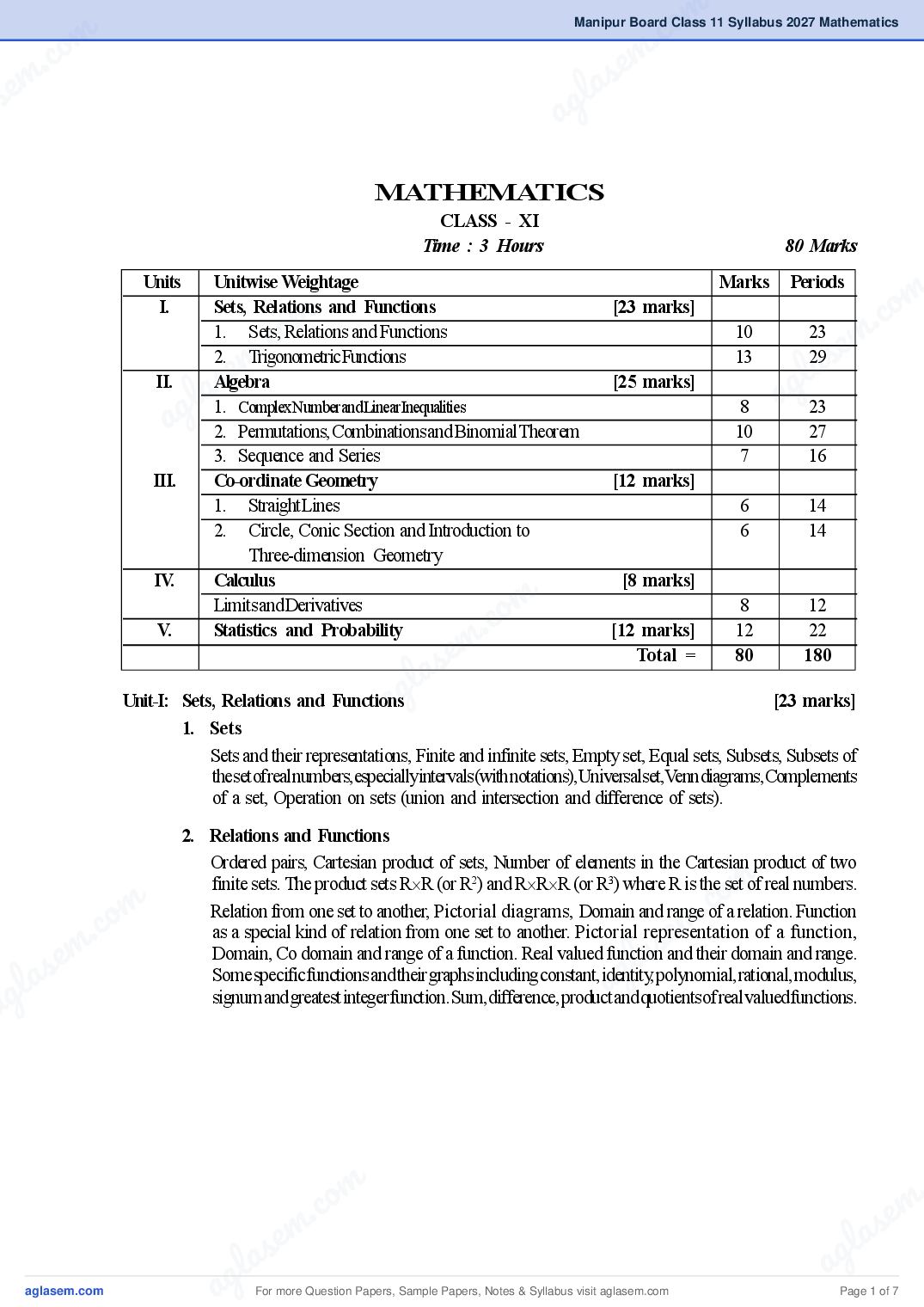
MATHEMATICS
CLASS - XI
Time : 3 Hours 80 Marks
Units Unitwise Weightage Marks Periods
m
I. Sets, Relations and Functions
m [23 marks]
.co
m .co
1. Sets, Relations and Functions 10 23
s e m
s e2. TrigonometricFunctions 13
l a
29
a ag 23
II. Algebra [25 marks]
g l 1. ComplexNumberandLinearInequalities 8
a 2. Permutations, Combinations and Binomial Theorem 10 27
3. Sequence and Series 7 16
III. Co-ordinate Geometry [12 marks]
1. Straight Lines 6 14
2. Circle, Conic Section and Introduction to 6 14
Three-dimension Geometry
IV. Calculus [8 marks]
m
.co
Limits and Derivatives 8 12
V. Statistics and Probability [12 marks] 12 22
s em Total = 80 180
l a
ag
Unit-I: Sets, Relations and Functions [23 marks]
1. Sets
Sets and their representations, Finite and infinite sets, Empty set, Equal sets, Subsets, Subsets of
theset ofreal numbers, especiallyintervals (withnotations), Universal set,Venndiagrams, Complements
of a set, Operation on sets (union and intersection and difference of sets).
2. Relations and Functions
Ordered pairs, Cartesian product of sets, Number of elements in the Cartesian product of two
m
.co
finite sets. The product sets RR (or R2) and RRR (or R3) where R is the set of real numbers.
m
.co
Relation from one set to another, Pictorial diagrams, Domain and range of a relation. Function
e m
e m l as
as a special kind of relation from one set to another. Pictorial representation of a function,
Domain, Co domain and range of a function. Real valued function and their domain and range.
las ag
Some specific functions and their graphs including constant, identity, polynomial, rational, modulus,
ag signum and greatest integer function. Sum, difference, product and quotients of real valued functions.
m .
.co s e m
s em l a
g la ag
a For more Question Papers, Sample Papers, Notes & Syllabus visit Page 1 of 7
Page 3
Positive and negative angles, Measurement of angles, Sexagesemal system and circular
system, Conversion from one system to another. Definition of trigonometric functions
with the help of unit circle. Signs of trigonometric functions (Quadrant Rule). The
identity sin2x+cos2x =1. Graphs of trigonometric functions. To express cos (x±y) and
sin(x ±y) in terms of sin x, sin y, cos x and cos y. Deducing identities like :
𝑡𝑎𝑛𝑥 ± 𝑡𝑎𝑛𝑦 𝑐𝑜𝑡𝑥𝑐𝑜𝑡𝑦 ∓ 1
𝑡𝑎𝑛(𝑥 ± 𝑦) = , cot(𝑥 ± 𝑦) =
1 ∓ 𝑡𝑎𝑛𝑥𝑡𝑎𝑛𝑦 𝑐𝑜𝑡𝑦 ± 𝑐𝑜𝑡𝑥
𝛼+𝛽 𝛼−𝛽 𝛼+𝛽 𝛼−𝛽
𝑠𝑖𝑛𝛼 + 𝑠𝑖𝑛𝛽 = 2𝑠𝑖𝑛 𝑐𝑜𝑠 ; 𝑠𝑖𝑛𝛼 − 𝑠𝑖𝑛𝛽 = 2𝑐𝑜𝑠 𝑠𝑖𝑛
2 2 2 2
𝛼 +𝛽 𝛼−𝛽 𝛼+𝛽 𝛼−𝛽
𝑐𝑜𝑠𝛼 + 𝑐𝑜𝑠𝛽 = 2𝑐𝑜𝑠 2
𝑐𝑜𝑠 2
; 𝑐𝑜𝑠𝛼 − 𝑐𝑜𝑠𝛽 = −2𝑠𝑖𝑛 2
𝑠𝑖𝑛 2
Identities related to 𝑠𝑖𝑛2𝑥, 𝑐𝑜𝑠2𝑥, 𝑡𝑎𝑛2𝑥, 𝑠𝑖𝑛3𝑥, 𝑐𝑜𝑠3𝑥 𝑎𝑛𝑑 𝑡𝑎𝑛3𝑥
Unit-II: Algebra [25 marks]
1. Complex numbers.
Need for complex numbers. The fundamental imaginary 1 unit (or i). Complex
numbers in the form of a + ib, Real and imaginary parts of a complex number, Complex
conjugates, Representation of a complex number by a point in a plane, Argand diagram,
Modulus of a complex number, Algebra of complex numbers.
2. Linear Inequalities.
Linear inequalities, Algebraic solution of linear inequalities in one variable and their
representation on the number line.
3. Premutations and Combinations.
Fundamental principle of counting, Factorial n where n is a non-negative integer,
Permutation as an arrangement, Meaning of nPr or P(n,r), Permutations in which things (i) may
be repeated (ii) are not all different. Combination, Meaning of nCr or C(n,r). Important properties
of nPr and nCr. Applications of permutations and combinations.
4. Binomial Theorem.
Bionomial theorem for a positive integral index (proof). Pascal's triangle, SimpleApplications.
5. Sequence and Series.
Sequence and Series, A.M., Geometric progression (G.P.), First term, Common ratio,
general term, sum to n terms of a G.P., Geometric Mean (G.M.), Relation between A.M. and
G.M. Infinite G.P. and its sum.
For more Question Papers, Sample Papers, Notes & Syllabus visit Page 2 of 7
Page 4
m .co
m .co s e m
se g l a
a
Unit-III: Coordinate Geometry [12 marks]
1. Straight lines :
Brief recall of 2D geometry from earlier classes. Slope of a line and angle between
two lines, various forms of equation of a straight line, Parallel to axes, slope-intercept
form, point-slope form, two point form, intercepts form. Distance of a point from
m
a line.
m .co
2. .co
Conic Sections :
m s e m
s e l
Definition, Equation of circle with given centre and radius, General equation of a circle,a
g l a its centre and radius. Equation of a circle when the end points of a diameter are given. ag
a
Sections of a cone. Definition of a conic section (degenerated conic section).
Equation of a conic section having given eccentricity, focus and directrix. Standard
equation and simple properties of parabola, ellipse and hyperbola.
3. Introduction to Three-dimentional Geometry :
Coordinate axes and coordinate planes in three dimensions. Coordinates of a
point. Distance between two points.
m
Unit-IV: Calculus
m .co [08 marks]
Limits and derivatives : s e
g la
Idea of limit, Left hand and right hand limits, conditions for existence of limit. Fundamental
a
Theorem on limit (statement only) and standard limits
(i) xn an
iii)
lim ex-1
lim na n1 (with proof)
x a x a
x 0
x =1 (with proof)
(ii) sin x iv) lim
lim 1 (with proof) log(1+x) =1 (with proof)
x0 x x 0
x
Derivative introduced as rate of change both as that of distance function and geometrically.
m
.co
Definition of derivative, relate it to slope of tangent to a curve; Derivative of sum,
m
.co
difference, product and quotient of functions. Derivative of polynomial and trigonometric
e m
e m
functions.
l as
las Unit-V: Statistics and Probability ag
[12 marks]
ag 1. Statistics :
Measure of dispersion, Range, Mean deviation, Variance and Standard deviation
of ungrouped/grouped data.
2. Probability :
Events, occurrence of events, “not”, “and” & “or” events, exhaustive events,
m .
.co s e m
s em l a
g la ag
a For more Question Papers, Sample Papers, Notes & Syllabus visit Page 3 of 7
Page 5
with the theories of earlier classes. Probability of an event, probability of “not”,
“and” & “or” events.
Appendix :
1. Infinite series : Exponential and Logarithmic series.
2. Mathematical Modelling :
Consolidating the understanding developed upto Class X. Focus on modelling
problems related to real life (like environment, travel, etc.) and connecting
with other subjects of study where many constraints may really need to be
ignored, formulating the model, looking for solutions, interpreting them in the
problems situation and evaluating the model.
PRESCRIBED TEXTBOOK :
1. Mathematics
Textbook for Class XI
Published by : NCERT, New Delhi
2. Mathematics Lab Manual Class XI
Published by : NCERT, New Delhi
REFERENCE BOOKS :
1. A Textbook of Mathematics Book-I for Class XI
By : S.N. Chhibber, G.D. Dhall & J.C. Nijhawan.
Published by : Macmillan Publishers India Pvt. Ltd.
2. Modern’s abc of Mathematics for Class XI
By : J.P. Mohindru
Published by : Modern Publishers, Jalandhar.
3. S.M.A.R.T. Minds Mathematics (Vol-I to II) for Class XI
By : Parijat Jain
Published by : VK Global Publications Pvt. Ltd., New Delhi.
——§§§——
For more Question Papers, Sample Papers, Notes & Syllabus visit Page 4 of 7
Page 6
m .co
m .co s e m
se l a
DESIGN OFag
QUESTION PAPER
Subject : MATHEMATICS
Class : XI
Full Mark : 80
Time : 3 Hours
WEIGHTAGE TO OBJECTIVES:
Objectives Marks Percentage
m
.co
Knowledge (K) 12 15
m
.co
I Understanding (U) 40 51
e m
Application (A)
em
24 30
04 a
l s
l as
Skill (S)
Total:
04
80 ag
100
g
aWEIGHTAGE TO FORM OF QUESTIONS: Time
Form of Questions No. of Question Marks Percentage
(in minutes)
Essay/Long Answer: (E/LA) 6 67 30 37
Short Answer (SA-I) 3 27 12 15
II
Short Answer (SA-II) 4 27 12 15
Short Answer (SA-III) 5 23 10 13
Very Short Answer(VSA) 6 13 6 7
MCQ 10 23 10 13
m
.co
Total: 34 180 80 100
em
WEIGHTAGE TO CONTENT:
UNIT
s CONTENTS
laFunctions
Marks Percentage
I
1.1
1.2 Trigonometric
g
Sets, Relations and
a functions
10
13
13
17
2.1 Complex Numbers and Linear Inequalities 8 10
Permutations & Combinations and Binomial
II 2.2
Theorem 10 13
III
2.3 Sequence and Series 7 8
3.1 Straight lines 6 7
III Circle, Conic Section and Introduction to Three
3.2
dimensional Geometry 6 7
m 10
.12co
IV 4.1 Limits and Derivatives 8
m
.co
V 5.1 Statistics and Probability 15
s
Total: em80 100
s em IV SCHEME OF SECTIONS : NIL
l a
g la V
SCHEME OF OPTIONS
ag
: Internal option in one SA-I (case study question),
a DIFFICULTY LEVEL :
two in SA-II, one in SA-III and three in E/LA
Difficult :30% of the total marks
VI
Average :50% of the total marks
Easy :20% of the total marks
Special Instruction: 1) Two questions of MCQ will be Assertion-Reason type question.
2) First option will be (a) & second option will be (b) in the internal option
Abbreviation : K(Knowledge),U(Understanding),C(Comprehension), Exp.(Expression), Skill(S),
m
E(Essay Type), SA (Short Answer Type), VSA (Very Short Answer Type),
.
.co m
MCQ(Multiple Choice Question)
s e
s em l a
g la ag
a For more Question Papers, Sample Papers, Notes & Syllabus visit Page 5 of 7
Page 7
Periodic Tests (Best 2 out of 3 tests conducted) 10 Marks
Mathematics Activities/Project Works 10 Marks
Conduct of Periodic Tests:
Periodic Test is a Pen and Paper assessment which is to be conducted by the respective
subject teacher. The format of periodic test must have questions items with a balance mix,
such as, very short answer (VSA), short answer (SA) and long answer (LA) to effectively
assess the knowledge, understanding, application, skills, analysis, evaluation and synthesis.
Depending on the nature of subject, the subject teacher will have the liberty of incorporating
any other types of questions too. The modalities of the PT are as follows:
a) Mode: The periodic test is to be taken in the form of pen-paper test.
b) Schedule: In the entire Academic Year, three Periodic Tests in each subject
may be conducted as follows:
Test Pre-Mid-Term (PT-I) Mid-Term (PT-II) Post Mid-Term (PT- III)
Tentative Month July-August November December-January
This is only a suggestive schedule and schools may conduct periodic tests as per their
convenience.
c) Average of Marks: Once schools complete the conduct of all the three periodic tests,
they will convert the weightage of each of the three tests into ten marks each for
identifying best two tests. The best two will be taken into consideration and the average
of the two shall be taken as the final marks for PT.
d) The school will ensure simple documentation to keep a record of performance
Assessment of Activity Work:
Throughout the year any 10 activities shall be performed by the student from the
activities given in the NCERT Laboratory Manual for the respective class (XI or XII)
which is available on the link: http://www.ncert.nic.in/exemplar/labmanuals.html a
record of the same may be kept by the student. An year end test on the activity may be
conducted
The weightage are as under:
The activities performed by the student throughout the year and record keeping:
5 marks
Assessment of the activity performed during the year end test: 3 marks
Viva-voce: 2 marks
For more Question Papers, Sample Papers, Notes & Syllabus visit Page 6 of 7
Page 8
m .co
m .co s e m
se g l a
a
SUGGESTIVE TOPICS FOR PROJECT
CLASS-XI MATHEMATICS
S.No. Content
Unit-I: Sets and Functions
m
1. Sets
m .co
.co m
Practical problems on Union and Intersection of two sets.
2.
m
Relations and Functions
s e
s e
Composition of Functions
l a
3.
g l aTrigonometric Functions
ag
a General solution of trigonometric equations of the type sin 𝑦 = sin,
cos 𝑦 = cos and tan 𝑦 = tan.
Unit-II: Algebra
1. Principle of Mathematical Induction
Process of the proof by induction, motivating the application of the method
by looking at natural numbers as the least inductive subset of real numbers.
The principle of mathematical induction and simple applications.
2. (Complex Numbers and) Quadratic Equations
Polar representation of complex numbers. Statement of Fundamental
Theorem of Algebra, solution of quadratic equations (with real coefficients)
m
.co
in the complex number system, cube roots of unity
3. Linear Inequalities
e m
Graphical solution of linear inequalities in two variables. Graphical method
las
of finding a solution of system of linear inequalities in two variables.
4. Binomial Theorem
ag
General and middle term in binomial expansion. Properties of binomial co-
efficients
5. Sequence and Series
Formulae for the following special sums
𝑛 𝑛 𝑛
2
𝑘, 𝑘 , 𝑘3
𝑘=1 𝑘=1 𝑘=1
6 Idea of Logarithm, Anti-Logarithm and their applications
m
.co
Unit-III: Coordinate Geometry
m 1. Straight Lines
m .co 2.
Normal form. General equation of a line.
Introduction to Three-dimensional Geometry
s e m
s e Section formula.
g l a
g la Unit-IV: Calculus
a
a 1. Limits and Derivatives
Derivatives of composite functions (Chain rule).
Unit-V Statistics and Probability
1. Probability
Random experiments; outcomes, sample space (set representation).
m .
.co s e m
s em l a
g la ag
a For more Question Papers, Sample Papers, Notes & Syllabus visit Page 7 of 7
Document Details
| Board / Org | Manipur Board |
| Exam | Class 11 |
| Type | Syllabus |
| Pages | 7 |
| Updated | 04 Nov 2026 |