Manipur Board Class 11 Syllabus 2027 Sociology
Finished viewing? Save it for later —
Download Manipur Board Class 11 Syllabus 2027 Sociology (PDF · 6 pages)About Manipur Board Class 11 Syllabus 2027 Sociology
Manipur Board Class 11 Syllabus 2027 Sociology is available here for free download. Published by Manipur Board for Class 11, this syllabus can be viewed online or downloaded as a PDF (6 pages). Candidates preparing for Class 11 can use Manipur Board Class 11 Syllabus 2027 Sociology to understand the exam pattern, the type of questions asked, and the overall difficulty level.
Frequently Asked Questions
How can I download Manipur Board Class 11 Syllabus 2027 Sociology?
Open this page and click the Download button to save Manipur Board Class 11 Syllabus 2027 Sociology as a PDF. It is completely free on AglaSem Docs.
Is Manipur Board Class 11 Syllabus 2027 Sociology free to download?
Yes. Manipur Board Class 11 Syllabus 2027 Sociology can be viewed online and downloaded as a PDF free of cost on AglaSem Docs.
How many pages does Manipur Board Class 11 Syllabus 2027 Sociology have?
Manipur Board Class 11 Syllabus 2027 Sociology contains 6 pages, which you can read online or download together as a single PDF.
Where can I find more Class 11 study material?
You can find more Class 11 question papers, sample papers, syllabus, and answer keys on AglaSem Docs.
Manipur Board Class 11 Syllabus 2027 Sociology – Text
Read the full text of this syllabus below — useful to quickly search, copy and reference the content online without downloading the PDF.
📄 View text version (7 pages)
Page 1
Manipur Board Class
11 Syllabus 2027
Sociology
EXAM YEAR TYPE SUBJECT
Manipur Class 11 2027 Syllabus Sociology
Notes · Sample Papers · Previous Year Papers · Mock Tests
Page 2
m .co
m .co s e m
se g l a
a
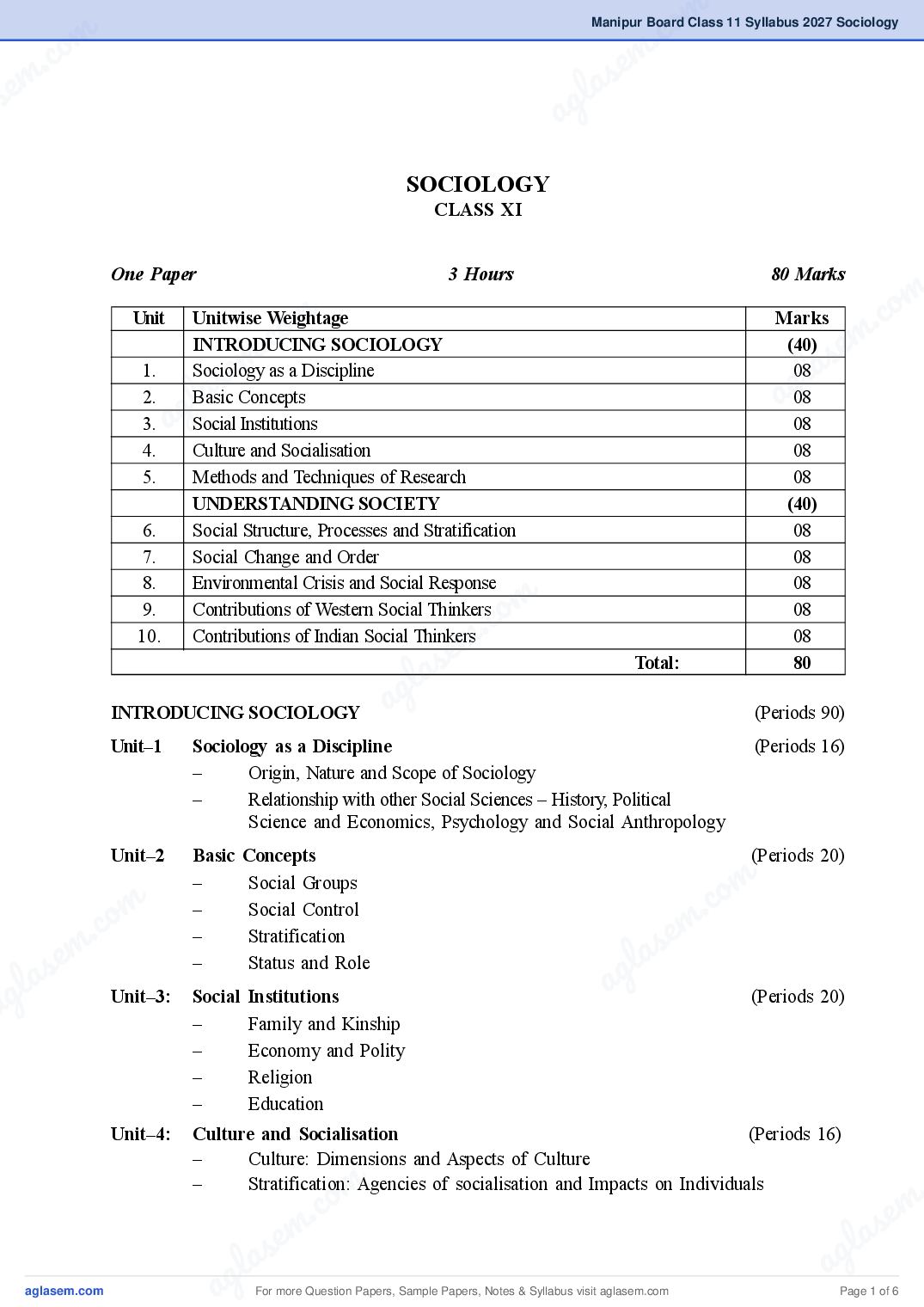
SOCIOLOGY
CLASS XI
One Paper 3 Hours 80 Marks
m
Unit m
Unitwise Weightage Marks .co
.co
INTRODUCING SOCIOLOGY
m
(40)
s e m
1.
s e
Sociology as a Discipline l
08 a
2.
g l a
Basic Concepts ag08
3. a Social Institutions 08
4. Culture and Socialisation 08
5. Methods and Techniques of Research 08
UNDERSTANDING SOCIETY (40)
6. Social Structure, Processes and Stratification 08
7. Social Change and Order 08
8. Environmental Crisis and Social Response 08
m
.co
9. Contributions of Western Social Thinkers 08
10. Contributions of Indian Social Thinkers
e m 08
las Total: 80
INTRODUCING SOCIOLOGY a
g (Periods 90)
Unit–1 Sociology as a Discipline (Periods 16)
– Origin, Nature and Scope of Sociology
– Relationship with other Social Sciences – History, Political
Science and Economics, Psychology and Social Anthropology
Unit–2 Basic Concepts (Periods 20)
m
.co
– Social Groups
m
.co
– Social Control
e m
e m – Stratification
l as
las – Status and Role
ag
ag Unit–3: Social Institutions (Periods 20)
– Family and Kinship
– Economy and Polity
– Religion
– Education
Unit–4: Culture and Socialisation (Periods 16)
– Culture: Dimensions and Aspects of Culture
– m
Stratification: Agencies of socialisation and Impacts on Individuals
.
.co s e m
s em l a
g la ag
a For more Question Papers, Sample Papers, Notes & Syllabus visit Page 1 of 6
Page 3
– Significance of Field Work in Sociology
– Techniques: Observation, Surveys and Interview
UNDERSTANDING SOCIETY (Periods 90)
Unit–6: Social Structure, Processes and Stratification (Periods 24)
– Social Structure
– Social Processes: Cooperation, Competition and Conflict
– Stratification: Caste, Class, Power, Ethnicity and Gender
Unit–7: Social Change and Order (Periods 24)
– Social Change: Dimensions, Factors and Consequences of Change
– Social Order: Law and Authority; Crime and Violence
Unit–8: Environmental Crisis and Social Response (Periods 18)
– Ecology and Society
– Environmental Problems and Risks
– Types of Environmental Hazards: Natural – Earthquakes; Tsunami; Volcanic
Eruptions; Landslides; Cyclones; Floods; Droughts; Man-made–Industrial and
Technical disasters; Accidents; Nuclear, Chemical and Biological Warfare;
Pollution and related disasters
– Mitigation and Management of Disasters: Role of Different Agencies
Unit–9: Contributions of Western Social Thinkers (Periods 12)
– Karl Marx on Class Conflict
– Weber on Bureaucracy
– Durkheim on Division of Labour
Unit –10: Contributions of Indian Social Thinkers (Periods 12)
– G.S. Ghurye on Race and Caste
– D.P. Mukherji on Tradition and Change
– R. Desai on State
– M.N. Srinivas on the Village
PRESCRIBED TEXTBOOKS:
1. Introducing Sociology: Textbook for Class XI, NCERT, New Delhi, 2007
2. Understanding Society: A Textbook for Class XI, NCERT, New Delhi, 2006
3. Environmental Education for Class XI,
By: Dr. Anuradha Sapelkar and Dr. Kadambari Sharma
Published by: Geeta Publishing House, New Delhi
For more Question Papers, Sample Papers, Notes & Syllabus visit Page 2 of 6
Page 4
m .co
m .co s e m
se g l a
a
REFERENCE BOOKS:
1. Johnson, H.M., Sociology: A Systematic Introduction, Allied Publishers, Mumbai, 1970
2. Davis, K., Human Society, The Macmillan Company, New York, 1970
3. Rao, C.N.S., Sociology, S. Chand & Comapny, New Delhi, 1990
m
.co
4. Young P.V., Scientific Social Surveys and Research 4th Edn., Prentice Hall of India Pvt. Ltd.
New Delhi, 2001.
o m m
. c s e
emNew Delhi, 2000.
5. Kothori, C.R., Research Methodology: Methods & Techniques 2nd Edn., Wishwa
s
Prakashan, l a
gYork,
l a a
6.
ag
Coser,
1971.
L. A., Master of Sociological Thought, Harcourt Brace Jovanovich, New
7. Abraham, F., Morgan, J. H., Sociological Thought, Macmillan India Limited, Madras, 1994.
8. Singh, Y., Indian Sociology: Social Conditioning and Emerging Concerns, Vistaar
Publications, New Delhi, 1986.
m
.co
s em
g la——§§§——
a
m
m .co
m .co s e m
s e g l a
g la a
a
m .
.co s e m
s em l a
g la ag
a For more Question Papers, Sample Papers, Notes & Syllabus visit Page 3 of 6
Page 5
QUESTION PAPER
Subject : SOCIOLOGY
Class : XI
Full Marks : 80
Time : 3 Hours
WEIGHTAGE TO OBJECTIVES
Objectives Marks Percentage
I Knowledge (K) 12 15
Understanding (U) 44 55
Application (A) 24 30
TOTAL 80 100
WEIGHTAGE TO FORMS OF QUESTIONS
No. of Time
FORM OF QUESTIONS Marks Percentage
Question (in Minutes)
Essay/Long Answer (E/LA) 4 80 32 40
II Short Answer (SA-I) 4 36 16 20
Short Answer (SA-II) 6 24 12 15
Very Short Answer (VSA) 8 16 08 10
O/MCQ 12 24 12 15
TOTAL 34 180 80 100
WEIGHTAGE TO CONTENT
Units Topics Marks Percentage
1 Sociology as a discipline 08 10
2 Basic Concepts 08 10
3 Social Institutions 08 10
4 Culture and Socialisation 08 10
III 5 Methods and Techniques of Research 08 10
6 Social Structure, Processes and Stratification 08 10
7 Social Change and Order 08 10
8 Environmental Crisis and Social Response 08 10
9 Contributions of Western Thinkers 08 10
10 Contributions of Indian Thinkers 08 10
TOTAL 80 100
IV SCHEMES OF SECTIONS: NIL
V SCHEME OF OPTIONS : 50% of Short Answer-I questions
DIFFICULTY LEVEL
Difficult : 30% of the total marks
VI
Average : 50% of the total marks
Easy : 20% of the total marks
NOTE: The question setter has to keep in mind that at the time of setting the paper two reason-
assertion based questions from the MCQ having 1 mark each and one resource-based
question from the Short Answer Type question having 4 marks are to be included in the
question paper.
Abbreviations:
K=Knowledge; U=Understanding; A=Application; S=Skill; E=Essay Type;
SA=Short Answer Type; VSA= Very Short Answer Type; O=Objective Type;
MCQ=Multiple Choice Question
For more Question Papers, Sample Papers, Notes & Syllabus visit Page 4 of 6
Page 6
m .co
m .co s e m
se g l a
a
PROJECT WORK
Maximum Marks:10
Project under taken during the academic year at school level
(to be submitted in the following format to the assigned Teacher)
m
.co
1. Introduction
m of Purpose
c.2.3.o Statement s e m
e m Research Question 07 Marks
l a
l as 4. Methodology
ag
ag 5. Data Analysis 03 Marks
6. Conclusion
Viva–based on the project work
TOTAL 10 Marks
Guidelines for Sociology Project Work : 10 Marks
One Project to be done throughout the session, as per the existing scheme.
m
.co
1. Steps involved in the conduct of the project: Students may work upon the following lines as a
suggested flow chart :
s em
la a Title/Topic
Choose
g
a Study, Objective of the Study
Need of the
Hypothesis
Content - Timeline, Mind maps, Pictures, etc.
Organization of Material/Data
Present Material/Data
m
.co
Analyzing the Material/Data for Conclusion
m
m .co Draw the Relevant Conclusion
s e m
s e Bibliography
g l a
g la a
a 2. Expected Check list for the Project Work:
Introduction of topic/title
Identifying the causes, events, consequences and/or remedies
Various stakeholders and effect on each of them
Advantages and disadvantages of situations or issues identified
Short-term and long-term implications of strategies suggested during research
Validity, reliability, appropriateness, and relevance of data used for research work and for presentation
in the project file
Presentation and writing that is succinct and coherent in project file
m
Citation of the materials referred to, in the file in foot notes, resources section, bibliography, etc.
.
.co s e m
s em l a
g la ag
a For more Question Papers, Sample Papers, Notes & Syllabus visit Page 5 of 6
Page 7
Project Work has broadly the following phases: Synopsis/Initiation, Data Collection, Data Analysis and
Interpretation, Conclusion.
The aspects of the project work to be covered by students can be assessed during the academic year.
The marks assigned for Project Work can be divided as is shown above.
4. Viva-Voce:
At the end, each learner will present the research work in the Project File to the External and Internal
examiner.
The questions should be asked from the Research Work/Project File of the learner.
The Internal Examiner should ensure that the study submitted by the learner is his/her own original
work.
In case of any doubt, authenticity should be checked and verified.
(SUGGESTED TOPICS FOR THE PROJECT WORKS)
(The purpose of the project work is to make the students the various dynamics and issues that exists in the
society they live in through the interactions with different individuals and issues and situations that they
encounter while collection information relating to the project work. To enable this the students are advised to
choose any Social Issues relating to the different communities and ethnic groups residing in the state of
Manipur. The topics cited here is just a broad outline to give hints to the teachers, in general, and to the
students, in particular, so that it might be easier while choosing the topic for the said Project Works.)
Impact of urbanization (like garbage, traffic, congestion)
Gender roles (home & outside)
Influence of Media (print media, radio, television)
Environmental Issues (like air, water, noise pollution, climate change, global warming)
Social media (negative or positive)
Mobile Phones (particularly on students & children)
HIV Infection (particularly women & Children)
Disability (problems or solution)
Alcoholism & Drug Abuse (At home & Society)
Ethnic relation s(religious, social)
Immigrants(impact on culture, economy, politics, etc)
Aging (Economic, health, participation)
Social Exclusion (Age, Sex, Ethnic, Economic group, etc)
(Or any such social issues which the student think is appropriate with the advice of the teacher assigned
to him or her)
PERIODIC TESTS: 10 MARKS
The teacher will assess the progress of the project work in the following manner:
Month Assessment Rubrics MARK Remarks
There will be two Periodic Tests – one during July
July-August
– August and another during September – October
carrying 20 marks each. Average mark from the This is
marks obtained by each student in the two tests 10 marks only for
September-
after converting it to as out of a total of 10 is to be this year
October submitted to the Council within the stipulated
timeline.
For more Question Papers, Sample Papers, Notes & Syllabus visit Page 6 of 6
Document Details
| Board / Org | Manipur Board |
| Exam | Class 11 |
| Type | Syllabus |
| Pages | 6 |
| Updated | 04 Nov 2026 |