CBSE Class 10 Science Question Paper 2020 Set 31-1-3 Solutions
Finished viewing? Save it for later —
Download CBSE Class 10 Science Question Paper 2020 Set 31-1-3 Solutions (PDF · 10 pages)About CBSE Class 10 Science Question Paper 2020 Set 31-1-3 Solutions
CBSE Class 10 Science Question Paper 2020 Set 31-1-3 Solutions is available here for free download. Published by CBSE for Class 10, this solution can be viewed online or downloaded as a PDF (10 pages). Candidates preparing for Class 10 can use CBSE Class 10 Science Question Paper 2020 Set 31-1-3 Solutions to understand the exam pattern, the type of questions asked, and the overall difficulty level.
Frequently Asked Questions
How can I download CBSE Class 10 Science Question Paper 2020 Set 31-1-3 Solutions?
Open this page and click the Download button to save CBSE Class 10 Science Question Paper 2020 Set 31-1-3 Solutions as a PDF. It is completely free on AglaSem Docs.
Is CBSE Class 10 Science Question Paper 2020 Set 31-1-3 Solutions free to download?
Yes. CBSE Class 10 Science Question Paper 2020 Set 31-1-3 Solutions can be viewed online and downloaded as a PDF free of cost on AglaSem Docs.
How many pages does CBSE Class 10 Science Question Paper 2020 Set 31-1-3 Solutions have?
CBSE Class 10 Science Question Paper 2020 Set 31-1-3 Solutions contains 10 pages, which you can read online or download together as a single PDF.
Where can I find more Class 10 study material?
You can find more Class 10 question papers, sample papers, syllabus, and answer keys on AglaSem Docs.
CBSE Class 10 Science Question Paper 2020 Set 31-1-3 Solutions – Text
Read the full text of this solution below — useful to quickly search, copy and reference the content online without downloading the PDF.
📄 View text version (10 pages)
Page 1
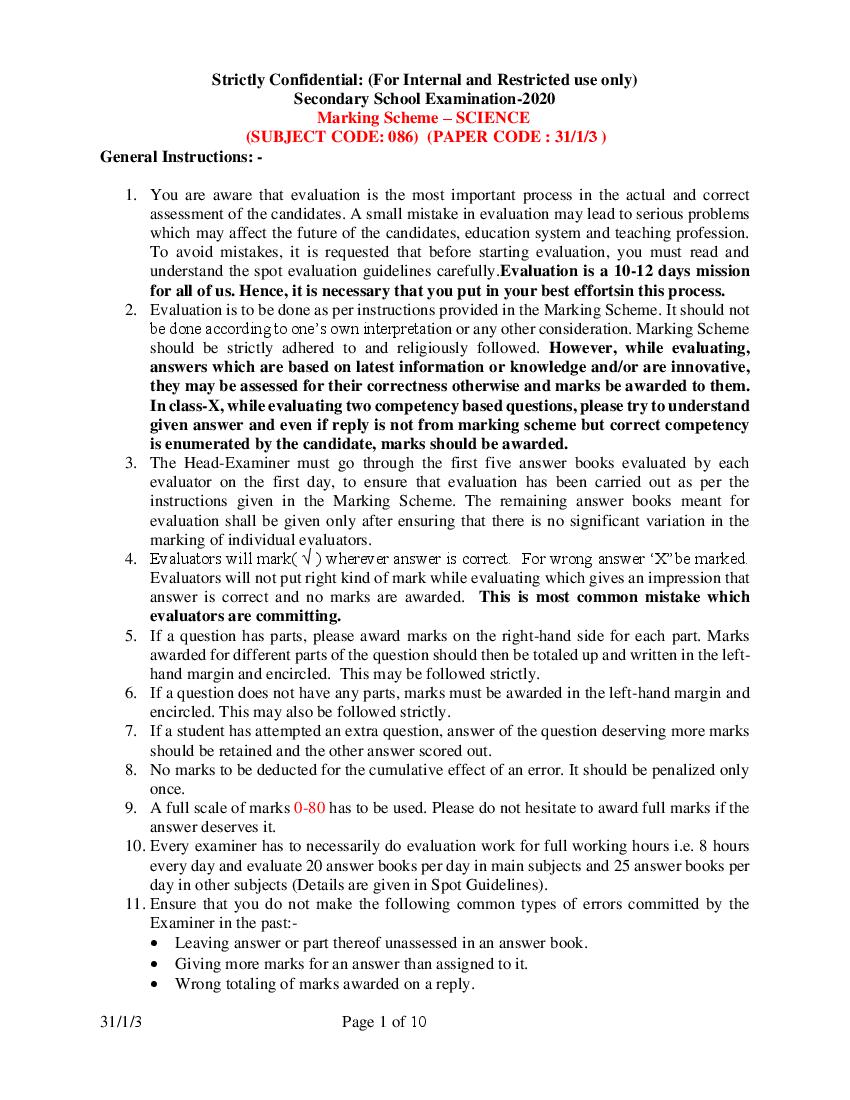
Secondary School Examination-2020
Marking Scheme – SCIENCE
(SUBJECT CODE: 086) (PAPER CODE : 31/1/3 )
General Instructions: -
1. You are aware that evaluation is the most important process in the actual and correct
assessment of the candidates. A small mistake in evaluation may lead to serious problems
which may affect the future of the candidates, education system and teaching profession.
To avoid mistakes, it is requested that before starting evaluation, you must read and
understand the spot evaluation guidelines carefully.Evaluation is a 10-12 days mission
for all of us. Hence, it is necessary that you put in your best effortsin this process.
2. Evaluation is to be done as per instructions provided in the Marking Scheme. It should not
be done according to one’s own interpretation or any other consideration. Marking Scheme
should be strictly adhered to and religiously followed. However, while evaluating,
answers which are based on latest information or knowledge and/or are innovative,
they may be assessed for their correctness otherwise and marks be awarded to them.
In class-X, while evaluating two competency based questions, please try to understand
given answer and even if reply is not from marking scheme but correct competency
is enumerated by the candidate, marks should be awarded.
3. The Head-Examiner must go through the first five answer books evaluated by each
evaluator on the first day, to ensure that evaluation has been carried out as per the
instructions given in the Marking Scheme. The remaining answer books meant for
evaluation shall be given only after ensuring that there is no significant variation in the
marking of individual evaluators.
4. Evaluators will mark( √ ) wherever answer is correct. For wrong answer ‘X”be marked.
Evaluators will not put right kind of mark while evaluating which gives an impression that
answer is correct and no marks are awarded. This is most common mistake which
evaluators are committing.
5. If a question has parts, please award marks on the right-hand side for each part. Marks
awarded for different parts of the question should then be totaled up and written in the left-
hand margin and encircled. This may be followed strictly.
6. If a question does not have any parts, marks must be awarded in the left-hand margin and
encircled. This may also be followed strictly.
7. If a student has attempted an extra question, answer of the question deserving more marks
should be retained and the other answer scored out.
8. No marks to be deducted for the cumulative effect of an error. It should be penalized only
once.
9. A full scale of marks 0-80 has to be used. Please do not hesitate to award full marks if the
answer deserves it.
10. Every examiner has to necessarily do evaluation work for full working hours i.e. 8 hours
every day and evaluate 20 answer books per day in main subjects and 25 answer books per
day in other subjects (Details are given in Spot Guidelines).
11. Ensure that you do not make the following common types of errors committed by the
Examiner in the past:-
• Leaving answer or part thereof unassessed in an answer book.
• Giving more marks for an answer than assigned to it.
• Wrong totaling of marks awarded on a reply.
31/1/3 Page 1 of 10
Page 2
• Wrong question wise totaling on the title page.
• Wrong totaling of marks of the two columns on the title page.
• Wrong grand total.
• Marks in words and figures not tallying.
• Wrong transfer of marks from the answer book to online award list.
• Answers marked as correct, but marks not awarded. (Ensure that the right tick mark is
correctly and clearly indicated. It should merely be a line. Same is with the X for
incorrect answer.)
• Half or a part of answer marked correct and the rest as wrong, but no marks awarded.
12. While evaluating the answer books if the answer is found to be totally incorrect, it should
be marked as cross (X) and awarded zero (0)Marks.
13. Any unassessed portion, non-carrying over of marks to the title page, or totaling error
detected by the candidate shall damage the prestige of all the personnel engaged in the
evaluation work as also of the Board. Hence, in order to uphold the prestige of all
concerned, it is again reiterated that the instructions be followed meticulously and
judiciously.
14. The Examiners should acquaint themselves with the guidelines given in the Guidelines for
spot Evaluation before starting the actual evaluation.
15. Every Examiner shall also ensure that all the answers are evaluated, marks carried over to
the title page, correctly totaled and written in figures and words.
16. The Board permits candidates to obtain photocopy of the Answer Book on request in an
RTI application and also separately as a part of the re-evaluation process on payment of
the processing charges.
31/1/3 Page 2 of 10
Page 3
MARKING SCHEME – CLASS X SCIENCE (2019-20)
QUESTION PAPER CODE: SET 31/1/3
S.NO VALUE POINTS/EXPECTED ANSWER MARKS TOTAL
MARKS
SECTION A
1 Cyclopentene / Cyclohexene-formula or structure (or any other). 1 1
If candidate writes Benzene give full mark
2 In case of AC – Electric power can be transmitted over long distances
without much loss of energy. 1 1
3 a) Thick hair growth in armpits, genital area/thinner hair on arms, legs,
face/ more active oil secretion from glands on skin/Occurrence of
pimples (any two) ½+½
b) Imbalance in male – female ratio/ decline in child sex ratio 1
c) Oral pills 1
d) Rate of birth and death 1 4
4 a) Human beings are at the top level in any food chain 1
b) Washing of vegetables, fruits, grains thoroughly/Organic farming/
Use of Bio pesticides (any one) 1
c) (b) / Trophic level 1
d) (a) / Consumer 1 4
5 (d) / Afforestation 1 1
6 (b) / (A) and (D) 1 1
7 (d)/ (A) ( B ) and ( D ) 1 1
8 (a)/ ( A ) and ( C ) 1 1
9 (c)/ ( A ) and ( B ) 1 1
10 (d) / Increases heavily
OR
(d) / 1A 1 1
11 (d) / (A) and (B)
OR
(d)/ Double displacement reaction 1 1
12 (d) / (B), (C) and (D) 1 1
13 (b) / Both (A) and (R) are true but (R) is not the correct 1 1
explanation of the assertion (A).
14 (c)/ A is true but R is false 1 1
SECTION B
15 i) H = I2Rt 1
ii) H = V.I.t
= V.Q ½
Given : V = 40 volts , Q = 96000 C
H = 40 V × 96000 C 1
= 3.84 × 10⁶ J ½ 3
31/1/3 Page 3 of 10
Page 4
Diagram 1
Labelling ½×4 3
17 • (i) Ethanol-C2H5OH/CH3CH2OH/
1
• (ii) Ethanoic Acid – CH3COOH/
1
b) As oxygen is added to ethanol ½
Oxidizing agent – Alkaline KMnO4 or
Acidified K2Cr2O7 ½ 3
18 a – receptor/ skin
b – sensory neuron
c - spinal cord ½×6
d – relay neuron
e – motor neuron
• Reflex Arc
Or
a) Directional movements of the plant part towards or away from the
stimulus. 1
b) When the tip of the tendril comes in contact with the support, more
auxin is diffused from the tip towards the side of the tendril away from
the support. As a result, that side grows faster and causes the tendril to
bend around the support 2 3
31/1/3 Page 4 of 10
Page 5
Instances:
• When a fine beam of light enters a smoke-filled dark room
through a small hole.
• When sunlight passes through a canopy of dense forest in
foggy/ misty conditions.
• Blue colour of sky. ½×4
• Red colour of the sun during sunrise or sunset.
(or any other)
OR
• Prism has 2 inclined refracting surfaces whereas a glass slab
has parallel refracting surfaces. 1
i) When monochromatic light passes through a glass slab it gets ½
displaced laterally whereas in a prism it gets angularly displaced. ½
ii) When white light passes through a glass slab, it gets laterally ½
displaced whereas in a prism, dispersion takes place. ½ 3
20 • Pollination is transfer of pollen from anther to stigma 1
Self Pollination Cross Pollination
Transfer of pollen in the same Transfer of pollen from one 1
flower flower to another.
• Pollination leads to fertilization resulting in the formation of
zygote. 1 3
21
Products: Hydrogen, Chlorine , Sodium hydroxide
Uses:
Hydrogen: In the production of margarine/ ammonia/as a fuel 1½
Chlorine: Water treatment/ swimming pools/ production of
PVC/ Disinfectants/CFCs/Pesticides.
Sodium hydroxide: For degreasing metal surfaces/ in making
soaps and detergents/ paper making/ artificial fibres.
(any one use of these or any other) ½× 3
OR
• Recrystallisation of sodium carbonate 1
• Na2CO3 + 10H2O Na2CO3.10H2O 1
• Basic Salt ½
• Permanent hardness ½ 3
22
• A black colour is formed on the surface ½
Heat
2Cu + O2 2CuO ½
Brown Copper Oxide; Black Colour ½
• Original/brown colour is restored. ½
31/1/3 Page 5 of 10
Page 6
CuO + H2 Cu + H2O ½
Black Copper; Brown ½ 3
23 Near point of Hypermetropia eye = 50 cm
Book placed at, u = -25 cm
Convex lens/converging lens ½
It will form a virtual image of the abject at near point of defective
eye
v = -50 cm ½
Lens formula
1 1 1
= -
𝑓 𝑣 𝑢
½
1 1 1
= -
𝑓 (−50) (−25)
1 ½
=
50
f = 50cm or 0.50m ½
1 1
p = = =+2D ½ 3
𝑓 0.5
24 • Homologous structures are those which have similar basic
structure and origin but modified to perform different functions. 1
• Example: forelimbs of reptiles, amphibians, humans and wings
of birds. ½
(or any other example)
• Yes ½
• Similarity in basic design of the structure indicates that their
ancestors were common. 1 3
SECTION C
25
i)
1
ii)
31/1/3 Page 6 of 10
Page 7
iii)
1
In case (i) sign is positive and m> 1 ½+½
(ii) sign is positive and m < 1 ½+½
OR
Given h = + 4.0 cm, u = -25.0 cm, f = -15.0 cm ½
1 1 1
i) image distance v = ? ; mirror formula : + =
𝑣 𝑢 𝑓 ½
1 1 1 1 1
or = - ;=- – (- )
𝑣 𝑓 𝑢 15 25
1 −5+3
= 151 + =
25 75
−2 1
=
75
v = - 37.5 cm
The screen should be placed 37.5 cm in front of the mirror. ½
ℎ1 𝑣
ii) m = =- ½
ℎ 𝑢
𝑣
: ℎ1 = - . h
𝑢
½
(− 37.5 × 4)
=-
−25
1
ℎ = - 6.0 cm (size of the image). ½
iii)
31/1/3 Page 7 of 10
Page 8
5
[Note: Deduct half mark for not showing arrows in ray diagrams.]
26 a) Law of dominance of traits: -In a cross between a pair of contrasting
characters, only one parental character will be expressed in F1
generation which is called dominant trait and the other is called 1
recessive trait.
For example – in pea plants,
Tall Dwarf /Short
½
Parents TT tt
Gametes
½
F1 All Tall
All plants in F1 generation were tall proving that the gene for tallness
is dominant over the gene for dwarfness/ short, which is not able to 1
express itself in the presence of dominant trait.
(any other example)
b) Traits acquired by an organism during its lifetime are known as 1
acquired traits.
These traits are not inherited because they occur in somatic cells
only/do not cause any change in the DNA of the germ cells. 1 5
27 a) Oxygen 1
• Released by splitting of water molecules 1
b)
• Tiny pores present on the surface of leaves. 1
• Opening and closing of stomata is a function of guard cells 1
• Guard cells swell up, when water flows into them, causing the ½ +½
stomatal pore to open. If the guard cells shrink the pore closes.
31/1/3 Page 8 of 10
Page 9
a)
Diagram 1
Labeling 4×½
b)
• Digestion of flood is completed in small intestine only.
• Finger like projections (villi) in the wall of small intestine
provides large surface area for maximum absorption.
1+1
• Villi of small intestine are richly supplied with blood vessels
5
for carrying absorbed food to different parts of the body.
(any two )
28 • These metals have more affinity for oxygen than carbon. 1
• Towards the top of the reactivity series. 1
• By electrolytic reduction of their molten ores. 1
• Example: Extraction of sodium from molten sodium chloride
by electrolysis.
Process:
• Molten NaCl is taken in an electrolytic cell and on passing
electricity Na is deposited at cathode and chlorine is liberated at 1
anode.
Reactions –
At cathode - Na+ + e- → Na
At anode - 2Cl- → Cl2 + 2e- ½
( or any other example) ½ 5
29 i) E, it has 4 valence electrons . ½+½
ii) B, it needs only 2 electrons to attain stable configuration. ½+½
iii) D , it loses two electrons to attain stable configuration . ½+½
iv) F, it has the largest size since size increases down the group. ½+½
31/1/3 Page 9 of 10
Page 10
OR
• Atomic size is the distance between the centre of the nucleus 1
and the outermost shell of an isolated atom .
• Picometer/pm 1
• Trends in Atomic radius
In a group: increases down the group ; ½
due to addition of a new shells . 1
In a period: atomic radius decreases from left to right ; ½ 5
due to increase in pulling power of nucleus or due to addition of 1
electrons in the same shell
30 a)
1
1
At Every point of a current carrying circular loop, the concentric
circles represent magnetic field around it which become larger as we
1
move away from the wire.
At the center of the loop, these lines appear as straight lines.
b) Magnetic field produced by a current carrying wire at a given pint
depends directly on the current passing through it. So if there is a
circular coil having ‘n’ turns, the field produced is n times as large as
that produced by a single turn. This is because the current in each
2 5
circular turn has the same direction and the field due to each turn just
adds up.
31/1/3 Page 10 of 10
Document Details
| Board / Org | CBSE |
| Exam | Class 10 |
| Type | Solution |
| Pages | 10 |
| Updated | 22 Jul 2026 |