AHSEC 2nd Year Syllabus Accountancy
Finished viewing? Save it for later —
Download AHSEC 2nd Year Syllabus Accountancy (PDF · 4 pages)About AHSEC 2nd Year Syllabus Accountancy
AHSEC 2nd Year Syllabus Accountancy is available here for free download. Published by Assam Board for Class 12, this syllabus can be viewed online or downloaded as a PDF (4 pages). Candidates preparing for Class 12 can use AHSEC 2nd Year Syllabus Accountancy to understand the exam pattern, the type of questions asked, and the overall difficulty level.
Frequently Asked Questions
How can I download AHSEC 2nd Year Syllabus Accountancy?
Open this page and click the Download button to save AHSEC 2nd Year Syllabus Accountancy as a PDF. It is completely free on AglaSem Docs.
Is AHSEC 2nd Year Syllabus Accountancy free to download?
Yes. AHSEC 2nd Year Syllabus Accountancy can be viewed online and downloaded as a PDF free of cost on AglaSem Docs.
How many pages does AHSEC 2nd Year Syllabus Accountancy have?
AHSEC 2nd Year Syllabus Accountancy contains 4 pages, which you can read online or download together as a single PDF.
Where can I find more Class 12 study material?
You can find more Class 12 question papers, sample papers, syllabus, and answer keys on AglaSem Docs.
AHSEC 2nd Year Syllabus Accountancy – Text
Read the full text of this syllabus below — useful to quickly search, copy and reference the content online without downloading the PDF.
📄 View text version (4 pages)
Page 1
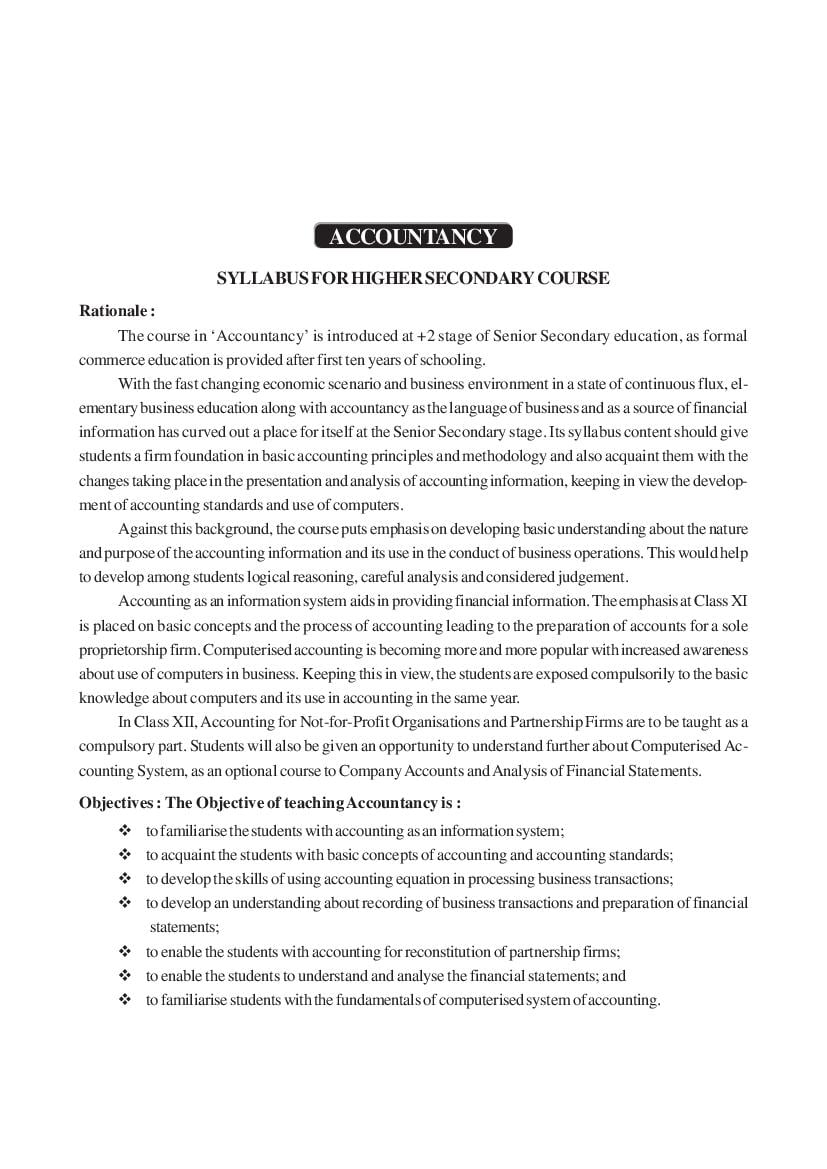
Rationale :
The course in ‘Accountancy’ is introduced at +2 stage of Senior Secondary education, as formal
commerce education is provided after first ten years of schooling.
With the fast changing economic scenario and business environment in a state of continuous flux, el-
ementary business education along with accountancy as the language of business and as a source of financial
information has curved out a place for itself at the Senior Secondary stage. Its syllabus content should give
students a firm foundation in basic accounting principles and methodology and also acquaint them with the
changes taking place in the presentation and analysis of accounting information, keeping in view the develop-
ment of accounting standards and use of computers.
Against this background, the course puts emphasis on developing basic understanding about the nature
and purpose of the accounting information and its use in the conduct of business operations. This would help
to develop among students logical reasoning, careful analysis and considered judgement.
Accounting as an information system aids in providing financial information. The emphasis at Class XI
is placed on basic concepts and the process of accounting leading to the preparation of accounts for a sole
proprietorship firm. Computerised accounting is becoming more and more popular with increased awareness
about use of computers in business. Keeping this in view, the students are exposed compulsorily to the basic
knowledge about computers and its use in accounting in the same year.
In Class XII, Accounting for Not-for-Profit Organisations and Partnership Firms are to be taught as a
compulsory part. Students will also be given an opportunity to understand further about Computerised Ac-
counting System, as an optional course to Company Accounts and Analysis of Financial Statements.
Objectives : The Objective of teaching Accountancy is :
to familiarise the students with accounting as an information system;
to acquaint the students with basic concepts of accounting and accounting standards;
to develop the skills of using accounting equation in processing business transactions;
to develop an understanding about recording of business transactions and preparation of financial
statements;
to enable the students with accounting for reconstitution of partnership firms;
to enable the students to understand and analyse the financial statements; and
to familiarise students with the fundamentals of computerised system of accounting.
Page 2
SYLLABUS FOR HIGHER SECONDARY SECOND YEAR COURSE
One Paper Three Hours Marks 100
Unitwise Distribution of Marks and Periods :
Part A : Accounting for Not-for-Profit Organisations and Partnership Firms (50 Marks)
Unit No. Topics Marks Periods
Unit No-I Accounting for nor Not-for Profit Organisations 10 20
Unit No-II Accounting for Partnership : Basic Concepts 10 20
Unit No-III Reconstitution of Partnership Firm–
Admission of a Partner 10 25
Unit No-IV Recnostitution of Partnership Firm–Retirement/Death of a Partner 10 20
Unit No-V Dissolution of Partnership Firm 10 15
50 100
Part B : Company Accounts and
Analysis of Financial Statements (50 Marks)
Unit No. Topics Marks Periods
Unit No-I Accounting for Share Capital 15 30
Unit No-II Issue and Redemption of Debentures 10 20
Unit No-III Financial Statements of a Company 08 15
Unit No-IV Analysis of Financial Statements 07 15
Unit No-V Accounting Ratios 05 10
Unit No-VI Cash Flow Statement 05 10
50 100
Or
Part C : Computerised Accounting System
Unit No. Topics Marks Periods
Unit No-I Overview of Computerised Accounting System 10 20
Unit No-II Using Computerised Accounting System 15 30
Unit No-III Accounting Using Database Management System 15 30
Unit No-IV Accounting Applications of Electronic Spreadsheet 10 20
50 100
Unitwise Distribution of Course Contents :
Part A : Accounting for Not-for-Profit Organisations and Partnership Firms
[Total Marks 50/ Total Periods -100]
Unit I : Accounting for Not-for-profit Organisations :
Meaning, characteristics and accounting records of Not-for-profit Organisations.
Receipts and Payments Account : Meaning and Preparation.
Income and Expenditure Account : Meaning, special terms used in Not-for-profit Organisations,
treatment of some peculiar items in Income and Expenditure Account, Concept of Fund Based
Page 3
and Non-fund Based accounting, Preparation of Income and Expenditure Account and Balance
Sheet from a Receipts and Payments Account and additional information and from a given Trial-
Balance. Incidental Trading Activities by a Not-for-Profit Organisation.
Unit II : Accounting of Partnership :
Basic Concepts, Characteristics of Partnership, Partnership Deed, Contents of Partnership Deed.
Maintanance of Capital Accounts of Partners : Fixed and Fluctuating Capital, Distribution of profit
among partners, interest on capital, drawings.
interest on drawings, interest on Partner’s loan to a firm, salary/commission to a partner, Guarantee
of Profit to a partner, Past adjustments.
Preparation of Final Accounts of Partnership Firm.
Unit-III : Reconstitution of Partnership Firm – Admission of a Partner :
Modes of Reconstruction of Partnership Firm.
Admission of New Partner : Matters relating to admission of a New Partner, New Profit Sharing
Ratio, Sacrificing Ratio.
Goodwill: Nature, needs, factors affecting and methods of valuation : Average profits, Super profits
and Capitalisation method, accounting treatment of goodwill on admission of a partner.
Treatment of Accumulated Profits and Losses, Revaluation of assets and Re-assessment of Liabilities.
Adjustment of capitals, change in Profit sharing ratio among the Existing Partners.
Unit-IV : Reconstitution of Partnership Firm – Retirement/Death of a Partner :
Ascertaining the Amount Due to Retiring/Deceased Partner.
Matters requiring attention at the time of retirement : New Profit Sharing Ratio, Gaining Ratio,
Treatment of Goodwill, Revaluation of assets and Re-assessment of Liabilities, Adjustment of
accumulated Profits/Reserve and Losses.
Disposal of Amount due to Retiring Partner.
Adjustment of Partners capital.
Death of a partner : Calculation of profit for the current period. Treatment of Joint Life Policy and
Individual Life Policy in case of death of a partner.
Unit-V : Dissolution of Partnership Firm :
Meaning, Dissolution of Partnership, Dissolution of a Firm.
Settlement of Accounts : Preparation of Realisation Accounts and other related accounts; (excluding
Piece meal distribution, insolvency of a partner and sale to a company).
Part-B : Company Accounts and Analysis of Financial Statements
(Total Marks : 50/ Total Periods : 100
Unit-I : Accounting for Share Capital :
Company : Meaning and definitions, features and types.
Share Capital : Meaning, classifications, Nature and class of shares. Accounting for Issue and
allotment of Equity and Preference shares, Oversubscription – proportionate allotment, under
subscription, Calls-in-Arrears, Calls-in-Advance, Issue of share at par, at a premium and at a
discount, Issue of shares for consideration other than cash.
Accounting for forfeiture of shares and Re-issue of forfeited shares.
Buy-back of shares – meaning.
Unit-II : Issue and Redemption of Debentures :
Debentures : Meaning and Types.
Accounting for Issue of Debentures : Issue of debentures at par, at a premium, at a discount,
oversubscription, issue of debentures for consideration other than cash, issue of debentures as a
Page 4
Collateral Security.
Terms of Issue of Debentures.
Accounting for Interest on Debentures, writing off Discount/Loss on Issue of Debentures.
Redemption of debentures : by payment in Lump-sum, purchase in open market, by conversion,
Sinking Fund Method.
Unit-III : Financial Statements of a Company :
Financial Statement : Meaning, Nature, Objectives, Types, Uses and Importance, Limitations.
Income Statement : Form and Contents.
Balance Sheet : Form and Contents.
Unit-IV : Analysis of Financial Statements :
Meaning, Significance, Objectives, Tools of Financial Statements : Comparative Statement, Common
Size Statements, Trend Analysis, Limitations of Analysis of Financial Statements.
Unit-V : Accounting Ratios :
Meaning of Accounting Ratios.
Ratio Analysis : Objectives, Advantages, Limitations and Types – Liquidity Ratios, Solvency Ratios,
Activity (Turnover) Ratios and Profitability Ratios.
Unit-VI : Cash Flow Statements:
Meaning, Nature and Objectives of Cash Flow Statements.
Preparation of Cash Flow Statements (as per Accounting Standard issued by ICAI)
OR
Part - C :Computerized Accounting System :
(Total Marks : 50/Total Periods : 100)
Unit - I : Overview of Computerised Accounting System :
Concept and Types of Computerised Accounting System (CAS).
Features of a Computerised Accounting System.
Structure of a Computerised Accounting System.
Unit - II : Using Computerised Accounting System :
Steps in installation of CAS. Preparation of chart of accounts, Codification and Hierarchy of
account heads.
Data Entry, Date Validation and Data verification.
Adjusting Entries. Preparation of financial statements. Closing entries and opening entries,
Security features generally available in CAS (Students are expected to understand and practise
the entire accounting process).
Unit -III : Accounting Using Database management System (DBMS):
Concept of DBMS.
Objective of DBMS : Tables, Queries, Forms, Reports.
Creating data tables for accounting.
Using Queries, forms and Reports for generating accounting information, Applications of
DBMS in generating accounting information such as shareholders records, sales reports,
customers profile, suppliers profile, pay roll, employees profile, petty cash register.
Unit - IV : Accounting Applications of Electronic Spreadsheet :
Concept of an Electronic Spreadsheet (ES).
Features offered by Electronic Spreadsheet (ES).
Applications of Electronic Spreadsheet in generating accounting information, preparing
depreciation schedule, loan repayment schedule, pay-roll accounting and other such
applications.
***
Document Details
| Board / Org | Assam Board |
| Exam | Class 12 |
| Type | Syllabus |
| Pages | 4 |
| Updated | 22 Jul 2026 |