AHSEC HS 2nd Year Syllabus 2026 History
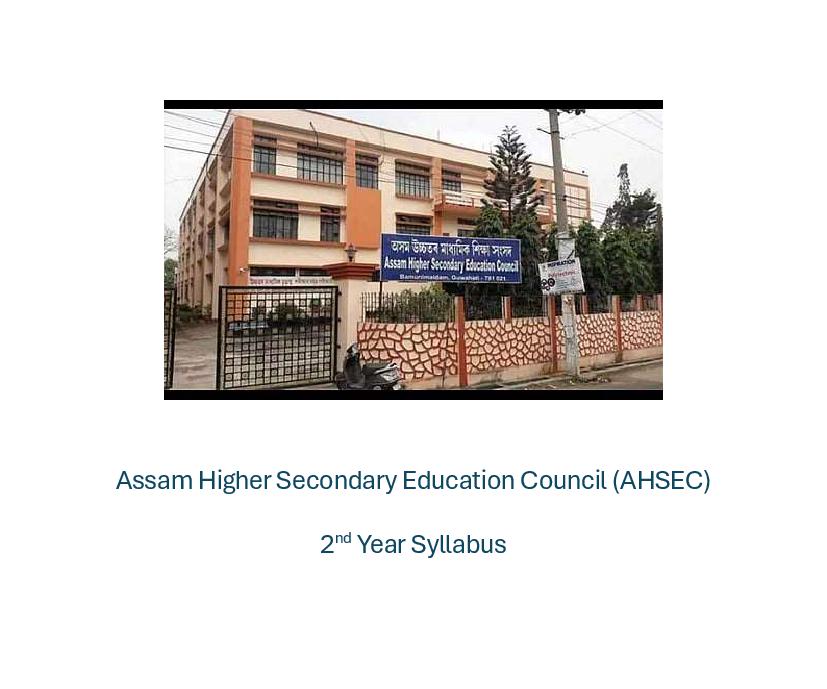
Finished viewing? Save it for later —
Download AHSEC HS 2nd Year Syllabus 2026 History (PDF · 9 pages)About AHSEC HS 2nd Year Syllabus 2026 History
AHSEC HS 2nd Year Syllabus 2026 History is available here for free download. Published by Assam Board for Class 12, this syllabus can be viewed online or downloaded as a PDF (9 pages). Candidates preparing for Class 12 can use AHSEC HS 2nd Year Syllabus 2026 History to understand the exam pattern, the type of questions asked, and the overall difficulty level.
Frequently Asked Questions
How can I download AHSEC HS 2nd Year Syllabus 2026 History?
Open this page and click the Download button to save AHSEC HS 2nd Year Syllabus 2026 History as a PDF. It is completely free on AglaSem Docs.
Is AHSEC HS 2nd Year Syllabus 2026 History free to download?
Yes. AHSEC HS 2nd Year Syllabus 2026 History can be viewed online and downloaded as a PDF free of cost on AglaSem Docs.
How many pages does AHSEC HS 2nd Year Syllabus 2026 History have?
AHSEC HS 2nd Year Syllabus 2026 History contains 9 pages, which you can read online or download together as a single PDF.
Where can I find more Class 12 study material?
You can find more Class 12 question papers, sample papers, syllabus, and answer keys on AglaSem Docs.
AHSEC HS 2nd Year Syllabus 2026 History – Text
Read the full text of this syllabus below — useful to quickly search, copy and reference the content online without downloading the PDF.
📄 View text version (9 pages)
Page 1
2nd Year Syllabus
Page 2
REVISED SYLLABUS FOR HIGHER SECONDARY FINAL YEAR COURSE
2024-2025
One Paper Time: Three Hours Marks 100
Theme wise Distribution of Marks and Periods Marks Periods
Section I:Themes in Indian History (Part I)& 50
Assam Through the Ages 30 (20+10)
Themes1- 4
Section II: Themes in Indian History (Part II)
Themes 5-8 20 50
Section III: Themes in Indian History (Part III)
Themes 10-12 20 50
MapWork 10 10
Project Work 20 20
Total 100 180
Themes in Indian History Part—I
Theme Theme Title Marks Periods
No
1 Bricks, Beads and Bones 10
The Harappa Civilisation
2 Kings, Farmers and Towns 10
Early States and Economies (c.600 BCE 600 CE)
3 Kingship, Caste and class 20 10
Early Societies (c. 600 BCE 600 CE)
4 Thinkers, Beliefs and Buildings 10
Cultural Developments (c. 600 BCE 600 CE)
Assam though the Ages 10 10
(Chapter 1, 2 and 3)
Themes in Indian History Part—II
5 Through the eyes of Travellers 13
Perceptions of Society (c. tenth to seventeenth centuries)
6 Bhakti-Sufi Traditions 13
Changes in Religious Beliefs and Devotional Texts (c. eighth to
eighteenth centuries) 20
7 An Imperial Capital – Vijayanagar (c. fourteenth to sixteenth 12
centuries)
8 Peasants, Zamindars and the States 12
Agrarian Society and the Mughal Empire
(c. sixteenth-seventeenth centuries)
Themes in Indian History Part—III
9 Colonialism and The Countryside 13
Exploring Official Archives
10 Rebels and Raj 12
1857 Revolt and its Representations 20
11 Mahatma Gandhi and the National Movement 13
Civil Disobedience and Beyond
12 Framing of the Constitution 12
The Beginning of a New Era
Map Work 10 10
Project Work 20 20
Total 100 180
Page 3
Theme wise Distribution of Course contents with specific learning objectives:
OBJECTIVE
THEMES Familiarise the learner with early urban
Theme-1: Bricks, Beads and Bones the Harappan centres and economic and social institutions.
Civilization
Introduce the ways in which new data can
Broad overview: Early urban centres
be lead to revision of existing notions of
Story of discovery: Harappan civilization.
history.
Excerpt: Archeological report on a major site.
Illustrate how archeological reports are
Discussion: How it has been utilized by
analysed and interpreted by scholars.
archeologists/historians.
Theme-2: Kings, Farmers and Towns: Early Familiarise the learner with major trends in
States and Economies (c. 600 BCE-600 CE) the political and economic history of the
Broad overview: Political and economic history subcontinent from c.4th century BCE to
from the sixteen mahajanapadas to the Gupta c.5th century CE.
Period.
Story of discovery: Inscriptions and the Introduce inscriptional analysis and the ways
understanding of political and economic history. in which these have shaped the
Excerpt: Asokan inscription and Gupta period land understanding of political and economic
grants. processes.
Discussion: Interpretation of inscriptions by
historians.
Theme-3: Kingship, Caste and Class: Early
Societies (C. 600 BCE-600 CE)
Broad overview: Issues in social history, including Familiarise the learner with issues in social
castes, kinship and gender. history.
Story of discovery: Transmission and publications
of the Mahabharata. Introduce strategies of textual analysis and
Excerpt: From the Mahabharata, illustrating how it their use in reconstruction of social history.
has been used by historians.
Discussion:Other sources for reconstructing social
history.
Theme-4 : Thinkers, Beliefs and Buildings :
Cultural Developments (c. 600 BCE - 600 CE)
Discuss the major religious developments in
(a)A brief review of religious histories of Vedic
religion, Jainism,Vaisnavism, Saivism. early India.
(b)Focus on Buddhism. Introduce strategies of visual analysis and
Story of discovery: Sanchi Stupa. their use in reconstructing histories of
Excerpt: Reproduction of sculptures from Sanchi. religion.
Discussion: Ways in which sculpture has been
interrupted by historians, other sources for
reconstructing the history of Buddhism.
Assam Through the Ages: Familiarise the learners different stages of
Broad overview: Stages of the history of Assam Assam History from prehistoric to modern
from prehistoric to modern period. period.
Page 4
Syllabi for H.S. Final Year
Focus the political, social, economic, religious
and cultural History of Assam.
Familiarise the learners with accounts in
travelers and chroniclers.
Brief discussion on Assam's participation in
freedom movement.
Part-II
Theme-5: Through the Eyes of Travelers
Perceptions of Society (c. tenth to seventeenth
Familiarise the learner with the salient
century)
features of social histories described by the
Broad overview: Outline of social and cultural life
travelers.
as they appear in travelers’ accounts.
Story of their writings:A discussion of where they
Discuss how travelers’ accounts can be
travelled, why they travelled, what they wrote and
used as sources of social history.
for whom they wrote.
Excerpts: From Alberuni, Ibn Batuta, Bernier.
Discussion: What these travel accounts can tell us
and how they have been interpreted by historians.
Theme-6 : Bhakti- Sufi Traditions Changes in
Religious Beliefs and Devotional Texts (c. Familiarise the learner with religious
eighth to eighteenth century) developments.
Broad overview: (a) Outline of religious
developments during this period. Discuss ways of analyzing devotional
(b) Ideas and practices of the Bhakti-Sufi saints. literature as sources of history.
Story of Transmission: How Bhakti-Sufi
compositions have been preserved.
Excerpts: Extracts from selected Bhakti-Sufi
works.
Discussion: Ways in which these have been
interpreted by historians.
Theme-7: An Imperial Capital Vijayanagara Familiarise the learner with the new
(c. fourteenth to sixteenth century) buildings that were built during the time.
Broad overview: (a) Outline of new buildings
duringVijaynagar period–temples, forts, irrigation Discuss the ways in which architecture can
facilities. be analyzed to reconstruct history.
(b) Relationship between architecture and the
political system.
Story of Discovery: Account of how Hampi was
found.
Excerpts: Visuals of buildings at Hampi.
Discussion: Ways in which historians have analysed
and interpreted these structures.
Page 5
Theme-8 : Peasants, Zamindars and the State: Discuss developments in agrarian relations.
Agrarian Society and the Mughal Empire (c.
sixteenth- seventeenth centuries) Discuss how to supplement official
document with other source.
Broad overview: a) Structure of agrarian
relations in the16th and 17th centuries.
b) Patterns of change over the period.
Story of discovery: Account of the
compilation and translation of Ain-i Akbari.
Excerpt: From the Ain-i Akbari
Discussion: Ways in which historians have used
the text to reconstruct history.
Part-III
Theme-9: Colonialism and the Countryside: Discuss how colonialism affected
Exploring Official Archives zamindars, peasants and artisans.
Broad overview: (a) Life of zamindars ,
peasantsand artisans in the late18th century. Understand the problems and limits of
(b) East India Company,revenue settlements and using official sources for understanding
surveys. the lives of people.
(c) Changes over the nineteenth century.
Story of official records: An account of why
official investigations into rural societies were
undertaken and the types of records and reports
produced.
Excerpts: From Firminger’s Fifth Report,
Accounts of Francis Buchanan-Hamilton and
Deccan Riots Report.
Discussion: What the official records tell and
do not tell and how they have been used by
historians.
Theme-10: Rebels and the Raj: Discuss how the events of 1857 are
1857 Revolt and its Representations being reinterpreted.
Broad Overview: (a) The events of 1857-58
(b) How these events were recorded and Discuss how visual material can be used
narrated by historians.
Focus: Lucknow.
Excerpts: Pictures of 1857. Extracts from
contemporary accounts.
Discussion: How the pictures of 1857 shaped,
British opinion of what had happened.
Theme-11: Mahatma Gandhi and the Familiarise the learner with significant
Nationalist Movement: Civil elements of the nationalist movement
Disobedience and Beyond and the nature of Gandhian.
Page 6
Discuss how Mahatma Gandhi was
Broad Overview: (a) The nationalist perceived by different groups.
movement1918-48, (b) The nature of Gandhian
Discuss how historians need to read and
politics and leadership.
interprete newspapers, diaries and letters
Focus: Mahatma Gandhi in 1931.
as historical source.
Excerpts: Reports from English and Indian
language newspapers and other contemporary
writings.
Discussion: How newspapers can be a source
of history.
Theme-12: The Framing of the Constitution: Familiarise students with the history of
The Beginning of a New Era the early years after independence.
Broad Overview: (a) Independence and the new Discuss how the founding ideals of the
nation state. (b) The making of the Constitution. new nation state were debated and
Focus: The Constitutional Assembly debates. formulated.
Excerpts: From the debates. Understand how such debates and
Discussion: What such debates reveal and discussions can be read by historians.
how they can be analyzed.
MapWork Familiarise the learner with the outline map
of ancient India and Assam.
Familiarise the learner with the cities and
places of ancient India and Assam.
Familiarise the learners with the areas/places
of ancient India and Assam where historical
events were taken place.
Familiarise the learners with the ancient
World map with special reference to South
Asia.
INTERNAL ASSESSMENT: (PROJECT WORK) (Total mark : 20)
General Guideline for project work
Introduction:
From the session 2024-25, the Board has decided to incorporate project work into the history
curriculum for class XII as part of regular classroom learning. The principal objective is to allow the
students to explore beyond textbooks, offering them a platform to refer to various materials, collect
information, analyze it, and identify relevant content. As a result, they will learn to make decisions
about what to include, gaining an understanding of how history is constructed and interpreted.
Guide to the Teachers
Teachers should ensure that project work is assigned to students either individually or in
groups, and that it is discussed at various stages—from the assignment of the topic and
review of drafts to the final submission.
Project report should be Hand written only.(Eco-friendly materials can be used by students)
The word limit of a project report should be 600 to 1000 words.
The Project report should include names of reference books and other sources consulted.
Page 7
The following steps are suggested:
Teachers should create and prepare a list of 15-20 project topics, allowing students the
option to select a project based on their individual interests. The project must be done
individually or in-groups.
The topic should be assigned after discussion with the students in the class to avoid
repetition and should then be discussed at every stage of submission of the draft/final project
work.
The teacher should act as a facilitator, closely supervising the project completion process.
They should guide students by offering necessary inputs, resources, and support to help for
enhance the content and quality of the project.
Students may use alternative sources available in local archives and libraries. They may use
newspaper cuttings, photographs, film footage and recorded written/speeches.
The suggested class project topics:
(Part I, II and III)
Indus Valley Civilization: Archaeological Discoveries and New Insights
The Mauryan Empire: A Glorious History and Enduring Legacy
The Mahabharata: India’s Epic Journey Through Time and Culture
The Vedic Age: A Foundation for Indian Civilization and Thought
Teachings of Jainism: The Path of Nonviolence and Liberation
Teachings of Buddhism: The Quest for Enlightenment and Compassion
Buddha Charita: The Epic Story of Siddhartha’s Path to Enlightenment
The Rise of Mahayana, Vaishnavism, Shaivism and Goddess Worship: A Cultural
Transformation
The Bhakti Movement: Interpretations and Commentaries
The Mystical Dimensions of Sufism
Gandhian Ideals: The Global Reach of Nonviolence and Civil Disobedience
Vijayanagar Empire: Architectural Achievements
Life of women in the Mughal rural society
Comparative Analysis of the Land Revenue Systems introduced by the Britishers in India
The Revolt of 1857: Causes, Strategy, Leadership, and Unity
Guru Nanak Dev’s Philosophy: A Vision of Equality, Justice, and Devotion
Kabir’s Vision: Challenging Religious Boundaries and Spiritual Norms
Understanding the Indian Constitution
Architectural Icons: Stupas and Pillar Edicts in Indian Buddhist Heritage
Comparative study of Mughal and Vijayanagar architecture
(Assam Through the Ages- An Overview)
Historicity of Early Kingdoms of Pragjyotisha and Kamarupa
Traditional Rulers of Ancient Assam: Unveiling the Early History
Social and Economic life of Ancient Kamarupa
Sankardeva: The Visionary Saint and Reformer of Assam
Bhakti and Sufi Traditions in Assam: A Confluence of Devotional Cultures
Neo-Vaishnavite Satras: Spiritual and Cultural Institutions of Assam
Ahom-Mughal Conflicts: The Legendary Leadership of Lachit Borphukan
The Buranjis: An unique form of historical records of Assam
British Raj in Assam: The Foundation of Colonial Rule
Rebels and the Raj: Resistance Movements Against British Rule in Assam
Revolt of 1857 in Assam: Focus on Maniram Dewan
Peasant Uprisings in Assam: Struggles Against British Oppression
Mahatma Gandhi’s Influence on the National Movement in Assam
The Rise of Social and Political Associations in Assam: Catalysts for Change
Bihu: Assam’s Rich Cultural Heritage
Page 8
N.B.-The class teacher can also select additional topics that will help broaden the students' knowledge.
While choosing these topics, it is important to ensure that they are appropriate for the students' level of
understanding and easy for them to grasp.
Teachers may prioritize Assam's history when selecting project topics, as reference books on the
subject are readily available, and students can easily engage in field surveys. Focusing on local history
allows students to access resources more conveniently and gain a deeper understanding through hands-
on experiences, such as visiting historical sites or conducting local trips.
Prescribed Textbooks: 1. Themes in Indian History: Part I, Published by AHSEC
2. Themes in Indian History: Part II, Published by NCERT
3. Themes in Indian History: Part III, Published by NCERT
4. ভাৰতৰ ইিতহাসৰ িবষয় ব , থম খ , Published by AHSEC
5. ভাৰতৰ ইিতহাসৰ িবষয় ব , ি তীয় খ , Published by AHSEC
6. ভাৰতৰ ইিতহাসৰ িবষয় ব , তৃ তীয় খ , Published by AHSEC
[Note: The textbooks are available in Bengali and Bodo Medium also]
Page 9
Notes
Model Papers Class 6 Notes
Sample Papers Class 7 Notes
Half Yearly Sample Papers Class 8 Notes
Class 9 Notes
Important Resources
Class 10 Notes
Periodic Table
Class 11 Notes
Writing Skills / Formats
Maps of India / World Class 12 Notes
Books and Solutions
NCERT Books
NCERT Book Solutions
HC Verma Chapter Wise Solutions
RD Sharma Solutions
CGBSE Solutions
Document Details
| Board / Org | Assam Board |
| Exam | Class 12 |
| Type | Syllabus |
| Pages | 9 |
| Updated | 24 Sep 2026 |