AHSEC HS 2nd Year Syllabus 2026 Statistics
Finished viewing? Save it for later —
Download AHSEC HS 2nd Year Syllabus 2026 Statistics (PDF · 4 pages)About AHSEC HS 2nd Year Syllabus 2026 Statistics
AHSEC HS 2nd Year Syllabus 2026 Statistics is available here for free download. Published by Assam Board for Class 12, this syllabus can be viewed online or downloaded as a PDF (4 pages). Candidates preparing for Class 12 can use AHSEC HS 2nd Year Syllabus 2026 Statistics to understand the exam pattern, the type of questions asked, and the overall difficulty level.
Frequently Asked Questions
How can I download AHSEC HS 2nd Year Syllabus 2026 Statistics?
Open this page and click the Download button to save AHSEC HS 2nd Year Syllabus 2026 Statistics as a PDF. It is completely free on AglaSem Docs.
Is AHSEC HS 2nd Year Syllabus 2026 Statistics free to download?
Yes. AHSEC HS 2nd Year Syllabus 2026 Statistics can be viewed online and downloaded as a PDF free of cost on AglaSem Docs.
How many pages does AHSEC HS 2nd Year Syllabus 2026 Statistics have?
AHSEC HS 2nd Year Syllabus 2026 Statistics contains 4 pages, which you can read online or download together as a single PDF.
Where can I find more Class 12 study material?
You can find more Class 12 question papers, sample papers, syllabus, and answer keys on AglaSem Docs.
AHSEC HS 2nd Year Syllabus 2026 Statistics – Text
Read the full text of this syllabus below — useful to quickly search, copy and reference the content online without downloading the PDF.
📄 View text version (4 pages)
Page 1
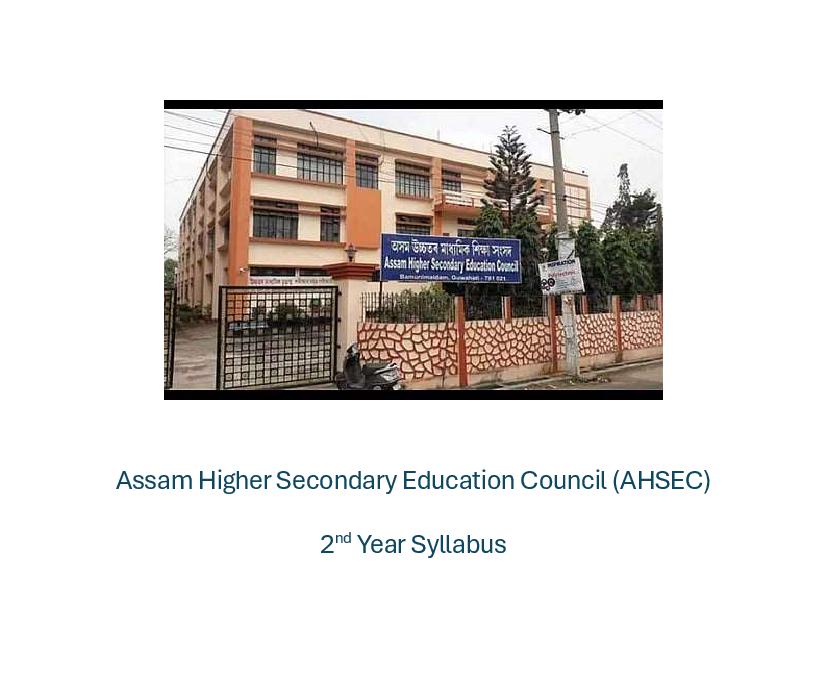
2nd Year Syllabus
Page 2
SYLLABUS FOR SECONDARY COURSE
Class XII
Objectives :
The main objectives of the course are to enable students ..
a. to acquire knowledge on basic statistical concepts.
b. to acquire the skill of statistical analysis of data from real life situation in a scientific manner.
c. to acquire knowledge on the basic aspects of statistical reasoning and drawing conclusions.
d. to create an aptitude for Statistics for those students who show a promise for higher studies and cre-
ative work in Statistics.
e. to develop aptitude for applications of statistical techniques in Biological Sciences, Social Sciences,
Education and Psychology.
Unit wise Distribution of Marks and Periods :
One Paper Three Hours Marks 100
Unit No. Title Marks Periods
Unit-I : Calculus of Finite difference 20 45
Unit-2 : Theory of Probability 40 65
Unit-3 : Elementary Theory of Sampling and Test of Significance 25 50
Unit-4 : Sample Survey 15 40
Total 100 200
Unit wise Distribution of Course contents :
Unit-1 : Calculus of Finite Difference :
Operators A and E. Construction of diagonal Difference tables. Estimation of missing values, Idea
of interpretation. Statements and applications of Newtons Forward, Backward and Longranges
interpolation formulae. Idea of numerical integration, General quadrature formula. Statement and
applications of trapezoidal rule, Simpsons 13 rd rule and Simpsons 3 8 th rule along with the
conditions under which they are derived.
Unit-2 : Theory of Probability :
Basic concepts of Random experiment, Sample point, Sample space and Event occurrence of an
event, Union and intersection of events. Complement of an event. Certain and null events. Exhaus-
tive, Mutually exclusive and equally likely events. Probability of an event. Classical, Emperical and
axiomatic (without introducing idea of measure theory). Unconditional probability, conditional prob-
ability, Dependent and independent events. Addition rule of Probability, Generalized Addition rule of
Probability (upto three events). Statements and application of multiplication rule of Probabilities.
Random Variable and Distribution:
Random variable; Discrete and continuous distribution of a random variable, p.mJ.
and p.d.f., density function. Representation of discret probability distribution. Probability curve of a
continuous distribution, Mathematical expectation of a random variable. Mathematical expectation
of the function of a random variable. Theorems on expectation of the sum and product of random
variables only application (without derivation).
Idea of Barnoulli Trials; Binomial distribution; Mathematical form, occurrence of the distribu- tion,
Derivation of the distribution, Calculation of Mean and variance. Poission distribution; Math-
Page 3
calculation of mean and variance. Normal distribution, Mathematical form (without proof). Im-
portant properties and their applications. Derivation of distribution of standard normal variate and
its applications.
Unit-3 : Elementary Theory of Sampling and Test of Significance :
Sample and Sampling. Random sampling, Parameter and Statistic.
Sampling distribution. Unbiased estimate of a parameter. Standard error of sampling mean
and sample preparation for random sampling (without Derivation) - simple applications. Statistical
hypothesis - Null hypothesis alternative hypothesis, Level of significance. Test (only two tailed
test) for a hypothetical population mean on the basis of information supplied by a random sample
drawn from a normal having known standard deviation (application only). Students ’t’ test (only
two tailed test) for an assumed mean (examples only), Large sample test (only two tailed test) for
proportion (examples only). Examples on use of frequency x2 for testing independence of at-
tributes in 2×2 table.
Unit-4 : Sample Survey :
Sample survey and complete enumeration. Basic principles of sample survey, validity of optimiza-
tion. Principal steps in a survey, Errors in a survey. Sampling and non sampling errors. Advantage
of sample survey over complete enumeration.
Simple random sampling with and without replacement - method of selection of SRS making
use of Table of random number, Estimation Population mean and total, use of formula - mean and
estimated population total. Limitations of SRS. Idea of stratified random sampling. Estimation of
population mean (method of allocation not included). Preparation of Questionnaire and schedule.
Idea of pilot survey.
Recommended Books:
Unit-1 : Calculus of Finite Difference
Ref Book- Finite Differences and Numerical Analysis by Saxena H.C.; S. Chand
Unit-2: Probability, Random variables and Distribution
Unit-3: Elementary Theory of Sampling and Test of Significance
Ref Book- Fundamentals of Mathematical Statistics by Gupta S.C. and Kapoor V.K., Sultan Chand & Sons(for
both Unit-2 & Unit-3)
Unit-4: Sample Survey
Ref Book- Fundamentals of Mathematical Statistics by Gupta S.C. and Kapoor V.K.; Sultan Chand & Sons.
Page 4
Notes
Model Papers Class 6 Notes
Sample Papers Class 7 Notes
Half Yearly Sample Papers Class 8 Notes
Class 9 Notes
Important Resources
Class 10 Notes
Periodic Table
Class 11 Notes
Writing Skills / Formats
Maps of India / World Class 12 Notes
Books and Solutions
NCERT Books
NCERT Book Solutions
HC Verma Chapter Wise Solutions
RD Sharma Solutions
CGBSE Solutions
Document Details
| Board / Org | Assam Board |
| Exam | Class 12 |
| Type | Syllabus |
| Pages | 4 |
| Updated | 24 Sep 2026 |