AHSEC HS 2nd Year Syllabus 2026 Geology
Finished viewing? Save it for later —
Download AHSEC HS 2nd Year Syllabus 2026 Geology (PDF · 4 pages)About AHSEC HS 2nd Year Syllabus 2026 Geology
AHSEC HS 2nd Year Syllabus 2026 Geology is available here for free download. Published by Assam Board for Class 12, this syllabus can be viewed online or downloaded as a PDF (4 pages). Candidates preparing for Class 12 can use AHSEC HS 2nd Year Syllabus 2026 Geology to understand the exam pattern, the type of questions asked, and the overall difficulty level.
Frequently Asked Questions
How can I download AHSEC HS 2nd Year Syllabus 2026 Geology?
Open this page and click the Download button to save AHSEC HS 2nd Year Syllabus 2026 Geology as a PDF. It is completely free on AglaSem Docs.
Is AHSEC HS 2nd Year Syllabus 2026 Geology free to download?
Yes. AHSEC HS 2nd Year Syllabus 2026 Geology can be viewed online and downloaded as a PDF free of cost on AglaSem Docs.
How many pages does AHSEC HS 2nd Year Syllabus 2026 Geology have?
AHSEC HS 2nd Year Syllabus 2026 Geology contains 4 pages, which you can read online or download together as a single PDF.
Where can I find more Class 12 study material?
You can find more Class 12 question papers, sample papers, syllabus, and answer keys on AglaSem Docs.
AHSEC HS 2nd Year Syllabus 2026 Geology – Text
Read the full text of this syllabus below — useful to quickly search, copy and reference the content online without downloading the PDF.
📄 View text version (4 pages)
Page 1
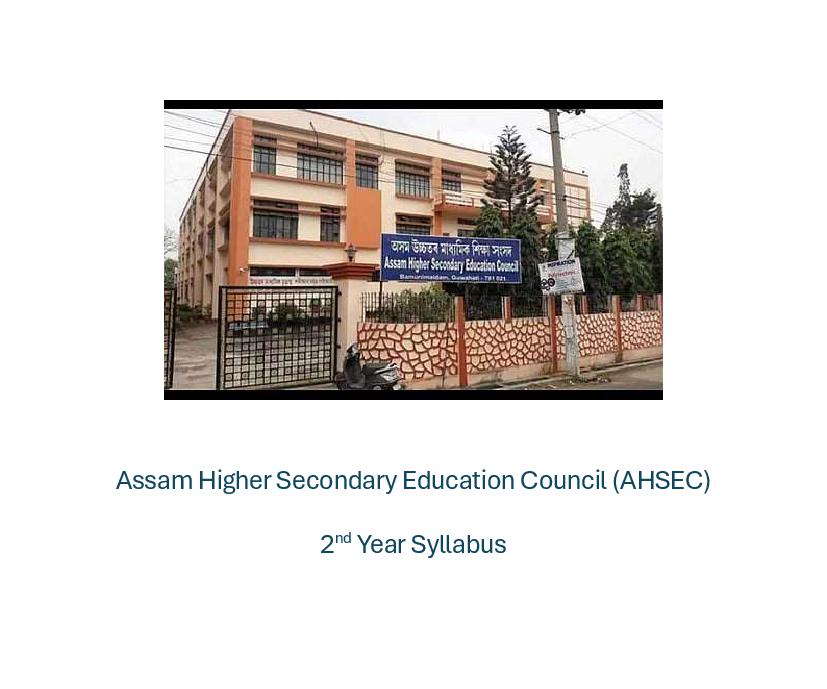
2nd Year Syllabus
Page 2
SYLLABUS FOR SECONDARY COURSE
CLASS XII
Objectives :
1. To explain the basic concept of Geology.
2. To acquire the fundamental knowledge of different branches of Geology with their specific importance.
3. To develop an interest to nature and its processes.
4. To develop interest towards the constitution of the Earth’s crust.
5. To increase the awareness of the problems of environment due to mining and industrial activity and its
remedial measures.
6. To develop an ability to use and interpret a geological map.
7. To know the importance of Geology contributing towards the national development especially the
Engineering Projects.
SYLLABUS FOR HIGHER SECONDARY FINALYEAR COURSE
One Paper Time : Three Hours Marks 70
Unitwise Distribution of Marks and Periods :
Unit No. Title Marks Periods
Unit-1 Petrology 20 35
Unit-2 Indian Stratigraphy 15 25
Unit-3 Economic geology 15 30
Unit-4 Ground Water and Engineering geology 10 25
Unit-5 Palaeontology 10 25
Total 70 140
Unit wise Distribution of Course contents :
Unit-1 Petrology :
Rocks, its definition and types (igneous, sedimentary and metamorphic), their distinguishing characters.
(i) Igneous: Its definition and composition, Forms of igneous rock. Differentiation of magma. Texture
and structure of igneous rock. Texture (Porphyritic, Poikilitic, Ophitic, Coarse, Fine and Glassy).
Structure (columnar, flow, pillow, vesicular, sheet, amygdaloidal). Classification of igneous rocks
on the basis of texture, mineralogical composition and color. Study of the following rocks with
respect to their mineralogical composition and texture:-Granite, Pegmatite, Rhyolite, Gabbro,
Dolerite, Basalt.
(ii) Sedimentary: Texture and structure of sedimentary rocks. Processes of formation of sedimentary
rocks. Study of the following rocks:- Conglomerate, Grit, Sandstone, Shale, Lime stone.
(iii) Metamorphic: Definition, agents and types of metamorphism. Depth zones of metamorphism
(epizone, mesozone, katazone). Study of the following rocks with respect to their mineralogical
composition and texture and structure:- Schist, Gneiss, Marble, Slate and Quartzite.
Unit-2 : Indian Stratigraphy :
Precambrian and Mesozoic stratigraphy ofN.E. India. Precambrian of Kamataka and Vindhyan. An
outline of the tertiary stratigraphy of the N.E. with emphasis on its lithology, paleontology and economic
importance.
Unit-3 : Economic Geology :
Definition of ore. Elementary idea of the processes of formation of mineral deposits. Origin and mode
of occurence of coal and petroleum. Mode of occurence, distribution in India and uses of the following
in the N.E.- Coal, Petroleum, Silliminite, Limestone.
Unit-4 : Ground Water and Engineering Geology :
Ground Water : Definition, elementary idea of hydrologic cycle, porosity, permeability, aquifers, water
table.
Engineering geology : Selection of bridge site and Dam site, Flood- its geological causes, prevention
Page 3
Unit-5 : PALEONTOLOGY :
Fossil : Definition, mode of preservation, uses. An outline of the important forms of life (plant and
animal) through geological ages. A brief morphological study of the phylum/class Brachiopoda,
Lamellibranchia and Gastropoda.
SYLLABUS FOR GEOLOGY PRACTICAL
Total Marks- 30
Unit-1 : Crystallography : Marks 3
Symmetry elements, Identification of the crystal forms of the normal class of the isometric, tetragonal
and hexagonal system with their general symbols.
Unit-2 : Measurements : Marks 4
Measurement of specific gravity of minerals. Determination of hardness of minerals using Moh’s scale
of hardness.
Unit-3 : Identification : Marks 6
Identification of the following Minerals :
Quartz, Orthoclase, Microcline, Garnet, Calcite, Muscovite, Biotite, Tourmaline, Galena, Haematite,
Pyrite, Magnetite, Malachite, Bauxite, Silliminite, Asbestos, Cuprite, Gypsum, Hornblende, Kyanite.
Identification of the following Rocks : Marks 6
Granite, Basalt, Pegmatite, Dolerite, Sandstone, Limestone, Conglomerate, Quartzite, Marble, Slate,
Granite-gneiss, Biotite-schist, Muscovite-Schist, Amphibolites.
Unit·4 : Drawing and interpretation of simple Geologic Maps. Marks 8
Unit-5 : Specimen collection and Laboratory note book. Marks 3
Total Periods 50 each of 45 minutes duration.
Recommended Books :
1. Bhu Bigyan (Geology) by Dr. Chatur Bhuj Pathak , publisher – Ashok Book Stall, Pan
bazar Guwahati, Assam. (Assamese medium book which include: Unit – 1, Unit – 2, Unit – 3,
Unit – 4,& Unit – 5)
2. A TEXTBOOK OF GEOLOGY by Pradip Kumar Mukharjee, published by
S. Bhattacharjee for The World Press Private Ltd.
(English medium book which include: Unit – 1, Unit – 2, Unit – 3, Unit – 4,
Unit – 5 & PRACTICALS).
3. PRINCIPLES OF ENGINEERING GEOLOGY by K.M. Bangar, published
by Standard publishers and Distributors. 1705/B, Delhi – 110006.
(English medium book which include: Unit – 1, Unit – 3, Unit – 3, Unit – 4, &
for PRACTICALS of Unit – 1, Unit – 3, Unit - 4).
4. ENGINEERING and GENERAL GEOLOGY by Parbin Singh – published by
S.K. Kataria & Sons 4885/109, Prakash Mahal. Daryaganj, New Delhi.
(English medium book which include: Unit – 1, Unit – 2, Unit – 3, Unit – 4 and
for PRACTICALS of Unit -1, Unit - 3)
***
Page 4
Notes
Model Papers Class 6 Notes
Sample Papers Class 7 Notes
Half Yearly Sample Papers Class 8 Notes
Class 9 Notes
Important Resources
Class 10 Notes
Periodic Table
Class 11 Notes
Writing Skills / Formats
Maps of India / World Class 12 Notes
Books and Solutions
NCERT Books
NCERT Book Solutions
HC Verma Chapter Wise Solutions
RD Sharma Solutions
CGBSE Solutions
Document Details
| Board / Org | Assam Board |
| Exam | Class 12 |
| Type | Syllabus |
| Pages | 4 |
| Updated | 24 Sep 2026 |