Maharashtra SSC Syllabus 2022 Sports
Finished viewing? Save it for later —
Download Maharashtra SSC Syllabus 2022 Sports (PDF · 54 pages)About Maharashtra SSC Syllabus 2022 Sports
Maharashtra SSC Syllabus 2022 Sports is available here for free download. Published by Maharashtra Board for Class 10, this syllabus can be viewed online or downloaded as a PDF (54 pages). Candidates preparing for Class 10 can use Maharashtra SSC Syllabus 2022 Sports to understand the exam pattern, the type of questions asked, and the overall difficulty level.
Frequently Asked Questions
How can I download Maharashtra SSC Syllabus 2022 Sports?
Open this page and click the Download button to save Maharashtra SSC Syllabus 2022 Sports as a PDF. It is completely free on AglaSem Docs.
Is Maharashtra SSC Syllabus 2022 Sports free to download?
Yes. Maharashtra SSC Syllabus 2022 Sports can be viewed online and downloaded as a PDF free of cost on AglaSem Docs.
How many pages does Maharashtra SSC Syllabus 2022 Sports have?
Maharashtra SSC Syllabus 2022 Sports contains 54 pages, which you can read online or download together as a single PDF.
Where can I find more Class 10 study material?
You can find more Class 10 question papers, sample papers, syllabus, and answer keys on AglaSem Docs.
Maharashtra SSC Syllabus 2022 Sports – Text
Read the full text of this syllabus below — useful to quickly search, copy and reference the content online without downloading the PDF.
📄 View text version (54 pages)
Page 1
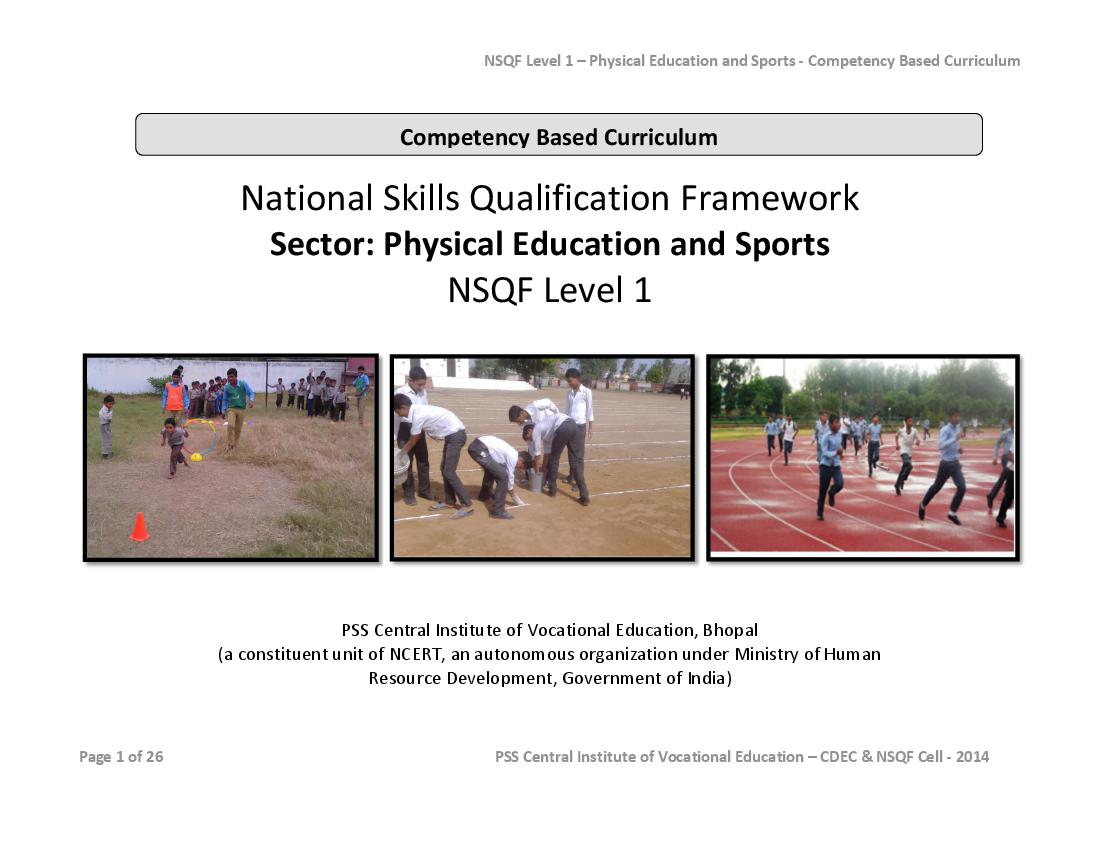
Competency Based Curriculum
National Skills Qualification Framework
Sector: Physical Education and Sports
NSQF Level 1
PSS Central Institute of Vocational Education, Bhopal
(a constituent unit of NCERT, an autonomous organization under Ministry of Human
Resource Development, Government of India)
Page 1 of 26 PSS Central Institute of Vocational Education – CDEC & NSQF Cell - 2014
Page 2
Copyright ©2013
All rights reserved. All copyright of this competency based curriculum is solely and exclusively owned by PSSCIVE.
Page 2 of 26 PSS Central Institute of Vocational Education – CDEC & NSQF Cell - 2014
Page 3
Contents
Introduction 4
About the Sector 5
Objectives of the course 7
Course Structure 8
Classroom Activities 10
Practical Activities 10
On the Job Training 10
Units 11
Assessment Guide 23
List of tools, Equipment and Materials 24
Trainer’s Qualification 25
List of Contributors 25
Acknowledgements 26
Page 3 of 26 PSS Central Institute of Vocational Education – CDEC & NSQF Cell - 2014
Page 4
Introduction
The National Skills Qualification Framework (NSQF) developed by the Ministry of Human Resource Development (MHRD), Government of
India provides a common reference for linking various qualifications to be used for setting common principles and guidelines for a nationally
recognized qualification system covering Schools, Vocational Education and Training Institutions, Technical Education Institutions, and
Universities/Colleges.
As per NSQF, qualifications are to be developed in series of levels of knowledge and skills, defined in terms of learning outcomes i.e., the
competencies (knowledge, skills and attitude) which the learners must possess regardless of whether they were acquired through formal,
non-formal or informal education and training system. Units of competency are the specification of knowledge and skill and the application
of that knowledge and skill to the standard of performance expected in the workplace.
Competency is defined in terms of what a person is required to perform, under what conditions it is done and how well it is to be done.
Generic competencies are considered essential for a person to participate effectively in the workforce, whereas technical competencies are
an individual's knowledge and expertise in the specific group task and its processes. An executive order F.No.1-4/2011-VE dated 3 Sept.,
2012 on the various aspects of NSQF has been issued by the MHRD. For more details on the NSQF, please visit the website of MHRD at www:
mhrd.gov.in. A competency based curriculum describes what learners must “know” and “be able to do” by the end of a program or study. It
identifies the competencies and sub-competencies each learner is expected to master. It states clearly the criteria and conditions by which
performance will be assessed. It also defines the learning activities that will lead the learner to mastery of the targeted learning outcome.
The competency based curriculum is broken down into parts known as Units. Each unit is further broken down into knowledge and skills on
the basis of which evidence is to be provided by the learner and the evaluation is to be done by the teacher or trainer.
Page 4 of 26 PSS Central Institute of Vocational Education – CDEC & NSQF Cell - 2014
Page 5
About the Sector
Physical education and Sports is a sector which is very wide in scope and extremely significant in its impact on society. There is lack of sports
consciousness and culture in the country. In general it is believed that Sports can only be pursued at the cost of academics. We even have a
very well known saying in India for it.
“Padhoge Likhoge Banoge Nawab, Kheloge Kudoge Banoge Kharab”
Such Myths exaggerate our imbalance towards physical activity.
As we live in the 21st century with all the issues of sedentary lifestyles, unhealthy food habits, stressful careers, this imbalance needs to
change else we will face a generation which will have a lower life span than the previous. There are already studies indicating that 30%
population of children today is obese. Obesity is a disease. That is an alarmingly high number as there is research to show that 80% of obese
children grow up to be obese adults. Diseases like type II diabetes, high cholesterol, stress related disorders are very common in this category.
The sowing of the seeds of physical activity as part of one’s lifestyle can only happen from childhood. It is a habit that needs to be formed
early on. It is therefore clear that physical education needs to be an integral part of education in all our schools. In addition to the obvious
health and fitness outcomes we are also looking at a great deal of life skills learning through sports, grooming better citizens.
The need for physical education as an integral part of education has been recognized by the government and efforts are being made to
elevate the status of physical education in schools. That is the grass roots level intervention which will eventually drive the demand for
physical education and sports related industry in India.
The immediate need is of good quality physical education and sports professionals at various levels. This demand is going to explode in the
coming years offering opportunities for all who want to be associated with Sports and build a career in this field. Several job opportunities
already exist and new ones are taking shape.
Self Schools Sports Academies Fitness Centers Hospitals Sports Events
Page 5 of 26 PSS Central Institute of Vocational Education – CDEC & NSQF Cell - 2014
Page 6
-Professional -Physical Education - Sports Coaches -Fitness Trainers -Sports Doctors -Event Managers
Players Teachers - Facility Managers -Personal Trainers -Physiotherapists -Officials
-Early Years Physical - Academy Managers -Aqua Trainers -Nutritionists -Commentators
Trainers -Nutritionists -Journalists
-Sports Coaches
There is already a gap today in the demand and supply of professionals in this sector in quantity as well as quality. A vocational course on
physical training and sports gives basic exposure of the relevant knowledge and skills required for someone interested in this sector.
Participation in such a vocational course should build entry level knowledge and skills giving the student an advantage when pursuing further
education in this field or employability skills should the student decide to go for a job.
Since most of the job roles in this sector require the employee to be dealing with fellow human beings, there is a certain level of maturity
and skills required in dealing with the customers. Level 1 of this vocational course would give exposure to students on several skills that are
required across the sector so that they get a flavor of what is the scope and also get an opportunity to explore their innate choices. As the
course progresses to level 2, students would be confident of doing roles like grounds marking, facility readiness, assisting a physical education
teacher in a school or academy. By level 4 the students would have confidence to conduct lessons on their own under the guidance of a
Physical Education director in a school or a team coach. They would have basic knowledge of Sports like skills, rules, ground markings,
conducting tournaments, basic first aid and a lot of exposure to actually conducting such lessons with children. They will have knowledge of
skills versus fitness and what can be done to improve both.
In schools, there is a dire need of physical education trainers who are able to focus on engaging the whole class and exciting children to
participate in physical activity for the pleasure on playing, social interaction, fun and fitness.
Page 6 of 26 PSS Central Institute of Vocational Education – CDEC & NSQF Cell - 2014
Page 7
Objectives of the Course
Upon completion of this level 1 course students will be able to
- Recognize the meaning and importance of a physically educated person
- Explain the meaning of health and fitness and apply some of the learnt measures to improve health and fitness
- Demonstrate the concept of age appropriateness and apply the correct learning outcomes to the various age groups in Sports and
Games with knowledge of some teaching learning techniques
- Demonstrate the value of fun in learning process and learn how to make lessons interesting for students using creativity and
colourful props.
- Apply a mix of skill and fitness trainings to improve individual performance.
- Describe basic ethics in Sports and transfer such knowledge to the students
- Accomplish and demonstrate the technical knowledge of some Sports, like ground markings, rules and regulations, skills required,
basic first aid and fixtures for tournaments.
Page 7 of 26 PSS Central Institute of Vocational Education – CDEC & NSQF Cell - 2014
Page 8
Course Structure: Competency Based Curriculum
Sector: Physical Education and Sports
Course Structure: This course (vocational qualification package) is a planned sequence of instructions consisting of the following 08 modules
called as Units.
Physical Training and Sports - Unit Matrix Level 1
No. of Notional Pre-requisite
Sl. # Unit Code Unit Title Sub-Unit
Learning hours Unit, if any
Meaning and concept of physical education
Aims and objectives of physical education
Foundation of Physical
1 PS 101 - NQ2013 Importance of physical education 15 Nil
Education
Scope and trends in physical education
Opportunities - social and economic
Meaning and concept of health and fitness
Growth and development
2 PS 102 - NQ2013 Health and Fitness 25 Nil
Structure of human body
Fundamental movement skills
Age appropriateness of physical activities
Sports equipment and props
3 PS 103 - NQ2013 Games and Sports Yoga 60 Nil
Sports etiquettes
Laws and rules of games
Page 8 of 26 PSS Central Institute of Vocational Education – CDEC & NSQF Cell - 2014
Page 9
No. of Notional Pre-requisite
Sl. # Unit Code Unit Title Sub-Unit
Learning hours Unit, if any
Meaning and concept of Hygiene
Posture
4 PS 104 - NQ2013 Developing an Athlete 20 Nil
Safety measures on playgrounds
First-Aid (basic)
Roles and responsibilities of a teacher
Effective Communication
5 PS 105 - NQ2013 Teaching-Learning 20 Nil
Teach to learn
Developing a lesson plan
Ground and court marking
Managing Sports
6 PS 106 - NQ2013 Preparing fixture 20 Nil
Events
Maintaining of props and equipment
Understanding Nutrients
7 PS 107 - NQ2013 Nutrition Balance your diet 20 Nil
Water and its importance in Health
Teach games for primary grades (Std I to III)
Teach a specific fitness related activity for Std
IV to VI
Demonstrate and teach 4 asanas to a student/
Work Integrated
8 PS 108 - NQ2013 teacher group 20 NA
Learning
Assist in ground preparation for school sports
day
Assist in checking personal hygiene of junior
students
Total 200
Successful completion of 200 hours of theory and practical sessions including 20 hours of work integrated learning is a requirement for full
qualification.
Page 9 of 26 PSS Central Institute of Vocational Education – CDEC & NSQF Cell - 2014
Page 10
Classroom Activities:
The main activity in classroom will be an interactive lecture session, followed by discussions. Teachers should make effective use of a variety
of instructional aids, such as Videos, Power Point Presentations, Charts, Diagrams, Models, Exhibits, Handouts, etc. to transmit knowledge in
projective and interactive mode. A variety of teaching methods will be used like chart preparation, collation of objects relevant to the topics,
preparation of informative document, planning of an event and role plays.
Practical Activities:
Activities that provide practical experience are termed as practical activities such as ground markings, visiting Sports facilities, conducting
physical activities according to lesson plans for students of various age groups in the schools, assisting in planning of some Sports events in
schools involving students, teachers and perhaps the community. Props, tools and equipment are used for practical activities to make the
activity fun and engaging. The vocational teacher with the School principal will plan practical activities where the students can get exposure to
all skills required in the course with assistance from the physical education teacher of the school.
On-the-Job Training:
On-the-job training (OJT) utilizes actual equipment and materials in a structured manner, following a training plan that reflects tasks to be
performed and competencies to be imparted under the supervision of an experienced trainer or supervisor. Training plan is prepared and
signed by the student, teacher, and supervisor at the organization/industry. In the first step of OJT the trainer will provide an overview of
the task to the student, explaining the constructional details and use of the tools, equipment, materials, etc. in performing the tasks. In the
second step trainer will tell, show, and demonstrate step by step the use of tools, materials and equipment for performing a task showing
the finished products at each appropriate step which will help the leaner understand what is required as outcome. Student will directly
participate in the next level while the trainer monitors the progress and provides the feedback. At the last level student practices with clearly
defined targets for performance standards.
Certification:
The certificate will be issued by the State’s Secondary Education Board/Central Board of Secondary Education (CBSE)
Page 10 of 26 PSS Central Institute of Vocational Education – CDEC & NSQF Cell - 2014
Page 11
Units
Unit Code:
PS 101 - Unit Title: Foundation of Physical Education Duration: 15 hrs
NQ2013
Location: Learning Outcome Knowledge Evaluation Performance Evaluation Teaching and Training Method
Interactive Lecture:
Lecture and discussion on meaning and
1. Describe the
concept of physical education.
Classroom and meaning and 1. Create a daily routine of a
1. Define physical education.
playground concept of physical physically active person.
Activity:
education.
Make charts on various concepts of
physical education.
1. Demonstrate the objectives of Interactive Lecture:
1. Differentiate between physical education by on-ground Lecture and discussion on aims and
cognitive and affective activities. objectives of physical education.
2. Explain the aims
Classroom and domain. 2. Complete the “quick self-
and objectives of
playground 2. Differentiate between the health check-up” questionnaire. Activity:
physical education.
aims and objectives of 3. Based on the score of the On-ground physical activities and games
physical education. questionnaire identify an aim and to experience the specific aims of
objectives to improve your score physical education.
by 6 points.
Interactive Lecture:
Importance of physical education.
3. Explain the 1. Describe the factors that
Classroom and 1. Describe the standards of
importance of make a person physically
playground physical education. Activity:
physical education. educated.
Group discussion on importance of
physical education.
Page 11 of 26 PSS Central Institute of Vocational Education – CDEC & NSQF Cell - 2014
Page 12
Location: Learning Outcome Knowledge Evaluation Performance Evaluation Teaching and Training Method
Interactive Lecture:
Discussion/ interaction of wide scope of
1. List the four parts of physical education.
4. Describe the physical education program. 1. Differentiate between fitness,
Classroom and
scope and trends of 2. Describe the current recreation and intra-mural Activity:
playground
physical education. trends within the scope of program. Role play and execute on-ground
physical education. physical activities in relation to various
scopes of physical education.
Interactive Lecture:
1. Explain the social and Discussion/ interaction of specific scope
1. Differentiate between coach
5. Identify the social economic impact of physical of physical education as profession.
and fitness trainer.
Classroom and and economic job education as profession.
2. Identify the job opportunities
playground opportunities in 2. List the job opportunities Activity:
with respect to the job
physical education. in the physical education and Partner/ group project – identify a job
responsibilities.
sports sector. role and list the qualities required for
the job role on a chart paper.
Page 12 of 26 PSS Central Institute of Vocational Education – CDEC & NSQF Cell - 2014
Page 13
Unit Code:
PS 102 - Unit Title: Health and Fitness Duration: 25 hrs
NQ2013
Location: Learning Outcome Knowledge Evaluation Performance Evaluation Teaching and Training Method
Interactive Lecture:
Meaning and concept of health and
1. Describe the 1. Explain the meaning of
1. Perform physical activities to fitness.
Classroom and meaning and health and fitness.
demonstrate the relevant fitness
playground concept of health 2. Explain the impact of
components. Activity:
and fitness. fitness on health.
Measure Fitness components of students
and its impact on health.
Interactive Lecture:
2. Describe the Explain stages of growth and
1. Differentiate between
various stages of development.
growth and development. 1. Identify the stages of physical
Classroom and growth and
2. Recognize the stages of and cognitive development in
playground development from Activity:
growth and development various age groups.
an infant to Project – observe PE classes of various
from an infant to adult.
adolescence. age groups.
Visit to a play school/ Montessori.
1. Explain skeletal structure, Lecture:
muscles, organ systems and 1. Identify the organs which are Structure of human body.
3. Describe the
blood. responsible for respiration.
Classroom structure of human
2. List the major muscle 2. Draw a well-labeled diagram of Activity:
body.
groups and the major bones digestive system. Projects of drawings – skeletal structure,
in the body. muscular system and organ systems.
Interactive Lecture:
1. Explain the fundamental
Discussion/ interaction of fundamental
movement skills.
4. Demonstrate the movement skills.
Classroom and 2. Differentiate between 1. Perform three fundamental
fundamental
playground locomotor, non- movement skills.
movement skills. Activity:
manipulative and
On-ground physical activities of
manipulative skills.
fundamental movement skills.
Page 13 of 26 PSS Central Institute of Vocational Education – CDEC & NSQF Cell - 2014
Page 14
Unit Code: Unit Title: Games and Sports Duration: 60 hrs
PS 103 - NQ2013
Location: Learning Outcome Knowledge Evaluation Performance Evaluation Teaching and Training Method
Interactive Lecture:
1. Explain the concept of age Age appropriate physical
appropriate physical activities activities and games with
1. Identify the age appropriate and games. general and specific warm-up
1. Execute the physical
Classroom and physical activities for pre- 2. Demonstrate the physical and cool down exercises.
activities and games as per
playground primary, primary, secondary and activities/ games with proper
the various age groups.
senior secondary age groups. warm-up and cool down Activity:
exercises as per the age Age appropriate physical
groups. activity/ games for all age
groups.
Interactive Lecture:
Discussion/ interaction of
1. Identify the name of the props and equipment.
5. Identify various age various props and equipment. 1. Demonstrate the usage of
Classroom and
appropriate props and 2. Explain the age appropriate props for age appropriate Activity:
playground
equipment and its usage. usage of props and activities. On-ground physical activities
equipment. using various props and
equipment for different age
categories.
1. Explain the benefits of yoga 1. Identify the yoga asanas
Classroom/ 2. Demonstrate the fundamental Activity:
for a healthy lifestyle. beneficial for strength.
Activity hall yoga asanas and explain the Demonstration and
2. Demonstrate various 2. Perform various
(indoor) benefits of yoga in fitness. explanation of yoga asanas.
fundamental yoga asanas. fundamental yoga asanas.
Page 14 of 26 PSS Central Institute of Vocational Education – CDEC & NSQF Cell - 2014
Page 15
Location: Learning Outcome Knowledge Evaluation Performance Evaluation Teaching and Training Method
Interactive Lecture:
Meaning and concept of sports
etiquettes and its application
1. Apply the learnt sports
Classroom and 3. Apply sports etiquettes during in games and sports.
1. Describe sports etiquettes. etiquettes while
playground physical activities and games.
participating in games.
Activity:
Sports etiquettes through on-
ground match experience.
Lecture:
Laws and rules of the games
(major team games).
1. Describe the laws and rules 1. Document the laws and
Classroom and 4. Explain the laws and rules of
of the games (major team rules of any 2 major team Activity:
playground the games.
games). games. Participate in major team
games following the laws and
rules of the games.
Page 15 of 26 PSS Central Institute of Vocational Education – CDEC & NSQF Cell - 2014
Page 16
Unit Code:
PS 104 - NQ2013 Unit Title: Developing an Athlete Duration: 20 hrs
Location: Learning Outcome Knowledge Evaluation Performance Evaluation Teaching and Training Method
Interactive Lecture:
1. Explain the best hygienic Meaning, concept and best
1. Identify the meaning and practices and its implication practices of hygiene.
1. Recognize the do’s and
Classroom concept of hygiene. on health.
don’ts of a hygienic lifestyle.
2. Describe the importance of Activity:
hygiene in daily life. Individual and group projects
of best hygienic practices.
Interactive Lecture:
1. Explain and demonstrate Meaning, concept and best
the correct postures. 1. Assess the correct practices of posture.
2. Differentiate between postures.
Classroom and 2. Demonstrate the correct
correct and incorrect posture. 2. Demonstrate and correct Activity:
playground posture – static and dynamic.
3. Explain the importance of the static and dynamic Demonstration of various
correct posture to avoid postures of fellow students. correct postures viz. correct
deformities. posture to stand, sit, walk,
climbing stairs, lifting weight
Interactive Lecture:
Safety measures – safe acts
and safe conditions.
1. Administer the safe usage
3. Apply the best practices of
1. List the best practices of of props and equipment. Activity:
Classroom and safe conditions and safe acts
safe acts and safe conditions 2. Create safe ground/ Safety measures on how to use
playground during physical activities and
during games and sports. condition for an activity and the props and correct ways to
games.
game. exercise.
Safe conditions of ground
preparations to avoid injuries
and accidents.
Page 16 of 26 PSS Central Institute of Vocational Education – CDEC & NSQF Cell - 2014
Page 17
Location: Learning Outcome Knowledge Evaluation Performance Evaluation Teaching and Training Method
Interactive Lecture:
1. Describe the basic principles
Meaning and concept of basics
of first-aid. 1. Administer the basic first-
4. Apply the knowledge of basic of first-aid.
Classroom and 2. Describe the basic sports aid for cuts, bruises, heat
first-aid.
playground injuries and its first-aid. stroke, nose bleeds, strain
Activity:
3. Describe basic health and sprain.
Demonstration of first-aid
hazards.
application.
Page 17 of 26 PSS Central Institute of Vocational Education – CDEC & NSQF Cell - 2014
Page 18
Unit Code:
PS 105 - NQ2013 Unit Title: Teaching-Learning Duration: 20 hrs
Location: Learning Outcome Knowledge Evaluation Performance Evaluation Teaching and Training Method
Interactive Lecture:
Roles and responsibilities of a
1. Identify the roles and
1. Explain the best teaching teacher and best practices of
responsibilities of a teacher.
Classroom and 1. Identify the roles and practices in school context. teaching.
2. Perform the role of a
playground responsibilities of a teacher. 2. Describe the qualities of a
teacher for physical
good teacher. Activity:
activities on-ground.
Role play as a teacher and take
games lessons on ground.
Interactive Lecture:
1. State the different elements
Meaning, concept and best
of communication and their
practices of communication in
importance.
teaching practice.
2. Best practices of
1. Accomplish the best
Classroom and 2. Identify the elements of communication while teaching
practices of communication Activity:
playground communication. students group of various age
during on-ground sessions. Role play as a teacher and
group.
demonstrate best practices of
3. Understand the value of
effective communication while
listening in teaching
taking games lessons on
communication.
ground.
Interactive Lecture:
Teaching-learning concept.
1. Accomplish effective
1. Differentiate between visual teaching methods in an on-
Classroom and Activity:
3. Effective Teaching Methods. learner and auditory learner. ground physical activity and
playground On-ground physical activities
game.
demonstrating the effective
teaching methods.
Page 18 of 26 PSS Central Institute of Vocational Education – CDEC & NSQF Cell - 2014
Page 19
Location: Learning Outcome Knowledge Evaluation Performance Evaluation Teaching and Training Method
Interactive Lecture:
Importance and need of
planning.
1. Create a lesson plan of a
How to make a plan for
physical activity/ game
4. Develop lesson plans for teaching/ training.
Classroom and 1. Explain how to relate goal session for a specific age
physical activities and games.
playground and plan. group.
Activity:
2. Execute the lesson plan
Execution of plan(s) on ground
on-ground.
with correct props and
equipment to achieve the
lesson objective.
Page 19 of 26 PSS Central Institute of Vocational Education – CDEC & NSQF Cell - 2014
Page 20
Unit Code:
PS 106 - NQ2013 Unit Title: Managing Sports Events Duration: 20 hrs
Location: Learning Outcome Knowledge Evaluation Performance Evaluation Teaching and Training Method
Interactive Lecture:
Ground marking and
1. Measure and accomplish equipment required for major
1. Demonstrate ground/ court 1. Explain the ground/ court the marking of grounds for sports and games.
Classroom and
markings and use of equipment markings (basic). any one game using
playground
for major games and sports. relevant equipment for Activity:
playing condition. Marking and preparation of
ground as a group for specific
games and sports.
1. Differentiate between league Interactive Lecture:
1. Schedule fixture for
2. Identify the correct and knockout tournaments. Various tournaments.
Classroom leagues and knockout
procedure to prepare fixtures. 2. Explain the procedure to Preparation of fixture.
tournaments.
prepare fixtures.
Interactive Lecture:
Names of props and
equipment and how to
1. Identify and explain the maintain.
3. Apply the knowledge of how various props and equipment 1. Demonstrate the
Classroom and
to maintain the props and for major sports and games. maintenance of props and Activity:
playground
equipment. 2. Explain how to maintain the equipment. Demonstration of props and
props and equipment. equipment maintenance.
Project – prepare the list of
props and equipment available
in school and its maintenance.
Page 20 of 26 PSS Central Institute of Vocational Education – CDEC & NSQF Cell - 2014
Page 21
Unit Code:
PS 107 - NQ2013 Unit Title: Nutrition Duration: 20 hrs
Location: Learning Outcome Knowledge Evaluation Performance Evaluation Teaching and Training Method
Interactive Lecture:
Six groups of nutrients and its
1. Explain the six groups of importance.
1. Identify the various nutrients 1. Identify the various
nutrients.
Classroom and its use in our body. nutrients and its use in our
2. Explain the role and Activity:
body.
importance of all nutrients. Make charts mentioning the
information on various
nutrients.
Interactive Lecture:
1. Explain the meaning and Balanced diet and nutritional
importance of balanced diet. values.
2. Describe the elements of 1. Prepare balanced diet for
Classroom 2. Explain balanced diet.
balanced diet. self. Activity:
3. Differentiate between diet Collect balanced diet chart for
and balanced diet. various profiles/ people
related to different activities.
Interactive Lecture:
1. Explain the importance of
Importance of water.
water in our body. 1. Tabulate your and your
3. Identify the importance of
Classroom 2. Myths and facts about water family’s water consumption
water in our body. Activity:
consumption during physical for a week.
Project – Water consumption
activity.
tabulation.
Page 21 of 26 PSS Central Institute of Vocational Education – CDEC & NSQF Cell - 2014
Page 22
Unit Code:
PS 108 - NQ2013 Unit Title: Work Integrated Learning Duration: 20 hrs
Location: Learning Outcome Knowledge Evaluation Performance Evaluation Teaching and Training Method
1. Demonstrate age
1. Identify the correct
1. Demonstrate teaching skills appropriate games/ physical Activity:
activity for teaching.
by teaching games/ physical activities while teaching the Teach games to a particular
Playground 2. Accomplish the correct
activities for primary grades primary groups. grade for 30 mins with specific
communication for the
(Std I to III). 2. Usage of correct learning outcome.
particular age group.
communication while teaching.
Activity:
1. Execute an activity
Teach the fitness related
2. Demonstrate the knowledge related to a specific fitness
1. Demonstrate a specific activity to a particular grade
Playground of fitness by teaching fitness goal to a class and measure
fitness related activity. for 30 mins and measure that
related activity – Std IV to VI. that fitness component.
fitness component
1. Select 4 standing asanas, to
3. Demonstrate and teach 4 1. Demonstrate and teach 4 Activity:
be taught to a group of
Playground fundamental asanas to a group standing asanas to a group Demonstrate and teach asanas
students or teachers.
of students or teachers. of students or teachers. to the specific group.
Document their benefits.
4. Apply the knowledge by 2. Administer the correct
Activity:
assisting the grounds men to 1. Create the correct ground ground marking by assisting
Playground Assist the ground men in
prepare the ground for school marking for school sports day. the ground men for sports
marking for sports day.
sports day. day.
Activity:
Check the personal hygiene
1. List and explain with reasons
School/ Assembly 5. Identify the personal hygiene 2. Check personal hygiene like clean nails, clean hair,
the best practices of personal
area of junior students in the school. of the students. clean attire etc. after the
hygiene.
assembly or in any designated
period.
Page 22 of 26 PSS Central Institute of Vocational Education – CDEC & NSQF Cell - 2014
Page 23
Assessment Guide
Assessment is a necessary process to determine the level of progress and learning of knowledge and skills at a particular level and take
remedial action. It needs to be continuous and comprehensive in nature to achieve this purpose. The student workbook has sections of
Assessment and Assessment checklists in each section of a module to judge the extent to which a student has grasped the concept and is
able to demonstrate the skill. A variety of assessment methods are used to evaluate the student as is required in the vocations that pertain
to this course. Appropriate evidence is to be collected from activities that can be clearly related to the Units of Competency. It should cover
all the elements and performance criteria/indicators in the competency standards.
The final assessment will be in line with the CBSE guidelines.
Page 23 of 26 PSS Central Institute of Vocational Education – CDEC & NSQF Cell - 2014
Page 24
List of Tools, Equipment and Materials
Quantity for
List of Items Quantity 30 students
Storage Cupboard for the props 1 1
Basketball Posts, ( Fixed to Movable with Acrylic board, ring and net) 1 pair 1 pair
Equipment
Volleyball Poles ( Fixed to Movable) 1 pair 1 pair
Mini Football Goal Posts (2mx1.1m) to full size fixed goal posts 1 pair 1 pair
Cricket Mat ( 33feet x 9 feet) 1 1
Kho Kho Posts 1 pair 1 pair
Computer with internet connectivity + one USB stick 8 GB 1 1
Tools
Projector 1 1
CD Player + Speakers 1 1
Marking Props: Cones, Flexi-poles, corner flags, Lime powder, Measuring Tape, rope , nails, hammer 1 1
Fitness props: Medicine ball, Agility Ladder, Step hurdles, sit and reach box , Weighing scale, Height scale, 1 1
whistle, stop watch
Props
Balancing Skills: Balance Beam 1 1
Pre-primary and primary Students: Bean Bag scarves, Soft balls, Plastic rackets and balls, Hula Hoops 1 1:2 to 1:4
Middle School Students: Frisbees, Footballs, Basketballs, Touch rugby, Volleyballs, cricket bats and balls 1 1:4
Props will be configured based on the class size for practical training
Page 24 of 26 PSS Central Institute of Vocational Education – CDEC & NSQF Cell - 2014
Page 25
Trainer’s Qualification
Graduate or Post Graduate in Physical Education (BPE/ BPEd/ MPEd) or Diploma in Physical Education/ Sports Coaching with 1+ years
of experience as a Physical Education Teacher or Coach.
Work experience in school, colleges, academies or in the area of physical training and sports (at least 1 year)
Good knowledge of school education system or sports coaching with prior experience in training / teaching.
List of Contributors
Mr. Saumil Majmudar, CEO, SV EduSports Pvt. Ltd., Bangalore
Ms. Jyoti Majmudar, COO, SV EduSports Pvt. Ltd., Bangalore
Mr. Parminder Gill, CMO, SV EduSports Pvt. Ltd., Bangalore
Mr. Meer Waqiruddin Khaleeq, Head – Business Development, SV EduSports Pvt. Ltd., Bangalore
Mr. Suhas Nair, Programme Director, SV EduSports Pvt. Ltd., Bangalore
Ms. Srividya Majmudar, Manager, Quality and Systems, SV EduSports Pvt. Ltd., Bangalore
Dr. Gautam Mukherjee, Manager – Product Development, SV EduSports Pvt. Ltd., Bangalore
Page 25 of 26 PSS Central Institute of Vocational Education – CDEC & NSQF Cell - 2014
Page 26
Acknowledgement
We would like to place on record our gratitude to Dr. Vinay Swarup Mehrotra, Head, Curriculum Development and Evaluation Centre
(CDEC), PSSCIVE, Prof. R.B. Shivagunde, Joint Director, PSSCIVE for their support and guidance in developing this curriculum as per NVEQF.
We would like to thank Labournet and Wadhawani Foundation for giving us this opportunity to contribute in this nation building exercise
through this vocational course.
The youth of India which is and will continue to be the most sought after resource for this country of a billion people, has inspired us to
undertake this journey in strengthening physical education and sports in India.
We would like to thank the schools we have partnered with, who have lent us their support in strengthening physical education and sports
at school level. They have believed in our ideas and given us the right platform to make the right impact at the right age.
We would like to thank the physical education colleges which have given us access to their students and have guided us whenever we sought
their support.
We would like to thank the physical education professionals who work with us. They have helped us change the way we look at physical
education. These physical education professionals who have believed in themselves and worked hard to bring physical education on the
radar of school authorities, parents and students.
Special thanks to the Sportsmen of India who have shown us what we are capable of doing if we commit.
We would like to thank all our well wishers, friends and investors who have appreciated with generosity our efforts so far, given us the right
platforms to present our thoughts and given us opportunities to showcase our products and services, without their trust and belief we would
not be here.
Our inspiration to offer this vocational course comes from the trust and confidence our schools have placed on us, the smiles that we see on
the young school children’s faces and the dire need for us as a nation to focus on preventive health and fitness.
We would like to appreciate the government for recognizing the need for elevating the status of physical education and sports in school
curriculum and giving us the opportunity to participate in this endeavor.
Thank you All!
Page 26 of 26 PSS Central Institute of Vocational Education – CDEC & NSQF Cell - 2014
Page 27
Competency Based Curriculum
National Skills Qualification Framework
NSQF Level 2
Sector: Physical Education and Sports
PSS Central Institute of Vocational Education, Bhopal
(a constituent unit of NCERT, an autonomous organization under Ministry of Human
Resource Development, Government of India)
Page 1 of 28 PSS Central Institute of Vocational Education – CDEC & NSQF Cell - 2014
Page 28
Copyright ©
All rights reserved. All copyright of this competency based curriculum is solely and exclusively owned by PSSCIVE.
Page 2 of 28 PSS Central Institute of Vocational Education – CDEC & NSQF Cell - 2014
Page 29
Contents
Introduction 4
About the Sector 5
Objectives of the course 7
Course Structure 8
Classroom Activities 9
Practical Activities 10
On the Job Training 10
Units 11
Assessment Guide 25
List of tools, Equipment and Materials 26
Trainer’s Qualification 26
List of Contributors 27
Acknowledgements 28
Page 3 of 28 PSS Central Institute of Vocational Education – CDEC & NSQF Cell - 2014
Page 30
Introduction
The National Skills Qualifications Framework (NSQF) developed by the Ministry of Human Resource Development (MHRD), Government of
India provides a common reference for linking various qualifications to be used for setting common principles and guidelines for a nationally
recognized qualification system covering Schools, Vocational Education and Training Institutions, Technical Education Institutions, and
Universities/Colleges.
As per NSQF qualifications are to be developed in series of levels of knowledge and skills, defined in terms of learning outcomes i.e., the
competencies (knowledge, skills and attitude) which the learners must possess regardless of whether they were acquired through formal,
non-formal or informal education and training system. Units of competency are the specification of knowledge and skill and the application
of that knowledge and skill to the standard of performance expected in the workplace.
Competency is defined in terms of what a person is required to perform, under what conditions it is done and how well it is to be done.
Generic competencies are considered essential for a person to participate effectively in the workforce, whereas technical competencies are
an individual's knowledge and expertise in the specific group task and its processes. An executive order F.No.1-4/2011-VE dated 3 Sept.,
2012 on the various aspects of NSQF has been issued by the MHRD. For more details on the NSQF, please visit the website of MHRD at www:
mhrd.gov.in. A competency based curriculum describes what learners must “know” and “be able to do” by the end of a program or study. It
identifies the competencies and sub-competencies each learner is expected to master. It states clearly the criteria and conditions by which
performance will be assessed. It also defines the learning activities that will lead the learner to mastery of the targeted learning outcome.
The competency based curriculum is broken down into parts known as Units. Each unit is further broken down into knowledge and skills on
the basis of which evidence is to be provided by the learner and the evaluation is to be done by the teacher or trainer.
Page 4 of 28 PSS Central Institute of Vocational Education – CDEC & NSQF Cell - 2014
Page 31
About the Sector
Physical education and Sports is a sector which is very wide in scope and extremely significant in its impact on society. There is lack of sports
consciousness and culture in the country. In general it is believed that Sports can only be pursued at the cost of academics. We even have a
very well-known saying in India for it;
“Padhoge Likhoge Banoge Nawab, Kheloge Kudoge Banoge Kharab”
Such Myths exaggerate our imbalance towards physical activity.
As we live in the 21st century with all the issues of sedentary lifestyles, unhealthy food habits, stressful careers, this imbalance needs to
change else we will face a generation which will have a lower life span than the previous. There are already studies indicating that 30%
population of children today is obese. Obesity is a disease. That is an alarmingly high number as there is research to show that 80% of obese
children grow up to be obese adults. Diseases like type II diabetes, high cholesterol, stress related disorders are very common in this category.
The sowing of the seeds of physical activity as part of one’s lifestyle can only happen from childhood. It is a habit that needs to be formed
early on. It is therefore clear that physical education needs to be an integral part of education in all our schools. Other that the obvious
health and fitness outcomes we are also looking at a great deal of life skills learning through sports, grooming better citizens.
The need for physical education as an integral part of education has been recognized by the government and efforts are being made to
elevate the status of physical education in schools. That is the grass roots level intervention which will eventually drive the demand for
physical education and sports related industry in India.
The immediate need is of good quality physical education and sports professionals at various levels. This demand is going to explode in the
coming years offering opportunities for all who want to be associated with Sports and build a career in this field. Several job opportunities
already exist and new ones are taking shape.
Page 5 of 28 PSS Central Institute of Vocational Education – CDEC & NSQF Cell - 2014
Page 32
Self Schools Sports Academies Fitness Centers Hospitals Sports Events
-Professional -Physical Education - Sports Coaches -Fitness Trainers -Sports Doctors -Event Managers
Players Teachers - Facility Managers -Personal trainers -Physiotherapists -Officials
-Early Years Physical - Academy Managers -Aqua trainers -Nutritionists -Commentators
Trainers -Nutritionists -Journalists
-Sports Coaches
There is already a gap today in the demand and supply of professionals in this sector in quantity as well as quality. A vocational course on
physical training and sports gives basic exposure of the relevant knowledge and skills required for someone interested in this sector.
Participation in such a vocational course should build entry level knowledge and skills giving the student an advantage when pursuing further
education in this field or employability skills, should the student decide to go for a job.
Since most of the job roles in this sector require the employee to be dealing with fellow human beings, there is a certain level of maturity
and skills required in dealing with the customers. Level 1 of this vocational course would give exposure to students on several skills that are
required across the sector so that they get a flavor of what is the scope and also get an opportunity to explore their innate choices. As the
course progresses to level 2, students would be confident of doing roles like grounds marking, facility readiness, assisting a physical education
teacher in a school or academy. By level 4 the students would have confidence to conduct lessons on their own under the guidance of a
Physical Education director in a school or a team coach. They would have basic knowledge of Sports like skills, rules, ground markings,
conducting tournaments, basic first aid and a lot of exposure to actually conducting such lessons with children. They will have knowledge of
skills versus fitness and what can be done to improve both.
In schools, there is a dire need of physical education trainers who are able to focus on engaging the whole class and exciting children to
participate in physical activity for the pleasure on playing, social interaction, fun and fitness.
Page 6 of 28 PSS Central Institute of Vocational Education – CDEC & NSQF Cell - 2014
Page 33
Objectives of the Course
Upon completion of this level 2 course students will be able to
- Understand the evolution of physical education
- Explain the meaning of health education, hygiene and communicable diseases
- Understand the role of sports in society
- Demonstrate the knowledge of age appropriate skills to be taught to the various age groups starting from early years to middle
school.
- Demonstrate how to test skills and fitness
- Understand the functions of various organ systems in the human body
- Demonstrate the knowledge of correct postures, basic training methods and safety in sports
- Demonstrate the knowledge of first aid for common injuries
- Understand the role of a good teacher in education and effective training methodologies
- Demonstrate the knowledge of planning and its use in planning sports days and tournaments
- Demonstrate the technical knowledge of ground markings, rules and regulations, skills required, and creating fixtures for
tournaments in the following sports: football, basketball, volleyball and cricket.
- Understand the importance of nutrition and the technical knowledge of caloric values and energy balance in the body
Page 7 of 28 PSS Central Institute of Vocational Education – CDEC & NSQF Cell - 2014
Page 34
Course Structure: Competency Based Curriculum
Sector: Physical Education and Sports
Course Structure: This course (vocational qualification package) is a planned sequence of instructions consisting of the following 08 modules
called as Units.
Physical Training and Sports - Unit Matrix Level 2
No. of
Sl. Notional Pre-requisite
Unit Code Unit Title Sub-Unit
# Learning Unit, if any
hours
Understanding the Evolution of physical education
Understanding the difference between ancient and modern
Evolution of
1 PS201-NQ2014 Olympic Games 10 Nil
Physical Education
Understanding the evolution of Indian sporting events
Identifying the role of sports in society
Learning about health education, hygiene, communicable diseases
2 PS 202-NQ2014 Health and Fitness 25 0
Understanding the functions of human body
How to test your fitness (basic)
Demonstrating the knowledge of fundamental skills for pre-school
children PS 103 -
Teaching physical education in primary school ( Grade 1 and 2) NQ2013:
3 PS203-NQ2014 Games and Sports 50
Teaching physical education in primary school ( Grade 3 to 5) Games and
Teaching Physical education in middle school ( Grad 6 and above) Sports
Demonstrating Yogic exercises ( Basic)
Page 8 of 28 PSS Central Institute of Vocational Education – CDEC & NSQF Cell - 2014
Page 35
Identifying postural deformities and learning corrective measures PS 104 -
Developing an NQ2013:
4 PS 204-NQ2014 Demonstrating basic training methods 25
Athlete Developing an
Teaching safe ways to participate in physical education and sports Athlete
Teaching basic first aid
Learning to train and training to learn PS 105 -
Learning to train Demonstrating the knowledge of effective teaching methods NQ2013:
5 PS 205 - NQ2013 25
Training to learn Demonstrate effective communication skills Teaching-
Demonstrating the knowledge of planning an event Learning
Teaching basic competencies of officiating
Demonstrating the knowledge of ground and court marking PS 106 -
Managing Sports NQ2013:
6 PS 206 - NQ2013 Teaching maintenance of props and equipment and sports 20
Events Managing
facilities
Sports Events
Teaching to organise sports days and tournaments
Understanding the role of nutrition and the use of food pyramid PS 107 -
7 PS 207 - NQ2013 Nutrition Calculating caloric values 15 NQ2013:
Diet and Weight Nutrition
Work Integrated
8 Projects, field trips and guest lectures 30
learning
Total 200
Successful completion of 200 hours of theory and practical sessions is a requirement for full qualification.
Classroom Activities:
The main activity in classroom will be an interactive lecture session, followed by discussions. Teachers should make effective use of a variety
of instructional aids, such as Videos, Power Point Presentations, Charts, Diagrams, Models, Exhibits, Handouts, etc. to transmit knowledge in
and effective and interactive mode. A variety of teaching methods will be used like projects, role-play, demonstration, discussion and debate
and hands on learning.
Page 9 of 28 PSS Central Institute of Vocational Education – CDEC & NSQF Cell - 2014
Page 36
Practical Activities:
Activities that provide practical experience are termed as practical activities. Most of the modules in this vocation lend very well to hands on
learning. Conducting physical activities according to lesson plans for students of various age groups in the schools, planning and organizing
tournaments involving students, teachers and perhaps the community, ground markings, visiting sports facilities etc. are good examples of
practical activities. Props, tools and equipment are used for practical activities to make the activity fun and engaging. The vocational teacher
with the permission of the school principal will plan practical activities where the students can get exposure to all skills required in the course.
On-the-Job Training:
On-the-job training (OJT) utilizes actual equipment and materials in a structured manner, following a training plan that reflects tasks to be
performed and competencies to be imparted under the supervision of an experienced trainer or supervisor. Training plan is prepared and
signed by the student, teacher, and supervisor at the organization/industry. In the first step of OJT the trainer will provide an overview of
the task to the student, explaining the use of the tools, equipment, materials, etc. in performing the tasks. In the second step trainer will tell,
show, and demonstrate step by step the use of tools, materials and equipment for performing a task showing the finished products at each
step which will help the leaner understand what is required as outcome. Student will learn and demonstrate these activities while the trainer
will monitor the progress and provide feedback. Students should be able demonstrate clearly the performance standards defined in the
modules.
Certification:
The certificate will be issued by the State’s Secondary Education Board/Central Board of Secondary Education (CBSE)
Page 10 of 28 PSS Central Institute of Vocational Education – CDEC & NSQF Cell - 2014
Page 37
Unit Code:
PS201- Unit Title : Evolution of Physical Education
NQ2014
Duration: 26 hours
Location: Learning
Outcome Knowledge Evaluation Performance Evaluation Teaching and Training Methods
Classroom 1. Understand 1. Explain why physical activity 1. List and demonstrate the physical Interactive Lecture:
& Play the evolution was necessary during the pre- activities and the dominant skills in Evolution of physical education
ground of Physical historic time pre- historic, ancient, medieval and Activity: on ground
Education 2. Identify the different forms of modern periods 1. Perform skills used for hunting
physical education during pre- 2. List the differences between pre- and war during the ancient
historic, ancient, medieval and historic physical activities and periods
modern periods modern games and sports 2. Perform skills used in playing
3. Explain when people started modern day games and sports
to consider physical education as 3. Visit nearby akhara and write
the medium for the overall down your observations and
development of an individual experiences
2. Understand 1 Explain how Olympic Games 1. List the fundamental changes that Interactive Lecture:
the difference played an important role in took place in ancient and modern Difference between ancient and
between bringing peace among the rival Olympic Games modern Olympic Games
ancient and city states in ancient Greece 2. Demonstrate the sportsman spirit Activity: on ground
modern 2. Explain how Olympic Games and teamwork during participation 1. Organize an Olympic event in
Olympic can foster international peace, in a sporting event school choosing the games from
Games understanding, friendship, etc. the ancient Olympics
3. Identify the differences 2.Organize an Olympic event in
between ancient and modern school choosing the games from
Olympic Games the modern Olympics
3.Explain Olympism and what
ideals it promotes
Page 11 of 28 PSS Central Institute of Vocational Education – CDEC & NSQF Cell - 2014
Page 38
3. Understand 1. Trace the history and 1. List all the Indian games and Interactive Lecture:
the evolution evolution of Indian games and identify which ones have Evolution of Indian sporting
of Indian sports from Indus valley transformed themselves into events
sporting civilization to the present day modern international games Activity: on ground:
events 2. List Indian sporting 2. List all the major international 1. Demonstrate and play
achievements on the sporting events in the world indigenous games– like Kabaddi,
international stage Kho-Kho, tug-of-war, gullidanda,
mall-stambha, bhrashram, etc.
2. Identify actions/tasks to be
performed while playing gulli-
danda and cricket and list
similarities and differences
between the two games.
4. Identifying 1. Discuss how sports can bring a 1. Demonstrate the knowledge of Interactive Lecture:
the role of positive change in society inter-personal and social skills while Role of sports in society
sports in 2. Discuss how sports can be playing a game or sport Activity: on ground:
society used as a medium to establish 2. Give examples from across the 1.Organize a small sports event
peace and equity among world on how sports is used to involving participants of different
different gender, abilities, address social issues age groups, gender, religion and
communities, economic background. Prepare a note on
backgrounds how a sports activity can be used
3. How can sports be used to for bringing harmony in such
build confidence groups.
4. How can sports inculcate 2. Design a program to improve
personal and social skills health and fitness of school
teachers
Page 12 of 28 PSS Central Institute of Vocational Education – CDEC & NSQF Cell - 2014
Page 39
Unit Code:
PS202- Unit Title : Health and Fitness
NQ2014
Duration: 21.5 hours
Location: Learning
Outcome Knowledge Evaluation Performance Evaluation Teaching and Training Methods
Classroom 1. Understand 1. Explain physical health, 1. List healthy personal hygiene Interactive Lecture:
& Play health mental health and social health practices Health education, hygiene and
ground education, 2. Explain how physical, mental 2. List things to be done to communicable diseases
hygiene and and social health of an improve community hygiene in Activity: Projects
communicable individual is inter-related your village? Do the following projects:
diseases 3. Explain personal hygiene and 3. List communicable diseases 1. Survey your classroom, playground
community hygiene and explain the precautions to and common areas, and propose
be taken to avoid them from measures on how the hygienic
spreading conditions can be improved
4. Identify the ways to improve 2. Survey your village/community and
one’s physical, mental and identify the potential threats that
social health could lead to the outbreak of different
communicable diseases. Propose and
present the preventive measures to be
taken.
3. Track your sickness to see how
often you fall sick and why
Page 13 of 28 PSS Central Institute of Vocational Education – CDEC & NSQF Cell - 2014
Page 40
2. Understand 1 Explain with diagram the 1. List the differences between: Interactive Lecture:
the functions functions of: a. Muscular system and skeletal Functions of human body
of human body a. Muscular system system Activity:
b. Skeletal system b. Respiratory and digestive 1. Choose three of your favourite
c. Respiratory system system organ systems, make a diagram on a
d. Digestive system c. Nervous system and chart paper and describe its functions
e. Nervous system circulatory system 2. Perform an on ground warm up
2. Describe the functions of 2. Explain the importance of activity, each student to demonstrate
blood in human body blood in human body an exercise for a particular muscle or a
group of muscles.
3. Learn to test 1. Explain with examples the 1. List the battery of health and Interactive Lecture:
your fitness components of skill related skill related fitness tests and Types of fitness tests
fitness perform them Activity: on ground:
2. Explain with examples the Explain the differences 1. Plan and demonstrate on ground
components of health related between: health and skill related fitness
fitness a. Aerobic capacity and assessments
anaerobic ability 2. Calculate BMI
b. Strength and flexibility
c. Action, Balance and Co-
ordination
Page 14 of 28 PSS Central Institute of Vocational Education – CDEC & NSQF Cell - 2014
Page 41
Unit Code:
PS203- Unit Title : Games and Sports
NQ2014
Duration: 37.5 hours
Location: Learning
Outcome Knowledge Evaluation Performance Evaluation Teaching and Training Methods
Classroom 1. 1. Explain age appropriateness 1. List the teaching points for Interactive Lecture:
& Play Demonstrate 2. Explain why it is important to the children of age group 1.5 to Fundamental skills for pre-school
ground the knowledge have age appropriate props and 5 years children
of activities 2. Demonstrate Action, Balance Activity: on ground
fundamental 3. Explain importance of and Co-ordination with 1. Perform on ground activities that
skills for pre- teaching skills based on Action, examples focus on the development of
school children Balance and Co-ordination in 3. Demonstrate the capability of fundamental skills like Action, Balance
early years physical education designing and performing and Co-ordination
program physical activities appropriate 2. Demonstrate skills to conduct
for the 1.5 to 5 years age group classes for pre-school children under
with focus on action, balance various situations/challenges
and co-ordination
2. Teach 1. Explain with examples 1. List the teaching points for Interactive Lecture:
Physical manipulative skill, non- the children of age group 6 to 8 Fundamental skills for primary school
Education in manipulative and locomotor years (Grade 1 and 2)
primary school skills 2. Demonstrate an Activity: on ground
(Grade 1 and 2. Explain why is it important to understanding of all the 1. Perform on ground activities that
2) teach fundamental skills to fundamental skills applicable to focus on the development of
children of the age group 6 to 8 the children of this age group fundamental skills
years 2. Demonstrate skills to conduct
classes for pre-school children under
various situations/challenges
Page 15 of 28 PSS Central Institute of Vocational Education – CDEC & NSQF Cell - 2014
Page 42
3. Teach 1. Explain the importance of 1. List the teaching points for Interactive Lecture:
Physical introducing sports specific skills the children of the age group 8 Fundamental skills and sports specific
education in along with fundamental skills for to 11 years skills in primary school (Grade 3 to 5)
primary school the age group 8 to 11 years 2. List the differences between Activity: on ground:
( Grade 3 to 5) 2. Explain why specialization fundamental skills and sports 1. Design and conduct a lesson on
should not start at the age specific skills fundamental skills applicable to the
group of 8 to 11 years 3. List five fundamental skills children of the age group 8 to 11
required to play all the outdoor years
games 2. Demonstrate the basic skills of
football, touch rugby, basketball and
cricket
4. Teach 1. Explain why it is important to 1. List the teaching Points for Interactive Lecture:
Physical include multiple games in the age group of 12 to 16 years Physical education program in middle
education in middle school physical 2. Demonstrate the school
middle school ( education program understanding of the rules of Activity: on ground:
Grad 6 and 2. Explain the difference in the the following sports 1.Design a coaching session on the
above) teaching approaches in early Football following skills
year’s physical education Basketball passing and receiving skills in
program and middle school Cricket football
physical education program. Volleyball dribbling skills in basketball
passing skills in volleyball
4.Demonstrate 1. Explain the importance of 1. List the differences between Interactive Lecture:
the basic yoga for both body and mind asana and pranayama Yogic exercises
knowledge of 2. Explain asanas, hatha yoga 2. Perform three yogic asanas in Activity:
yogic exercises and pranayama standing position, sitting 1. Perform hatha yoga
position, and lying position
Page 16 of 28 PSS Central Institute of Vocational Education – CDEC & NSQF Cell - 2014
Page 43
Unit Code:
PS204- Unit Title : Developing an athlete
NQ2014
Duration: 21.5 hours
Location: Learning
Outcome Knowledge Evaluation Performance Evaluation Teaching and Training Methods
Classroom 1. Identify 1. Explain active and inactive 1. Demonstrate different types Interactive Lecture:
& Play postural postures of standing, sitting, bending and Correct posture, deformities and
ground deformities 2. Explain the common causes sleeping postures corrective measures
and learn of deformity 2. Demonstrate different types Activity:
about 3. Explain the causes of the of deformities and the 1. Make a chart on different postural
corrective following postural deformities: corrective measures to be taken deformities
measures a. Spinal curvature 2. Make a chart on correct postures of
b. Flat foot standing, sitting, bending and sleeping
c. Knock knees
d. Bow legs
d. Round shoulder
2. Understand 1. Explain the different types of 1. List the differences between: Interactive Lecture:
the basic training methods a. Continuous and interval Basic training methods
training 2. Explain the benefits of training Activity:
methods aerobic or continuous training b. Plyometric and circuit training 1. Make a chart on different training
3. Explain the factors one 2. Demonstrate and perform methods
should consider before choosing different types of training like
a training method aerobic, interval, plyometric,
circuit and weight training
Page 17 of 28 PSS Central Institute of Vocational Education – CDEC & NSQF Cell - 2014
Page 44
3. Learn safe 1. Explain how to make ground 1. List the differences between Interactive Lecture:
ways to conditions safe safe conditions and safe acts Safe ways to participate in physical
participate in 2. Explain why it is important to 2. List the key guidelines for education and sports
physical know the correct ways to safe conditions and safe acts Activity:
education and perform an exercise 3. List and demonstrate the best 1. Survey the school sports facility and
sports practices for cool down and list the safety issues
warm up 2. Perform an on-ground activity to
demonstrate safe conditions while
playing outdoor games
2. Demonstrate the safe use of props
3. Demonstrate the correct method to
perform the basic exercises
4. Learn basic 1. Explain the basic principles of 1. Make a list of items to be Interactive Lecture:
First Aid First Aid included in a First Aid kit First Aid
2. Explain and demonstrate RICE List common sports injuries and Activity: on ground:
their First Aid 1. Demonstrate the basic first aid for
2. Differentiate between: the following: cuts, bruises, heat
a. Cuts and nose bleeds stroke, nose bleeds, strain and sprain
b. Sprain and strain
Page 18 of 28 PSS Central Institute of Vocational Education – CDEC & NSQF Cell - 2014
Page 45
Unit Code:
PS205- Unit Title : Learning to train : Training to learn
NQ2014
Duration: 26 hours
Location: Learning
Outcome Knowledge Evaluation Performance Evaluation Teaching and Training Methods
Classroom 1. Learn to 1. Explain the idea of a perfect 1. List the expected code of Interactive Lecture:
& Play train and train teacher. Describe based on their conduct a teacher Qualities of a good teacher
ground to learn personal qualities, core values, 2. List examples from your Role Play:
social skills and code of conduct. everyday life where appropriate 1. Play the role of a teacher teaching
2. Explain the qualities of a behavior is required some topics.
reflective teacher 3. Identify the difference 2. Do a role play on a discipline issue
3. Explain the meaning of between a reflective and a non- in class. Discuss the effectiveness of
discipline reflective teacher the teacher’s approach to solving the
4. List the differences between issue.
proactive and reactive strategies Activity:
to deal with discipline 3. Make a chart on the roles and
responsibilities of a teacher and an
expected code of conduct in school
Page 19 of 28 PSS Central Institute of Vocational Education – CDEC & NSQF Cell - 2014
Page 46
2. 1. Explain and demonstrate 1. List the differences between: Interactive Lecture:
Demonstrate different teaching methods a. A lecture method and a role Effective teaching methods
the knowledge 2. List different teaching play method Role Play:
of effective methods. Explain why there is a b. Hands on learning and 1. Play the role of a teacher using a
teaching need for these teaching discussion and debate training method, lecture method and
methods methods 2. Demonstrate the knowledge a role play method
of using role play as a teaching
method
3. Demonstrate the difference
between a kinesthetic learner
and a reflective learner
3. 1. Explain various elements of 1. Identify the elements of Interactive Lecture:
Demonstrate communications, their usage effective communication Effective communication skills
effective and relevance 2. Identify the ways to improve Role Play:
communicatio 2. Explain why communication is one’s listening skills 1. Situation 1: Parent - teacher
n skills important 3. Demonstrate effective meeting. One student plays the role
3. Explain the significance of listening skills, speaking skills, of a teacher and all others play the
listening in communication writing skills, and reading skills role of parents. This meeting is to
convince parents of the importance of
physical education and sports for their
children.
2. Situation 2: Principal addressing the
assembly on children’s day
3. Situation 3: An oral exam being
conducted by an external examiner.
Appoint a few students as examiners
and rest as students.
4. Situation 4: A teacher taking a
physical activity class for grade 4
students.
Page 20 of 28 PSS Central Institute of Vocational Education – CDEC & NSQF Cell - 2014
Page 47
4.Demonstrate 1. Explain the different elements 1. Demonstrate the knowledge Interactive Lecture:
knowledge of of planning of planning by organizing a Planning an event
planning an 2. Explain with examples why volleyball competition Activity:
event planning is important 2. Demonstrate the knowledge 1 Plan a sports day for a primary
of planning by organizing a school. List the major items you
school sports day would consider in this plan
Unit Code:
PS206- Unit Title : Managing sports events
NQ2014
Duration: 33.5 hours
Location: Learning
Outcome Knowledge Evaluation Performance Evaluation Teaching and Training Methods
Classroom 1.Learn to 1. Explain rules of the four 1. Demonstrate the Interactive Lecture:
& Play manage sports major games: football, understanding of the rules of Managing sports events
ground events basketball, volleyball and cricket football, basketball, volleyball Activity: on ground
2. Explain officiating dress codes and cricket 1. Officiate football, basketball,
for different games 2. Demonstrate the knowledge volleyball and cricket matches
3. Explain different signals while of officiating football,
officiating different games basketball, volleyball and cricket
2. 1. Explain the measurements of 1. Demonstrate the Interactive Lecture:
Demonstrate a football ground, a cricket court/ground marking on a Ground and court marking
the knowledge pitch, a volleyball court and a chart paper for football, Activity: on ground
of ground and basketball court. basketball, volleyball and cricket Mark the ground and court of four
court marking 2. Describe the various tools and 2. List the tools and equipment major games – football, basketball,
equipment needed to mark a needed to mark football ground, volleyball and cricket
court or a ground volleyball court, basketball court
and cricket pitch and field
Page 21 of 28 PSS Central Institute of Vocational Education – CDEC & NSQF Cell - 2014
Page 48
3. Learn to 1. Explain the correct 1. Inflate the balls with correct Interactive Lecture:
maintain procedures to maintain balls pressure Maintaining props, equipment and
props, before and after their use 2. Demonstrate an sports facilities
equipment 2. Explain the correct understanding of maintaining Activity:
and sports procedures to maintain props the props and equipment before 1. Clean your sports room and
facilities and equipment before and after and after their use arrange the props and equipment
their use 3. List down the maintenance neatly
procedure of a volleyball court 2. Make a chart stating the best
after the match practices in maintaining balls
4. Learn to 1. Explain the different stages of 1. Design a sports day Interactive Lecture:
organize planning an event mentioning different stages of Organizing sports day and
sports day and 2. Explain different roles and planning tournaments
tournaments responsibilities in planning and 2. Make an agenda for the Activity:
execution of sports day and a sports day 1. Make four groups in a class. Each
tournament 3. Make a checklist for before group prepares a sports day schedule
3. Explain how to prepare the and after a football tournament for your school and presents it in the
checklist for an event and also 4. Prepare a knock out fixture class
the importance of it for 15 teams 2. On Ground:
a. Organize inter class tournaments in
your school for football, volleyball,
cricket and basketball
b. Plan and conduct annual sports day
of your school
Page 22 of 28 PSS Central Institute of Vocational Education – CDEC & NSQF Cell - 2014
Page 49
Unit Code:
PS207- Unit Title : Nutrition
NQ2014
Duration: 19.5 hours
Location: Learning
Outcome Knowledge Evaluation Performance Evaluation Teaching and Training Methods
Classroom 1.Understand 1. Explain nutrient and 1. Differentiate between: Interactive Lecture:
& Play the role of constituents of nutrition a. Macro and micro nutrients Nutrition and food pyramid
ground nutrition and 2. Explain food pyramid b. Simple and complex Activity:
the use of food carbohydrates 1. Prepare a chart explaining the
pyramid 2. Demonstrate an different nutrients
understanding of balance diet 2. Visit the local vegetable market and
3. How is a balanced diet linked list the commodities that are rich in
to a food pyramid carbohydrates, proteins, vitamins and
fat.
3. List the food items that are a good
source of protein for a vegetarian
2. Learn to 1. Explain calorie 1. List the ingredients of a Interactive Lecture:
calculate 2. Explain the caloric values of nutritious diet How to calculate caloric values
caloric values different food items 2. What is caloric value? Activity:
3. Demonstrate how to calculate 3. How to calculate caloric value 1. Prepare a chart explaining the
caloric values of food items? caloric value of different food items
3. Explain oxidation of food 4. Calculate caloric values of 2. Visit the local vegetable market and
different food items list the commodities that are rich in
3. List the food items that are carbohydrate, protein, vitamins and
good sources of protein for a fat.
vegetarian
Page 23 of 28 PSS Central Institute of Vocational Education – CDEC & NSQF Cell - 2014
Page 50
3. Understand 1. Explain what leads to energy 1. Differentiate between: Interactive Lecture:
diet and imbalance a. Energy in and energy out Diet and weight
weight 2. Identify factors that lead to b. Normal diet and sports diet Activity:
the increase and decrease in 2. Demonstrate the ability to 1. Calculate the basal metabolic rate
body weight prepare a diet plan to increase 2. Prepare a chart recommending the
2. Explain basal metabolic rate weight food items to be included for regular
3. Explain the factors that need 3.Demonstrate the ability to diet and for sports diet
to be considered while creating prepare a sports diet
a sports diet
Page 24 of 28 PSS Central Institute of Vocational Education – CDEC & NSQF Cell - 2014
Page 51
Assessment Guide
Assessment is a necessary process to determine the level of progress and learning of knowledge and skills at a particular level and take
remedial action. It needs to be continuous and comprehensive in nature to achieve this purpose. The student workbook has sections of
Assessment and Assessment checklists in each section of a module to judge the extent to which a student has grasped the concept and is
able to demonstrate the skill. A variety of assessment methods are used to evaluate the student as is required in the vocations that pertain
to this course. Appropriate evidence is to be collected from activities that can be clearly related to the units of competency. It should cover
all the elements and performance criteria/indicators in the competency standards.
The final assessment will be in line with the CBSE guidelines.
Page 25 of 28 PSS Central Institute of Vocational Education – CDEC & NSQF Cell - 2014
Page 52
List of Tools, Equipment and Materials
Quantity for
List of Items Quantity 30 students
Storage Cupboard for the props 1 1
Volleyball Poles ( Mobile in schools where the ground exists) 1 pair 1 pair
Mini Football Goal Posts (2mx1.1m) to full size fixed goal posts 1 pair 1 pair
Kho-Kho Posts 1 pair 1 pair
Marking Props: Cones, Flexi-poles, Measuring Tape, 1 1
Fitness props: Medicine ball, Agility Ladder, Step hurdles, Weighing scale, Height scale, whistle, stop 1 1
watch
1 1
Sports props: Hula Hoops, Frisbees, Footballs, Basketballs, Rugby balls, Volleyballs, cricket bats and balls 1 1:2 to 1:4
Props will be configured based on the class size for practical training
Trainer’s Qualification
Graduate or Post Graduate in Physical Education (BPE/ BPEd/ MPEd) or Diploma in Physical Education/ Sports Coaching with 1+ years
of experience as a Physical Education Teacher or Coach.
Work experience in school, colleges, academies or in the area of physical training and sports (at least 1 year)
Good knowledge of school education system or sports coaching with prior experience in training / teaching.
Page 26 of 28 PSS Central Institute of Vocational Education – CDEC & NSQF Cell - 2014
Page 53
List of Contributors
Mr. Saumil Majmudar, CEO, SV EduSports Pvt. Ltd., Bangalore
Ms. Jyoti Majmudar, COO, SV EduSports Pvt. Ltd., Bangalore
Mr. Parminder Gill, CMO, SV EduSports Pvt. Ltd., Bangalore
Mr. Meer Waqiruddin Khaleeq, Head – Business Development, SV EduSports Pvt. Ltd., Bangalore
Ms. Srividya Majmudar, Manager, Quality and Systems, SV EduSports Pvt. Ltd., Bangalore
Mr. Javed Azad Khan, Product manager, EduSports, Bangalore
Mr. Delix Issac, Product manager, EduSports, Bangalore
Page 27 of 28 PSS Central Institute of Vocational Education – CDEC & NSQF Cell - 2014
Page 54
Acknowledgement
We would like to place on record our gratitude to Dr. Vinay Swarup Mehrotra, Head, Curriculum Development and Evaluation Centre
(CDEC), PSSCIVE, Prof. R.B. Shivagunde, Joint Director, PSSCIVE for their support and guidance in developing this curriculum as per NSQF.
We would like to thank Labournet and Wadhawani Foundation for giving us this opportunity to contribute in this nation building exercise
through this vocational course.
The youth of India which is and will continue to be the most sought after resource for this country of a billion people, has inspired us to
undertake this journey in strengthening physical education and sports in India.
We would like to thank the schools we have partnered with, who have lent us their support in strengthening physical education and sports
at school level. They have believed in our ideas and given us the right platform to make the right impact at the right age.
We would like to thank the physical education colleges which have given us access to their students and have guided us whenever we sought
their support.
We would like to thank the physical education professionals who work with us. They have helped us change the way we look at physical
education. These physical education professionals who have believed in themselves and worked hard to bring physical education on the
radar of school authorities, parents and students.
Special thanks to the Sportsmen of India who have shown us what we are capable of doing if we commit.
We would like to thank all our well-wishers, friends and investors who have appreciated with generosity our efforts so far, given us the right
platforms to present our thoughts and given us opportunities to showcase our products and services, without their trust and belief we would
not be here.
Our inspiration to offer this vocational course comes from the trust and confidence our schools have placed on us, the smiles that we see on
the young school children’s faces and the dire need for us as a nation to focus on preventive health and fitness.
We would like to appreciate the government for recognizing the need for elevating the status of physical education and sports in school
curriculum and giving us the opportunity to participate in this endeavor.
Thank you All!
Page 28 of 28 PSS Central Institute of Vocational Education – CDEC & NSQF Cell - 2014
Document Details
| Board / Org | Maharashtra Board |
| Exam | Class 10 |
| Type | Syllabus |
| Pages | 54 |
| Updated | 09 Jun 2026 |