CUSAT CAT 2017 Question Paper Zoology
Finished viewing? Save it for later —
Download CUSAT CAT 2017 Question Paper Zoology (PDF · 16 pages)About CUSAT CAT 2017 Question Paper Zoology
CUSAT CAT 2017 Question Paper Zoology is available here for free download. Published by Cochin University for CUSAT Common Admission Test, this question paper can be viewed online or downloaded as a PDF (16 pages). Candidates preparing for CUSAT Common Admission Test can use CUSAT CAT 2017 Question Paper Zoology to understand the exam pattern, the type of questions asked, and the overall difficulty level.
Frequently Asked Questions
How can I download CUSAT CAT 2017 Question Paper Zoology?
Open this page and click the Download button to save CUSAT CAT 2017 Question Paper Zoology as a PDF. It is completely free on AglaSem Docs.
Is CUSAT CAT 2017 Question Paper Zoology free to download?
Yes. CUSAT CAT 2017 Question Paper Zoology can be viewed online and downloaded as a PDF free of cost on AglaSem Docs.
How many pages does CUSAT CAT 2017 Question Paper Zoology have?
CUSAT CAT 2017 Question Paper Zoology contains 16 pages, which you can read online or download together as a single PDF.
Where can I find more CUSAT Common Admission Test study material?
You can find more CUSAT Common Admission Test question papers, sample papers, syllabus, and answer keys on AglaSem Docs.
CUSAT CAT 2017 Question Paper Zoology – Text
Read the full text of this question paper below — useful to quickly search, copy and reference the content online without downloading the PDF.
📄 View text version (16 pages)
Page 1
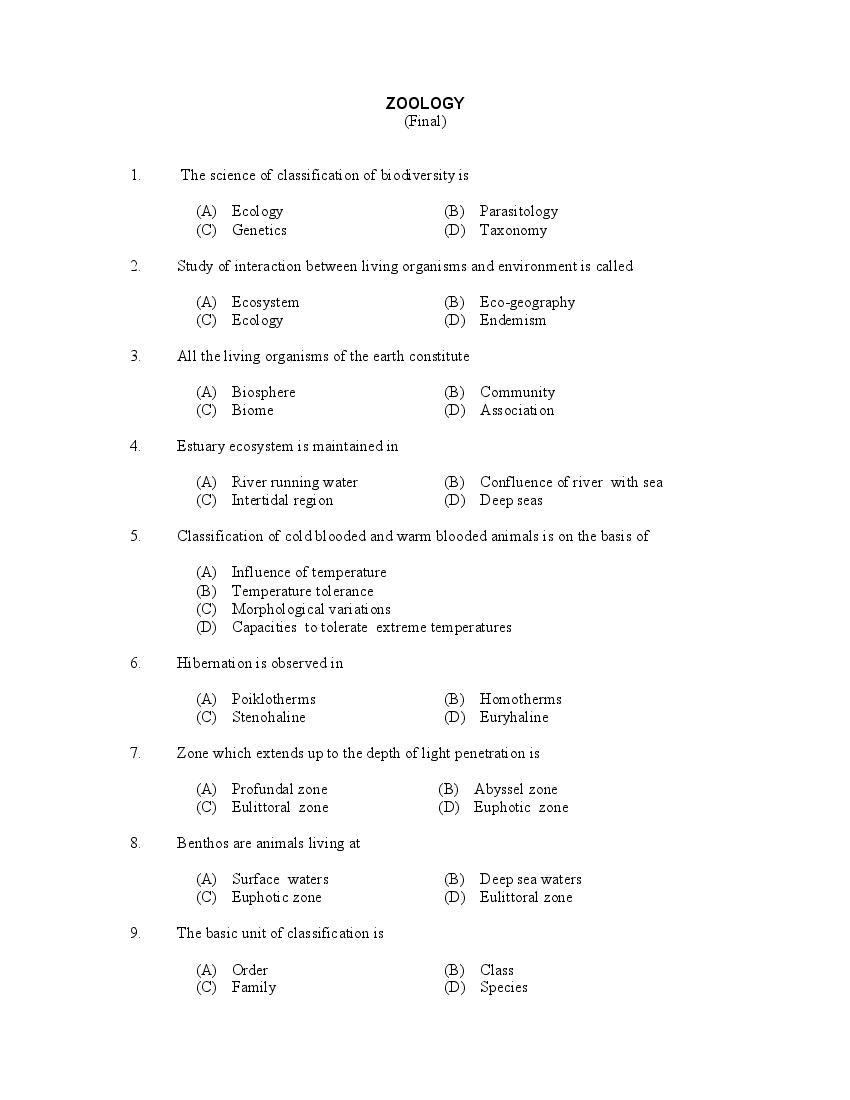
(Final)
1. The science of classification of biodiversity is
(A) Ecology (B) Parasitology
(C) Genetics (D) Taxonomy
2. Study of interaction between living organisms and environment is called
(A) Ecosystem (B) Eco-geography
(C) Ecology (D) Endemism
3. All the living organisms of the earth constitute
(A) Biosphere (B) Community
(C) Biome (D) Association
4. Estuary ecosystem is maintained in
(A) River running water (B) Confluence of river with sea
(C) Intertidal region (D) Deep seas
5. Classification of cold blooded and warm blooded animals is on the basis of
(A) Influence of temperature
(B) Temperature tolerance
(C) Morphological variations
(D) Capacities to tolerate extreme temperatures
6. Hibernation is observed in
(A) Poiklotherms (B) Homotherms
(C) Stenohaline (D) Euryhaline
7. Zone which extends up to the depth of light penetration is
(A) Profundal zone (B) Abyssel zone
(C) Eulittoral zone (D) Euphotic zone
8. Benthos are animals living at
(A) Surface waters (B) Deep sea waters
(C) Euphotic zone (D) Eulittoral zone
9. The basic unit of classification is
(A) Order (B) Class
(C) Family (D) Species
Page 2
10. Organism that are independent of water current for their locomotion
(A) Plankton (B) Nekton
(C) Benthos (D) Neustons
11. The mantle covering the earth which protects the life on earth from U.V. radiation
(A) Ozone layer (B) Oxygen layer
(C) Chlorine layer (D) None of the above
12. Main causes of pollution
(A) Population increase
(B) Industrialisation
(C) Growing vehicular traffic
(D) All the above
13. Flurocarbons destroy
(A) Forests (B) Rivers
(C) Ozone umbrella (D) CO2 umbrella
14. Atmosphere gets heated by
(A) Excess CO2 (B) Excess No2
(C) Excess SO2 (D) Excess CO
15. Biological magnification occurs through
(A) Biodegradable pollutants
(B) Non- biodegradable pollutants
(C) Biological purifiers
(D) Eutrophication
16. National animal of India is
(A) Lion (B) Fox
(C) Pocupine (D) Tiger
17. State bird of Kerala is
(A) Hornbill (B) Hornet
(C) Crow (D) Racquet tailed drango
18. Gir Lion Project was started at
(A) Delhi (B) Gujarat
(C) Assam (D) Tamil Nadu
Page 3
19. Headquarters of IUCN is at
(A) America (B) Australia
(C) Russia (D) Switzerland
20. Environent Protection Act was passed in the year
(A) 1972 (B) 1974
(C) 1981 (D) 1986
21. Anti-bodies are produced by
(A) ‘T’ lymphocytes (B) ‘B’ lymphocytes
(C) Neutrophils (D) Macrophages
22. Purity and activity of the antibodies are tested by
(A) Monoclonal antibodies (B) Antibiotics
(C) Enzymes (D) Ethonol
23. In India ethanol is produced from
(A) Sugar beet (B) Sweet potato
(C) Molasses (D) Tapioca
24. Bio-catalysts are
(A) Vaccines (B) Antibiotics
(C) Enzymes (D) Hormones
25. The single specimen designated as type of a new species is known as
(A) Holotype (B) Paratype
(C) Allotype (D) Syntype
26. Binomial system of classification was established by
(A) Darwin (B) Lamarck
(C) Aristotle (D) Linnaeus
27. Wings of birds and insects are
(A) Homologous organs (B) Analogous organs
(C) Hind limb modifications (D) Fore limb modifications
28. Prehensile tail in monkeys and chameleon is used for
(A) balancing on trees (B) encircling tree branches
(C) to help young ones to follow (D) to hop on to tree branches
Page 4
29. Glomerulus of vertebrates is an organ of
(A) Sweating (B) Excretion
(C) Respiration (D) Reproduction
30. Veins carrying oxygenated blood are
(A) Pulmonary veins (B) Caudal veins
(C) Caval veins (D) Aorta
31. Bioluminescence is caused by the oxidation of
(A) Luciferin (B) Luciferase
(C) Oxytocin (D) Pectin
32. The salinity of standard sea water is
(A) 30‰ (B) 35‰
(C) 40‰ (D) 45‰
33. Notochord is present in all chordates during
(A) Adult stage (B) Reproductive stage
(C) Embryonic stage (D) None of the above
34. Elphidium belongs to
(A) Rhizopoda (B) Ciliata
(C) Dinoflagellata (D) Radiolaria
35. Malarial parasite belongs to the order
(A) Haemosporidia (B) Sarcodina
(C) Metacercaria (D) Heleozoa
36. Process of ingestion in amoeba is
(A) Autophagus (B) Circumvallation
(C) Ciliary action (D) Encystation
37. Endo-erythrocytic cycle in Plasmodium vivax occurs in
(A) Mosquitos (B) Bed bugs
(C) Humans (D) Armadillos
38. Following is a shelled protozoa
(A) Entamoeba (B) Arcella
(C) Arca (D) Glochidium
Page 5
39. Monocyctis is a parasite in
(A) Scorpion (B) Spider
(C) Earth worms (D) Centipedes
40. Among protozoa the only class that contains two nuclei in all the species is
(A) Class Rhizopoda (B) Class Mastigophora
(C) Class Ciliata (D) Class Sporozoa
41. Dicyemid mesozoans are parasitic in the reproductive system of
(A) Arthropods (B) Cephalopods
(C) Isopoda (D) Amphipoda
42. Amphiblastula is the larva of
(A) Amphioxus (B) Obelia
(C) Sponges (D) Amphineura
43. Euplectella is commonly known as
(A) Venus flower basket (B) Deadman’s fingers
(C) Boring sponge (D) Freshwater sponge
44. Sponges are charaterised by
(A) Water vascular system (B) Canal system
(C) Perihaemal system (D) Haemocoelic system
45. Coelenterates are
(A) Coelomatic (B) Acoelomatic
(C) Triploblastic (D) None of the above
46. Polymorphism in coelenterates is highly developed in
(A) Corals (B) Halistemma
(C) Obelia (D) Jelly fish
47. The process of strobilisation occurs in
(A) Anthozoa (B) Hydrozoa
(C) Scyphozoa (D) None of the above
48. The largest Barrier Reef of the world is in
(A) India (B) New Zealand
(C) Australia (D) West Indies
Page 6
49. Ephyra is the larva of
(A) Aurelia (B) Obelia
(C) Cassiopia (D) Hydra
50. The characteristic feature of Coelenterates is the presence of
(A) Radial symmetry (B) Bilateral symmetry
(C) Coelenteron (D) Archenteron
51. Beroe belongs to
(A) Ctenophora (B) Scyphozoa
(C) Hydrozoa (D) Anthozoa
52. Body space is filled with parenchyma in
(A) Nemetods (B) Platyhelmithes
(C) Mollusca (D) Coelenterata
53. Pig is an intermediate host of the parasite
(A) Faciola hepatica (B) Taenia solium
(C) Schistosoma haematobium (D) Ascaris lumbricoides
54. Tape worms respire
(A) with Ctenidia (B) with Pulmanary chamber
(C) Anaerobically (D) Aerobically
55. Schistosomiasis is caused by
(A) Liver fluke (B) Tape worm
(C) Blood fluke (D) None of the above
56. Wucheraria brancrofti causes
(A) Malaria (B) Typhoid
(C) Elephantiasis (D) Paralysis
57. The intermediate host causing filarial infection is
(A) Anapheles mosquito (B) Culex mosquito
(C) Parasitic mite (D) Cyclops
58. True segmentation is found in
(A) Centipedes (B) Tape worms
(C) Earth worms (D) Prawns
Page 7
59. One of the following is an Archiannelid
(A) Neries (B) Leech
(C) Polygordius (D) Spirorbis
60. In earth worms, Typhlosole is
(A) a locomotary organ (B) reproductive organ
(C) inner folding of the intestine (D) part of digestive system
61. Centepedes belong to
(A) Scolopendra (B) Chilopoda
(C) Decapoda (D) Octopoda
62. “Cypris larva” is the larva of
(A) Ostrcoda (B) Cladocera
(C) Cirripedia (D) Palaemon
63. Parasitic castration in crabs is caused by
(A) Sacculina (B) Cyclops
(C) Balanus (D) Phyllosoma
64. Antennae in insects serve as
(A) Feelers (B) Photoreceptors
(C) Tango receptors (D) Copulatoy structures
65. Proboscis in butterflies is the modification of
(A) First maxilla (B) Second maxilla
(C) Antenna (D) Mandible
66. The common name of Apterygota insect found among stored books is
(A) Gold fish (B) Silver fish
(C) Damsel flies (D) Ear wig
67. Absence of metamorphosis during development occurs in
(A) Ametabolous insects (B) Holometabolous insects
(C) Hemimetabolous insects (D) Parthanogenetic insects
68. Order Odonata comprises of
(A) Cockroaches (B) Butterflies
(C) Dragon flies (D) Grass hoppers
Page 8
69. Haemocoel is characteristic of
(A) Arthropoda (B) Echinodermeta
(C) Nemethelminthes (D) Platyhelminthes
70. Limulus is a
(A) Living legend (B) Living fossil
(C) Scorpion (D) Crustacean
71. Book lungs are respiratory organs of
(A) Daphnia (B) Scorpions
(C) Cockroaches (D) Peripatus
72. Crystaline style is present in
(A) Pila (B) Freshwater mussel
(C) Lingula (D) Limulus
73. Nautilus belongs to
(A) Cephalopoda (B) Gastropoda
(C) Scaphopoda (D) Pelecypoda
74. The marine mollusk Onchidium is a
(A) Pulmanate (B) Prosobranchia
(C) Opisthobranchia (D) Nudibranchia
75. Scaphopoda is typically represented by
(A) Octopus (B) Dentalium
(C) Chiton (D) Pila
76. Eviceration takes place in
(A) Star fish (B) Sea-lily
(C) Sea cucumber (D) Sea-urchin
77. Beche-de-mer is a product obtained from
(A) Sardines (B) Mackerel
(C) Sea cucumber (D) Crabs
78. Dipleurula is the larva of
(A) Echinoidea (B) Astroidea
(C) Holothuroidea (D) None of the above
Page 9
79. Tornaria is the larva of
(A) Phoronis (B) Enterpneusta
(C) Ascidians (D) Amphioxis
80. Pogonophora do not have a
(A) Circulatory system (B) Digestive system
(C) Urinary tracts (D) Reproductive tracts
81. Peripatus belongs to
(A) Trilobita (B) Ostracoda
(C) Onychophora (D) Brachiopoda
82. Buccal diverticulam acts as notochord in
(A) Amphioxus (B) Doliolids
(C) Enteropneust worms (D) Tadpole larva
83. Endostyle of tunicates is part of
(A) Alimentary system (B) Respiratory system
(C) Excretory system (D) Nervous system
84. Thaliacea are
(A) Pelagic tunicates (B) Sessile tunicates
(C) Fish larvae (D) Planktonic annelids
85. Tadpole larva is the larva of
(A) Frog (B) Toad
(C) Ascidian (D) Amphioxus
86. In land vertebrates, gill skeleton is reduced and modified as
(A) Hyoid apparatus (B) Larynx
(C) Pharynx (D) mandible
87. Coelacanth is a
(A) Scorpion fish (B) Planktonic fish larvae
(C) Living fossil (D) Cephalochordate
88. Whale shark, Rhynodon typus is a
(A) Carnivore (B) Herbivore
(C) Omnivore (D) Plankton feeder
Page 10
89. Lateral line in fish function as
(A) Respiratory organ (B) Sense organ
(C) Digestive organ (D) Excretory organ
90. Clown fish are
(A) deep water fish (B) associated with sea anemones
(C) extinct fish (D) associated with sharks
91. Skeleton in Holocephalii is
(A) Absent (B) Bony
(C) Cartilaginous (D) Fleshy
92. This clupeid fish forms a major fishery along Kerala coast
(A) Sardinella fimbriata (B) Sardinella sirm
(C) Sardinella longiceps (D) Coilia dussumeri
93. Tadpoles of frog have
(A) External gills (B) Internal gills
(C) Lungs (D) Air bladder
94. Barkudia insularis is a
(A) Limbless lizard (B) Limbless amphibian
(C) Finless fish (D) Sea snake
95. Dinosaurs existed during the period from
(A) Precambrian to Ordovician (B) Silurian to Carboniferous
(C) Triassic to Cretaceous (D) Miocene to Pliocene
96. Typhlops braminus is a
(A) Sea snake (B) Blind snake
(C) Venomous snake (D) Limbless lizard
97. The following is a living fossil
(A) Sea snake (B) Hawkbill turtle
(C) Sphenodon (D) Crocodile
98. Fangs of poisonous snakes are modified
(A) Maxillary teeth (B) Mandibular teeth
(C) Canines (D) Pre-molars
Page 11
99. Ostrich is a/an
(A) Antarctic bird (B) Flightless bird
(C) Arctic bird (D) Bird of paradise
100. Skeleton in birds is
(A) Pneumatic (B) Heavy
(C) Short (D) Long
101. Feathers of birds are derivatives of
(A) Ectoderm (B) Endoderm
(C) Mesoderm (D) Coelomic
102. Prototheria are
(A) Egg laying sea birds (B) Egg laying reptiles
(C) Egg laying amphibian (D) Egg laying mammals
103. Kangaroo is a
(A) Rodent (B) Marsupial
(C) Edentate mammal (D) Ungulate
104. Sea cow (Dugong) belongs to order
(A) Cetacea (B) Sirenia
(C) Proboscidae (D) Ungulate
105. Intestinal caecum in rabbit aids in
(A) Digestion of food (B) Assimilation
(C) Digestion of cellulose (D) Vestigial
106. Canine teeth are characteristic of
(A) Rodentia (B) Logomorpha
(C) Ungulata (D) Carnivora
107. Eyes of mammals differ from those of birds in not having
(A) Pecten (B) Lens
(C) Retina (D) Iris
108. Amber grease is obtained from
(A) Dugong (B) Dolphin
(C) Killer whale (D) Sperm whale
Page 12
109. Haemocoel contains
(A) Haemoglobin (B) Plasma
(C) Lymph (D) None of the above
110. Dissolving unwanted and decaying body cell is the function of
(A) Mitochondria (B) Chromosomes
(C) Ribosomes (D) Lysosomes
111. Power house of a cell is
(A) Ribosomes (B) Lysosomes
(C) Centriole (D) Mitochondria
112. Animal cell differs from plant cell mainly due to the absence of
(A) cell wall (B) cytoplasm
(C) nucleus (D) nucleolus
113. Meiotic cell division occurs in
(A) Liver (B) Kidney
(C) Gonads (D) Brain
114. A core of nucleic acid surrounded by a protein shell occurs in
(A) Nucleolus (B) Bacteria
(C) Nucleus (D) Virus
115. Sex-linked inheritance was first suggested by
(A) Morgan (B) Mendal
(C) Darwin (D) Wallace
116. XO- type of eggs develop into
(A) Sterile female (B) Normal female
(C) Sterile Male (D) Normal male
117. In human eye, the rods and cones are found in the
(A) Cornea (B) Retina
(C) Eye lense (D) Optic nerve
118. Thyroxine consists of
(A) Thymus (B) Magnesium
(C) Iron (D) Iodine
Page 13
119. Respiratory pigment containing copper is known as
(A) Haemoglobin (B) Haemocyanin
(C) Copper oxide (D) Copper sulphate
120. “Origin of species” was written by
(A) Wallace (B) Darwin
(C) Collins (D) Bates
121. Parthenogenic progeny is always
(A) Male (B) Female
(C) Hermaphrodite (D) Sterile
122. Embryonic origin of entire nervous system is
(A) Endodermal (B) Mesodermal
(C) Mesentries (D) Ectodermal
123. Androgen is secreted by
(A) Testes (B) Ovaries
(C) Liver (D) Kidney
124. Hormone Insulin is secreted by
(A) Gastric glands (B) Pancreatic glands
(C) Islets of Langerhans (D) Cystic lobes of liver
125. Theory of “Ontogeny recapitulates phylogeny” was proposed by
(A) T.H.Huxley (B) H. Spencer
(C) E. Haeckel (D) F. Galton
126. The part of the sperm that pierces the covering of the ovum is
(A) Tail (B) Middle piece
(C) Head (D) Acrosome
127. The cavity of blastula is known as
(A) Pseudocoel (B) Haemocoel
(C) Archenteron (D) Blastocoel
128. The study of fossils is called
(A) Paleobotany (B) Paleozoology
(C) Paleontology (D) None of the above
Page 14
129. Rearing of silkworms is called
(A) Apiculture (B) Sericulture
(C) Articulture (D) Pomiculture
130. Distribution of animals to various geographical regions of the world is called
(A) Zoogeology (B) Zoogeography
(C) Zoology (D) None of the above
131. Man belongs to the taxonomic order
(A) Cetacea (B) Sirenia
(C) Primates (D) Logomorpha
132. In marine protozoans there is no
(A) Contractile vacuole (B) Food vacuole
(C) Both (A) and (B) (D) None of the above
133. Function of Gemmules in sponges is
(A) Sexual reproduction (B) Asexual reproduction
(C) Digestion (D) Excretion
134. “Trilobite larva” belongs to
(A) Spider (B) Crab
(C) Scolopendra (D) Limulus
135. Pila globosa undergoes
(A) Aestivation (B) Hibernation
(C) Torsion (D) None of the above
136. Byssus, the attachment organ, is present in
(A) Sepia (B) Octopus
(C) Aplysia (D) Mytilus
137. Mitochondria are concerned with
(A) Release of energy (B) Systhesis of fat
(C) Secretion of shell (D) Oxygen absorption
138. Self -fertilization is prevented in annelids by
(A) protandry (B) protogyny
(C) the atrophy of testes (D) the atrophy ovaries
Page 15
139. Prokaryotic cell does not have
(A) Cell wall
(B) Cell membrane
(C) Nuclear membrane and nucleolus
(D) Nucleoid
140. Chiasmata formation takes place in
(A) Mitosis (B) Meiosis
(C) Interphase (D) None of the above
141. Zygotene is characterized by
(A) Chiasmata formation
(B) Crossing over
(C) Pairing of homologous chromosomes
(D) Tetrad formation
142. Lock and key model was proposed by
(A) Koshland (B) Emil Fishcer
(C) Parlor (D) Arora
143. Mitotic cell division occurred in
(A) Somatic cell (B) Germ cell
(C) Both (A) and (B) (D) None of the above
144. Albinism is an extreme degree of generalized
(A) hyperpigmentation (B) hypopigmentation
(C) failure of pigmentation (D) perioral pigmentation
145. During glomerular filtration the malpighian body acts like a
(A) structural unit (B) biological filter
(C) biological buffer (D) acid-base balancer
146. Night blindness is caused by
(A) Genetic disturbance (B) Excessive drinking
(C) Vitamin A deficiency (D) Excess secretion of adrenals
147. Digestive process in humans is
(A) Extracellular (B) Intercellular
(C) Intracellular (D) Both (B) and (C)
Page 16
148. Number of cervical vertebrae in humans is
(A) 7 (B) 12
(C) 5 (D) 10
149. Animal which can tolerate narrow range of salt concentration is called
(A) Eurythermal (B) Stenothermal
(C) Euryhaline (D) Stenohaline
150. Heart in Anura (Amphibia) is
(A) Mono-chambered (B) Di-chambered
(C) Tri-chambered (D) Tetra –chambered
***
Document Details
| Board / Org | Cochin University |
| Exam | CUSAT Common Admission Test |
| Type | Question Paper |
| Pages | 16 |
| Updated | 22 Jul 2026 |