KSET Syllabus Physical Education
Finished viewing? Save it for later —
Download KSET Syllabus Physical Education (PDF · 7 pages)About KSET Syllabus Physical Education
KSET Syllabus Physical Education is available here for free download. Published by Karnataka Exams for Karnataka State Eligibility Test, this syllabus can be viewed online or downloaded as a PDF (7 pages). Candidates preparing for Karnataka State Eligibility Test can use KSET Syllabus Physical Education to understand the exam pattern, the type of questions asked, and the overall difficulty level.
Frequently Asked Questions
How can I download KSET Syllabus Physical Education?
Open this page and click the Download button to save KSET Syllabus Physical Education as a PDF. It is completely free on AglaSem Docs.
Is KSET Syllabus Physical Education free to download?
Yes. KSET Syllabus Physical Education can be viewed online and downloaded as a PDF free of cost on AglaSem Docs.
How many pages does KSET Syllabus Physical Education have?
KSET Syllabus Physical Education contains 7 pages, which you can read online or download together as a single PDF.
Where can I find more Karnataka State Eligibility Test study material?
You can find more Karnataka State Eligibility Test question papers, sample papers, syllabus, and answer keys on AglaSem Docs.
KSET Syllabus Physical Education – Text
Read the full text of this syllabus below — useful to quickly search, copy and reference the content online without downloading the PDF.
📄 View text version (7 pages)
Page 1
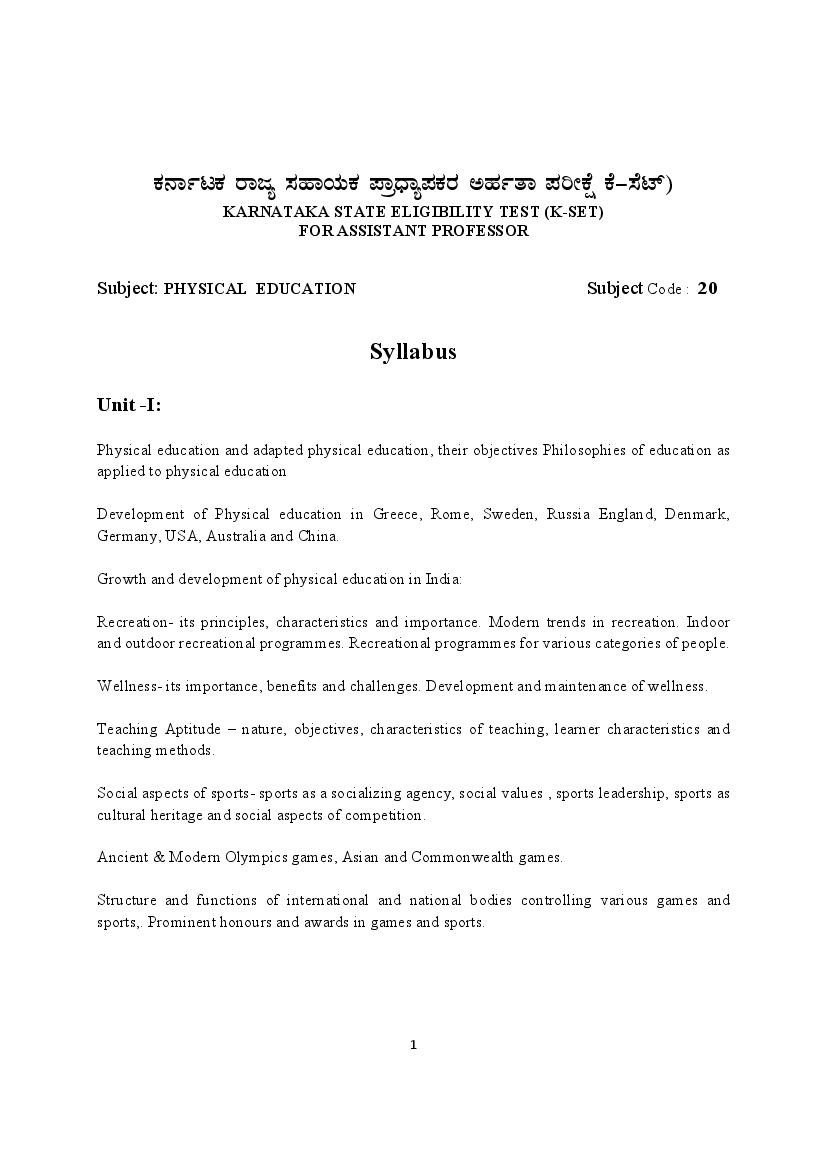
KARNATAKA STATE ELIGIBILITY TEST (K-SET)
FOR ASSISTANT PROFESSOR
Subject: PHYSICAL EDUCATION Subject Code : 20
Syllabus
Unit -I:
Physical education and adapted physical education, their objectives Philosophies of education as
applied to physical education
Development of Physical education in Greece, Rome, Sweden, Russia England, Denmark,
Germany, USA, Australia and China.
Growth and development of physical education in India:
Recreation- its principles, characteristics and importance. Modern trends in recreation. Indoor
and outdoor recreational programmes. Recreational programmes for various categories of people.
Wellness- its importance, benefits and challenges. Development and maintenance of wellness.
Teaching Aptitude – nature, objectives, characteristics of teaching, learner characteristics and
teaching methods.
Social aspects of sports- sports as a socializing agency, social values , sports leadership, sports as
cultural heritage and social aspects of competition.
Ancient & Modern Olympics games, Asian and Commonwealth games.
Structure and functions of international and national bodies controlling various games and
sports,. Prominent honours and awards in games and sports.
1
Page 2
Exercise physiology its scope and importance in the field of physical education and sports.
Cardio respiratory adaptations to long and short term physical activities.
Muscle- its types , characteristics and functions. Microscopic structure of muscle fibre. Sliding
filament theory of muscular contraction. Types of muscle fibres and sports performance.
Muscular adaptations to exercise.
Neuro-muscular junction and transmission of nerve impulse, kinesthetic Sense organs and neural
control of motor skills.
Bio-chemical aspects of exercise - Metabolism of food products. Aerobic and anaerobic systems
during rest and exercise. Direct and indirect methods of measuring energy cost of exercise
Recovery process - Physiological aspects of fatigue. Restoration of energy stores. Recovery
oxygen. Nutritional aspects of performance.
Environmental influence on human physiology under exercise.
Women in sports- trainability. Physiological gender differences and special problems of women
athletes.
Aging - Physiological consequences, life style management and healthful aging.
Physiological responses of various therapeutic modalities and rehabilitation.
Physiological aspects of various Ergogenic aids. Massage manipulations and their physiological
responses.
Unit- III:
Kinesiology and biomechanics. Modern trends in biomechanics. Planes and Axes of human
body. Joints and their movements.
Muscle attachments - Origin, insertion, action and leverage of the principal muscles used in
sports.
Motion: its laws and their application in sports. Projectile and principles of projections
Linear and angular kinematics and kinetics.
Friction, Spin, impact and elasticity.
2
Page 3
Mechanical advantage and applications of Levers in sports.
Posture and its deformities with their corrective exercises.
Kinesiological, Muscular and mechanical analyses of fundamental movements:
Mechanical analyses of major sports skills
Unit – IV:
Sports psychology- its importance in the field of physical education and sports.
Motivation in sports- types, theories and dynamics.
Psychological factors affecting sports performance- Emotions, Anxiety aggression, stress ,self
confidence, concentration , mental practice and goal setting.
Personality- Theories of personality, measurement of personality.
Group dynamics, Group cohesion and leadership in sports.
Cognitive process- memory and thinking. Principles of Motor skill learning.
Transfer of training and its types with its implication in sports
Long and short term psychological preparation for performance/ competition.
Psychological skill training for activation and relaxation
Spectators and sports performance.
Unit -V:
Development of teacher education for physical education in India. Comparative study of
professional preparation in physical education of India with those of USA, Russia, Germany,
Australia and UK.
Professional and other courses of physical education in India. Role of Government agencies
monitoring professional courses in physical education.
Qualities, qualifications and responsibilities of physical education personnel at primary,
secondary and higher education levels. Scope of physical education personnel in the promotion
of health, fitness and wellness.
Recent Government policies for promoting physical education and sports in India.
Hierarchy of organizational set-up in physical education at schools, colleges and university level.
Role of public & private sectors in the promotion of physical education and sports in the country.
3
Page 4
different levels of education - primary, secondary and higher education.
Curriculum design and content- importance, selection and classification of subject matter with
reference to age, sex and differently abled pupils. Integrated programme for boys and girls.
Teaching aids - Time-table, Concepts, credit system for various subject coursestheory and
practical, Impact of technology in physical education and sports,
Curriculum evaluation: Concepts and purpose; procedure and appraisal.
Unit -VI:
Health- its objectives and spectrum. Health education, its importance and principles . Role of
genetics and environment in achieving health. Health-related physical fitness.
Community health programme- Health appraisal & health instructions. International and national
health promoting government & private agencies.
School Health programme and personal hygiene.
Communicable diseases: causes, symptoms, prevention through other means and Immunization.
Psychosomatic disorders/ sedentary life style diseases : causes, symptoms and prevention.
Obesity related health problems. Body weight control and its significance on health. Role of
exercise, dieting and combination of exercise & dieting on weight control.
First-aid- objectives and principles. First-aid for Shock, poisoning, burns, drowning, bleeding,
electric shock and common sports injuries.
Pollution- Air, water, sound and radiation. Effects of pollution on health, Preventive and safety
measures from pollution.
Nutrition- Balanced diet and its components. Nutritional Deficiencies. Understanding of
malnutrition and nutritional supplements.
Effects of smoking, alcohol, & drugs on health; prevention and rehabilitation
4
Page 5
Sports training- its characteristics and principles. Training load, its features, principles and
adaptation process. Means and methods of executing training load. Overload, its Causes,
symptoms and remedial measures.
Strength- its characteristics, types of strength, factors determining strength and strength
development.
Endurance- its characteristics, types of endurance, factors determining endurance and endurance
development.
Speed- its characteristics, types of Speed, factors determining Speed and speed development.
Flexibility-its characteristics, types of flexibility, factors determining flexibility and flexibility
development.
Coordinative abilities- its characteristics, types of coordinative abilities, factors determining
coordinative abilities and development of coordinative abilities.
Technique and skill- its characteristics and importance. Different stages of technique
development and technique training. Tactics and strategy.
Planning- its importance and principles. Types of planning.
Periodization- its importance, objectives and types of periodization. Concept of different periods
- Preparatory, competition and transitional. Types of Competition:
Talent identification- process and procedure
Unit -VIII:
Research in physical education- its importance and classification. Ethical issues in research.
Methods of research- Descriptive, historical and experimental. Experimental research designs.
Identification and formulation of research problem. Types of research hypotheses and their
formulation. Hypotheses testing.
Tools of research- Questionnaires, opinionnaires, interviews and observation.
5
Page 6
online journals. Note taking and critical reading.
Sampling Techniques- Probability and non probability.
Data, its types and collecting measures.
Normal probability curve and grading scales.
Statistical processes, their importance and uses in research.
Application of parametric and non parametric statistical techniques in research.
Computer applications- statistical packages for data analyses- SPSS, e-mail, search engines and
Microsoft office.
Preparation of research proposal, report, abstract, paper for publication and paper for
presentation.
Unit - IX:
Test, measurement and evaluation -their types and importance in physical education and sports.
Principles and processes of evaluation in physical education.
Criteria of selecting an appropriate test and administration of testing programme.
Types of tests and construction of standard knowledge and skill tests. Tests for fitness- Physical
fitness, motor fitness, motor ability and motor educability. Health related fitness tests.
Test for fitness components- strength, endurance, speed, flexibility and coordinative abilities.
Sports skill tests- Badminton, Basketball, Football, Hockey, Tennis, and Volleyball.
Anthropometric Measurements- land marks and measurement of various body segments ,height,
sitting-height, weight, diameters, circumferences, skinfolds, body mass index, ponderal index.
Somatotype and Posture evaluating techniques.
Testing of physiological phenomenons- Blood pressure, breathing frequency vital capacity, heart
rate, pulse rate, body temperature and body composition.
6
Page 7
mental-toughness, and self-efficacy.
Unit - X:
Management- its principles and theories. Scope of management in physical education and sports.
Guiding principles for organizing physical education & sports programmes in institutions.
Personnel management- objectives and principles. Self-appraisal, communication skills and time
management. Essential skills of administration.
Financial management- objectives, purposes, principles and scope. Planning and preparation of
budget. Mechanics of purchase and auditing.
Supervision - objectives, principles and importance of supervision. Techniques of supervision.
Duties and responsibilities of a supervisor.
Facility management- planning, procuring and maintenance of facilities- indoor and outdoor
facilities. Planning and management of sports infrastructure. Management of records.
Role of sports manager- interpersonal, informational and decision making. Managerial skills –
technical, human and conceptual. Qualities and qualification of sports manager.
Event management- its principles, planning, check list, rehearsal, itinerary, execution, reporting
and follow-up procedures of an event.
Public relation- principles of public relations in physical education and sports. Mass Media-
communication and publicity, qualifications of Public relation officer.
7
Document Details
| Board / Org | Karnataka Exams |
| Exam | Karnataka State Eligibility Test |
| Type | Syllabus |
| Pages | 7 |
| Updated | 24 Sep 2026 |