CBSE Class 10 Science Question Paper 2020 Set 31-5-3 Solutions
Finished viewing? Save it for later —
Download CBSE Class 10 Science Question Paper 2020 Set 31-5-3 Solutions (PDF · 9 pages)About CBSE Class 10 Science Question Paper 2020 Set 31-5-3 Solutions
CBSE Class 10 Science Question Paper 2020 Set 31-5-3 Solutions is available here for free download. Published by CBSE for Class 10, this solution can be viewed online or downloaded as a PDF (9 pages). Candidates preparing for Class 10 can use CBSE Class 10 Science Question Paper 2020 Set 31-5-3 Solutions to understand the exam pattern, the type of questions asked, and the overall difficulty level.
Frequently Asked Questions
How can I download CBSE Class 10 Science Question Paper 2020 Set 31-5-3 Solutions?
Open this page and click the Download button to save CBSE Class 10 Science Question Paper 2020 Set 31-5-3 Solutions as a PDF. It is completely free on AglaSem Docs.
Is CBSE Class 10 Science Question Paper 2020 Set 31-5-3 Solutions free to download?
Yes. CBSE Class 10 Science Question Paper 2020 Set 31-5-3 Solutions can be viewed online and downloaded as a PDF free of cost on AglaSem Docs.
How many pages does CBSE Class 10 Science Question Paper 2020 Set 31-5-3 Solutions have?
CBSE Class 10 Science Question Paper 2020 Set 31-5-3 Solutions contains 9 pages, which you can read online or download together as a single PDF.
Where can I find more Class 10 study material?
You can find more Class 10 question papers, sample papers, syllabus, and answer keys on AglaSem Docs.
CBSE Class 10 Science Question Paper 2020 Set 31-5-3 Solutions – Text
Read the full text of this solution below — useful to quickly search, copy and reference the content online without downloading the PDF.
📄 View text version (9 pages)
Page 1
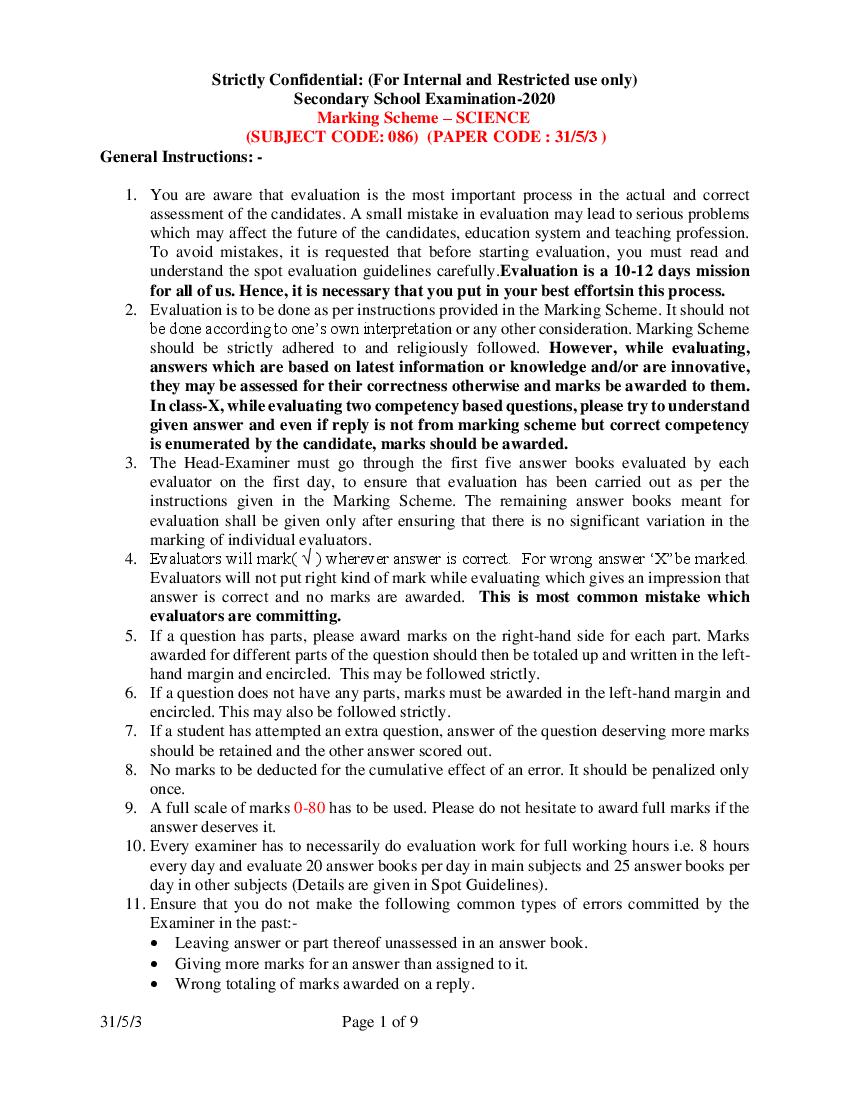
Secondary School Examination-2020
Marking Scheme – SCIENCE
(SUBJECT CODE: 086) (PAPER CODE : 31/5/3 )
General Instructions: -
1. You are aware that evaluation is the most important process in the actual and correct
assessment of the candidates. A small mistake in evaluation may lead to serious problems
which may affect the future of the candidates, education system and teaching profession.
To avoid mistakes, it is requested that before starting evaluation, you must read and
understand the spot evaluation guidelines carefully.Evaluation is a 10-12 days mission
for all of us. Hence, it is necessary that you put in your best effortsin this process.
2. Evaluation is to be done as per instructions provided in the Marking Scheme. It should not
be done according to one’s own interpretation or any other consideration. Marking Scheme
should be strictly adhered to and religiously followed. However, while evaluating,
answers which are based on latest information or knowledge and/or are innovative,
they may be assessed for their correctness otherwise and marks be awarded to them.
In class-X, while evaluating two competency based questions, please try to understand
given answer and even if reply is not from marking scheme but correct competency
is enumerated by the candidate, marks should be awarded.
3. The Head-Examiner must go through the first five answer books evaluated by each
evaluator on the first day, to ensure that evaluation has been carried out as per the
instructions given in the Marking Scheme. The remaining answer books meant for
evaluation shall be given only after ensuring that there is no significant variation in the
marking of individual evaluators.
4. Evaluators will mark( √ ) wherever answer is correct. For wrong answer ‘X”be marked.
Evaluators will not put right kind of mark while evaluating which gives an impression that
answer is correct and no marks are awarded. This is most common mistake which
evaluators are committing.
5. If a question has parts, please award marks on the right-hand side for each part. Marks
awarded for different parts of the question should then be totaled up and written in the left-
hand margin and encircled. This may be followed strictly.
6. If a question does not have any parts, marks must be awarded in the left-hand margin and
encircled. This may also be followed strictly.
7. If a student has attempted an extra question, answer of the question deserving more marks
should be retained and the other answer scored out.
8. No marks to be deducted for the cumulative effect of an error. It should be penalized only
once.
9. A full scale of marks 0-80 has to be used. Please do not hesitate to award full marks if the
answer deserves it.
10. Every examiner has to necessarily do evaluation work for full working hours i.e. 8 hours
every day and evaluate 20 answer books per day in main subjects and 25 answer books per
day in other subjects (Details are given in Spot Guidelines).
11. Ensure that you do not make the following common types of errors committed by the
Examiner in the past:-
• Leaving answer or part thereof unassessed in an answer book.
• Giving more marks for an answer than assigned to it.
• Wrong totaling of marks awarded on a reply.
31/5/3 Page 1 of 9
Page 2
• Wrong question wise totaling on the title page.
• Wrong totaling of marks of the two columns on the title page.
• Wrong grand total.
• Marks in words and figures not tallying.
• Wrong transfer of marks from the answer book to online award list.
• Answers marked as correct, but marks not awarded. (Ensure that the right tick mark is
correctly and clearly indicated. It should merely be a line. Same is with the X for
incorrect answer.)
• Half or a part of answer marked correct and the rest as wrong, but no marks awarded.
12. While evaluating the answer books if the answer is found to be totally incorrect, it should
be marked as cross (X) and awarded zero (0)Marks.
13. Any unassessed portion, non-carrying over of marks to the title page, or totaling error
detected by the candidate shall damage the prestige of all the personnel engaged in the
evaluation work as also of the Board. Hence, in order to uphold the prestige of all
concerned, it is again reiterated that the instructions be followed meticulously and
judiciously.
14. The Examiners should acquaint themselves with the guidelines given in the Guidelines for
spot Evaluation before starting the actual evaluation.
15. Every Examiner shall also ensure that all the answers are evaluated, marks carried over to
the title page, correctly totaled and written in figures and words.
16. The Board permits candidates to obtain photocopy of the Answer Book on request in an
RTI application and also separately as a part of the re-evaluation process on payment of
the processing charges.
31/5/3 Page 2 of 9
Page 3
MARKING SCHEME – CLASS X,SCIENCE (2019-20)
QUESTION PAPER CODE : 31/5/3
S.NO Value Points/Expected Answer MARKS TOTAL
MARKS
SECTION A
1. (iv) / (A) is false, but (R) is true 1 1
2. (ii) / Both (A) and (R) are true, but (R) is not the correct explanation of 1 1
the assertion(A)
3. No charged particles/ions 1 1
4. All are metalloids/Shows the properties of metals and non-metals
OR
Properties of elements are a periodic function of their atomic number 1 1
5. (a) Cells which convert solar energy to electrical energy/electricity 1
(b) Voltage – 0.5 to 1V ½
Electricity –0.7W ½
(c) India receives great amount of solar energy throughout the year. 1
(d) Advantages :- No moving parts/require little maintenance /work
quite satisfactorily without any focusing device/can be set up in remote ½+½
and inaccessible areas. 4
(Any Two)
6. (a) Thyroid stimulating hormone. 1
(b) It stimulates / regulates thyroid gland to produce thryroid hormone
or thyroxine. 1
(c) Because high and low TSH level may increase the chances of 1
miscarriage. 1 4
(d) Proper medication is required.
7. (B) / 10−3 A and 10−6 A respectively 1 1
8. (A) / 5A 1 1
9. (C) / remains unchanged 1 1
10. (B)/ Chipko Movement 1 1
11. (D) /I , II and III
OR
(D) / Reduce 1 1
12. (B) / Decomposition & Redox 1 1
13. (C)/ Green 1 1
14. (B) / XY2
OR
(B ) / (C)
Group 16 and period 3 /Group 17 and period 3
(Note- Both are correct, marks to be awarded for any one) 1 1
SECTION-B
15. (a) Displacement /Redox/ Exothermic reaction/Thermit reaction.
31/5/3 Page 3 of 9
Page 4
Redox : Aluminium is oxidised and Iron is reduced
Exothermic- Heat is produced
Thermit reaction: Molten iron is produced. ½+½
(Any one type with appropriate reason)
(b) Double displacement reaction ½
Ions are exchanged between the reactants ½
(c) Decomposition reaction /Calcination ½
ZnCO3 decomposes to ZnO+CO2 ½ 3
16. (a) Li ,K ½
(b) Mg ½
(c) C ½
(d) K ½
(e) S ½
(f) Al ½ 3
17. (a) Anode- Oxygen
Cathode- Hydrogen 1
(b) Because one molecule of water contains two atoms of hydrogen and
one atom of oxygen/ 2H2O2H2+O2 1
(c) Electrolysis of water will not take place 1
OR
(a) Chemical Name – Sodium Carbonate decahydrate
Common Name – Washing Soda
Chemical Formula - Na2 CO3 . 10H2 O ½ ×3
(b) NaCl + H2 O + CO2 + NH3 → NH4 Cl + NaHCO3
Heat
2NaHCO3 Na2 CO3 + H2 O + CO2
Na2 CO3 + 10H2 O → Na2 CO3 . 10H2 O
1
(c) It helps in removing permanent hardness./ It forms insoluable Ca
½ 3
or Mg salts in the form of scum
18. (a) Grass Insect Frog Snake Hawk 1
(b) Frog ½
(c) Hawk ½
(d) Biomagnification ½
(e) 1000J ½
OR
(a) All interacting organisms in an area together with non living
constituents of the environment form an ecosystem. 1
(b) Forest/Pond/Terrestrial /any other 1 3
(c) Decomposers are present in ponds or lakes; whereas these are
absent in an aquarium. 1
19. (a)
Secretions from seminal vesicle. 1
22+X and 22+Y ½+½
31/5/3 Page 4 of 9
Page 5
(ii) Male – XY ½ 3
20. (a) Exchange of gases. 1
(b) Because amount of oxygen dissolved in water is fairly low as
compared to the air 1
(c) (i) Pyruvate ½
(ii) Carbon dioxide ½ 3
21. (a) Because tallness is the dominant trait 1
(b) The recessive character is expressed in the F2 generation when two copies
of the recessive trait are present together/(tt). 1
(c) In the F2 progeny , the dominant character is also expressed along with
the recessive character in ratio of 3:1 respectively. 1 3
22. (a)
1
(b)
1
(c)
1
3
(Note : Deduct ½ marks overall if no arrows are shown)
23. (a) Myopia/Short sightedness ½
(b) Concave/Diverging lens. ½
(c)
Excessive curvature of eye lens
elongation of eye ball ½+ ½
1
(d) P(D) =
f(m)
1 10 2 1
P(D) = = = = −0.4D
−2.5(m) −25 −5
(Deduct ½ mark if unit is not mentioned)
OR
31/5/3 Page 5 of 9
Page 6
a long distance.
(b) Because in the absence of atomosphere there is no scattering of light. 1
(c) Because of atmospheric refraction, the sun appears above the horizon 3
even after actual sunset. 1
24. (a)
1
(b)
Right hand thumb rule. 1
When a current carrying straight conductor is held in the right hand in
such a way that the thumb points towards the direction of the current,
then the fingers will wrap around the conductor in the direction of the
field lines of the magnetic field 1 3
SECTION C
25 (a) When two or more organic compounds have same molecular
formula but different structural formula , then the compounds 1
are called isomers and this phenomenon is called isomerism
1+1
Butane Iso-Butane
(b) Because ‘X’ is an unsaturated carbon compound 1
(c) Oxidising agent. 1 5
26. (a) An alloy in which one of the constituent is mercury. 1
(b) Because of its lower melting point. ½
(c)
When iron/steel articles are coated with a thin layer of zinc. 1
It protects the articles from rusting. 1
(d) Anode – Impure copper ½
Cathode – Pure copper ½
Electrolyte – Acidified copper sulphate solution ½
OR
26. (a)Electronic configuration
Al O 1
2,8,3 2,6
31/5/3 Page 6 of 9
Page 7
Al3+]2 [O2−]3 1
(b) (i) Hydrogen gas is evolved.
(ii) Salt and water are formed/Oxide gets dissolved.
(iii) No reaction ½ ×4 5
(iv) Brisk effervescence.
27. (a)
Preventing unwanted pregnancies.
Prevention of STDs/Sexually transmitted diseases
Keeping gap between children 1+1
(Any two)
(b)
Egg production in ovaries
↓
Eggs are transported /carried from ovary to oviduct
↓
Fertilization takes place in the fallopian tube and zygote is formed
↓
Zygote forms embryo and implantation takes place in the uterus
↓
Embryo grows and develop into foetus
↓
Delivery of mature foetus after nine months through vagina ½ ×6
OR
(a) (i) Budding
(ii) Regeneration
(iii) Binary fission
(iv) Fragmentation
(v) Spore formation ½ ×5
(b)
Vegetative propagation help those plants to grow that have lost
the power of producing seeds.
The plants produced through Vegetative propagation are
genetically similar to their parents.
½ ×3
These plants bear fruits earlier than plants produced from seeds.
(b) If the pollination does not occur the pollen grains are not
1 5
transferred to stigma of a flower, no fertilization will take place
28. (a) Because ventricles have to pump blood to various distant
organs of the body 1
(b) Because their energy requirement is low 1
(c) In aquatic vertebrates the blood goes only once through the
31/5/3 Page 7 of 9
Page 8
through the heart two times during each cycle. 1
(d) Because transpirational pull is greater during day time. 1
(e) To prevent the backflow of the blood /blood flows only in one 5
direction. 1
29. (a)
1
OB = 18 cm ; OF1=20 cm
(c) Virtual, erect and magnified 1
(d) u = -18 cm; f = 20 cm ½
1 1 1
= − ½
f v u
1 1 1 1 1 1
= v − −18 ; = v + 18
20 20
1 1 1 18 − 20 −1 1
= − = =
v 20 18 360 180
∴ v = −180cm
v −180
Magnification = u = −18 = +10 1
OR
(a)
1
PA=15 cm ; PF = 30 cm
(b) Virtual , erect and magnified
1
(c) f = -30 cm u = -15 cm
½
31/5/3 Page 8 of 9
Page 9
= +
f v u
1 1 1
= v + −15
−30
1 1 1 1 1 5
=− + =
v 30 15 30
∴ v = 30cm
−v −30 1
Magnification = u = −15 = 2
30. P ½
(a) I1 = V1
100 W 10
I1 = 220 V = 22 A ½
P2 10 1
I2 = = = A
V 220 22 ½
I = I1 + I2
10 1 11
= + A= A = 0.5 A
22 22 22 1
(b) (i)
½
½
(ii) Net R=R1+R2=2+3=5 Ω ½
V 5
I=𝑅 = 5 = 1A ½
𝑛𝑒𝑡
∴ Voltage across 3Ω resistor ∶
½
5
∴ V = 1 × 3 = 3V
31/5/3 Page 9 of 9
Document Details
| Board / Org | CBSE |
| Exam | Class 10 |
| Type | Solution |
| Pages | 9 |
| Updated | 22 Jul 2026 |