KSET Syllabus Visual Arts
Finished viewing? Save it for later —
Download KSET Syllabus Visual Arts (PDF · 11 pages)About KSET Syllabus Visual Arts
KSET Syllabus Visual Arts is available here for free download. Published by Karnataka Exams for Karnataka State Eligibility Test, this syllabus can be viewed online or downloaded as a PDF (11 pages). Candidates preparing for Karnataka State Eligibility Test can use KSET Syllabus Visual Arts to understand the exam pattern, the type of questions asked, and the overall difficulty level.
Frequently Asked Questions
How can I download KSET Syllabus Visual Arts?
Open this page and click the Download button to save KSET Syllabus Visual Arts as a PDF. It is completely free on AglaSem Docs.
Is KSET Syllabus Visual Arts free to download?
Yes. KSET Syllabus Visual Arts can be viewed online and downloaded as a PDF free of cost on AglaSem Docs.
How many pages does KSET Syllabus Visual Arts have?
KSET Syllabus Visual Arts contains 11 pages, which you can read online or download together as a single PDF.
Where can I find more Karnataka State Eligibility Test study material?
You can find more Karnataka State Eligibility Test question papers, sample papers, syllabus, and answer keys on AglaSem Docs.
KSET Syllabus Visual Arts – Text
Read the full text of this syllabus below — useful to quickly search, copy and reference the content online without downloading the PDF.
📄 View text version (11 pages)
Page 1
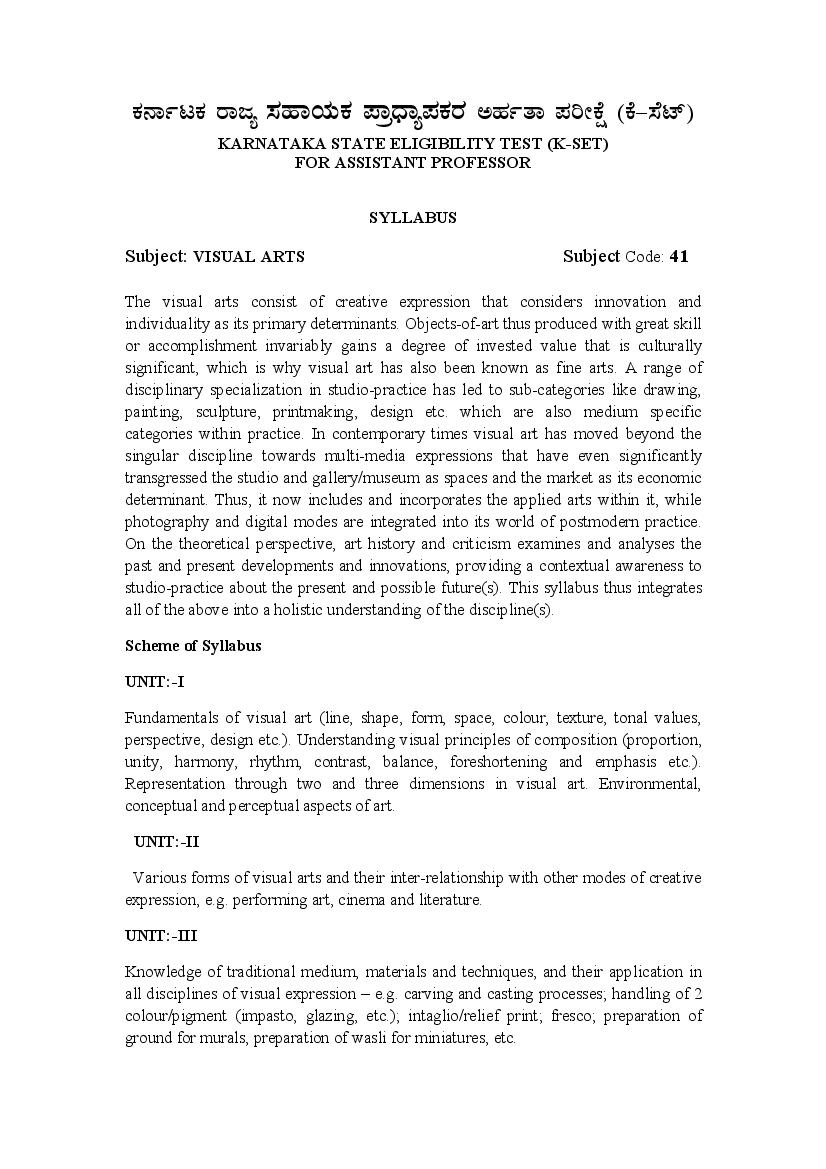
KARNATAKA STATE ELIGIBILITY TEST (K-SET)
FOR ASSISTANT PROFESSOR
SYLLABUS
Subject: VISUAL ARTS Subject Code: 41
The visual arts consist of creative expression that considers innovation and
individuality as its primary determinants. Objects-of-art thus produced with great skill
or accomplishment invariably gains a degree of invested value that is culturally
significant, which is why visual art has also been known as fine arts. A range of
disciplinary specialization in studio-practice has led to sub-categories like drawing,
painting, sculpture, printmaking, design etc. which are also medium specific
categories within practice. In contemporary times visual art has moved beyond the
singular discipline towards multi-media expressions that have even significantly
transgressed the studio and gallery/museum as spaces and the market as its economic
determinant. Thus, it now includes and incorporates the applied arts within it, while
photography and digital modes are integrated into its world of postmodern practice.
On the theoretical perspective, art history and criticism examines and analyses the
past and present developments and innovations, providing a contextual awareness to
studio-practice about the present and possible future(s). This syllabus thus integrates
all of the above into a holistic understanding of the discipline(s).
Scheme of Syllabus
UNIT:-I
Fundamentals of visual art (line, shape, form, space, colour, texture, tonal values,
perspective, design etc.). Understanding visual principles of composition (proportion,
unity, harmony, rhythm, contrast, balance, foreshortening and emphasis etc.).
Representation through two and three dimensions in visual art. Environmental,
conceptual and perceptual aspects of art.
UNIT:-II
Various forms of visual arts and their inter-relationship with other modes of creative
expression, e.g. performing art, cinema and literature.
UNIT:-III
Knowledge of traditional medium, materials and techniques, and their application in
all disciplines of visual expression – e.g. carving and casting processes; handling of 2
colour/pigment (impasto, glazing, etc.); intaglio/relief print; fresco; preparation of
ground for murals, preparation of wasli for miniatures, etc.
Page 2
Developments in modern techniques, processes and procedures and their application
in contemporary visual practices (installation; multi-colour print; computer-aided
design – vector & rector; multimedia and digital technologies in art; trompe l’oeil
illusory hyperrealism etc.)
UNIT:-V
The study of Indian and Western aesthetics and art appreciation.
UNIT:-VI
Study of chronological periods from prehistory to post-modern art and artists of the
West, with a focus on the various movements that transformed its history
UNIT:-VII
Study of chronological periods and developments in Indian art from prehistory to the
19th century.
UNIT:-VIII
Contemporary practices in Indian art during the 20th & 21st centuries with reference
to art movements & major exponents; modern concept of advertising, designing and
visual communication; experimental modes in contemporary visual expression;
development of art education in India from colonial (British) art schools till the
present.
UNIT:-IX
The study of art in the Far East, South East and Central Asia and the ancient
Near-East
UNIT:-X
Understanding visual practices of traditional communities and their contemporary
transformations – the ‘folk’, ‘tribal’ and craft practices in India
Syllabus for Visual Arts Electives
Elective: I: Art History
Principles of Art Historical methodology – Formalism; Iconology; Semiotic analysis;
Psychoanalytic method in Art History; Gestalt Theory of Visual Perception; impact of
theories in class and gender on the discipline; Deconstruction and its transformative
role for Art History; contemporary shifts towards a “New” Art History; art history as
an evolving discipline in India from colonial period to post-Independent era;
Page 3
aesthetic theories and their relevance to art historical/critical analysis of the visual
object
Indian Iconography:
Antiquity of image worship in India and principles of iconometry; iconography and its
development through Vedic to Brahmanical images: Indra, Surya, Agni, Varuna,
Kubera, Yama, Ashta-dikpalas, Vishnu, Shiva, Shakti, the Saptamtrikas, Kartikeya,
Ganesha, and river goddesses (Ganga and Yamuna) etc.
Buddhist iconography: the evolution of the Buddha image (including Dhyani Buddhas,
Manushi Buddhas, etc.), Bodhisattva (Avalokiteshvara, Manjushri, Maitreya etc.),
Tara, Kubera etc.
Jain iconography: Tirthankara (Adinath, Parshvanath, Neminath, Mahavira), Bahubali;
Ambika, Saraswati, Yaksha and Yakshi (in the Jain context) etc.
Indian Sculpture (pre-modern developments):
A comprehensive study of early Indian sculpture from Indus valley civilization to the
postGupta period – dynasties like Maurya, Sunga, Satavahana, Kushana, Gupta,
Pala-Sena, Chandela, Solanki, Parmar, Chalukya, Pallava, Rashtrakuta, Ganga, Chola,
Hoysala, etc.
Indian Architecture:
Early Indian architecture (with reference to ancient literature and shilpa texts): Indus
valley; Maurya
Origin and development of the stupa: Bharhut, Sanchi, Sarnath and Amaravati
Evolution of rock-cut caves (Lomas-rishi, Khandagiri, Udaigiri, Bhaja, Karle, Kanheri,
Ajanta, Elephanta, Ellora and Mamallapuram)
Evolution of temple architecture & their classification into Nagara, Dravida and
Vessara categories: Gupta temples; Orissan developments (Parashurameshwara,
Mukteshvara, Lingaraj and Konark); Chandella, Pratihar, Parmara and Solanki temple
styles; Chalukyan, Rastrakuta and Hoysala temple architecture (including Virupaksha,
Kaliashnatha in Ellora, Hoyasaleshvara; Pallava monolithic and structural temples;
Chola temples; Martand Sun temple in Kashmir
Imperial architecture during Sultanate & Mughal rule: features of provincial
Indo-Islamic architecture; Mughal architecture (Humayun’s Tomb, Fatehpur Sikari
and Sikandra, Taj Mahal, Red Fort and Jama Masjid)
Colonial & Modern architecture: Le Corbusier, Charles Correa, B.V. Doshi and
others.
Page 4
pre-historic painting, wall paintings at Ajanta and later mural tradition (Bagh, Badami,
Ellora, Sittanvasal, Lepakshi, Kerala murals such as Mattancherry palace etc.);
manuscript painting & the miniature traditions: Eastern and Western Indian
manuscripts; Sultanate painting (the Chaurpanchasika and pre-Mughal schools),
Mughal miniature painting from Akbar to Shah Jahan; Rajasthani miniature painting;
Pahari miniature painting ; Deccani painting (Ahmednagar, Bijapur and Golconda).
Modern Indian Art: Modernity in Indian Art; Ravi Varma; E.B. Havell, A.K.
Coomaraswamy, Stella Kramrisch, Abanindranath Tagore and the “Bengal School”;
Nandalal Bose, Benodebehari Mukherjee and Ramkinkar Baij; Amrita Sher-Gil;
Jamini Roy; the 1940s artists’ collectives: Calcutta Group (Kolkata), Progressive
Artists Group (Mumbai), Delhi Shilpi Chakra (Delhi), Cholamandala Artists’ Village
(Chennai); Indigenism and the trends in 1950s and 1960s; trends in abstraction since
the 1970s; the 20th & 21st century contemporary trends towards globalization
(including the introduction of installation, performance, digital/video etc.) with a
study of select individuaartists
Western Art: Overview of Western art from prehistory to the present: Prehistoric art,
art in ancient Egypt, Aegean art, Greece and Rome; Early-Christian and Byzantine art;
Romanesque and Gothic art; Renaissance painting and sculpture; Mannerism and
Baroque painting and sculpture; Rococo, Neoclassicism and Romanticism; Modern
movements including Realism, Impressionism, Post-Impression, Fauvism,
Expressionism, Cubism, Constructivism, Futurism, Dada and Surrealism, Abstract
Expressionism, Op art, Pop art; Post-modern developments including, Minimal and
Conceptual Art, Fluxus movement, Arte Povera, Body art, Land and Environment Art,
Graffiti, Process art, Performance art, Installation, Neo-figuration, Happening,
Feminist and Gay art.
Art of Ancient Near-East: Visual expression from ancient Mesopotamia (Sumer,
Akkad, Babylonia, Assyria); art in Achaemanid and Sassanian Persia.
Art of Far East, Central and South-East Asia:
Introduction to cultural exchange between India and these ancient cultures and the
emergence of distinctive visual expressions: ancient China (Shang, Zhou, and Han
dynasties); Buddhist sculpture from upto Tang dynasty; Six Dynasties and Tang
painting; Chinese landscape tradition from Song to Qing; Japan (Haniwa pottery
figures; Buddhist sculptures from Nara to Kamakura periods); late Heian and
Kamakura painting including the Tale of Genji and the Heiji Monogatari Emaki
scrolls; Japanese scroll painting in the Momoyama & Edo periods; ukiyo-e
woodblock prints from the Edo period); Tibet (Buddhist icons and the thangka
painting tradition); Nepal (Buddhist and Brahmanical sculptures and painting); Sri
Lanka (sculpture and painting – including Sigiriya murals); Cambodia (sculpture and
architecture,especially Angkor Wat and Angkor Thom); Java (sculpture and
Page 5
Prambanan complex); Buddhist art in Myanmar/Burma and Siam/Thailand etc..
Indian Folk and Tribal Art:
Phad, Pichhwai and Kavad painting (Rajasthan); Pata painting in Bengal and Orissa;
Madhubani/Mithila painting (Bihar), Warli painting (Maharastra), Pithora painting
(Gujarat); Dhokra bronze casting; votive terracotta objects (including votive horses
offered across various states in India); wood carving and wooden dolls (Kondapalli,
Karnataka, Bengal, Madhya Pradesh); leather puppets (Andhra Pradesh, Karnataka);
traditional and modern textiles and functional objects (textiles of Banaras,
Kanchipuram, Gujrat, Orissa, and the North-Eastern states; tie-and-dye fabrics;
embroidery; kantha, Phulkari, Chamba rumal; metal-ware including Bidri, repousse,
enamelling; jewellery including jade, beads etc.
Elective-II: Drawing and Painting
Aesthetics:
Fundamental elements of drawing and painting. Imagery in visual arts. Origin and
development of art (visual). Classification of Arts. Conceptual and Visual reality.
Relevance of study of aesthetics in painting: The early philosophical thoughts in
Indian Culture. Nature and Function of Art in the society.
Indian aesthetics: Concept of Ras-Sutra and its commentaries: The Theory of Rasa,
Sadharanikarana, Dhvani, Alankara, Auchitya,etc; shilpa texts like the Chitrasutra of
the Vishnudharmottara Purana, Shadanga from Yashodhara’s commentary on the
Kamasutra, etc.; A.K. Coomaraswamy and Rabindranath Tagore’s contributions
towards Indian aesthetics
Western Aesthetics: Theory of imitation and representation, catharsis (Plato and
Aristotle). Aesthetical views of Kant, Hegel, Croce, Tolstoy, Baumgarten,
Schopenhauer, Clive Bell, Roger Fry, I. A. Richards, Susanne Langer, Sigmund Freud,
and George Santayana.
History of Drawing and Painting:
Indian painting: Prehistoric Paintings in India, Wall paintings of Ajanta, Bagh,
Badami and Sittanavasal.Manuscript painting tradition Pala and Western
Indian.Tradition of Miniature paintings: Pre-Mughal, Mughal, Rajasthani, Pahari
(Basohli, Guler-Kangra and Garhwal) and Deccani painting (Ahmendagar, Bijapur &
Golconda). Company School of painting. Advent of Modernism with Raja Ravi
Page 6
his disciples.
Breakthrough in Indian painting: Contribution of Amrita Sher-Gil. Progressive artist
group – Bombay, Calcutta Group – Calcutta, Shilpi Chakra – Delhi, Chola mandala –
Madras and Baroda School – Baroda.
In Indian Art the Major trends of Indigenous since 1970, Contemporary painting and
eminent artists: Impressionistic, Expressionistic, Abstraction, Decoration, Neo-Tantric,
Figurative and Non-figurative, Surrealistic, Representational and
Non-representational painting.
Western Painting: Prehistoric paintings of France and Spain. Egyptian, Aegean Art,
Greece and Roman painting. Byzantine, Gothic, Renaissance, Mannerism, Baroque,
Rococo, NeoClassicism, Romanticism, Realism, Impressionism, Post Impressionism,
Fauvism & Symbolism, Cubism, Futurism, Dada & Surrealism Expressionism,
Abstract Expressionism, Op and Pop Art, Minimal Art & Post Modern Trends, New
Media, Installation and Illusory Hyper Realism, etc.
Material and Method:
Application of Materials, Support in Painting (Canvas, Paper, Wall surface, Panels),
Mix media. Oil painting and its technique – Traditional and Non-traditional.
Techniques of Wall paintings – Traditional (Fresco Secco and Buono) and Modern.
Water color painting, wash technique, pastel and crayon, Acrylic color, color
preparation and technical aspect of pigments. Color theory and color harmony.
Art Schools and Art Education:
The introduction of formal training in art through Colonial Art Schools, and the
transition from Colonial understanding to Post-Independent art education in the art
schools at Chennai, Kolkata, Lahore, Mumbai, Delhi, Lucknow, Jaipur; art promotion
and education through art academies; rethinking institutional art education at
Santiniketan and Baroda; role of art galleries and museums in art education; increase
in curatorial venture as a collaboration between the museum, galleries and practicing
artists and historians; role of art journals and magazines in the dialogue between
viewing public and the artist.
Elective III: Applied Art
Elements & principles of design
The term ‘Graphic Design’ and William Addison Diggings; Basics of Graphic
Design/Applied Art: Image and Text; Developing message to promote product.
Page 7
‘Portmanteau’ terms such as, Advertorials, Info graphics, Infomercials, Edutainment
etc.
Innovations and Movements
History of advertising in India and rest of the world; Calligraphy, Advent of
moveable types, Typefaces, fronts and families; Architecture and anatomy of letters;
Classifications of types and size, Early Typographers and study of traditional hand
writing and script like Indian manuscripts, Persian, Chinese, Japanese and Roman etc.
Development of printing processes in India and rest of the world: letterpress, gravure,
silkscreen and Offset etc.
Movements that influenced graphic design: Art Nouveau, The Art of War), The ISMs
of Art: Futurism, Dada, De Stijl, & Constructivism, Art and Craft movement,
Bauhaus movement and new typography, history of graphic design and the nature of
advertising history, Illustrated Modernism & Psychedelia, New Wave and Post
Modernism, Digital Expressionism & Postscript, The Digital Future.
Advertising forms and media
Print, outdoor, electronic and new media advertising; Media Options: newspapers
and magazines, radio, TV and cinema, posters, Direct Mail, Ambient and Guerrilla
advertising, digital and online advertising. Viral Advertising. Boom in Outdoor
advertising: billboards and transits, innovative Materials and advantages.
Emergence of Poster as a ‘new genre of art’: Study of posters with reference to
Poland, Japan, UK and America and Bolshevik Russia. Placards and propagandas,
Protest and Wartime posters, Subway culture.
Cultural frames of advertising phases: Idolatry, Iconology, Narcissism, and Transition
from ‘Totemism’ (the fourth cultural frame) to ‘Mise-en-Scene’ (Fifth Frame);
Evolution from Traditional to Industrial to Consumer society & development of
communications media. Future of advertising and advertising agencies. Blurring the
lines between advertising and entertainment
The impact of Graphic Design with advance technology; Re-defining “Graphic
design”; Attributes needed by the modern designers.
Design, campaign and packaging
Designing of logo, rebus, symbol, mark and corporate identity; stories behind the
development of most well-known symbols/identities the world; Brands, rebranding
and brand positioning; Precursors and prophets of advertising theories and principles;
Designing events –Event Mascots and other global entertainments, films and festivals.
Page 8
creative brief.
Developing visuals and messages for print-ads (newspaper and magazines), Direct
Mail, posters, outdoor advertising (billboards and transits), merchandising,
show-windows and supermarket items (Point of sales / Point of Purchase items,
dispensers, stands, stalls etc.)
Media selection, Approaches& the target audience. Innovations in media. New
technologies, TV graphics, multimedia presentation, web-page designing and
understanding of rector and vector software; Internet – its use in advertising products
and services, net marketing
Prepress, Printing presses, and Post-press: manipulations of pixels and resolutions,
colour corrections, knowledge of computer-to-plate graphic reproductions, offset
printing, Finishing and Converting. Additive and subtractive colours, four colour
printing mechanics, Spot Colours and Lainations, UVs etc.
Design of packaging, merchandising and novelties.
Advertising corporate and new trends
Origin and growth of advertising agencies: Role and responsibilities of a Graphic
designer. Creative core: Creative/Art Director, Visualizer, and Copywriter, interaction
in developing concepts.
World’s leading Advertising Corporates, Multinationals and Indian scenario: Indian
Advertising Agencies with all India branches. Ad-Gurus or remarkable Ad-Men and
epoch making advertising campaigns by them. Highest honours, Awards in the
advertising creativity and extraordinary contribution.
Famous designers of the world on branding and corporate identity design, Film titles.
Interdisciplinary participation approach with disciplines of art, collaboration and
internship with industries and corporates.
Computers and its role in creating new visual effects (Photography, Digital Graphics,
Film titles, Multimedia presentations, Image Editing, Web Graphics and types of
online Advertising, Web page designing); Importance of market research in
advertising. Print media vs. Electronic Media.
Elective –IV: Printmaking (Graphic Art)
Aesthetics and history:
Understanding of fundamentals of visual art (space, form, size, shape, line, colour,
texture, tonal values, perspective, design and aesthetic) in relation to print making.
Page 9
contrast, balance and emphasis). Reproduction of two dimensional identical prints.
Knowledge of history, invention, development and definition of print making
(Graphic Art) process, techniques and materials in Asia and Europe. Japanese
woodcuts and important masters of Ukiyo-e School and works of masters such as
Hokusai, Hiroshige, Utamaro etc.
Print making as a mode of creative expression during 19th –20th century from book
production to establishing of atelier/workshops, groups, experiments and influences
on advertising.
Mode, medium and process:
Knowledge of types of print making techniques (i) wood-cut and lino-cut (ii) intaglio-
wood and metal (iii) etching – line, aquatint, soft ground, etc. (iv) surface printing
(planography, offset, oleograph etc.), (v) stencil and serigraph (iv) other techniques-
colography, chine-collé, monoprint, unique print, dry-point, engraving, mezzotint,
viscosity, digital imaging, mix medium etc.
Knowledge on use of different kinds of mediums, materials and printing process used
in print making (wood, lino, copper, zinc, plywood, stone, acrylic, paper, cardboard,
gum, acids, chemicals, ink, resin, software, tools, machine, equipment etc. Preparation
of different types of surface from identification of material to designing till printing.
Work of art:
Knowledge of works of master print makers and their contribution in development of
printmaking from historic to modern like Durer, Rembrandt, Hogarth, Goya, Gauguin,
Degas, Lautrec, Daumier, German expressionists (Kathe Kollwitz, Nolde, Heckel,
Grosz, Munch etc.), Picasso, Pop and figurative artists (Rauschenberg, Lichtenstein,
Jim Dine), David Hockney, Krishna Reddy, Peter Daglish, Stanley Jones, Paul
Lingren, Carol Summers etc.
Development of Printmaking in India, contribution and influence of British during
colonial period, establishment of press and schools, popular printmaking in mid-19th
century till pre independence. Print making trends in India post independence.
Contribution of Indian print makers: Raja Ravi Varma, member of Vichitra club,
Mukul Dey, Gangendranath Tagore etc. Santiniketan School, Nandalal Bose, Binode
Behari Mukherjee, Ramkinkar, Biswarup Bose, Ramen Chakraborty, Haren Das,
Somnath Hore, Chittaprasad, Jyoti Bhatt, Kanwal Krishna, Devyani Krishna, Y.K.
Shukla, Vasant Parab, Jagmohan Chopra, Paramjeet Singh, Lalita Lajmi, Naina Dalal,
Laxma Goud, R.B. Bhaskaran, R.M. Pallaniappan, Sanat Kar, Lalu Prasad Shaw,
Amitabh Banerjee, Debraj Dakoji, Bhupen Khakhar, Waman Chincholkar, Paul Koli,
Deepak Banerjee, Jai Zharotia, Prayag Jha, Rini Dhumal, Anupam Sud, Jayant Parikh,
Kanchan Chander etc.
Page 10
Good quality prints - criteria (technically and aesthetically), conventions to identify
the authenticity of prints – signature, editions, artists proof etc. Display - mounting
and preservation of prints. Various issues related to the contemporary printmaking
(mechanical production, computer graphics, influences of advertising, atelier,
workshops and groups etc.)
Elective –V: Sculpture
Elements & principles of sculpture
Fundamentals and elements of sculpture; origin and development of imagery in
sculpture; classification of sculpture; sculptural form vis-a-vis conceptual reality.
Relevance of the study of aesthetics for sculptural practice: the early philosophical
ideas in India and the West; the role and function of sculpture in the society.
History of sculpture in Western and Oriental traditions; traditional sculptural program
as integral part of architectural structures such as churches, temples and secular
buildings
Study of form, material, methods, and techniques relevant to sculptural practice;
clarity of understanding of terminologies related to the art of sculpture.
Study of varied media in sculptural practice:
1. Clay and wax
Preparation of natural clay for sculpture; modelling and casting with clay; terracotta
& firing of clay; types of kilns; possibilities in the range of colours and pigments in
ceramic works; two-dimensional and three-dimensional modes in clay sculptures;
modelling and carving in wax.
2. Plaster of Paris (POP)
History, chemical composition and physical nature of POP; advantages and
disadvantages of working with POP; accelerating and retarding agents; surface
treatment of POP; casting and carving in POP.
3. Wood
Nature and varieties of wood; carving tools and methods of carving for sculpting in
wood; seasoning and preservation of wood; finishing and staining of wood.
4. Stone
Origin of sculpting in stone; tools and equipment, methods and approach relevant to
stone carving; treatment and preservation of stone against weathering.
5. Metal
Page 11
sculpture; physical properties and classification of metals as ferrous and non-ferrous,
alloy, etc.; bronze as the primary sculptural metal; the Lost-wax method (cire-perdue);
indigenous methods including “gravity casting”, “sand casting”, etc.; melting points
of metals; surface treatment viz. anodising, oxidation and patination; welding and
forging processes for working with metals; preservation of metal sculptures.
Assemblage and Installation
History & background of mix-media; new hybrid forms of 1960’s and more recent
developments; public sculptures; environmental art.
Monumental sculpture:
Scope, problems, limitations, concept and development; eminent exponents such as
D.P. Roychowdhary, Ramkinkar Baij, Prodosh Dasgupta, Sankho Chaudhurai, Piloo
Pochkhanawla, Chintamoni Kar, Sarbari Roy Chowdhury, Amarnath Sehgal, Dhanraj
Bhagat, Kanayi Kunhiraman, M. Dharmani, Nagji Patel, Balbir Singh Katt.
Contemporary Indian Sculptors:
Combine indigenous knowledge with new materials and techniques; select
individuals – B.C Sanyal, Somnath Hore, K.G. Subramanyan, Biman B. Das, Meera
Mukherjee, Raghav Kaneria, Himmat Shah, Latika Katt, Jeram Patel, Ajit
Chakraborty, Sushen Ghose, Satish Gujral, Ved Nayar, P.V Janakiram, Shiv Singh,
Balan Nambiar, S. Nandgopal, Mahendra Pandya, Rajnikant Panchal, Mrinalini
Mukherjee, K.S. Radhakrishnan, S. Nandgopal, Dhruva Mistri, Pritpal Singh Ladi,
Anita Dube, Ravindra Reddy, N.N. Rimzon, Pushpamala N., Sudarshan Shetty,
Subodh Gupta , Anish Kapoor, etc.
Contribution of select modern & contemporary sculptors from the West:
Honore Daumier, Auguste Rodin, Camille Claudel, Paul Gauguin, Aristide Maillol,
Antoine Bourdelle, Henri Matisse, Ernst Barlach, Constantin Brancusi, Pablo Picasso,
Aleksandr Archipenko, Raymond Duchamp-Villon, Jacques Lipchitz, Henri Laurens,
Umberto Boccioni, Vladimir Tatlin, Naum Gabo, Sophie Tauber, Jean Arp, Max
Ernst, Antoine Pevsner, Alexander Calder, Henry Moore, Barbara Hepworth, David
Smith, Louise Bourgeois, Isamu Noguchi, Alberto Giacometti, Cesar, Marino Marini,
Lucio Fontana, George Segal, Claes Oldenburg, Anthony Caro, Tony Smith, Donald
Judd, Carl Andre, Eva Hesse, Duane Hanson, Judy Chicago, Joel Schapiro, Barry
Flanagan, Georg Baselitz, Jimmie Durham, Jeff Koons, Kiki Smith.
*******
Document Details
| Board / Org | Karnataka Exams |
| Exam | Karnataka State Eligibility Test |
| Type | Syllabus |
| Pages | 11 |
| Updated | 24 Sep 2026 |