KSET Syllabus Women Studies
Finished viewing? Save it for later —
Download KSET Syllabus Women Studies (PDF · 3 pages)About KSET Syllabus Women Studies
KSET Syllabus Women Studies is available here for free download. Published by Karnataka Exams for Karnataka State Eligibility Test, this syllabus can be viewed online or downloaded as a PDF (3 pages). Candidates preparing for Karnataka State Eligibility Test can use KSET Syllabus Women Studies to understand the exam pattern, the type of questions asked, and the overall difficulty level.
Frequently Asked Questions
How can I download KSET Syllabus Women Studies?
Open this page and click the Download button to save KSET Syllabus Women Studies as a PDF. It is completely free on AglaSem Docs.
Is KSET Syllabus Women Studies free to download?
Yes. KSET Syllabus Women Studies can be viewed online and downloaded as a PDF free of cost on AglaSem Docs.
How many pages does KSET Syllabus Women Studies have?
KSET Syllabus Women Studies contains 3 pages, which you can read online or download together as a single PDF.
Where can I find more Karnataka State Eligibility Test study material?
You can find more Karnataka State Eligibility Test question papers, sample papers, syllabus, and answer keys on AglaSem Docs.
KSET Syllabus Women Studies – Text
Read the full text of this syllabus below — useful to quickly search, copy and reference the content online without downloading the PDF.
📄 View text version (3 pages)
Page 1
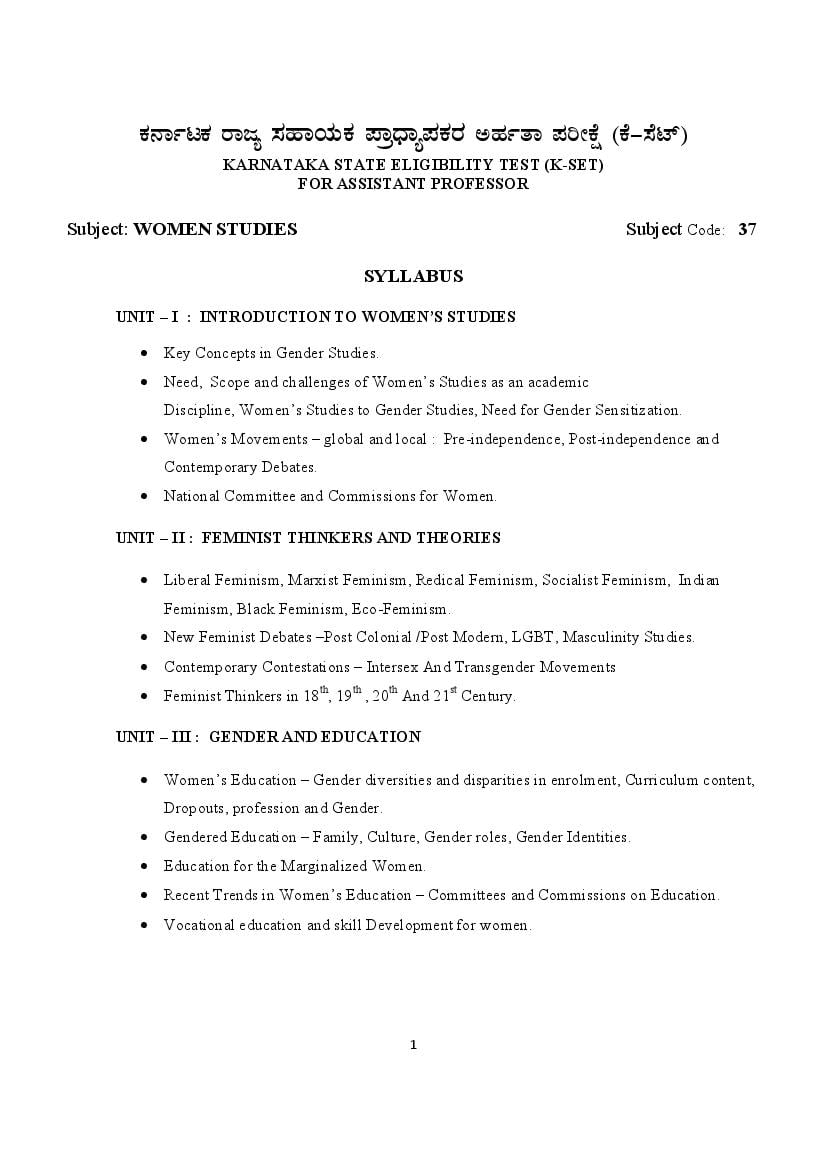
KARNATAKA STATE ELIGIBILITY TEST (K-SET)
FOR ASSISTANT PROFESSOR
Subject: WOMEN STUDIES Subject Code: 37
SYLLABUS
UNIT – I : INTRODUCTION TO WOMEN’S STUDIES
Key Concepts in Gender Studies.
Need, Scope and challenges of Women’s Studies as an academic
Discipline, Women’s Studies to Gender Studies, Need for Gender Sensitization.
Women’s Movements – global and local : Pre-independence, Post-independence and
Contemporary Debates.
National Committee and Commissions for Women.
UNIT – II : FEMINIST THINKERS AND THEORIES
Liberal Feminism, Marxist Feminism, Redical Feminism, Socialist Feminism, Indian
Feminism, Black Feminism, Eco-Feminism.
New Feminist Debates –Post Colonial /Post Modern, LGBT, Masculinity Studies.
Contemporary Contestations – Intersex And Transgender Movements
Feminist Thinkers in 18 th, 19th , 20th And 21st Century.
UNIT – III : GENDER AND EDUCATION
Women’s Education – Gender diversities and disparities in enrolment, Curriculum content,
Dropouts, profession and Gender.
Gendered Education – Family, Culture, Gender roles, Gender Identities.
Education for the Marginalized Women.
Recent Trends in Women’s Education – Committees and Commissions on Education.
Vocational education and skill Development for women.
1
Page 2
Theoretical Perspective : Fredrick Engels, Rosa Luxemburg, Sandra Whiteworth, Boserup
Esther.
Concept of Work – Productive and non – productive work – Use value and market value.
Gender Division of Labour – Mode of Production – Women in organized and unorganized
sector.
New Economic Policy and its impact on Women’s Employment – Globalization –
Structural Adjustment Programs.
UNIT V – GENDER AND ENTREPRENEURSHIP
Concept And Meaning, Importance of Entrepreneurship, Entrepreneurial Traits, Factors
contributing to Entrepreneurship, enabling environment, small enterprises, women in agri-
business.
Gender and emerging Technology – Impact.
Self – help Groups and Micro Credit.
Gender mainstreaming, Gender budgeting, planning and Analysis.
UNIT – VI WOMEN AND HEALTH
Life Cycle Approach to Women’s Health – Health status of women in India, factors
influencing health and Nutritional Status.
Material and Child Health (MCH) to Reproductive and Child health approaches.
Issues of declining Child Sex Ratio, Widowhood and old age.
Occupational and mental health.
Health, Hygiene and Sanitation.
National Health and Population Policies and Programmes.
UNIT – VII WONEN EMPOERMENT AND DEVELOPMENT
Theories of Development , Alternative Approaches – Women in Development (WID),
Women and Development (WAD) and Gender and Development (GAD).
2
Page 3
Inequality Index (GII), Global Gender Gap Index (GGGI).
Women Development Approaches in Indian Five – Year Plans.
Women and leadership – Panchayati Raj and Role of NGOS and Women Development.
Sustainable Development Goals, Polices and Programmes.
UNIT VIII – WOMEN LAWS AND GOVERNANCE
Rights : Gender Equality, Gender Discrimination, Women’s Rights As Human Rights.
Constitutional Provisions for Women in India.
Personal Laws, Labour Laws, Family Courts, Enforcement Machinery – Police and
Judiciary.
Crime against women and child : Child Abuse, Violence, Human Trafficking, Sexual
Harassment at Workplace Act, 2013 – Legal protection
International Conventions and Legislations Related to Women’s Rights.
UNIT – IX GENDER AND MEDIA
Discourse on Women and Media Studies – Mainstream Media, Feminist Media.
Coverage of Women’s issues and issues of Women in Mass Media and Media
Organizations (Audio –Visual and Print Media).
Digital Media and Legal protection.
Alternative Media – Folk Art, Street Play and Theatre.
Indecent Representation of Women (Prohibition) Act, 1986, Impact of Media on Women.
UNIT – X : FEMINIST RESEARCH METHODOLOGY
Understanding Feminist Research – Concepts, Debates and Limitations.
Feminist Epistemology, Feminist Standpoint, Sexist and Non-Sexist Research
Methodology, Ethnography, Queer Theories.
Research Design and Methods – Survey, Exploratory, Diagnostic, Experimental, Action
Research and Case Studies.
Qualitative verses Quantitative Research.
3
Document Details
| Board / Org | Karnataka Exams |
| Exam | Karnataka State Eligibility Test |
| Type | Syllabus |
| Pages | 3 |
| Updated | 24 Sep 2026 |