ICSE Class 10 Question Paper 2019 for Biology
Finished viewing? Save it for later —
Download ICSE Class 10 Question Paper 2019 for Biology (PDF · 11 pages)About ICSE Class 10 Question Paper 2019 for Biology
ICSE Class 10 Question Paper 2019 for Biology is available here for free download. Published by CISCE for Class 10, this question paper can be viewed online or downloaded as a PDF (11 pages). Candidates preparing for Class 10 can use ICSE Class 10 Question Paper 2019 for Biology to understand the exam pattern, the type of questions asked, and the overall difficulty level.
Frequently Asked Questions
How can I download ICSE Class 10 Question Paper 2019 for Biology?
Open this page and click the Download button to save ICSE Class 10 Question Paper 2019 for Biology as a PDF. It is completely free on AglaSem Docs.
Is ICSE Class 10 Question Paper 2019 for Biology free to download?
Yes. ICSE Class 10 Question Paper 2019 for Biology can be viewed online and downloaded as a PDF free of cost on AglaSem Docs.
How many pages does ICSE Class 10 Question Paper 2019 for Biology have?
ICSE Class 10 Question Paper 2019 for Biology contains 11 pages, which you can read online or download together as a single PDF.
Where can I find more Class 10 study material?
You can find more Class 10 question papers, sample papers, syllabus, and answer keys on AglaSem Docs.
ICSE Class 10 Question Paper 2019 for Biology – Text
Read the full text of this question paper below — useful to quickly search, copy and reference the content online without downloading the PDF.
📄 View text version (11 pages)
Page 1
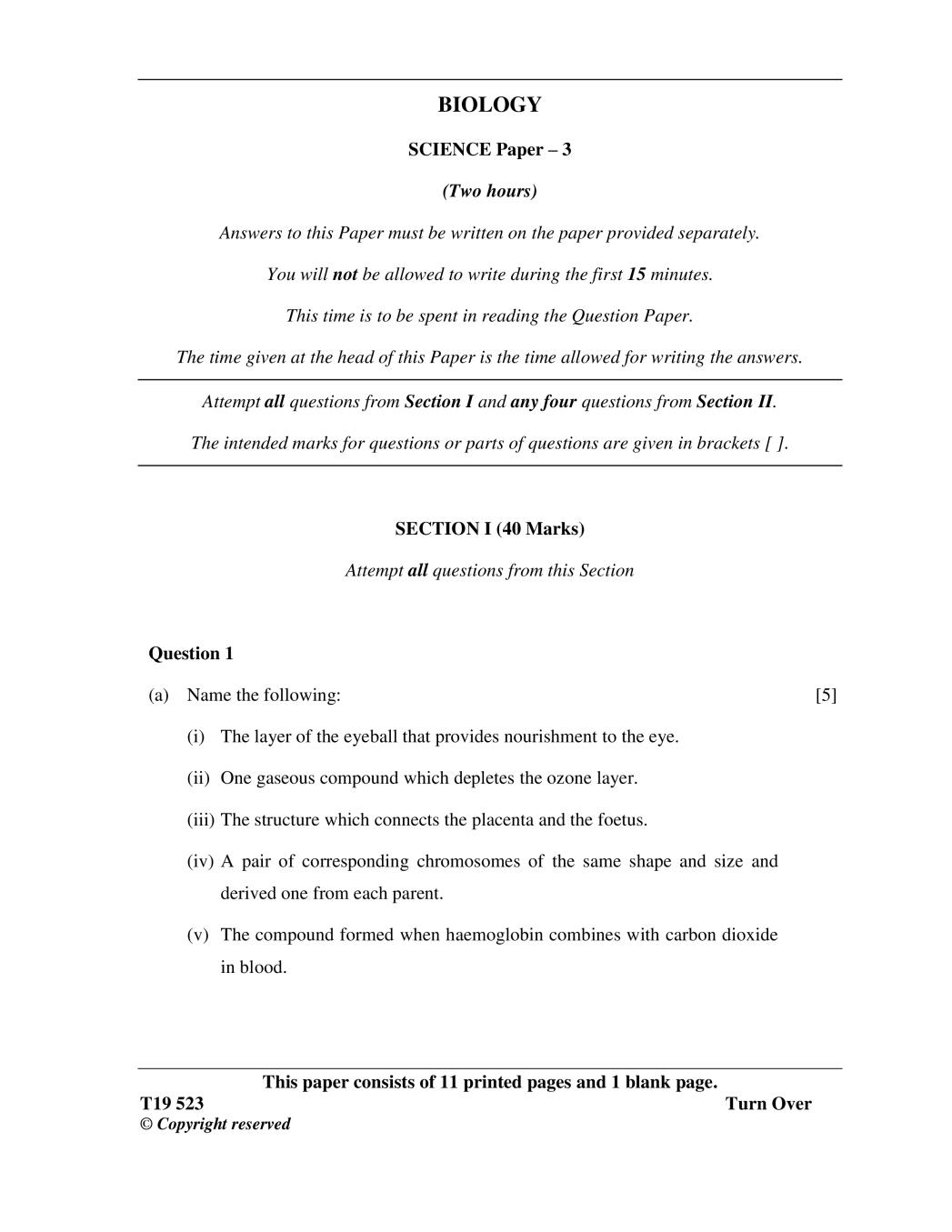
SCIENCE Paper – 3
(Two hours)
Answers to this Paper must be written on the paper provided separately.
You will not be allowed to write during the first 15 minutes.
This time is to be spent in reading the Question Paper.
The time given at the head of this Paper is the time allowed for writing the answers.
Attempt all questions from Section I and any four questions from Section II.
The intended marks for questions or parts of questions are given in brackets [ ].
SECTION I (40 Marks)
Attempt all questions from this Section
Question 1
(a) Name the following: [5]
(i) The layer of the eyeball that provides nourishment to the eye.
(ii) One gaseous compound which depletes the ozone layer.
(iii) The structure which connects the placenta and the foetus.
(iv) A pair of corresponding chromosomes of the same shape and size and
derived one from each parent.
(v) The compound formed when haemoglobin combines with carbon dioxide
in blood.
This paper consists of 11 printed pages and 1 blank page.
T19 523 Turn Over
© Copyright reserved
Page 2
underlined for each statement:
(i) The theory of Inheritance of Acquired Characters was proposed by Watson
and Crick.
(ii) The protective sac which develops around the developing embryo is called
the Pericardium.
(iii) Maintaining balance of the body and coordinating muscular activities is
carried out by the cerebrum.
(iv) The kidney is composed of number of neurons.
(v) The part of the eye which can be donated from a clinically dead person is
the Retina.
(c) Give suitable biological reasons for the following statements: [5]
(i) The birth rate in India is very high.
(ii) Carbon monoxide is dangerous when inhaled.
(iii) Root hairs become flaccid and droop when excess fertilizers are added to
the moist soil around them.
(iv) Acid rain is harmful to the environment.
(v) All life on Earth is supported by Photosynthesis.
(d) Match the items given in Column A with the most appropriate ones in Column [5]
B and REWRITE the correct matching pairs:
Column A Column B
(i) Cranial nerves – Testosterone
(ii) Leydig cells – Natural reflex
(iii) Acetylcholine – 12 pairs
(iv) Spinal nerves – Prolactin
(v) Sneezing – Neurotransmitter
– 18 pairs
– 31 pairs
– Conditioned reflex
T19 523 2
Page 3
(i) While recording the pulse rate, where exactly does a doctor press on our
wrist?
A. Nerve
B. Vein
C. Artery
D. Capillary
(ii) In a human male, a sperm will contain:
A. Both X and Y chromosomes
B. Only Y chromosome
C. Only X chromosome
D. Either X or Y chromosome
(iii) A muscular wall is absent in:
A. Capillary
B. Venule
C. Arteriole
D. Vein
(iv) On which day of the menstrual cycle does ovulation take place?
A. 5th day
B. 28th day
C. 14th day
D. 1st day
(v) Which one of the following does not affect the rate of transpiration?
A. Light
B. Humidity
C. Wind
D. Age of the plant
T19 523 3 Turn Over
Page 4
remaining three belong:
Example: glucose, starch, cellulose, calcium
Odd term: calcium
Category: others are different types of carbohydrates.
(i) Addison’s disease, Cushing’s Syndrome, Acromegaly, Leukemia.
(ii) Insulin, Adrenaline, Pepsin, Thyroxine.
(iii) Axon, Dendron, Photon, Cyton.
(iv) Chicken pox, Colour blindness, Haemophilia, Albinism.
(v) Polythene bag, Crop residue, Animal waste, Decaying vegetable.
(g) Expand the following biological abbreviations: [5]
(i) ABA
(ii) IAA
(iii) ATP
(iv) DNA
(v) TSH
(h) Study the picture given below and answer the following questions: [5]
(i) Identify the type of pollution.
(ii) Name one pollutant that causes the above pollution.
(iii) Mention the impact of this pollution on human health.
T19 523 4
Page 5
(v) What is a ‘Pollutant’? Explain the term.
SECTION II (40 Marks)
Attempt any four questions from this Section.
Question 2
(a) Given below is an experimental setup to demonstrate a particular tropic [5]
movement in germinating seeds. Study the diagram and answer the questions
that follow:
2
Perforated trough
Moist sawdust
Germinating seed
1
Brick
(i) Label the parts 1 and 2.
(ii) Name the tropic movement shown by part 1.
(iii) Part 1 is affected by two stimuli. Name them.
Which one of the two is stronger?
(iv) What is Thigmotropism? Give one example.
(v) What is meant by ‘Positive’ and ‘Negative’ tropic movements in plants?
(b) Mention the exact location of the following: [5]
(i) Testis
(ii) Incus
(iii) Thylakoids
(iv) Amniotic fluid
(v) Corpus callosum
T19 523 5 Turn Over
Page 6
(a) The diagram given below represents an experiment to prove the importance of [5]
a factor in photosynthesis. Answer the questions that follow:
Paper
Black Paper
Clip
(i) Name the factor studied in this experiment.
(ii) What will you observe in the experimental leaf after the starch test?
(iii) Explain the process of Photosynthesis.
(iv) Give a balanced chemical equation to represent the process of
photosynthesis.
(v) Draw a neat, labelled diagram of an experimental setup to show that
oxygen is released during photosynthesis.
(b) State the main functions of the following: [5]
(i) Medulla Oblongata
(ii) Cytokinins
(iii) Tears
(iv) Coronary Artery
(v) Seminal Vesicles
T19 523 6
Page 7
(a) The diagram given below represents an organ system in the human body. [5]
Study the same and answer the questions that follow:
(i) Identify the system.
(ii) Label the parts marked 2 and 4. Mention the function of part 5.
(iii) Name the structural and functional units of the part marked 1.
(iv) What is the fluid that accumulates in part 3?
Which is the main nitrogenous waste present in it?
(v) Draw a neat, labelled diagram showing the longitudinal section of part 1.
(b) The diagram given below represents an endocrine gland in the human body. [5]
Study the diagram and answer the following questions:
Infundibulum
Anterior lobe
Posterior lobe
T19 523 7 Turn Over
Page 8
(ii) Why is the above gland referred to as the ‘Master gland’?
(iii) Name the hormone which in deficiency causes Diabetes Insipidus.
How does this disorder differ from Diabetes Mellitus?
(iv) Explain the term ‘Hormone’.
What is the role of Tropic hormones in the human body?
(v) Which lobe of the above gland secretes:
1. Oxytocin
2. ACTH
3. Growth hormone
Question 5
(a) Given below is an apparatus which was setup to investigate a physiological [5]
process in plants. The setup was placed in bright sunlight. Answer the questions
that follow:
Bell Jar
Water Drops
Plant
Rubber sheet
Glass Plate
Vaseline
(i) Name the process being studied. Define the process.
(ii) Why was the pot enclosed in a rubber sheet?
(iii) Mention two external factors which can accelerate the above process.
(iv) List two adaptations in plants to reduce the above process.
(v) Draw a neat, labelled diagram of a stomatal apparatus.
T19 523 8
Page 9
Study them and answer the questions that follow:
A B
(i) Identify Australopithecus and Neanderthal man from the above pictures.
(ii) Mention two characteristic features each for the two stages.
(iii) Who proposed the theory of ‘Natural Selection’?
(iv) Name the organism used as an example to explain ‘Industrial Melanism’.
(v) Give two examples of Vestigial organs in humans.
Question 6
(a) In Mendel’s experiments, tall pea plants (T) are dominant over dwarf pea [5]
plants (t).
(i) What is the phenotype and genotype of the F1 generation if a homozygous
tall plant is crossed with a homozygous dwarf plant?
(ii) Draw a Punnett square board to show the gametes and offspring when both
the parents are heterozygous for tallness.
(iii) What is the phenotypic ratio and genotypic ratio of the above cross in (ii)?
(iv) State Mendel’s Law of Dominance.
(v) What is a Dihybrid Cross?
T19 523 9 Turn Over
Page 10
Study the diagram and answer the following questions:
(i) Identify the stage by giving a suitable reason.
(ii) Is it a plant or an animal cell? Give a reason to support your answer.
(iii) Draw a neat, labelled diagram of the stage which follows the one shown in
the diagram.
(iv) How many chromosomes will each daughter cell have after the completion
of the above division?
(v) Name the four nitrogenous bases.
Question 7
(a) Answer the following questions briefly: [5]
(i) How are the cytons and axons placed in the brain and the spinal cord?
(ii) Which part of the human ear gives ‘Dynamic balance’ and ‘Static balance’
to the body?
(iii) Explain how the human eye adapts itself to bright light and dim light.
(iv) What is Parthenocarpy? Give one example.
(v) Mention any two objectives of ‘Swachh Bharat Abhiyan’.
T19 523 10
Page 11
Study the diagram and answer the following questions:
(i) Identify the system.
(ii) Label the parts marked 5 and 6.
(iii) Name the two hormones secreted by 1.
(iv) Mention the number and the name of the part involved in fertilization and
implantation from the above diagram.
(v) Mention the surgical methods of contraception in:
1. Human males.
2. Human females.
T19 523 11
Document Details
| Board / Org | CISCE |
| Exam | Class 10 |
| Type | Question Paper |
| Pages | 11 |
| Updated | 22 Jul 2026 |