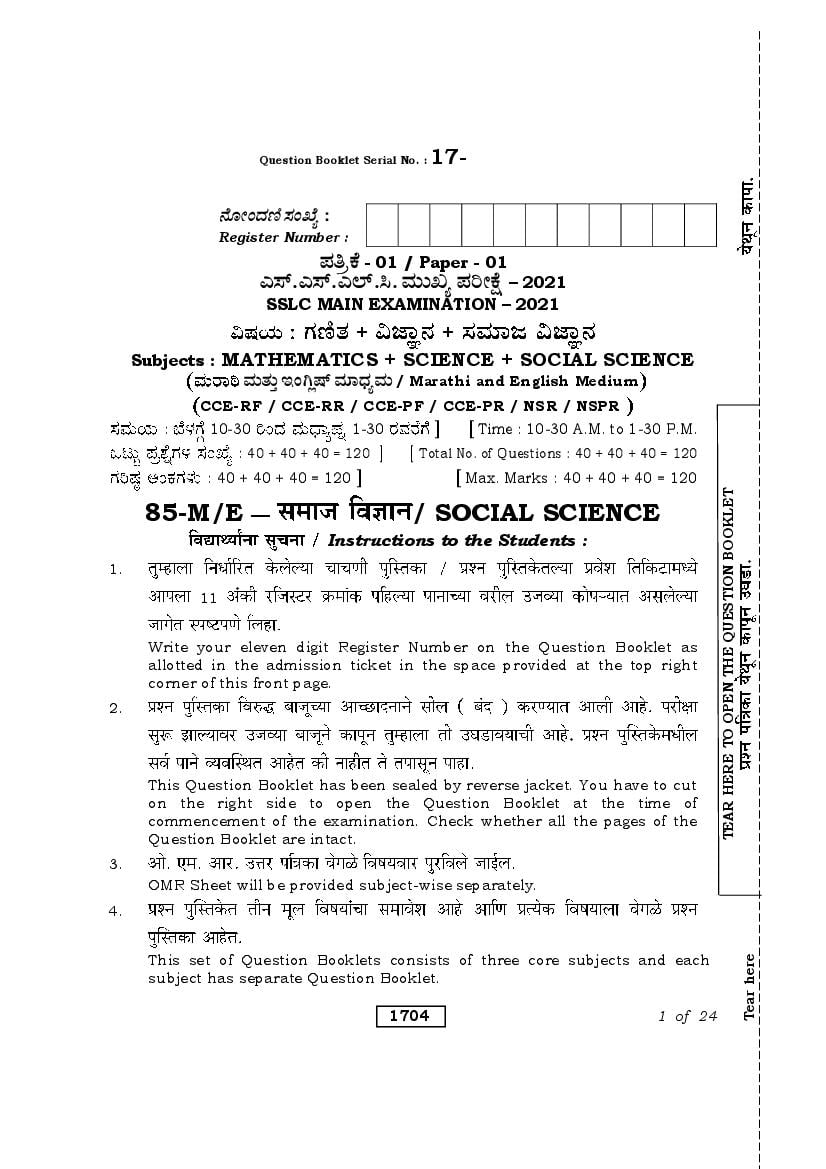
Karnataka SSLC Question Paper 2021 Social Science for Marathi Medium
Finished viewing? Save it for later —
Download Karnataka SSLC Question Paper 2021 Social Science for Marathi Medium (PDF · 24 pages)About Karnataka SSLC Question Paper 2021 Social Science for Marathi Medium
Karnataka SSLC Question Paper 2021 Social Science for Marathi Medium is available here for free download. Published by Karnataka Board for Class 10, this question paper can be viewed online or downloaded as a PDF (24 pages). Candidates preparing for Class 10 can use Karnataka SSLC Question Paper 2021 Social Science for Marathi Medium to understand the exam pattern, the type of questions asked, and the overall difficulty level.
Frequently Asked Questions
How can I download Karnataka SSLC Question Paper 2021 Social Science for Marathi Medium?
Open this page and click the Download button to save Karnataka SSLC Question Paper 2021 Social Science for Marathi Medium as a PDF. It is completely free on AglaSem Docs.
Is Karnataka SSLC Question Paper 2021 Social Science for Marathi Medium free to download?
Yes. Karnataka SSLC Question Paper 2021 Social Science for Marathi Medium can be viewed online and downloaded as a PDF free of cost on AglaSem Docs.
How many pages does Karnataka SSLC Question Paper 2021 Social Science for Marathi Medium have?
Karnataka SSLC Question Paper 2021 Social Science for Marathi Medium contains 24 pages, which you can read online or download together as a single PDF.
Where can I find more Class 10 study material?
You can find more Class 10 question papers, sample papers, syllabus, and answer keys on AglaSem Docs.
Karnataka SSLC Question Paper 2021 Social Science for Marathi Medium – Text
Read the full text of this question paper below — useful to quickly search, copy and reference the content online without downloading the PDF.
📄 View text version (24 pages)
Page 1
®æãàí¨Ü~ ÓÜíTæ :
Register Number :
±Ü£ÅPæ - 01 / Paper - 01
GÓ….GÓ….GÇ….Ô. ÊÜááS ±ÜÄàûæ – 2021
SSLC MAIN EXAMINATION – 2021
+ +
Subjects : MATHEMATICS + SCIENCE + SOCIAL SCIENCE
ÊÜáñÜᤠCíXÉÐ… ÊÜÞ«ÜÂÊÜá / Marathi and English Medium
CCE-RF / CCE-RR / CCE-PF / CCE-PR / NSR / NSPR
: 10-30 1-30 ] [ Time : 10-30 A.M. to 1-30 P.M.
: 40 + 40 + 40 = 120 ] [ Total No. of Questions : 40 + 40 + 40 = 120
: 40 + 40 + 40 = 120 ] [ Max. Marks : 40 + 40 + 40 = 120
TEAR HERE TO OPEN THE QUESTION BOOKLET
85-M/E — / SOCIAL SCIENCE
Instructions to the Students :
1.
11
Write your eleven digit Register Number on the Question Booklet as
allotted in the admission ticket in the space provided at the top right
corner of this front page.
2.
This Question Booklet has been sealed by reverse jacket. You have to cut
on the right side to open the Question Booklet at the time of
commencement of the examination. Check whether all the pages of the
Question Booklet are intact.
3.
OMR Sheet will be provided subject-wise separately.
4.
This set of Question Booklets consists of three core subjects and each
Tear here
subject has separate Question Booklet.
1704 1 of 24
Page 2
(i) – 1 40
(ii) – 41 80
(iii) – 81 120
40 questions are provided against each subject. This set of Question
Booklets contains 120 questions in all.
(i) Mathematics – Question Numbers 1 to 40
(ii) Science – Question Numbers 41 to 80
(iii) Social Science – Question Numbers 81 to 120
6.
Each question carries one mark. Answering all the questions is
compulsory and each correct answer will be awarded one mark. There will
be no negative marking for wrong answers.
7.
a)
b)
20 C
C
20) A B C D
c)
1704 2 of 24
Page 3
a) Read the questions carefully.
b) Completely darken / shade the relevant circle against Question
Number in the OMR Sheet using blue / black ball point pen. Do not
try to alter the entry and not to do any stray marks on OMR Sheet.
Example : In the question booklet, if C is the correct answer for
Question No. 20, then in the OMR Sheet shade the option C using
blue / black ball point pen as follows.
Question No. 20) A B C D ( This is an example only )
c) Do not fold, tear, wrinkle or staple on the OMR Sheet.
8.
If more than one circle is shaded for a given question, such answer is
treated as wrong and no marks will be given.
9.
Student and Room Invigilator should sign in the OMR Sheet in the space
provided.
1704 3 of 24
Page 4
Candidate should return the subject-wise answered OMR Sheet to the
Room Invigilator before leaving the examination hall.
11.
Rough work can be done in the space provided at the end of the Question
Booklet.
12.
Calculators, Mobiles, Smart Watches and any other electronic equipment
are not allowed inside the examination hall.
1704 4 of 24
Page 5
( OMR )
40 × 1 = 40
Four choices are given for each of the following questions / incomplete
statements. Choose the correct answer and shade the correct option in the
OMR Answer Sheet given to you with a black / blue ball point pen.
40 × 1 = 40
81.
(A)
(B)
(C)
(D)
Constantinople was considered as ‘The Gate of European Trade’ because it
was
(A) the centre for International Trade routes
(B) the only sea route
(C) the capital of Roman Empire
(D) the only source of resources of Europeans
1704 5 of 24
Page 6
(A) (B)
(C) (D)
The First Anglo-Maratha War ended with the treaty of
(A) Bassein (B) Salbai
(C) Allahabad (D) Lahore
83. –
(A) (B)
(C) (D)
The civil courts established during the British period were known as
(A) Diwani Adalats (B) Fouzdari Adalats
(C) Lok Adalats (D) Shariyat Adalats
84. –
(A)
(B)
(C)
(D)
The British gained confidence during Second Anglo-Mysore War due to
(A) Haider Ali’s defeat at Porto Nova
(B) defeat of Peshwa in First Anglo-Maratha War
(C) Marathas signed Subsidiary Alliance
(D) Cornwallis captured Srirangapatna
1704 6 of 24
Page 7
–
(A)
(B)
(C)
(D)
Dayanand Saraswati realised that the remedies to the maladies of India
are present in Veda so he
(A) declared ‘Back to Vedas’
(B) wrote Sathyartha Prakasha
(C) started Cow Protection Movement
(D) started Shuddhi Movement
86. –
(A)
(B)
(C)
(D)
1704 7 of 24
Page 8
among the following, is
(A) it spread all over the country
(B) it was a well organised revolt
(C) it had no eminent leader
(D) many Indian kings were disloyal to British
87. –
(A) (B)
(C) (D)
The First President of the Indian National Congress was
(A) W. C. Bonnerjee (B) Surendranath Banerjee
(C) Dadabhai Naoroji (D) Gopal Krishna Gokhale
88. –
(A) (B)
(C) (D)
The one who belongs to moderates among the following is
(A) Aurobindo Ghosh (B) Gopal Krishna Gokhale
(C) Bal Gangadhar Tilak (D) Lala Lajpat Rai
1704 8 of 24
Page 9
(A) (B)
(C) (D)
Gandhiji launched Champaran movement to support
(A) Indigo growers (B) Cotton growers
(C) Tadi growers (D) Tea Estate workers
90.
–
(A)
(B)
(C)
(D)
Rabindranath Tagore returned his title ‘Knighthood’ back to British
Government because to
(A) support the Jallianwala Bagh massacre
(B) support Gandhiji in Champaran Satyagraha
(C) express his non-co-operation against British
(D) boycott of foreign goods
1704 9 of 24
Page 10
(A)
(B)
(C)
(D)
The ‘Iron Man of India’ is
(A) Sardar Vallabhbhai Patel
(B) Netaji Subhash Chandra Bose
(C) Bal Gangadhar Tilak
(D) Babasaheb Ambedkar
92. –
(A) 26 1950 (B) 26 1950
(C) 15 1950 (D) 26 1950
The Constitution of India was adopted on
(A) 26th October, 1950 (B) 26th August, 1950
(C) 15th August, 1950 (D) 26th January, 1950
93. –
(A) (B)
(C) (D)
The objective of establishing Lokayukta institution is to check
(A) Communalism (B) Terrorism
(C) Regionalism (D) Corruption
1704 10 of 24
Page 11
(A) (B)
(C) (D)
The Panchsheel principles were signed between
(A) India and Nepal (B) India and Bhutan
(C) India and China (D) India and Sri Lanka
95.
(A)
(B)
(C)
(D)
The Iron and Steel Industries established by India with the help of Russia
are
(A) Bokaro and Bhilai Iron and Steel Industries
(B) Salem and Vijayanagar Iron and Steel Industries
(C) Bhadravathi and Bokaro Iron and Steel Industries
(D) Rourkela and Durgapur Iron and Steel Industries
1704 11 of 24
Page 12
(A)
(B)
(C)
(D)
The Foreign Policy of India is also called as
(A) Foreign Policy of Ambedkar
(B) Foreign Policy of Sardar Patel
(C) Foreign Policy of Nehru
(D) Foreign Policy of Mahatma Gandhi
97. –
(A)
(B)
(C)
(D)
The World’s Parliament is
(A) General Assembly
(B) Security Council
(C) Secretariat
(D) Social and Economic Council
1704 12 of 24
Page 13
(A) (B)
(C) (D)
The word ‘United Nations’ was proposed by
(A) F. D. Roosevelt (B) Joseph Stalin
(C) Winston Churchill (D) Jawaharlal Nehru
99. 1976 –
(A)
(B)
(C)
(D)
Untouchability Crime Act was implemented in 1976 with necessary
changes as
(A) Consumer Rights Protection Act
(B) Untouchability Right Protection Act
(C) Criminal Rights Protection Act
(D) Civil Rights Protection Act
1704 13 of 24
Page 14
(A) (B)
(C) (D)
The main feature of unorganised sector labour is
(A) migration (B) job security
(C) leave facility (D) fixed wages
101. –
(A) (B)
(C) (D)
Narmada Bachao Andolana was led by
(A) Medha Patkar (B) Sundarlal Bahuguna
(C) Kerala Shastra Parishad (D) M. D. Nanjundaswamy
102. –
(A) (B)
(C) (D)
Invisible hunger refers to
(A) hungriness (B) poverty
(C) malnutrition (D) richness
1704 14 of 24
Page 15
(A) (B)
(C) (D)
The Greater Himalayas are also called as
(A) Himadri (B) Himachal
(C) Siwaliks (D) Doons
104.
(A) (B)
(C) (D)
The highest peak of the Eastern Ghat is
(A) Annamalai (B) Amrapali
(C) Arma Konda (D) Amarkantak
105. –
(A) (B)
(C) (D)
The coldest month in India is
(A) November (B) December
(C) January (D) February
1704 15 of 24
Page 16
(A)
(B)
(C)
(D)
The black soil is highly retentive because it is
(A) extremely compact (B) black in colour
(C) found in heavy rainfall areas (D) pebbled rock particles
107. –
(A) (B)
(C) (D)
The longest river in South India is
(A) Kaveri (B) Krishna
(C) Godavari (D) Tungabhadra
108. –
(A) (B)
(C) (D)
The tree trunk supported by a number of stilt roots is found in the
(A) Mountain forest (B) Mangrove forest
(C) Tropical evergreen forest (D) Desert vegetation
1704 16 of 24
Page 17
(A) (B)
(C) (D)
The important multipurpose river valley project of Odisha is
(A) Hirakud (B) Bhakra Nangal
(C) Pampa Sagar (D) Nagarjuna Sagar
110. –
(A)
(B)
(C)
(D)
Shifting cultivation in India is declining nowadays because
(A) of the governmental policies and tribal settlements
(B) people have now started coming out with commercial farming
(C) there is no demand for the products of shifting cultivation
(D) people are abandoning agriculture
1704 17 of 24
Page 18
(A) (B)
(C) (D)
The ‘Silicon Valley of India’ is
(A) Mangaluru (B) Mumbai
(C) Kolkata (D) Bengaluru
112. –
(A)
(B)
(C)
(D)
One of the preventive measures for the earthquake's effects among the
following is
(A) constructing retention wall
(B) restrict sand mining in coastal areas
(C) developing mangrove forests along the coast
(D) restriction on digging of deep wells for underground water
1704 18 of 24
Page 19
–
(A) (B)
(C) (D)
The total value of all goods and services produced in a country during one
year is
(A) Per capita income (B) Real national income
(C) Standard of living (D) Purchasing power parity
114. –
(A) (B)
(C) (D)
Gram Swarajya was the concept of
(A) Jawaharlal Nehru (B) Bal Gangadhar Tilak
(C) Sardar Vallabhbhai Patel (D) Mahatma Gandhi
115.
(A) (B)
(C) (D)
When the National Income is divided by the total population it is
(A) Underdevelopment (B) Development
(C) Per capita income (D) Standard of living
1704 19 of 24
Page 20
(A) (B)
(C) (D)
Establishment of Kaiga Nuclear Power Plant was opposed under the
leadership of
(A) Sundarlal Bahuguna (B) Dr. Shivaram Karanth
(C) Medha Patkar (D) B. V. Karanth
117. 15
(A)
(B)
(C) 15
(D)
15th March is observed every year as ‘World Consumers Day’ because
(A) John F. Kennedy accepted the Consumer rights on this day.
(B) England declared the Consumer rights on this day
(C) UN declared Consumer rights on 15th March
(D) Consumer Education was started on this day
1704 20 of 24
Page 21
(A) 1966 (B) 1976
(C) 1986 (D) 1996
The Consumer Protection Act was passed in India in the year
(A) 1966 (B) 1976
(C) 1986 (D) 1996
119. –
(A) (B)
(C) (D)
The Banker’s Bank is
(A) NABARD (B) Apex Bank
(C) Reserve Bank (D) IDBI
120. –
(A) (B)
(C) (D)
The ‘Gateway of India’ is
(A) Chennai (B) Mumbai
(C) Delhi (D) Kolkata
1704 21 of 24
Page 22
1704 22 of 24
Page 23
1704 23 of 24
Page 24
Document Details
| Board / Org | Karnataka Board |
| Exam | Class 10 |
| Type | Question Paper |
| Pages | 24 |
| Language | marathi |
| Updated | 22 Jul 2026 |