MBOSE Class 8 Syllabus 2027 Social Science (End-Term, revised)
Finished viewing? Save it for later —
Download MBOSE Class 8 Syllabus 2027 Social Science (End-Term, revised) (PDF · 5 pages)About MBOSE Class 8 Syllabus 2027 Social Science (End-Term, revised)
MBOSE Class 8 Syllabus 2027 Social Science (End-Term, revised) is available here for free download. Published by Meghalaya Board for Class 8, this syllabus can be viewed online or downloaded as a PDF (5 pages). Candidates preparing for Class 8 can use MBOSE Class 8 Syllabus 2027 Social Science (End-Term, revised) to understand the exam pattern, the type of questions asked, and the overall difficulty level.
Frequently Asked Questions
How can I download MBOSE Class 8 Syllabus 2027 Social Science (End-Term, revised)?
Open this page and click the Download button to save MBOSE Class 8 Syllabus 2027 Social Science (End-Term, revised) as a PDF. It is completely free on AglaSem Docs.
Is MBOSE Class 8 Syllabus 2027 Social Science (End-Term, revised) free to download?
Yes. MBOSE Class 8 Syllabus 2027 Social Science (End-Term, revised) can be viewed online and downloaded as a PDF free of cost on AglaSem Docs.
How many pages does MBOSE Class 8 Syllabus 2027 Social Science (End-Term, revised) have?
MBOSE Class 8 Syllabus 2027 Social Science (End-Term, revised) contains 5 pages, which you can read online or download together as a single PDF.
Where can I find more Class 8 study material?
You can find more Class 8 question papers, sample papers, syllabus, and answer keys on AglaSem Docs.
MBOSE Class 8 Syllabus 2027 Social Science (End-Term, revised) – Text
Read the full text of this syllabus below — useful to quickly search, copy and reference the content online without downloading the PDF.
📄 View text version (6 pages)
Page 1
MBOSE Class 8
Syllabus 2027 Social
Science (End-Term,
revised)
EXAM YEAR TYPE SUBJECT
Meghalaya Class 8 2027 Syllabus Science
Notes · Sample Papers · Previous Year Papers · Mock Tests
Page 2
.co s e m
s em l a
a ag
MEGHALAYA BO ARD OE S CHO OL EDUCATION
HEADQUARTERS :: TURA.
N9IIErcATIQN-NO.9g"
m
om
Datedror@zozo.
. co
. c e m
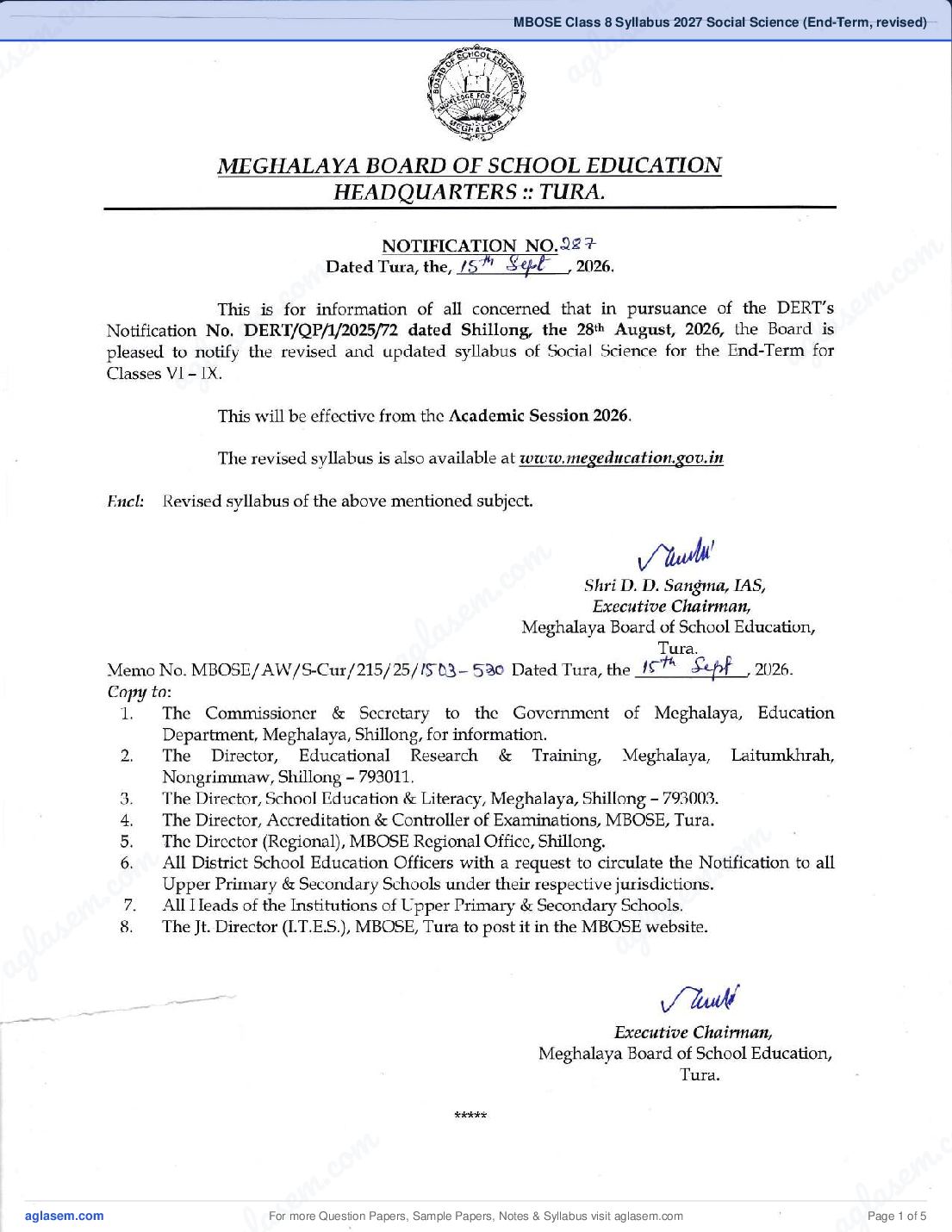
This is for information of all concerned that in pursuance of the DERT's
e m l as
l as
Notification No. DERT/QP/L/2025/72 dated Shillong, the 28th August, 2026, fhe Board is
pleased to notify the revised and updated syllabus of Social Science for the End-Term for
ag
ag
Classes VI - IX.
This will be effective from the Academic Session 2026.
The revised syllabus is also available atwww.megeducation goo.ilr
Encl: Revised syllabus of the above mentioned subject.
m
c. o
,/w,ln,
ShriD.D. SanSma,IAS,
s em MeghalayaExecutiae Chairman,
l a Board of School Educatioru
ag 5Bc Dated Trra,t6u tr"t^ '4>P
Tura.
Memo No. MBOSE/ AW/S-Cur/21.5/25//t03* ,ZOZO.
Copy to:
1,. The Commissioner & Secretarv to the Covernment of Meghalaya, Education
Department Meghalaya, Shillong, for information.
2. The Director, Educational Research & Training, Meghalaya Laitumkhrah,
Nongrimmaw, Shillong - 793011,.
J. The Director, School Education & Literacy, Meghalaya Shillong -793003.
4. The Director, Accreditation & Conkoller of Examinations, MBOSE, Tura.
m
.co
5. The Director (Regional), MBOSE Regional Office, Shitlong.
m A11 District School Education Officers with a request to circulate the Notification to all
.co
6.
Upper Primary & Secondary Schools under their respective jurisdictions.
e m
e m 7. All Heads of the Lrstitutions of Upper Primary & Secondary Schools.
las
las 8. The Jt. Director (I.T.E.S.), MBOSE, Tura to post it in the MBOSE website.
ag
ag
Executiae Chairman,
Meghalaya Board of School Educatioru
Tura.
m . c
c. o s e m
s em
For more Question Papers, Sample Papers, Notes & Syllabus visit
gl a
Page 1 of 5
Page 3
Directorate of Educational Research & Training
Nongrimmaw, Laitumkhrah, Shillong - 793011
SOCIAL SCIENCE REVISED SYLLABUS
CLASSES VI- IX
For End-term of Academic Year 2026
For more Question Papers, Sample Papers, Notes & Syllabus visit Page 2 of 5
Page 4
m .co
m .co s e m
se
SOCIAL SCIENCE
g l a
a
CLASS VIII
End – Term
(Internal - 20 marks; External - 80 marks)
Course Structure
Sl. No. Sections Internal Assessment through project activities External Assessment
1 History 7 marks 30 marks
2 Civics 6 marks 20 marks
m
.co
3 Geography 7 marks 30 marks
m
.co m
Total 20 marks 80 marks
s e
s em Section - A: History
g l a
Chapter 5:laReforms in Indian Society: Condition of Women; Caste-Ridden Society;a Some
g
Eminenta Social Reformers- Raja Rammohun Roy and Brahmo Samaj, Ishwar Chandra
Vidyasagar, Henry Louis Vivian Derozio, Debendranath Tagore, Keshab Chandra Sen; Reform
Movements in Western India; Reform Movement in Southern India-Veda Samaj, Sri Narayan
Guru, E.V. Ramaswamy Naicker (Periyar), Swami Dayananda Saraswati, Ramkrishna
Paramhansa and Swami Vivekananda; Women’s Initiative for the Cause of Women; Muslim
Reform Movements; Reform Movements among Parsis and Sikhs; Other Reform Movements-
The Theosophical Society; Jains; Mahatma Gandhi; Bhim Rao Ambedkar; Changes Brought to
m
.co
Society.
e m
las
Chapter 6: Indian National Movement: (First Phase) (For internal assessment only): Rise of
ag
Nationalism; The Moderates Phase, British Attitude towards the Congress; The Radical Phase;
Differences between the Moderates and Extremists; Partition of Bengal (1905); The Swadeshi and
Boycott movements; Split in Indian National Congress (1907); Minto- Morley Reforms of 1909;
Revolutionary Movement: The First Phase.
The National Movement (Second Phase): Emergence of Mahatma Gandhi- Gandhi Return to
India (1914); Gandhi’s Ideology; Early Campaigns of Gandhi; Montague- Chelmsford Reforms
(1919); Home Rule Movement; The Rowlatt Act (1919); Jallianwala Bagh Massacre; Khilafat
m
.co
Movement (1920); Non-Cooperation Movement (1920-22)-Start of the Movement, Constructive
m
.co
Programme, Withdrawal of the Movement.
e m
s
Non-Cooperation to Civil Disobedience Movement (1922-30)- (For Internal Assessment Only)
e m l a
s
Mobilization of the Peasants Revolutionary Movement-The Second Phase; Simon Commission
la (1927); Purna Swaraj Resolution.
ag
ag Civil Disobedience Movement (1930-34)- Dandi March; First Round Table Conference (1930),
Gandhi - Irwin Pact (1931); Second Round Table Conference (1931); Third Round Table
Conference (1932); Resumption of the Movement.
Civil Disobedience to Quit India Movement (1934-42)-Government of India Act of 1935; Quit
India Movement (1942); Azad Hind Fauj (Indian National Army); Towards Independence and
Partition
m .
.co s e m
s em l a
g la ag
a For more Question Papers, Sample Papers, Notes & Syllabus visit Page 3 of 5
Page 5
States; Rehabilitation of the Refugees; Solving the Economic Difficulties; Framing a Constitution;
Planning for Development; An Independent Foreign Policy, Non- Alignment, India On The Move;
Success; Challenges Ahead.
Chapter 8: Financial Education (For internal assessment only): Introduction to Insurance,
Types of Insurance
Section - B: Civics
Chapter 4: The Judiciary: Importance of Judiciary; Need for Independent Judiciary; The
Supreme Court-Composition, Appointment, Tenure and Removal of Judges, Jurisdiction, Judicial
Review; The High Court-Composition, Appointment, Eligibility, Powers and Functions of High
Court, Jurisdiction, Advocate General; Subordinate Courts, Types of Subordinate Courts, Lok
Adalat;
Chapter 5: Marginalisation and Social Justice: Causes of Marginalisation; Effects of
Marginalization; Scheduled Castes (SCs)- Steps for their Upliftment; Scheduled Tribes (STs)-
Tribal Society, Religious Belief, Languages, Stereotyping of Tribes in India, Status of STs, Steps
taken for their Upliftment; Other backward Classes (OBCs); Minorities Other Marginalized
Groups, Women- Measures Taken for their Upliftment; Children-Steps taken for their Upliftment;
Social Inequality and Economic Status, Reservation.
Chapter 6: Government for Development (For internal assessment only): Five- Year Plans;
NITI Aayog; Agriculture; Increase in Agricultural Production; Green Revolution; Industries;
Industrial Growth; Cottage Industries; Small- Scale Industries; Public and Private Sectors;
Transportation- Roadways, NHAI, Railways, Ports, Aviation; Telecommunication; Social Sector-
Education, Sanitation Water, Health, Employment, Housing, Rural Development; Social
Challenges.
Chapter 7: Financial Education (For internal assessment only): Types of Banks and Tax.
Section - C: Geography
Chapter 5: Major Crops and Agriculture Development: Major Crops: Cereals-Rice, Wheat,
Maize, Millets, Pulses; Cash Crops- Sugarcane, Cotton, Jute; Beverages- Tea, Coffee
Chapter 6: Manufacturing Industries: Industries- Classification of Industries- On the Basis
of Raw Materials, On the Basis of Size, On the Basis of Ownership.
Distribution of Major Industries in the World: Iron and Steel Industry; Cotton Textile Industry;
Information Technology (IT) Industry.
Chapter 7: Meghalaya-An Overview: Introduction; Location; Climate; Population; Economy;
Food; Art and Culture; Forest Resources; Animals and Birds; Reptiles and Fishes; Administrative
Divisions.
For more Question Papers, Sample Papers, Notes & Syllabus visit Page 4 of 5
Page 6
m .co
m .co s e m
se g l a
a
Chapter 8: Natural and Man-Made Disasters (For internal assessment only): Introduction;
Natural Disasters and Natural Hazards: Natural Disasters-Earthquakes: Elements at Risk, Typical
Effects of Earthquake, Causes of Earthquakes, Where do Earthquakes Occur? Detecting
Earthquakes, Prediction and Control of Earthquake, Major Mitigation Strategies to Reduce the
Impact of Earthquake; Landslides, Onset, Type and Warning, Elements at Risk (Vulnerability
m
Factors or Elements), Typical Effects (Ill Effects) of Landslides, Major Mitigation Strategies
m .co
(Measure to Reduce the Ill Effects of Landslides); Floods, Onset, Type and Warning, Elements at
.co e m
Risk of Floods (Vulnerable Elements), Typical Effects of Floods (Ill Effects of Floods), Major
e m
Mitigation Strategies (Measures to Reduce the Impact/Ill-Effects of Floods);
l as
as
Man- Made Disasters; Fires, Extent of Fires, Causes of Fires, Safety Measures for Fire Prevention
l ag
ag
in Home, Other Measures; Accidents - Road Accidents, Safety Measures- Safety Measures to be
adopted while travelling in an aircraft; Rail Accidents; Epidemic- Onset and Warning, Outbreak
of an Epidemic, Elements at Risk in an Epidemic:H3, Risk Reduction; Measures of an Epidemic
Chapter 9: Road Accidents (For internal assessment only): Causes, Prevention and First Aid
Chapter 10: Financial Education (For internal assessment only): Part I: Money in & Money
Out Part II: Demand Draft (DD)/ Payment Order
o m
c
Internal assessment: Three project activities are. to be completed in each term, one from each
section.
s em
g laActivities for End-Term.
a
Suggested Project
1. Create a poster/collage of leaders and events of the first and second phase of the Indian National
Movement.
2. Role play on any leader explaining their role in the Indian National Movement.
3. Group discussion on relevance or importance of Gender equality in Indian society with special
reference to the role of women in Meghalaya.
4. Collect newspaper articles, news clippings, pictures etc. highlighting the prevalence of
discrimination against the marginalized sections of Indian society, (With reference to the
m
m discrimination of people from the North-east in mainland India.
.co
m .co 5. Create a photo essay of forest resources found in Meghalaya.
s e m
s e
6. Create a poster on traditional dances of the Hills tribes in Meghalaya.
g l a
la a
7. Identify, paste pictures on cash crops and write an explanation on each.
ag Note: All Chapters are equally important. Internal assessment of 20 marks shall be realized through
the conduct of projects, minimum one from each sections-History, Civics and Geography for each
term.
Textbook as prescribed by MBOSE:
- Orchid Social Sciences- VIII
m
Published by- M/s Yogson International, H-159, Sector-12, Noida – 201301.
.
.co s e m
s em l a
g la ag
a For more Question Papers, Sample Papers, Notes & Syllabus visit Page 5 of 5
Document Details
| Board / Org | Meghalaya Board |
| Exam | Class 8 |
| Type | Syllabus |
| Pages | 5 |
| Updated | 04 Nov 2026 |