NIOS Class 12 Question Paper 2021 (Oct) Biology
Finished viewing? Save it for later —
Download NIOS Class 12 Question Paper 2021 (Oct) Biology (PDF · 24 pages)About NIOS Class 12 Question Paper 2021 (Oct) Biology
NIOS Class 12 Question Paper 2021 (Oct) Biology is available here for free download. Published by NIOS for National Institute of Open Schooling Class 12, this question paper can be viewed online or downloaded as a PDF (24 pages). Candidates preparing for National Institute of Open Schooling Class 12 can use NIOS Class 12 Question Paper 2021 (Oct) Biology to understand the exam pattern, the type of questions asked, and the overall difficulty level.
Frequently Asked Questions
How can I download NIOS Class 12 Question Paper 2021 (Oct) Biology?
Open this page and click the Download button to save NIOS Class 12 Question Paper 2021 (Oct) Biology as a PDF. It is completely free on AglaSem Docs.
Is NIOS Class 12 Question Paper 2021 (Oct) Biology free to download?
Yes. NIOS Class 12 Question Paper 2021 (Oct) Biology can be viewed online and downloaded as a PDF free of cost on AglaSem Docs.
How many pages does NIOS Class 12 Question Paper 2021 (Oct) Biology have?
NIOS Class 12 Question Paper 2021 (Oct) Biology contains 24 pages, which you can read online or download together as a single PDF.
Where can I find more National Institute of Open Schooling Class 12 study material?
You can find more National Institute of Open Schooling Class 12 question papers, sample papers, syllabus, and answer keys on AglaSem Docs.
NIOS Class 12 Question Paper 2021 (Oct) Biology – Text
Read the full text of this question paper below — useful to quickly search, copy and reference the content online without downloading the PDF.
📄 View text version (24 pages)
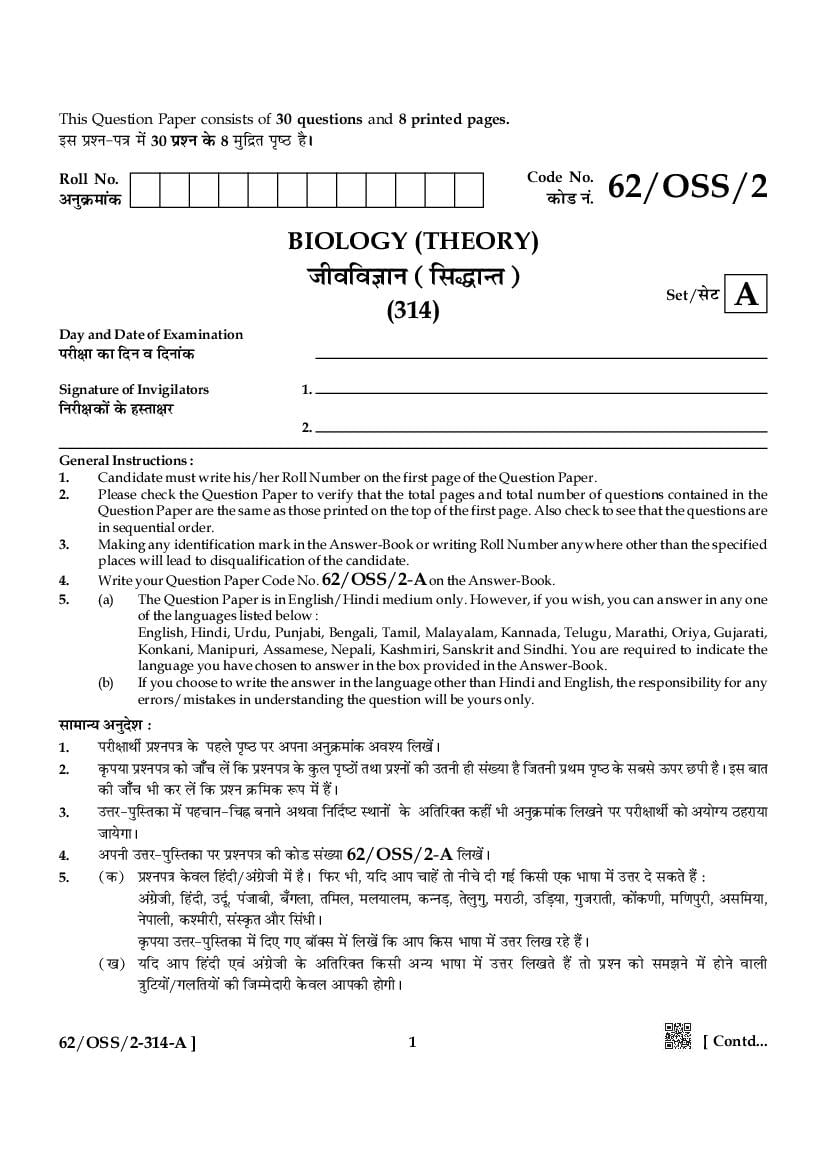
Page 1
ß‚ ¬˝‡Ÿ-¬òÊ ◊¥ 30 ¬˝‡Ÿ ∑§ 8 ◊ÈÁŒ˝Ã ¬Îc∆UU „Ò–
Roll No. Code No.
•ŸÈ∑˝§◊Ê¥∑§ ∑§Ê«U Ÿ¥. 62/OSS/2
BIOLOGY (THEORY)
¡ËflÁflôÊÊŸ (Á‚hÊãÃ)
(314)
Set/‚≈U A
Day and Date of Examination
¬⁄UˡÊÊ ∑§Ê ÁŒŸ fl ÁŒŸÊ¥∑§
Signature of Invigilators 1.
ÁŸ⁄UˡÊ∑§Ê¥ ∑§ „SÃÊˇÊ⁄U
2.
General Instructions :
1. Candidate must write his/her Roll Number on the first page of the Question Paper.
2. Please check the Question Paper to verify that the total pages and total number of questions contained in the
Question Paper are the same as those printed on the top of the first page. Also check to see that the questions are
in sequential order.
3. Making any identification mark in the Answer-Book or writing Roll Number anywhere other than the specified
places will lead to disqualification of the candidate.
4. Write your Question Paper Code No. 62/OSS/2-A on the Answer-Book.
5. (a) The Question Paper is in English/Hindi medium only. However, if you wish, you can answer in any one
of the languages listed below :
English, Hindi, Urdu, Punjabi, Bengali, Tamil, Malayalam, Kannada, Telugu, Marathi, Oriya, Gujarati,
Konkani, Manipuri, Assamese, Nepali, Kashmiri, Sanskrit and Sindhi. You are required to indicate the
language you have chosen to answer in the box provided in the Answer-Book.
(b) If you choose to write the answer in the language other than Hindi and English, the responsibility for any
errors/mistakes in understanding the question will be yours only.
‚Ê◊Êãÿ •ŸÈŒ‡Ê —
1. ¬⁄UˡÊÊÕ˸ ¬˝‡Ÿ¬òÊ ∑§ §¬„‹ ¬Îc∆U ¬⁄U •¬ŸÊ •ŸÈ∑˝§◊Ê¥∑§ •fl‡ÿU Á‹π¥–
2. ∑Χ¬ÿÊ ¬˝‡Ÿ¬òÊ ∑§Ê ¡ÊÚ°ø ‹¥ Á∑§ ¬˝‡Ÿ¬òÊ ∑§ ∑ȧ‹ ¬Îc∆UÊ¥ ÃÕÊ ¬˝‡ŸÊ¥ ∑§Ë ©ÃŸË „Ë ‚¥ÅUÿÊ „Ò Á¡ÃŸË ¬˝Õ◊ ¬Îc∆ ∑ §‚’‚ ™§¬⁄U ¿U¬Ë „Ò– ß‚ ’ÊÃ
∑§Ë ¡ÊÚ°ø ÷Ë ∑§⁄U ‹¥ Á∑§ ¬˝‡Ÿ ∑˝ Á◊∑§ UM§¬ ◊¥ „Ò¥–
3. § ©ûÊ⁄U-¬ÈÁSUÃ∑§Ê ◊¥ ¬„øÊŸ-Áøq ’ŸÊŸ •ÕflÊ ÁŸÁŒ¸c≈U SÕÊŸÊ¥ ∑§§ •ÁÃÁ⁄UÄà ∑§„Ë¥ ÷Ë •ŸÈ∑˝§◊Ê¥∑§ Á‹πŸ ¬⁄U ¬⁄UˡÊÊÕ˸ ∑§Ê •ÿÊÇÿ ∆U„⁄UÊÿÊ
¡ÊÿªÊ–
4. •¬ŸË ©ûÊ⁄U-¬ÈÁSUÃ∑§Ê ¬⁄U ¬˝‡Ÿ¬òÊ ∑§Ë ∑§Ê«U ‚¥ÅÿÊ 62/OSS/2-A Á‹π¥–
5. (∑§) ¬˝‡Ÿ¬òÊ ∑§fl‹ Á„¥ŒË/•¥ª˝¡Ë ◊¥ „Ò– Á»§⁄U ÷Ë, ÿÁŒ •Ê¬ øÊ„¥ ÃÊ ŸËø ŒË ªß¸ Á∑§‚Ë ∞∑§ ÷Ê·Ê ◊¥ ©ûÊ⁄ Œ ‚∑§Ã „Ò¥ —
•¥ª˝¡Ë, Á„¥ŒË, ©ŒÍ¸, ¬¥¡Ê’Ë, ’°ª‹Ê, ÃÁ◊‹, ◊‹ÿÊ‹◊, ∑§ãŸ«∏, ËȪÈ, ◊⁄UÊ∆UË, ©Á«∏ÿÊ, ªÈ¡⁄UÊÃË, ∑§Ê¥∑§áÊË, ◊ÁáʬÈ⁄UË, •‚Á◊ÿÊ,
Ÿ¬Ê‹Ë, ∑§‡◊Ë⁄UË, ‚¥S∑Χç•ÊÒ⁄U Á‚¥œË–
∑Χ¬ÿÊ ©ûÊ⁄U-¬ÈÁSÃ∑§Ê ◊¥ ÁŒ∞ ª∞ ’ÊÚÄ‚ ◊¥ Á‹π¥ Á∑§ •Ê¬ Á∑§‚ ÷Ê·Ê ◊¥ ©ûÊ⁄U Á‹π ⁄U„ „Ò¥– §
(π) ÿÁŒ •Ê¬ Á„¥ŒË ∞fl¥ •¥ª˝¡Ë ∑§ •ÁÃÁ⁄UÄà Á∑§‚Ë •ãÿ ÷Ê·Ê ◊¥ ©ûÊ⁄U Á‹πà „Ò¥ ÃÊ ¬˝‡Ÿ ∑§Ê ‚◊¤ÊŸ ◊¥ „ÊŸ flÊ‹Ë
òÊÈÁ≈UÿÊ¥/ª‹ÁÃÿÊ¥ ∑§Ë Á¡ê◊UŒÊ⁄Ë ∑ fl‹ •Ê¬∑§Ë „ʪ˖
62/OSS/2-314-A ] 1 [ Contd...
Page 2
¡ËflÁflôÊÊŸ (Á‚hÊãÃ)
(314)
Time : 3 Hours ] [ Maximum Marks : 80
‚◊ÿ — 3 ÉÊá≈U ] [ ¬ÍáÊÊZ∑§ — 80
Note : (i) This Question Paper consists of 30 questions.
(ii) All questions are compulsory.
(iii) Marks for each question have been indicated against it.
(iv) Each question from Question Nos. 1 to 8 has four alternatives - (A), (B), (C) and (D),
out of which one is the most appropriate. Choose the correct answer among the four
alternatives and write it in your answer-book against the number of the question. No
separate time is allotted for attempting multiple choice-questions.
ÁŸŒ¸‡Ê — (i) ß‚ ¬˝‡Ÿ-¬òÊ ◊¥ 30 ¬˝‡Ÿ „Ò¥–
(ii) ‚÷Ë ¬˝‡Ÿ •ÁŸflÊÿ¸ „Ò¥–
(iii) ¬˝àÿ∑§ ¬˝‡Ÿ ∑§ •¥∑§ ©‚∑§ ‚Ê◊Ÿ Œ‡Êʸ∞ ª∞ „Ò¥–
(iv) ¬˝‡Ÿ ‚¥ÅÿÊ 1 ‚ 8 Ã∑§ ∑§ ¬˝àÿ∑§ ¬˝‡Ÿ ◊¥ øÊ⁄U Áfl∑§À¬ (A), (B), (C) •ÊÒ⁄U (D) ÁŒÿ ª∞ „Ò¥, Á¡Ÿ◊¥ ∞∑§
‚flʸÁœ∑§ ©Áøà „Ò– øÊ⁄UÊ¥ Áfl∑§À¬Ê¥ ◊¥ ‚ ‚„Ë ©ûÊ⁄U øÈÁŸ∞ ÃÕÊ •¬ŸË ©ûÊ⁄U-¬ÈÁSÃ∑§Ê ◊¥ ¬˝‡Ÿ ‚¥ÅÿÊ ∑§ ‚Ê◊Ÿ
Á‹Áπ∞– ’„È-Áfl∑§À¬Ë ¬˝‡ŸÊ¥ ∑§ Á‹∞ •ÁÃÁ⁄UÄà ‚◊ÿ Ÿ„Ë¥ ÁŒÿÊ ¡Ê∞ªÊ–
1. Parthenocarpy is : 1
(A) Production of seeds with pollination and fertilisation
(B) A type of asexual reproduction
(C) Development of plants by micropropagation
(D) Development of fruit from unfertilized ovary
•ÁŸ·∑§»§‹ŸË „Ò¥ —
(A) ’Ë¡ ∑§Ê ©à¬ÊŒ ¬⁄UʪáÊ ÃÕÊ ÁŸ·øŸ ∑§ ‚ÊÕ
(B) ∞∑§ ¬˝∑§Ê⁄U ∑§Ê •‹Ò¥Áª∑§ ¬˝¡ŸŸ
(C) ‚͡◊ ¬˝flœ¸Ÿ mÊ⁄UÊ Áfl∑§Ê‚
(D) •ÁŸ·Áøà •á«UʇÊÿ ‚ »§‹ ∑§Ê Áfl∑§Ê‚
2. Name the group which includes spiny-skinned marine animals which has tube feet for 1
locomotion.
(A) Porifera (B) Reptilia (C) Echinodermata (D) Arthropoda
©‚ ‚◊Í„ ∑§Ê ŸÊ◊ Á‹Áπ∞ Á¡‚◊¥ ‚◊ÈŒ˝Ë ¬˝ÊáÊË ∑§Ê¥≈UŒÊ⁄U àfløÊ ÃÕÊ ‚¥ø‹Ÿ ŸÊ‹ ¬ÊŒÊ¥ mÊ⁄UÊ „ÊÃÊ „Ò —
(A) ¬Ê⁄UË»§⁄UÊ (B) ⁄Uå≈UËÁ‹ÿÊ (C) ß∑§ÊߟʫU◊¸≈UÊ (D) •ÊÕʸ¬Ê«UÊ
62/OSS/2-314-A ] 2 [ Contd...
Page 3
(A) Protein (B) Vitamin A (C) Vitamin C (D) Vitamin B
Á¬˝ÿÊ œË◊ ¬˝∑§Ê‡Ê ◊¥ Œπ Ÿ„Ë¥ ¬ÊÃË– fl„ Á∑§‚ ¬Ê·∑§ Ãàfl ∑§Ë ∑§◊Ë ‚ ∑§c≈U ÷ʪ ⁄U„Ë „Ò?
(A) ¬˝Ê≈UËŸ (B) Áfl≈UÊÁ◊Ÿ A (C) Áfl≈UÊÁ◊Ÿ C (D) Áfl≈UÊÁ◊Ÿ B
4. From which part of the plant does guttation take place ? 1
(A) Lenticels (B) Cuticle (C) Stomata (D) Hydathodes
¬ÊÒœ ∑§ Á∑§‚ ÷ʪ ‚ Á’ãŒÈdÊfl „ÊÃÊ „Ò?
(A) flÊÃ⁄¥Uœ˝Ê¥ (B) ÄÿÍÁ≈U∑§‹ (C) ⁄Uãœ˝ (D) „Êß«UÕÊ«U‚
5. Bt. crops are : 1
(A) Transgenic crops
(B) Hybrid crops
(C) Crops which are pest-resistant
(D) Crops on which Bacillus thuringiensis forms gall
Bt. »§‚‹¥ „Ò¥ —
(A) ¬⁄UÊ¡ËŸË »§‚‹¥
(B) ‚¥∑§⁄U »§‚‹¥
(C) »§‚‹¥ ¡Ê ¬Ë«∏∑§ ¬˝ÁÃ⁄UÊœË „Ò¥
(D) »§‚‹¥ Á¡Ÿ◊¥ ’Ò‚ËÁ‹‚ ÕÈÁ⁄UÁã¡∞Á‚‚ Á¬Á^∑§Ê∞¥ ’ŸÊà „¥Ò
6. Choose an organism which transmits Malaria in humans : 1
(A) Female culex mosquito (B) Aedes mosquito
(C) Plasmodium (D) Female Anopheles
©‚ ¡Ëfl ∑§Ê øÿŸ ∑§ËÁ¡∞ ¡Ê ◊ÊŸfl ◊¥ ◊‹Á⁄UÿÊ »Ò§‹ÊÃÊ „Ò —
(A) ◊ÊŒÊ ÄÿÍ‹ÒÄ‚ ◊ë¿U⁄U (B) ∞«UË‚ ◊ë¿U⁄U
(C) å‹Êí◊ÊÁ«Uÿ◊ (D) ◊ÊŒÊ ∞ŸÊÁ»§‹Ë¡
62/OSS/2-314-A ] 3 [ Contd...
Page 4
(A) Down’s syndrome (B) Turner’s syndrome
(C) Sickle cell anemia (D) Haemophilia
__________ ∞∑§ •ÊÚ≈UÊ‚Ê◊‹ Áfl∑§Ê⁄U „Ò —
(A) «UÊ©ã‚ Á‚ã«˛UÊ◊ (B) ≈UŸ¸‚¸ Á‚ã«˛UÊ◊
(C) Á‚∑§‹ ‚‹ ∞ŸËÁ◊ÿÊ (D) „Ë◊ÊÁ»§Á‹ÿÊ
8. Ginger and Turmeric are examples of : 1
(A) Tuberous root (B) Rhizome
(C) Tuber (D) Sucker
•Œ⁄U∑§ ÃÕÊ „ÀŒË ©ŒÊ„⁄UáÊ „Ò —
(A) ∑¥§ÁŒ‹§ ¡«∏ (B) ¬˝∑¥§Œ
(C) ∑¥§Œ (D) •¥Ã—÷ÍSÃÊÁ⁄U∑§Ê
9. (a) Name a naturally occurring growth inhibitor found in a wide variety of plants. 2
(b) Define the term Vernalisation.
(a) ’„Èà ‚Ê⁄U ¬ÊҜʥ ◊¥ ¬˝Ê∑ΧÁÃ∑§ flÎÁh •fl⁄UÊœË ∑§ M§¬ ◊¥ ¬Ê∞ ¡ÊŸ flÊ‹ „Ê◊ʸŸ ∑§Ê ŸÊ◊ Á‹Áπ∞–
(b) fl‚¥ÃË∑§⁄UáÊ ¬Œ ∑§Ê ¬Á⁄U÷Ê·Ê ŒËÁ¡∞–
10. Draw a neat diagram of Amoeba and label the following : 2
food vacuole, pseudopodium and contractile vacuole.
•◊Ë’Ê ∑§Ê ∞∑§ Sflë¿U ÁøòÊ ’ŸÊ߸ÿ ÃÕÊ ÁŸêŸ ∑§Ê ŸÊ◊Ê¥Á∑§Ã ∑§ËÁ¡∞ —
πÊl Á⁄UÁÄÃ∑§Ê, ∑ͧ≈U¬ÊŒ ÃÕÊ ‚¥∑ȧøŸ‡ÊË‹ Á⁄UÁÄÃ∑§Ê
11. Mention any four activities which help in maintaining sustainable development. 2
‚ÃìʷáÊËÿ ¬Á⁄Uflœ¸Ÿ ’ŸÊ∞ ⁄UπŸ ∑§ Á‹∞ Á∑§ã„Ë¥ øÊ⁄U ªÁÃÁflÁœÿÊ¥ ∑§Ê ©À‹π ∑§ËÁ¡∞–
12. Name any two disorders of the musculo-skeletal system which are hereditary. 2
¬‡ÊËÿ ÃÕÊ ∑¥§∑§Ê‹Ë Ã¥òÊ ∑§ Á∑§ã„Ë¥ ŒÊ ∞‚ Áfl∑§Ê⁄UÊ¥ ∑§ ŸÊ◊ Á‹Áπ∞ ¡Ê •ÊŸÈfl¥Á‡Ê∑§ „Ê–
62/OSS/2-314-A ] 4 [ Contd...
Page 5
¬‡ÊË ⁄U‡ÊÊ¥ ∑§ øÊ⁄U ‹ˇÊáÊÊ¥ ∑§Ê ©À‹π ∑§ËÁ¡∞–
14. Define the following terms : 2
(a) Ecotone
(b) Ecological succession
ÁŸêŸ ¬ŒÊ¥ ∑§Ë ¬Á⁄U÷Ê·Ê ŒËÁ¡∞ —
(a) ß∑§Ê≈UÊŸ
(b) ¬ÊÁ⁄UÁSÕÁÃ∑§ •ŸÈ∑˝§◊áÊ
15. Draw a neat and labelled diagram of a stomatal apparatus of a dicot leaf. 2
Á∑§‚Ë Ám’Ë¡¬òÊË ¬ûÊË ∑§ ⁄¥Uœ˝ ©¬∑§⁄UáÊ ∑§Ê Sflë¿U ÃÕÊ ŸÊ◊Ê¥Á∑§Ã ÁøòÊ ’ŸÊ߸ÿ–
16. (a) Give an example each of broad-spectrum antibiotics and narrow spectrum antibiotics. 2
(b) State any two drawbacks of using antibiotics.
(a) √ÿʬ∑§ ÃÕÊ ‚ËÁ◊à ¬˝ÿʪ flÊ‹ ¬˝àÿ∑§ ∞¥≈UË’ÊÿÊÁ≈U∑§‚ ∑§Ê ∞∑§-∞∑§ ©ŒÊ„⁄UáÊ ŒËÁ¡∞–
(b) ∞¥≈UË’ÊÿÊÁ≈U∑§Ê¥ ∑§Ë ©¬ÿʪʥ ∑§Ë Á∑§ã„Ë¥ ŒÊ ∑§Á◊ÿÊ¥ ∑§Ê ©À‹π ∑§ËÁ¡∞–
17. Briefly explain double fertilisation in Angiosperms. 2
•ÊflÎÃ’ËÁ¡ÿÊ¥ ◊¥ ÁmÁŸ·øŸ ∑§Ë ‚¥ÁˇÊåà ◊¥ √ÿÊÅÿÊ ∑§ËÁ¡∞–
18. Distinguish between In-situ and Ex-situ conservation of Biodiversity. 2
SflSÕÊÁŸ∑§ ÃÕÊ ’ÊsSÕÊÁŸ∑§ ‚¥⁄UˇÊáÊ ∑§ ◊äÿ Áfl÷Œ ∑§ËÁ¡∞–
19. Distinguish between chondrichthyes and osteichthyes with suitable examples. 2
∑§ÊÚÁ᫲UÄÕË¡ ÃÕÊ •ÊÚÁS≈UÄÕË¡ ∑§ ◊äÿ Áfl÷Œ ∑§ËÁ¡∞ ©Áøà ©ŒÊ„⁄UáÊÊ¥ ‚Á„Ö
20. List any four adaptations found in Anemophilous flowers. 2
flÊÿÈ-¬⁄UÊÁªÃ »Í§‹Ê¥ ◊¥ ¬Ê߸ ¡ÊŸ flÊ‹Ë Á∑§ã„Ë¥ øÊ⁄U •ŸÈ∑ͧ‹ŸÊ¥ ∑§Ê ‚ÍøË’h ∑§ËÁ¡∞–
62/OSS/2-314-A ] 5 [ Contd...
Page 6
Kidney, Ureter and Urethra
(b) Name the structural and functional units of the kidney.
(a) ◊ÊŸfl ∑§ ©à‚¡¸Ÿ Ã¥òÊ ∑§Ê Sflë¿U ÁøòÊ ’ŸÊßÿ ÃÕÊ ÁŸêŸ •¥ªÊ¥ ∑§Ê ŸÊ◊Ê¥Á∑§Ã ∑§ËÁ¡∞ —
flÎÄ∑§, ◊ÍòÊflÊÁ„ŸË ÃÕÊ ◊ÍòÊ ◊ʪ¸–
(b) flÎÄ∑§ ∑§Ë ‚¥⁄UøŸÊà◊∑§ ÃÕÊ ∑§Êÿʸà◊∑§ ß∑§Ê߸ ∑§Ê ŸÊ◊ Á‹Áπ∞–
22. (a) List any four reasons for population explosion in India. 4
(b) State and define the surgical methods of family planning in human males and females.
(a) ÷Ê⁄Uà ◊¥ ¡Ÿ‚¥ÅÿÊ ÁflS»§Ê≈U ∑§ Á‹ÿ ©ûÊ⁄UŒÊÿË Á∑§ã„Ë¥ øÊ⁄U ∑§Ê⁄UáÊÊ¥ ∑§Ê ‚ÍøË’h ∑§ËÁ¡∞–
(b) ◊ÊŸfl Ÿ⁄U ÃÕÊ ◊ÊŒÊ ◊¥ ¬Á⁄UflÊ⁄U ÁŸÿÊ¡Ÿ ∑§Ë ‡ÊÀÿ ÁflÁœÿÊ¥ ∑§Ê ©À‹Áπà ÃÕÊ ¬Á⁄U÷ÊÁ·Ã ∑§ËÁ¡∞–
23. (a) Draw a neat and labelled diagrammatic structure of an Antibody. 4
(b) Distinguish between an antigen and an antibody.
(a) Á∑§‚Ë ∞∑§ ¬˝ÁÃÁ¬¥«U ∑§Ë ‚¥⁄UøŸÊ ∑§Ë ÁøòÊÊà◊∑§ ¬˝Œ‡Ê¸Ÿ ∑§⁄U ŸÊ◊Ê¥Á∑§Ã ∑§ËÁ¡∞–
(b) ¬˝Á០ÃÕÊ ¬˝ÁÃÁ¬¥«U ∑§ ◊äÿ Áfl÷Œ ∑§ËÁ¡∞–
24. How does Archaebacteria differ from Eubacteria ? State the three types of Archaebacteria 4
and also mention the location they are found.
•ÊÁ∑¸§’ÒÄ≈UËÁ⁄UÿÊ ∑§Ê ÿÍ’ÒÄ≈UËÁ⁄UÿÊ ‚ Á∑§‚ ¬˝∑§Ê⁄U Á÷㟠∑§⁄¥Uª? ÃËŸ ¬˝∑§Ê⁄U ∑§ •ÊÁ∑¸§’ÒÄ≈UËÁ⁄UÿÊ•Ê¥ ∑§Ê ©À‹π ∑§ËÁ¡∞
ÃÕÊ ÿ„ ÷Ë Á‹π¥ fl„ ∑§„Ê° ¬Ê∞ ¡Êà „Ò–
25. (a) What is Hydroponics ? Give any two significance of this process. 4
(b) Give the scientific name of any one Insectivorous plant.
(a) ¡‹ ‚¥flœ¸Ÿ ÄÿÊ „Ò? ß‚ ¬˝Á∑˝§ÿÊ ∑§ Á∑§ã„Ë¥ ŒÊ ◊„ûflÊ¥ ∑§Ê ©À‹π ∑§ËÁ¡∞–
(b) Á∑§‚Ë ∞∑§ ∑§Ë≈UÊ„Ê⁄UË ¬ÊŒ¬ ∑§Ê flÒôÊÊÁŸ∑§ ŸÊ◊ Á‹Áπ∞–
62/OSS/2-314-A ] 6 [ Contd...
Page 7
(b) Who proposed this structure ?
(a) DNA ∑§Ë ŒÊ„⁄UË ∑ȧá«U‹Ë ‚¥⁄UøŸÊ ∑§Ê ∞∑§ Sflë¿U ÁøòÊ ’ŸÊ߸ÿ–
(b) Á∑§‚Ÿ ß‚ ‚¥⁄UøŸÊ ∑§Ê ¬˝ÁìÊÁŒÃ Á∑§ÿÊ?
27. (a) List any four functions of proteins in our diet. 6
(b) Expand the abbreviation PEM. Name the two diseases caused due to PEM.
(c) What do you understand by Hypervitaminosis ? Name the two vitamins and their
effect on the human body when taken regularily.
(a) „◊Ê⁄U ÷Ê¡Ÿ ◊¥ ¬˝Ê≈UËŸ ∑§ Á∑§ã„Ë¥ øÊ⁄U ∑§ÊÿÊZ ∑§Ê ‚ÍøË’h ∑§ËÁ¡∞–
(b) PEM ∑§Ê ¬Í⁄UÊ ŸÊ◊ Á‹Áπ∞– PEM ∑§ ∑§Ê⁄UáÊ „ÊŸ flÊ‹Ë ŒÊ ’Ë◊ÊÁ⁄UÿÊ¥ ∑§ ŸÊ◊ Á‹Áπ∞–
(c) •ÁÃÁfl≈UÊÁ◊ŸÃÊ ‚ •Ê¬ ÄÿÊ ‚◊¤Êà „Ò¥? ŒÊ Áfl≈UÊÁ◊ŸÊ¥ ∑§ ŸÊ◊ Á‹Áπ∞ ÃÕÊ Á¡Ÿ∑§ ÁŸÿÁ◊à M§¬ ‚ ‹Ÿ ¬⁄U
◊ÊŸfl ‡Ê⁄UË⁄U ¬⁄U ©Ÿ∑§Ê ¬˝÷Êfl ¬«∏ÃÊ „Ò–
28. (a) Give the generalized balanced equation to show the process of Photosynthesis. 6
(b) Expand the abbreviations :
(i) Rubisco and
(ii) PEPco and explain the role of these enzymes. Where are these enzymes present
in the C4 plants ?
(c) What do you understand by Compensation point ?
(a) ¬˝∑§Ê‡Ê ‚¥‡‹·áÊ ∑§Ë ¬˝Á∑˝§ÿÊ ∑§Ê ÁŸM§¬áÊ ∑§⁄UÃË ‚Ê◊ÊãÿË∑Χà ‚¥ÃÈÁ‹Ã ‚◊Ë∑§⁄UáÊ ∑§Ê Á‹Áπ∞–
(b) (i) Rubisco ÃÕÊ
(ii) PEPco ∑§Ê ¬È⁄UÊ ŸÊ◊ Á‹Áπ∞ ÃÕÊ ßŸ ∞ã¡Êß◊Ê¥ ∑§Ë ÷ÍÁ◊∑§Ê ∑§Ë √ÿÊÅÿÊ ∑§⁄¥U– ÿ„ ∞ã¡Êß◊ C4 ¬ÊŒ¬Ê¥
◊¥ ∑§„Ê° ¬Ê∞ ¡Êà „Ò¥?
(c) ‚◊ÊÿÊ¡Ÿ Á’ãŒÈ ‚ •Ê¬ ÄÿÊ ‚◊¤Êà „Ò¥?
62/OSS/2-314-A ] 7 [ Contd...
Page 8
honey bees ?
◊ÊŸfl, ¬ÁˇÊÿÊ¥ ÃÕÊ ◊œÈ◊ÁÄπÿÊ¥ ◊¥ Á‹¥ª ÁŸœÊ¸⁄UáÊ ∑§ ¬˝àÿ∑§ ∑§ ŒÊ ŒÊ ÁflÁ‡Êc≈U ‹ˇÊáÊÊ¥ ∑§Ê ‚¥ˇÊ¬ ◊¥ ©À‹π ∑§ËÁ¡∞–
30. (a) Draw a neat and labelled diagram of the internal structure of the human ear. 6
(b) Briefly explain the mechanism of hearing.
(a) ◊ÊŸfl ∑§ •Ê¥ÃÁ⁄U∑§ ∑§ÊŸ ∑§Ê ∞∑§ Sflë¿U ÃÕÊ ŸÊ◊Ê¥Á∑§Ã ÁøòÊ ’ŸÊßÿ–
(b) ‚ÈŸŸ ∑§Ë ∑§Êÿ¸ÁflÁœ ∑§Ë ‚¥ˇÊ¬ ◊¥ √ÿÊÅÿÊ ∑§ËÁ¡∞–
-o0o-
62/OSS/2-314-A ] 8 [ Contd...
Page 9
ß‚ ¬˝‡Ÿ-¬òÊ ◊¥ 30 ¬˝‡Ÿ ∑§ 8 ◊ÈÁŒ˝Ã ¬Îc∆UU „Ò–
Roll No. Code No.
•ŸÈ∑˝§◊Ê¥∑§ ∑§Ê«U Ÿ¥. 62/OSS/2
BIOLOGY (THEORY)
¡ËflÁflôÊÊŸ (Á‚hÊãÃ)
(314)
Set/‚≈U B
Day and Date of Examination
¬⁄UˡÊÊ ∑§Ê ÁŒŸ fl ÁŒŸÊ¥∑§
Signature of Invigilators 1.
ÁŸ⁄UˡÊ∑§Ê¥ ∑§ „SÃÊˇÊ⁄U
2.
General Instructions :
1. Candidate must write his/her Roll Number on the first page of the Question Paper.
2. Please check the Question Paper to verify that the total pages and total number of questions contained in the
Question Paper are the same as those printed on the top of the first page. Also check to see that the questions are
in sequential order.
3. Making any identification mark in the Answer-Book or writing Roll Number anywhere other than the specified
places will lead to disqualification of the candidate.
4. Write your Question Paper Code No. 62/OSS/2-B on the Answer-Book.
5. (a) The Question Paper is in English/Hindi medium only. However, if you wish, you can answer in any one
of the languages listed below :
English, Hindi, Urdu, Punjabi, Bengali, Tamil, Malayalam, Kannada, Telugu, Marathi, Oriya, Gujarati,
Konkani, Manipuri, Assamese, Nepali, Kashmiri, Sanskrit and Sindhi. You are required to indicate the
language you have chosen to answer in the box provided in the Answer-Book.
(b) If you choose to write the answer in the language other than Hindi and English, the responsibility for any
errors/mistakes in understanding the question will be yours only.
‚Ê◊Êãÿ •ŸÈŒ‡Ê —
1. ¬⁄UˡÊÊÕ˸ ¬˝‡Ÿ¬òÊ ∑§ §¬„‹ ¬Îc∆U ¬⁄U •¬ŸÊ •ŸÈ∑˝§◊Ê¥∑§ •fl‡ÿU Á‹π¥–
2. ∑Χ¬ÿÊ ¬˝‡Ÿ¬òÊ ∑§Ê ¡ÊÚ°ø ‹¥ Á∑§ ¬˝‡Ÿ¬òÊ ∑§ ∑ȧ‹ ¬Îc∆UÊ¥ ÃÕÊ ¬˝‡ŸÊ¥ ∑§Ë ©ÃŸË „Ë ‚¥ÅUÿÊ „Ò Á¡ÃŸË ¬˝Õ◊ ¬Îc∆ ∑ §‚’‚ ™§¬⁄U ¿U¬Ë „Ò– ß‚ ’ÊÃ
∑§Ë ¡ÊÚ°ø ÷Ë ∑§⁄U ‹¥ Á∑§ ¬˝‡Ÿ ∑˝ Á◊∑§ UM§¬ ◊¥ „Ò¥–
3. § ©ûÊ⁄U-¬ÈÁSUÃ∑§Ê ◊¥ ¬„øÊŸ-Áøq ’ŸÊŸ •ÕflÊ ÁŸÁŒ¸c≈U SÕÊŸÊ¥ ∑§§ •ÁÃÁ⁄UÄà ∑§„Ë¥ ÷Ë •ŸÈ∑˝§◊Ê¥∑§ Á‹πŸ ¬⁄U ¬⁄UˡÊÊÕ˸ ∑§Ê •ÿÊÇÿ ∆U„⁄UÊÿÊ
¡ÊÿªÊ–
4. •¬ŸË ©ûÊ⁄U-¬ÈÁSUÃ∑§Ê ¬⁄U ¬˝‡Ÿ¬òÊ ∑§Ë ∑§Ê«U ‚¥ÅÿÊ 62/OSS/2-B Á‹π¥–
5. (∑§) ¬˝‡Ÿ¬òÊ ∑§fl‹ Á„¥ŒË/•¥ª˝¡Ë ◊¥ „Ò– Á»§⁄U ÷Ë, ÿÁŒ •Ê¬ øÊ„¥ ÃÊ ŸËø ŒË ªß¸ Á∑§‚Ë ∞∑§ ÷Ê·Ê ◊¥ ©ûÊ⁄ Œ ‚∑§Ã „Ò¥ —
•¥ª˝¡Ë, Á„¥ŒË, ©ŒÍ¸, ¬¥¡Ê’Ë, ’°ª‹Ê, ÃÁ◊‹, ◊‹ÿÊ‹◊, ∑§ãŸ«∏, ËȪÈ, ◊⁄UÊ∆UË, ©Á«∏ÿÊ, ªÈ¡⁄UÊÃË, ∑§Ê¥∑§áÊË, ◊ÁáʬÈ⁄UË, •‚Á◊ÿÊ,
Ÿ¬Ê‹Ë, ∑§‡◊Ë⁄UË, ‚¥S∑Χç•ÊÒ⁄U Á‚¥œË–
∑Χ¬ÿÊ ©ûÊ⁄U-¬ÈÁSÃ∑§Ê ◊¥ ÁŒ∞ ª∞ ’ÊÚÄ‚ ◊¥ Á‹π¥ Á∑§ •Ê¬ Á∑§‚ ÷Ê·Ê ◊¥ ©ûÊ⁄U Á‹π ⁄U„ „Ò¥– §
(π) ÿÁŒ •Ê¬ Á„¥ŒË ∞fl¥ •¥ª˝¡Ë ∑§ •ÁÃÁ⁄UÄà Á∑§‚Ë •ãÿ ÷Ê·Ê ◊¥ ©ûÊ⁄U Á‹πà „Ò¥ ÃÊ ¬˝‡Ÿ ∑§Ê ‚◊¤ÊŸ ◊¥ „ÊŸ flÊ‹Ë
òÊÈÁ≈UÿÊ¥/ª‹ÁÃÿÊ¥ ∑§Ë Á¡ê◊UŒÊ⁄Ë ∑ fl‹ •Ê¬∑§Ë „ʪ˖
62/OSS/2-314-B ] 1 [ Contd...
Page 10
¡ËflÁflôÊÊŸ (Á‚hÊãÃ)
(314)
Time : 3 Hours ] [ Maximum Marks : 80
‚◊ÿ — 3 ÉÊá≈U ] [ ¬ÍáÊÊZ∑§ — 80
Note : (i) This Question Paper consists of 30 questions.
(ii) All questions are compulsory.
(iii) Marks for each question have been indicated against it.
(iv) Each question from Question Nos. 1 to 8 has four alternatives - (A), (B), (C) and (D),
out of which one is the most appropriate. Choose the correct answer among the four
alternatives and write it in your answer-book against the number of the question. No
separate time is allotted for attempting multiple choice-questions.
ÁŸŒ¸‡Ê — (i) ß‚ ¬˝‡Ÿ-¬òÊ ◊¥ 30 ¬˝‡Ÿ „Ò¥–
(ii) ‚÷Ë ¬˝‡Ÿ •ÁŸflÊÿ¸ „Ò¥–
(iii) ¬˝àÿ∑§ ¬˝‡Ÿ ∑§ •¥∑§ ©‚∑§ ‚Ê◊Ÿ Œ‡Êʸ∞ ª∞ „Ò¥–
(iv) ¬˝‡Ÿ ‚¥ÅÿÊ 1 ‚ 8 Ã∑§ ∑§ ¬˝àÿ∑§ ¬˝‡Ÿ ◊¥ øÊ⁄U Áfl∑§À¬ (A), (B), (C) •ÊÒ⁄U (D) ÁŒ∞ ª∞ „Ò¥, Á¡Ÿ◊¥ ∞∑§
‚flʸÁœ∑§ ©Áøà „Ò– øÊ⁄UÊ¥ Áfl∑§À¬Ê¥ ◊¥ ‚ ‚„Ë ©ûÊ⁄U øÈÁŸ∞ ÃÕÊ •¬ŸË ©ûÊ⁄U-¬ÈÁSÃ∑§Ê ◊¥ ¬˝‡Ÿ ‚¥ÅÿÊ ∑§ ‚Ê◊Ÿ
Á‹Áπ∞– ’„È-Áfl∑§À¬Ë ¬˝‡ŸÊ¥ ∑§ Á‹∞ •ÁÃÁ⁄UÄà ‚◊ÿ Ÿ„Ë¥ ÁŒÿÊ ¡Ê∞ªÊ–
1. Name the modification to which runner, stolon and sucker belong. 1
(A) Underground modification of stem.
(B) Sub-aerial modification of stem.
(C) Modification of leaves.
(D) Aerial modification of stem.
©¬Á⁄U ÷ÍSÃÊ⁄UË, ÷ÍSÃÊ⁄UË ÃÕÊ •¥Ã—÷ÍSÃÊ⁄UË Á¡‚ ∑§ M§¬Ê¥Ã⁄U „Ò ©Ÿ∑§Ê ŸÊ◊ Á‹Áπ∞–
(A) ÷ÍÁ◊ªÃ ß ∑§ M§¬Ê¥Ã⁄UáÊ
(B) •flflÊÿflËÿ ß ∑§ M§¬Ê¥Ã⁄UáÊ
(C) ¬ÁûÊÿÊ¥ ∑§ M§¬Ê¥Ã⁄UáÊ
(D) flÊÿflËÿ ß ∑§ M§¬Ê¥Ã⁄UáÊ
62/OSS/2-314-B ] 2 [ Contd...
Page 11
(A) Female culex mosquito (B) Aedes mosquito
(C) Plasmodium (D) Female Anopheles
©‚ ¡Ëfl ∑§Ê øÿŸ ∑§ËÁ¡∞ ¡Ê ◊ÊŸfl ◊¥ ◊‹Á⁄UÿÊ »Ò§‹ÊÃÊ „Ò —
(A) ◊ÊŒÊ ÄÿÍ‹ÒÄ‚ ◊ë¿U⁄U (B) ∞«UË‚ ◊ë¿U⁄U
(C) å‹Êí◊ÊÁ«Uÿ◊ (D) ◊ÊŒÊ ∞ŸÊÁ»§‹Ë¡
3. From which part of the plant does guttation take place ? 1
(A) Lenticels (B) Cuticle (C) Stomata (D) Hydathodes
¬ÊÒœ ∑§ Á∑§‚ ÷ʪ ‚ Á’ãŒÈdÊfl „ÊÃÊ „Ò?
(A) flÊÃ⁄¥Uœ˝Ê¥ (B) ÄÿÍÁ≈U∑§‹ (C) ⁄Uãœ˝ (D) „Êß«UÕÊ«U‚
4. __________ is an autosomal disorder. 1
(A) Down’s syndrome (B) Turner’s syndrome
(C) Sickle cell anemia (D) Haemophilia
__________ ∞∑§ •ÊÚ≈UÊ‚Ê◊‹ ∑§Ê Áfl∑§Ê⁄U „Ò —
(A) «UÊ©ã‚ Á‚ã«˛UÊ◊ (B) ≈UŸ¸‚¸ Á‚ã«˛UÊ◊
(C) Á‚∑§‹ ‚‹ ∞ŸËÁ◊ÿÊ (D) „Ë◊ÊÁ»§Á‹ÿÊ
5. Animals with soft, unsegmented body protected by a calcareous shell and a muscular foot 1
for locomotion-belong to which group ?
(A) Arthropoda (B) Echinodermata (C) Mollusca (D) Amphibia
fl„ ¬˝ÊáÊË Á¡Ÿ∑§Ê ‡Ê⁄UË⁄U ∑§Ê◊‹, •π¥«UËÿ „ÊÃÊ „Ò Á¡‚∑§Ë ⁄UˇÊÊ ∑§ Á‹∞ ∑§∆UÊ⁄U ∑Ò§ÁÀ‚ÿ◊Ë ∑§flø „ÊÃÊ „Ò ÃÕÊ ◊Ê¥‚‹ ¬Ò⁄U
ø‹Ÿ ∑§ Á‹∞ „ÊÃÊ „Ò, Á∑§‚ ‚◊Í„ ‚ ‚¥’¥ÁœÃ „Ò?
(A) •ÊÚÕ˝Ê¸¬ÊÚ«U (B) ∞∑§ÊߟʫU◊¸≈UÊ (C) ◊Ê‹S∑§ (D) ©÷ÿø⁄U
6. Priya is unable to see in dim light. Lack of which nutrient is she suffering from ? 1
(A) Protein (B) Vitamin A (C) Vitamin C (D) Vitamin B
Á¬˝ÿÊ œË◊ ¬˝∑§Ê‡Ê ◊¥ Œπ Ÿ„Ë¥ ¬ÊÃË– fl„ Á∑§‚ ¬Ê·∑§ Ãàfl ∑§Ë ∑§◊Ë ‚ ∑§c≈U ÷ʪ ⁄U„Ë „Ò?
(A) ¬˝Ê≈UËŸ (B) Áfl≈UÊÁ◊Ÿ A (C) Áfl≈UÊÁ◊Ÿ C (D) Áfl≈UÊÁ◊Ÿ B
62/OSS/2-314-B ] 3 [ Contd...
Page 12
(A) Production of seeds with pollination and fertilisation
(B) A type of asexual reproduction
(C) Development of plants by micropropagation
(D) Development of fruit from unfertilized ovary
•ÁŸ·∑§»§‹ŸË „Ò¥ —
(A) ’Ë¡ ∑§Ê ©à¬ÊŒ ¬⁄UʪáÊ ÃÕÊ ÁŸ·øŸ ∑§ ‚ÊÕ
(B) ∞∑§ ¬˝∑§Ê⁄U ∑§Ê •‹Ò¥Áª∑§ ¬˝¡ŸŸ
(C) ‚͡◊ ¬˝flœ¸Ÿ mÊ⁄UÊ Áfl∑§Ê‚
(D) •ÁŸ·Áøà •á«UʇÊÿ ‚ »§‹ ∑§Ê Áfl∑§Ê‚
8. Bt. crops are : 1
(A) Transgenic crops
(B) Hybrid crops
(C) Crops which are pest-resistant
(D) Crops on which Bacillus thuringiensis forms gall
Bt. »§‚‹¥ „Ò¥ —
(A) ¬⁄UÊ¡ËŸË »§‚‹¥
(B) ‚¥∑§⁄U »§‚‹¥
(C) »§‚‹¥ ¡Ê ¬Ë«∏∑§ ¬˝ÁÃ⁄UÊœË „Ò¥
(D) »§‚‹¥ Á¡Ÿ◊¥ ’Ò‚ËÁ‹‚ ÕÈÁ⁄UÁã¡∞Á‚‚ Á¬Á^∑§Ê∞¥ ’ŸÊà „¥Ò
9. Draw a neat and labelled diagram of a stomatal apparatus of a dicot leaf. 2
Á∑§‚Ë Ám’Ë¡¬òÊË ¬ûÊË ∑§ ⁄¥Uœ˝ ©¬∑§⁄UáÊ ∑§Ê Sflë¿U ÃÕÊ ŸÊ◊Ê¥Á∑§Ã ÁøòÊ ’ŸÊ߸ÿ–
10. (a) List any two adaptations found in Entomophilous flowers. 2
(b) List any two adaptations to promote cross-pollination in flowers.
(a) ∑§Ë≈U ¬⁄UÊÁªÃ »Í§‹Ê¥ ◊¥ ¬Ê∞ ¡ÊŸ flÊ‹ Á∑§ã„Ë¥ ŒÊ •ŸÈ∑ͧ‹ŸÊ¥ ∑§Ê ‚ÍøË’h ∑§ËÁ¡∞–
(b) »Í§‹Ê¥ ◊¥ ¬⁄U¬⁄UʪáÊ ∑§Ê ‚◊Õ¸Ÿ ŒŸ flÊ‹ Á∑§ã„Ë¥ ŒÊ •ŸÈ∑ͧ‹ŸÊ¥ ∑§Ê ‚ÍøË’h ∑§ËÁ¡∞–
62/OSS/2-314-B ] 4 [ Contd...
Page 13
•ÊflÎÃ’ËÁ¡ÿÊ¥ ◊¥ ÁmÁŸ·øŸ ∑§Ë ‚¥ÁˇÊåà ◊¥ √ÿÊÅÿÊ ∑§ËÁ¡∞–
12. Distinguish between chondrichthyes and osteichthyes with suitable examples. 2
∑§ÊÚÁ᫲UÄÕË¡ ÃÕÊ •ÊÚÁS≈UÄÕË¡ ∑§ ◊äÿ Áfl÷Œ ∑§ËÁ¡∞ ©Áøà ©ŒÊ„⁄UáÊÊ¥ ‚Á„Ö
13. (a) Give an example each of broad-spectrum antibiotics and narrow spectrum antibiotics. 2
(b) State any two drawbacks of using antibiotics.
(a) √ÿʬ∑§ ÃÕÊ ‚ËÁ◊à ¬˝ÿʪ flÊ‹ ¬˝àÿ∑§ ∞¥≈UË’ÊÿÊÁ≈U∑§‚ ∑§Ê ∞∑§-∞∑§ ©ŒÊ„⁄UáÊ ŒËÁ¡∞–
(b) ∞¥≈UË’ÊÿÊÁ≈U∑§Ê¥ ∑§Ë ©¬ÿʪʥ ∑§Ë Á∑§ã„Ë¥ ŒÊ ∑§Á◊ÿÊ¥ ∑§Ê ©À‹π ∑§ËÁ¡∞–
14. Distinguish between In-situ and Ex-situ conservation of Biodiversity. 2
SflSÕÊÁŸ∑§ ÃÕÊ ’ÊsSÕÊÁŸ∑§ ‚¥⁄UˇÊáÊ ∑§ ◊äÿ Áfl÷Œ ∑§ËÁ¡∞–
15. Mention any four activities which help in maintaining sustainable development. 2
‚ÃìʷáÊËÿ ¬Á⁄Uflœ¸Ÿ ’ŸÊ∞ ⁄UπŸ ∑§ Á‹∞ Á∑§ã„Ë¥ øÊ⁄U ªÁÃÁflÁœÿÊ¥ ∑§Ê ©À‹π ∑§ËÁ¡∞–
16. State the four characteristics of the muscle fibres. 2
¬‡ÊË ⁄U‡ÊÊ¥ ∑§ øÊ⁄U ‹ˇÊáÊÊ¥ ∑§Ê ©À‹π ∑§ËÁ¡∞–
17. Draw a neat and labelled diagram of Chlamydomonas. 2
Ä‹Ò◊Êß«UÊ◊ÊŸÊ‚ ∑§Ê ∞∑§ Sflë¿U ÃÕÊ ŸÊ◊Ê¥Á∑§Ã ÁøòÊ ’ŸÊ߸ÿ–
18. Define the following terms : 2
(a) Ecotone
(b) Ecological succession
ÁŸêŸ ¬ŒÊ¥ ∑§Ë ¬Á⁄U÷Ê·Ê ŒËÁ¡∞ —
(a) ß∑§Ê≈UÊŸ
(b) ¬ÊÁ⁄UÁSÕÁÃ∑§ •ŸÈ∑˝§◊áÊ
62/OSS/2-314-B ] 5 [ Contd...
Page 14
¬‡ÊËÿ ÃÕÊ ∑¥§∑§Ê‹Ë Ã¥òÊ ∑§ Á∑§ã„Ë¥ ŒÊ ∞‚ Áfl∑§Ê⁄UÊ¥ ∑§ ŸÊ◊ Á‹Áπ∞ ¡Ê •ÊŸÈfl¥Á‡Ê∑§ „Ê–
20. (a) Name a naturally occurring growth inhibitor found in a wide variety of plants. 2
(b) Define the term Vernalisation.
(a) ’„Èà ‚Ê⁄U ¬ÊҜʥ ◊¥ ¬˝Ê∑ΧÁÃ∑§ flÎÁh •fl⁄UÊœË ∑§ M§¬ ◊¥ ¬Ê∞ ¡ÊŸ flÊ‹ „Ê◊ʸŸ ∑§Ê ŸÊ◊ Á‹Áπ∞–
(b) fl‚¥ÃË∑§⁄UáÊ ¬Œ ∑§Ê ¬Á⁄U÷Ê·Ê ŒËÁ¡∞–
21. List any four criteria for essentiality of elements for a healthy growth of plants. 4
¬ÊҜʥ ∑§ SflSâÿ ¬Íáʸ flÎÁh ∑§ Á‹∞ ÃàflÊ¥ ∑§Ë •ÁŸflÊÿ¸ÃÊ ¡ÊŸŸ ∑§Ë ∑§‚ÊÒ≈UË ∑§ Á∑§ã„Ë¥ øÊ⁄U •ÊœÊ⁄UÊ¥ ∑§Ê ‚ÍøË’h
∑§ËÁ¡∞–
22. How does Archaebacteria differ from Eubacteria ? State the three types of Archaebacteria 4
and also mention the location they are found.
•ÊÁ∑¸§’ÒÄ≈UËÁ⁄UÿÊ ∑§Ê ÿÍ’ÒÄ≈UËÁ⁄UÿÊ ‚ Á∑§‚ ¬˝∑§Ê⁄U Á÷㟠∑§⁄¥Uª? ÃËŸ ¬˝∑§Ê⁄U ∑§ •ÊÁ∑¸§’ÒÄ≈UËÁ⁄UÿÊ•Ê¥ ∑§Ê ©À‹π ∑§ËÁ¡∞
ÃÕÊ ÿ„ ÷Ë Á‹π¥ fl„ ∑§„Ê° ¬Ê∞ ¡Êà „Ò–
23. A high population growth has severe environmental implications. List any four effect of 4
such uncontrolled population growth on our country.
©ëø ¡Ÿ‚¥ÅÿÊ flÎÁh ∑§ ª¥÷Ë⁄U ¬ÿʸfl⁄UáÊËÿ ¬Á⁄UáÊÊ◊ „Êà „Ò¥– „◊Ê⁄U Œ‡Ê ◊¥ ∞‚Ë •ÁŸÿ¥ÁòÊà ¡Ÿ‚¥ÅÿÊ flÎÁh ∑§ Á∑§ã„Ë¥ øÊ⁄U
¬˝÷ÊflÊ¥ ∑§Ë ‚ÍøË’h ∑§ËÁ¡∞–
24. (a) Draw a neat diagram of the double helical structure of DNA. 4
(b) Who proposed this structure ?
(a) DNA ∑§Ë ŒÊ„⁄UË ∑ȧá«U‹Ë ‚¥⁄UøŸÊ ∑§Ê ∞∑§ Sflë¿U ÁøòÊ ’ŸÊ߸ÿ–
(b) Á∑§‚Ÿ ß‚ ‚¥⁄UøŸÊ ∑§Ê ¬˝ÁìÊÁŒÃ Á∑§ÿÊ?
25. (a) Draw a neat and labelled diagrammatic structure of an Antibody. 4
(b) Distinguish between an antigen and an antibody.
(a) Á∑§‚Ë ∞∑§ ¬˝ÁÃÁ¬¥«U ∑§Ë ‚¥⁄UøŸÊ ∑§Ë ÁøòÊÊà◊∑§ ¬˝Œ‡Ê¸Ÿ ∑§⁄U ŸÊ◊Ê¥Á∑§Ã ∑§ËÁ¡∞–
(b) ¬˝Á០ÃÕÊ ¬˝ÁÃÁ¬¥«U ∑§ ◊äÿ Áfl÷Œ ∑§ËÁ¡∞–
62/OSS/2-314-B ] 6 [ Contd...
Page 15
Kidney, Ureter and Urethra
(b) Name the structural and functional units of the kidney.
(a) ◊ÊŸfl ∑§ ©à‚¡¸Ÿ Ã¥òÊ ∑§Ê Sflë¿U ÁøòÊ ’ŸÊßÿ ÃÕÊ ÁŸêŸ •¥ªÊ¥ ∑§Ê ŸÊ◊Ê¥Á∑§Ã ∑§ËÁ¡∞ —
flÎÄ∑§, ◊ÍòÊflÊÁ„ŸË ÃÕÊ ◊ÍòÊ ◊ʪ¸–
(b) flÎÄ∑§ ∑§Ë ‚¥⁄UøŸÊà◊∑§ ÃÕÊ ∑§Êÿʸà◊∑§ ß∑§Ê߸ ∑§Ê ŸÊ◊ Á‹Áπ∞–
27. (a) Draw a neat and labelled diagram of the internal structure of the human ear. 6
(b) Briefly explain the mechanism of hearing.
(a) ◊ÊŸfl ∑§ •Ê¥ÃÁ⁄U∑§ ∑§ÊŸ ∑§Ê ∞∑§ Sflë¿U ÃÕÊ ŸÊ◊Ê¥Á∑§Ã ÁøòÊ ’ŸÊßÿ–
(b) ‚ÈŸŸ ∑§Ë ∑§Êÿ¸ÁflÁœ ∑§Ë ‚¥ˇÊ¬ ◊¥ √ÿÊÅÿÊ ∑§ËÁ¡∞–
28. Briefly state two constrasting features each in sex-determination in humans, birds and in 6
honey bees ?
◊ÊŸfl, ¬ÁˇÊÿÊ¥ ÃÕÊ ◊œÈ◊ÁÄπÿÊ¥ ◊¥ Á‹¥ª ÁŸœÊ¸⁄UáÊ ∑§ ¬˝àÿ∑§ ∑§ ŒÊ ŒÊ ÁflÁ‡Êc≈U ‹ˇÊáÊÊ¥ ∑§Ê ‚¥ˇÊ¬ ◊¥ ©À‹π ∑§ËÁ¡∞–
29. (a) Give the generalized balanced equation to show the process of Photosynthesis. 6
(b) Expand the abbreviations :
(i) Rubisco and
(ii) PEPco and explain the role of these enzymes. Where are these enzymes present
in the C4 plants ?
(c) What do you understand by Compensation point ?
(a) ¬˝∑§Ê‡Ê ‚¥‡‹·áÊ ∑§Ë ¬˝Á∑˝§ÿÊ ∑§Ê ÁŸM§¬áÊ ∑§⁄UÃË ‚Ê◊ÊãÿË∑Χà ‚¥ÃÈÁ‹Ã ‚◊Ë∑§⁄UáÊ ∑§Ê Á‹Áπ∞–
(b) (i) Rubisco ÃÕÊ
(ii) PEPco ∑§Ê ¬È⁄UÊ ŸÊ◊ Á‹Áπ∞ ÃÕÊ ßŸ ∞ã¡Êß◊Ê¥ ∑§Ë ÷ÍÁ◊∑§Ê ∑§Ë √ÿÊÅÿÊ ∑§⁄¥U– ÿ„ ∞ã¡Êß◊ C4 ¬ÊŒ¬Ê¥
◊¥ ∑§„Ê° ¬Ê∞ ¡Êà „Ò¥?
(c) ‚◊ÊÿÊ¡Ÿ Á’ãŒÈ ‚ •Ê¬ ÄÿÊ ‚◊¤Êà „Ò¥?
62/OSS/2-314-B ] 7 [ Contd...
Page 16
(b) What is the special balanced diet required by a woman during her pregnancy ?
(c) (i) List any two causes of obesity.
(ii) List two effects of obesity on the person.
(a) „◊Ê⁄U ÷Ê¡Ÿ ◊¥ fl‚Ê ∑§ Á∑§ã„Ë¥ øÊ⁄U ∑§ÊÿÊZ ∑§Ê ‚ÍøË’h ∑§ËÁ¡∞–
(b) ¬˝‚fl ∑§ ŒÊÒ⁄UÊŸ Á∑§‚Ë ◊Á„‹Ê ∑§Ê ∑Ò§‚Ë Áfl‡Ê· ‚¥ÃÈÁ‹Ã •Ê„Ê⁄U ∑§Ë •Êfl‡ÿ∑§ÃÊ „Ò?
(c) (i) ◊Ê≈Uʬ ∑§ Á∑§ã„Ë¥ ŒÊ ∑§Ê⁄UáÊÊ¥ ∑§Ê ‚ÍøË’h ∑§ËÁ¡∞–
(ii) √ÿÁÄà ¬⁄U ¬«∏Ÿ flÊ‹ ◊Ê≈Uʬ ∑§ ŒÊ ¬˝÷ÊflÊ¥ ∑§Ê ‚ÍøË’h ∑§ËÁ¡∞–
-o0o-
62/OSS/2-314-B ] 8 [ Contd...
Page 17
ß‚ ¬˝‡Ÿ-¬òÊ ◊¥ 30 ¬˝‡Ÿ ∑§ 8 ◊ÈÁŒ˝Ã ¬Îc∆UU „Ò–
Roll No. Code No.
•ŸÈ∑˝§◊Ê¥∑§ ∑§Ê«U Ÿ¥. 62/OSS/2
BIOLOGY (THEORY)
¡ËflÁflôÊÊŸ (Á‚hÊãÃ)
(314)
Set/‚≈U C
Day and Date of Examination
¬⁄UˡÊÊ ∑§Ê ÁŒŸ fl ÁŒŸÊ¥∑§
Signature of Invigilators 1.
ÁŸ⁄UˡÊ∑§Ê¥ ∑§ „SÃÊˇÊ⁄U
2.
General Instructions :
1. Candidate must write his/her Roll Number on the first page of the Question Paper.
2. Please check the Question Paper to verify that the total pages and total number of questions contained in the
Question Paper are the same as those printed on the top of the first page. Also check to see that the questions are
in sequential order.
3. Making any identification mark in the Answer-Book or writing Roll Number anywhere other than the specified
places will lead to disqualification of the candidate.
4. Write your Question Paper Code No. 62/OSS/2-C on the Answer-Book.
5. (a) The Question Paper is in English/Hindi medium only. However, if you wish, you can answer in any one
of the languages listed below :
English, Hindi, Urdu, Punjabi, Bengali, Tamil, Malayalam, Kannada, Telugu, Marathi, Oriya, Gujarati,
Konkani, Manipuri, Assamese, Nepali, Kashmiri, Sanskrit and Sindhi. You are required to indicate the
language you have chosen to answer in the box provided in the Answer-Book.
(b) If you choose to write the answer in the language other than Hindi and English, the responsibility for any
errors/mistakes in understanding the question will be yours only.
‚Ê◊Êãÿ •ŸÈŒ‡Ê —
1. ¬⁄UˡÊÊÕ˸ ¬˝‡Ÿ¬òÊ ∑§ §¬„‹ ¬Îc∆U ¬⁄U •¬ŸÊ •ŸÈ∑˝§◊Ê¥∑§ •fl‡ÿU Á‹π¥–
2. ∑Χ¬ÿÊ ¬˝‡Ÿ¬òÊ ∑§Ê ¡ÊÚ°ø ‹¥ Á∑§ ¬˝‡Ÿ¬òÊ ∑§ ∑ȧ‹ ¬Îc∆UÊ¥ ÃÕÊ ¬˝‡ŸÊ¥ ∑§Ë ©ÃŸË „Ë ‚¥ÅUÿÊ „Ò Á¡ÃŸË ¬˝Õ◊ ¬Îc∆ ∑ §‚’‚ ™§¬⁄U ¿U¬Ë „Ò– ß‚ ’ÊÃ
∑§Ë ¡ÊÚ°ø ÷Ë ∑§⁄U ‹¥ Á∑§ ¬˝‡Ÿ ∑˝ Á◊∑§ UM§¬ ◊¥ „Ò¥–
3. § ©ûÊ⁄U-¬ÈÁSUÃ∑§Ê ◊¥ ¬„øÊŸ-Áøq ’ŸÊŸ •ÕflÊ ÁŸÁŒ¸c≈U SÕÊŸÊ¥ ∑§§ •ÁÃÁ⁄UÄà ∑§„Ë¥ ÷Ë •ŸÈ∑˝§◊Ê¥∑§ Á‹πŸ ¬⁄U ¬⁄UˡÊÊÕ˸ ∑§Ê •ÿÊÇÿ ∆U„⁄UÊÿÊ
¡ÊÿªÊ–
4. •¬ŸË ©ûÊ⁄U-¬ÈÁSUÃ∑§Ê ¬⁄U ¬˝‡Ÿ¬òÊ ∑§Ë ∑§Ê«U ‚¥ÅÿÊ 62/OSS/2-C Á‹π¥–
5. (∑§) ¬˝‡Ÿ¬òÊ ∑§fl‹ Á„¥ŒË/•¥ª˝¡Ë ◊¥ „Ò– Á»§⁄U ÷Ë, ÿÁŒ •Ê¬ øÊ„¥ ÃÊ ŸËø ŒË ªß¸ Á∑§‚Ë ∞∑§ ÷Ê·Ê ◊¥ ©ûÊ⁄ Œ ‚∑§Ã „Ò¥ —
•¥ª˝¡Ë, Á„¥ŒË, ©ŒÍ¸, ¬¥¡Ê’Ë, ’°ª‹Ê, ÃÁ◊‹, ◊‹ÿÊ‹◊, ∑§ãŸ«∏, ËȪÈ, ◊⁄UÊ∆UË, ©Á«∏ÿÊ, ªÈ¡⁄UÊÃË, ∑§Ê¥∑§áÊË, ◊ÁáʬÈ⁄UË, •‚Á◊ÿÊ,
Ÿ¬Ê‹Ë, ∑§‡◊Ë⁄UË, ‚¥S∑Χç•ÊÒ⁄U Á‚¥œË–
∑Χ¬ÿÊ ©ûÊ⁄U-¬ÈÁSÃ∑§Ê ◊¥ ÁŒ∞ ª∞ ’ÊÚÄ‚ ◊¥ Á‹π¥ Á∑§ •Ê¬ Á∑§‚ ÷Ê·Ê ◊¥ ©ûÊ⁄U Á‹π ⁄U„ „Ò¥– §
(π) ÿÁŒ •Ê¬ Á„¥ŒË ∞fl¥ •¥ª˝¡Ë ∑§ •ÁÃÁ⁄UÄà Á∑§‚Ë •ãÿ ÷Ê·Ê ◊¥ ©ûÊ⁄U Á‹πà „Ò¥ ÃÊ ¬˝‡Ÿ ∑§Ê ‚◊¤ÊŸ ◊¥ „ÊŸ flÊ‹Ë
òÊÈÁ≈UÿÊ¥/ª‹ÁÃÿÊ¥ ∑§Ë Á¡ê◊UŒÊ⁄Ë ∑ fl‹ •Ê¬∑§Ë „ʪ˖
62/OSS/2-314-C ] 1 [ Contd...
Page 18
¡ËflÁflôÊÊŸ (Á‚hÊãÃ)
(314)
Time : 3 Hours ] [ Maximum Marks : 80
‚◊ÿ — 3 ÉÊá≈U ] [ ¬ÍáÊÊZ∑§ — 80
Note : (i) This Question Paper consists of 30 questions.
(ii) All questions are compulsory.
(iii) Marks for each question have been indicated against it.
(iv) Each question from Question Nos. 1 to 8 has four alternatives - (A), (B), (C) and (D),
out of which one is the most appropriate. Choose the correct answer among the four
alternatives and write it in your answer-book against the number of the question. No
separate time is allotted for attempting multiple choice-questions.
ÁŸŒ¸‡Ê — (i) ß‚ ¬˝‡Ÿ-¬òÊ ◊¥ 30 ¬˝‡Ÿ „Ò¥–
(ii) ‚÷Ë ¬˝‡Ÿ •ÁŸflÊÿ¸ „Ò¥–
(iii) ¬˝àÿ∑§ ¬˝‡Ÿ ∑§ •¥∑§ ©‚∑§ ‚Ê◊Ÿ Œ‡Êʸ∞ ª∞ „Ò¥–
(iv) ¬˝‡Ÿ ‚¥ÅÿÊ 1 ‚ 8 Ã∑§ ∑§ ¬˝àÿ∑§ ¬˝‡Ÿ ◊¥ øÊ⁄U Áfl∑§À¬ (A), (B), (C) •ÊÒ⁄U (D) ÁŒ∞ ª∞ „Ò¥, Á¡Ÿ◊¥ ∞∑§
‚flʸÁœ∑§ ©Áøà „Ò– øÊ⁄UÊ¥ Áfl∑§À¬Ê¥ ◊¥ ‚ ‚„Ë ©ûÊ⁄U øÈÁŸ∞ ÃÕÊ •¬ŸË ©ûÊ⁄U-¬ÈÁSÃ∑§Ê ◊¥ ¬˝‡Ÿ ‚¥ÅÿÊ ∑§ ‚Ê◊Ÿ
Á‹Áπ∞– ’„È-Áfl∑§À¬Ë ¬˝‡ŸÊ¥ ∑§ Á‹∞ •ÁÃÁ⁄UÄà ‚◊ÿ Ÿ„Ë¥ ÁŒÿÊ ¡Ê∞ªÊ–
1. Bt. crops are : 1
(A) Transgenic crops
(B) Hybrid crops
(C) Crops which are pest-resistant
(D) Crops on which Bacillus thuringiensis forms gall
Bt. »§‚‹¥ „Ò¥ —
(A) ¬⁄UÊ¡ËŸË »§‚‹¥
(B) ‚¥∑§⁄U »§‚‹¥
(C) »§‚‹¥ ¡Ê ¬Ë«∏∑§ ¬˝ÁÃ⁄UÊœË „Ò¥
(D) »§‚‹¥ Á¡Ÿ◊¥ ’Ò‚ËÁ‹‚ ÕÈÁ⁄UÁã¡∞Á‚‚ Á¬Á^∑§Ê∞¥ ’ŸÊà „¥Ò
2. __________ is an in-vitro diagnostic technique by which hereditary disorders in a developing 1
foetus is detected.
(A) Amniocentesis (B) Gene therapy
(C) Genetic Engineering (D) Ultra Sound
__________ ∞∑§ ∞‚Ë ∑ΧÁòÊ◊ flÊÃÊfl⁄UáÊ ◊¥ ’Ë◊Ê⁄UË ¬„øÊŸ ∑§Ë Ã∑§ŸË∑§ „Ò Á¡‚∑§ mÊ⁄UÊ ¡ËŸ ◊¥ ŒÊ·Ê¥ ∑§ ∑§Ê⁄UáÊ
©à¬ãŸ •ÊŸÈfl¥Á‡Ê∑§ Áfl∑§Ê⁄UÊ¥ ∑§Ë πÊ¡ Áfl∑§Á‚à „Ê ⁄U„ ÷˝ÈáÊ ∑§Ë, ∑§Ë ¡ÊÃË „Ò–
(A) ©À’flœŸ (B) ¡ËŸ ÁøÁ∑§à‚Ê
(C) •ÊŸÈfl¥Á‡Ê∑§ •Á÷ÿÊ¥ÁòÊ∑§Ë (D) •À≈˛UÊ ‚Ê©¥«U
62/OSS/2-314-C ] 2 [ Contd...
Page 19
(A) Tuberous root (B) Rhizome
(C) Tuber (D) Sucker
•Œ⁄U∑§ ÃÕÊ „ÀŒË ©ŒÊ„⁄UáÊ „Ò —
(A) ∑¥§ÁŒ‹§ ¡«∏ (B) ¬˝∑¥§Œ
(C) ∑¥§Œ (D) •¥Ã—÷ÍSÃÊÁ⁄U∑§Ê
4. Choose an organism which transmits Malaria in humans : 1
(A) Female culex mosquito (B) Aedes mosquito
(C) Plasmodium (D) Female Anopheles
©‚ ¡Ëfl ∑§Ê øÿŸ ∑§ËÁ¡∞ ¡Ê ◊ÊŸfl ◊¥ ◊‹Á⁄UÿÊ »Ò§‹ÊÃÊ „Ò —
(A) ◊ÊŒÊ ÄÿÍ‹ÒÄ‚ ◊ë¿U⁄U (B) ∞«UË‚ ◊ë¿U⁄U
(C) å‹Êí◊ÊÁ«Uÿ◊ (D) ◊ÊŒÊ ∞ŸÊÁ»§‹Ë¡
5. A Person has low haemoglobin content, tires easily and lookes pale. Name the disease he is 1
suffering from ?
(A) Malnutrition (B) Anaemia
(C) Haemophilia (D) Thallesemia
∞∑§ √ÿÁÄà ◊¥ „Ë◊ÊÇ‹Ê’ËŸ ∑§Ë ∑§◊Ë „Ò, ‡ÊËÉÊ˝ „Ë Õ∑§Ÿ ‹ªÃÊ „Ò, ø„⁄UÊ ¬Ë‹Ê ÁŒπÃÊ „Ò, fl„ Á∑§‚ ⁄Uʪ ‚ ª˝Á‚à „Ò?
(A) ∑ȧ¬Ê·áÊ (B) •ŸËÁ◊ÿÊ
(C) „Ë◊Ê»§ËÁ‹ÿÊ (D) Õ‹Ë‚ËÁ◊ÿÊ
6. Parthenocarpy is : 1
(A) Production of seeds with pollination and fertilisation
(B) A type of asexual reproduction
(C) Development of plants by micropropagation
(D) Development of fruit from unfertilized ovary
•ÁŸ·∑§»§‹ŸË „Ò¥ —
(A) ’Ë¡ ∑§Ê ©à¬ÊŒ ¬⁄UʪáÊ ÃÕÊ ÁŸ·øŸ ∑§ ‚ÊÕ
(B) ∞∑§ ¬˝∑§Ê⁄U ∑§Ê •‹Ò¥Áª∑§ ¬˝¡ŸŸ
(C) ‚͡◊ ¬˝flœ¸Ÿ mÊ⁄UÊ Áfl∑§Ê‚
(D) •ÁŸ·Áøà •á«UʇÊÿ ‚ »§‹ ∑§Ê Áfl∑§Ê‚
62/OSS/2-314-C ] 3 [ Contd...
Page 20
(A) Lenticels (B) Cuticle (C) Stomata (D) Hydathodes
¬ÊÒœ ∑§ Á∑§‚ ÷ʪ ‚ Á’ãŒÈdÊfl „ÊÃÊ „Ò?
(A) flÊÃ⁄¥Uœ˝Ê¥ (B) ÄÿÍÁ≈U∑§‹ (C) ⁄Uãœ˝ (D) „Êß«UÕÊ«U‚
8. Name the group which includes spiny-skinned marine animals which has tube feet for 1
locomotion.
(A) Porifera (B) Reptilia (C) Echinodermata (D) Arthropoda
©‚ ‚◊Í„ ∑§Ê ŸÊ◊ Á‹Áπ∞ Á¡‚◊¥ ‚◊ÈŒ˝Ë ¬˝ÊáÊË ∑§Ê¥≈UŒÊ⁄U àfløÊ ÃÕÊ ‚¥ø‹Ÿ ŸÊ‹ ¬ÊŒÊ¥ mÊ⁄UÊ „ÊÃÊ „Ò —
(A) ¬Ê⁄UË»§⁄UÊ (B) ⁄Uå≈UËÁ‹ÿÊ (C) ß∑§ÊߟʫU◊¸≈UÊ (D) •ÊÕ˝Ê¸¬Ê«UÊ
9. State the four characteristics of the muscle fibres. 2
¬‡ÊË ⁄U‡ÊÊ¥ ∑§ øÊ⁄U ‹ˇÊáÊÊ¥ ∑§Ê ©À‹π ∑§ËÁ¡∞–
10. Draw a neat and labelled diagram of a stomatal apparatus of a dicot leaf. 2
Á∑§‚Ë Ám’Ë¡¬òÊË ¬ûÊË ∑§ ⁄¥Uœ˝ ©¬∑§⁄UáÊ ∑§Ê Sflë¿U ÃÕÊ ŸÊ◊Ê¥Á∑§Ã ÁøòÊ ’ŸÊ߸ÿ–
11. Distinguish between chondrichthyes and osteichthyes with suitable examples. 2
∑§ÊÚÁ᫲UÄÕË¡ ÃÕÊ •ÊÚÁS≈UÄÕË¡ ∑§ ◊äÿ Áfl÷Œ ∑§ËÁ¡∞ ©Áøà ©ŒÊ„⁄UáÊÊ¥ ‚Á„Ö
12. Mention any four activities which help in maintaining sustainable development. 2
‚ÃìʷáÊËÿ ¬Á⁄Uflœ¸Ÿ ’ŸÊ∞ ⁄UπŸ ∑§ Á‹∞ Á∑§ã„Ë¥ øÊ⁄U ªÁÃÁflÁœÿÊ¥ ∑§Ê ©À‹π ∑§ËÁ¡∞–
13. Name any two disorders of the musculo-skeletal system which are hereditary. 2
¬‡ÊËÿ ÃÕÊ ∑¥§∑§Ê‹Ë Ã¥òÊ ∑§ Á∑§ã„Ë¥ ŒÊ ∞‚ Áfl∑§Ê⁄UÊ¥ ∑§ ŸÊ◊ Á‹Áπ∞ ¡Ê •ÊŸÈfl¥Á‡Ê∑§ „Ê–
62/OSS/2-314-C ] 4 [ Contd...
Page 21
(b) List two adaptations to ensure self-pollination.
(a) Sflÿ¥¬⁄UʪáÊ ÃÕÊ ¬⁄U¬⁄UʪáÊ ∑§ ◊äÿ Áfl÷Œ ∑§ËÁ¡∞–
(b) Sflÿ¥¬⁄UʪáÊ ∑§Ê ‚◊Õ¸Ÿ ŒŸ flÊ‹ Á∑§ã„Ë¥ ŒÊ •ŸÈ∑ͧ‹ŸÊ¥ ∑§Ë ‚ÍøË ’ŸÊ߸ÿ–
15. (a) Give an example each of broad-spectrum antibiotics and narrow spectrum antibiotics. 2
(b) State any two drawbacks of using antibiotics.
(a) √ÿʬ∑§ ÃÕÊ ‚ËÁ◊à ¬˝ÿʪ flÊ‹ ¬˝àÿ∑§ ∞¥≈UË’ÊÿÊÁ≈U∑§‚ ∑§Ê ∞∑§-∞∑§ ©ŒÊ„⁄UáÊ ŒËÁ¡∞–
(b) ∞¥≈UË’ÊÿÊÁ≈U∑§Ê¥ ∑§Ë ©¬ÿʪʥ ∑§Ë Á∑§ã„Ë¥ ŒÊ ∑§Á◊ÿÊ¥ ∑§Ê ©À‹π ∑§ËÁ¡∞–
16. Distinguish between In-situ and Ex-situ conservation of Biodiversity. 2
SflSÕÊÁŸ∑§ ÃÕÊ ’ÊsSÕÊÁŸ∑§ ‚¥⁄UˇÊáÊ ∑§ ◊äÿ Áfl÷Œ ∑§ËÁ¡∞–
17. (a) Name a naturally occurring growth inhibitor found in a wide variety of plants. 2
(b) Define the term Vernalisation.
(a) ’„Èà ‚Ê⁄U ¬ÊҜʥ ◊¥ ¬˝Ê∑ΧÁÃ∑§ flÎÁh •fl⁄UÊœË ∑§ M§¬ ◊¥ ¬Ê∞ ¡ÊŸ flÊ‹ „Ê◊ʸŸ ∑§Ê ŸÊ◊ Á‹Áπ∞–
(b) fl‚¥ÃË∑§⁄UáÊ ¬Œ ∑§Ê ¬Á⁄U÷Ê·Ê ŒËÁ¡∞–
18. List any four adaptations found in Anemophilous flowers. 2
flÊÿÈ-¬⁄UÊÁªÃ »Í§‹Ê¥ ◊¥ ¬Ê߸ ¡ÊŸ flÊ‹Ë Á∑§ã„Ë¥ øÊ⁄U •ŸÈ∑ͧ‹ŸÊ¥ ∑§Ê ‚ÍøË’h ∑§ËÁ¡∞–
19. Draw neat and labelled diagram of amoeba showing binary fission. 2
Ámπá«UŸ ÁŒπÊà „È∞ •◊Ë’Ê ∑§Ê Sflë¿U ÃÕÊ ŸÊ◊Ê¥Á∑§Ã ÁøòÊ ’ŸÊßÿ–
20. Briefly explain double fertilisation in Angiosperms. 2
•ÊflÎÃ’ËÁ¡ÿÊ¥ ◊¥ ÁmÁŸ·øŸ ∑§Ë ‚¥ÁˇÊåà ◊¥ √ÿÊÅÿÊ ∑§ËÁ¡∞–
62/OSS/2-314-C ] 5 [ Contd...
Page 22
(b) Who proposed this structure ?
(a) DNA ∑§Ë ŒÊ„⁄UË ∑ȧá«U‹Ë ‚¥⁄UøŸÊ ∑§Ê ∞∑§ Sflë¿U ÁøòÊ ’ŸÊ߸ÿ–
(b) Á∑§‚Ÿ ß‚ ‚¥⁄UøŸÊ ∑§Ê ¬˝ÁìÊÁŒÃ Á∑§ÿÊ?
22. (a) What is Hydroponics ? Give any two significance of this process. 4
(b) Give the scientific name of any one Insectivorous plant.
(a) ¡‹ ‚¥flœ¸Ÿ ÄÿÊ „Ò? ß‚ ¬˝Á∑˝§ÿÊ ∑§ Á∑§ã„Ë¥ ŒÊ ◊„ûflÊ¥ ∑§Ê ©À‹π ∑§ËÁ¡∞–
(b) Á∑§‚Ë ∞∑§ ∑§Ë≈UÊ„Ê⁄UË ¬ÊŒ¬ ∑§Ê flÒôÊÊÁŸ∑§ ŸÊ◊ Á‹Áπ∞–
23. (a) Draw a neat diagram of the Excretory organs in humans and label the following parts : 4
Kidney, Ureter and Urethra
(b) Name the structural and functional units of the kidney.
(a) ◊ÊŸfl ∑§ ©à‚¡¸Ÿ Ã¥òÊ ∑§Ê Sflë¿U ÁøòÊ ’ŸÊßÿ ÃÕÊ ÁŸêŸ •¥ªÊ¥ ∑§Ê ŸÊ◊Ê¥Á∑§Ã ∑§ËÁ¡∞ —
flÎÄ∑§, ◊ÍòÊflÊÁ„ŸË ÃÕÊ ◊ÍòÊ ◊ʪ¸–
(b) flÎÄ∑§ ∑§Ë ‚¥⁄UøŸÊà◊∑§ ÃÕÊ ∑§Êÿʸà◊∑§ ß∑§Ê߸ ∑§Ê ŸÊ◊ Á‹Áπ∞–
24. (a) Draw a neat and labelled diagrammatic structure of an Antibody. 4
(b) Distinguish between an antigen and an antibody.
(a) Á∑§‚Ë ∞∑§ ¬˝ÁÃÁ¬¥«U ∑§Ë ‚¥⁄UøŸÊ ∑§Ë ÁøòÊÊà◊∑§ ¬˝Œ‡Ê¸Ÿ ∑§⁄U ŸÊ◊Ê¥Á∑§Ã ∑§ËÁ¡∞–
(b) ¬˝Á០ÃÕÊ ¬˝ÁÃÁ¬¥«U ∑§ ◊äÿ Áfl÷Œ ∑§ËÁ¡∞–
25. State the meanings of the following terms : 4
(a) Ovulation (b) Colostrum
(c) Implantation (d) Placenta
ÁŸêŸÁ‹Áπà ¬ŒÊ¥ ∑§ •Õ¸ Á‹Áπ∞ —
(a) •¥«UÊà‚ª¸ (b) ŸflSÃãÿ
(c) •á«U⁄UʬáÊ (d) •¬⁄UÊ
62/OSS/2-314-C ] 6 [ Contd...
Page 23
©ŒÊ„⁄UáÊÊ¥ ‚Á„à Á∑§ã„Ë¥ øÊ⁄U ¬˝∑§Ê⁄U ∑§ »¥§¡Ê߸ÿÊ¥ ∑§ ŸÊ◊ Á‹Áπ∞–
27. (a) Give the generalized balanced equation to show the process of Photosynthesis. 6
(b) Expand the abbreviations :
(i) Rubisco and
(ii) PEPco and explain the role of these enzymes. Where are these enzymes present
in the C4 plants ?
(c) What do you understand by Compensation point ?
(a) ¬˝∑§Ê‡Ê ‚¥‡‹·áÊ ∑§Ë ¬˝Á∑˝§ÿÊ ∑§Ê ÁŸM§¬áÊ ∑§⁄UÃË ‚Ê◊ÊãÿË∑Χà ‚¥ÃÈÁ‹Ã ‚◊Ë∑§⁄UáÊ ∑§Ê Á‹Áπ∞–
(b) (i) Rubisco ÃÕÊ
(ii) PEPco ∑§Ê ¬È⁄UÊ ŸÊ◊ Á‹Áπ∞ ÃÕÊ ßŸ ∞ã¡Êß◊Ê¥ ∑§Ë ÷ÍÁ◊∑§Ê ∑§Ë √ÿÊÅÿÊ ∑§⁄¥U– ÿ„ ∞ã¡Êß◊ C4 ¬ÊŒ¬Ê¥
◊¥ ∑§„Ê° ¬Ê∞ ¡Êà „Ò¥?
(c) ‚◊ÊÿÊ¡Ÿ Á’ãŒÈ ‚ •Ê¬ ÄÿÊ ‚◊¤Êà „Ò¥?
28. (a) List any four functions of proteins in our diet. 6
(b) Expand the abbreviation PEM. Name the two diseases caused due to PEM.
(c) What do you understand by Hypervitaminosis ? Name the two vitamins and their
effect on the human body when taken regularily.
(a) „◊Ê⁄U ÷Ê¡Ÿ ◊¥ ¬˝Ê≈UËŸ ∑§ Á∑§ã„Ë¥ øÊ⁄U ∑§ÊÿÊZ ∑§Ê ‚ÍøË’h ∑§ËÁ¡∞–
(b) PEM ∑§Ê ¬Í⁄UÊ ŸÊ◊ Á‹Áπ∞– PEM ∑§ ∑§Ê⁄UáÊ „ÊŸ flÊ‹Ë ŒÊ ’Ë◊ÊÁ⁄UÿÊ¥ ∑§ ŸÊ◊ Á‹Áπ∞–
(c) •ÁÃÁfl≈UÊÁ◊ŸÃÊ ‚ •Ê¬ ÄÿÊ ‚◊¤Êà „Ò¥? ŒÊ Áfl≈UÊÁ◊ŸÊ¥ ∑§ ŸÊ◊ Á‹Áπ∞ ÃÕÊ Á¡Ÿ∑§ ÁŸÿÁ◊à M§¬ ‚ ‹Ÿ ¬⁄U
◊ÊŸfl ‡Ê⁄UË⁄U ¬⁄U ©Ÿ∑§Ê ¬˝÷Êfl ¬«∏ÃÊ „Ò–
62/OSS/2-314-C ] 7 [ Contd...
Page 24
(b) Distinguish between Myopia and Hypermetropia.
(a) ◊ÊŸfl ŸòÊ ∑§Ë ©äflʸœ⁄U ∑§Ê≈U ∑§Ê ∞∑§ Sflë¿U ÃÕÊ ŸÊ◊Ê¥Á∑§Ã ÁøòÊ ’ŸÊ߸ÿ–
(b) ÁŸ∑§≈U ŒÎÁc≈U ÃÕÊ ŒÍ⁄U ŒÎÁc≈U ŒÊ·Ê¥ ∑§ ◊äÿ Áfl÷Œ ∑§ËÁ¡∞–
30. Briefly state two constrasting features each in sex-determination in humans, birds and in 6
honey bees ?
◊ÊŸfl, ¬ÁˇÊÿÊ¥ ÃÕÊ ◊œÈ◊ÁÄπÿÊ¥ ◊¥ Á‹¥ª ÁŸœÊ¸⁄UáÊ ∑§ ¬˝àÿ∑§ ∑§ ŒÊ ŒÊ ÁflÁ‡Êc≈U ‹ˇÊáÊÊ¥ ∑§Ê ‚¥ˇÊ¬ ◊¥ ©À‹π ∑§ËÁ¡∞–
-o0o-
62/OSS/2-314-C ] 8 [ Contd...
Document Details
| Board / Org | NIOS |
| Exam | National Institute of Open Schooling Class 12 |
| Type | Question Paper |
| Pages | 24 |
| Updated | 22 Jul 2026 |