CBSE Class 12 Business Operations and Administration Question Paper 2019
Finished viewing? Save it for later —
Download CBSE Class 12 Business Operations and Administration Question Paper 2019 (PDF · 8 pages)About CBSE Class 12 Business Operations and Administration Question Paper 2019
CBSE Class 12 Business Operations and Administration Question Paper 2019 is available here for free download. Published by CBSE for Class 12, this question paper can be viewed online or downloaded as a PDF (8 pages). Candidates preparing for Class 12 can use CBSE Class 12 Business Operations and Administration Question Paper 2019 to understand the exam pattern, the type of questions asked, and the overall difficulty level.
Frequently Asked Questions
How can I download CBSE Class 12 Business Operations and Administration Question Paper 2019?
Open this page and click the Download button to save CBSE Class 12 Business Operations and Administration Question Paper 2019 as a PDF. It is completely free on AglaSem Docs.
Is CBSE Class 12 Business Operations and Administration Question Paper 2019 free to download?
Yes. CBSE Class 12 Business Operations and Administration Question Paper 2019 can be viewed online and downloaded as a PDF free of cost on AglaSem Docs.
How many pages does CBSE Class 12 Business Operations and Administration Question Paper 2019 have?
CBSE Class 12 Business Operations and Administration Question Paper 2019 contains 8 pages, which you can read online or download together as a single PDF.
Where can I find more Class 12 study material?
You can find more Class 12 question papers, sample papers, syllabus, and answer keys on AglaSem Docs.
CBSE Class 12 Business Operations and Administration Question Paper 2019 – Text
Read the full text of this question paper below — useful to quickly search, copy and reference the content online without downloading the PDF.
📄 View text version (8 pages)
Page 1
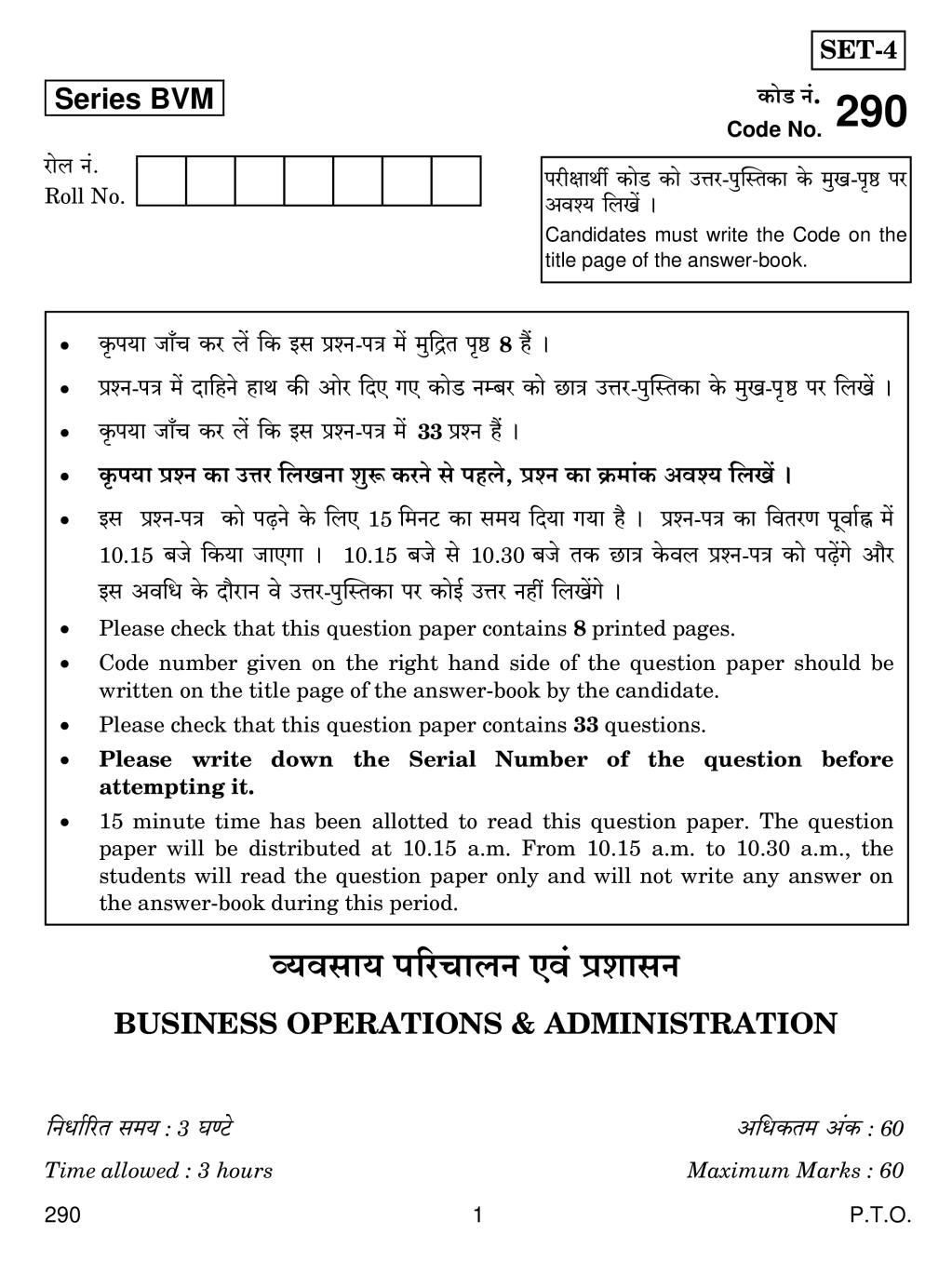
Series BVM H$moS> Z§.
Code No. 290
amob Z§. narjmWu H$moS >H$mo CÎma-nwpñVH$m Ho$ _wI-n¥ð >na
Roll No. Adí` {bIo§ &
Candidates must write the Code on the
title page of the answer-book.
H¥$n`m Om±M H$a b| {H$ Bg àíZ-nÌ _o§ _w{ÐV n¥ð> 8 h¢ &
àíZ-nÌ _| Xm{hZo hmW H$s Amoa {XE JE H$moS >Zå~a H$mo N>mÌ CÎma-nwpñVH$m Ho$ _wI-n¥>ð> na {bI| &
H¥$n`m Om±M H$a b| {H$ Bg àíZ-nÌ _| >33 àíZ h¢ &
H¥$n`m àíZ H$m CÎma {bIZm ewê$ H$aZo go nhbo, àíZ H$m H«$_m§H$ Adí` {bI| &
Bg àíZ-nÌ H$mo n‹T>Zo Ho$ {bE 15 {_ZQ >H$m g_` {X`m J`m h¡ & àíZ-nÌ H$m {dVaU nydm©• _|
10.15 ~Oo {H$`m OmEJm & 10.15 ~Oo go 10.30 ~Oo VH$ N>mÌ Ho$db àíZ-nÌ H$mo n‹T>|Jo Am¡a
Bg Ad{Y Ho$ Xm¡amZ do CÎma-nwpñVH$m na H$moB© CÎma Zht {bI|Jo &
Please check that this question paper contains 8 printed pages.
Code number given on the right hand side of the question paper should be
written on the title page of the answer-book by the candidate.
Please check that this question paper contains 33 questions.
Please write down the Serial Number of the question before
attempting it.
15 minute time has been allotted to read this question paper. The question
paper will be distributed at 10.15 a.m. From 10.15 a.m. to 10.30 a.m., the
students will read the question paper only and will not write any answer on
the answer-book during this period.
ì`dgm` n[aMmbZ Ed§ àemgZ
BUSINESS OPERATIONS & ADMINISTRATION
{ZYm©[aV g_` : 3 KÊQ>o A{YH$V_ A§H$ : 60
Time allowed : 3 hours Maximum Marks : 60
290 1 P.T.O.
Page 2
(i) Bg àíZ-nÌ _| 33 àíZ em{_b h¢ {OZ_| go Aä`Wu H$mo {g\©$ 25 àíZ H$aZo H$s µOê$aV
h¡ &
(ii) àíZ-nÌ Xmo IÊS>m| _| {d^m{OV h¡ &
IÊS> H$
~hþ{dH$ënr` àíZ /[aº ñWmZ ^[aE /grYo àíZ : Hw$b 12 àíZ em{_b h¢ Omo
1 – 1 A§H$ Ho$ h¢ & BZ_| go {H$Ýht 10 àíZm| Ho$ CÎma Xr{OE &
A{V bKw CÎmar` àíZ : Hw$b 7 àíZ em{_b h¢, àË`oH$ 2 A§H$ Ho$ h¢ & BZ_| go
{H$Ýht 5 àíZm| Ho$ CÎma Xr{OE &
bKw CÎmar` àíZ : Hw$b 7 àíZ em{_b h¢, àË`oH$ 3 A§H$ Ho$ h¢ & BZ_| go
{H$Ýht 5 àíZm| Ho$ CÎma Xr{OE &
IÊS> I
XrK© CÎmar` /{Z~ÝYmË_H$ àíZ : Hw$b 7 àíZ em{_b h¢, àË`oH$ 5 A§H$ Ho$ h¢ & BZ_| go
{H$Ýht 5 àíZm| Ho$ CÎma Xr{OE &
General Instructions :
(i) This question paper contains 33 questions out of which the candidate
needs to attempt only 25 questions.
(ii) Question paper is divided into two sections.
SECTION A
Multiple choice questions / Fill in the blanks/Direct questions :
contains total 12 questions of 1 mark each. Answer any 10 questions.
Very short answer type questions : contains total 7 questions of
2 marks each. Answer any 5 questions.
Short answer type questions : contains total 7 questions of 3 marks
each. Answer any 5 questions.
SECTION B
Long answer / Essay type questions : contains total 7 questions of 5 marks
each. Answer any 5 questions.
290 2
Page 3
SECTION A
~hþ{dH$ënr¶ àíZ
Multiple Choice Questions
{ZåZ{b{IV _| go {H$Ýht Xg àíZm| Ho$ CÎma Xr{OE : 1×10=10
Answer any ten of the following questions :
1. g§JR>Z Ho$ gXñ¶m| H$mo g§JR>Z Ho$ gdm}Îm‘ {hV ‘| H$m‘ H$aZo Ho$ {bE àmoËgm{hV H$aZo H$mo
H$hVo h¢
(H$) g§J{R>V H$aZm (I) {Z¶moOZ Am¡a {ZU©¶ boZm
(J) {Z¶§ÌU H$aZm (K) ZoV¥Ëd H$aZm
Motivating members of the organization to work in the best interest of
the organization is called
(a) Organizing (b) Planning and decision-making
(c) Controlling (d) Leading
2. g§JR>Z Ho$ bú¶m| H$s àm{ßV Ho$ {bE AYrZñWm| Ho$ à¶mgm| Ho$ ‘mJ©Xe©Z Am¡a n¶©dojU H$mo
H$hVo h¢
(H$) {Z¶moOZ (I) g§JR>Z
(J) {ZX}eZ (K) {Z¶§ÌU
Guiding and supervising the efforts of subordinates towards the
attainment of the organization’s goals is called
(a) Planning (b) Organizing
(c) Directing (d) Controlling
3. à~§YZ ‘| {Z¶moOZ H$m¶© BZHo$ Ûmam AnojmH¥$V A{YH$ {H$¶m OmVm h¡
(H$) erf© à~§YZ (I) ‘ܶ à~§YZ
(J) {ZMbm à~§YZ (K) Cn`w©³V g^r
Planning function of management is performed relatively more by
(a) Top management (b) Middle management
(c) Lower management (d) All of the above
290 3 P.T.O.
Page 4
(H$) {ZînmXZ – {Z¶moOZ – {Z¶§ÌU
(I) {Z¶moOZ – {Z¶§ÌU – {ZînmXZ
(J) {Z¶§ÌU – {ZînmXZ – {Z¶moOZ
(K) {Z¶moOZ – {ZînmXZ – {Z¶§ÌU
Which of the following represents the proper sequence of events ?
(a) Execution – Planning – Control
(b) Planning – Control – Execution
(c) Control – Execution – Planning
(d) Planning – Execution – Control
5. ‘‘g§JR>Z Ho$ gmonm{ZH$ (Scalar) {gÕm§V’’ Ho$ AZwgma
(H$) EH$ à~§YH$ gr{‘V bmoJm| H$s XoIaoI H$a gH$Vm h¡
(I) àm{YH$ma H$s aoIm ñnîQ> ê$n go n[a^m{fV hmoZr Mm{hE
(J) AgmYmaU ê$n go O{Q>b g‘ñ¶mAm| H$mo Cƒ ñVa Ho$ à~§YZ H$mo ^oOm OmVm h¡
(K) à˶oH$ AYrZñW Ho$ D$na EH$ loîR> (Cƒ A{YH$mar) hmoZm Mm{hE
According to ‘‘Scalar Principle of Organization’’
(a) A manager can directly supervise a limited number of people
(b) The line of authority must be clearly defined
(c) Exceptionally complex problems are referred to higher levels of
management
(d) Each subordinate should have one superior
6. {Z¶§ÌU ‘| g{Þ{hV h¡
(H$) ¶h Om±MZm {H$ H$ƒo ‘mb H$s H$moB© ~a~mXr Z hmo
(I) AYrZñWm| Ho$ H$m‘ H$m n¶©dojU H$aZm
(J) Bg ~mV H$s Om±M H$aZm {H$ à˶oH$ H$m¶© AnZmB© JB© ¶moOZmAm|, {XE JE {ZX}em|
VWm {ZYm©[aV {gÕm§Vm| Ho$ AZwgma hmo ahm h¡
(K) Cn`w©³V g^r
Controlling involves
(a) Checking that there is no wastage of raw material
(b) Supervising the work of the subordinates
(c) Verifying that everything occurs in conformity with the plans
adopted, instructions issued and principles established
(d) All of the above
290 4
Page 5
Bggo ~MZm MmhVo h¢ ?
(H$) E³g {gÕm§V (I) dmB© {gÕm§V
(J) (H$) Am¡a (I) XmoZm| (K) Cn`w©³V ‘| go H$moB© Zht
In which theory is it assumed that people dislike work and seek to avoid
it at all costs ?
(a) Theory X (b) Theory Y
(c) Both (a) and (b) (d) None of the above
8. {ZåZ{b{IV ‘| go H$m¡Z-gm ’o$¶mob Ho$ 14 à~§YZ {gÕm§Vm| ‘| go EH$ Zht h¡ ?
(H$) gh¶moJ H$s ^mdZm (I) nhbe{³V
(J) ì¶dñWm (K) ì¶{³VdmX
Which of the following is not one of Fayol’s 14 principles of
management ?
(a) Esprit de corps (b) Initiative
(c) Order (d) Individualism
9. gwf‘m AnZo AYrZñWm| H$mo {ZU©¶ boZo H$s à{H«$¶m ‘| ^mJ boZo Ho$ {bE àmoËgm{hV
H$aVr h¡ bo{H$Z CÝh| do O¡go Mmho d¡go H$m‘ H$aZo Ho$ {bE nyU© ñdV§ÌVm Zht XoVr & CgH$s
ZoV¥Ëd e¡br h¡
(H$) amOemhr (I) {Za§Hw$e
(J) {Z~m©Y (K) bmoH$Vm§{ÌH$
Sushma encourages her subordinates to participate in the
decision-making process but does not give them complete freedom to do
as they like. Her leadership style is
(a) Monarchial (b) Autocratic
(c) Laissez-faire (d) Democratic
10. {ZåZ{b{IV ‘| go H$m¡Z-gm à~§YH$m| Am¡a ZoVmAm| Ho$ ~rM A§Va Ho$ ~mao ‘| gM Zht h¡ ?
(H$) à~§YH$ {Z¶w³V {H$E OmVo h¢
(I) à~§YH$ AZm¡nMm[aH$ gmYZm| Ho$ ‘mܶ‘ go à^m{dV H$aVo h¢
(J) ZoVmAm| H$mo {Z¶w³V {H$¶m Om gH$Vm h¡
(K) ZoVm Am¡nMm[aH$ àm{YH$mar go D$na OmH$a ^r à^m{dV H$a gH$Vo h¢
Which of the following is not true concerning the difference between
managers and leaders ?
(a) Managers are appointed
(b) Managers influence through informal means
(c) Leaders may be appointed
(d) Leaders can influence beyond formal authority
290 5 P.T.O.
Page 6
(H$) MH«$ H$m g‘¶ N>moQ>m hmoZm (I) bmJVm| ‘| H$Q>m¡Vr
(J) ì¶mnH$ Xe©H$m| VH$ nhþ±M (K) Cn`w©³V g^r
Which of the following are advantages normally associated with B2B
e-commerce ?
(a) Shorter cycle times (b) Reduction in costs
(c) Reaches wider audiences (d) All of the above
12. B©-~¢qH$J H$mo Eogo ^r OmZm OmVm h¡
(H$) Am°Q>mo‘¡{Q>H$ ~¢qH$J (I) ZoQ> ~¢qH$J
(J) nma§n[aH$ ~¢qH$J (K) BH$moZm°{‘H$ ~¢qH$J
e-banking is also known as
(a) Automatic Banking (b) Net Banking
(c) Traditional Banking (d) Economic Banking
A{V bKw CÎmar¶ àíZ
Very Short Answer Type Questions
{ZåZ{b{IV _| go {H$Ýht nm±M àíZm| Ho$ CÎma Xr{OE : 2×5=10
Answer any five of the following questions :
13. d¡km{ZH$ à~§Y H$mo n[a^m{fV H$s{OE &
Define Scientific Management.
14. hoZar ’o$¶mob Ûmam ~Vm¶m J¶m A{YH$ma Ed§ CÎmaXm{¶Ëd H$m {gÕm§V ³¶m h¡ ?
What is the principle of authority and responsibility as stated by Henry
Fayol ?
15. Ho$ÝÐrH$aU go Amn ³¶m g‘PVo h¢ ?
What do you mean by Centralisation ?
16. {Z¶moOZ ³¶m h¡ ?
What is Planning ?
290 6
Page 7
What is Laissez-faire style ?
18. {b{IV gåàofU Ho$ {H$Ýht Xmo bm^m| d Xmo hm{Z¶m| H$mo ~VmBE &
State any two advantages and two disadvantages of written
communication.
19. D$Üd©‘wIr Ed§ AYmo‘wIr gåàofU Ho$ ~rM A§Va ñnîQ> H$s{OE &
Distinguish between upward and downward communication.
bKw CÎmar¶ àíZ
Short Answer Type Questions
{ZåZ{b{IV _| go {H$Ýht nm±M àíZm| Ho$ CÎma Xr{OE : 3×5=15
Answer any five of the following questions :
20. ‘à~ÝY {dkmZ Ed§ H$bm XmoZm| h¡ &’ g§jon ‘| g‘PmBE &
‘Management is both a science and an art.’ Explain in brief.
21. A{^àoaUm H$mo n[a^m{fV H$s{OE &
Define Motivation.
22. ‘¡ñbmo Ho$ Amdí¶H$Vm nXmZwH«$‘ {gÕm§V Ho$ g§X^© ‘| AmË‘-gå‘mZ Am¡a gwajm H$s µOê$aVm|
(Amdí`H$VmAm|) H$mo g‘PmBE &
Explain self-esteem needs and safety needs with reference to Maslow’s
need hierarchy theory.
23. {Z¶§ÌU H$s à{H«$¶m ‘| gpå‘{bV ~w{Z¶mXr H$X‘ ³¶m h¢ ?
What are the basic steps involved in the process of controlling ?
24. ì¶dgm¶ ‘| gyMZm àm¡Úmo{JH$s Ho$ ‘hÎd H$mo g§jon ‘| g‘PmBE &
Explain in brief, the importance of Information Technology in business.
25. B©-H$m°‘g© VWm B©-{~OZog ‘| ³¶m A§Va h¡ ?
What is the difference between e-commerce and e-business ?
26. à~ÝY Ed§ àemgZ Ho$ ~rM A§Va ñnîQ> H$s{OE &
Distinguish between Management and Administration.
290 7 P.T.O.
Page 8
SECTION B
XrK© CÎmar¶ àíZ
Long Answer Type Questions
{ZåZ{b{IV _| go {H$Ýht nm±M àíZm| Ho$ CÎma Xr{OE : 5×5=25
Answer any five of the following questions :
27. à~ÝY H$s n[a^mfm Xr{OE Am¡a ~VmBE {H$ à~ÝY Ho$ H$m¶© EH$-Xÿgao go {H$g àH$ma g§~§{YV
h¢ &
Define Management and explain how the functions of management are
related to each other.
28. à˶m¶moOZ Ed§ {dHo$ÝÐrH$aU Ho$ ~rM A§Va ñnîQ> H$s{OE &
Distinguish between Delegation and Decentralisation.
29. EH$ CXmhaU H$s ghm¶Vm go H$m¶©j‘Vm VWm à^mderbVm Ho$ ~rM A§Va H$mo g‘PmBE &
Explain the difference between Efficiency and Effectiveness with the help
of an example.
30. EH$V§Ìr¶ ZoV¥Ëd ³¶m h¡ ? BgH$s ‘w»¶ {deofVmE± ~VmBE &
What is Autocratic Leadership ? Explain its main characteristics.
31. à^mdnyU© gåàofU H$s {deofVmAm| H$mo g‘PmBE &
Explain the features of Effective Communication.
32. {d{^Þ {hV g‘yhm| Ho$ à{V EH$ ì¶dgm¶ Ho$ gm‘m{OH$ CÎmaXm{¶Ëdm| H$mo g§jon ‘| g‘PmBE &
Explain in brief, the social responsibilities of a business towards different
interest groups.
33. à{ejU H$m ³¶m AW© h¡ ? BgH$s Amdí¶H$Vm Ed§ ‘hÎd H$mo g‘PmBE &
What is meant by Training ? Explain its need and importance.
290 8
Document Details
| Board / Org | CBSE |
| Exam | Class 12 |
| Type | Question Paper |
| Pages | 8 |
| Updated | 30 Apr 2026 |