NIOS Class 12 Question Paper 2021 (Oct) Chemistry
Finished viewing? Save it for later —
Download NIOS Class 12 Question Paper 2021 (Oct) Chemistry (PDF · 24 pages)About NIOS Class 12 Question Paper 2021 (Oct) Chemistry
NIOS Class 12 Question Paper 2021 (Oct) Chemistry is available here for free download. Published by NIOS for National Institute of Open Schooling Class 12, this question paper can be viewed online or downloaded as a PDF (24 pages). Candidates preparing for National Institute of Open Schooling Class 12 can use NIOS Class 12 Question Paper 2021 (Oct) Chemistry to understand the exam pattern, the type of questions asked, and the overall difficulty level.
Frequently Asked Questions
How can I download NIOS Class 12 Question Paper 2021 (Oct) Chemistry?
Open this page and click the Download button to save NIOS Class 12 Question Paper 2021 (Oct) Chemistry as a PDF. It is completely free on AglaSem Docs.
Is NIOS Class 12 Question Paper 2021 (Oct) Chemistry free to download?
Yes. NIOS Class 12 Question Paper 2021 (Oct) Chemistry can be viewed online and downloaded as a PDF free of cost on AglaSem Docs.
How many pages does NIOS Class 12 Question Paper 2021 (Oct) Chemistry have?
NIOS Class 12 Question Paper 2021 (Oct) Chemistry contains 24 pages, which you can read online or download together as a single PDF.
Where can I find more National Institute of Open Schooling Class 12 study material?
You can find more National Institute of Open Schooling Class 12 question papers, sample papers, syllabus, and answer keys on AglaSem Docs.
NIOS Class 12 Question Paper 2021 (Oct) Chemistry – Text
Read the full text of this question paper below — useful to quickly search, copy and reference the content online without downloading the PDF.
📄 View text version (24 pages)
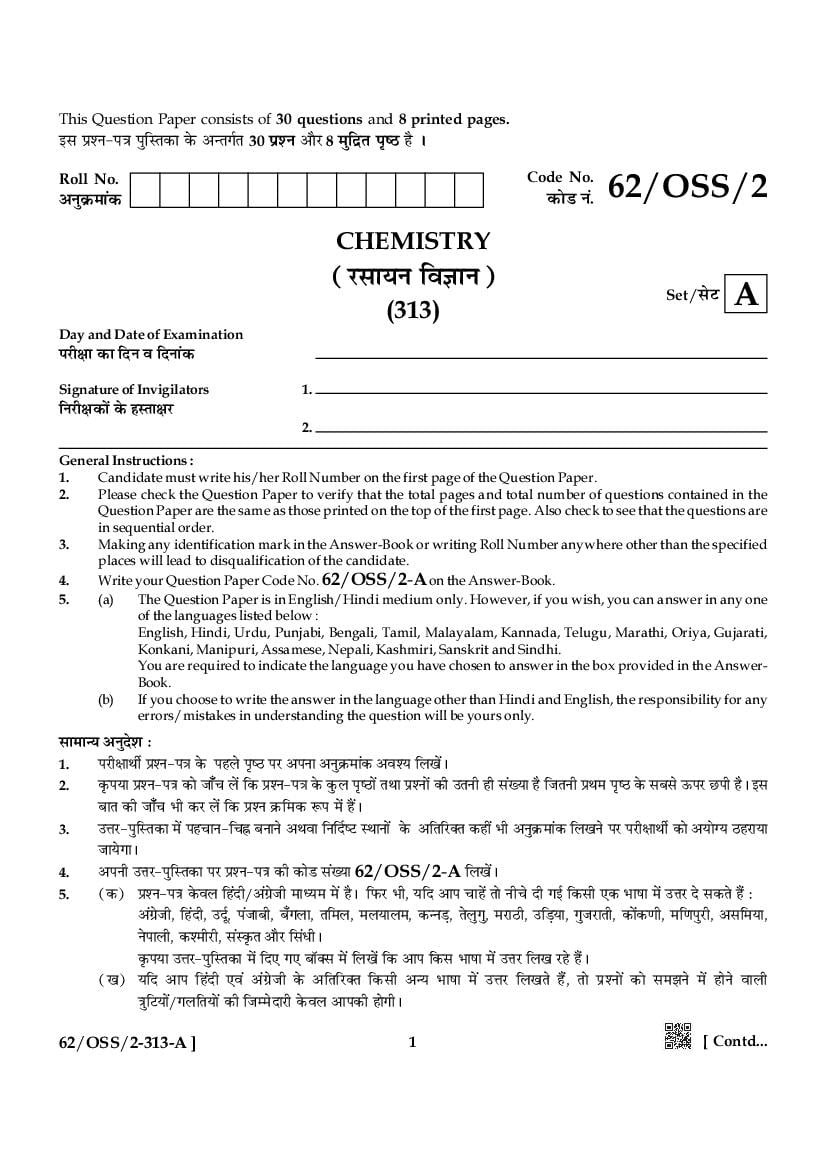
Page 1
ß‚ ¬˝‡Ÿ-¬òÊ ¬ÈÁSÃ∑§Ê ∑§ •ãê¸Ã 30 ¬˝‡Ÿ •ÊÒ⁄ 8 ◊ÈÁŒ˝Ã ¬Îc∆U „Ò –
Roll No. Code No.
•ŸÈ∑˝§◊Ê¥∑§ ∑§Ê«U Ÿ¥. 62/OSS/2
CHEMISTRY
(⁄U‚ÊÿŸ ÁflôÊÊŸ)
(313)
Set/‚≈U A
Day and Date of Examination
¬⁄UˡÊÊ ∑§Ê ÁŒŸ fl ÁŒŸÊ¥∑§
Signature of Invigilators 1.
ÁŸ⁄UˡÊ∑§Ê¥ ∑§ „SÃÊˇÊ⁄U
2.
General Instructions :
1. Candidate must write his/her Roll Number on the first page of the Question Paper.
2. Please check the Question Paper to verify that the total pages and total number of questions contained in the
Question Paper are the same as those printed on the top of the first page. Also check to see that the questions are
in sequential order.
3. Making any identification mark in the Answer-Book or writing Roll Number anywhere other than the specified
places will lead to disqualification of the candidate.
4. Write your Question Paper Code No. 62/OSS/2-A on the Answer-Book.
5. (a) The Question Paper is in English/Hindi medium only. However, if you wish, you can answer in any one
of the languages listed below :
English, Hindi, Urdu, Punjabi, Bengali, Tamil, Malayalam, Kannada, Telugu, Marathi, Oriya, Gujarati,
Konkani, Manipuri, Assamese, Nepali, Kashmiri, Sanskrit and Sindhi.
You are required to indicate the language you have chosen to answer in the box provided in the Answer-
Book.
(b) If you choose to write the answer in the language other than Hindi and English, the responsibility for any
errors/mistakes in understanding the question will be yours only.
‚Ê◊Êãÿ •ŸÈŒ‡Ê —
1. ¬⁄UˡÊÊÕ˸ ¬˝‡Ÿ-¬òÊ ∑§ §¬„‹ ¬Îc∆U ¬⁄U •¬ŸÊ •ŸÈ∑˝§◊Ê¥∑§ •fl‡ÿU Á‹π¥–
2. ∑Χ¬ÿÊ ¬˝‡Ÿ-¬òÊ ∑§Ê ¡ÊÚ°ø ‹¥ Á∑§ ¬˝‡Ÿ-¬òÊ ∑§ ∑ȧ‹ ¬Îc∆UÊ¥ ÃÕÊ ¬˝‡ŸÊ¥ ∑§Ë ©ÃŸË „Ë ‚¥ÅUÿÊ „Ò Á¡ÃŸË ¬˝Õ◊ ¬Îc∆ ∑ §‚’‚ ™§¬⁄U ¿U¬Ë „Ò– ß‚
’Êà ∑§Ë ¡ÊÚ°ø ÷Ë ∑§⁄U ‹¥ Á∑§ ¬˝‡Ÿ ∑˝ Á◊∑§ UM§¬ ◊¥ „Ò¥–
3. § ©ûÊ⁄U-¬ÈÁSUÃ∑§Ê ◊¥ ¬„øÊŸ-Áøq ’ŸÊŸ •ÕflÊ ÁŸÁŒ¸c≈U SÕÊŸÊ¥ ∑§§ •ÁÃÁ⁄UÄà ∑§„Ë¥ ÷Ë •ŸÈ∑˝§◊Ê¥∑§ Á‹πŸ ¬⁄U ¬⁄UˡÊÊÕ˸ ∑§Ê •ÿÊÇÿ ∆U„⁄UÊÿÊ
¡ÊÿªÊ–
4. •¬ŸË ©ûÊ⁄U-¬ÈÁSUÃ∑§Ê ¬⁄U ¬˝‡Ÿ-¬òÊ ∑§Ë ∑§Ê«U ‚¥ÅÿÊ 62/OSS/2-A Á‹π¥–
5. (∑§) ¬˝‡Ÿ-¬òÊ ∑§fl‹ Á„¥ŒË/•¥ª˝¡Ë ◊Êäÿ◊ ◊¥ „Ò– Á»§⁄U ÷Ë, ÿÁŒ •Ê¬ øÊ„¥ ÃÊ ŸËø ŒË ªß¸ Á∑§‚Ë ∞∑§ ÷Ê·Ê ◊¥ ©ûÊ⁄ Œ ‚∑§Ã „Ò¥ —
•¥ª˝¡Ë, Á„¥ŒË, ©ŒÍ¸, ¬¥¡Ê’Ë, ’°ª‹Ê, ÃÁ◊‹, ◊‹ÿÊ‹◊, ∑§ãŸ«∏, ËȪÈ, ◊⁄UÊ∆UË, ©Á«∏ÿÊ, ªÈ¡⁄UÊÃË, ∑§Ê¥∑§áÊË, ◊ÁáʬÈ⁄UË, •‚Á◊ÿÊ,
Ÿ¬Ê‹Ë, ∑§‡◊Ë⁄UË, ‚¥S∑Χç•ÊÒ⁄U Á‚¥œË–
∑Χ¬ÿÊ ©ûÊ⁄U-¬ÈÁSÃ∑§Ê ◊¥ ÁŒ∞ ª∞ ’ÊÚÄ‚ ◊¥ Á‹π¥ Á∑§ •Ê¬ Á∑§‚ ÷Ê·Ê ◊¥ ©ûÊ⁄U Á‹π ⁄U„ „Ò¥– §
(π) ÿÁŒ •Ê¬ Á„¥ŒË ∞fl¥ •¥ª˝¡Ë ∑§ •ÁÃÁ⁄UÄà Á∑§‚Ë •ãÿ ÷Ê·Ê ◊¥ ©ûÊ⁄U Á‹πà „Ò¥, ÃÊ ¬˝‡ŸÊ¥ ∑§Ê ‚◊¤ÊŸ ◊¥ „ÊŸ flÊ‹Ë
òÊÈÁ≈UÿÊ¥/ª‹ÁÃÿÊ¥ ∑§Ë Á¡ê◊UŒÊ⁄Ë ∑ fl‹ •Ê¬∑§Ë „ʪ˖
62/OSS/2-313-A ] 1 [ Contd...
Page 2
(⁄U‚ÊÿŸ ÁflôÊÊŸ)
(313)
Time : 3 Hours ] [ Maximum Marks : 80
‚◊ÿ — 3 ÉÊá≈U ] [ ¬ÍáÊÊZ∑§ — 80
Note : (i) All questions are compulsory.
(ii) Marks allotted are indicated against each question.
(iii) Each question from Question Nos. 1 to 10 has four alternatives - (A), (B), (C) and (D),
out of which one is the most appropriate. Choose the correct answer among the four
alternatives and write it in your Answer-Book against the Number of the question. No
extra time is allotted for attempting multiple choice questions.
(iv) Use log tables, if necessary.
ÁŸŒ¸‡Ê — (i) ‚÷Ë ¬˝‡ŸÊ¥ ∑§ ©ûÊ⁄U ŒËÁ¡∞–
(ii) ¬˝àÿ∑§ ¬˝‡Ÿ ∑§ ‚Ê◊Ÿ ©‚∑§ •¥∑§ Œ‡Êʸÿ ª∞ „Ò¥–
(iii) ¬˝‡Ÿ ‚¥ÅÿÊ 1 ‚ 10 ◊¥ ¬˝àÿ∑§ ¬˝‡Ÿ ◊¥ øÊ⁄U Áfl∑§À¬ - (A), (B), (C) ÃÕÊ (D) „Ò¥, Á¡Ÿ◊¥ ‚ ∞∑§ ‚’‚
©¬ÿÈÄàÊ „Ò¥– øÊ⁄UÊ¥ Áfl∑§À¬Ê¥ ◊¥ ‚ ‚„Ë ©ûÊ⁄U øÈŸ¥ ÃÕÊ •¬ŸË ©ûÊ⁄U-¬ÈÁSÃ∑§Ê ◊¥ ¬˝‡Ÿ ‚¥ÅÿÊ ∑§ ‚Ê◊Ÿ ©ûÊ⁄U Á‹π¥–
’„ÈÁfl∑§À¬Ë ¬˝‡ŸÊ¥ ∑§ Á‹ÿ •ÁÃÁ⁄UÄàÊ ‚◊ÿ Ÿ„Ë¥ ÁŒÿÊ ¡ÊÿªÊ–
(iv) ÿÁŒ •Êfl‡ÿ∑§ „Ê, ÃÊ ‹ÊÚª ≈U’‹ ∑§Ê ¬˝ÿʪ ∑§⁄¥U–
1. The total number of electrons which can be accommodated in all orbitals having principal 1
quantum number 2 and azimuthul quantum number 1 is :
(A) 2 (B) 4 (C) 6 (D) 8
ÿÁŒ ◊ÈÅÿ Ä√ÊÊ¥≈U◊ ‚¥ÅÿÊ 2 ÃÕÊ ∞¡ËêÿÍÕ‹ Ä√ÊÊ¥≈U◊ ‚¥ÅÿÊ 1 „Ò ÃÊ ‚÷Ë ∑§ˇÊ∑§Ê¥ ◊¥ Á∑§ÃŸ ß‹Ä≈˛UÊÚŸ ÷⁄U ¡Ê ‚∑§Ã „Ò¥?
(A) 2 (B) 4 (C) 6 (D) 8
2. The wavelength of the electro-magnetic radiation having a frequency of 1368 kHz will be : 1
(A) 219.3 m (B) 222.3 m (C) 216.3 m (D) 225.3 m
1368 kHz •ÊflÎÁûÊ flÊ‹Ë ÁfllÈÃ-øÈê’∑§Ëÿ ÁflÁ∑§⁄UáÊ ∑§Ë Ã⁄¥UªŒÒäÿ¸ „ÊªË —
(A) 219.3 m (B) 222.3 m (C) 216.3 m (D) 225.3 m
3. The colloidal solutions are purified by : 1
(A) Peptisation (B) Coagulation (C) Dialysis (D) Emulsification
∑§Ê‹Êß«UË Áfl‹ÿŸÊ¥ ∑§Ê ‡ÊÊœŸ Á∑§‚ ÁflÁœmÊ⁄UÊ Á∑§ÿÊ ¡ÊÃÊ „Ò?
(A) ¬å≈UÊß¡Ë∑§⁄UáÊ (B) S∑¥§ŒŸ (C) •¬Ê„Ÿ (D) ¬Êÿ‚Ë∑§⁄UáÊ
62/OSS/2-313-A ] 2 [ Contd...
Page 3
(A) Ideal gas equation (B) Real gas equation
(C) Compressibility factor (D) Gas constant
PV=nRT ∑§Ê •ŸÈ¬Êà „ÊÃÊ „Ò —
(A) •ÊŒ‡Ê¸ ªÒ‚ ‚◊Ë∑§⁄UáÊ (B) flÊSÃÁfl∑§ ªÒ‚ ‚◊Ë∑§⁄UáÊ
(C) ‚¥¬Ë«˜UÿÃÊ ªÈáÊ∑§ (D) ªÒ‚ ÁSÕ⁄UÊ¥∑§
5. AlCl3 is a : 1
(A) Lewis acid (B) Lewis base (C) Bronsted acid (D) Bronsted base
AlCl3 „Ò —
(A) ‹Íß‚ •ê‹ (B) ‹Íß‚ ˇÊÊ⁄U (C) ’˝Ê°S≈U«U •ê‹ (D) ’˝Ê°S≈U«U ˇÊÊ⁄U
6. In a hydrogen - oxygen fuel cell, combustion of hydrogen occurs to : 1
(A) produce high purity water
(B) create potential difference between two electrodes
(C) generate heat
(D) remove adsorbed oxygen from electrode surface
„Êß«˛UÊ¡Ÿ-•ÊÚÄ‚Ë¡Ÿ ßZœŸ ‚‹ ◊¥, „Êß«˛UÊ¡Ÿ ∑§Ê Œ„Ÿ Á∑§‚ Á‹∞ „ÊÃÊ „Ò?
(A) ©ìÊ ‡ÊÈhÃÊ ∑§Ê ¡‹ ©à¬ãŸ ∑§⁄UŸ ∑§ Á‹∞
(B) ŒÊ ß‹Ä≈˛UÊ«UÊ¥ ∑§ ’Ëø Áfl÷flÊãÃ⁄U ©à¬ãŸ ∑§⁄UŸ ∑§ Á‹∞
(C) ™§c◊Ê ©à¬ãŸ ∑§⁄UŸ ∑§ Á‹∞
(D) ß‹Ä≈˛UÊ«U ‚ •Áœ‡ÊÊÁ·Ã •ÊÚÄ‚Ë¡Ÿ „≈UÊŸ ∑§ Á‹∞
7. Which one of the following has S–O–S bond ? 1
(A) H2S2O8 (B) H2S2O7 (C) H 2S 2O 4 (D) H 2S 2O 5
ÁŸêŸÁ‹Áπà ◊¥ ‚ Á∑§‚◊¥ S–O–S •Ê’¥œ „ÊÃÊ „Ò?
(A) H 2S 2O 8 (B) H 2S 2O 7 (C) H 2S 2O 4 (D) H 2S 2O 5
8. Compound (A) on heating gives an oxide. This oxide is used for white washing when mixed 1
with water (A) is :
(A) Ca2(PO4)3 (B) CaCO 3 (C) Ca(OH)2 (D) CaSO 4
ÿÊÒÁª∑§ (A) ∑§Ê ª◊¸ ∑§⁄UŸ ¬⁄U ∞∑§ •ÊÚÄ‚Êß«U ’ŸÃÊ „Ò, ¡’ ß‚ •ÊÚÄ‚Êß«U ∑§Ê ¡‹ ∑§ ‚ÊÕ Á◊ÁüÊà ∑§⁄Uà „Ò¥ ÃÊ ‚»§ŒË
∑§⁄UŸ ∑§ Á‹∞ ©¬ÿʪ „ÊÃÊ „Ò– ÿÊÒÁª∑§ (A) „Ò —
(A) Ca2(PO4)3 (B) CaCO 3 (C) Ca(OH)2 (D) CaSO 4
1
9. The correct IUPAC name of is :
(A) Methyl ethanoate (B) Aceto ethanoate
(C) Ethanoic anhydride (D) Ethanoyl ethanoate
∑§Ê •Ê߸.ÿÍ.¬Ë.∞.‚Ë. ∑§ •ŸÈ‚Ê⁄U ‚„Ë ŸÊ◊ „Ò —
(A) ◊ÁÕ‹ ∞ÕŸÊÚ∞≈U (B) ∞‚Ë≈UÊ ∞ÕŸÊÚ∞≈U
(C) ∞ÕŸÊß∑§ ∞ã„Êß«˛UÊß«U (D) ∞ÕÊŸÊÚß‹ ∞ÕŸÊÚ∞≈U
62/OSS/2-313-A ] 3 [ Contd...
Page 4
10. C2H5OH → X
→ Y →Z
H2O, Heat
In the above reaction sequence, Z is :
(A) CH2=CH2 (B)
(C) CH3−CH2−O−CH2−CH3 (D) CH3−CH2−OH
PBr3 ∞À∑§Ê„ÊÚ‹Ë KOH iH 2 SO 4
C2H5OH → X → Y →Z
H 2 O, ª◊ ¸
©¬ÿȸÄàÊ •Á÷Á∑˝§ÿÊ •ŸÈ∑˝§◊ ◊¥, Z „Ò —
(A) CH2=CH2 (B)
(C) CH3−CH2−O−CH2−CH3 (D) CH3−CH2−OH
11. What is meant by molar volume ? How is it related with density ? What are the STP conditions 2
at which molar volume is measured ?
◊Ê‹⁄U •Êÿß ‚ ÄÿÊ •Á÷¬˝Êÿ „Ò? ÿ„ ÉÊŸàfl ‚ Á∑§‚ ¬˝∑§Ê⁄U ‚¥’¥ÁœÃ „ÊÃÊ „Ò? Á∑§‚ ◊ÊŸ∑§ Ãʬ •ÊÒ⁄U ŒÊ’ ¬⁄U ◊Ê‹⁄U
•Êÿß ∑§Ê ◊Ê¬Ê ¡ÊÃÊ „Ò?
12. 4 g of copper chloride was found to contain 1.890 g of copper and 2.110 g of chlorine. 2
Calculate the percentage of copper and chlorine in it.
4 g ∑§ÊÚ¬⁄U Ä‹Ê⁄UÊß«U ◊¥ 1.890 g ∑§ÊÚ¬⁄U ÃÕÊ 2.110 g Ä‹Ê⁄UËŸ „Ò¥ ÃÊ ß‚◊¥ ∑§ÊÚ¬⁄U •ÊÒ⁄U Ä‹Ê⁄UËŸ ∑§Ë ¬˝ÁÇÊà ◊ÊòÊÊ
¬Á⁄U∑§Á‹Ã ∑§ËÁ¡∞–
13. State Heisenberg uncertainty principle. Write its mathematical expression. 2
„Êß¡Ÿ’ª¸ •ÁŸÁ‡øÃÃÊ Á‚hʥà ∑§Ê S¬c≈U ∑§ËÁ¡∞– ß‚∑§Ê ªÁáÊÃËÿ √ÿ¥¡∑§ Á‹Áπ∞–
14. What is difference between diffusion and effusion ?
2
Áfl‚⁄UáÊ •ÊÒ⁄U ÁŸS‚⁄UáÊ ◊¥ ÄÿÊ •¥Ã⁄U „ÊÃÊ „Ò?
15. State the first law of thermodynamics. What is its limitation ? 2
™§c◊ʪÁÃ∑§Ë ∑§ ¬˝Õ◊ ÁŸÿ◊ ∑§Ê ©À‹π ∑§ËÁ¡∞– ß‚ ÁŸÿ◊ ∑§Ë ‚Ë◊Ê ÄÿÊ „Ò?
16. By the electrolysis of H2SO4 (50% W/W) followed by distillation compound (A) is obtained. 2
Compound (A) reacts with MnCl2 in alkaline medium to give a brown coloured compound
(B). Identify (A) and (B) and also write the chemical equation for the reaction of (A) with
MnCl2.
•Ê‚flŸ ∑§ ‚ÊÕ ‚ÀçÿÍÁ⁄U∑§ ∞Á‚«U (50% W/W) ∑§Ê ÁfllÈà •¬ÉÊ≈UŸ ∑§⁄UŸ ¬⁄U ÿÊÒÁª∑§ (A) ¬˝ÊåàÊ „ÊÃÊ „Ò– ÿÊÒÁª∑§
(A) ˇÊÊ⁄UËÿ ◊Êäÿ◊ ◊¥ MnCl2 ‚ •Á÷Á∑˝§ÿÊ ∑§⁄U∑§ ÷Í⁄U ⁄¥Uª ∑§Ê ÿÊÒÁª∑§ (B) ’ŸÊÃÊ „Ò– (A) •ÊÒ⁄U (B) ∑§Ê ¬„øÊÁŸ∞
•ÊÒ⁄U (A) ∑§Ë MnCl2 ∑§ ‚ÊÕ •Á÷Á∑˝§ÿÊ ∑§Ë ⁄UÊ‚ÊÿÁŸ∑§ ‚◊Ë∑§⁄UáÊ ÷Ë Á‹Áπ∞–
62/OSS/2-313-A ] 4 [ Contd...
Page 5
(a) Chlorobenzene to Toluene
(b) Decanol to Decanal
•Ê¬ ÁŸêŸÁ‹Áπà ¬Á⁄UfløŸÊ¥ ∑§Ê Á∑§‚ ¬˝∑§Ê⁄U ‚ê¬ãŸ ∑§⁄¥Uª?
(a) Ä‹Ê⁄UÊ’ã¡ËŸ ∑§Ê ≈UÊÚ‹Í߸Ÿ ◊¥
(b) «U∑§Ê•ÊÚ‹ ∑§Ê «U∑§ÊŸÒ‹ ◊¥
18. How do thermoplastic differ from thermosetting polymers ? 2
Õ◊ʸå‹ÊÁS≈U∑§, Õ◊ʸ‚Á≈¥Uª ’„È‹∑§Ê¥ ‚ Á∑§‚ ¬˝∑§Ê⁄U Á÷㟠„Êà „Ò¥?
19. Name the polymer which is formed by the condensation of 3-hydroxybutanoic acid and 2
3-hydroxypentanoic acid. Give the structure of the polymer formed.
3-„Êß«˛UÊÚÄ‚ËéÿÍ≈UŸÊÚß∑§ •ê‹ •ÊÒ⁄U 3-„Êß«˛UÊÚĂˬã≈UŸÊÚß∑§ •ê‹ ∑§ ‚¥ÉÊŸŸ ‚ ’ŸŸ flÊ‹ ’„È‹∑§ ∑§Ê ŸÊ◊ Á‹Áπ∞–
’ŸŸ flÊ‹ ’„È‹∑§ ∑§Ë ‚¥⁄UøŸÊ ÷Ë ŒËÁ¡∞–
20. (a) The observed and calculated molar mass of KCl is 38.75 g mol−1 and 75.5 g per mole 4
respectively. Calculate the Van’t-Hoff factor.
(b) The relative lowering of vapour pressure produced by dissolving 7.2 g of substance in
100 g of water is 0.00715. Calculate the molar mass of the substance.
(a) KCl ∑§Ê ¬˝ÁˇÊà •ÊÒ⁄U ¬Á⁄U∑§Á‹Ã ◊Ê‹⁄U Œ˝√ÿ◊ÊŸ ∑˝§◊‡Ê— 38.75 g ¬˝Áà ◊Ê‹ •ÊÒ⁄U 75.5 g ¬˝Áà ◊Ê‹ „Ò–
flÊã≈U„Ê»§ ∑§Ê⁄U∑§ ¬Á⁄U∑§Á‹Ã ∑§ËÁ¡∞–
(b) 7.2 g ¬ŒÊÕ¸ ∑§Ê 100 g ¬ÊŸË ◊¥ Áfl‹ÿ ∑§⁄UŸ ¬⁄U flÊc¬ ŒÊ’ ∑§Ê •Ê¬ÁˇÊ∑§ •flŸ◊Ÿ 0.00715 „Ò– ¬ŒÊÕ¸ ∑§Ê
◊Ê‹⁄U Œ˝√ÿ◊ÊŸ ¬Á⁄U∑§Á‹Ã ∑§ËÁ¡∞–
4
21. Calculate the enthalpy change in the reaction.
4NH3(g)+3O2(g) → 2N2(g)+6H2O(l) at 298 K. Given that enthalpy of formation for NH 3(g)
and H2O(l) are −46.0 kJ mol−1 and −286.0 kJ mol−1 respectively. Also mention the standard
enthalpy of formation of an element.
298 K Ãʬ ¬⁄U ŒË ªß¸ •Á÷Á∑˝§ÿÊ.
4NH3(g)+3O2(g) → 2N2(g)+6H2O(l) ∑§Ê ∞¥ÕÒÀ¬Ë ¬Á⁄UfløŸ ¬Á⁄U∑§Á‹Ã ∑§ËÁ¡∞– NH3(g) •ÊÒ⁄U H2O(l)
∑§Ë ‚¥÷flŸ ∞¥ÕÒÀ¬Ë ∑˝§◊‡Ê— −46.0 kJ mol−1 •ÊÒ⁄U−286.0 kJ mol−1 „Ò– Á∑§‚Ë Ãàfl ∑§Ë ◊ÊŸ∑§ ‚¥÷flŸ
∞ãÕÒÀ¬Ë ∑§Ê ÷Ë ©À‹π ∑§ËÁ¡∞–
4
22. (a) What is Polyprotic acid ? Give two examples.
(b) Calculate the pH of 1×10⁻³ M aqueous solution of NaOH.
(a) ’„Ȭ˝ÊÁ≈U∑§ •ê‹ ÄÿÊ „ÊÃÊ „Ò? ŒÊ ©ŒÊ„⁄UáÊ ŒËÁ¡∞–
(b) 1×10⁻³ M NaOH ∑§ ¡‹Ëÿ Áfl‹ÿŸ ∑§Ë pH ¬Á⁄U∑§Á‹Ã ∑§ËÁ¡∞–
62/OSS/2-313-A ] 5 [ Contd...
Page 6
(i) Although Lithium has the most negative Eo value, its reaction with water is less vigorous
than that of sodium with least negative Eo in the group.
(ii) Lithium shows properties similar to magnesium.
(iii) Zr (Atomic Number 40) and Hf (Atomic Number 72) have almost same atomic radii.
(iv) Transition elements are generally paramagnetic in nature.
ÁŸêŸÁ‹Áπà ∑§Ë √ÿÊÅÿÊ ∑§ËÁ¡∞ —
(i) ÿlÁ¬ ‹ËÁÕÿ◊ ∑§Ê Eo ◊ÊŸ •Áœ∑§Ã◊ ´§áÊÊà◊∑§ „Ò, ¬ÊŸË ‚ ß‚∑§Ë •Á÷Á∑˝§ÿÊ ‚ÊœÊ⁄UáÊÃÿÊ ‚ÊÁ«Uÿ◊,
Á¡‚∑§Ê ‚◊Í„ ◊¥ ‚’‚ ∑§◊ ´§áÊÊà◊∑§ Eo „ÊÃÊ „Ò, ∑§Ë ÃÈ‹ŸÊ ◊¥ ∑§◊ ¬˝’‹ „ÊÃË „Ò–
(ii) ‹ËÁÕÿ◊, ◊ÒÇŸËÁ‡Êÿ◊ ∑§ ‚◊ÊŸ ªÈáÊœ◊¸ Œ‡ÊʸÃÊ „Ò¥–
(iii) Zr (¬⁄U◊ÊáÊÈ ∑˝§◊Ê¥∑§ 40) •ÊÒ⁄U Hf (¬⁄U◊ÊáÊÈ ∑˝§◊Ê¥∑§ 72) ∑§Ê ¬⁄U◊ÊáÊÈ •Ê∑§Ê⁄U ‹ª÷ª ∞∑§ ‚◊ÊŸ „ÊÃÊ „Ò–
(iv) ¬˝∑ΧÁà ◊¥ ‚¥∑˝§◊áÊ Ãàfl ‚ÊœÊ⁄UáÊÃÿÊ •ŸÈøÈê’∑§Ëÿ „Êà „Ò¥–
24. Complete the following reactions : 4
(i) Al2O3+2NaOH →
(ii) O3+2FeSO4+H2SO4 →
(iii) K2Cr2O7+H2SO4+3SO2 →
(iv) 6XeF4+12H2O →
ÁŸêŸÁ‹Áπà •Á÷Á∑˝§ÿÊ•Ê¥ ∑§Ê ¬Íáʸ ∑§ËÁ¡∞ —
(i) Al2O3+2NaOH →
(ii) O3+2FeSO4+H2SO4 →
(iii) K2Cr2O7+H2SO4+3SO2 →
(iv) 6XeF4+12H2O →
25. Illustrate the following reactions giving a chemical equation for each : 4
(a) Kolbe’s reaction
(b) Hofmann’s Bromamide reaction
ÁŸêŸÁ‹Áπà •Á÷Á∑˝§ÿÊ•Ê¥ ∑§Ê ©ŒÊ„⁄UáÊ ŒÃ „È∞ √ÿÊÅÿÊ ∑§ËÁ¡∞ —
(a) ∑§ÊÀ’ •Á÷Á∑˝§ÿÊ
(b) „ÊÚ»§◊ÊŸ ’˝Ê◊Ê◊Êß«U •Á÷Á∑˝§ÿÊ
26. (a) Arrange the following in order of their increasing stability : 4
Justify your answer.
(b) How will you distinguish between primary, secondary and tertiary alcohols ?
(a) ÁŸêŸÁ‹Áπà ∑§Ê ©Ÿ∑§ SÕÊÁÿàfl ∑§ •Ê⁄UÊ„Ë ∑˝§◊ ◊¥ √ÿflÁSÕà ∑§ËÁ¡∞ —
•¬Ÿ ©ûÊ⁄U ∑§Ê •ÊÒÁøàÿ ŒËÁ¡∞–
(b) •Ê¬ ¬˝ÊÕÁ◊∑§, ÁmÃËÿ∑§ •ÊÒ⁄U ÃÎÃËÿ∑§ ∞À∑§Ê„ÊÚ‹Ê¥ ◊¥ Á∑§‚ ¬˝∑§Ê⁄U Áfl÷Œ ∑§⁄¥Uª?
62/OSS/2-313-A ] 6 [ Contd...
Page 7
(i) AgCl, AgI (ii) LiCl, KCl
(b) Predict the molecular geometrics of AX4 type molecules having :
(i) 4 bond pairs and no lone pairs,
(ii) 2 bond pairs and 2 lone pairs
Justify your answer.
(c) Be2 molecule does not exist. Explain on the basis of molecular orbital theory.
(a) ÁŒ∞ ª∞ ÿÈÇ◊Ê¥ ◊¥ ∑§ÊÒŸ ‚Ê •Áœ∑§ ‚„‚¥ÿÊ¡∑§ „Ò •ÊÒ⁄U ÄÿÊ¥?
(i) AgCl, AgI (ii) LiCl, KCl
(b) AX4 ¬˝∑§Ê⁄U ∑§ •áÊÈ•Ê¥ ∑§Ë •ÊÁáfl∑§ íÿÊÁ◊ÁÃÿÊ¥ ∑§Ë ¬˝ÊªÈÁÄàÊ ∑§ËÁ¡∞ ¡’ ©Ÿ◊¥ „Ò¥ —
(i) 4 •Ê’¥œ ÿÈÇ◊ •ÊÒ⁄U ‡ÊÍãÿ ∞∑§∑§ ÿÈÇ◊ ÃÕÊ
(ii) 2 •Ê’¥œ ÿÈÇ◊ •ÊÒ⁄U 2 ∞∑§∑§ ÿÈÇ◊–
•¬Ÿ ©ûÊ⁄U ∑§Ê •ÊÒÁøàÿ ŒËÁ¡∞–
(c) Be2 •áÊÈ ∑§Ê •ÁSÃàfl Ÿ„Ë¥ „ÊÃÊ „Ò– •ÊÁáfl∑§ ∑§ˇÊ∑§ Á‚hʥà ∑§ •ÊœÊ⁄U ¬⁄U ß‚∑§Ë √ÿÊÅÿÊ ∑§ËÁ¡∞–
28. (a) Derive the units of rate constants K for the first and second order reaction. 6
(b) Define molar conductivity. How molar conductivity varies with concentration ?
(c) Define solubility product (K sp) and solubility equilibrium.
(a) ¬˝Õ◊ ∑§ÊÁ≈U •ÊÒ⁄U ÁmÃËÿ ∑§ÊÁ≈U ∑§Ë •Á÷Á∑˝§ÿÊ•Ê¥ ∑§ Á‹∞ Œ⁄U ÁSÕ⁄UÊ¥∑§ K ∑§Ë ß∑§ÊßÿÊ¥ ∑§Ê √ÿÈà¬ãŸ ∑§ËÁ¡∞–
(b) ◊Ê‹⁄U øÊ‹∑§ÃÊ ∑§Ê ¬Á⁄U÷ÊÁ·Ã ∑§ËÁ¡∞– ‚Ê¥Œ˝ÃÊ ∑§ ‚ÊÕ ◊Ê‹⁄U øÊ‹∑§ÃÊ ◊¥ Á∑§‚ ¬˝∑§Ê⁄U ¬Á⁄UfløŸ „ÊÃÊ „Ò?
(c) Áfl‹ÿÃÊ ©à¬ÊŒ (Ksp) •ÊÒ⁄U Áfl‹ÿÃÊ ‚Êêÿ ∑§Ê ¬Á⁄U÷ÊÁ·Ã ∑§ËÁ¡∞–
29. (a) [Fe(H2O)6]2+ complex is paramagnetic whereas [Fe(CN)6]4− is diamagnetic. Explain 6
on the basis of crystal field theory.
(b) Write the IUPAC name, coordination number and oxidation state of cobalt in
[Co(en)2 (H2O) CN]2+.
(c) What is linkage isomerism ? Give one example.
[Atomic number : Fe=26, Co=27]
(a) [Fe(H2O)6]2+ ‚¥∑ȧ‹ •ŸÈøÈê’∑§Ëÿ „ÊÃÊ „Ò ¡’Á∑§ [Fe(CN)6]4− ‚¥∑ȧ‹ ¬˝ÁÃøÈê’∑§Ëÿ– Á∑˝§S≈U‹ ˇÊòÊ
Á‚hÊãà ∑§ •ÊœÊ⁄U ¬⁄U ß‚∑§Ë √ÿÊÅÿÊ ∑§ËÁ¡∞–
(b) [Co(en)2 (H2O) CN]2+ ∑§Ê •Ê߸.ÿÍ.¬Ë.∞.‚Ë. ŸÊ◊, ©¬‚„‚¥ÿÊ¡∑§ ‚¥ÅÿÊ •ÊÒ⁄U ∑§Ê’ÊÀ≈U ∑§Ë •ÊÚÄ‚Ë∑§⁄UáÊ
•flSÕÊ Á‹Áπ∞–
(c) ’¥œŸË ‚◊ÊflÿflÃÊ ÄÿÊ „ÊÃË „Ò? ß‚∑§Ê ∞∑§ ©ŒÊ„⁄UáÊ ŒËÁ¡∞–
[¬⁄U◊ÊáÊÈ ∑˝§◊Ê¥∑§ — Fe=26, Co=27]
62/OSS/2-313-A ] 7 [ Contd...
Page 8
NaNO2/HCl
(i) (ii) CH3CH2NH2 →
(iii) (iv)
ether
(v) (vi) CH3CH2 MgBr + (CH3 )2 C = O →
H2O
ÁŸêŸÁ‹Áπà •Á÷Á∑˝§ÿÊ•Ê¥ ◊¥ ◊ÈÅÿ ©à¬ÊŒÊ¥ ∑§Ë ¬˝ÊªÈÁÄàÊ ∑§ËÁ¡∞ —
NaNO2/HCl
(i) (ii) CH3CH2NH2 →
(iii) (iv)
ether
(v) (vi) CH3CH2 MgBr + (CH 3 )2 C = O →
H2 O
-o0o-
62/OSS/2-313-A ] 8 [ Contd...
Page 9
ß‚ ¬˝‡Ÿ-¬òÊ ¬ÈÁSÃ∑§Ê ∑§ •ãê¸Ã 30 ¬˝‡Ÿ •ÊÒ⁄ 8 ◊ÈÁŒ˝Ã ¬Îc∆U „Ò –
Roll No. Code No.
•ŸÈ∑˝§◊Ê¥∑§ ∑§Ê«U Ÿ¥. 62/OSS/2
CHEMISTRY
(⁄U‚ÊÿŸ ÁflôÊÊŸ)
(313)
Set/‚≈U B
Day and Date of Examination
¬⁄UˡÊÊ ∑§Ê ÁŒŸ fl ÁŒŸÊ¥∑§
Signature of Invigilators 1.
ÁŸ⁄UˡÊ∑§Ê¥ ∑§ „SÃÊˇÊ⁄U
2.
General Instructions :
1. Candidate must write his/her Roll Number on the first page of the Question Paper.
2. Please check the Question Paper to verify that the total pages and total number of questions contained in the
Question Paper are the same as those printed on the top of the first page. Also check to see that the questions are
in sequential order.
3. Making any identification mark in the Answer-Book or writing Roll Number anywhere other than the specified
places will lead to disqualification of the candidate.
4. Write your Question Paper Code No. 62/OSS/2-B on the Answer-Book.
5. (a) The Question Paper is in English/Hindi medium only. However, if you wish, you can answer in any one
of the languages listed below :
English, Hindi, Urdu, Punjabi, Bengali, Tamil, Malayalam, Kannada, Telugu, Marathi, Oriya, Gujarati,
Konkani, Manipuri, Assamese, Nepali, Kashmiri, Sanskrit and Sindhi.
You are required to indicate the language you have chosen to answer in the box provided in the Answer-
Book.
(b) If you choose to write the answer in the language other than Hindi and English, the responsibility for any
errors/mistakes in understanding the question will be yours only.
‚Ê◊Êãÿ •ŸÈŒ‡Ê —
1. ¬⁄UˡÊÊÕ˸ ¬˝‡Ÿ-¬òÊ ∑§ §¬„‹ ¬Îc∆U ¬⁄U •¬ŸÊ •ŸÈ∑˝§◊Ê¥∑§ •fl‡ÿU Á‹π¥–
2. ∑Χ¬ÿÊ ¬˝‡Ÿ-¬òÊ ∑§Ê ¡ÊÚ°ø ‹¥ Á∑§ ¬˝‡Ÿ-¬òÊ ∑§ ∑ȧ‹ ¬Îc∆UÊ¥ ÃÕÊ ¬˝‡ŸÊ¥ ∑§Ë ©ÃŸË „Ë ‚¥ÅUÿÊ „Ò Á¡ÃŸË ¬˝Õ◊ ¬Îc∆ ∑ §‚’‚ ™§¬⁄U ¿U¬Ë „Ò– ß‚
’Êà ∑§Ë ¡ÊÚ°ø ÷Ë ∑§⁄U ‹¥ Á∑§ ¬˝‡Ÿ ∑˝ Á◊∑§ UM§¬ ◊¥ „Ò¥–
3. § ©ûÊ⁄U-¬ÈÁSUÃ∑§Ê ◊¥ ¬„øÊŸ-Áøq ’ŸÊŸ •ÕflÊ ÁŸÁŒ¸c≈U SÕÊŸÊ¥ ∑§§ •ÁÃÁ⁄UÄà ∑§„Ë¥ ÷Ë •ŸÈ∑˝§◊Ê¥∑§ Á‹πŸ ¬⁄U ¬⁄UˡÊÊÕ˸ ∑§Ê •ÿÊÇÿ ∆U„⁄UÊÿÊ
¡ÊÿªÊ–
4. •¬ŸË ©ûÊ⁄U-¬ÈÁSUÃ∑§Ê ¬⁄U ¬˝‡Ÿ-¬òÊ ∑§Ë ∑§Ê«U ‚¥ÅÿÊ 62/OSS/2-B Á‹π¥–
5. (∑§) ¬˝‡Ÿ-¬òÊ ∑§fl‹ Á„¥ŒË/•¥ª˝¡Ë ◊Êäÿ◊ ◊¥ „Ò– Á»§⁄U ÷Ë, ÿÁŒ •Ê¬ øÊ„¥ ÃÊ ŸËø ŒË ªß¸ Á∑§‚Ë ∞∑§ ÷Ê·Ê ◊¥ ©ûÊ⁄ Œ ‚∑§Ã „Ò¥ —
•¥ª˝¡Ë, Á„¥ŒË, ©ŒÍ¸, ¬¥¡Ê’Ë, ’°ª‹Ê, ÃÁ◊‹, ◊‹ÿÊ‹◊, ∑§ãŸ«∏, ËȪÈ, ◊⁄UÊ∆UË, ©Á«∏ÿÊ, ªÈ¡⁄UÊÃË, ∑§Ê¥∑§áÊË, ◊ÁáʬÈ⁄UË, •‚Á◊ÿÊ,
Ÿ¬Ê‹Ë, ∑§‡◊Ë⁄UË, ‚¥S∑Χç•ÊÒ⁄U Á‚¥œË–
∑Χ¬ÿÊ ©ûÊ⁄U-¬ÈÁSÃ∑§Ê ◊¥ ÁŒ∞ ª∞ ’ÊÚÄ‚ ◊¥ Á‹π¥ Á∑§ •Ê¬ Á∑§‚ ÷Ê·Ê ◊¥ ©ûÊ⁄U Á‹π ⁄U„ „Ò¥– §
(π) ÿÁŒ •Ê¬ Á„¥ŒË ∞fl¥ •¥ª˝¡Ë ∑§ •ÁÃÁ⁄UÄà Á∑§‚Ë •ãÿ ÷Ê·Ê ◊¥ ©ûÊ⁄U Á‹πà „Ò¥, ÃÊ ¬˝‡ŸÊ¥ ∑§Ê ‚◊¤ÊŸ ◊¥ „ÊŸ flÊ‹Ë
òÊÈÁ≈UÿÊ¥/ª‹ÁÃÿÊ¥ ∑§Ë Á¡ê◊UŒÊ⁄Ë ∑ fl‹ •Ê¬∑§Ë „ʪ˖
62/OSS/2-313-B ] 1 [ Contd...
Page 10
(⁄U‚ÊÿŸ ÁflôÊÊŸ)
(313)
Time : 3 Hours ] [ Maximum Marks : 80
‚◊ÿ — 3 ÉÊá≈U ] [ ¬ÍáÊÊZ∑§ — 80
Note : (i) All questions are compulsory.
(ii) Marks allotted are indicated against each question.
(iii) Each question from Question Nos. 1 to 10 has four alternatives - (A), (B), (C) and (D),
out of which one is the most appropriate. Choose the correct answer among the four
alternatives and write it in your Answer-Book against the Number of the question. No
extra time is allotted for attempting multiple choice questions.
(iv) Use log tables, if necessary.
ÁŸŒ¸‡Ê — (i) ‚÷Ë ¬˝‡ŸÊ¥ ∑§ ©ûÊ⁄U ŒËÁ¡∞–
(ii) ¬˝àÿ∑§ ¬˝‡Ÿ ∑§ ‚Ê◊Ÿ ©‚∑§ •¥∑§ Œ‡Êʸÿ ª∞ „Ò¥–
(iii) ¬˝‡Ÿ ‚¥ÅÿÊ 1 ‚ 10 ◊¥ ¬˝àÿ∑§ ¬˝‡Ÿ ◊¥ øÊ⁄U Áfl∑§À¬ - (A), (B), (C) ÃÕÊ (D) „Ò¥, Á¡Ÿ◊¥ ‚ ∞∑§ ‚’‚
©¬ÿÈÄàÊ „Ò¥– øÊ⁄UÊ¥ Áfl∑§À¬Ê¥ ◊¥ ‚ ‚„Ë ©ûÊ⁄U øÈŸ¥ ÃÕÊ •¬ŸË ©ûÊ⁄U-¬ÈÁSÃ∑§Ê ◊¥ ¬˝‡Ÿ ‚¥ÅÿÊ ∑§ ‚Ê◊Ÿ ©ûÊ⁄U Á‹π¥–
’„ÈÁfl∑§À¬Ë ¬˝‡ŸÊ¥ ∑§ Á‹ÿ •ÁÃÁ⁄UÄàÊ ‚◊ÿ Ÿ„Ë¥ ÁŒÿÊ ¡ÊÿªÊ–
(iv) ÿÁŒ •Êfl‡ÿ∑§ „Ê, ÃÊ ‹ÊÚª ≈U’‹ ∑§Ê ¬˝ÿʪ ∑§⁄¥U–
3 PBr 2 4 alc. KOH iH SO
1. C2H5OH → X
→ Y →Z 1
H2O, Heat
In the above reaction sequence, Z is :
(A) CH2=CH2 (B)
(C) CH3−CH2−O−CH2−CH3 (D) CH3−CH2−OH
PBr3 ∞À∑§Ê„ÊÚ‹Ë KOH iH 2 SO 4
C2H5OH → X → Y →Z
H 2 O, ª◊ ¸
©¬ÿȸÄàÊ •Á÷Á∑˝§ÿÊ •ŸÈ∑˝§◊ ◊¥, Z „Ò —
(A) CH2=CH2 (B)
(C) CH3−CH2−O−CH2−CH3 (D) CH3−CH2−OH
62/OSS/2-313-B ] 2 [ Contd...
Page 11
(A) Methyl ethanoate (B) Aceto ethanoate
(C) Ethanoic anhydride (D) Ethanoyl ethanoate
∑§Ê •Ê߸.ÿÍ.¬Ë.∞.‚Ë. ∑§ •ŸÈ‚Ê⁄U ‚„Ë ŸÊ◊ „Ò —
(A) ◊ÁÕ‹ ∞ÕŸÊÚ∞≈U (B) ∞‚Ë≈UÊ ∞ÕŸÊÚ∞≈U
(C) ∞ÕŸÊß∑§ ∞ã„Êß«˛UÊß«U (D) ∞ÕÊŸÊÚß‹ ∞ÕŸÊÚ∞≈U
3. Compound (A) on heating gives an oxide. This oxide is used for white washing when mixed 1
with water (A) is :
(A) Ca2(PO4)3 (B) CaCO 3 (C) Ca(OH)2 (D) CaSO 4
ÿÊÒÁª∑§ (A) ∑§Ê ª◊¸ ∑§⁄UŸ ¬⁄U ∞∑§ •ÊÚÄ‚Êß«U ’ŸÃÊ „Ò, ¡’ ß‚ •ÊÚÄ‚Êß«U ∑§Ê ¡‹ ∑§ ‚ÊÕ Á◊ÁüÊà ∑§⁄Uà „Ò¥ ÃÊ ‚»§ŒË
∑§⁄UŸ ∑§ Á‹∞ ©¬ÿʪ „ÊÃÊ „Ò– ÿÊÒÁª∑§ (A) „Ò —
(A) Ca2(PO4)3 (B) CaCO 3 (C) Ca(OH)2 (D) CaSO 4
4. Which of the following hydrides is most acidic ? 1
(A) H2Te (B) H2Se (C) H2O (D) H2 S
ÁŸêŸÁ‹Áπà „Êß«˛UÊß«UÊ¥ ◊¥ ‚ ∑§ÊÒŸ ‚Ê •Áœ∑§Ã◊ •ê‹Ëÿ „Ò¥?
(A) H2Te (B) H2Se (C) H2O (D) H2 S
5. In a hydrogen - oxygen fuel cell, combustion of hydrogen occurs to : 1
(A) produce high purity water
(B) create potential difference between two electrodes
(C) generate heat
(D) remove adsorbed oxygen from electrode surface
„Êß«˛UÊ¡Ÿ-•ÊÚÄ‚Ë¡Ÿ ßZœŸ ‚‹ ◊¥, „Êß«˛UÊ¡Ÿ ∑§Ê Œ„Ÿ Á∑§‚ Á‹∞ „ÊÃÊ „Ò?
(A) ©ìÊ ‡ÊÈhÃÊ ∑§Ê ¡‹ ©à¬ãŸ ∑§⁄UŸ ∑§ Á‹∞
(B) ŒÊ ß‹Ä≈˛UÊ«UÊ¥ ∑§ ’Ëø Áfl÷flÊãÃ⁄U ©à¬ãŸ ∑§⁄UŸ ∑§ Á‹∞
(C) ™§c◊Ê ©à¬ãŸ ∑§⁄UŸ ∑§ Á‹∞
(D) ß‹Ä≈˛UÊ«U ‚ •Áœ‡ÊÊÁ·Ã •ÊÚÄ‚Ë¡Ÿ „≈UÊŸ ∑§ Á‹∞
6. The Conjugate Base of NH3 is : 1
(A) NH+
4 (B) NH2− (C) NH−
2 (D) N3−
NH3 ∑§Ê ‚¥ÿÈÇ◊Ë ˇÊÊ⁄U „Ò —
(A) NH+
4 (B) NH2− (C) NH−
2 (D) N3−
62/OSS/2-313-B ] 3 [ Contd...
Page 12
(A) Ideal gas equation (B) Real gas equation
(C) Compressibility factor (D) Gas constant
PV=nRT ∑§Ê •ŸÈ¬Êà „ÊÃÊ „Ò —
(A) •ÊŒ‡Ê¸ ªÒ‚ ‚◊Ë∑§⁄UáÊ (B) flÊSÃÁfl∑§ ªÒ‚ ‚◊Ë∑§⁄UáÊ
(C) ‚¥¬Ë«˜UÿÃÊ ªÈáÊ∑§ (D) ªÒ‚ ÁSÕ⁄UÊ¥∑§
8. Which of the following liquid will exhibit highest vapour pressure ? 1
(A) C2H5OH(l) (B) NH3(l) (C) HF(l) (D) H2O(l)
ÁŸêŸÁ‹Áπà Œ˝flÊ¥ ◊¥ ‚ Á∑§‚ Œ˝fl ∑§Ê flÊc¬ ŒÊ’ •Áœ∑§Ã◊ „ʪÊ?
(A) C2H5OH(l) (B) NH3(l) (C) HF(l) (D) H2O(l)
9. The wavelength of the electro-magnetic radiation having a frequency of 1368 kHz will be : 1
(A) 219.3 m (B) 222.3 m (C) 216.3 m (D) 225.3 m
1368 kHz •ÊflÎÁûÊ flÊ‹Ë ÁfllÈÃ-øÈê’∑§Ëÿ ÁflÁ∑§⁄UáÊ ∑§Ë Ã⁄¥UªŒÒäÿ¸ „ÊªË —
(A) 219.3 m (B) 222.3 m (C) 216.3 m (D) 225.3 m
10. How many quantum numbers are required to define the electron in atom ? 1
(A) Two (B) Three (C) One (D) Four
¬⁄U◊ÊáÊÈ ◊¥ ß‹Ä≈˛UÊÚŸ ∑§Ê ¬Á⁄U÷ÊÁ·Ã ∑§⁄UŸ ∑§ Á‹∞ Á∑§ÃŸ ÄflÊ¥≈U◊ ‚¥ÅÿÊ•Ê¥ ∑§Ë •Êfl‡ÿ∑§ÃÊ „ÊÃË „Ò?
(A) ŒÊ (B) ÃËŸ (C) ∞∑§ (D) øÊ⁄U
11. Name the polymer which is formed by the condensation of 3-hydroxybutanoic acid and 2
3-hydroxypentanoic acid. Give the structure of the polymer formed.
3-„Êß«˛UÊÚÄ‚ËéÿÍ≈UŸÊÚß∑§ •ê‹ •ÊÒ⁄U 3-„Êß«˛UÊÚĂˬã≈UŸÊÚß∑§ •ê‹ ∑§ ‚¥ÉÊŸŸ ‚ ’ŸŸ flÊ‹ ’„È‹∑§ ∑§Ê ŸÊ◊ Á‹Áπ∞–
’ŸŸ flÊ‹ ’„È‹∑§ ∑§Ë ‚¥⁄UøŸÊ ÷Ë ŒËÁ¡∞–
12. How is Buna-N obtained ? Give its two uses. 2
’ÍŸÊ-N ∑§Ê Á∑§‚ ¬˝∑§Ê⁄U ¬˝ÊåàÊ Á∑§ÿÊ ¡ÊÃÊ „Ò? ß‚∑§ ŒÊ ©¬ÿʪ ŒËÁ¡∞–
13. How will you carry out the following conversions ? 2
(a) Chlorobenzene to Toluene
(b) Decanol to Decanal
•Ê¬ ÁŸêŸÁ‹Áπà ¬Á⁄UfløŸÊ¥ ∑§Ê Á∑§‚ ¬˝∑§Ê⁄U ‚ê¬ãŸ ∑§⁄¥Uª?
(a) Ä‹Ê⁄UÊ’ã¡ËŸ ∑§Ê ≈UÊÚ‹Í߸Ÿ ◊¥
(b) «U∑§Ê•ÊÚ‹ ∑§Ê «U∑§ÊŸÒ‹ ◊¥
62/OSS/2-313-B ] 4 [ Contd...
Page 13
Compound (A) reacts with MnCl2 in alkaline medium to give a brown coloured compound
(B). Identify (A) and (B) and also write the chemical equation for the reaction of (A) with
MnCl2.
•Ê‚flŸ ∑§ ‚ÊÕ ‚ÀçÿÍÁ⁄U∑§ ∞Á‚«U (50% W/W) ∑§Ê ÁfllÈà •¬ÉÊ≈UŸ ∑§⁄UŸ ¬⁄U ÿÊÒÁª∑§ (A) ¬˝ÊåàÊ „ÊÃÊ „Ò– ÿÊÒÁª∑§
(A) ˇÊÊ⁄UËÿ ◊Êäÿ◊ ◊¥ MnCl2 ‚ •Á÷Á∑˝§ÿÊ ∑§⁄U∑§ ÷Í⁄U ⁄¥Uª ∑§Ê ÿÊÒÁª∑§ (B) ’ŸÊÃÊ „Ò– (A) •ÊÒ⁄U (B) ∑§Ê ¬„øÊÁŸ∞
•ÊÒ⁄U (A) ∑§Ë MnCl2 ∑§ ‚ÊÕ •Á÷Á∑˝§ÿÊ ∑§Ë ⁄UÊ‚ÊÿÁŸ∑§ ‚◊Ë∑§⁄UáÊ ÷Ë Á‹Áπ∞–
15. State Heisenberg uncertainty principle. Write its mathematical expression. 2
„Êß¡Ÿ’ª¸ •ÁŸÁ‡øÃÃÊ Á‚hʥà ∑§Ê S¬c≈U ∑§ËÁ¡∞– ß‚∑§Ê ªÁáÊÃËÿ √ÿ¥¡∑§ Á‹Áπ∞–
16. Define enthalpy of solution. Give one example. 2
Áfl‹ÿŸ ∑§Ë ∞¥ÕÒÀ¬Ë ∑§Ê ¬Á⁄U÷ÊÁ·Ã ∑§ËÁ¡∞– ∞∑§ ©ŒÊ„⁄UáÊ ŒËÁ¡∞–
17. What is Dalton’s law of partial pressure ? Explain why Dalton’s law is not applicable to a 2
system of ammonia and hydrogen chloride gas.
«UÊÀ≈UŸ ∑§Ê •Ê¥Á‡Ê∑§ ŒÊ’ ÁŸÿ◊ ÄÿÊ „Ò? S¬c≈U ∑§ËÁ¡∞ Á∑§ «UÊÀ≈UŸ ∑§Ê ÁŸÿ◊ •◊ÊÁŸÿÊ •ÊÒ⁄U „Êß«˛UÊ¡Ÿ Ä‹Ê⁄UÊß«U ªÒ‚
∑§ ÁŸ∑§Êÿ ∑§ Á‹∞ ÄÿÊ¥ ‹ÊªÍ Ÿ„Ë¥ „ÊÃÊ „Ò?
18. How many moles of methane are required to produce 22.0 g CO2(g) after combustion of 2
methane ?
◊ËÕŸ Œ„Ÿ ‚ 22.0 g CO2(g) ’ŸÊŸ ∑§ Á‹∞ Á∑§ÃŸ ◊Ê‹ ◊ËÕŸ ∑§Ë •Êfl‡ÿ∑§ÃÊ „ÊÃË „Ò?
19. What is meant by molar volume ? How is it related with density ? What are the STP conditions 2
at which molar volume is measured ?
◊Ê‹⁄U •Êÿß ‚ ÄÿÊ •Á÷¬˝Êÿ „Ò? ÿ„ ÉÊŸàfl ‚ Á∑§‚ ¬˝∑§Ê⁄U ‚¥’¥ÁœÃ „ÊÃÊ „Ò? Á∑§‚ ◊ÊŸ∑§ Ãʬ •ÊÒ⁄U ŒÊ’ ¬⁄U ◊Ê‹⁄U
•Êÿß ∑§Ê ◊Ê¬Ê ¡ÊÃÊ „Ò?
20. (a) Arrange the following in order of their increasing stability : 4
Justify your answer.
(b) How will you distinguish between primary, secondary and tertiary alcohols ?
(a) ÁŸêŸÁ‹Áπà ∑§Ê ©Ÿ∑§ SÕÊÁÿàfl ∑§ •Ê⁄UÊ„Ë ∑˝§◊ ◊¥ √ÿflÁSÕà ∑§ËÁ¡∞ —
•¬Ÿ ©ûÊ⁄U ∑§Ê •ÊÒÁøàÿ ŒËÁ¡∞–
(b) •Ê¬ ¬˝ÊÕÁ◊∑§, ÁmÃËÿ∑§ •ÊÒ⁄U ÃÎÃËÿ∑§ ∞À∑§Ê„ÊÚ‹Ê¥ ◊¥ Á∑§‚ ¬˝∑§Ê⁄U Áfl÷Œ ∑§⁄¥Uª?
62/OSS/2-313-B ] 5 [ Contd...
Page 14
(a) Kolbe’s reaction
(b) Hofmann’s Bromamide reaction
ÁŸêŸÁ‹Áπà •Á÷Á∑˝§ÿÊ•Ê¥ ∑§Ê ©ŒÊ„⁄UáÊ ŒÃ „È∞ √ÿÊÅÿÊ ∑§ËÁ¡∞ —
(a) ∑§ÊÀ’ •Á÷Á∑˝§ÿÊ
(b) „ÊÚ»§◊ÊŸ ’˝Ê◊Ê◊Êß«U •Á÷Á∑˝§ÿÊ
22. Complete the following reactions : 4
(i) Al2O3+2NaOH →
(ii) O3+2FeSO4+H2SO4 →
(iii) K2Cr2O7+H2SO4+3SO2 →
(iv) 6XeF4+12H2O →
ÁŸêŸÁ‹Áπà •Á÷Á∑˝§ÿÊ•Ê¥ ∑§Ê ¬Íáʸ ∑§ËÁ¡∞ —
(i) Al2O3+2NaOH →
(ii) O3+2FeSO4+H2SO4 →
(iii) K2Cr2O7+H2SO4+3SO2 →
(iv) 6XeF4+12H2O →
23. (a) What is Polyprotic acid ? Give two examples. 4
(b) Calculate the pH of 1×10⁻³ M aqueous solution of NaOH.
(a) ’„Ȭ˝ÊÁ≈U∑§ •ê‹ ÄÿÊ „ÊÃÊ „Ò? ŒÊ ©ŒÊ„⁄UáÊ ŒËÁ¡∞–
(b) 1×10⁻³ M NaOH ∑§ ¡‹Ëÿ Áfl‹ÿŸ ∑§Ë pH ¬Á⁄U∑§Á‹Ã ∑§ËÁ¡∞–
24. Calculate the enthalpy change in the reaction. 4
4NH3(g)+3O2(g) → 2N2(g)+6H2O(l) at 298 K. Given that enthalpy of formation for NH 3(g)
and H2O(l) are −46.0 kJ mol−1 and −286.0 kJ mol−1 respectively. Also mention the standard
enthalpy of formation of an element.
298 K Ãʬ ¬⁄U ŒË ªß¸ •Á÷Á∑˝§ÿÊ.
4NH3(g)+3O2(g) → 2N2(g)+6H2O(l) ∑§Ê ∞¥ÕÒÀ¬Ë ¬Á⁄UfløŸ ¬Á⁄U∑§Á‹Ã ∑§ËÁ¡∞– NH3(g) •ÊÒ⁄U H2O(l)
∑§Ë ‚¥÷flŸ ∞¥ÕÒÀ¬Ë ∑˝§◊‡Ê— −46.0 kJ mol−1 •ÊÒ⁄U−286.0 kJ mol−1 „Ò– Á∑§‚Ë Ãàfl ∑§Ë ◊ÊŸ∑§ ‚¥÷flŸ
∞ãÕÒÀ¬Ë ∑§Ê ÷Ë ©À‹π ∑§ËÁ¡∞–
25. Explain the following : 4
(i) Although Lithium has the most negative Eo value, its reaction with water is less vigorous
than that of sodium with least negative Eo in the group.
(ii) Lithium shows properties similar to magnesium.
(iii) Zr (Atomic Number 40) and Hf (Atomic Number 72) have almost same atomic radii.
(iv) Transition elements are generally paramagnetic in nature.
ÁŸêŸÁ‹Áπà ∑§Ë √ÿÊÅÿÊ ∑§ËÁ¡∞ —
(i) ÿlÁ¬ ‹ËÁÕÿ◊ ∑§Ê Eo ◊ÊŸ •Áœ∑§Ã◊ ´§áÊÊà◊∑§ „Ò, ¬ÊŸË ‚ ß‚∑§Ë •Á÷Á∑˝§ÿÊ ‚ÊœÊ⁄UáÊÃÿÊ ‚ÊÁ«Uÿ◊,
Á¡‚∑§Ê ‚◊Í„ ◊¥ ‚’‚ ∑§◊ ´§áÊÊà◊∑§ Eo „ÊÃÊ „Ò, ∑§Ë ÃÈ‹ŸÊ ◊¥ ∑§◊ ¬˝’‹ „ÊÃË „Ò–
(ii) ‹ËÁÕÿ◊, ◊ÒÇŸËÁ‡Êÿ◊ ∑§ ‚◊ÊŸ ªÈáÊœ◊¸ Œ‡ÊʸÃÊ „Ò¥–
(iii) Zr (¬⁄U◊ÊáÊÈ ∑˝§◊Ê¥∑§ 40) •ÊÒ⁄U Hf (¬⁄U◊ÊáÊÈ ∑˝§◊Ê¥∑§ 72) ∑§Ê ¬⁄U◊ÊáÊÈ •Ê∑§Ê⁄U ‹ª÷ª ∞∑§ ‚◊ÊŸ „ÊÃÊ „Ò–
(iv) ¬˝∑ΧÁà ◊¥ ‚¥∑˝§◊áÊ Ãàfl ‚ÊœÊ⁄UáÊÃÿÊ •ŸÈøÈê’∑§Ëÿ „Êà „Ò¥–
62/OSS/2-313-B ] 6 [ Contd...
Page 15
water freezes at −0.3748C. Calculate the freezing point depression constant of water.
34.2 g ‡Ê∑¸§⁄UÊ (◊Ê‹⁄U Œ˝√ÿ◊ÊŸ = 342 g mol−1) ∑§Ê 500 cm3 ¡‹ ◊¥ Áfl‹ÿŸ −0.3748C ¬⁄U Á„◊Ë÷Íà „ÊÃË „Ò–
¡‹ ∑§Ê Á„◊Ê¥∑§ •flŸ◊Ÿ ÁSÕ⁄UÊ¥∑§ ¬Á⁄U∑§Á‹Ã ∑§ËÁ¡∞–
27. Predict the major product of the following reactions : 6
NaNO2/HCl
(i) (ii) CH3CH2NH2 →
(iii) (iv)
ether
(v) (vi) CH3CH2 MgBr + (CH 3 )2 C = O →
H2 O
ÁŸêŸÁ‹Áπà •Á÷Á∑˝§ÿÊ•Ê¥ ◊¥ ◊ÈÅÿ ©à¬ÊŒÊ¥ ∑§Ë ¬˝ÊªÈÁÄàÊ ∑§ËÁ¡∞ —
NaNO2/HCl
(i) (ii) CH3CH2NH2 →
(iii) (iv)
ether
(v) (vi) CH3CH2 MgBr + (CH 3 )2 C = O →
H2 O
62/OSS/2-313-B ] 7 [ Contd...
Page 16
on the basis of crystal field theory.
(b) Write the IUPAC name, coordination number and oxidation state of cobalt in
[Co(en)2 (H2O) CN]2+.
(c) What is linkage isomerism ? Give one example.
[Atomic number : Fe=26, Co=27]
(a) [Fe(H2O)6]2+ ‚¥∑ȧ‹ •ŸÈøÈê’∑§Ëÿ „ÊÃÊ „Ò ¡’Á∑§ [Fe(CN)6]4− ‚¥∑ȧ‹ ¬˝ÁÃøÈê’∑§Ëÿ– Á∑˝§S≈U‹ ˇÊòÊ
Á‚hÊãà ∑§ •ÊœÊ⁄U ¬⁄U ß‚∑§Ë √ÿÊÅÿÊ ∑§ËÁ¡∞–
(b) [Co(en)2 (H2O) CN]2+ ∑§Ê •Ê߸.ÿÍ.¬Ë.∞.‚Ë. ŸÊ◊, ©¬‚„‚¥ÿÊ¡∑§ ‚¥ÅÿÊ •ÊÒ⁄U ∑§Ê’ÊÀ≈U ∑§Ë •ÊÚÄ‚Ë∑§⁄UáÊ
•flSÕÊ Á‹Áπ∞–
(c) ’¥œŸË ‚◊ÊflÿflÃÊ ÄÿÊ „ÊÃË „Ò? ß‚∑§Ê ∞∑§ ©ŒÊ„⁄UáÊ ŒËÁ¡∞–
[¬⁄U◊ÊáÊÈ ∑˝§◊Ê¥∑§ — Fe=26, Co=27]
29. (a) Derive the units of rate constants K for the first and second order reaction. 6
(b) Define molar conductivity. How molar conductivity varies with concentration ?
(c) Define solubility product (K sp) and solubility equilibrium.
(a) ¬˝Õ◊ ∑§ÊÁ≈U •ÊÒ⁄U ÁmÃËÿ ∑§ÊÁ≈U ∑§Ë •Á÷Á∑˝§ÿÊ•Ê¥ ∑§ Á‹∞ Œ⁄U ÁSÕ⁄UÊ¥∑§ K ∑§Ë ß∑§ÊßÿÊ¥ ∑§Ê √ÿÈà¬ãŸ ∑§ËÁ¡∞–
(b) ◊Ê‹⁄U øÊ‹∑§ÃÊ ∑§Ê ¬Á⁄U÷ÊÁ·Ã ∑§ËÁ¡∞– ‚Ê¥Œ˝ÃÊ ∑§ ‚ÊÕ ◊Ê‹⁄U øÊ‹∑§ÃÊ ◊¥ Á∑§‚ ¬˝∑§Ê⁄U ¬Á⁄UfløŸ „ÊÃÊ „Ò?
(c) Áfl‹ÿÃÊ ©à¬ÊŒ (Ksp) •ÊÒ⁄U Áfl‹ÿÃÊ ‚Êêÿ ∑§Ê ¬Á⁄U÷ÊÁ·Ã ∑§ËÁ¡∞–
30. (a) Which one in the pairs is more covalent and why ? 6
(i) AgCl, AgI (ii) LiCl, KCl
(b) Predict the molecular geometrics of AX4 type molecules having :
(i) 4 bond pairs and no lone pairs,
(ii) 2 bond pairs and 2 lone pairs
Justify your answer.
(c) Be2 molecule does not exist. Explain on the basis of molecular orbital theory.
(a) ÁŒ∞ ª∞ ÿÈÇ◊Ê¥ ◊¥ ∑§ÊÒŸ ‚Ê •Áœ∑§ ‚„‚¥ÿÊ¡∑§ „Ò •ÊÒ⁄U ÄÿÊ¥?
(i) AgCl, AgI (ii) LiCl, KCl
(b) AX4 ¬˝∑§Ê⁄U ∑§ •áÊÈ•Ê¥ ∑§Ë •ÊÁáfl∑§ íÿÊÁ◊ÁÃÿÊ¥ ∑§Ë ¬˝ÊªÈÁÄàÊ ∑§ËÁ¡∞ ¡’ ©Ÿ◊¥ „Ò¥ —
(i) 4 •Ê’¥œ ÿÈÇ◊ •ÊÒ⁄U ‡ÊÍãÿ ∞∑§∑§ ÿÈÇ◊ ÃÕÊ
(ii) 2 •Ê’¥œ ÿÈÇ◊ •ÊÒ⁄U 2 ∞∑§∑§ ÿÈÇ◊–
•¬Ÿ ©ûÊ⁄U ∑§Ê •ÊÒÁøàÿ ŒËÁ¡∞–
(c) Be2 •áÊÈ ∑§Ê •ÁSÃàfl Ÿ„Ë¥ „ÊÃÊ „Ò– •ÊÁáfl∑§ ∑§ˇÊ∑§ Á‚hʥà ∑§ •ÊœÊ⁄U ¬⁄U ß‚∑§Ë √ÿÊÅÿÊ ∑§ËÁ¡∞–
-o0o-
62/OSS/2-313-B ] 8 [ Contd...
Page 17
ß‚ ¬˝‡Ÿ-¬òÊ ¬ÈÁSÃ∑§Ê ∑§ •ãê¸Ã 30 ¬˝‡Ÿ •ÊÒ⁄ 8 ◊ÈÁŒ˝Ã ¬Îc∆U „Ò –
Roll No. Code No.
•ŸÈ∑˝§◊Ê¥∑§ ∑§Ê«U Ÿ¥. 62/OSS/2
CHEMISTRY
(⁄U‚ÊÿŸ ÁflôÊÊŸ)
(313)
Set/‚≈U C
Day and Date of Examination
¬⁄UˡÊÊ ∑§Ê ÁŒŸ fl ÁŒŸÊ¥∑§
Signature of Invigilators 1.
ÁŸ⁄UˡÊ∑§Ê¥ ∑§ „SÃÊˇÊ⁄U
2.
General Instructions :
1. Candidate must write his/her Roll Number on the first page of the Question Paper.
2. Please check the Question Paper to verify that the total pages and total number of questions contained in the
Question Paper are the same as those printed on the top of the first page. Also check to see that the questions are
in sequential order.
3. Making any identification mark in the Answer-Book or writing Roll Number anywhere other than the specified
places will lead to disqualification of the candidate.
4. Write your Question Paper Code No. 62/OSS/2-C on the Answer-Book.
5. (a) The Question Paper is in English/Hindi medium only. However, if you wish, you can answer in any one
of the languages listed below :
English, Hindi, Urdu, Punjabi, Bengali, Tamil, Malayalam, Kannada, Telugu, Marathi, Oriya, Gujarati,
Konkani, Manipuri, Assamese, Nepali, Kashmiri, Sanskrit and Sindhi.
You are required to indicate the language you have chosen to answer in the box provided in the Answer-
Book.
(b) If you choose to write the answer in the language other than Hindi and English, the responsibility for any
errors/mistakes in understanding the question will be yours only.
‚Ê◊Êãÿ •ŸÈŒ‡Ê —
1. ¬⁄UˡÊÊÕ˸ ¬˝‡Ÿ-¬òÊ ∑§ §¬„‹ ¬Îc∆U ¬⁄U •¬ŸÊ •ŸÈ∑˝§◊Ê¥∑§ •fl‡ÿU Á‹π¥–
2. ∑Χ¬ÿÊ ¬˝‡Ÿ-¬òÊ ∑§Ê ¡ÊÚ°ø ‹¥ Á∑§ ¬˝‡Ÿ-¬òÊ ∑§ ∑ȧ‹ ¬Îc∆UÊ¥ ÃÕÊ ¬˝‡ŸÊ¥ ∑§Ë ©ÃŸË „Ë ‚¥ÅUÿÊ „Ò Á¡ÃŸË ¬˝Õ◊ ¬Îc∆ ∑ §‚’‚ ™§¬⁄U ¿U¬Ë „Ò– ß‚
’Êà ∑§Ë ¡ÊÚ°ø ÷Ë ∑§⁄U ‹¥ Á∑§ ¬˝‡Ÿ ∑˝ Á◊∑§ UM§¬ ◊¥ „Ò¥–
3. § ©ûÊ⁄U-¬ÈÁSUÃ∑§Ê ◊¥ ¬„øÊŸ-Áøq ’ŸÊŸ •ÕflÊ ÁŸÁŒ¸c≈U SÕÊŸÊ¥ ∑§§ •ÁÃÁ⁄UÄà ∑§„Ë¥ ÷Ë •ŸÈ∑˝§◊Ê¥∑§ Á‹πŸ ¬⁄U ¬⁄UˡÊÊÕ˸ ∑§Ê •ÿÊÇÿ ∆U„⁄UÊÿÊ
¡ÊÿªÊ–
4. •¬ŸË ©ûÊ⁄U-¬ÈÁSUÃ∑§Ê ¬⁄U ¬˝‡Ÿ-¬òÊ ∑§Ë ∑§Ê«U ‚¥ÅÿÊ 62/OSS/2-C Á‹π¥–
5. (∑§) ¬˝‡Ÿ-¬òÊ ∑§fl‹ Á„¥ŒË/•¥ª˝¡Ë ◊Êäÿ◊ ◊¥ „Ò– Á»§⁄U ÷Ë, ÿÁŒ •Ê¬ øÊ„¥ ÃÊ ŸËø ŒË ªß¸ Á∑§‚Ë ∞∑§ ÷Ê·Ê ◊¥ ©ûÊ⁄ Œ ‚∑§Ã „Ò¥ —
•¥ª˝¡Ë, Á„¥ŒË, ©ŒÍ¸, ¬¥¡Ê’Ë, ’°ª‹Ê, ÃÁ◊‹, ◊‹ÿÊ‹◊, ∑§ãŸ«∏, ËȪÈ, ◊⁄UÊ∆UË, ©Á«∏ÿÊ, ªÈ¡⁄UÊÃË, ∑§Ê¥∑§áÊË, ◊ÁáʬÈ⁄UË, •‚Á◊ÿÊ,
Ÿ¬Ê‹Ë, ∑§‡◊Ë⁄UË, ‚¥S∑Χç•ÊÒ⁄U Á‚¥œË–
∑Χ¬ÿÊ ©ûÊ⁄U-¬ÈÁSÃ∑§Ê ◊¥ ÁŒ∞ ª∞ ’ÊÚÄ‚ ◊¥ Á‹π¥ Á∑§ •Ê¬ Á∑§‚ ÷Ê·Ê ◊¥ ©ûÊ⁄U Á‹π ⁄U„ „Ò¥– §
(π) ÿÁŒ •Ê¬ Á„¥ŒË ∞fl¥ •¥ª˝¡Ë ∑§ •ÁÃÁ⁄UÄà Á∑§‚Ë •ãÿ ÷Ê·Ê ◊¥ ©ûÊ⁄U Á‹πà „Ò¥, ÃÊ ¬˝‡ŸÊ¥ ∑§Ê ‚◊¤ÊŸ ◊¥ „ÊŸ flÊ‹Ë
òÊÈÁ≈UÿÊ¥/ª‹ÁÃÿÊ¥ ∑§Ë Á¡ê◊UŒÊ⁄Ë ∑ fl‹ •Ê¬∑§Ë „ʪ˖
62/OSS/2-313-C ] 1 [ Contd...
Page 18
(⁄U‚ÊÿŸ ÁflôÊÊŸ)
(313)
Time : 3 Hours ] [ Maximum Marks : 80
‚◊ÿ — 3 ÉÊá≈U ] [ ¬ÍáÊÊZ∑§ — 80
Note : (i) All questions are compulsory.
(ii) Marks allotted are indicated against each question.
(iii) Each question from Question Nos. 1 to 10 has four alternatives - (A), (B), (C) and (D),
out of which one is the most appropriate. Choose the correct answer among the four
alternatives and write it in your Answer-Book against the Number of the question. No
extra time is allotted for attempting multiple choice questions.
(iv) Use log tables, if necessary.
ÁŸŒ¸‡Ê — (i) ‚÷Ë ¬˝‡ŸÊ¥ ∑§ ©ûÊ⁄U ŒËÁ¡∞–
(ii) ¬˝àÿ∑§ ¬˝‡Ÿ ∑§ ‚Ê◊Ÿ ©‚∑§ •¥∑§ Œ‡Êʸÿ ª∞ „Ò¥–
(iii) ¬˝‡Ÿ ‚¥ÅÿÊ 1 ‚ 10 ◊¥ ¬˝àÿ∑§ ¬˝‡Ÿ ◊¥ øÊ⁄U Áfl∑§À¬ - (A), (B), (C) ÃÕÊ (D) „Ò¥, Á¡Ÿ◊¥ ‚ ∞∑§ ‚’‚
©¬ÿÈÄàÊ „Ò¥– øÊ⁄UÊ¥ Áfl∑§À¬Ê¥ ◊¥ ‚ ‚„Ë ©ûÊ⁄U øÈŸ¥ ÃÕÊ •¬ŸË ©ûÊ⁄U-¬ÈÁSÃ∑§Ê ◊¥ ¬˝‡Ÿ ‚¥ÅÿÊ ∑§ ‚Ê◊Ÿ ©ûÊ⁄U Á‹π¥–
’„ÈÁfl∑§À¬Ë ¬˝‡ŸÊ¥ ∑§ Á‹ÿ •ÁÃÁ⁄UÄàÊ ‚◊ÿ Ÿ„Ë¥ ÁŒÿÊ ¡ÊÿªÊ–
(iv) ÿÁŒ •Êfl‡ÿ∑§ „Ê, ÃÊ ‹ÊÚª ≈U’‹ ∑§Ê ¬˝ÿʪ ∑§⁄¥U–
1. In a hydrogen - oxygen fuel cell, combustion of hydrogen occurs to : 1
(A) produce high purity water
(B) create potential difference between two electrodes
(C) generate heat
(D) remove adsorbed oxygen from electrode surface
„Êß«˛UÊ¡Ÿ-•ÊÚÄ‚Ë¡Ÿ ßZœŸ ‚‹ ◊¥, „Êß«˛UÊ¡Ÿ ∑§Ê Œ„Ÿ Á∑§‚ Á‹∞ „ÊÃÊ „Ò?
(A) ©ìÊ ‡ÊÈhÃÊ ∑§Ê ¡‹ ©à¬ãŸ ∑§⁄UŸ ∑§ Á‹∞
(B) ŒÊ ß‹Ä≈˛UÊ«UÊ¥ ∑§ ’Ëø Áfl÷flÊãÃ⁄U ©à¬ãŸ ∑§⁄UŸ ∑§ Á‹∞
(C) ™§c◊Ê ©à¬ãŸ ∑§⁄UŸ ∑§ Á‹∞
(D) ß‹Ä≈˛UÊ«U ‚ •Áœ‡ÊÊÁ·Ã •ÊÚÄ‚Ë¡Ÿ „≈UÊŸ ∑§ Á‹∞
62/OSS/2-313-C ] 2 [ Contd...
Page 19
2. C2H5OH → X
→ Y →Z 1
H2O, Heat
In the above reaction sequence, Z is :
(A) CH2=CH2 (B)
(C) CH3−CH2−O−CH2−CH3 (D) CH3−CH2−OH
C2H5OH
PBr3 ∞À∑§Ê„ÊÚ‹Ë KOH iH2 SO 4
→ X → Y →Z
H2O, ª◊¸
©¬ÿȸÄàÊ •Á÷Á∑˝§ÿÊ •ŸÈ∑˝§◊ ◊¥, Z „Ò —
(A) CH2=CH2 (B)
(C) CH3−CH2−O−CH2−CH3 (D) CH3−CH2−OH
3. Which of the halogen exists as liquid at ordinary temperature ? 1
(A) F2 (B) Cl2 (C) Br2 (D) I2
∑§ÊÒŸ ‚Ë „Ò‹Ê¡Ÿ ‚Ê◊Êãÿ Ãʬ ¬⁄U Œ˝fl „ÊÃË „Ò?
(A) F2 (B) Cl2 (C) Br2 (D) I2
4. The correct IUPAC name of is : 1
(A) Methyl ethanoate (B) Aceto ethanoate
(C) Ethanoic anhydride (D) Ethanoyl ethanoate
∑§Ê •Ê߸.ÿÍ.¬Ë.∞.‚Ë. ∑§ •ŸÈ‚Ê⁄U ‚„Ë ŸÊ◊ „Ò —
(A) ◊ÁÕ‹ ∞ÕŸÊÚ∞≈U (B) ∞‚Ë≈UÊ ∞ÕŸÊÚ∞≈U
(C) ∞ÕŸÊß∑§ ∞ã„Êß«˛UÊß«U (D) ∞ÕÊŸÊÚß‹ ∞ÕŸÊÚ∞≈U
5. Compound (A) on heating gives an oxide. This oxide is used for white washing when mixed 1
with water (A) is :
(A) Ca2(PO4)3 (B) CaCO 3 (C) Ca(OH)2 (D) CaSO 4
ÿÊÒÁª∑§ (A) ∑§Ê ª◊¸ ∑§⁄UŸ ¬⁄U ∞∑§ •ÊÚÄ‚Êß«U ’ŸÃÊ „Ò, ¡’ ß‚ •ÊÚÄ‚Êß«U ∑§Ê ¡‹ ∑§ ‚ÊÕ Á◊ÁüÊà ∑§⁄Uà „Ò¥ ÃÊ ‚»§ŒË
∑§⁄UŸ ∑§ Á‹∞ ©¬ÿʪ „ÊÃÊ „Ò– ÿÊÒÁª∑§ (A) „Ò —
(A) Ca2(PO4)3 (B) CaCO 3 (C) Ca(OH)2 (D) CaSO 4
6. Out of four liquids given below, the one having lowest vapour pressure at 258C is : 1
(A) CCl 4 (B) C6H6 (C) CHCl3 (D) H2O
ŸËø ÁŒ∞ ª∞ øÊ⁄U Œ˝flÊ¥ ◊¥ ‚ 258C ¬⁄U ‚’‚ ÁŸêŸÃ◊ flÊc¬ ŒÊ’ Á∑§‚∑§Ê „ÊÃÊ „Ò¥?
(A) CCl 4 (B) C6H6 (C) CHCl3 (D) H2O
7. The wavelength of the electro-magnetic radiation having a frequency of 1368 kHz will be : 1
(A) 219.3 m (B) 222.3 m (C) 216.3 m (D) 225.3 m
1368 kHz •ÊflÎÁûÊ flÊ‹Ë ÁfllÈÃ-øÈê’∑§Ëÿ ÁflÁ∑§⁄UáÊ ∑§Ë Ã⁄¥UªŒÒäÿ¸ „ÊªË —
(A) 219.3 m (B) 222.3 m (C) 216.3 m (D) 225.3 m
62/OSS/2-313-C ] 3 [ Contd...
Page 20
(A) dx2−y2 (B) dz 2 (C) dyz (D) dxy
∑§ÊÒŸ ‚ d-∑§ˇÊ∑§ ◊¥ øÊ⁄U ¬ÊÁ‹ÿÊ° (lobes) Ÿ„Ë¥ „ÊÃË „Ò¥?
(A) dx2−y2 (B) dz 2 (C) dyz (D) dxy
9. The Conjugate acid of HCO−
3 base is : 1
(A) H2CO3 (B) CO 2 (C) CO 23− (D) H2O
3 ˇÊÊ⁄U ∑§Ê ‚¥ÿÈÇ◊Ë •ê‹ „Ò —
HCO−
(A) H2CO3 (B) CO 2 (C) CO 23− (D) H2O
10. The ratio of PV=nRT is known as : 1
(A) Ideal gas equation (B) Real gas equation
(C) Compressibility factor (D) Gas constant
PV=nRT ∑§Ê •ŸÈ¬Êà „ÊÃÊ „Ò —
(A) •ÊŒ‡Ê¸ ªÒ‚ ‚◊Ë∑§⁄UáÊ (B) flÊSÃÁfl∑§ ªÒ‚ ‚◊Ë∑§⁄UáÊ
(C) ‚¥¬Ë«˜UÿÃÊ ªÈáÊ∑§ (D) ªÒ‚ ÁSÕ⁄UÊ¥∑§
11. Classify the following as natural and synthetics polymers : 2
(i) Polyisoprene (ii) Neoprene
(iii) Buna-S (iv) Butyl rubber
ÁŸêŸÁ‹Áπà ∑§Ê ¬˝Ê∑ΧÁÃ∑§ •ÊÒ⁄U ‚¥‡‹Á·Ã ’„È‹∑§Ê¥ ◊¥ flªË¸∑Χà ∑§ËÁ¡∞ —
(i) ¬ÊÚ‹Ë•Ê߂ʬ˝ËŸ (ii) ÁŸÿʬ˝ËŸ
(iii) ’ÍŸÊ-S (iv) éÿÍ≈UÊß‹ ⁄U’⁄U
12. Name the polymer which is formed by the condensation of 3-hydroxybutanoic acid and 2
3-hydroxypentanoic acid. Give the structure of the polymer formed.
3-„Êß«˛UÊÚÄ‚ËéÿÍ≈UŸÊÚß∑§ •ê‹ •ÊÒ⁄U 3-„Êß«˛UÊÚĂˬã≈UŸÊÚß∑§ •ê‹ ∑§ ‚¥ÉÊŸŸ ‚ ’ŸŸ flÊ‹ ’„È‹∑§ ∑§Ê ŸÊ◊ Á‹Áπ∞–
’ŸŸ flÊ‹ ’„È‹∑§ ∑§Ë ‚¥⁄UøŸÊ ÷Ë ŒËÁ¡∞–
13. Define with example enthalpy of Neutralization. 2
©ŒÊ„⁄UáÊ ‚Á„à ©ŒÊ‚ËŸË∑§⁄UáÊ ∑§Ë ∞¥ÕÒÀ¬Ë ∑§Ê ¬Á⁄U÷ÊÁ·Ã ∑§ËÁ¡∞–
14. How will you carry out the following conversions ? 2
(a) Chlorobenzene to Toluene
(b) Decanol to Decanal
•Ê¬ ÁŸêŸÁ‹Áπà ¬Á⁄UfløŸÊ¥ ∑§Ê Á∑§‚ ¬˝∑§Ê⁄U ‚ê¬ãŸ ∑§⁄¥Uª?
(a) Ä‹Ê⁄UÊ’ã¡ËŸ ∑§Ê ≈UÊÚ‹Í߸Ÿ ◊¥
(b) «U∑§Ê•ÊÚ‹ ∑§Ê «U∑§ÊŸÒ‹ ◊¥
15. What is meant by molar volume ? How is it related with density ? What are the STP conditions 2
at which molar volume is measured ?
◊Ê‹⁄U •Êÿß ‚ ÄÿÊ •Á÷¬˝Êÿ „Ò? ÿ„ ÉÊŸàfl ‚ Á∑§‚ ¬˝∑§Ê⁄U ‚¥’¥ÁœÃ „ÊÃÊ „Ò? Á∑§‚ ◊ÊŸ∑§ Ãʬ •ÊÒ⁄U ŒÊ’ ¬⁄U ◊Ê‹⁄U
•Êÿß ∑§Ê ◊Ê¬Ê ¡ÊÃÊ „Ò?
62/OSS/2-313-C ] 4 [ Contd...
Page 21
atoms in 2.0 g of chlorophyll. (Atomic mass of Mg=24 amu)
Œ˝√ÿ◊ÊŸ ∑§ mÊ⁄UÊ Ä‹Ê⁄UÊÁ»§‹ ◊¥ 2.68% ◊ÒÇŸËÁ‡Êÿ◊ „Ò– 2.0 g Ä‹Ê⁄UÊÁ»§‹ ◊¥ ◊ÒÇãÊËÁ‡Êÿ◊ ¬⁄U◊ÊáÊÈ•Ê¥ ∑§Ë ‚¥ÅÿÊ
¬Á⁄U∑§Á‹Ã ∑§ËÁ¡∞– (Mg ∑§Ê ¬⁄U◊ÊÁáfl∑§ Œ˝√ÿ◊ÊŸ 24 amu „Ò)
17. By the electrolysis of H2SO4 (50% W/W) followed by distillation compound (A) is obtained. 2
Compound (A) reacts with MnCl2 in alkaline medium to give a brown coloured compound
(B). Identify (A) and (B) and also write the chemical equation for the reaction of (A) with
MnCl2.
•Ê‚flŸ ∑§ ‚ÊÕ ‚ÀçÿÍÁ⁄U∑§ ∞Á‚«U (50% W/W) ∑§Ê ÁfllÈà •¬ÉÊ≈UŸ ∑§⁄UŸ ¬⁄U ÿÊÒÁª∑§ (A) ¬˝ÊåàÊ „ÊÃÊ „Ò– ÿÊÒÁª∑§
(A) ˇÊÊ⁄UËÿ ◊Êäÿ◊ ◊¥ MnCl2 ‚ •Á÷Á∑˝§ÿÊ ∑§⁄U∑§ ÷Í⁄U ⁄¥Uª ∑§Ê ÿÊÒÁª∑§ (B) ’ŸÊÃÊ „Ò– (A) •ÊÒ⁄U (B) ∑§Ê ¬„øÊÁŸ∞
•ÊÒ⁄U (A) ∑§Ë MnCl2 ∑§ ‚ÊÕ •Á÷Á∑˝§ÿÊ ∑§Ë ⁄UÊ‚ÊÿÁŸ∑§ ‚◊Ë∑§⁄UáÊ ÷Ë Á‹Áπ∞–
18. (a) Name the laws which can be combined to obtain the ideal gas equation. 2
(b) Write the ideal gas equation.
(a) ∑§ÊÒŸ-∑§ÊÒŸ ‚ ÁŸÿ◊Ê¥ ∑§Ê ‚¥ÿÊÁ¡Ã ∑§⁄U∑§ •ÊŒ‡Ê¸ ªÒ‚ ‚◊Ë∑§⁄UáÊ ¬˝ÊåàÊ ∑§⁄U ‚∑§Ã „Ò¥?
(b) •ÊŒ‡Ê¸ ªÒ‚ ‚◊Ë∑§⁄UáÊ Á‹Áπ∞–
19. State Heisenberg uncertainty principle. Write its mathematical expression. 2
„Êß¡Ÿ’ª¸ •ÁŸÁ‡øÃÃÊ Á‚hʥà ∑§Ê S¬c≈U ∑§ËÁ¡∞– ß‚∑§Ê ªÁáÊÃËÿ √ÿ¥¡∑§ Á‹Áπ∞–
20. Complete the following reactions : 4
(i) Al2O3+2NaOH →
(ii) O3+2FeSO4+H2SO4 →
(iii) K2Cr2O7+H2SO4+3SO2 →
(iv) 6XeF4+12H2O →
ÁŸêŸÁ‹Áπà •Á÷Á∑˝§ÿÊ•Ê¥ ∑§Ê ¬Íáʸ ∑§ËÁ¡∞ —
(i) Al2O3+2NaOH →
(ii) O3+2FeSO4+H2SO4 →
(iii) K2Cr2O7+H2SO4+3SO2 →
(iv) 6XeF4+12H2O →
21. Explain the following : 4
(i) Although Lithium has the most negative Eo value, its reaction with water is less vigorous
than that of sodium with least negative Eo in the group.
(ii) Lithium shows properties similar to magnesium.
(iii) Zr (Atomic Number 40) and Hf (Atomic Number 72) have almost same atomic radii.
(iv) Transition elements are generally paramagnetic in nature.
ÁŸêŸÁ‹Áπà ∑§Ë √ÿÊÅÿÊ ∑§ËÁ¡∞ —
(i) ÿlÁ¬ ‹ËÁÕÿ◊ ∑§Ê Eo ◊ÊŸ •Áœ∑§Ã◊ ´§áÊÊà◊∑§ „Ò, ¬ÊŸË ‚ ß‚∑§Ë •Á÷Á∑˝§ÿÊ ‚ÊœÊ⁄UáÊÃÿÊ ‚ÊÁ«Uÿ◊,
Á¡‚∑§Ê ‚◊Í„ ◊¥ ‚’‚ ∑§◊ ´§áÊÊà◊∑§ Eo „ÊÃÊ „Ò, ∑§Ë ÃÈ‹ŸÊ ◊¥ ∑§◊ ¬˝’‹ „ÊÃË „Ò–
(ii) ‹ËÁÕÿ◊, ◊ÒÇŸËÁ‡Êÿ◊ ∑§ ‚◊ÊŸ ªÈáÊœ◊¸ Œ‡ÊʸÃÊ „Ò¥–
(iii) Zr (¬⁄U◊ÊáÊÈ ∑˝§◊Ê¥∑§ 40) •ÊÒ⁄U Hf (¬⁄U◊ÊáÊÈ ∑˝§◊Ê¥∑§ 72) ∑§Ê ¬⁄U◊ÊáÊÈ •Ê∑§Ê⁄U ‹ª÷ª ∞∑§ ‚◊ÊŸ „ÊÃÊ „Ò–
(iv) ¬˝∑ΧÁà ◊¥ ‚¥∑˝§◊áÊ Ãàfl ‚ÊœÊ⁄UáÊÃÿÊ •ŸÈøÈê’∑§Ëÿ „Êà „Ò¥–
62/OSS/2-313-C ] 5 [ Contd...
Page 22
(a) Kolbe’s reaction
(b) Hofmann’s Bromamide reaction
ÁŸêŸÁ‹Áπà •Á÷Á∑˝§ÿÊ•Ê¥ ∑§Ê ©ŒÊ„⁄UáÊ ŒÃ „È∞ √ÿÊÅÿÊ ∑§ËÁ¡∞ —
(a) ∑§ÊÀ’ •Á÷Á∑˝§ÿÊ
(b) „ÊÚ»§◊ÊŸ ’˝Ê◊Ê◊Êß«U •Á÷Á∑˝§ÿÊ
23. (a) Arrange the following in order of their increasing stability : 4
Justify your answer.
(b) How will you distinguish between primary, secondary and tertiary alcohols ?
(a) ÁŸêŸÁ‹Áπà ∑§Ê ©Ÿ∑§ SÕÊÁÿàfl ∑§ •Ê⁄UÊ„Ë ∑˝§◊ ◊¥ √ÿflÁSÕà ∑§ËÁ¡∞ —
•¬Ÿ ©ûÊ⁄U ∑§Ê •ÊÒÁøàÿ ŒËÁ¡∞–
(b) •Ê¬ ¬˝ÊÕÁ◊∑§, ÁmÃËÿ∑§ •ÊÒ⁄U ÃÎÃËÿ∑§ ∞À∑§Ê„ÊÚ‹Ê¥ ◊¥ Á∑§‚ ¬˝∑§Ê⁄U Áfl÷Œ ∑§⁄¥Uª?
24. Calculate the mole fraction of benzene (molar mass 78 g mol −1) and carbon tetrachloride 4
(molar mass=154 g mol −1) in a solution containing 30% benzene by mass in carbon
tetrachloride.
’¥¡ËŸ ∑§ Œ˝√ÿ◊ÊŸ mÊ⁄UÊ ∑§Ê’¸Ÿ ≈U≈˛UÊÄ‹Ê⁄UÊß«U ◊¥ 30% Áfl‹ÿŸ ◊¥ ’¥¡ËŸ (◊Ê‹⁄U Œ˝√ÿ◊ÊŸ=78 g mol−1) •ÊÒ⁄U ∑§Ê’¸Ÿ
≈U≈˛UÊÄ‹Ê⁄UÊß«U (◊Ê‹⁄U Œ˝√ÿ◊ÊŸ=154 g mol−1) ∑§ ◊Ê‹ •¥‡ÊÊ¥ ∑§Ê ¬Á⁄U∑§‹Ÿ ∑§ËÁ¡∞–
25. (a) What is Polyprotic acid ? Give two examples. 4
(b) Calculate the pH of 1×10⁻³ M aqueous solution of NaOH.
(a) ’„Ȭ˝ÊÁ≈U∑§ •ê‹ ÄÿÊ „ÊÃÊ „Ò? ŒÊ ©ŒÊ„⁄UáÊ ŒËÁ¡∞–
(b) 1×10⁻³ M NaOH ∑§ ¡‹Ëÿ Áfl‹ÿŸ ∑§Ë pH ¬Á⁄U∑§Á‹Ã ∑§ËÁ¡∞–
26. Calculate the enthalpy change in the reaction.
4NH3(g)+3O2(g) → 2N2(g)+6H2O(l) at 298 K. Given that enthalpy of formation for NH 3(g) 4
and H2O(l) are −46.0 kJ mol−1 and −286.0 kJ mol−1 respectively. Also mention the standard
enthalpy of formation of an element.
298 K Ãʬ ¬⁄U ŒË ªß¸ •Á÷Á∑˝§ÿÊ.
4NH3(g)+3O2(g) → 2N2(g)+6H2O(l) ∑§Ê ∞¥ÕÒÀ¬Ë ¬Á⁄UfløŸ ¬Á⁄U∑§Á‹Ã ∑§ËÁ¡∞– NH3(g) •ÊÒ⁄U H2O(l)
∑§Ë ‚¥÷flŸ ∞¥ÕÒÀ¬Ë ∑˝§◊‡Ê— −46.0 kJ mol−1 •ÊÒ⁄U−286.0 kJ mol−1 „Ò– Á∑§‚Ë Ãàfl ∑§Ë ◊ÊŸ∑§ ‚¥÷flŸ
∞ãÕÒÀ¬Ë ∑§Ê ÷Ë ©À‹π ∑§ËÁ¡∞–
27. (a) Derive the units of rate constants K for the first and second order reaction. 6
(b) Define molar conductivity. How molar conductivity varies with concentration ?
(c) Define solubility product (K sp) and solubility equilibrium.
(a) ¬˝Õ◊ ∑§ÊÁ≈U •ÊÒ⁄U ÁmÃËÿ ∑§ÊÁ≈U ∑§Ë •Á÷Á∑˝§ÿÊ•Ê¥ ∑§ Á‹∞ Œ⁄U ÁSÕ⁄UÊ¥∑§ K ∑§Ë ß∑§ÊßÿÊ¥ ∑§Ê √ÿÈà¬ãŸ ∑§ËÁ¡∞–
(b) ◊Ê‹⁄U øÊ‹∑§ÃÊ ∑§Ê ¬Á⁄U÷ÊÁ·Ã ∑§ËÁ¡∞– ‚Ê¥Œ˝ÃÊ ∑§ ‚ÊÕ ◊Ê‹⁄U øÊ‹∑§ÃÊ ◊¥ Á∑§‚ ¬˝∑§Ê⁄U ¬Á⁄UfløŸ „ÊÃÊ „Ò?
(c) Áfl‹ÿÃÊ ©à¬ÊŒ (Ksp) •ÊÒ⁄U Áfl‹ÿÃÊ ‚Êêÿ ∑§Ê ¬Á⁄U÷ÊÁ·Ã ∑§ËÁ¡∞–
62/OSS/2-313-C ] 6 [ Contd...
Page 23
NaNO2/HCl
(i) (ii) CH3CH2NH2 →
(iii) (iv)
ether
(v) (vi) CH3CH2 MgBr + (CH3 )2 C = O →
H2O
ÁŸêŸÁ‹Áπà •Á÷Á∑˝§ÿÊ•Ê¥ ◊¥ ◊ÈÅÿ ©à¬ÊŒÊ¥ ∑§Ë ¬˝ÊªÈÁÄàÊ ∑§ËÁ¡∞ —
NaNO2/HCl
(i) (ii) CH3CH2NH2 →
(iii) (iv)
ether
(v) (vi) CH3CH2 MgBr + (CH 3 )2 C = O →
H2 O
62/OSS/2-313-C ] 7 [ Contd...
Page 24
(i) AgCl, AgI (ii) LiCl, KCl
(b) Predict the molecular geometrics of AX4 type molecules having :
(i) 4 bond pairs and no lone pairs,
(ii) 2 bond pairs and 2 lone pairs
Justify your answer.
(c) Be2 molecule does not exist. Explain on the basis of molecular orbital theory.
(a) ÁŒ∞ ª∞ ÿÈÇ◊Ê¥ ◊¥ ∑§ÊÒŸ ‚Ê •Áœ∑§ ‚„‚¥ÿÊ¡∑§ „Ò •ÊÒ⁄U ÄÿÊ¥?
(i) AgCl, AgI (ii) LiCl, KCl
(b) AX4 ¬˝∑§Ê⁄U ∑§ •áÊÈ•Ê¥ ∑§Ë •ÊÁáfl∑§ íÿÊÁ◊ÁÃÿÊ¥ ∑§Ë ¬˝ÊªÈÁÄàÊ ∑§ËÁ¡∞ ¡’ ©Ÿ◊¥ „Ò¥ —
(i) 4 •Ê’¥œ ÿÈÇ◊ •ÊÒ⁄U ‡ÊÍãÿ ∞∑§∑§ ÿÈÇ◊ ÃÕÊ
(ii) 2 •Ê’¥œ ÿÈÇ◊ •ÊÒ⁄U 2 ∞∑§∑§ ÿÈÇ◊–
•¬Ÿ ©ûÊ⁄U ∑§Ê •ÊÒÁøàÿ ŒËÁ¡∞–
(c) Be2 •áÊÈ ∑§Ê •ÁSÃàfl Ÿ„Ë¥ „ÊÃÊ „Ò– •ÊÁáfl∑§ ∑§ˇÊ∑§ Á‚hʥà ∑§ •ÊœÊ⁄U ¬⁄U ß‚∑§Ë √ÿÊÅÿÊ ∑§ËÁ¡∞–
30. (a) [Fe(H2O)6]2+ complex is paramagnetic whereas [Fe(CN)6]4− is diamagnetic. Explain 6
on the basis of crystal field theory.
(b) Write the IUPAC name, coordination number and oxidation state of cobalt in
[Co(en)2 (H2O) CN]2+.
(c) What is linkage isomerism ? Give one example.
[Atomic number : Fe=26, Co=27]
(a) [Fe(H2O)6]2+ ‚¥∑ȧ‹ •ŸÈøÈê’∑§Ëÿ „ÊÃÊ „Ò ¡’Á∑§ [Fe(CN)6]4− ‚¥∑ȧ‹ ¬˝ÁÃøÈê’∑§Ëÿ– Á∑˝§S≈U‹ ˇÊòÊ
Á‚hÊãà ∑§ •ÊœÊ⁄U ¬⁄U ß‚∑§Ë √ÿÊÅÿÊ ∑§ËÁ¡∞–
(b) [Co(en)2 (H2O) CN]2+ ∑§Ê •Ê߸.ÿÍ.¬Ë.∞.‚Ë. ŸÊ◊, ©¬‚„‚¥ÿÊ¡∑§ ‚¥ÅÿÊ •ÊÒ⁄U ∑§Ê’ÊÀ≈U ∑§Ë •ÊÚÄ‚Ë∑§⁄UáÊ
•flSÕÊ Á‹Áπ∞–
(c) ’¥œŸË ‚◊ÊflÿflÃÊ ÄÿÊ „ÊÃË „Ò? ß‚∑§Ê ∞∑§ ©ŒÊ„⁄UáÊ ŒËÁ¡∞–
[¬⁄U◊ÊáÊÈ ∑˝§◊Ê¥∑§ — Fe=26, Co=27]
-o0o-
62/OSS/2-313-C ] 8 [ Contd...
Document Details
| Board / Org | NIOS |
| Exam | National Institute of Open Schooling Class 12 |
| Type | Question Paper |
| Pages | 24 |
| Updated | 22 Jul 2026 |