NIOS Class 12 Question Paper 2021 (Oct) Early Childhood Care & Education
Finished viewing? Save it for later —
Download NIOS Class 12 Question Paper 2021 (Oct) Early Childhood Care & Education (PDF · 5 pages)About NIOS Class 12 Question Paper 2021 (Oct) Early Childhood Care & Education
NIOS Class 12 Question Paper 2021 (Oct) Early Childhood Care & Education is available here for free download. Published by NIOS for National Institute of Open Schooling Class 12, this question paper can be viewed online or downloaded as a PDF (5 pages). Candidates preparing for National Institute of Open Schooling Class 12 can use NIOS Class 12 Question Paper 2021 (Oct) Early Childhood Care & Education to understand the exam pattern, the type of questions asked, and the overall difficulty level.
Frequently Asked Questions
How can I download NIOS Class 12 Question Paper 2021 (Oct) Early Childhood Care & Education?
Open this page and click the Download button to save NIOS Class 12 Question Paper 2021 (Oct) Early Childhood Care & Education as a PDF. It is completely free on AglaSem Docs.
Is NIOS Class 12 Question Paper 2021 (Oct) Early Childhood Care & Education free to download?
Yes. NIOS Class 12 Question Paper 2021 (Oct) Early Childhood Care & Education can be viewed online and downloaded as a PDF free of cost on AglaSem Docs.
How many pages does NIOS Class 12 Question Paper 2021 (Oct) Early Childhood Care & Education have?
NIOS Class 12 Question Paper 2021 (Oct) Early Childhood Care & Education contains 5 pages, which you can read online or download together as a single PDF.
Where can I find more National Institute of Open Schooling Class 12 study material?
You can find more National Institute of Open Schooling Class 12 question papers, sample papers, syllabus, and answer keys on AglaSem Docs.
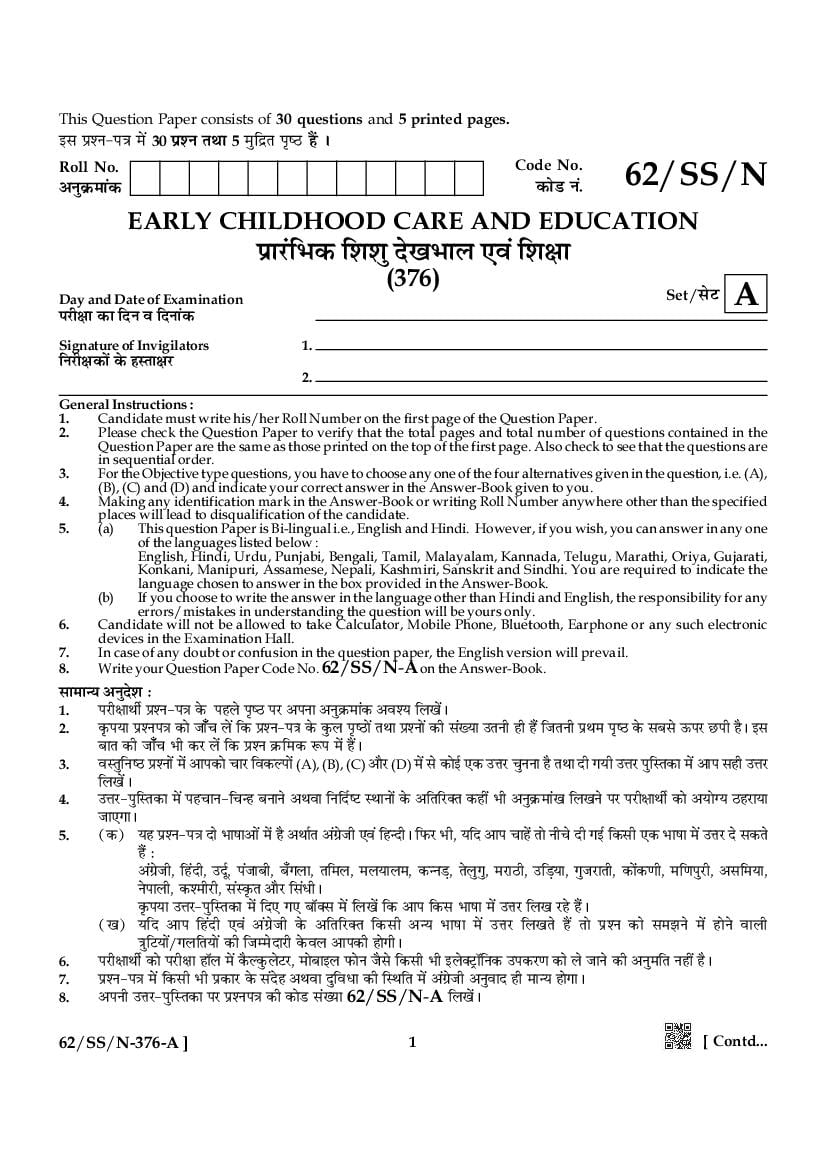
NIOS Class 12 Question Paper 2021 (Oct) Early Childhood Care & Education – Text
Read the full text of this question paper below — useful to quickly search, copy and reference the content online without downloading the PDF.
📄 View text version (5 pages)
Page 1
ß‚ ¬˝‡Ÿ-¬òÊ ◊¥ 30 ¬˝‡Ÿ ÃÕÊ 5 ◊ÈÁŒ˝Ã ¬Îc∆UU „Ò¥ –
Roll No. Code No.
•ŸÈ∑˝§◊Ê¥∑§ ∑§Ê«U Ÿ¥. 62/SS/N
EARLY CHILDHOOD CARE AND EDUCATION
¬˝Ê⁄¥UÁ÷∑§ Á‡Ê‡ÊÈ Œπ÷Ê‹ ∞fl¥ Á‡ÊˇÊÊ
(376)
Day and Date of Examination
¬⁄UˡÊÊ ∑§Ê ÁŒŸ fl ÁŒŸÊ¥∑§
Set/‚≈U A
Signature of Invigilators 1.
ÁŸ⁄UˡÊ∑§Ê¥ ∑§ „SÃÊˇÊ⁄U
2.
General Instructions :
1. Candidate must write his/her Roll Number on the first page of the Question Paper.
2. Please check the Question Paper to verify that the total pages and total number of questions contained in the
Question Paper are the same as those printed on the top of the first page. Also check to see that the questions are
in sequential order.
3. For the Objective type questions, you have to choose any one of the four alternatives given in the question, i.e. (A),
(B), (C) and (D) and indicate your correct answer in the Answer-Book given to you.
4. Making any identification mark in the Answer-Book or writing Roll Number anywhere other than the specified
places will lead to disqualification of the candidate.
5. (a) This question Paper is Bi-lingual i.e., English and Hindi. However, if you wish, you can answer in any one
of the languages listed below :
English, Hindi, Urdu, Punjabi, Bengali, Tamil, Malayalam, Kannada, Telugu, Marathi, Oriya, Gujarati,
Konkani, Manipuri, Assamese, Nepali, Kashmiri, Sanskrit and Sindhi. You are required to indicate the
language chosen to answer in the box provided in the Answer-Book.
(b) If you choose to write the answer in the language other than Hindi and English, the responsibility for any
errors/mistakes in understanding the question will be yours only.
6. Candidate will not be allowed to take Calculator, Mobile Phone, Bluetooth, Earphone or any such electronic
devices in the Examination Hall.
7. In case of any doubt or confusion in the question paper, the English version will prevail.
8. Write your Question Paper Code No. 62/SS/N-A on the Answer-Book.
‚Ê◊Êãÿ •ŸÈŒ‡Ê —
1. ¬⁄UˡÊÊÕ˸ ¬˝‡Ÿ-¬òÊ ∑§ §¬„‹ ¬Îc∆U ¬⁄U •¬ŸÊ •ŸÈ∑˝§◊Ê¥∑§ •fl‡ÿU Á‹π¥–
2. ∑Χ¬ÿÊ ¬˝‡Ÿ¬òÊ ∑§Ê ¡ÊÚ°ø ‹¥ Á∑§ ¬˝‡Ÿ-¬òÊ ∑§ ∑ȧ‹ ¬Îc∆UÊ¥ ÃÕÊ ¬˝‡ŸÊ¥ ∑§Ë ‚¥ÅUÿÊ ©ÃŸË „Ë „Ò¥ Á¡ÃŸË ¬˝Õ◊ ¬Îc∆ ∑ §‚’‚ ™§¬⁄U ¿U¬Ë „Ò– ß‚
’Êà ∑§Ë ¡ÊÚ°ø ÷Ë ∑§⁄U ‹¥ Á∑§ ¬˝‡Ÿ ∑˝ Á◊∑§ UM§¬ ◊¥ „Ò¥–
3. § flSÃÈÁŸc∆U ¬˝‡ŸÊ¥ ◊¥ •Ê¬∑§Ê øÊ⁄U Áfl∑§À¬Ê¥ (A), (B), (C) •ÊÒ⁄U (D) ◊¥ ‚ ∑§Ê߸ ∞∑§ ©ûÊ⁄U øÈŸŸÊ „Ò ÃÕÊ ŒË ªÿË ©ûÊ⁄U ¬ÈÁSÃ∑§Ê ◊¥ •Ê¬ ‚„Ë ©ûÊ⁄U
Á‹π¥–
4. ©ûÊ⁄U-¬ÈÁSÃ∑§Ê ◊¥ ¬„øÊŸ-Áøã„ ’ŸÊŸ •ÕflÊ ÁŸÁŒ¸c≈U SÕÊŸÊ¥ ∑§ •ÁÃÁ⁄UÄà ∑§„Ë¥ ÷Ë •ŸÈ∑˝§◊Ê¥π Á‹πŸ ¬⁄U ¬⁄UˡÊÊÕ˸ ∑§Ê •ÿÊÇÿ ∆U„⁄UÊÿÊ
¡Ê∞ªÊ–
5. (∑§) ÿ„ ¬˝‡Ÿ-¬òÊ ŒÊ ÷Ê·Ê•Ê¥ ◊¥ „Ò •Õʸà •¥ª˝¡Ë ∞fl¥ Á„ãŒË– Á»§⁄U ÷Ë, ÿÁŒ •Ê¬ øÊ„¥ ÃÊ ŸËø ŒË ªß¸ Á∑§‚Ë ∞∑§ ÷Ê·Ê ◊¥ ©ûÊ⁄U Œ ‚∑§Ã
„Ò¥ —
•¥ª˝¡Ë, Á„¥ŒË, ©ŒÍ¸, ¬¥¡Ê’Ë, ’°ª‹Ê, ÃÁ◊‹, ◊‹ÿÊ‹◊, ∑§ãŸ«∏, ËȪÈ, ◊⁄UÊ∆UË, ©Á«∏ÿÊ, ªÈ¡⁄UÊÃË, ∑§Ê¥∑§áÊË, ◊ÁáʬÈ⁄UË, •‚Á◊ÿÊ,
Ÿ¬Ê‹Ë, ∑§‡◊Ë⁄UË, ‚¥S∑Χç•ÊÒ⁄U Á‚¥œË–
∑Χ¬ÿÊ ©ûÊ⁄U-¬ÈÁSÃ∑§Ê ◊¥ ÁŒ∞ ª∞ ’ÊÚÄ‚ ◊¥ Á‹π¥ Á∑§ •Ê¬ Á∑§‚ ÷Ê·Ê ◊¥ ©ûÊ⁄U Á‹π ⁄U„ „Ò¥– §
(π) ÿÁŒ •Ê¬ Á„¥ŒË ∞fl¥ •¥ª˝¡Ë ∑§ •ÁÃÁ⁄UÄà Á∑§‚Ë •ãÿ ÷Ê·Ê ◊¥ ©ûÊ⁄U Á‹πà „Ò¥ ÃÊ ¬˝‡Ÿ ∑§Ê ‚◊¤ÊŸ ◊¥ „ÊŸ flÊ‹Ë
òÊÈÁ≈UÿÊ¥/ª‹ÁÃÿÊ¥ ∑§Ë Á¡ê◊UŒÊ⁄Ë ∑ fl‹ •Ê¬∑§Ë „ʪ˖
6. ¬⁄UˡÊÊÕ˸ ∑§Ê ¬⁄UˡÊÊ „ÊÚ‹ ◊¥ ∑Ò§À∑ȧ‹≈U⁄U, ◊Ê’Êß‹ »§ÊŸ ¡Ò‚ Á∑§‚Ë ÷Ë ß‹Ä≈˛UÊÚÁŸ∑§ ©¬∑§⁄UáÊ ∑§Ê ‹ ¡ÊŸ ∑§Ë •ŸÈ◊Áà Ÿ„Ë¥ „Ò–
7. ¬˝‡Ÿ-¬òÊ ◊¥ Á∑§‚Ë ÷Ë ¬˝∑§Ê⁄U ∑§ ‚¥Œ„ •ÕflÊ ŒÈÁflœÊ ∑§Ë ÁSÕÁà ◊¥ •¥ª˝¡Ë •ŸÈflÊŒ „Ë ◊Êãÿ „ʪʖ
8. •¬ŸË ©ûÊ⁄U-¬ÈÁSUÃ∑§Ê ¬⁄U ¬˝‡Ÿ¬òÊ ∑§Ë ∑§Ê«U ‚¥ÅÿÊ 62/SS/N-A Á‹π¥–
62/SS/N-376-A ] 1 [ Contd...
Page 2
¬˝Ê⁄¥UÁ÷∑§ Á‡Ê‡ÊÈ Œπ÷Ê‹ ∞fl¥ Á‡ÊˇÊÊ
(376)
Time : 3 Hours ] [ Maximum Marks : 80
‚◊ÿ — 3 ÉÊá≈U ] [ ¬ÍáÊÊZ∑§ — 80
Note : All questions are compulsory and carry marks as indicated against each question.
ÁŸŒ¸‡Ê — ‚÷Ë ¬˝‡Ÿ •ÁŸflÊÿ¸ „Ò •ÊÒ⁄U ¬˝àÿ∑§ ¬˝‡Ÿ ∑§ •¥∑§ ©‚∑§ ‚Ê◊Ÿ ÁŒÿ ª∞ „Ò¥–
Choose the correct answers from the options given below :
ŸËø ÁŒÿ ª∞ Áfl∑§À¬Ê¥ ◊¥ ‚ ‚„Ë ©ûÊ⁄U øÈŸ¥ —
1. Case study is : 1
(A) Research design in which two or more groups are compared under similar conditions
where each group may get a different treatment.
(B) Way of collecting data from a group of people of different ages at a particular time.
(C) Study of research issues collecting information from a set of people at different intervals
of time over a decided period.
(D) In-depth study of individuals, groups or institutions.
∑§‚ S≈U«UË (◊Ê◊‹Ê •äÿÿŸ) „Ò —
(A) •ŸÈ‚¥œÊŸ Á«U$¡Êߟ Á¡‚◊¥ ŒÊ ÿÊ ŒÊ ‚ •Áœ∑§ ‚◊Í„Ê¥ ∑§Ë ÃÈ‹ŸÊ ‚◊ÊŸ ¬Á⁄UÁSÕÁÃÿÊ¥ ◊¥ ∑§Ë ¡ÊÃË „Ò, ¡„Ê° ¬˝àÿ∑§
‚◊Í„ ◊¥ ∞∑§ •‹ª ©¬øÊ⁄U „ÊÃÊ „Ò–
(B) Á∑§‚Ë Áfl‡Ê· ‚◊ÿ ◊¥ ÁflÁ÷ÛÊ •ÊÿÈ ∑§ ‹ÊªÊ¥ ∑§ ‚◊Í„ ‚ «U≈UÊ ∞∑§òÊ ∑§⁄UŸ ∑§Ê Ã⁄UË∑§Ê–
(C) •ŸÈ‚¥œÊŸ ◊ÈŒ˜ŒÊ¥ ∑§Ê •äÿÿŸ Á¡‚◊¥ ∞∑§ ÁŸÁ‡øà •flÁœ ∑§ ‚◊ÿ ∑§ •¥Ã⁄UÊ‹ ¬⁄U ‹ÊªÊ¥ ∑§ ∞∑§ ‚≈U ‚
¡ÊŸ∑§Ê⁄UË ∞∑§ÁòÊà ∑§Ë ¡ÊÃË „Ò–
(D) √ÿÁÄÃÿÊ¥, ‚◊Í„Ê¥ ÿÊ ‚¥SÕÊŸÊ¥ ∑§Ê ª„Ÿ •äÿÿŸ–
2. Care and stimulation are critical during : 1
(A) The first two years (B) First four years
(C) First six years (D) First three years
Œπ÷Ê‹ •ÊÒ⁄U ©ûÊ¡Ÿ ◊„àfl¬Íáʸ „Ò¥ —
(A) ¬„‹ ŒÊ fl·ÊZ ∑§ ŒÊÒ⁄UÊŸ (B) ¬„‹ øÊ⁄U fl·ÊZ ∑§ ŒÊÒ⁄UÊŸ
(C) ¬„‹ ¿U„ fl·ÊZ ∑§ ŒÊÒ⁄UÊŸ (D) ¬„‹ ÃËŸ fl·ÊZ ∑§ ŒÊÒ⁄UÊŸ
62/SS/N-376-A ] 2 [ Contd...
Page 3
(A) Balances in intake of nutrition by an individual.
(B) Satisfaction of hunger.
(C) Taking more nutrition.
(D) Deficiency in intake of nutrients by individuals.
∑ȧ¬Ê·áÊ ∑§Ê •Õ¸ „Ò —
(A) ∞∑§ √ÿÁÄà mÊ⁄UÊ ¬Ê·áÊ ∑§ ‚flŸ ◊¥ ‚¥ÃÈ‹Ÿ
(B) ÷Íπ ∑§Ë ‚¥ÃÈÁc≈U
(C) •Áœ∑§ ¬Ê·áÊ ‹ŸÊ
(D) √ÿÁÄÃÿÊ¥ mÊ⁄UÊ ¬Ê·∑§ ÃàflÊ¥ ∑§ ‚flŸ ◊¥ ∑§◊Ë
4. Sensorimotor stage is : 1
(A) Second stage of cognitive development
(B) Starts from seven years of age
(C) First stage of cognitive development
(D) Starts at two years of age
‚ã‚ÊÁ⁄U◊Ê≈U⁄U •flSÕÊ —
(A) ‚¥ôÊÊŸÊà◊∑§ Áfl∑§Ê‚ ∑§Ê ŒÍ‚⁄UÊ ø⁄UáÊ „Ò
(B) ‚Êà fl·¸ ∑§Ë •ÊÿÈ ◊¥ ‡ÊÈM§ „ÊÃË „Ò
(C) ‚¥ôÊÊŸÊà◊∑ Áfl∑§Ê‚ ∑§Ê ¬„‹Ê ø⁄UáÊ „Ò
(D) ŒÊ fl·¸ ∑§Ë •ÊÿÈ ◊¥ ‡ÊÈM§ „ÊÃË „Ò
Explain the following in one sentence only.
ÁŸêŸÁ‹Áπà ∑§Ê ∑§fl‹ ∞∑§ flÊÄÿ ◊¥ ‚◊¤ÊÊßÿ–
5. Developmentally appropriate ECCE Curriculum 1
Áfl∑§Ê‚Êà◊∑§ M§¬ ‚ ©¬ÿÈÄà ߸.‚Ë.‚Ë.߸ ¬Ê∆K∑˝§◊
6. Reinforcement 1
‚Ȍ΅∏Ë∑§⁄UáÊ
7. Motor development 1
◊Ê¥‚ ¬Á‡ÊÿÊ¥ ∑§Ê Áfl∑§Ê‚
8. Ledger 1
πÊÃÊ ’„Ë
62/SS/N-376-A ] 3 [ Contd...
Page 4
ÁflÁflœÃÊ
10. Peer tutoring 1
‚ÊÁÕÿÊ¥ ∑§ mÊ⁄UÊ Á‡ÊˇÊáÊ
Short Answer Questions (SAQ)
‹ÉÊÈ ©ûÊ⁄UËÿ ¬˝‡Ÿ —
11. What is the objective of ECCE ? 2
߸.‚Ë.‚Ë.߸. ∑§Ê ©g‡ÿ ÄÿÊ „Ò?
12. What do you mean by the term ‘Children’s rights’ ? 2
“’ìÊÊ¥ ∑§ •Áœ∑§Ê⁄UÊ¥” ‚ •Ê¬ ÄÿÊ ‚◊¤Êà „Ò¥?
13. What is moral development ? 2
ŸÒÁÃ∑§ Áfl∑§Ê‚ ÄÿÊ „Ò?
14. What is meaning of term ‘eye hand coordination’ ? 2
“ŸòÊ-„ÊÕ ‚◊ãflÿ” ‡ÊéŒ ∑§Ê ÄÿÊ •Õ¸ „Ò?
15. What is the sleeping pattern of newborns ? 2
Ÿfl¡Êà Á‡Ê‡ÊÈ•Ê¥ ∑§ ‚ÊŸ ∑§Ê Ã⁄UË∑§Ê ÄÿÊ „Ò?
16. What are stock records ? 2
S≈UÊÚ∑§ Á⁄U∑§Ê«¸U ÄÿÊ „Êà „Ò¥?
17. What are the two types of auditing ? 2
“•ÊÚÁ«UÁ≈¥Uª” ∑§ ∑§ÊÒŸ ‚ ŒÊ ¬˝∑§Ê⁄U „Êà „Ò¥?
18. What is meant by academic readiness ? 2
“•∑§ÊŒUÁ◊∑§ Ãà¬⁄UÃÊ” ‚ ÄÿÊ •Á÷¬˝Êÿ „Ò?
19. What is multi linguism ? 2
’„È ÷ÊcÿÃÊ ÄÿÊ „Ò?
20. How can children with physical disabilities be involved in the activities in classroom ? 2
‡ÊÊ⁄UËÁ⁄U∑§ •ˇÊ◊ÃÊ flÊ‹ ’ìÊ ∑Ò§‚ ∑§ˇÊÊ ∑§Ë ªÁÃÁflÁœÿÊ¥ ◊¥ ‡ÊÊÁ◊‹ „Ê ‚∑§Ã „Ò¥?
62/SS/N-376-A ] 4 [ Contd...
Page 5
‚◊Êfl‡ÊË Á‡ÊˇÊÊ ∑§ ÄÿÊ ‹Ê÷ „Ò¥?
22. What is the role of ready families and communities ? 4
ÃÒÿÊ⁄U ¬Á⁄UflÊ⁄UÊ¥ •ÊÒ⁄U ‚◊ÈŒÊÿÊ¥ ∑§Ë ÷ÍÁ◊∑§Ê ÄÿÊ „Ò?
23. What is the role of teachers in facilitating community ownership and participation ? 4
‚Ê◊ÈŒÊÁÿ∑§ SflÊÁ◊àfl •ÊÒ⁄U ÷ʪˌÊ⁄UË ∑§Ê ‚ÈÁflœÊ¡Ÿ∑§ ’ŸÊŸ ◊¥ Á‡ÊˇÊ∑§Ê¥ ∑§Ë ÷ÍÁ◊∑§Ê ÄÿÊ „Ò?
24. How can the parents be involved in the activities of the ECCE centre ? 4
߸.‚Ë.‚Ë.߸. ∑§ãŒ˝ ∑§Ë ªÁÃÁflÁœÿÊ¥ ◊¥ •Á÷÷Êfl∑§Ê¥ ∑§Ê ∑Ò§‚ ‡ÊÊÁ◊‹ Á∑§ÿÊ ¡Ê ‚∑§ÃÊ „Ò?
25. What are the qualities of an effective ECCE teacher ? 4
∞∑§ ¬˝÷ÊflË ß¸.‚Ë.‚Ë.߸ Á‡ÊˇÊ∑§ ∑§ ªÈáÊ ÄÿÊ „Êà „Ò¥?
Long Answer Questions
ŒËÉʸ ©ûÊ⁄UËÿ ¬˝‡Ÿ —
26. Discuss the importance of supervision, mentoring and monitoring in an ECCE centre. 6
߸.‚Ë.‚Ë.߸. ∑§ãŒ˝ ◊¥ ¬ÿ¸flˇÊáÊ, ◊¥≈UÁ⁄¥Uª •ÊÒ⁄U ÁŸª⁄UÊŸË ∑§ ◊„àfl ¬⁄U øøʸ ∑§⁄¥U–
27. Explain the factors to be considered while selecting the location of an ECCE centre. 6
߸.‚Ë.‚Ë.߸. ∑§ãŒ˝ ∑§Ê øÿŸ ∑§⁄Uà ‚◊ÿ ÁfløÊ⁄U Á∑§ÿ ¡ÊŸ flÊ‹ ∑§Ê⁄U∑§Ê¥ ∑§Ë √ÿÊÅÿÊ ∑§⁄¥U–
28. List out the points to be taken into mind while conducting interview and observations. 6
‚ÊˇÊÊà∑§Ê⁄U •ÊÒ⁄U Á≈Uå¬ÁáÊÿÊ¥ ∑§Ê ‚¥øÊ‹Ÿ ∑§⁄Uà ‚◊ÿ äÿÊŸ ◊¥ ⁄Uπ ¡ÊŸ flÊ‹ Á’¥ŒÈ•Ê¥ ∑§Ê ‚ÍøË’h ∑§⁄¥U–
29. Describe the type of play in early years. 6
¬˝Ê⁄¥UÁ÷∑§ fl·ÊZ ◊¥ π‹Ÿ ∑§ ¬˝∑§Ê⁄U ∑§Ê fláʸŸ ∑§⁄¥U–
30. Design a Day’s schedule for three year old children on any theme of your choice. 6
•¬Ÿ mÊ⁄UÊ øÈŸË ªÿË Á∑§‚Ë ÷Ë Áfl·ÿ ¬⁄U 3 ‚Ê‹ ∑§ ’ìÊÊ¥ ∑§ Á‹∞ ∞∑§ ÁŒŸ ∑§Ê ‡Ê«KÍ‹ Á«U$¡Êߟ ∑§⁄¥U–
-oOo-
62/SS/N-376-A ] 5 [ Contd...
Document Details
| Board / Org | NIOS |
| Exam | National Institute of Open Schooling Class 12 |
| Type | Question Paper |
| Pages | 5 |
| Updated | 30 Apr 2026 |