NIOS Class 12 Question Paper 2021 (Oct) Economics
Finished viewing? Save it for later —
Download NIOS Class 12 Question Paper 2021 (Oct) Economics (PDF · 24 pages)About NIOS Class 12 Question Paper 2021 (Oct) Economics
NIOS Class 12 Question Paper 2021 (Oct) Economics is available here for free download. Published by NIOS for National Institute of Open Schooling Class 12, this question paper can be viewed online or downloaded as a PDF (24 pages). Candidates preparing for National Institute of Open Schooling Class 12 can use NIOS Class 12 Question Paper 2021 (Oct) Economics to understand the exam pattern, the type of questions asked, and the overall difficulty level.
Frequently Asked Questions
How can I download NIOS Class 12 Question Paper 2021 (Oct) Economics?
Open this page and click the Download button to save NIOS Class 12 Question Paper 2021 (Oct) Economics as a PDF. It is completely free on AglaSem Docs.
Is NIOS Class 12 Question Paper 2021 (Oct) Economics free to download?
Yes. NIOS Class 12 Question Paper 2021 (Oct) Economics can be viewed online and downloaded as a PDF free of cost on AglaSem Docs.
How many pages does NIOS Class 12 Question Paper 2021 (Oct) Economics have?
NIOS Class 12 Question Paper 2021 (Oct) Economics contains 24 pages, which you can read online or download together as a single PDF.
Where can I find more National Institute of Open Schooling Class 12 study material?
You can find more National Institute of Open Schooling Class 12 question papers, sample papers, syllabus, and answer keys on AglaSem Docs.
NIOS Class 12 Question Paper 2021 (Oct) Economics – Text
Read the full text of this question paper below — useful to quickly search, copy and reference the content online without downloading the PDF.
📄 View text version (22 pages)
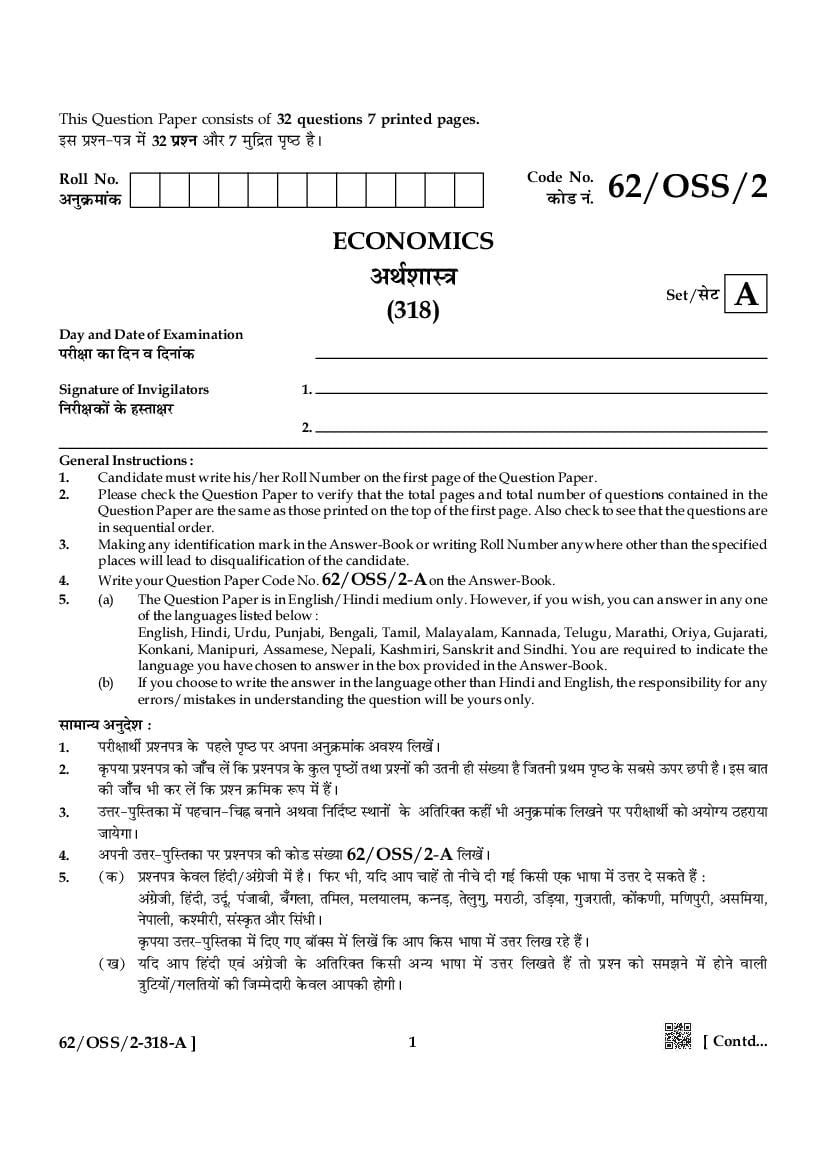
Page 1
ß‚ ¬˝‡Ÿ-¬òÊ ◊¥ 32 ¬˝‡Ÿ •ÊÒ⁄U 7 ◊ÈÁŒ˝Ã ¬Îc∆U „Ò–
Roll No. Code No.
•ŸÈ∑˝§◊Ê¥∑§ ∑§Ê«U Ÿ¥. 62/OSS/2
ECONOMICS
•Õ¸‡ÊÊSòÊ
(318)
Set/‚≈U A
Day and Date of Examination
¬⁄UˡÊÊ ∑§Ê ÁŒŸ fl ÁŒŸÊ¥∑§
Signature of Invigilators 1.
ÁŸ⁄UˡÊ∑§Ê¥ ∑§ „SÃÊˇÊ⁄U
2.
General Instructions :
1. Candidate must write his/her Roll Number on the first page of the Question Paper.
2. Please check the Question Paper to verify that the total pages and total number of questions contained in the
Question Paper are the same as those printed on the top of the first page. Also check to see that the questions are
in sequential order.
3. Making any identification mark in the Answer-Book or writing Roll Number anywhere other than the specified
places will lead to disqualification of the candidate.
4. Write your Question Paper Code No. 62/OSS/2-A on the Answer-Book.
5. (a) The Question Paper is in English/Hindi medium only. However, if you wish, you can answer in any one
of the languages listed below :
English, Hindi, Urdu, Punjabi, Bengali, Tamil, Malayalam, Kannada, Telugu, Marathi, Oriya, Gujarati,
Konkani, Manipuri, Assamese, Nepali, Kashmiri, Sanskrit and Sindhi. You are required to indicate the
language you have chosen to answer in the box provided in the Answer-Book.
(b) If you choose to write the answer in the language other than Hindi and English, the responsibility for any
errors/mistakes in understanding the question will be yours only.
‚Ê◊Êãÿ •ŸÈŒ‡Ê —
1. ¬⁄UˡÊÊÕ˸ ¬˝‡Ÿ¬òÊ ∑§ §¬„‹ ¬Îc∆U ¬⁄U •¬ŸÊ •ŸÈ∑˝§◊Ê¥∑§ •fl‡ÿU Á‹π¥–
2. ∑Χ¬ÿÊ ¬˝‡Ÿ¬òÊ ∑§Ê ¡ÊÚ°ø ‹¥ Á∑§ ¬˝‡Ÿ¬òÊ ∑§ ∑ȧ‹ ¬Îc∆UÊ¥ ÃÕÊ ¬˝‡ŸÊ¥ ∑§Ë ©ÃŸË „Ë ‚¥ÅUÿÊ „Ò Á¡ÃŸË ¬˝Õ◊ ¬Îc∆ ∑ §‚’‚ ™§¬⁄U ¿U¬Ë „Ò– ß‚ ’ÊÃ
∑§Ë ¡ÊÚ°ø ÷Ë ∑§⁄U ‹¥ Á∑§ ¬˝‡Ÿ ∑˝ Á◊∑§ UM§¬ ◊¥ „Ò¥–
3. § ©ûÊ⁄U-¬ÈÁSUÃ∑§Ê ◊¥ ¬„øÊŸ-Áøq ’ŸÊŸ •ÕflÊ ÁŸÁŒ¸c≈U SÕÊŸÊ¥ ∑§§ •ÁÃÁ⁄UÄà ∑§„Ë¥ ÷Ë •ŸÈ∑˝§◊Ê¥∑§ Á‹πŸ ¬⁄U ¬⁄UˡÊÊÕ˸ ∑§Ê •ÿÊÇÿ ∆U„⁄UÊÿÊ
¡ÊÿªÊ–
4. •¬ŸË ©ûÊ⁄U-¬ÈÁSUÃ∑§Ê ¬⁄U ¬˝‡Ÿ¬òÊ ∑§Ë ∑§Ê«U ‚¥ÅÿÊ 62/OSS/2-A Á‹π¥–
5. (∑§) ¬˝‡Ÿ¬òÊ ∑§fl‹ Á„¥ŒË/•¥ª˝¡Ë ◊¥ „Ò– Á»§⁄U ÷Ë, ÿÁŒ •Ê¬ øÊ„¥ ÃÊ ŸËø ŒË ªß¸ Á∑§‚Ë ∞∑§ ÷Ê·Ê ◊¥ ©ûÊ⁄ Œ ‚∑§Ã „Ò¥ —
•¥ª˝¡Ë, Á„¥ŒË, ©ŒÍ¸, ¬¥¡Ê’Ë, ’°ª‹Ê, ÃÁ◊‹, ◊‹ÿÊ‹◊, ∑§ãŸ«∏, ËȪÈ, ◊⁄UÊ∆UË, ©Á«∏ÿÊ, ªÈ¡⁄UÊÃË, ∑§Ê¥∑§áÊË, ◊ÁáʬÈ⁄UË, •‚Á◊ÿÊ,
Ÿ¬Ê‹Ë, ∑§‡◊Ë⁄UË, ‚¥S∑Χç•ÊÒ⁄U Á‚¥œË–
∑Χ¬ÿÊ ©ûÊ⁄U-¬ÈÁSÃ∑§Ê ◊¥ ÁŒ∞ ª∞ ’ÊÚÄ‚ ◊¥ Á‹π¥ Á∑§ •Ê¬ Á∑§‚ ÷Ê·Ê ◊¥ ©ûÊ⁄U Á‹π ⁄U„ „Ò¥– §
(π) ÿÁŒ •Ê¬ Á„¥ŒË ∞fl¥ •¥ª˝¡Ë ∑§ •ÁÃÁ⁄UÄà Á∑§‚Ë •ãÿ ÷Ê·Ê ◊¥ ©ûÊ⁄U Á‹πà „Ò¥ ÃÊ ¬˝‡Ÿ ∑§Ê ‚◊¤ÊŸ ◊¥ „ÊŸ flÊ‹Ë
òÊÈÁ≈UÿÊ¥/ª‹ÁÃÿÊ¥ ∑§Ë Á¡ê◊UŒÊ⁄Ë ∑ fl‹ •Ê¬∑§Ë „ʪ˖
62/OSS/2-318-A ] 1 [ Contd...
Page 2
•Õ¸‡ÊÊSòÊ
(318)
Time : 3 Hours ] [ Maximum Marks : 100
‚◊ÿ — 3 ÉÊá≈U ] [ ¬ÍáÊÊZ∑§ — 100
Note : (i) All questions are compulsory.
(ii) Marks allotted to each question are indicated against it.
(iii) Each question from Question Nos. 1 to 10 has four alternatives - (A), (B), (C) and (D)
out of which one is most appropriate. Choose the correct answer among the four
alternatives and write it in your answer-book against the number of the question. No
extra time is allotted for attempting multiple choice questions.
ÁŸŒ¸‡Ê — (i) ‚÷Ë ¬˝‡ŸÊ¥ ∑§ ©ûÊ⁄U ŒËÁ¡∞–
(ii) ¬˝àÿ∑§ ¬˝‡Ÿ ∑§ ‚Ê◊Ÿ ©‚∑§ •¥∑§ Á‹π ª∞ „Ò¥–
(iii) ¬˝‡Ÿ ‚¥ÅÿÊ 1 ‚ 10 Ã∑§ ∑§ ¬˝àÿ∑§ ¬˝‡Ÿ ◊¥ øÊ⁄U Áfl∑§À¬ - (A), (B), (C) ÃÕÊ (D) „Ò¥, Á¡Ÿ◊¥ ‚ ∞∑§ ‚’‚
©¬ÿÈÄà „Ò– øÊ⁄UÊ¥ Áfl∑§À¬Ê¥ ◊¥ ‚ ‚„Ë ©ûÊ⁄U øÈŸ¥ ÃÕÊ •¬ŸË ©ûÊ⁄U-¬ÈÁSÃ∑§Ê ◊¥ ¬˝‡Ÿ ‚¥ÅÿÊ ∑§ ‚Ê◊Ÿ ©ûÊ⁄U Á‹π¥–
’„È-Áfl∑§À¬Ë ¬˝‡ŸÊ¥ ∑§ Á‹∞ •ÁÃÁ⁄UÄà ‚◊ÿ Ÿ„Ë¥ ÁŒÿÊ ¡Ê∞ªÊ–
1. Which one is not the ‘positional’ average ? 1
(A) Mean (B) Median (C) Mode (D) Quartile
ߟ◊¥ ‚ ∑§ÊÒŸ-‚Ë “ÁSÕÃËÿ” •ÊÒ‚Ã Ÿ„Ë¥ „Ò?
(A) ◊Êäÿ (B) ◊ÊÁäÿ∑§Ê (C) ’„È‹∑§ (D) øÃÈÕ¸∑§
2. As we move along an indifference curve from left to right. Marginal Rate of Substitution : 1
(A) Decreases (B) Increases
(C) Remains unchanged (D) First decreases, then increases
∞∑§ •ŸÁœ◊ÊŸ fl∑˝§ ¬⁄U ¡Ò‚-¡Ò‚ ’Ê∞° ‚ ŒÊ∞° ø‹Ã „Ò– ¬˝ÁÃSÕʬŸ ∑§Ë ‚Ë◊ʥà Œ⁄U —
(A) ∑§◊ „ÊÃË ¡ÊÃË „Ò (B) ’…∏ÃË ¡ÊÃË „Ò
(C) •¬Á⁄UflÁøà ⁄U„ÃË „Ò (D) ¬„‹ ∑§◊ „ÊÃË „Ò, Á»§⁄U ’…∏ÃË „Ò
62/OSS/2-318-A ] 2 [ Contd...
Page 3
48 units, Marginal Physical Product of 10 units of input is :
(A) 4 units (B) 4.8 units (C) 5 units (D) 8 units
ÿÁŒ 8 ß∑§Ê߸ •ÊªÃ ∑§Ê ∑ȧ‹ ÷ÊÒÁÃ∑§ ©à¬ÊŒ 40 ß∑§Ê߸ „Ê •ÊÒ⁄U 10 ß∑§Ê߸ •ÊªÃ ∑§Ê 48 ß∑§Ê߸ „Ê, ÃÊ 10 ß∑§Ê߸ •ÊªÃ
∑§Ë ‚Ë◊ʥà ÷ÊÒÁÃ∑§ ©à¬ÊŒ Á∑§ÃŸË ß∑§Ê߸ „ʪË?
(A) 4 ß∑§ÊßÿÊ° (B) 4.8 ß∑§ÊßÿÊ° (C) 5 ß∑§ÊßÿÊ° (D) 8 ß∑§ÊßÿÊ°
4. As output is increased, Average Fixed Cost : 1
(A) Rises (B) Falls
(C) Remains unchanged (D) First falls, then rises
©à¬ÊŒŸ ◊¥ flÎÁh ∑§ ‚ÊÕ-‚ÊÕ •ÊÒ‚Ã ÁSÕ⁄U ‹ÊªÃ —
(A) ’…∏ÃË ¡ÊÃË „Ò (B) Áª⁄UÃË ¡ÊÃË „Ò
(C) ÁSÕ⁄U ⁄U„ÃË „Ò (D) ‡ÊÈM§ ◊¥ Áª⁄UÃË „Ò, ’ÊŒ ◊¥ ’…∏ÃË ¡ÊÃË „Ò
5. Which item is not included in national income ? 1
(A) Rent (B) Interest on national debt
(C) Profit (D) Factor income from abroad
∑§ÊÒŸ-‚Ë ◊Œ ⁄UÊc≈˛UËÿ •Êÿ ◊¥ ‡ÊÊÁ◊‹ Ÿ„Ë¥ ∑§Ë ¡ÊÃË „Ò?
(A) Á∑§⁄UÊÿÊ (B) ⁄UÊc≈˛UËÿ ´§áÊ ¬⁄U éÿÊ¡
(C) ‹Ê÷ (D) ÁflŒ‡ÊÊ¥ ‚ ‚ÊœŸ •Êÿ
6. GDP of a year calculated on the basis of prices of base year is called : 1
(A) Nominal GDP (B) Real GDP
(C) Both (A) and (B) (D) Neither (A) nor (B)
•ÊœÊ⁄U fl·¸ ∑§ ∑§Ë◊ÃÊ¥ ¬⁄U •ÊœÊÁ⁄Uà ∞∑§ fl·¸ ∑§Ê GDP ∑§Ë ªáÊŸÊ ∑§Ë ¡ÊÃË „Ò– Á¡‚ ∑§„Ê ¡ÊÃÊ „Ò —
(A) ◊ÊÒÁŒ˝∑§ GDP (B) flÊSÃÁfl∑§ GDP
(C) (A) •ÊÒ⁄U (B) ŒÊŸÊ¥ (D) ŸÊ (A) •ÊÒ⁄U ŸÊ (B)
7. Saving function is given by : 1
(A) a+by (B) a−by (C) −a+(1−b)y (D) −a−(1−b)y
’øà »§‹Ÿ ÿ„ „Ò —
(A) a+by (B) a−by (C) −a+(1−b)y (D) −a−(1−b)y
8. Credit creation by commercial banks is also called : 1
(A) Deposit creation (B) Money creation
(C) Both (A) and (B) (D) None of the above
flÊÁáÊÁíÿ∑§ ’Ò¥∑§Ê¥ mÊ⁄UÊ ‚Êπ ÁŸ◊ʸáÊ ÿ„ ÷Ë ∑§„‹ÊÃÊ „Ò —
(A) ¡◊Ê ÁŸ◊ʸáÊ (B) ◊ÈŒ˝Ê ÁŸ◊ʸáÊ
(C) (A) •ÊÒ⁄U (B) ŒÊŸÊ¥ (D) ©¬⁄UÊÄà ◊¥ ‚ ∑§Ê߸ Ÿ„Ë¥
62/OSS/2-318-A ] 3 [ Contd...
Page 4
(A) Primary function of money (B) Secondary function of money
(C) Other function of money (D) None of the above
“◊ÍÀÿ ∑§Ë ∞∑§M§¬ÃÊ” ◊ÈŒ˝Ê ∑§Ê ÿ„ ∑§Êÿ¸ „Ò —
(A) ¬˝ÊÕÁ◊∑§ ∑§Êÿ¸ „Ò (B) ÁmÃËÿ∑§ ∑§Êÿ¸ „Ò
(C) •ãÿ ∑§Êÿ¸ „Ò (D) ©¬⁄UÊÄà ◊¥ ‚ ∑§Ê߸ Ÿ„Ë¥
10. Proportion of deposits to be kept by the commercial banks with itself and with the central 1
bank as cash is called :
(A) Cash Reserve Ratio (B) Statutory Liquidity Ratio
(C) Legal Reserve Ratio (D) None of the above
¡◊Ê•Ê¥ ∑§Ê fl„ •ŸÈ¬Êà Á∑§ ∞∑§ flÊÁáÊÁíÿ∑§ ’Ò¥∑§ •¬Ÿ ¬Ê‚ •ÊÒ⁄U ∑§ãŒ˝Ëÿ ’Ò¥∑§ ∑§ ¬Ê‚ Ÿ∑§Œ M§¬ ◊¥ ⁄UπÃÊ „Ò, ÿ„
∑§„‹ÊÃÊ „Ò —
(A) Ÿ∑§Œ ∑§Ê· •ŸÈ¬Êà (B) flÒœÊÁŸ∑§ Ã⁄U‹ÃÊ •ŸÈ¬ÊÃ
(C) flÒœÊÁŸ∑§ ∑§Ê· •ŸÈ¬Êà (D) ©¬⁄UÊÄà ◊¥ ‚ ∑§Ê߸ Ÿ„Ë¥
11. How do index numbers help in formulating economic policies ? Give an example. 3
•ÊÁÕ¸∑§ ŸËÁÃÿÊ° ’ŸÊŸ ◊¥ ‚Íø∑§Ê°∑§ ∑Ò§‚ ‚„Êÿ∑§ „Êà „Ò¥? ∞∑§ ©ŒÊ„⁄UáÊ ŒËÁ¡∞–
12. State meanings of macroeconomics and microeconomics. Give an example of each. 3
‚◊Ác≈U •Õ¸‡ÊÊSòÊ •ÊÒ⁄U √ÿÁc≈U •Õ¸‡ÊÊSòÊ ∑§ •Õ¸ ’ÃÊß∞– ¬˝àÿ∑§ ∑§Ê ∞∑§-∞∑§ ©ŒÊ„⁄UáÊ ŒËÁ¡∞–
13. When price of a good falls by Rs. 3 per unit, the quantity demanded rises from 18 units to 3
24 units. Price elasticity of demand is (−)1. Calculate price of the good before change.
¡’ ∞∑§ flSÃÈ ∑§Ë ∑§Ë◊à 3 L§. Áª⁄U ¡ÊÃË „Ò ÃÊ ©‚∑§Ë ◊Ê°ª 18 ß∑§Ê߸ ‚ ’…∏ ∑§⁄U 24 ß∑§Ê߸ „Ê ¡ÊÃË „Ò– ◊Ê°ª ∑§Ë ∑§Ë◊Ã
‹Êø (−)1 „Ò– ¬Á⁄UfløŸ ‚ ¬Ífl¸ ∑§Ë ∑§Ë◊à ∑§Ë ªáÊŸÊ ∑§ËÁ¡∞–
14. Distinguish between explicit and implicit costs with the help of example. 3
S¬c≈U •ÊÒ⁄U •Ê⁄UÊÁ¬Ã ‹ÊªÃÊ¥ ◊¥ ÷Œ ∞∑§ ©ŒÊ„⁄UáÊ ∑§Ë ‚„ÊÿÃÊ ‚ ∑§ËÁ¡∞–
15. Explain any three features of Perfect Competition. 3
¬Íáʸ ¬˝ÁÃÿÊÁªÃÊ ∑§Ë Á∑§ã„Ë¥ ÃËŸ Áfl‡Ê·ÃÊ•Ê¥ ∑§Ë √ÿÊÅÿÊ ∑§ËÁ¡∞–
62/OSS/2-318-A ] 4 [ Contd...
Page 5
(Rs. Crore)
(i) Depreciation 40
(ii) Net indirect tax 60
(iii) Net factor income to abroad 5
(iv) Net domestic product at factor cost 500
(v) Net current transfers from abroad 10
‚∑§‹ ⁄UÊc≈˛UËÿ ¬˝ÿÊíÿ •Êÿ ∑§Ë ªáÊŸÊ ∑§ËÁ¡∞ —
(∑§⁄UÊ«∏ L§.)
(i) ◊ÍÀÿOÊ‚ 40
(ii) ÁŸfl‹ •¬˝àÿˇÊ ∑§⁄U 60
(iii) ÁflŒ‡ÊÊ¥ ∑§Ê ÁŸfl‹ ‚ÊœŸ •Êÿ 5
(iv) ‚ÊœŸ ‹ÊªÃ ¬⁄U ÁŸfl‹ ÉÊ⁄U‹Í ©à¬ÊŒ 500
(v) ÁflŒ‡ÊÊ¥ ‚ ÁŸfl‹ øÊ‹Í „SÃÊ¥Ã⁄UáÊ 10
17. Explain the concept of Marginal Propensity to save with the help of an example. 3
∞∑§ ©ŒÊ„⁄UáÊ ∑§Ë ‚„ÊÿÃÊ ‚ ‚Ë◊ʥà ’øà ¬˝flÎÁûÊ ∑§Ë •flœÊ⁄UáÊÊ ‚◊¤ÊÊß∞–
18. Explain the role of Open Market Operations as an instrument of monetary policy to solve the 3
problem of deficient demand.
◊Ê°ª ◊¥ ∑§◊Ë ∑§Ë ‚◊SÿÊ ∑§Ê „‹ ∑§⁄UŸ ◊¥ ◊ÊÒÁŒ˝∑§ ŸËÁà ∑§ ∞∑§ ©¬Êÿ ∑§ M§¬ ◊¥ “πÈ‹ ’Ê¡Ê⁄U ∑§Ë Á∑˝§ÿÊ∞°” ∑§Ë ÷ÍÁ◊∑§Ê
‚◊¤ÊÊß∞–
19. Calculate consumption expenditure from the following data : 3
(i) Autonomous consumption = Rs. 100 crore
(ii) Marginal Propensity to consume = 0.8
(iii) National income = Rs. 500 crore
ÁŸêŸÁ‹Áπà •Ê°∑§«∏Ê¥ ‚ ©¬÷ʪ √ÿÿ ∑§Ë ªáÊŸÊ ∑§ËÁ¡∞ —
(i) SflÊÿûÊ ©¬÷ʪ = 100 ∑§⁄UÊ«∏ L§.
(ii) ‚Ë◊ʥà ©¬÷ʪ ¬˝flÎÁûÊ = 0.8
(iii) ⁄UÊc≈˛UËÿ •Êÿ = 500 ∑§⁄UÊ«∏ L§.
20. Define fiscal deficit. What does it show ? 3
⁄UÊ¡∑§Ê·Ëÿ ÉÊÊ≈UÊ ∑§Ë ¬Á⁄U÷Ê·Ê ŒËÁ¡∞– ÿ„ ÄÿÊ Œ‡ÊʸÃÊ „Ò?
21. Calculate First Quartile from the following : 4
Marks 0 - 20 20 - 40 40 - 60 60 - 80 80 -100
No. of students 14 22 32 26 6
ÁŸêŸ ‚ ¬˝Õ◊ øÃÈÕ¸∑§ ∑§Ë ªáÊŸÊ ∑§ËÁ¡∞ —
•¥∑§ 0 - 20 20 - 40 40 - 60 60 - 80 80 - 100
ÁfllÊÁÕ¸ÿÊ¥ ∑§Ë ‚¥ïÅÿÊ 14 22 32 26 6
62/OSS/2-318-A ] 5 [ Contd...
Page 6
“ÄÿÊ ©à¬ÊŒŸ Á∑§ÿÊ ¡Êÿ” ∑§ãŒ˝Ëÿ ‚◊SÿÊ ∑§Ê ‚¥ˇÊ¬ ◊¥ fláʸŸ ∑§ËÁ¡∞–
23. Explain the Law of Diminishing Marginal Utility with the help of a numerical example. 4
“‚Ë◊ʥà ©¬ÿÊÁªÃÊ OÊ‚ ÁŸÿ◊” ∞∑§ ‚¥ÅÿÊà◊∑§ ©ŒÊ„⁄UáÊ ∑§Ë ‚„ÊÿÃÊ ‚ ‚◊¤ÊÊß∞–
24. State the relation between Total Physical Product and Marginal Physical Product. 4
∑ȧ‹ ÷ÊÒÁÃ∑§ ©à¬ÊŒ •ÊÒ⁄U ‚Ë◊ʥà ÷ÊÒÁÃ∑§ ©à¬ÊŒ ∑§ ’Ëø ‚¥’¥œ ’ÃÊß∞–
25. What is meant by excess supply of a product ? Explain the changes that take place in a 4
situation of excess supply.
∞∑§ ©à¬ÊŒ ∑§ ¬ÍÁø •ÊÁœÄÿ ‚ ÄÿÊ •Á÷¬˝Êÿ „Ò? ∞‚Ë ÁSÕÁà ◊¥ „ÊŸ flÊ‹ ¬Á⁄UfløŸ ‚◊¤ÊÊß∞–
26. Explain the concept of ‘normal resident’. 4
“‚Ê◊Êãÿ ÁŸflÊ‚Ë” ∑§Ë •flœÊ⁄UáÊÊ ‚◊¤ÊÊß∞–
27. Calculate ‘mean deviation’ and ‘coefficient of mean deviation’ from median. 6
Size of item 5 10 15 20 25
Frequency 3 6 10 3 4
◊ÊÁäÿ∑§Ê ‚ “◊Êäÿ Áflø‹Ÿ” •ÊÒ⁄U “◊Êäÿ Áflø‹Ÿ ªÈáÊÊ¥∑§” ∑§Ë ªáÊŸÊ ∑§ËÁ¡∞–
◊Œ ∑§Ê •Ê∑§Ê⁄U 5 10 15 20 25
•ÊflÎÁûÊ 3 6 10 3 4
28. Explain the following issues in construction of an index number : 6
(a) Purpose
(b) Choice of average
‚Íø∑§Ê¥∑§ ∑§ ÁŸ◊ʸáÊ ◊¥ ÁŸêŸ ’ÊÃÊ¥ ∑§Ê ‚◊¤ÊÊß∞ —
(a) ©g‡ÿ
(b) •ÊÒ‚Ã ∑§Ê øÈŸÊfl
29. How do the following factors affect price elasticity of demand ? 6
(i) Share in total expenditure
(ii) Level of price
(iii) Habits
∑§Ë◊à ◊Ê°ª ‹Êø ∑§Ê ÁŸêŸÁ‹Áπà ∑§Ê⁄U∑§ ∑Ò§‚ ¬˝÷ÊÁflà ∑§⁄Uà „Ò¥?
(i) ∑ȧ‹ √ÿÿ ◊¥ ÷ʪ
(ii) ∑§Ë◊à SÃ⁄U
(iii) •ÊŒÃ
62/OSS/2-318-A ] 6 [ Contd...
Page 7
•Ê¬ÍÁø ∑§Ë ¬Á⁄U÷Ê·Ê ŒËÁ¡∞– •Ê¬ÍÁø ∑§Ê “»§◊¸ ∑§Ê ©g‡ÿ” ∑Ò§‚ ¬˝÷ÊÁflà ∑§⁄UÃÊ „Ò?
31. Calculate Net Domestic Product at Factor Cost : 6
(Rs. Crore)
(i) Net current transfers from abroad 5
(ii) Indirect tax 90
(iii) Private final consumption expenditure 600
(iv) Depreciation 30
(v) Net domestic capital formation 100
(vi) Exports 50
(vii) Net factor income to abroad 20
(viii) Imports 60
(ix) Government final consumption expenditure 200
(x) Subsidies 10
“‚ÊœŸ ‹ÊªÃ ¬⁄U ÁŸfl‹ ÉÊ⁄U‹Í ©à¬ÊŒ” ∑§Ë ªáÊŸÊ ∑§ËÁ¡∞ —
(∑§⁄UÊ«∏ L§.)
(i) ÁflŒ‡ÊÊ¥ ‚ ÁŸfl‹ øÊ‹Í „SÃÊ¥Ã⁄UáÊ 5
(ii) •¬˝àÿˇÊ ∑§⁄U 90
(iii) ÁŸ¡Ë •¥ÁÃ◊ ©¬÷ʪ √ÿÿ 600
(iv) ◊ÍÀÿOÊ‚ 30
(v) ÁŸfl‹ ÉÊ⁄U‹Í ¬°Í¡Ë ÁŸ◊ʸáÊ 100
(vi) ÁŸÿʸà 50
(vii) ÁflŒ‡ÊÊ¥ ‚ ÁŸfl‹ ∑§Ê⁄U∑§ •Êÿ 20
(viii) •ÊÿÊÃ 60
(ix) ‚⁄U∑§Ê⁄UË •¥ÁÃ◊ ©¬÷ʪ √ÿÿ 200
(x) •ÊÁÕ¸∑§ ‚„ÊÿÃÊ 10
32. Explain ‘providing employment opportunities’ objective of government budget. 6
‚⁄U∑§Ê⁄UË ’¡≈U ∑§Ê “⁄UÊ¡ªÊ⁄U ∑§ •fl‚⁄U ©¬‹éœ ∑§⁄UÊŸÊ” ©g‡ÿ ‚◊¤ÊÊß∞–
-o0o-
62/OSS/2-318-A ] 7 [ Contd...
Page 8
Page 9
ß‚ ¬˝‡Ÿ-¬òÊ ◊¥ 32 ¬˝‡Ÿ •ÊÒ⁄U 7 ◊ÈÁŒ˝Ã ¬Îc∆U „Ò–
Roll No. Code No.
•ŸÈ∑˝§◊Ê¥∑§ ∑§Ê«U Ÿ¥. 62/OSS/2
ECONOMICS
•Õ¸‡ÊÊSòÊ
(318)
Set/‚≈U B
Day and Date of Examination
¬⁄UˡÊÊ ∑§Ê ÁŒŸ fl ÁŒŸÊ¥∑§
Signature of Invigilators 1.
ÁŸ⁄UˡÊ∑§Ê¥ ∑§ „SÃÊˇÊ⁄U
2.
General Instructions :
1. Candidate must write his/her Roll Number on the first page of the Question Paper.
2. Please check the Question Paper to verify that the total pages and total number of questions contained in the
Question Paper are the same as those printed on the top of the first page. Also check to see that the questions are
in sequential order.
3. Making any identification mark in the Answer-Book or writing Roll Number anywhere other than the specified
places will lead to disqualification of the candidate.
4. Write your Question Paper Code No. 62/OSS/2-B on the Answer-Book.
5. (a) The Question Paper is in English/Hindi medium only. However, if you wish, you can answer in any one
of the languages listed below :
English, Hindi, Urdu, Punjabi, Bengali, Tamil, Malayalam, Kannada, Telugu, Marathi, Oriya, Gujarati,
Konkani, Manipuri, Assamese, Nepali, Kashmiri, Sanskrit and Sindhi. You are required to indicate the
language you have chosen to answer in the box provided in the Answer-Book.
(b) If you choose to write the answer in the language other than Hindi and English, the responsibility for any
errors/mistakes in understanding the question will be yours only.
‚Ê◊Êãÿ •ŸÈŒ‡Ê —
1. ¬⁄UˡÊÊÕ˸ ¬˝‡Ÿ¬òÊ ∑§ §¬„‹ ¬Îc∆U ¬⁄U •¬ŸÊ •ŸÈ∑˝§◊Ê¥∑§ •fl‡ÿU Á‹π¥–
2. ∑Χ¬ÿÊ ¬˝‡Ÿ¬òÊ ∑§Ê ¡ÊÚ°ø ‹¥ Á∑§ ¬˝‡Ÿ¬òÊ ∑§ ∑ȧ‹ ¬Îc∆UÊ¥ ÃÕÊ ¬˝‡ŸÊ¥ ∑§Ë ©ÃŸË „Ë ‚¥ÅUÿÊ „Ò Á¡ÃŸË ¬˝Õ◊ ¬Îc∆ ∑ §‚’‚ ™§¬⁄U ¿U¬Ë „Ò– ß‚ ’ÊÃ
∑§Ë ¡ÊÚ°ø ÷Ë ∑§⁄U ‹¥ Á∑§ ¬˝‡Ÿ ∑˝ Á◊∑§ UM§¬ ◊¥ „Ò¥–
3. § ©ûÊ⁄U-¬ÈÁSUÃ∑§Ê ◊¥ ¬„øÊŸ-Áøq ’ŸÊŸ •ÕflÊ ÁŸÁŒ¸c≈U SÕÊŸÊ¥ ∑§§ •ÁÃÁ⁄UÄà ∑§„Ë¥ ÷Ë •ŸÈ∑˝§◊Ê¥∑§ Á‹πŸ ¬⁄U ¬⁄UˡÊÊÕ˸ ∑§Ê •ÿÊÇÿ ∆U„⁄UÊÿÊ
¡ÊÿªÊ–
4. •¬ŸË ©ûÊ⁄U-¬ÈÁSUÃ∑§Ê ¬⁄U ¬˝‡Ÿ¬òÊ ∑§Ë ∑§Ê«U ‚¥ÅÿÊ 62/OSS/2-B Á‹π¥–
5. (∑§) ¬˝‡Ÿ¬òÊ ∑§fl‹ Á„¥ŒË/•¥ª˝¡Ë ◊¥ „Ò– Á»§⁄U ÷Ë, ÿÁŒ •Ê¬ øÊ„¥ ÃÊ ŸËø ŒË ªß¸ Á∑§‚Ë ∞∑§ ÷Ê·Ê ◊¥ ©ûÊ⁄ Œ ‚∑§Ã „Ò¥ —
•¥ª˝¡Ë, Á„¥ŒË, ©ŒÍ¸, ¬¥¡Ê’Ë, ’°ª‹Ê, ÃÁ◊‹, ◊‹ÿÊ‹◊, ∑§ãŸ«∏, ËȪÈ, ◊⁄UÊ∆UË, ©Á«∏ÿÊ, ªÈ¡⁄UÊÃË, ∑§Ê¥∑§áÊË, ◊ÁáʬÈ⁄UË, •‚Á◊ÿÊ,
Ÿ¬Ê‹Ë, ∑§‡◊Ë⁄UË, ‚¥S∑Χç•ÊÒ⁄U Á‚¥œË–
∑Χ¬ÿÊ ©ûÊ⁄U-¬ÈÁSÃ∑§Ê ◊¥ ÁŒ∞ ª∞ ’ÊÚÄ‚ ◊¥ Á‹π¥ Á∑§ •Ê¬ Á∑§‚ ÷Ê·Ê ◊¥ ©ûÊ⁄U Á‹π ⁄U„ „Ò¥– §
(π) ÿÁŒ •Ê¬ Á„¥ŒË ∞fl¥ •¥ª˝¡Ë ∑§ •ÁÃÁ⁄UÄà Á∑§‚Ë •ãÿ ÷Ê·Ê ◊¥ ©ûÊ⁄U Á‹πà „Ò¥ ÃÊ ¬˝‡Ÿ ∑§Ê ‚◊¤ÊŸ ◊¥ „ÊŸ flÊ‹Ë
òÊÈÁ≈UÿÊ¥/ª‹ÁÃÿÊ¥ ∑§Ë Á¡ê◊UŒÊ⁄Ë ∑ fl‹ •Ê¬∑§Ë „ʪ˖
62/OSS/2-318-B ] 1 [ Contd...
Page 10
•Õ¸‡ÊÊSòÊ
(318)
Time : 3 Hours ] [ Maximum Marks : 100
‚◊ÿ — 3 ÉÊá≈U ] [ ¬ÍáÊÊZ∑§ — 100
Note : (i) All questions are compulsory.
(ii) Marks allotted to each question are indicated against it.
(iii) Each question from Question Nos. 1 to 10 has four alternatives - (A), (B), (C) and (D)
out of which one is most appropriate. Choose the correct answer among the four
alternatives and write it in your answer-book against the number of the question. No
extra time is allotted for attempting multiple choice questions.
ÁŸŒ¸‡Ê — (i) ‚÷Ë ¬˝‡ŸÊ¥ ∑§ ©ûÊ⁄U ŒËÁ¡∞–
(ii) ¬˝àÿ∑§ ¬˝‡Ÿ ∑§ ‚Ê◊Ÿ ©‚∑§ •¥∑§ Á‹π ª∞ „Ò¥–
(iii) ¬˝‡Ÿ ‚¥ÅÿÊ 1 ‚ 10 Ã∑§ ∑§ ¬˝àÿ∑§ ¬˝‡Ÿ ◊¥ øÊ⁄U Áfl∑§À¬ - (A), (B), (C) ÃÕÊ (D) „Ò¥, Á¡Ÿ◊¥ ‚ ∞∑§ ‚’‚
©¬ÿÈÄà „Ò– øÊ⁄UÊ¥ Áfl∑§À¬Ê¥ ◊¥ ‚ ‚„Ë ©ûÊ⁄U øÈŸ¥ ÃÕÊ •¬ŸË ©ûÊ⁄U-¬ÈÁSÃ∑§Ê ◊¥ ¬˝‡Ÿ ‚¥ÅÿÊ ∑§ ‚Ê◊Ÿ ©ûÊ⁄U Á‹π¥–
’„È-Áfl∑§À¬Ë ¬˝‡ŸÊ¥ ∑§ Á‹∞ •ÁÃÁ⁄UÄà ‚◊ÿ Ÿ„Ë¥ ÁŒÿÊ ¡Ê∞ªÊ–
1. As output is increased, Average Fixed Cost : 1
(A) Rises (B) Falls
(C) Remains unchanged (D) First falls, then rises
©à¬ÊŒŸ ◊¥ flÎÁh ∑§ ‚ÊÕ-‚ÊÕ •ÊÒ‚Ã ÁSÕ⁄U ‹ÊªÃ —
(A) ’…∏ÃË ¡ÊÃË „Ò (B) Áª⁄UÃË ¡ÊÃË „Ò
(C) ÁSÕ⁄U ⁄U„ÃË „Ò (D) ‡ÊÈM§ ◊¥ Áª⁄UÃË „Ò, ’ÊŒ ◊¥ ’…∏ÃË ¡ÊÃË „Ò
2. If Total Physical Product of 8 units of input is 40 units of output and of 10 units of input is 1
48 units, Marginal Physical Product of 10 units of input is :
(A) 4 units (B) 4.8 units (C) 5 units (D) 8 units
ÿÁŒ 8 ß∑§Ê߸ •ÊªÃ ∑§Ê ∑ȧ‹ ÷ÊÒÁÃ∑§ ©à¬ÊŒ 40 ß∑§Ê߸ „Ê •ÊÒ⁄U 10 ß∑§Ê߸ •ÊªÃ ∑§Ê 48 ß∑§Ê߸ „Ê, ÃÊ 10 ß∑§Ê߸ •ÊªÃ
∑§Ë ‚Ë◊ʥà ÷ÊÒÁÃ∑§ ©à¬ÊŒ Á∑§ÃŸË ß∑§Ê߸ „ʪË?
(A) 4 ß∑§ÊßÿÊ° (B) 4.8 ß∑§ÊßÿÊ° (C) 5 ß∑§ÊßÿÊ° (D) 8 ß∑§ÊßÿÊ°
62/OSS/2-318-B ] 2 [ Contd...
Page 11
(A) Decreases (B) Increases
(C) Remains unchanged (D) First decreases, then increases
∞∑§ •ŸÁœ◊ÊŸ fl∑˝§ ¬⁄U ¡Ò‚-¡Ò‚ ’Ê∞° ‚ ŒÊ∞° ø‹Ã „Ò– ¬˝ÁÃSÕʬŸ ∑§Ë ‚Ë◊ʥà Œ⁄U —
(A) ∑§◊ „ÊÃË ¡ÊÃË „Ò (B) ’…∏ÃË ¡ÊÃË „Ò
(C) •¬Á⁄UflÁøà ⁄U„ÃË „Ò (D) ¬„‹ ∑§◊ „ÊÃË „Ò, Á»§⁄U ’…∏ÃË „Ò
4. Which one is not the ‘positional’ average ? 1
(A) Mean (B) Median (C) Mode (D) Quartile
ߟ◊¥ ‚ ∑§ÊÒŸ-‚Ë “ÁSÕÃËÿ” •ÊÒ‚Ã Ÿ„Ë¥ „Ò?
(A) ◊Êäÿ (B) ◊ÊÁäÿ∑§Ê (C) ’„È‹∑§ (D) øÃÈÕ¸∑§
5. Proportion of deposits to be kept by the commercial banks with itself and with the central 1
bank as cash is called :
(A) Cash Reserve Ratio (B) Statutory Liquidity Ratio
(C) Legal Reserve Ratio (D) None of the above
¡◊Ê•Ê¥ ∑§Ê fl„ •ŸÈ¬Êà Á∑§ ∞∑§ flÊÁáÊÁíÿ∑§ ’Ò¥∑§ •¬Ÿ ¬Ê‚ •ÊÒ⁄U ∑§ãŒ˝Ëÿ ’Ò¥∑§ ∑§ ¬Ê‚ Ÿ∑§Œ M§¬ ◊¥ ⁄UπÃÊ „Ò, ÿ„
∑§„‹ÊÃÊ „Ò —
(A) Ÿ∑§Œ ∑§Ê· •ŸÈ¬Êà (B) flÒœÊÁŸ∑§ Ã⁄U‹ÃÊ •ŸÈ¬ÊÃ
(C) flÒœÊÁŸ∑§ ∑§Ê· •ŸÈ¬Êà (D) ©¬⁄UÊÄà ◊¥ ‚ ∑§Ê߸ Ÿ„Ë¥
6. Uniformity of value is the function of money : 1
(A) Primary function of money (B) Secondary function of money
(C) Other function of money (D) None of the above
“◊ÍÀÿ ∑§Ë ∞∑§M§¬ÃÊ” ◊ÈŒ˝Ê ∑§Ê ÿ„ ∑§Êÿ¸ „Ò —
(A) ¬˝ÊÕÁ◊∑§ ∑§Êÿ¸ „Ò (B) ÁmÃËÿ∑§ ∑§Êÿ¸ „Ò
(C) •ãÿ ∑§Êÿ¸ „Ò (D) ©¬⁄UÊÄà ◊¥ ‚ ∑§Ê߸ Ÿ„Ë¥
7. Credit creation by commercial banks is also called : 1
(A) Deposit creation (B) Money creation
(C) Both (A) and (B) (D) None of the above
flÊÁáÊÁíÿ∑§ ’Ò¥∑§Ê¥ mÊ⁄UÊ ‚Êπ ÁŸ◊ʸáÊ ÿ„ ÷Ë ∑§„‹ÊÃÊ „Ò —
(A) ¡◊Ê ÁŸ◊ʸáÊ (B) ◊ÈŒ˝Ê ÁŸ◊ʸáÊ
(C) (A) •ÊÒ⁄U (B) ŒÊŸÊ¥ (D) ©¬⁄UÊÄà ◊¥ ‚ ∑§Ê߸ Ÿ„Ë¥
8. Saving function is given by : 1
(A) a+by (B) a−by (C) −a+(1−b)y (D) −a−(1−b)y
’øà »§‹Ÿ ÿ„ „Ò —
(A) a+by (B) a−by (C) −a+(1−b)y (D) −a−(1−b)y
62/OSS/2-318-B ] 3 [ Contd...
Page 12
(A) Nominal GDP (B) Real GDP
(C) Both (A) and (B) (D) Neither (A) nor (B)
•ÊœÊ⁄U fl·¸ ∑§ ∑§Ë◊ÃÊ¥ ¬⁄U •ÊœÊÁ⁄Uà ∞∑§ fl·¸ ∑§Ê GDP ∑§Ë ªáÊŸÊ ∑§Ë ¡ÊÃË „Ò– Á¡‚ ∑§„Ê ¡ÊÃÊ „Ò —
(A) ◊ÊÒÁŒ˝∑§ GDP (B) flÊSÃÁfl∑§ GDP
(C) (A) •ÊÒ⁄U (B) ŒÊŸÊ¥ (D) ŸÊ (A) •ÊÒ⁄U ŸÊ (B)
10. Which item is not included in national income ? 1
(A) Rent (B) Interest on national debt
(C) Profit (D) Factor income from abroad
∑§ÊÒŸ-‚Ë ◊Œ ⁄UÊc≈˛UËÿ •Êÿ ◊¥ ‡ÊÊÁ◊‹ Ÿ„Ë¥ ∑§Ë ¡ÊÃË „Ò?
(A) Á∑§⁄UÊÿÊ (B) ⁄UÊc≈˛UËÿ ´§áÊ ¬⁄U éÿÊ¡
(C) ‹Ê÷ (D) ÁflŒ‡ÊÊ¥ ‚ ‚ÊœŸ •Êÿ
11. State meanings of macroeconomics and microeconomics. Give an example of each. 3
‚◊Ác≈U •Õ¸‡ÊÊSòÊ •ÊÒ⁄U √ÿÁc≈U •Õ¸‡ÊÊSòÊ ∑§ •Õ¸ ’ÃÊß∞– ¬˝àÿ∑§ ∑§Ê ∞∑§-∞∑§ ©ŒÊ„⁄UáÊ ŒËÁ¡∞–
12. How do index numbers help in formulating economic policies ? Give an example. 3
•ÊÁÕ¸∑§ ŸËÁÃÿÊ° ’ŸÊŸ ◊¥ ‚Íø∑§Ê°∑§ ∑Ò§‚ ‚„Êÿ∑§ „Êà „Ò¥? ∞∑§ ©ŒÊ„⁄UáÊ ŒËÁ¡∞–
13. When price of a good rises from Rs. 5 to Rs. 6 per unit, the consumer buys 10 units less of it. 3
Price elasticity of demand is (−)2. Calculate quantity of the good purchased before the price
change.
¡’ flSÃÈ ∑§Ë ∑§Ë◊à 5 L§. ‚ 6 L§. ¬˝Áà ß∑§Ê߸ „Ê ¡ÊÃË „Ò ÃÊ ©¬÷ÊÄÃÊ flSÃÈ ∑§Ë 10 ß∑§Ê߸ ∑§◊ π⁄UËŒÃÊ „Ò– ◊Ê°ª ∑§Ë
∑§Ë◊à ‹Êø (−)2 „Ò– ∑§Ë◊à ¬Á⁄UfløŸ ‚ ¬Ífl¸ flSÃÈ ∑§Ë π⁄UËŒË ¡ÊŸ flÊ‹Ë ◊ÊòÊÊ ∑§Ë ªáÊŸÊ ∑§ËÁ¡∞–
14. Explain any three features of Perfect Competition. 3
¬Íáʸ ¬˝ÁÃÿÊÁªÃÊ ∑§Ë Á∑§ã„Ë¥ ÃËŸ Áfl‡Ê·ÃÊ•Ê¥ ∑§Ë √ÿÊÅÿÊ ∑§ËÁ¡∞–
15. Distinguish between explicit and implicit costs with the help of example. 3
S¬c≈U •ÊÒ⁄U •Ê⁄UÊÁ¬Ã ‹ÊªÃÊ¥ ◊¥ ÷Œ ∞∑§ ©ŒÊ„⁄UáÊ ∑§Ë ‚„ÊÿÃÊ ‚ ∑§ËÁ¡∞–
62/OSS/2-318-B ] 4 [ Contd...
Page 13
(Rs. Crore)
(i) Net factor income to abroad 20
(ii) Net current transfers from abroad (−)10
(iii) Net indirect-tax 100
(iv) Depreciation 50
(v) Gross National Disposable Income 750
‚ÊœŸ ‹ÊªÃ ¬⁄U ÁŸfl‹ ÉÊ⁄U‹Í ©à¬ÊŒ ∑§Ë ªáÊŸÊ ∑§ËÁ¡∞ —
(∑§⁄UÊ«∏ L§.)
(i) ÁflŒ‡ÊÊ¥ ∑§Ê ÁŸfl‹ ‚ÊœŸ •Êÿ 20
(ii) ÁflŒ‡ÊÊ¥ ‚ ÁŸfl‹ øÊ‹Í „SÃÊ¥Ã⁄UáÊ (−)10
(iii) ‡ÊÈh •¬˝àÿˇÊ ∑§⁄U 100
(iv) ◊ÍÀÿOÊ‚ 50
(v) ‚∑§‹ ⁄UÊc≈˛UËÿ ¬˝ÿÊíÿ •Êÿ 750
17. Define fiscal deficit. What does it show ? 3
⁄UÊ¡∑§Ê·Ëÿ ÉÊÊ≈UÊ ∑§Ë ¬Á⁄U÷Ê·Ê ŒËÁ¡∞– ÿ„ ÄÿÊ Œ‡ÊʸÃÊ „Ò?
18. Explain the concept of Marginal Propensity to save with the help of an example. 3
∞∑§ ©ŒÊ„⁄UáÊ ∑§Ë ‚„ÊÿÃÊ ‚ ‚Ë◊ʥà ’øà ¬˝flÎÁûÊ ∑§Ë •flœÊ⁄UáÊÊ ‚◊¤ÊÊß∞–
19. Calculate Marginal Propensity to consume : 3
(i) National Income = Rs. 600 crore
(ii) Autonomous consumption = Rs. 200 crore
(iii) Total consumption expenditure = Rs. 560 crore
‚Ë◊ʥà ©¬÷ʪ ¬˝flÎÁûÊ ∑§Ë ªáÊŸÊ ∑§ËÁ¡∞ —
(i) ⁄UÊc≈˛UËÿ •Êÿ = 600 ∑§⁄UÊ«∏ L§.
(ii) SflÊÿûÊ ©¬÷ʪ = 200 ∑§⁄UÊ«∏ L§.
(iii) ∑ȧ‹ ©¬÷ʪ √ÿÿ = 560 ∑§⁄UÊ«∏ L§.
20. Explain the role of Open Market Operations as an instrument of monetary policy to solve the 3
problem of deficient demand.
◊Ê°ª ◊¥ ∑§◊Ë ∑§Ë ‚◊SÿÊ ∑§Ê „‹ ∑§⁄UŸ ◊¥ ◊ÊÒÁŒ˝∑§ ŸËÁà ∑§ ∞∑§ ©¬Êÿ ∑§ M§¬ ◊¥ “πÈ‹ ’Ê¡Ê⁄U ∑§Ë Á∑˝§ÿÊ∞°” ∑§Ë ÷ÍÁ◊∑§Ê
‚◊¤ÊÊß∞–
21. Calculate Median : 4
Size of item 0 - 10 10 - 20 20 - 30 30 - 40 40 - 50
Frequency 10 12 15 8 7
◊ÊÁäÿ∑§Ê ∑§Ê ªáÊŸÊ ∑§ËÁ¡∞ —
◊Œ ∑§Ê •Ê∑§Ê⁄U 0 - 10 10 - 20 20 - 30 30 - 40 40 - 50
•ÊflÎÁûÊ 10 12 15 8 7
62/OSS/2-318-B ] 5 [ Contd...
Page 14
“‚Ê◊Êãÿ ÁŸflÊ‚Ë” ∑§Ë •flœÊ⁄UáÊÊ ‚◊¤ÊÊß∞–
23. State the relation between Total Physical Product and Marginal Physical Product. 4
∑ȧ‹ ÷ÊÒÁÃ∑§ ©à¬ÊŒ •ÊÒ⁄U ‚Ë◊ʥà ÷ÊÒÁÃ∑§ ©à¬ÊŒ ∑§ ’Ëø ‚¥’¥œ ’ÃÊß∞–
24. What is meant by excess supply of a product ? Explain the changes that take place in a 4
situation of excess supply.
∞∑§ ©à¬ÊŒ ∑§ ¬ÍÁø •ÊÁœÄÿ ‚ ÄÿÊ •Á÷¬˝Êÿ „Ò? ∞‚Ë ÁSÕÁà ◊¥ „ÊŸ flÊ‹ ¬Á⁄UfløŸ ‚◊¤ÊÊß∞–
25. Explain the Law of Diminishing Marginal Utility with the help of a numerical example. 4
“‚Ë◊ʥà ©¬ÿÊÁªÃÊ OÊ‚ ÁŸÿ◊” ∞∑§ ‚¥ÅÿÊà◊∑§ ©ŒÊ„⁄UáÊ ∑§Ë ‚„ÊÿÃÊ ‚ ‚◊¤ÊÊß∞–
26. Describe briefly the central problem ‘What to produce’ ? 4
“ÄÿÊ ©à¬ÊŒŸ Á∑§ÿÊ ¡Êÿ” ∑§ãŒ˝Ëÿ ‚◊SÿÊ ∑§Ê ‚¥ˇÊ¬ ◊¥ fláʸŸ ∑§ËÁ¡∞–
27. Calculate Mean Deviation and Coefficient of Deviation from mean : 6
Size of item 0 - 10 10 - 20 20 - 30 30 - 40 40 - 50
Frequency 23 7 14 9 7
◊Êäÿ ‚ ◊Êäÿ Áflø‹Ÿ •ÊÒ⁄U ◊Êäÿ Áflø‹Ÿ ªÈáÊÊ¥∑§ ∑§Ë ªáÊŸÊ ∑§ËÁ¡∞ —
◊Œ ∑§Ê •Ê∑§Ê⁄U 0 - 10 10 - 20 20 - 30 30 - 40 40 - 50
•ÊflÎÁûÊ 23 7 14 9 7
28. Explain ‘providing employment opportunities’ objective of government budget. 6
‚⁄U∑§Ê⁄UË ’¡≈U ∑§Ê “⁄UÊ¡ªÊ⁄U ∑§ •fl‚⁄U ©¬‹éœ ∑§⁄UÊŸÊ” ©g‡ÿ ‚◊¤ÊÊß∞–
29. Define supply. Explain how does the ‘objective of the firm’ affect the supply. 6
•Ê¬ÍÁø ∑§Ë ¬Á⁄U÷Ê·Ê ŒËÁ¡∞– •Ê¬ÍÁø ∑§Ê “»§◊¸ ∑§Ê ©g‡ÿ” ∑Ò§‚ ¬˝÷ÊÁflà ∑§⁄UÃÊ „Ò?
30. How do the following factors affect price elasticity of demand ? 6
(i) Share in total expenditure
(ii) Level of price
(iii) Habits
∑§Ë◊à ◊Ê°ª ‹Êø ∑§Ê ÁŸêŸÁ‹Áπà ∑§Ê⁄U∑§ ∑Ò§‚ ¬˝÷ÊÁflà ∑§⁄Uà „Ò¥?
(i) ∑ȧ‹ √ÿÿ ◊¥ ÷ʪ
(ii) ∑§Ë◊à SÃ⁄U
(iii) •ÊŒÃ
62/OSS/2-318-B ] 6 [ Contd...
Page 15
(Rs. Crore)
(i) Net factor income to abroad 20
(ii) Rent 100
(iii) Indirect tax 110
(iv) Interest 120
(v) Profit 250
(vi) Compensation of employees 750
(vii) Subsidies 10
(viii) Consumption of fixed capital 40
(ix) Mixed income 300
(x) Net current transfers from abroad 5
’Ê¡Ê⁄U ∑§Ë◊à ¬⁄U ‚∑§‹ ⁄UÊc≈˛UËÿ ©à¬ÊŒ ∑§Ë ªáÊŸÊ ∑§ËÁ¡∞ —
(∑§⁄UÊ«∏ L§.)
(i) ÁflŒ‡ÊÊ¥ ∑§Ê ÁŸfl‹ ‚ÊœŸ •Êÿ 20
(ii) Á∑§⁄UÊÿÊ 100
(iii) •¬˝àÿˇÊ ∑§⁄U 110
(iv) éÿÊ¡ 120
(v) ‹Ê÷ 250
(vi) ∑§◊¸øÊÁ⁄UÿÊ¥ ∑§Ê ¬ÊÁ⁄UüÊÁ◊∑§ 750
(vii) •ÊÁÕ¸∑§ ‚„ÊÿÃÊ 10
(viii) •ø‹ ¬°Í¡Ë ∑§Ê ©¬÷ʪ 40
(ix) Á◊ÁüÊà •Êÿ 300
(x) ÁflŒ‡ÊÊ¥ ‚ ÁŸfl‹ øÊ‹Í „SÃÊ¥Ã⁄UáÊ 5
32. Explain the following issues in construction of an index number : 6
(a) Purpose
(b) Choice of average
‚Íø∑§Ê¥∑§ ∑§ ÁŸ◊ʸáÊ ◊¥ ÁŸêŸ ’ÊÃÊ¥ ∑§Ê ‚◊¤ÊÊß∞ —
(a) ©g‡ÿ
(b) •ÊÒ‚Ã ∑§Ê øÈŸÊfl
-o0o-
62/OSS/2-318-B ] 7 [ Contd...
Page 17
ß‚ ¬˝‡Ÿ-¬òÊ ◊¥ 32 ¬˝‡Ÿ •ÊÒ⁄U 7 ◊ÈÁŒ˝Ã ¬Îc∆U „Ò–
Roll No. Code No.
•ŸÈ∑˝§◊Ê¥∑§ ∑§Ê«U Ÿ¥. 62/OSS/2
ECONOMICS
•Õ¸‡ÊÊSòÊ
(318)
Set/‚≈U C
Day and Date of Examination
¬⁄UˡÊÊ ∑§Ê ÁŒŸ fl ÁŒŸÊ¥∑§
Signature of Invigilators 1.
ÁŸ⁄UˡÊ∑§Ê¥ ∑§ „SÃÊˇÊ⁄U
2.
General Instructions :
1. Candidate must write his/her Roll Number on the first page of the Question Paper.
2. Please check the Question Paper to verify that the total pages and total number of questions contained in the
Question Paper are the same as those printed on the top of the first page. Also check to see that the questions are
in sequential order.
3. Making any identification mark in the Answer-Book or writing Roll Number anywhere other than the specified
places will lead to disqualification of the candidate.
4. Write your Question Paper Code No. 62/OSS/2-C on the Answer-Book.
5. (a) The Question Paper is in English/Hindi medium only. However, if you wish, you can answer in any one
of the languages listed below :
English, Hindi, Urdu, Punjabi, Bengali, Tamil, Malayalam, Kannada, Telugu, Marathi, Oriya, Gujarati,
Konkani, Manipuri, Assamese, Nepali, Kashmiri, Sanskrit and Sindhi. You are required to indicate the
language you have chosen to answer in the box provided in the Answer-Book.
(b) If you choose to write the answer in the language other than Hindi and English, the responsibility for any
errors/mistakes in understanding the question will be yours only.
‚Ê◊Êãÿ •ŸÈŒ‡Ê —
1. ¬⁄UˡÊÊÕ˸ ¬˝‡Ÿ¬òÊ ∑§ §¬„‹ ¬Îc∆U ¬⁄U •¬ŸÊ •ŸÈ∑˝§◊Ê¥∑§ •fl‡ÿU Á‹π¥–
2. ∑Χ¬ÿÊ ¬˝‡Ÿ¬òÊ ∑§Ê ¡ÊÚ°ø ‹¥ Á∑§ ¬˝‡Ÿ¬òÊ ∑§ ∑ȧ‹ ¬Îc∆UÊ¥ ÃÕÊ ¬˝‡ŸÊ¥ ∑§Ë ©ÃŸË „Ë ‚¥ÅUÿÊ „Ò Á¡ÃŸË ¬˝Õ◊ ¬Îc∆ ∑ §‚’‚ ™§¬⁄U ¿U¬Ë „Ò– ß‚ ’ÊÃ
∑§Ë ¡ÊÚ°ø ÷Ë ∑§⁄U ‹¥ Á∑§ ¬˝‡Ÿ ∑˝ Á◊∑§ UM§¬ ◊¥ „Ò¥–
3. § ©ûÊ⁄U-¬ÈÁSUÃ∑§Ê ◊¥ ¬„øÊŸ-Áøq ’ŸÊŸ •ÕflÊ ÁŸÁŒ¸c≈U SÕÊŸÊ¥ ∑§§ •ÁÃÁ⁄UÄà ∑§„Ë¥ ÷Ë •ŸÈ∑˝§◊Ê¥∑§ Á‹πŸ ¬⁄U ¬⁄UˡÊÊÕ˸ ∑§Ê •ÿÊÇÿ ∆U„⁄UÊÿÊ
¡ÊÿªÊ–
4. •¬ŸË ©ûÊ⁄U-¬ÈÁSUÃ∑§Ê ¬⁄U ¬˝‡Ÿ¬òÊ ∑§Ë ∑§Ê«U ‚¥ÅÿÊ 62/OSS/2-C Á‹π¥–
5. (∑§) ¬˝‡Ÿ¬òÊ ∑§fl‹ Á„¥ŒË/•¥ª˝¡Ë ◊¥ „Ò– Á»§⁄U ÷Ë, ÿÁŒ •Ê¬ øÊ„¥ ÃÊ ŸËø ŒË ªß¸ Á∑§‚Ë ∞∑§ ÷Ê·Ê ◊¥ ©ûÊ⁄ Œ ‚∑§Ã „Ò¥ —
•¥ª˝¡Ë, Á„¥ŒË, ©ŒÍ¸, ¬¥¡Ê’Ë, ’°ª‹Ê, ÃÁ◊‹, ◊‹ÿÊ‹◊, ∑§ãŸ«∏, ËȪÈ, ◊⁄UÊ∆UË, ©Á«∏ÿÊ, ªÈ¡⁄UÊÃË, ∑§Ê¥∑§áÊË, ◊ÁáʬÈ⁄UË, •‚Á◊ÿÊ,
Ÿ¬Ê‹Ë, ∑§‡◊Ë⁄UË, ‚¥S∑Χç•ÊÒ⁄U Á‚¥œË–
∑Χ¬ÿÊ ©ûÊ⁄U-¬ÈÁSÃ∑§Ê ◊¥ ÁŒ∞ ª∞ ’ÊÚÄ‚ ◊¥ Á‹π¥ Á∑§ •Ê¬ Á∑§‚ ÷Ê·Ê ◊¥ ©ûÊ⁄U Á‹π ⁄U„ „Ò¥– §
(π) ÿÁŒ •Ê¬ Á„¥ŒË ∞fl¥ •¥ª˝¡Ë ∑§ •ÁÃÁ⁄UÄà Á∑§‚Ë •ãÿ ÷Ê·Ê ◊¥ ©ûÊ⁄U Á‹πà „Ò¥ ÃÊ ¬˝‡Ÿ ∑§Ê ‚◊¤ÊŸ ◊¥ „ÊŸ flÊ‹Ë
òÊÈÁ≈UÿÊ¥/ª‹ÁÃÿÊ¥ ∑§Ë Á¡ê◊UŒÊ⁄Ë ∑ fl‹ •Ê¬∑§Ë „ʪ˖
62/OSS/2-318-C ] 1 [ Contd...
Page 18
•Õ¸‡ÊÊSòÊ
(318)
Time : 3 Hours ] [ Maximum Marks : 100
‚◊ÿ — 3 ÉÊá≈U ] [ ¬ÍáÊÊZ∑§ — 100
Note : (i) All questions are compulsory.
(ii) Marks allotted to each question are indicated against it.
(iii) Each question from Question Nos. 1 to 10 has four alternatives - (A), (B), (C) and (D)
out of which one is most appropriate. Choose the correct answer among the four
alternatives and write it in your answer-book against the number of the question. No
extra time is allotted for attempting multiple choice questions.
ÁŸŒ¸‡Ê — (i) ‚÷Ë ¬˝‡ŸÊ¥ ∑§ ©ûÊ⁄U ŒËÁ¡∞–
(ii) ¬˝àÿ∑§ ¬˝‡Ÿ ∑§ ‚Ê◊Ÿ ©‚∑§ •¥∑§ Á‹π ª∞ „Ò¥–
(iii) ¬˝‡Ÿ ‚¥ÅÿÊ 1 ‚ 10 Ã∑§ ∑§ ¬˝àÿ∑§ ¬˝‡Ÿ ◊¥ øÊ⁄U Áfl∑§À¬ - (A), (B), (C) ÃÕÊ (D) „Ò¥, Á¡Ÿ◊¥ ‚ ∞∑§ ‚’‚
©¬ÿÈÄà „Ò– øÊ⁄UÊ¥ Áfl∑§À¬Ê¥ ◊¥ ‚ ‚„Ë ©ûÊ⁄U øÈŸ¥ ÃÕÊ •¬ŸË ©ûÊ⁄U-¬ÈÁSÃ∑§Ê ◊¥ ¬˝‡Ÿ ‚¥ÅÿÊ ∑§ ‚Ê◊Ÿ ©ûÊ⁄U Á‹π¥–
’„È-Áfl∑§À¬Ë ¬˝‡ŸÊ¥ ∑§ Á‹∞ •ÁÃÁ⁄UÄà ‚◊ÿ Ÿ„Ë¥ ÁŒÿÊ ¡Ê∞ªÊ–
1. As we move along an indifference curve from left to right. Marginal Rate of Substitution : 1
(A) Decreases (B) Increases
(C) Remains unchanged (D) First decreases, then increases
∞∑§ •ŸÁœ◊ÊŸ fl∑˝§ ¬⁄U ¡Ò‚-¡Ò‚ ’Ê∞° ‚ ŒÊ∞° ø‹Ã „Ò– ¬˝ÁÃSÕʬŸ ∑§Ë ‚Ë◊ʥà Œ⁄U —
(A) ∑§◊ „ÊÃË ¡ÊÃË „Ò (B) ’…∏ÃË ¡ÊÃË „Ò
(C) •¬Á⁄UflÁøà ⁄U„ÃË „Ò (D) ¬„‹ ∑§◊ „ÊÃË „Ò, Á»§⁄U ’…∏ÃË „Ò
2. As output is increased, Average Fixed Cost : 1
(A) Rises (B) Falls
(C) Remains unchanged (D) First falls, then rises
©à¬ÊŒŸ ◊¥ flÎÁh ∑§ ‚ÊÕ-‚ÊÕ •ÊÒ‚Ã ÁSÕ⁄U ‹ÊªÃ —
(A) ’…∏ÃË ¡ÊÃË „Ò (B) Áª⁄UÃË ¡ÊÃË „Ò
(C) ÁSÕ⁄U ⁄U„ÃË „Ò (D) ‡ÊÈM§ ◊¥ Áª⁄UÃË „Ò, ’ÊŒ ◊¥ ’…∏ÃË ¡ÊÃË „Ò
62/OSS/2-318-C ] 2 [ Contd...
Page 19
(A) Mean (B) Median (C) Mode (D) Quartile
ߟ◊¥ ‚ ∑§ÊÒŸ-‚Ë “ÁSÕÃËÿ” •ÊÒ‚Ã Ÿ„Ë¥ „Ò?
(A) ◊Êäÿ (B) ◊ÊÁäÿ∑§Ê (C) ’„È‹∑§ (D) øÃÈÕ¸∑§
4. If Total Physical Product of 8 units of input is 40 units of output and of 10 units of input is 1
48 units, Marginal Physical Product of 10 units of input is :
(A) 4 units (B) 4.8 units (C) 5 units (D) 8 units
ÿÁŒ 8 ß∑§Ê߸ •ÊªÃ ∑§Ê ∑ȧ‹ ÷ÊÒÁÃ∑§ ©à¬ÊŒ 40 ß∑§Ê߸ „Ê •ÊÒ⁄U 10 ß∑§Ê߸ •ÊªÃ ∑§Ê 48 ß∑§Ê߸ „Ê, ÃÊ 10 ß∑§Ê߸ •ÊªÃ
∑§Ë ‚Ë◊ʥà ÷ÊÒÁÃ∑§ ©à¬ÊŒ Á∑§ÃŸË ß∑§Ê߸ „ʪË?
(A) 4 ß∑§ÊßÿÊ° (B) 4.8 ß∑§ÊßÿÊ° (C) 5 ß∑§ÊßÿÊ° (D) 8 ß∑§ÊßÿÊ°
5. Saving function is given by : 1
(A) a+by (B) a−by (C) −a+(1−b)y (D) −a−(1−b)y
’øà »§‹Ÿ ÿ„ „Ò —
(A) a+by (B) a−by (C) −a+(1−b)y (D) −a−(1−b)y
6. Credit creation by commercial banks is also called : 1
(A) Deposit creation (B) Money creation
(C) Both (A) and (B) (D) None of the above
flÊÁáÊÁíÿ∑§ ’Ò¥∑§Ê¥ mÊ⁄UÊ ‚Êπ ÁŸ◊ʸáÊ ÿ„ ÷Ë ∑§„‹ÊÃÊ „Ò —
(A) ¡◊Ê ÁŸ◊ʸáÊ (B) ◊ÈŒ˝Ê ÁŸ◊ʸáÊ
(C) (A) •ÊÒ⁄U (B) ŒÊŸÊ¥ (D) ©¬⁄UÊÄà ◊¥ ‚ ∑§Ê߸ Ÿ„Ë¥
7. Uniformity of value is the function of money : 1
(A) Primary function of money (B) Secondary function of money
(C) Other function of money (D) None of the above
“◊ÍÀÿ ∑§Ë ∞∑§M§¬ÃÊ” ◊ÈŒ˝Ê ∑§Ê ÿ„ ∑§Êÿ¸ „Ò —
(A) ¬˝ÊÕÁ◊∑§ ∑§Êÿ¸ „Ò (B) ÁmÃËÿ∑§ ∑§Êÿ¸ „Ò
(C) •ãÿ ∑§Êÿ¸ „Ò (D) ©¬⁄UÊÄà ◊¥ ‚ ∑§Ê߸ Ÿ„Ë¥
8. Proportion of deposits to be kept by the commercial banks with itself and with the central 1
bank as cash is called :
(A) Cash Reserve Ratio (B) Statutory Liquidity Ratio
(C) Legal Reserve Ratio (D) None of the above
¡◊Ê•Ê¥ ∑§Ê fl„ •ŸÈ¬Êà Á∑§ ∞∑§ flÊÁáÊÁíÿ∑§ ’Ò¥∑§ •¬Ÿ ¬Ê‚ •ÊÒ⁄U ∑§ãŒ˝Ëÿ ’Ò¥∑§ ∑§ ¬Ê‚ Ÿ∑§Œ M§¬ ◊¥ ⁄UπÃÊ „Ò, ÿ„
∑§„‹ÊÃÊ „Ò —
(A) Ÿ∑§Œ ∑§Ê· •ŸÈ¬Êà (B) flÒœÊÁŸ∑§ Ã⁄U‹ÃÊ •ŸÈ¬ÊÃ
(C) flÒœÊÁŸ∑§ ∑§Ê· •ŸÈ¬Êà (D) ©¬⁄UÊÄà ◊¥ ‚ ∑§Ê߸ Ÿ„Ë¥
62/OSS/2-318-C ] 3 [ Contd...
Page 20
(A) Rent (B) Interest on national debt
(C) Profit (D) Factor income from abroad
∑§ÊÒŸ-‚Ë ◊Œ ⁄UÊc≈˛UËÿ •Êÿ ◊¥ ‡ÊÊÁ◊‹ Ÿ„Ë¥ ∑§Ë ¡ÊÃË „Ò?
(A) Á∑§⁄UÊÿÊ (B) ⁄UÊc≈˛UËÿ ´§áÊ ¬⁄U éÿÊ¡
(C) ‹Ê÷ (D) ÁflŒ‡ÊÊ¥ ‚ ‚ÊœŸ •Êÿ
10. GDP of a year calculated on the basis of prices of base year is called : 1
(A) Nominal GDP (B) Real GDP
(C) Both (A) and (B) (D) Neither (A) nor (B)
•ÊœÊ⁄U fl·¸ ∑§ ∑§Ë◊ÃÊ¥ ¬⁄U •ÊœÊÁ⁄Uà ∞∑§ fl·¸ ∑§Ê GDP ∑§Ë ªáÊŸÊ ∑§Ë ¡ÊÃË „Ò– Á¡‚ ∑§„Ê ¡ÊÃÊ „Ò —
(A) ◊ÊÒÁŒ˝∑§ GDP (B) flÊSÃÁfl∑§ GDP
(C) (A) •ÊÒ⁄U (B) ŒÊŸÊ¥ (D) ŸÊ (A) •ÊÒ⁄U ŸÊ (B)
11. Explain any three features of Perfect Competition. 3
¬Íáʸ ¬˝ÁÃÿÊÁªÃÊ ∑§Ë Á∑§ã„Ë¥ ÃËŸ Áfl‡Ê·ÃÊ•Ê¥ ∑§Ë √ÿÊÅÿÊ ∑§ËÁ¡∞–
12. Distinguish between explicit and implicit costs with the help of example. 3
S¬c≈U •ÊÒ⁄U •Ê⁄UÊÁ¬Ã ‹ÊªÃÊ¥ ◊¥ ÷Œ ∞∑§ ©ŒÊ„⁄UáÊ ∑§Ë ‚„ÊÿÃÊ ‚ ∑§ËÁ¡∞–
13. When price of a product rises from Rs. 6 to Rs. 8 per unit, quantity demanded falls by 9 units. 3
Price elasticity of demand is (−)1.5. Calculate quantity demanded of the product before the
price change.
¡’ ∞∑§ flSÃÈ ∑§Ë ∑§Ë◊à 6 L§. ¬˝Áà ß∑§Ê߸ ‚ ’…∏∑§⁄U 8 L§. „Ê ¡ÊÃË „Ò, ÃÊ ◊Ê°ª ◊ÊòÊÊ 9 ß∑§Ê߸ Áª⁄U ¡ÊÃË „Ò– ◊Ê°ª ∑§Ë
∑§Ë◊à ‹Êø (−)1.5 „Ò– ∑§Ë◊à ¬Á⁄UfløŸ ‚ ¬Ífl¸ ∑§Ë flSÃÈ ∑§Ë ◊Ê°ª ◊ÊòÊÊ ∑§Ë ªáÊŸÊ ∑§ËÁ¡∞–
14. How do index numbers help in formulating economic policies ? Give an example. 3
•ÊÁÕ¸∑§ ŸËÁÃÿÊ° ’ŸÊŸ ◊¥ ‚Íø∑§Ê°∑§ ∑Ò§‚ ‚„Êÿ∑§ „Êà „Ò¥? ∞∑§ ©ŒÊ„⁄UáÊ ŒËÁ¡∞–
15. State meanings of macroeconomics and microeconomics. Give an example of each. 3
‚◊Ác≈U •Õ¸‡ÊÊSòÊ •ÊÒ⁄U √ÿÁc≈U •Õ¸‡ÊÊSòÊ ∑§ •Õ¸ ’ÃÊß∞– ¬˝àÿ∑§ ∑§Ê ∞∑§-∞∑§ ©ŒÊ„⁄UáÊ ŒËÁ¡∞–
62/OSS/2-318-C ] 4 [ Contd...
Page 21
(Rs. Crore)
(i) Gross National Disposable income 500
(ii) Depreciation 40
(iii) Net factor income from abroad (−)10
(iv) Net current transfers from abroad 20
(v) Net indirect tax 70
⁄UÊc≈˛UËÿ •Êÿ ∑§Ë ªáÊŸÊ ∑§ËÁ¡∞ —
(∑§⁄UÊ«∏ L§.)
(i) ‚∑§‹ ⁄UÊc≈˛UËÿ ¬˝ÿÊíÿ •Êÿ 500
(ii) ◊ÍÀÿOÊ‚ 40
(iii) ÁflŒ‡ÊÊ¥ ‚ ÁŸfl‹ ‚ÊœŸ •Êÿ (−)10
(iv) ÁflŒ‡ÊÊ¥ ‚ ÁŸfl‹ øÊ‹Í „SÃÊ¥Ã⁄UáÊ 20
(v) ÁŸfl‹ •¬˝àÿˇÊ ∑§⁄U 70
17. Explain the role of Open Market Operations as an instrument of monetary policy to solve the 3
problem of deficient demand.
◊Ê°ª ◊¥ ∑§◊Ë ∑§Ë ‚◊SÿÊ ∑§Ê „‹ ∑§⁄UŸ ◊¥ ◊ÊÒÁŒ˝∑§ ŸËÁà ∑§ ∞∑§ ©¬Êÿ ∑§ M§¬ ◊¥ “πÈ‹ ’Ê¡Ê⁄U ∑§Ë Á∑˝§ÿÊ∞°” ∑§Ë ÷ÍÁ◊∑§Ê
‚◊¤ÊÊß∞–
18. Define fiscal deficit. What does it show ? 3
⁄UÊ¡∑§Ê·Ëÿ ÉÊÊ≈UÊ ∑§Ë ¬Á⁄U÷Ê·Ê ŒËÁ¡∞– ÿ„ ÄÿÊ Œ‡ÊʸÃÊ „Ò?
19. Calculate autonomous consumption from the following data : 3
(i) Total consumption expenditure = Rs. 410 crore
(ii) Marginal Propensity to consume = 0.6
(iii) National Income = Rs. 600 crore
ÁŸêŸÁ‹Áπà •Ê¥∑§«∏Ê¥ ‚ SflÊÿûÊ ©¬÷ʪ ∑§Ë ªáÊŸÊ ∑§ËÁ¡∞ —
(i) ∑ȧ‹ ©¬÷ʪ √ÿÿ = 410 ∑§⁄UÊ«∏ L§.
(ii) ‚Ë◊ʥà ©¬÷ʪ ¬˝flÎÁûÊ = 0.6
(iii) ⁄UÊc≈˛UËÿ •Êÿ = 600 ∑§⁄UÊ«∏ L§.
20. Explain the concept of Marginal Propensity to save with the help of an example. 3
∞∑§ ©ŒÊ„⁄UáÊ ∑§Ë ‚„ÊÿÃÊ ‚ ‚Ë◊ʥà ’øà ¬˝flÎÁûÊ ∑§Ë •flœÊ⁄UáÊÊ ‚◊¤ÊÊß∞–
21. Calculate Mean : 4
Marks 0-8 8 - 16 16 - 24 24 - 32 32 - 40
No. of Students 3 4 20 8 5
◊Êäÿ ∑§Ë ªáÊŸÊ ∑§ËÁ¡∞ —
•¥∑§ 0-8 8 - 16 16 - 24 24 - 32 32 - 40
ÁfllÊÁÕ¸ÿÊ¥ ∑§Ë ‚¥ÅïÿÊ
ÿÊ 3 4 20 8 5
62/OSS/2-318-C ] 5 [ Contd...
Page 22
“‚Ë◊ʥà ©¬ÿÊÁªÃÊ OÊ‚ ÁŸÿ◊” ∞∑§ ‚¥ÅÿÊà◊∑§ ©ŒÊ„⁄UáÊ ∑§Ë ‚„ÊÿÃÊ ‚ ‚◊¤ÊÊß∞–
23. What is meant by excess supply of a product ? Explain the changes that take place in a 4
situation of excess supply.
∞∑§ ©à¬ÊŒ ∑§ ¬ÍÁø •ÊÁœÄÿ ‚ ÄÿÊ •Á÷¬˝Êÿ „Ò? ∞‚Ë ÁSÕÁà ◊¥ „ÊŸ flÊ‹ ¬Á⁄UfløŸ ‚◊¤ÊÊß∞–
24. Describe briefly the central problem ‘What to produce’ ? 4
“ÄÿÊ ©à¬ÊŒŸ Á∑§ÿÊ ¡Êÿ” ∑§ãŒ˝Ëÿ ‚◊SÿÊ ∑§Ê ‚¥ˇÊ¬ ◊¥ fláʸŸ ∑§ËÁ¡∞–
25. Explain the concept of ‘normal resident’. 4
“‚Ê◊Êãÿ ÁŸflÊ‚Ë” ∑§Ë •flœÊ⁄UáÊÊ ‚◊¤ÊÊß∞–
26. State the relation between Total Physical Product and Marginal Physical Product. 4
∑ȧ‹ ÷ÊÒÁÃ∑§ ©à¬ÊŒ •ÊÒ⁄U ‚Ë◊ʥà ÷ÊÒÁÃ∑§ ©à¬ÊŒ ∑§ ’Ëø ‚¥’¥œ ’ÃÊß∞–
27. Calculate Quartile Deviation and coefficient of Quartile Deviation from the following data : 6
200, 80, 120, 150, 100, 140
ÁŸêŸÁ‹Áπà •Ê°∑§«∏Ê¥ ‚ øÃÈÕ¸∑§ Áflø‹Ÿ •ÊÒ⁄U øÃÈÕ¸∑§ Áflø‹Ÿ ªÈáÊÊ¥∑§ ∑§Ë ªáÊŸÊ ∑§ËÁ¡∞ —
200, 80, 120, 150, 100, 140
28. Define supply. Explain how does the ‘objective of the firm’ affect the supply. 6
•Ê¬ÍÁø ∑§Ë ¬Á⁄U÷Ê·Ê ŒËÁ¡∞– •Ê¬ÍÁø ∑§Ê “»§◊¸ ∑§Ê ©g‡ÿ” ∑Ò§‚ ¬˝÷ÊÁflà ∑§⁄UÃÊ „Ò?
29. Explain ‘providing employment opportunities’ objective of government budget. 6
‚⁄U∑§Ê⁄UË ’¡≈U ∑§Ê “⁄UÊ¡ªÊ⁄U ∑§ •fl‚⁄U ©¬‹éœ ∑§⁄UÊŸÊ” ©g‡ÿ ‚◊¤ÊÊß∞–
30. Explain the following issues in construction of an index number : 6
(a) Purpose
(b) Choice of average
‚Íø∑§Ê¥∑§ ∑§ ÁŸ◊ʸáÊ ◊¥ ÁŸêŸ ’ÊÃÊ¥ ∑§Ê ‚◊¤ÊÊß∞ —
(a) ©g‡ÿ
(b) •ÊÒ‚Ã ∑§Ê øÈŸÊfl
62/OSS/2-318-C ] 6 [ Contd...
Page 23
(Rs. Crore)
(i) Net factor income to abroad 20
(ii) Intermediate consumption 600
(iii) Indirect tax 80
(iv) Depreciation 30
(v) Subsidies 10
(vi) Gross value of output 1000
(vii) Net current transfers from abroad (−)5
(viii) Mixed Income 200
(ix) Rent 60
(x) Interest 20
⁄UÊc≈˛UËÿ •Êÿ ∑§Ë ªáÊŸÊ ∑§ËÁ¡∞ —
(∑§⁄UÊ«∏ L§.)
(i) ÁflŒ‡ÊÊ¥ ∑§Ê ÁŸfl‹ ‚ÊœŸ •Êÿ 20
(ii) ◊äÿflÃ˸ ©¬÷ʪ 600
(iii) •¬˝àÿˇÊ ∑§⁄U 80
(iv) ◊ÍÀÿOÊ‚ 30
(v) •ÊÁÕ¸∑§ ‚„ÊÿÃÊ 10
(vi) ©à¬ÊŒŸ ∑§Ê ‚∑§‹ ◊ÍÀÿ 1000
(vii) ÁflŒ‡ÊÊ¥ ‚ ÁŸfl‹ øÊ‹Í „SÃÊ¥Ã⁄UáÊ (−)5
(viii) Á◊ÁüÊà •Êÿ 200
(ix) Á∑§⁄UÊÿÊ 60
(x) éÿÊ¡ 20
32. How do the following factors affect price elasticity of demand ? 6
(i) Share in total expenditure
(ii) Level of price
(iii) Habits
∑§Ë◊à ◊Ê°ª ‹Êø ∑§Ê ÁŸêŸÁ‹Áπà ∑§Ê⁄U∑§ ∑Ò§‚ ¬˝÷ÊÁflà ∑§⁄Uà „Ò¥?
(i) ∑ȧ‹ √ÿÿ ◊¥ ÷ʪ
(ii) ∑§Ë◊à SÃ⁄U
(iii) •ÊŒÃ
-o0o-
62/OSS/2-318-C ] 7 [ Contd...
Document Details
| Board / Org | NIOS |
| Exam | National Institute of Open Schooling Class 12 |
| Type | Question Paper |
| Pages | 24 |
| Updated | 22 Jul 2026 |