ICSE Class 10 Question Paper 2019 for Chemistry
Finished viewing? Save it for later —
Download ICSE Class 10 Question Paper 2019 for Chemistry (PDF · 9 pages)About ICSE Class 10 Question Paper 2019 for Chemistry
ICSE Class 10 Question Paper 2019 for Chemistry is available here for free download. Published by CISCE for Class 10, this question paper can be viewed online or downloaded as a PDF (9 pages). Candidates preparing for Class 10 can use ICSE Class 10 Question Paper 2019 for Chemistry to understand the exam pattern, the type of questions asked, and the overall difficulty level.
Frequently Asked Questions
How can I download ICSE Class 10 Question Paper 2019 for Chemistry?
Open this page and click the Download button to save ICSE Class 10 Question Paper 2019 for Chemistry as a PDF. It is completely free on AglaSem Docs.
Is ICSE Class 10 Question Paper 2019 for Chemistry free to download?
Yes. ICSE Class 10 Question Paper 2019 for Chemistry can be viewed online and downloaded as a PDF free of cost on AglaSem Docs.
How many pages does ICSE Class 10 Question Paper 2019 for Chemistry have?
ICSE Class 10 Question Paper 2019 for Chemistry contains 9 pages, which you can read online or download together as a single PDF.
Where can I find more Class 10 study material?
You can find more Class 10 question papers, sample papers, syllabus, and answer keys on AglaSem Docs.
ICSE Class 10 Question Paper 2019 for Chemistry – Text
Read the full text of this question paper below — useful to quickly search, copy and reference the content online without downloading the PDF.
📄 View text version (9 pages)
Page 1
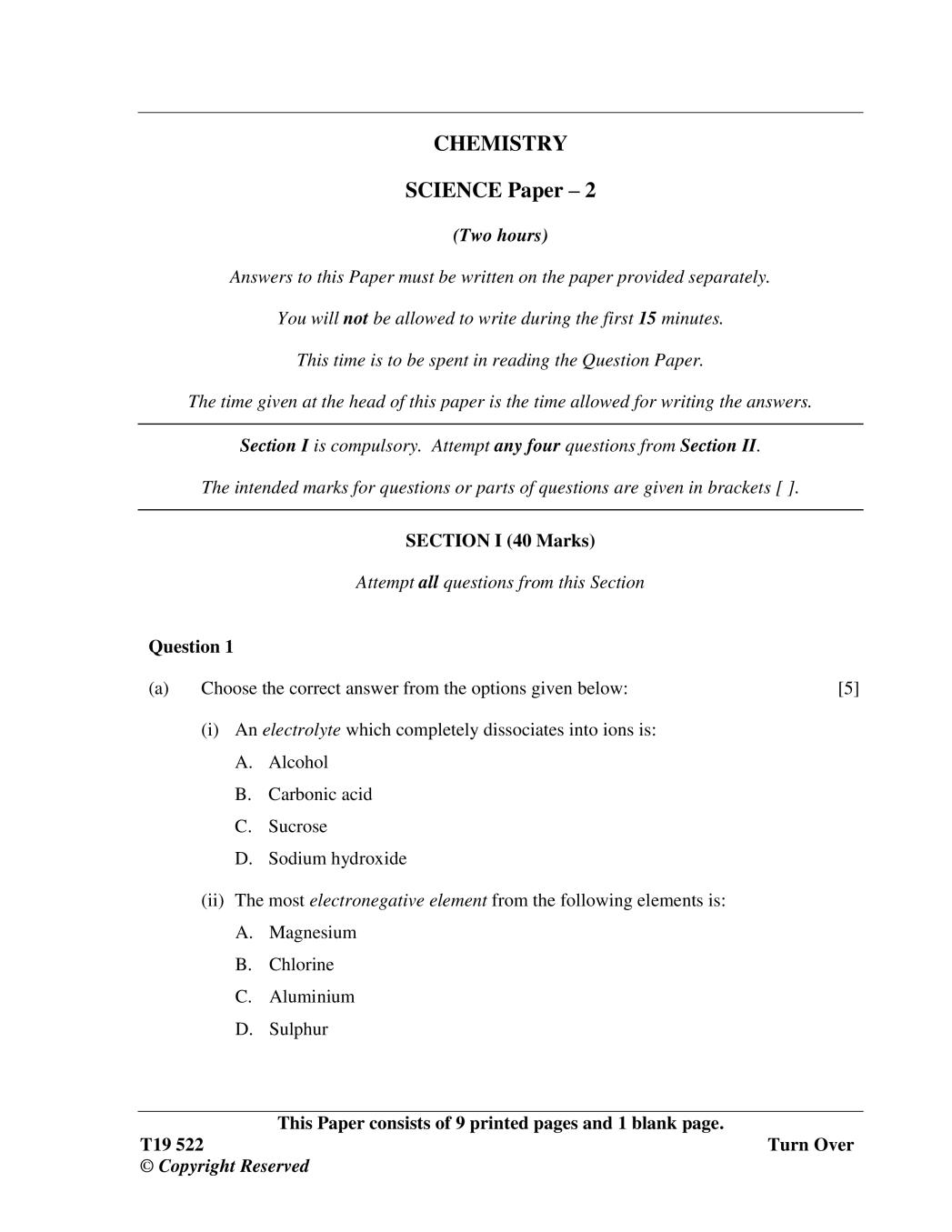
SCIENCE Paper – 2
(Two hours)
Answers to this Paper must be written on the paper provided separately.
You will not be allowed to write during the first 15 minutes.
This time is to be spent in reading the Question Paper.
The time given at the head of this paper is the time allowed for writing the answers.
Section I is compulsory. Attempt any four questions from Section II.
The intended marks for questions or parts of questions are given in brackets [ ].
SECTION I (40 Marks)
Attempt all questions from this Section
Question 1
(a) Choose the correct answer from the options given below: [5]
(i) An electrolyte which completely dissociates into ions is:
A. Alcohol
B. Carbonic acid
C. Sucrose
D. Sodium hydroxide
(ii) The most electronegative element from the following elements is:
A. Magnesium
B. Chlorine
C. Aluminium
D. Sulphur
This Paper consists of 9 printed pages and 1 blank page.
T19 522 Turn Over
© Copyright Reserved
Page 2
A. Aluminium is brittle.
B. Aluminium gives strength.
C. Aluminium brings lightness.
D. Aluminium lowers melting point.
(iv) The drying agent used to dry HCl gas is:
A. Conc. H2SO4
B. ZnO
C. Al2O3
D. CaO
(v) A hydrocarbon which is a greenhouse gas is:
A. Acetylene
B. Ethylene
C. Ethane
D. Methane
(b) Fill in the blanks with the choices given in brackets: [5]
(i) Conversion of ethanol to ethene by the action of concentrated sulphuric
acid is an example of ____________. (dehydration / dehydrogenation /
dehydrohalogenation)
(ii) When sodium chloride is heated with concentrated sulphuric acid below
200oC, one of the products formed is ____________. (sodium hydrogen
sulphate / sodium sulphate / chlorine)
(iii) Ammonia reacts with excess chlorine to form ____________. (nitrogen /
nitrogen trichloride / ammonium chloride)
(iv) Substitution reactions are characteristic reactions of ____________.
(alkynes / alkenes / alkanes)
(v) In Period 3, the most metallic element is ____________. (sodium /
magnesium / aluminium)
T19 522 2
Page 3
(i) Reduction of copper (II) oxide by hydrogen.
(ii) Action of dilute sulphuric acid on sodium hydroxide.
(iii) Action of dilute sulphuric acid on zinc sulphide.
(iv) Ammonium hydroxide is added to ferrous sulphate solution.
(v) Chlorine gas is reacted with ethene.
(d) State one observation for each of the following: [5]
(i) Concentrated nitric acid is reacted with sulphur.
(ii) Ammonia gas is passed over heated copper (II) oxide.
(iii) Copper sulphate solution is electrolysed using copper electrodes.
(iv) A small piece of zinc is added to dilute hydrochloric acid.
(v) Lead nitrate is heated strongly in a test tube.
(e) (i) Calculate: [5]
1. The number of moles in 12g of oxygen gas. [O = 16]
2. The weight of 1022 atoms of carbon.
[C = 12, Avogadro’s No. = 6 x 10²³]
(ii) Molecular formula of a compound is C6H18O3. Find its empirical formula.
(f) (i) Give the IUPAC name of the following organic compounds: [5]
1.
2.
T19 522 3 Turn Over
Page 4
(iii) Name the saturated hydrocarbon containing two carbon atoms.
(iv) Give the structural formula of Acetic acid.
(g) Give the appropriate term defined by the statements given below: [5]
(i) The formula that represents the simplest ratio of the various elements
present in one molecule of the compound.
(ii) The substance that releases hydronium ion as the only positive ion when
dissolved in water.
(iii) The tendency of an atom to attract electrons towards itself when combined
in a covalent compound.
(iv) The process by which certain ores, specially carbonates, are converted to
oxides in the absence of air.
(v) The covalent bond in which the electrons are shared equally between the
combining atoms.
(h) Arrange the following according to the instructions given in brackets: [5]
(i) K, Pb, Ca, Zn. (In the increasing order of the reactivity)
(ii) Mg2+, Cu2+, Na1+, H1+ (In the order of preferential discharge at the
cathode)
(iii) Li, K, Na, H (In the decreasing order of their ionization potential)
(iv) F, B, N, O (In the increasing order of electron affinity)
(v) Ethane, methane, ethene, ethyne. (In the increasing order of the
molecular weight) [H = 1, C = 12]
T19 522 4
Page 5
Attempt any four questions from this Section
Question 2
(a) Draw the electron dot structure of: [3]
(i) Nitrogen molecule [N = 7]
(ii) Sodium chloride [Na = 11, Cl = 17]
(iii) Ammonium ion [N = 7, H = 1]
(b) The pH values of three solutions A, B and C are given in the table. Answer the [3]
following questions:
Solution pH value
A 12
B 2
C 7
(i) Which solution will have no effect on litmus solution?
(ii) Which solution will liberate CO2 when reacted with sodium carbonate?
(iii) Which solution will turn red litmus solution blue?
(c) Study the extract of the Periodic Table given below and answer the questions [4]
that follow. Give the alphabet corresponding to the element in question.
DO NOT repeat an element.
A
C D E
B G F
(i) Which element forms electrovalent compound with G?
(ii) The ion of which element will migrate towards the cathode during
electrolysis?
(iii) Which non-metallic element has the valency of 2?
(iv) Which is an inert gas?
T19 522 5 Turn Over
Page 6
(a) Name the particles present in: [3]
(i) Strong electrolyte
(ii) Non- electrolyte
(iii) Weak electrolyte
(b) Distinguish between the following pairs of compounds using the reagent given [3]
in the bracket.
(i) Manganese dioxide and copper (II) oxide. (using concentrated HCl)
(ii) Ferrous sulphate solution and ferric sulphate solution. (using sodium
hydroxide solution)
(iii) Dilute hydrochloric acid and dilute sulphuric acid. (using lead nitrate
solution)
(c) Choose the method of preparation of the following salts, from the methods [4]
given in the list:
[List: A. Neutralization B. Precipitation
C. Direct combination D. Substitution]
(i) Lead chloride
(ii) Iron (II) sulphate
(iii) Sodium nitrate
(iv) Iron (III) chloride
Question 4
(a) Complete the following equations: [3]
(i) S + conc. HNO3 →
(ii) C + conc. H2SO4 →
(iii) Cu + dil. HNO3 →
T19 522 6
Page 7
(i) Ethene from bromoethane
(ii) Ethyne using calcium carbide
(iii) Methane from sodium acetate.
(c) Name the following organic compounds: [4]
(i) The compound with 3 carbon atoms whose functional group is a carboxyl.
(ii) The first homologue whose general formula is CnH2n.
(iii) The compound that reacts with acetic acid to form ethyl ethanoate.
(iv) The compound formed by complete chlorination of ethyne.
Question 5
(a) Give the chemical formula of: [3]
(i) Bauxite
(ii) Cryolite
(iii) Sodium aluminate
(b) Answer the following questions based on the extraction of aluminium from [3]
alumina by Hall-Heroult’s Process.:
(i) What is the function of cryolite used along with alumina as the
electrolyte?
(ii) Why is powdered coke sprinkled on top of the electrolyte?
(iii) Name the electrode, from which aluminium is collected.
T19 522 7 Turn Over
Page 8
COLUMN I COLUMN II
(i) Duralumin A. Electrical fuse
(ii) Solder B. Surgical instruments
(iii) Brass C. Aircraft body
(iv) Stainless Steel D. Decorative articles
Question 6
(a) Identify the substances underlined: [3]
(i) The catalyst used to oxidise ammonia.
(ii) The organic compound which when solidified, forms an ice like mass.
(iii) The dilute acid which is an oxidizing agent.
(b) Copper sulphate solution reacts with sodium hydroxide solution to form a [3]
precipitate of copper hydroxide according to the equation:
2NaOH + CuSO4 → Na2SO4 + Cu(OH)2 ↓
(i) What mass of copper hydroxide is precipitated by using 200 gm of sodium
hydroxide?
[H = 1, O = 16, Na = 23, S = 32, Cu = 64]
(ii) What is the colour of the precipitate formed?
(c) Find the empirical formula and the molecular formula of an organic [4]
compound from the data given below:
C = 75.92%, H = 6.32% and N = 17.76%
The vapour density of the compound is 39.5.
[C = 12, H = 1, N = 14]
T19 522 8
Page 9
(a) Name the gas evolved in each of the following cases: [3]
(i) Alumina undergoes electrolytic reduction.
(ii) Ethene undergoes hydrogenation reaction.
(iii) Ammonia reacts with heated copper oxide.
(b) Study the flow chart given and give balanced equations to represent the [3]
reactions A, B and C:
B
A
Mg3N2 NH3 NH4Cl
C
(c) Copy and complete the following table which refers to the industrial method [4]
for the preparation of ammonia and sulphuric acid:
Catalytic equation
Name of the compound Name of the process
(with the catalyst)
Ammonia (i)__________ (ii)__________
Sulphuric acid (iii)__________ (iv)__________
T19 522 9
Document Details
| Board / Org | CISCE |
| Exam | Class 10 |
| Type | Question Paper |
| Pages | 9 |
| Updated | 22 Jul 2026 |