NIOS Class 12 October 2024 Question Paper Introduction To Law
Finished viewing? Save it for later —
Download NIOS Class 12 October 2024 Question Paper Introduction To Law (PDF · 12 pages)About NIOS Class 12 October 2024 Question Paper Introduction To Law
NIOS Class 12 October 2024 Question Paper Introduction To Law is available here for free download. Published by NIOS for National Institute of Open Schooling Class 12, this question paper can be viewed online or downloaded as a PDF (12 pages). Candidates preparing for National Institute of Open Schooling Class 12 can use NIOS Class 12 October 2024 Question Paper Introduction To Law to understand the exam pattern, the type of questions asked, and the overall difficulty level.
Frequently Asked Questions
How can I download NIOS Class 12 October 2024 Question Paper Introduction To Law?
Open this page and click the Download button to save NIOS Class 12 October 2024 Question Paper Introduction To Law as a PDF. It is completely free on AglaSem Docs.
Is NIOS Class 12 October 2024 Question Paper Introduction To Law free to download?
Yes. NIOS Class 12 October 2024 Question Paper Introduction To Law can be viewed online and downloaded as a PDF free of cost on AglaSem Docs.
How many pages does NIOS Class 12 October 2024 Question Paper Introduction To Law have?
NIOS Class 12 October 2024 Question Paper Introduction To Law contains 12 pages, which you can read online or download together as a single PDF.
Where can I find more National Institute of Open Schooling Class 12 study material?
You can find more National Institute of Open Schooling Class 12 question papers, sample papers, syllabus, and answer keys on AglaSem Docs.
NIOS Class 12 October 2024 Question Paper Introduction To Law – Text
Read the full text of this question paper below — useful to quickly search, copy and reference the content online without downloading the PDF.
📄 View text version (12 pages)
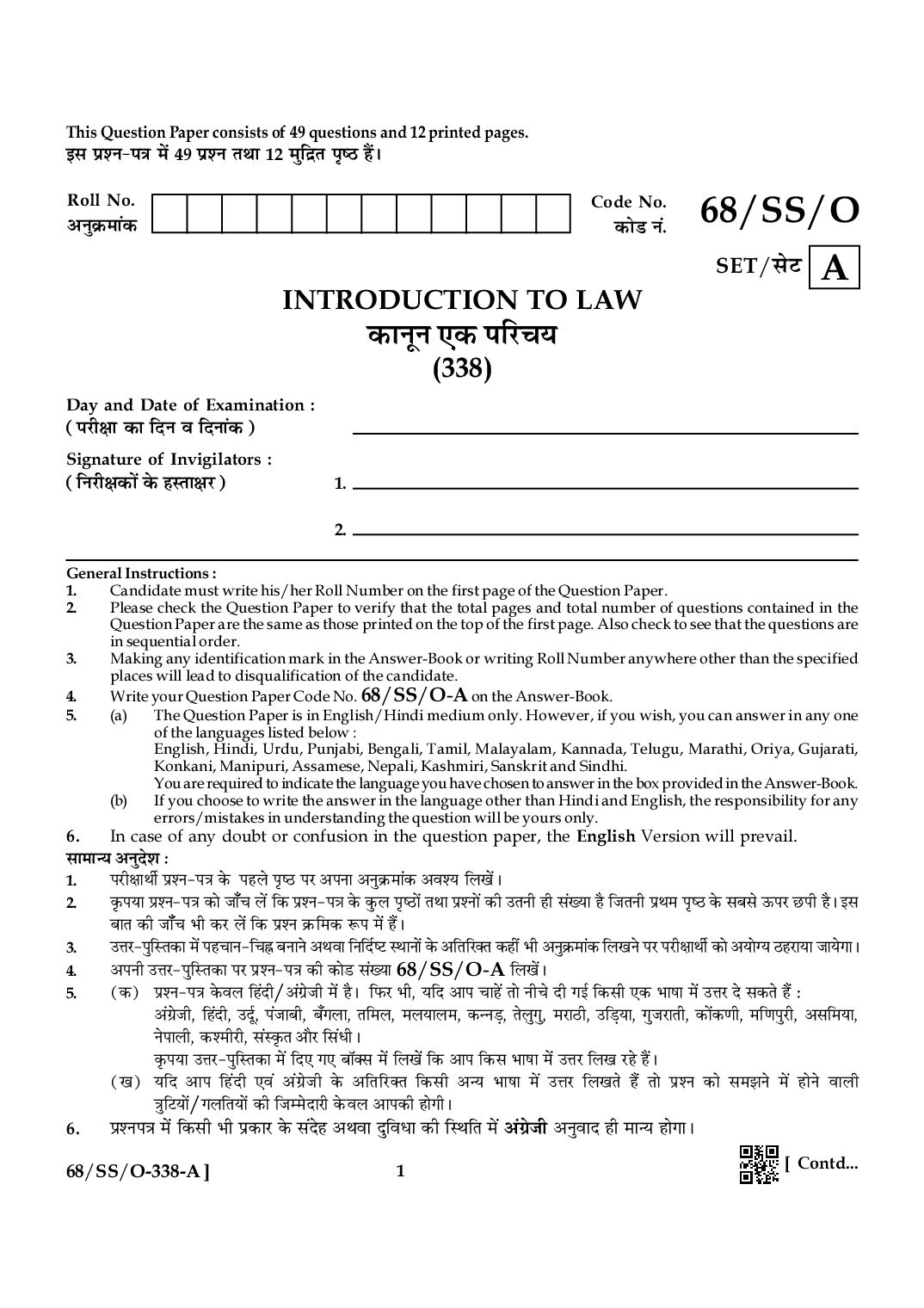
Page 1
ß‚ ¬˝‡Ÿ-¬òÊ ◊¥ 49 ¬˝‡Ÿ ÃÕÊ 12 ◊ÈÁŒ˝Ã ¬Îc∆U „Ò¥–
Roll No. Code No.
•ŸÈ∑˝§◊Ê¥∑§ ∑§Ê«U Ÿ¥.
68/SS/O
SET/‚ ≈ A
INTRODUCTION TO LAW
∑§ÊŸÍŸ ∞∑§ ¬Á⁄Uøÿ
(338)
Day and Date of Examination :
(¬⁄UˡÊÊ ∑§Ê ÁŒŸ fl ÁŒŸÊ¥∑§)
Signature of Invigilators :
(ÁŸ⁄UˡÊ∑§Ê¥ ∑§ „SÃÊˇÊ⁄U) 1.
2.
General Instructions :
1. Candidate must write his/her Roll Number on the first page of the Question Paper.
2. Please check the Question Paper to verify that the total pages and total number of questions contained in the
Question Paper are the same as those printed on the top of the first page. Also check to see that the questions are
in sequential order.
3. Making any identification mark in the Answer-Book or writing Roll Number anywhere other than the specified
places will lead to disqualification of the candidate.
4. Write your Question Paper Code No. 68/SS/O-A on the Answer-Book.
5. (a) The Question Paper is in English/Hindi medium only. However, if you wish, you can answer in any one
of the languages listed below :
English, Hindi, Urdu, Punjabi, Bengali, Tamil, Malayalam, Kannada, Telugu, Marathi, Oriya, Gujarati,
Konkani, Manipuri, Assamese, Nepali, Kashmiri, Sanskrit and Sindhi.
You are required to indicate the language you have chosen to answer in the box provided in the Answer-Book.
(b) If you choose to write the answer in the language other than Hindi and English, the responsibility for any
errors/mistakes in understanding the question will be yours only.
6. In case of any doubt or confusion in the question paper, the English Version will prevail.
‚Ê◊Êãÿ •ŸÈŒ‡Ê —
1. ¬⁄UˡÊÊÕ˸ ¬˝‡Ÿ-¬òÊ ∑§ §¬„‹ ¬Îc∆U ¬⁄U •¬ŸÊ •ŸÈ∑˝§◊Ê¥∑§ •fl‡ÿU Á‹π¥–
2. ∑Χ¬ÿÊ ¬˝‡Ÿ-¬òÊ ∑§Ê ¡ÊÚ°ø ‹¥ Á∑§ ¬˝‡Ÿ-¬òÊ ∑§ ∑ȧ‹ ¬Îc∆UÊ¥ ÃÕÊ ¬˝‡ŸÊ¥ ∑§Ë ©ÃŸË „Ë ‚¥ÅUÿÊ „Ò Á¡ÃŸË ¬˝Õ◊ ¬Îc∆ ∑ §‚’‚ ™§¬⁄U ¿U¬Ë „Ò– ß‚
’Êà ∑§Ë ¡ÊÚ°ø ÷Ë ∑§⁄U ‹¥ Á∑§ ¬˝‡Ÿ ∑˝ Á◊∑§ UM§¬ ◊¥ „Ò¥–
3. § ©ûÊ⁄U-¬ÈÁSUÃ∑§Ê ◊¥ ¬„øÊŸ-Áøq ’ŸÊŸ •ÕflÊ ÁŸÁŒ¸c≈U SÕÊŸÊ¥ ∑§§•ÁÃÁ⁄UÄà ∑§„Ë¥ ÷Ë •ŸÈ∑§˝ ◊Ê¥∑§ Á‹πŸ ¬⁄U ¬⁄UˡÊÊÕ˸ ∑§Ê •ÿÊÇÿ ∆U„⁄UÊÿÊ ¡ÊÿªÊ–
4. •¬ŸË ©ûÊ⁄U-¬ÈÁSUÃ∑§Ê ¬⁄U ¬˝‡Ÿ-¬òÊ ∑§Ë ∑§Ê«U ‚¥ÅÿÊ 68/SS/O-A Á‹π¥–
5. (∑§) ¬˝‡Ÿ-¬òÊ ∑§fl‹ Á„¥ŒË/•¥ª˝¡Ë ◊¥ „Ò– Á»§⁄U ÷Ë, ÿÁŒ •Ê¬ øÊ„¥ ÃÊ ŸËø ŒË ªß¸ Á∑§‚Ë ∞∑§ ÷Ê·Ê ◊¥ ©ûÊ⁄ Œ ‚∑§Ã „Ò¥ —
•¥ª˝¡Ë, Á„¥ŒË, ©ŒÍ¸, ¬¥¡Ê’Ë, ’°ª‹Ê, ÃÁ◊‹, ◊‹ÿÊ‹◊, ∑§ãŸ«∏, ËȪÈ, ◊⁄UÊ∆UË, ©Á«∏ÿÊ, ªÈ¡⁄UÊÃË, ∑§Ê¥∑§áÊË, ◊ÁáʬÈ⁄UË, •‚Á◊ÿÊ,
Ÿ¬Ê‹Ë, ∑§‡◊Ë⁄UË, ‚¥S∑Χç•ÊÒ⁄U Á‚¥œË–
∑Χ¬ÿÊ ©ûÊ⁄U-¬ÈÁSÃ∑§Ê ◊¥ ÁŒ∞ ª∞ ’ÊÚÄ‚ ◊¥ Á‹π¥ Á∑§ •Ê¬ Á∑§‚ ÷Ê·Ê ◊¥ ©ûÊ⁄U Á‹π ⁄U„ „Ò¥–
(π) ÿÁŒ •Ê¬ Á„¥ŒË ∞fl¥ •¥ª˝¡Ë ∑§ •ÁÃÁ⁄UÄà Á∑§‚Ë •ãÿ ÷Ê·Ê ◊¥ ©ûÊ⁄U Á‹πà „Ò¥ ÃÊ ¬˝‡Ÿ ∑§Ê ‚◊¤ÊŸ ◊¥ „ÊŸ flÊ‹Ë
òÊÈÁ≈UÿÊ¥/ª‹ÁÃÿÊ¥ ∑§Ë Á¡ê◊UŒÊ⁄Ë ∑ fl‹ •Ê¬∑§Ë „ʪ˖
6. ¬˝‡Ÿ¬òÊ ◊¥ Á∑§‚Ë ÷Ë ¬˝∑§Ê⁄U ∑§ ‚¥Œ„ •ÕflÊ ŒÈÁflœÊ ∑§Ë ÁSÕÁà ◊¥ •¥ª˝¡Ë •ŸÈflÊŒ „Ë ◊Êãÿ „ʪʖ
1 [ Contd...
Page 2
∑§ÊŸÍŸ ∞∑§ ¬Á⁄Uøÿ
(338)
Time : 3 Hours ] [ Maximum Marks : 100
‚◊ÿ — 3 ÉÊá≈U ] [ ¬ÍáÊÊZ∑§ — 100
Notes :
(i) This question paper consists of 49 questions in all.
(ii) All questions are compulsory.
(iii) Marks are given against each question.
(iv) Attempt all questions either from Optional Module A or Optional Module B in all sections.
(v) Section - A consists of :
(a) Q.No. 1 to 20 - Multiple Choice type questions (MCQs) carrying 1 mark each. Select and
write the most appropriate option out of the four options given in each of these questions.
(b) Q.No. 21 to 35 - Objective type questions carrying 2 marks each (with 2 sub-parts of 1 mark
each) and attempt these questions as per the instructions given for each of the questions
21 to 35.
(vi) Section - B consists of :
(a) Q.No. 36 to 41 - Very Short Answer type questions carrying 2 marks each, to be answered in
the range of 30 to 50 words.
(b) Q.No. 42 to 46 - Short Answer type questions carrying 4 marks each, to be answered in the
range of 50 to 80 words.
(c) Q.No. 47 to 49 - Long Answer type questions carrying 6 marks each, to be answered in the
range of 80 to 120 words.
ÁŸŒ¸‡Ê —
(i) ß‚ ¬˝‡Ÿ-¬òÊ ◊¥ ∑ȧ‹ 49 ¬˝‡Ÿ „Ò¥–
(ii) ‚÷Ë ¬˝‡Ÿ •ÁŸflÊÿ¸ „Ò¥–
(iii) ¬˝àÿ∑§ ¬˝‡Ÿ ∑§ ‚Ê◊Ÿ ©‚∑§ •¥∑§ ÁŒ∞ ª∞ „Ò¥–
(iv) ‚÷Ë ¬˝‡ŸÊ¥ ∑§ ©ûÊ⁄U ¬˝àÿ∑§ πá«U ◊¥ ‚ ÿÊ ÃÊ flÒ∑§ÁÀ¬∑§ ◊ÊÚ«KÍ‹ A ÿÊ flÒ∑§ÁÀ¬∑§ ◊ÊÚ«KÍ‹ B ◊¥ ‚ ŒËÁ¡∞–
(v) πá«U - ∑§ ◊¥ ‡ÊÊÁ◊‹ „Ò¥ —
(a) ¬˝‡Ÿ ‚¥ÅÿÊ 1 ‚ 20 - ’„ÈÁfl∑§À¬Ëÿ ¬˝∑§Ê⁄U ∑§ ¬˝‡Ÿ „Ò¥, ¡Ê ¬˝àÿ∑§ ¬˝‡Ÿ 1 •¥∑§ ∑§Ê „Ò– ߟ ¬˝‡ŸÊ¥ ◊¥ ¬˝àÿ∑§ ◊¥ ÁŒÿ
ªÿ øÊ⁄U Áfl∑§À¬Ê¥ ◊¥ ‚ ‚’‚ ©¬ÿÈÄà Áfl∑§À¬ øÈÁŸÿ •ÊÒ⁄U Á‹Áπ∞–
(b) ¬˝‡Ÿ ‚¥ÅÿÊ 21 ‚ 35 - flSÃÈÁŸc∆U ¬˝∑§Ê⁄U ∑§ ¬˝‡Ÿ „Ò¥, ¡Ê ¬˝àÿ∑§ ¬˝‡Ÿ 2 •¥∑§ ∑§Ê „ÒU (ŒÊ ©¬÷ʪ ∑§ ‚ÊÕ ¬˝àÿ∑§ ∑§Ê
1 •¥∑§)– ¬˝‡Ÿ ‚¥ÅÿÊ 21 ‚ 35 ◊¥ ¬˝àÿ∑§ ¬˝‡Ÿ ◊¥ ŒË ªß¸ ‚ÍøŸÊ •ŸÈ‚Ê⁄U ¬˝‡ŸÊ¥ ∑§ ©ûÊ⁄U ŒËÁ¡∞–
(vi) πá«U - π§ ◊¥ ‡ÊÊÁ◊‹ „Ò¥ —
(a) ¬˝‡Ÿ ‚¥ÅÿÊ 36 ‚ 41 - •ÁËÉÊÈ ©ûÊ⁄UËÿ ¬˝∑§Ê⁄U ∑§ ¬˝‡Ÿ „Ò¥, ¬˝àÿ∑§ ∑§ 2 •¥∑§ „Ò¥ •ÊÒ⁄U ©ûÊ⁄U ∑§Ë ‚Ë◊Ê 30 ‚ 50 ‡ÊéŒ
„Ò–
(b) ¬˝‡Ÿ ‚¥ÅÿÊ 42 ‚ 46 - ‹ÉÊÈ ©ûÊ⁄UËÿ ¬˝∑§Ê⁄U ∑§ ¬˝‡Ÿ „Ò¥, ¬˝àÿ∑§ ∑§ 4 •¥∑§ „Ò¥ •ÊÒ⁄U ©ûÊ⁄U ∑§Ë ‚Ë◊Ê 50 ‚ 80 ‡ÊéŒ „Ò–
(c) ¬˝‡Ÿ ‚¥ÅÿÊ 47 ‚ 49 - ŒËÉʸ ©ûÊ⁄UËÿ ¬˝∑§Ê⁄U ∑§ ¬˝‡Ÿ „Ò¥, ¬˝àÿ∑§ ∑§ 6 •¥∑§ „Ò¥ •ÊÒ⁄U ©ûÊ⁄U ∑§Ë ‚Ë◊Ê 80 ‚ 120 ‡ÊéŒ „Ò–
2 [ Contd...
Page 3
(1) Answer of all questions are to be given in the Answer-Book given to you.
‚÷Ë ¬˝‡ŸÊ¥ ∑§ ©ûÊ⁄U •Ê¬∑§Ê ŒË ªß¸ ©ûÊ⁄U-¬ÈÁSÃ∑§Ê ◊¥ „Ë Á‹π¥–
(2) 15 minutes time has been allotted to read this question paper. The question paper will be distributed
at 2 : 15 p.m. From 2 : 15 p.m. to 2 : 30 p.m., the students will read the question paper only and
will not write any answer on the Answer-Book during this period.
ß‚ ¬˝‡Ÿ-¬òÊ ∑§Ê ¬…∏Ÿ ∑§ Á‹∞ 15 Á◊Ÿ≈U ∑§Ê ‚◊ÿ ÁŒÿÊ ªÿÊ „Ò– ¬˝‡Ÿ-¬òÊ ∑§Ê ÁflÃ⁄UáÊ ŒÊ¬„⁄U ◊¥ 2 : 15 ’¡ Á∑§ÿÊ ¡Ê∞ªÊ–
2 : 15 ’¡ ‚ 2 : 30 ’¡ Ã∑§ ¿UÊòÊ ∑§fl‹ ¬˝‡Ÿ-¬òÊ ∑§Ê ¬…∏¥ª •ÊÒ⁄U ß‚ •flÁœ ∑§ ŒÊÒ⁄UÊŸ fl ©ûÊ⁄U-¬ÈÁSÃ∑§Ê ¬⁄U ∑§Ê߸ ©ûÊ⁄U Ÿ„Ë¥
Á‹π¥ª–
SECTION - A / πá«U - ∑§
1. The idea of law as guide to human conduct is as old as the existence of the __________. 1
(A) Human beings (B) Civilised society
(C) Government (D) Courts
◊ÊŸfl •Êø⁄UáÊ ∑§ ◊ʪ¸Œ‡Ê¸∑§ ∑§ M§¬ ◊¥ ∑§ÊŸÍŸ ∑§Ë •flœÊ⁄UáÊÊ ÁŸêŸÁ‹Áπà ◊¥ ‚ Á∑§‚ ∑§ •ÁSÃàfl Á¡ÃŸË ¬È⁄UÊŸË „Ò?
(A) ◊ÊŸfl ©à¬Áà (B) ‚èÿ ‚◊Ê¡
(C) ‚⁄U∑§Ê⁄U (D) •ŒÊ‹ÃÊ¥
2. Private law regulates and governs the relations of citizens with __________. 1
(A) government (B) society
(C) each other (D) private companies
ÁŸ¡Ë ∑§ÊŸÍŸ ÁŸêŸÁ‹Áπà ◊¥ ‚ Á∑§‚ ∑§ ‚ÊÕ ŸÊªÁ⁄U∑§Ê¥ ∑§ ‚ê’ãœÊ¥ ∑§Ê ÁflÁŸÿÁ◊à •ÊÒ⁄U ‡ÊÊÁ‚à ∑§⁄Uà „Ò¥?
(A) ‚⁄U∑§Ê⁄U (B) ‚◊Ê¡
(C) •Ê¬‚ ◊¥ ∞∑§ ŒÍ‚⁄U ∑§ ‚ÊÕ (D) ¬˝Ê߸fl≈U ∑§ê¬ÁŸÿÊ¥ ∑§ ‚ÊÕ
3. Which one of the following is NOT dealt by Personal Law ? 1
(A) marriage (B) divorce (C) succession (D) employment
√ÿÁÄêà ∑§ÊŸÍŸ ÁŸêŸÁ‹Áπà ◊¥ ‚ Á∑§‚ ∑§Ê ÁŸ¬≈UÊ⁄UÊ Ÿ„Ë¥ ∑§⁄UÃÊ „Ò?
(A) ÁflflÊ„ (B) ËÊ∑§ (C) ©ûÊ⁄UÊÁœ∑§Ê⁄U (D) ⁄UÊ$¡ªÊ⁄U
4. Which one of the following is NOT a source of Hindu Law ? 1
(A) Customs of Hindus (B) Vedas
(C) Judicial decisions about Hindus (D) International Laws
ÁŸêŸÁ‹Áπà ◊¥ ‚ ∑§ÊÒŸ Á„ãŒÈ ∑§ÊŸÍŸ ∑§Ê dÊà Ÿ„Ë¥ „Ò?
(A) ⁄UËÁÃ-Á⁄UflÊ¡ (B) flŒ
(C) Á„ãŒÈ•Ê¥ ∑§ ’Ê⁄U ◊¥ ãÿÊÁÿ∑§ ÁŸáʸÿ (D) •ãÃ⁄Uʸc≈˛UËÿ ∑§ÊŸÍŸ
3 [ Contd...
Page 4
in Western parts of India ? 1
(A) Parsis (B) Portuguese (C) French (D) Jews
16flË¥ ‡ÊÃÊéŒË ◊¥ ÷Ê⁄Uà ∑§ ¬Á‡ø◊Ë ÷ʪʥ ◊¥ ⁄UÊ◊Ÿ ∑Ò§ÕÊÁ‹∑§ øø¸ ∑§Ë SÕʬŸÊ ÁŸêŸÁ‹Áπà ◊¥ ‚ Á∑§‚Ÿ ∑§Ë ÕË?
(A) ¬Ê⁄UÁ‚ÿÊ¥ (B) ¬ÈøªÊÁ‹ÿÊ¥ (C) »˝§Ê¥‚ËÁ‚ÿÊ¥ (D) ÿ„ÍÁŒÿÊ¥
6. The Indian Christian marriage act was codified in the year __________. 1
(A) 1870 (B) 1872 (C) 1874 (D) 1876
÷Ê⁄UÃËÿ ߸‚Ê߸ ÁflflÊ„ •ÁœÁŸÿ◊ Á∑§‚ fl·¸ ‚¥Á„ÃÊ’h Á∑§ÿÊ ªÿÊ ÕÊ?
(A) 1870 (B) 1872 (C) 1874 (D) 1876
7. Which punishment theory advocates even the capital punishment to teach a lesson to others ? 1
(A) Reformative Theory (B) Detterent Theory
(C) Retributive Theory (D) Compensation Theory
Œá«U ∑§Ê ∑§ÊÒŸ ‚Ê Á‚hÊãà ŒÍ‚⁄UÊ¥ ∑§Ê ‚’∑§ Á‚πÊŸ ∑§ Á‹∞ “»§Ê¥‚Ë ∑§Ë ‚$¡Ê” ŒŸ ∑§Ë fl∑§Ê‹Ã ∑§⁄UÃÊ „Ò?
(A) ‚ÈœÊ⁄UÊà◊∑§ Á‚hÊãà (B) ÁŸflÊ⁄U∑§ Á‚hÊãÃ
(C) ¬˝ÁÃ∑§Ê⁄UË Á‚hÊãà (D) ˇÊÁìÍÁø Á‚hÊãÃ
8. Choose the correct full form of IPC : 1
(A) Indian Personal Code (B) Indian Personal Conduct
(C) Indian Penal Code (D) Indian Penal Case
•Ê߸.¬Ë.‚Ë. (IPC) ∑§Ê ‚„Ë ÁflSÃÎà M§¬ øÈÁŸ∞ —
(A) ßÁã«UÿŸ ¬‚¸Ÿ‹ ∑§Ê«U (B) ßÁã«UÿŸ ¬‚¸Ÿ‹ ∑§ã«UÄ≈U
(C) ßÁã«UÿŸ ¬ËŸ‹ ∑§Ê«U (D) ßÁã«UÿŸ ¬ËŸ‹ ∑§‚
9. Which punishment theory works on the dictum “you can not cure by killing” ? 1
(A) Detterent Theory (B) Reformative Theory
(C) Preventive Theory (D) Compensation Theory
Œá«U ∑§Ê ∑§ÊÒŸ ‚Ê Á‚hÊãà “•Ê¬ „àÿÊ mÊ⁄UÊ ©¬øÊ⁄U Ÿ„Ë¥ ∑§⁄U ‚∑§Ã” ∑§Ë ©ÁÄà ¬⁄U •ÊœÊÁ⁄Uà „Ò?
(A) ÁŸflÊ⁄U∑§ Á‚hÊãà (B) ‚ÈœÊ⁄UÊà◊∑§ Á‚hÊãÃ
(C) ÁŸ⁄UÊœ∑§ Á‚hÊãà (D) ˇÊÁìÍÁø Á‚hÊãÃ
10. Which one of the following statements is TRUE about pleading ? 1
(A) Every pleading must state the laws.
(B) Every pleading must state the facts.
(C) Every pleading should be oral.
(D) Every pleading is to reduce the punishment.
ÁŸêŸÁ‹Áπà ◊¥ ‚ ∑§ÊÒŸ ‚Ê ∑§ÕŸ •Á÷flÊøŸ (pleading) ∑§ ’Ê⁄U ◊¥ “‚àÿ” „Ò?
(A) ¬˝àÿ∑§ •Á÷flÊøŸ ◊¥ ∑§ÊŸÍŸÊ¥ ∑§Ê ©À‹π „ÊŸÊ øÊÁ„∞–
(B) ¬˝àÿ∑§ •Á÷flÊøŸ ◊¥ ÃâÿÊ¥ ∑§Ê ©À‹π „ÊŸÊ øÊÁ„∞–
(C) ¬˝àÿ∑§ •Á÷flÊøŸ ◊ÊÒÁπ∑§ „ÊŸÊ øÊÁ„∞–
(D) ¬˝àÿ∑§ •Á÷flÊøŸ Œá«U ∑§◊ ∑§⁄UŸ ∑§ Á‹∞ „Ò–
4 [ Contd...
Page 5
(A) Habeas Corpus (B) Mandamus (C) Prohibition (D) Concession
ÁŸêŸÁ‹Áπà ◊¥ ‚ ∑§ÊÒŸ ‚Ê Áfl∑§À¬ “‚¥flÒœÊÁŸ∑§ ©¬øÊ⁄UÊ¥ ∑§ •Áœ∑§Ê⁄U” ∑§ •ãê¸Ã Ÿ„Ë¥ •ÊÃÊ?
(A) ’¥ŒË ¬˝àÿˇÊË∑§⁄UáÊ (B) ¬⁄U◊ÊŒ‡Ê (C) ÁŸ·œÊŒ‡Ê (D) Á⁄UÿÊÿÃ
12. The aim of RTI (Right to Information Act) is to bring information to the __________. 1
(A) Press (B) Citizens (C) Courts (D) Lawyers
“‚ÍøŸÊ ∑§Ê •Áœ∑§Ê⁄U” ∑§Ê ©g‡ÿ ÁŸêŸÁ‹Áπà ◊¥ ‚ Á∑§‚ ∑§Ê ‚ÍøŸÊ ¬˝ŒÊŸ ∑§⁄UŸ ∑§Ê „Ò?
(A) ¬˝‚ (B) ŸÊªÁ⁄U∑§Ê¥ (C) •ŒÊ‹ÃÊ¥ (D) fl∑§Ë‹Ê¥
13. Which law prescribes method of enforcing rights or obtaining redress for their invasion; 1
machinery for carrying on a suit ?
(A) Criminal Law (B) Civil Law
(C) Procedural Law (D) Substantive Law
∑§ÊÒŸ ‚Ê ∑§ÊŸÍŸ •Áœ∑§Ê⁄UÊ¥ ∑§Ê ‹ÊªÍ ∑§⁄UŸ, •ÕflÊ ©Ÿ∑§ ©À‹¥ÉÊŸ ¬⁄U ˇÊÁìÍÁø ¬˝Êåà ∑§⁄UŸ ÃÕÊ ◊È∑§Œ◊Ê ∑§⁄UŸ ∑§ Ã¥òÊ ∑§Ê
ÁŸœÊ¸Á⁄Uà ∑§⁄UÃÊ „Ò?
(A) •Ê¬⁄UÊÁœ∑§ ∑§ÊŸÍŸ (B) ŸÊªÁ⁄U∑§ ∑§ÊŸÍŸ
(C) ¬˝ÁÃÁ∑˝§ÿÊà◊∑§ ∑§ÊŸÍŸ (D) •Áœc∆UÊÿË ∑§ÊŸÍŸ
14. Substantive Law is a __________. 1
(A) statutory law
(B) law of action
(C) law of regulating employees
(D) law that provides mechanism to arrest
•Áœc∆UÊÿË ∑§ÊŸÍŸ ∞∑§ __________–
(A) ‚¥flÒœÊÁŸ∑§ ∑§ÊŸÍŸ „Ò–
(B) ∑§Ê⁄¸UflÊ߸ ∑§ÊŸÍŸ „Ò–
(C) ∑§◊¸øÊÁ⁄UÿÊ¥ ∑§Ê ÁŸÿÁ◊à ∑§⁄UŸ ∑§Ê ∑§ÊŸÍŸ „Ò–
(D) Áª⁄UçÃÊ⁄U ∑§⁄UŸ ∑§ Ã¥òÊ ∑§Ê ŒŸ flÊ‹Ê ∑§ÊŸÍŸ „Ò–
15. Under which law comes the ‘Right to appeal’ ? 1
(A) Procedural law (B) Substantive law
(C) Statutory law (D) None of the above
“•¬Ë‹ ∑§⁄UŸ ∑§Ê •Áœ∑§Ê⁄U” Á∑§‚ ∑§ÊŸÍŸ ∑§ •ãê¸Ã Á◊‹ÃÊ „Ò?
(A) ¬˝Á∑˝§ÿÊà◊∑§ ∑§ÊŸÍŸ (B) •Áœc∆UÊÿË ∑§ÊŸÍŸ
(C) ‚¥flÒœÊÁŸ∑§ ∑§ÊŸÍŸ (D) ©¬⁄UÊÄà ◊¥ ‚ ∑§Ê߸ Ÿ„Ë¥
16. Which one of the following is NOT defined by the Substantial Criminal Law ? 1
(A) Murder (B) Robbery (C) Marriage (D) Rape
ÁŸêŸÁ‹Áπà ◊¥ ‚ Á∑§‚ ∑§Ê •Áœc∆UÊÿË •Ê¬⁄UÊÁœ∑§ ∑§ÊŸÍŸ ∑§ •ãê¸Ã ¬Á⁄U÷ÊÁ·Ã Ÿ„Ë¥ Á∑§ÿÊ ¡ÊÃÊ?
(A) „àÿÊ (B) «U∑Ò§ÃË (C) ÁflflÊ„ (D) ’‹Êà∑§Ê⁄U
5 [ Contd...
Page 6
(A) Another Dispute Resolution (B) Alternate Dispute Resolution
(C) Authorised Dispute Reference (D) Alternate Dispute Removal
∞.«UË.•Ê⁄U. (ADR) ∑§Ê ‚„Ë ÁflSÃÎà M§¬ øÈÁŸ∞ —
(A) •Ÿ•Œ⁄U Á«USåÿÍ≈U Á⁄U$¡Ê‹È‡ÊŸ (B) •ÊÀ≈U⁄UŸ≈U Á«USåÿÍ≈U Á⁄U$¡Ê‹È‡ÊŸ
(C) •ÊÕÊ⁄UÊ߸í«U Á«USåÿÍ≈U ⁄U»§⁄Uã‚ (D) •ÊÀ≈U⁄UŸ≈U Á«USåÿÍ≈U Á⁄U◊Ífl‹
18. Choose the correct option : 1
No appeal is permissible against the awards of the __________.
(A) Lok Adalats (B) Formal Courts
(C) Governmental Departments (D) None of the above
‚„Ë Áfl∑§À¬ øÈÁŸ∞ —
ÁŸêŸÁ‹Áπà ◊¥ ‚ Á∑§‚∑§ ÁŸáʸÿ ∑§ ÁflL§h •¬Ë‹ ∑§⁄UŸ ∑§Ë •ŸÈ◊Áà Ÿ„Ë¥ „Ò?
(A) ‹Ê∑§ •ŒÊ‹Ã (B) •ÊÒ¬øÊÁ⁄U∑§ ãÿÊÿÊ‹ÿ
(C) ‚⁄U∑§Ê⁄UË Áfl÷ʪ (D) ©¬⁄UÊÄà ◊¥ ‚ ∑§Ê߸ Ÿ„Ë¥
19. Choose the option which is TRUE for the Constitution of India : 1
(A) It was framed by a penal of jurists.
(B) It was adopted on November 24, 1949.
(C) Dr. B.R. Ambedkar was the Chairman of Constitutent Assembly.
(D) Constitution contains the laws and the principles according to which the State of India
is governed.
ÁŸêŸÁ‹Áπà ◊¥ ‚ ∑§ÊÒŸ ‚Ê ∑§ÕŸ “÷Ê⁄Uà ∑§ ‚¥ÁflœÊŸ” ∑§ ’Ê⁄U ◊¥ “‚àÿ” „Ò?
(A) ß‚∑§Ê ãÿÊÿÁflŒÊ¥ ∑§ ∞∑§ ¬Ÿ‹ Ÿ ÁŸÁ◊¸Ã Á∑§ÿÊ ÕÊ–
(B) ß‚∑§Ê 24 Ÿflê’⁄U 1949 ∑§Ê •¥ªË∑§Ê⁄U Á∑§ÿÊ ªÿÊ ÕÊ–
(C) «UÊÚ. ÷Ë◊⁄UÊfl •ê’«U∑§⁄U ‚¥ÁflœÊŸ ‚÷Ê ∑§ •äÿˇÊ Õ–
(D) ‚¥ÁflœÊŸ ◊¥ ∞‚ ∑§ÊŸÍŸ •ÊÒ⁄U ÁŸÿ◊ „Ò¥ Á¡Ÿ∑§ •ŸÈ‚Ê⁄U ÷Ê⁄Uà ⁄UÊíÿ ∑§Ê ‡ÊÊ‚Ÿ ‚¥øÊÁ‹Ã „ÊÃÊ „Ò–
20. Which one of the following is NOT a fundamental right ? 1
(A) Right to Equality (B) Right to Freedom
(C) Right to Property (D) Right to Education
ÁŸêŸÁ‹Áπà ◊¥ ‚ ∑§ÊÒŸ ‚Ê •Áœ∑§Ê⁄U ◊ÊÒÁ‹∑§ •Áœ∑§Ê⁄U Ÿ„Ë¥ „Ò?
(A) ‚◊ÊŸÃÊ ∑§Ê •Áœ∑§Ê⁄U (B) SflÃ¥òÊÃÊ ∑§Ê •Áœ∑§Ê⁄U
(C) ‚ê¬ÁûÊ ∑§Ê •Áœ∑§Ê⁄U (D) Á‡ÊˇÊÊ ∑§Ê •Áœ∑§Ê⁄U
21. Fill in the blanks : 1+1=2
Both public and __________ Law may be __________ or Procedural Law.
Á⁄UÄà SÕÊŸÊ¥ ∑§Ê ∆UË∑§ ‚ ÷Á⁄Uÿ —
¬Áé‹∑§ •ÊÒ⁄U __________ ∑§ÊŸÍŸ ŒÊŸÊ¥ „Ë __________ •ÕflÊU ¬˝Á∑˝§ÿÊà◊∑§ ∑§ÊŸÍŸ „Ê ‚∑§Ã „Ò¥–
6 [ Contd...
Page 7
dispute have to wait for __________ for years. 1+1=2
ÿ„ ∞∑§ ‚ÈÁflÁŒÃ Ãâÿ „Ò Á∑§ flø◊ÊŸ ãÿÊÁÿ∑§ √ÿflSÕÊ ’„Èà „Ë __________ „Ò •ÊÒ⁄U Á∑§‚Ë ÁflflÊŒ ‚ ¡È«∏Ë ¬ÊÁ≈¸UÿÊ¥
∑§Ê fl·ÊZ Ã∑§ __________ ¬˝ÃˡÊÊ ∑§⁄UŸË ¬«∏ÃË „Ò–
23. Conciliation is a __________ and non binding process in comparison to __________ and
litigation in courts. 1+1=2
‚◊¤ÊÊÒÃÊ, __________ •ÊÒ⁄U ◊È∑§Œ◊’Ê¡Ë ∑§Ë ÃÈ‹ŸÊ ◊¥ ∞∑§ __________ •ÊÒ⁄U •Ê’Êäÿ∑§Ê⁄UË ¬˝Á∑˝§ÿÊ „Ò–
24. Match the items in Column - A correctly with their corresponding items in Column - B. 1+1=2
Column - A Column - B
(a) Lok Adalat (i) Wastage of time and money
(b) Formal Court (ii) National legal services
(iii) American system
(iv) Saves time and money
∑§Ê‹◊ - A ◊¥ Œ¡¸ •Ê߸≈Uê‚ ∑§Ê ∑§Ê‹◊ - B ∑§Ë •Ê߸≈Uê‚ ∑§ ‚ÊÕ ‚„Ë Á◊‹ÊŸ ∑§ËÁ¡∞–
∑§Ê‹◊ - A ∑§Ê‹◊ - B
(a) ‹Ê∑§ •ŒÊ‹Ã (i) ‚◊ÿ •ÊÒ⁄U œŸ ∑§Ë ’⁄U’ÊŒË
(b) ÁŸÿÁ◊à ãÿÊÿÊ‹ÿ (ii) ⁄UÊc≈˛UËÿ ÁflÁœ∑§ ‚flÊ∞°
(iii) •◊⁄UË∑§Ë ¬˝áÊÊ‹Ë
(iv) ‚◊ÿ •ÊÒ⁄U œŸ ∑§Ë ’øÃ
25. Fill in the blanks : 1+1=2
The fundamental rights can not be __________ by any organ of the __________.
Á⁄UÄà SÕÊŸÊ¥ ∑§Ê ∆UË∑§ ‚ ÷Á⁄Uÿ —
◊ÊÒÁ‹∑§ •Áœ∑§Ê⁄UÊ¥ ∑§Ê __________ ∑§ Á∑§‚Ë ÷Ë •¥ª mÊ⁄UÊ __________ Ÿ„Ë¥ Á∑§ÿÊ ¡Ê ‚∑§ÃÊ–
26. Write true or false against the statement :
(i) There is no difference between ordinary rights and fundamental rights. 1
(ii) Originally, seven fundamental rights were enshrined in Part III of the Indian 1
Constitution.
∑§ÕŸÊ¥ ∑§ ‚Ê◊Ÿ ‚àÿ •ÕflÊ •‚àÿ Á‹Áπ∞ —
(i) ‚ÊœÊ⁄UáÊ •Áœ∑§Ê⁄UÊ¥ •ÊÒ⁄U ◊ÊÒÁ‹∑§ •Áœ∑§Ê⁄UÊ¥ ∑§ ’Ëø ∑§Ê߸ •ãÃ⁄U Ÿ„Ë¥ „Ò–
(ii) ◊Í‹ M§¬ ◊¥, ÷Ê⁄UÃËÿ ‚¥ÁflœÊŸ ∑§ ÷ʪ III ◊¥ ‚Êà ◊ÊÒÁ‹∑§ •Áœ∑§Ê⁄U Œ¡¸ Õ–
7 [ Contd...
Page 8
(i) Untouchability has been abolished and its practice in any form is prohibited. 1
(ii) Fundamental rights are enshrined in Part IV of the Constitution. 1
∑§ÕŸÊ¥ ∑§ ‚Ê◊Ÿ ‚àÿ •ÕflÊ •‚àÿ Á‹Áπ∞ —
(i) •S¬Î‡ÿÃÊ (¿ÈU•Ê¿ÍUÃ) ∑§Ê Á◊≈UÊ ÁŒÿÊ ªÿÊ „Ò •ÊÒ⁄U Á∑§‚Ë ÷Ë M§¬ ◊¥ ß‚∑§ √ÿfl„Ê⁄U ¬⁄U ¬˝ÁÒ㜠„Ò–
(ii) ◊ÊÒÁ‹∑§ •Áœ∑§Ê⁄U ÷Ê⁄UÃËÿ ‚¥ÁflœÊŸ ∑§ ÷ʪ IV ◊¥ Œ¡¸ „Ò¥–
28. Fill in the blanks : 1+1=2
Directive principles are non __________ and are meant to make India a __________ state.
Á⁄UÄà SÕÊŸÊ¥ ∑§Ê ∆UË∑§ ‚ ÷Á⁄Uÿ —
⁄UÊíÿ ∑§ ŸËÁà ÁŸŒ‡Ê∑§ Á‚hÊãà __________ Ÿ„Ë¥ „Ò¥ •ÊÒ⁄U ߟ∑§Ê ©g‡ÿ ÷Ê⁄Uà ∑§Ê ∞∑§ __________ ⁄UÊíÿ ’ŸÊŸÊ
„Ò–
29. Answer the following questions :
(i) Who is the ex-officio Chairman of Rajya Sabha ? 1
(ii) The members of the Rajya Sabha are elected by which particular system ? 1
ÁŸêŸÁ‹Áπà ¬˝‡ŸÊ¥ ∑§ ©ûÊ⁄U Á‹Áπ∞ —
(i) ∑§ÊÒŸ ⁄UÊíÿ ‚÷Ê ∑§Ê ¬ŒŸ •äÿˇÊ „ÊÃÊ „Ò?
(ii) ⁄UÊíÿ ‚÷Ê ∑§ ‚ŒSÿ Á∑§‚ Áfl‡Ê· ¬˝áÊÊ‹Ë ∑§ •ŸÈ‚Ê⁄U øÈŸ ¡Êà „Ò¥?
30. Fill in the blanks : 1+1=2
A money bill can be introduced in __________ Sabha only with the prior permission of the
__________.
Á⁄UÄà SÕÊŸÊ¥ ∑§Ê ∆UË∑§ ‚ ÷Á⁄Uÿ —
ÁflûÊ Áflœÿ∑§ ∑§Ê ∑§fl‹ __________ ‚÷Ê ◊¥ __________ ∑§Ë ¬Ífl¸ •ŸÈ◊Áà ‚ ¬˝SÃÈà Á∑§ÿÊ ¡Ê ‚∑§ÃÊ „Ò–
31. (i) What age you must have attained to become a member of Lok Sabha ? 1
(ii) What age you must have attained to become a member of Rajya Sabha ? 1
(i) ‹Ê∑§ ‚÷Ê ∑§Ê ‚ŒSÿ ’ŸŸ ∑§ Á‹∞ •Ê¬∑§Ë •ÊÿÈ Á∑§ÃŸ fl·¸ ÿÊ ©‚‚ •Áœ∑§ „ÊŸË øÊÁ„∞?
(ii) ⁄UÊíÿ ‚÷Ê ∑§Ê ‚ŒSÿ ’ŸŸ ∑§ Á‹∞ •Ê¬∑§Ë •ÊÿÈ Á∑§ÃŸ fl·¸ ∑§Ë „ÊŸË øÊÁ„∞?
32. (i) Which court has the jurisdiction to hear a dispute between Union Government and the 1
States ?
(ii) The door of which court can be knocked if fundamental right of your, is violated ? 1
(i) ‚¥ÉÊËÿ ‚⁄U∑§Ê⁄U •ÊÒ⁄U ⁄UÊíÿÊ¥ ∑§ ’Ëø ∑§ Á∑§‚Ë ÁflflÊŒ ¬⁄U ∑§ÊÒŸ ‚Ê ãÿÊÿÊ‹ÿ ‚ÈŸflÊ߸ ∑§⁄U ‚∑§ÃÊ „Ò?
(ii) ÿÁŒ ◊ÊÒÁ‹∑§ •Áœ∑§Ê⁄UÊ¥ ∑§Ê ©À‹¥ÉÊŸ „ÊÃÊ „Ò ÃÊ Á∑§‚ ãÿÊÿÊ‹ÿ ∑§Ê Œ⁄UflÊ¡Ê π≈Uπ≈UÊÿÊ ¡Ê ‚∑§ÃÊ „Ò?
8 [ Contd...
Page 9
(Environmental Law and Sustainable Development) / (¬ÿʸfl⁄UáÊ ∑§ÊŸÍŸ •ÊÒ⁄U œÊ⁄UáÊËÿ Áfl∑§Ê‚)
33. (i) Name any two things that are part of the environment. 1
(ii) Which particular topic was discussed at Rio Conference in 1992 ? 1
(i) ∞‚Ë ŒÊ øË$¡Ê¥ ∑§ ŸÊ◊ Á‹Áπ∞ ¡Ê ¬ÿʸfl⁄UáÊ ∑§Ê ÷ʪ „Ò¥–
(ii) Á⁄UÿÊ ‚ê◊‹Ÿ - 1992 ◊¥ Á∑§‚ Áfl·ÿ ¬⁄U øøʸ „È߸ ÕË?
34. (i) To which court can a person aggrieved by any order, decision or award of NGT go ? 1
(ii) Which type of gas was leaked in Bhopal by Union Carbide factory in 1984 ? 1
(i) Ÿ‡ÊŸ‹ ª˝ËŸ Á≈˛UéÿÍŸ‹ ∑§ Á∑§‚Ë ÁŸáʸÿ •ÕflÊ •ÊŒ‡Ê ‚ ¬ËÁ«∏à ∑§Ê߸ √ÿÁÄà Á∑§‚ ãÿÊÿÊ‹ÿ ◊¥ •¬Ë‹ ∑§⁄UŸ ¡Ê
‚∑§ÃÊ „Ò?
(ii) 1984 ÷ͬʋ ◊¥ ÿÍÁŸÿŸ ∑§Ê’ʸ߫U »Ò§Ä≈˛UË ‚ Á∑§‚ ¬˝∑§Ê⁄U ∑§Ë ªÒ‚ ‹Ë∑§ „È߸ ÕË?
35. Match the following correctly : 1+1=2
(a) Agenda 21 (i) Principles of natural justice
(b) NGT (ii) Government of India
(iii) Rio - Declaration
(iv) Kyoto - Protocol
ÁŸêŸÁ‹Áπà ∑§Ê ‚„Ë Á◊‹ÊŸ ∑§ËÁ¡∞ —
(a) ∞¡ã«UÊ - 21 (i) ¬˝Ê∑ΧÁÃ∑§ ãÿÊÿ ∑§Ê Á‚hÊãÃ
(b) Ÿ‡ÊŸ‹ ª˝ËŸ Á≈˛UéÿÍŸ‹ (ii) ÷Ê⁄Uà ‚⁄U∑§Ê⁄U
(iii) Á⁄UÿÊ - ÉÊÊ·áÊÊ
(iv) ÄÿÊ≈UÊ - ¬˝Ê≈UÊ∑§Ê‹
OPTION - II / Áfl∑§À¬ - II
(Consumer Protection) / (©¬÷ÊÄÃÊ ‚È⁄UˇÊÊ)
33. Fill in the blanks correctly : 1+1=2
The Consumer Protection Act, __________ is an act to protect the __________ of the
consumers.
Á⁄UÄà SÕÊŸ ∆UË∑§ ‚ ÷Á⁄Uÿ —
©¬÷ÊÄÃÊ ‚¥⁄UˇÊáÊ •ÁœÁŸÿ◊ __________ , ∞∑§ ∞‚Ê •ÁœÁŸÿ◊ „Ò ¡Ê ©¬÷ÊÄÃÊ•Ê¥ ∑§ __________ ∑§Ë ⁄UˇÊÊ
∑§⁄UŸÊ „Ò–
9 [ Contd...
Page 10
(i) Offering any gifts, prizes or other items along with the goods is not an “unfair trade 1
practice.”
(ii) Selling any rebuilt, renovated, reconditioned or old goods as new goods is acceptable to 1
the consumer and is not an “Unfair Trade Practice.”
∑§ÕŸÊ¥ ∑§ ‚Ê◊Ÿ ‚àÿ •ÕflÊ •‚àÿ Á‹Áπ∞ —
(i) flSÃÈ•Ê¥ ∑§ ‚ÊÕ ©¬„Ê⁄U, ¬È⁄US∑§Ê⁄U •ÕflÊ •ãÿ øË$¡¥ ŒŸÊ “•ŸÈÁøà ∑§Ê⁄UÊ’Ê⁄UË √ÿfl„Ê⁄U” Ÿ„Ë¥ „Ò–
(ii) Á∑§‚Ë ¬È⁄UÊŸË, ¬ÈŸÁŸ¸Á◊¸Ã •ÕflÊ ©¬ÿʪ ∑§Ë flSÃÈ ∑§Ê ’øŸÊ ¡Ê ©¬÷ÊÄÃÊ ∑§Ê SflË∑§Êÿ¸ „Ò - fl„ ∞∑§ “•ŸÈÁøÃ
∑§Ê⁄UÊ’Ê⁄UË √ÿfl„Ê⁄U” Ÿ„Ë¥ „Ò–
35. Answer the following questions : 1+1=2
(i) What does exist when a person or enterprise is the only supplier of a particular
commodity ?
(ii) What is promoted in India by the enactment of the competition Act, 2022 ?
ÁŸêŸÁ‹Áπà ¬˝‡ŸÊ¥ ∑§ ©ûÊ⁄U Á‹Áπ∞ —
(i) ¡’ Á∑§‚Ë Áfl‡Ê· flSÃÈ ∑§Ê ∑§fl‹ ∞∑§ „Ë √ÿÁÄà •ÕflÊ ©l◊ mÊ⁄UÊ ’øÊ ¡ÊÃÊ „Ò, ÃÊ ∑§ÊÒŸ ‚Ë ¬Á⁄UÁSÕÁà ©à¬ãŸ
„ÊÃË „Ò?
(ii) ¬˝ÁÃS¬œÊ¸ •ÁœÁŸÿ◊ 2022 ∑§Ê ‹ÊªÍ ∑§⁄U∑§ ÷Ê⁄Uà ◊¥ Á∑§‚∑§Ê ¬˝Êà‚ÊÁ„à Á∑§ÿÊ ªÿÊ „Ò?
SECTION - B / πá«U - π
36. Explain any two grounds for divorce under the Hindu Law. 2x1=2
Á„ãŒÈ ∑§ÊŸÍŸ ∑§ •ãê¸Ã ËÊ∑§ ∑§ Á‹∞ ∑§Ê߸ ŒÊ •ÊœÊ⁄U S¬c≈U ∑§ËÁ¡∞–
37. State any two conditions which are taken necessary for a crime. 2x1=2
Á∑§‚Ë •¬⁄UÊœ ∑§ Á‹∞ ∑§ÊÒŸ ‚Ë ŒÊ ¬Á⁄UÁSÕÁÃÿÊ¥ ∑§Ê •Êfl‡ÿ∑§ ◊ÊŸÊ ªÿÊ „Ò?
OR / •ÕflÊ
State any four defenses listed in the Criminal Law. 4x½=2
•Ê¬⁄UÊÁœ∑§ ∑§ÊŸÍŸ ∑§ •ãê¸Ã Á∑§ã„Ë¥ øÊ⁄U ’øÊflÊ¥ ∑§Ê ©À‹π ∑§ËÁ¡∞–
38. Explain the meaning of ‘Private Law’. 2
ÁŸ¡Ë ∑§ÊŸÍŸ ∑§Ê •Õ¸ S¬c≈U ∑§ËÁ¡∞–
OR / •ÕflÊ
Explain the meaning of ‘Public Law’.
‚Êfl¸¡ÁŸ∑§ (¡Ÿ) ∑§ÊŸÍŸ ∑§Ê •Õ¸ S¬c≈U ∑§ËÁ¡∞–
39. Analyse the advantages of Plea Bargaining. 2
å‹Ë ’ʪ¸ÁŸ¥ª ∑§ ‹Ê÷Ê¥ ∑§Ê Áfl‡‹·áÊ ∑§ËÁ¡∞–
40. Analyse the legislative powers of the Parliament. 2
‚¥‚Œ ∑§Ë ÁflœÊÿË ‡ÊÁÄÃÿÊ¥ ∑§Ê Áfl‡‹·áÊ ∑§ËÁ¡∞–
10 [ Contd...
Page 11
(Environmental Law and Sustainable Development) / (¬ÿʸfl⁄UáÊ ∑§ÊŸÍŸ •ÊÒ⁄U œÊ⁄UáÊËÿ Áfl∑§Ê‚)
41. Explain the Kyoto protocol. 2
ÄÿÊ≈UÊ ¬˝Ê≈UÊ∑§ÊÚ‹ ∑§Ë √ÿÊÅÿÊ ∑§ËÁ¡∞–
OPTION - II / Áfl∑§À¬ - II
(Consumer Protection) / (©¬÷ÊÄÃÊ ‚È⁄UˇÊÊ)
41. Explain the meaning of “Consumer redressal”. 2
“©¬÷ÊÄÃÊ ÁŸflÊ⁄UáÊ” ∑§Ê •Õ¸ S¬c≈U ∑§ËÁ¡∞–
42. Explain any two important features of ‘Hybrid Legal System’. 4
“Á◊ÁüÊà ∑§ÊŸÍŸ ¬˝áÊÊ‹Ë” ∑§Ë Á∑§ã„Ë¥ ŒÊ ◊„àfl¬Íáʸ Áfl‡Ê·ÃÊ•Ê¥ ∑§Ë √ÿÊÅÿÊ ∑§ËÁ¡∞–
OR / •ÕflÊ
Explain any two essentials of a valid Muslim marriage.
Á∑§‚Ë ◊ÈÁS‹◊ ÁflflÊ„ ∑§Ë flÒœÃÊ ∑§ Á‹∞ ŒÊ •ÁŸflÊÿ¸ÃÊ•Ê¥ ∑§Ë √ÿÊÅÿÊ ∑§ËÁ¡∞–
43. Analyse the importance of Right to Constitutional Remedies. 4
‚¥flÒœÊÁŸ∑§ ©¬øÊ⁄UÊ¥ ∑§ •Áœ∑§Ê⁄U ∑§ ◊„àfl ∑§Ê Áfl‡‹·áÊ ∑§ËÁ¡∞–
OR / •ÕflÊ
Analyse the two principles of Criminal Law.
•Ê¬⁄UÊÁœ∑§ ∑§ÊŸÍŸ ∑§ Á∑§ã„Ë¥ ŒÊ Á‚hÊãÃÊ¥ ∑§Ê Áfl‡‹·áÊ ∑§ËÁ¡∞–
44. Explain any four actions that come under Procedural Law. 4x1=4
¬˝Á∑˝§ÿÊà◊∑§ ∑§ÊŸÍŸ ∑§ •ãê¸Ã •ÊŸ flÊ‹Ë Á∑§ã„Ë¥ øÊ⁄U ∑§Ê⁄¸UflÊ߸ÿÊ¥ ∑§Ê S¬c≈U ∑§ËÁ¡∞–
OR / •ÕflÊ
Explain any four functions of the Constitutional Law.
‚¥flÒœÊÁŸ∑§ ∑§ÊŸÍŸ ∑§ ∑§Ê߸ øÊ⁄U ∑§Êÿ¸ S¬c≈U ∑§ËÁ¡∞–
45. Describe any four Fundamental Rights. 4x1=4
Á∑§ã„Ë¥ øÊ⁄U ◊ÊÒÁ‹∑§ •Áœ∑§Ê⁄UÊ¥ ∑§Ê fláʸŸ ∑§ËÁ¡∞–
46. Explain any four powers of the speaker of Lok Sabha. 4x1=4
‹Ê∑§ ‚÷Ê •äÿˇÊ ∑§Ë Á∑§ã„Ë¥ øÊ⁄U ‡ÊÁÄÃÿÊ¥ ∑§Ë √ÿÊÅÿÊ ∑§ËÁ¡∞–
11 [ Contd...
Page 12
¿U— ¬˝∑§Ê⁄U ∑§ ∞‚ ‹ÊªÊ¥ ∑§Ê fláʸŸ ∑§ËÁ¡∞ Á¡ã„¥ ◊Èçà ÁflÁœ∑§ ‚flÊ∞° ¬˝Êåà ∑§⁄UŸ ∑§Ê •Áœ∑§Ê⁄U „Ò–
OR / •ÕflÊ
Name the act under which Central or State government can constitute the authorities to 2+4
provide free legal aid to needy and poor. Name all the authorities created under this Act.
©‚ •ÁœÁŸÿ◊ ∑§Ê ŸÊ◊ Á‹Áπ∞ Á¡‚∑§ •ãê¸Ã ∑§ãŒ˝Ëÿ •ÊÒ⁄U ⁄UÊíÿ ‚⁄U∑§Ê⁄¥U ¡M§⁄UÃ◊¥Œ •ÊÒ⁄U ª⁄UË’ ‹ÊªÊ¥ ∑§Ê ÁŸ—‡ÊÈÀ∑§
(◊ÈçÃ) ÁflÁœ∑§ ‚flÊ∞¥ ¬˝ŒÊŸ ∑§⁄UŸ ∑§ Á‹∞ ¬˝ÊÁœ∑§⁄UáÊ ªÁ∆Uà ∑§⁄U ‚∑§ÃË „Ò¥– ß‚ •ÁœÁŸÿ◊ ∑§ •ãê¸Ã ªÁ∆Uà ‚÷Ë
¬˝ÊÁœ∑§⁄UáÊÊ¥ ∑§ ŸÊ◊ Á‹Áπ∞–
48. Explain the six freedoms guaranted under the Right to Freedom. 6x1=6
SflÃ¥òÊÃÊ ∑§ •Áœ∑§Ê⁄U •ãê¸Ã ŒË ªß¸ (¬˝àÿÊ÷ÍÃ) Á∑§ã„Ë¥ ¿U— SflÃ¥òÊÃÊ•Ê¥ ∑§Ê S¬c≈U ∑§ËÁ¡∞–
OR / •ÕflÊ
Explain any four differences between Fundamental Rights and Directive Principles of State
Policy.
◊ÊÒÁ‹∑§ •Áœ∑§Ê⁄UÊ¥ •ÊÒ⁄U ⁄UÊíÿ ∑§ ŸËÁà ÁŸŒ¸‡Ê∑§ Á‚hÊãÃÊ¥ ∑§ ’Ëø ∑§Ê߸ øÊ⁄U •ãÃ⁄U S¬c≈U ∑§ËÁ¡∞– 4x1½
OPTION - I / Áfl∑§À¬ - I
(Environmental Law and Sustainable Development) / (¬ÿʸfl⁄UáÊ ∑§ÊŸÍŸ •ÊÒ⁄U œÊ⁄UáÊËÿ Áfl∑§Ê‚)
49. Explain any six needs for Sustainable Development. 6x1=6
œÊ⁄UáÊËÿ Áfl∑§Ê‚ ∑§Ë Á∑§ã„Ë¥ ¿U— •Êfl‡ÿ∑§ÃÊ•Ê¥ ∑§Ë √ÿÊÅÿÊ ∑§ËÁ¡∞–
OPTION - II / Áfl∑§À¬ - II
(Consumer Protection) / (©¬÷ÊÄÃÊ ‚È⁄UˇÊÊ)
49. Explain any six unfair trade practices. 6x1=6
Á∑§ã„Ë¥ ¿U— •ŸÈÁøà ∑§Ê⁄UÊ’Ê⁄UË √ÿfl„Ê⁄UÊ¥ ∑§Ê S¬c≈U ∑§ËÁ¡∞–
-oOo-
12 [ Contd...
Document Details
| Board / Org | NIOS |
| Exam | National Institute of Open Schooling Class 12 |
| Type | Question Paper |
| Pages | 12 |
| Language | english |
| Updated | 24 Sep 2026 |