Manipur Board Class 11 Syllabus 2027 Accountancy
Finished viewing? Save it for later —
Download Manipur Board Class 11 Syllabus 2027 Accountancy (PDF · 5 pages)About Manipur Board Class 11 Syllabus 2027 Accountancy
Manipur Board Class 11 Syllabus 2027 Accountancy is available here for free download. Published by Manipur Board for Class 11, this syllabus can be viewed online or downloaded as a PDF (5 pages). Candidates preparing for Class 11 can use Manipur Board Class 11 Syllabus 2027 Accountancy to understand the exam pattern, the type of questions asked, and the overall difficulty level.
Frequently Asked Questions
How can I download Manipur Board Class 11 Syllabus 2027 Accountancy?
Open this page and click the Download button to save Manipur Board Class 11 Syllabus 2027 Accountancy as a PDF. It is completely free on AglaSem Docs.
Is Manipur Board Class 11 Syllabus 2027 Accountancy free to download?
Yes. Manipur Board Class 11 Syllabus 2027 Accountancy can be viewed online and downloaded as a PDF free of cost on AglaSem Docs.
How many pages does Manipur Board Class 11 Syllabus 2027 Accountancy have?
Manipur Board Class 11 Syllabus 2027 Accountancy contains 5 pages, which you can read online or download together as a single PDF.
Where can I find more Class 11 study material?
You can find more Class 11 question papers, sample papers, syllabus, and answer keys on AglaSem Docs.
Manipur Board Class 11 Syllabus 2027 Accountancy – Text
Read the full text of this syllabus below — useful to quickly search, copy and reference the content online without downloading the PDF.
📄 View text version (6 pages)
Page 1
Manipur Board Class
11 Syllabus 2027
Accountancy
EXAM YEAR TYPE SUBJECT
Manipur Class 11 2027 Syllabus Accountancy
Notes · Sample Papers · Previous Year Papers · Mock Tests
Page 2
m .co
m .co s e m
se g l a
a
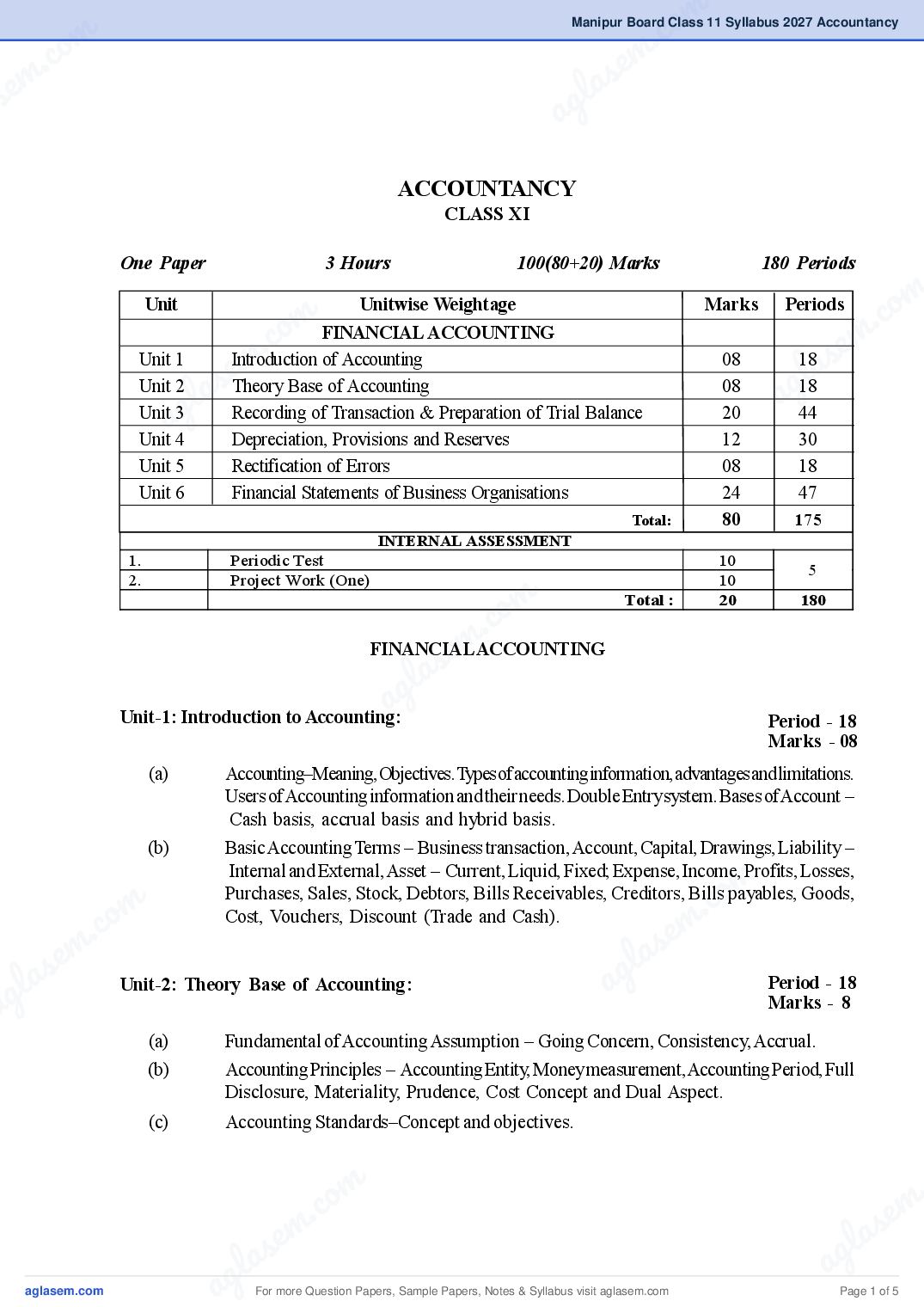
ACCOUNTANCY
CLASS XI
One Paper 3 Hours 100(80+20) Marks 180 Periods
m
.co
Unit Unitwise Weightage Marks Periods
o m FINANCIAL ACCOUNTING m
c
. of Accounting s e
Unit 1 m
eTheory Base of Accounting
Introduction 08 18
l a
Unit 2
as
l Recording of Transaction & Preparation of Trial Balance 08
ag 18
Unit 3g
a Depreciation, Provisions and Reserves
Unit 4
20
12
44
30
Unit 5 Rectification of Errors 08 18
Unit 6 Financial Statements of Business Organisations 24 47
Total: 80 175
INTERNAL ASSESSMENT
1. Periodic Test 10
5
2. Project Work (One) 10
m
c. o
Total : 20 180
e m
FINANCIAL ACCOUNTING
las
a g
Unit-1: Introduction to Accounting: Period - 18
Marks - 08
(a) Accounting–Meaning, Objectives. Types of accounting information, advantages and limitations.
Users of Accounting information and their needs. Double Entry system. Bases of Account –
Cash basis, accrual basis and hybrid basis.
(b) Basic Accounting Terms – Business transaction, Account, Capital, Drawings, Liability –
Internal and External, Asset – Current, Liquid, Fixed; Expense, Income, Profits, Losses,
m
m .co
Purchases, Sales, Stock, Debtors, Bills Receivables, Creditors, Bills payables, Goods,
.co m
Cost, Vouchers, Discount (Trade and Cash).
m s e
s e g l a
g la Unit-2: Theory Base of Accounting: a Period - 18
a Marks - 8
(a) Fundamental of Accounting Assumption – Going Concern, Consistency, Accrual.
(b) Accounting Principles – Accounting Entity, Money measurement, Accounting Period, Full
Disclosure, Materiality, Prudence, Cost Concept and Dual Aspect.
(c) Accounting Standards–Concept and objectives.
m .
.co s e m
s em l a
g la ag
a For more Question Papers, Sample Papers, Notes & Syllabus visit Page 1 of 5
Page 3
Marks - 20
(a) Accounting Equation – Meaning, Analysis of transactions, Using Accounting Equation.
(b) Rules of Debit and Credit – For Assets, Liabilities, Capital, Revenue and Expenses.
(c) Origin of transactions – Source Documents – (Invoice, Cash memo, Pay in slip, Cheque),
Preparation of vouchers – Cash (Debit and Credit), Non Cash (Transfer).
(d) Books of original Entry – Meaning, Format and Recording.
(e) Goods and Services Tax (GST) – Characteristics, Objectives and Accounting.
(f) Cash Book – Simple, Cash Book with Bank Column, Petty Cash Book.
(g) Other Books – Purchases Book, Sales Book, Purchases Returns Book, Sales Returns Book,
Bills Receivable Book, Bills Payable Book and Journal Proper.
(h) Ledger – Meaning, Utility, Format, Posting from Journal, Cash book and other Special
purpose Books, Balancing of Accounts.
(i) Trial Balance – Meaning, Objectives and preparation.
(j) Bank Reconciliation Statement – Meaning, Need and Preparation.
Unit 4: Depreciation, Provisions and Reserves Period - 30
Marks - 12
(a) Depreciation – Meaning, Need and factors affecting depreciation.
(b) Methods of Computation of Depreciation – Straight line Method, Written Down Value Method
(Excluding Change in method).
(c) Accounting Treatment of Depreciation – By charging to Asset Account, by creating Provision
for Depreciation/Accumulated Depreciation Account, preparation of Asset Disposal Account.
(d) Provisions and Reserves – Meaning, Objective and Difference between provisions and Reserves.
(e) Types of Reserves – Revenue Reserve, Capital Reserve, General Reserve, Specific Reserves,
Secret Reserves.
Unit 5: Rectification of Errors Period - 18
Marks - 08
(a) Errors and theory types – Errors not affecting trial balance and Errors affecting trial balance.
(b) Rectification of errors before and after the preparation of financial statements.
(c) Suspense Account – Meaning, Preparation and treatment of suspense account balance in
final statements.
For more Question Papers, Sample Papers, Notes & Syllabus visit Page 2 of 5
Page 4
m .co
m .co s e m
se g l a
a
Unit 6: Financial Statement of Business Organisations Period - 47
(a) Financial Statements – Meaning, Objective and Importance. Marks - 44
(b) Trading and Profit and Loss Account – Gross Profit, Operating Profit and Net Profit.
m
(c) Balance Sheet – Need, Grouping, Marshalling of Assets and Liabilities.
m .co
(d)
.co
Adjustments in preparation of Financial Statements – with respect to closing stock, outstanding
m s e m
s
expenses, prepaid expenses, accrued income, income received in advance, depreciation,
e l a
ag
bad debts, provision for doubtful debts, provision for discount on debtors.
g
(e)l a Preparation of Trading and profit and Loss – Account and Balance Sheet of Sole proprietorship
a Concerns.
PRESCRIBED TEXT BOOKS :
1. Accountancy for Class – XI
By: D.K. Goel, Rajesh Goel and Shelly Goel
Published by: Arya Publications, New Delhi.
m
.co
2. Double Entry Book Keeping for Class XI
By: T.S. Grewal
em
Published by: Sultan Chand and Sons, New Delhi.
s
REFERENCE BOOKS :
g la
1. a for Class XI
Companion Accountancy
By : O.P. Gupta, S.R. Goel and S.K. Jain
Published by : S. Dinesh & Co.
2. Accountancy for Class XI
By : R.K. Mittal and A.K. Jain
Published by : V.K. (India) Enterprises.
——§§§——
m
m .co
m .co s e m
s e g l a
g la a
a
m .
.co s e m
s em l a
g la ag
a For more Question Papers, Sample Papers, Notes & Syllabus visit Page 3 of 5
Page 5
QUESTION PAPER
Subject : ACCOUNTANCY
Paper : Theory
Class : XI
Full Mark : 100(80+20)
Time : 3 Hours
WEIGHTAGE TO OBJECTIVES:
Objectives Marks Percentage
Knowledge(K) 12 15
I Understanding (U) 44 55
Application (A) 24 30
Total: 80 100
WEIGHTAGE TO FORMS OF QUESTIONS:
FORM OF QUESTIONS No. of questions Time (in minutes) Marks Percentage
Essay/Long Answer (E/LA) 3 74 24 30
II Short Answer Type-I (SA-I) 6 42 24 30
Short Answer Type-II (SA-II) 6 24 12 15
Very Short Answer(VSA) 8 16 8 10
MCQ 12 24 12 15
Total: 35 180 m 80 100
WEIGHTAGE TO CONTENT:
Unit PART-A Marks Percentage
1 Introduction to Accounting 8 10
2 Theory Base of Accounting 8 10
3 Recording of Transaction and preparation of Trial Balance 20 25
III 4 Depreciation, Provisions and Reserves 12 15
5 Rectification of Errors 8 10
6 Financial Statements of Business Organisation 24 30
Total: 80 100
PART-B (Internal Assessment)
I. Periodic Test 10
IV
II. Project Work(one) 10
Total 20
V SCHEME OF SECTIONS: NIL
VI SCHEME OF OPTIONS: 50% in SA-I & 100% in Essay/ (LA)Type Questions.
DIFFICULTY LEVEL :
VII Difficult : 30% of the total marks
Average : 50% of the total marks
Easy : 20% of the total marks
Special Instruction: 1) Two questions of MCQ will be assertion-reason type question.
2) One question of SA-I will be source based question
Abbreviation: K(Knowledge), U(Understanding), A(Application),S(Skill), E(Essay Type),
SA(Short Answer Type), VSA(Very Short Answer Type), O(Objective Type).
MCQ (Multiple Choice Question).
For more Question Papers, Sample Papers, Notes & Syllabus visit Page 4 of 5
Page 6
m .co
m .co s e m
se g l a
a
MAIN OBJECTIVES OF PROJECT WORKS IN ACCOUNTANCY FOR
CLASS XI
1. To enable students to practical exposure of accounting practices, concepts and conventions
m
.co
to real life business situations.
m
.co
2. To develop analytical, investigative and problem solving skills through collection,
m s e m
preparation and interpretation of accounting data.
s e l a
3. To adevelop decision making skills and abilities through analysis and interpretation of g
g l a
a financial and accounting data.
4. To promote independent learning, research aptitude and critical thinking among students.
5. To improve communication and presentation skills through Report Writing and Project
Preparation.
CLASS XI PROJECT WORK (ANY ONE)
1. Collection of source documents, preparation of vouchers , recording of transactions with
m
.co
the help of vouchers.
2. Preparation of Bank Reconciliation Statement with the given Cash Book and the Pass Book
with twenty to twenty five transactions.
e m
las
3. Preparation of Trial Balance, Final Accounts (Trading and Profit and Loss Account and
g
Balance Sheet) with some common adjustment items including GST related transactions.
a
Assessment:
The Marks will be allocated on the following heads:
a. Introduction and Objectives : 2
b. Findings /contents/observations 3
c. Analysis and conclusion 2
d. Viva 3 m
m Total = 10
.co
m .co s e m
s e g l a
g la a
a
m .
.co s e m
s em l a
g la ag
a For more Question Papers, Sample Papers, Notes & Syllabus visit Page 5 of 5
Document Details
| Board / Org | Manipur Board |
| Exam | Class 11 |
| Type | Syllabus |
| Pages | 5 |
| Updated | 04 Nov 2026 |