NIOS Class 12 October 2024 Question Paper Library and Information Science
Finished viewing? Save it for later —
Download NIOS Class 12 October 2024 Question Paper Library and Information Science (PDF · 13 pages)About NIOS Class 12 October 2024 Question Paper Library and Information Science
NIOS Class 12 October 2024 Question Paper Library and Information Science is available here for free download. Published by NIOS for National Institute of Open Schooling Class 12, this question paper can be viewed online or downloaded as a PDF (13 pages). Candidates preparing for National Institute of Open Schooling Class 12 can use NIOS Class 12 October 2024 Question Paper Library and Information Science to understand the exam pattern, the type of questions asked, and the overall difficulty level.
Frequently Asked Questions
How can I download NIOS Class 12 October 2024 Question Paper Library and Information Science?
Open this page and click the Download button to save NIOS Class 12 October 2024 Question Paper Library and Information Science as a PDF. It is completely free on AglaSem Docs.
Is NIOS Class 12 October 2024 Question Paper Library and Information Science free to download?
Yes. NIOS Class 12 October 2024 Question Paper Library and Information Science can be viewed online and downloaded as a PDF free of cost on AglaSem Docs.
How many pages does NIOS Class 12 October 2024 Question Paper Library and Information Science have?
NIOS Class 12 October 2024 Question Paper Library and Information Science contains 13 pages, which you can read online or download together as a single PDF.
Where can I find more National Institute of Open Schooling Class 12 study material?
You can find more National Institute of Open Schooling Class 12 question papers, sample papers, syllabus, and answer keys on AglaSem Docs.
NIOS Class 12 October 2024 Question Paper Library and Information Science – Text
Read the full text of this question paper below — useful to quickly search, copy and reference the content online without downloading the PDF.
📄 View text version (13 pages)
Page 1
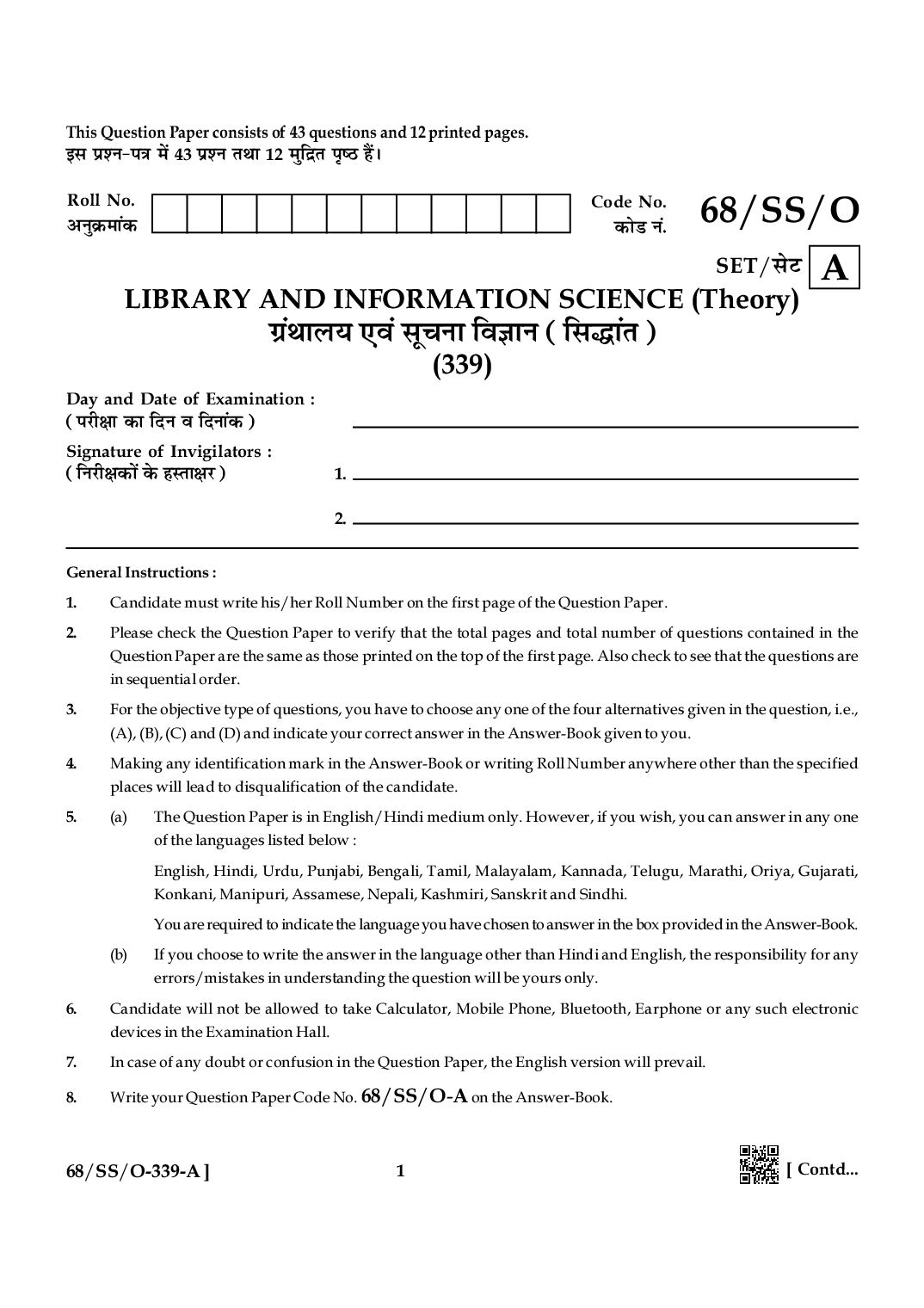
ß‚ ¬˝‡Ÿ-¬òÊ ◊¥ 43 ¬˝‡Ÿ ÃÕÊ 12 ◊ÈÁŒ˝Ã ¬Îc∆U „Ò¥–
Roll No. Code No.
•ŸÈ∑˝§◊Ê¥∑§ ∑§Ê«U Ÿ¥.
68/SS/O
SET/‚ ≈ A
LIBRARY AND INFORMATION SCIENCE (Theory)
ª˝¥ÕÊ‹ÿ ∞fl¥ ‚ÍøŸÊ ÁflôÊÊŸ (Á‚hÊ¥Ã)
(339)
Day and Date of Examination :
(¬⁄UˡÊÊ ∑§Ê ÁŒŸ fl ÁŒŸÊ¥∑§)
Signature of Invigilators :
(ÁŸ⁄UˡÊ∑§Ê¥ ∑§ „SÃÊˇÊ⁄U) 1.
2.
General Instructions :
1. Candidate must write his/her Roll Number on the first page of the Question Paper.
2. Please check the Question Paper to verify that the total pages and total number of questions contained in the
Question Paper are the same as those printed on the top of the first page. Also check to see that the questions are
in sequential order.
3. For the objective type of questions, you have to choose any one of the four alternatives given in the question, i.e.,
(A), (B), (C) and (D) and indicate your correct answer in the Answer-Book given to you.
4. Making any identification mark in the Answer-Book or writing Roll Number anywhere other than the specified
places will lead to disqualification of the candidate.
5. (a) The Question Paper is in English/Hindi medium only. However, if you wish, you can answer in any one
of the languages listed below :
English, Hindi, Urdu, Punjabi, Bengali, Tamil, Malayalam, Kannada, Telugu, Marathi, Oriya, Gujarati,
Konkani, Manipuri, Assamese, Nepali, Kashmiri, Sanskrit and Sindhi.
You are required to indicate the language you have chosen to answer in the box provided in the Answer-Book.
(b) If you choose to write the answer in the language other than Hindi and English, the responsibility for any
errors/mistakes in understanding the question will be yours only.
6. Candidate will not be allowed to take Calculator, Mobile Phone, Bluetooth, Earphone or any such electronic
devices in the Examination Hall.
7. In case of any doubt or confusion in the Question Paper, the English version will prevail.
8. Write your Question Paper Code No. 68/SS/O-A on the Answer-Book.
68/SS/O-339-A ] 1 [ Contd...
Page 2
1. ¬⁄UˡÊÊÕ˸ ¬˝‡Ÿ-¬òÊ ∑§ §¬„‹ ¬Îc∆U ¬⁄U •¬ŸÊ •ŸÈ∑˝§◊Ê¥∑§ •fl‡ÿU Á‹π¥–
2. ∑Χ¬ÿÊ ¬˝‡Ÿ-¬òÊ ∑§Ê ¡ÊÚ°ø ‹¥ Á∑§ ¬˝‡Ÿ-¬òÊ ∑§ ∑ȧ‹ ¬Îc∆UÊ¥ ÃÕÊ ¬˝‡ŸÊ¥ ∑§Ë ©ÃŸË „Ë ‚¥ÅUÿÊ „Ò Á¡ÃŸË ¬˝Õ◊ ¬Îc∆ ∑ §‚’‚ ™§¬⁄U ¿U¬Ë „Ò– ß‚
’Êà ∑§Ë ¡ÊÚ°ø ÷Ë ∑§⁄U ‹¥ Á∑§ ¬˝‡Ÿ ∑˝ Á◊∑§ UM§¬ ◊¥ „Ò¥–
3. flSÃÈÁŸc∆ ¬˝‡ŸÊ¥ ◊¥ •Ê¬∑§Ê øÊ⁄U Áfl∑§À¬Ê¥U (A), (B), (C) ÃÕÊ (D) ◊¥ ‚ ∑§Ê߸ ∞∑§ ©ûÊ⁄U øÈŸŸÊ „Ò ÃÕÊ ŒË ªß¸ ©ûÊ⁄U-¬ÈÁSÃ∑§Ê ◊¥ •Ê¬ ‚„Ë ©ûÊ⁄U
Á‹π¥–
4. § ©ûÊ⁄U-¬ÈÁSUÃ∑§Ê ◊¥ ¬„øÊŸ-Áøq ’ŸÊŸ •ÕflÊ ÁŸÁŒ¸c≈U SÕÊŸÊ¥ ∑§§•ÁÃÁ⁄UÄà ∑§„Ë¥ ÷Ë •ŸÈ∑§˝ ◊Ê¥∑§ Á‹πŸ ¬⁄U ¬⁄UˡÊÊÕ˸ ∑§Ê •ÿÊÇÿ ∆U„⁄UÊÿÊ ¡ÊÿªÊ–
5. (∑§) ¬˝‡Ÿ-¬òÊ ∑§fl‹ Á„¥ŒË/•¥ª˝¡Ë ◊Êäÿ◊ ◊¥ „Ò– Á»§⁄U ÷Ë, ÿÁŒ •Ê¬ øÊ„¥ ÃÊ ŸËø ŒË ªß¸ Á∑§‚Ë ∞∑§ ÷Ê·Ê ◊¥ ©ûÊ⁄ Œ ‚∑§Ã „Ò¥ —
•¥ª˝¡Ë, Á„¥ŒË, ©ŒÍ¸, ¬¥¡Ê’Ë, ’¥ª‹Ê, ÃÁ◊‹, ◊‹ÿÊ‹◊, ∑§ãŸ«∏, ËȪÈ, ◊⁄UÊ∆UË, ©Á«∏ÿÊ, ªÈ¡⁄UÊÃË, ∑§Ê¥∑§áÊË, ◊ÁáʬÈ⁄UË, •‚Á◊ÿÊ,
Ÿ¬Ê‹Ë, ∑§‡◊Ë⁄UË, ‚¥S∑Χç•ÊÒ⁄U Á‚¥œË–
∑Χ¬ÿÊ ©ûÊ⁄U-¬ÈÁSÃ∑§Ê ◊¥ ÁŒ∞ ª∞ ’ÊÚÄ‚ ◊¥ Á‹π¥ Á∑§ •Ê¬ Á∑§‚ ÷Ê·Ê ◊¥ ©ûÊ⁄U Á‹π ⁄U„ „Ò¥–
(π) ÿÁŒ •Ê¬ Á„¥ŒË ∞fl¥ •¥ª˝¡Ë ∑§ •ÁÃÁ⁄UÄà Á∑§‚Ë •ãÿ ÷Ê·Ê ◊¥ ©ûÊ⁄U Á‹πà „Ò¥, ÃÊ ¬˝‡ŸÊ¥ ∑§Ê ‚◊¤ÊŸ ◊¥ „ÊŸ flÊ‹Ë
òÊÈÁ≈UÿÊ¥/ª‹ÁÃÿÊ¥ ∑§Ë Á¡ê◊UŒÊ⁄Ë ∑ fl‹ •Ê¬∑§Ë „ʪ˖
6. § ¬⁄UˡÊÊÕ˸ ∑§Ê ¬⁄UˡÊÊ „ÊÚ‹ ◊¥ ∑Ò§À∑ȧ‹≈U⁄U, ◊Ê’Êß‹ »§ÊŸ, é‹È≈ÍUÕ, ßÿ⁄U»§ÊŸ ¡Ò‚ Á∑§‚Ë ÷Ë ß‹Ä≈˛UÊÚÁŸ∑§ ©¬∑§⁄UáÊ ∑§Ê ‹ ¡ÊŸ ∑§Ë •ŸÈ◊Áà Ÿ„Ë¥
„Ò–
7. § ¬˝‡Ÿ-¬òÊ ◊¥ Á∑§‚Ë ÷Ë ¬˝∑§Ê⁄U ∑§ ‚¥Œ„ •ÕflÊ ŒÈÁflœÊ ∑§Ë ÁSÕÁà ◊¥ •¥ª˝¡Ë •ŸÈflÊŒ „Ë ◊Êãÿ „ʪʖ
8. •¬ŸË ©ûÊ⁄U-¬ÈÁSUÃ∑§Ê ¬⁄U ¬˝‡Ÿ-¬òÊ ∑§Ë ∑§Ê«U ‚¥ÅÿÊ 68/SS/O-A Á‹π¥–
68/SS/O-339-A ] 2 [ Contd...
Page 3
ª˝¥ÕÊ‹ÿ ∞fl¥ ‚ÍøŸÊ ÁflôÊÊŸ (Á‚hÊ¥Ã)
(339)
Time : 3 Hours ] [ Maximum Marks : 80
‚◊ÿ — 3 ÉÊá≈U ] [ ¬ÍáÊÊZ∑§ — 80
Notes :
(i) This question paper consists of 43 questions in all.
(ii) All questions are compulsory.
(iii) Marks are given against each question.
(iv) Section - A consists of :
(a) Q. No. 1 to 16 - Multiple Choice Questions (MCQs) carrying 1 mark each. Select and write
the most appropriate option out of the four options given in each of these questions.
(b) Q. No. 17 to 28 - Objective type questions. Q. No. 17 to 28 carry 2 marks each (few questions
with 2 sub-parts of 1 mark each).
(v) Section - B consists of :
(a) Q. No. 29 to 36 -Very Short Answer-type questions carrying 2 marks each to be answered
in the range of 30 to 50 words.
(b) Q. No. 37 to 40 - Short Answer-type questions carrying 3 marks each to be answered in the
range of 50 to 80 words.
(c) Q. No. 41 to 43 - Long Answer-type questions carrying 4 marks each to be answered in the
range of 80 to 120 words.
(d) Answer the questions from either Optional Module-A or Optional Module-B.
ÁŸŒ¸‡Ê —
(i) ß‚ ¬˝‡Ÿ-¬òÊ ◊¥ ∑ȧ‹ 43 ¬˝‡Ÿ „Ò¥–
(ii) ‚÷Ë ¬˝‡Ÿ •ÁŸflÊÿ¸ „Ò¥–
(iii) ¬˝àÿ∑§ ¬˝‡Ÿ ∑§ ‚Ê◊Ÿ ©‚∑§ •¥∑§ ÁŒ∞ ª∞ „Ò¥–
(iv) πá«U-∑§ :
(a) ¬˝. ‚¥. 1 ‚ 16 Ã∑§ ’„È-Áfl∑§À¬Ëÿ ¬˝‡Ÿ „Ò¥, ¬˝àÿ∑§ ∑§Ê 1 •¥∑§ „Ò– ߟ◊¥ ‚ ¬˝àÿ∑§ ¬˝‡Ÿ ◊¥ ÁŒ∞ ª∞ øÊ⁄U Áfl∑§À¬Ê¥ ◊¥
‚ ‚’‚ ©¬ÿÍÄà Áfl∑§À¬ ∑§Ê øÈŸ∑§⁄U Á‹Áπ∞–
(b) ¬˝. ‚¥. 17 ‚ 28 Ã∑§ flSÃÈÁŸc∆U ¬˝‡Ÿ „Ò¥– ¬˝àÿ∑§ ∑§ 2 •¥∑§ „Ò¥ (∑ȧ¿U ◊¥ 1 •¥∑§ flÊ‹ 2 ©¬-÷ʪʥ ‚Á„Ã)
(v) πá«U-π —
(a) ¬˝. ‚¥. 29 ‚ 36 Ã∑§ •ÁËÉÊÈ-©ûÊ⁄UËÿ ¬˝‡Ÿ „Ò¥– ¬˝àÿ∑§ ∑§ 2 •¥∑§ „Ò¥, ¬˝àÿ∑§ ∑§Ê ©ûÊ⁄U 30 ‚ 50 ‡ÊéŒÊ¥ ◊¥ Œ¥–
(b) ¬˝. ‚¥. 37 ‚ 40 Ã∑§ ‹ÉÊÈ ©ûÊ⁄UËÿ ¬˝‡Ÿ „Ò¥– ¬˝àÿ∑§ ∑§ 3 •¥∑§ „Ò¥– ¬˝àÿ∑§ ∑§Ê ©ûÊ⁄U 50 ‚ 80 ‡ÊéŒÊ¥ ◊¥ Œ¥–
(c) ¬˝. ‚¥. 41 ‚ 43 Ã∑§ ŒËÉʸ-©ûÊ⁄UËÿ ¬˝‡Ÿ „Ò¥ ¬˝àÿ∑§ ∑§ 4 •¥∑§ „Ò¥– ¬˝àÿ∑§ ∑§Ê ©ûÊ⁄U 80 ‚ 120 ‡ÊéŒÊ¥ ◊¥ Œ¥–
(d) flÒ∑§ÁÀ¬∑§ ◊ÊÚ«˜UÿÍ‹¸ - A •ÕflÊ flÒ∑§ÁÀ¬∑§ ◊ÊÚ«˜UÿÍ‹¸ - B ∑§ ¬˝‡ŸÊ¥ ∑§ ©ûÊ⁄U Œ¥–
(1) Answers of all questions are to be given in the Answer-Book given to you.
‚÷Ë ¬˝‡ŸÊ¥ ∑§ ©ûÊ⁄U •Ê¬∑§Ê ŒË ªß¸ ©ûÊ⁄U-¬ÈÁSÃ∑§Ê ◊¥ „Ë Á‹π¥–
(2) 15 minutes time has been alloted to read this question paper. The question paper will be distributed
at 2:15 p.m. From 2:15 p.m. to 2:30 p.m., the students will read the question paper only and will
not write any answer on the Answer-Book during this period.
ß‚ ¬˝‡Ÿ-¬òÊ ¬…∏Ÿ ∑§ Á‹∞ 15 Á◊Ÿ≈U ∑§Ê ‚◊ÿ ÁŒÿÊ ªÿÊ „Ò– ¬˝‡Ÿ-¬òÊ ∑§Ê ÁflÃ⁄UáÊ ŒÊ¬„⁄U ◊¥ 2:15 ’¡ Á∑§ÿÊ ¡Ê∞ªÊ–
ŒÊ¬„⁄U 2:15 ’¡ ‚ 2:30 ’¡ Ã∑§ ¿UÊòÊ ∑§fl‹ ¬˝‡Ÿ-¬òÊ ∑§Ê ¬…∏¥ª •ÊÒ⁄U ß‚ •flÁœ ∑§ ŒÊÒ⁄UÊŸ fl ©ûÊ⁄U-¬ÈÁSÃ∑§Ê ¬⁄U ∑§Ê߸ ©ûÊ⁄U
Ÿ„Ë¥ Á‹π¥ª–
68/SS/O-339-A ] 3 [ Contd...
Page 4
Multiple Choice Questions (MCQs). Each question carries 1 mark.
’„ÈÁfl∑§À¬Ëÿ ¬˝‡Ÿ ¬˝àÿ∑§ ¬˝‡Ÿ 1 •¥∑§ ∑§Ê „Ò–
1. The __________ Law states that to disseminate knowledge and to put the books to maximum 1
use.
(A) First (B) Second (C) Third (D) Fourth
ÿ„ __________‚ÍòÊ ÁŸÁ‡øà ∑§⁄UÃÊ „Ò Á∑§ ôÊÊŸ ∑§Ê ¬˝‚Ê⁄U •ÊÒ⁄U ¬ÈSÃ∑§Ê¥ ∑§Ê •Áœ∑§Ã◊ ©¬ÿʪ „Ê–
(A) ¬˝Õ◊ (B) ÁmÃËÿ (C) ÃÎÃËÿ (D) øÃÈÕ¸
2. A document providing a broader view of a subject is called __________. 1
(A) Micro (B) Macro (C) Pamphlet (D) Phono-record
Áfl·ÿ ∑§ ◊ÈÅÿ M§¬ ∑§Ê ôÊÊŸ ŒŸ flÊ‹Ê ¬˝‹π __________ ∑§„‹ÊÃÊ „Ò–
(A) ‚͡◊ (B) fl΄à (C) ¬øʸ (D) »§ÊŸÊÁ⁄U∑§Ê«¸U
3. The success of any __________ depends upon the educated and enlightened citizens 1
irrespective of their social status.
(A) autocracy (B) democracy (C) fascism (D) monarchy
Á∑§‚Ë ÷Ë __________ ∑§Ë ‚»§‹ÃÊ ©‚∑§ Á‡ÊÁˇÊà •ÊÒ⁄U ¬˝’Èh ŸÊªÁ⁄U∑§ ¬⁄U ÁŸ÷¸⁄U ∑§⁄UÃË „Ò, øÊ„ ©‚∑§Ë ‚Ê◊ÊÁ¡∑§
ÁSÕÁà ∑ȧ¿U ÷Ë „Ê–
(A) ÁŸ⁄¥U∑ȧ‡ÊÃÊ (B) ‹Ê∑§Ã¥òÊ (C) »§Ê‚ËflÊŒ (D) ⁄UÊ¡‡ÊÊ„Ë
4. A library provides a __________ forum for social get-together within its premises. 1
(A) wrong (B) right (C) individual (D) group
∞∑§ ¬ÈSÃ∑§Ê‹ÿ •¬Ÿ ¬Á⁄U‚⁄U ∑§ ÷ËÃ⁄U ‚Ê◊ÊÁ¡∑§ ◊‹-Á◊‹Ê¬ ∑§ Á‹∞ ∞∑§ __________ ◊¥ø ¬˝ŒÊŸ ∑§⁄UÃÊ „Ò–
(A) ª‹Ã (B) ‚„Ë (C) √ÿÁÄêà (D) ‚◊Í„
5. Name the two implications of the Fifth Law of Library Science. 1
(A) Publicity and Open Access
(B) Library Location and Stack Room Guides
(C) Book Selection and Library Hours
(D) Library Building and Growth of Staff
ª˝¥ÕÊ‹ÿ ÁflôÊÊŸ ∑§ ¬Ê°øfl¥ ‚ÍòÊ ∑§ ŒÊ ÁŸÁ„ÃÊÕÊZ ∑§ ŸÊ◊ ’ÃÊß∞–
(A) ¬˝øÊ⁄U •ÊÒ⁄U ◊ÈÄà •Á÷ª◊
(B) ª˝¥ÕÊ‹ÿ ∑§Ë •flÁSÕÁà •ÊÒ⁄U ‚¥ª˝„∑§ˇÊ ◊ʪ¸ŒÁ‡Ê¸∑§Ê∞°
(C) ¬ÈSÃ∑§Ê¥ ∑§Ê øÿŸ •ÊÒ⁄U ª˝¥ÕÊ‹ÿ ∑§ ‚◊ÿ
(D) ª˝¥ÕÊ‹ÿ ÷flŸ •ÊÒ⁄U S≈UÊ»§ ◊¥ flÎÁh
68/SS/O-339-A ] 4 [ Contd...
Page 5
(A) Data sources (B) Knowledge sources
(C) Information sources (D) Secondary sources
Á¡Ÿ dÊÃÊ¥ ‚ „◊ ‚ÍøŸÊ ¬˝Êåà ∑§⁄U ‚∑§Ã „Ò¥ ©ã„¥ __________ ∑§„à „Ò¥–
(A) «UÊ≈UÊ dÊà (B) ôÊÊŸ dÊÃ
(C) ‚ÍøŸÊ dÊà (D) ÁmÃËÿ∑§ ‚ÍøŸÊ
7. After the introduction of open access in libraries, the role of the __________ has taken the 1
uppermost priority in libraries.
(A) Shelving (B) Blocking (C) Shifting (D) Binding
ÁŸ’ʸœ •Á÷ª◊ ∑§Ê ª˝¥ÕÊ‹ÿ ◊¥ ‹ÊªÍ ∑§⁄UŸ ‚ __________ ∑§Êÿ¸ ∑§Ê ¬˝ÊÕÁ◊∑§ÃÊ ŒË ¡ÊÃË „Ò–
(A) ‡ÊÒÁÀfl¥ª (B) é‹ÊÚÁ∑¥§ª (C) Á‡ÊÁç≈¥Uª (D) Á¡ÀŒ’¥ŒË
8. The back issues of periodicals are usually arranged __________ in the shelves. 1
(A) year-wise (B) publisher-wise (C) alphabetically (D) country-wise
¬È⁄UÊŸ •¥∑§Ê¥ ∑§Ë ¬ÁòÊ∑§Ê•Ê¥ ∑§Ê ‡ÊÒÀ»§ ¬⁄U ¬˝Êÿ— __________ ⁄UπÊ ¡ÊÃÊ „Ò–
(A) fl·¸ ∑§ •ŸÈ‚Ê⁄U (B) ¬˝∑§Ê‡Ê∑§ ∑§ •ŸÈ‚Ê⁄U (C) fláʸ∑˝§◊ÊŸÈ‚Ê⁄U (D) Œ‡Ê ∑§ •ŸÈ‚Ê⁄U
9. The need for organizing library material is to (i) maximize search capabilities for users. 1
(ii) display the available resources and (iii) minimize physical, intellectual and __________
barriers.
(A) Time (B) Language (C) Technical (D) Access
ª˝¥ÕÊ‹ÿ ‚Ê◊ª˝Ë ∑§ √ÿflSÕʬŸ ∑§Ë •Êfl‡ÿ∑§ÃÊ ß‚Á‹∞ „ÊÃË „Ò Á∑§ (i) ¬Ê∆U∑§ •Áœ∑§ ‚ •Áœ∑§ ¬˝∑§Ê⁄U ‚ πÊ¡Ÿ ◊¥
‚ˇÊ◊ „Ê (ii) ©¬‹éœ ‚¥‚ÊœŸÊ¥ ∑§Ê ¬˝Œ‡Ê¸Ÿ „Ê ‚∑§ •ÊÒ⁄U (iii) ÷ÊÒÁÃ∑§, ’ÊÒÁh∑§ •ÊÒ⁄U __________ ∑§Ë L§∑§Êfl≈UÊ¥ ∑§Ê
∑§◊ ‚ ∑§◊ Á∑§ÿÊ ¡Ê ‚∑§–
(A) ‚◊ÿ (B) ÷Ê·Ê (C) Ã∑§ŸË∑§Ë (D) ¬„È°ø
10. Current awareness services, indexing and abstracting services, etc. fall under __________ 1
services.
(A) Reader Advisory (B) Circulation
(C) Reference (D) Referral
‚Ê◊Áÿ∑§ ¡ÊªM§∑§ÃÊ ‚flÊ, •ŸÈ∑˝§◊áÊË∑§⁄UáÊ •ÊÒ⁄U ‚Ê⁄U∑§⁄UáÊ ‚flÊ ßàÿÊÁŒ __________ ‚flÊ•Ê¥ ∑§ •¥Ãª¸Ã •ÊÃË „Ò¥–
(A) ¬Ê∆U∑§ ¬⁄UÊ◊‡Ê¸ (B) ‚∑ȸ§‹‡ÊŸ
(C) ‚¥Œ÷¸ (D) ⁄U»§⁄U‹
11. __________ services are offered in response to requests from the users. 1
(A) Anticipatory (B) Indexing (C) Abstracting (D) Responsive
__________ ‚flÊ∞° ©¬ÿʪ∑§Ãʸ•Ê¥ ∑§ •ŸÈ⁄Uʜʥ ∑§ ¡flÊ’ ¬˝ŒÊŸ ∑§⁄UÃË „Ò¥–
(A) ¬ÍflʸŸÈ◊ÊÁŸÃ (B) •ŸÈ∑˝§◊ÁáÊ∑§⁄UáÊ (C) ‚Ê⁄U∑§⁄UáÊ (D) ¬˝àÿÈûÊ⁄UÊà◊∑§
68/SS/O-339-A ] 5 [ Contd...
Page 6
12. In the acronym ‘POSDCORB’, ‘S’ stands for : 1
(A) Shelving (B) Staffing
(C) Stacking (D) Sources
¬Á⁄UfláÊ˸ ‡ÊéŒ ‘POSDCORB’ ◊¥ ‘S’ ∑§Ê •Õ¸ „Ò —
(A) ‡ÊÒÁÀfl¥ª (B) ∑§ÊÁ◊¸∑§ √ÿflSÕÊ (S≈UÊÁ»¥§ª)
(C) S≈ÒUÁ∑¥§ª (D) dÊÃ
13. __________ structure of job grades and pay ranges established within an organization. 1
(A) Salary (B) Support (C) Career (D) Fringe
Á∑§‚Ë ‚¥ª∆UŸ ∑§ •¥Œ⁄U SÕÊÁ¬Ã ¡ÊÚ’ ª˝«U fl flß ◊ÊŸ ∑§Ë SÕʬŸÊ __________ ‚¥⁄UøŸÊ ∑§„‹ÊÃË „Ò–
(A) flß (B) ‚„Êÿ∑§ (C) ¡ËÁfl∑§Ê (D) ßÃ⁄U ‹Ê÷
14. When users need the latest developments in their areas of interest on a regular basis, the 1
need is known as __________.
(A) exhaustive information need (B) everyday information need
(C) current information need (D) catching-up information need
¡’ ©¬ÿÊÄÃÊ ∑§Ê ©Ÿ∑§Ë L§Áø ∑§ ˇÊòÊÊ¥ ◊¥ ÁŸÿÁ◊à M§¬ ‚ •lß ¡ÊŸ∑§ÊÁ⁄UÿÊ¥ ∑§Ë •Êfl‡ÿ∑§ÃÊ „ÊÃË „Ò ©‚
__________ ∑§„à „Ò¥–
(A) ‚flÊZª¬Íáʸ ‚ÍøŸÊ •Êfl‡ÿ∑§ÃÊ (B) ŒÒÁŸ∑§ ‚ÍøŸÊ •Êfl‡ÿ∑§ÃÊ
(C) ‚Ê◊Áÿ∑§ ‚ÍøŸÊ •Êfl‡ÿ∑§ÃÊ (D) äÿÊŸ∑§·Ë¸ ‚ÍøŸÊ •Êfl‡ÿ∑§ÃÊ
15. __________ section deals with membership work, issue and return work and work related 1
to users requirements.
(A) Acquisition (B) Technical (C) Periodical (D) Circulation
__________ •ŸÈ÷ʪ ‚ŒSÿÃÊ ∑§Êÿ¸, ¬ÈSÃ∑§ ¡Ê⁄UË •ÊÒ⁄U flÊÁ¬‚ ∑§⁄UŸ ∑§ ∑§Êÿ¸, ©¬ÿʪ∑§Ãʸ•Ê¥ ∑§Ë •Êfl‡ÿ∑§ÃÊ•Ê¥
‚¥’¥ÁœÃ ∑§ÊÿÊZ, ∑§Ê ÁŸc¬ÊŒŸ ∑§⁄UÃÊ „Ò–
(A) •Áœª˝„áÊ (B) Ã∑§ŸË∑§Ë (C) ¬ÁòÊ∑§Ê (D) ¬Á⁄UøÊ‹Ÿ
16. The three primary checkpoints for the acquisition of library materials namely, availability of 1
library funds, __________ and need of library users.
(A) Use of reading material (B) Use of library staff
(C) Use of library authorities (D) Use of book publishers
ª˝¥ÕÊ‹ÿ ‚Ê◊ª˝Ë ∑§ •Áœª˝„áÊ ◊¥ ÃËŸ ◊ÈÅÿ ¡Ê°ø-ÁŸÿ¥òÊ∑§ „Ò¥, ÿÕÊ — ª˝¥ÕÊ‹ÿ ÁŸÁœ ∑§Ë ©¬‹éœÃÊ, __________ •ÊÒ⁄
Uª˝¥ÕÊ‹ÿ ©¬ÿʪ∑§Ãʸ•Ê¥ ∑§Ë •Êfl‡ÿ∑§ÃÊ–
(A) ¬Ê∆˜ÿ‚Ê◊ª˝Ë ∑§Ê ©¬ÿʪ (B) ª˝¥ÕÊ‹ÿ ∑§ ∑§◊¸øÊÁ⁄UÿÊ¥ ∑§Ê ©¬ÿʪ
(C) ª˝¥ÕÊ‹ÿ ∑§ ¬˝ÊÁœ∑§ÊÁ⁄UÿÊ¥ ∑§Ê ©¬ÿʪ (D) ¬ÈSÃ∑§ ¬˝∑§Ê‡Ê∑§Ê¥ ∑§Ê ©¬ÿʪ
OR/•ÕflÊ
68/SS/O-339-A ] 6 [ Contd...
Page 7
12. __________ is the activity of obtaining information resources relevant to an information 1
need from a collection resources.
(A) Abstracting (B) Knowledge
(C) Information retrieval (D) Indexing
__________ ‚ÍøŸÊ ‚¥‚ÊœŸÊ¥ ∑§ ‚¥ª˝„ ‚ ‚ÍøŸÊ ∑§Ë •Êfl‡ÿ∑§ÃÊ ∑§ Á‹∞ ¬˝Ê‚¥Áª∑§ ‚ÍøŸÊ ‚¥‚ÊœŸ ¬˝Êåà ∑§⁄UŸ ∑§Ë
ªÁÃÁflÁœ „Ò–
(A) ‚Ê⁄U ‚¥ˇÊ¬ (B) ôÊÊŸ
(C) ‚ÍøŸÊ ¬ÈŸ— ¬˝ÊÁåà (D) •ŸÈ∑˝§◊áÊ
13. __________ indexes are usually found at the back of the book. 1
(A) Book (B) Subject (C) Author (D) Title
__________ ∑§ •ŸÈ∑˝§◊áÊË ¬˝Êÿ— ¬ÈSÃ∑§ ∑§ •¥Ã ◊¥ ÁŒ∞ „Êà „Ò¥–
(A) ¬ÈSÃ∑§Ê¥ (B) Áfl·ÿ (C) ‹π∑§ (D) ‡ÊË·¸∑§
14. The intent of the __________ search is to acquire some information, assuming it is available 1
on the internet.
(A) Navigational (B) Transactional (C) Informational (D) Truncation
__________ πÊ¡ ∑§Ê •Ê‡Êÿ Á∑§‚Ë ‚ÍøŸÊ ∑§Ê ¬˝Êåà ∑§⁄UŸÊ „Ò, ß‚ ‚¥÷ÊflŸÊ ∑§ ‚ÊÕ Á∑§ fl„ ‚ÍøŸÊ ߥ≈U⁄UŸ≈U ¬⁄U
©¬‹éœ „ʪ˖
(A) ŸÒÁflª‡ÊŸ‹ (B) √ÿÊfl‚ÊÿÊà◊∑§ (C) ‚ÍøŸÊà◊∑§ (D) ≈˛¥U∑§‡ÊŸ (∑§Ê≈U-¿UÊ°≈U)
15. In __________ language, the terms are selected from the same document to describe its content. 1
(A) free indexing (B) vocabulary indexing
(C) controlled indexing (D) natural indexing
__________ ÷Ê·Ê ◊¥ Áfl·ÿ-flSÃÈ ∑§Ê Œ‡ÊʸŸ ∑§ Á‹∞ ¬Œ ©‚Ë ¬˝‹π ‚ Á‹∞ ¡Êà „Ò¥–
(A) ◊ÈÄà •ŸÈ∑˝§◊áÊË∑§⁄UáÊ (B) ‡ÊéŒÊfl‹Ë •ŸÈ∑˝§◊áÊË∑§⁄UáÊ
(C) ÁŸÿ¥ÁòÊà •ŸÈ∑˝§◊áÊË∑§⁄UáÊ (D) ¬˝Ê∑ΧÁÃ∑§ •ŸÈ∑˝§◊áÊË∑§⁄UáÊ
16. The __________ search is one where a search is conducted on a particular field of the database 1
to get required information.
(A) field based (B) truncation (C) limiting (D) full text
__________ πÊ$¡ fl„ πÊ$¡ „Ò ¡„Ê° •¬ÁˇÊà ‚ÍøŸÊ ∑§Ë πÊ¡ «UÊ≈UÊ’‚ ∑§ ÁflÁ‡Êc≈U ˇÊòÊ ◊¥ Á∑˝§ÿÊÁãflà ∑§Ë ¡ÊÃË „Ò–
(A) ˇÊòÊ •ÊœÊÁ⁄Uà (B) ‚¥ˇÊ¬Ÿ (C) ‚ËÁ◊ÁÃ∑§⁄UáÊ (D) ¬Íáʸ ¬Ê∆˜Uÿ flSÃÈ
68/SS/O-339-A ] 7 [ Contd...
Page 8
Objective type questions of 2 marks each - 12 questions/¬˝àÿ∑§ ¬˝‡Ÿ ∑§Ê 2 •¥∑§ - 12 ¬˝‡Ÿ
17. Attempt the following questions : 2
(i) Name any two vital roles of the library.
(ii) Name any two “Application of Ranganathan Laws to the Web” by Alireza Noruzi.
ÁŸêŸÁ‹Áπà ¬˝‡ŸÊ¥ ∑§ ©ûÊ⁄U ŒËÁ¡∞–
(i) ª˝¥ÕÊ‹ÿ ∑§Ë Á∑§ã„Ë¥ ŒÊ ◊„àfl¬Íáʸ ÷ÍÁ◊∑§Ê•Ê¥ ∑§ ŸÊ◊ Á‹Áπ∞–
(ii) •Á‹⁄¥U¡Ê ŸÊM§¡Ë mÊ⁄UÊ ⁄UÁøà ⁄¥UªŸÊÕŸ fl’ ÁŸÿ◊Ê¥ ∑§ Á∑§ã„Ë¥ ŒÊ •ŸÈ¬˝ÿʪʥ ∑§ ŸÊ◊ ’ÃÊß∞–
18. Fill in the blanks : 2
(i) Based on physical format, a documentary source may be either on __________ media
or on __________ media.
(ii) Multimedia includes text, together with pictures, __________ and __________.
Á⁄UÄà SÕÊŸÊ¥ ∑§Ë ¬ÍÁø ∑§ËÁ¡∞–
(i) ÷ÊÒÁÃ∑§ ¬˝ÊM§¬ ∑§ •ÊœÊ⁄U ¬⁄U ∞∑§ ¬˝‹πËÿ dÊà __________ ◊ËÁ«UÿÊ •ÕflÊ __________ ◊ËÁ«UÿÊ
•ÊœÊÁ⁄Uà „Ê ‚∑§ÃÊ „Ò–
(ii) ◊À≈UË◊ËÁ«UÿÊ ◊¥ ◊Í‹-¬Ê∆U, ÁøòÊÊ¥ ‚Á„Ø •ÊÒ⁄U __________ •ÊÒ⁄U __________ ‚ÍøŸÊ∞° ‡ÊÊÁ◊‹ „Ò¥–
19. How many types of bibliographies are there ? Give any two kinds of Bibliographies. 2
flʥ槪◊ÿ ‚ÍøË Á∑§ÃŸ ¬˝∑§Ê⁄U ∑§Ë „Ò¥? Á∑§ã„Ë¥ ŒÊ flʥ槪◊ÿ ‚ÍÁøÿÊ¥ ∑§ ’Ê⁄ ◊¥ ’ÃÊß∞–
20. Match Column - I statements with the right option of Column - II : 2
Column - I Column - II
(i) Film cards (a) Binding
(ii) Collation (b) Microfiche
SÃê÷ - I ∑§ ∑§ÕŸÊ¥ ∑§Ê SÃê÷ - II ∑§ ‚„Ë Áfl∑§À¬ ‚ Á◊‹ÊŸ ∑§ËÁ¡∞–
SÃê÷ - I SÃê÷ - II
(i) Á»§À◊ ¬òÊ∑§ (a) Á¡ÀŒ
(ii) ∑§Ê‹‡ÊŸ (b) ◊Êß∑˝§ÊÁ»§‡Ê
21. Differentiate between : 2
Shelf list method and Accession Register method.
•¥Ã⁄U S¬c≈U ∑§ËÁ¡∞ :
‡ÊÒÀ»§ Á‹S≈U ÁflÁœ •ÊÒ⁄U ¬Á⁄Uª˝„áÊ ¬¥Á¡∑§Ê ÁflÁœ–
22. What is the ephemeral value of periodicals ? 2
¬ÁòÊ∑§Ê•Ê¥ ∑§Ê ˇÊÁáÊ∑§ (•À¬∑§Ê‹ËŸ) ◊ÍÀÿ ÄÿÊ „Ò?
68/SS/O-339-A ] 8 [ Contd...
Page 9
(i) The author of the e-book “Treasure Island” by __________ and publisher of “Oxford
Reference Atlas for India and the World” __________.
Á⁄UÄà SÕÊŸ ÷Á⁄U∞–
(i) ߸ ’È∑§ ““≈˛U¡⁄U •Êß‹Ò¥«U”” ∑§ ‹π∑§ __________ •ÊÒ⁄U ““•ÊÚÄ‚»§Ê«¸U ⁄ÒU»˝§ã‚ ∞≈U‹‚ »§ÊÚ⁄U ßÁá«∏ÿÊ ∞á«U ÁŒ
flÀ«¸U”” ∑§ ¬˝∑§Ê‡Ê∑§ __________ „Ò¥–
24. List any four steps for computer-based searching. 2
∑¥§åÿÍ≈U⁄U •ÊœÊÁ⁄Uà πÊ¡ ∑§ Á∑§ã„Ë¥ øÊ⁄U ø⁄UáÊÊ¥ ∑§Ê ‚ÍøË’h ∑§ËÁ¡∞–
25. Fill in the blanks : 2
(i) DVD stands for __________.
(ii) OPAC stands for __________.
Á⁄UÄà SÕÊŸ ÷Á⁄U∞–
(i) «UË.flË.«UË. ∑§Ê ◊Ë’ „Ò __________–
(ii) •Ê¬∑§ ∑§Ê ◊Ë’ „Ò __________–
26. Write TRUE for correct Statements and FALSE for incorrect statements. 2
(i) Abstracting service and Digest service are good examples of Condensation type services.
(ii) SDI service is a personalized current awareness service.
‚„Ë ∑§ÕŸ ∑§ ‚Ê◊Ÿ “‚„Ë” •ÊÒ⁄U ª‹Ã ∑§ÕŸ ∑§ ‚Ê◊Ÿ “ª‹Ã” Á‹Áπ∞–
(i) ‚Ê⁄U∑§⁄UáÊ ‚flÊ •ÊÒ⁄U «UÊß¡S≈U ‚flÊ ‚¥ÉÊŸŸ ¬˝∑§Ê⁄U ∑§Ë ‚flÊ ∑§ ©ûÊ◊ ©ŒÊ„⁄UáÊ „Ò¥–
(ii) ∞‚.«UË.•Ê߸. ∞∑§ √ÿÁÄêà ‚Ê◊Áÿ∑§ ¡ÊªM§∑§ÃÊ ‚flÊ „Ò–
OPTIONAL MODULE - A / flÒ∑§ÁÀ¬∑§ ◊ÊÚ«KÍ‹ - A
27. Attempt the following questions : 2
(i) Describe the necessity of a circulation system in a library.
(ii) List the training programs accessible for library professionals at different levels.
ŸËø Á‹π ¬˝‡ŸÊ¥ ∑§ ©ûÊ⁄U Á‹Áπ∞–
(i) ∞∑§ ª˝¥ÕÊ‹ÿ ◊¥ ¬Á⁄UøÊ‹Ÿ ¬˝áÊÊ‹Ë ∑§Ë •Êfl‡ÿ∑§ÃÊ ∑§Ê fláʸŸ ∑§ËÁ¡∞–
(ii) ª˝¥ÕÊ‹ÿ √ÿfl‚ÊÁÿÿÊ¥ „ÃÈ ÁflÁ÷ÛÊ SÃ⁄UÊ¥ ¬⁄U ©¬‹éœ ¬˝Á‡ÊˇÊáÊ ∑§Êÿ¸∑˝§◊Ê¥ ∑§Ê ‚ÍøË’h ∑§ËÁ¡∞–
28. Fill in the blanks : 2
(i) __________ interview is based on an interview schedule, which is in the form of a
questionnaire.
(ii) __________ is done for major damages to the documents.
Á⁄UÄà SÕÊŸ ÷Á⁄U∞ —
(i) __________ ‚ÊˇÊÊà∑§Ê⁄U ¬˝‡ŸÊfl‹Ë ∑§ M§¬ ◊¥ ÃÒÿÊ⁄U ‚ÊˇÊÊà∑§Ê⁄U •ŸÈ‚ÍøË ¬⁄U •ÊœÊÁ⁄Uà „ÊÃÊ „Ò–
(ii) ŒSÃÊfl¡Ê¥ ∑§Ê „È߸ ÷Ê⁄UË ˇÊÁà __________ ∑§ ◊Êäÿ◊ ‚ ∆UË∑§ ∑§Ë ¡ÊÃË „Ò–
OR/•ÕflÊ
68/SS/O-339-A ] 9 [ Contd...
Page 10
27. Attempt the following questions : 2
(i) Explain the dictionary arrangement.
(ii) Define advanced search techniques.
ŸËø Á‹π ¬˝‡ŸÊ¥ ∑§ ©ûÊ⁄U Á‹Áπ∞ -
(i) ‡ÊéŒ∑§Ê‡Ê √ÿflSÕʬŸ ∑§Ê ©À‹π ∑§ËÁ¡∞–
(ii) ©ãŸÃ πÊ¡ Ã∑§ŸË∑§ ∑§Ê ¬Á⁄U÷ÊÁ·Ã ∑§ËÁ¡∞–
28. Match Column - I statements with the right option of Column - II : 2
Column - I Column - II
(i) PubMed (a) First Librarian
(ii) Melvil Dewey (b) Database
SÃê÷ - I ∑§ ∑§ÕŸÊ¥ ∑§Ê SÃê÷ - II ∑§ ‚„Ë Áfl∑§À¬ ‚ Á◊‹ÊŸ ∑§ËÁ¡∞–
SÃê÷ - I SÃê÷ - II
(i) ¬’◊«U (a) ¬˝Õ◊ ª˝¥ÕÊ‹ÿË
(ii) ◊ÁÀfl‹ «KÍ߸ (b) «UÊ≈UÊ’‚
SECTION - B/πá«U - π
Very Short Answer Questions. Each question carries 2 marks. Answer the following
questions in two sentences
•Áà ‹ÉÊÈ ©ûÊ⁄UËÿ ¬˝‡Ÿ– ¬˝àÿ∑§ ¬˝‡Ÿ 2 •¥∑ ∑§Ê „Ò– „⁄U ¬˝‡Ÿ ∑§Ê ©ûÊ⁄U ŒÊ flÊÄÿÊ¥ ◊¥ Á‹Áπ∞–
29. Differentiate between clearing houses and data banks. 2
ÁÄ‹ÿÁ⁄¥Uª „Ê©‚ •ÊÒ⁄U «UÊ≈UÊ ’Ò¥∑§ ◊¥ •¥Ã⁄U S¬c≈U ∑§ËÁ¡∞–
OR/•ÕflÊ
What are the implications of library staff as per the First and Fifth Law of Library Science ?
ª˝¥ÕÊ‹ÿ ÁflôÊÊŸ ∑§ ¬˝Õ◊ •ÊÒ⁄U ¬¥ø◊ ‚ÍòÊ ∑§ •ŸÈ‚Ê⁄U ª˝¥ÕÊ‹ÿ ∑§ ∑§◊¸øÊ⁄U˪áÊ ∑§ ÁŸÁ„ÃÊÕ¸ ÄÿÊ „Ò¥?
30. What do you understand by non-documentary sources ? 2
•¬˝‹πËÿ ‚ÍøŸÊ dÊà ‚ •Ê¬ ÄÿÊ ‚◊¤Êà „Ò¥?
31. How do you access online sources of information ? 2
•Ê¬ ‚ÍøŸÊ ∑§ •ÊÚŸ‹Êߟ dÊÃÊ¥ Ã∑§ ∑Ò§‚ ¬„È°øà „Ò¥?
32. State the difference between a dictionary and an encyclopaedia. 2
‡ÊéŒ∑§Ê‡Ê •ÊÒ⁄U Áfl‡fl∑§Ê‡Ê ◊¥ •¥Ã⁄U S¬c≈U ∑§ËÁ¡∞–
68/SS/O-339-A ] 10 [ Contd...
Page 11
¬Ê∆U∑§ ¬⁄UÊ◊‡Ê¸ ‚flÊ ÄÿÊ „Ò?
OR/•ÕflÊ
Distinguish between reference and information service.
‚¥Œ÷¸ ‚flÊ •ÊÒ⁄U ‚ÍøŸÊ ‚flÊ ◊¥ •¥Ã⁄U S¬c≈U ∑§ËÁ¡∞–
34. What are the different services offered under the category of Current Awareness service ? 2
‚◊‚Ê◊Áÿ∑§ ¡ÊªM§∑§ÃÊ ‚flÊ ∑§Ë üÊáÊË ∑§ •¥Ãª¸Ã ŒË ¡ÊŸ flÊ‹Ë ‚flÊ•Ê¥ ∑§Ê fláʸŸ ∑§ËÁ¡∞–
OPTIONAL MODULE - A/flÒ∑§ÁÀ¬∑§ ◊ÊÚ«KÍ‹ - A
35. What are the direct methods of library user studies ? 2
ª˝¥ÕÊ‹ÿ ©¬ÿʪ∑§Ãʸ •äÿÿŸ ∑§ ¬˝àÿˇÊ Ã⁄UË∑§ ÄÿÊ „Ò¥?
36. What do you understand by professional staff ? 2
√ÿÊfl‚ÊÁÿ∑§ ∑§◊¸øÊ⁄UË ‚ •Ê¬ ÄÿÊ ‚◊¤Êà „Ò¥?
OR/•ÕflÊ
OPTIONAL MODULE - B/flÒ∑§ÁÀ¬∑§ ◊ÊÚ«KÍ‹ - B
35. What is a simple search technique ? 2
‚⁄U‹ πÊ¡ Ã∑§ŸË∑§ ÄÿÊ „Ò?
36. How is a subject index being created ? 2
Áfl·ÿ •ŸÈ∑˝§◊áÊË Á∑§‚ ¬˝∑§Ê⁄U ’ŸÊ߸ ¡ÊÃË „Ò?
Short Answer Questions Each question carries 3 marks
Answer the following questions in two sentences
‹ÉÊÈ ©ûÊ⁄UËÿ ¬˝‡Ÿ ¬˝àÿ∑§ ¬˝‡Ÿ 3 •¥∑ ∑§Ê „Ò– „⁄U ¬˝‡Ÿ ∑§Ê ©ûÊ⁄U ŒÊ flÊÄÿÊ¥ ◊¥ Á‹Áπ∞–
37. State any three purposes for which the Library is responsible as a social institution. 3
∑§Ê߸ ÃËŸ ©g‡ÿ ’ÃÊß∞ Á¡Ÿ∑§ Á‹∞ ¬ÈSÃ∑§Ê‹ÿ ∞∑§ ‚Ê◊ÊÁ¡∑§ ‚¥SÕÊ ∑§ M§¬ ◊¥ Á¡ê◊ŒÊ⁄U „Ò?
OR/•ÕflÊ
Write a brief note on the implication of the Second Law of Library Science on the obligation
of the State.
⁄UÊíÿ ∑§ ŒÊÁÿàfl ¬⁄U ¬ÈSÃ∑§Ê‹ÿ ÁflôÊÊŸ ∑§ ŒÍ‚⁄U ÁŸÿ◊ ∑§ ÁŸÁ„ÃÊÕ¸ ¬⁄U ∞∑§ ‚¥ÁˇÊåà Á≈Uå¬áÊË Á‹π¥–
38. Examine the fundamental characteristics of a typical general newspaper. 3
∞∑§ ‚Ê◊Êãÿ ‚◊ÊøÊ⁄U ¬òÊ ∑§Ë ◊ÊÒÁ‹∑§ Áfl‡Ê·ÃÊ•Ê¥ ∑§Ê fláʸŸ ∑§ËÁ¡∞–
39. Enumerate the tasks conducted by the maintenance department. 3
⁄Uπ⁄UπÊfl Áfl÷ʪ mÊ⁄UÊ Á∑§∞ ª∞ ∑§ÊÿÊZ ∑§Ê ‚ÍøË’h ∑§ËÁ¡∞–
68/SS/O-339-A ] 11 [ Contd...
Page 12
40. What are the various types of staff training ? 3
∑§◊¸øÊ⁄UË ¬˝Á‡ÊˇÊáÊ ∑§ ∑§ÊÒŸ-∑§ÊÒŸ ÁflÁ÷ÛÊ ¬˝∑§Ê⁄U „Ò¥?
OR/•ÕflÊ
OPTIONAL MODULE-B/flÒ∑§ÁÀ¬∑§ ◊ÊÚ«KÍ‹ - B
40. Explain in brief the role of Boolean operators. 3
’ÍÁ‹ÿŸ ‚¥øÊ‹∑§ ∑§Ë ÷ÍÁ◊∑§Ê ∑§Ê ‚¥ÁˇÊåà fláʸŸ ∑§ËÁ¡∞–
Long Answer Questions. Each question carries 4 marks.
ŒËÉʸ ©ûÊ⁄UËÿ ¬˝‡Ÿ– ¬˝àÿ∑§ ¬˝‡Ÿ 4 •¥∑§ ∑§Ê „Ò–
41. How are libraries different from information centres ? Explain. 4
¬ÈSÃ∑§Ê‹ÿ ‚ÍøŸÊ ∑¥§Œ˝Ê¥ ‚ Á∑§‚ ¬˝∑§Ê⁄U Á÷ÛÊ „Ò¥? S¬c≈U ∑§ËÁ¡∞–
OR/•ÕflÊ
What is the rationale for employing a classified arrangement of books to connect each book
with its reader ?
¬˝àÿ∑§ ¬ÈSÃ∑§ ∑§Ê ©‚∑§ ¬Ê∆U∑§ ‚ ¡Ê«∏Ÿ ∑§ Á‹∞ ¬ÈSÃ∑§Ê¥ ∑§Ê flªË¸∑Χà √ÿflSÕÊ ∑§Ê ©¬ÿʪ ∑§⁄UŸ ∑§Ê ÄÿÊ •ÊÒÁøàÿ „Ò?
42. What are the different types of information sources ? List the categories of primary sources. 4
‚ÍøŸÊ dÊÃÊ¥ ∑§ ÁflÁ÷ÛÊ ¬˝∑§Ê⁄U ÄÿÊ „Ò¥? ¬˝ÊÕÁ◊∑§ dÊÃÊ¥ ∑§Ë üÊÁáÊÿÊ¥ ∑§Ë ‚ÍøË ’ŸÊ∞°–
OR/•ÕflÊ
Differentiate between periodicals focused on indexing and those focused on abstracting.
•ŸÈ∑˝§◊áÊ ¬⁄U ∑§ÁãŒ˝Ã ¬ÁòÊ∑§Ê•Ê¥ •ÊÒ⁄U ‚Ê⁄U-‚¥ˇÊ¬áÊ ¬⁄U ∑§ÁãŒ˝Ã ¬ÁòÊ∑§Ê•Ê¥ ∑§ ’Ëø •¥Ã⁄U S¬c≈U ∑§ËÁ¡∞–
43. What do you know about ‘anticipatory services’ ? Enumerate any six categories of anticipatory 4
services.
•Ê¬ ¬ÍflʸŸÈ◊ÊŸ ‚flÊ•Ê¥ ∑§ ’Ê⁄U ◊¥ ÄÿÊ ¡ÊŸÃ „Ò¥? ¬Íflʸ¬ÁˇÊà ‚flÊ•Ê¥ ∑§Ë ∑§Ê߸ ¿U„ üÊÁáÊÿÊ° ’ÃÊ∞°–
OR/•ÕflÊ
Detail the varieties of services provided by a university library.
Áfl‡flÁfllÊ‹ÿ ¬ÈSÃ∑§Ê‹ÿ (ª˝¥ÕÊ‹ÿ) mÊ⁄UÊ ¬˝ŒÊŸ ∑§Ë ¡ÊŸ flÊ‹Ë ‚flÊ•Ê¥ ∑§Ë ÁflÁflœÃÊ ∑§Ê Áflfl⁄UáÊ Œ¥–
-oOo-
68/SS/O-339-A ] 12 [ Contd...
Page 13
Document Details
| Board / Org | NIOS |
| Exam | National Institute of Open Schooling Class 12 |
| Type | Question Paper |
| Pages | 13 |
| Language | english |
| Updated | 24 Sep 2026 |