NIOS Class 12 Question Paper 2021 (Oct) History
Finished viewing? Save it for later —
Download NIOS Class 12 Question Paper 2021 (Oct) History (PDF · 36 pages)About NIOS Class 12 Question Paper 2021 (Oct) History
NIOS Class 12 Question Paper 2021 (Oct) History is available here for free download. Published by NIOS for National Institute of Open Schooling Class 12, this question paper can be viewed online or downloaded as a PDF (36 pages). Candidates preparing for National Institute of Open Schooling Class 12 can use NIOS Class 12 Question Paper 2021 (Oct) History to understand the exam pattern, the type of questions asked, and the overall difficulty level.
Frequently Asked Questions
How can I download NIOS Class 12 Question Paper 2021 (Oct) History?
Open this page and click the Download button to save NIOS Class 12 Question Paper 2021 (Oct) History as a PDF. It is completely free on AglaSem Docs.
Is NIOS Class 12 Question Paper 2021 (Oct) History free to download?
Yes. NIOS Class 12 Question Paper 2021 (Oct) History can be viewed online and downloaded as a PDF free of cost on AglaSem Docs.
How many pages does NIOS Class 12 Question Paper 2021 (Oct) History have?
NIOS Class 12 Question Paper 2021 (Oct) History contains 36 pages, which you can read online or download together as a single PDF.
Where can I find more National Institute of Open Schooling Class 12 study material?
You can find more National Institute of Open Schooling Class 12 question papers, sample papers, syllabus, and answer keys on AglaSem Docs.
NIOS Class 12 Question Paper 2021 (Oct) History – Text
Read the full text of this question paper below — useful to quickly search, copy and reference the content online without downloading the PDF.
📄 View text version (36 pages)
Page 1
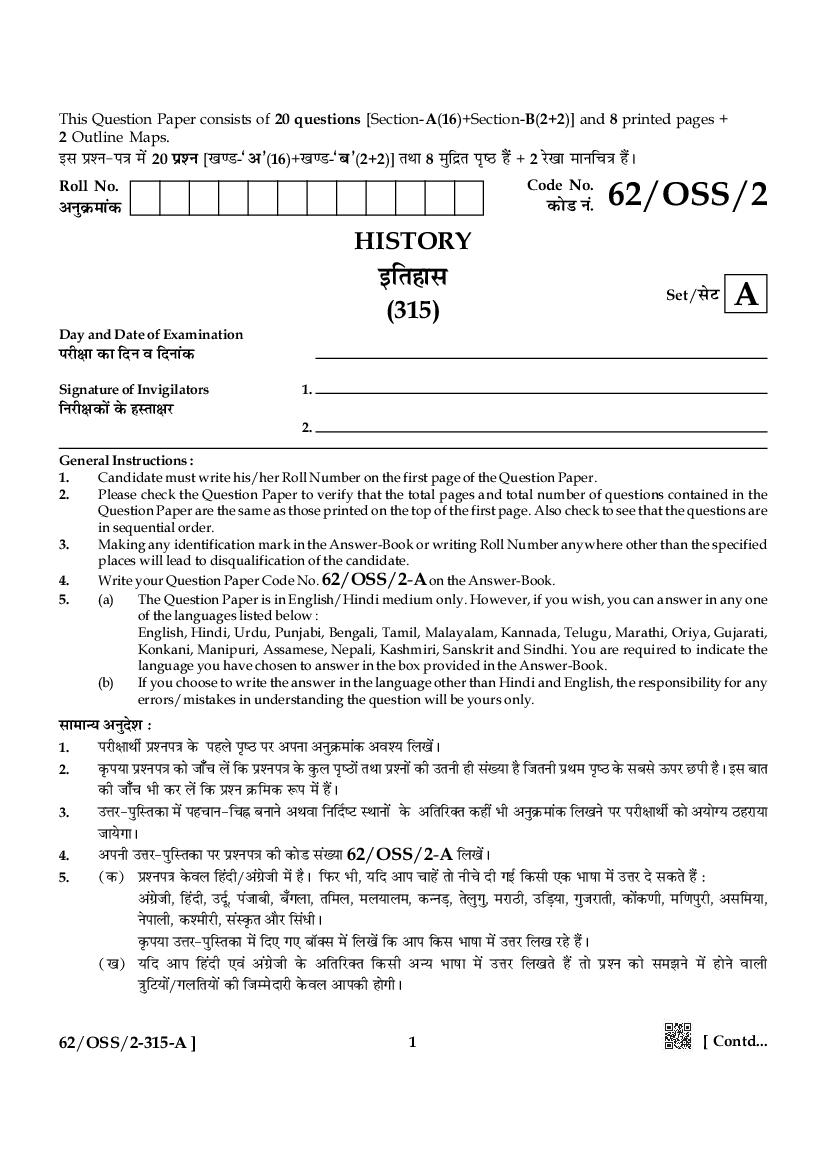
2 Outline Maps.
ß‚ ¬˝‡Ÿ-¬òÊ ◊¥ 20 ¬˝‡Ÿ [πá«U-“•”(16)+πá«U-“’”(2+2)] ÃÕÊ 8 ◊ÈÁŒ˝Ã ¬Îc∆U „Ò¥ + 2 ⁄UπÊ ◊ÊŸÁøòÊ „Ò¥–
Roll No. Code No.
•ŸÈ∑˝§◊Ê¥∑§ ∑§Ê«U Ÿ¥. 62/OSS/2
HISTORY
ßÁÄʂ
(315)
Set/‚≈U A
Day and Date of Examination
¬⁄UˡÊÊ ∑§Ê ÁŒŸ fl ÁŒŸÊ¥∑§
Signature of Invigilators 1.
ÁŸ⁄UˡÊ∑§Ê¥ ∑§ „SÃÊˇÊ⁄U
2.
General Instructions :
1. Candidate must write his/her Roll Number on the first page of the Question Paper.
2. Please check the Question Paper to verify that the total pages and total number of questions contained in the
Question Paper are the same as those printed on the top of the first page. Also check to see that the questions are
in sequential order.
3. Making any identification mark in the Answer-Book or writing Roll Number anywhere other than the specified
places will lead to disqualification of the candidate.
4. Write your Question Paper Code No. 62/OSS/2-A on the Answer-Book.
5. (a) The Question Paper is in English/Hindi medium only. However, if you wish, you can answer in any one
of the languages listed below :
English, Hindi, Urdu, Punjabi, Bengali, Tamil, Malayalam, Kannada, Telugu, Marathi, Oriya, Gujarati,
Konkani, Manipuri, Assamese, Nepali, Kashmiri, Sanskrit and Sindhi. You are required to indicate the
language you have chosen to answer in the box provided in the Answer-Book.
(b) If you choose to write the answer in the language other than Hindi and English, the responsibility for any
errors/mistakes in understanding the question will be yours only.
‚Ê◊Êãÿ •ŸÈŒ‡Ê —
1. ¬⁄UˡÊÊÕ˸ ¬˝‡Ÿ¬òÊ ∑§ §¬„‹ ¬Îc∆U ¬⁄U •¬ŸÊ •ŸÈ∑˝§◊Ê¥∑§ •fl‡ÿU Á‹π¥–
2. ∑Χ¬ÿÊ ¬˝‡Ÿ¬òÊ ∑§Ê ¡ÊÚ°ø ‹¥ Á∑§ ¬˝‡Ÿ¬òÊ ∑§ ∑ȧ‹ ¬Îc∆UÊ¥ ÃÕÊ ¬˝‡ŸÊ¥ ∑§Ë ©ÃŸË „Ë ‚¥ÅUÿÊ „Ò Á¡ÃŸË ¬˝Õ◊ ¬Îc∆ ∑ §‚’‚ ™§¬⁄U ¿U¬Ë „Ò– ß‚ ’ÊÃ
∑§Ë ¡ÊÚ°ø ÷Ë ∑§⁄U ‹¥ Á∑§ ¬˝‡Ÿ ∑˝ Á◊∑§ UM§¬ ◊¥ „Ò¥–
3. § ©ûÊ⁄U-¬ÈÁSUÃ∑§Ê ◊¥ ¬„øÊŸ-Áøq ’ŸÊŸ •ÕflÊ ÁŸÁŒ¸c≈U SÕÊŸÊ¥ ∑§§ •ÁÃÁ⁄UÄà ∑§„Ë¥ ÷Ë •ŸÈ∑˝§◊Ê¥∑§ Á‹πŸ ¬⁄U ¬⁄UˡÊÊÕ˸ ∑§Ê •ÿÊÇÿ ∆U„⁄UÊÿÊ
¡ÊÿªÊ–
4. •¬ŸË ©ûÊ⁄U-¬ÈÁSUÃ∑§Ê ¬⁄U ¬˝‡Ÿ¬òÊ ∑§Ë ∑§Ê«U ‚¥ÅÿÊ 62/OSS/2-A Á‹π¥–
5. (∑§) ¬˝‡Ÿ¬òÊ ∑§fl‹ Á„¥ŒË/•¥ª˝¡Ë ◊¥ „Ò– Á»§⁄U ÷Ë, ÿÁŒ •Ê¬ øÊ„¥ ÃÊ ŸËø ŒË ªß¸ Á∑§‚Ë ∞∑§ ÷Ê·Ê ◊¥ ©ûÊ⁄ Œ ‚∑§Ã „Ò¥ —
•¥ª˝¡Ë, Á„¥ŒË, ©ŒÍ¸, ¬¥¡Ê’Ë, ’°ª‹Ê, ÃÁ◊‹, ◊‹ÿÊ‹◊, ∑§ãŸ«∏, ËȪÈ, ◊⁄UÊ∆UË, ©Á«∏ÿÊ, ªÈ¡⁄UÊÃË, ∑§Ê¥∑§áÊË, ◊ÁáʬÈ⁄UË, •‚Á◊ÿÊ,
Ÿ¬Ê‹Ë, ∑§‡◊Ë⁄UË, ‚¥S∑Χç•ÊÒ⁄U Á‚¥œË–
∑Χ¬ÿÊ ©ûÊ⁄U-¬ÈÁSÃ∑§Ê ◊¥ ÁŒ∞ ª∞ ’ÊÚÄ‚ ◊¥ Á‹π¥ Á∑§ •Ê¬ Á∑§‚ ÷Ê·Ê ◊¥ ©ûÊ⁄U Á‹π ⁄U„ „Ò¥– §
(π) ÿÁŒ •Ê¬ Á„¥ŒË ∞fl¥ •¥ª˝¡Ë ∑§ •ÁÃÁ⁄UÄà Á∑§‚Ë •ãÿ ÷Ê·Ê ◊¥ ©ûÊ⁄U Á‹πà „Ò¥ ÃÊ ¬˝‡Ÿ ∑§Ê ‚◊¤ÊŸ ◊¥ „ÊŸ flÊ‹Ë
òÊÈÁ≈UÿÊ¥/ª‹ÁÃÿÊ¥ ∑§Ë Á¡ê◊UŒÊ⁄Ë ∑ fl‹ •Ê¬∑§Ë „ʪ˖
62/OSS/2-315-A ] 1 [ Contd...
Page 2
ßÁÄʂ
(315)
Time : 3 Hours ] [ Maximum Marks : 100
‚◊ÿ — 3 ÉÊá≈U ] [ ¬ÍáÊÊZ∑§ — 100
Note : (i) This question paper consists of two Sections, viz, ‘A’ and ‘B’.
(ii) All the questions of section ‘A’ are to be attempted.
(iii) Section ‘B’ has two options. Candidates are required to attempt questions from one
option only.
(iv) Answer Question Nos. 1 to 4 in not more than 20 words each, Question Nos. 5 to 11
and 17 in not more than 80 words each and Question Nos. 12 to 15 and 18 in not more
than 200 words each.
ÁŸŒ¸‡Ê — (i) ß‚ ¬˝‡Ÿ-¬òÊ ◊¥ ŒÊ πá«U „Ò¥ - πá«U “•” ÃÕÊ “’”–
(ii) πá«U “•” ∑§ ‚÷Ë ¬˝‡ŸÊ¥ ∑§Ê „‹ ∑§⁄UŸÊ „Ò¥–
(iii) πá«U “’” ◊¥ ŒÊ Áfl∑§À¬ „Ò¥– ¬⁄UˡÊÊÁÕ¸ÿÊ¥ ∑§Ê ∑§fl‹ ∞∑§ Áfl∑§À¬ ∑§ „Ë ¬˝‡ŸÊ¥ ∑§ ©ûÊ⁄U ŒŸ „Ò¥–
(iv) ¬˝‡Ÿ ‚¥ÅÿÊ 1 ‚ 4 Ã∑§ ∑§ ¬˝àÿ∑§ ¬˝‡Ÿ ∑§Ê ©ûÊ⁄U 20 ‡ÊéŒÊ¥ ◊¥, ¬˝‡Ÿ ‚¥ÅÿÊ 5 ‚ 11 Ã∑§ ÃÕÊ 17 ◊¥ ¬˝àÿ∑§ ¬˝‡Ÿ
∑§Ê ©ûÊ⁄U 80 ‡ÊéŒÊ¥ ◊¥ •ÊÒ⁄U ¬˝‡Ÿ ‚¥ÅÿÊ 12 ‚ 15 Ã∑§ ÃÕÊ 18 ◊¥ ¬˝àÿ∑§ ¬˝‡Ÿ ∑§Ê ©ûÊ⁄U 200 ‡ÊéŒÊ¥ ◊¥ ŒËÁ¡∞–
SECTION - A
πá«U - •
1. How does archaeology help in understanding the past ? Explain giving two points. 2
¬È⁄UÊÃàfl Á∑§‚ ¬˝∑§Ê⁄U •ÃËà ∑§Ê ‚◊¤ÊŸ ◊¥ ‚„ÊÿÃÊ ∑§⁄UÃÊ „Ò? ŒÊ Á’ãŒÈ•Ê¥ ‚Á„à S¬c≈U ∑§ËÁ¡∞–
2. Mention any two features of the Dravida style of architecture. 2
Œ˝Áfl«∏ ‡ÊÒ‹Ë ∑§Ë SÕʬàÿ ∑§‹Ê ∑§Ë Á∑§ã„Ë¥ ŒÊ Áfl‡Ê·ÃÊ•Ê¥ ∑§Ê ©À‹π ∑§ËÁ¡∞–
3. Explain any two examples of music prevalent during Medieval India. 2
◊äÿ∑§Ê‹ËŸ ÷Ê⁄Uà ∑§ ŒÊÒ⁄UÊŸ ¬˝øÁ‹Ã ‚¥ªËà ∑§ Á∑§ã„Ë¥ ŒÊ ©ŒÊ„⁄UáÊÊ¥ ∑§Ë √ÿÊÅÿÊ ∑§ËÁ¡∞–
4. State any two methods adopted by the British for the expansion of their empire in India. 2
÷Ê⁄Uà ◊¥ •¬Ÿ ‚Ê◊˝Êíÿ ∑§ ÁflSÃÊ⁄U ∑§ Á‹∞ •¥ª˝¡Ê¥ mÊ⁄UÊ •¬ŸÊ∞ ª∞ Á∑§ã„Ë¥ ŒÊ Ã⁄UË∑§Ê¥ ∑§Ê ©À‹π ∑§ËÁ¡∞–
62/OSS/2-315-A ] 2 [ Contd...
Page 3
Civilization.
„«∏å¬Ê ‚èÿÃÊ ∑§ ¬ÃŸ ¬⁄U ÁflmÊŸÊ¥ ∑§ ÁflÁ÷ÛÊ ◊ÃÊ¥ ∑§Ê Áfl‡‹·áÊ ∑§ËÁ¡∞–
OR / •ÕflÊ
Analyse any four aspects of the early Vedic Society.
¬˝Ê⁄¥UÁ÷∑§ flÒÁŒ∑§ ‚◊Ê¡ ∑§ Á∑§ã„Ë¥ øÊ⁄U ¬„‹È•Ê¥ ∑§Ê Áfl‡‹·áÊ ∑§ËÁ¡∞–
6. Describe any four causes of the Revolt of 1857. 4
1857 ∑§ ÁflŒ˝Ê„ ∑§ Á∑§ã„Ë¥ øÊ⁄U ∑§Ê⁄UáÊÊ¥ ∑§Ê fláʸŸ ∑§ËÁ¡∞–
OR / •ÕflÊ
Describe any four provisions of the Hunter Commission of 1882.
1882 ∑§ „¥≈U⁄U ∑§Á◊‡ÊŸ ∑§ Á∑§ã„Ë¥ øÊ⁄U ¬˝ÊflœÊŸÊ¥ ∑§Ê fláʸŸ ∑§ËÁ¡∞–
7. “Muhammad Tughlak is famous for his innovative projects.” Explain. 4
“◊È„ê◊Œ ÃȪ‹∑§ •¬ŸË Ÿß¸ ÿÊ¡ŸÊ•Ê¥ ∑§ Á‹∞ ¡ÊŸÊ ¡ÊÃÊ „Ò–” S¬c≈U ∑§ËÁ¡∞–
OR / •ÕflÊ
Why was Battle of Panipat (1526) significant ? Explain.
¬ÊŸË¬Ã ∑§Ê ÿÈh (1526) ◊„àfl¬Íáʸ ÄÿÊ¥ ÕÊ? S¬c≈U ∑§ËÁ¡∞–
8. Explain the reasons for the rise of nationalism in India. 4
÷Ê⁄Uà ◊¥ ⁄UÊc≈˛UflÊŒ ∑§ ©Œÿ „ÊŸ ∑§ ∑§Ê⁄UáÊÊ¥ ∑§Ë √ÿÊÅÿÊ ∑§ËÁ¡∞–
OR / •ÕflÊ
“A new thrust to the national movement was required and it came from the Home Rule
movement.” Explain.
““SflŒ‡ÊË •Ê¥ŒÊ‹Ÿ ∑§Ê Ÿ∞ Á‚⁄U ‚ ¡Ê⁄UŒÊ⁄U …¥Uª ‚ •Êª ’…∏ÊŸ ∑§Ë ¡M§⁄Uà ÕË •ÊÒ⁄U ÿ„ „Ê◊M§‹ •Ê¥ŒÊ‹Ÿ ‚ ‚¥÷fl „È߸–””
S¬c≈U ∑§ËÁ¡∞–
62/OSS/2-315-A ] 3 [ Contd...
Page 4
ªÈ≈U-ÁŸ⁄U¬ˇÊ •Ê¥ŒÊ‹Ÿ ÄÿÊ ÕÊ? ©‚∑§ ©g‡ÿÊ¥ ∑§Ê ¬⁄UˡÊáÊ ∑§ËÁ¡∞–
OR / •ÕflÊ
Examine any four provisions of the Treaty of Versailles.
fl‚ʸÿ ∑§Ë ‚¥Áœ ∑§ Á∑§ã„Ë¥ øÊ⁄U ¬˝ÊflœÊŸÊ¥ ∑§Ë ¬⁄Uπ ∑§ËÁ¡∞–
10. Describe the currency system of Medieval India. 4
◊äÿ∑§Ê‹ËŸ ÷Ê⁄Uà ∑§Ë ◊ÈŒ˝Ê ¬˝áÊÊ‹Ë ∑§Ê fláʸŸ ∑§ËÁ¡∞–
OR / •ÕflÊ
Describe the various styles and forms of Painting in Medieval India.
◊äÿ∑§Ê‹ËŸ ÷Ê⁄Uà ◊¥ ÁøòÊ∑§‹Ê ∑§Ë ÁflÁ÷ÛÊ ‡ÊÒÁ‹ÿÊ¥ ∑§Ê fláʸŸ ∑§ËÁ¡∞–
11. Explain any four contributions of Ishwar Chandra Vidyasagar. 4
߸‡fl⁄U øãŒ˝ Áfllʂʪ⁄U ∑§ Á∑§ã„Ë¥ øÊ⁄U ÿʪŒÊŸÊ¥ ∑§Ë √ÿÊÅÿÊ ∑§ËÁ¡∞–
OR / •ÕflÊ
Explain the ‘Drain of Wealth’ theory propounded by early Indian nationalists.
÷Ê⁄UÃËÿ ¬Ífl¸flÃ˸ ⁄UÊc≈˛UflÊÁŒÿÊ¥ mÊ⁄UÊ ’ËÊ∞ ª∞ ““‚¥¬ÁûÊ ∑§ ¬˝flÊ„”” Á‚hʥà ∑§Ë √ÿÊÅÿÊ ∑§ËÁ¡∞–
12. Explain the main doctrines of Buddhism. 10
’ÊÒh œ◊¸ ∑§ ◊ÈÅÿ Á‚hÊ¥ÃÊ¥ ∑§Ë √ÿÊÅÿÊ ∑§ËÁ¡∞–
OR / •ÕflÊ
Explain the significance of Sangam Literature.
‚¥ª◊ ‚ÊÁ„àÿ ∑§ ◊„àfl ∑§Ê S¬c≈U ∑§ËÁ¡∞–
13. Examine the challenges to Mughal rule in India. 10
÷Ê⁄Uà ◊¥ ◊Ȫ‹ ‡ÊÊ‚Ÿ ∑§Ê Á¡Ÿ øÈŸÊÒÁÃÿÊ¥ ∑§Ê ‚Ê◊ŸÊ ∑§⁄UŸÊ ¬«∏Ê, ©Ÿ∑§Ê ¬⁄UˡÊáÊ ∑§ËÁ¡∞–
OR / •ÕflÊ
Examine the central and provincial administrative system of the Mughals.
◊Ȫ‹Ê¥ ∑§Ë ∑§ãŒ˝Ëÿ •ÊÒ⁄U ¬˝ÊãÃËÿ ¬˝‡ÊÊ‚ÁŸ∑§ ¬˝áÊÊ‹Ë ∑§Ê ¬⁄UˡÊáÊ ∑§ËÁ¡∞–
62/OSS/2-315-A ] 4 [ Contd...
Page 5
‚ÁflŸÿ •flôÊÊ •Ê¥ŒÊ‹Ÿ ∑§Ë ◊ÈÅÿ ÉÊ≈UŸÊ•Ê¥ ∑§Ê fláʸŸ ∑§ËÁ¡∞–
OR / •ÕflÊ
Describe the events that led to the freedom of India in 1947.
©Ÿ ÉÊ≈UŸÊ•Ê¥ ∑§Ê fláʸŸ ∑§ËÁ¡∞ Á¡Ÿ∑§ ∑§Ê⁄UáÊ ÷Ê⁄Uà ∑§Ê 1947 ◊¥ SflÃ¥òÊÃÊ Á◊‹Ë–
15. Examine the causes of the Russian Revolution. 10
M§‚Ë ∑˝§Ê¥Áà ∑§ ∑§Ê⁄UáÊÊ¥ ∑§Ë ¬⁄Uπ ∑§ËÁ¡∞–
OR / •ÕflÊ
Examine the role of globalization as a significant development of the 20th Century.
20flË¥ ‚ŒË ∑§ ∞∑§ ◊„àfl¬Íáʸ Áfl∑§Ê‚ ∑§ M§¬ ◊¥ flÒ‡flË∑§⁄UáÊ ∑§Ë ÷ÍÁ◊∑§Ê ∑§Ë ¬⁄Uπ ∑§ËÁ¡∞–
16 (a) On the given political outline map of India mark the following :
(i) Neolithic sites
(1) Buzahom 1
(2) Chirand 1
(ii) (1) Azmer 1
(2) Panipat 1
(3) Seat of power of Holkar 1
(4) Seat of power of Gaikwad 1
(iii) The territory which first signed the subsidiary treaty 1
(iv) The place where Gandhiji broke the salt law 1
(v) Option I : Name of the most powerful Mahajanapada 1
OR
Option II : Gandhar
(b) On the given political outline map of Europe mark Germany. 1
62/OSS/2-315-A ] 5 [ Contd...
Page 6
(i) Ÿfl¬Ê·ÊáÊ SÕ‹
(1) ’È$¡„Ê◊ 1
(2) Áø⁄U„¥Œ 1
(ii) (1) •¡◊⁄U 1
(2) ¬ÊŸË¬Ã 1
(3) „Ê‹∑§⁄U ∑§Ê ‡ÊÁÄà ∑¥§Œ˝ 1
(4) ªÊÿ∑§flÊ«∏ ∑§Ê ‡ÊÁÄà ∑¥§Œ˝ 1
(iii) fl„ ‚Ë◊ÊˇÊòÊ Á¡‚Ÿ ‚fl¸¬˝Õ◊ ‚„Êÿ∑§ ‚¥Áœ ¬⁄U „SÃÊˇÊ⁄U Á∑§ÿ 1
(iv) ªÊ¥œË¡Ë Ÿ◊∑§ ∑§ÊŸÍŸ ¡„Ê° ÃÊ«∏Ê 1
(v) Áfl∑§À¬ I : ‚’‚ ‡ÊÁÄÇÊÊ‹Ë ◊„Ê¡Ÿ¬Œ ∑§Ê ŸÊ◊ 1
•ÕflÊ
Áfl∑§À¬ II : ª¥œÊ⁄U
(b) ÿÍ⁄Uʬ ∑§ ⁄UÊ¡ŸÒÁÃ∑§ ⁄UπÊ ◊ÊŸÁøòÊ ¬⁄U ¡◊¸ŸË ∑§Ê Œ‡Êʸßÿ– 1
Note : The following questions are for the visually impaired only in lieu of Map Question
No. 16.
(i) Mention any two Paleolithic sites 2
(ii) (1) Which Mughal ruler was defeated by Shershah ? 1
(2) Where is the Qutub Minar situated ? 1
(3) Name any two Maratha Confederacies. 2
(iii) Which Indian state signed the Subsidiary Treaty first with the British ? 1
(iv) Where did Gandhiji break the salt law ? 1
(v) Name the capital of the Chola kingdom. 1
OR
Where did Buddha deliver his first sermon ?
(vi) Who was Benito Mussolini ? 1
62/OSS/2-315-A ] 6 [ Contd...
Page 7
(i) ŒÊ ¬Ê·ÊáÊ SÕ‹Ê¥ ∑§Ê ©À‹π ∑§ËÁ¡∞– 2
(ii) (1) Á∑§‚ ◊Ȫ‹ ‚◊˝Ê≈U ∑§Ê ‡Ê⁄U‡ÊÊ„ Ÿ ¬⁄UÊÁ¡Ã Á∑§ÿÊ ÕÊ? 1
(2) ∑ȧÃÈ’ Á◊ŸÊ⁄U ∑§„Ê° ’ŸÊÿÊ ªÿÊ ÕÊ? 1
(3) Á∑§ã„Ë¥ ŒÊ ◊⁄UÊ∆UÊ ⁄UÊíÿ ‚¥ÉÊ ∑§ ŸÊ◊– 2
(iii) Á∑§‚ ÷Ê⁄UÃËÿ ⁄UÊíÿ Ÿ ‚fl¸¬˝Õ◊ Á’˝Á≈U‡Ê ∑§ ‚ÊÕ ‚„Êÿ∑§ ‚¥Áœ ¬⁄U „SÃÊˇÊ⁄U Á∑§∞? 1
(iv) ªÊ¥œË¡Ë Ÿ Ÿ◊∑§ ∑§ÊŸÍŸ ∑§„Ê° ÃÊ«∏Ê? 1
(v) øÊ‹ ∑§Ë ⁄UÊ¡œÊŸË ∑§Ê ŸÊ◊– 1
•ÕflÊ
’Èh Ÿ •¬ŸÊ ¬„‹Ê ¬˝fløŸ ∑§„Ê° ÁŒÿÊ ÕÊ?
(vi) ’ÁŸÃÊ ◊È‚ÊÁ‹ŸË ∑§ÊÒŸ ÕÊ? 1
SECTION - B
πá«U - ’
OPTION - I
Áfl∑§À¬ - I
(Evolution of State)
(⁄UÊíÿ ∑§Ê ÁflSÃÊ⁄U)
17. Explain any four features of Gupta administration. 4
ªÈåÃ∑§Ê‹ËŸ ¬˝‡ÊÊ‚Ÿ ∑§Ë Á∑§ã„Ë¥ øÊ⁄U Áfl‡Ê·ÃÊ•Ê¥ ∑§Ë √ÿÊÅÿÊ ∑§ËÁ¡∞–
OR / •ÕflÊ
Explain any four features of the Mauryan Bureaucracy.
◊ÊÒÿ¸∑§Ê‹ËŸ ŸÊÒ∑§⁄U‡ÊÊ„Ë ∑§Ë Á∑§ã„Ë¥ øÊ⁄U Áfl‡Ê·ÃÊ•Ê¥ ∑§Ë √ÿÊÅÿÊ ∑§ËÁ¡∞–
62/OSS/2-315-A ] 7 [ Contd...
Page 8
◊Ȫ‹ ‚Ê◊˝Êíÿ ∑§ Äà ⁄UÊíÿ ∑§Ë ¬˝∑ΧÁà ∑§Ë ¬⁄Uπ ∑§ËÁ¡∞–
OR / •ÕflÊ
Examine the administrative system of the Chola rulers.
øÊ‹ ‡ÊÊ‚∑§Ê¥ ∑§ ¬˝‡ÊÊ‚Ÿ √ÿflSÕÊ ∑§Ê ¬⁄UˡÊáÊ ∑§ËÁ¡∞–
OPTION - II
Áfl∑§À¬ - II
(Culture of India)
(÷Ê⁄UÃËÿ ‚¥S∑ΧÁÃ)
17. Explain any four kinds of textiles produced in India. 4
÷Ê⁄Uà ◊¥ ÁŸÁ◊¸Ã Á∑§ã„Ë¥ øÊ⁄U ¬˝∑§Ê⁄U ∑§ flSòÊÊ¥ ∑§Ë √ÿÊÅÿÊ ∑§ËÁ¡∞–
OR / •ÕflÊ
Explain how writing and printing help in cultural communication.
‹πŸ •ÊÒ⁄U ◊ÈŒ˝áÊ ‚Ê¥S∑ΧÁÃ∑§ ‚¥¬˝·áÊ ◊¥ Á∑§‚ ¬˝∑§Ê⁄U ‚„Êÿ∑§ „Êà „Ò¥? S¬c≈U ∑§ËÁ¡∞–
18. Examine how music helps in communicating different ideas. 10
ÁflÁ÷ÛÊ ÁfløÊ⁄UÊ¥ ∑§Ê ‚¥¬˝Á·Ã ∑§⁄UŸ ◊¥ ‚¥ªËà Á∑§‚ ¬˝∑§Ê⁄U ◊ŒŒ ∑§⁄UÃÊ „Ò? ¡Ê°ø ∑§ËÁ¡∞–
OR / •ÕflÊ
“Food culture is an integral part of human existence.” Examine the statement giving examples.
““πÊl ‚¥S∑ΧÁà ◊ÊŸfl ∑§ •ÁSÃàfl ∑§Ê •Á÷ÛÊ •¥ª „Ò–”” ∑§ÕŸ ∑§Ë ©ŒÊ„⁄UáÊÊ¥ ‚Á„à ¡Ê°ø ∑§ËÁ¡∞–
-o0o-
62/OSS/2-315-A ] 8 [ Contd...
Page 9
✄
Roll No.
Outline Map of India (Political)
✄
62/OSS/2-315-A ] 9 [ Contd...
Page 10
G
PA
K
AN
BL
62/OSS/2-315-A ] 10 [ Contd...
Page 11
✄
Roll No.
Outline Map of Europe (Political)
✄
62/OSS/2-315-A ] 11 [ Contd...
Page 12
G
PA
K
AN
BL
62/OSS/2-315-A ] 12 [ Contd...
Page 13
+2 Outline Maps.
ß‚ ¬˝‡Ÿ-¬òÊ ◊¥ 20 ¬˝‡Ÿ [πá«U-“•”(16)+πá«U-“’”(2+2)] ÃÕÊ 8 ◊ÈÁŒ˝Ã ¬Îc∆U „Ò¥ +2 ⁄UπÊ ◊ÊŸÁøòÊ „Ò¥–
Roll No. Code No.
•ŸÈ∑˝§◊Ê¥∑§ ∑§Ê«U Ÿ¥. 62/OSS/2
HISTORY
ßÁÄʂ
(315)
Set/‚≈U B
Day and Date of Examination
¬⁄UˡÊÊ ∑§Ê ÁŒŸ fl ÁŒŸÊ¥∑§
Signature of Invigilators 1.
ÁŸ⁄UˡÊ∑§Ê¥ ∑§ „SÃÊˇÊ⁄U
2.
General Instructions :
1. Candidate must write his/her Roll Number on the first page of the Question Paper.
2. Please check the Question Paper to verify that the total pages and total number of questions contained in the
Question Paper are the same as those printed on the top of the first page. Also check to see that the questions are
in sequential order.
3. Making any identification mark in the Answer-Book or writing Roll Number anywhere other than the specified
places will lead to disqualification of the candidate.
4. Write your Question Paper Code No. 62/OSS/2-B on the Answer-Book.
5. (a) The Question Paper is in English/Hindi medium only. However, if you wish, you can answer in any one
of the languages listed below :
English, Hindi, Urdu, Punjabi, Bengali, Tamil, Malayalam, Kannada, Telugu, Marathi, Oriya, Gujarati,
Konkani, Manipuri, Assamese, Nepali, Kashmiri, Sanskrit and Sindhi. You are required to indicate the
language you have chosen to answer in the box provided in the Answer-Book.
(b) If you choose to write the answer in the language other than Hindi and English, the responsibility for any
errors/mistakes in understanding the question will be yours only.
‚Ê◊Êãÿ •ŸÈŒ‡Ê —
1. ¬⁄UˡÊÊÕ˸ ¬˝‡Ÿ¬òÊ ∑§ §¬„‹ ¬Îc∆U ¬⁄U •¬ŸÊ •ŸÈ∑˝§◊Ê¥∑§ •fl‡ÿU Á‹π¥–
2. ∑Χ¬ÿÊ ¬˝‡Ÿ¬òÊ ∑§Ê ¡ÊÚ°ø ‹¥ Á∑§ ¬˝‡Ÿ¬òÊ ∑§ ∑ȧ‹ ¬Îc∆UÊ¥ ÃÕÊ ¬˝‡ŸÊ¥ ∑§Ë ©ÃŸË „Ë ‚¥ÅUÿÊ „Ò Á¡ÃŸË ¬˝Õ◊ ¬Îc∆ ∑ §‚’‚ ™§¬⁄U ¿U¬Ë „Ò– ß‚ ’ÊÃ
∑§Ë ¡ÊÚ°ø ÷Ë ∑§⁄U ‹¥ Á∑§ ¬˝‡Ÿ ∑˝ Á◊∑§ UM§¬ ◊¥ „Ò¥–
3. § ©ûÊ⁄U-¬ÈÁSUÃ∑§Ê ◊¥ ¬„øÊŸ-Áøq ’ŸÊŸ •ÕflÊ ÁŸÁŒ¸c≈U SÕÊŸÊ¥ ∑§§ •ÁÃÁ⁄UÄà ∑§„Ë¥ ÷Ë •ŸÈ∑˝§◊Ê¥∑§ Á‹πŸ ¬⁄U ¬⁄UˡÊÊÕ˸ ∑§Ê •ÿÊÇÿ ∆U„⁄UÊÿÊ
¡ÊÿªÊ–
4. •¬ŸË ©ûÊ⁄U-¬ÈÁSUÃ∑§Ê ¬⁄U ¬˝‡Ÿ¬òÊ ∑§Ë ∑§Ê«U ‚¥ÅÿÊ 62/OSS/2-B Á‹π¥–
5. (∑§) ¬˝‡Ÿ¬òÊ ∑§fl‹ Á„¥ŒË/•¥ª˝¡Ë ◊¥ „Ò– Á»§⁄U ÷Ë, ÿÁŒ •Ê¬ øÊ„¥ ÃÊ ŸËø ŒË ªß¸ Á∑§‚Ë ∞∑§ ÷Ê·Ê ◊¥ ©ûÊ⁄ Œ ‚∑§Ã „Ò¥ —
•¥ª˝¡Ë, Á„¥ŒË, ©ŒÍ¸, ¬¥¡Ê’Ë, ’°ª‹Ê, ÃÁ◊‹, ◊‹ÿÊ‹◊, ∑§ãŸ«∏, ËȪÈ, ◊⁄UÊ∆UË, ©Á«∏ÿÊ, ªÈ¡⁄UÊÃË, ∑§Ê¥∑§áÊË, ◊ÁáʬÈ⁄UË, •‚Á◊ÿÊ,
Ÿ¬Ê‹Ë, ∑§‡◊Ë⁄UË, ‚¥S∑Χç•ÊÒ⁄U Á‚¥œË–
∑Χ¬ÿÊ ©ûÊ⁄U-¬ÈÁSÃ∑§Ê ◊¥ ÁŒ∞ ª∞ ’ÊÚÄ‚ ◊¥ Á‹π¥ Á∑§ •Ê¬ Á∑§‚ ÷Ê·Ê ◊¥ ©ûÊ⁄U Á‹π ⁄U„ „Ò¥– §
(π) ÿÁŒ •Ê¬ Á„¥ŒË ∞fl¥ •¥ª˝¡Ë ∑§ •ÁÃÁ⁄UÄà Á∑§‚Ë •ãÿ ÷Ê·Ê ◊¥ ©ûÊ⁄U Á‹πà „Ò¥ ÃÊ ¬˝‡Ÿ ∑§Ê ‚◊¤ÊŸ ◊¥ „ÊŸ flÊ‹Ë
òÊÈÁ≈UÿÊ¥/ª‹ÁÃÿÊ¥ ∑§Ë Á¡ê◊UŒÊ⁄Ë ∑ fl‹ •Ê¬∑§Ë „ʪ˖
62/OSS/2-315-B ] 1 [ Contd...
Page 14
ßÁÄʂ
(315)
Time : 3 Hours ] [ Maximum Marks : 100
‚◊ÿ — 3 ÉÊá≈U ] [ ¬ÍáÊÊZ∑§ — 100
Note : (i) This question paper consists of two Sections, viz, ‘A’ and ‘B’.
(ii) All the questions of section ‘A’ are to be attempted.
(iii) Section ‘B’ has two options. Candidates are required to attempt questions from one
option only.
(iv) Answer Question Nos. 1 to 4 in not more than 20 words each, Question Nos. 5 to 11
and 17 in not more than 80 words each and Question Nos. 12 to 15 and 18 in not more
than 200 words each.
ÁŸŒ¸‡Ê — (i) ß‚ ¬˝‡Ÿ-¬òÊ ◊¥ ŒÊ πá«U „Ò¥ - πá«U “•” ÃÕÊ “’”–
(ii) πá«U “•” ∑§ ‚÷Ë ¬˝‡ŸÊ¥ ∑§Ê „‹ ∑§⁄UŸÊ „Ò¥–
(iii) πá«U “’” ◊¥ ŒÊ Áfl∑§À¬ „Ò¥– ¬⁄UˡÊÊÁÕ¸ÿÊ¥ ∑§Ê ∑§fl‹ ∞∑§ Áfl∑§À¬ ∑§ „Ë ¬˝‡ŸÊ¥ ∑§ ©ûÊ⁄U ŒŸ „Ò¥–
(iv) ¬˝‡Ÿ ‚¥ÅÿÊ 1 ‚ 4 Ã∑§ ∑§ ¬˝àÿ∑§ ¬˝‡Ÿ ∑§Ê ©ûÊ⁄U 20 ‡ÊéŒÊ¥ ◊¥, ¬˝‡Ÿ ‚¥ÅÿÊ 5 ‚ 11 Ã∑§ ÃÕÊ 17 ◊¥ ¬˝àÿ∑§ ¬˝‡Ÿ
∑§Ê ©ûÊ⁄U 80 ‡ÊéŒÊ¥ ◊¥ •ÊÒ⁄U ¬˝‡Ÿ ‚¥ÅÿÊ 12 ‚ 15 Ã∑§ ÃÕÊ 18 ◊¥ ¬˝àÿ∑§ ¬˝‡Ÿ ∑§Ê ©ûÊ⁄U 200 ‡ÊéŒÊ¥ ◊¥ ŒËÁ¡∞––
SECTION - A
πá«U - •
1. State any two methods adopted by the British for the expansion of their empire in India. 2
÷Ê⁄Uà ◊¥ •¬Ÿ ‚Ê◊˝Êíÿ ∑§ ÁflSÃÊ⁄U ∑§ Á‹∞ •¥ª˝¡Ê¥ mÊ⁄UÊ •¬ŸÊ∞ ª∞ Á∑§ã„Ë¥ ŒÊ Ã⁄UË∑§Ê¥ ∑§Ê ©À‹π ∑§ËÁ¡∞–
2. Mention any two features of the Nagar style of temples. 2
Ÿª⁄U ‡ÊÒ‹Ë ∑§ ◊¥ÁŒ⁄UÊ¥ ∑§Ë Á∑§ã„Ë¥ ŒÊ Áfl‡Ê·ÃÊ•Ê¥ ∑§Ê ©À‹π ∑§ËÁ¡∞–
3. How does archaeology help in understanding the past ? Explain giving two points. 2
¬È⁄UÊÃàfl Á∑§‚ ¬˝∑§Ê⁄U •ÃËà ∑§Ê ‚◊¤ÊŸ ◊¥ ‚„ÊÿÃÊ ∑§⁄UÃÊ „Ò? ŒÊ Á’ãŒÈ•Ê¥ ‚Á„à S¬c≈U ∑§ËÁ¡∞–
4. Explain any two examples of music prevalent during Medieval India. 2
◊äÿ∑§Ê‹ËŸ ÷Ê⁄Uà ∑§ ŒÊÒ⁄UÊŸ ¬˝øÁ‹Ã ‚¥ªËà ∑§ Á∑§ã„Ë¥ ŒÊ ©ŒÊ„⁄UáÊÊ¥ ∑§Ë √ÿÊÅÿÊ ∑§ËÁ¡∞–
62/OSS/2-315-B ] 2 [ Contd...
Page 15
„«∏å¬Ê߸ ∑ΧÁ· ∑§ Á∑§ã„Ë¥ øÊ⁄U ¬„‹È•Ê¥ ∑§Ê ¬⁄UˡÊáÊ ∑§ËÁ¡∞–
OR / •ÕflÊ
Examine the role of Ashoka in the Consolidation of the empire through his policy of Dhamma.
“œê◊” ∑§Ë ŸËÁà ∑§ ¡Á⁄Uÿ ‚Ê◊˝ÊíÿÊ¥ ∑§Ê ‚¥ªÁ∆Uà ∑§⁄UŸ ∑§ Á‹∞ •‡ÊÊ∑§ ∑§Ë ÷ÍÁ◊∑§Ê ∑§Ë ¬⁄Uπ ∑§ËÁ¡∞–
6. Describe any four causes of the failure of the Revolt of 1857. 4
1857 ∑§ ÁflŒ˝Ê„ ∑§ •‚»§‹ „ÊŸ ∑§ Á∑§ã„Ë¥ øÊ⁄U ∑§Ê⁄UáÊÊ¥ ∑§Ê fláʸŸ ∑§ËÁ¡∞–
OR / •ÕflÊ
Describe the views of Macaulay on spreading English education in India.
÷Ê⁄Uà ◊¥ •¥ª˝¡Ë Á‡ÊˇÊÊ ∑§ ÁflSÃÊ⁄U ∑§ Á‹∞ ◊Ò∑§ÊÚ‹ ∑§ ÁfløÊ⁄UÊ¥ ∑§Ê fláʸŸ ∑§ËÁ¡∞–
7. “Muhammad Tughlak is famous for his innovative projects.” Explain. 4
“◊È„ê◊Œ ÃȪ‹∑§ •¬ŸË Ÿß¸ ÿÊ¡ŸÊ•Ê¥ ∑§ Á‹∞ ¡ÊŸÊ ¡ÊÃÊ „Ò–” S¬c≈U ∑§ËÁ¡∞–
OR / •ÕflÊ
Why was Battle of Panipat (1526) significant ? Explain.
¬ÊŸË¬Ã ∑§Ê ÿÈh (1526) ◊„àfl¬Íáʸ ÄÿÊ¥ ÕÊ? S¬c≈U ∑§ËÁ¡∞–
8. Describe the currency system of Medieval India. 4
◊äÿ∑§Ê‹ËŸ ÷Ê⁄Uà ∑§Ë ◊ÈŒ˝Ê ¬˝áÊÊ‹Ë ∑§Ê fláʸŸ ∑§ËÁ¡∞–
OR / •ÕflÊ
Describe the various styles and forms of Painting in Medieval India.
◊äÿ∑§Ê‹ËŸ ÷Ê⁄Uà ◊¥ ÁøòÊ∑§‹Ê ∑§Ë ÁflÁ÷ÛÊ ‡ÊÒÁ‹ÿÊ¥ ∑§Ê fláʸŸ ∑§ËÁ¡∞–
9. Analyse the problems of development in the post-colonial world. 4
©¬ÁŸfl‡ÊÊûÊ⁄U Áfl‡fl ◊¥ Áfl∑§Ê‚ ∑§Ë ‚◊SÿÊ•Ê¥ ∑§Ê Áfl‡‹·áÊ ∑§ËÁ¡∞–
OR / •ÕflÊ
Analyse the Cuban Missile crisis during the cold war.
‡ÊËà ÿÈh ∑§ ŒÊÒ⁄UÊŸ ÄÿÍ’Ê ∑§ Á◊‚Êß‹ ‚¥∑§≈U ∑§Ê Áfl‡‹·áÊ ∑§ËÁ¡∞–
62/OSS/2-315-B ] 3 [ Contd...
Page 16
߸‡fl⁄U øãŒ˝ Áfllʂʪ⁄U ∑§ Á∑§ã„Ë¥ øÊ⁄U ÿʪŒÊŸÊ¥ ∑§Ë √ÿÊÅÿÊ ∑§ËÁ¡∞–
OR / •ÕflÊ
Explain the ‘Drain of Wealth’ theory propounded by early Indian nationalists.
÷Ê⁄UÃËÿ ¬Ífl¸flÃ˸ ⁄UÊc≈˛UflÊÁŒÿÊ¥ mÊ⁄UÊ ’ËÊ∞ ª∞ ““‚¥¬ÁûÊ ∑§ ¬˝flÊ„”” Á‚hʥà ∑§Ë √ÿÊÅÿÊ ∑§ËÁ¡∞–
11. Explain the reasons for the rise of nationalism in India. 4
÷Ê⁄Uà ◊¥ ⁄UÊc≈˛UflÊŒ ∑§ ©Œÿ „ÊŸ ∑§ ∑§Ê⁄UáÊÊ¥ ∑§Ë √ÿÊÅÿÊ ∑§ËÁ¡∞–
OR / •ÕflÊ
“A new thrust to the national movement was required and it came from the Home Rule
movement.” Explain.
““SflŒ‡ÊË •Ê¥ŒÊ‹Ÿ ∑§Ê Ÿ∞ Á‚⁄U ‚ ¡Ê⁄UŒÊ⁄U …¥Uª ‚ •Êª ’…∏ÊŸ ∑§Ë ¡M§⁄Uà ÕË •ÊÒ⁄U ÿ„ „Ê◊M§‹ •Ê¥ŒÊ‹Ÿ ‚ ‚¥÷fl „È߸–””
S¬c≈U ∑§ËÁ¡∞–
12. Explain the doctrines of Jainism. 10
¡ÒŸ œ◊¸ ∑§ Á‚hÊ¥ÃÊ¥ ∑§Ë √ÿÊÅÿÊ ∑§ËÁ¡∞–
OR / •ÕflÊ
Explain the important features of various schools of art and sculpture which emerged during
200 BC - 300 AD.
200 ߸. ¬Í. ‚ 300 ߸. ◊¥. ∑§‹Ê ÃÕÊ ◊ÍÁø∑§‹Ê ∑§Ë ÁflÁ÷ÛÊ ‡ÊÒÁ‹ÿÊ¥ ∑§Ë ◊„àfl¬Íáʸ Áfl‡Ê·ÃÊ•Ê¥ ∑§Ë √ÿÊÅÿÊ ∑§ËÁ¡∞–
13. Describe the main events of the Civil Disobedience Movement. 10
‚ÁflŸÿ •flôÊÊ •Ê¥ŒÊ‹Ÿ ∑§Ë ◊ÈÅÿ ÉÊ≈UŸÊ•Ê¥ ∑§Ê fláʸŸ ∑§ËÁ¡∞–
OR / •ÕflÊ
Describe the events that led to the freedom of India in 1947.
©Ÿ ÉÊ≈UŸÊ•Ê¥ ∑§Ê fláʸŸ ∑§ËÁ¡∞ Á¡Ÿ∑§ ∑§Ê⁄UáÊ ÷Ê⁄Uà ∑§Ê 1947 ◊¥ SflÃ¥òÊÃÊ Á◊‹Ë–
62/OSS/2-315-B ] 4 [ Contd...
Page 17
M§‚Ë ∑˝§Ê¥Áà ∑§ ∑§Ê⁄UáÊÊ¥ ∑§Ë ¬⁄Uπ ∑§ËÁ¡∞–
OR / •ÕflÊ
Examine the role of globalization as a significant development of the 20th Century.
20flË¥ ‚ŒË ∑§ ∞∑§ ◊„àfl¬Íáʸ Áfl∑§Ê‚ ∑§ M§¬ ◊¥ flÒ‡flË∑§⁄UáÊ ∑§Ë ÷ÍÁ◊∑§Ê ∑§Ë ¬⁄Uπ ∑§ËÁ¡∞–
15. Examine the challenges to Mughal rule in India. 10
÷Ê⁄Uà ◊¥ ◊Ȫ‹ ‡ÊÊ‚Ÿ ∑§Ê Á¡Ÿ øÈŸÊÒÁÃÿÊ¥ ∑§Ê ‚Ê◊ŸÊ ∑§⁄UŸÊ ¬«∏Ê, ©Ÿ∑§Ê ¬⁄UˡÊáÊ ∑§ËÁ¡∞–
OR / •ÕflÊ
Examine the central and provincial administrative system of the Mughals.
◊Ȫ‹Ê¥ ∑§Ë ∑§ãŒ˝Ëÿ •ÊÒ⁄U ¬˝ÊãÃËÿ ¬˝‡ÊÊ‚ÁŸ∑§ ¬˝áÊÊ‹Ë ∑§Ê ¬⁄UˡÊáÊ ∑§ËÁ¡∞–
16. (a) On the given political outline map of India mark the following :
(i) Neolithic sites
(1) Buzahom 1
(2) Chirand 1
(ii) (1) Azmer 1
(2) Panipat 1
(3) Seat of power of Holkar 1
(4) Seat of power of Gaikwad 1
(iii) The territory which first signed the subsidiary treaty 1
(iv) The place where Gandhiji broke the salt law 1
(v) Option I : Name of the most powerful Mahajanapada 1
OR
Option II : Gandhar
(b) On the given political outline map of Europe mark Germany. 1
62/OSS/2-315-B ] 5 [ Contd...
Page 18
(i) Ÿfl¬Ê·ÊáÊ SÕ‹
(1) ’È$¡„Ê◊ 1
(2) Áø⁄U„¥Œ 1
(ii) (1) •¡◊⁄U 1
(2) ¬ÊŸË¬Ã 1
(3) „Ê‹∑§⁄U ∑§Ê ‡ÊÁÄà ∑¥§Œ˝ 1
(4) ªÊÿ∑§flÊ«∏ ∑§Ê ‡ÊÁÄà ∑¥§Œ˝ 1
(iii) fl„ ‚Ë◊ÊˇÊòÊ Á¡‚Ÿ ‚fl¸¬˝Õ◊ ‚„Êÿ∑§ ‚¥Áœ ¬⁄U „SÃÊˇÊ⁄U Á∑§ÿ 1
(iv) ªÊ¥œË¡Ë Ÿ◊∑§ ∑§ÊŸÍŸ ¡„Ê° ÃÊ«∏Ê 1
(v) Áfl∑§À¬ I : ‚’‚ ‡ÊÁÄÇÊÊ‹Ë ◊„Ê¡Ÿ¬Œ ∑§Ê ŸÊ◊ 1
•ÕflÊ
Áfl∑§À¬ II : ª¥œÊ⁄U
(b) ÿÍ⁄Uʬ ∑§ ⁄UÊ¡ŸÒÁÃ∑§ ⁄UπÊ ◊ÊŸÁøòÊ ¬⁄U ¡◊¸ŸË ∑§Ê Œ‡Êʸßÿ– 1
Note : The following questions are for the visually impaired only in lieu of Map Question
No. 16.
(i) Mention any two Paleolithic sites 2
(ii) (1) Which Mughal ruler was defeated by Shershah ? 1
(2) Where is the Qutub Minar situated ? 1
(3) Name any two Maratha Confederacies. 2
(iii) Which Indian state signed the Subsidiary Treaty first with the British ? 1
(iv) Where did Gandhiji break the salt law ? 1
(v) Name the capital of the Chola kingdom. 1
OR
Where did Buddha deliver his first sermon ?
(vi) Who was Benito Mussolini ? 1
62/OSS/2-315-B ] 6 [ Contd...
Page 19
(i) ŒÊ ¬Ê·ÊáÊ SÕ‹Ê¥ ∑§Ê ©À‹π ∑§ËÁ¡∞– 2
(ii) (1) Á∑§‚ ◊Ȫ‹ ‚◊˝Ê≈U ∑§Ê ‡Ê⁄U‡ÊÊ„ Ÿ ¬⁄UÊÁ¡Ã Á∑§ÿÊ ÕÊ? 1
(2) ∑ȧÃÈ’ Á◊ŸÊ⁄U ∑§„Ê° ’ŸÊÿÊ ªÿÊ ÕÊ? 1
(3) Á∑§ã„Ë¥ ŒÊ ◊⁄UÊ∆UÊ ⁄UÊíÿ ‚¥ÉÊ ∑§ ŸÊ◊– 2
(iii) Á∑§‚ ÷Ê⁄UÃËÿ ⁄UÊíÿ Ÿ ‚fl¸¬˝Õ◊ Á’˝Á≈U‡Ê ∑§ ‚ÊÕ ‚„Êÿ∑§ ‚¥Áœ ¬⁄U „SÃÊˇÊ⁄U Á∑§∞? 1
(iv) ªÊ¥œË¡Ë Ÿ Ÿ◊∑§ ∑§ÊŸÍŸ ∑§„Ê° ÃÊ«∏Ê? 1
(v) øÊ‹ ∑§Ë ⁄UÊ¡œÊŸË ∑§Ê ŸÊ◊– 1
•ÕflÊ
’Èh Ÿ •¬ŸÊ ¬„‹Ê ¬˝fløŸ ∑§„Ê° ÁŒÿÊ ÕÊ?
(vi) ’ÁŸÃÊ ◊È‚ÊÁ‹ŸË ∑§ÊÒŸ ÕÊ? 1
SECTION - B
πá«U - ’
OPTION - I
Áfl∑§À¬ - I
(Evolution of State)
(⁄UÊíÿ ∑§Ê ÁflSÃÊ⁄U)
17. Explain any four features of Gupta administration. 4
ªÈåÃ∑§Ê‹ËŸ ¬˝‡ÊÊ‚Ÿ ∑§Ë Á∑§ã„Ë¥ øÊ⁄U Áfl‡Ê·ÃÊ•Ê¥ ∑§Ë √ÿÊÅÿÊ ∑§ËÁ¡∞–
OR / •ÕflÊ
Explain any four features of the Mauryan Bureaucracy.
◊ÊÒÿ¸∑§Ê‹ËŸ ŸÊÒ∑§⁄U‡ÊÊ„Ë ∑§Ë Á∑§ã„Ë¥ øÊ⁄U Áfl‡Ê·ÃÊ•Ê¥ ∑§Ë √ÿÊÅÿÊ ∑§ËÁ¡∞–
62/OSS/2-315-B ] 7 [ Contd...
Page 20
◊Ȫ‹ ‚Ê◊˝Êíÿ ∑§ Äà ⁄UÊíÿ ∑§Ë ¬˝∑ΧÁà ∑§Ë ¬⁄Uπ ∑§ËÁ¡∞–
OR / •ÕflÊ
Examine the administrative system of the Chola rulers.
øÊ‹ ‡ÊÊ‚∑§Ê¥ ∑§ ¬˝‡ÊÊ‚Ÿ √ÿflSÕÊ ∑§Ê ¬⁄UˡÊáÊ ∑§ËÁ¡∞–
OPTION - II
Áfl∑§À¬ - II
(Culture of India)
(÷Ê⁄UÃËÿ ‚¥S∑ΧÁÃ)
17. Explain any four kinds of textiles produced in India. 4
÷Ê⁄Uà ◊¥ ÁŸÁ◊¸Ã Á∑§ã„Ë¥ øÊ⁄U ¬˝∑§Ê⁄U ∑§ flSòÊÊ¥ ∑§Ë √ÿÊÅÿÊ ∑§ËÁ¡∞–
OR / •ÕflÊ
Explain how writing and printing help in cultural communication.
‹πŸ •ÊÒ⁄U ◊ÈŒ˝áÊ ‚Ê¥S∑ΧÁÃ∑§ ‚¥¬˝·áÊ ◊¥ Á∑§‚ ¬˝∑§Ê⁄U ‚„Êÿ∑§ „Êà „Ò¥? S¬c≈U ∑§ËÁ¡∞–
18. Examine how music helps in communicating different ideas. 10
ÁflÁ÷ÛÊ ÁfløÊ⁄UÊ¥ ∑§Ê ‚¥¬˝Á·Ã ∑§⁄UŸ ◊¥ ‚¥ªËà Á∑§‚ ¬˝∑§Ê⁄U ◊ŒŒ ∑§⁄UÃÊ „Ò? ¡Ê°ø ∑§ËÁ¡∞–
OR / •ÕflÊ
“Food culture is an integral part of human existence.” Examine the statement giving examples.
““πÊl ‚¥S∑ΧÁà ◊ÊŸfl ∑§ •ÁSÃàfl ∑§Ê •Á÷ÛÊ •¥ª „Ò–”” ∑§ÕŸ ∑§Ë ©ŒÊ„⁄UáÊÊ¥ ‚Á„à ¡Ê°ø ∑§ËÁ¡∞–
-o0o-
62/OSS/2-315-B ] 8 [ Contd...
Page 21
✄
Roll No.
Outline Map of India (Political)
✄
62/OSS/2-315-B ] 9 [ Contd...
Page 22
G
PA
K
AN
BL
62/OSS/2-315-B ] 10 [ Contd...
Page 23
✄
Roll No.
Outline Map of Europe (Political)
✄
62/OSS/2-315-B ] 11 [ Contd...
Page 24
G
PA
K
AN
BL
62/OSS/2-315-B ] 12 [ Contd...
Page 25
+2 Outline Maps.
ß‚ ¬˝‡Ÿ-¬òÊ ◊¥ 20 ¬˝‡Ÿ [πá«U-“•”(16) +πá«U-“’”(2+2)] ÃÕÊ 8 ◊ÈÁŒ˝Ã ¬Îc∆U „Ò¥ +2 ⁄UπÊ ◊ÊŸÁøòÊ „Ò¥–
Roll No. Code No.
•ŸÈ∑˝§◊Ê¥∑§ ∑§Ê«U Ÿ¥. 62/OSS/2
HISTORY
ßÁÄʂ
(315)
Set/‚≈U C
Day and Date of Examination
¬⁄UˡÊÊ ∑§Ê ÁŒŸ fl ÁŒŸÊ¥∑§
Signature of Invigilators 1.
ÁŸ⁄UˡÊ∑§Ê¥ ∑§ „SÃÊˇÊ⁄U
2.
General Instructions :
1. Candidate must write his/her Roll Number on the first page of the Question Paper.
2. Please check the Question Paper to verify that the total pages and total number of questions contained in the
Question Paper are the same as those printed on the top of the first page. Also check to see that the questions are
in sequential order.
3. Making any identification mark in the Answer-Book or writing Roll Number anywhere other than the specified
places will lead to disqualification of the candidate.
4. Write your Question Paper Code No. 62/OSS/2-C on the Answer-Book.
5. (a) The Question Paper is in English/Hindi medium only. However, if you wish, you can answer in any one
of the languages listed below :
English, Hindi, Urdu, Punjabi, Bengali, Tamil, Malayalam, Kannada, Telugu, Marathi, Oriya, Gujarati,
Konkani, Manipuri, Assamese, Nepali, Kashmiri, Sanskrit and Sindhi. You are required to indicate the
language you have chosen to answer in the box provided in the Answer-Book.
(b) If you choose to write the answer in the language other than Hindi and English, the responsibility for any
errors/mistakes in understanding the question will be yours only.
‚Ê◊Êãÿ •ŸÈŒ‡Ê —
1. ¬⁄UˡÊÊÕ˸ ¬˝‡Ÿ¬òÊ ∑§ §¬„‹ ¬Îc∆U ¬⁄U •¬ŸÊ •ŸÈ∑˝§◊Ê¥∑§ •fl‡ÿU Á‹π¥–
2. ∑Χ¬ÿÊ ¬˝‡Ÿ¬òÊ ∑§Ê ¡ÊÚ°ø ‹¥ Á∑§ ¬˝‡Ÿ¬òÊ ∑§ ∑ȧ‹ ¬Îc∆UÊ¥ ÃÕÊ ¬˝‡ŸÊ¥ ∑§Ë ©ÃŸË „Ë ‚¥ÅUÿÊ „Ò Á¡ÃŸË ¬˝Õ◊ ¬Îc∆ ∑ §‚’‚ ™§¬⁄U ¿U¬Ë „Ò– ß‚ ’ÊÃ
∑§Ë ¡ÊÚ°ø ÷Ë ∑§⁄U ‹¥ Á∑§ ¬˝‡Ÿ ∑˝ Á◊∑§ UM§¬ ◊¥ „Ò¥–
3. § ©ûÊ⁄U-¬ÈÁSUÃ∑§Ê ◊¥ ¬„øÊŸ-Áøq ’ŸÊŸ •ÕflÊ ÁŸÁŒ¸c≈U SÕÊŸÊ¥ ∑§§ •ÁÃÁ⁄UÄà ∑§„Ë¥ ÷Ë •ŸÈ∑˝§◊Ê¥∑§ Á‹πŸ ¬⁄U ¬⁄UˡÊÊÕ˸ ∑§Ê •ÿÊÇÿ ∆U„⁄UÊÿÊ
¡ÊÿªÊ–
4. •¬ŸË ©ûÊ⁄U-¬ÈÁSUÃ∑§Ê ¬⁄U ¬˝‡Ÿ¬òÊ ∑§Ë ∑§Ê«U ‚¥ÅÿÊ 62/OSS/2-C Á‹π¥–
5. (∑§) ¬˝‡Ÿ¬òÊ ∑§fl‹ Á„¥ŒË/•¥ª˝¡Ë ◊¥ „Ò– Á»§⁄U ÷Ë, ÿÁŒ •Ê¬ øÊ„¥ ÃÊ ŸËø ŒË ªß¸ Á∑§‚Ë ∞∑§ ÷Ê·Ê ◊¥ ©ûÊ⁄ Œ ‚∑§Ã „Ò¥ —
•¥ª˝¡Ë, Á„¥ŒË, ©ŒÍ¸, ¬¥¡Ê’Ë, ’°ª‹Ê, ÃÁ◊‹, ◊‹ÿÊ‹◊, ∑§ãŸ«∏, ËȪÈ, ◊⁄UÊ∆UË, ©Á«∏ÿÊ, ªÈ¡⁄UÊÃË, ∑§Ê¥∑§áÊË, ◊ÁáʬÈ⁄UË, •‚Á◊ÿÊ,
Ÿ¬Ê‹Ë, ∑§‡◊Ë⁄UË, ‚¥S∑Χç•ÊÒ⁄U Á‚¥œË–
∑Χ¬ÿÊ ©ûÊ⁄U-¬ÈÁSÃ∑§Ê ◊¥ ÁŒ∞ ª∞ ’ÊÚÄ‚ ◊¥ Á‹π¥ Á∑§ •Ê¬ Á∑§‚ ÷Ê·Ê ◊¥ ©ûÊ⁄U Á‹π ⁄U„ „Ò¥– §
(π) ÿÁŒ •Ê¬ Á„¥ŒË ∞fl¥ •¥ª˝¡Ë ∑§ •ÁÃÁ⁄UÄà Á∑§‚Ë •ãÿ ÷Ê·Ê ◊¥ ©ûÊ⁄U Á‹πà „Ò¥ ÃÊ ¬˝‡Ÿ ∑§Ê ‚◊¤ÊŸ ◊¥ „ÊŸ flÊ‹Ë
òÊÈÁ≈UÿÊ¥/ª‹ÁÃÿÊ¥ ∑§Ë Á¡ê◊UŒÊ⁄Ë ∑ fl‹ •Ê¬∑§Ë „ʪ˖
62/OSS/2-315-C ] 1 [ Contd...
Page 26
ßÁÄʂ
(315)
Time : 3 Hours ] [ Maximum Marks : 100
‚◊ÿ — 3 ÉÊá≈U ] [ ¬ÍáÊÊZ∑§ — 100
Note : (i) This question paper consists of two Sections, viz, ‘A’ and ‘B’.
(ii) All the questions of section ‘A’ are to be attempted.
(iii) Section ‘B’ has two options. Candidates are required to attempt questions from one
option only.
(iv) Answer Question Nos. 1 to 4 in not more than 20 words each, Question Nos. 5 to 11
and 17 in not more than 80 words each and Question Nos. 12 to 15 and 18 in not more
than 200 words each.
ÁŸŒ¸‡Ê — (i) ß‚ ¬˝‡Ÿ-¬òÊ ◊¥ ŒÊ πá«U „Ò¥ - πá«U “•” ÃÕÊ “’”–
(ii) πá«U “•” ∑§ ‚÷Ë ¬˝‡ŸÊ¥ ∑§Ê „‹ ∑§⁄UŸÊ „Ò¥–
(iii) πá«U “’” ◊¥ ŒÊ Áfl∑§À¬ „Ò¥– ¬⁄UˡÊÊÁÕ¸ÿÊ¥ ∑§Ê ∑§fl‹ ∞∑§ Áfl∑§À¬ ∑§ „Ë ¬˝‡ŸÊ¥ ∑§ ©ûÊ⁄U ŒŸ „Ò¥–
(iv) ¬˝‡Ÿ ‚¥ÅÿÊ 1 ‚ 4 Ã∑§ ∑§ ¬˝àÿ∑§ ¬˝‡Ÿ ∑§Ê ©ûÊ⁄U 20 ‡ÊéŒÊ¥ ◊¥, ¬˝‡Ÿ ‚¥ÅÿÊ 5 ‚ 11 Ã∑§ ÃÕÊ 17 ◊¥ ¬˝àÿ∑§ ¬˝‡Ÿ
∑§Ê ©ûÊ⁄U 80 ‡ÊéŒÊ¥ ◊¥ •ÊÒ⁄U ¬˝‡Ÿ ‚¥ÅÿÊ 12 ‚ 15 Ã∑§ ÃÕÊ 18 ◊¥ ¬˝àÿ∑§ ¬˝‡Ÿ ∑§Ê ©ûÊ⁄U 200 ‡ÊéŒÊ¥ ◊¥ ŒËÁ¡∞–
SECTION - A
πá«U - •
1. Explain any two examples of music prevalent during Medieval India. 2
◊äÿ∑§Ê‹ËŸ ÷Ê⁄Uà ∑§ ŒÊÒ⁄UÊŸ ¬˝øÁ‹Ã ‚¥ªËà ∑§ Á∑§ã„Ë¥ ŒÊ ©ŒÊ„⁄UáÊÊ¥ ∑§Ë √ÿÊÅÿÊ ∑§ËÁ¡∞–
2. Mention any two features of the Vesara style of temples. 2
fl‚⁄U ‡ÊÒ‹Ë ∑§ ◊¥ÁŒ⁄UÊ¥ ∑§Ë Á∑§ã„Ë¥ ŒÊ Áfl‡Ê·ÃÊ•Ê¥ ∑§Ê ©À‹π ∑§ËÁ¡∞–
3. State any two methods adopted by the British for the expansion of their empire in India. 2
÷Ê⁄Uà ◊¥ •¬Ÿ ‚Ê◊˝Êíÿ ∑§ ÁflSÃÊ⁄U ∑§ Á‹∞ •¥ª˝¡Ê¥ mÊ⁄UÊ •¬ŸÊ∞ ª∞ Á∑§ã„Ë¥ ŒÊ Ã⁄UË∑§Ê¥ ∑§Ê ©À‹π ∑§ËÁ¡∞–
4. How does archaeology help in understanding the past ? Explain giving two points. 2
¬È⁄UÊÃàfl Á∑§‚ ¬˝∑§Ê⁄U •ÃËà ∑§Ê ‚◊¤ÊŸ ◊¥ ‚„ÊÿÃÊ ∑§⁄UÃÊ „Ò? ŒÊ Á’ãŒÈ•Ê¥ ‚Á„à S¬c≈U ∑§ËÁ¡∞–
62/OSS/2-315-C ] 2 [ Contd...
Page 27
„«∏å¬Ê Á‡ÊÀ¬ ∑§ Á∑§ã„Ë¥ øÊ⁄U ¬„‹È•Ê¥ ∑§Ê ¬⁄UˡÊáÊ ∑§ËÁ¡∞–
OR / •ÕflÊ
Examine the different views on the migration of Aryans in ancient India.
÷Ê⁄Uà ◊¥ •ÊÿÊZ ∑§ SÕÊŸÊ¥Ã⁄UáÊ ¬⁄U ÁflÁ÷ÛÊ ÁfløÊ⁄UÊ¥ ∑§Ë ¬⁄Uπ ∑§ËÁ¡∞–
6. Describe the role of Rani Lakshmi Bai in the Revolt of 1857. 4
1857 ∑§ ÁflŒ˝Ê„ ◊¥ ⁄UÊŸË ‹ˇ◊Ë ’Ê߸ ∑§Ë ÷ÍÁ◊∑§Ê ∑§Ê fláʸŸ ∑§ËÁ¡∞–
OR / •ÕflÊ
Describe any four features of the Bengal Renaissance in the 19th Century.
19flË¥ ‚ŒË ◊¥ ’¥ªÊ‹ ∑§ ¬ÈŸ¡Ê¸ª⁄UáÊ ∑§Ë Á∑§ã„Ë¥ øÊ⁄U Áfl‡Ê·ÃÊ•Ê¥ ∑§Ê fláʸŸ ∑§ËÁ¡∞–
7. “Muhammad Tughlak is famous for his innovative projects.” Explain. 4
“◊È„ê◊Œ ÃȪ‹∑§ •¬ŸË Ÿß¸ ÿÊ¡ŸÊ•Ê¥ ∑§ Á‹∞ ¡ÊŸÊ ¡ÊÃÊ „Ò–” S¬c≈U ∑§ËÁ¡∞–
OR / •ÕflÊ
Why was Battle of Panipat (1526) significant ? Explain.
¬ÊŸË¬Ã ∑§Ê ÿÈh (1526) ◊„àfl¬Íáʸ ÄÿÊ¥ ÕÊ? S¬c≈U ∑§ËÁ¡∞–
8. Describe the currency system of Medieval India. 4
◊äÿ∑§Ê‹ËŸ ÷Ê⁄Uà ∑§Ë ◊ÈŒ˝Ê ¬˝áÊÊ‹Ë ∑§Ê fláʸŸ ∑§ËÁ¡∞–
OR / •ÕflÊ
Describe the various styles and forms of Painting in Medieval India.
◊äÿ∑§Ê‹ËŸ ÷Ê⁄Uà ◊¥ ÁøòÊ∑§‹Ê ∑§Ë ÁflÁ÷ÛÊ ‡ÊÒÁ‹ÿÊ¥ ∑§Ê fláʸŸ ∑§ËÁ¡∞–
9. 1930’s witnessed several acts of aggression and appeasement. Examine the statement with 4
examples.
““1930 ∑§Ë Œ‡Ê∑§ •Ÿ∑§ •Ê∑˝§◊áÊÊ¥ •ÊÒ⁄U ÃÈc≈UË∑§⁄UáÊ ∑§Ê ‚ÊˇÊË ÕÊ–”” ∑§ÕŸ ∑§Ë ©ŒÊ„⁄UáÊÊ¥ ‚Á„à ¬⁄Uπ ∑§ËÁ¡∞–
OR / •ÕflÊ
“Hitler was a totalitarian.” Examine the statement.
““Á„≈U‹⁄U ∞∑§Œ‹Ëÿ ‡ÊÊ‚∑§ ÕÊ–”” ∑§ÕŸ ∑§Ë ¬⁄Uπ ∑§ËÁ¡∞–
62/OSS/2-315-C ] 3 [ Contd...
Page 28
߸‡fl⁄U øãŒ˝ Áfllʂʪ⁄U ∑§ Á∑§ã„Ë¥ øÊ⁄U ÿʪŒÊŸÊ¥ ∑§Ë √ÿÊÅÿÊ ∑§ËÁ¡∞–
OR / •ÕflÊ
Explain the ‘Drain of Wealth’ theory propounded by early Indian nationalists.
÷Ê⁄UÃËÿ ¬Ífl¸flÃ˸ ⁄UÊc≈˛UflÊÁŒÿÊ¥ mÊ⁄UÊ ’ËÊ∞ ª∞ ““‚¥¬ÁûÊ ∑§ ¬˝flÊ„”” Á‚hʥà ∑§Ë √ÿÊÅÿÊ ∑§ËÁ¡∞–
11. Explain the reasons for the rise of nationalism in India. 4
÷Ê⁄Uà ◊¥ ⁄UÊc≈˛UflÊŒ ∑§ ©Œÿ „ÊŸ ∑§ ∑§Ê⁄UáÊÊ¥ ∑§Ë √ÿÊÅÿÊ ∑§ËÁ¡∞–
OR / •ÕflÊ
“A new thrust to the national movement was required and it came from the Home Rule
movement.” Explain.
““SflŒ‡ÊË •Ê¥ŒÊ‹Ÿ ∑§Ê Ÿ∞ Á‚⁄U ‚ ¡Ê⁄UŒÊ⁄U …¥Uª ‚ •Êª ’…∏ÊŸ ∑§Ë ¡M§⁄Uà ÕË •ÊÒ⁄U ÿ„ „Ê◊M§‹ •Ê¥ŒÊ‹Ÿ ‚ ‚¥÷fl „È߸–””
S¬c≈U ∑§ËÁ¡∞–
12. Explain the rise of Magadha as a powerful empire. 10
◊ªœ ∑§ ∞∑§ ‡ÊÁÄÇÊÊ‹Ë ‚Ê◊˝Êíÿ ∑§ M§¬ ◊¥ ©Œÿ ∑§Ê S¬c≈U ∑§ËÁ¡∞–
OR / •ÕflÊ
Explain the religious condition during the Gupta period.
ªÈåà ∑§Ê‹ ∑§ ‚◊ÿ œÊÁ◊¸∑§ ÁSÕÁà ∑§Ë √ÿÊÅÿÊ ∑§ËÁ¡∞–
13. Describe the main events of the Civil Disobedience Movement. 10
‚ÁflŸÿ •flôÊÊ •Ê¥ŒÊ‹Ÿ ∑§Ë ◊ÈÅÿ ÉÊ≈UŸÊ•Ê¥ ∑§Ê fláʸŸ ∑§ËÁ¡∞–
OR / •ÕflÊ
Describe the events that led to the freedom of India in 1947.
©Ÿ ÉÊ≈UŸÊ•Ê¥ ∑§Ê fláʸŸ ∑§ËÁ¡∞ Á¡Ÿ∑§ ∑§Ê⁄UáÊ ÷Ê⁄Uà ∑§Ê 1947 ◊¥ SflÃ¥òÊÃÊ Á◊‹Ë–
62/OSS/2-315-C ] 4 [ Contd...
Page 29
M§‚Ë ∑˝§Ê¥Áà ∑§ ∑§Ê⁄UáÊÊ¥ ∑§Ë ¬⁄Uπ ∑§ËÁ¡∞–
OR / •ÕflÊ
Examine the role of globalization as a significant development of the 20th Century.
20flË¥ ‚ŒË ∑§ ∞∑§ ◊„àfl¬Íáʸ Áfl∑§Ê‚ ∑§ M§¬ ◊¥ flÒ‡flË∑§⁄UáÊ ∑§Ë ÷ÍÁ◊∑§Ê ∑§Ë ¬⁄Uπ ∑§ËÁ¡∞–
15. Examine the challenges to Mughal rule in India. 10
÷Ê⁄Uà ◊¥ ◊Ȫ‹ ‡ÊÊ‚Ÿ ∑§Ê Á¡Ÿ øÈŸÊÒÁÃÿÊ¥ ∑§Ê ‚Ê◊ŸÊ ∑§⁄UŸÊ ¬«∏Ê, ©Ÿ∑§Ê ¬⁄UˡÊáÊ ∑§ËÁ¡∞–
OR / •ÕflÊ
Examine the central and provincial administrative system of the Mughals.
◊Ȫ‹Ê¥ ∑§Ë ∑§ãŒ˝Ëÿ •ÊÒ⁄U ¬˝ÊãÃËÿ ¬˝‡ÊÊ‚ÁŸ∑§ ¬˝áÊÊ‹Ë ∑§Ê ¬⁄UˡÊáÊ ∑§ËÁ¡∞–
16. (a) On the given political outline map of India mark the following :
(i) Neolithic sites
(1) Buzahom 1
(2) Chirand 1
(ii) (1) Azmer 1
(2) Panipat 1
(3) Seat of power of Holkar 1
(4) Seat of power of Gaikwad 1
(iii) The territory which first signed the subsidiary treaty 1
(iv) The place where Gandhiji broke the salt law 1
(v) Option I : Name of the most powerful Mahajanapada 1
OR
Option II : Gandhar
(b) On the given political outline map of Europe mark Germany. 1
62/OSS/2-315-C ] 5 [ Contd...
Page 30
(i) Ÿfl¬Ê·ÊáÊ SÕ‹
(1) ’È$¡„Ê◊ 1
(2) Áø⁄U„¥Œ 1
(ii) (1) •¡◊⁄U 1
(2) ¬ÊŸË¬Ã 1
(3) „Ê‹∑§⁄U ∑§Ê ‡ÊÁÄà ∑¥§Œ˝ 1
(4) ªÊÿ∑§flÊ«∏ ∑§Ê ‡ÊÁÄà ∑¥§Œ˝ 1
(iii) fl„ ‚Ë◊ÊˇÊòÊ Á¡‚Ÿ ‚fl¸¬˝Õ◊ ‚„Êÿ∑§ ‚¥Áœ ¬⁄U „SÃÊˇÊ⁄U Á∑§ÿ 1
(iv) ªÊ¥œË¡Ë Ÿ◊∑§ ∑§ÊŸÍŸ ¡„Ê° ÃÊ«∏Ê 1
(v) Áfl∑§À¬ I : ‚’‚ ‡ÊÁÄÇÊÊ‹Ë ◊„Ê¡Ÿ¬Œ ∑§Ê ŸÊ◊ 1
•ÕflÊ
Áfl∑§À¬ II : ª¥œÊ⁄U
(b) ÿÍ⁄Uʬ ∑§ ⁄UÊ¡ŸÒÁÃ∑§ ⁄UπÊ ◊ÊŸÁøòÊ ¬⁄U ¡◊¸ŸË ∑§Ê Œ‡Êʸßÿ– 1
Note : The following questions are for the visually impaired only in lieu of Map Question
No. 16.
(i) Mention any two Paleolithic sites 2
(ii) (1) Which Mughal ruler was defeated by Shershah ? 1
(2) Where is the Qutub Minar situated ? 1
(3) Name any two Maratha Confederacies. 2
(iii) Which Indian state signed the Subsidiary Treaty first with the British ? 1
(iv) Where did Gandhiji break the salt law ? 1
(v) Name the capital of the Chola kingdom. 1
OR
Where did Buddha deliver his first sermon ?
(vi) Who was Benito Mussolini ? 1
62/OSS/2-315-C ] 6 [ Contd...
Page 31
(i) ŒÊ ¬Ê·ÊáÊ SÕ‹Ê¥ ∑§Ê ©À‹π ∑§ËÁ¡∞– 2
(ii) (1) Á∑§‚ ◊Ȫ‹ ‚◊˝Ê≈U ∑§Ê ‡Ê⁄U‡ÊÊ„ Ÿ ¬⁄UÊÁ¡Ã Á∑§ÿÊ ÕÊ? 1
(2) ∑ȧÃÈ’ Á◊ŸÊ⁄U ∑§„Ê° ’ŸÊÿÊ ªÿÊ ÕÊ? 1
(3) Á∑§ã„Ë¥ ŒÊ ◊⁄UÊ∆UÊ ⁄UÊíÿ ‚¥ÉÊ ∑§ ŸÊ◊– 2
(iii) Á∑§‚ ÷Ê⁄UÃËÿ ⁄UÊíÿ Ÿ ‚fl¸¬˝Õ◊ Á’˝Á≈U‡Ê ∑§ ‚ÊÕ ‚„Êÿ∑§ ‚¥Áœ ¬⁄U „SÃÊˇÊ⁄U Á∑§∞? 1
(iv) ªÊ¥œË¡Ë Ÿ Ÿ◊∑§ ∑§ÊŸÍŸ ∑§„Ê° ÃÊ«∏Ê? 1
(v) øÊ‹ ∑§Ë ⁄UÊ¡œÊŸË ∑§Ê ŸÊ◊– 1
•ÕflÊ
’Èh Ÿ •¬ŸÊ ¬„‹Ê ¬˝fløŸ ∑§„Ê° ÁŒÿÊ ÕÊ?
(vi) ’ÁŸÃÊ ◊È‚ÊÁ‹ŸË ∑§ÊÒŸ ÕÊ? 1
SECTION - B
πá«U - ’
OPTION - I
Áfl∑§À¬ - I
(Evolution of State)
(⁄UÊíÿ ∑§Ê ÁflSÃÊ⁄U)
17. Explain any four features of Gupta administration. 4
ªÈåÃ∑§Ê‹ËŸ ¬˝‡ÊÊ‚Ÿ ∑§Ë Á∑§ã„Ë¥ øÊ⁄U Áfl‡Ê·ÃÊ•Ê¥ ∑§Ë √ÿÊÅÿÊ ∑§ËÁ¡∞–
OR / •ÕflÊ
Explain any four features of the Mauryan Bureaucracy.
◊ÊÒÿ¸∑§Ê‹ËŸ ŸÊÒ∑§⁄U‡ÊÊ„Ë ∑§Ë Á∑§ã„Ë¥ øÊ⁄U Áfl‡Ê·ÃÊ•Ê¥ ∑§Ë √ÿÊÅÿÊ ∑§ËÁ¡∞–
62/OSS/2-315-C ] 7 [ Contd...
Page 32
◊Ȫ‹ ‚Ê◊˝Êíÿ ∑§ Äà ⁄UÊíÿ ∑§Ë ¬˝∑ΧÁà ∑§Ë ¬⁄Uπ ∑§ËÁ¡∞–
OR / •ÕflÊ
Examine the administrative system of the Chola rulers.
øÊ‹ ‡ÊÊ‚∑§Ê¥ ∑§ ¬˝‡ÊÊ‚Ÿ √ÿflSÕÊ ∑§Ê ¬⁄UˡÊáÊ ∑§ËÁ¡∞–
OPTION - II
Áfl∑§À¬ - II
(Culture of India)
(÷Ê⁄UÃËÿ ‚¥S∑ΧÁÃ)
17. Explain any four kinds of textiles produced in India. 4
÷Ê⁄Uà ◊¥ ÁŸÁ◊¸Ã Á∑§ã„Ë¥ øÊ⁄U ¬˝∑§Ê⁄U ∑§ flSòÊÊ¥ ∑§Ë √ÿÊÅÿÊ ∑§ËÁ¡∞–
OR / •ÕflÊ
Explain how writing and printing help in cultural communication.
‹πŸ •ÊÒ⁄U ◊ÈŒ˝áÊ ‚Ê¥S∑ΧÁÃ∑§ ‚¥¬˝·áÊ ◊¥ Á∑§‚ ¬˝∑§Ê⁄U ‚„Êÿ∑§ „Êà „Ò¥? S¬c≈U ∑§ËÁ¡∞–
18. Examine how music helps in communicating different ideas. 10
ÁflÁ÷ÛÊ ÁfløÊ⁄UÊ¥ ∑§Ê ‚¥¬˝Á·Ã ∑§⁄UŸ ◊¥ ‚¥ªËà Á∑§‚ ¬˝∑§Ê⁄U ◊ŒŒ ∑§⁄UÃÊ „Ò? ¡Ê°ø ∑§ËÁ¡∞–
OR / •ÕflÊ
“Food culture is an integral part of human existence.” Examine the statement giving examples.
““πÊl ‚¥S∑ΧÁà ◊ÊŸfl ∑§ •ÁSÃàfl ∑§Ê •Á÷ÛÊ •¥ª „Ò–”” ∑§ÕŸ ∑§Ë ©ŒÊ„⁄UáÊÊ¥ ‚Á„à ¡Ê°ø ∑§ËÁ¡∞–
-o0o-
62/OSS/2-315-C ] 8 [ Contd...
Page 33
✄
Roll No.
Outline Map of India (Political)
✄
62/OSS/2-315-C ] 9 [ Contd...
Page 34
G
PA
K
AN
BL
62/OSS/2-315-C ] 10 [ Contd...
Page 35
✄
Roll No.
Outline Map of Europe (Political)
✄
62/OSS/2-315-C ] 11 [ Contd...
Page 36
G
PA
K
AN
BL
62/OSS/2-315-C ] 12 [ Contd...
Document Details
| Board / Org | NIOS |
| Exam | National Institute of Open Schooling Class 12 |
| Type | Question Paper |
| Pages | 36 |
| Updated | 22 Jul 2026 |