Goa Board Class 9 Sample Paper 2026 French T.L
Finished viewing? Save it for later —
Download Goa Board Class 9 Sample Paper 2026 French T.L (PDF · 41 pages)About Goa Board Class 9 Sample Paper 2026 French T.L
Goa Board Class 9 Sample Paper 2026 French T.L is available here for free download. Published by Goa Board for Class 9, this sample paper can be viewed online or downloaded as a PDF (41 pages). Candidates preparing for Class 9 can use Goa Board Class 9 Sample Paper 2026 French T.L to understand the exam pattern, the type of questions asked, and the overall difficulty level.
Frequently Asked Questions
How can I download Goa Board Class 9 Sample Paper 2026 French T.L?
Open this page and click the Download button to save Goa Board Class 9 Sample Paper 2026 French T.L as a PDF. It is completely free on AglaSem Docs.
Is Goa Board Class 9 Sample Paper 2026 French T.L free to download?
Yes. Goa Board Class 9 Sample Paper 2026 French T.L can be viewed online and downloaded as a PDF free of cost on AglaSem Docs.
How many pages does Goa Board Class 9 Sample Paper 2026 French T.L have?
Goa Board Class 9 Sample Paper 2026 French T.L contains 41 pages, which you can read online or download together as a single PDF.
Where can I find more Class 9 study material?
You can find more Class 9 question papers, sample papers, syllabus, and answer keys on AglaSem Docs.
Goa Board Class 9 Sample Paper 2026 French T.L – Text
Read the full text of this sample paper below — useful to quickly search, copy and reference the content online without downloading the PDF.
📄 View text version (41 pages)
Page 1
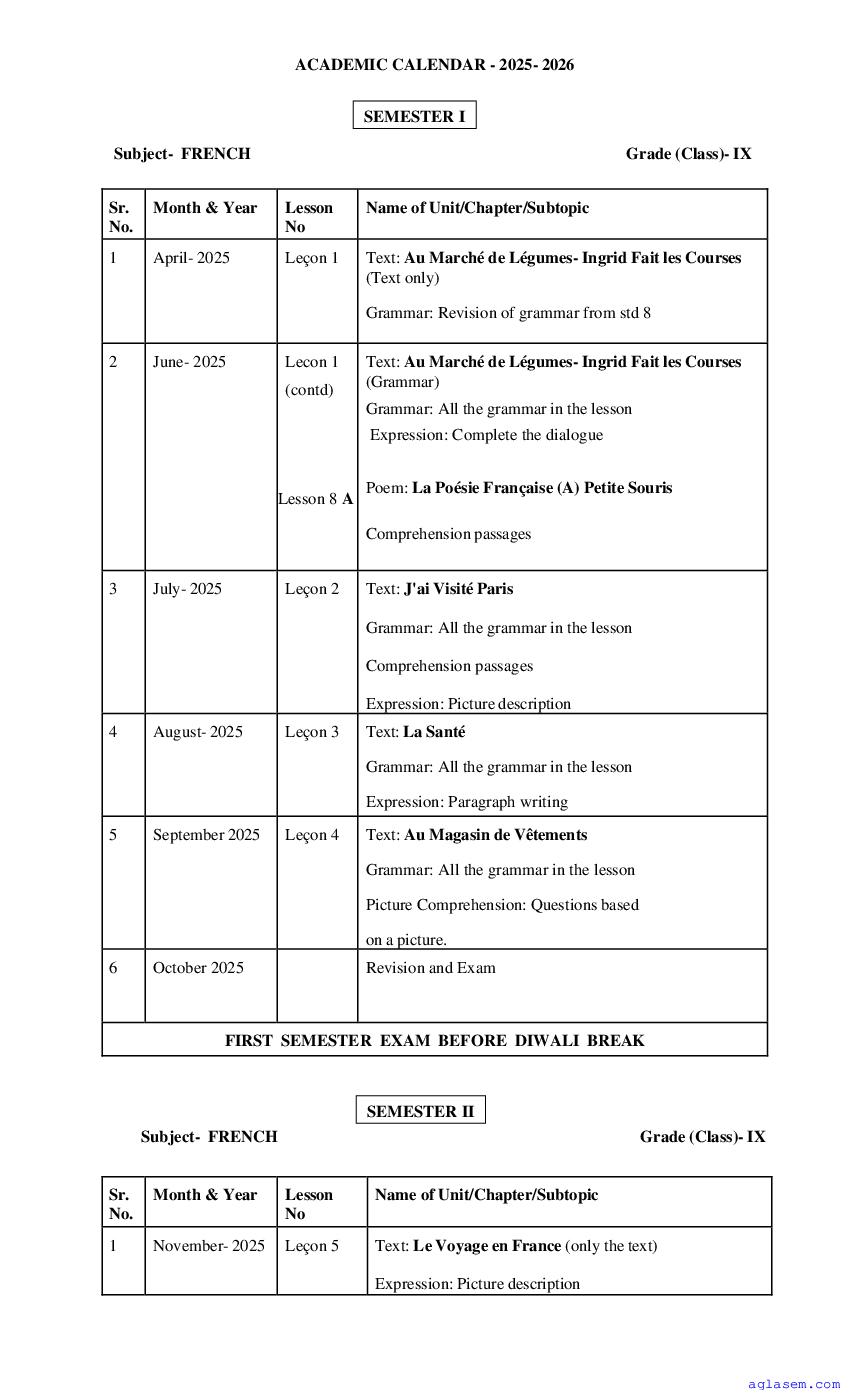
SEMESTER I
Subject- FRENCH Grade (Class)- IX
Sr. Month & Year Lesson Name of Unit/Chapter/Subtopic
No. No
1 April- 2025 Leçon 1 Text: Au Marché de Légumes- Ingrid Fait les Courses
(Text only)
Grammar: Revision of grammar from std 8
2 June- 2025 Lecon 1 Text: Au Marché de Légumes- Ingrid Fait les Courses
(contd) (Grammar)
Grammar: All the grammar in the lesson
Expression: Complete the dialogue
Poem: La Poésie Française (A) Petite Souris
Lesson 8 A
Comprehension passages
3 July- 2025 Leçon 2 Text: J'ai Visité Paris
Grammar: All the grammar in the lesson
Comprehension passages
Expression: Picture description
4 August- 2025 Leçon 3 Text: La Santé
Grammar: All the grammar in the lesson
Expression: Paragraph writing
5 September 2025 Leçon 4 Text: Au Magasin de Vêtements
Grammar: All the grammar in the lesson
Picture Comprehension: Questions based
on a picture.
6 October 2025 Revision and Exam
FIRST SEMESTER EXAM BEFORE DIWALI BREAK
SEMESTER II
Subject- FRENCH Grade (Class)- IX
Sr. Month & Year Lesson Name of Unit/Chapter/Subtopic
No. No
1 November- 2025 Leçon 5 Text: Le Voyage en France (only the text)
Expression: Picture description
Page 2
(contd)
Comprehension passages
Expression: Paragraph writing
3 January- 2026 Leçon 6 Text: A la Plage
Grammar: All the grammar in the lesson
Picture Comprehension: Questions based
on a picture.
4 February- 2026 Leçon 7 Text: Le Carnaval
Expression: Write a postcard
5 March- 2025 Leçon 8 B Poem: La Poésie Française (B) Crayons de Couleur
Comprehension passages Expression:
Complete the dialogue
SEMESTER II EXAM BEFORE SUMMER VACATIONS
Page 3
FRENCH STD IX ( 2025-26 )
TEXTBOOK - LE NOUVEAU PAS À PAS – II ( Goa Board )
SECTION A
Prose and Poetry:
Leçon 1 - Au marché de légumes- Ingrid fait les courses
Leçon 2 - J’ai visité Paris
Leçon 3 - La santé
Leçon 4 - Au magasin de vêtements
Leçon 5 - Le voyage en France
Leçon 6 - A la plage
Leçon 7- Le Carnaval
Leçon 8 A - La poésie française (Petite souris)
Leçon 8 B - La poésie française (Crayons de couleur)
SECTION B
Leçon 1- :
- Conjugation: acheter, pouvoir, devoir
- Il faut et devoir
- Les expressions de quantité
Leçon 2 :
- Le Passé Composé ( l’auxiliaire AVOIR/ ETRE)
- Le Passé Récent
- Les Adjectifs Qualificatifs et la place des adjectifs
Leçon 3 :
- L’Imparfait - la forme/ l’usage
- Mettre le verbe à l’imparfait ou au passé composé
Leçon 4 :
- Les verbes irréguliers- essayer, nettoyer
- les comparatifs
- Le complément d’object direct
- Pronoms démonstratifs
Page 4
- Futur simple – la forme/ l’usage et les verbes irréguliers
Leçon 6 :
- Verbes pronominaux
- Les pronoms réflechis
Leçon 7 :
- Review of tenses relevant to La Carte Postale
Leçon 8 A and 8 B :
- les Adjectifs de couleur
Section C
- Pictures and Unseen Passages
- Questions to assess inference, evaluation, vocabulary and interpretation
Section D
- Introductions (La présentation)
- Appreciation questions
- Framing sentences
- Dialogue writing
- Picture Description
- Paragraph Writing
- Postcard writing
Note:
All Grammar topics taught in Std VIII are to be included for testing in Std IX.
____________________________________________________________
Page 5
MAPPING OF SYLLABUS WITH CURRICULUM GOALS
SERIAL CHAPTER NO. CURRICULUM GOALS COMPETENCIES LEARNING OUTCOMES
NO. AND NAME
1. Leçon 1 – CG-1 C 1.1 Identifies main points, summarises
Au Marché de Develops reading comprehension and after a careful reading of the text, and LO 1. Listens to announcements,
Légumes :Ingrid summarising skills by engaging with a responds coherently. instructions, texts read aloud, audios,
Fait les Courses variety of texts (essays, articles, and and videos to gather information, main
news reports) and uses various C1.2 Uses strategies to organise ideas and points, and details; responds
strategies to write for different information to write for an intended accordingly by answering questions.
audiences. purpose and audience
LO 2. Communicates thoughts, ideas,
opinions, and viewpoints verbally and
non-verbally.
CG-2 C2.2 Asks a variety of questions on social
Develops the capacity for effective experiences using appropriate language LO 3. Speaks fluently with
oral and written communication in (open-ended/closed-ended, formal/ appropriate pronunciation, intonation,
different situations (formal and informal, relevant to context, with and pauses, using proper grammar.
informal) sensitivity)
LO 5. Reads aloud prose with
appropriate stress, pauses, tone, and
C2.3 Shares ideas on the various aspects of
intonation.
their social and cultural surroundings in
oral and written form LO 7. Reads silently with
comprehension and interprets different
layers of meaning.
LO 11. Uses appropriate punctuation
marks and correct spelling of words
during dictation.
LO 14. Uses grammatical elements in
context, such as tense and mood,
subject-verb agreement, pronouns,
adjectives, prepositions, quantity, etc.
Page 6
own Indian culture with Francophone
cultures.
2. Leçon 2 – CG-2 C2.1 Listens critically and reads different
J’ai Visité Paris Develops the capacity for effective news articles, reports etc to express LO 3. Speaks fluently with
oral and written communication in opinions. appropriate pronunciation, intonation,
different situations (formal and and pauses, using proper grammar.
informal) C2.2 Asks a variety of questions on social
experiences using appropriate language LO 5. Reads aloud prose with
(open-ended/closed-ended, formal/ appropriate stress, pauses, tone, and
informal, relevant to context, with intonation.
sensitivity)
LO 9. Writes informal letters,
C2.3 Shares ideas on the various aspects of invitations, advertisements, slogans,
their social and cultural surroundings in messages, signboards, itineraries,
oral and written form travel brochures.
LO 13. Interprets maps, pictures etc to
C2.4 Writes letters and essays in an
speak or write a paragraph based on
appropriate language for different
interpretation.
audiences.
LO 14. Uses grammatical elements in
context, such as tense and mood,
subject-verb agreement, pronouns,
CG-4 C4.1 Interprets, understands, and applies adjectives, prepositions, quantity, etc.
Develops the ability to recognise basic basic linguistic aspects (rules), such as
linguistic aspects (word and sentence sentence structure, punctuation, tense, LO 20. Recognizes and appreciates
structure) and use them in oral and gender and parts of speech. cultural experiences and diversity in
written expression. the text and makes oral and written
presentations.
LO 21. Identifies and appreciates
aspects of Francophone cultures,
including traditions, holidays, and
customs.
Page 7
own Indian culture with Francophone
cultures.
3. Leçon 3- CG-2 C2.2 Asks a variety of questions on social
La Santé Develops the capacity for effective experiences using appropriate language LO 2. Communicates thoughts, ideas,
oral and written communication in (open-ended/closed-ended, formal/ opinions, and viewpoints verbally and
different situations (formal and informal, relevant to context, with non-verbally.
informal) sensitivity)
LO 3. Speaks fluently with
C2.3 Shares ideas on the various aspects of appropriate pronunciation, intonation,
their social and cultural surroundings in and pauses, using proper grammar.
oral and written form
LO 10. Writes short dialogues and
participates in role-plays, skits, etc.,
for promoting social causes such as
“The importance of a balanced diet” in
the Indian context, etc.
CG-4 C4.1 Interprets, understands, and applies
LO 11. Uses appropriate punctuation
Develops the ability to recognise basic basic linguistic aspects (rules), such as
marks and correct spelling of words
linguistic aspects (word and sentence sentence structure, punctuation, tense,
during dictation.
structure) and use them in oral and gender and parts of speech.
written expression. LO 14. Uses grammatical elements in
context, such as tense and mood,
subject-verb agreement, pronouns,
adjectives, prepositions, quantity, etc
LO 23. Develops empathy for their
classmates and others who are elderly,
sick, in distress or in need of help.
4. Leçon 4 – CG-1 C 1.1 Identifies main points, summarises
Au Magasin de Develops reading comprehension and after a careful reading of the text, and LO 2. Communicates thoughts, ideas,
Vêtements summarising skills by engaging with a responds coherently. opinions, and viewpoints verbally and
variety of texts (essays, articles, and non-verbally.
news reports) and uses various
Page 8
audiences. appropriate pronunciation, intonation,
and pauses, using proper grammar.
LO 5. Reads aloud and recites
poems/prose with appropriate stress,
CG-2 C2.2 Asks a variety of questions on social pauses, tone, and intonation.
Develops the capacity for effective experiences using appropriate language
oral and written communication in (open-ended/closed-ended, formal/ LO 8. Writes short answers,
different situations (formal and informal, relevant to context, with paragraphs, reports using appropriate
informal) sensitivity) vocabulary and grammar on a given
theme.
C2.3 Shares ideas on the various aspects of
their social and cultural surroundings in LO 9. Writes informal letters,
oral and written form invitations, advertisements, slogans,
messages, signboards, itineraries,
travel brochures.
LO 14. Uses grammatical elements in
context, such as tense and mood,
subject-verb agreement, pronouns,
adjectives, prepositions, quantity, etc.
LO 18. Uses their bilingual or
multilingual abilities to understand a
text and participates in activities such
as translation.
LO 19. Appreciates the similarities
and differences between languages in
a multilingual classroom and in
society.
LO 20. Recognizes and appreciates
cultural experiences and diversity in
the text and makes oral and written
presentations.
Page 9
own Indian culture with Francophone
cultures.
5. Leçon 5- CG-1 C 1.1 Identifies main points, summarises
Le Voyage en Develops reading comprehension and after a careful reading of the text, and LO 2. Communicates thoughts, ideas,
France summarising skills by engaging with a responds coherently. opinions, and viewpoints verbally and
variety of texts (essays, articles, and non-verbally.
news reports) and uses various C1.2 Uses strategies to organise ideas and
strategies to write for different information to write for an intended LO 5. Reads aloud prose with
audiences. purpose and audience appropriate stress, pauses, tone, and
intonation.
LO 6. Reads and comprehends given
text using strategies such as
CG-4 C4.1 Interprets, understands, and applies predicting, inferring.
Develops the ability to recognise basic basic linguistic aspects (rules), such as
LO 9. Writes informal letters,
linguistic aspects (word and sentence sentence structure, punctuation, tense,
invitations, advertisements, slogans,
structure) and use them in oral and gender and parts of speech.
messages, signboards, itineraries,
written expression.
travel brochures.
LO 12. Reads and comprehends
information in their environment
outside of school, such as on
billboards, advertisements, product
labels, while visiting markets, etc.
LO 13. Interprets maps, graphs, tables
to speak or write a paragraph based on
interpretation.
LO 14. Uses grammatical elements in
context, such as tense and mood,
subject-verb agreement, pronouns,
adjectives, prepositions, quantity, etc.
Page 10
cultural experiences and diversity in
the text and makes oral and written
presentations.
LO 21. Students can identify and
appreciate aspects of Francophone
cultures, including traditions,
holidays, and customs.
6. Leçon 6- CG-2 C2.1 Listens critically and reads different
À la Plage Develops the capacity for effective journal entries and reports to express LO 1. Listens to announcements,
oral and written communication in opinions. instructions, texts read aloud, audios,
different situations (formal and and videos to gather information, main
informal) C2.3 Shares ideas on the various aspects of points, and details; responds
their social and cultural surroundings in accordingly by answering questions.
oral and written form
LO 2. Communicates thoughts, ideas,
opinions, and viewpoints verbally and
non-verbally.
CG-4 C2.4 Writes journal entries, letters etc in an
Develops the ability to recognise basic appropriate language for different LO 7. Reads silently with
linguistic aspects (word and sentence audiences. comprehension and interprets different
structure) and use them in oral and layers of meaning.
written expression. C4.1 Interprets, understands, and applies
LO 9. Writes informal letters,
basic linguistic aspects (rules), such as
invitations, advertisements, slogans,
sentence structure, punctuation, tense,
messages, signboards, itineraries,
gender and parts of speech.
travel brochures.
LO 10. Writes short dialogues and
participates in role-plays, skits, etc.,
for promoting social causes such as
environmental conservation, beach
cleanliness in the Indian context, etc.
LO 12. Reads and comprehends
information in their environment
Page 11
billboards, advertisements, product
labels, while visiting markets, etc.
LO 14. Uses grammatical elements in
context, such as tense and mood,
subject-verb agreement, pronouns,
adjectives, prepositions, quantity, etc.
LO 15. Uses words, phrases to make
sense in different contexts.
LO 21. Students can identify and
appreciate aspects of Francophone
cultures, including traditions,
holidays, and customs
7. Leçon 7- CG-1 C 1.1 Identifies main points, summarises
Le Carnaval Develops reading comprehension and after a careful reading of the text, and LO 2. Communicates thoughts, ideas,
summarising skills by engaging with a responds coherently. opinions, and viewpoints verbally and
variety of texts (essays, articles, and non-verbally.
news reports) and uses various C1.2 Uses strategies to organise ideas and
strategies to write for different information to write for an intended LO 5. Reads aloud and recites
audiences. purpose and audience poems/prose with appropriate stress,
pauses, tone, and intonation.
LO 8. Writes short answers,
CG-2 C2.2 Asks a variety of questions on social paragraphs using appropriate
Develops the capacity for effective experiences using appropriate language vocabulary and grammar on a given
oral and written communication in (open-ended/closed-ended, formal/ theme.
different situations (formal and informal, relevant to context, with
LO 9. Writes informal letters,
informal) sensitivity)
invitations, advertisements, slogans,
messages, signboards, itineraries,
C2.3 Shares ideas and critiques on the
travel brochures.
various aspects of their social and cultural
surroundings in oral and written form. LO 16. Understands and deduces
word meanings in different contexts
Page 12
in an appropriate language for different digital tools.
audiences.
LO 20. Recognizes and appreciates
cultural experiences and diversity in
the text and makes oral and written
presentations.
LO 21. Students can identify and
appreciate aspects of Francophone
cultures, including traditions,
holidays, and customs.
LO 22. Students can compare and
contrast their own Indian culture with
Francophone cultures.
8. 8A.-La Poésie CG-3: C3.1 Identifies and appreciates different
Française : Explores different forms of literature forms of Literature such as poetry, drama LO 3. Speaks fluently with
Petite Souris ( poetry ). etc appropriate pronunciation, intonation,
and pauses, using proper grammar.
LO 5. Reads aloud and recites poems
with appropriate stress, pauses, tone,
and intonation.
CG-5: C5.1 Understands the phonetics and script LO 8. Writes short answers,
Develops an appreciation of the of the language, the number of vowels and paragraphs, reports using appropriate
distinctive features of the particular how they interact and are used. vocabulary and grammar on a given
language, including its alphabet and theme.
script, sounds, rhymes and other word C5.2 Engages in the use of rhymes and
LO 17. Composes poems on a given
plays and games unique to the other wordplays in the language, to make
theme or on their own initiative.
language. speech and writing more interesting and
enjoyable.
C5.3 Becomes familiar with some of the
major word games in the language (e.g.
rhyming words, ) and humour.
Page 13
Française : Explores different forms of literature forms of Literature such as poetry, drama LO 2. Communicates thoughts, ideas,
Crayons de ( poetry ). etc opinions, and viewpoints verbally and
Couleur non-verbally.
LO 3. Speaks fluently with
CG-5: C5.1 Understands the phonetics and script appropriate pronunciation, intonation,
Develops an appreciation of the of the language, the number of vowels and and pauses, using proper grammar.
distinctive features of the particular how they interact and are used.
language, including its alphabet and LO 5. Reads aloud and recites poems
script, sounds, rhymes and other word C5.2 Engages in the use of rhymes and with appropriate stress, pauses, tone,
plays and games unique to the other wordplays in the language, and intonation.
language. vocabulary to make speech and writing
LO 17. Composes poems on a given
more interesting and enjoyable.
theme or on their own initiative.
C5.3 Becomes familiar with some of the LO 22. Students can compare and
major word games in the language (e.g. contrast certain aspects and
rhyming words) symbolism in their own Indian culture
with Francophone cultures.
Page 14
Total
Semester I Written 80 20 marks MCQ Internal Assessment 20 100
Exam marks 60 marks Subjective Language skills: marks marks
questions Listening, Speaking
Semester II Written 80 20 marks MCQ Internal Assessment 20 100
Exam marks 60 marks Subjective Language skills: marks marks
questions Reading, Writing
SEMESTER I DESIGN OF THE QUESTION PAPER
Class : 9
Duration: 3 hrs Subject :FRENCH Max. Marks 80
The weightage or the distribution of marks over different dimensions of the question paper
shall be as follows:
1. Weightage to Learning Outcomes
S.No. Learning Outcomes Marks Percentage of Marks
1. Knowledge of language elements 32 40%
2. Comprehension 24 30%
3. Expression 20 25%
4. Appreciation 04 5%
TOTAL 100%
2. Weightage to Content / Subject Units
S.No. Content Areas Marks
1. Prose and Poetry 17
2. Grammar 15
3. Comprehension 24
4. Expression 24
TOTAL 80
Page 15
Sr. Form of Questions Marks for Number of Total %
No each question questions Marks
1. Objective Type (MCQ) 1 20 20 25%
2 Very Short Answer Type (VSA) 1 30 30 37.5%
3 Short Answer Type (SA) 2 10 20 25%
4 Long Answer Type (LA) 5 02 10 12.5%
TOTAL 58 80 100%
The expected time for different types of question would be as follows:
S.No. Form of Questions Approx.time for Number Approx. time
each Question of for each form
in minutes (t) questions of question in
(n) mins (n x t)
1. Objective Type (MCQ) 1 min 20 20 mins
2. Very Short Answer Type (VSA) 2 mins 30 60 mins
3. Short Answer Type (SA) 6 mins 10 60 mins
4. Long Answer Type (LA) 20 mins 2 40 mins
TOTAL 62 180 mins
As the total time is calculated on the basis of the number of questions required to be
answered and the length of their anticipated answers, it would, therefore, be advisable for the
candidates to budget their time properly by cutting out the superfluous words and be within
the expected time limits.
4. Scheme of Options
There will be no overall choice. However, there is an internal choice as follows:
Section A Section B Section C Section D
Question numbers
7, 8 16, 17, 18, 19, 20, 27 ------------- 51, 62
Total No. of
02 06 ------------- 02
Choice questions
5. Weightage to Difficulty level of questions:
S.No. Estimated difficulty level of questions Percentage
1. Easy 20 %
2. Average 60 %
3. Difficulty 20 %
A question may vary in difficulty level from individual to individual. As such, the assessment
in respect of each question will be made by the paper setter on the basis of general anticipation
from the group as a whole taking the examination. This provision is only to make the paper
balanced in its weightage, rather than to determine the pattern of marking at any stage.
6. Number of Main Questions:
There will be 62 questions of varied marks
Page 16
Class : 9 Final Exam
SEMESTER II
Duration: 3 hrs Subject :FRENCH Max. Marks 80
The weightage or the distribution of marks over different dimensions of the question paper
shall be as follows:
1. Weightage to Learning Outcomes
S.No. Learning Outcomes Marks Percentage of Marks
1. Knowledge of language elements 32 40%
2. Comprehension 24 30%
3. Expression 20 25%
4. Appreciation 04 5%
TOTAL 100%
2. Weightage to Content / Subject Units
S.No. Content Areas Marks
1. Prose and Poetry 17
2. Grammar 15
3. Comprehension 24
4. Expression 24
TOTAL 80
3. Weightage to Forms of Questions
Sr. Form of Questions Marks for Number of Total %
No each question questions Marks
1. Objective Type (MCQ) 1 20 20 25%
2 Very Short Answer Type (VSA) 1 25 25 31.25%
3 Short Answer Type (SA) 2 10 20 25%
4 Long Answer Type (LA) 5 03 15 18.75%
TOTAL 58 80 100%
Page 17
S.No. Form of Questions Approx.time for Number Approx. time
each Question of for each form
in minutes (t) questions of question in
(n) mins (n x t)
1. Objective Type (MCQ) 1 min 20 20 mins
2. Very Short Answer Type (VSA) 2 mins 25 50 mins
3. Short Answer Type (SA) 5 mins 10 50 mins
4. Long Answer Type (LA) 20 mins 3 60 mins
TOTAL 58 180 mins
As the total time is calculated on the basis of the number of questions required to be
answered and the length of their anticipated answers, it would, therefore, be advisable for the
candidates to budget their time properly by cutting out the superfluous words and be within
the expected time limits.
4. Scheme of Options
There will be no overall choice. However, there is an internal choice as follows:
Section A Section B Section C Section D
Question numbers
7, 8 16, 17, 18, 19, 20, 27 ------------- 51, 58
Total No. of
02 06 ------------- 02
Choice questions
5. Weightage to Difficulty level of questions:
S.No. Estimated difficulty level of questions Percentage
1. Easy 20 %
2. Average 60 %
3. Difficulty 20 %
A question may vary in difficulty level from individual to individual. As such, the assessment
in respect of each question will be made by the paper setter on the basis of general anticipation
from the group as a whole taking the examination. This provision is only to make the paper
balanced in its weightage, rather than to determine the pattern of marking at any stage.
7. Number of Main Questions:
There will be 58 questions of varied marks
Page 18
Testing of Language Skills :
Semester I: Listening (10 marks) and Speaking (10 marks)
Semester II: Reading (10 marks) and Writing (10 marks)
SUGGESTED LIST OF ACTIVITIES :
SEMESTER I
LISTENING SKILLS
1. Listen to a French audio story followed by a questionnaire
2. Watch a French video clip without subtitles followed by a questionnaire
3. Listen to a French song followed by a questionnaire
SPEAKING SKILLS
1. Powerpoint presentation on monuments of Paris / France, Festivals, Seasons of France / Goa
etc
2. 1 minute talk / speech
- La ville de Paris / Mes vacances à Paris
- Une visite au marché
- Une visite au magasin de vêtements…etc
3. Story -telling
4. Monologue…….etc
SEMESTER II
READING SKILLS
1. Read aloud a fairy tale / short story/ unseen passage in French
2. Read from authentic resources like French magazines, newspapers
WRITING SKILLS
1. Paragraph writing on a suitable topic
2. Write a postcard or email
3. Create a dialogue on a given scenario
4. Write a poem
5. Create a travel brochure / advertisement for a garment shop…..etc
NOTE:
SUITABLE RUBRICS MUST BE CREATED FOR EACH SKILL TESTED.
RECORDS MUST BE MAINTAINED FOR THE PERUSAL OF THE BOARD.
Page 19
INSTRUCTIONS FOR THE TEACHERS:
➢ Properly orient students about the assessment as per the guidelines at the beginning of the
academic year.
➢ Guide the students in the selection of the topics.
➢ Create rubrics for assessment and share and explain to the students before they start so
that they know the parameters / criteria of assessment
SEMESTER I Listening & Speaking
SEMESTER II Reading & Writing
➢ Record of the assessment must be maintained for scrutiny if required
Sample Rubrics are attached here. Teachers are free to prepare suitable rubrics for the activities or
tasks selected.
1. RUBRICS FOR LISTENING SKILLS:
Excellent Good Satisfactory Needs improvement
CRITERIA
(4 marks) (3 marks) (2 marks) (1 mark)
A. Make The student links The student links The student links The student is unable to
connections/ Ask what they are what they are hearing what they are link what they are
Questions hearing to prior to prior knowledge in hearing to prior hearing to any prior
knowledge in the the subject and/or knowledge in the knowledge in the subject
subject and/or assimilates subject and/or or assimilate knowledge
assimilates knowledge from assimilates from another subject
knowledge from other subjects knowledge from
other areas 80% of other areas with
the time teacher help.
B. General Showed a very Showed a good Did not understand Did not understand
Understanding good general general a lot of the enough vocabulary or
understanding of understanding of the vocabulary and information to answer
all the vocabulary vocabulary and information but was the questions.
and information by information with able to complete
completing all the most questions some of the
questions. completed questions.
C. Listens for Showed limited Was unable to grasp
detail Included all the Was able to include ability to listen for specific details while
specific most of the specific details and listening and did not
information and information and occasionally include it in the answers.
details in his / her details in his / her included specific
information.
answers. answers.
D. Accuracy of Content was Most answers were Included a small Left out most of the
answers accurate and accurate with only a amount of answers or answers were
related to few errors. information, unrelated to the
Page 20
left out or was not
accurate.
E. Was able to Was able to identify Was able to identify Was not able to identify
Summarisation of identify the main the main theme and the main theme and the main theme nor any
Key Points theme and key some key details, had very few or no key key details correctly, so
details, difficulty in details, so was unable to
summarised both summarising both in summarised what summarise what he / she
in an organised an organised manner. he / she had listened had listened to.
manner. to in a disorganised
manner.
1. RECORD OF ASSESSMENT OF LISTENING SKILLS
Activity / Task :
1. Listen to a French audio story followed by a questionnaire
2. Watch a French video clip without subtitles followed by a questionnaire
3. Listen to a French song followed by a questionnaire…………….4…..
Criteria:
A. Make connections/ Ask Questions B. General Understanding C. Listens for detail
D. Accuracy of answers E. Summarisation of Key Points
Roll Activity / Task A B C D E Total Total Marks
No Marks out Marks out of
of 20 2 10
1
2
Page 21
Excellent Good Satisfactory Needs improvement
CRITERIA
(4 marks) (3 marks) (2 marks) (1 mark)
A. Pronunciation Consistently uses Uses correct Uses correct Seldom uses correct
accurate pronunciation most pronunciation pronunciation
pronunciation of the times sometimes
B. Fluency Speaks French Rarely pauses / Sometimes pauses/ Interrupted speech
fluently / never rarely reverts to sometimes reverts frequently/ often
reverts back to English or another back to English or reverts back to
English or another language another language English or another
language language
C. Vocabulary Consistently uses Frequently uses a Sometimes uses new Rarely uses new
a wide range of wide range of vocabulary vocabulary/ repeats
new vocabulary vocabulary words all the time
D. Grammatical No grammatical Some errors that do Frequent errors that Multiple errors that
accuracy errors / very not interfere with sometimes make it distort the meaning
accurate the meaning of the difficult to of the sentence
sentence understand the
sentence
E. Presentation / Consistently uses Demonstrates an Uses an expressive Rarely uses an
content an expressive expressive voice, voice, facial expressive voice nor
voice, facial facial expression expression and facial expression nor
expression and and gestures most gestures sometimes gestures while
gestures while of the time while while speaking. speaking.
speaking. Content speaking. Most of Content partially Content inaccurate.
accurate. the content was accurate
accurate.
2. RECORD OF ASSESSMENT OF SPEAKING SKILLS
Activity / Task :
1. Powerpoint presentation on monuments of Paris / France, Festivals, Seasons of France / Goa etc
2. 1 minute talk / speech
- La ville de Paris / Mes vacances à Paris
- Une visite au marché etc
3. Story -telling ……..4…..
Criteria:
A. Pronunciation B. Fluency C. Vocabulary D. Grammatical accuracy
E. Presentation / content
Roll Activity / Task A B C D E Total Total Marks
No Marks Marks out of 10
out of 20 2
1
2
Page 22
Excellent Good Satisfactory Needs
CRITERIA improvement
(5 marks) (4 marks) (3 marks) (2 mark)
A. Pronunciation/ Reads clearly and Reads clearly most Reads fairly clearly, Lacks
Clarity distinctly all the of the time. sometimes confidence and
time. Pronounces Mispronounces a mispronounces mispronounces
all words correctly few words. words. most words
while reading.
B. Pausing Almost all the Most of the reading Some pausing to Almost no
reading is evidences reflect the pausing to
characterized by appropriate pausing punctuation and reflect
pausing to reflect to reflect the meaning of the text. punctuation or
punctuation and punctuation and meaning of the
meaning of the text. meaning of the text. text.
C. Intonation All of the reading Most of the reading Some evidence of Almost no
evidences variation evidences variation variation in voice or variation in
in voice or tone in voice or tone tone (pitch) to voice or tone
(pitch) to reflect the (pitch) to reflect the reflect the meaning (pitch) to reflect
meaning of the text. meaning of the text. of the text. the meaning of
the text.
D. Fluency Reads fluently, in a Reads in a Reads in a Reads but needs
natural and meaningful manner meaningful manner to stop and
rhythmic manner with very few but needs to still figure out most
stops. figure out some words.
words.
3. RECORD OF ASSESSMENT OF READING SKILLS
Activity / Task :
1. Read aloud a fairy tale / short story/ unseen passage in French
2. Read from authentic resources like French magazines, newspapers …….3……
Criteria:
A. Pronunciation/ Clarity B. Pausing C. Intonation D. Fluency
Roll Activity / Task A B C D Total Total Marks
No Marks out Marks out of
of 20 2 10
1
2
Page 23
Excellent Good Satisfactory Needs improvement
CRITERIA
(4 marks) (3 marks) (2 marks) (1 mark)
A. Content / Writing is clearly Writing is Writing is related to Writing is extremely
Ideas focused. Holds purposeful. the topic but very limited in
the reader's Contains some few details on the communicating the
attention. details of the theme theme / topic central theme / topic
Contains all / topic
details of the topic
/theme
B. Vocabulary Effective and Frequent use of a Shows some use of Inaccurate word choices
engaging use of variety of word word choices which obscure the
word choices choices meaning
C. Grammar All sentences are Most sentences are Sentences are fairly Sentences are difficult to
very well well constructed. well constructed but understand. Numerous
constructed. No Few grammar / few grammar / errors in grammar/
grammar / spelling errors but spelling errors which spelling
spelling errors. does not interfere interferes with
with understanding understanding to
the sentence some extent
D. Language Demonstrates a Demonstrates a fair Demonstrates Falls short in
control high degree of degree of language minimal degree of demonstrating language
language control control language control control
E. Organization Information is Information is Information is Information is irrelevant
relevant and relevant, presented partially relevant but / not in logical order /
presented in in logical order but lacks logical order disorganized
logical order. lacks overview of
An excellent the topic
overview of the
topic is provided
RECORD OF ASSESSMENT OF WRITING SKILLS
Activity / Task :
1. 1 Paragraph writing on a suitable topic
2. Write a postcard
3. Create a dialogue on a given scenario………..4….
Criteria:
A. Content / Ideas B. Vocabulary C. Grammar D. Language control E. Organization
Roll Activity / Task A B C D E Total Total Marks
No Marks Marks out of
out of 2 10
20
1
2
Page 24
Subject: French Class: 9
Paper: SEMESTER I Max Marks: 80 Duration: 3 hours
OBJECTIVES KNOWLEDGE OF COMPREHENSION EXPRESSION APPRECIATION Total
ELEMENTS OF LANGUAGE
Form of MCQ VSA SA E/ MCQ VSA SA E/ MCQ VSA SA E/ MCQ VSA SA E
Questions LA LA LA LA
Marks 1 1 2 5 1 1 2 5 1 1 2 5 1 1 2 5
Sr. CONTENT
No.
1. Prose & poetry 6(1) 3(1) 4(2) 17
2. Grammar 8(1) 7(1) 15
3. Comprehension 6(1) 6(1) 6(2) 24
4. Expression 10(1) 2(5) 4(1) 24
Sub Total 14(1) 10(1) 4(2) 6(1) 6(1) 6(2) 10(1) 2(5) 4(1) 80
TOTAL 32 24 20 04 80 marks
Note: Figures outside the brackets indicates the number of questions and figures within the brackets indicates the marks per question
Summary: Essay (E / LA) No. 02 Marks 10
Short Answer (SA) No. 10 Marks 20
Very Short Answer (VSA) No. 30 Marks 30
Objective (MCQ) No. 20 Marks 20
Page 25
SEMESTER I
FRENCH Marks: 80
Duration: 3 hrs
INSTRUCTIONS:1) All questions are compulsory.
2) Figures to the right indicate full marks.
SECTION A
Choisissez la bonne réponse : (2)
1. Au marché Ingrid va chez _______________.
A. le poissonnier
B. le médecin
C. le marchand de fruits et de légumes
D. le boucher
2. Le musée très célèbre à Paris est ________________.
A. Le Louvre
B. Le Panthéon
C. Les Invalides
D. La Tour Eiffel
Choisissez le mot / l’expression du texte pour remplacer les mots soulignés : (2)
3. Quand il y a un accident sur la route, il faut appeler la police immédiatement.
A. maintenant
B. tout de suite
C. toute la journée
D. fortifiant
4. Véronique va avec sa cousine au théâtre.
A. accompagne
B. arrive
C. passe
D. attend
Choisissez la bonne réponse aux devinettes suivantes : (2)
5. Le médecin écrit ceci après avoir examiné le malade.
A. Une recette
B. Une ordonnance
C. Un chèque
D. Une lettre
6. Les bijoux portés sur les doigts.
A. Les bracelets
Page 26
C. Les chaînes
D. Les bagues
Répondez aux questions suivantes en phrases complètes : (10 – 15 mots) (4)
7. Pourquoi Ingrid n’aime-t-elle pas aller au supermarché ?
OU
7. Ingrid, pour qui prépare-t-elle la salade niçoise ?
8. Qu’est-ce que Pierre a fait pendant sa maladie ?
OU
8. Quel type de chemise choisit Karl ? Pourquoi ?
Lisez la phrase du texte et répondez aux questions suivantes en phrases complètes:
(3)
« Nous sommes allés à Versailles. »
9. Qui est allé à Versailles ?
10. Où est Versailles ?
11. Pourquoi sont-ils allés à Versailles ?
Répondez aux questions suivantes en phrases complètes : (10 -15 mots) (4)
12.Que fait la souris grise quand elle n’est pas dans sa cachette ?
13. Quand est-ce que la petite souris rouge mange tout ?
SECTION B
Trouvez la forme verbale qui convient : (2)
14.___________ les fenêtres, mes enfants!
A. Ferme
B. Fermons
C. Fermez
D. Fermer
15. Hier, les deux filles ____________ au concert.
A. vont
B. vont aller
C. vient d’aller
D. sont allées
Récrivez les phrases suivantes en mettant les verbes entre parenthèses aux temps
indiqués : (2)
16. Hier, mes amis _________ ( aller – passé composé ) au pique-nique.
Page 27
16. Nous ____________ ( chanter – imparfait) l’hymne national tous les jours.
17. Elle ____________ ( nettoyer– présent) la chambre.
OU
17. Je n’ai pas faim, je ________ ( manger– passé récent) deux sandwichs.
Récrivez les phrases suivantes en remplaçant les mots soulignés par des pronoms
convenables : (2)
18. La mère prépare le repas pour sa famille.
OU
18. Les enfants jouent sur la plage.
19. Il a acheté cet appartement.
OU
19.Nous lisons le journal .
Posez la question correspondante aux mots soulignés : (1)
20. Hélène boit du coca.
OU
20. Ils écoutent une histoire.
Choisissez la paire d’adjectifs démonstratifs et pronoms démonstratifs
convenables : (2)
21.______ homme-ci aime jouer au tennis. ______-là aime jouer au volley.
A. Ce , celle
B. Cet, celui
C. Ce, celui
D. Cet, celle
22.______ robe est en soie. ______ de Julie est en coton.
A. Cet, celle
B. Ce, celle
C. Cette, ceux
D. Cette, celle
Choisissez les adjectifs possessifs convenables correspondant au sujet pour compléter
la phrase: (2)
23. J’ai mis __________ livres sur les étagères dans le salon. Où as- tu mis les tiens?
A. mes
B. mon
C. tes
D. ton
24. Nous partons en vacances avec _________ amis et ils partent avec les leurs
Page 28
B. tes
C. mes
D. nos
Choisissez la paire de prépositions convenables pour compléter la phrase : (1)
25. Il fait froid ______ décembre, mais il fait frais ____ printemps.
A. au / en
B. à / au
C. en / à
D. en / au
Choisissez la paire d’articles partitifs convenables pour compléter les blancs : (1)
26. Elle mange ______ fromage mais son frère ne mange pas ______ fromage.
A. de / du
B. de la / de
C. du / de la
D. du / de
Faites selon les indications : (2)
27. Je bois du thé au petit déjeuner. (Récrivez la phrase au négatif)
OU
27. L’acteur est suisse. (Mettez les mots soulignés au féminin)
28. Désirez-vous boire une _______ de café? Je vais boire un ______ de lait.
( Remplissez les blancs avec les expressions de quantité convenables )
SECTION C
Observez l’image et choisissez la bonne réponse : (2)
Page 29
A. Eid
B. Noël
C. Diwali
D. Pâques
30. Dans quel mois célèbre-t-on ce festival ?
A. octobre
B. novembre
C. décembre
D. janvier
Observez l’image et répondez aux questions qui suivent : (2)
31. Combien de membres y a -t-il dans cette famille ?
32. Que fait la famille ?
Lisez le texte ci- dessous et répondez aux questions :
Sabine habite dans une assez grande maison à Bordeaux en France. Elle habite avec son père, sa
sœur et ses deux poissons rouges qui s’appellent Marvin et Jojo. La maison de Sabine a huit pièces.
En bas, il y a le salon, la salle à manger et la cuisine. Il y a un petit bureau à côté de la cuisine.
Sabine adore passer du temps dans le salon car il y a une grande télévision et un canapé très
confortable. En haut il y a la salle de bain et les chambres. Sabine partage sa chambre avec les
poissons rouges. Derrière la maison, il y a un joli jardin où il y a une pelouse, des fleurs et un
grand arbre. Quand le soleil brille, Sabine mange avec sa famille dans le jardin. Il y a aussi un petit
garage. Ce qui est bizarre, c’est que son papa n’a pas de voiture !
Page 30
poissons rouges – goldfish
en bas – downstairs
partage- share,
une pelouse- lawn
Choisissez un mot / une expression du texte convenable pour compléter la (2)
phrase :
33. J’adore me reposer sur le canapé dans ________ et regarder la télévision.
A) la cuisine
B) le bureau
C) le salon
D) le garage
34. En été, les jardins de mes voisins sont pleins de ____________.
A) pièces
B) fleurs
C) poissons rouges
D) voitures
Trouvez dans le texte : (2)
35. Un autre mot pour ' aimer beaucoup. '
36. Le contraire de " petite. "
Répondez en phrases complètes aux questions suivantes : (6)
37. Sabine, avec qui habite-t-elle à Bordeaux ?
38. Pourquoi Sabine adore-t-elle passer du temps dans le salon ?
39. Pourquoi le garage de Sabine est-il bizarre ?
Lisez le texte ci- dessous et répondez aux questions :
L’été est bientôt fini et papa fait des courses pour acheter des crayons, de la colle et toutes
sortes de choses pour Nicolas, le grand frère de Jérémie. Nicolas va aller à la maternelle cette
année. Il est fier d’aller à l’école. Jérémie veut y aller aussi. "Non," dit Nicolas "tu es trop
petit." Jérémie boude. "Que se passe-t-il ?" dit maman. "Je veux aller à l’école, moi aussi." dit
Jérémie. "Tu as seulement trois ans, mon trésor, il faut attendre encore. Mais que dirais-tu de
jouer à l’école à la maison ?" Maman donne à Jérémie du papier et des crayons ainsi qu’un
petit tableau avec une craie. Ensemble, ils placent des chaises en rond et les toutous de Jérémie
deviennent des élèves. Jérémie dit à maman, "J’aime mieux mon école que celle de Nicolas."
"Ah oui ? Pourquoi ?" demande Maman. "Parce qu’ici, c’est moi le professeur."
Vocabulaire en anglais :
la maternelle- kindergarten
la colle- glue
Page 31
bouder- to sulk ,
seulement-only
les toutous- doggies
Choisissez la bonne réponse : (2)
40. Que fait Papa quand l’été est bientôt fini ?
A) Il va à la maternelle.
B) Il joue avec Nicolas.
C) Il achète des crayons et de la colle pour Nicolas.
D) Il devient élève.
41. Pourquoi Jérémie ne peut-il pas aller à la maternelle ?
A) La maternelle est trop loin.
B) Il est trop grand pour la maternelle.
C) Il reste à la maison avec ses parents.
D) Il est trop petit pour la maternelle.
Trouvez dans le texte : (2)
42. Un verbe qui est le contraire de < vendre >.
43. Le nom qui signifie < le shopping >
Répondez en phrases complétez aux questions suivantes : (6)
44. Pourquoi le petit Jérémie boude-t-il ?
45. Maman, que donne-t-elle à Jérémie ?
46. Pourquoi Jérémie aime mieux son école que celle de Nicolas ?
SECTION D
Utilisez ces quatre mots clés pour présenter cette personne : (4)
Pierre Dubois -- français – Paris – professeur
47. __________________________________________.
48. __________________________________________.
49. __________________________________________.
50. __________________________________________.
Composez une phrase avec l’expression suivante : ( 2)
51. étudiant
OU
51. à la mode
52. malade
Répondez aux questions suivantes en phrases complètes : (4)
53. Aimez-vous faire les courses ? Pourquoi ? (Donnez une raison)
Page 32
55. Qu’est -ce que vous appréciez de votre école ?
56. Aimerez-vous visiter la France ? ( Donnez une raison )
Complétez le dialogue suivant entre Mme. Dupont et Xavier, le fils de Mme. Leblanc.
(4)
Mme.Leblanc: Bonjour Mme. Dupont. C’est mon fils Xavier.
57. M.Dupont: Bonjour Mme. Leblanc. Bonjour Xavier. _____________________?
Xavier: Bonjour. Moi, j’ai douze ans.
M.Dupont: Quel est le nom de ton école?
58. Xavier: ________________________________________________________.
M.Dupont: Et à quelle heure tu te lèves le matin?
59. Xavier:_________________________________________________________.
M. Dupont : Comment vas-tu à l’école ?
60. Xavier : ______________________________________________________.
61. Écrivez un paragraphe (45- 50 mots) pour décrire l’image suivante : (5)
62. Écrivez un paragraphe sur un de ces sujets suivants (45- 50 mots) : (5)
Ma fête favorite
OU
Une visite au marché
____________________________________________________________
Page 33
Subject: French Class: 9
Paper: SEMESTER II Max Marks: 80 Duration: 3 hours
OBJECTIVES KNOWLEDGE OF COMPREHENSION EXPRESSION APPRECIATION Total
ELEMENTS OF LANGUAGE
Form of MCQ VSA SA E/ MCQ VSA SA E/ MCQ VSA SA E/ MCQ VSA SA E
Questions LA LA LA LA
Marks 1 1 2 5 1 1 2 5 1 1 2 5 1 1 2 5
Sr. CONTENT
No.
1. Prose & poetry 6(1) 3(1) 4(2) 17
2. Grammar 8(1) 7(1) 15
3. Comprehension 6(1) 6(1) 6(2) 24
4. Expression 5(1) 3(5) 4(1) 24
Sub Total 14(1) 10(1) 4(2) 6(1) 6(1) 6(2) 5(1) 3(5) 4(1) 80
TOTAL 32 24 20 04 80 marks
Note: Figures outside the brackets indicates the number of questions and figures within the brackets indicates the marks per question
Summary: Essay (E / LA) No. 3 Marks 15
Short Answer (SA) No. 10 Marks 20
Very Short Answer (VSA) No. 25 Marks 25
Objective (MCQ) No. 20 Marks 20
Page 34
SEMESTER II
FRENCH Marks: 80
Duration: 3 hrs
INSTRUCTIONS:1) All questions are compulsory.
2) Figures to the right indicate full marks.
SECTION A
Choisissez la bonne réponse : (2)
1. Les trois filles vont visiter ________ pour connaitre son activité industrielle.
A) Paris
B) Lyon
C) Grenoble
D) L’Île de Ré
2. Si l’on va trop loin ________ , on risque de se noyer.
A) de la plage
B) de la ville
C) du rivage
D) de la mer
Choisissez le mot/l’expression du texte pour remplacer les mots soulignés: (2)
3. Mon petit frère est très envieux de mon cadeau.
A) grand
B) différent
C) content
D) jaloux
4. Jane est très contente d’aller pour son voyage.
A) grande
B) partie
C) ravie
D) vieille
Choisissez la bonne réponse aux devinettes suivantes : (2)
5. La mère d’un parent
A) la tante
B) la sœur
C) la grand- mère
D) la mère
Page 35
A) samedi
B) jeudi
C) dimanche
D) lundi
Répondez aux questions suivantes en phrases complètes:(10–15mots) (4)
7. Les filles, pourquoi visiteront-elles Lyon ?
OU
7. Qu’est-ce que Doreen voudrait faire ? Pourquoi ?
8. Qu’est-ce que l’auteur du journal va faire à la plage ?
OU
8. Quelle difficulté aura l’auteur en septembre ?
Lisez les phrases du texte et répondez aux questions suivantes en phrases
complètes: (3)
«Les Portugais ont amené cette tradition européenne.»
9. De quelle tradition parle- t- on ici ?
10. Où les Portugais ont – ils amené cette tradition ?
11. Avant comment s’appelait cette tradition ?
Répondez aux questions suivantes en phrases complètes:(10-15mots) (4)
12.De quelle couleur sont les pommes et les praires ?
13. Nommez deux choses rouges dans le poème « Crayons de couleur »
SECTION B
Trouvez la forme verbale qui convient: (2)
14. Je ________ du coca au restaurant hier.
A) ai bu
B) buvait
C) bois
D) vais boire
15. Hélène ce roman demain.
A) a lu
B) lit
C) lira
D) vont lire
Récrivez les phrases suivantes en mettant les verbes entre parenthèses aux temps
indiqués : (2)
16. Il ___________ (faire -présent) chaud aujourd’hui.
Page 36
16. Pierre (arriver –passé récent) de Paris.
17. Ma mère (acheter – futur proche) beaucoup de cadeaux.
OU
17. Les enfants (s’amuser – futur simple ) avec leurs amis.
Récrivez les phrases suivantes en remplaçant les mots soulignés par des pronoms
convenables: (2)
18.La femme va au marché.
OU
18. Mes cousins vont à Panjim.
19. Henri reçoit la lettre.
OU
19. Elle achète le sac noir
Posez la question correspondante aux mots soulignés: (1)
20.Ingrid fait ses courses.
OU
20 Laurent habite à Lyon.
Choisissez la paire d’adjectifs démonstratifs et pronoms démonstratifs
convenables : (2)
21 ________roman-ci est plus intéressant que -là.
A) Ce/ celle
B) Cette/celui
C) Cette/celle
D) Cet/celui
22 ____ filles –ci sont américaines mais _____ -là sont anglaises.
A) Cette/ ces
B) Cette/ celles
C) Ces/ celles
D) Ces/ ces
Choisissez la paire d’adjectifs possessifs convenables correspondant au sujet: (2)
23. Emmanuel prend _____ cahier, mais je ne trouve pas _____ cahier.
A) son/mon
B) sa/ma
C) ses/mes
Page 37
24. J’aime beaucoup ____ sœur et ____ frères.
A) mes/mes
B) ma/mon
C) mon/mes
D) ma/ mes
Choisissez la paire de prépositions convenables : (1)
25. Ravi va ______ Canada _____ automne.
A) au/en
B) aux/au
C) à la/en
D) à l’/au
Choisissez la paire d’articles partitifs convenables: (1)
26. Janet achète ______ fruits et ______ légumes au supermarché.
A) du/de la
B) des/des
C) de l’/des
D) du/de
Faites selon les indications: (2)
27. Rahul boit du jus d’orange. (Récrivez la phrase au négatif)
OU
27. Le chanteur chante une belle chanson. (Mettez les mots soulignés au féminin)
28. Le train arrive à 7h.30 du matin. (Ecrivez l’heure soulignée en lettres )
SECTIONC
Observez l’image et choisissez la bonne réponse : (2)
Page 38
A) dans la classe
B) dans le jardin
C) dans le musée
D) dans l’hôpital
30. Où est le tableau ?
A) devant le professeur
B) derrière le professeur
C) derrière les étudiants
D) sous le mur
Observez l’image et répondez aux questions qui suivent : (2)
31. Les enfants, où sont-ils ?
32. Dans cette image, nommez deux choses qu’on peut voir dans le ciel.
Lisez le texte ci-dessous et répondez aux questions :
Marianne vit à Montréal depuis quinze ans. Elle est arrivée ici à l’âge de cinq ans. Son père est
médecin et sa mère est infirmière. Marianne vient de finir ses études. Elle travaille dans une
agence de voyages comme secrétaire. Elle aime son travail parce qu’elle rencontre beaucoup
de gens. Comme la famille de Marianne, il y a beaucoup d’autres familles françaises qui vivent
au Québec. Tous ces Français immigrés veulent retourner en France quand ils ont gagné
assez d’argent. Les parents de Marianne aussi. Mais Marianne, qu’est-ce qu’elle pense ? Elle
aime bien la France. Elle est déjà allée deux fois dans ce pays. Mais pour elle, la vie c’est à
Montréal. C’est ici qu’elle a tous ses souvenirs d’enfance avec ses voisins. Elle a des amis à
New York et à Toronto…. Et maintenant elle ne peut pas imaginer sa nouvelle vie en France
sans ces chers souvenirs.
Page 39
depuis - since
immigrés - immigrants
gagner – earn
deux fois - twice
les souvenirs - memories
la vie - life
Choisissez un mot / une expression du texte convenable pour compléter la phrase:
(2)
33. Cette semaine, il ne fait pas de soleil _________ trois jours.
A) depuis
B) après
C) maintenant
D) déjà
34. Les enfants trouvent difficile __________ la vie adulte.
A) de venir
B) de gagner
C) d’ imaginer
D) d’ arriver
Trouvez dans le texte: (2)
35. Un mot qui signifie « une personne qui écrit des ordonnances’
36. Le contraire de « un peu »
Répondez en phrases complètes aux questions suivantes: (6)
37. Où est-ce que Marianne travaille ?
38. Quand les parents de Marianne vont- ils retourner en France ?
39. Selon Marianne, pourquoi ‘la vie c’est à Montréal’?
Lisez le texte ci-dessous et répondez aux questions:
Chaque année, le petit village de Saint-Suliac organise une grande fête en été. Les habitants
décorent les rues avec des guirlandes colorées. Il y a un marché où on peut acheter des fruits,
des légumes, et des produits locaux comme du miel et du fromage. Les enfants adorent la fête
parce qu'il y a un carrousel et des jeux. Le soir, tout le monde se réunit sur la place principale
pour danser et regarder un feu d’artifice. C’est un moment très spécial pour tous les habitants
de Saint-Suliac.
Page 40
locaux - local
un carrousel - merry-go-round
un feu d’artifice - fireworks
Choisissez la bonne réponse : (2)
40. Quand est-ce qu’on organise la fête ?
A) en automne
B) au printemps
C) en été
D) en hiver
41. Où est-ce que tout le monde se réunit le soir ?
A) le quartier principale
B) la rue principale
C) la place principale
D) le quartier
Trouvez dans le texte: (2)
42. Le mot qui signifie ‘les personnes qui habitent dans un lieu’.
43. Le nom qui correspond au verbe ‘ produire’
Répondez en phrases complètes aux questions suivantes : (6)
44. Quels produits peut-on acheter au marché ?
45. Pourquoi les enfants aiment-ils la fête ?
46. Que fait tout le monde le soir sur la place principale ?
SECTION D
Répondez aux questions suivantes : (4)
47. Pourquoi aimez-vous les vacances d’été ? (Donnez une raison)
48. Aimerez-vous visiter Paris ? Pourquoi ? (Donnez une raison)
49. Selon vous, pourquoi les gens aiment-ils aller à la plage ?
50. Selon vous, qu’est-ce que la couleur ‘verte’ symbolise ? (Donnez une raison )
Composez une phrase avec l’expression suivante : (1)
51. la rue
OU
51. s’amuser
Page 41
52. Mme. D’Souza : ?
Roshan : Je vais au cinéma maman.
Mme D’Souza : Mais avec qui vas-tu au cinéma ?
53. Roshan : .
Mme D’Souza : Eh bien, comment voyageras – tu ?
54. Roshan :
Mme D’Souza : Et la nourriture ? Qu’est-ce que tu vas manger ?
55. Roshan :____________________________________.
Mme D’Souza : D’accord, Prend soin.
56. Vous êtes Jason /Jeanette et vous habitez à Panjim. Écrivez une carte postale à ton
ami Varad / amie Veena qui habite à Delhi, pour lui décrire le Carnaval à Goa.
(45-50 mots) (5)
57. Écrivez un paragraphe (45- 50 mots) pour décrire l’image suivante : (5)
.
58. Écrivez un paragraphe sur un de ces sujets suivants (45- 50mots): (5)
Les fêtes en Inde
OU
Une journée à la plage.
____________________________________________________________