NIOS Class 12 Question Paper 2021 (Oct) Physics
Finished viewing? Save it for later —
Download NIOS Class 12 Question Paper 2021 (Oct) Physics (PDF · 24 pages)About NIOS Class 12 Question Paper 2021 (Oct) Physics
NIOS Class 12 Question Paper 2021 (Oct) Physics is available here for free download. Published by NIOS for National Institute of Open Schooling Class 12, this question paper can be viewed online or downloaded as a PDF (24 pages). Candidates preparing for National Institute of Open Schooling Class 12 can use NIOS Class 12 Question Paper 2021 (Oct) Physics to understand the exam pattern, the type of questions asked, and the overall difficulty level.
Frequently Asked Questions
How can I download NIOS Class 12 Question Paper 2021 (Oct) Physics?
Open this page and click the Download button to save NIOS Class 12 Question Paper 2021 (Oct) Physics as a PDF. It is completely free on AglaSem Docs.
Is NIOS Class 12 Question Paper 2021 (Oct) Physics free to download?
Yes. NIOS Class 12 Question Paper 2021 (Oct) Physics can be viewed online and downloaded as a PDF free of cost on AglaSem Docs.
How many pages does NIOS Class 12 Question Paper 2021 (Oct) Physics have?
NIOS Class 12 Question Paper 2021 (Oct) Physics contains 24 pages, which you can read online or download together as a single PDF.
Where can I find more National Institute of Open Schooling Class 12 study material?
You can find more National Institute of Open Schooling Class 12 question papers, sample papers, syllabus, and answer keys on AglaSem Docs.
NIOS Class 12 Question Paper 2021 (Oct) Physics – Text
Read the full text of this question paper below — useful to quickly search, copy and reference the content online without downloading the PDF.
📄 View text version (24 pages)
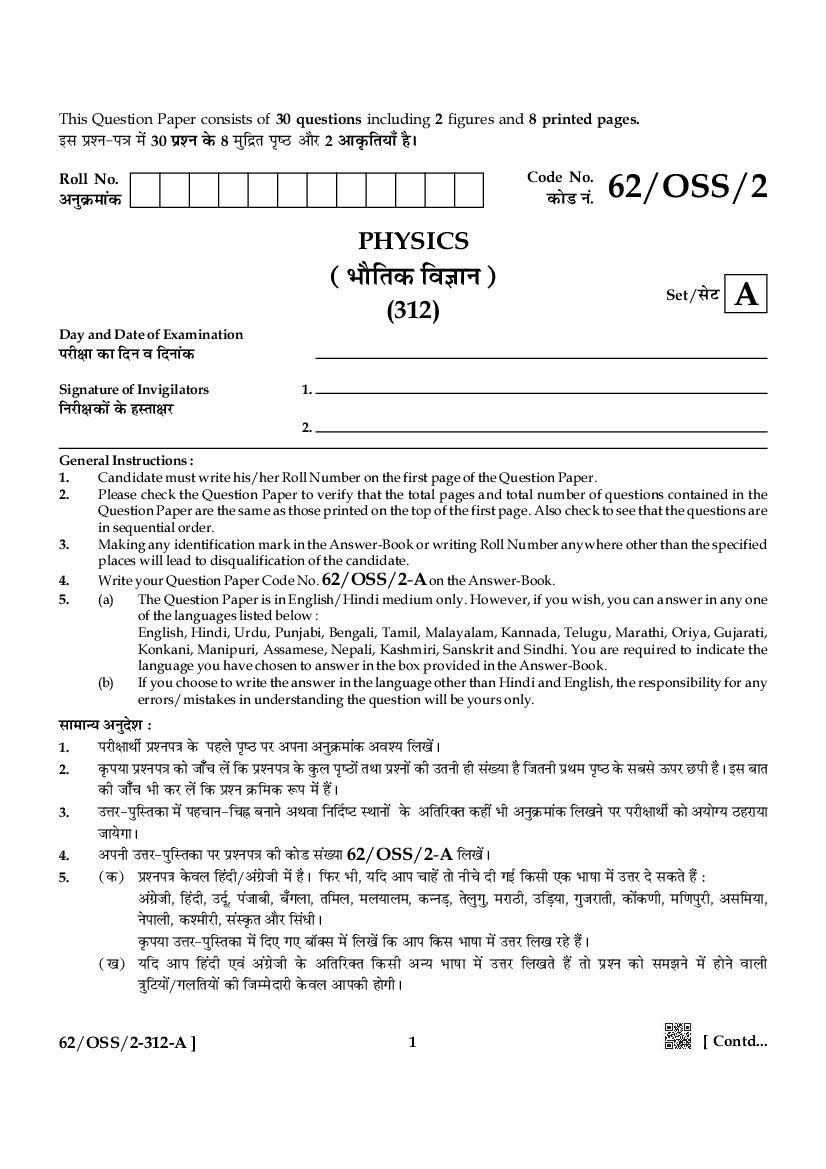
Page 1
ß‚ ¬˝‡Ÿ-¬òÊ ◊¥ 30 ¬˝‡Ÿ ∑§ 8 ◊ÈÁŒ˝Ã ¬Îc∆UU •ÊÒ⁄U 2 •Ê∑ΧÁÃÿÊ° „Ò–
Roll No. Code No.
•ŸÈ∑˝§◊Ê¥∑§ ∑§Ê«U Ÿ¥. 62/OSS/2
PHYSICS
(÷ÊÒÁÃ∑§ ÁflôÊÊŸ)
(312)
Set/‚≈U A
Day and Date of Examination
¬⁄UˡÊÊ ∑§Ê ÁŒŸ fl ÁŒŸÊ¥∑§
Signature of Invigilators 1.
ÁŸ⁄UˡÊ∑§Ê¥ ∑§ „SÃÊˇÊ⁄U
2.
General Instructions :
1. Candidate must write his/her Roll Number on the first page of the Question Paper.
2. Please check the Question Paper to verify that the total pages and total number of questions contained in the
Question Paper are the same as those printed on the top of the first page. Also check to see that the questions are
in sequential order.
3. Making any identification mark in the Answer-Book or writing Roll Number anywhere other than the specified
places will lead to disqualification of the candidate.
4. Write your Question Paper Code No. 62/OSS/2-A on the Answer-Book.
5. (a) The Question Paper is in English/Hindi medium only. However, if you wish, you can answer in any one
of the languages listed below :
English, Hindi, Urdu, Punjabi, Bengali, Tamil, Malayalam, Kannada, Telugu, Marathi, Oriya, Gujarati,
Konkani, Manipuri, Assamese, Nepali, Kashmiri, Sanskrit and Sindhi. You are required to indicate the
language you have chosen to answer in the box provided in the Answer-Book.
(b) If you choose to write the answer in the language other than Hindi and English, the responsibility for any
errors/mistakes in understanding the question will be yours only.
‚Ê◊Êãÿ •ŸÈŒ‡Ê —
1. ¬⁄UˡÊÊÕ˸ ¬˝‡Ÿ¬òÊ ∑§ §¬„‹ ¬Îc∆U ¬⁄U •¬ŸÊ •ŸÈ∑˝§◊Ê¥∑§ •fl‡ÿU Á‹π¥–
2. ∑Χ¬ÿÊ ¬˝‡Ÿ¬òÊ ∑§Ê ¡ÊÚ°ø ‹¥ Á∑§ ¬˝‡Ÿ¬òÊ ∑§ ∑ȧ‹ ¬Îc∆UÊ¥ ÃÕÊ ¬˝‡ŸÊ¥ ∑§Ë ©ÃŸË „Ë ‚¥ÅUÿÊ „Ò Á¡ÃŸË ¬˝Õ◊ ¬Îc∆ ∑ §‚’‚ ™§¬⁄U ¿U¬Ë „Ò– ß‚ ’ÊÃ
∑§Ë ¡ÊÚ°ø ÷Ë ∑§⁄U ‹¥ Á∑§ ¬˝‡Ÿ ∑˝ Á◊∑§ UM§¬ ◊¥ „Ò¥–
3. § ©ûÊ⁄U-¬ÈÁSUÃ∑§Ê ◊¥ ¬„øÊŸ-Áøq ’ŸÊŸ •ÕflÊ ÁŸÁŒ¸c≈U SÕÊŸÊ¥ ∑§§ •ÁÃÁ⁄UÄà ∑§„Ë¥ ÷Ë •ŸÈ∑˝§◊Ê¥∑§ Á‹πŸ ¬⁄U ¬⁄UˡÊÊÕ˸ ∑§Ê •ÿÊÇÿ ∆U„⁄UÊÿÊ
¡ÊÿªÊ–
4. •¬ŸË ©ûÊ⁄U-¬ÈÁSUÃ∑§Ê ¬⁄U ¬˝‡Ÿ¬òÊ ∑§Ë ∑§Ê«U ‚¥ÅÿÊ 62/OSS/2-A Á‹π¥–
5. (∑§) ¬˝‡Ÿ¬òÊ ∑§fl‹ Á„¥ŒË/•¥ª˝¡Ë ◊¥ „Ò– Á»§⁄U ÷Ë, ÿÁŒ •Ê¬ øÊ„¥ ÃÊ ŸËø ŒË ªß¸ Á∑§‚Ë ∞∑§ ÷Ê·Ê ◊¥ ©ûÊ⁄ Œ ‚∑§Ã „Ò¥ —
•¥ª˝¡Ë, Á„¥ŒË, ©ŒÍ¸, ¬¥¡Ê’Ë, ’°ª‹Ê, ÃÁ◊‹, ◊‹ÿÊ‹◊, ∑§ãŸ«∏, ËȪÈ, ◊⁄UÊ∆UË, ©Á«∏ÿÊ, ªÈ¡⁄UÊÃË, ∑§Ê¥∑§áÊË, ◊ÁáʬÈ⁄UË, •‚Á◊ÿÊ,
Ÿ¬Ê‹Ë, ∑§‡◊Ë⁄UË, ‚¥S∑Χç•ÊÒ⁄U Á‚¥œË–
∑Χ¬ÿÊ ©ûÊ⁄U-¬ÈÁSÃ∑§Ê ◊¥ ÁŒ∞ ª∞ ’ÊÚÄ‚ ◊¥ Á‹π¥ Á∑§ •Ê¬ Á∑§‚ ÷Ê·Ê ◊¥ ©ûÊ⁄U Á‹π ⁄U„ „Ò¥– §
(π) ÿÁŒ •Ê¬ Á„¥ŒË ∞fl¥ •¥ª˝¡Ë ∑§ •ÁÃÁ⁄UÄà Á∑§‚Ë •ãÿ ÷Ê·Ê ◊¥ ©ûÊ⁄U Á‹πà „Ò¥ ÃÊ ¬˝‡Ÿ ∑§Ê ‚◊¤ÊŸ ◊¥ „ÊŸ flÊ‹Ë
òÊÈÁ≈UÿÊ¥/ª‹ÁÃÿÊ¥ ∑§Ë Á¡ê◊UŒÊ⁄Ë ∑ fl‹ •Ê¬∑§Ë „ʪ˖
62/OSS/2-312-A ] 1 [ Contd...
Page 2
(÷ÊÒÁÃ∑§ ÁflôÊÊŸ)
(312)
Time : 3 Hours ] [ Maximum Marks : 80
‚◊ÿ — 3 ÉÊá≈U ] [ ¬ÍáÊÊZ∑§ — 80
Note : (i) All questions are compulsory. There is no overall choice, however, alternative choices
are given in some questions. In such questions, you have to attempt only one choice.
(ii) Marks allotted are indicated against each question.
(iii) Each question from Question Nos. 1 to 10 has four alternative - (A), (B), (C) and (D),
out of which one is most appropriate. Choose the correct answer among the four
alternatives and write it in your answer-book against the number of the question. No
extra time is allotted for attempting multiple choice questions.
ÁŸŒ¸‡Ê — (i) ‚÷Ë ¬˝‡ŸÊ¥ ∑§ ©ûÊ⁄U Œ¥– ¬Íáʸ ¬˝‡Ÿ-¬òÊ ◊¥ Áfl∑§À¬ Ÿ„Ë¥ „Ò¥, Á»§⁄U ÷Ë ∑ȧ¿U ¬˝‡ŸÊ¥ ◊¥ •Ê¥ÃÁ⁄U∑§ Áfl∑§À¬ „Ò– ∞‚ ‚÷Ë
¬˝‡ŸÊ¥ ◊¥ •Ê¬∑§Ê ∞∑§ „Ë Áfl∑§À¬ ∑§Ê ©ûÊ⁄U ŒŸÊ „Ò– –
(ii) ¬˝àÿ∑§ ¬˝‡Ÿ ∑§ ‚Ê◊Ÿ •¥∑§ Œ‡Êʸÿ ªÿ „Ò¥–
(iii) ¬˝‡Ÿ ‚¥ÅÿÊ 1 ‚ 10 Ã∑§ ∑§ ¬˝àÿ∑§ ¬˝‡Ÿ ◊¥ øÊ⁄U Áfl∑§À¬ - (A), (B), (C) •ÊÒ⁄U (D) ÁŒÿ ªÿ „Ò¥, Á¡Ÿ◊¥ ‚ ∞∑§
‚’ ‚ ©¬ÿÈÄà „Ò– øÊ⁄UÊ¥ Áfl∑§À¬Ê¥ ◊¥ ‚ ‚„Ë ©ûÊ⁄U øÈŸ¥ ÃÕÊ •¬ŸË ©ûÊ⁄U-¬ÈÁSÃ∑§Ê ◊¥ ¬˝‡Ÿ ‚¥ÅÿÊ ∑§ ‚Ê◊Ÿ ©ûÊ⁄U
Á‹Áπÿ– ’„ÈflÒ∑§ÁÀ¬∑§ ¬˝‡ŸÊ¥ ∑§ Á‹ÿ •ÁÃÁ⁄UÄà ‚◊ÿ Ÿ„Ë¥ ÁŒÿÊ ¡ÊÿªÊ–
1. A ball of mass ‘m’ strikes a rigid wall with speed ‘u’ and rebounds back with the same speed. 1
The impulse imparted to the ball by the wall is :
(A) 2 mu (B) mu (C) zero (D) −2 mu
‘m’ Œ˝√ÿ◊ÊŸ ∑§Ë ∞∑§ ª¥Œ ŒÎ…∏ ŒËflÊ⁄U ‚ ‘u’ ªÁà ‚ ≈U∑§⁄UÊÃË „Ò •ÊÒ⁄U ≈U∑§⁄UÊŸ ∑§ ’ÊŒ ©‚Ë ªÁà ‚ flÊÁ¬‚ •ÊÃË „Ò–
ŒËflÊ⁄U ∑§ mÊ⁄UÊ ª¥Œ ∑§Ê ÁŒÿÊ ªÿÊ •Êflª „Ò —
(A) 2 mu (B) mu (C) ‡ÊÍãÿ (D) −2 mu
2. A crane lifts a mass of 100 kg to a height of 10 m in 20 seconds. The power of the crane is 1
(take g=10 ms−2) :
(A) 100 W (B) 200 W (C) 250 W (D) 500 W
∞∑§ ∑˝§Ÿ 100 kg Œ˝√ÿ◊ÊŸ flÊ‹Ë flSÃÈ ∑§Ê 10 m ∑§Ë ™°§øÊ߸ ¬⁄U 20 ‚∑¥§«U ◊¥ ™§¬⁄U ‹ ¡ÊÃË „Ò– ∑˝§Ÿ ∑§Ë ‡ÊÁÄà „Ò
(‹ËÁ¡∞ g=10 ms−2) :
(A) 100 W (B) 200 W (C) 250 W (D) 500 W
62/OSS/2-312-A ] 2 [ Contd...
Page 3
(A) 24.9% (B) 25.7% (C) 26.8% (D) 28.8%
∞∑§ ∑§ÊŸÊ¸ ߥÁ¡Ÿ flÊc¬ Á’ãŒÈ •ÊÒ⁄U Á„◊ Á’ãŒÈ ∑§ ’Ëø ∑§Êÿ¸ ∑§⁄UÃÊ „Ò– ߥÁ¡Ÿ ∑§Ë ŒˇÊÃÊ „ÊªË —
(A) 24.9% (B) 25.7% (C) 26.8% (D) 28.8%
4. Which of the following processes is correct for a given P–V diagram ? 1
(A) Adiabatic Process (B) Isothermal Process
(C) Isobaric Process (D) Isochoric Process
ÁŒ∞ ª∞ P–V •Ê⁄Uπ ∑§ Á‹∞ ∑§ÊÒŸ ‚Ê ©¬∑˝§◊ ‚„Ë „Ò?
(A) L§hÊc◊ ¬˝∑˝§◊ (B) ‚◊ÃÊ¬Ë ¬˝∑˝§◊
(C) ‚◊ŒÊ’Ë ¬˝∑˝§◊ (D) ‚◊•ÊÿÃŸË ¬˝∑˝§◊
5. Sound waves travel fastest in : 1
(A) Solids (B) Liquids (C) Gases (D) Vacuum
äflÁŸ ∑§Ë Ã⁄¥Uª¥ ∑§ÊÒŸ ‚ ◊Êäÿ◊ ◊¥ ‚’‚ Ã$¡ ªÁà ‚ ‚¥ø⁄UáÊ ∑§⁄UÃË „Ò¥?
(A) ∆UÊ‚ (B) Œ˝fl (C) ªÒ‚ (D) ÁŸflʸÃ
6. Figure shows a sinusoidal wave at a given instant. 1
Which points are in same phase ?
(A) A, B (B) B, C (C) B, D (D) C, E
Á∑§‚Ë ÁŸÿà ‚◊ÿ ¬⁄U ∞∑§ íÿÊfl∑˝§Ëÿ Ã⁄¥Uª ∑§Ê ÁøòÊ ◊¥ Œ‡ÊʸÿÊ ªÿÊ „Ò–
fl ∑§ÊÒŸ ‚ ŒÊ Á’ãŒÈ „Ò¥, ¡Ê ∞∑§ „Ë ∑§‹Ê ◊¥ „Ò¥?
(A) A, B (B) B, C (C) B, D (D) C, E
62/OSS/2-312-A ] 3 [ Contd...
Page 4
(A) rotates the plane of polarised light
(B) changes the direction of polarised light
(C) does not allow plane polarised light to pass through it
(D) none of these
∞∑§ ¬˝∑§ÊÁ‡Ê∑§Ëÿ ¬ŒÊÕ¸ —
(A) œ˝ÈÁflà ¬˝∑§Ê‡Ê ∑§ Ë ∑§Ê ÉÊÈ◊ÊÃÊ „Ò
(B) œ˝ÈÁflà ¬˝∑§Ê‡Ê ∑§Ë ÁŒ‡ÊÊ ∑§Ê ’Œ‹ÃÊ „Ò
(C) ‚◊Ë œ˝ÈÁflà ¬˝∑§Ê‡Ê ∑§Ê ß‚◊¥ ‚ ªÈ¡⁄UŸ Ÿ„Ë¥ ŒÃÊ
(D) ߟ◊¥ ‚ ∑§Ê߸ Ÿ„Ë¥
8. In nuclear reactions, there is a conservation of : 1
(A) Mass only (B) Energy only
(C) Momentum only (D) Mass, Energy and Momentum
ŸÊÁ÷∑§Ëÿ •Á÷Á∑˝§ÿÊ ◊¥ ‚¥⁄UˇÊáÊ „ÊÃÊ „Ò —
(A) ∑§fl‹ Œ˝√ÿ◊ÊŸ ∑§Ê (B) ∑§fl‹ ™§¡Ê¸ ∑§Ê
(C) ∑§fl‹ ‚¥flª ∑§Ê (D) Œ˝√ÿ◊ÊŸ, ™§¡Ê¸ •ÊÒ⁄U ‚¥flª ∑§Ê
9. Which of the following spectral series falls within visible region of electromagnetic 1
radiation ?
(A) Lyman series (B) Balmer series (C) Paschen series (D) Pfund series
ŸËø ÁŒ∞ „È∞ ◊¥ ‚ ∑§ÊÒŸ ‚Ë S¬Ä≈˛U‹ üÊáÊË ÁfllÈÃ-øÈê’∑§Ëÿ ÁflÁ∑§⁄UáÊÊ¥ ∑§ ŒÎ‡ÿ ÷ʪ ∑§ •ãê¸Ã •ÊÃË „Ò?
(A) ‹Êß◊Ÿ üÊáÊË (B) ’Ê◊⁄U üÊáÊË (C) ¬Ê‡øŸ üÊáÊË (D) »¥§«U üÊáÊË
10. The refractive index of glass is 1.5 for light waves of λ=6000 Å in vacuum. Its wavelength in 1
glass is :
(A) 9000 Å (B) 4000 Å (C) 6000 Å (D) 3000 Å
ÁŸflʸà ◊¥ λ=6000 Å ¬˝∑§Ê‡Ê ∑§Ë Á∑§⁄UáÊÊ¥ ∑§ Á‹∞ ∑§Ê°ø ∑§Ê •¬fløŸÊ¥∑§ 1.5 „Ò– ∑§Ê°ø ◊¥ ß‚∑§Ë Ã⁄¥UªŒÒäÿ¸ ∑§Ê ◊ÊŸ
„Ò —
(A) 9000 Å (B) 4000 Å (C) 6000 Å (D) 3000 Å
62/OSS/2-312-A ] 4 [ Contd...
Page 5
(a) SÕÒÁÃ∑§ ÉÊ·¸áÊ ªÈáÊÊ¥∑§ •ÊÒ⁄U (b) ªÁá ÉÊ·¸áÊ ªÈáÊÊ¥∑§ ∑§Ë ¬Á⁄U÷Ê·Ê ŒËÁ¡∞–
12. A block of mass ‘m’ is held on a rough inclined surface of inclination θ. Show in a diagram 2
various forces acting on the block.
‘m’ Œ˝√ÿ◊ÊŸ ∑§Ê ∞∑§ ªÈ≈U∑§Ê θ •ÊŸÁà ∑§ πÈ⁄UŒ⁄U Ë ¬⁄U ⁄UπÊ „È•Ê „Ò– ªÈ≈U∑§ ¬⁄U ¬˝÷ÊflË ÁflÁ÷㟠’‹Ê¥ ∑§Ê ÁøòÊ mÊ⁄UÊ
Œ‡Êʸßÿ–
13. Draw a schematic diagram of hydraulic jack for raising automobiles to the desired height. 2
◊Ê≈U⁄U ªÊÁ«∏ÿÊ¥ ∑§Ê ∞∑§ ÁŸÁ‡øà ™°§øÊ߸ Ã∑§ ©∆UÊŸ ∑§ Á‹∞ „Êß«˛UÊÁ‹∑§ ¡Ò∑§ ∑§Ê ∞∑§ ‚◊ÈÁøà ÁøòÊ ’ŸÊßÿ–
14. State Zeroth law of Thermodynamics. How many joules of work is equivalent to one calorie 2
of heat ?
™§c◊ʪÁÃ∑§Ë ∑§ ‡ÊÍãÿ ∑§ÊÁ≈U ÁŸÿ◊ ∑§Ê ∑§ÕŸ Á‹Áπ∞– ™§c◊Ê ∑§Ë ∞∑§ ∑Ò§‹Ê⁄UË ∑§Êÿ¸ ∑§ Á∑§ÃŸ ¡Í‹ ∑§ ’⁄UÊ’⁄U „ÊÃË „Ò?
15. Draw an indicator diagram for a thermodynamic system, when it expands isothermally 2
from volume V1 to V2 at pressures P1 and P2 respectively.
™§c◊ʪÁÃ∑§Ë ÁŸ∑§Êÿ ∑§ Á‹∞ ∞∑§ ‚Íø∑§ •Ê⁄Uπ ’ŸÊßÿ, ¡’Á∑§ ŒÊ’ P1 •ÊÒ⁄U P2 ¬⁄U ∑˝§◊‡Ê— •Êÿß V1 fl V2
‚◊ÃÊ¬Ë •flSÕÊ ◊¥ ¬˝‚Ê⁄U ∑§ ŒÊÒ⁄UÊŸ „ÊÃÊ „Ò–
16. State two reasons, which were pointed out by Laplace for his correction to the formula for 2
velocity of sound in air given by Newton.
©Ÿ ŒÊ ∑§Ê⁄UáÊÊ¥ ∑§Ê Á‹Áπ∞, Á¡ã„¥ äÿÊŸ ◊¥ ⁄Uπ∑§⁄U ‹Êå‹Ê‚ ∑§Ê flÊÿÈ ◊¥ äflÁŸ ∑§ flª ∑§ Á‹∞ ãÿÍ≈UŸ ∑§Ê ‚ÍòÊ ‚¥‡ÊÊÁœÃ
∑§⁄UŸÊ ¬«∏Ê–
17. Show that for every 18C rise in temperature, the velocity of sound in air increases by 2
0.61 ms−1.
ÿ„ Œ‡Êʸßÿ Á∑§ ¬˝Áà 18C Ãʬ ’…∏Ÿ ¬⁄U flÊÿÈ ◊¥ äflÁŸ ∑§Ê flª 0.61 ms−1 ’…∏ ¡ÊÃÊ „Ò–
18. Draw a graph showing the variation of resistivity of a semiconductor with temperature. 2
Ãʬ ∑§ ‚ÊÕ •h¸øÊ‹∑§ ∑§Ë ¬˝ÁÃ⁄UÊœ∑§ÃÊ ∑§ ¬Á⁄UfløŸ ∑§Ê Œ‡ÊʸŸ ∑§ Á‹∞ ∞∑§ ª˝Ê»§ ’ŸÊßÿ–
19. What are main four observations from the experimental study of photo-electric effect ? 2
¬˝∑§Ê‡Ê-ÁfllÈà ¬˝÷Êfl ∑§ ¬˝ÊÿÊÁª∑§ •äÿÿŸ ‚ ∑§ÊÒŸ ‚ øÊ⁄U ◊ÈÅÿ ¬˝ˇÊáÊ ¬˝Êåà „Êà „Ò¥?
62/OSS/2-312-A ] 5 [ Contd...
Page 6
the inertia of a body ?
Is it correct to say that a body always moves in the direction of external force acting on it ?
Give reasons thereof.
ãÿÍ≈UŸ ∑§ ¬˝Õ◊ ªÁà ÁŸÿ◊ ∑§Ê Á‹Áπ∞– ¡«∏àfl ∑§Ë ¬Á⁄U÷Ê·Ê ŒËÁ¡∞– ∑§ÊÒŸ ‚Ë ÷ÊÒÁÃ∑§ ⁄UÊÁ‡Ê Á∑§‚Ë Á¬¥«U ∑§ ¡«∏àfl ∑§
◊ʬ ∑§ Á‹∞ ©¬ÿʪ ∑§Ë ¡ÊÃË „Ò?
ÄÿÊ ÿ„ ∑§„ŸÊ ‚„Ë „Ò Á∑§ ∑§Ê߸ flSÃÈ „◊‡ÊÊ ©‚ ¬⁄U ∑§Êÿ¸ ∑§⁄U ⁄U„ ’Ês ’‹ ∑§Ë ÁŒ‡ÊÊ ◊¥ ø‹ÃË „Ò? ß‚∑§Ê ∑§Ê⁄UáÊ
Á‹Áπ∞–
21. A body of mass 2 kg is at a height of 10 m above the ground. By applying work-energy 4
principle :
(a) Calculate speed of the ball at a height of 6 m from the ground, when it falls freely from
top.
(b) Calculate speed of the ball, when it reaches the ground after free fall from a height of
10 m.
(c) How much work is done by gravitational force in bringing the ball at a height of 10 m
from the ground ?
(d) State whether the work done in (c) will be positive or negative. (Take g=10 ms−2)
2 kg Œ˝√ÿ◊ÊŸ ∑§Ê ∞∑§ Á¬¥«U ¡◊ËŸ ‚ 10 m ∑§Ë ™°§øÊ߸ ¬⁄U ⁄UπÊ „È•Ê „Ò– ∑§Êÿ¸-™§¡Ê¸ Á‚hÊãà ∑§Ê ¬˝ÿʪ ∑§⁄Uà „È∞ —
(a) ¡◊ËŸ ‚ 6 m ∑§Ë ™°§øÊ߸ ¬⁄U Á¬¥«U ∑§Ë øÊ‹ ∑§Ë ªáÊŸÊ ∑§ËÁ¡∞, ¡’ fl„ 10 m ‚ ◊ÈÄàÊ M§¬ ‚ Áª⁄UÃÊ „Ò–
(b) 10 m ∑§Ë ™°§øÊ߸ ‚ ◊ÈÄàÊ M§¬ ‚ Áª⁄U ∑§⁄U $¡◊ËŸ ¬⁄U ¬„È°øŸ ¬⁄U Á¬¥«U ∑§Ë øÊ‹ ∑§Ë ªáÊŸÊ ∑§ËÁ¡∞–
(c) ªÈL§àflËÿ ’‹ mÊ⁄UÊ ¡◊ËŸ ‚ 10 m ∑§Ë ™°§øÊ߸ ¬⁄U ‹ ¡ÊŸ ◊¥ Á∑§ÃŸÊ ∑§Êÿ¸ Á∑§ÿÊ ¡Ê∞ªÊ?
(d) ÿ„ ’ËÊßÿ Á∑§ (c) ◊¥ Á∑§ÿÊ ªÿÊ ∑§Êÿ¸ œŸÊà◊∑§ „ÊªÊ ÿÊ ´§áÊÊà◊∑§? (g=10 ms−2 ∑§Ê ◊ÊŸ ‹ËÁ¡∞)
22. Based on Bernauli’s theorem, describe the working of a ‘Flow meter’ to measure rate of flow 4
of liquids through pipes. Draw its diagram.
’ŸÍ¸‹Ë Á‚hÊãà ¬⁄U •ÊœÊÁ⁄Uà “¬˝flÊ„◊ʬ˔ ∑§Ë ∑§Êÿ¸ÁflÁœ ∑§ ’Ê⁄U ◊¥ Á‹Áπ∞ Á¡‚ Ÿ‹Ë ◊¥ ’„à „È∞ Œ˝fl ∑§ ¬˝flÊ„ ∑§Ë Œ⁄U
∑§Ê ◊ʬŸ ∑§ Á‹∞ ¬˝ÿʪ ◊¥ ‹ÊÿÊ ¡ÊÃÊ „Ò– ß‚∑§Ê ∞∑§ ÁøòÊ ÷Ë ’ŸÊßÿ–
OR / •ÕflÊ
On the basis of Stoke’s law, explain (a) why a soldier opens his parachute close to the ground, 4
when he jumps from a flying aeroplane ? (b) why rain drops reaching the earth donot have
very high kinetic energy ?
S≈UÊ∑§ ÁŸÿ◊ ∑§ •ÊœÊ⁄U ¬⁄U ÿ„ ‚◊¤ÊÊßÿ Á∑§ (a) ÄÿÊ¥ ‚ÒÁŸ∑§ ¡◊ËŸ ∑§ ÁŸ∑§≈U „Ë •¬ŸÊ ¬Ò⁄UʇÊÍ≈U πÊ‹ÃÊ „Ò ¡’ fl„
©«∏à „È∞ ¡„Ê¡ ‚ ∑ͧŒÃÊ „Ò? (b) œ⁄UÃË ¬⁄U ¬„È°øŸ flÊ‹Ë fl·Ê¸ ∑§Ë ’Í°ŒÊ¥ ∑§Ë ªÁá ™§¡Ê¸ ’„Èà •Áœ∑§ ÄÿÊ¥ Ÿ„Ë¥ „ÊÃË?
62/OSS/2-312-A ] 6 [ Contd...
Page 7
when they are connected first (a) in series and then (b) in parallel. Draw circuit diagrams
for each.
ŒÊ ¬˝ÁÃ⁄UÊœ∑§Ê¥ R1 •ÊÒ⁄U R2 ∑§Ê V flÊÀ≈U ∑§Ë ’Ò≈˛UË ‚ ¡Ê«∏Ê ªÿÊ „Ò– ÃÈÀÿ ¬˝ÁÃ⁄UÊœ∑§ ∑§Ê ◊ÊŸ ôÊÊà ∑§ËÁ¡∞, ¡’Á∑§ ߟ
ŒÊ ¬˝ÁÃ⁄UÊœ∑§Ê¥ ∑§Ê ∑˝§◊‡Ê— (a) ¬„‹ üÊáÊË ‚¥ÿÊ¡Ÿ ◊¥ •ÊÒ⁄U (b) Á»§⁄U ¬Ê‡fl¸ üÊáÊË ◊¥ ¡Ê«∏Ê ªÿÊ „Ò– ߟ◊¥ ‚ ¬˝àÿ∑§ ∑§Ê
¬Á⁄U¬Õ ’ŸÊßÿ–
24. Derive an expression for the drift velocity of conduction electrons, when electric field is 4
applied.
ÁfllÈà ˇÊòÊ ∑§ ‹ªÊ∞ ¡ÊŸ ¬⁄U øÊ‹Ÿ ß‹Ä≈˛UÊŸÊ¥ ∑§ •¬flÊ„ flª ∑§ Á‹∞ √ÿ¥¡∑§ ¬˝Êåà ∑§ËÁ¡∞–
25. State de Broglie Hypothesis. Derive an expression for the de Broglie wavelength of an 4
elementary particle of mass ‘m’ and charge ‘q’ and moving with a velocity ‘v’ after being
accelerated through a potential difference ‘V’.
Á«U ’˝ÊÇ‹Ë ∑§Ë ¬Á⁄U∑§À¬ŸÊ ∑§Ê Á‹Áπ∞– ∞∑§ ◊Í‹ ∑§áÊ Á¡‚∑§Ê Œ˝√ÿ◊ÊŸ ‘m’, •Êfl‡Ê ‘q’, ‘v’ ªÁà ‚ ø‹Êÿ◊ÊŸ „Ò,
¡’ ©‚ ‘V’ Áfl÷flÊãÃ⁄U ‚ àflÁ⁄Uà Á∑§ÿÊ ¡ÊÃÊ „Ò Á«U ’˝ÊÇ‹Ë Ã⁄¥UªŒÒäÿ¸ ∑§ Á‹∞ √ÿ¥¡∑§ ¬˝Êåà ∑§ËÁ¡∞–
26. (a) Show three basic components of a Transistor with the help of a diagram. 4
(b) Draw symbols of n-p-n and p-n-p transistors.
(c) Why does the arrow head point ‘outward’ in case of n-p-n transistor; while ‘inward’ in
case of p-n-p transistor ?
(a) ÁøòÊ ∑§Ë ‚„ÊÿÃÊ ‚ ≈˛UÊ¥Á¡S≈U⁄U ∑§ ÃËŸ ◊ÈÅÿ •flÿflÊ¥ ∑§Ê ÁŒπ‹Êßÿ–
(b) n-p-n •ÊÒ⁄U p-n-p ≈˛UÊ¥Á¡S≈U⁄UÊ¥ ∑§ Á‹∞ ‚Ê¥∑§ÁÃ∑§ ÁŸM§¬áÊ ∑§Ê ’ŸÊßÿ–
(c) n-p-n ≈˛UÊ¥Á¡S≈U⁄U ◊¥ ’ÊáÊʪ˝ “’Ê„⁄U ∑§Ë •Ê⁄U” ¡’Á∑§ p-n-p ≈˛UÊ¥Á¡S≈U⁄U ◊¥ “•ãŒ⁄U ∑§Ë •Ê⁄U” ÄÿÊ¥ „ÊÃÊ „Ò?
27. What are electric field lines ? State their three properties. Draw electric field lines for 6
(a) single positive point charge; and (b) electric dipole.
ÁfllÈà ˇÊòÊ ⁄UπÊ∞° ÄÿÊ „ÊÃË „Ò¥? ©Ÿ∑§ ÃËŸ ªÈáÊœ◊ÊZ ∑§Ê Á‹Áπ∞– (a) œŸÊà◊∑§ ∞∑§‹ Á’ãŒÈ •Êfl‡Ê, •ÊÒ⁄U
(b) ÁfllÈà Ámœ˝Èfl ∑§ Á‹∞ ÁfllÈà ˇÊòÊ ⁄UπÊ∞° πË¥Áø∞–
28. (a) Explain the phenomenon of polarisation of light. Draw a schematic arrangement of 6
apparatus used for it.
(b) How unpolarised light is plane polarised by reflection from a transparent material ?
Show it by drawing a ray diagram.
(c) Derive an expression for Brewster’s law.
(a) ¬˝∑§Ê‡Ê ∑§ œ˝ÈflË∑§⁄UáÊ ∑§Ë ¬Á⁄UÉÊ≈UŸÊ ∑§Ê ‚◊¤ÊÊßÿ– ß‚∑§ Á‹∞ ©¬∑§⁄UáÊ ∑§Ê √ÿflSÕÊà◊∑§ ÁøòÊ ’ŸÊßÿ–
(b) Á∑§‚Ë ¬Ê⁄UŒ‡Ê˸ ¬ŒÊÕ¸ ‚ ¬⁄UÊflÁøà „Ê ¡ÊŸ ¬⁄U •œ˝ÈÁflà ¬˝∑§Ê‡Ê Á∑§‚ ¬˝∑§Ê⁄U ‚◊Ë œÈ˝Áflà „ÊÃÊ „Ò? ß‚∑§ Á‹∞
∞∑§ Á∑§⁄UáÊ •Ê⁄Uπ ÷Ë ’ŸÊßÿ–
(c) ’˝ÍS≈U⁄U ÁŸÿ◊ ∑§ Á‹∞ √ÿ¥¡∑§ ¬˝Êåà ∑§ËÁ¡∞–
62/OSS/2-312-A ] 7 [ Contd...
Page 8
Effect’.
(a) State ‘Raman Effect’, with its simple theoretical explanation.
(b) Calculate refractive index of an equilateral prism, if the angle of minimum deviation is
equal to the angle of prism.
‚⁄U ‚Ë.flË. ⁄U◊Ÿ ∑§Ê 1930 ◊¥ ÷ÊÒÁÃ∑§Ë ∑§Ê ŸÊ’‹ ¬È⁄US∑§Ê⁄U “⁄U◊Ÿ ¬˝÷Êfl” ∑§Ë πÊ¡ ∑§ Á‹∞ ¬˝ŒÊŸ Á∑§ÿÊ ªÿÊ ÕÊ–
(a) “⁄U◊Ÿ ¬˝÷Êfl” ∑§ ’Ê⁄U ◊¥ ’ËÊßÿ •ÊÒ⁄U ‚ÊÕ ◊¥ ß‚∑§Ë ‚⁄U‹ ‚ÒhÊÁãÃ∑§ √ÿÊÅÿÊ ∑§ËÁ¡∞–
(b) Á∑§‚Ë ‚◊’Ê„È Á¬˝í◊ ∑§ ¬ŒÊÕ¸ ∑§ •¬fløŸÊ¥∑§ ∑§Ê ¬Á⁄U∑§‹Ÿ ∑§ËÁ¡∞, ¡’ ãÿÍŸÃ◊ Áflø‹Ÿ ∑§ÊáÊ •ÊÒ⁄U Á¬˝í◊
∑§ÊáÊ ∞∑§ ŒÍ‚⁄U ∑§ ’⁄UÊ’⁄U „Ê–
30. (a) Classify solids as conductors, semiconductors and insulators, on the basis of energy 4
bands. Draw one diagram each for their energy bands.
(b) Write down main two differences between intrinsic and extrinsic semiconductors. 2
(a) ™§¡Ê¸ ’Ò¥«UÊ¥ ∑§ •ÊœÊ⁄U ¬⁄U øÊ‹∑§Ê¥, •h¸-øÊ‹∑§Ê¥ ∞fl¥ ÁfllÈÃ-Áfl⁄UÊÁœÿÊ¥ ∑§ flªË¸∑§⁄UáÊ ∑§ ’Ê⁄U ◊¥ Á‹Áπ∞– ¬˝àÿ∑§
∑§ Á‹∞ ∞∑§-∞∑§ ™§¡Ê¸ ’Ò¥«U ∑§Ê ÁøòÊ ’ŸÊßÿ–
(b) ŸÒ¡ •h¸øÊ‹∑§Ê¥ fl ’Ês •h¸øÊ‹∑§Ê¥ ∑§ ’Ëø ŒÊ ◊ÈÅÿ •ãÃ⁄U Á‹Áπ∞–
OR / •ÕflÊ
(a) Explain the formation of p-n junction. Draw a diagram for it. Hence define ‘Depletion 4
Region’ and ‘Barrier Potential’.
(b) Draw I-V characteristics for a zener diode. What is its main application ? 2
(a) p-n ‚¥Áœ ∑§Ë ‚¥⁄UøŸÊ ∑§Ê ‚◊¤ÊÊßÿ– ß‚∑§ Á‹∞ ∞∑§ ÁøòÊ ’ŸÊßÿ– “•flÿfl ˇÊòÊ” •ÊÒ⁄U “Áfl÷fl ¬˝ÊøË⁄U” ∑§Ë
¬Á⁄U÷Ê·Ê ŒËÁ¡∞–
(b) $¡Ÿ⁄U «UÊÿÊ«U ∑§ I-V •Á÷‹ˇÊáÊÊ¥ ∑§ Á‹∞ ∞∑§ fl∑˝§ÁøòÊ ’ŸÊßÿ– ß‚∑§Ê ∞∑§ ◊ÈÅÿ •ŸÈ¬˝ÿʪ ÄÿÊ „Ò?
-o0o-
62/OSS/2-312-A ] 8 [ Contd...
Page 9
ß‚ ¬˝‡Ÿ-¬òÊ ◊¥ 30 ¬˝‡Ÿ ∑§ 8 ◊ÈÁŒ˝Ã ¬Îc∆UU •ÊÒ⁄U 2 •Ê∑ΧÁÃÿÊ° „Ò¥–
Roll No. Code No.
•ŸÈ∑˝§◊Ê¥∑§ ∑§Ê«U Ÿ¥. 62/OSS/2
PHYSICS
(÷ÊÒÁÃ∑§ ÁflôÊÊŸ)
(312)
Set/‚≈U B
Day and Date of Examination
¬⁄UˡÊÊ ∑§Ê ÁŒŸ fl ÁŒŸÊ¥∑§
Signature of Invigilators 1.
ÁŸ⁄UˡÊ∑§Ê¥ ∑§ „SÃÊˇÊ⁄U
2.
General Instructions :
1. Candidate must write his/her Roll Number on the first page of the Question Paper.
2. Please check the Question Paper to verify that the total pages and total number of questions contained in the
Question Paper are the same as those printed on the top of the first page. Also check to see that the questions are
in sequential order.
3. Making any identification mark in the Answer-Book or writing Roll Number anywhere other than the specified
places will lead to disqualification of the candidate.
4. Write your Question Paper Code No. 62/OSS/2-B on the Answer-Book.
5. (a) The Question Paper is in English/Hindi medium only. However, if you wish, you can answer in any one
of the languages listed below :
English, Hindi, Urdu, Punjabi, Bengali, Tamil, Malayalam, Kannada, Telugu, Marathi, Oriya, Gujarati,
Konkani, Manipuri, Assamese, Nepali, Kashmiri, Sanskrit and Sindhi. You are required to indicate the
language you have chosen to answer in the box provided in the Answer-Book.
(b) If you choose to write the answer in the language other than Hindi and English, the responsibility for any
errors/mistakes in understanding the question will be yours only.
‚Ê◊Êãÿ •ŸÈŒ‡Ê —
1. ¬⁄UˡÊÊÕ˸ ¬˝‡Ÿ¬òÊ ∑§ §¬„‹ ¬Îc∆U ¬⁄U •¬ŸÊ •ŸÈ∑˝§◊Ê¥∑§ •fl‡ÿU Á‹π¥–
2. ∑Χ¬ÿÊ ¬˝‡Ÿ¬òÊ ∑§Ê ¡ÊÚ°ø ‹¥ Á∑§ ¬˝‡Ÿ¬òÊ ∑§ ∑ȧ‹ ¬Îc∆UÊ¥ ÃÕÊ ¬˝‡ŸÊ¥ ∑§Ë ©ÃŸË „Ë ‚¥ÅUÿÊ „Ò Á¡ÃŸË ¬˝Õ◊ ¬Îc∆ ∑ §‚’‚ ™§¬⁄U ¿U¬Ë „Ò– ß‚ ’ÊÃ
∑§Ë ¡ÊÚ°ø ÷Ë ∑§⁄U ‹¥ Á∑§ ¬˝‡Ÿ ∑˝ Á◊∑§ UM§¬ ◊¥ „Ò¥–
3. § ©ûÊ⁄U-¬ÈÁSUÃ∑§Ê ◊¥ ¬„øÊŸ-Áøq ’ŸÊŸ •ÕflÊ ÁŸÁŒ¸c≈U SÕÊŸÊ¥ ∑§§ •ÁÃÁ⁄UÄà ∑§„Ë¥ ÷Ë •ŸÈ∑˝§◊Ê¥∑§ Á‹πŸ ¬⁄U ¬⁄UˡÊÊÕ˸ ∑§Ê •ÿÊÇÿ ∆U„⁄UÊÿÊ
¡ÊÿªÊ–
4. •¬ŸË ©ûÊ⁄U-¬ÈÁSUÃ∑§Ê ¬⁄U ¬˝‡Ÿ¬òÊ ∑§Ë ∑§Ê«U ‚¥ÅÿÊ 62/OSS/2-B Á‹π¥–
5. (∑§) ¬˝‡Ÿ¬òÊ ∑§fl‹ Á„¥ŒË/•¥ª˝¡Ë ◊¥ „Ò– Á»§⁄U ÷Ë, ÿÁŒ •Ê¬ øÊ„¥ ÃÊ ŸËø ŒË ªß¸ Á∑§‚Ë ∞∑§ ÷Ê·Ê ◊¥ ©ûÊ⁄ Œ ‚∑§Ã „Ò¥ —
•¥ª˝¡Ë, Á„¥ŒË, ©ŒÍ¸, ¬¥¡Ê’Ë, ’°ª‹Ê, ÃÁ◊‹, ◊‹ÿÊ‹◊, ∑§ãŸ«∏, ËȪÈ, ◊⁄UÊ∆UË, ©Á«∏ÿÊ, ªÈ¡⁄UÊÃË, ∑§Ê¥∑§áÊË, ◊ÁáʬÈ⁄UË, •‚Á◊ÿÊ,
Ÿ¬Ê‹Ë, ∑§‡◊Ë⁄UË, ‚¥S∑Χç•ÊÒ⁄U Á‚¥œË–
∑Χ¬ÿÊ ©ûÊ⁄U-¬ÈÁSÃ∑§Ê ◊¥ ÁŒ∞ ª∞ ’ÊÚÄ‚ ◊¥ Á‹π¥ Á∑§ •Ê¬ Á∑§‚ ÷Ê·Ê ◊¥ ©ûÊ⁄U Á‹π ⁄U„ „Ò¥– §
(π) ÿÁŒ •Ê¬ Á„¥ŒË ∞fl¥ •¥ª˝¡Ë ∑§ •ÁÃÁ⁄UÄà Á∑§‚Ë •ãÿ ÷Ê·Ê ◊¥ ©ûÊ⁄U Á‹πà „Ò¥ ÃÊ ¬˝‡Ÿ ∑§Ê ‚◊¤ÊŸ ◊¥ „ÊŸ flÊ‹Ë
òÊÈÁ≈UÿÊ¥/ª‹ÁÃÿÊ¥ ∑§Ë Á¡ê◊UŒÊ⁄Ë ∑ fl‹ •Ê¬∑§Ë „ʪ˖
62/OSS/2-312-B ] 1 [ Contd...
Page 10
(÷ÊÒÁÃ∑§ ÁflôÊÊŸ)
(312)
Time : 3 Hours ] [ Maximum Marks : 80
‚◊ÿ — 3 ÉÊá≈U ] [ ¬ÍáÊÊZ∑§ — 80
Note : (i) All questions are compulsory. There is no overall choice, however, alternative choices
are given in some questions. In such questions, you have to attempt only one choice.
(ii) Marks allotted are indicated against each question.
(iii) Each question from Question Nos. 1 to 10 has four alternative - (A), (B), (C) and (D),
out of which one is most appropriate. Choose the correct answer among the four
alternatives and write it in your answer-book against the number of the question. No
extra time is allotted for attempting multiple choice questions.
ÁŸŒ¸‡Ê — (i) ‚÷Ë ¬˝‡ŸÊ¥ ∑§ ©ûÊ⁄U Œ¥– ¬Íáʸ ¬˝‡Ÿ-¬òÊ ◊¥ Áfl∑§À¬ Ÿ„Ë¥ „Ò¥, Á»§⁄U ÷Ë ∑ȧ¿U ¬˝‡ŸÊ¥ ◊¥ •Ê¥ÃÁ⁄U∑§ Áfl∑§À¬ „Ò– ∞‚ ‚÷Ë
¬˝‡ŸÊ¥ ◊¥ •Ê¬∑§Ê ∞∑§ „Ë Áfl∑§À¬ ∑§Ê ©ûÊ⁄U ŒŸÊ „Ò– –
(ii) ¬˝àÿ∑§ ¬˝‡Ÿ ∑§ ‚Ê◊Ÿ •¥∑§ Œ‡Êʸÿ ªÿ „Ò¥–
(iii) ¬˝‡Ÿ ‚¥ÅÿÊ 1 ‚ 10 Ã∑§ ∑§ ¬˝àÿ∑§ ¬˝‡Ÿ ◊¥ øÊ⁄U Áfl∑§À¬ - (A), (B), (C) •ÊÒ⁄U (D) ÁŒÿ ªÿ „Ò¥, Á¡Ÿ◊¥ ‚ ∞∑§
‚’ ‚ ©¬ÿÈÄà „Ò– øÊ⁄UÊ¥ Áfl∑§À¬Ê¥ ◊¥ ‚ ‚„Ë ©ûÊ⁄U øÈŸ¥ ÃÕÊ •¬ŸË ©ûÊ⁄U-¬ÈÁSÃ∑§Ê ◊¥ ¬˝‡Ÿ ‚¥ÅÿÊ ∑§ ‚Ê◊Ÿ ©ûÊ⁄U
Á‹Áπÿ– ’„ÈflÒ∑§ÁÀ¬∑§ ¬˝‡ŸÊ¥ ∑§ Á‹ÿ •ÁÃÁ⁄UÄà ‚◊ÿ Ÿ„Ë¥ ÁŒÿÊ ¡ÊÿªÊ–
1. An optically active substance : 1
(A) rotates the plane of polarised light
(B) changes the direction of polarised light
(C) does not allow plane polarised light to pass through it
(D) none of these
∞∑§ ¬˝∑§ÊÁ‡Ê∑§Ëÿ ¬ŒÊÕ¸ —
(A) œ˝ÈÁflà ¬˝∑§Ê‡Ê ∑§ Ë ∑§Ê ÉÊÈ◊ÊÃÊ „Ò
(B) œ˝ÈÁflà ¬˝∑§Ê‡Ê ∑§Ë ÁŒ‡ÊÊ ∑§Ê ’Œ‹ÃÊ „Ò
(C) ‚◊Ë œ˝ÈÁflà ¬˝∑§Ê‡Ê ∑§Ê ß‚◊¥ ‚ ªÈ¡⁄UŸ Ÿ„Ë¥ ŒÃÊ
(D) ߟ◊¥ ‚ ∑§Ê߸ Ÿ„Ë¥
62/OSS/2-312-B ] 2 [ Contd...
Page 11
(A) Mass only (B) Energy only
(C) Momentum only (D) Mass, Energy and Momentum
ŸÊÁ÷∑§Ëÿ •Á÷Á∑˝§ÿÊ ◊¥ ‚¥⁄UˇÊáÊ „ÊÃÊ „Ò —
(A) ∑§fl‹ Œ˝√ÿ◊ÊŸ ∑§Ê (B) ∑§fl‹ ™§¡Ê¸ ∑§Ê
(C) ∑§fl‹ ‚¥flª ∑§Ê (D) Œ˝√ÿ◊ÊŸ, ™§¡Ê¸ •ÊÒ⁄U ‚¥flª ∑§Ê
3. Which of the following spectral series falls within visible region of electromagnetic 1
radiation ?
(A) Lyman series (B) Balmer series (C) Paschen series (D) Pfund series
ŸËø ÁŒ∞ „È∞ ◊¥ ‚ ∑§ÊÒŸ ‚Ë S¬Ä≈˛U‹ üÊáÊË ÁfllÈÃ-øÈê’∑§Ëÿ ÁflÁ∑§⁄UáÊÊ¥ ∑§ ŒÎ‡ÿ ÷ʪ ∑§ •ãê¸Ã •ÊÃË „Ò?
(A) ‹Êß◊Ÿ üÊáÊË (B) ’Ê◊⁄U üÊáÊË (C) ¬Ê‡øŸ üÊáÊË (D) »¥§«U üÊáÊË
4. The refractive index of glass is 1.5 for light waves of λ=6000 Å in vacuum. Its wavelength in 1
glass is :
(A) 9000 Å (B) 4000 Å (C) 6000 Å (D) 3000 Å
ÁŸflʸà ◊¥ λ=6000 Å ¬˝∑§Ê‡Ê ∑§Ë Á∑§⁄UáÊÊ¥ ∑§ Á‹∞ ∑§Ê°ø ∑§Ê •¬fløŸÊ¥∑§ 1.5 „Ò– ∑§Ê°ø ◊¥ ß‚∑§Ë Ã⁄¥UªŒÒäÿ¸ ∑§Ê ◊ÊŸ
„Ò —
(A) 9000 Å (B) 4000 Å (C) 6000 Å (D) 3000 Å
5. A ball of mass ‘m’ strikes a rigid wall with speed ‘u’ and rebounds back with the same speed. 1
The impulse imparted to the ball by the wall is :
(A) 2 mu (B) mu (C) zero (D) −2 mu
‘m’ Œ˝√ÿ◊ÊŸ ∑§Ë ∞∑§ ª¥Œ ŒÎ…∏ ŒËflÊ⁄U ‚ ‘u’ ªÁà ‚ ≈U∑§⁄UÊÃË „Ò •ÊÒ⁄U ≈U∑§⁄UÊŸ ∑§ ’ÊŒ ©‚Ë ªÁà ‚ flÊÁ¬‚ •ÊÃË „Ò–
ŒËflÊ⁄U ∑§ mÊ⁄UÊ ª¥Œ ∑§Ê ÁŒÿÊ ªÿÊ •Êflª „Ò —
(A) 2 mu (B) mu (C) ‡ÊÍãÿ (D) −2 mu
6. The Internal Energy of an ideal gas depends upon : 1
(A) temperature only (B) volume only
(C) both volume and temperature (D) not on both volume and temperature together
Á∑§‚Ë •ÊŒ‡Ê¸ ªÒ‚ ∑§Ë •ÊãÃÁ⁄U∑§ ™§¡Ê¸ Á∑§‚ ¬⁄U ÁŸ÷¸⁄U ∑§⁄UÃË „Ò?
(A) ∑§fl‹ Ãʬ ¬⁄U (B) ∑§fl‹ •Êÿß ¬⁄U
(C) ŒÊŸÊ¥ Ãʬ fl •Êÿß ¬⁄U (D) ŒÊŸÊ¥ Ãʬ fl •Êÿß ¬⁄U ∞∑§ ‚ÊÕ Ÿ„Ë¥
62/OSS/2-312-B ] 3 [ Contd...
Page 12
(A) 24.9% (B) 25.7% (C) 26.8% (D) 28.8%
∞∑§ ∑§ÊŸÊ¸ ߥÁ¡Ÿ flÊc¬ Á’ãŒÈ •ÊÒ⁄U Á„◊ Á’ãŒÈ ∑§ ’Ëø ∑§Êÿ¸ ∑§⁄UÃÊ „Ò– ߥÁ¡Ÿ ∑§Ë ŒˇÊÃÊ „ÊªË —
(A) 24.9% (B) 25.7% (C) 26.8% (D) 28.8%
8. Which of the following processes is correct for a given P–V diagram ? 1
(A) Adiabatic Process (B) Isothermal Process
(C) Isobaric Process (D) Isochoric Process
ÁŒ∞ ª∞ P–V •Ê⁄Uπ ∑§ Á‹∞ ∑§ÊÒŸ ‚Ê ©¬∑˝§◊ ‚„Ë „Ò?
(A) L§hÊc◊ ¬˝∑˝§◊ (B) ‚◊ÃÊ¬Ë ¬˝∑˝§◊
(C) ‚◊ŒÊ’Ë ¬˝∑˝§◊ (D) ‚◊•ÊÿÃŸË ¬˝∑˝§◊
9. Which of the following properties of a wave is independent of others ? 1
(A) Velocity (B) Frequency (C) Amplitude (D) Wavelength
Ã⁄¥Uª ∑§Ê fl„ ∑§ÊÒŸ-‚Ê ªÈáÊœ◊¸ „Ò, ¡Ê ∞∑§ ŒÍ‚⁄U ªÈáÊœ◊ÊZ ¬⁄U ÁŸ÷¸⁄U Ÿ„Ë¥ ∑§⁄UÃÊ?
(A) flª (B) •ÊflÎÁûÊ (C) ÁflSÕʬŸ (D) Ã⁄¥UªŒÒäÿ¸
10. Figure shows a sinusoidal wave at a given instant. 1
Which points are in same phase ?
(A) A, B (B) B, C (C) B, D (D) C, E
Á∑§‚Ë ÁŸÿà ‚◊ÿ ¬⁄U ∞∑§ íÿÊfl∑˝§Ëÿ Ã⁄¥Uª ∑§Ê ÁøòÊ ◊¥ Œ‡ÊʸÿÊ ªÿÊ „Ò–
fl ∑§ÊÒŸ ‚ ŒÊ Á’ãŒÈ „Ò¥, ¡Ê ∞∑§ „Ë ∑§‹Ê ◊¥ „Ò¥?
(A) A, B (B) B, C (C) B, D (D) C, E
62/OSS/2-312-B ] 4 [ Contd...
Page 13
0.61 ms−1.
ÿ„ Œ‡Êʸßÿ Á∑§ ¬˝Áà 18C Ãʬ ’…∏Ÿ ¬⁄U flÊÿÈ ◊¥ äflÁŸ ∑§Ê flª 0.61 ms−1 ’…∏ ¡ÊÃÊ „Ò–
12. Draw a graph showing the variation of resistivity of a semiconductor with temperature. 2
Ãʬ ∑§ ‚ÊÕ •h¸øÊ‹∑§ ∑§Ë ¬˝ÁÃ⁄UÊœ∑§ÃÊ ∑§ ¬Á⁄UfløŸ ∑§Ê Œ‡ÊʸŸ ∑§ Á‹∞ ∞∑§ ª˝Ê»§ ’ŸÊßÿ–
13. What are main four observations from the experimental study of photo-electric effect ? 2
¬˝∑§Ê‡Ê-ÁfllÈà ¬˝÷Êfl ∑§ ¬˝ÊÿÊÁª∑§ •äÿÿŸ ‚ ∑§ÊÒŸ ‚ øÊ⁄U ◊ÈÅÿ ¬˝ˇÊáÊ ¬˝Êåà „Êà „Ò¥?
14. Define (a) coefficient of static friction; and (b) coefficient of kinetic friction. 2
(a) SÕÒÁÃ∑§ ÉÊ·¸áÊ ªÈáÊÊ¥∑§ •ÊÒ⁄U (b) ªÁá ÉÊ·¸áÊ ªÈáÊÊ¥∑§ ∑§Ë ¬Á⁄U÷Ê·Ê ŒËÁ¡∞–
15. Draw a vector diagram for three concurrent forces acting at a point in such a way that these 2
forces are in equilibrium.
∞∑§ ‚ÁŒ‡Ê ÁøòÊ ’ŸÊßÿ ¡’Á∑§ ÃËŸ ‚¥ªÊ◊Ë ’‹ ∞∑§ Á’ãŒÈ ¬⁄U ß‚ ¬˝∑§Ê⁄U ‹ªÊ∞ ¡Êà „Ò¥ Á∑§ ÿ ÃËŸÊ¥ ’‹ ‚¥ÃÈ‹Ÿ ◊¥ „Ê¥–
16. Draw a schematic diagram of hydraulic jack for raising automobiles to the desired height. 2
◊Ê≈U⁄U ªÊÁ«∏ÿÊ¥ ∑§Ê ∞∑§ ÁŸÁ‡øà ™°§øÊ߸ Ã∑§ ©∆UÊŸ ∑§ Á‹∞ „Êß«˛UÊÁ‹∑§ ¡Ò∑§ ∑§Ê ∞∑§ ‚◊ÈÁøà ÁøòÊ ’ŸÊßÿ–
17. State Zeroth law of Thermodynamics. How many joules of work is equivalent to one calorie 2
of heat ?
™§c◊ʪÁÃ∑§Ë ∑§ ‡ÊÍãÿ ∑§ÊÁ≈U ÁŸÿ◊ ∑§Ê ∑§ÕŸ Á‹Áπ∞– ™§c◊Ê ∑§Ë ∞∑§ ∑Ò§‹Ê⁄UË ∑§Êÿ¸ ∑§ Á∑§ÃŸ ¡Í‹ ∑§ ’⁄UÊ’⁄U „ÊÃË „Ò?
18. State First Law of Thermodynamics. Write its mathematical form. 2
™§c◊ʪÁÃ∑§Ë ∑§ ¬˝Õ◊ ÁŸÿ◊ ∑§Ê ∑§ÕŸ Á‹Áπ∞– ß‚∑§ ªÁáÊÃËÿ M§¬ ∑§Ê ÷Ë Á‹Áπ∞–
19. State two reasons, which were pointed out by Laplace for his correction to the formula for 2
velocity of sound in air given by Newton.
©Ÿ ŒÊ ∑§Ê⁄UáÊÊ¥ ∑§Ê Á‹Áπ∞, Á¡ã„¥ äÿÊŸ ◊¥ ⁄Uπ∑§⁄U ‹Êå‹Ê‚ ∑§Ê flÊÿÈ ◊¥ äflÁŸ ∑§ flª ∑§ Á‹∞ ãÿÍ≈UŸ ∑§Ê ‚ÍòÊ ‚¥‡ÊÊÁœÃ
∑§⁄UŸÊ ¬«∏Ê–
62/OSS/2-312-B ] 5 [ Contd...
Page 14
elementary particle of mass ‘m’ and charge ‘q’ and moving with a velocity ‘v’ after being
accelerated through a potential difference ‘V’.
Á«U ’˝ÊÇ‹Ë ∑§Ë ¬Á⁄U∑§À¬ŸÊ ∑§Ê Á‹Áπ∞– ∞∑§ ◊Í‹ ∑§áÊ Á¡‚∑§Ê Œ˝√ÿ◊ÊŸ ‘m’, •Êfl‡Ê ‘q’, ‘v’ ªÁà ‚ ø‹Êÿ◊ÊŸ „Ò,
¡’ ©‚ ‘V’ Áfl÷flÊãÃ⁄U ‚ àflÁ⁄Uà Á∑§ÿÊ ¡ÊÃÊ „Ò Á«U ’˝ÊÇ‹Ë Ã⁄¥UªŒÒäÿ¸ ∑§ Á‹∞ √ÿ¥¡∑§ ¬˝Êåà ∑§ËÁ¡∞–
21. (a) Show three basic components of a Transistor with the help of a diagram. 4
(b) Draw symbols of n-p-n and p-n-p transistors.
(c) Why does the arrow head point ‘outward’ in case of n-p-n transistor; while ‘inward’ in
case of p-n-p transistor ?
(a) ÁøòÊ ∑§Ë ‚„ÊÿÃÊ ‚ ≈˛UÊ¥Á¡S≈U⁄U ∑§ ÃËŸ ◊ÈÅÿ •flÿflÊ¥ ∑§Ê ÁŒπ‹Êßÿ–
(b) n-p-n •ÊÒ⁄U p-n-p ≈˛UÊ¥Á¡S≈U⁄UÊ¥ ∑§ Á‹∞ ‚Ê¥∑§ÁÃ∑§ ÁŸM§¬áÊ ∑§Ê ’ŸÊßÿ–
(c) n-p-n ≈˛UÊ¥Á¡S≈U⁄U ◊¥ ’ÊáÊʪ˝ “’Ê„⁄U ∑§Ë •Ê⁄U” ¡’Á∑§ p-n-p ≈˛UÊ¥Á¡S≈U⁄U ◊¥ “•ãŒ⁄U ∑§Ë •Ê⁄U” ÄÿÊ¥ „ÊÃÊ „Ò?
22. State Newton’s Third Law of Motion. Illustrate it by describing through an example of 4
keeping a book placed on the table. Draw its diagram.
What is the vectorial form of Newton’s third law of motion ?
ãÿÍ≈UŸ ∑§ ÃË‚⁄U ªÁà ÁŸÿ◊ ∑§Ê Á‹Áπ∞– ß‚ ∞∑§ ©‚ ©ŒÊ„⁄UáÊ ∑§ mÊ⁄UÊ ¬˝ŒÁ‡Ê¸Ã ∑§ËÁ¡∞ ¡’ ∞∑§ ¬ÈSÃ∑§ ∑§Ê ◊$¡ ¬⁄U
⁄UπÊ ¡ÊÃÊ „Ò– ß‚∑§Ê ∞∑§ ÁøòÊ ’ŸÊßÿ–
ãÿÍ≈UŸ ∑§ ÃË‚⁄U ªÁà ÁŸÿ◊ ∑§Ê ‚ÁŒ‡Ê •Á÷M§¬ ÄÿÊ „Ò?
23. A body of mass 2 kg is at a height of 10 m above the ground. By applying work-energy 4
principle :
(a) Calculate speed of the ball at a height of 6 m from the ground, when it falls freely from
top.
(b) Calculate speed of the ball, when it reaches the ground after free fall from a height of
10 m.
(c) How much work is done by gravitational force in bringing the ball at a height of 10 m
from the ground ?
(d) State whether the work done in (c) will be positive or negative. (Take g=10 ms−2)
2 kg Œ˝√ÿ◊ÊŸ ∑§Ê ∞∑§ Á¬¥«U ¡◊ËŸ ‚ 10 m ∑§Ë ™°§øÊ߸ ¬⁄U ⁄UπÊ „È•Ê „Ò– ∑§Êÿ¸-™§¡Ê¸ Á‚hÊãà ∑§Ê ¬˝ÿʪ ∑§⁄Uà „È∞ —
(a) ¡◊ËŸ ‚ 6 m ∑§Ë ™°§øÊ߸ ¬⁄U Á¬¥«U ∑§Ë øÊ‹ ∑§Ë ªáÊŸÊ ∑§ËÁ¡∞, ¡’ fl„ 10 m ‚ ◊ÈÄàÊ M§¬ ‚ Áª⁄UÃÊ „Ò–
(b) 10 m ∑§Ë ™°§øÊ߸ ‚ ◊ÈÄàÊ M§¬ ‚ Áª⁄U ∑§⁄U $¡◊ËŸ ¬⁄U ¬„È°øŸ ¬⁄U Á¬¥«U ∑§Ë øÊ‹ ∑§Ë ªáÊŸÊ ∑§ËÁ¡∞–
(c) ªÈL§àflËÿ ’‹ mÊ⁄UÊ ¡◊ËŸ ‚ 10 m ∑§Ë ™°§øÊ߸ ¬⁄U ‹ ¡ÊŸ ◊¥ Á∑§ÃŸÊ ∑§Êÿ¸ Á∑§ÿÊ ¡Ê∞ªÊ?
(d) ÿ„ ’ËÊßÿ Á∑§ (c) ◊¥ Á∑§ÿÊ ªÿÊ ∑§Êÿ¸ œŸÊà◊∑§ „ÊªÊ ÿÊ ´§áÊÊà◊∑§? (g=10 ms−2 ∑§Ê ◊ÊŸ ‹ËÁ¡∞)
62/OSS/2-312-B ] 6 [ Contd...
Page 15
of liquids through pipes. Draw its diagram.
’ŸÍ¸‹Ë Á‚hÊãà ¬⁄U •ÊœÊÁ⁄Uà “¬˝flÊ„◊ʬ˔ ∑§Ë ∑§Êÿ¸ÁflÁœ ∑§ ’Ê⁄U ◊¥ Á‹Áπ∞ Á¡‚ Ÿ‹Ë ◊¥ ’„à „È∞ Œ˝fl ∑§ ¬˝flÊ„ ∑§Ë Œ⁄U
∑§Ê ◊ʬŸ ∑§ Á‹∞ ¬˝ÿʪ ◊¥ ‹ÊÿÊ ¡ÊÃÊ „Ò– ß‚∑§Ê ∞∑§ ÁøòÊ ÷Ë ’ŸÊßÿ–
OR / •ÕflÊ
On the basis of Stoke’s law, explain (a) why a soldier opens his parachute close to the ground,
when he jumps from a flying aeroplane ? (b) why rain drops reaching the earth donot have
very high kinetic energy ?
S≈UÊ∑§ ÁŸÿ◊ ∑§ •ÊœÊ⁄U ¬⁄U ÿ„ ‚◊¤ÊÊßÿ Á∑§ (a) ÄÿÊ¥ ‚ÒÁŸ∑§ ¡◊ËŸ ∑§ ÁŸ∑§≈U „Ë •¬ŸÊ ¬Ò⁄UʇÊÍ≈U πÊ‹ÃÊ „Ò ¡’ fl„
©«∏à „È∞ ¡„Ê¡ ‚ ∑ͧŒÃÊ „Ò? (b) œ⁄UÃË ¬⁄U ¬„È°øŸ flÊ‹Ë fl·Ê¸ ∑§Ë ’Í°ŒÊ¥ ∑§Ë ªÁá ™§¡Ê¸ ’„Èà •Áœ∑§ ÄÿÊ¥ Ÿ„Ë¥ „ÊÃË?
25. Describe four main properties of magnets. 4
øÈê’∑§Ê¥ ∑§ øÊ⁄U ◊ÈÅÿ œ◊¸ Á‹Áπ∞–
26. Derive an expression for the drift velocity of conduction electrons, when electric field is applied. 4
ÁfllÈà ˇÊòÊ ∑§ ‹ªÊ∞ ¡ÊŸ ¬⁄U øÊ‹Ÿ ß‹Ä≈˛UÊŸÊ¥ ∑§ •¬flÊ„ flª ∑§ Á‹∞ √ÿ¥¡∑§ ¬˝Êåà ∑§ËÁ¡∞–
27. (a) Classify solids as conductors, semiconductors and insulators, on the basis of energy 4
bands. Draw one diagram each for their energy bands.
(b) Write down main two differences between intrinsic and extrinsic semiconductors. 2
(a) ™§¡Ê¸ ’Ò¥«UÊ¥ ∑§ •ÊœÊ⁄U ¬⁄U øÊ‹∑§Ê¥, •h¸-øÊ‹∑§Ê¥ ∞fl¥ ÁfllÈÃ-Áfl⁄UÊÁœÿÊ¥ ∑§ flªË¸∑§⁄UáÊ ∑§ ’Ê⁄U ◊¥ Á‹Áπ∞– ¬˝àÿ∑§
∑§ Á‹∞ ∞∑§-∞∑§ ™§¡Ê¸ ’Ò¥«U ∑§Ê ÁøòÊ ’ŸÊßÿ–
(b) ŸÒ¡ •h¸øÊ‹∑§Ê¥ fl ’Ês •h¸øÊ‹∑§Ê¥ ∑§ ’Ëø ŒÊ ◊ÈÅÿ •ãÃ⁄U Á‹Áπ∞–
OR / •ÕflÊ
(a) Explain the formation of p-n junction. Draw a diagram for it. Hence define ‘Depletion 4
Region’ and ‘Barrier Potential’.
(b) Draw I-V characteristics for a zener diode. What is its main application ? 2
(a) p-n ‚¥Áœ ∑§Ë ‚¥⁄UøŸÊ ∑§Ê ‚◊¤ÊÊßÿ– ß‚∑§ Á‹∞ ∞∑§ ÁøòÊ ’ŸÊßÿ– “•flÿfl ˇÊòÊ” •ÊÒ⁄U “Áfl÷fl ¬˝ÊøË⁄U” ∑§Ë
¬Á⁄U÷Ê·Ê ŒËÁ¡∞–
(b) $¡Ÿ⁄U «UÊÿÊ«U ∑§ I-V •Á÷‹ˇÊáÊÊ¥ ∑§ Á‹∞ ∞∑§ fl∑˝§ÁøòÊ ’ŸÊßÿ– ß‚∑§Ê ∞∑§ ◊ÈÅÿ •ŸÈ¬˝ÿʪ ÄÿÊ „Ò?
62/OSS/2-312-B ] 7 [ Contd...
Page 16
(a) single positive point charge; and (b) electric dipole.
ÁfllÈà ˇÊòÊ ⁄UπÊ∞° ÄÿÊ „ÊÃË „Ò¥? ©Ÿ∑§ ÃËŸ ªÈáÊœ◊ÊZ ∑§Ê Á‹Áπ∞– (a) œŸÊà◊∑§ ∞∑§‹ Á’ãŒÈ •Êfl‡Ê, •ÊÒ⁄U
(b) ÁfllÈà Ámœ˝Èfl ∑§ Á‹∞ ÁfllÈà ˇÊòÊ ⁄UπÊ∞° πË¥Áø∞–
29. (a) Explain the phenomenon of ‘scattering of light’. 6
(b) State ‘Rayleigh’s law of scattering’.
(c) Explain the red colour of the sun at sunrise and sunset. Draw a diagram.
(a) “¬˝∑§Ê‡Ê ∑§ ¬˝∑§ËáʸŸ” ∑§Ë ¬Á⁄UÉÊ≈UŸÊ ∑§Ë √ÿÊÅÿÊ ∑§ËÁ¡∞–
(b) “⁄ÒU‹ ∑§ ¬˝∑§ËáʸŸ ÁŸÿ◊” ∑§Ê ∑§ÕŸ Á‹Áπ∞–
(c) ß‚ Ãâÿ ∑§Ë √ÿÊÅÿÊ ∑§ËÁ¡∞ Á∑§ ‚ÍÿʸŒÿ fl ‚ÍÿʸSà ∑§ ‚◊ÿ ‚Íÿ¸ ‹Ê‹ ⁄¥Uª ∑§Ê ÄÿÊ¥ ÁŒπÊ߸ ŒÃÊ „Ò? ß‚∑§
Á‹∞ ∞∑§ ÁøòÊ ’ŸÊßÿ–
30. Sir C.V. Raman was awarded Nobel prize in Physics in 1930 for the discovery of ‘Raman 6
Effect’.
(a) State ‘Raman Effect’, with its simple theoretical explanation.
(b) Calculate refractive index of an equilateral prism, if the angle of minimum deviation is
equal to the angle of prism.
‚⁄U ‚Ë.flË. ⁄U◊Ÿ ∑§Ê 1930 ◊¥ ÷ÊÒÁÃ∑§Ë ∑§Ê ŸÊ’‹ ¬È⁄US∑§Ê⁄U “⁄U◊Ÿ ¬˝÷Êfl” ∑§Ë πÊ¡ ∑§ Á‹∞ ¬˝ŒÊŸ Á∑§ÿÊ ªÿÊ ÕÊ–
(a) “⁄U◊Ÿ ¬˝÷Êfl” ∑§ ’Ê⁄U ◊¥ ’ËÊßÿ •ÊÒ⁄U ‚ÊÕ ◊¥ ß‚∑§Ë ‚⁄U‹ ‚ÒhÊÁãÃ∑§ √ÿÊÅÿÊ ∑§ËÁ¡∞–
(b) Á∑§‚Ë ‚◊’Ê„È Á¬˝í◊ ∑§ ¬ŒÊÕ¸ ∑§ •¬fløŸÊ¥∑§ ∑§Ê ¬Á⁄U∑§‹Ÿ ∑§ËÁ¡∞, ¡’ ãÿÍŸÃ◊ Áflø‹Ÿ ∑§ÊáÊ •ÊÒ⁄U Á¬˝í◊
∑§ÊáÊ ∞∑§ ŒÍ‚⁄U ∑§ ’⁄UÊ’⁄U „Ê–
-o0o-
62/OSS/2-312-B ] 8 [ Contd...
Page 17
ß‚ ¬˝‡Ÿ-¬òÊ ◊¥ 30 ¬˝‡Ÿ ∑§ 8 ◊ÈÁŒ˝Ã ¬Îc∆UU •ÊÒ⁄U 1 •Ê∑ΧÃË „Ò¥–
Roll No. Code No.
•ŸÈ∑˝§◊Ê¥∑§ ∑§Ê«U Ÿ¥. 62/OSS/2
PHYSICS
(÷ÊÒÁÃ∑§ ÁflôÊÊŸ)
(312)
Set/‚≈U C
Day and Date of Examination
¬⁄UˡÊÊ ∑§Ê ÁŒŸ fl ÁŒŸÊ¥∑§
Signature of Invigilators 1.
ÁŸ⁄UˡÊ∑§Ê¥ ∑§ „SÃÊˇÊ⁄U
2.
General Instructions :
1. Candidate must write his/her Roll Number on the first page of the Question Paper.
2. Please check the Question Paper to verify that the total pages and total number of questions contained in the
Question Paper are the same as those printed on the top of the first page. Also check to see that the questions are
in sequential order.
3. Making any identification mark in the Answer-Book or writing Roll Number anywhere other than the specified
places will lead to disqualification of the candidate.
4. Write your Question Paper Code No. 62/OSS/2-C on the Answer-Book.
5. (a) The Question Paper is in English/Hindi medium only. However, if you wish, you can answer in any one
of the languages listed below :
English, Hindi, Urdu, Punjabi, Bengali, Tamil, Malayalam, Kannada, Telugu, Marathi, Oriya, Gujarati,
Konkani, Manipuri, Assamese, Nepali, Kashmiri, Sanskrit and Sindhi. You are required to indicate the
language you have chosen to answer in the box provided in the Answer-Book.
(b) If you choose to write the answer in the language other than Hindi and English, the responsibility for any
errors/mistakes in understanding the question will be yours only.
‚Ê◊Êãÿ •ŸÈŒ‡Ê —
1. ¬⁄UˡÊÊÕ˸ ¬˝‡Ÿ¬òÊ ∑§ §¬„‹ ¬Îc∆U ¬⁄U •¬ŸÊ •ŸÈ∑˝§◊Ê¥∑§ •fl‡ÿU Á‹π¥–
2. ∑Χ¬ÿÊ ¬˝‡Ÿ¬òÊ ∑§Ê ¡ÊÚ°ø ‹¥ Á∑§ ¬˝‡Ÿ¬òÊ ∑§ ∑ȧ‹ ¬Îc∆UÊ¥ ÃÕÊ ¬˝‡ŸÊ¥ ∑§Ë ©ÃŸË „Ë ‚¥ÅUÿÊ „Ò Á¡ÃŸË ¬˝Õ◊ ¬Îc∆ ∑ §‚’‚ ™§¬⁄U ¿U¬Ë „Ò– ß‚ ’ÊÃ
∑§Ë ¡ÊÚ°ø ÷Ë ∑§⁄U ‹¥ Á∑§ ¬˝‡Ÿ ∑˝ Á◊∑§ UM§¬ ◊¥ „Ò¥–
3. § ©ûÊ⁄U-¬ÈÁSUÃ∑§Ê ◊¥ ¬„øÊŸ-Áøq ’ŸÊŸ •ÕflÊ ÁŸÁŒ¸c≈U SÕÊŸÊ¥ ∑§§ •ÁÃÁ⁄UÄà ∑§„Ë¥ ÷Ë •ŸÈ∑˝§◊Ê¥∑§ Á‹πŸ ¬⁄U ¬⁄UˡÊÊÕ˸ ∑§Ê •ÿÊÇÿ ∆U„⁄UÊÿÊ
¡ÊÿªÊ–
4. •¬ŸË ©ûÊ⁄U-¬ÈÁSUÃ∑§Ê ¬⁄U ¬˝‡Ÿ¬òÊ ∑§Ë ∑§Ê«U ‚¥ÅÿÊ 62/OSS/2-C Á‹π¥–
5. (∑§) ¬˝‡Ÿ¬òÊ ∑§fl‹ Á„¥ŒË/•¥ª˝¡Ë ◊¥ „Ò– Á»§⁄U ÷Ë, ÿÁŒ •Ê¬ øÊ„¥ ÃÊ ŸËø ŒË ªß¸ Á∑§‚Ë ∞∑§ ÷Ê·Ê ◊¥ ©ûÊ⁄ Œ ‚∑§Ã „Ò¥ —
•¥ª˝¡Ë, Á„¥ŒË, ©ŒÍ¸, ¬¥¡Ê’Ë, ’°ª‹Ê, ÃÁ◊‹, ◊‹ÿÊ‹◊, ∑§ãŸ«∏, ËȪÈ, ◊⁄UÊ∆UË, ©Á«∏ÿÊ, ªÈ¡⁄UÊÃË, ∑§Ê¥∑§áÊË, ◊ÁáʬÈ⁄UË, •‚Á◊ÿÊ,
Ÿ¬Ê‹Ë, ∑§‡◊Ë⁄UË, ‚¥S∑Χç•ÊÒ⁄U Á‚¥œË–
∑Χ¬ÿÊ ©ûÊ⁄U-¬ÈÁSÃ∑§Ê ◊¥ ÁŒ∞ ª∞ ’ÊÚÄ‚ ◊¥ Á‹π¥ Á∑§ •Ê¬ Á∑§‚ ÷Ê·Ê ◊¥ ©ûÊ⁄U Á‹π ⁄U„ „Ò¥– §
(π) ÿÁŒ •Ê¬ Á„¥ŒË ∞fl¥ •¥ª˝¡Ë ∑§ •ÁÃÁ⁄UÄà Á∑§‚Ë •ãÿ ÷Ê·Ê ◊¥ ©ûÊ⁄U Á‹πà „Ò¥ ÃÊ ¬˝‡Ÿ ∑§Ê ‚◊¤ÊŸ ◊¥ „ÊŸ flÊ‹Ë
òÊÈÁ≈UÿÊ¥/ª‹ÁÃÿÊ¥ ∑§Ë Á¡ê◊UŒÊ⁄Ë ∑ fl‹ •Ê¬∑§Ë „ʪ˖
62/OSS/2-312-C ] 1 [ Contd...
Page 18
(÷ÊÒÁÃ∑§ ÁflôÊÊŸ)
(312)
Time : 3 Hours ] [ Maximum Marks : 80
‚◊ÿ — 3 ÉÊá≈U ] [ ¬ÍáÊÊZ∑§ — 80
Note : (i) All questions are compulsory. There is no overall choice, however, alternative choices
are given in some questions. In such questions, you have to attempt only one choice.
(ii) Marks allotted are indicated against each question.
(iii) Each question from Question Nos. 1 to 10 has four alternative - (A), (B), (C) and (D),
out of which one is most appropriate. Choose the correct answer among the four
alternatives and write it in your answer-book against the number of the question. No
extra time is allotted for attempting multiple choice questions.
ÁŸŒ¸‡Ê — (i) ‚÷Ë ¬˝‡ŸÊ¥ ∑§ ©ûÊ⁄U Œ¥– ¬Íáʸ ¬˝‡Ÿ-¬òÊ ◊¥ Áfl∑§À¬ Ÿ„Ë¥ „Ò¥, Á»§⁄U ÷Ë ∑ȧ¿U ¬˝‡ŸÊ¥ ◊¥ •Ê¥ÃÁ⁄U∑§ Áfl∑§À¬ „Ò– ∞‚ ‚÷Ë
¬˝‡ŸÊ¥ ◊¥ •Ê¬∑§Ê ∞∑§ „Ë Áfl∑§À¬ ∑§Ê ©ûÊ⁄U ŒŸÊ „Ò– –
(ii) ¬˝àÿ∑§ ¬˝‡Ÿ ∑§ ‚Ê◊Ÿ •¥∑§ Œ‡Êʸÿ ªÿ „Ò¥–
(iii) ¬˝‡Ÿ ‚¥ÅÿÊ 1 ‚ 10 Ã∑§ ∑§ ¬˝àÿ∑§ ¬˝‡Ÿ ◊¥ øÊ⁄U Áfl∑§À¬ - (A), (B), (C) •ÊÒ⁄U (D) ÁŒÿ ªÿ „Ò¥, Á¡Ÿ◊¥ ‚ ∞∑§
‚’ ‚ ©¬ÿÈÄà „Ò– øÊ⁄UÊ¥ Áfl∑§À¬Ê¥ ◊¥ ‚ ‚„Ë ©ûÊ⁄U øÈŸ¥ ÃÕÊ •¬ŸË ©ûÊ⁄U-¬ÈÁSÃ∑§Ê ◊¥ ¬˝‡Ÿ ‚¥ÅÿÊ ∑§ ‚Ê◊Ÿ ©ûÊ⁄U
Á‹Áπÿ– ’„ÈflÒ∑§ÁÀ¬∑§ ¬˝‡ŸÊ¥ ∑§ Á‹ÿ •ÁÃÁ⁄UÄà ‚◊ÿ Ÿ„Ë¥ ÁŒÿÊ ¡ÊÿªÊ–
1. A Carnot engine is working between steam point and ice point. Its efficiency will be : 1
(A) 24.9% (B) 25.7% (C) 26.8% (D) 28.8%
∞∑§ ∑§ÊŸÊ¸ ߥÁ¡Ÿ flÊc¬ Á’ãŒÈ •ÊÒ⁄U Á„◊ Á’ãŒÈ ∑§ ’Ëø ∑§Êÿ¸ ∑§⁄UÃÊ „Ò– ߥÁ¡Ÿ ∑§Ë ŒˇÊÃÊ „ÊªË —
(A) 24.9% (B) 25.7% (C) 26.8% (D) 28.8%
62/OSS/2-312-C ] 2 [ Contd...
Page 19
Which one of the following statements is true ?
(A) A is isothermal process, while B is adiabatic process
(B) A is adiabatic process, while B is isothermal process
(C) Both are isothermal processes
(D) Both are adiabatic processes
ÁŒÿÊ „È•Ê P-V •Ê⁄Uπ ªÒ‚ ∑§ ¬˝‚Ê⁄U ∑§ Á‹∞ „Ò? ŸËø ÁŒ∞ ª∞ ∑§ÕŸÊ¥ ◊¥ ‚ ∑§ÊÒŸ-‚Ê ‚„Ë „Ò?
(A) A ‚◊ÃÊ¬Ë ¬˝∑˝§◊ „Ò, ¡’Á∑§ B L§hÊc◊ ¬˝∑˝§◊ „Ò
(B) A L§hÊc◊ ¬˝∑˝§◊ „Ò, ¡’Á∑§ B ‚◊ÃÊ¬Ë ¬˝∑˝§◊ „Ò
(C) ŒÊŸÊ¥ „Ë ‚◊ÃÊ¬Ë ¬˝∑˝§◊ „¥Ò
(D) ŒÊŸÊ¥ „Ë L§hÊc◊ ¬˝∑˝§◊ „Ò¥
3. Sound waves travel fastest in : 1
(A) Solids (B) Liquids (C) Gases (D) Vacuum
äflÁŸ ∑§Ë Ã⁄¥Uª¥ ∑§ÊÒŸ ‚ ◊Êäÿ◊ ◊¥ ‚’‚ Ã$¡ ªÁà ‚ ‚¥ø⁄UáÊ ∑§⁄UÃË „Ò¥?
(A) ∆UÊ‚ (B) Œ˝fl (C) ªÒ‚ (D) ÁŸflʸÃ
4. The ratio of frequencies of second and third harmonics of standing waves in a pipe closed at 1
one end is :
(A) 1 : 2 (B) 1 : 3 (C) 2 : 3 (D) 3 : 5
∞∑§ Á‚⁄U ¬⁄U ’¥Œ ¬Ê߬ ◊¥ ¡ÁŸÃ •¬˝ªÊ◊Ë Ã⁄¥UªÊ¥ ∑§ ÁmÃËÿ fl ÃÎÃËÿ ‚¥ŸÊŒÊ¥ ∑§Ë •ÊflÎÁûÊÿÊ¥ ∑§Ê •ŸÈ¬Êà „Ò —
(A) 1:2 (B) 1:3 (C) 2:3 (D) 3:5
62/OSS/2-312-C ] 3 [ Contd...
Page 20
(A) rotates the plane of polarised light
(B) changes the direction of polarised light
(C) does not allow plane polarised light to pass through it
(D) none of these
∞∑§ ¬˝∑§ÊÁ‡Ê∑§Ëÿ ¬ŒÊÕ¸ —
(A) œ˝ÈÁflà ¬˝∑§Ê‡Ê ∑§ Ë ∑§Ê ÉÊÈ◊ÊÃÊ „Ò
(B) œ˝ÈÁflà ¬˝∑§Ê‡Ê ∑§Ë ÁŒ‡ÊÊ ∑§Ê ’Œ‹ÃÊ „Ò
(C) ‚◊Ë œ˝ÈÁflà ¬˝∑§Ê‡Ê ∑§Ê ß‚◊¥ ‚ ªÈ¡⁄UŸ Ÿ„Ë¥ ŒÃÊ
(D) ߟ◊¥ ‚ ∑§Ê߸ Ÿ„Ë¥
6. In nuclear reactions, there is a conservation of : 1
(A) Mass only (B) Energy only
(C) Momentum only (D) Mass, Energy and Momentum
ŸÊÁ÷∑§Ëÿ •Á÷Á∑˝§ÿÊ ◊¥ ‚¥⁄UˇÊáÊ „ÊÃÊ „Ò —
(A) ∑§fl‹ Œ˝√ÿ◊ÊŸ ∑§Ê (B) ∑§fl‹ ™§¡Ê¸ ∑§Ê
(C) ∑§fl‹ ‚¥flª ∑§Ê (D) Œ˝√ÿ◊ÊŸ, ™§¡Ê¸ •ÊÒ⁄U ‚¥flª ∑§Ê
7. Which of the following spectral series falls within visible region of electromagnetic 1
radiation ?
(A) Lyman series (B) Balmer series (C) Paschen series (D) Pfund series
ŸËø ÁŒ∞ „È∞ ◊¥ ‚ ∑§ÊÒŸ ‚Ë S¬Ä≈˛U‹ üÊáÊË ÁfllÈÃ-øÈê’∑§Ëÿ ÁflÁ∑§⁄UáÊÊ¥ ∑§ ŒÎ‡ÿ ÷ʪ ∑§ •ãê¸Ã •ÊÃË „Ò?
(A) ‹Êß◊Ÿ üÊáÊË (B) ’Ê◊⁄U üÊáÊË (C) ¬Ê‡øŸ üÊáÊË (D) »¥§«U üÊáÊË
8. The refractive index of glass is 1.5 for light waves of λ=6000 Å in vacuum. Its wavelength in 1
glass is :
(A) 9000 Å (B) 4000 Å (C) 6000 Å (D) 3000 Å
ÁŸflʸà ◊¥ λ=6000 Å ¬˝∑§Ê‡Ê ∑§Ë Á∑§⁄UáÊÊ¥ ∑§ Á‹∞ ∑§Ê°ø ∑§Ê •¬fløŸÊ¥∑§ 1.5 „Ò– ∑§Ê°ø ◊¥ ß‚∑§Ë Ã⁄¥UªŒÒäÿ¸ ∑§Ê ◊ÊŸ
„Ò —
(A) 9000 Å (B) 4000 Å (C) 6000 Å (D) 3000 Å
9. A ball of mass ‘m’ strikes a rigid wall with speed ‘u’ and rebounds back with the same speed. 1
The impulse imparted to the ball by the wall is :
(A) 2 mu (B) mu (C) zero (D) −2 mu
‘m’ Œ˝√ÿ◊ÊŸ ∑§Ë ∞∑§ ª¥Œ ŒÎ…∏ ŒËflÊ⁄U ‚ ‘u’ ªÁà ‚ ≈U∑§⁄UÊÃË „Ò •ÊÒ⁄U ≈U∑§⁄UÊŸ ∑§ ’ÊŒ ©‚Ë ªÁà ‚ flÊÁ¬‚ •ÊÃË „Ò–
ŒËflÊ⁄U ∑§ mÊ⁄UÊ ª¥Œ ∑§Ê ÁŒÿÊ ªÿÊ •Êflª „Ò —
(A) 2 mu (B) mu (C) ‡ÊÍãÿ (D) −2 mu
62/OSS/2-312-C ] 4 [ Contd...
Page 21
(take g=10 ms−2) :
(A) 100 W (B) 200 W (C) 250 W (D) 500 W
∞∑§ ∑˝§Ÿ 100 kg Œ˝√ÿ◊ÊŸ flÊ‹Ë flSÃÈ ∑§Ê 10 m ∑§Ë ™°§øÊ߸ ¬⁄U 20 ‚∑¥§«U ◊¥ ™§¬⁄U ‹ ¡ÊÃË „Ò– ∑˝§Ÿ ∑§Ë ‡ÊÁÄà „Ò
(‹ËÁ¡∞ g=10 ms−2) :
(A) 100 W (B) 200 W (C) 250 W (D) 500 W
11. Draw a schematic diagram of hydraulic jack for raising automobiles to the desired height. 2
◊Ê≈U⁄U ªÊÁ«∏ÿÊ¥ ∑§Ê ∞∑§ ÁŸÁ‡øà ™°§øÊ߸ Ã∑§ ©∆UÊŸ ∑§ Á‹∞ „Êß«˛UÊÁ‹∑§ ¡Ò∑§ ∑§Ê ∞∑§ ‚◊ÈÁøà ÁøòÊ ’ŸÊßÿ–
12. State Zeroth law of Thermodynamics. How many joules of work is equivalent to one calorie 2
of heat ?
™§c◊ʪÁÃ∑§Ë ∑§ ‡ÊÍãÿ ∑§ÊÁ≈U ÁŸÿ◊ ∑§Ê ∑§ÕŸ Á‹Áπ∞– ™§c◊Ê ∑§Ë ∞∑§ ∑Ò§‹Ê⁄UË ∑§Êÿ¸ ∑§ Á∑§ÃŸ ¡Í‹ ∑§ ’⁄UÊ’⁄U „ÊÃË „Ò?
13. Draw an indicator diagram for a thermodynamic system, when it expands isothermally 2
from volume V1 to V2 at pressures P1 and P2 respectively.
™§c◊ʪÁÃ∑§Ë ÁŸ∑§Êÿ ∑§ Á‹∞ ∞∑§ ‚Íø∑§ •Ê⁄Uπ ’ŸÊßÿ, ¡’Á∑§ ŒÊ’ P1 •ÊÒ⁄U P2 ¬⁄U ∑˝§◊‡Ê— •Êÿß V1 fl V2
‚◊ÃÊ¬Ë •flSÕÊ ◊¥ ¬˝‚Ê⁄U ∑§ ŒÊÒ⁄UÊŸ „ÊÃÊ „Ò–
14. State two reasons, which were pointed out by Laplace for his correction to the formula for 2
velocity of sound in air given by Newton.
©Ÿ ŒÊ ∑§Ê⁄UáÊÊ¥ ∑§Ê Á‹Áπ∞, Á¡ã„¥ äÿÊŸ ◊¥ ⁄Uπ∑§⁄U ‹Êå‹Ê‚ ∑§Ê flÊÿÈ ◊¥ äflÁŸ ∑§ flª ∑§ Á‹∞ ãÿÍ≈UŸ ∑§Ê ‚ÍòÊ ‚¥‡ÊÊÁœÃ
∑§⁄UŸÊ ¬«∏Ê–
15. Draw a diagram of an electromagnetic wave depicting electric and magnetic fields. 2
∞∑§ ÁfllÈÃ-øÈê’∑§Ëÿ Ã⁄¥Uª ∑§Ê ÁøòÊ ’ŸÊßÿ, Á¡‚◊¥ ÁfllÈà fl øÈê’∑§Ëÿ ˇÊòÊÊ¥ ∑§Ê Œ‡ÊʸÿÊ ªÿÊ „Ê–
16. Draw a graph showing the variation of resistivity of a semiconductor with temperature. 2
Ãʬ ∑§ ‚ÊÕ •h¸øÊ‹∑§ ∑§Ë ¬˝ÁÃ⁄UÊœ∑§ÃÊ ∑§ ¬Á⁄UfløŸ ∑§Ê Œ‡ÊʸŸ ∑§ Á‹∞ ∞∑§ ª˝Ê»§ ’ŸÊßÿ–
17. Write four main properties of X-rays. 2
∞Ä‚-Á∑§⁄UáÊÊ¥ ∑§ øÊ⁄U ◊ÈÅÿ ªÈáÊÊ¥ ∑§Ê Á‹Áπ∞–
18. Define (a) coefficient of static friction; and (b) coefficient of kinetic friction. 2
(a) SÕÒÁÃ∑§ ÉÊ·¸áÊ ªÈáÊÊ¥∑§ •ÊÒ⁄U (b) ªÁá ÉÊ·¸áÊ ªÈáÊÊ¥∑§ ∑§Ë ¬Á⁄U÷Ê·Ê ŒËÁ¡∞–
19. A block of mass ‘m’ is held on a rough inclined surface of inclination θ. Show in a diagram 2
various forces acting on the block.
‘m’ Œ˝√ÿ◊ÊŸ ∑§Ê ∞∑§ ªÈ≈U∑§Ê θ •ÊŸÁà ∑§ πÈ⁄UŒ⁄U Ë ¬⁄U ⁄UπÊ „È•Ê „Ò– ªÈ≈U∑§ ¬⁄U ¬˝÷ÊflË ÁflÁ÷㟠’‹Ê¥ ∑§Ê ÁøòÊ mÊ⁄UÊ
Œ‡Êʸßÿ–
62/OSS/2-312-C ] 5 [ Contd...
Page 22
of liquids through pipes. Draw its diagram.
’ŸÍ¸‹Ë Á‚hÊãà ¬⁄U •ÊœÊÁ⁄Uà “¬˝flÊ„◊ʬ˔ ∑§Ë ∑§Êÿ¸ÁflÁœ ∑§ ’Ê⁄U ◊¥ Á‹Áπ∞ Á¡‚ Ÿ‹Ë ◊¥ ’„à „È∞ Œ˝fl ∑§ ¬˝flÊ„ ∑§Ë Œ⁄U
∑§Ê ◊ʬŸ ∑§ Á‹∞ ¬˝ÿʪ ◊¥ ‹ÊÿÊ ¡ÊÃÊ „Ò– ß‚∑§Ê ∞∑§ ÁøòÊ ÷Ë ’ŸÊßÿ–
OR / •ÕflÊ
On the basis of Stoke’s law, explain (a) why a soldier opens his parachute close to the ground,
when he jumps from a flying aeroplane ? (b) why rain drops reaching the earth donot have
very high kinetic energy ?
S≈UÊ∑§ ÁŸÿ◊ ∑§ •ÊœÊ⁄U ¬⁄U ÿ„ ‚◊¤ÊÊßÿ Á∑§ (a) ÄÿÊ¥ ‚ÒÁŸ∑§ ¡◊ËŸ ∑§ ÁŸ∑§≈U „Ë •¬ŸÊ ¬Ò⁄UʇÊÍ≈U πÊ‹ÃÊ „Ò ¡’ fl„
©«∏à „È∞ ¡„Ê¡ ‚ ∑ͧŒÃÊ „Ò? (b) œ⁄UÃË ¬⁄U ¬„È°øŸ flÊ‹Ë fl·Ê¸ ∑§Ë ’Í°ŒÊ¥ ∑§Ë ªÁá ™§¡Ê¸ ’„Èà •Áœ∑§ ÄÿÊ¥ Ÿ„Ë¥ „ÊÃË?
21. Two resistances R1 and R2 are connected with a battery of V volts. Compute the net resistance, 4
when they are connected first (a) in series and then (b) in parallel. Draw circuit diagrams for
each.
ŒÊ ¬˝ÁÃ⁄UÊœ∑§Ê¥ R1 •ÊÒ⁄U R2 ∑§Ê V flÊÀ≈U ∑§Ë ’Ò≈˛UË ‚ ¡Ê«∏Ê ªÿÊ „Ò– ÃÈÀÿ ¬˝ÁÃ⁄UÊœ∑§ ∑§Ê ◊ÊŸ ôÊÊà ∑§ËÁ¡∞, ¡’Á∑§ ߟ ŒÊ
¬˝ÁÃ⁄UÊœ∑§Ê¥ ∑§Ê ∑˝§◊‡Ê— (a) ¬„‹ üÊáÊË ‚¥ÿÊ¡Ÿ ◊¥ •ÊÒ⁄U (b) Á»§⁄U ¬Ê‡fl¸ üÊáÊË ◊¥ ¡Ê«∏Ê ªÿÊ „Ò– ߟ◊¥ ‚ ¬˝àÿ∑§ ∑§Ê
¬Á⁄U¬Õ ’ŸÊßÿ–
22. Derive an expression for the drift velocity of conduction electrons, when electric field is applied. 4
ÁfllÈà ˇÊòÊ ∑§ ‹ªÊ∞ ¡ÊŸ ¬⁄U øÊ‹Ÿ ß‹Ä≈˛UÊŸÊ¥ ∑§ •¬flÊ„ flª ∑§ Á‹∞ √ÿ¥¡∑§ ¬˝Êåà ∑§ËÁ¡∞–
23. An alpha particle and a proton are accelerated through the same potential difference. Find 4
the ratio of their de Broglie wavelengths.
∞∑§ •À»§Ê ∑§áÊ •ÊÒ⁄U ∞∑§ ¬˝Ê≈UÊŸ ∞∑§‚◊ÊŸ Áfl÷flÊãÃ⁄U mÊ⁄UÊ àflÁ⁄Uà Á∑§∞ ª∞ „Ò¥– ©Ÿ∑§ Á«U ’˝ÊÇ‹Ë Ã⁄¥UªŒÒäÿÊZ ∑§Ê
•ŸÈ¬Êà ôÊÊà ∑§ËÁ¡∞–
24. (a) Draw logic symbols for a NAND gate, 4
(i) as the combination of two gates; and also
(ii) for its final form, when combined.
(b) Draw truth table and also write Boolean expression for NAND gate.
(a) NAND ª≈U ∑§
(i) ŒÊ ª≈UÊ¥ ∑§ ‚¥ÿÊ¡Ÿ ‚ ÃÕÊ
(ii) ∞∑§ ‚¥ÿÊÁ¡Ã ÁŸM§¬áÊ ∑§ mÊ⁄UÊ ∞∑§-∞∑§ Ã∑¸§ ¬˝ÃË∑§ ’ŸÊßÿ–
(b) NAND ª≈U ∑§Ë ‚àÿ ‚ÊÁ⁄UáÊË ÃÕÊ ß‚∑§ Á‹∞ ’ÍÁ‹ÿŸ √ÿ¥¡∑§ Á‹Áπ∞–
62/OSS/2-312-C ] 6 [ Contd...
Page 23
the inertia of a body ?
Is it correct to say that a body always moves in the direction of external force acting on it ?
Give reasons thereof.
ãÿÍ≈UŸ ∑§ ¬˝Õ◊ ªÁà ÁŸÿ◊ ∑§Ê Á‹Áπ∞– ¡«∏àfl ∑§Ë ¬Á⁄U÷Ê·Ê ŒËÁ¡∞– ∑§ÊÒŸ ‚Ë ÷ÊÒÁÃ∑§ ⁄UÊÁ‡Ê Á∑§‚Ë Á¬¥«U ∑§ ¡«∏àfl ∑§
◊ʬ ∑§ Á‹∞ ©¬ÿʪ ∑§Ë ¡ÊÃË „Ò?
ÄÿÊ ÿ„ ∑§„ŸÊ ‚„Ë „Ò Á∑§ ∑§Ê߸ flSÃÈ „◊‡ÊÊ ©‚ ¬⁄U ∑§Êÿ¸ ∑§⁄U ⁄U„ ’Ês ’‹ ∑§Ë ÁŒ‡ÊÊ ◊¥ ø‹ÃË „Ò? ß‚∑§Ê ∑§Ê⁄UáÊ
Á‹Áπ∞–
26. A body of mass 2 kg is at a height of 10 m above the ground. By applying work-energy 4
principle :
(a) Calculate speed of the ball at a height of 6 m from the ground, when it falls freely from
top.
(b) Calculate speed of the ball, when it reaches the ground after free fall from a height of
10 m.
(c) How much work is done by gravitational force in bringing the ball at a height of 10 m
from the ground ?
(d) State whether the work done in (c) will be positive or negative. (Take g=10 ms−2)
2 kg Œ˝√ÿ◊ÊŸ ∑§Ê ∞∑§ Á¬¥«U ¡◊ËŸ ‚ 10 m ∑§Ë ™°§øÊ߸ ¬⁄U ⁄UπÊ „È•Ê „Ò– ∑§Êÿ¸-™§¡Ê¸ Á‚hÊãà ∑§Ê ¬˝ÿʪ ∑§⁄Uà „È∞ —
(a) ¡◊ËŸ ‚ 6 m ∑§Ë ™°§øÊ߸ ¬⁄U Á¬¥«U ∑§Ë øÊ‹ ∑§Ë ªáÊŸÊ ∑§ËÁ¡∞, ¡’ fl„ 10 m ‚ ◊ÈÄàÊ M§¬ ‚ Áª⁄UÃÊ „Ò–
(b) 10 m ∑§Ë ™°§øÊ߸ ‚ ◊ÈÄàÊ M§¬ ‚ Áª⁄U ∑§⁄U $¡◊ËŸ ¬⁄U ¬„È°øŸ ¬⁄U Á¬¥«U ∑§Ë øÊ‹ ∑§Ë ªáÊŸÊ ∑§ËÁ¡∞–
(c) ªÈL§àflËÿ ’‹ mÊ⁄UÊ ¡◊ËŸ ‚ 10 m ∑§Ë ™°§øÊ߸ ¬⁄U ‹ ¡ÊŸ ◊¥ Á∑§ÃŸÊ ∑§Êÿ¸ Á∑§ÿÊ ¡Ê∞ªÊ?
(d) ÿ„ ’ËÊßÿ Á∑§ (c) ◊¥ Á∑§ÿÊ ªÿÊ ∑§Êÿ¸ œŸÊà◊∑§ „ÊªÊ ÿÊ ´§áÊÊà◊∑§? (g=10 ms−2 ∑§Ê ◊ÊŸ ‹ËÁ¡∞)
27. (a) Define capacitance. State and define SI unit of capacitance. 6
(b) Explain the working principle of a capacitor with the help of a diagram.
(c) Derive expression for the capacity of a parallel plate capacitor.
(a) œÊÁ⁄UÃÊ ∑§Ë ¬Á⁄U÷Ê·Ê ŒËÁ¡∞– œÊÁ⁄UÃÊ ∑§Ë SI ß∑§Ê߸ Á‹Áπ∞ •ÊÒ⁄U ß‚ ß∑§Ê߸ ∑§Ê ¬Á⁄U÷ÊÁ·Ã ∑§ËÁ¡∞–
(b) ‚¥œÊÁ⁄UòÊ ∑§ ∑§Êÿ¸ Á‚hÊãà ∑§Ê ÁøòÊ ∑§Ë ‚„ÊÿÃÊ ‚ ‚◊¤ÊÊßÿ–
(c) ‚◊Ê¥Ã⁄U å‹≈U ‚¥œÊÁ⁄UòÊ ∑§Ë œÊÁ⁄UÃÊ ∑§ Á‹∞ √ÿ¥¡∑§ ¬˝Êåà ∑§ËÁ¡∞–
62/OSS/2-312-C ] 7 [ Contd...
Page 24
bands. Draw one diagram each for their energy bands.
(b) Write down main two differences between intrinsic and extrinsic semiconductors. 2
(a) ™§¡Ê¸ ’Ò¥«UÊ¥ ∑§ •ÊœÊ⁄U ¬⁄U øÊ‹∑§Ê¥, •h¸-øÊ‹∑§Ê¥ ∞fl¥ ÁfllÈÃ-Áfl⁄UÊÁœÿÊ¥ ∑§ flªË¸∑§⁄UáÊ ∑§ ’Ê⁄U ◊¥ Á‹Áπ∞– ¬˝àÿ∑§
∑§ Á‹∞ ∞∑§-∞∑§ ™§¡Ê¸ ’Ò¥«U ∑§Ê ÁøòÊ ’ŸÊßÿ–
(b) ŸÒ¡ •h¸øÊ‹∑§Ê¥ fl ’Ês •h¸øÊ‹∑§Ê¥ ∑§ ’Ëø ŒÊ ◊ÈÅÿ •ãÃ⁄U Á‹Áπ∞–
OR / •ÕflÊ
(a) Explain the formation of p-n junction. Draw a diagram for it. Hence define ‘Depletion 4
Region’ and ‘Barrier Potential’.
(b) Draw I-V characteristics for a zener diode. What is its main application ? 2
(a) p-n ‚¥Áœ ∑§Ë ‚¥⁄UøŸÊ ∑§Ê ‚◊¤ÊÊßÿ– ß‚∑§ Á‹∞ ∞∑§ ÁøòÊ ’ŸÊßÿ– “•flÿfl ˇÊòÊ” •ÊÒ⁄U “Áfl÷fl ¬˝ÊøË⁄U” ∑§Ë
¬Á⁄U÷Ê·Ê ŒËÁ¡∞–
(b) $¡Ÿ⁄U «UÊÿÊ«U ∑§ I-V •Á÷‹ˇÊáÊÊ¥ ∑§ Á‹∞ ∞∑§ fl∑˝§ÁøòÊ ’ŸÊßÿ– ß‚∑§Ê ∞∑§ ◊ÈÅÿ •ŸÈ¬˝ÿʪ ÄÿÊ „Ò?
29. What are electric field lines ? State their three properties. Draw electric field lines for 6
(a) single positive point charge; and (b) electric dipole.
ÁfllÈà ˇÊòÊ ⁄UπÊ∞° ÄÿÊ „ÊÃË „Ò¥? ©Ÿ∑§ ÃËŸ ªÈáÊœ◊ÊZ ∑§Ê Á‹Áπ∞– (a) œŸÊà◊∑§ ∞∑§‹ Á’ãŒÈ •Êfl‡Ê, •ÊÒ⁄U
(b) ÁfllÈà Ámœ˝Èfl ∑§ Á‹∞ ÁfllÈà ˇÊòÊ ⁄UπÊ∞° πË¥Áø∞–
30. (a) Explain the phenomenon of polarisation of light. Draw a schematic arrangement of 6
apparatus used for it.
(b) How unpolarised light is plane polarised by reflection from a transparent material ?
Show it by drawing a ray diagram.
(c) Derive an expression for Brewster’s law.
(a) ¬˝∑§Ê‡Ê ∑§ œ˝ÈflË∑§⁄UáÊ ∑§Ë ¬Á⁄UÉÊ≈UŸÊ ∑§Ê ‚◊¤ÊÊßÿ– ß‚∑§ Á‹∞ ©¬∑§⁄UáÊ ∑§Ê √ÿflSÕÊà◊∑§ ÁøòÊ ’ŸÊßÿ–
(b) Á∑§‚Ë ¬Ê⁄UŒ‡Ê˸ ¬ŒÊÕ¸ ‚ ¬⁄UÊflÁøà „Ê ¡ÊŸ ¬⁄U •œ˝ÈÁflà ¬˝∑§Ê‡Ê Á∑§‚ ¬˝∑§Ê⁄U ‚◊Ë œÈ˝Áflà „ÊÃÊ „Ò? ß‚∑§ Á‹∞
∞∑§ Á∑§⁄UáÊ •Ê⁄Uπ ÷Ë ’ŸÊßÿ–
(c) ’˝ÍS≈U⁄U ÁŸÿ◊ ∑§ Á‹∞ √ÿ¥¡∑§ ¬˝Êåà ∑§ËÁ¡∞–
-o0o-
62/OSS/2-312-C ] 8 [ Contd...
Document Details
| Board / Org | NIOS |
| Exam | National Institute of Open Schooling Class 12 |
| Type | Question Paper |
| Pages | 24 |
| Updated | 22 Jul 2026 |