CBSE Class 12 Knowledge Traditions and Practices of India Question Paper 2019
Finished viewing? Save it for later —
Download CBSE Class 12 Knowledge Traditions and Practices of India Question Paper 2019 (PDF · 15 pages)About CBSE Class 12 Knowledge Traditions and Practices of India Question Paper 2019
CBSE Class 12 Knowledge Traditions and Practices of India Question Paper 2019 is available here for free download. Published by CBSE for Class 12, this question paper can be viewed online or downloaded as a PDF (15 pages). Candidates preparing for Class 12 can use CBSE Class 12 Knowledge Traditions and Practices of India Question Paper 2019 to understand the exam pattern, the type of questions asked, and the overall difficulty level.
Frequently Asked Questions
How can I download CBSE Class 12 Knowledge Traditions and Practices of India Question Paper 2019?
Open this page and click the Download button to save CBSE Class 12 Knowledge Traditions and Practices of India Question Paper 2019 as a PDF. It is completely free on AglaSem Docs.
Is CBSE Class 12 Knowledge Traditions and Practices of India Question Paper 2019 free to download?
Yes. CBSE Class 12 Knowledge Traditions and Practices of India Question Paper 2019 can be viewed online and downloaded as a PDF free of cost on AglaSem Docs.
How many pages does CBSE Class 12 Knowledge Traditions and Practices of India Question Paper 2019 have?
CBSE Class 12 Knowledge Traditions and Practices of India Question Paper 2019 contains 15 pages, which you can read online or download together as a single PDF.
Where can I find more Class 12 study material?
You can find more Class 12 question papers, sample papers, syllabus, and answer keys on AglaSem Docs.
CBSE Class 12 Knowledge Traditions and Practices of India Question Paper 2019 – Text
Read the full text of this question paper below — useful to quickly search, copy and reference the content online without downloading the PDF.
📄 View text version (15 pages)
Page 1
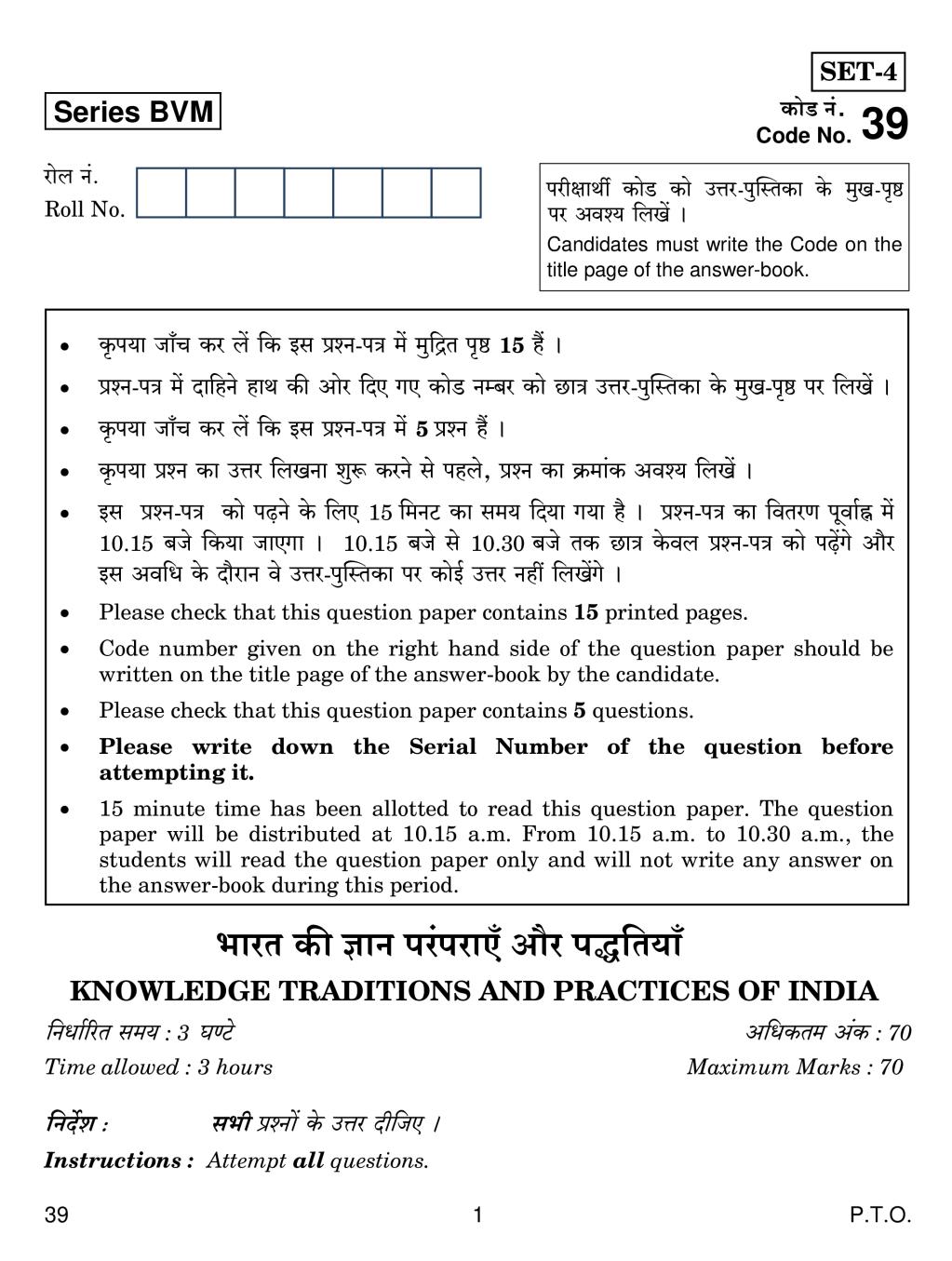
Series BVM H$moS> Z§.
Code No. 39
amob Z§. narjmWu H$moS >H$mo CÎma-nwpñVH$m Ho$ _wI-n¥ð
Roll No. >na Adí` {bIo§ &
Candidates must write the Code on the
title page of the answer-book.
H¥$n`m Om±M H$a b| {H$ Bg àíZ-nÌ _o§ _w{ÐV n¥ð> 15 h¢ &
àíZ-nÌ _| Xm{hZo hmW H$s Amoa {XE JE H$moS >Zå~a H$mo N>mÌ CÎma-nwpñVH$m Ho$ _wI-n¥ð> na {bI| &
H¥$n`m Om±M H$a b| {H$ Bg àíZ-nÌ _| 5 àíZ h¢ &
H¥$n`m àíZ H$m CÎma {bIZm ewê$ H$aZo go nhbo, àíZ H$m H«$_m§H$ Adí` {bI| &
Bg àíZ-nÌ H$mo n‹T>Zo Ho$ {bE 15 {_ZQ >H$m g_` {X`m J`m h¡ & àíZ-nÌ H$m {dVaU nydm©• _|
10.15 ~Oo {H$`m OmEJm & 10.15 ~Oo go 10.30 ~Oo VH$ N>mÌ Ho$db àíZ-nÌ H$mo n‹T>|Jo Am¡a
Bg Ad{Y Ho$ Xm¡amZ do CÎma-nwpñVH$m na H$moB© CÎma Zht {bI|Jo &
Please check that this question paper contains 15 printed pages.
Code number given on the right hand side of the question paper should be
written on the title page of the answer-book by the candidate.
Please check that this question paper contains 5 questions.
Please write down the Serial Number of the question before
attempting it.
15 minute time has been allotted to read this question paper. The question
paper will be distributed at 10.15 a.m. From 10.15 a.m. to 10.30 a.m., the
students will read the question paper only and will not write any answer on
the answer-book during this period.
^maV H$s kmZ na§namE± Am¡a nÕ{V`m±
KNOWLEDGE TRADITIONS AND PRACTICES OF INDIA
{ZYm©[aV g_` : 3 KÊQ>o A{YH$V_ A§H$ : 70
Time allowed : 3 hours Maximum Marks : 70
{ZX}e : g^r àíZm| Ho$ CÎma Xr{OE &
Instructions : Attempt all questions.
39 1 P.T.O.
Page 2
(nR>Z H$m¡eb)
SECTION A
(Reading Skills)
1. (H$) {ZåZ{b{IV AZwÀN>oXm| H$mo n‹T>H$a nyN>o JE n«íZm| Ho$ CÎma Xr{OE : 25=10
~m¡Õ {dMmam| go ào[aV _m¡`© {eënH$bm gm±Mr Ho$ ñVyn gmaZmW Ho$ EH$mí_r` do{XH$m
(aoqbJ) Am¡a ~moYJ`m Ho$ ñV§^m| go ì`º$ hmoVr h¡ & ew§J {eënH$bm Zo nËWa H$s
do{XH$mAm| (aoqbJ) Am¡a ñVynm| Ho$ n[agam| Ho$ _w»` àdoe Ûma H$mo gOmdQ> àXmZ H$s & BZ
ñ_maH$m| Ho$ CXmhaU h¢ – gm±Mr (^monmb Ho$ {ZH$Q>), ^ahþV (_Ü` àXoe), Am¡a H¥$îUm
ZXr na A_amdVr Ho$ ñVyn & ^ahþV _| àdoe Ûma àmMrZ ^maVr` eham| Ho$ bH$‹S>r Ho$ H$Z©
\$mQ>H$m| H$s nËWa na AZwH¥${V`m± h¢ & do{XH$mAm| Ho$ Ab§H$aU _| gdm©{YH$ à_wI h¡ `j
Am¡a `{j`m± (Abm¡{H$H$ àmUr) &
gm±Mr H$m _hmZ ñVyn, {OgH$s AmYma{ebm _ybV: AemoH$ Zo aIr Wr, Cgo Am±Y« d§e Ho$
g§ajU _| {dñVma {X`m J`m & Hw$fmUm| Ho$ A§VJ©V {eënH$bm _| Jhar H$mbr ñV[aV
MÅ>mZm| na C^ma dmbr {M{ÌV ~ob|, `yZmZr dñÌ {dÝ`mg _| emñÌr` _wÐmAm| Ho$ A§H$Z
{Z{_©V hþE & Bg_| hmWrXm±V Am¡a Am`m{VV H$m±M H$m Cn`moJ ^r hþAm & Jm§Yma Ho$ ñVyn _|
gm±Mr Am¡a ^ahþV Ho$ àma§{^H$ ñVynm| H$m H«${_H$ {dH$mg ñnîQ> h¡ &
JwßVH$mb _| Jw\$m _§{Xam| Am¡a EH$mí_r` ñWbm| H$s na§nam BªQ> Am¡a nËWa Ho$ _pÝXa {Z_m©U
Ho$ ê$n _| {dH${gV hþB© & BgHo$ Xmo H$maU Wo & EH$ H$maU Wm, Jw\$m _§{Xa Ho$ {eënr Am¡a
_y{V©H$ma Ho$db dht Jw\$m _§{Xa ~Zm gH$Vo Wo Ohm± {demb nËWa `m nd©V CnbãY hm|,
O~{H$ T>m±Mo dmbm nËWa H$m _§{Xa {H$gr ^r ñWmZ na ~Zm`m Om gH$Vm Wm Ohm± BªQ>mo| H$mo
~Zm`m Om gHo$ `m nËWam| H$mo T>moH$a bm`m Om gHo$ & Xÿgam H$maU Wm, _§{Xa {Z_m©U _|
{eënH$bm Am¡a _y{V©H$bm _| ZdrZVm bmZo `m à`moJ H$aZo H$s A{YH$ g§^mdZm Wr &
(i) _yb ê$n _| ñVyn {H$gHo$ ~Zo hmoVo Wo ?
(ii) Hw$fmU H$mbrZ {eënH$bm H$s {deofVmAm| H$s gyMr ~ZmBE &
(iii) _m¡`© {eënH$bm Ho$ CXmhaU Xr{OE &
(iv) EH$mí_r` _§{Xa {Z_m©U nËWa Ho$ _§{Xa {Z_m©U _| Š`mo§ ~Xb J`m ?
(v) e§wJ H$mbrZ {eënH$bm Ho$ ñVyn _m¡`© {eënH$bm Ho$ ñVynm| go {H$g ê$n _| {^Þ Wo ?
39 2
Page 3
^maV _| ^mfm AÜ``Z
^mfm Ho$ AÜ``Z H$s Amdí`H$Vm G$½doX O¡go àmMrZ J«§Wm| Ho$ kmZ H$mo g_PZo H$s
Amdí`H$Vm go CËnÞ hþB© & `o J«§W hOmam| dfmªo go _m¡{IH$ na§nam go hr Jw é go {eî` H$mo
gm¢no Om aho Wo & `Ú{n ^maV Ho$ nmg EH$ Üd{Z d¡km{ZH$ {b{n Wr, {\$a ^r kmZ H$mo
_m¡{IH$ ê$n _| g§{MV Am¡a g§Mm[aV {H$`m Om ahm Wm & N>h emñÌm| H$m {dH$mg {OÝh|
doXm§J H$hm J`m h¡, J§«W nmR>m| Ho$ CƒmaU Am¡a AW© Ho$ {bE hþAm, `o h¢ : {ejm, {Zéº$,
ì`mH$aU, N>§X, H$ën Am¡a Á`mo{Vf & BZ N>h emñÌm| _| go àW_ Mma ^mfm go g§~§{YV h¢
– Üd{Z, eãX Am¡a ê$n, ì`wËn{Îm Am¡a N>§XemñÌ & `h Mmam| ^mJ AmYw{ZH$ ^mfm{dkmZ
Ho$ A§J h¢ &
^mfm Ho$ VrZ bjU h¡ :
(1) `h _ybV: dmUr h¡ & ^mfm Ho$ {bE à`wº$ h_mao eãXm| na Ü`mZ Xr{OE : ^mfm,
dmH²$, dmUr, ~mobr, Am{X & g~ _mZVo h¢ {H$ ^mfm dmUr hr h¡ ({b{n Jm¡U h¡
Š`m|{H$ `h dmUr H$m A§H$Z h¡) &
(2) `h {dMma H$m gmYZ h¡ – ^mfm Ho$ {~Zm qMVZ Zht hmo gH$Vm &
(3) `h h_ g~Ho$ {bE dñVw, AZw^d, ^mdZmE± Am¡a {dMmam| H$m {Z_m©U CÝh| Zm_
XoH$a H$aVr h¡ & BZHo$ Ûmam h_ CZ dñVwAm| Ho$ ~mao _| ^r OmZVo h¢ Omo ^m¡{VH$ ê$n
go {dÚ_mZ Zht h¢ & H$moB© ì`{º$ "Jm`' eãX H$hVm h¡ Vmo h_ AnZo _Z _| EH$
{deof new H$m {MÌ XoIVo h¢ Am¡a BgHo$ ~mao _| {dñVma go ~Vm gH$Vo h¢ &
(i) J§«Wm|/nmR>m| H$m CƒmaU H$aZo Ho$ {bE {dH${gV H$s JB© gyMr ~ZmBE &
(ii) ^mfm Ho$ bjU Š`m h¢ ?
(iii) ^mfm Ho$ AÜ``Z H$s Amdí`H$Vm Š`m| n‹S>r ?
(iv) ^mfm Ho$ {bE àma§{^H$ eãX Š`m h¢ ? `o Š`m {gÕ H$aVo h¢ ?
(v) ^mfm Ho$ H$m¡Z-go àmMrZ emñÌ AmYw{ZH$ ^mfm{dkmZ Ho$ A§J h¢ ?
39 3 P.T.O.
Page 4
Mauryan architecture, which is inspired by Buddhist thought, is
illustrated by the stūpas at Sanchi, the monolithic rail at Sarnath and
.
the pillars of Bodh Gaya. Śunga architecture added decorations of
stone vedikas (railings) and gateways surrounding the stūpa.
Examples of these monuments are the stūpas at Sanchi (near Bhopal),
Bharhut (Madhya Pradesh), and Amaravati on the Krishna River. At
Bharhut the gateways are imitations in stone of the wooden portals of
early Indian towns. Most prominent in the embellishment of the
vedikas are the carvings of Yaksas
. and Yakasīs
. (supernatural beings).
The great stūpa at Sanchi, whose foundation was originally laid by
Aśoka, was enlarged under the patronage of the Andhra Dynasty.
Architecture under the Kusānas
. . produced relief friezes carved in dark
schist and portrayed figures in classical poses with flowing Hellenistic
draperies; it also made use of ivory and imported glass. The stūpa in
Gandhara marks the gradual elaboration of the primitive types known
at Sanchi and Bharhut.
In the Gupta age, the tradition of excavating cave temples and
monolithic shrines evolved into the construction of brick and stone
temples. This was due to two reasons. One reason was that while the
architects and sculptors could create a cave temple only where
boulders or hills were available, a structural stone temple could be
created at any chosen site by baking bricks or quarrying and
transporting stones. Secondly, there was more scope for architectural
and sculptural innovation and experimentation while constructing a
temple.
(i) What were stūpas made up of originally ?
(ii) List the characteristics of Kusāna
. . architecture.
(iii) Give the examples of Mauryan architecture.
(iv) What led to evolution of monolithic shrines into the construction
of stone temples ?
(v) How were stūpas in Sunga architecture different from the ones in
Mauryan architecture ?
39 4
Page 5
Study of Language in India
The study of language arose from the need to understand the
knowledge texts such as the Rgveda.
. These texts have been
transmitted orally from teacher to disciples for millennia. Though
India had a scientific phonetic script, still knowledge was stored and
.
transmitted orally. Six disciplines known as vedāngas developed to
articulate and interpret texts : śiksā
. (phonetics), nirukta (etymology),
vyākarana
. (grammar), chanda (prosody), kalpa (ritualistic
performances) and jyotisa
. (astronomy). Out of these six disciplines, the
first four pertain to language, its sounds, words and forms, etymology
and metre. These four are today part of modern linguistics.
Three features of language are :
(1) It is primarily speech. Consider our words for language : bhāsā, .
vāk, vānī,
. bolī, etc. All assert that language is speech (writing is
secondary as it represents speech).
(2) It is the means of thought — thinking is not possible without
language.
(3) It constructs for each of us things, experiences, emotions and
ideas by naming them. With these we know things that are not
present physically. Someone utters the word ‘cow’ and we see in
our mind the picture of a particular animal and can describe it at
length.
(i) List the disciplines developed to articulate and interpret texts.
(ii) What are the features of language ?
(iii) Why was there a need to study language ?
(iv) What are the primary words for language ? What does it prove ?
(v) Which old disciplines of language are part of modern linguistics
today ?
39 5 P.T.O.
Page 6
({díbofUmË_H$ H$m¡eb)
SECTION B
(Analytical Skills)
2. {ZåZ{b{IV AZwÀN>oXm| H$mo n‹T>H$a nyN>o JE àíZm| Ho$ CÎma Xr{OE : 10
(H$) AܶmnH$ Am¡a {dÚmWu
^maVr¶ g§ñH¥${V ‘| AܶmnH$ Am¡a N>mÌm| ‘| EH$ Img Vah H$m g§~§Y nm¶m OmVm h¡ Wm &
AܶmnH$, Jwé ¶m AmMm¶© H$mo A˶{YH$ gå‘mZ {X¶m OmVm h¡ Am¡a Cgo Eogm ‘mJ©Xe©H$
‘mZm OmVm Wm Omo {eî¶ H$mo AkmZ Ho$ A§YH$ma go ‘w³V hmoH$a kmZ H$m àH$me àmßV H$aZo
‘| ghm¶Vm H$aVm Wm & AܶmnH$ H$m Ka hr AmMm¶©Hw$b ¶m JwéHw$b H$m Ho$ÝÐ hmoVm
Wm & Jwé Am¡a {eî¶ ‘| {deof ghOrdr g§~§Y hmoVm Wm Am¡a {dÚm{W©¶m| H$mo Jwé Ho$ n[adma
Ho$ gXñ¶m| Ho$ ê$n ‘| ‘mZm OmVm Wm &
Jwé Ho$ gmW ahZo dmbo {eî¶ AmË‘-{Z¶§ÌU, g§¶‘, AZwgaU Am¡a g‘n©U H$m OrdZ OrVo
Wo Am¡a ¶‘ (AmË‘-g§¶‘) VWm {Z¶‘ (nm±M g§ñH$ma), AWm©V² em¡M eara, ‘Z Am¡a
{dMma H$s n{dÌVm; g§Vmof gH$mamË‘H$ gmoM; Vn H$R>moa gmYZm; ñdmܶm¶ ñd¶§
Aܶ¶Z H$aZm, AmË‘{ZarjU; VWm B©ídaà{UYmZ B©ída Ho$ à{V {dídmg Am¡a g‘n©U
go AnZo OrdZ H$mo {Z¶{‘V H$aVo Wo &
(I) AܶmnH$ Ho$ à{V gå‘mZ
O~ Jwé, AWdm {ejH$ {dÚmb¶ ‘| àdoe H$aVm h¡, Vmo dh gXm A{YH$V‘ AmXa Am¡a
gå‘mZ àmßV H$aVm h¡ & CgHo$ {dÚm{W©¶m| H$mo CgHo$ g‘j ^y{‘ na nyam boQ> OmZm Mm{hE;
AnZm Xm{hZm hmW ‘w±h na aI boZm Mm{hE, Am¡a V~ VH$ EH$ ^r eãX Zht ~mobZm
Mm{hE O~ VH$ dh CÝh| ~mobZo H$s AZw‘{V Z Xo & Omo Jwé Ho$ ‘Zm H$aZo na ^r ~mV
39 6
Page 7
AnZr ~mobMmb ‘| {Z¶§ÌU Z aI gH|$, do ~mX ‘| Xe©ZemñÌ H$s n‹T>mB© Ho$ {bE A¶mo½¶
‘mZo OmVo h¢ & BZ Cnm¶m| go Jwé H$mo gXm dh gå‘mZ àmßV hmoVm h¡ Omo Cgo {‘bZm
Mm{hE : {dÚmWu AmkmH$mar hmoVo h¢ Am¡a gmdYmZrnyd©H$ ‘Z ‘| {~R>mE JE {Z¶‘m| Ho$
{déÕ AmMaU H$^r Zht H$aVo &
(i) àmMrZ ^maV ‘| Jwé-{eî¶ Ho$ g§~§Ym| H$s VwbZm AmYw{ZH$ g‘¶ go H$s{OE & Amn
{H$go AÀN>m ‘mZVo h¢ Am¡a ³¶m| ? 3+3=6
(ii) ‘ghOrdr g§~§Y’ H$m ³¶m VmËn¶© h¡ ? ¶h {dÚm{W©¶m| Ho$ {bE {H$g àH$ma ghm¶H$
hmoVm Wm ? 4
Read the passages given below and answer the questions that follow :
(a) The Teacher and the Student
A given teacher-student relationship obtained in Indian culture. The
teacher, the guru, the ācārya, was highly honoured and was seen as
the guide who helped students escape the darkness of ignorance and
attain the light of knowledge. The teacher’s house was the centre of the
ācāryakula, the gurukula. The student and the teacher had a
symbiotic relationship and students were treated as members of the
teacher’s family.
Students living with the teacher led a life of self-control, abstinence,
obedience and devotion and regulated their lives by adhering to yama
39 7 P.T.O.
Page 8
. positive contentment; tapas austerity;
body, mind, thought; santosa
svādhyāya self-study, introspection; and īśvarapranidhāna
. faith in
and surrender to the Gods.
(b) Respect for the Teacher
When the Guru, or teacher, enters the school, he is always received
with the utmost reverence and respect. His pupils must throw
themselves down at full length before him; place their right hand on
their mouth, and not venture to speak a single word until he gives
them express permission. Those who talk and prate contrary to the
prohibition of their master are expelled from the school, as boys who
cannot restrain their tongue, and who are consequently unfit for the
study of philosophy. By these means the preceptor always receives that
respect which is due to him : the pupils are obedient, and seldom
offend against rules which are so carefully inculcated.
(i) Compare and contrast the relations between teacher and taught
in ancient India with that of the modern times. Which one do you
think is better and why ?
(ii) What is meant by ‘symbiotic relationship’ ? How was it helpful to
students ?
39 8
Page 9
(i) ‘‘Ho$db AnZo gËH$‘m] ¶m Y‘© H$m nmbZ H$aZo go hr H$moB© ì¶{³V CƒV‘ H$ë¶mU Ho $
{bE ‘hmZV‘ ‘mJ© àmßV H$a gH$Vm h¡ &’’ gdm}ƒ H$ë¶mU H$mo àmßV H$aZo Ho$ {bE
AmnH$m ‘mJ© ³¶m hmoJm ? g‘H$mbrZ ^maV Ho$ g§X^© ‘| {Q>ßnUr H$s{OE &
(ii) {ejm Ho$ ~mao ‘| ^maVr¶ {dMma Ho$db ~w{Õ na H|${ÐV Zht Wm : BgH$m bú¶ {dÚmWu H$m
^rVar Am¡a ~mhar {dH$mg H$aZm Wm Am¡a dh CÝh| OrdZ Ho$ CVma-M‹T>md H$m gm‘Zm H$aZo
Ho$ {bE V¡¶ma H$aZm ^r Wm & Bg H$WZ na {Q>ßnUr H$s{OE Am¡a g‘H$mbrZ {ejm
àUmbr go BgH$s VwbZm H$s{OE &
Attempt any one out of the two long-answer type questions :
(i) ‘‘It is only by performing one’s righteous duties or dharma that one can
hope to attain the supreme path to the highest good.’’ What would be
your path to attain the highest good ? Comment in the wake of
contemporary India.
(ii) The Indian concept of education was not focused on the intellect alone :
it focused on the students’ inner as well as outer development and
prepared them to face the vicissitudes of life. Comment on this
statement and compare it with contemporary education system.
IÊS> J : qMVZ H$m¡eb
SECTION C : Thinking Skills
4. {ZåZ{b{IV N>h bKw-CÎmar` àíZm| ‘| go {H$Ýht nm±M Ho$ CÎma Xr{OE : 3×5=15
(i) nmamea Am¡a dmah{‘{ha Ho$ Ûmam dfm© H$s ^{dî¶dmUr H$aZo H$s VH$ZrH|$ {H$g na AmYm[aV
Wt ?
(ii) EH$ ‘pñOX H$s à‘wI {deofVmE± {b{IE &
(iii) dU© ì¶dñWm ‘| {Z{hV AmYma^yV CÔoí¶ ³¶m Wo ?
(iv) ^maV ‘| {Z{‘©V dñÌm| na EH$ {Q>ßnUr {b{IE &
(v) H$b[an¶Åx> H$s n[a^mfm Xr{OE Am¡a BgHo$ ^oXm| H$s gyMr ~ZmBE &
(vi) ‘ì¶mnma’ go Amn ³¶m g‘PVo h¢ ? ì¶mnma ‘| Xmo à‘wI ‘ܶñWm| Ho$ Zm‘ {b{IE &
39 9 P.T.O.
Page 10
(i) What were the techniques developed by Parāśara’s and Varāhamihira
to predict rainfall based on ?
(ii) Outline the salient features of a mosque.
(iii) What was the primary objective underlying the varna
. vyavasthā ?
(iv) Write a note on fabrics produced in India.
(v) Define kalarippayattu
. and list its types.
(vi) What do you understand by ‘trade’ ? Name two major intermediaries in
trade.
5. {ZåZ{b{IV àË`oH$ àíZ Ho$ CÎma Ho$ {bE Mma {dH$ën {XE JE h¢ & g~go Cn`wº$ CÎma H$mo
MwZH$a Cgo AnZr CÎma-nwpñVH$m _| {b{IE & 1×10=10
(i) Jwbm~ H$m BÌ EH$ bmoH${චgwJ§Y h¡, {OgH$s ImoO H$m lo¶ _________ H$s ‘m± H$mo
{X¶m OmVm h¡ &
(H$) Zya Ohm±
(I) ~ra~b
(J) Q>rny gwëVmZ
(K) Ohm±Jra
(ii) Zrbm a§J àmßV H$aZo H$m òmoV àm`… _________ h¡ &
(H$) ‘OrR>
(I) Zrb
(J) Am‘ H$m {N>bH$m
(K) ~m±g
39 10
Page 11
_____________ àH$ma H$s _N>{b`m| H$mo gyMr~Õ {H$`m h¡ &
(H$) 44
(I) 16
(J) 34
(K) 10
(iv) ^maV-Am¶© ^mfmE± ‘w»¶ ê$n go _____________ _| ~mobr OmVr h¢ &
(H$) X{jUr ^maV
(I) ¶yamonr¶ Xoem|
(J) CÎmar ^maV
(K) A’$Jm{ZñVmZ
(v) __________ Zo O¶nwa Ho$ {ZH$Q> O¶J‹T> {H$bm AWdm ‘{dO¶ XþJ©’ ~Zdm¶m Wm &
(H$) Q>rny gwëVmZ
(I) amOm ‘mZ qgh
(J) gdmB© O¶ qgh
(K) Cn¶w©³V ‘| go H$moB© Zht
(vi) nhm‹S>r {MÌe¡br Ho$ ‘hÎdnyÊm© Ho$ÝÐ ~gmobr, Oå‘y, Jwboa Am¡a _________ Wo &
(H$) bXmI
(I) boh
(J) H$m±J‹S>m
(K) {e‘bm
39 11 P.T.O.
Page 12
(H$) ~«÷M¶©, dmZàñW, J¥hñW, gݶmg
(I) ~«÷M¶©, J¥hñW, gݶmg, dmZàñW
(J) dmZàñW, J¥hñW, gݶmg, ‘moj
(K) ~«÷M¶©, J¥hñW, dmZàñW, gݶmg
(viii) _________ ‘| YZw{d©Úm Ho$ {Z¶‘ {XE JE h¢ &
(H$) Am¶wd}X
(I) YZwd}X
(J) ‘„nwamU
(K) AWd©doX
(ix) Zmb§Xm Ho$ nwñVH$mb¶ ‘Y‘©J§O’ _| VrZ ~hþ‘§{Obo ^dZ Wo {OZHo$ Zm_ Wo,
(H$) pñWa‘{V, erb^Ð VWm em§Va{jV
(I) ‘aËZgmJa’, ‘aËZa§OH$’ VWm ‘aËZmoX{Y’
(J) ZmQ>çJ¥h, {Zdm©U VWm agamO
(K) aËZH$moe, {J[aHy$Q> VWm J«§Wmb¶
(x) ¶Owd}X ‘| C„oI h¡ {H$ gamoda ‘| ‘N>{b¶m| H$mo _________ nH$‹S>m OmVm Wm &
(H$) Omb S>mb H$a
(I) ‘N>br nH$‹S> H$a
(J) em‘H$m| Ho$ à¶moJ go
(K) Cn¶w©³V ‘| go H$moB© Zht
39 12
Page 13
Select the most appropriate answer and write it down in your
answer-sheet.
(i) The āttar of roses was a popular perfume, the discovery of which is
attributed to the mother of _________.
(a) Nur Jehan
(b) Birbal
(c) Tipu Sultan
(d) Jehangir
(ii) The source of blue dye is usually _________.
(a) Madder
(b) Indigo
(c) Mango bark
(d) Bamboo
(iii) The Chalukya king Someśvardeva (1127 CE) described methods of
culturing fish and listed _________ kinds of fishes.
(a) 44
(b) 16
(c) 34
(d) 10
39 13 P.T.O.
Page 14
(a) Southern India
(b) European countries
(c) Northern India
(d) Afghanistan
(v) Jaigarh Fort or ‘Victory Fort’ was constructed near Jaipur by _______.
(a) Tipu Sultan
(b) Raja Man Singh
(c) Sawai Jai Singh
(d) None of the above
(vi) The important centres of the Pahari school of painting were Basholi,
Jammu, Guler and _________.
(a) Ladakh
(b) Leh
(c) Kangra
(d) Shimla
(vii) Choose the correct sequence of the stages of āśrama vyavasthā.
.
(a) Brahmacarya, Vanaprastha, Grhastha,
. Samnyāsa
.
(b) Brahmacarya, Grhastha,
. Samnyāsa, Vanaprastha
.
(c) Vanaprastha, Grhastha,
. Samnyāsa, Moksha
.
(d) Brahmacarya, Grhastha,
. Vanaprastha, Samnyāsa
39 14
Page 15
(a) Ayurveda
(b) Dhanurveda
(c) Mallapurāna
.
(d) Atharvaveda
~
(ix) Nālandā’s library ‘Dharmaganja’ had three multi-storey buildings
namely,
(a) Sthiramati, Śīlabhadra and Śāntaraksita
.
(b) ~
‘Ratnasāgara’, ‘Ratnaranjaka’ and ‘Ratnodadhi’
(c) Nātyagriha, Nirvāna and Rasarāja
(d) Ratnakosha, Girikuta and Granthālaya
(x) Yajurveda mentions capturing fish by _________ in a pond.
(a) laying net
(b) fishing
(c) sedating them
(d) None of the above
39 15 P.T.O.
Document Details
| Board / Org | CBSE |
| Exam | Class 12 |
| Type | Question Paper |
| Pages | 15 |
| Updated | 01 May 2026 |