HP Board Class 12 Syllabus 2024
Finished viewing? Save it for later —
Download HP Board Class 12 Syllabus 2024 (PDF · 89 pages)About HP Board Class 12 Syllabus 2024
HP Board Class 12 Syllabus 2024 is available here for free download. Published by Himachal Pradesh Board for Class 10, this syllabus can be viewed online or downloaded as a PDF (89 pages). Candidates preparing for Class 10 can use HP Board Class 12 Syllabus 2024 to understand the exam pattern, the type of questions asked, and the overall difficulty level.
Frequently Asked Questions
How can I download HP Board Class 12 Syllabus 2024?
Open this page and click the Download button to save HP Board Class 12 Syllabus 2024 as a PDF. It is completely free on AglaSem Docs.
Is HP Board Class 12 Syllabus 2024 free to download?
Yes. HP Board Class 12 Syllabus 2024 can be viewed online and downloaded as a PDF free of cost on AglaSem Docs.
How many pages does HP Board Class 12 Syllabus 2024 have?
HP Board Class 12 Syllabus 2024 contains 89 pages, which you can read online or download together as a single PDF.
Where can I find more Class 10 study material?
You can find more Class 10 question papers, sample papers, syllabus, and answer keys on AglaSem Docs.
HP Board Class 12 Syllabus 2024 – Text
Read the full text of this syllabus below — useful to quickly search, copy and reference the content online without downloading the PDF.
📄 View text version (81 pages)
Page 1
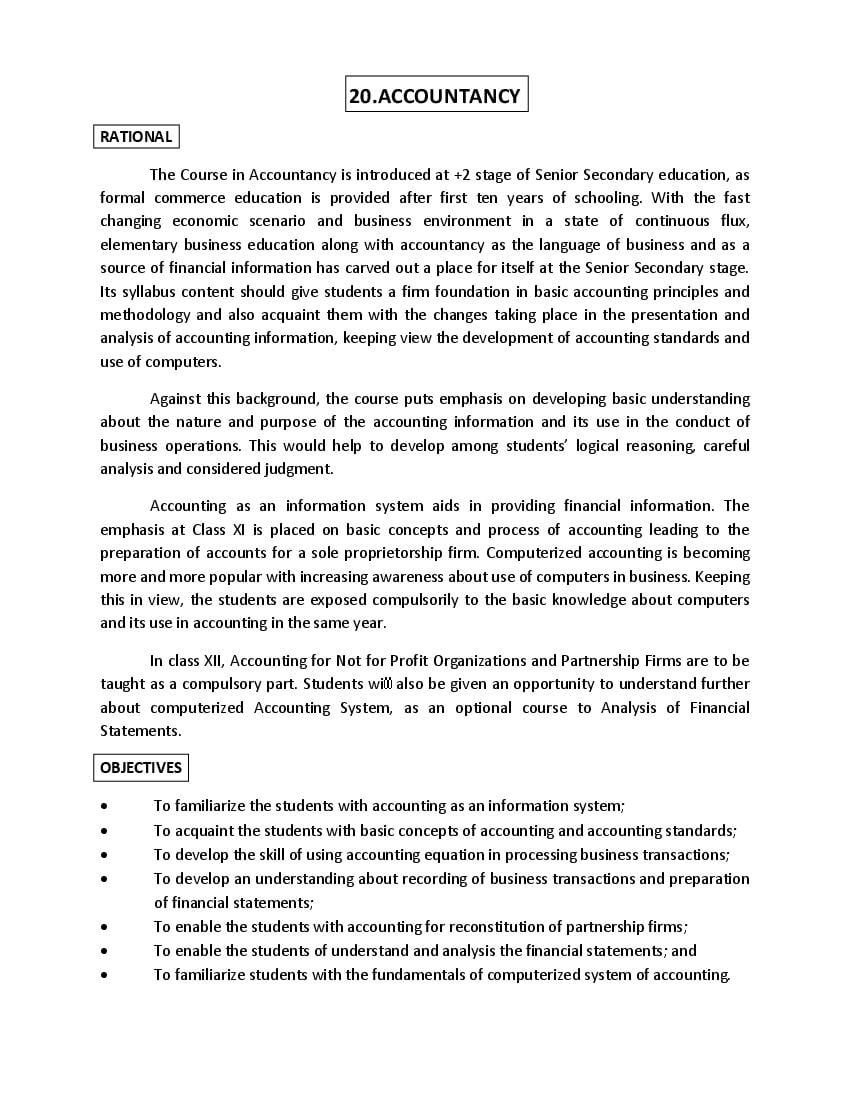
RATIONAL
The Course in Accountancy is introduced at +2 stage of Senior Secondary education, as
formal commerce education is provided after first ten years of schooling. With the fast
changing economic scenario and business environment in a state of continuous flux,
elementary business education along with accountancy as the language of business and as a
source of financial information has carved out a place for itself at the Senior Secondary stage.
Its syllabus content should give students a firm foundation in basic accounting principles and
methodology and also acquaint them with the changes taking place in the presentation and
analysis of accounting information, keeping view the development of accounting standards and
use of computers.
Against this background, the course puts emphasis on developing basic understanding
about the nature and purpose of the accounting information and its use in the conduct of
business operations. This would help to develop among students’ logical reasoning, careful
analysis and considered judgment.
Accounting as an information system aids in providing financial information. The
emphasis at Class XI is placed on basic concepts and process of accounting leading to the
preparation of accounts for a sole proprietorship firm. Computerized accounting is becoming
more and more popular with increasing awareness about use of computers in business. Keeping
this in view, the students are exposed compulsorily to the basic knowledge about computers
and its use in accounting in the same year.
In class XII, Accounting for Not for Profit Organizations and Partnership Firms are to be
taught as a compulsory part. Students will also be given an opportunity to understand further
about computerized Accounting System, as an optional course to Analysis of Financial
Statements.
OBJECTIVES
To familiarize the students with accounting as an information system;
To acquaint the students with basic concepts of accounting and accounting standards;
To develop the skill of using accounting equation in processing business transactions;
To develop an understanding about recording of business transactions and preparation
of financial statements;
To enable the students with accounting for reconstitution of partnership firms;
To enable the students of understand and analysis the financial statements; and
To familiarize students with the fundamentals of computerized system of accounting.
Page 2
UNITS MARKS
Part A: ACCOUNTING FOR NOT FOR PROFIT ORGANISATIONS PARTNERSHIP FIRMS AND
COMPANIES
1. Accounting for not for profit organizations 08
2. Accounting for Partnership Firms 03
3. Reconstitution of Partnership 15
4. Accounting for share Capital and Debenture 19
Total 45
PART B: FINANCIAL STATEMENT ANALYSIS
5. Analysis of financial statements 09
6. Cash Flow Statement 06
Total 15
Project Work - 20
PART-A:
ACCOUNTING FOR NOT-FOR-PROFIT ORGANISATIONS, PARTNERSHIP FIRMS AND COMPANIES
Unit 1 : Accounting for Not-for-Profit Organizations
Not for profit organisation: Meaning and examples.
Receipts and payments: Meaning and concept of fund based accounting.
Preparation of Income and Expenditure Account and Balance sheet from Receipt and
Payment Account with additional information.
Unit 2 : Accounting for Partnership Firms
Nature of Partnership firm : Partnership Deed-meaning, importance.
Final Accounts of Partnership : Fixed vs fluctuating Capital, Division of Profit among
partners, Profit and loss Appropriation Account.
Unit 3 : Reconstitution of Partnership
Changes in Profit Sharing Ratio among the existing partners-Sacrificing Ratio and Gaining
Ratio.
Accounting for Revaluation of Assets and Liabilities and distribution of reserves and
Accumulated Profits.
Page 3
Profit and Capitalisation methods.
Admission of a Partner: Effect of Admission of Partner, change in Profit sharing Ratio,
Accounting Treatment for Goodwill, Revaluation of Assets and liabilities, reserves
(Accumulated Profits) and adjustment of Capitals.
Retirement/Death of a partner: Changer in Profit sharing ratio, accounting treatment of
goodwill, Revaluation of Assets and Liabilities, adjustment of accumulated Profits
(Reserves) and capitals.
Unit 4 : Accounting for share Capital and Debenture
Share Capital : Meaning, Nature and Types.
Accounting for share capital : Issue and Allotment of Equity and Preference shares:
Private placement of shares; over subscription and under subscription; issue at par,
premium and at discount; calls in advance, calls in arrears, issue of shares for
consideration other than cash.
Forfeiture of shares: accounting treatment, re-issue of forfeited shares.
Presentation of share Capital and Debenture in company’s Balance sheet.
Issue of debenture-at par and premium; issue of debenture for consideration other than
cash.
Redemption of debenture.
Out of Proceeds of fresh issue, accumulated profits and sinking fund.
PART-B; FINANCIAL STATEMENT ANALYSIS
Unit 5: Analysis of Financial Statements
Financial statements of a company: Preparation of simple balance sheet of a company in the
prescribed form with major headings only.
Financial Statement Analysis: meaning, significance and purpose, limitations,
Tools for Financial Statement Analysis: Comparative Statements, Common Size Statements.
Accounting Ratios : Meaning and Objectives, types of ratios:
Liquidity Ratios : Current Ratio, liquidity ratio
Solvency Ratios: Debt of Equity, Total Assets of Debt, proprietary Ratio
Activity Ratios: Inventory Turnover, Debtors Turnover, Payables Turnover, Working
Capital Turnover, Fixed Assets Turnover, Current Assets Turnover.
Profitability Ratio: Gross Profit, Operating Ratio, Net Profit Ratio, Return on Investment,
Earning Per share, Dividend per share, Profit Earning Ratio.
Page 4
Cash Flow Statement: Meaning and objectives, Preparation, adjustments related to
depreciation, dividend and tax, sale and purchase of non-current assets (as per revised
standard issued by ICAI)
Unit 7: Project Work in Accounting
BOOKS RECOMMENDED:
Yks[kk”kkL= Hkkx A ds fy, ,d ikB~;iqLrd
ys[kk”kkL= Hkkx B ds fy, ,d IkkB~;iqLrd
Published by N.C.E.R.T. New Delhi
Accountancy book for Part A
Accountancy book for Part B
(94)
Page 5
The present syllabus reinforces the ideas introduced in the lower classes while the
students learn new concepts besides getting an exposure to contemporary areas of the subject.
The syllabus also aims at emphasizing the underlying principles that are common to both
animals and plants as well as highlighting the relationship of biology with other areas of
knowledge. The format of the syllabus allows a simple, clear, consequential flow of concepts
without any jarring jumps. The syllabus also stresses the connection of the study of Biology to
real life problems, use of biological discoveries/innovations in everyday life-in environment,
nature, medicine, health and agriculture. The updated syllabus also focuses on reducing the
curriculum load while ensuring that ample opportunities and scope for learning and
appreciating basic concepts of the subject continues to be available within its framework.
The prescribed syllabus is expected to
Promote understanding of basic principles of biology
Learning of emerging knowledge and its relevance to individual and society.
Encourage rational/specific attitude to issues related to population, environment and
development.
Enhance awareness about environmental issues and problems and the appropriate
solutions.
Create awareness amongst the learners about variations amongst the living and
developing respect for the diversities and to appreciate that the most complex biological
phenomenon are also built on essentially simple processes.
It is expected that the students would get an exposure to various branches of Biology in
the syllabus in a more contextual and friendly manner as they study its various units.
One Paper Time: 3 Hours Total Marks 60
Unit
1. Sexual reproduction 12 Marks
2. Genetics and evolution 14 Marks
3. Biology and human Welfare 10 Marks
4. Biotechnology and its applications 12 Marks
5. Ecology and environment 12 Marks
Page 6
Reproduction in Organisms.
Sexual Reproduction in Flowering Plants.
Human Reproduction.
Reproductive Health.
Pollination and Fertilization in Flowering plants.
Development of seeds and fruits.
Human reproduction: reproductive system in male and female, menstrual cycle.
Production of gametes, fertilization, implantation, embryo development, pregnancy and
parturition.
II. Genetics and evolution
Principles of Inheritance and Variation.
Molecular Basis of Inheritance.
Evolution.
Mendelian inheritance.
Chromosome theory of inheritance, deviations from Mendelian ratio (gene interaction-
incomplete dominance, co-dominance, complementary genes, multiple alleles).
Sex determination in human beings : XX,XY
Linkage and crossing over.
Inheritance pattern of haemophilia and blood groups in human beings.
DNA: replication, transcription, translations.
Gene expression and regulation.
Genome and human genome Project.
DNA fingerprinting.
Evolution: Theories and evidences.
III. Biology and Human Welfare
Human Health and Disease.
Strategies for Enhancement in Food Production.
Microbes in Human Welfare.
Animal Husbandry.
Basic concepts of immunology, Vaccines.
Pathogens, Parasites
Plant breeding, tissue culture, food production.
Microbes in household food processing, industrial production, sewage treatment and
ENE generation.
Cancer and AIDS.
Adolescence and drug/alcohol abuse.
Page 7
Biotechnology: Principles and Processes.
Biotechnology and its Applications.
Recombinant DNA technology.
Applications in Health, Agriculture and Industry
Genetically modified (GM) organisms; biosafety issues.
Insulin and Bt cotton.
V. Ecology & Environment
Organisms and Populations.
Ecosystem
Biodiversity and Conservation.
Environmental Issues.
Ecosystem : components, types and energy flow.
Species, population and community.
Ecological adaptations.
Centers of diversity and conservation of biodiversity National Parks and sanctuaries,
Environmental issues.
PRACTICALS
Time: 3 Hours 20 Marks
1. Two experiments 3+3=6
2. Slide preparation 3
3. Spotting 4
4. Investigatory project and viva based on the project 4
5. Record and Viva based on the experiment 3
Total 20
LIST OF EXPERIMENTS
1. Study pollen germination on a slide.
2. Collect and study soil from different sites and study them for texture and moisture
content.
3. Study the pH and Water holding capacity of soil. Correlate with the kinds of plants found
in them.
4. Collect water from different water bodies around you and study them for pH clarity and
presence of any living organisms.
Page 8
sites.
6. Study of plant population density by quadrat method.
7. Study of plant population frequency by quadrat method.
STUDY/OBSERVATION OF THE FOLLOWING (SPOTTING)
1. Study of flowers adapted to pollination by different agencies (weed, insect)
2. Study of pollen germination on a slide.
3. Study and identify stages of gamete development i.e. t.s. testis and t.s. ovary through
permanent slide.
4. Study meiosis in onion bud cell or grass hopper testis through permanent slide.
5. Study of t.s. of blastula through permanent slide.
6. Study Mendelian inheritance using seeds of different colour/size of any plant.
7. Study prepared prediqree charts of genetic traits such as rolling of tongue, blood
groups, widow’s peak, colour blindness.
8. Exercise on controlled pollination-emasculation, tagging and bagging.
9. To identify common diseases causing organism like Ascaris, Antamoeba, Plasmodium,
ringworm. Comment of symptoms of diseases that they cause through permanent slides
or specimens.
10. Study plants and animals found in xerophytic condition. Comment upon their
adaptation/ecosystem.
11. Study plants and animals found in aquatic conditions. Comment upon their
adaptation/ecosystem.
12. Study analogous and homologous organs in various plants and animals.
BOOKS RECOMMENDED
Biology Published by N.C.E.R.T. New Delhi
Page 9
RATIONABLE
The courses in Business Studies and Accountancy are introduced at +2 stage of Higher
Secondary Education as formal commerce education is provided after first ten years of
schooling. Therefore, it becomes necessary that instructions in this subject is given in such a
manner that students have a good understanding of the principles and practices bearing in
business (trade and industry) as well as their relationship with the society.
Business is a dynamic process that brings together technology, natural resources and
human initiative in a constantly changing global environment. To understand the framework in
which a business operates, a detailed study of the organization and management of business
processes and its interaction with the environment of business processes and its interaction
with the environment is required. Globalization has changed the way firms transact their
business. Information Technology is becoming a part of business operations in more and more
organizations. Computerized systems are fast replacing other systems. E-business and other
related concepts are picking up fast which need to be emphasized in the curriculum.
The course in Business Studies will prepare students to analysis, manage, evaluate and
respond to changes which affect business. It provides a way of looking at and interacting with
the business environment. It recognizes the fact that business influences and is influenced by
social, political, legal and economic forces. It allows students to appreciate that business is an
integral component of society and develops an understanding of many social and ethical issues.
Therefore, to acquire basic knowledge of the business world, a course in Business
Studies would be useful. It also informs students of a range of study and work options and
bridges the gap between school and work.
OBJECTIVES
To develop in students an understanding of the processes of business and its
environment;
To acquaint students with the dynamic nature and inter-dependent aspects of business;
To develop an interest in the theory and practice of business, trade and industry;
To familiarize candidates with theoretical foundations of organizing, managing and
handling operations of business firm;
To help students appreciate the economic and social significance of business activity and
the social costs and benefits arising there from;
Page 10
business;
To prepare students to function more effectively and responsibly as consumers,
employers, employees and citizens;
To help students in making the transition from school to the world of work including
self-employment;
To develop in students a business attitude and skills to be precise and articulate.
One Paper 3 Hours 80 Marks
UNIT WISE WEIGHTAGE (Structure of Question Paper/ Distribution of Marks)
UNITS MARKS
PART A: PRINCIPLES AND FUNCTIONS OF MANAGEMENT
1. Nature and Significance of Management (2+3+1) 06
2. Principles of Management (2+3+1) 06
3. Business Environment -
4. Planning (5+1) 06
5. Organizing (2+2+4) 08
6. Staffing (2+3+3) 08
7. Directing (1+1+2+2+4) 10
8. Controlling (5+1) 06
Total 50
PART B: Business Finance and Marketing
9. Financial Management (1+1+2+4) 08
10. Financial Markets (1+1+2+3) 07
11. Marketing (1+2+3+4) 10
12. Consumer Protecting (4+1) 05
Total 30
PART A: PRINCIPLE AND FUNCTIONS OF MANAGEMENT
Unit 1: Nature and Significance of Management
Management-concept, objectives, importance.
Nature of management; Management as Science, Art, Profession.
Levels of management-top, middle, supervisory (first level)
Management function-planning, organizing, staffing, directing and controlling
Coordination-nature and importance.
Page 11
Principles of Management-meaning, nature and significance
Fayol’s Principles of management.
Taylor’s Scientific Management-Principles and techniques.
Unit 3: Business Environment
Business Environment-meaning, nature and importance.
Dimensions of Business Environment-Economic, Social, Technological, political and
Legal.
Economic Environment in India; Impact of Government policy changes on business and
industry with special reference to adoption of the policies of liberalization, privatization
and globalization.
Unit 4: Planning
Meaning features, importance, limitations
Planning process.
Types of Plans- Objectives, Strategy, Policy, Procedure, Method, Rule, Budget, Program.
Unit 5: Organizing
Meaning and importance.
Steps in the process of organizing.
Structure of organization-functional and divisional.
Formal and informal organization.
Delegation: meaning, elements and importance.
Decentralization: meaning and importance.
Difference between delegation and decentralization.
Unit 6: Staffing
Meaning, need and importance of staffing.
Staffing as a part of Human Resource Management.
Steps in staffing process.
Recruitment-meaning and sources.
Selection-meaning and process.
Training and Development-meaning and need. Methods of training: job rotation,
apprenticeship, vestibule and internship.
Page 12
Meaning, importance and principles.
Elements of Directing
- Supervision-meanings and importance
- Motivation-meaning and importance, Maslow’s hierarchy of needs; Financial and
non-financial incentives.
- Leadership-meaning, importance: qualities of a good leader.
- Communication-meaning and importance, formal and informal communication;
barriers to effective communication.
Unit 8: Controlling
Meaning and importance
Relationship between planning and controlling
Steps in the process of control
Techniques of controlling: budgetary control.
Part-B: Business Finance and Marketing
Unit 9: Financial Management
Meaning, role, objectives of financial management
Financial planning- meaning and importance
Capital structure- meaning and factors
Fixed and working Capital-meanings and factors affecting its requirements.
Unit 10: Financial Markets
Concept of Financial Market: Money Market-nature, instruments
Capital market: nature and types-primary and secondary market.
Distinction between capital market and money market.
Stock Exchange-meaning, functions, NSEI, OCTEL, Trading Procedure.
Securities and Exchange Board of India (SEBI)-Objectives, Functions.
Unit 11: Marketing
Marketing- meaning, functions and role
Distinction between marketing and selling
Marketing mix-concept and elements.
- Product-nature, classification, branding, labelling and packaging
Page 13
factors determining choice of channels.
- Promotion-meaning and role, promotion mix, Role of Advertising and personal
selling; objections to Advertising.
- Price: factors influencing pricing
Unit 12: Consumer Protection
Importance of consumer protection
Consumer rights
Consumer responsibilities
Ways and means of consumer protection-Consumer awareness and legal
redressed with special reference to Consumer Protection Act.
Role of consumer organizations and NGOs.
BOOKS RECOMMENDED:
O;Oklkf;d v/;;u Hkkx&1 vkSj Hkkx&2
Published by N.C.E.R.T. New Delhi
Business Studies Part-I and Part-II
Page 14
RATIONAL
Higher secondary is the most crucial stage of school education because at this juncture
specialized discipline based, content-oriented courses are introduced. Students reach this stage
after 10 years of general education and opt for chemistry with a purpose of pursuing their
career in basic sciences or professional courses like medicine, engineering, technology and
study courses in applied areas of science and technology at tertiary level. Therefore, there is a
need to provide learners with sufficient conceptual background of Chemistry, which will make
them competent to meet the challenges of academic and professional courses after the higher
secondary stage.
The new and updated curriculum is based on disciplinary approach with rigor and depth
taking care that the syllabus is not heavy and at the same time it is comparable to the
international level. The knowledge related to the subject of chemistry has undergone
tremendous changes during the past one decade. Many new areas like synthetic materials, bio-
molecules, natural resources, industrial chemistry are coming in a big way and deserve to be an
integral part of chemistry syllabus at senior secondary stage. At international level, new
formulations and nomenclature of elements and compounds, symbols and units of physical
quantities floated by scientific bodies like IUPAC and CGPM are of immense importance and
need to be incorporated in the updated syllabus. The revised syllabus takes care of all these
aspects. Greater emphasis has been laid on use of new nomenclature, symbols and
formulations, teaching of fundamental concepts, applications of concepts in chemistry to
industry/technology, logical sequencing of units, removal of obsolete content and repetition
etc.
OBJECTIVES
The board objectives of teaching Chemistry at Senior Secondary Stage are to help the
learners:
To promote understanding of basic facts and concepts in chemistry while retaining the
excitement of chemistry.
To make students capable of studying chemistry in academic and professional courses (such
as medicine technology) at tertiary level.
To expose the students to various emerging new areas of chemistry and apprise them with
their relevance in their future studies and their application in various spheres of chemical
sciences and technology.
Page 15
population, weather, industries and agriculture.
To develop problem solving skills in students.
To expose the students to different processes used in industries and their technological
applications.
To apprise students with interface of chemistry with other disciplines of science such as
physics, biology, geology, engineering etc.
To acquaint students with different aspects of chemistry used in daily life.
To develop an interest in students to study chemistry as a discipline.
(THEORY)
One Paper Time: 3 Hours 60 Marks
Unit No. Title Marks
Unit I Solid State 04
Unit II Solutions 03
Unit III Electrochemistry 06
Unit IV Chemical Kinetics 04
Unit V Surface chemistry 04
Unit VI General Principles and processes of Isolation Elements 03
Unit VII p-Block Elements 06
Unit VIII d- and f-Block Elements 05
Unit IX Coordination Compounds 03
Unit X Haloalkanes and Haloarenes 05
Unit XI Alcohols, Phenols and Ethers 02
Unit XII Aldehydes, Ketones and Carboxylic acids 03
Unit XIII Organic Compounds containing Nitrogen 02
Unit XIV Biomolecules 03
Unit XV Polymers 03
Unit XVI Chemistry in Everyday life 04
Total 60
Unit I: Solid State
Classification of Solids based on different binding forces: molecular, ionic covalent and metallic
solids, amorphous and crystalline solids (elementary idea), unit cell in two dimensional and
three dimensional lattices, calculation of density of unit cell, packing in solids, voids, number of
atoms per unit cell in a cubic unit cell, point defects, electrical and magnetic properties.
Page 16
Types of solutions, expression of concentration of solutions of solids in liquids, solubility of
gases in liquids, solid solutions, colligative properties-relative lowering of vapour pressure,
elevation of B.P. depression of freezing point, osmotic pressure, determination of molecular
masses using colligative properties, abnormal molecular mass.
Unit III: Electrochemistry
Redox reactions, conductance in electrolytic solutions, specific and molar conductivity
variations of conductivity with concentration, Kohlrausch’s Law, electrolysis and laws of
electrolysis (elementary idea), dry cell. Electrolytic cells and Galvanic cells; lead accumulator,
EMF of a cell standard electrode potential, Nernst equation and its application to chemical
cells, fuel cells; corrosion.
Unit IV: Chemical Kinetics
Rate of a reaction (average and instantaneous), factors affecting rates of reaction;
concentration, temperature, catalyst; order and molecularity of a reaction; rate law and specific
rate constant, integrated rate equations and half life (only for zero and first order reactions);
concept of collision theory (elementary idea, no mathematical treatment)
Unit V: Surface Chemistry
Adsorption- physisorption and chemisorptions factors affecting adsorption of gases of solids;
catalysis : homogenous and heterogeneous activity and selectivity : enzyme catalysis; colloidal
state : distinction between true solutions colloids and suspensions; lyophilic, lyophobic
multimolucular, and macromolecular colloids; properties of colloids; Tyndall effect, Brownian
movement, electrophoresis, coagulation; emulsion- types of emulsions.
Unit VI: General Principles and Processes of Isolation of Elements
Principles and methods of extraction- concentration, oxidation, reduction, electrolytic method
and refining; occurrence and principles of extraction of aluminum, copper, zinc and Iron.
Unit VII: p-Block Elements
Group 15 Elements: General introduction, electronic configuration, occurance oxidation states,
trends in physical and chemical properties; nitrogen- preparation, properties and uses :
compounds of nitrogen; preparation, properties of ammonia and nitric acid, oxides of nitrogen
(structure only); Phosphorous-allotropic forms : compounds of phosphorous: preparation and
properties of phosphine, halides (PCl3, PCl5) and oxoacids (elementary idea only)
Page 17
occurrence, trends in physical and chemical properties; dioxygen: preparation, properties and
uses; simple oxides; Ozone. Suphur-allotropic forms; compounds of sulphure : preparation,
properties and uses of sulphure dioxide: sulphuric acid: industrial process of manufacture,
properties and uses, oxoacids of sulphur (structures only).
Group 17 Elements: General introduction, electronic configuration, oxidation states,
occurrence, trends in physical and chemical properties; compounds of halogens : Preparation,
properties and uses of chlorine and hydrochloric acid, inter halogen compounds, oxoacids of
halogens (structure only)
Group 18 Elements: General introduction, electronic configuration. Occurrence, trends in
physical and chemical properties, uses.
Unit VIII: d and f-Block Elements
General introduction, electronic configuration, occurrence and characteristics of transition
metals, general trends in properties of the first row transition metals – metallic character,
ionization enthalpy, oxidation. States, ionic radii, colour catalytic property, magnetic properties,
interstitial compounds, alloy formation. Preparation and properties of K2 Cr2 O7 and KMnO4.
Lanthanoids- Electronic configuration, oxidation states, chemical reactivity and Lanthanoid
contraction.
Actinoids- Electronic configuration, oxidation states.
Unit IX: Coordination Compounds
Coordination Compounds – introduction, ligands and coordination number, colour, magnetic
properties and shapes, IUPAC nomenclature of mononuclear coordination compounds.
Bonding; isomerism, importance of coordination compounds (in qualitative analysis, extraction
of metals and biological system).
Unit X: Haloalkanes and Haloarenes
Haloalkanes:
Nomenclature, nature of C-X bond, physical and chemical properties, mechanism of
substitution reactions.
Haloarenes:
Nature of C-X bond, substitution reactions (directive influence of halogen for monosubstituted
compounds only)
Uses and environment effects of –dichloromethane, trichloromethane, tetrachloromethane,
iodoform, freons, DDT.
Page 18
Alcohols: Nomenclature, methods of preparation, physical and chemical properties (of primary
alcohols only); identification of primary, secondary and tertiary alcohols; mechanism of
dehydration, uses, some important compounds-methanol and ethanol.
Phenols: Nomenclature, methods of preparation, physical and chemical properties, acidic
nature of phenol, electrophillic substitution reactions, uses of phenols.
Ethers: Nomenclature, methods of preparation, physical and chemical properties, uses.
Unit XII Aldehydes, Ketones and Carboxylic Acids
Aldehydes and Ketones: Nomenclature, nature of carbonyl group, methods of preparation,
physical and chemical properties and mechanism of nucleophilic addition, reactivity of alpha
hydrogen in aldehydes; uses.
Carboxylic Acids: Nomenclature, acidic nature, methods of preparation, physical and chemical
properties; uses.
Unit XIII: Organic Compounds containing Nitrogen
Animes: Nomenclature, classification, structure, methods of preparation, Physical and chemical
properties, uses, identification of primary, secondary and tertiary amines.
Cyanides and Isocyanides: Will be mentioned at relevant places in context.
Diazonium Salts: Preparation, chemical reactions and importance in synthetic organic
chemistry.
Unit XIV: Biomolecules
Carbohydrates: Classification, (aldoses and ketoses) monsaccharides, (glucose and
fructose),oligosaccharides (sucross, lactose, maltose), polysaccharides (sarch, cellulose,
glycogen); importance.
Proteins: Elementary idea of α-amino acids: peptide bond, polypeptides, proteins, primary
structure, secondary structure, tertiary structures and quaternary structure (qualitative idea
only), denaturation of proteins: enzymes.
Vitamins: Classification and functions
Nucleic Acids: DNA & RNA.
Page 19
Classification: natural and synthetic, methods of polymerization (addition and condensation),
copolymerization. Some important polymers: natural and synthetic like polythene, nylon,
polyesters, Bakelite, rubber.
Unit XVI: Chemistry in Everyday life
1. Chemicals in medicines: analygesics, tranquilizers, antiseptics, disinfectants, antimicrobials,
antifertility drugs, antibiotics, antacids, antihistamines.
2. Chemicals in food: preservatives, artificial sweetening agents.
3. Cleansing agents: soaps and detergents, cleansing action.
PRACTICAL
EVALUATION SCHEME FOR EXAMINATION MARKS
Volumetric Analysis 07 Marks
Salt Analysis 05 Marks
Content Based Experiment 02 Marks
Class Record and Viva 03 Marks
Investigatory Project 03 Marks
Total 20 Marks
PRACTICAL SYLLABUS
A. Surface Chemistry
(a) Preparation of one lyophilic and one lyophobic sol.
Lyophilic sol-Starch, egg albumin and gum.
Lyophobic sol-aluminum hydroxide, ferric hydroxide, arsensious sulphide.
(b) Study of the role of emulsifying agent in stabilizing the emulsions of different oils.
B. Chemical Kinetics
(a) Effect of concentration and temperature on the rate of reaction between sodium
thiosulphate and hydrochloric acid.
(b) Study of reaction rates of any one of the following:
(i) Reaction of iodide ion and with hydrogen peroxide at room temperature using
different concentration of iodide ions.
(ii) Reaction between potassium iodate, KIO3 and sodium sulphite
: (Na2 SO3) using starch solution as indicator (clock reaction).
Page 20
(a) Any one of the following experiments:
(i) Enthalpy of dissolution of copper sulphate or potassium nitrate.
(ii) Enthalpy of neutralization of strong acid (HCl) and strong base (NaOH)
(iii) Determination of enthalphy change during interaction (Hydrogen bond
formation) between acetone and chloroform.
D. Electochemistry
Variation of cell potential in Zn/Zn2+ǁCu2+/Cu with change in concentration of electrolytes
(CuSO4 or ZnSO4) at room temperature.
E. Chromatography
(i) Separation of pigments from extracts of leaves and flowers by pap chromatography
and determination of Rf values.
(ii) Separation of constituents present in an inorganic mixture containing cations only
(constituents having wide difference in Rf values to be provided)
F. Preparation of Inorganic Compounds
(i) Preparation of double salt of ferrous ammonium sulphate or potash alum.
(ii) Preparation of potassium ferric oxalate.
G. Preparation of Organic Compounds
Preparation of any two of the following compounds
(i) Acetanilide
(ii) Di-benzal acetone
(iii) p-Nitroacetanilide
(iv) Aniline yellow or 2-Napthol aniline dye.
(v) Iodoform
H. Test for the functional groups present in organic compounds:
Unsaturation, alcoholic, phenolic, aldehydic, ketonic, carboxylic and amino (primary groups)
I. Study of Carbohydrates, fats and proteins in pure form and detection of their presence in
given food stuffs.
Page 21
standard solution of :
(i) Oxalic acid
(ii) Ferrous ammonium sulphate.
(Students will be required to prepare standard solutions by weighing themselves)
K. Qualitative analysis
Determination of one cation and one anion in a given salt
Cations- Pb2+, Cu2+,As3+, Al3+, Fe3+, Mn2+, Zn2+, Co2+, Ni2+, Ca2+, Sr2+, Ba2+, Mg2+, NH4+
Anions- CO32-, S2-, SO32-, SO42-, NO2, NO3, Cl-, Br-, I-, PO43-; C2O42-, CH3COO-
(Note Insoluble salts excluded)
PROJECT:
Scientific investigations involving laboratory testing and collecting information from other
sources.
A Few suggested Projects
Study of presence of oxalate ions in guava fruit at different stages of ripening.
Study of quantity of casein present in different samples of milk.
Preparation of soybean milk and its comparison with the natural milk with respect to curd
formation, effect of temperature, etc.
Study of the effect of potassium bisulphate as food preservative under various conditions
(temperature, concentration, time etc.)
Study of digestion of starch by salivary amylase and, effect of PH and temperature on it.
Comparative study of the rate of fermentation of following materials; wheat flour, gram flour,
Potato juice, carrot juice etc.
Extraction of essential oils present in Saunf (anised), Ajwain (carum), Illaichi (cardomam).
Study of common food adulterants in fat, oil, butter, sugar, turmeric powder, chilli powder and
pepper.
Note: Any other investigatory project, which involves about 10 period of work, can be
chosen with the approval of the teacher.
BOOKS RECOMMENDED:
Chemistry Part-I
Published by NCERT, New Delhi
Chemistry Part-II
Page 22
Syllabus
Subject: Computer Science Class: 10+2
Marks
UNIT - I
Network Operating System
Basic network concepts, Overview and History of Linux, Linux Kernel, Linux
Resources, Advantages of Linux, Creating and Viewing Files, Basic shell
concept, shell commands, I/O redirection, pipelines, vi editor, Linux File
System, manage files using shell, Cyber Laws.
Unit II
Network Operating System Administration (Configuration & Maintenance)
Hardware and Network Operating System Maintenance, Network Security and
IT Career opportunities, Window NT & it’s advantages, Difference between
Linux and Windows NT, Linux firewall and it’s types, Managing Storage
Devices Understanding basic disk concepts and manage system disks, logical
volume concepts and managing logical columns, manage file system attributes
and swap space, Mount point view, Introduction to shell Scripting.
Administering User Accounts using GUI tool and Command Line.
Unit III
Desktop Publishing (Advanced)
Introduction to CorelDraw, Various components of CorelDraw window, Tools in
CorelDraw, Creating Graphics & saving files, Importing images of various
graphic formats and editing them, Designing logos, Greeting Cards etc. Hands
on with CorelDraw.
Unit IV
Elementary Server side Scripting through PHP
Dreamweaver, XHTML, Difference between XHTML and HTML, Fundamentals
of PHP, it’s advantages, Variables, Data Types, Operators, scope of variable,
Control Program Flow (Decision statement and Looping statements), arrays,
functions, working with applications submitting forms, get/post methods,.
Date/time session variables.
Page 23
RDBMS Concepts and MYSQL
Basic of database systems, Problems in Traditional file oriented approach,
Three level architecture of DBMS, Roles of DBA, Data Dictionary, Advantages
and Disadvantages of RDBMS, Constraints: Domain level constraints,
Referential Constraints, SQL Statements: DDL Statements, DML Statements,
DCL Statements, TCL Statements, Concept of Keys, Constraints on Attributes,
SQL Functions.
Unit VI
PL/SQL
PL/SQL block structure, Basics of PL/SQL, Controlling PL/SQL Flow for
Execution, If statements, IF-THEN-ELSE statement Execution Flow, IF-THEN-
ELSEIF statement Execution Flow, LOOP Statement, Basic Loop, For Loop,
While Loop.
Triggers, Types of Triggers: Row-Level Triggers, Statement Level Triggers,
BEFORE and AFTER Triggers.
Cursor, Types of Cursor: Implicit and Explicit Cursor.
Unit VII
Internet Business Applications
Concept of on line service-E-Commerce Practice, Net Banking, Online
submission of various application forms, Various kinds of online reservations
such as railways, Hotels etc., Online, Customer support services, online
marketing & shopping, Social Networking viz, Facebook etc.
Unit VIII
Project Work
Page 24
Module Name of Unit Theory Practical Total
Code Hours Hours Hours
CS – 401 Network Operating system 10 10 20
CS – 402 Network Operating system 10 14 24
Administration
CS – 403 Desktop Publishing (Advanced) 12 16 28
CS – 404 Elementary Server side Scripting 14 30 44
Though PHP
CS – 405 RDBMS Concepts & MySQL 12 18 30
CS – 406 PL/SQL 14 20 34
CS – 407 Internet Business Applications 12 16 28
CS – 408 On-Job Training/Project Work 0 16 16
Total 84 140 224
STRUCTURE OF QUESTION PAPER/DISTRIBUTION OF MARKS
Unit MCQ Distribution Total Marks
1 Marks 2 Marks 3 Marks 5 Marks
I : Network Operating 1 - 2 - 07
System
II : NOS Administration 2 1 1 - 07
III :Desktop Publishing 1 - 2 - 07
IV :Elementary Server 2 - 1 1 10
Side Scripting Using PHP (one question
internal
choice)
V :RDBMS Concepts and 2 - 1 1 10
MYSQL
VI : PL/SQL 1 - - 1 06
VII : Internet Business 3 - - 2 13
Applications (one question
internal
choice)
Total 12 02 21 25 60
Page 25
Rationale
Economics is one of the social sciences, which has great influence on every human
being. As economic life and the economic go through change, the need to ground education in
children's own experience becomes essential. While doing so, it is imperative to provide them
opportunities to acquire analytical skills to observe the understand the economic realities.
At senior secondary stage, the learners are in a position to understand abstract ideas,
exercise the power of thinking and to develop their own perception. It is at this stage, the
learners and exposed to the rigour of the discipline of economics in a systematic way.
The economics courses are introduced in such a way that in the initial stage, the
learners are introduced to the economic realities that the nation is facing today along with
some basic statistical tools to understand these broader economic realities. In the later stage,
the learners are introduced to economics as a theory of abstraction.
The economics courses also contain many projects and activities. These will provide
opportunities for the learners to explore various economic issued both from their day-to-day
life and also from issues, which are broader and invisible in nature. The academic skills that
they learn in these courses would provide opportunities to use information and communication
technologies to facilitate their learning process.
OBJECTIVES
1. Understanding of some basic economics concepts and development of economic reasoning
which the learners can apply in their day-to-day life as citizens, workers and consumers.
2. Realization of learner’s role in nation building and sensitivity to the economic issues that the
nation is facing today.
3. Equipment with basic tools of economic and statistics to analyses economic issues. This is
pertinent for even those who may not pursue this course beyond senior secondary stage.
4. Development of understanding that there can be more than one view on any economics
issue and necessary skills to argue logically with reasoning.
Page 26
Units Marks
PART A : INTODUCTORY MICRO ECONOMICS
1. Introduction 05
2. Consumer Behavior and Demand 12
3. Producer Behavior and Supply 12
4. Forms of Market and Price Determination 05
5. Simple applications of Tools of demand and supply cuves 06
40
PART B : INTROSUCTORY MACRO ECONMICS
6. National Income and Related Aggregates 12
7. Determination of income and Employment 08
8. Money and Banking 07
9. Government Budget and the Economy 08
10. Balance of Payments 05
40
Question wise distribution of marks :-
Type of Question No of Question Marks Total Marks
Objective Type/MCQ 16 01 16
Short Answer -I 04 02 08
Short Answer -II 06 03 18
Short Answer-III 02 04 08
Long Answer 06 05 30
Total 34 80
Page 27
What is microeconomics?
Central problems of an economy, production possibility curve and opportunity cost.
UNIT 2 : CONSUMER BEHAVIOUR AND DEMAND
Consumer's Equilibrium - meaning and attainment of equilibrium through Utility
Approach: One and two commodity cases.
Demand, market demand,. Determinants of demand, demand schedule, demand curve,
movement along and shifts in demand curve, price elasticity of demand, measurement of price
elasticity of demand - percentage, total expenditure and geometric methods.
UNIT 3 : PRODUCER BEHAVIOUR AND SUPPLY
Production function - Returns to a factor and returns to scale.
Supply, market supply, determinants of supply, supply schedule, supply curve,
movement along and shifts in supply curve, price elasticity of supply, measurement of price
elasticity of supply - percentage and geometric method.
Cost and Revenue - Short-run cost-total cost, Total variable cost, Total Fixed cost;
Average Fixed cost, Average Variable cost and Marginal Cost-meaning and their relationship.
Revenue total, average and marginal revenue-Producers' equilibrium-meaning and its
conditions in terms of total cost and total revenue.
UNIT 4 : FORMS OF MARKET AND PRICE DETERMINATION
Forms of market - Perfect competition, Monopoly, Monopolistic competition - their
meaning and features.
Price determination under perfect competition - Equilibrium price, effects of shifts in
demand and supply.
UNIT 5 : SIMPLE APPLICATIONS OF TOOLS OF DEMAND AND SUPPLY CURVES
Page 28
UNIT 6 : NATIONAL INCOME AND RELATED AGGREGATES
Macroeconomics: Meaning.
Circular flow of income, concepts of GDP, GNP, NDP, NNP (at market price and factor
cost), National Disposable income (gross and net); Private income, Personal , Income and
Personal Disposable Income, Measurement of National Income - value Added method, Income
method and Expenditure method.
UNIT 7 : DETERMINATION OF INCOME AND EMPLOYMENT
Aggregate demand, Aggregate supply and their components.
Propensity to consume and propensity to save (average and marginal).
Meaning of Involuntary unemployment and full employment.
Determination of income and employment : Two sector model
Concept of investment multiplier and its working.
Problems of excess and deficient demand.
Measures to correct excess and deficient demand - availability of credit, change in Government
spending.
UNIT 8 : MONEY AND BANKING
Money - meaning and functions.
Central bank - meaning and functions.
Commercial banks - meaning and functions.
Recent significant reforms and issues in India Banking System.
Privatization and Modernization.
UNIT 9 : GOVERNMENT BUDGET AND THE ECONOMY
Government budget - meaning and its components.
Objectives of government budget.
Classification of receipts - revenue and capital; classification of expenditure - revenue and
capital, plan and non-plan, and development and non-development. Balanced budget, surplus
Page 29
deficit : meaning and implications; measures to contain different deficits.
Down sizing the role of government : Meaning and implications.
UNIT 10 : BALANCE OF PAYMENTS
Foreign exchange rate - meaning (Fixed and Flexible), merits and demerits; Determination
through demand and supply
Balance of payments account - meaning and components.
A brief analysis about recent exchange rate issues.
BOOKS RECOMMENDED :
O;f"V vFkZ'kkL= ,d ifjp;
lef"V vFkZ'kkL= ,d ifjp; Published by N.C.E.R.T., NEW DELHI
Introductory Microeconomics
Introductory Microeconomics
Page 30
BACKGROUND
Students are expected to have acquired a reasonable degree of language proficiency in
English by the time they come to class XII, and the course will aim, essentially, at promoting the
higher-order language skills.
For a large number of students, the senior secondary stage will be a preparation for the
university, where a fairly high degree of proficiency in English may be required. But for another
large group, the senior secondary stage may be a preparation for entry into the world of work.
The Core Courses should cater to both groups by promoting the language skills required for
academic study as well as the language skills required for the workplace.
OBJECTIVE
The general objective at this stage are :
- to listen to and comprehend live as well as recorded oral presentations on a variety of
topics.
- to develop greater confidence and proficiency in the use of language skills necessary for
social and academic purposes.
- to participate in group discussion/interviews, making short oral presentation of given
topics.
- to perceive the overall meaning and organization of the text (i.e., the relationships of
the different ‘’chunks’’ in the text to the each other).
- to identify the central/main point and supporting details etc.
- to build communicative competence in various registers of English.
- to promote advance language skills with an aim to develop the skills of reasoning,
drawing inferences etc. through meaningful activities.
- to develop ability and knowledge required in order to engage in independent reflection
and enquiry.
- to develop the capacity to appreciate literary use of English and also use English
creatively and imaginatively.
At the end of this stage learners will be able to do the following :
- read and comprehend extended texts (prescribed and non-prescribed) in the following
genres : fiction, science fiction, drama, poetry, biography, autobiography, travel and
sports literature, etc.
Page 31
unseen texts)
- understand and respond to lectures, speeches, etc.
- write expository/argumentative essays of 250-500 words, explaining or developing a
topic, arguing a case, etc.
- write formal/informal letters and applications for different purposes.
- write items related to the workplace (minutes, memoranda, notices, summaries,
reports; filling up of forms, preparing CVs, e-mail messages etc.)
- taking/making notes from reference materials, recorded talks etc.
LANGUAGE ITEMS
The Core Course should draw upon the language items suggested for classes IX-X and
develop deeper into their usage and functions. Particular attention may, however, be given to
the following areas of grammar:
- The uses of different tense forms for different kinds of narration (e.g. media, commentaries,
reports, programmer, etc)
- The use of passive forms in scientific and innovative writings.
- Converting one kind of sentence/clause into a different kind of structure of well as other items
to exemplify stylistic variations in different discourses
- Modal auxiliaries – used based on semantic considerations.
METHODS AND TECHNIQUES
The techniques used for teaching should promote habits of self-learning and reduce
dependence on the teacher. In general, we recommend a multi-skill, learner-centred, activity based
approach, of which there can be many variations. The core classroom activity is likely to be that of silent
reading of prescribed/selected texts for comprehension, which can lead to other forms of language
learning activities such as role play, dramatization, group discussion, writing, etc. although many such
activities could be carried out without the preliminary use of textual material. It is important that
students be trained to read independently and intelligently, interacting actively with texts, with the use
of reference materials (dictionaries, thesauruses, etc.) where necessary. Some pre-reading activity will
generally be required, and the course books should suggest suitable activities, leaving teachers free to
devise other activities when desired. So also, the reading of texts should be followed by post reading
activities. It is important to remember that every text can generate different readings. Students should
be encouraged to interpret texts in different ways.
Group and pair activities can be resorted to when desired, but many useful language activities
can be carried out individually.
In general, teachers should encourage students to interact actively with texts and with each
other. Oral activity (group discussion, etc.) should be encouraged.
Page 32
UNIT-WISE WEIGHTAGE
Unit/Areas of Learning Marks
Section A
A. Reading Skills 17
Reading unseen prose passages and note making
Section B
B. Creative writing skills 26
Section C
i. English Reader 23
ii. Supplementary Reader 14
SECTION - A
READING UNSEEN PASSAGES AND NOTE MAKING
17 Marks
The total length of the two passages will be between 950-1200 words. The passages will include
two of the following :
(a) Factual Passages e.g. instructions, descriptions, reports.
(b) Discursive Passage involving opinion e.g. argumentative, persuasive or interpretative text.
(c) Literary Passage e.g. extract from fiction, drama, Poetry, essay or biography.
SUMMARY
Reading No. of Words Name of the Testing Areas Marks Allotted
Section Lesson
1. 600-700 Unseen Passage 1. MCQ 07
2. Objective 03
2. 350-500 Note-making and 1. Subjective 07
summary
A passage of about 600-700 words carrying 10 marks and another passage of about 350-500
words carrying 07 marks.
1. A passage to test reading comprehension. The passage can be literary factual or discursive. The
length of the passage should be between 600-700 words. 10 Marks
2. A shorter passage of 350-500 words for note-making and abstraction. 07 Marks
Page 33
Creative writing Skills 26 Marks
3. One out of two short compositions of not more than 50 words each e.g. 04
advertisement and notices, designing or drafting posters, writing formal
and informal invitations and replies.
4. A report or a factual description based on verbal input provided 06
(one out of two) (100-125 words) and MCQ 04
5. Writing one out of two letters based on verbal input. 06
Letter types include :
(a) business or official letters (for making enquiries, registering complaints,
asking for and giving information, placing orders and sending replies);
(b) letters to the editor (giving suggestions on an issue)
(c) application for a job
6. One out of two compositions based on visual or verbal inputs (150-200 06
words). Output may be descriptive or argumentative in nature such as an
article, or a speech.
SECTION - C
Text Books 37 Marks
Prescribed Books :
English reader 23
7. One out of two extracts based on poetry from the text to test 04
Comprehension and appreciation
8. Two out of four short questions from the poetry sections to test local 04
and global comprehension of text and MCQ. 01
9. Three short answer question based on the lessons from prescribed 06
text. (2X3) and MCQ(1x2) 02
10. One out of two long answer type questions based on the text to 06
test global comprehension and extrapolation beyond the set text.
(Expected w word limit about 125-150 words each)
Supplementary Reader 14
11. One out of two long answer type question based on supplementary 06
Reader to test comprehension and extrapolation of theme, character
and incidents (Expected word limit about 125-150 words)
12. Three short answer question from the Supplementary Reader (2X3) 06
and MCQ(1x2) 02
Prescribe Books :
1. Flemingo - Published by H.P. Board of School Education, Dharamshala.
2. Vistas - Published by H.P. Board of School Education, Dharamshala.
Page 34
RATIONAL
Geography is introduced as an elective subject at the senior secondary stage. After ten
years of general education, students branch out at the beginning of this stage and are exposed
to the rigorous of the discipline for the first time. Being an entry point for the higher education,
students choose geography for pursuing their academic interest and, therefore, need a broader
and deeper understanding of the subject. For others, geographical knowledge is useful in daily
lives because it is a valuable medium for the education of young people. Its contribution lies in
the content, cognitive processes, skills and values that geography promotes and thus helps the
students expore, understand and evaluate the environmental and social dimensions of the
world in a better manner.
Since geography explores the relationship between people and the environment, it
includes studies of physical and human environments and the interactions at different scales -
local, state/region, nation and the world. The fundamental principles responsible for the
varieties in the distributional pattern of physical and human features and phenomena over the
earth's surface need to be understood properly. Application of these principles would be taken
up through selected case studies from the world and India. Thus, the physical and human
environment of India and study of some issues from a geographical point of view will be
covered in greater detail. Students will be exposed to different methods used in geographical
investigations.
OBJECTIVES
The course in geography will help learners :
- Familiarise themselves with the terms, key concepts and basic principles of geography.
- Search for, recognize and understand the processes and patterns of the spatial
arrangement of the natural as well as human features and phenomena on the earth's surface;
- Understand and analyse the inter-relationship between physical and human
environments and their impact;
- Apply geographical knowledge and methods of inquiry to new situations or problems at
different levels-local, regional, national and global;
- Develop geographical skills, relating to collection, processing and analysis and
data/information and preparation of report including map and graphs, and use of computers
whereas possible, and
- Utilize geographical knowledge in understanding issues concerning the community such
as environmental issues, socio-economic concerns, gender and become responsible and
effective member of the community.
Page 35
A. FUNDAMENTALS OF HUMAN GEOGRAPHY 30 MARKS
Unit 1 : Human Geography 02
Unit 2 : People 04
Unit 3 : Human Activities 09
Unit 4 : Transport, Communication and Trade 09
Unit 5 : Human Settlements 04
Unit 6 : Map work 02
B. INDIAN: PEOPLE AND ECONOMY 30 MARKS
Unit 7 : People 04
Unit 8 : Human Settlements 04
Unit 9 : Resources and Development 11
Unit 10 : Transport, Communication and International Trade 06
Unit 11 : Geographical Perspective on Selected Issues and problems 02
Unit 12 : Map Work 03
C. PRACTICAL WORK 20 MARKS
Unit 1 : Processing of data and Thematic Mapping 14
Unit 2 : Field study of Spatial Information Technology 06
A. FUNDAMENTALS OF HUMAN GEOGRAPHY 30 MARKS
Unit 1 : Human Geography : Nature and Scope
Unit 2 : People
- Population of the world - distribution, density and growth
- Population change-spatial patterns and structure;
determinants of population changes;
- Age-sex ratio; rural-urban composition;
- Human development - concept; selected indicators,
international comparisons
UNIT 3 : HUMAN ACTIVITIES
- Primary activities - concept and changing trends; gathering, pastoral, mining,
subsistence agriculture, modern agriculture; people engaged in agricultural and allied activities
some examples from selected countries;
- Secondary activities-concepts; manufacturing: agro- processing, household, small scale,
large-scale; people engaged in secondary activities - some examples from selected countries;
Page 36
engaged in tertiary activates - some examples from selected countries
- Quaternary activates-concept; knowledge based industries; people engaged in
quaternary activities - some examples from selected countries
UNIT 4 : TRANSPORT, COMMUNICATION AND TRADE
- Land transport - roads, railway - rail network; trans-continental railways;
- Water transport - inland waterways; major ocean routes;
- Air Transport Inter continental air routes
- Oil and gas pipelines;
- Satellite communication and cyber space
- International trade-Basis and changing patterns; ports as gateways of international
trade, role of WTO in international trade.
UNIT 5 : HUMAN SETTLEMENTS
- Settlement types - rural and urban; morphology of cities (case study ); distribution of
mega cities; problems of human settlements in developing countries.
UNIT 6 : MAP WORK OUTLINE POLITICAL MAP OF WORLD 2 MARKS
IDENTIFICATION ONLY
B. INDIA : PEOPLE AND ECONOMY 30 MARKS
UNIT 7 : PEOPLE
- Population distribution, density and growth; composition of population; linguistic and
religious; rural-urban population; change through time-regional variations; occupation;
- Migration : International, national-causes and consequences;
- Human Development - Selected indicators and regional patters.
- Population, environment and development.
UNIT 8 : HUMAN SETTLEMENTS
- Rural Settlements - types of distribution;
- Urban settlements - types, distribution, and functional classification.
Page 37
- Land resources - general land use; agricultural land use-major crops; agricultural
development and problems; Distribution of Wheat, Rice, Tea, Coffee, Cotton, Jute, Sugar cane
and Rubber.
- Water resources - availability and utilization-irrigation, domestic, industrial and other
uses; scarcity of water and conservation method-rain water harvesting and watershed
management (one case study related with participatory watershed management to be
introduced).
- Mineral and energy resources-metallic (Iron, ore, Copper, Bauxite, Manganese) and non-
metallic (Mica, Salt) minerals and their distribution; conventional (Coal, Petroleum, Natural gas
and Hydro electricity) and non-conventional energy sources (Solar, wind, biogas).
- Industries - types and distribution; industrial location and clustering; changing pattern of
selected industries - iron and steel, cotton textiles, sugar, petrochemicals and knowledge based
industries; impact of liberalization, privatization and globalization on industrial location.
- Planning in India - target area planning (case study); idea of sustainable development
(case study)
UNIT 10 : TRANSPORT, COMMUNICATION AND INTERNATIONAL TRADE
Transport and communication - roads, railways, waterways and airways; oil and gas
pipelines; national electric grids; communication networkings - radio, television, satellite and
internet.
- International trade-changing pattern of India's foreign trade; sea ports and their
hinterland and airports,
UNIT 11 : GEOGRAPHICLA PERSPECTIVE ON SELECTED ISSUES AND PROBLEMS
(ONE CASE STUDY TO BE INTRODUCED FOR EACH TOPIC)
- Environmental pollution; urban-waste disposal.
- Urbanisation-rural-urban migration; problem of slum.
- Land Degradation.
UNIT 12 : MAP WORK - ON OUTLINE POLITICAL MAP OF INDIA FOR LOCATING AND LABELLING
03 Marks
C. Practical Work 20 Marks
Page 38
- Sources of data.
- Tabulating and processing of data; calculation of averages, measures of central
tendency, deviation and rank correlation;
- Representation of data - construction of diagrams: bars, circles and flowchart; thematic
maps; construction of dot; chropleth and isopleth maps;
- Use of computers in data processing and mapping.
UNIT II : FIELD STUDY OF SPATIAL INFORMATION TECHNOLOGY
Field visit and study : map orientation, observation and preparation of sketch; survey on
any one of the local concerns; pollution, ground water changes, land use and land-use changes,
poverty, energy issues, soil degradation, drought and impacts, flood catchment area of school,
Market survey and Household survey (any one topic of local concern may be taken up for the
study; observation and questionnaire survey may be adopted for the data collection; collected
data may be tabulated and analysed with diagrams and maps):
OR
SPATIAL INFORMATION TECHNOLOGY
Introduction to GIS; hardware requirements and software modules; data formats; roster
and vector data, data input, editing & topology building; data analysis; overlay & buffer.
BOOKS RECOMMENDED
rhu ikB~;iqLRkdsa %
ekuo Hkwxksy ds ewy fl}kUr] Hkkjr&yksx vkSj vFkZO;LFkk] Hkwxksy esa iz;ksxkRed dk;Z Hkkx&2 jk"Vªh;
'kSf{kd vuqla/kku kku vkSj izf'k{k.k ifj"kn~ }kjk izdkf'krA
Page 39
OBJECTIVES
The Human Ecology and Family Sciences (HEFS) Curriculum has been framed to enable
the learners to:
1. Develop an understanding of the self in relation to family and society.
2. Understand one’s role and responsibilities as a productive individual and as a member
of one’s family, community and society.
3. Integrate learning across diverse domains and form linkages with other academic
subjects.
4. Develop sensitivity and undertake a critical analysis of issues and concerns of equity and
diversity.
5. Appreciate the discipline of HEFS for professional careers.
THEORY
One paper (Theory) Time : 3 Hours 60 Marks
UNIT MARKS
I. Work, livelihood and career; Preparation, choices and selection 20
II. Career Opportunities 04
(A) Nutrition, Food Science and Technology 09
(B) Human Development and Family Studies 09
(C) Fabric and Apparel 09
(D) Resource and Management 09
Total 60
UNIT I: Work, livelihood and career; Preparation, choices and selection
- Work, age and gender
- Occupational heritage of India
- Career options
- Entrepreneurship and self-employment
- Life skills for career building
UNIT II: Career Opportunities
Scope of Human Ecology and Family Science in higher education and careers Major concepts,
relevance and skills in the following areas;
Page 40
Specific Careers and Areas
Clinical nutrition and dietetics
Public nutrition and health
Catering and food services management
Food processing and technology
Food quality and food safety
B. Human Development and Family Studies
Specific Careers and Areas
Early childhood care and education
Guidance and counseling
Special education and support services
Support services for children in difficult circumstances
Management of institutions and programs for children, youth and elderly
C. Fabric and Apparel
Specific Careers and Areas
Care and maintenance of fabrics in institutions
Design for fabric and apparel
Retailing and merchandising
Production and quality control in garment industry
Museumology and textile consevation
D. Resource Management
Specific Careers and Areas
Human Resource Management
Hospitality management
Designing of interior and exterior space
Event management
Consumer services
E. Communication and Extension
Specific Careers and Areas
Management of development programs
Development communication and journalism
Media management and advocacy
Media design and production
Corporate communication and public relations
Page 41
Time: 3 Hours 20 Marks
I. Nutrition, Food Science and Technology 06
II. Human Development and Family Studies 02
III. Fabric and Apparel 02
IV. Resource Management 02
V. Extension and Communication 02
Projects 02
Record 02
Viva 02
Total 20
Specializations in HEFS
Nutrition, Food Science and Technology
1. Qualitative tests on food adulterations
2. Development and preparation of supplementary foods for nutrition programmes.
3. Planning messages for nutrition, health and life skills using different modes of
communication for different focal groups.
4. Preservation of foods using traditional and /or contemporary methods.
5. Packaging and study of shelf life of the prepared products.
Human Development and Family Studies
6. Preparation and use of teaching aids, using indigenous and locally available material to
communicate socially relevant messages for children adolescents and adults in the
community.
7. Conducting mock sessions among peers in career guidance, nutrition counseling and
personal counseling under supervision.
Fabric and Apparel
8. Preparation of articles using applied textile design techniques: tie and dye/batik/block
printing.
9. Application of quality control techniques in garment industry:
a) Fabric inspection
b) Quality of seams and notions
c) Size labels
d) Packaging
Page 42
a) Mending
b) Cleaning
c) Storage
Resource Management
11. Open and account in bank/ post office. Learn basic banking operations (Mock exercises
in the lab with real bank forms)
12. Application of traditional/contemporary techniques of home decorations:
a) Floor and wall decorations
b) Flower arrangement
c) Other forms of local decorations
Extension and Communication
13. Analysis and discussion of print, radio, and electronic media with reference to: focus,
presentation, technology and cost
14. Communicating with groups on any one of the following themes.
a) Social message-gender equality, AIDs, female feticide, child labour, rights abuse and
other such themes)
b) Scientific fact/ discovery
c) Any significant incident/event
Projects
Anyone of the following may be undertaken and evaluated:
1a) Analysis of traditional occupations prevalent in one’s own local area, their beginnings,
present status and challenges faced.
b) Analysis of gender roles, entrepreneurial opportunities, and future careers and family
participation.
2. Documentation of any public/mass campaign being implemented in own area, with
reference to:
a) Purpose of campaign
b) Focal group
c) Modalities of implementation
d) Stakeholders involved
e) Media and methods used
Comment on the relevance of the campaign
Page 43
with reference to:
a) Programme objectives
b) Focal group
c) Modalities of implementation
d) Stakeholders involved
4. Visit to the neighboring areas and interviews two adolescents and two adults regarding
their perception of persons with special needs.
5. Profile any one person with special needs, child or adult: to find out their diet, clothing,
activities, physical and psychological needs
6. Observe and document any event in your school/ home or neighbourhood. Evaluate the
same with respect to:
a) Its relevance
b) Resource availability and mobilization
c) Planning and execution of the event
d) Financial Implications
e) Feedback from stakeholders
Suggest modifications for the future.
Viva
Record
Page 44
RATIONALE
Through a focus on a range of important historical sources the students would be
introduced to a set of important historical events and processes. A discussion of these themes,
it is hoped, would allow students not only to know about these events and processes, but also
to discover the excitement of doing history.
OBJECTIVES
- Effort in these senior secondary classes would be to emphasize to students that history
is a critical discipline, a process of enquiry, a way of knowing about the past, rather than just a
collection of facts. The syllabus would help them understand the process through which
historians write history, by choosing and assembling different types of evidence, and by reading
their sources critically. They will appreciate how historians follow the trails that lead to the
past, and how historical knowledge develops.
- The syllabus would also enable students to relate/compare development in different
situations, analyze connection between similar processes located in different time periods, and
discover the relationship between different methods of social enquiry within different social
sciences.
- In class XII the focus will be on a detailed study of some themes in Ancient, Medieval
and Modern Indian history. The object would be to study a set of these themes in some detail
and depth rather than survey the entire chronological span of Indian history. In this sense the
courses will built on the knowledge that the students have acquired in the earlier classes.
- Each theme in class XII will also introduce the student to one type of source for the
study of history. Through such a study students would begin to see what different types of
sources can reveal and what they cannot tell. They would come to know how historians analyze
these sources, the problems and difficulties of interpreting each type of source, and the way a
larger picture of an event, a historical process, or a historical figure, is built by looking at
different types of sources.
- Each theme for class XII will be organized around four subheads : (a) a detailed overview
of the events, issues and processes under discussion, (b) a summary of the present state of
research on the theme, (c) an account of how knowledge about the theme has been acquired.
(d) an excerpt from a primary source related to the theme, explaining how it has been used by
historians.
- In the textbooks each theme would be located in a specific time and place. But these
discussions would be situated within a wider context by (a) plotting the specific event within
time-lines, (b) discussing the particular event or process in relation to developments in other
places and other times.
Page 45
UNITS MARKS
PART-1 21
1. Inte, Bead and Bones 5
2. King Farmers and Towns 8
3. Fraternity, Caste and Class 3
4. Thickness, Beliefs and Buildings 5
PART-II 28
5. Society Through Travelers Account 4
6. Bhakti Sufi Traditions 6
7. An Empire Capital- Vijay Nagar 5
8. Farmers, Zamindars and States 5
9. King and Different Narratives 8
PART-III 31
10. Colonialism and Rural Society: Evidence from Official Reports' 3
11. Representations of 1857 6
12. Colonialism and Indian Towns : Town Plans and Municipal Reports 5
13. Mahatma Gandhi Through Contemporary Eyes 8
14. Partition through Oral Sources 5
15. The Making of the Constitution 4
PART-IV
Map Work (Units 1 to 15) 5
PRESCRIBED BOOKS :
1] Hkkjrh; bfrgkl ds dqN fo"k; Hkkx 1] 2 vkSj 3 fg- iz- Ldwy f'k{kk cksMZ /keZ'kkyk }kjk izdkf'kr
Page 46
fo"k; % fgUnh
d{kk % ckjgoha ¼vuqiwjd ijh{kk&2023½
iw.kkZad % 80 ¼iw.kZ ikB~;dze½
iz'u oxhZdj.k %
dkS'ky izd`fr ds vk/kkj ij
dkS'ky vad
KkukRed 27
Ckks/kkRed 16
jpukRed 08
O;k[;kRed 11
Lkeh{kkRed 06
Lora= fparu 12
dqy 80
iz'u i= izk:i %
vuqHkkx iz'u lanHkZ dkS'ky iz'u iz'u izdkj Hkkx@ vad izfr vad
izd`fr la[;k fodYi Hkkx
vifBr vifBr x|ka'k cks/kkRed 1 cgqfodYih; 7 5 8
cks/k y?kqŸkjh; 3
vifBr dkO;ka'k cks/kkRed 2 cgqfodYih; 7 5 8
y?kqŸkjh; 3
jpukRed fucU/k jpukRed 3 fucU/kkRed 1¼5 ls½ 4 4
ys[ku i=& izkFkZuk i= jpukRed 4 fucU/kkRed 1¼2 ls½ 4 4
lwpukRed vfHkO;fDr vkSj ek/;e KkukRed 5 cgqfodYih; 3 1 3
ys[ku KkukRed 6 y?kqŸkjh; 1¼2 ls½ 3 3
dkO; dkO;ka'k dh lizlax O;k[;k O;k[;kRed 7 fucU/kkRed 1 3 3
lkfgfR;d iz'uksŸkj dkO; Hkkx
cks/k ¼varjk Hkkx&2½ KkukRed 8 y?kqŸkjh; 3¼6 ls½ 2 6
dfo ifjp;¼varjk&2½
dfo dh lkfgfR;d KkukRed 9 cgqfodYih; 3 1 3
fo'ks"krk,a¼varjk&2½ Lkeh{kkRed 10 y?kqŸkjh; 1¼2 ls½ 3 3
dkO; lkSna ;Z¼varjk&2½ KkukRed 11 cgqfodYih; 3 1 3
x| x|k;ka'k dh lizlx a O;k[;kRed 12 fucU/kkRed 2¼3 ls½ 4 8
lkfgfR;d O;k[;k¼varjk&2½
cks/k iz'uksŸkj x| Hkkx KkukRed 13 y?kqŸkjh; 3¼6 ls½ 2 6
¼varjk Hkkx&2½
x|dkj ifjp; ¼varjk KkukRed 14 cgqfodYih; 3 1 3
Hkkx&2½ Lkeh{kkRed 15 y?kqŸkjh; 1¼3 ls½ 3 3
x|dkj dh lkfgfR;d
fo'ks"krk¼avarjk &2½
Lora= vuqiwjd ikB~;iqLrd varjky Lora= 16d fucU/kkRed 2¼3 ls½ 3 6
Hkkf"kd Hkkx&2
vfHkO;fDr vH;kl iz'u fparu 16[k fucU/kkRed 2¼3 ls½ 3 6
dqy vad 80
Page 47
The syllabus in the subject of Mathematics has undergone changes from time to time in
accordance with growth of the subject and emerging needs of society. Senior secondary stage is
a launching stage from where the students go either for higher academic education in
Mathematics or for professional courses like engineering, physical and Bioscience, commerce or
computer applications. The present revised syllabus has been designed in accordance with
National curriculum Frame Work 2005 and as per guidelines given in Focus Group on teaching
of Mathematics 2005 and which is to meet the emerging needs of all categories of students.
Motivating the topics from real life situations and other subject areas, greater emphasis has
been laid on application of various concepts.
OBJECTIVES
The board objectives of teaching Mathematics at senior school stage intend to help the
pupil:
To acquire knowledge and critical understanding particularly by way of motivation of
visualization of basic facts, concepts, terms, principles and symbols and mastery of
underlying processes and skills.
To feel the flow of reasons while proving a result or solving a problem.
To apply the knowledge and skills acquired to solve problems and wherever possible, by
more than one method.
To develop positive attitude to think, analyze and articulate logically.
To develop interest in the subject by participating in related competitions.
To acquaint students with different aspects of mathematics used in daily life.
To develop an interest in students to study mathematics as a discipline.
To develop awareness of the need for national integration, protection of environment
observance of small family norms, removal of social barriers, elimination of sex biases.
To develop reverence and respect towards great Mathematicians for their contribution
to the field of Mathematics.
Page 48
Units Marks
I. RELATIONS AND FUNCTIONS 10
II. ALGEBRA 12
III. CALCULUS 33
IV. VECTORS AND THREE-DIMENSION GEOMETRY 12
V. LINEAR PROGRAMMING 5
VI. PROBABILITY 8
TOTAL 80
UNIT I. RELATIONS AND FUNCTIONS 10 Marks
1. Relations and Functions: (1+3=4) Marks
Types of relations: reflexive, symmetric, transitive and equivalence relations. One to one
and onto functions, composite functions, inverse of a function. Binary operations.
2. Inverse Trigonometric Functions: (1+1+4c=6) Marks
Definition, range, domain, principal value branches. Graphs of inverse trigonometric
functions. Elementary properties of inverse trigonometric functions.
UNIT II. ALGEBRA (12) Marks
1. Matrices: (1+3=4)
Concept, notation, order, equality, types of matrices, zero matrix, transpose of a matrix,
symmetric and skew symmetric matrices. Addition, multiplication and scalar
multiplication of matrices, simple properties of addition, multiplication and scalar
multiplication. Non-commutatively of multiplication of matrices and existence of non-
zero matrices whose product is the zero matrix (restrict to square matrices of order 2).
Concept of elementary row and column operations. Invertible matrices and proof of the
uniqueness of inverse, if it exists; (Here all matrices will have real entries).
2. Determinants: (3+5=8)
Determinant of a square matrix (up to 3 X 3 matrices), properties of determinants,
minors, cofactors and applications of determinants in finding the area of a triangle.
Adjoint and inverse of a square matrix. Consistency, inconsistency and number of linear
equations by examples, solving system of linear equations in two or three variables
(having unique solution) using inverse of a matrix.
Page 49
1. Continuity and Differentiability: (1+3+4c) Marks
Continuity and differentiability, derivative of composite functions, chain rule. derivatives
of inverse trigonometric functions., derivative of implicit function. Concept of
exponential and logarithmic functions and their derivative. Logarithmic differentiation.
Derivative of functions expressed in parametric forms. Second order derivatives Rolle’s
and Lagrange’s Mean Value Theorems (without proof) and their geometric
interpretations.
2. Applications of derivatives: Rate of change, increasing/decreasing functions, tangents &
normals, approximation, maxima and minima (first derivative test motivated
geometrically and second derivative test given as a probable tool). Simple problems
(that illustrate basic principles and understanding of the subject as well as real-life
situations). ( 1+1+5(c)) Marks
3. Integrals: (1+3+3) Marks
Integration as inverse process of differentiation. Integration of variety of functions by
substitution, by partial fractions and by parts only simple integrals of the type.
𝑑𝑥 𝑑𝑥 𝑑𝑥 𝑑𝑥 𝑑𝑥
∫ 𝑥 2±𝑎2 , ∫ , ∫ , ∫ √𝑎𝑥 2+𝑏𝑥 2+𝑐 ,∫ ,
√𝑥 2 ±𝑎2 √𝑎2 −𝑥 2 √𝑎𝑥 2 +𝑏𝑥+𝑐
𝑝𝑥+𝑞 𝑝𝑥+𝑞
∫ 𝑎𝑥 2+𝑏𝑥+𝑐 𝑑𝑥 , ∫ √𝑎𝑥 2+𝑏𝑥+𝑐 𝑑𝑥 , ∫ √𝑎2 ± 𝑥 2 𝑑𝑥 and √𝑥 2 − 𝑎2 𝑑𝑥
to be evaluated.
Definite integrals as a limit of a sum, Fundamental Theorem of Calculus (without proof).
Basic properties of definite integrals and evaluation of definite integrals.
4. Applications of the Integrals: (1+5(c)) Marks
Applications in finding the area under simple curves, especially lines, areas of
circles/parabolas/ellipses (ij standard form only). Area between the two above said
curves (the region should be clearly identifiable).
5. Differential Equation: (1+1+3) Marks
Definition, order and degree, general and particular solutions of differential equation,
Formation of differential, equation whose general solution is given, Solution of
differential equations by method of separation of variables, homogenous differential
equations of first order and first degree. Solutions of linear differential equation of the
𝑑𝑥
type: 𝑑𝑥 + 𝑝(𝑥)𝑦 = 𝑞(𝑥), where p(x) and q(x) are functions of x.
(17)
Page 50
1. Vectors: (1+4) Marks
Vectors and scalars, magnitude and direction of a vector. Direction consines/ratios of
vectors. Types of vectors (equal, unit, zero, parallel and collinear vectors). Position
vector of a point, negative of a vector, component of a vector, addition of vectors,
multiplication of a vector by a scalar, position vector of a point dividing a line segment in
a given ratio. Scalar (dot) product of vectors, projection of a vector on a line. Vector
(cross) product of vectors.
2. Three – Dimensional geometry: (1+1+5(c)) Marks
Direction cosines/ratios of a line joining two points. Cartesian and vector equation of a
line, coplanar and skew lines, shortest distance between two lines. Cartesian and vector
equation of plane. Angle between (i) two lines, (ii) two planes. (iii) a line and a plane.
Distance of a point from a plane.
UNIT V. LINEAR PROGRAMMING
1. Linear Programming: (5) Marks
Introduction, definition of related terminology such as constraints, objective function,
optimization, different types of linear programming (L.P.) problems, mathematical
formulation of L.P. problems, graphical method of solution for problems in two
variables, feasible and infeasible regions, feasible and infeasible solutions, optional
feasible solutions (up to three non-trivial constraints).
UNIT VI. PROBABILITY
1. Probability: (1+1+3+3+(c)) Marks
Multiplication theorem on probability. Conditional probability, independent events,
total probability, Baye’s theorem, Random variable and its probability distribution,
mean and variance of haphazard variable. Repeated independent (Bernoulli) trials and
Binomial distribution.
PRESCRIBED BOOKS:
1. Mathematics Part-I published by H.P. Board of school Education Dharamshala.
2. Mathematics Part-II published by H.P. Board of school Education Dharamshala.
Page 59
It covers the following aspects:
Eligibility Conditions for Admission to the course. Conditions for Granting Affiliation to
Schools offering Physical Education as an Elective Subject, Norms for Physical Fitness Test (For
use at the time of Admission). Theory Syllabus Practical Activity Syllabus – Part A, Part B, Part C,
Part-D.
ELIGIBILITY CONDITIONS FOR ADMISSION TO THE COURSE
The following category of Students will be permitted to join the course:
1. Those who have represented the school in Inter-school Tournaments in any game/sport.
2. Those who do not represent the school but are keen to join the course should undergo a
physical fitness test and secure a minimum of 40% marks. The norms of the test to be
used for ascertaining eligibility is given on page 2.
3. Those granted permission to join the course should be medically fit to follow a
prescribed programme of physical education.
4. The unit of a class in physical education and health education should not exceed 40
students.
5. Instructional hours and duration of the period should be strictly as per the norms of the
Board.
CONDITIONS FOR GRANTING AFFILIATION TO SCHOOLS FOR OFFERING PHYSICAL
EDUCATION AS AN ELECTIVE SUBJECT
Only those schools satisfying the following conditions will be permitted to offered
physical education as a course study at +2 stage as an elective subject:
1. The school should have adequate open space to accommodate at least 200mts. track
and play fields for minimum three games/sports.
2. The teacher handling the elective programme to physical education should hold a
Master Degree in Physical Education.
3. The School should provide adequate funds for physical education and health education
for the purchase of equipments, books on physical education and also for the
maintenance of sport facilities.
(53)
Page 60
(For admission)
NORMS FOR PHYSICAL FITNESS TEST
(Boys)
Point 100 mts. 12 min. Run/walk Long Jump Cricket Ball Shuttle Run
Marks (sec.) (Mts.) (Mts.) Throw (Mts). (4X10mts.) (Sec.)
10 12.0 2000 5.50 70 8.5
9 12.5 1900 5.25 65 9.0
8 13.0 1800 5.00 60 9.4
7 13.5 1700 4.80 55 9.7
6 13.8 1650 4.65 50 10.0
5 14.0 1600 4.50 45 10.3
4 14.5 1550 4.35 40 10.6
3 14.8 1450 4.10 35 11.0
2 15.3 1350 3.85 30 11.5
1 15.8 1250 3.60 25 12.0
NORMS FOR PHYSICAL FITNESS TEST
(Girls):
Point 100 mts. 12 min. Run/walk Long Jump Cricket Ball Shuttle Run
Marks (sec.) (Mts.) (Mts.) Throw (Mts). (4X10mts.) (Sec.)
10 14.0 1700 5.0 50 9.5
9 14.5 1600 4.75 46 10.0
8 15.0 1500 4.50 42 10.5
7 15.5 1400 4.25 38 11.0
6 16.0 1300 4.00 34 11.5
5 16.5 1200 3.75 30 12.0
4 17.0 1100 3.50 26 12.5
3 17.5 1000 3.25 22 13.0
2 18.0 900 3.00 18 13.5
1 18.5 800 2.75 14 14.0
Page 61
PART – A
THEORY 24 MARKS
1. PHYSICAL FITNESS AND WELLNESS
1. Meaning and Importance of physical Fitness and Wellness.
2. Components of Physical Fitness and Wellness.
3. Factors affecting Physical Fitness and Wellness.
4. Principles of Physical Fitness development.
5. Means of fitness development.
(a) Aerobic Activities – Jogging, Cycling Calisthenics and Rhythmic Exercises.
(b) Participation in Games and Sports.
(c) Circuit Training
2. TRAINING METHODS
1. Meaning and Concept of Training
2. Warming up, Limbering down and their importance.
3. Methods of Training
(a) Methods of Strength Development-Isometric, and Isokinetic Exercises.
(b) Methods of Endurance Development-Continuous Method, Interval Training and
Fartlek.
(c) Methods of Speed Development-Acceleration Runs and Pace Races.
3. SOCIOLOGICAL ASPECTS OF PHYSICAL EDUCATION
1. Meaning of Sociological and its importance in Physical Education and Sports.
2. Games and Sports as man is cultural Heritage.
3. Development of leadership Qualities and group dynamics.
PART-B 12 Marks
1. History of the game/sport (Any one game/sport of student’s choice).
2. Latest general rules of the game/sport (Any one game/sport of student’s choice).
3. Measurement of play fields and specifications of sports equipment.
4. Fundamental skills of the game/sport.
5. Related sports terminologies.
6. Important tournaments and venues.
7. Sports personalities.
8. Sports Awards
Page 62
1. HEALTHFUL LIVING
1. Concept of environment
2. Scope of environment – living environment, work place environment and
environment for leisure activities.
3. Essential elements of healthful environment – safe water, low levels of noise, clean
air, sanitary surrounding, low levels of radioactive radiations and absence of hazards
responsible for accidents in (i) Home and neighborhood in rural and urban areas (ii)
school and work place (iii) during leisure time activities – recreation and sports.
4. Role of individual in improvement of environment for health promotion and
prevention of accidents related to transportation swimming and water sports.
5. Disaster preparedness and health care during disasters.
2. FAMILY HEALTH EDUCATION
1. Meaning and functions of family and its importance as a social institution.
2. Needs and problems of adolescents and their management.
3. Human reproduction – menstruation, conceptional and prenatal care.
4. Problems associated with pre-marital sex and teenage pregnancies.
5. Preparation of marriage.
6. Role of parents in child care.
3. PREVENTION AND FIRST AID FOR COMMON SPORTS INJURIES
1. Soft Tissue Injuries – sprain and strain.
2. Bone injuries.
3. Joint Injuries.
PRACTICAL 20 MARKS
The activity syllabus has been divided into following four parts. The marks of each part
are as follows:
Part-A Track and Field (Two events) - 6 Marks
Part-B Games and Sports (One Game) - 3 Marks
Part-C Achievement in Sports - 8 Marks
Part-D Practical Note Book (Class Record) - 3 Marks
Page 63
Any two events may be opted. Each event will carry 4 marks out of which 2 marks are
for viva concerning athletics event selected by the candidate.
1. Sprints 100 meters or 200 meters or 400 meters.
2. Middle and Long distance running 800 meters or 1500* meters or 3000* meters
3. Broad Jump.
4. Triple Jump*
5. High Jump.
6. Shot Put.
7. Discuss throw.
8. Javelin Throw.
*denotes ‘for boys only’
PART- B TEAM GAMES
Any one game from Group A and B may be opted. The game will carry 4 marks out of
which 2 marks will be proficiency in the game and skills of the game.
Group A Group B
Hockey Badminton
Football* Wrestling*
Volley Ball Table Tennis
Basket Ball Boxing*
Kabaddi Rhythmic (Folk Dance, Drill & Marching)
Kho-Kho
Hand Ball
*denotes ‘for boys only’
PART C ACHIEVEMENT IN SPORTS
(Breakup of 8 marks shall be as follows)
1. School level participation 3
2. Zonal level participation 4
3. District level participation 5
4. State level participation 6
5. National level participation 8
PART D PRACTICAL NOTE BOOK
Practical Record (activities) 3 marks
BOOKS RECOMMENDED:
Any book confirming to the syllabus
Page 64
Senior secondary stage of school education is a stage of transition from general education to
discipline-based focus on curriculum. The present update syllabus keeps in view the rigour and
depth of disciplinary approach as well as the comprehension level of learners. Due care has also
been taken that the syllabus is not heavy and is at the same time, comparable to the
international standards. Salient features of the syllabus include:
Emphasis on basic conceptual understanding of the content.
Emphasis, on use of SI units, symbols, nomenclature of physical quantities and formulations
as per international standards.
Providing logical sequencing of the units of the subject matter and proper placement of
concepts with their linkage for better learning.
Reducing the curriculum load by eliminating overlapping of concepts/content within the
discipline and other disciplines.
Promoting process-skills, problems-solving abilities and applications of Physics concepts.
Besides, the syllabus also attempts to:
Strengthen the concepts developed at the secondary stage to provide firm foundation for
further learning in the subject.
Expose the learners to different processes used in Physics-related industrial and
technological applications.
Develop process-skills and experimental, observational, manipulative, decision making and
investigatory skills in the learners.
Promote problem solving abilities and creative thinking in learners.
Develop conceptual competence in the learners and make them realize and appreciate the
interface of Physics with other disciplines.
THEORY
One Paper Time: 3 Hrs 60 Marks
Unit-I Electrostatics 07
Unit-II Current Electricity 07
Unit-III Magnetic effect of current & Magnetism 07
Unit-IV Electromagnetic Induction and Alternating Current 07
Unit-V Electromagnetic Waves 03
Unit-VI Optics 12
Unit-VII Dual Nature of Matter 03
Unit-VIII Atoms and Nuclei 04
Unit-IX Electronic Devices 06
Unit-X Communication Systems 04
Total 60
Page 65
Electric Charges; Conservation of charge, Coulomb’s law-force between two point
charges, forces between multiple charges; superposition principle and continuous charge
distribution.
Electric field, electric field due to a point charge, electric field lines, electric dipole, electric field
due to a dipole; torque on a dipole in uniform electric field.
Electric flux, statement of Gauss’s theorem and its applications to find field due to infinitely
long straight wire, uniformly charged infinite plans sheet and uniformly charged thin spherical
shell (field inside and outside).
Electric potential, potential difference, electric potential due to a point charge, a dipole and
system of charges; equipotential surfaces, electrical potential energy of a system of two point
charges and of electric dipole in an electrostatic field.
Conductors and insulators, free charges and bound charges inside a conductor; Dielectrics and
electric polarization, capacitor and capacitance, combination of capacitors in series and in
parallel, capacitance of a parallel plate capacitor with and without dielectric medium between
the plates; energy stored in a capacitor. Van de Graaff generator.
Unit II : Current Electricity
Electric current, flow of electric charges in a metallin conductor, drift velocity and mobility, and
their relation with electric current; Ohm’s law, electrical resistance, V-I characteristics, (linear
and non-linear) electrical energy and power, electrical resistivity and conductivity, Carbon
resistors, colour code for carbon resistors; series and parallel combinations of resistors;
temperature dependence of resistance.
Internal resistance of a cell, Potential difference and emf of a cell, combination of cells in series
and in parallel.
Kirchhoff’s laws and simple applications, Wheatstone bridge, Metre bridge.
Potentiometer- principle and its applications to measure potential difference, and for
comparing emf of two cell; measurement of internal resistance of a cell.
Unit III : Magnetic Effect of Current and Magnetism
Concept of magnetic field, Oersted’s experiment.
Biot-Savart law, and its application to current carrying circular loop.
Ampere’s law and its applications to infinitely long straight wire, straight and tropical solenoids.
Force on a moving charge in uniform magnetic and electric fields Cyclotron.
Force on a moving charge in uniform magnetic and electric fields Cyclotron.
Force on a current-carrying conductor in a uniform magnetic field. Force between two parallel
current-carrying conductors-definition of ampere. Torque experienced by a current loop in
uniform magnetic field; moving coil galvanometer-its current sensitivity and conversion to
ammeter and voltmeter.
Current loop as a magnetic dipole and its magnetic dipole moment; Magnetic dipole moment of
a revolving electron; Magnetic field intensity due to a magnetic dipole (bar magnet) along its
axis and perpendicular to its axis. Torque on a magnetic dipole (bar magnet) in a uniform
magnetic field; bar magnet as an equivalent solenoid, magnetic field lines; Earth’s magnetic
Page 66
Electromagnets and factors affecting their strengths Permanent magnets.
Unit IV: Electromagnetic Induction and Alternating Current
Electromagnetic induction, Faraday’s laws, Induced emf and current, Lenz’s law, Eddy currents,
Self and mutual inductance.
Need for displacement current.
Alternating currents, peak and rms value of alternating current/voltage, reactance and
impedance; LC oscillations, (qualitative treatment only), LCR series circuit, resonance; Power in
AC circuits, wattles current.
AC generator and transformer.
Unit V Electromagnetic Waves
Electromagnetic waves and their characteristics (qualitative ideas only); Transverse nature of
electromagnetic waves.
Electromagnetic spectrum (radio-waves, microwaves, infrared, visible, ultraviolet, X-rays,
gamma rays) including elementary facts about their uses;
Unit VI : Optics
Reflections of light, spherical mirrors, mirror formula. Refraction of light total internal
reflection and its applications, optical fibers, refraction at spherical surfaces, lenses, thin lens
formula, lens-maker’s formula. Magnification, power of a lens, combination of thin lenses in
contact. Refraction and dispersion of light through a prism.
Scattering of light- blue colour of the sky and reddish appearance of the sun at sun rise and
sunset.
Optical instruments – Human eye, image formation and accommodation, correction of eye
defects (myopia, hypermetropia, presbyopia and astigmatism) using lenses. Microscopes and
astronomical telescopes (reflection and refraction) and their magnifying powers.
Wave Optics – Wave front and Huygen’s principle; reflection and refraction of plane wave at a
plane surgace using wave fronts. Proof of laws of reflection and refraction using Huygen’s
principle. Interference- Young’s double slit experiment and expression for fringe width,
coherent sources and sustained interference of light. Diffraction due to a single slit, width of
central maximum. Resolving power of microscopes and astronomical telescopes. Polarisation,
plane polarized light, Brewster’s Law; uses of plane Polarized light and Polaroid.
Unit VII : Dual Nature of Matter and Radiation
Dual nature of radiation. Photoelectric effect, Hertz and Lenard’s observation; Einstein’s
photoelectric equation-particle nature of light.
Matter waves – wave nature of particles, de-Broglie relation, Davisson Germer experiment.
Page 67
Alpha-particle scattering experiment, Rutherford’s model of atom; Bohr model, energy levels,
hydrogen spectrum.
Composition and size of nucleus, atomic masses, isotopes, isobars, isotones, Radioactivity-
alpha, beta and gamma particles/rays and their properties; radioactive decay law. Mass-energy
relation, mass defect, binding energy per nucleon and its variation with mass number, nuclear
fission and fusion.
Unit IX : Electronic Devices
Semiconductors; Semiconductor diode-I-V characteristics in forward and reverse bias, diode as
a rectifier; I-V characteristics of LED, photodiode, solar cell, and Zener diode; Zener diode as a
voltage regulator. Junction transistor, transistor action, characteristics of transistor; transistor
as an amplifier (common emitter configuration) and oscillator. Logic gates (OR, AND, NOT,
NAND, and NOR): Transistor as a switch.
Unit X : Communication Systems
Elements of a communication systems (block diagram only); bandwidth of signals (speech, TV
and digital data); bandwidth of transmission medium. Propagation of electromagnetic waves in
the atmosphere, sky and space wave propagation. Need for modulation. Production and
detection of an amplitude-modulated wave.
PRACTICALS
Every student will perform 10 experiments (5 from each section) and 8 activities (4 from each
section) during the academic year. Two demonstration experiments must be performed by the
teacher with participation of students. The students will maintain a record of these
demonstration experiments.
B. Evaluation Scheme for Practical Examination:
One experiment from any one Section 6 Marks
Two activities (One from each section) 2 + 2 = 4 Marks
Practical record (experiments & activities) 3 Marks
Record of demonstration experiments & Viva based on these experiments 2 Marks
Viva on experiments and activities 5 Marks
Total 20 Marks
SECTION A
EXPERIMENTS
1. To determine resistance per cm of a given wire by plotting a graph of potential difference
versus current.
2. To find resistance of a given wire using meter bridge and hence determine the specific
resistance of its material.
3. To verify the laws of combination (series/parallel) of resistances using a meter bridge.
Page 68
5. To determine the internal resistance of given primary cell using potentiometer.
6. To determine resistance of a galvanometer by half-deflection method and to find its figure
of merit.
7. To convert the given galvanometer (of known resistance of figure of merit) into an
ammeter and voltmeter of desired range and to verify the same.
8. To find the frequency of the a.c. mains with a sonometer.
ACTIVITIES
1. To measure the resistance and impedance of an inductor with or without iron core.
2. To measure resistance, voltage (AC/DC), current (AC and check continuity of a given circuit
using multimeter.
3. To assemble a household circuit comprising three bulbs, three (on/off) switches, a fuse
and a power source.
4. To assemble the components of a given electrical circuit.
5. To study the variation in potential drop with length of a wire for a steady current.
6. To draw the diagram of a given open circuit comprising at least a battery,
resistor/rheostat, key, ammeter and voltmeter. Mark the components that are not
connected in proper order and correct the circuit and also the circuit diagram.
SECTION B
EXPERIMENTS
1. To find the value of v for different values of u in case of, a concave mirror and to the find
the focal length.
2. To find the focal length of a convex lens by plotting graphs between u and v or between
I/u and 1/v.
3. To find the focal length of a convex mirror, using a convex lens.
4. To find the focal length of a concave lens, using a convex lens.
5. To determine angle of minimum deviation for a given prism by plotting a graph between
angle of incidence and the angle of deviation.
6. To determine refraction index of a glass slab using a travelling microscope.
7. To find refractive index of a liquid by using (i) concave mirror, (ii) convex lens and plane
mirror.
8. To draw the I-V characteristic curve of a p-n junction in forward bias and reverse bias.
9. To draw the characteristic curves of a zener diode and to determine its reverse break
down voltage.
10. To study the characteristics of a common-emitter npn or pnp, transistor and to find out
the values of current and voltage gains.
ACTIVITIES
1. To study effect of intensity of light (by varying distance of the source) on an L.D.R.
2. To identify a diode, an LED, a transistor, and IC, a resistor and a capacitor from mixed
collection of such items.
Page 69
(i) Identify base of transistor
(ii) Distinguish between npn and pnp type transistors
(iii) See the unidirectional flow of current in case of a diode and an LED.
(iv) Check whether a given electronic components (e.g. diode, transistor or I C ) is in
working order.
4. To observe refraction and lateral deviation of beam of light incident obliquely o glass slab.
5. To observe polarization of light using two Polaroid.
6. To observe diffraction of light due to a thin slit.
7. To study the nature and size of the image formed by (i) convex lens (ii) concave mirror, on
a screen by using a candle and a screen (for different distances of the candle from the
lens/mirror).
8. To obtain a lens combination with the specified focal length by using two lenses from the
given set of lenses.
BOOKS RECOMMENDED:
Physics Part-I
Published by NCERT New Delhi.
Physics part-II
Page 70
RATIONAE
At the senior secondary level students who opt Political Science are given an
opportunity to get introduced to the diverse concerns of a Political Scientist. At this level there
is a need to enable students to engage with political processes that surround them and
provided them with an understanding of the historical context that has shaped the present. The
different courses introduce the students to the various streams of the discipline of political
science : political theory, Indian political and international politics. Concerns of the other two
stream - comparative politics and public administration - are accommodated at different places
in these courses. In introducing these streams, special care has been taken not to burden the
students with the current jargon of the discipline. The basic idea here is to lay the foundations
for a serious engagement with the discipline at the under graduation stage.
OBJECTIVES
Indian Constitution At Work :-
- Enable students to understand historical processes and circumstances in which the
Constitution was drafted.
- Provide opportunity for students to be familiar with the diverse visions that guided the makers
of the Indian Constitution.
- Enable students to identify the certain key features of the Constitution and compare these to
other constitutions in the world.
- Analyse the way in which the provisions of the Constitution have worked in real political life.
POLITICAL THEORY
- Develop the skills for logical reasoning and abstraction.
- Inculcate attention to and respect for viewpoints other than one's own.
- Introduce students to the different political thinkers in relation to a concept and in everyday
social life.
- Enable students to meaningfully participate in a concern of current political life that surrounds
them.
- Encourage the students to analyses any unexamined prejudices that one may have inherited.
POLITICs IN INDIA AFTER INDEPENDENCE
- enable students to be familiar with some of the key political events and figures in the post-
independence period.
- Develop skills of political analysis through events and processes recent history.
- Develop their capacity to link macro processes with micro situations and their own life.
- Encourage the students to take a historical perspective of making sense of the contemporary
India.
(36)
Page 71
- enable the students to expand their horizon beyond India and make sense of the political map
of contemporary world.
- Familiarise the students with some of the key political events and processes in the post cold
war era.
- Equip students to be conscious of the way in which global events and processes shape our
everyday lives.
- Strengthen their capacity for political analysis by thinking contemporary developments in a
historical perspective.
One Paper 80 Marks
UNITS MARKS
PART A : POLTICS IN INDIA SINCE INDEPENDENCE
1. Nation-Building and its problems 7
2. Era of one-party dominance 5
3. Politics of Planned Development 4
4. India's External relations 5
5. Challenges to and Restoration of Congress System 4
6. Crisis of the Constitutional order 4
7. Rise of New Social Movements 4
8. Regional aspirations and conflicts 2
9. Recent issues and challenges 3
Total 38
PART B : CONTEMPORAY WORLD-POLTICS
10. Cold War Era in World Politics 7
11. Disintegration of the Second World and the 5
Collapse of Bipolarity
12. US Dominance in World Politics 5
13. Alternative centres of Economic and Political Power 5
14. South Asia in the Post-Cold war Era 3
15. International organizations in a unipolar world 4
16. Security in Contemporary World 4
17. Environment and Natural Resources 3
18. Globalisation and its Critics 6
Total 42
Page 72
1. Era of One-Party Dominance :
First three general elections, nature of Congress dominance at the national level, uneven
dominance at the state level, coalitional nature of Congress, Major opposition parties.
2. Nation-Building and its Problems :
Nehru's approach to nation-building: Legacy of partition: challenge of 'refugee' resettlement,
the Kashmir problem. Organization and reorganization of states; Political conflict over
language.
3. Politics of Planned Development :
Five year plans, expansion of state sector and the rise of new economic interests. Famine
and suspension of five year plans. Green revolution and its political fallouts.
4. India's External Relations :
Nehru's foreign policy. Sino-Indian war of 1962, Indo-Pak war of 1965 and 1971. India's
nuclear programme and shifting alliances in world politics.
5. Challenge to and Restoration of Congress System :
Political succession after Nehru. Non-Congressism and electoral upset of 1967, Congress split
and reconstitution, Congress' victory in 1971 elections, politics of garibi hatao.
6. Crisis of the Constitutional Order :
Search for committed bureaucracy and judiciary. Navnirman movement in Gujarat and the
Bihar movement. Emergency: context, constitutional and extra-constitutional dimensions,
resistance to emergency 1977 election and the formation of Janata Party. Rise of civil liberties
organisations.
7. Regional Aspirations and Conflicts :
Rise of regional parties. Punjab crisis and the anti-Sikh riots of 1984. The Kashmir situation.
Challenges and responses in the North East.
8. Rise of New Social Movements :
Farmers’ movements, women's movement, Environment and Development-affected
people's movements. Implementation of Mandal Commission report and its aftermath.
9. Democratic Upsurge and Coalition Politics :
Participatory upsurge in 1990s. Rise of the JD and the BJP. Increasing role of regional parties
and coalition polities. UF and NDA governments Elections 2004 and UPA government.
10. Recent issues and challenges :
Challenge of and responses to globalization: new economic policy and its opposition. Rise
of OBCs in North Indian politics. Dalit politics in electoral and non-electoral arena. Challenge of
communalism: Ayodhya dispute, Gujarat riots.
Page 73
LEARNING OBJECTIVES :
COURSE CONTENTS
11. Cold War Era in World Politics
Emergence of two power blocks after the second world war. Arenas of the cold war.
Challenges to Bipolarity: Non Aligned Movement, quest for new international economic order.
India and the cold war.
12. Disintegration of the 'Second World" and the Collapse of Bipolarity
New entities in world politics: Russia, Balkan states and Central Asian states,
Introduction of democratic politics and capitalism in post-communist regimes. India's relations
with Russia and other post-communist countries.
13. US Dominance in World Politics :
Growth of unilateralism : Afghanistan, first Gulf War, response to 9/11 and attack on
Iraq. Dominance and challenge to the US in economy and ideology. India's renegotiation of its
relationship with the USA.
14. Alternative Centers of Economic and Political Power :
Rise of China as an economic power in post-Mao era, creation and expansion of
European Union, ASEAN. India's changing relations with China.
15. South Asia in the Post-Cold War Era :
Democratisation and its reversals in Pakistan and Nepal. Ethnic conflict in Sri Lanka,
Impact of economic globalization on the region. Conflicts and efforts for peace in South Asia.
India's relations with its neighbours.
16. International Organizations in a unipolar World :
Restructuring and the future of the UN. India's position in the restructured UN. Rise of
new international actors: new international economic organisations, NGOs. How democratic
and accountable are the new institutions of global governance?
17. Security in Contemporary World :
Traditional concerns of security and politics of disarmament. Non-traditional or human
security: global poverty, health and education. Issues of human rights and migration.
18. Globalisation and Its Critics.
Economic, cultural and political manifestations. Debates on the nature of consequences
of globalisation. Anti-globalisation movements. India as an arena of globalization and struggle
against it.
PRESCRIBED BOOKS :
1- ledkyhu fo'o jktuhrh fg-iz- Ldwy f'k{kk cksMZ] /keZ'kkyk }kjk izdkf'krA
2- LorU= Hkkjr esa jktuhrh fg-iz- Ldwy f'k{kk cksMZ] /keZ'kkyk }kjk izdkf'krA
Page 74
Psychology is introduced as an elective subject at the higher secondary stage of school
education. As a discipline, psychology specializes in the study of experiences, behaviors and
mental processes of human beings within a socio-cultural and socio-historical context. This
course purports to introduce the learners to the basic ideas, principles and methods in
psychology so as to enable them to understand themselves and their social world better. The
emphasis is put on creating interest and exposure needed by learners to develop their own
knowledge base and understanding.
The courses deals with psychological knowledge and practices which are contextually
rooted. It emphasizes the complexity of behavioral processes and discourages simplistic cause-
effect thinking. This is pursued by encouraging critical reasoning, allowing students to
appreciate the role of cultural factors in behavior, and illustrating how biology and experience
shape behavior. The course while developing an appreciation of subjectivity, also focuses on
multiplicity of worldviews.
It is suggested that the teaching-learning processes should involve students in evolving
their own understanding. Therefore, Teaching of Psychology should be based on the use of case
studies , narratives, experiential exercises, analysis of common everyday experiences, etc.
The present effort at reforming and updating the syllabus is based on the feedback
received from the teachers and students as well as some new educational and curricular
concerns such as, the curriculum load, interdisciplinary approach, issues related to gender
parity, concerns of special and marginalised groups, peace and environmental concerns, and
inculcating citizenship values.
OBJECTIVES
1. To develop appreciation about human behaviour and human mind in the context of
learners' immediate society and environment.
2. To develop in learners an appreciation of multidisciplinary nature of psychological
knowledge and its application in various aspects of life.
3. To enable learners to become perceptive, socially aware and self-reflective.
4. To facilitate students' quest for personal growth and effectiveness, and to enable them
to become responsive and responsible citizens
Page 75
UNIT-WISE WEIGHTAGE
UNITS MARKS
Psychology and self & Psychology and Society
I. Variations in Psychological Attributes 07
II. Self and Personality 08
III. Meeting Life Challenges 06
IV. Psychological Disorders 07
V. Therapeutic Approaches 06
VI. Attitude and Social Cognition 07
VII. Social Influence and Group Processes 06
VIII. Psychology and Life 07
IX. Developing Psychological Skills 06
Practicals (Psychological testing, Case Profile etc.) 20
PSYCHOLOGY AND SELF & PSYCHOLOGY AND SOCIETY
UNIT I : VARIATIONS IN PSYCHOLOGICAL ATTRIBUTES 07 Marks
The unit aim at studying how people differ with respect to their various psychological
attributes.
Individual differences in human functioning, Assessment psychological attributes;
Intelligence: Individual difference in intelligence: Theories of Intelligence: Culture and
Intelligence, Emotional intelligence: Special abilities: Aptitude-nature and measurement;
Creativity;
UNIT II : SELF AND PERSONALITY 08 Marks
The unit focuses on the study of self and personality in the context of different
approaches in an effort to appraise the person. The assessment of personality will also be
discussed.
Concepts of self, concept, self-esteem, self-efficacy, and self-regulation; culture and
self ; Personality concept; Major approaches type and Trait, Psychodynamic, Humanistic,
Behavioural, Cultural; Assessment of personality: Self-report measures, behavioural analysis,
and projective measures.
(46)
Page 76
This unit deals with the nature of stress and how responses to stress depend on an
individual's appraisal of stressors. Strategies to cope with stress will also be dealt with.
UNIT IV : PSYCHOLOGICAL DISORDERS 07 MARKS
This unit discusses the concepts of normality and abnormality and the major
psychological disorders.
Concepts of abnormality and Psychological disorder, Factors, underlying abnormal
behaviour, Classification of disorder, Major psychological disorders- Anxiety, Somato-form
Dissociative, Mood, Schizophrenic, Developmental and Behavioural Substance Related.
UNIT V : THERAPUTIC APPROCHES 06 MARKS
The unit discusses the goals, techniques and effectiveness of different approaches to
treat psychological disorders.
Nature and process of therapy; Therapeutic relationship; Types of therapies: Psycho-
dynamic, Humanistic, Cognitive, Behaviour and Bio-medical; Alternative therapies - Yoga,
Meditation; Rehabilitation of mentally ill.
UNIT VI : ATTITUDE AND SOCIAL CONGNITION 07 MARKS
This unit focuses on formation and change of attitudes, cultural influences on
attribution tendencies and conditions influencing pro-social behaviour.
Explaining social behaviour: Impression formation and explaining behaviour of others
through attributions; Social cognition; Schemas and stereotypes; Nature and components of
attitudes; Attitude formation and change; Behaviour in the presence of others; Pro-social
Behaviour; Prejudice and discrimination; Strategies for handling prejudice.
UNIT VII : SOCIAL INFLUENCE AND GROUP PROCESSES 06 MARKS
The unit deals with concept of group, its functions and the dynamics of social influence
on conformity, obedience and compilance. Different conflict resolution strategies will also be
discussed.
Conformity, Obedience, and Compliance; Groups : Nature, formation and Types;
Influence of group on individual behavior, Inter-Group Conflicts; Conflict resolution strategies.
(47)
Page 77
The unit focuses on the application of psychological understanding to some important
social issues.
Human-environment relationship; Environmental effects on human behaviour: Noise,
pollution, crowding, natural disasters, Psychology and social concerns: Aggression, Violence and
Peace, Discrimination and Poverty, health, impact of television on behaviour Promoting pro-
environmental behaviour.
UNIT IX : DEVELOPING PSYCHOLOGICAL SKILLS 06 MARKS
The unit deals with some effective Psychological and interpersonal skills for facilitating
personal-social development.
Effective pscyhological skills: Observational skills, Interviewing skills, Testing skills
Counselling skills, Communication skills.
PRACTICALS PSYCHOLOGICAL TESTING (PROFILE) 20 MARKS
The students shall be required to prepare one case profile and conduct five practicals
related to the topics covered in the course. The case profile will include development history of
the subject, using both qualitative (observation, interview, rating scale etc.) and quantitative
(Psychological testing ) approaches. Practicals would involve using standardised psychological
assessment devices in different domains (intelligence, personality, aptitude, adjustment,
attitude, self-concept, and anxiety).
MARKS DISTRIBUTION
(i) Reporting file including case profile : 03 Marks
(ii) Viva Voice : 04 Marks
(iii) Two practical 7 marks each 3 for accurate conduct and 3 for reporting.
BOOKS RECOMMENDED :
euksfoKku
Published by N.C.E.R.T., NEW DELHI.
Psychology
Page 78
ONE PAPER 3 HOURS 80 MARKS
Some Aspects of Indian Administration :
UNIT 1 EVOLUTION OF INDIAN ADMINISITRATION :
Evolution and development of Central Administration in India (Mughal and British
Period) British influence on Indian administration and its legacies.
UNIT II INDIAN ADMINISTRATION AND CONSTITUTION :
Indian Administration and its social, Economical, Political, Legal and constitutional
influence. Legislative administration and financial relations between the Unions and the States.
Controversy regarding center-state relations.
UNIT III PERSONNEL ADMINISTRATION :
All India Services :- Characteristics, merits and demerits Recruitment and Training of I.A.S., I.P.S.
and I.F.S. (Forest) defects of Recruitment and Training in India. Role of U.P.S.C.
UNIT IV STATE ADMINISTRATION
Governor as Chief Executive. Administrative Secretariat. Role of Chief Secretary.
UNIT V ADMINISTRATION OF LOCAL GOVTS
Meaning, Features, Kinds (Panchayat, Panchyat Samiti, Zila Parishad, Municipal Committee and
Municipal Corporation). Role of B.D.O. and Executive Officers. Reasons for unsatisfactory
functions of Local Govts. and remedies.
UNIT VI DEVELOPMENT ADMINISTRATION :
Meaning, significance and essential factors for development administration. Composition and
functions of Planning Commission in India, NDC (National Development Council), Contributions
and problems of Public Sector in India.
Page 79
Budget : Meaning , Kinds, Principles and Significance, Preparation of Budget.
UNIT VIII CITIZEN AND ADMINISTRATION :
Importance of citizen's participation in administration, causes of poor citizen's participation in
administration. Methods to make effective citizen's participation in India.
UNIT IX ADMINISTRATIVE TRIBUNALS :
Meaning, reasons for growth, advantages and disadvantages. Differences between
administrative tribunals and laws courts.
UNIT X ADMINISTRATIVE CORRUPTION :
Meaning, Causes and remedies, Ombudsman (Lokpal)
Central Vigilance Commission.
BOOKS RECOMMENDED :
Any book conforming to the syllabus.
Page 80
RATIONAL
Sociology is introduced as an elective subject at the senior secondary stage. The syllabus
is designed to help learners to reflect on what they hear and see in the course of everyday life
and develop a constructive attitude towards society in change; to equip a learner with concepts
and theoretical skills for the purpose. The Curriculum of Sociology at this stage should enable
the learner to understand dynamics of human behavior in all its complexities and
manifestations. The learners of today need answers and explanations to satisfy the questions
that arise in their minds while trying to understand social world. Therefore, there is a need to
develop an analytical approach towards the social structure so that they can meaningfully
participate in the process of social change. There is scope in the syllabus not only for interactive
learning, based on exercises and project work but also for teachers and students to jointly
innovate new ways of learning.
Sociology studies society. The child’s familiarity with the society in which she/he lives in
makes the study of sociology a double edged experience. At one level sociology studies
institutions such as family and kinship, class, caste and tribe religion and region-contexts
with which children are familiar of, even if differentially. For India is a society which is
varied both horizontally and vertically. The effort in the books will be to grapple overtly
with this both as a source of strength and as a site for interrogation.
Significantly the intellectual legacy of sociology equips the discipline with a plural
perspective that overtly engages with the need for defamiliarization, to unlearn and
question the given. This interrogative and critical character of sociology also makes it
possible to understand both other cultures as well as relearn about one’s own culture.
This plural perspective makes for an inbuilt richness and openness that not too many
other disciplines in practice share. From its very inception sociology has had mutually
enriching and contesting traditions of an interpretative method that openly takes into
account ‘subjectivity’ and causal explanations that pays due importance to establishing
causal correspondences with considerable sophistication. Not surprisingly its field work
tradition also entails large scale survey methods as well as a rich ethnographic tradition.
Indeed Indian sociology, in particular has bridged this distinction between what has
often been seen as distinct approaches of sociology and social anthropology. The
Syllabus provides ample opportunity to make the child familiar with the excitement of
field work as well as its theoretical significance for the very discipline of sociology.
The plural legacy of sociology also enables a bird’s eye view and a worm’s eye view of
the society the child lives in. This is particularly true today when the local is inextricably
defined and shaped by macro global processes.
Page 81
society cannot be treated as an add on topic but is fundamental to the manner that all
chapters shall be dealt with.
The chapters shall seek for a child centric approach that makes it possible to connect the
lived reality of children with social structures and social processes that sociology studies.
A conscious effort will be made to build into the chapters a scope for exploration of
society that makes learning a process of discovery. A way towards this is to deal with
sociological concepts not as givens but a product of societal actions humanly
constructed and therefore open to questioning.
OBJECTIVES
1. To enable learners to relate classroom teaching to their outside environment.
2. To introduce them to the basic concepts of sociology that would enable them to
observe and interpret social life.
3. To be aware of the complexity of social processes.
4. To appreciate diversity in society in India and the world at large.
5. To build the capacity of students to understand and analyze the changes in
contemporary Indian society.
One Paper 3 Hours Marks : 80
UNIT-WISE WEIGHTAGE
UNITS MARKS
INDIAN SOCIETY 38 MARKS
I. Structure of Indian Society 11
II. Social Institution: Continuity & Change 09
III. Social Inequality & Exclusion 10
IV. The Challenges of unity in Diversity 08
CHANGE AND DEVELOPMENT IN INDIA 42 MARKS
V. Process of social Change in India 11
VI. Social Change and the Polity 08
VII. Social Change & the Economy 09
VIII. New Areas of Social Change 07
IX. Social Movements 07
Page 82
UNIT I: STRUCTURE OF INDIAN SOCIETY
Introduction Indian Society: Colonialism, Nationalism, class 11 Marks
and community
Demographic Structure
Rural-Urban linkages and Divisions
UNIT II. SOCIAL INSTITUTIONS: CONTINUITY & CHANGE
Family and Kinship 09 Marks
The Cast System
Tribal Society
The Market as a social Institution
UNIT III. SOCIAL INEQUALITY & EXCLUSION
Caste Prejudice, Scheduled Castes and other Backward Classes 10 Marks
Marginalization of Tribal Communities
The Struggle for Women’s Equality
The Protection of Religious Minorities
Caring for the Differently Able
UNIT IV: THE CHALLENGES OF UNITY IN DIVERSITY
Problems of Communalism, Regionalism, Casteism & Patriarchy 08 Marks
Role of the state in a plural and Unequal Society
What we share
CHANGE AND DEVELOPMENT IN INDIA MARKS 42
UNIT V: PROCESS OF SOCIAL CHANGE IN INDIA
Process of Structural change: 11 Marks
Colonialism, Industrialization, Urbanization
Process of Cultural Change:
Modernization, Westernization, Sanskritisation, Secularization.
Social Reform Movements & Laws
UNIT VI: SOCIAL CHANGE AND THE POLITY
The constitution as an instrument of Social Change 08 Marks
Page 83
Panchayati Raj and the Challenges of social Transformation
UNIT VII: SOCIAL CHANGE & THE ECONOMY
Land Reforms, the Green Revolution and agrarian society 09 Marks
From Planned Industrialization to liberalization
Change in the Class Structure
UNIT VIII: NEW AREAS OF SOCIAL CHANGE
Media and Social Change 7 Marks
Globalization and Social Change
UNIT IX: SOCIAL MOVEMENTS
Class-Based Movement : Workers, Peasants. 7 Marks
Caste-Based Movements: Dalit Movement, Backward Castest, Trends in Upper caste
Reponses.
Women’s Movement in Independent India.
Tribal Movements.
Environmental Movements.
BOOKS RECOMMENDED:
Hkkjrh; lekt&lekt”kkL= Published by N.C.E.R.T. New Delhi
Indian Society-Sociology
Page 84
ikB~;dze% ijh{kkfunsZ”kk”p
vof/k% gksjk=;e~ ,de~ iz”ui=s iw.kkZd% 80
vfLeu~ iz”ui=s PkRokj% [k.Mk% Hkfo’;fUr
[k.M % ^^d** vifBrka”&vocks/kue~ 13
[k.M % ^^[k** jpukReddk;Ze~ 16
[k.M % ^^x** ifBr&vocks/kue~ 35
[k.M % ^^?k** NUn vyadkjk% 16
izfr[k.Ma foLr`rfooj.ke~
[k.M % ^^d**
¼vifBrka”kkocks/kue~½
vadk% 13
¼1½ 40&60 “kCnifjfer% ,d% ljy% vifBr% x|ka”k% 05
iz”uoSfo/;e~&
i) ,dinsu mRrje~ 01
ii) iw.kZokD;su mRrje~ 02
iii) Hkkf’kddk;Ze~ 02
drZ`&fdz;kinp;ue~
loZuke&laKkinp;ue~
fo”ks’k.k& fo”ks’;p;ue~
lekukFkZd& foykseinp;ue~
¼2½ 80&100 “kCnifjfer% ,d ljy vifBr% x|ka”k%A¼lEikfnr% ljy% lkfgfR;d% va”k%½ 08
iz”uoSfo/;e~&
iw.kZokD;su mRrje~ ¼iz”u};e~½ 02
,dinsu mRrje~ ¼,diz”u%½ 01
Hkk’kk& LkEc)dk;Ze~ 05
drkZ& fdz;kinp;ue~ 01
fo”ks’k.k&fo”ks’;&iz;ksx% 01
loZukeiz;ksx%@laKkiz;ksx% 01
“kCnkFkZp;ue~@foyksep;ue~ 01
Lkeqfpr”kh’kZdiznkue~A 01
Page 85
vad% 16
1- iznÙk:ijs[kk;k dFkkla;kstue~@dzek;kstue~ 08
2- lM~dsrk/kkfjre~ o.kZue~ 08
[k.M&^x* ¼ifBr&vocks/kue~½
vad % 35
1- =;% va”kk%
(i) Xk|ka”k% 04
(ii) i|ka”k% 04
(iii) ukV~;ka”k% 04
2- dfo ifjp;e~ ,oa ikBL; lkjys[kue~ ¼2-5$2-5½ 05
3- ljykFkZ ys[kue~ ¼2-5$2-5½ 05
4- cgqfodYih; iz”u 13
[k.M&^?k* ¼NUnks·yadkjifjp;%½
vad% 16
1- vyadkj ifjp;e~ 06
2- NUn ifjp;e~ 06
3- NUnks·ysdkjk/kkfjr cgqfodYih; iz”u 04
fu/kkZfjr iqLrdkfu%
“kkLorh ¼Hkkx%2½ fg0iz0Ldwy f”k{kk cksMZ }kjk izdkf”kr
O;kdj.klkSjHkEk~ ¼la”kksf/krlaLdj.k.ke~½ ¼jk’Vªh;&”kSf{kd&vuq- ,oa izf”k{k.kifj’knk
izdkf”kre~½
gk;jlaLd`rxzkej ¼,e~ vkjdkysfyf[kre~½
jpukuqokndkSeqnh ¼dfiynsof}osnhfyf[kre~½
laLd`rlkfgR;ifjp;% ¼lalHkZiqLrde~½ ¼jk-“kS-vuq-iz- ifj’kn izdkf”kre~&
Lka”kksf/krlaLdj.ke~½
Page 86
One Paper 3 Hours 80 Marks
SECTION-A MARKS : 50
1. Reading Skills : 08
(i) Comprehension of an unseen passage (factual) of about 150
words followed by five questions.
2. Writing Skills : 42
(i) Essay 10
(ii) Letter writing (Personal, business and official connected with 08
daily life and application writing)
(iii) Precis Writing 08
(iv) Sentence making with the help of idiomatic phrases 08
(v) Advertisements 08
SECTION-B : MARKS : 30
A. Book 1
Jangal ki Ek Rat
(i) One out of two extracts from the prescribed book followed
by short answer type questions for comprehension.
(ii) One essay type question (100 words) on content/theme of
the prescribed book.
(iii) Four short answer type questions from the prescribed book
(B) Book - II
Heroine Ki Talash
(i) One Essay type questions (100 words) on theme/content
(ii) Four short answer type questions on characters/ events/
evaluative nature
Short Answer Type Question 4x3=12 Marks
Book-1 & Book-2 based MCQ 1x8=08 Marks
Character Sketch 10 Marks
Prescribed Text Book :
1. Jangal Ki Ek Rat by Rehan Ahmed Abbasi published by Maktaba Payam-e-Ta'
leem, N. Delhi.
2. Heroine Ki Talash by prof. M. Mujeeb published by Maktaba Jamia , New Delhi.
Recommended Book :
1. Urdu Qawaid, published by the NCERT , New Delhi.
Page 87
The Syllabus Consists of Two Parts:
I. Theory 60 Marks
II. Practical 20 Marks
Total 80 Marks
Theory
The theory paper will be divided into two parts and will be of 3 hours duration.
Part-A (Historical and Philosophical aspects of Yoga)
1. Yoga as defined in the Indian systems of philosophy with special reference to Sankhya
and Yogdarshana.
2. The theory of Chitta its Vrittis and the concept of Kaleshas also the methods of their
control.
3. The importance of social and personal ethics in personal life. A detailed study of Yamas,
Niyamas and Pratyahara, their contribution towards the inclucation of moral values in
life.
4. The role of Yoga Education for the restoration of Communal harmony, peace and
National Internal Integration in the country.
5. General study of the life of:
(i) Gorakh Nath (iV) Shri Aurbindo
(ii) Swami Ram Tirtha (V) Gautama Budha
(iii) Swami Viveka Nanda
Part-B (Therapeutic and Physiological aspects of yoga)
6. Concept of health from the yogic point of view. Yoga as a science of health care and
disease cure.
7. Physiological basis of Asanas, Pranayamas, Mudras and Bandhas. The benefits of such
yogic practices.
8. Seperative study of the effects of yogic and non-yogic system of exercises on human
organism. Yogic way of relaxation.
9. Yoga therapy its importance and limitations.
Study of common diseases such as Diabetes, High and Low Blood Pressure, Obesity,
Insomnia, Chronic Fatigue, Memory loss and retention, Bronchial Asthma. High levels of
blood cholesterol. Gastrict acidity, Ulcer. Chronic constipation, Piles, Hemia, Cervical
spondylitis, Low back pain and certain Postural deformities- theircauses, symptoms and
treatment through yogic therapatic measures.
Page 88
Asanas 6 Marks
Pranayama, Mudras, Bhandas & Dhayana 6 Marks
Shatkarmas 4 Marks
Practical Notebook 4 Marks
Total 20 Marks
(i) Asnas as given in Hatha Yoga Pradeepika, Ghrenda Samhita, Shiva Samhita,
Yogapanishads and other in vogue.
(ii) Kriyas-Shatkaramas (Shatrkriyas) as described in Hatha Yoga Pradeepika,
Ghrenda Samhita and Shatkarama Sangraha.
(iii) Pranayamas- Anuloma-viloma, Ujjai, Bhastrika and familiarity with other
Pranayamas such as Surayabhedana-Chandrabhedana, Sitli-Shitkari, Bhastrika,
Bharamari and Plavani
(iv) Bandhas-Jalandhar, Uddiyana, Mula and Mahavandha.
(v) Meditation-Elementary practice of Medication, Chanting of “OM” and the
practice of dhatana in any of the selected postures i.e. Sidhasna. Swastikasana
Padmasana, Sukhasana and Vajarasana.
(vi) Practical Notebook to be prepared by the students illustrating any nine asanas of
their choice, and two kriyas and two body systems out of the following i.e.
respiratory, glandular, excretory, Human brain and Spinal Chord.
LIST OF YOGIC ASANAS REQUIRED TO BE PERFORMED BY THE STUDENTS IS AS UNDER:
STANDING POSTURES:
Tarasana, Trikonasana, Konasana, Padahastasana, Garudasana, Ardha-Chandrasan,
khagasana, Birbhadrasana, Shirshangushthasana.
SITTING POSTURES:
Padmasana, Vajarasana, Parvatasana, Yogmudrasana, Uttitha-padmasana,
Mandukasana, Paschimottanasana, Akaran-Dhanurasana, Shishankasana, Vakasana,
Padamvakasana, Ardha-matsyenbrasana, Gomukhasana, Gorakshasana,
Edpadsikandasana, Dwipadsikandasana, Uttithadwipadsikandasana, Puran-
matsyenbrasana, Kukutasana, Onkarasana, Ushtrasana.
LYING POSTURES:
Shavasana, Halasana, Uttanapadasana, Matasyasana, Karanpidasana,
Makrasana, Bhugangasana, Dhanurasana, Shalabhasana, Naukasana, Mayurasana,
Shrishasana, Sarvangasana, Chakrasana, Gharabhasana, Pawanmuktasana.
Page 89
1. Patanjal Yogsutras
2. Rajayoga by Swami Vivekandanda
3. Asanas by Swami Kuvalayananda.
4. Pranayama by Swami Kuvalayananda.
5. Hathyoga Pradeepika.
6. Gherandasamhita.
7. Suksham vyama by Swami Dharendra Braham Chari.
8. Yoga Therapy by Swami Kuvalayananda and Dr. S.L. Vinkar.
9. Applied Philosophy by Samson Wright.
10. Ypga Philosophy by S.N. Dasgupta.
11. Yog Chakitsa by Swami Ram Dev.
Document Details
| Board / Org | Himachal Pradesh Board |
| Exam | Class 10 |
| Type | Syllabus |
| Pages | 89 |
| Updated | 09 Jun 2026 |