NIOS Class 12 Question Paper 2021 (Oct) Psychology
Finished viewing? Save it for later —
Download NIOS Class 12 Question Paper 2021 (Oct) Psychology (PDF · 24 pages)About NIOS Class 12 Question Paper 2021 (Oct) Psychology
NIOS Class 12 Question Paper 2021 (Oct) Psychology is available here for free download. Published by NIOS for National Institute of Open Schooling Class 12, this question paper can be viewed online or downloaded as a PDF (24 pages). Candidates preparing for National Institute of Open Schooling Class 12 can use NIOS Class 12 Question Paper 2021 (Oct) Psychology to understand the exam pattern, the type of questions asked, and the overall difficulty level.
Frequently Asked Questions
How can I download NIOS Class 12 Question Paper 2021 (Oct) Psychology?
Open this page and click the Download button to save NIOS Class 12 Question Paper 2021 (Oct) Psychology as a PDF. It is completely free on AglaSem Docs.
Is NIOS Class 12 Question Paper 2021 (Oct) Psychology free to download?
Yes. NIOS Class 12 Question Paper 2021 (Oct) Psychology can be viewed online and downloaded as a PDF free of cost on AglaSem Docs.
How many pages does NIOS Class 12 Question Paper 2021 (Oct) Psychology have?
NIOS Class 12 Question Paper 2021 (Oct) Psychology contains 24 pages, which you can read online or download together as a single PDF.
Where can I find more National Institute of Open Schooling Class 12 study material?
You can find more National Institute of Open Schooling Class 12 question papers, sample papers, syllabus, and answer keys on AglaSem Docs.
NIOS Class 12 Question Paper 2021 (Oct) Psychology – Text
Read the full text of this question paper below — useful to quickly search, copy and reference the content online without downloading the PDF.
📄 View text version (21 pages)
Page 1
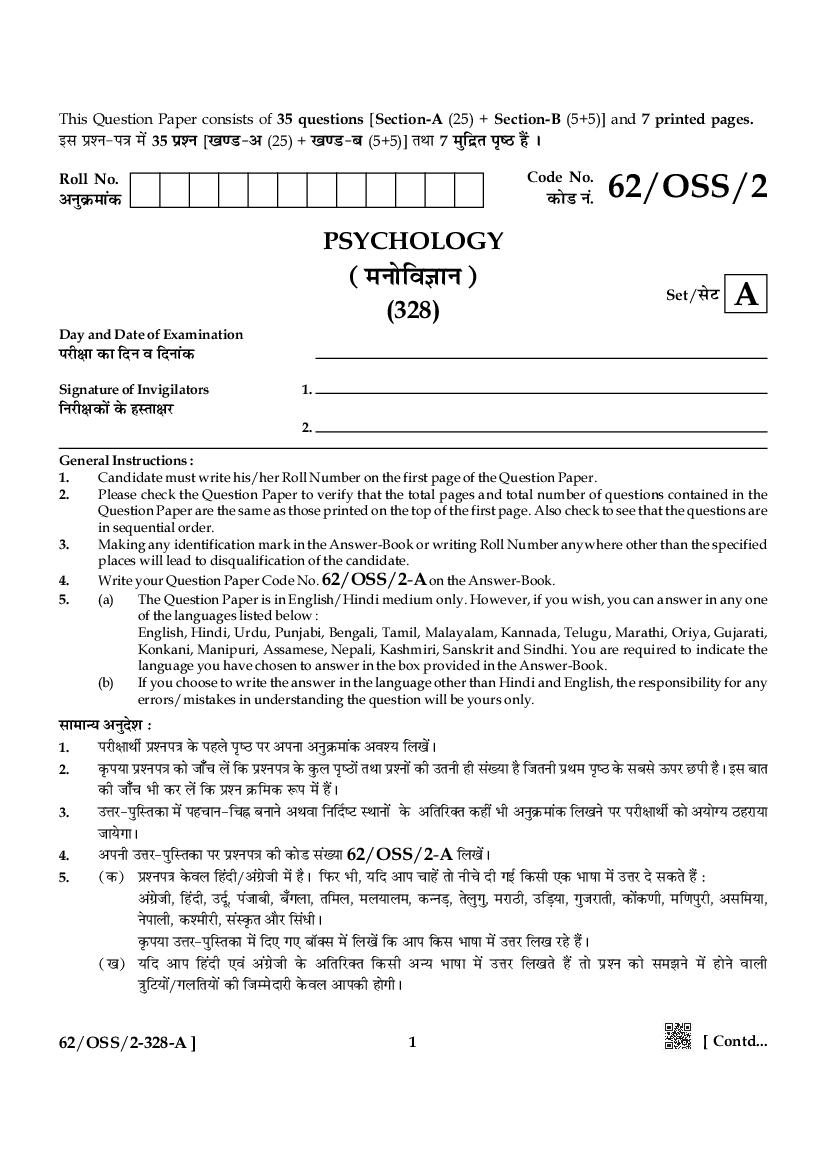
ß‚ ¬˝‡Ÿ-¬òÊ ◊¥ 35 ¬˝‡Ÿ [πá«U-• (25) + πá«U-’ (5+5)] ÃÕÊ 7 ◊ÈÁŒ˝Ã ¬Îc∆U „Ò¥ –
Roll No. Code No.
•ŸÈ∑˝§◊Ê¥∑§ ∑§Ê«U Ÿ¥. 62/OSS/2
PSYCHOLOGY
(◊ŸÊÁflôÊÊŸ)
(328)
Set/‚≈U A
Day and Date of Examination
¬⁄UˡÊÊ ∑§Ê ÁŒŸ fl ÁŒŸÊ¥∑§
Signature of Invigilators 1.
ÁŸ⁄UˡÊ∑§Ê¥ ∑§ „SÃÊˇÊ⁄U
2.
General Instructions :
1. Candidate must write his/her Roll Number on the first page of the Question Paper.
2. Please check the Question Paper to verify that the total pages and total number of questions contained in the
Question Paper are the same as those printed on the top of the first page. Also check to see that the questions are
in sequential order.
3. Making any identification mark in the Answer-Book or writing Roll Number anywhere other than the specified
places will lead to disqualification of the candidate.
4. Write your Question Paper Code No. 62/OSS/2-A on the Answer-Book.
5. (a) The Question Paper is in English/Hindi medium only. However, if you wish, you can answer in any one
of the languages listed below :
English, Hindi, Urdu, Punjabi, Bengali, Tamil, Malayalam, Kannada, Telugu, Marathi, Oriya, Gujarati,
Konkani, Manipuri, Assamese, Nepali, Kashmiri, Sanskrit and Sindhi. You are required to indicate the
language you have chosen to answer in the box provided in the Answer-Book.
(b) If you choose to write the answer in the language other than Hindi and English, the responsibility for any
errors/mistakes in understanding the question will be yours only.
‚Ê◊Êãÿ •ŸÈŒ‡Ê —
1. ¬⁄UˡÊÊÕ˸ ¬˝‡Ÿ¬òÊ ∑§ ¬„‹ ¬Îc∆U ¬⁄U •¬ŸÊ •ŸÈ∑˝§◊Ê¥∑§ •fl‡ÿU Á‹π¥–
2. ∑Χ¬ÿÊ ¬˝‡Ÿ¬òÊ ∑§Ê ¡ÊÚ°ø ‹¥ Á∑§ ¬˝‡Ÿ¬òÊ ∑§ ∑ȧ‹ ¬Îc∆UÊ¥ ÃÕÊ ¬˝‡ŸÊ¥ ∑§Ë ©ÃŸË „Ë ‚¥ÅUÿÊ „Ò Á¡ÃŸË ¬˝Õ◊ ¬Îc∆ ∑ §‚’‚ ™§¬⁄U ¿U¬Ë „Ò– ß‚ ’ÊÃ
∑§Ë ¡ÊÚ°ø ÷Ë ∑§⁄U ‹¥ Á∑§ ¬˝‡Ÿ ∑˝ Á◊∑§ UM§¬ ◊¥ „Ò¥–
3. § ©ûÊ⁄U-¬ÈÁSUÃ∑§Ê ◊¥ ¬„øÊŸ-Áøq ’ŸÊŸ •ÕflÊ ÁŸÁŒ¸c≈U SÕÊŸÊ¥ ∑§§ •ÁÃÁ⁄UÄà ∑§„Ë¥ ÷Ë •ŸÈ∑˝§◊Ê¥∑§ Á‹πŸ ¬⁄U ¬⁄UˡÊÊÕ˸ ∑§Ê •ÿÊÇÿ ∆U„⁄UÊÿÊ
¡ÊÿªÊ–
4. •¬ŸË ©ûÊ⁄U-¬ÈÁSUÃ∑§Ê ¬⁄U ¬˝‡Ÿ¬òÊ ∑§Ë ∑§Ê«U ‚¥ÅÿÊ 62/OSS/2-A Á‹π¥–
5. (∑§) ¬˝‡Ÿ¬òÊ ∑§fl‹ Á„¥ŒË/•¥ª˝¡Ë ◊¥ „Ò– Á»§⁄U ÷Ë, ÿÁŒ •Ê¬ øÊ„¥ ÃÊ ŸËø ŒË ªß¸ Á∑§‚Ë ∞∑§ ÷Ê·Ê ◊¥ ©ûÊ⁄ Œ ‚∑§Ã „Ò¥ —
•¥ª˝¡Ë, Á„¥ŒË, ©ŒÍ¸, ¬¥¡Ê’Ë, ’°ª‹Ê, ÃÁ◊‹, ◊‹ÿÊ‹◊, ∑§ãŸ«∏, ËȪÈ, ◊⁄UÊ∆UË, ©Á«∏ÿÊ, ªÈ¡⁄UÊÃË, ∑§Ê¥∑§áÊË, ◊ÁáʬÈ⁄UË, •‚Á◊ÿÊ,
Ÿ¬Ê‹Ë, ∑§‡◊Ë⁄UË, ‚¥S∑Χç•ÊÒ⁄U Á‚¥œË–
∑Χ¬ÿÊ ©ûÊ⁄U-¬ÈÁSÃ∑§Ê ◊¥ ÁŒ∞ ª∞ ’ÊÚÄ‚ ◊¥ Á‹π¥ Á∑§ •Ê¬ Á∑§‚ ÷Ê·Ê ◊¥ ©ûÊ⁄U Á‹π ⁄U„ „Ò¥– §
(π) ÿÁŒ •Ê¬ Á„¥ŒË ∞fl¥ •¥ª˝¡Ë ∑§ •ÁÃÁ⁄UÄà Á∑§‚Ë •ãÿ ÷Ê·Ê ◊¥ ©ûÊ⁄U Á‹πà „Ò¥ ÃÊ ¬˝‡Ÿ ∑§Ê ‚◊¤ÊŸ ◊¥ „ÊŸ flÊ‹Ë
òÊÈÁ≈UÿÊ¥/ª‹ÁÃÿÊ¥ ∑§Ë Á¡ê◊UŒÊ⁄Ë ∑ fl‹ •Ê¬∑§Ë „ʪ˖
62/OSS/2-328-A ] 1 [ Contd...
Page 2
(◊ŸÊÁflôÊÊŸ)
(328)
Time : 3 Hours ] [ Maximum Marks : 100
‚◊ÿ — 3 ÉÊá≈U ] [ ¬ÍáÊÊZ∑§ — 100
Note : (i) This Question Paper consists of two Sections, viz., ‘A’ and ‘B’.
(ii) All questions from Section ‘A’ are to be attempted.
(iii) Section ‘B’ has two options. Candidates are required to attempt questions from one
option only.
(iv) Marks are indicated against each question.
(v) For multiple-choice questions, choose the correct answer from the four options (A), (B),
(C) or (D) and write it in your answer-book.
ÁŸŒ¸‡Ê — (i) ß‚ ¬˝‡Ÿ-¬òÊ ◊¥ ŒÊ πá«U „Ò¥ - πá«U “•” ∞fl¥ πá«U “’”–
(ii) πá«U “•” ∑§ ‚÷Ë ¬˝‡ŸÊ¥ ∑§Ê „‹ ∑§⁄UŸÊ „Ò¥–
(iii) πá«U “’” ◊¥ ŒÊ Áfl∑§À¬ „Ò¥– ¬⁄UˡÊÊÁÕ¸ÿÊ¥ ∑§Ê ∑§fl‹ ∞∑§ Áfl∑§À¬ ∑§ „Ë ¬˝‡ŸÊ¥ ∑§ ©ûÊ⁄U ŒŸ „Ò¥–
(iv) ¬˝àÿ∑§ ¬˝‡Ÿ ∑§Ê •¥∑§ ©‚∑§ ‚Ê◊Ÿ •¥Á∑§Ã „Ò¥–
(v) ’„ÈÁfl∑§À¬Ëÿ ¬˝‡ŸÊ¥ ∑§ Á‹∞, øÊ⁄U Áfl∑§À¬Ê¥ (A), (B), (C) •ÕflÊ (D) ◊¥ ‚ ‚„Ë ©ûÊ⁄U ∑§Ê øÿŸ ∑§⁄¥U •ÊÒ⁄U ©‚
•¬ŸË ©ûÊ⁄U-¬ÈÁSÃ∑§Ê ◊¥ Á‹π¥–
SECTION - A/πá«U-•
1. Perception is influenced by many factors. Which of the following are the most common ? 1
(A) Needs and motives (B) Altruism and philanthropy
(C) Cast and color (D) Conditional stimulus and response
¬˝àÿˇÊË∑§⁄UáÊ ∑§ß¸ ∑§Ê⁄U∑§Ê¥ ‚ ¬˝÷ÊÁflà „ÊÃÊ „Ò– ÁŸêŸÁ‹Áπà ◊¥ ‚ ∑§ÊÒŸ ‚ ‚’‚ •Áœ∑§ ‚È‹÷ „¥Ò?
(A) •Êfl‡ÿ∑§ÃÊ∞° ∞fl¥ ¬˝ÿÊ¡Ÿ (B) ¬⁄U◊ÊÕ¸ ∞fl¥ ¬⁄Uʬ∑§Ê⁄UË
(C) ¡ÊÁà ∞fl¥ ⁄¥Uª (D) •ŸÈ∑ͧÁ‹Ã ©Œ˜ŒË¬Ÿ ÃÕÊ ¬˝ÁÃÁ∑˝§ÿÊ
2. Development occurs through which two main processes ? 1
(A) Maturation and learning (B) Eating and sleeping
(C) Reading and writing (D) Assimilating and accommodation
Áfl∑§Ê‚ Á∑§Ÿ ŒÊ ¬˝Á∑˝§ÿÊ•Ê¥ mÊ⁄UÊ „ÊÃÊ „Ò?
(A) ¬Á⁄U¬ÄflÃÊ ÃÕÊ ‚Ëπ (B) πÊŸÊ ÃÕÊ ‚ÊŸÊ
(C) ¬…∏ŸÊ ÃÕÊ Á‹πŸÊ (D) •Êà◊‚ÊÃ∑§⁄UáÊ ÃÕÊ ‚◊ÊÿÊ¡Ÿ
62/OSS/2-328-A ] 2 [ Contd...
Page 3
(A) Conflicts and motives (B) Traits and perceptions
(C) Reward and punishment (D) Aims and aspirations
◊ŸÊÁfl‡‹·∑§ ŒÎÁc≈U∑§ÊáÊ ◊¥ √ÿÁÄà ∑§ __________ ÃÕÊ __________¬⁄U ∑§ÁãŒ˝Ã Á∑§ÿÊ ¡ÊÃÊ „Ò–
(A) •¥ÃmZmÊ¥ ÃÕÊ •Á÷¬˝⁄U∑§Ê¥ (B) ªÈáÊÊ¥ ÃÕÊ ¬˝àÿˇÊË∑§⁄UáÊÊ¥
(C) ¬È⁄US∑§Ê⁄U ÃÕÊ ‚$¡Ê (D) ©g‡ÿ ÃÕÊ øÊ„Ã
4. Group involves interdependence of which of the following factors ? 1
(A) Behaviour and outcome (B) Focus and regulation
(C) Affect and affiliation (D) Decision and facilitation
ÁŸêŸ ◊¥ ‚ Á∑§‚ ∑§Ê⁄U∑§ ¬⁄U ‚◊Í„ ∑§Ë ¬⁄US¬⁄U ÁŸ÷¸⁄UÃÊ ÁŸÁ„à „Ò?
(A) √ÿfl„Ê⁄U ÃÕÊ ¬Á⁄UáÊÊ◊ (B) ∑§ãŒ˝∑§ ÃÕÊ ÁŸÿ◊Ÿ
(C) ¬˝÷Êfl ÃÕÊ ‚¥’¥œ (D) ÁŸáʸÿ ÃÕÊ ‚ÈÁflœÊ
5. Which of the following is a type of environment ? 1
(A) Physical (B) Social and Cultural
(C) Psychological (D) All of them
ÁŸêŸ ◊¥ ‚ ∑§ÊÒŸ ‚Ê ¬ÿʸfl⁄UáÊ ∑§Ê ∞∑§ ¬˝∑§Ê⁄U „Ò?
(A) ÷ÊÒÁÃ∑§ (B) ‚Ê◊ÊÁ¡∑§ ÃÕÊ ‚Ê¥S∑ΧÁÃ∑§
(C) ◊ŸÊflÒôÊÊÁŸ∑§ (D) ©¬⁄UÊÄà ‚÷Ë
6. What is nerve impulse ? 2
Ã¥ÁòÊ∑§Ê •Êflª ÄÿÊ „Ò?
7. Rita has the mental age of 12 on her 10th birthday. What is her IQ ? 2
⁄UË≈UÊ ∑§Ë 10 fl¥ ¡ã◊ÁŒŸ ¬⁄U ◊ÊŸÁ‚∑§ •ÊÿÈ 12 „Ò– ©‚∑§Ë ’ÈÁh ‹Áéœ ÄÿÊ „Ò?
62/OSS/2-328-A ] 3 [ Contd...
Page 4
•Êà◊ ‚ê◊ÊŸ ÄÿÊ „Ò?
9. What is psychological environment ? 2
◊ŸÊflÒôÊÊÁŸ∑§ ¬ÿʸfl⁄UáÊ ÄÿÊ „Ò?
10. How can primary prevention promote wellbeing ? 2
¬˝ÊÕÁ◊∑§ ⁄UÊ∑§ÕÊ◊ Á∑§‚ ¬˝∑§Ê⁄U ∑ȧ‡Ê‹ˇÊ◊ ∑§Ê ¬˝ÊãŸÃ ∑§⁄U ‚∑§ÃË „Ò?
11. What are the ethical consideration in psychological studies ? 4
◊ŸÊflÒôÊÊÁŸ∑§ •äÿÿŸÊ¥ ◊¥ ∑§ÊÒŸ ‚ ŸÒÁÃ∑§ ÁfløÊ⁄UÊ¥ ∑§Ê •¬ŸÊŸÊ „ÊÃÊ „Ò?
12. Explain the most common human emotions one can experience. 4
•àÿÊÁœ∑§ ‚Ê◊Êãÿ ◊ÊŸfl ‚¥flªÊ¥ ∑§Ê •ŸÈ÷fl ∑§Ê߸ ∑§⁄U ‚∑§ÃÊ „Ò, ©Ÿ∑§Ë √ÿÊÅÿÊ ∑§ËÁ¡∞–
13. Elaborate on the first four Maslow’s hierarchy of needs. 4
◊ÊS‹Ê ∑§Ë ¬„‹Ë øÊ⁄U •Êfl‡ÿ∑§ÃÊ •Áœ∑˝§◊ ∑§Ê ÁflSÃÊ⁄U ŒËÁ¡∞–
14. Describe different ways to enhance memory. 4
S◊ÎÁà ‚¥flœ¸Ÿ ∑§ ÁflÁ÷ÛÊ Ã⁄UË∑§Ê¥ ∑§Ê fláʸŸ ∑§ËÁ¡∞–
15. What are the various approaches to study development ? Explain briefly. 4
Áfl∑§Ê‚ ∑§ •äÿÿŸ ∑§ Á‹∞ ÁflÁ÷ÛÊ ŒÎÁc≈U∑§ÊáÊ ÄÿÊ „Ò¥? ‚¥ˇÊ¬ ◊¥ √ÿÊÅÿÊ ∑§ËÁ¡∞–
16. According to Piaget, there are four stages of cognitive development. Discuss. 4
Á¬ÿÊ¡ ∑§ •ŸÈ‚Ê⁄U ‚¥ôÊÊŸÊà◊∑§ Áfl∑§Ê‚ ∑§ øÊ⁄U ø⁄UáÊ „Ò¥– øøʸ ∑§ËÁ¡∞–
62/OSS/2-328-A ] 4 [ Contd...
Page 5
»˝§Êÿ«U ∑§ •ŸÈ‚Ê⁄U √ÿÁÄÃàfl ∑§Ë ‚¥⁄UøŸÊ ÄÿÊ „Ò?
18. According to the Indian approach to personality, elaborate on the concept of Gunas. 4
√ÿÁÄÃàfl ∑§ Á‹∞ ÷Ê⁄UÃËÿ ŒÎÁc≈U∑§ÊáÊ ∑§ •ŸÈ‚Ê⁄U ªÈáÊÊ¥ ∑§Ë •flœÊ⁄UáÊÊ ∑§Ê ‚ÈÁflSÃÊ⁄U ŒËÁ¡∞–
19. Identify the reasons why do people join groups ? 4
©Ÿ ∑§Ê⁄UáÊÊ¥ ∑§Ë ¬„øÊŸ ∑§ËÁ¡∞ Á∑§ ‹Êª ‚◊Í„ ◊¥ ÄÿÊ¥ ‚Áê◊Á‹Ã „Êà „Ò¥?
20. What is the effect of group on individual ? 4
Á∑§‚Ë √ÿÁÄà ¬⁄U ‚◊Í„ ∑§Ê ÄÿÊ ¬˝÷Êfl ¬«∏ÃÊ „Ò?
21. What are the various approaches or perspectives to understand human behaviour ? Explain. 6
◊ÊŸflËÿ √ÿfl„Ê⁄U ∑§Ê ‚◊¤ÊŸ „ÃÈ ÁflÁ÷ÛÊ ¬Á⁄U¬˝ˇÿ ∑§ÊÒŸ ‚ „Ò¥? √ÿÊÅÿÊ ∑§ËÁ¡∞–
22. “Learning is influenced by many factors”. Elaborate. 6
““‚ËπŸ ∑§Ê ¬˝÷ÊÁflà ∑§⁄UŸ flÊ‹ •Ÿ∑§ ∑§Ê⁄U∑§ „Ò¥””– ‚ÈÁflSÃÊ⁄U ŒËÁ¡∞–
23. Elaborate on the various aspects or areas of human development. 6
◊ÊŸfl Áfl∑§Ê‚ ∑§ ÁflÁ÷ÛÊ ˇÊòÊÊ¥ ∑§Ê ‚ÈÁflSÃÊ⁄U ŒËÁ¡∞–
24. What are the steps for self-instructional training ? 6
•Êà◊ ÁŸŒ¸‡ÊÊà◊∑§ ¬˝Á‡ÊˇÊáÊ ∑§ ∑§ÊÒŸ ‚ ø⁄UáÊ „Ò¥?
25. Explain the main aspects which are kept in mind while dealing with the social world. 6
‚Ê◊ÊÁ¡∑§ ¡ªÃ ∑§ ¬˝Áà √ÿfl„Ê⁄U ∑§⁄Uà ‚◊ÿ Á¡Ÿ ◊ÈÅÿ ¬ˇÊÊ¥ ∑§Ê äÿÊŸ ◊¥ ⁄UπÊ ¡ÊÃÊ „Ò, ©Ÿ∑§Ë √ÿÊÅÿÊ ∑§ËÁ¡∞–
62/OSS/2-328-A ] 5 [ Contd...
Page 6
OPTION - I/Áfl∑§À¬ - I
World of Work/∑§Êÿ¸ ¡ªÃ
26. Claustrophobia is the fear of __________. 1
(A) Climbing (B) Closed place
(C) Clouds (D) Challenges
‚¥flÎÃ-SÕÊŸ ÷ËÁà «U⁄U „Ò __________.
(A) ø…∏Ÿ ∑§Ê (B) ’¥Œ SÕÊŸÊ¥ ∑§Ê
(C) ’ÊŒ‹Ê¥ ∑§Ê (D) øÈŸÊÒÁÃÿÊ¥ ∑§Ê
27. State the affective reactions to stress. 2
Œ’Êfl ∑§ ¬˝Áà ÷ÊflÊà◊∑§ ¬˝ÁÃÁ∑˝§ÿÊ•Ê¥ ∑§Ê ©À‹π ∑§ËÁ¡∞–
28. Define work motivation. 2
∑§Êÿ¸ ¬˝Êà‚Ê„Ÿ ∑§Ë ¬Á⁄U÷Ê·Ê ŒËÁ¡∞–
29. Discuss the stages of vocational development. 4
√ÿÊfl‚ÊÁÿ∑§ Áfl∑§Ê‚ ∑§ ø⁄UáÊÊ¥ ¬⁄U øøʸ ∑§ËÁ¡∞–
30. Explain the various job-related requirements in the world of work. 6
∑§Êÿ¸ ¡ªÃ ◊¥ ÁflÁ÷ÛÊ ŸÊÒ∑§Á⁄UÿÊ¥ ‚ ‚¥’¥ÁœÃ •„¸ÃÊ•Ê¥ ∑§Ë √ÿÊÅÿÊ ∑§ËÁ¡∞–
62/OSS/2-328-A ] 6 [ Contd...
Page 7
Facilitating Early Childhood Education/’ø¬Ÿ ∑§Ë Á‡ÊˇÊÊ
26. Parental involvement method in a play centre include : 1
(A) Social function
(B) Home visit
(C) Parent education
(D) All of the above
Á∑§‚Ë å‹ ‚¥≈U⁄U ◊¥ ◊ÊÃÊ-Á¬ÃÊ ∑§Ë ‚ÛÊÁ‹åÃÃÊ ∑§Ê Ã⁄UË∑§Ê „Ò —
(A) ‚Ê◊ÊÁ¡∑§ ‚◊Ê⁄UÊ„
(B) ÉÊ⁄U ∑§Ê ŒÊÒ⁄UÊ
(C) •Á÷÷Êfl∑§Ê¥ ∑§Ê Á‡ÊÁˇÊà ∑§⁄UŸÊ
(D) ©¬⁄UÊÄà ‚÷Ë
27. What is the scope of parental involvement in a play centre ? 2
Á∑§‚Ë å‹ ‚¥≈U⁄U ◊¥ ◊ÊÃÊ-Á¬ÃÊ ∑§Ë ‚ãŸÁ‹åÃÃÊ ∑§Ê ∑§Êÿ¸-ˇÊòÊ ÄÿÊ „Ò?
28. What is the design characteristics of a good play equipment ? 2
π‹ ∑§ •ë¿U ©¬∑§⁄UáÊ ∑§Ë ÄÿÊ Áfl‡Ê·ÃÊ∞° „Ò¥?
29. Elaborate on the basic forms of discipline. 4
•ŸÈ‡ÊÊ‚Ÿ ∑§ ◊͋Ø ¬˝∑§Ê⁄UÊ¥ ¬⁄U ‚ÈÁflSÃÊ⁄U ŒËÁ¡∞–
30. Explain the characteristics of development of children in early childhood. 6
¬˝Ê⁄¥UÁ÷∑§ ’ÊÀÿ∑§Ê‹ ◊¥ Áfl∑§Ê‚ ∑§Ë Áfl‡Ê·ÃÊ•Ê¥ ∑§Ë √ÿÊÅÿÊ ∑§ËÁ¡∞–
-o0o-
62/OSS/2-328-A ] 7 [ Contd...
Page 9
ß‚ ¬˝‡Ÿ-¬òÊ ◊¥ 35 ¬˝‡Ÿ [πá«U-• (25) + πá«U-’ (5+5)] ÃÕÊ 7 ◊ÈÁŒ˝Ã ¬Îc∆U „Ò¥ –
Roll No. Code No.
•ŸÈ∑˝§◊Ê¥∑§ ∑§Ê«U Ÿ¥. 62/OSS/2
PSYCHOLOGY
(◊ŸÊÁflôÊÊŸ)
(328)
Set/‚≈U B
Day and Date of Examination
¬⁄UˡÊÊ ∑§Ê ÁŒŸ fl ÁŒŸÊ¥∑§
Signature of Invigilators 1.
ÁŸ⁄UˡÊ∑§Ê¥ ∑§ „SÃÊˇÊ⁄U
2.
General Instructions :
1. Candidate must write his/her Roll Number on the first page of the Question Paper.
2. Please check the Question Paper to verify that the total pages and total number of questions contained in the
Question Paper are the same as those printed on the top of the first page. Also check to see that the questions are
in sequential order.
3. Making any identification mark in the Answer-Book or writing Roll Number anywhere other than the specified
places will lead to disqualification of the candidate.
4. Write your Question Paper Code No. 62/OSS/2-B on the Answer-Book.
5. (a) The Question Paper is in English/Hindi medium only. However, if you wish, you can answer in any one
of the languages listed below :
English, Hindi, Urdu, Punjabi, Bengali, Tamil, Malayalam, Kannada, Telugu, Marathi, Oriya, Gujarati,
Konkani, Manipuri, Assamese, Nepali, Kashmiri, Sanskrit and Sindhi. You are required to indicate the
language you have chosen to answer in the box provided in the Answer-Book.
(b) If you choose to write the answer in the language other than Hindi and English, the responsibility for any
errors/mistakes in understanding the question will be yours only.
‚Ê◊Êãÿ •ŸÈŒ‡Ê —
1. ¬⁄UˡÊÊÕ˸ ¬˝‡Ÿ¬òÊ ∑§ ¬„‹ ¬Îc∆U ¬⁄U •¬ŸÊ •ŸÈ∑˝§◊Ê¥∑§ •fl‡ÿU Á‹π¥–
2. ∑Χ¬ÿÊ ¬˝‡Ÿ¬òÊ ∑§Ê ¡ÊÚ°ø ‹¥ Á∑§ ¬˝‡Ÿ¬òÊ ∑§ ∑ȧ‹ ¬Îc∆UÊ¥ ÃÕÊ ¬˝‡ŸÊ¥ ∑§Ë ©ÃŸË „Ë ‚¥ÅUÿÊ „Ò Á¡ÃŸË ¬˝Õ◊ ¬Îc∆ ∑ §‚’‚ ™§¬⁄U ¿U¬Ë „Ò– ß‚ ’ÊÃ
∑§Ë ¡ÊÚ°ø ÷Ë ∑§⁄U ‹¥ Á∑§ ¬˝‡Ÿ ∑˝ Á◊∑§ UM§¬ ◊¥ „Ò¥–
3. § ©ûÊ⁄U-¬ÈÁSUÃ∑§Ê ◊¥ ¬„øÊŸ-Áøq ’ŸÊŸ •ÕflÊ ÁŸÁŒ¸c≈U SÕÊŸÊ¥ ∑§§ •ÁÃÁ⁄UÄà ∑§„Ë¥ ÷Ë •ŸÈ∑˝§◊Ê¥∑§ Á‹πŸ ¬⁄U ¬⁄UˡÊÊÕ˸ ∑§Ê •ÿÊÇÿ ∆U„⁄UÊÿÊ
¡ÊÿªÊ–
4. •¬ŸË ©ûÊ⁄U-¬ÈÁSUÃ∑§Ê ¬⁄U ¬˝‡Ÿ¬òÊ ∑§Ë ∑§Ê«U ‚¥ÅÿÊ 62/OSS/2-B Á‹π¥–
5. (∑§) ¬˝‡Ÿ¬òÊ ∑§fl‹ Á„¥ŒË/•¥ª˝¡Ë ◊¥ „Ò– Á»§⁄U ÷Ë, ÿÁŒ •Ê¬ øÊ„¥ ÃÊ ŸËø ŒË ªß¸ Á∑§‚Ë ∞∑§ ÷Ê·Ê ◊¥ ©ûÊ⁄ Œ ‚∑§Ã „Ò¥ —
•¥ª˝¡Ë, Á„¥ŒË, ©ŒÍ¸, ¬¥¡Ê’Ë, ’°ª‹Ê, ÃÁ◊‹, ◊‹ÿÊ‹◊, ∑§ãŸ«∏, ËȪÈ, ◊⁄UÊ∆UË, ©Á«∏ÿÊ, ªÈ¡⁄UÊÃË, ∑§Ê¥∑§áÊË, ◊ÁáʬÈ⁄UË, •‚Á◊ÿÊ,
Ÿ¬Ê‹Ë, ∑§‡◊Ë⁄UË, ‚¥S∑Χç•ÊÒ⁄U Á‚¥œË–
∑Χ¬ÿÊ ©ûÊ⁄U-¬ÈÁSÃ∑§Ê ◊¥ ÁŒ∞ ª∞ ’ÊÚÄ‚ ◊¥ Á‹π¥ Á∑§ •Ê¬ Á∑§‚ ÷Ê·Ê ◊¥ ©ûÊ⁄U Á‹π ⁄U„ „Ò¥– §
(π) ÿÁŒ •Ê¬ Á„¥ŒË ∞fl¥ •¥ª˝¡Ë ∑§ •ÁÃÁ⁄UÄà Á∑§‚Ë •ãÿ ÷Ê·Ê ◊¥ ©ûÊ⁄U Á‹πà „Ò¥ ÃÊ ¬˝‡Ÿ ∑§Ê ‚◊¤ÊŸ ◊¥ „ÊŸ flÊ‹Ë
òÊÈÁ≈UÿÊ¥/ª‹ÁÃÿÊ¥ ∑§Ë Á¡ê◊UŒÊ⁄Ë ∑ fl‹ •Ê¬∑§Ë „ʪ˖
62/OSS/2-328-B ] 1 [ Contd...
Page 10
(◊ŸÊÁflôÊÊŸ)
(328)
Time : 3 Hours ] [ Maximum Marks : 100
‚◊ÿ — 3 ÉÊá≈U ] [ ¬ÍáÊÊZ∑§ — 100
Note : (i) This Question Paper consists of two Sections, viz., ‘A’ and ‘B’.
(ii) All questions from Section ‘A’ are to be attempted.
(iii) Section ‘B’ has two options. Candidates are required to attempt questions from one
option only.
(iv) Marks are indicated against each question.
(v) For multiple-choice questions, choose the correct answer from the four options (A), (B),
(C) or (D) and write it in your answer-book.
ÁŸŒ¸‡Ê — (i) ß‚ ¬˝‡Ÿ-¬òÊ ◊¥ ŒÊ πá«U „Ò¥ - πá«U “•” ∞fl¥ πá«U “’”–
(ii) πá«U “•” ∑§ ‚÷Ë ¬˝‡ŸÊ¥ ∑§Ê „‹ ∑§⁄UŸÊ „Ò¥–
(iii) πá«U “’” ◊¥ ŒÊ Áfl∑§À¬ „Ò¥– ¬⁄UˡÊÊÁÕ¸ÿÊ¥ ∑§Ê ∑§fl‹ ∞∑§ Áfl∑§À¬ ∑§ „Ë ¬˝‡ŸÊ¥ ∑§ ©ûÊ⁄U ŒŸ „Ò¥–
(iv) ¬˝àÿ∑§ ¬˝‡Ÿ ∑§Ê •¥∑§ ©‚∑§ ‚Ê◊Ÿ •¥Á∑§Ã „Ò¥–
(v) ’„ÈÁfl∑§À¬Ëÿ ¬˝‡ŸÊ¥ ∑§ Á‹∞, øÊ⁄U Áfl∑§À¬Ê¥ (A), (B), (C) •ÕflÊ (D) ◊¥ ‚ ‚„Ë ©ûÊ⁄U ∑§Ê øÿŸ ∑§⁄¥U •ÊÒ⁄U ©‚
•¬ŸË ©ûÊ⁄U-¬ÈÁSÃ∑§Ê ◊¥ Á‹π¥–
SECTION - A/πá«U-•
1. In the Psychoanalytic approach focus is on a person’s __________ and __________. 1
(A) Conflicts and motives (B) Traits and perceptions
(C) Reward and punishment (D) Aims and aspirations
◊ŸÊÁfl‡‹·∑§ ŒÎÁc≈U∑§ÊáÊ ◊¥ √ÿÁÄà ∑§ __________ ÃÕÊ __________¬⁄U ∑§ÁãŒ˝Ã Á∑§ÿÊ ¡ÊÃÊ „Ò–
(A) •¥ÃmZmÊ¥ ÃÕÊ •Á÷¬˝⁄U∑§Ê¥ (B) ªÈáÊÊ¥ ÃÕÊ ¬˝àÿˇÊË∑§⁄UáÊÊ¥
(C) ¬È⁄US∑§Ê⁄U ÃÕÊ ‚$¡Ê (D) ©g‡ÿ ÃÕÊ øÊ„Ã
62/OSS/2-328-B ] 2 [ Contd...
Page 11
(A) Needs and motives (B) Altruism and philanthropy
(C) Cast and color (D) Conditional stimulus and response
¬˝àÿˇÊË∑§⁄UáÊ ∑§ß¸ ∑§Ê⁄U∑§Ê¥ ‚ ¬˝÷ÊÁflà „ÊÃÊ „Ò– ÁŸêŸÁ‹Áπà ◊¥ ‚ ∑§ÊÒŸ ‚ ‚’‚ •Áœ∑§ ‚È‹÷ „Ò¥?
(A) •Êfl‡ÿ∑§ÃÊ∞° ∞fl¥ ¬˝ÿÊ¡Ÿ (B) ¬⁄U◊ÊÕ¸ ∞fl¥ ¬⁄Uʬ∑§Ê⁄UË
(C) ¡ÊÁà ∞fl¥ ⁄¥Uª (D) •ŸÈ∑ͧÁ‹Ã ©Œ˜ŒË¬Ÿ ÃÕÊ ¬˝ÁÃÁ∑˝§ÿÊ
3. Group involves interdependence of which of the following factors ? 1
(A) Behaviour and outcome (B) Focus and regulation
(C) Affect and affiliation (D) Decision and facilitation
ÁŸêŸ ◊¥ ‚ Á∑§‚ ∑§Ê⁄U∑§ ¬⁄U ‚◊Í„ ∑§Ë ¬⁄US¬⁄U ÁŸ÷¸⁄UÃÊ ÁŸÁ„à „Ò?
(A) √ÿfl„Ê⁄U ÃÕÊ ¬Á⁄UáÊÊ◊ (B) ∑§ãŒ˝∑§ ÃÕÊ ÁŸÿ◊Ÿ
(C) ¬˝÷Êfl ÃÕÊ ‚¥’¥œ (D) ÁŸáʸÿ ÃÕÊ ‚ÈÁflœÊ
4. Which of the following is a type of environment ? 1
(A) Physical (B) Social and Cultural
(C) Psychological (D) All of them
ÁŸêŸ ◊¥ ‚ ∑§ÊÒŸ ‚Ê ¬ÿʸfl⁄UáÊ ∑§Ê ∞∑§ ¬˝∑§Ê⁄U „Ò?
(A) ÷ÊÒÁÃ∑§ (B) ‚Ê◊ÊÁ¡∑§ ÃÕÊ ‚Ê¥S∑ΧÁÃ∑§
(C) ◊ŸÊflÒôÊÊÁŸ∑§ (D) ©¬⁄UÊÄà ‚÷Ë
5. Development occurs through which two main processes ? 1
(A) Maturation and learning (B) Eating and sleeping
(C) Reading and writing (D) Assimilating and accommodation
Áfl∑§Ê‚ Á∑§Ÿ ŒÊ ¬˝Á∑˝§ÿÊ•Ê¥ mÊ⁄UÊ „ÊÃÊ „Ò?
(A) ¬Á⁄U¬ÄflÃÊ ÃÕÊ ‚Ëπ (B) πÊŸÊ ÃÕÊ ‚ÊŸÊ
(C) ¬…∏ŸÊ ÃÕÊ Á‹πŸÊ (D) •Êà◊‚ÊÃ∑§⁄UáÊ ÃÕÊ ‚◊ÊÿÊ¡Ÿ
62/OSS/2-328-B ] 3 [ Contd...
Page 12
•Êà◊ ‚ê◊ÊŸ ÄÿÊ „Ò?
7. How can primary prevention promote wellbeing ? 2
¬˝ÊÕÁ◊∑§ ⁄UÊ∑§ÕÊ◊ Á∑§‚ ¬˝∑§Ê⁄U ∑ȧ‡Ê‹ˇÊ◊ ∑§Ê ¬˝ÊãŸÃ ∑§⁄U ‚∑§ÃË „Ò?
8. What is nerve impulse ? 2
Ã¥ÁòÊ∑§Ê •Êflª ÄÿÊ „Ò?
9. Rita has the mental age of 12 on her 10th birthday. What is her IQ ? 2
⁄UË≈UÊ ∑§Ë 10 fl¥ ¡ã◊ÁŒŸ ¬⁄U ◊ÊŸÁ‚∑§ •ÊÿÈ 12 „Ò– ©‚∑§Ë ’ÈÁh ‹Áéœ ÄÿÊ „Ò?
10. What is psychological environment ? 2
◊ŸÊflÒôÊÊÁŸ∑§ ¬ÿʸfl⁄UáÊ ÄÿÊ „Ò?
11. How is the knowledge of the principles of development important ? Explain briefly. 4
Áfl∑§Ê‚ ∑§ Á‚hÊ¥ÃÊ¥ ∑§Ë ¡ÊŸ∑§Ê⁄UË ∑Ò§‚ ◊„àfl¬Íáʸ „Ò? ‚¥ˇÊ¬ ◊¥ √ÿÊÅÿÊ ∑§ËÁ¡∞–
12. According to Piaget, there are four stages of cognitive development. Discuss. 4
Á¬ÿÊ¡ ∑§ •ŸÈ‚Ê⁄U ‚¥ôÊÊŸÊà◊∑§ Áfl∑§Ê‚ ∑§ øÊ⁄U ø⁄UáÊ „Ò¥– øøʸ ∑§ËÁ¡∞–
13. Briefly explain the trait perspective with reference to the theories of personality. 4
√ÿÁÄÃàfl ∑§ Á‚hÊ¥ÃÊ¥ ∑§ ‚¥Œ÷¸ ◊¥ ‡ÊË‹ ªÈáÊ Á‚hʥà ∑§Ë ‚¥ˇÊ¬ ◊¥ √ÿÊÅÿÊ ∑§ËÁ¡∞–
14. Elaborate on the first four Maslow’s hierarchy of needs. 4
◊ÊS‹Ê ∑§Ë ¬„‹Ë øÊ⁄U •Êfl‡ÿ∑§ÃÊ •Áœ∑˝§◊ ∑§Ê ÁflSÃÊ⁄U ŒËÁ¡∞–
62/OSS/2-328-B ] 4 [ Contd...
Page 13
S◊ÎÁà ‚¥flœ¸Ÿ ∑§ ÁflÁ÷ÛÊ Ã⁄UË∑§Ê¥ ∑§Ê fláʸŸ ∑§ËÁ¡∞–
16. What are the ethical consideration in psychological studies ? 4
◊ŸÊflÒôÊÊÁŸ∑§ •äÿÿŸÊ¥ ◊¥ ∑§ÊÒŸ ‚ ŸÒÁÃ∑§ ÁfløÊ⁄UÊ¥ ∑§Ê •¬ŸÊŸÊ „ÊÃÊ „Ò?
17. According to the Indian approach to personality, elaborate on the concept of Gunas. 4
√ÿÁÄÃàfl ∑§ Á‹∞ ÷Ê⁄UÃËÿ ŒÎÁc≈U∑§ÊáÊ ∑§ •ŸÈ‚Ê⁄U ªÈáÊÊ¥ ∑§Ë •flœÊ⁄UáÊÊ ∑§Ê ‚ÈÁflSÃÊ⁄U ŒËÁ¡∞–
18. Identify the reasons why do people join groups ? 4
©Ÿ ∑§Ê⁄UáÊÊ¥ ∑§Ë ¬„øÊŸ ∑§ËÁ¡∞ Á∑§ ‹Êª ‚◊Í„ ◊¥ ÄÿÊ¥ ‚Áê◊Á‹Ã „Êà „Ò¥?
19. What is the effect of group on individual ? 4
Á∑§‚Ë √ÿÁÄà ¬⁄U ‚◊Í„ ∑§Ê ÄÿÊ ¬˝÷Êfl ¬«∏ÃÊ „Ò?
20. How does an organism function during emotional arousal ? 4
‚¥flªÊà◊∑§ ÷Êfl ¬˝’ÊœŸ ∑§ ŒÊÒ⁄UÊŸ ¡Ëfl Á∑§‚ ¬˝∑§Ê⁄U Á∑˝§ÿÊ∑§⁄UáÊ ∑§⁄UÃÊ „Ò?
21. Elaborate on the various aspects or areas of human development. 6
◊ÊŸfl Áfl∑§Ê‚ ∑§ ÁflÁ÷ÛÊ ˇÊòÊÊ¥ ∑§Ê ‚ÈÁflSÃÊ⁄U ŒËÁ¡∞–
22. What are the steps for self-instructional training ? 6
•Êà◊ ÁŸŒ¸‡ÊÊà◊∑§ ¬˝Á‡ÊˇÊáÊ ∑§ ∑§ÊÒŸ ‚ ø⁄UáÊ „Ò¥?
23. Explain the three therapeutic approaches based on behaviour therapy. 6
√ÿfl„Ê⁄U¬⁄U∑§ ©¬øÊ⁄U ∑§ ÃËŸ ©¬Êª◊Ê¥ ∑§Ë √ÿÊÅÿÊ ∑§ËÁ¡∞–
62/OSS/2-328-B ] 5 [ Contd...
Page 14
¬˝◊Èπ ÁfløÊ⁄UœÊ⁄UÊ•Ê¥ ∑§ ‚¥Œ÷¸ ◊¥ ◊ŸÊÁflôÊÊŸ ∞∑§ Áfl·ÿ ∑§ M§¬ ◊¥ Á∑§‚ ¬˝∑§Ê⁄U Áfl∑§Á‚à „È•Ê?
25. “Learning is influenced by many factors”. Elaborate. 6
““‚ËπŸ ∑§Ê ¬˝÷ÊÁflà ∑§⁄UŸ flÊ‹ •Ÿ∑§ ∑§Ê⁄U∑§ „¥Ò””– ‚ÈÁflSÃÊ⁄U ŒËÁ¡∞–
SECTION - B/πá«U-’
OPTION - I/Áfl∑§À¬ - I
World of Work/∑§Êÿ¸ ¡ªÃ
26. Claustrophobia is the fear of __________. 1
(A) Climbing (B) Closed place
(C) Clouds (D) Challenges
‚¥flÎÃ-SÕÊŸ ÷ËÁà «U⁄U „Ò __________.
(A) ø…∏Ÿ ∑§Ê (B) ’¥Œ SÕÊŸÊ¥ ∑§Ê
(C) ’ÊŒ‹Ê¥ ∑§Ê (D) øÈŸÊÒÁÃÿÊ¥ ∑§Ê
27. State the affective reactions to stress. 2
Œ’Êfl ∑§ ¬˝Áà ÷ÊflÊà◊∑§ ¬˝ÁÃÁ∑˝§ÿÊ•Ê¥ ∑§Ê ©À‹π ∑§ËÁ¡∞–
28. Define an organisation and give its example. 2
‚¥ª∆UŸ ∑§Ë ¬Á⁄U÷Ê·Ê ŒËÁ¡∞ ÃÕÊ ß‚∑§Ê ©ŒÊ„⁄UáÊ ŒËÁ¡∞–
29. Discuss the stages of vocational development. 4
√ÿÊfl‚ÊÁÿ∑§ Áfl∑§Ê‚ ∑§ ø⁄UáÊÊ¥ ¬⁄U øøʸ ∑§ËÁ¡∞–
30. Explain the various job-related requirements in the world of work. 6
∑§Êÿ¸ ¡ªÃ ◊¥ ÁflÁ÷ÛÊ ŸÊÒ∑§Á⁄UÿÊ¥ ‚ ‚¥’¥ÁœÃ •„¸ÃÊ•Ê¥ ∑§Ë √ÿÊÅÿÊ ∑§ËÁ¡∞–
62/OSS/2-328-B ] 6 [ Contd...
Page 15
Facilitating Early Childhood Education/’ø¬Ÿ ∑§Ë Á‡ÊˇÊÊ
26. Parental involvement method in a play centre include : 1
(A) Social function
(B) Home visit
(C) Parent education
(D) All of the above
Á∑§‚Ë å‹ ‚¥≈U⁄U ◊¥ ◊ÊÃÊ-Á¬ÃÊ ∑§Ë ‚ÛÊÁ‹åÃÃÊ ∑§Ê Ã⁄UË∑§Ê „Ò —
(A) ‚Ê◊ÊÁ¡∑§ ‚◊Ê⁄UÊ„
(B) ÉÊ⁄U ∑§Ê ŒÊÒ⁄UÊ
(C) •Á÷÷Êfl∑§Ê¥ ∑§Ê Á‡ÊÁˇÊà ∑§⁄UŸÊ
(D) ©¬⁄UÊÄà ‚÷Ë
27. What is the scope of parental involvement in a play centre ? 2
Á∑§‚Ë å‹ ‚¥≈U⁄U ◊¥ ◊ÊÃÊ-Á¬ÃÊ ∑§Ë ‚ãŸÁ‹åÃÃÊ ∑§Ê ∑§Êÿ¸-ˇÊòÊ ÄÿÊ „Ò?
28. What are the requirements of play space-indoors in the play centre ? 2
å‹ ‚¥≈U⁄U ◊¥ π‹ ∑§ ߥ«UÊ⁄U ˇÊòÊ ∑§Ë ÄÿÊ •Êfl‡ÿ∑§ÃÊ∞° „Ò¥?
29. Elaborate on the basic forms of discipline. 4
•ŸÈ‡ÊÊ‚Ÿ ∑§ ◊͋Ø ¬˝∑§Ê⁄UÊ¥ ¬⁄U ‚ÈÁflSÃÊ⁄U ŒËÁ¡∞–
30. Explain the characteristics of development of children in early childhood. 6
¬˝Ê⁄¥UÁ÷∑§ ’ÊÀÿ∑§Ê‹ ◊¥ Áfl∑§Ê‚ ∑§Ë Áfl‡Ê·ÃÊ•Ê¥ ∑§Ë √ÿÊÅÿÊ ∑§ËÁ¡∞–
-o0o-
62/OSS/2-328-B ] 7 [ Contd...
Page 17
ß‚ ¬˝‡Ÿ-¬òÊ ◊¥ 35 ¬˝‡Ÿ [πá«U-• (25) + πá«U-’ (5+5)] ÃÕÊ 7 ◊ÈÁŒ˝Ã ¬Îc∆U „Ò¥ –
Roll No. Code No.
•ŸÈ∑˝§◊Ê¥∑§ ∑§Ê«U Ÿ¥. 62/OSS/2
PSYCHOLOGY
(◊ŸÊÁflôÊÊŸ)
(328)
Set/‚≈U C
Day and Date of Examination
¬⁄UˡÊÊ ∑§Ê ÁŒŸ fl ÁŒŸÊ¥∑§
Signature of Invigilators 1.
ÁŸ⁄UˡÊ∑§Ê¥ ∑§ „SÃÊˇÊ⁄U
2.
General Instructions :
1. Candidate must write his/her Roll Number on the first page of the Question Paper.
2. Please check the Question Paper to verify that the total pages and total number of questions contained in the
Question Paper are the same as those printed on the top of the first page. Also check to see that the questions are
in sequential order.
3. Making any identification mark in the Answer-Book or writing Roll Number anywhere other than the specified
places will lead to disqualification of the candidate.
4. Write your Question Paper Code No. 62/OSS/2-C on the Answer-Book.
5. (a) The Question Paper is in English/Hindi medium only. However, if you wish, you can answer in any one
of the languages listed below :
English, Hindi, Urdu, Punjabi, Bengali, Tamil, Malayalam, Kannada, Telugu, Marathi, Oriya, Gujarati,
Konkani, Manipuri, Assamese, Nepali, Kashmiri, Sanskrit and Sindhi. You are required to indicate the
language you have chosen to answer in the box provided in the Answer-Book.
(b) If you choose to write the answer in the language other than Hindi and English, the responsibility for any
errors/mistakes in understanding the question will be yours only.
‚Ê◊Êãÿ •ŸÈŒ‡Ê —
1. ¬⁄UˡÊÊÕ˸ ¬˝‡Ÿ¬òÊ ∑§ ¬„‹ ¬Îc∆U ¬⁄U •¬ŸÊ •ŸÈ∑˝§◊Ê¥∑§ •fl‡ÿU Á‹π¥–
2. ∑Χ¬ÿÊ ¬˝‡Ÿ¬òÊ ∑§Ê ¡ÊÚ°ø ‹¥ Á∑§ ¬˝‡Ÿ¬òÊ ∑§ ∑ȧ‹ ¬Îc∆UÊ¥ ÃÕÊ ¬˝‡ŸÊ¥ ∑§Ë ©ÃŸË „Ë ‚¥ÅUÿÊ „Ò Á¡ÃŸË ¬˝Õ◊ ¬Îc∆ ∑ §‚’‚ ™§¬⁄U ¿U¬Ë „Ò– ß‚ ’ÊÃ
∑§Ë ¡ÊÚ°ø ÷Ë ∑§⁄U ‹¥ Á∑§ ¬˝‡Ÿ ∑˝ Á◊∑§ UM§¬ ◊¥ „Ò¥–
3. § ©ûÊ⁄U-¬ÈÁSUÃ∑§Ê ◊¥ ¬„øÊŸ-Áøq ’ŸÊŸ •ÕflÊ ÁŸÁŒ¸c≈U SÕÊŸÊ¥ ∑§§ •ÁÃÁ⁄UÄà ∑§„Ë¥ ÷Ë •ŸÈ∑˝§◊Ê¥∑§ Á‹πŸ ¬⁄U ¬⁄UˡÊÊÕ˸ ∑§Ê •ÿÊÇÿ ∆U„⁄UÊÿÊ
¡ÊÿªÊ–
4. •¬ŸË ©ûÊ⁄U-¬ÈÁSUÃ∑§Ê ¬⁄U ¬˝‡Ÿ¬òÊ ∑§Ë ∑§Ê«U ‚¥ÅÿÊ 62/OSS/2-C Á‹π¥–
5. (∑§) ¬˝‡Ÿ¬òÊ ∑§fl‹ Á„¥ŒË/•¥ª˝¡Ë ◊¥ „Ò– Á»§⁄U ÷Ë, ÿÁŒ •Ê¬ øÊ„¥ ÃÊ ŸËø ŒË ªß¸ Á∑§‚Ë ∞∑§ ÷Ê·Ê ◊¥ ©ûÊ⁄ Œ ‚∑§Ã „Ò¥ —
•¥ª˝¡Ë, Á„¥ŒË, ©ŒÍ¸, ¬¥¡Ê’Ë, ’°ª‹Ê, ÃÁ◊‹, ◊‹ÿÊ‹◊, ∑§ãŸ«∏, ËȪÈ, ◊⁄UÊ∆UË, ©Á«∏ÿÊ, ªÈ¡⁄UÊÃË, ∑§Ê¥∑§áÊË, ◊ÁáʬÈ⁄UË, •‚Á◊ÿÊ,
Ÿ¬Ê‹Ë, ∑§‡◊Ë⁄UË, ‚¥S∑Χç•ÊÒ⁄U Á‚¥œË–
∑Χ¬ÿÊ ©ûÊ⁄U-¬ÈÁSÃ∑§Ê ◊¥ ÁŒ∞ ª∞ ’ÊÚÄ‚ ◊¥ Á‹π¥ Á∑§ •Ê¬ Á∑§‚ ÷Ê·Ê ◊¥ ©ûÊ⁄U Á‹π ⁄U„ „Ò¥– §
(π) ÿÁŒ •Ê¬ Á„¥ŒË ∞fl¥ •¥ª˝¡Ë ∑§ •ÁÃÁ⁄UÄà Á∑§‚Ë •ãÿ ÷Ê·Ê ◊¥ ©ûÊ⁄U Á‹πà „Ò¥ ÃÊ ¬˝‡Ÿ ∑§Ê ‚◊¤ÊŸ ◊¥ „ÊŸ flÊ‹Ë
òÊÈÁ≈UÿÊ¥/ª‹ÁÃÿÊ¥ ∑§Ë Á¡ê◊UŒÊ⁄Ë ∑ fl‹ •Ê¬∑§Ë „ʪ˖
62/OSS/2-328-C ] 1 [ Contd...
Page 18
(◊ŸÊÁflôÊÊŸ)
(328)
Time : 3 Hours ] [ Maximum Marks : 100
‚◊ÿ — 3 ÉÊá≈U ] [ ¬ÍáÊÊZ∑§ — 100
Note : (i) This Question Paper consists of two Sections, viz., ‘A’ and ‘B’.
(ii) All questions from Section ‘A’ are to be attempted.
(iii) Section ‘B’ has two options. Candidates are required to attempt questions from one
option only.
(iv) Marks are indicated against each question.
(v) For multiple-choice questions, choose the correct answer from the four options (A), (B),
(C) or (D) and write it in your answer-book.
ÁŸŒ¸‡Ê — (i) ß‚ ¬˝‡Ÿ-¬òÊ ◊¥ ŒÊ πá«U „Ò¥ - πá«U “•” ∞fl¥ πá«U “’”–
(ii) πá«U “•” ∑§ ‚÷Ë ¬˝‡ŸÊ¥ ∑§Ê „‹ ∑§⁄UŸÊ „Ò¥–
(iii) πá«U “’” ◊¥ ŒÊ Áfl∑§À¬ „Ò¥– ¬⁄UˡÊÊÁÕ¸ÿÊ¥ ∑§Ê ∑§fl‹ ∞∑§ Áfl∑§À¬ ∑§ „Ë ¬˝‡ŸÊ¥ ∑§ ©ûÊ⁄U ŒŸ „Ò¥–
(iv) ¬˝àÿ∑§ ¬˝‡Ÿ ∑§Ê •¥∑§ ©‚∑§ ‚Ê◊Ÿ •¥Á∑§Ã „Ò¥–
(v) ’„ÈÁfl∑§À¬Ëÿ ¬˝‡ŸÊ¥ ∑§ Á‹∞, øÊ⁄U Áfl∑§À¬Ê¥ (A), (B), (C) •ÕflÊ (D) ◊¥ ‚ ‚„Ë ©ûÊ⁄U ∑§Ê øÿŸ ∑§⁄¥U •ÊÒ⁄U ©‚
•¬ŸË ©ûÊ⁄U-¬ÈÁSÃ∑§Ê ◊¥ Á‹π¥–
SECTION - A/πá«U-•
1. Development occurs through which two main processes ? 1
(A) Maturation and learning (B) Eating and sleeping
(C) Reading and writing (D) Assimilating and accommodation
Áfl∑§Ê‚ Á∑§Ÿ ŒÊ ¬˝Á∑˝§ÿÊ•Ê¥ mÊ⁄UÊ „ÊÃÊ „Ò?
(A) ¬Á⁄U¬ÄflÃÊ ÃÕÊ ‚Ëπ (B) πÊŸÊ ÃÕÊ ‚ÊŸÊ
(C) ¬…∏ŸÊ ÃÕÊ Á‹πŸÊ (D) •Êà◊‚ÊÃ∑§⁄UáÊ ÃÕÊ ‚◊ÊÿÊ¡Ÿ
62/OSS/2-328-C ] 2 [ Contd...
Page 19
(A) Behaviour and outcome (B) Focus and regulation
(C) Affect and affiliation (D) Decision and facilitation
ÁŸêŸ ◊¥ ‚ Á∑§‚ ∑§Ê⁄U∑§ ¬⁄U ‚◊Í„ ∑§Ë ¬⁄US¬⁄U ÁŸ÷¸⁄UÃÊ ÁŸÁ„à „Ò?
(A) √ÿfl„Ê⁄U ÃÕÊ ¬Á⁄UáÊÊ◊ (B) ∑§ãŒ˝∑§ ÃÕÊ ÁŸÿ◊Ÿ
(C) ¬˝÷Êfl ÃÕÊ ‚¥’¥œ (D) ÁŸáʸÿ ÃÕÊ ‚ÈÁflœÊ
3. Which of the following is a type of environment ? 1
(A) Physical (B) Social and Cultural
(C) Psychological (D) All of them
ÁŸêŸ ◊¥ ‚ ∑§ÊÒŸ ‚Ê ¬ÿʸfl⁄UáÊ ∑§Ê ∞∑§ ¬˝∑§Ê⁄U „Ò?
(A) ÷ÊÒÁÃ∑§ (B) ‚Ê◊ÊÁ¡∑§ ÃÕÊ ‚Ê¥S∑ΧÁÃ∑§
(C) ◊ŸÊflÒôÊÊÁŸ∑§ (D) ©¬⁄UÊÄà ‚÷Ë
4. Perception is influenced by many factors. Which of the following are the most common ? 1
(A) Needs and motives (B) Altruism and philanthropy
(C) Cast and color (D) Conditional stimulus and response
¬˝àÿˇÊË∑§⁄UáÊ ∑§ß¸ ∑§Ê⁄U∑§Ê¥ ‚ ¬˝÷ÊÁflà „ÊÃÊ „Ò– ÁŸêŸÁ‹Áπà ◊¥ ‚ ∑§ÊÒŸ ‚ ‚’‚ •Áœ∑§ ‚È‹÷ „Ò¥?
(A) •Êfl‡ÿ∑§ÃÊ∞° ∞fl¥ ¬˝ÿÊ¡Ÿ (B) ¬⁄U◊ÊÕ¸ ∞fl¥ ¬⁄Uʬ∑§Ê⁄UË
(C) ¡ÊÁà ∞fl¥ ⁄¥Uª (D) •ŸÈ∑ͧÁ‹Ã ©Œ˜ŒË¬Ÿ ÃÕÊ ¬˝ÁÃÁ∑˝§ÿÊ
5. In the Psychoanalytic approach focus is on a person’s __________ and __________. 1
(A) Conflicts and motives (B) Traits and perceptions
(C) Reward and punishment (D) Aims and aspirations
◊ŸÊÁfl‡‹·∑§ ŒÎÁc≈U∑§ÊáÊ ◊¥ √ÿÁÄà ∑§ __________ ÃÕÊ __________¬⁄U ∑§ÁãŒ˝Ã Á∑§ÿÊ ¡ÊÃÊ „Ò–
(A) •¥ÃmZmÊ¥ ÃÕÊ •Á÷¬˝⁄U∑§Ê¥ (B) ªÈáÊÊ¥ ÃÕÊ ¬˝àÿˇÊË∑§⁄UáÊÊ¥
(C) ¬È⁄US∑§Ê⁄U ÃÕÊ ‚$¡Ê (D) ©g‡ÿ ÃÕÊ øÊ„Ã
62/OSS/2-328-C ] 3 [ Contd...
Page 20
⁄UË≈UÊ ∑§Ë 10 fl¥ ¡ã◊ÁŒŸ ¬⁄U ◊ÊŸÁ‚∑§ •ÊÿÈ 12 „Ò– ©‚∑§Ë ’ÈÁh ‹Áéœ ÄÿÊ „Ò?
7. What is social facilitation ? Give example. 2
‚Ê◊ÊÁ¡∑§ ‚ÈÁflœÊ ÄÿÊ „Ò? ©ŒÊ„⁄UáÊ ŒËÁ¡∞–
8. How can primary prevention promote wellbeing ? 2
¬˝ÊÕÁ◊∑§ ⁄UÊ∑§ÕÊ◊ Á∑§‚ ¬˝∑§Ê⁄U ∑ȧ‡Ê‹ˇÊ◊ ∑§Ê ¬˝ÊãŸÃ ∑§⁄U ‚∑§ÃË „Ò?
9. What is self-esteem ? 2
•Êà◊ ‚ê◊ÊŸ ÄÿÊ „Ò?
10. What is nerve impulse ? 2
Ã¥ÁòÊ∑§Ê •Êflª ÄÿÊ „Ò?
11. Describe different ways to enhance memory. 4
S◊ÎÁà ‚¥flœ¸Ÿ ∑§ ÁflÁ÷ÛÊ Ã⁄UË∑§Ê¥ ∑§Ê fláʸŸ ∑§ËÁ¡∞–
12. According to Freud, what is the structure of personality ? 4
»˝§Êÿ«U ∑§ •ŸÈ‚Ê⁄U √ÿÁÄÃàfl ∑§Ë ‚¥⁄UøŸÊ ÄÿÊ „Ò?
13. What are the various approaches to study development ? Explain briefly. 4
Áfl∑§Ê‚ ∑§ •äÿÿŸ ∑§ Á‹∞ ÁflÁ÷ÛÊ ŒÎÁc≈U∑§ÊáÊ ÄÿÊ „Ò¥? ‚¥ˇÊ¬ ◊¥ √ÿÊÅÿÊ ∑§ËÁ¡∞–
62/OSS/2-328-C ] 4 [ Contd...
Page 21
„ÒÁflÉÊc≈¸U mÊ⁄UÊ ©À‹Áπà ÁflÁ÷ÛÊ •ÊÿÈ ‚◊Í„Ê¥ ∑§ Áfl∑§Ê‚Êà◊∑§ ∑§ÊÿÊZ ∑§Ë ‚¥ˇÊ¬ ◊¥ ¬„øÊŸ ∑§ËÁ¡∞–
15. How is intrinsic motivation different from extrinsic motivation ? Give example. 4
•Ê¥ÃÁ⁄U∑§ ¬˝⁄UáÊÊ Á∑§‚ ¬˝∑§Ê⁄U ’Ês ¬˝⁄UáÊÊ ‚ Á÷ÛÊ „Ò? ©ŒÊ„⁄UáÊ ŒËÁ¡∞–
16. Explain the most common human emotions one can experience. 4
•àÿÊÁœ∑§ ‚Ê◊Êãÿ ◊ÊŸfl ‚¥flªÊ¥ ∑§Ê •ŸÈ÷fl ∑§Ê߸ ∑§⁄U ‚∑§ÃÊ „Ò, ©Ÿ∑§Ë √ÿÊÅÿÊ ∑§ËÁ¡∞–
17. Identify the reasons why do people join groups ? 4
©Ÿ ∑§Ê⁄UáÊÊ¥ ∑§Ë ¬„øÊŸ ∑§ËÁ¡∞ Á∑§ ‹Êª ‚◊Í„ ◊¥ ÄÿÊ¥ ‚Áê◊Á‹Ã „Êà „Ò¥?
18. Briefly explain the methods that depict the distribution of scores in the measures of central 4
tendency.
©Ÿ ÁflÁœÿÊ¥ ∑§Ë ‚¥ˇÊ¬ ◊¥ √ÿÊÅÿÊ ∑§ËÁ¡∞ Á¡Ÿ∑§ mÊ⁄UÊ ∑§ãŒ˝Ëÿ ¬˝flÎÁûÊ ∑§ ◊ÊŸ∑§Ê¥ ◊¥ •Ê¥∑§«UÊ¥ ∑§Ë Áfl‡Ê·ÃÊ•Ê¥ ∑§ Áfl÷Ê¡Ÿ
∑§Ê fláʸŸ Á∑§ÿÊ ¡ÊÃÊ „Ò?
19. According to the Indian approach to personality, elaborate on the concept of Gunas. 4
√ÿÁÄÃàfl ∑§ Á‹∞ ÷Ê⁄UÃËÿ ŒÎÁc≈U∑§ÊáÊ ∑§ •ŸÈ‚Ê⁄U ªÈáÊÊ¥ ∑§Ë •flœÊ⁄UáÊÊ ∑§Ê ‚ÈÁflSÃÊ⁄U ŒËÁ¡∞–
20. What is the effect of group on individual ? 4
Á∑§‚Ë √ÿÁÄà ¬⁄U ‚◊Í„ ∑§Ê ÄÿÊ ¬˝÷Êfl ¬«∏ÃÊ „Ò?
21. What are the steps for self-instructional training ? 6
•Êà◊ ÁŸŒ¸‡ÊÊà◊∑§ ¬˝Á‡ÊˇÊáÊ ∑§ ∑§ÊÒŸ ‚ ø⁄UáÊ „Ò¥?
22. “Learning is influenced by many factors”. Elaborate. 6
““‚ËπŸ ∑§Ê ¬˝÷ÊÁflà ∑§⁄UŸ flÊ‹ •Ÿ∑§ ∑§Ê⁄U∑§ „Ò¥””– ‚ÈÁflSÃÊ⁄U ŒËÁ¡∞–
62/OSS/2-328-C ] 5 [ Contd...
Page 22
’ÈÁh ¬⁄UˡÊáÊÊ¥ ∑§Ê ©¬ÿʪ Á∑§Ÿ ÁflÁ÷ÛÊ ©g‡ÿÊ¥ ∑§Ë ¬ÍÁø „ÃÈ Á∑§ÿÊ ¡ÊÃÊ „Ò?
24. Explain the main aspects which are kept in mind while dealing with the social world. 6
‚Ê◊ÊÁ¡∑§ ¡ªÃ ∑§ ¬˝Áà √ÿfl„Ê⁄U ∑§⁄Uà ‚◊ÿ Á¡Ÿ ◊ÈÅÿ ¬ˇÊÊ¥ ∑§Ê äÿÊŸ ◊¥ ⁄UπÊ ¡ÊÃÊ „Ò, ©Ÿ∑§Ë √ÿÊÅÿÊ ∑§ËÁ¡∞–
25. What are the various approaches or perspectives to understand human behaviour ? Explain. 6
◊ÊŸflËÿ √ÿfl„Ê⁄U ∑§Ê ‚◊¤ÊŸ „ÃÈ ÁflÁ÷ÛÊ ¬Á⁄U¬˝ˇÿ ∑§ÊÒŸ ‚ „Ò¥? √ÿÊÅÿÊ ∑§ËÁ¡∞–
SECTION - B/πá«U-’
OPTION - I/Áfl∑§À¬ - I
World of Work/∑§Êÿ¸ ¡ªÃ
26. Claustrophobia is the fear of __________. 1
(A) Climbing (B) Closed place
(C) Clouds (D) Challenges
‚¥flÎÃ-SÕÊŸ ÷ËÁà «U⁄U „Ò __________.
(A) ø…∏Ÿ ∑§Ê (B) ’¥Œ SÕÊŸÊ¥ ∑§Ê
(C) ’ÊŒ‹Ê¥ ∑§Ê (D) øÈŸÊÒÁÃÿÊ¥ ∑§Ê
27. State the affective reactions to stress. 2
Œ’Êfl ∑§ ¬˝Áà ÷ÊflÊà◊∑§ ¬˝ÁÃÁ∑˝§ÿÊ•Ê¥ ∑§Ê ©À‹π ∑§ËÁ¡∞–
28. Define work motivation. 2
∑§Êÿ¸ ¬˝Êà‚Ê„Ÿ ∑§Ë ¬Á⁄U÷Ê·Ê ŒËÁ¡∞–
29. What are the provisions for career development ? 4
∑Ò§Á⁄Uÿ⁄U Áfl∑§Ê‚ ∑§ Á‹∞ ÄÿÊ ¬˝ÊflœÊŸ „¥Ò?
30. Explain the various job-related requirements in the world of work. 6
∑§Êÿ¸ ¡ªÃ ◊¥ ÁflÁ÷ÛÊ ŸÊÒ∑§Á⁄UÿÊ¥ ‚ ‚¥’¥ÁœÃ •„¸ÃÊ•Ê¥ ∑§Ë √ÿÊÅÿÊ ∑§ËÁ¡∞–
62/OSS/2-328-C ] 6 [ Contd...
Page 23
Facilitating Early Childhood Education/’ø¬Ÿ ∑§Ë Á‡ÊˇÊÊ
26. Parental involvement method in a play centre include : 1
(A) Social function
(B) Home visit
(C) Parent education
(D) All of the above
Á∑§‚Ë å‹ ‚¥≈U⁄U ◊¥ ◊ÊÃÊ-Á¬ÃÊ ∑§Ë ‚ÛÊÁ‹åÃÃÊ ∑§Ê Ã⁄UË∑§Ê „Ò —
(A) ‚Ê◊ÊÁ¡∑§ ‚◊Ê⁄UÊ„
(B) ÉÊ⁄U ∑§Ê ŒÊÒ⁄UÊ
(C) •Á÷÷Êfl∑§Ê¥ ∑§Ê Á‡ÊÁˇÊà ∑§⁄UŸÊ
(D) ©¬⁄UÊÄà ‚÷Ë
27. What is the scope of parental involvement in a play centre ? 2
Á∑§‚Ë å‹ ‚¥≈U⁄U ◊¥ ◊ÊÃÊ-Á¬ÃÊ ∑§Ë ‚ãŸÁ‹åÃÃÊ ∑§Ê ∑§Êÿ¸-ˇÊòÊ ÄÿÊ „Ò?
28. What is the design characteristics of a good play equipment ? 2
π‹ ∑§ •ë¿U ©¬∑§⁄UáÊ ∑§Ë ÄÿÊ Áfl‡Ê·ÃÊ∞° „Ò¥?
29. What is the need and basis for a play centre ? 4
å‹ ‚¥≈U⁄U ∑§Ë •Êfl‡ÿ∑§ÃÊ ÃÕÊ •ÊœÊ⁄U ÄÿÊ „Ò?
30. Explain the characteristics of development of children in early childhood. 6
¬˝Ê⁄¥UÁ÷∑§ ’ÊÀÿ∑§Ê‹ ◊¥ Áfl∑§Ê‚ ∑§Ë Áfl‡Ê·ÃÊ•Ê¥ ∑§Ë √ÿÊÅÿÊ ∑§ËÁ¡∞–
-o0o-
62/OSS/2-328-C ] 7 [ Contd...
Document Details
| Board / Org | NIOS |
| Exam | National Institute of Open Schooling Class 12 |
| Type | Question Paper |
| Pages | 24 |
| Updated | 22 Jul 2026 |