CBSE Class 12 Question Paper 2025 Commercial Art
Finished viewing? Save it for later —
Download CBSE Class 12 Question Paper 2025 Commercial Art (PDF · 12 pages)About CBSE Class 12 Question Paper 2025 Commercial Art
CBSE Class 12 Question Paper 2025 Commercial Art is available here for free download. Published by CBSE for Class 12, this question paper can be viewed online or downloaded as a PDF (12 pages). Candidates preparing for Class 12 can use CBSE Class 12 Question Paper 2025 Commercial Art to understand the exam pattern, the type of questions asked, and the overall difficulty level.
Frequently Asked Questions
How can I download CBSE Class 12 Question Paper 2025 Commercial Art?
Open this page and click the Download button to save CBSE Class 12 Question Paper 2025 Commercial Art as a PDF. It is completely free on AglaSem Docs.
Is CBSE Class 12 Question Paper 2025 Commercial Art free to download?
Yes. CBSE Class 12 Question Paper 2025 Commercial Art can be viewed online and downloaded as a PDF free of cost on AglaSem Docs.
How many pages does CBSE Class 12 Question Paper 2025 Commercial Art have?
CBSE Class 12 Question Paper 2025 Commercial Art contains 12 pages, which you can read online or download together as a single PDF.
Where can I find more Class 12 study material?
You can find more Class 12 question papers, sample papers, syllabus, and answer keys on AglaSem Docs.
CBSE Class 12 Question Paper 2025 Commercial Art – Text
Read the full text of this question paper below — useful to quickly search, copy and reference the content online without downloading the PDF.
📄 View text version (12 pages)
Page 1
-
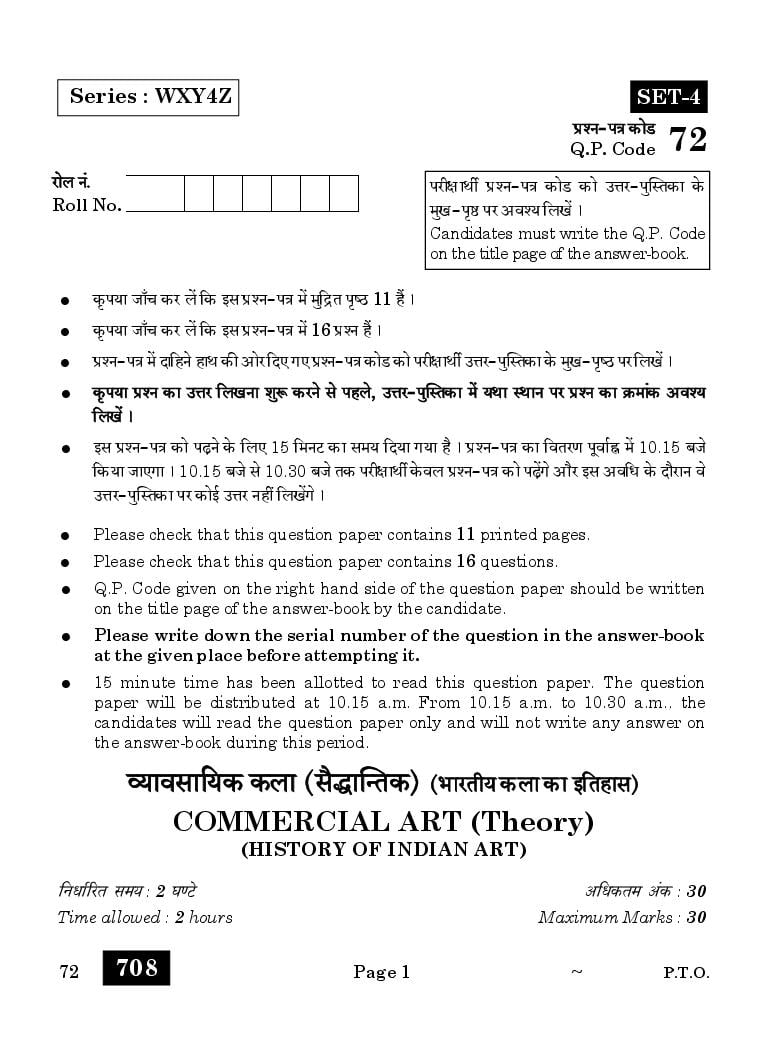
Q.P. Code 72
. - -
Roll No. -
Candidates must write the Q.P. Code
on the title page of the answer-book.
- 11
- 16
- - - -
, -
- 15 - 10.15
10.15 10.30 -
-
Please check that this question paper contains 11 printed pages.
Please check that this question paper contains 16 questions.
Q.P. Code given on the right hand side of the question paper should be written
on the title page of the answer-book by the candidate.
Please write down the serial number of the question in the answer-book
at the given place before attempting it.
15 minute time has been allotted to read this question paper. The question
paper will be distributed at 10.15 a.m. From 10.15 a.m. to 10.30 a.m., the
candidates will read the question paper only and will not write any answer on
the answer-book during this period.
() ( )
COMMERCIAL ART (Theory)
(HISTORY OF INDIAN ART)
{ZYm©[aV g‘¶ : 2 KÊQ>o A{YH$V‘ A§H$ : 30
Time allowed : 2 hours Maximum Marks : 30
72 708 Page 1 ~ P.T.O.
Page 2
* –
( 1 )
* –
( 2 )
* –
( 6 )
– 81=8
( )
:
1. () ?
(A)
(B)
(C) ,
(D)
2. (A) : ‘ ’
(R) : , -
(A) (A) (R) (R), (A)
(B) (A) (R) , (R), (A)
(C) (A) (R)
(D) (A) (R)
72 Page 2 ~
Page 3
* SECTION – A
Attempt all questions. (Each question will carry 1 mark.)
* SECTION – B
Attempt all questions. (Each question will carry 2 marks.)
* SECTION – C
Attempt any two questions. (Each question will carry 6 marks.)
SECTION – A 81=8
(Multiple Choice Questions)
Select the correct answer from the given options :
1. In which painting Lord Krishna is painted in Veerat (Large) Rupa ?
(A) Krishna with Gopis
(B) Krishna lifting Mount Govardhana
(C) Nand, Yashoda and Krishna going to Vrindavan with Kinsmen.
(D) Krishna on Swing
2. Assertion (A) : Mughal School painting ‘Falcon on the Bird Rest’ is an
example of detailed naturalism characteristic of the Mughal
miniatures.
Reason (R) : Mughal artists were known for their simplistic designs and
realistic portryal of flora and fauna, influenced by American and
Australian traditions.
(A) Both (A) and (R) are true and (R) is the correct explanation of (A).
(B) Both (A) and (R) are true and (R) is not correct explanation of (A).
(C) (A) is true, but (R) is false.
(D) (A) is false and (R) is true.
72 Page 3 ~ P.T.O.
Page 4
(A) (B)
(C) (D)
4.
(A)
(B)
(C)
(D)
5. ?
(A) . (B)
(C) (D)
6. “ ” ?
(A) (B)
(C) .. (D)
7.
?
(A) (B)
(C) (D)
8. “ ” - ?
(A)
(B)
(C)
(D)
72 Page 4 ~
Page 5
(A) Oil pastel (B) Oil on canvas
(C) Acrylic on canvas (D) Water colour on paper
4. Identify the painting of Rajasthani school where the artist used bright
glowing colours with flat background ?
(A) Krishna lifting Mount Govardhana
(B) Chaugan players
(C) Marriage procession of Dara Shikoh
(D) Krishna with Gopis
5. Which of the following is not a print maker ?
(A) K. Laxma Goud (B) Amrita Shergil
(C) Somnath Hore (D) Jyoti Bhatt
6. Empathy and Sorrow are dominant emotions in the painting “Journey’s
End”. Who is the artist of this painting ?
(A) Nandalal Bose (B) Raja Ravi Verma
(C) D.P. Roy Chowdhary (D) Abanindranath Tagore
7. The Garment or Dhoti of Lord Krishna in the Rajasthani miniature
paintings were majorly painted in tones of yellow is known as :
(A) Digamber (B) Neelamber
(C) Pitamber (D) Ghanshyam
8. Which of the following is the subject matter of the painting “Krishna on
Swing” ?
(A) It is related to Dance performance.
(B) It is related to family gathering.
(C) It is related to fair/carnival.
(D) It is a scene from Rasikpriya by Keshavdas.
72 Page 5 ~ P.T.O.
Page 6
( )
100
9. “, ”
“ ”
- /
10.
-
11. ,
:
“ ”
72 Page 6 ~
Page 7
(Short answer type questions)
Answer for these questions is expected in around 100 words.
9. Nand, Yashoda and Krishna with Kinsmen going to Vrindavan depicts
God’s love for his devotees.
Write the name of the artist and medium of the painting.
Justify, how the artist has successfully shown simple living through
the composition.
OR
The miniature painting “Bharat meets Rama at Chitrakut stands out for
its unique and aesthetic qualities.
Briefly describe the subject matter and the life value/message given
through the painting.
10. The prosperous Deccan school excelled in depicting women as
accomplished sportspersons, highlighting their cultural refinement.
Describe the painting from Deccan school that showcases women
empowerment in the field of sports.
Mention the name of the painting and Sub-school.
OR
From your course of study this painting depicts divine interventions and
protectiveness by lifting a huge mountain.
Identify and name the painting, also mention its artist.
Appreciate the painting based on its subject matter.
11. “The paintings effectively convey a mother’s undeniable love for her child.
Their deep emotional connection and sense of care”.
For any one of the painting given below :
Name the artist and medium of the painting.
Justify the above statement by describing its compositional
arrangement in short.
“Mother and Child”
OR
Mother Teresa
72 Page 7 ~ P.T.O.
Page 8
13
“ ”
“ ”
–
( )
200 : 2+2+2=6
14. ()
(i)
(ii) -
(iii) ,
15. ;
, 3+3=6
,
,
72 Page 8 ~
Page 9
How the depiction of the human form and tonal values enhance the
emotional depth in the art work.
Name the artist and the medium used.
OR
Identify the print that signifies the power of worship and the hidden
power of Kundalini from your syllabus.
Write the name of the print and printmaker.
Describe two compositional qualities that you admire in this graphic
print.
13 A true mentor and friend guides you to wisdom and peace by instilling
values of simplicity and profound thinking.
Write the school and medium of the painting.
Evaluate and justify this statement through describing any one
artwork mentioned below :
“Kabir and Raidas”
OR
“Hazrat Nizamuddin Auliya and Amir Khusro”.
SECTION – C
Attempt any two questions from the given options.
(Long answer type questions)
Answer for this question is expected in around 200 words : 2+2+2=6
14. This Pahari School painting depicts a divine figure surrounded by a group
of female (Gopis) devotees.
(i) Write the name of the artist and the painting mentioned above.
(ii) Describe the scene, focusing on the interactions between the central
figure and the surrounding figures.
(iii) Explain the artistic features and how elements such as colour,
composition and detailing contribute to the portryal of various
figures.
15. Identify the painting from Mughal school that captures a grand
celebration, filled with large crowd and intricate detailing. Based on your
study of this painting from your syllabus answer the following : 3+3=6
Name of the painting, its artist and medium.
Write about the compositional arrangement of the figures, animals
and the other elements within the scene.
72 Page 9 ~ P.T.O.
Page 10
: 3+3=6
,
___________
72 Page 10 ~
Page 11
Based on your syllabus answer the following : 3+3=6
Identify and name the painting, artist and medium.
Appreciate the colours and compositional arrangement in detail.
___________
72 Page 11 ~ P.T.O.
Page 12
Document Details
| Board / Org | CBSE |
| Exam | Class 12 |
| Type | Question Paper |
| Pages | 12 |
| Updated | 24 Sep 2026 |