Manipur Board Class 11 Syllabus 2027 Agriculture
Finished viewing? Save it for later —
Download Manipur Board Class 11 Syllabus 2027 Agriculture (PDF · 6 pages)About Manipur Board Class 11 Syllabus 2027 Agriculture
Manipur Board Class 11 Syllabus 2027 Agriculture is available here for free download. Published by Manipur Board for Class 11, this syllabus can be viewed online or downloaded as a PDF (6 pages). Candidates preparing for Class 11 can use Manipur Board Class 11 Syllabus 2027 Agriculture to understand the exam pattern, the type of questions asked, and the overall difficulty level.
Frequently Asked Questions
How can I download Manipur Board Class 11 Syllabus 2027 Agriculture?
Open this page and click the Download button to save Manipur Board Class 11 Syllabus 2027 Agriculture as a PDF. It is completely free on AglaSem Docs.
Is Manipur Board Class 11 Syllabus 2027 Agriculture free to download?
Yes. Manipur Board Class 11 Syllabus 2027 Agriculture can be viewed online and downloaded as a PDF free of cost on AglaSem Docs.
How many pages does Manipur Board Class 11 Syllabus 2027 Agriculture have?
Manipur Board Class 11 Syllabus 2027 Agriculture contains 6 pages, which you can read online or download together as a single PDF.
Where can I find more Class 11 study material?
You can find more Class 11 question papers, sample papers, syllabus, and answer keys on AglaSem Docs.
Manipur Board Class 11 Syllabus 2027 Agriculture – Text
Read the full text of this syllabus below — useful to quickly search, copy and reference the content online without downloading the PDF.
📄 View text version (7 pages)
Page 1
Manipur Board Class 11
Syllabus 2027
Agriculture
EXAM YEAR TYPE SUBJECT
Manipur Class 11 2027 Syllabus Agriculture
Notes · Sample Papers · Previous Year Papers · Mock Tests
Page 2
.co s e m
s em l a
a ag
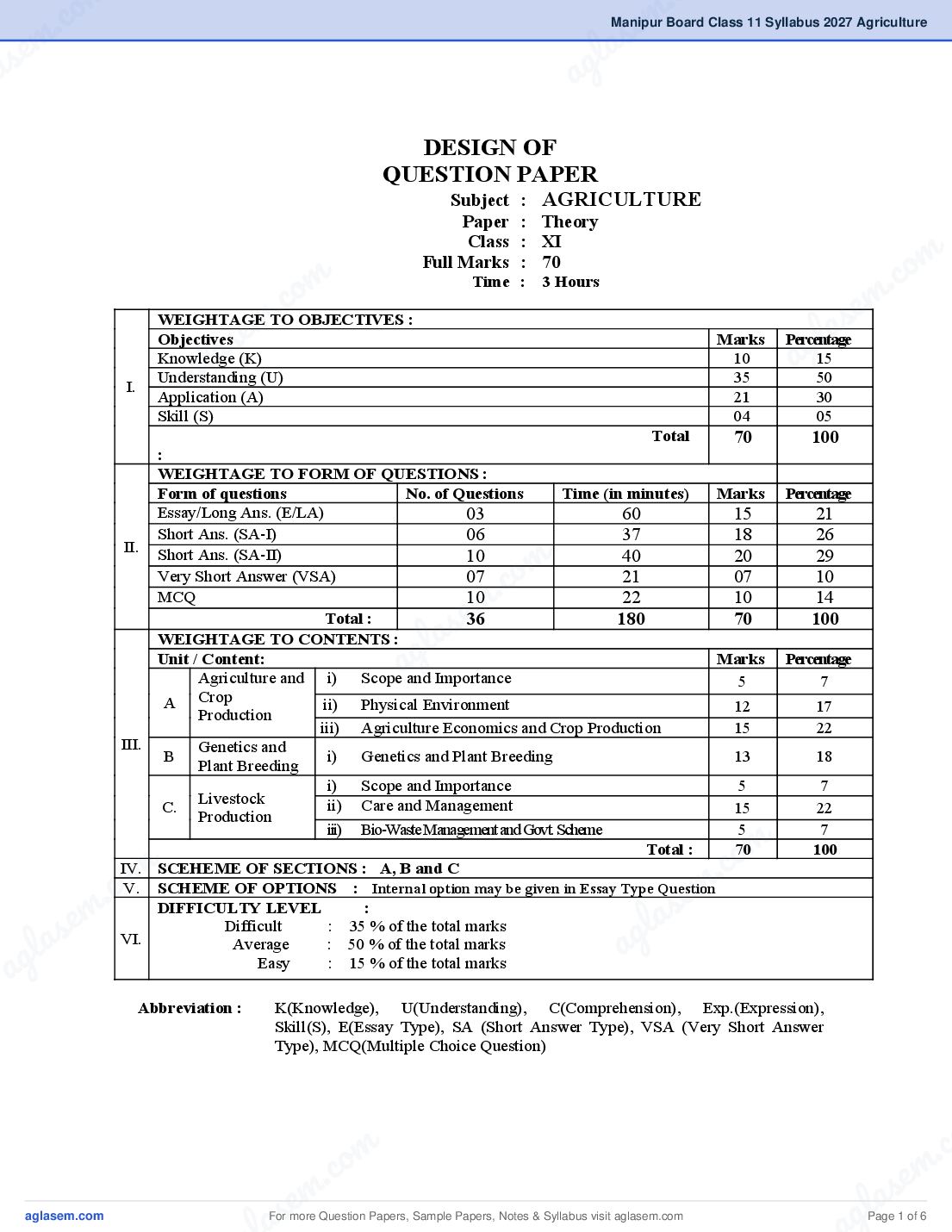
DESIGN OF
QUESTION PAPER
Subject : AGRICULTURE
Paper : Theory
Class : XI
m
om
Full Marks : 70
Time : 3 Hours . co
. c e m
m
WEIGHTAGE TO OBJECTIVES :
e l as
l s
Objectives
a
Knowledge (K) 10 g
Marks Percentage
a 5015
I. ag
Understanding (U) 35
Application (A) 21 30
Skill (S) 04 05
Total 70 100
:
WEIGHTAGE TO FORM OF QUESTIONS :
Form of questions No. of Questions Time (in minutes) Marks Percentage
Essay/Long Ans. (E/LA) 03 60 15 21
Short Ans. (SA-I) 06 37 18 26
II.
Short Ans. (SA-II) 10
m 40 20 29
Very Short Answer (VSA)
MCQ
07
10
m .co 21
22
07
10
10
14
Total : 36
s e 180 70 100
WEIGHTAGE TO CONTENTS :
l a
Unit / Content:
ag
Agriculture and i) Scope and Importance
Marks
5
Percentage
7
A Crop ii) Physical Environment 12 17
Production
iii) Agriculture Economics and Crop Production 15 22
III. Genetics and
B i) Genetics and Plant Breeding 13 18
Plant Breeding
i) Scope and Importance 5 7
Livestock ii) Care and Management
C. 15 22
Production
iii) Bio-Waste Management and Govt. Scheme 5 7
m
.co
Total : 70 100
m
.co
IV. SCEHEME OF SECTIONS : A, B and C
V. SCHEME OF OPTIONS : Internal option may be given in Essay Type Question
e m
e m DIFFICULTY LEVEL :
las
las VI.
Difficult
Average
: 35 % of the total marks
: 50 % of the total marks ag
ag Easy : 15 % of the total marks
Abbreviation : K(Knowledge), U(Understanding), C(Comprehension), Exp.(Expression),
Skill(S), E(Essay Type), SA (Short Answer Type), VSA (Very Short Answer
Type), MCQ(Multiple Choice Question)
m . c
c. o s e m
s em
For more Question Papers, Sample Papers, Notes & Syllabus visit
gl a
Page 1 of 6
Page 3
THEORY
CLASS XI
One Paper Time: 3 Hours 70 Marks
Marks
Section Units
Unitwise Total
I Part A
Agriculture and Crop Production
Unit: I: Scope and Importance 5
Unit: II: Physical Environment 12 30
Unit: III: Agriculture Economics and Crop Production 13
Part B
Genetics and Plant Breeding
Unit: IV Genetics and Plant Breeding 15 15
II Livestock Production
Unit V: Scope and Importance 5
Unit VI: Care and Management 15 25
Unit VII: Bio-waste Management and Government Schemes 5
Total 70
SECTION - I
PART A - AGRICULTURE AND CROP PRODUCTION:
Unit I: Scope and Importance:
Definition of Agriculture, its branches
Scope in the national economy and employment
Unit II: Physical Environment:
1. Climate and Weather, elements of Weather: Rainfall, Temperature, Humidity, Wind, Sunshine,
Climate Change and Global warming.
2. Soil, Soil texture and structure and its types.
3. Soil erosion and Soil conservation.
4. Tillage definition and types. Concept of conservation tillage.
For more Question Papers, Sample Papers, Notes & Syllabus visit Page 2 of 6
Page 4
.co s e m
s em l a
a ag
Unit III: Agriculture Economics and Crop Production
1. Agricultural Economics, Cooperative system in Agriculture, Crop insurance. Kisan Credit Cards.
Marketing of Agricultural products (supply chain, retailing, wholesale), haats.
2. Package of practices in field crops like important varieties, seed rate, sowing time, intercultural
m
om
operations, yield and marketing for Rice, Maize, Mustard, Soyabean, Groundnut, Pea, Sugarcane,
. co
c
gram & broad bean.
. e m
e m l as
l as
3. Package of practices of fruits: Mango, Banana, Lime, Grape, Pomegranate. Vegetables: Potato,
Tomato, Cauliflower, Cabbage, Brinjal, Bottle gourd, Pumpkin, Cucumber. Flower- Rose, Gladiolus. ag
g
4. aMethods of plant propagation – Layering and Cutting, and Tissue culture.
PART B - GENETICS AND PLANT BREEDING
Unit IV: Genetics and Plant Breeding
m
1. Cell and its structure, cell division-Mitosis and Meiosis and their significance in plant growth and
development.
m .co
s e
2. Introduction to -DNA, RNA, and their differences.
3. Role of Genetics in Plant breeding,la
crops-introduction, Selection, ag self and cross-pollinated crops, methods of breeding in field
Hybridization, Mutation.
4. Mendel’s laws of Inheritance. Their importance in plant breeding.
SECTION - II: LIVESTOCK PRODUCTION
Unit V: Scope and Importance
o m
m (a) Importance of livestock in Agriculture, National Economy and Nutritional security c
c. o (b) Important animal based food products and their role in our diet. sem.
s em g l a
la a
(c) Important indigenous and exotic breeds of cattle, buffalo and poultry, and quantitative and qualitative
ag production details of produces (milk, meat and eggs)
(d) Concept of Anand pattern of cooperative system of milk procurement and pricing of milk. Marketing
of milk in India.
Unit VI: Care and Management
(a) Animal body structure and functions.
(b) Concept of grazing and stall feeding including poultry feeding.
m . c
c. o s e m
s em
For more Question Papers, Sample Papers, Notes & Syllabus visit
gl a
Page 3 of 6
Page 5
Balanced ratio-definition and ingredients.
(d) Housing of dairy animals and poultry.
(e) Management of calves, bullocks, pregnant and milch animals as well as chicks and layers.
(f) Economics of rearing dairy cattle , poultry.
(g) Systems of milking by hand and by machine. Important considerations in both these methods.
(h) Concept of clean milk production processing, pasteurization and packaging and milk. Familiarisation
with the value added products from milk.
(i) Principles of disease management and vaccination.
(j) Signs of sick animals, symptoms of common diseases in cattle and poultry-Rinderpest, Black quarter,
Foot and Mouth, Mastitis, Haemorrhagic Septicaemia, Solmonellosis, bird flu, Fowl Pox and
Ranikhet disease, their prevention and control.
Unit VII: Bio-Waste Management and Government Schemes
(a) Utilization of animals wastes in Biogas plant.
(b) Important government schemes for development of livestock dairy, poultry in India. Their important
features and eligibility criteria.
AGRICULTURE
CLASS XI
PRACTICAL
One Paper Time: 3 hours 30 marks
Section Units Marks
I Part A-Agriculture and Crop Production 08
Part B- Genetics, Plant Breeding and Microbiology 04
II Livestock practical 08
Reports of the visit 05
Viva voce 05
Total 30
SECTION - I
PART A - AGRICULTURE AND CROP PRODUCTION
1. Agriculture and Crop Production
(a) Visit to a crop field. Identify different crops growing in the field and make a report.
For more Question Papers, Sample Papers, Notes & Syllabus visit Page 4 of 6
Page 6
.co s e m
s em l a
a ag
(b) Identification of farm implements used for different operations, draw a design of at least 5
implements and make a report.
(c) Identification of seeds of different crops.
(d) Seed germination test. (two cereals , two pulses, two vegetables, two flowers)
(e) Calculation of cost of production of rice crop in one hectare of land area & prepare a report.
(f) Visit to an orchard and identify different fruit crops and make a report.
m
om
(g) Identification of important vegetable crops, prepare a report.
. co
c
(h) Identification of important flower crops.
. e m
e m
(i) Orchard layout, digging of pits and planting of sapling of any one fruit crop.
l as
l as
(j) Land preparation and sowing of rice crop seed in the bed.
(k) Preparation of cropping scheme.
ag
ag
SECTION – II
2. Livestock
(a) Identification of body parts of dairy animals and Poultry.
(b) Identification of common breeds of cows, buffaloes and poultry birds.
(c) Handling and restraining of animals.
(d) Testing of milk fat and SNF.
m
.co
(e) Visit to a local veterinary hospital and observe the condition of a sick animal and prepare a report.
(f) Compute ration for an animal and poultry and prepare a report.
e m
(g) Visit to milk processing plant and on outlet a milk & milk products centre. Record the processing
a
& sale of variety in milk based products.
l s
ag
(h) Identification of feeds, fodder crops and grasses.
(i) Visit to Biogas plant.
3. Report on the Visits
1. The student have to prepare a report of their visit to different organizations and submit to the
subject teacher for the evaluation. The report must contain the student’s original work and
observations.
m
.co
2. Prepare Herbarium of different crops and weed species. The leaves of the crops and weeds are
m pressed dried and mounted on the Herbarium sheet.
c. o4. Viva Voce s e m
e m la
las ag
ag Students can be asked questions based on:
(i) Identification of objects
(ii) Visit Report analysis.
(iii) Experiences in their field visits, etc.
A range of 5 to 10 questions can be asked depending on the response of the student. Evaluation 5x1=5
Or should be based on number of questions answered. Evaluator should stick to the time and ½ x10=5
number of questions.
m . c
c. o
*****
e m
em as
s
For more Question Papers, Sample Papers, Notes & Syllabus visit
gl
Page 5 of 6
Page 7
1. Handbook of Animal Husbandry
Published by : Directorate of Information and Publications of Agriculture, Indian Council
of Agricultural Research, Krishi Anusandhan Bhavan, Pusa, New Delhi – 110012.
2. A Text Book of Animal Husbandry by G.C. Banerjee
Published by Oxford & IBH Publishing Co. Pvt. Ltd., New Delhi.
3. Hand Book of Agriculture – ICAR publication
or
Hand Book of Agriculture by S.C. Panda,
Published by : J.V. Publishing House, Jodhpur.
4. A text book of Plant Breeding by Purohit & Purohit,
Published by : J.V. Publishing House, Jodhpur.
5. A text book of Genetics by Purohit & Purohit,
Published by : J.V. Publishing House, Jodhpur.
6. A text book of Production Technology of fruits crops by Prasad & Raju,
Published by : J.V. Publishing House, Jodhpur.
7. A text book of Production Technology of Vegetables & Flowers by Prasad , Raju & Bhardwaj,
Published by : J.V. Publishing House, Jodhpur
8. A text book of Field Crops by Mukund Joshi,
Published by : PHI Learning Private Ltd., Delhi.
*****
For more Question Papers, Sample Papers, Notes & Syllabus visit Page 6 of 6
Document Details
| Board / Org | Manipur Board |
| Exam | Class 11 |
| Type | Syllabus |
| Pages | 6 |
| Updated | 04 Nov 2026 |