Assam CEE 2027 Sample Paper
Finished viewing? Save it for later —
Download Assam CEE 2027 Sample Paper (PDF · 15 pages)About Assam CEE 2027 Sample Paper
Assam CEE 2027 Sample Paper is available here for free download. Published by Assam Exams for Assam CEE, this sample paper can be viewed online or downloaded as a PDF (15 pages). Candidates preparing for Assam CEE can use Assam CEE 2027 Sample Paper to understand the exam pattern, the type of questions asked, and the overall difficulty level.
Frequently Asked Questions
How can I download Assam CEE 2027 Sample Paper?
Open this page and click the Download button to save Assam CEE 2027 Sample Paper as a PDF. It is completely free on AglaSem Docs.
Is Assam CEE 2027 Sample Paper free to download?
Yes. Assam CEE 2027 Sample Paper can be viewed online and downloaded as a PDF free of cost on AglaSem Docs.
How many pages does Assam CEE 2027 Sample Paper have?
Assam CEE 2027 Sample Paper contains 15 pages, which you can read online or download together as a single PDF.
Where can I find more Assam CEE study material?
You can find more Assam CEE question papers, sample papers, syllabus, and answer keys on AglaSem Docs.
Assam CEE 2027 Sample Paper – Text
Read the full text of this sample paper below — useful to quickly search, copy and reference the content online without downloading the PDF.
📄 View text version (15 pages)
Page 1
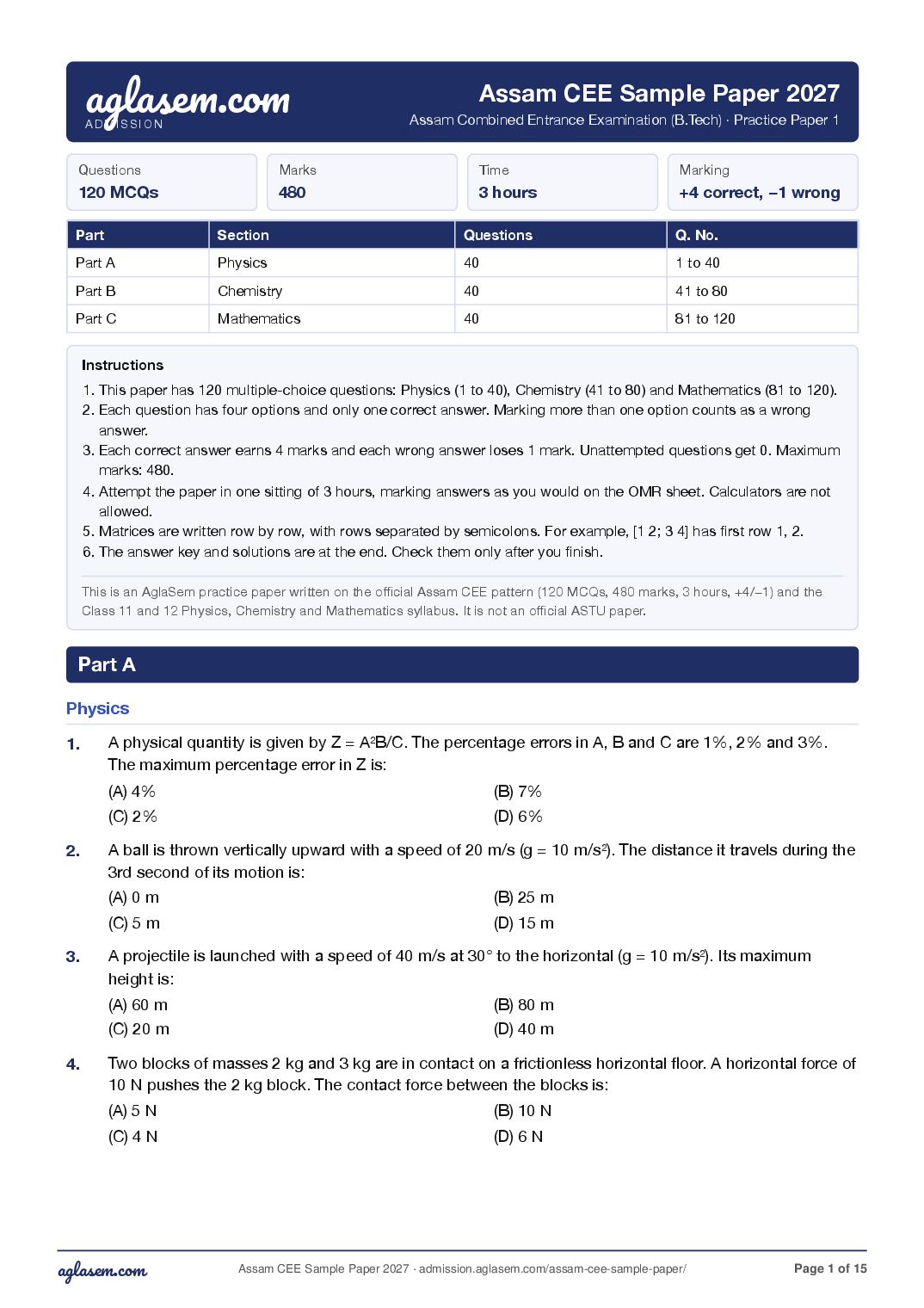
Assam CEE Sample Paper 2027
Assam Combined Entrance Examination (B.Tech) · Practice Paper 1
Questions Marks Time Marking
120 MCQs 480 3 hours +4 correct, −1 wrong
Part Section Questions Q. No.
Part A Physics 40 1 to 40
Part B Chemistry 40 41 to 80
Part C Mathematics 40 81 to 120
Instructions
1. This paper has 120 multiple-choice questions: Physics (1 to 40), Chemistry (41 to 80) and Mathematics (81 to 120).
2. Each question has four options and only one correct answer. Marking more than one option counts as a wrong
answer.
3. Each correct answer earns 4 marks and each wrong answer loses 1 mark. Unattempted questions get 0. Maximum
marks: 480.
4. Attempt the paper in one sitting of 3 hours, marking answers as you would on the OMR sheet. Calculators are not
allowed.
5. Matrices are written row by row, with rows separated by semicolons. For example, [1 2; 3 4] has first row 1, 2.
6. The answer key and solutions are at the end. Check them only after you finish.
This is an AglaSem practice paper written on the official Assam CEE pattern (120 MCQs, 480 marks, 3 hours, +4/−1) and the
Class 11 and 12 Physics, Chemistry and Mathematics syllabus. It is not an official ASTU paper.
Part A
Physics
1. A physical quantity is given by Z = A²B/C. The percentage errors in A, B and C are 1%, 2% and 3%.
The maximum percentage error in Z is:
(A) 4% (B) 7%
(C) 2% (D) 6%
2. A ball is thrown vertically upward with a speed of 20 m/s (g = 10 m/s²). The distance it travels during the
3rd second of its motion is:
(A) 0 m (B) 25 m
(C) 5 m (D) 15 m
3. A projectile is launched with a speed of 40 m/s at 30° to the horizontal (g = 10 m/s²). Its maximum
height is:
(A) 60 m (B) 80 m
(C) 20 m (D) 40 m
4. Two blocks of masses 2 kg and 3 kg are in contact on a frictionless horizontal floor. A horizontal force of
10 N pushes the 2 kg block. The contact force between the blocks is:
(A) 5 N (B) 10 N
(C) 4 N (D) 6 N
Assam CEE Sample Paper 2027 · admission./assam-cee-sample-paper/ Page 1 of 15
Page 2
30°. The coefficient of static friction is:
(A) √3 (B) 1/2
(C) √3/2 (D) 1/√3
6. A body of mass 2 kg moving at 4 m/s is acted on by a force that increases its speed to 6 m/s. The work
done by the force is:
(A) 40 J (B) 4 J
(C) 52 J (D) 20 J
7. A pump lifts 600 kg of water through a height of 20 m in 1 minute (g = 10 m/s²). The power delivered by
the pump is:
(A) 2 kW (B) 0.2 kW
(C) 20 kW (D) 120 kW
8. A 1 kg ball moving at 6 m/s collides head-on and perfectly elastically with a stationary 2 kg ball. The
velocity of the 2 kg ball after the collision is:
(A) 6 m/s (B) 3 m/s
(C) 4 m/s (D) 2 m/s
9. A solid sphere rolls without slipping on a horizontal surface. The fraction of its total kinetic energy that is
rotational is:
(A) 2/7 (B) 2/5
(C) 1/2 (D) 5/7
10. A person standing on a freely rotating turntable pulls in the arms, reducing the moment of inertia of the
system from 6 kg m² to 4 kg m². If the initial angular speed was 2 rad/s, the final angular speed is:
(A) 2 rad/s (B) 1.33 rad/s
(C) 3 rad/s (D) 4 rad/s
11. A planet has the same mean density as the Earth but twice its radius. If the escape speed on Earth is
11.2 km/s, the escape speed on the planet is:
(A) 11.2 km/s (B) 22.4 km/s
(C) 44.8 km/s (D) 15.8 km/s
12. The acceleration due to gravity at a height R/2 above the Earth's surface (R = radius of Earth, g = value
at the surface) is:
(A) 4g/9 (B) g/2
(C) g/4 (D) 2g/3
13. A wire 2 m long with cross-sectional area 1 mm² carries a load of 10 kg (g = 10 m/s², Y = 2 × 10¹¹ N/m²).
The extension of the wire is:
(A) 0.1 mm (B) 1 mm
(C) 0.5 mm (D) 10 mm
14. Water flows at 2 m/s through a pipe of diameter 4 cm, which narrows to a diameter of 2 cm. The speed
of water in the narrow part is:
(A) 8 m/s (B) 1 m/s
(C) 16 m/s (D) 4 m/s
15. 100 g of water at 80 °C is mixed with 300 g of water at 20 °C. Ignoring heat losses, the final temperature
of the mixture is:
(A) 40 °C (B) 30 °C
(C) 50 °C (D) 35 °C
Assam CEE Sample Paper 2027 · admission./assam-cee-sample-paper/ Page 2 of 15
Page 3
(A) 50% (B) 76%
(C) 40% (D) 25%
17. 2 mol of a monatomic ideal gas is heated at constant pressure so that its temperature rises by 30 K (R =
8.314 J mol⁻¹ K⁻¹). The heat supplied is about:
(A) 748 J (B) 499 J
(C) 1247 J (D) 1746 J
18. The rms speed of the molecules of an ideal gas at 27 °C is v. The temperature at which the rms speed
becomes 2v is:
(A) 327 °C (B) 927 °C
(C) 108 °C (D) 1200 °C
19. A mass of 0.5 kg attached to a spring of force constant 200 N/m oscillates on a smooth horizontal
surface. Its time period is:
(A) π/10 s (B) π/20 s
(C) π/5 s (D) 10π s
20. A pipe closed at one end is 85 cm long. If the speed of sound in air is 340 m/s, the frequency of its
fundamental mode is:
(A) 50 Hz (B) 200 Hz
(C) 100 Hz (D) 400 Hz
21. A point charge q is placed at the centre of a cube. The electric flux through any one face of the cube is:
(A) q/6ε₀ (B) 6q/ε₀
(C) q/8ε₀ (D) q/ε₀
22. A parallel-plate capacitor storing energy U is charged and then disconnected from the battery. A slab of
dielectric constant 4 is inserted to fill the gap. The stored energy becomes:
(A) U (B) U/16
(C) 4U (D) U/4
23. A wire of resistance R is stretched uniformly so that its length doubles. Its new resistance is:
(A) R/4 (B) 2R
(C) 4R (D) R/2
24. A cell of emf 12 V and internal resistance 1 Ω is connected to an external resistance of 5 Ω. The
potential difference across the terminals of the cell is:
(A) 12 V (B) 10 V
(C) 2 V (D) 8 V
25. In a metre bridge, an unknown resistance is in the left gap and 6 Ω in the right gap. The balance point is
40 cm from the left end. The unknown resistance is:
(A) 4 Ω (B) 6 Ω
(C) 9 Ω (D) 2.4 Ω
26. A circular coil of 50 turns and radius 10 cm carries a current of 2 A (μ₀ = 4π × 10⁻⁷ T m/A). The magnetic
field at its centre is:
(A) 2π × 10⁻⁴ T (B) 4π × 10⁻⁴ T
(C) π × 10⁻⁴ T (D) 2π × 10⁻⁵ T
Assam CEE Sample Paper 2027 · admission./assam-cee-sample-paper/ Page 3 of 15
Page 4
perpendicular to it. The ratio of the radii of their circular paths (proton : alpha) is:
(A) 1 : 2 (B) 1 : 1
(C) 2 : 1 (D) 1 : √2
28. A galvanometer of resistance 100 Ω gives full-scale deflection for 1 mA. To convert it into an ammeter of
range 0–1 A, one should connect:
(A) about 999 Ω in series (B) about 0.1 Ω in parallel
(C) about 100 Ω in parallel (D) about 0.1 Ω in series
29. Which material has a small negative magnetic susceptibility that hardly changes with temperature?
(A) Iron (B) Aluminium
(C) Liquid oxygen (D) Bismuth
30. A coil of 100 turns and area 0.01 m² is placed perpendicular to a magnetic field of 0.5 T. The field is
reduced to zero uniformly in 0.1 s. The average induced emf is:
(A) 0.5 V (B) 5 V
(C) 50 V (D) 0.05 V
31. In a series LCR circuit, R = 30 Ω, X_L = 80 Ω and X_C = 40 Ω. The power factor of the circuit is:
(A) 1.0 (B) 0.5
(C) 0.6 (D) 0.8
32. In a plane electromagnetic wave in vacuum, the peak electric field is 30 V/m. The peak magnetic field is:
(A) 1 × 10⁻⁸ T (B) 3 × 10⁻⁷ T
(C) 1 × 10⁻⁷ T (D) 9 × 10⁹ T
33. An object is placed 30 cm in front of a concave mirror of focal length 20 cm. The image is:
(A) real, inverted, 12 cm in front of the mirror, magnification −0.4
(B) virtual, erect, 60 cm behind the mirror, magnification +2
(C) virtual, erect, 12 cm behind the mirror, magnification +0.4
(D) real, inverted, 60 cm in front of the mirror, magnification −2
34. A prism of angle 60° is made of glass of refractive index √2. Its angle of minimum deviation is:
(A) 45° (B) 60°
(C) 15° (D) 30°
35. In Young's double-slit experiment, the slit separation is 0.5 mm, the screen is 1 m away and the
wavelength is 600 nm. The fringe width is:
(A) 0.12 mm (B) 12 mm
(C) 2.4 mm (D) 1.2 mm
36. Light of wavelength 400 nm falls on a metal of work function 2.0 eV (take hc = 1240 eV nm). The
stopping potential is:
(A) 5.1 V (B) 1.1 V
(C) 3.1 V (D) 2.0 V
37. The ratio of the longest wavelength in the Lyman series to the longest wavelength in the Balmer series
of hydrogen is:
(A) 4/9 (B) 27/5
(C) 5/27 (D) 9/4
Assam CEE Sample Paper 2027 · admission./assam-cee-sample-paper/ Page 4 of 15
Page 5
(A) 3 h (B) 12 h
(C) 8 h (D) 6 h
39. Pure silicon becomes a p-type semiconductor when it is doped with:
(A) Antimony (B) Arsenic
(C) Boron (D) Phosphorus
40. A full-wave rectifier is fed with an AC supply of 50 Hz. The fundamental frequency of the ripple in its
output is:
(A) 200 Hz (B) 100 Hz
(C) 50 Hz (D) 25 Hz
Part B
Chemistry
41. The number of molecules in 4.4 g of CO₂ is (N_A = 6.022 × 10²³ mol⁻¹):
(A) 6.022 × 10²³ (B) 3.011 × 10²²
(C) 6.022 × 10²² (D) 1.807 × 10²³
42. 4 g of NaOH is dissolved in water to make 250 mL of solution. The molarity of the solution is:
(A) 0.04 M (B) 0.4 M
(C) 0.1 M (D) 1.6 M
43. A compound contains 40.0% carbon, 6.67% hydrogen and 53.3% oxygen by mass. Its empirical
formula is:
(A) C₂H₄O (B) CH₂O₂
(C) CHO (D) CH₂O
44. The number of radial nodes in a 3p orbital is:
(A) 3 (B) 0
(C) 1 (D) 2
45. ₗ
Which set of quantum numbers (n, l, m ) is NOT allowed?
(A) (3, 2, −2) (B) (2, 2, 1)
(C) (4, 0, 0) (D) (2, 1, 0)
46. Using the Bohr model, the energy of the electron in the n = 2 orbit of He⁺ is:
(A) −6.8 eV (B) −13.6 eV
(C) −54.4 eV (D) −3.4 eV
47. The correct order of first ionisation enthalpy is:
(A) O < N < C < B (B) B < C < N < O
(C) B < C < O < N (D) C < B < N < O
48. The shape of the ClF₃ molecule is:
(A) T-shaped (B) Trigonal planar
(C) Trigonal pyramidal (D) See-saw
49. According to molecular orbital theory, the bond order of the superoxide ion O₂⁻ is:
(A) 1 (B) 2.5
(C) 2 (D) 1.5
Assam CEE Sample Paper 2027 · admission./assam-cee-sample-paper/ Page 5 of 15
Page 6
(A) −82.0 kJ (B) −89.5 kJ
(C) −92.0 kJ (D) −87.0 kJ
51. For a reaction, ΔH = +40 kJ mol⁻¹ and ΔS = +100 J K⁻¹ mol⁻¹. Assuming both are constant, the reaction
becomes spontaneous above:
(A) 400 K (B) 4000 K
(C) 40 K (D) 0.4 K
52. Given: C(s) + O₂(g) → CO₂(g), ΔH = −393.5 kJ; CO(g) + ½O₂(g) → CO₂(g), ΔH = −283.0 kJ. The enthalpy
of formation of CO(g) is:
(A) −110.5 kJ mol⁻¹ (B) −393.5 kJ mol⁻¹
(C) −676.5 kJ mol⁻¹ (D) +110.5 kJ mol⁻¹
53. The pH of a 0.001 M aqueous NaOH solution at 25 °C is:
(A) 10 (B) 3
(C) 12 (D) 11
54. The solubility product of AgCl at 25 °C is 1.6 × 10⁻¹⁰. Its solubility in pure water is about:
(A) 4 × 10⁻⁵ mol L⁻¹ (B) 8 × 10⁻¹¹ mol L⁻¹
(C) 1.6 × 10⁻⁵ mol L⁻¹ (D) 1.26 × 10⁻⁵ mol L⁻¹
55. A buffer contains 0.1 M CH₃COOH and 0.2 M CH₃COONa. If pKa of acetic acid is 4.74 (log 2 = 0.30),
the pH of the buffer is:
(A) 4.74 (B) 5.04
(C) 9.26 (D) 4.44
56. The oxidation number of sulphur in peroxodisulphuric acid, H₂S₂O₈, is:
(A) +5 (B) +6
(C) +7 (D) +8
57. The IUPAC name of (CH₃)₂CH–CH₂–CH₂–OH is:
(A) 2-Methylpentan-1-ol (B) 3-Methylbutan-2-ol
(C) 2-Methylbutan-4-ol (D) 3-Methylbutan-1-ol
58. The number of σ and π bonds in acrylonitrile, CH₂=CH–C≡N, is:
(A) 6 σ and 2 π (B) 5 σ and 3 π
(C) 7 σ and 3 π (D) 6 σ and 3 π
59. Propene reacts with HBr in the presence of benzoyl peroxide. The main product is:
(A) 1,2-Dibromopropane (B) Propan-2-ol
(C) 1-Bromopropane (D) 2-Bromopropane
60. Which of the following species is aromatic?
(A) Cyclopentadienyl cation (B) Cyclopentadienyl anion
(C) Cycloheptatriene (D) Cyclooctatetraene
61. 1.8 g of glucose (M = 180 g mol⁻¹) is dissolved in 100 g of water. If Kb of water is 0.52 K kg mol⁻¹, the
elevation in boiling point is:
(A) 0.104 K (B) 0.52 K
(C) 0.0052 K (D) 0.052 K
62. The osmotic pressure of a 0.1 M solution of a non-electrolyte at 300 K is (R = 0.0821 L atm K⁻¹ mol⁻¹):
(A) 24.6 atm (B) 0.246 atm
(C) 2.46 atm (D) 4.92 atm
Assam CEE Sample Paper 2027 · admission./assam-cee-sample-paper/ Page 6 of 15
Page 7
Gibbs energy change is (F = 96500 C mol⁻¹):
(A) −106.2 kJ mol⁻¹ (B) −81.1 kJ mol⁻¹
(C) −212.3 kJ mol⁻¹ (D) +212.3 kJ mol⁻¹
64. A current of 2 A is passed through CuSO₄ solution for 965 s. The mass of copper deposited at the
cathode is (Cu = 63.5, F = 96500 C mol⁻¹):
(A) 0.0635 g (B) 1.27 g
(C) 0.3175 g (D) 0.635 g
65. The electrode potential of a hydrogen electrode (p_H₂ = 1 bar) dipped in a solution of pH 3 at 298 K is:
(A) +0.177 V (B) 0.000 V
(C) −0.059 V (D) −0.177 V
66. Λ°m (in S cm² mol⁻¹) of CH₃COONa, HCl and NaCl are 91, 426 and 126. Λ°m of CH₃COOH is:
(A) 391 S cm² mol⁻¹ (B) 209 S cm² mol⁻¹
(C) 461 S cm² mol⁻¹ (D) 643 S cm² mol⁻¹
67. A first-order reaction has a half-life of 69.3 s. The time required for 90% completion of the reaction is:
(A) 100 s (B) 230.3 s
(C) 62.4 s (D) 207.9 s
68. For the rate law, rate = k[A][B]², the concentration of A is doubled and that of B is halved. The rate
becomes:
(A) the same (B) double the original
(C) half the original (D) one-quarter of the original
69. The rate of a reaction doubles when the temperature rises from 300 K to 310 K. The activation energy is
about (R = 8.314 J mol⁻¹ K⁻¹, log 2 = 0.301):
(A) 26.8 kJ mol⁻¹ (B) 5.36 kJ mol⁻¹
(C) 107.2 kJ mol⁻¹ (D) 53.6 kJ mol⁻¹
70. The spin-only magnetic moment of Mn²⁺ (Z of Mn = 25) is about:
(A) 1.73 BM (B) 3.87 BM
(C) 4.90 BM (D) 5.92 BM
71. Zirconium (4d) and hafnium (5d) have almost identical atomic radii. This is mainly due to:
(A) Lanthanoid contraction (B) Diagonal relationship
(C) Inert pair effect (D) Actinoid contraction
72. The IUPAC name of [Co(NH₃)₅Cl]Cl₂ is:
(A) Chloridopentaamminecobalt(III) chloride
(B) Pentaamminecobalt(III) trichloride
(C) Pentaamminechloridocobalt(II) chloride
(D) Pentaamminechloridocobalt(III) chloride
73. The number of unpaired electrons in the low-spin complex [Fe(CN)₆]³⁻ is:
(A) 0 (B) 5
(C) 3 (D) 1
74. Which of the following complexes shows optical isomerism?
(A) cis-[Co(en)₂Cl₂]⁺ (B) [Co(NH₃)₆]³⁺
(C) trans-[Co(en)₂Cl₂]⁺ (D) trans-[Pt(NH₃)₂Cl₂]
Assam CEE Sample Paper 2027 · admission./assam-cee-sample-paper/ Page 7 of 15
Page 8
(A) CH₃CH₂Br (B) CH₃Br
(C) (CH₃)₃CBr (D) (CH₃)₂CHBr
76. Which compound undergoes the Cannizzaro reaction with concentrated NaOH?
(A) Acetaldehyde (B) Acetone
(C) Propanal (D) Benzaldehyde
77. Which is the strongest acid?
(A) CCl₃COOH (B) CF₃COOH
(C) CH₃COOH (D) ClCH₂COOH
78. Which of the following does NOT give the iodoform test?
(A) Propan-2-ol (B) Acetone
(C) Ethanol (D) Methanol
79. Which amine is the most basic in aqueous solution?
(A) (CH₃)₂NH (B) C₆H₅NH₂
(C) CH₃NH₂ (D) (CH₃)₃N
80. Which of the following is a non-reducing sugar?
(A) Glucose (B) Sucrose
(C) Lactose (D) Maltose
Part C
Mathematics
81. In a class of 60 students, 35 study Physics, 30 study Mathematics and 10 study neither. The number of
students who study both is:
(A) 5 (B) 25
(C) 15 (D) 20
82. If A has 2 elements and B has 3 elements, the number of relations from A to B is:
(A) 64 (B) 32
(C) 8 (D) 6
83. The value of sin²(π/8) + sin²(3π/8) is:
(A) 1/2 (B) 0
(C) 1 (D) √2
84. The general solution of tan x = √3 is:
(A) x = 2nπ + π/3, n ∈ Z (B) x = nπ + π/6, n ∈ Z
(C) x = nπ ± π/3, n ∈ Z (D) x = nπ + π/3, n ∈ Z
85. The value of (1 + i)⁸ is:
(A) 16 (B) 16i
(C) −16 (D) 8
86. The roots of x² − 6x + k = 0 differ by 2. The value of k is:
(A) 7 (B) 5
(C) 8 (D) 9
Assam CEE Sample Paper 2027 · admission./assam-cee-sample-paper/ Page 8 of 15
Page 9
(A) [−1, 5] (B) (−∞, −1) ∪ (5, ∞)
(C) (−5, 1) (D) (−1, 5)
88. The number of different arrangements of all the letters of the word ASSAM is:
(A) 20 (B) 30
(C) 60 (D) 120
89. A committee of 3 men and 2 women is to be chosen from 6 men and 5 women. The number of ways is:
(A) 120 (B) 30
(C) 200 (D) 462
90. The term independent of x in the expansion of (x + 1/x²)⁶ is:
(A) 15 (B) 6
(C) 30 (D) 20
91. The sum of the first 20 terms of the AP 3, 7, 11, 15, … is:
(A) 840 (B) 820
(C) 780 (D) 800
92. The arithmetic mean of two positive numbers is 10 and their geometric mean is 8. The numbers are:
(A) 16 and 4 (B) 12 and 8
(C) 14 and 6 (D) 18 and 2
93. The distance between the parallel lines 3x + 4y = 5 and 6x + 8y = 25 is:
(A) 4 (B) 3/2
(C) 3 (D) 2
94. The length of the latus rectum of the ellipse x²/25 + y²/16 = 1 is:
(A) 25/2 (B) 16/5
(C) 32/5 (D) 8/5
95. The focus of the parabola y² = −12x is:
(A) (−3, 0) (B) (0, −3)
(C) (3, 0) (D) (−12, 0)
96. The eccentricity of the hyperbola 9x² − 16y² = 144 is:
(A) 5/4 (B) 4/5
(C) √7/4 (D) 5/3
97. The point on the x-axis that is equidistant from A(1, 2, 3) and B(3, 4, 5) is:
(A) (9, 0, 0) (B) (6, 0, 0)
(C) (−9, 0, 0) (D) (2, 0, 0)
98. The value of lim (x→2) (x³ − 8)/(x² − 4) is:
(A) 12 (B) 3
(C) 2 (D) 4
99. The variance of the observations 2, 4, 6, 8, 10 is:
(A) 10 (B) 40
(C) 8 (D) 2√2
100. Two fair dice are thrown. The probability that the sum of the numbers is 8 is:
(A) 5/36 (B) 7/36
(C) 1/9 (D) 1/6
Assam CEE Sample Paper 2027 · admission./assam-cee-sample-paper/ Page 9 of 15
Page 10
(A) (3x − 1)/(2 − x) (B) (3x + 1)/(2 − x)
(C) (x + 3)/(2x − 1) (D) (2x + 1)/(x − 3)
102. The principal value of sin⁻¹(sin(2π/3)) is:
(A) π/3 (B) π/6
(C) −π/3 (D) 2π/3
103. If A = [2 3; 1 2] satisfies A² − 4A + I = O, then A⁻¹ equals:
(A) [−2 3; 1 −2] (B) [2 3; 1 2]
(C) [2 −1; −3 2] (D) [2 −3; −1 2]
104. The system x + y + z = 1, x + 2y + 3z = 2, x + 3y + kz = 3 does NOT have a unique solution when k
equals:
(A) 4 (B) 6
(C) 5 (D) 3
105. The function f(x) = (sin 3x)/x for x ≠ 0 and f(0) = k is continuous at x = 0 if k equals:
(A) 1 (B) 3
(C) 1/3 (D) 0
106. If y = xˣ, then dy/dx at x = 1 is:
(A) 0 (B) e
(C) 2 (D) 1
107. If x = a cos³t and y = a sin³t, then dy/dx is:
(A) cot t (B) −tan t
(C) −cot t (D) tan t
108. The radius of a circle increases at 0.5 cm/s. The rate of increase of its area when the radius is 10 cm is:
(A) 20π cm²/s (B) 100π cm²/s
(C) 5π cm²/s (D) 10π cm²/s
109. The function f(x) = 2x³ − 9x² + 12x + 1 has a local maximum at:
(A) x = −1 (B) x = 1
(C) x = 2 (D) x = 3
110. ∫ dx/(x² + 4x + 13) equals:
(A) (1/6) log|(x − 1)/(x + 5)| + C (B) (1/3) tan⁻¹((x + 2)/3) + C
(C) tan⁻¹((x + 2)/3) + C (D) (1/3) tan⁻¹((x − 2)/3) + C
111. The value of ∫ (from 0 to π/2) sin x/(sin x + cos x) dx is:
(A) π/4 (B) π
(C) 1 (D) π/2
112. The value of ∫ (from 0 to 1) x eˣ dx is:
(A) 1 (B) e
(C) 2e − 1 (D) e − 1
113. The area of the region enclosed between the curves y = x² and y = x is:
(A) 1/12 sq unit (B) 1/2 sq unit
(C) 1/6 sq unit (D) 1/3 sq unit
Assam CEE Sample Paper 2027 · admission./assam-cee-sample-paper/ Page 10 of 15
Page 11
(A) order 3, degree 2 (B) order 1, degree 4
(C) order 2, degree 3 (D) order 2, degree 4
115. The integrating factor of the differential equation dy/dx + y/x = x² (x > 0) is:
(A) x (B) log x
(C) 1/x (D) eˣ
116. The area of the parallelogram whose adjacent sides are a = 3i + j + 4k and b = i − j + k is:
(A) √42 sq units (B) 42 sq units
(C) √42/2 sq units (D) √26 sq units
117. The distance of the point (2, 3, −5) from the plane x + 2y − 2z = 9 is:
(A) 3 units (B) 1 unit
(C) 6 units (D) 9 units
118. The maximum value of Z = 3x + 2y subject to x + y ≤ 4, x + 3y ≤ 6, x ≥ 0, y ≥ 0 is:
(A) 4 (B) 11
(C) 14 (D) 12
119. Bag I has 3 red and 2 black balls; Bag II has 2 red and 4 black balls. A bag is chosen at random and a
ball drawn from it is red. The probability that it came from Bag I is:
(A) 1/2 (B) 9/14
(C) 5/14 (D) 3/5
120. A fair die is thrown twice. If X is the number of sixes obtained, the mean of X is:
(A) 1/2 (B) 1/6
(C) 1/3 (D) 2/3
Assam CEE Sample Paper 2027 · admission./assam-cee-sample-paper/ Page 11 of 15
Page 12
1 B 2 C 3 C 4 D 5 D 6 D 7 A 8 C 9 A 10 C
11 B 12 A 13 B 14 A 15 D 16 A 17 C 18 B 19 A 20 C
21 A 22 D 23 C 24 B 25 A 26 A 27 B 28 B 29 D 30 B
31 C 32 C 33 D 34 D 35 D 36 B 37 C 38 C 39 C 40 B
41 C 42 B 43 D 44 C 45 B 46 B 47 C 48 A 49 D 50 C
51 A 52 A 53 D 54 D 55 B 56 B 57 D 58 D 59 C 60 B
61 D 62 C 63 C 64 D 65 D 66 A 67 B 68 C 69 D 70 D
71 A 72 D 73 D 74 A 75 B 76 D 77 B 78 D 79 A 80 B
81 C 82 A 83 C 84 D 85 A 86 C 87 D 88 B 89 C 90 A
91 B 92 A 93 B 94 C 95 A 96 A 97 A 98 B 99 C 100 A
101 B 102 A 103 D 104 C 105 B 106 D 107 B 108 D 109 B 110 B
111 A 112 A 113 C 114 C 115 A 116 A 117 A 118 D 119 B 120 C
Solutions
Physics
1. (B) Maximum % error = 2(1%) + 2% + 3% = 7%; errors always add, even for the quantity in the denominator.
2. (C) The ball reaches the top at t = 2 s (h = 20 m) and falls ½·10·1² = 5 m during the 3rd second.
3. (C) H = u²sin²θ/2g = 1600 × (1/4)/20 = 20 m.
4. (D) a = 10/5 = 2 m/s²; the 3 kg block needs F = 3 × 2 = 6 N, which is the contact force.
5. (D) At the angle of repose, μs = tan θ = tan 30° = 1/√3.
6. (D) W = ΔK = ½ × 2 × (6² − 4²) = 36 − 16 = 20 J.
7. (A) P = mgh/t = 600 × 10 × 20/60 = 2000 W = 2 kW.
8. (C) v₂ = 2m₁u/(m₁ + m₂) = 2 × 1 × 6/3 = 4 m/s.
9. (A) K_rot = ½(2/5 mR²)ω² = (1/5)mv² and K_total = (1/2 + 1/5)mv² = (7/10)mv², so the fraction is 2/7.
10. (C) Angular momentum is conserved: 6 × 2 = 4 × ω, so ω = 3 rad/s.
11. (B) vₑ = √(2GM/R) = R√(8πGρ/3) varies as R for equal density, so it doubles to 22.4 km/s.
12. (A) g′ = gR²/(R + h)² = g/(3/2)² = 4g/9.
13. (B) ΔL = FL/(AY) = (100 × 2)/(10⁻⁶ × 2 × 10¹¹) = 10⁻³ m = 1 mm.
14. (A) Continuity: A₁v₁ = A₂v₂ and A varies as d², so v₂ = 2 × (4/2)² = 8 m/s.
15. (D) Heat lost = heat gained: 100(80 − T) = 300(T − 20), giving T = 14000/400 = 35 °C.
16. (A) η = 1 − T₂/T₁ = 1 − 400 K/800 K = 0.5 = 50% (temperatures must be in kelvin).
17. (C) Q = nCpΔT = 2 × (5/2)R × 30 = 1247 J; 748 J would be nCvΔT.
18. (B) v_rms varies as √T, so T must become 4 × 300 K = 1200 K = 927 °C.
19. (A) T = 2π√(m/k) = 2π√(0.5/200) = 2π × 0.05 = π/10 s.
20. (C) For a closed pipe f₁ = v/4L = 340/(4 × 0.85) = 100 Hz; 200 Hz would be an open pipe.
21. (A) By Gauss's law the total flux is q/ε₀, shared equally by the 6 faces by symmetry.
22. (D) Charge stays constant and C becomes 4C, so U = Q²/2C falls to U/4.
23. (C) Volume is constant, so doubling L halves A; R = ρL/A becomes 2 × 2 = 4 times.
24. (B) I = 12/(5 + 1) = 2 A; terminal voltage V = E − Ir = 12 − 2 = 10 V.
25. (A) X/6 = 40/60, so X = 4 Ω.
Assam CEE Sample Paper 2027 · admission./assam-cee-sample-paper/ Page 12 of 15
Page 13
27. (B) r = √(2mK)/(qB); the alpha has 4 times the mass and 2 times the charge, so √4/2 = 1 and the radii are equal.
28. (B) Shunt S = IgG/(I − Ig) = (0.001 × 100)/0.999 ≈ 0.1 Ω, connected in parallel.
29. (D) Bismuth is diamagnetic (χ small and negative, nearly temperature-independent); Al and O₂ are paramagnetic, Fe
is ferromagnetic.
30. (B) e = NAΔB/Δt = 100 × 0.01 × 0.5/0.1 = 5 V.
31. (C) Z = √(30² + 40²) = 50 Ω; power factor = R/Z = 30/50 = 0.6.
32. (C) B₀ = E₀/c = 30/(3 × 10⁸) = 1 × 10⁻⁷ T.
33. (D) 1/v = 1/f − 1/u = −1/20 + 1/30 = −1/60, so v = −60 cm and m = −v/u = −2.
34. (D) √2 = sin((60° + δ)/2)/sin 30° gives sin((60° + δ)/2) = 1/√2, so (60° + δ)/2 = 45° and δ = 30°.
35. (D) β = λD/d = (600 × 10⁻⁹ × 1)/(0.5 × 10⁻³) = 1.2 × 10⁻³ m = 1.2 mm.
36. (B) Photon energy = 1240/400 = 3.1 eV; K_max = 3.1 − 2.0 = 1.1 eV, so V₀ = 1.1 V.
37. (C) 1/λ_L = R(1 − 1/4) = 3R/4 and 1/λ_B = R(1/4 − 1/9) = 5R/36, so λ_L/λ_B = (5/36)/(3/4) = 5/27.
38. (C) 1/8 = (1/2)³, so 3 half-lives = 24 h and T½ = 8 h.
39. (C) Trivalent boron creates holes (acceptor impurity); P, As and Sb are pentavalent donors giving n-type.
40. (B) Both half-cycles are rectified, so the output repeats twice per input cycle: 2 × 50 = 100 Hz.
Chemistry
41. (C) Moles = 4.4/44 = 0.1, so molecules = 0.1 × 6.022 × 10²³ = 6.022 × 10²²; 1.807 × 10²³ is the number of atoms.
42. (B) Moles of NaOH = 4/40 = 0.1; molarity = 0.1/0.250 L = 0.4 M.
43. (D) Mole ratio C : H : O = 40/12 : 6.67/1 : 53.3/16 = 3.33 : 6.67 : 3.33 = 1 : 2 : 1.
44. (C) Radial nodes = n − l − 1 = 3 − 1 − 1 = 1.
45. (B) l can only take values 0 to n − 1, so l = 2 is impossible when n = 2.
ₙ
46. (B) E = −13.6 Z²/n² eV = −13.6 × 4/4 = −13.6 eV.
47. (C) IE rises across the period, but N (half-filled 2p³) is higher than O, so B < C < O < N.
48. (A) Cl has 3 bond pairs and 2 lone pairs (sp³d); the lone pairs sit equatorially, giving a T shape.
49. (D) O₂⁻ has 10 bonding and 7 antibonding valence electrons: (10 − 7)/2 = 1.5.
50. (C) Δn_g = 2 − 4 = −2; ΔH = ΔU + Δn_gRT = −87.0 − 2 × 8.314 × 300/1000 = −92.0 kJ.
51. (A) ΔG = ΔH − TΔS < 0 when T > ΔH/ΔS = 40000/100 = 400 K.
52. (A) Subtract the second equation from the first (Hess's law): −393.5 − (−283.0) = −110.5 kJ mol⁻¹.
53. (D) [OH⁻] = 10⁻³ M, so pOH = 3 and pH = 14 − 3 = 11.
54. (D) Ksp = s², so s = √(1.6 × 10⁻¹⁰) ≈ 1.26 × 10⁻⁵ mol L⁻¹.
55. (B) pH = pKa + log([salt]/[acid]) = 4.74 + log 2 = 5.04.
56. (B) H₂S₂O₈ has one peroxide (O–O) link, each of those O is −1: 2 + 2x − 12 − 2 = 0 gives x = +6, not +7.
57. (D) The longest chain with the –OH has 4 C; number from the –OH end, so –OH is at C-1 and –CH₃ at C-3.
58. (D) σ: 3 C–H + C=C + C–C + C≡N = 6; π: one in C=C and two in C≡N = 3.
59. (C) Peroxide effect (Kharasch): free-radical addition gives the anti-Markovnikov product, 1-bromopropane.
60. (B) The cyclopentadienyl anion is cyclic, planar and fully conjugated with 6 π electrons (4n + 2, n = 1).
61. (D) Molality = 0.01 mol/0.1 kg = 0.1 m; ΔTb = 0.52 × 0.1 = 0.052 K.
62. (C) π = CRT = 0.1 × 0.0821 × 300 = 2.46 atm.
63. (C) E°cell = 0.34 − (−0.76) = 1.10 V; ΔG° = −nFE° = −2 × 96500 × 1.10 = −212.3 kJ mol⁻¹.
64. (D) Q = 1930 C = 0.02 F; Cu²⁺ + 2e⁻ → Cu, so 0.01 mol Cu = 0.635 g.
65. (D) E = −0.059 × pH = −0.059 × 3 = −0.177 V.
66. (A) Kohlrausch's law: Λ°(CH₃COOH) = 91 + 426 − 126 = 391 S cm² mol⁻¹.
Assam CEE Sample Paper 2027 · admission./assam-cee-sample-paper/ Page 13 of 15
Page 14
68. (C) New rate = k(2[A])([B]/2)² = (2/4) × original = ½ × original.
69. (D) log 2 = (Ea/2.303R)(10/(300 × 310)); Ea = 2.303 × 8.314 × 0.301 × 9300 ≈ 53 600 J mol⁻¹.
70. (D) Mn²⁺ is 3d⁵ with 5 unpaired electrons: μ = √(n(n + 2)) = √35 ≈ 5.92 BM.
71. (A) Poor shielding by the 4f electrons that fill before Hf cancels the expected size increase from 4d to 5d.
72. (D) Ligands are named alphabetically (ammine before chlorido); Co: x + 0 − 1 = +2, so x = +3.
73. (D) Fe³⁺ is 3d⁵; strong-field CN⁻ pairs the electrons as t₂g⁵, leaving 1 unpaired electron.
74. (A) The cis isomer has no plane of symmetry, so it is chiral; the trans isomer has a mirror plane.
75. (B) SN2 needs backside attack, so the least hindered halide (methyl) reacts fastest.
76. (D) Cannizzaro reaction needs an aldehyde with no α-hydrogen; benzaldehyde has none.
77. (B) Three strongly electron-withdrawing F atoms stabilise the carboxylate ion most (−I effect: F > Cl).
78. (D) The test needs a CH₃CO– group or CH₃CH(OH)– group; methanol has neither.
79. (A) In water, inductive effect, solvation and steric effects together make the secondary amine (CH₃)₂NH the most
basic.
80. (B) In sucrose the glycosidic link joins C1 of glucose and C2 of fructose, so no free carbonyl group remains.
Mathematics
81. (C) n(P ∪ M) = 60 − 10 = 50, so n(P ∩ M) = 35 + 30 − 50 = 15.
82. (A) A × B has 2 × 3 = 6 elements, and each subset is a relation: 2⁶ = 64.
83. (C) 3π/8 = π/2 − π/8, so sin²(3π/8) = cos²(π/8) and the sum is 1.
84. (D) tan x = tan(π/3), and tan has period π, so x = nπ + π/3.
85. (A) (1 + i)² = 2i, so (1 + i)⁸ = (2i)⁴ = 16i⁴ = 16.
86. (C) (α − β)² = (α + β)² − 4αβ = 36 − 4k = 4, so k = 8.
87. (D) −3 < x − 2 < 3 gives −1 < x < 5.
88. (B) 5 letters with A twice and S twice: 5!/(2! 2!) = 120/4 = 30.
89. (C) ⁶C₃ × ⁵C₂ = 20 × 10 = 200.
90. (A) T(r+1) = ⁶Cᵣ x^(6 − 3r); 6 − 3r = 0 gives r = 2, so the term is ⁶C₂ = 15.
91. (B) S₂₀ = (20/2)[2 × 3 + 19 × 4] = 10 × 82 = 820.
92. (A) a + b = 20 and ab = 64, so a and b are roots of t² − 20t + 64 = 0, that is 16 and 4.
93. (B) Write the second line as 3x + 4y = 12.5; distance = |12.5 − 5|/√(3² + 4²) = 7.5/5 = 3/2.
94. (C) Latus rectum = 2b²/a = 2 × 16/5 = 32/5.
95. (A) y² = −4ax with 4a = 12 gives a = 3; the parabola opens left, so the focus is (−3, 0).
96. (A) x²/16 − y²/9 = 1, so e = √(1 + 9/16) = 5/4.
97. (A) (x − 1)² + 4 + 9 = (x − 3)² + 16 + 25 gives 4x = 36, so x = 9.
98. (B) (x³ − 8)/(x² − 4) = (x² + 2x + 4)/(x + 2) → 12/4 = 3.
99. (C) Mean = 6; variance = (16 + 4 + 0 + 4 + 16)/5 = 8.
100. (A) Favourable pairs: (2,6), (3,5), (4,4), (5,3), (6,2), so P = 5/36.
101. (B) y = (2x − 1)/(x + 3) gives xy + 3y = 2x − 1, so x = (3y + 1)/(2 − y).
102. (A) sin(2π/3) = sin(π/3) and π/3 lies in [−π/2, π/2], so the value is π/3.
103. (D) Multiply A² − 4A + I = O by A⁻¹: A − 4I + A⁻¹ = O, so A⁻¹ = 4I − A = [2 −3; −1 2].
104. (C) The coefficient determinant is 1(2k − 9) − 1(k − 3) + 1(3 − 2) = k − 5, which is zero for k = 5.
105. (B) lim (x→0) sin 3x/x = 3 × lim sin 3x/3x = 3, so k = 3.
106. (D) ln y = x ln x gives dy/dx = xˣ(1 + ln x), which equals 1 at x = 1.
107. (B) dy/dt = 3a sin²t cos t and dx/dt = −3a cos²t sin t; dividing gives −tan t.
Assam CEE Sample Paper 2027 · admission./assam-cee-sample-paper/ Page 14 of 15
Page 15
109. (B) f′(x) = 6(x − 1)(x − 2) = 0 at x = 1, 2; f″(1) = −6 < 0, so x = 1 is a local maximum.
110. (B) x² + 4x + 13 = (x + 2)² + 3², and ∫ dx/(u² + a²) = (1/a) tan⁻¹(u/a) + C.
111. (A) Using x → π/2 − x, the integral equals ∫ cos x/(sin x + cos x) dx; adding both gives 2I = π/2, so I = π/4.
112. (A) By parts: [x eˣ − eˣ] from 0 to 1 = (e − e) − (0 − 1) = 1.
113. (C) The curves meet at x = 0 and 1; area = ∫ (from 0 to 1) (x − x²) dx = 1/2 − 1/3 = 1/6.
114. (C) The highest derivative is d²y/dx² (order 2), and its power is 3 (degree 3).
115. (A) IF = e^(∫ (1/x) dx) = e^(log x) = x.
116. (A) a × b = 5i + j − 4k, and |a × b| = √(25 + 1 + 16) = √42.
117. (A) d = |2 + 6 + 10 − 9|/√(1 + 4 + 4) = 9/3 = 3 units.
118. (D) Corner points (0, 0), (4, 0), (3, 1), (0, 2) give Z = 0, 12, 11, 4; the maximum is 12 at (4, 0).
119. (B) Bayes: (½ × 3/5)/(½ × 3/5 + ½ × 1/3) = (3/10)/(14/30) = 9/14.
120. (C) P(X = 0, 1, 2) = 25/36, 10/36, 1/36; E(X) = 10/36 + 2/36 = 12/36 = 1/3.
Assam CEE Sample Paper 2027 · admission./assam-cee-sample-paper/ Page 15 of 15
Document Details
| Board / Org | Assam Exams |
| Exam | Assam CEE |
| Type | Sample Paper |
| Pages | 15 |
| Language | english |
| Updated | 24 Oct 2026 |