NIOS Class 12 October 2024 Question Paper Painting
Finished viewing? Save it for later —
Download NIOS Class 12 October 2024 Question Paper Painting (PDF · 15 pages)About NIOS Class 12 October 2024 Question Paper Painting
NIOS Class 12 October 2024 Question Paper Painting is available here for free download. Published by NIOS for National Institute of Open Schooling Class 12, this question paper can be viewed online or downloaded as a PDF (15 pages). Candidates preparing for National Institute of Open Schooling Class 12 can use NIOS Class 12 October 2024 Question Paper Painting to understand the exam pattern, the type of questions asked, and the overall difficulty level.
Frequently Asked Questions
How can I download NIOS Class 12 October 2024 Question Paper Painting?
Open this page and click the Download button to save NIOS Class 12 October 2024 Question Paper Painting as a PDF. It is completely free on AglaSem Docs.
Is NIOS Class 12 October 2024 Question Paper Painting free to download?
Yes. NIOS Class 12 October 2024 Question Paper Painting can be viewed online and downloaded as a PDF free of cost on AglaSem Docs.
How many pages does NIOS Class 12 October 2024 Question Paper Painting have?
NIOS Class 12 October 2024 Question Paper Painting contains 15 pages, which you can read online or download together as a single PDF.
Where can I find more National Institute of Open Schooling Class 12 study material?
You can find more National Institute of Open Schooling Class 12 question papers, sample papers, syllabus, and answer keys on AglaSem Docs.
NIOS Class 12 October 2024 Question Paper Painting – Text
Read the full text of this question paper below — useful to quickly search, copy and reference the content online without downloading the PDF.
📄 View text version (15 pages)
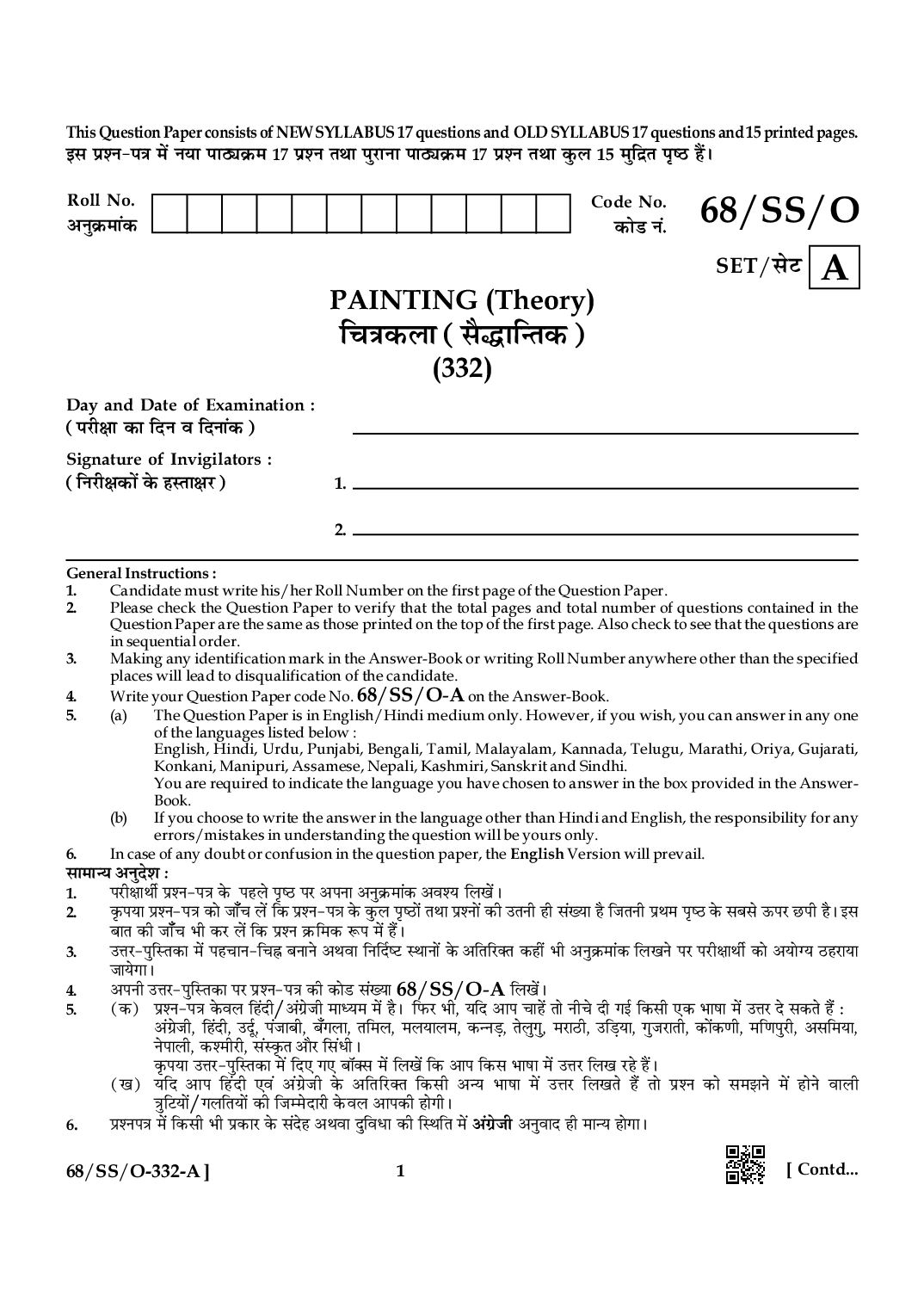
Page 1
ß‚ ¬˝‡Ÿ-¬òÊ ◊¥ ŸÿÊ ¬Ê∆K∑˝§◊ 17 ¬˝‡Ÿ ÃÕÊ ¬È⁄UÊŸÊ ¬Ê∆K∑˝§◊ 17 ¬˝‡Ÿ ÃÕÊ ∑ȧ‹ 15 ◊ÈÁŒ˝Ã ¬Îc∆U „Ò¥–
Roll No. Code No.
•ŸÈ∑˝§◊Ê¥∑§ ∑§Ê«U Ÿ¥.
68/SS/O
SET/‚ ≈ A
PAINTING (Theory)
ÁøòÊ∑§‹Ê (‚ÒhÊÁãÃ∑§)
(332)
Day and Date of Examination :
(¬⁄UˡÊÊ ∑§Ê ÁŒŸ fl ÁŒŸÊ¥∑§)
Signature of Invigilators :
(ÁŸ⁄UˡÊ∑§Ê¥ ∑§ „SÃÊˇÊ⁄U) 1.
2.
General Instructions :
1. Candidate must write his/her Roll Number on the first page of the Question Paper.
2. Please check the Question Paper to verify that the total pages and total number of questions contained in the
Question Paper are the same as those printed on the top of the first page. Also check to see that the questions are
in sequential order.
3. Making any identification mark in the Answer-Book or writing Roll Number anywhere other than the specified
places will lead to disqualification of the candidate.
4. Write your Question Paper code No. 68/SS/O-A on the Answer-Book.
5. (a) The Question Paper is in English/Hindi medium only. However, if you wish, you can answer in any one
of the languages listed below :
English, Hindi, Urdu, Punjabi, Bengali, Tamil, Malayalam, Kannada, Telugu, Marathi, Oriya, Gujarati,
Konkani, Manipuri, Assamese, Nepali, Kashmiri, Sanskrit and Sindhi.
You are required to indicate the language you have chosen to answer in the box provided in the Answer-
Book.
(b) If you choose to write the answer in the language other than Hindi and English, the responsibility for any
errors/mistakes in understanding the question will be yours only.
6. In case of any doubt or confusion in the question paper, the English Version will prevail.
‚Ê◊Êãÿ •ŸÈŒ‡Ê —
1. ¬⁄UˡÊÊÕ˸ ¬˝‡Ÿ-¬òÊ ∑§ §¬„‹ ¬Îc∆U ¬⁄U •¬ŸÊ •ŸÈ∑˝§◊Ê¥∑§ •fl‡ÿU Á‹π¥–
2. ∑Χ¬ÿÊ ¬˝‡Ÿ-¬òÊ ∑§Ê ¡ÊÚ°ø ‹¥ Á∑§ ¬˝‡Ÿ-¬òÊ ∑§ ∑ȧ‹ ¬Îc∆UÊ¥ ÃÕÊ ¬˝‡ŸÊ¥ ∑§Ë ©ÃŸË „Ë ‚¥ÅUÿÊ „Ò Á¡ÃŸË ¬˝Õ◊ ¬Îc∆ ∑ §‚’‚ ™§¬⁄U ¿U¬Ë „Ò– ß‚
’Êà ∑§Ë ¡ÊÚ°ø ÷Ë ∑§⁄U ‹¥ Á∑§ ¬˝‡Ÿ ∑˝ Á◊∑§ UM§¬ ◊¥ „Ò¥–
3. § ©ûÊ⁄U-¬ÈÁSUÃ∑§Ê ◊¥ ¬„øÊŸ-Áøq ’ŸÊŸ •ÕflÊ ÁŸÁŒ¸c≈U SÕÊŸÊ¥ ∑§§•ÁÃÁ⁄UÄà ∑§„Ë¥ ÷Ë •ŸÈ∑˝§◊Ê¥∑§ Á‹πŸ ¬⁄U ¬⁄UˡÊÊÕ˸ ∑§Ê •ÿÊÇÿ ∆U„⁄UÊÿÊ
¡ÊÿªÊ–
4. •¬ŸË ©ûÊ⁄U-¬ÈÁSUÃ∑§Ê ¬⁄U ¬˝‡Ÿ-¬òÊ ∑§Ë ∑§Ê«U ‚¥ÅÿÊ 68/SS/O-A Á‹π¥–
5. (∑§) ¬˝‡Ÿ-¬òÊ ∑§fl‹ Á„¥ŒË/•¥ª˝¡Ë ◊Êäÿ◊ ◊¥ „Ò– Á»§⁄U ÷Ë, ÿÁŒ •Ê¬ øÊ„¥ ÃÊ ŸËø ŒË ªß¸ Á∑§‚Ë ∞∑§ ÷Ê·Ê ◊¥ ©ûÊ⁄ Œ ‚∑§Ã „Ò¥ —
•¥ª˝¡Ë, Á„¥ŒË, ©ŒÍ¸, ¬¥¡Ê’Ë, ’°ª‹Ê, ÃÁ◊‹, ◊‹ÿÊ‹◊, ∑§ãŸ«∏, ËȪÈ, ◊⁄UÊ∆UË, ©Á«∏ÿÊ, ªÈ¡⁄UÊÃË, ∑§Ê¥∑§áÊË, ◊ÁáʬÈ⁄UË, •‚Á◊ÿÊ,
Ÿ¬Ê‹Ë, ∑§‡◊Ë⁄UË, ‚¥S∑Χç•ÊÒ⁄U Á‚¥œË–
∑Χ¬ÿÊ ©ûÊ⁄U-¬ÈÁSÃ∑§Ê ◊¥ ÁŒ∞ ª∞ ’ÊÚÄ‚ ◊¥ Á‹π¥ Á∑§ •Ê¬ Á∑§‚ ÷Ê·Ê ◊¥ ©ûÊ⁄U Á‹π ⁄U„ „Ò¥–
(π) ÿÁŒ •Ê¬ Á„¥ŒË ∞fl¥ •¥ª˝¡Ë ∑§ •ÁÃÁ⁄UÄà Á∑§‚Ë •ãÿ ÷Ê·Ê ◊¥ ©ûÊ⁄U Á‹πà „Ò¥ ÃÊ ¬˝‡Ÿ ∑§Ê ‚◊¤ÊŸ ◊¥ „ÊŸ flÊ‹Ë
òÊÈÁ≈UÿÊ¥/ª‹ÁÃÿÊ¥ ∑§Ë Á¡ê◊UŒÊ⁄Ë ∑ fl‹ •Ê¬∑§Ë „ʪ˖
6. ¬˝‡Ÿ¬òÊ ◊¥ Á∑§‚Ë ÷Ë ¬˝∑§Ê⁄U ∑§ ‚¥Œ„ •ÕflÊ ŒÈÁflœÊ ∑§Ë ÁSÕÁà ◊¥ •¥ª˝¡Ë •ŸÈflÊŒ „Ë ◊Êãÿ „ʪʖ
68/SS/O-332-A ] 1 [ Contd...
Page 2
1. This Question Paper Booklet contains two Question Papers - one based on revised study material
marked as NEW SYLLABUS and the other based on pre-revised study material marked as
OLD SYLLABUS.
2. NEW SYLLABUS is for those candidates who have registered for 2023-2024 (stream-I, Block-I)
admission and are appearing in October-2024 Examinations.
3. OLD SYLLABUS is for those candidates who has registered before 2023-24 (Stream-I, Block-I)
admission.
4. Candidates are to answer only one Question Paper from the given two Question Papers.
5. Candidates are not allowed to mix questions from the given two Question Papers.
◊„àfl¬Íáʸ ÁŸŒ¸‡Ê
1. ß‚ ¬˝‡Ÿ-¬òÊ ¬ÈÁSÃ∑§Ê ◊¥ ŒÊ ¬˝‡Ÿ-¬òÊ „Ò¥ - ∞∑§ ‚¥‡ÊÊÁœÃ •äÿÿŸ ‚Ê◊ª˝Ë ¬⁄U •ÊœÊÁ⁄Uà „Ò Á¡‚ ¬⁄U “ŸÿÊ ¬Ê∆K∑˝§◊” •¥Á∑§Ã
„Ò ÃÕÊ ŒÍ‚⁄UÊ ‚¥‡ÊÊœŸ ‚ ¬Ífl¸ •äÿÿŸ ‚Ê◊ª˝Ë ¬⁄U •ÊœÊÁ⁄Uà „Ò Á¡‚ ¬⁄U “¬È⁄UÊŸÊ ¬Ê∆K∑˝§◊” •¥Á∑§Ã „Ò–
2. ŸÿÊ ¬Ê∆K∑˝§◊ ©Ÿ ¬⁄UˡÊÊÁÕ¸ÿÊ¥ ∑§ Á‹∞ „Ò Á¡Ÿ∑§Ê ŸÊ◊Ê¥∑§Ÿ 2023-2024 (S≈˛UË◊-I, é‹ÊÚ∑§-I) ◊¥ „È•Ê „Ò ÃÕÊ ¡Ê •Ä≈UÊ’⁄U
2024 ¬⁄UˡÊÊ ◊¥ ’Ò∆UŸ ¡Ê ⁄U„ „Ò¥–
3. ¬È⁄UÊŸÊ ¬Ê∆K∑˝§◊ ©Ÿ ¬⁄UˡÊÊÁÕ¸ÿÊ¥ ∑§ Á‹∞ „Ò Á¡Ÿ∑§Ê ŸÊ◊Ê¥∑§Ÿ 2023-24 (S≈˛UË◊-I, é‹ÊÚ∑§-I)∑§ ¬„‹ „È•Ê „Ò–
4. ¬⁄UˡÊÊÕ˸ ÁŒ∞ ª∞ ŒÊ ¬˝‡Ÿ-¬òÊÊ¥ ◊¥ ‚ ∑§fl‹ ∞∑§ ¬˝‡Ÿ-¬òÊ ‚ „Ë ©ûÊ⁄U Á‹π¥–
5. ¬⁄UˡÊÊÕ˸ ∑§Ê ŒÊ ¬˝‡Ÿ-¬òÊÊ¥ ∑§ ¬˝‡ŸÊ¥ ∑§Ê Á◊‹Ê∑§⁄U ©ûÊ⁄U ŒŸ ∑§Ë •ŸÈ◊Áà Ÿ„Ë¥ „Ò–
Note / ÁŸŒ¸‡Ê —
(1) Answer of all questions are to be given in the Answer-Book given to you.
‚÷Ë ¬˝‡ŸÊ¥ ∑§ ©ûÊ⁄U •Ê¬∑§Ê ŒË ªß¸ ©ûÊ⁄U-¬ÈÁSÃ∑§Ê ◊¥ „Ë Á‹π¥–
(2) 15 minutes time has been allotted to read this question paper. The question paper will be distributed
at 2 : 15 p.m. From 2 : 15 p.m. to 2 : 30 p.m., the students will read the question paper only and
will not write any answer on the Answer-Book during this period.
ß‚ ¬˝‡Ÿ-¬òÊ ∑§Ê ¬…∏Ÿ ∑§ Á‹∞ 15 Á◊Ÿ≈U ∑§Ê ‚◊ÿ ÁŒÿÊ ªÿÊ „Ò– ¬˝‡Ÿ-¬òÊ ∑§Ê ÁflÃ⁄UáÊ ŒÊ¬„⁄U ◊¥ 2 : 15 ’¡ Á∑§ÿÊ ¡Ê∞ªÊ–
2 : 15 ’¡ ‚ 2 : 30 ’¡ Ã∑§ ¿UÊòÊ ∑§fl‹ ¬˝‡Ÿ-¬òÊ ∑§Ê ¬…∏¥ª •ÊÒ⁄U ß‚ •flÁœ ∑§ ŒÊÒ⁄UÊŸ fl ©ûÊ⁄U-¬ÈÁSÃ∑§Ê ¬⁄U ∑§Ê߸ ©ûÊ⁄U Ÿ„Ë¥
Á‹π¥ª–
68/SS/O-332-A ] 2 [ Contd...
Page 3
PAINTING (Theory)
ÁøòÊ∑§‹Ê (Á‚hÊãÃ)
(332)
Time : 2 Hours ] [ Maximum Marks : 40
‚◊ÿ — 2 ÉÊá≈U ] [ ¬ÍáÊÊZ∑§§ — 40
Note :
(i) This question paper consists of 17 questions in all.
(ii) All questions are compulsory.
(iii) Marks are given against each question.
(iv) Section - A consists of
Q.No. 1 to 8 - Multiple Choice type Questions (MCQs) carrying 1 mark each. Select and write the
most appropriate option out of the four options given in each of these questions.
(v) Section - B consists of Objective type questions. Q.No. 9 to 11
(a) Read the passage and attempt the following questions.
(b) Read the passage and attempt the following questions.
(c) Read the passage and attempt the following questions.
(vi) Section - C consists of Subjective type questions. Q.No. 12 to 17
(a) Q.No. 12 to 14 - Very Short questions carrying 2 marks each to be answered in the range of
30 - 40 words. An internal choice has been provided in some of these questions.
(b) Q.No. 15 - Short Answer type question carrying 04 marks to be answered in the range of
70 to 80 words. An internal choice has been provided in this question.
(c) Q.No. 16 to 17 - Long Answer type questions carrying 05 marks each to be answered in the
range 90 - 100 words. An internal choice has been provided in this question.
ÁŸŒ¸‡Ê —
(i) ß‚ ¬˝‡Ÿ-¬òÊ ◊¥ ∑ȧ‹ 17 ¬˝‡Ÿ „Ò¥–
(ii) ‚÷Ë ¬˝‡Ÿ •ÁŸflÊÿ¸ „Ò¥–
(iii) ¬˝àÿ∑§ ¬˝‡Ÿ ∑§ ‚Ê◊Ÿ ©‚∑§ •¥∑§ ÁŒ∞ ª∞ „Ò¥–
(iv) πá«U - ∑§ ◊¥ ‡ÊÊÁ◊‹ „Ò¥ —
¬˝‡Ÿ ‚¥ÅÿÊ 1 ‚ 8 Ã∑§ ’„ÈÁfl∑§À¬Ëÿ ¬˝∑§Ê⁄U ∑§ ¬˝‡Ÿ „Ò¥ •ÊÒ⁄U ¬˝àÿ∑§ 1 •¥∑§ ∑§Ê „Ò– ߟ◊¥ ‚ ¬˝àÿ∑§ ¬˝‡Ÿ ◊¥ ÁŒ∞ ª∞ øÊ⁄U
Áfl∑§À¬Ê¥ ◊¥ ‚ ‚’‚ ©¬ÿÈÄà Áfl∑§À¬ ∑§Ê øÿŸ ∑§⁄U Á‹πŸÊ „Ò–
(v) πá«U - π§ ◊¥ flSÃÈÁŸc∆U ¬˝∑§Ê⁄U ∑§ ¬˝‡Ÿ „Ò¥– ¬˝‡Ÿ ‚¥ÅÿÊ 9 ‚ 11
(a) ÁŸêŸÁ‹Áπà •ŸÈë¿UŒ ∑§Ê ¬…∏ •ÊÒ⁄ ÁŸêŸÁ‹Áπà ¬˝‡ŸÊ¥U ∑§ ©ûÊ⁄U ŒËÁ¡∞–
(b) ÁŸêŸÁ‹Áπà •ŸÈë¿UŒ ∑§Ê ¬…∏ •ÊÒ⁄ ÁŸêŸÁ‹Áπà ¬˝‡ŸÊ¥U ∑§ ©ûÊ⁄U ŒËÁ¡∞–
(c) ÁŸêŸÁ‹Áπà •ŸÈë¿UŒ ∑§Ê ¬…∏ •ÊÒ⁄ ÁŸêŸÁ‹Áπà ¬˝‡ŸÊ¥U ∑§ ©ûÊ⁄U ŒËÁ¡∞–
ߟ◊¥ ‚ ∑ȧ¿U ¬˝‡ŸÊ¥ ◊¥ •Ê¥ÃÁ⁄U∑§ Áfl∑§À¬ ÁŒ∞ ª∞ „Ò¥–
(vi) πá«U - ª§ ◊¥ Áfl·ÿÁŸc∆U ¬˝∑§Ê⁄U ∑§ ¬˝‡Ÿ „Ò¥– ¬˝‡Ÿ ‚¥ÅÿÊ 12 ‚ 17
(a) ¬˝‡Ÿ ‚¥ÅÿÊ 12 ‚ 14 Ã∑§ •Áà ‹ÉÊÈ-©ûÊ⁄UËÿ ¬˝∑§Ê⁄U ∑§ ŒÊ-ŒÊ •¥∑§Ê¥ ∑§ ¬˝‡Ÿ „Ò¥– ߟ ¬˝‡ŸÊ¥ ∑§ ©ûÊ⁄U 30 ‚ 40 ‡ÊéŒÊ¥
◊¥ ÁŒ∞ ¡ÊŸ øÊÁ„∞– ߟ◊¥ ‚ ∑ȧ¿U ¬˝‡ŸÊ¥ ◊¥ •Ê¥ÃÁ⁄U∑§ Áfl∑§À¬ ÁŒ∞ ª∞ „Ò¥–
(b) ¬˝‡Ÿ ‚¥ÅÿÊ 15 ‹ÉÊÈ-©ûÊ⁄UËÿ ¬˝∑§Ê⁄U ∑§Ê øÊ⁄U •¥∑§Ê¥ ∑§Ê ¬˝‡Ÿ „Ò– ß‚ ¬˝‡Ÿ ∑§Ê ©ûÊ⁄U 70 ‚ 80 ‡ÊéŒÊ¥ ◊¥ ÁŒÿÊ ¡ÊŸÊ
øÊÁ„∞– ß‚ ¬˝‡Ÿ ◊¥ •Ê¥ÃÁ⁄U∑§ Áfl∑§À¬ ÁŒÿÊ ªÿÊ „Ò–
(c) ¬˝‡Ÿ ‚¥ÅÿÊ 16 ‚ 17 ŒËÉʸ ©ûÊ⁄UËÿ ¬˝∑§Ê⁄U ∑§Ê ¬Ê°ø •¥∑§Ê¥ ∑§Ê§ ¬˝‡Ÿ „Ò– ß‚ ¬˝‡Ÿ ∑§Ê ©ûÊ⁄U 90 ‚ 100 ‡ÊéŒÊ¥ ◊¥ ÁŒÿÊ
¡ÊŸÊ øÊÁ„∞– ß‚◊¥ •Ê¥ÃÁ⁄U∑§ Áfl∑§À¬ ÁŒÿÊ ªÿÊ „Ò–
68/SS/O-332-A ] 3 [ Contd...
Page 4
Choose the correct answer below the questions :
¬˝‡Ÿ ∑§ ŸËø ‚„Ë ©ûÊ⁄U øÈŸ¥ —
1. The animal form Bull on the storage Jar from Harappan Pottery represents as the symbol of : 1
(A) Freedom (B) Loyalty
(C) Gentleness (D) Power and Strength
„«∏å¬Ê Á◊^Ë ∑§ ’øŸÊ¥ ∑§ ÷¥«UÊ⁄UáÊ ¬ÊòÊ ¬⁄U ’ŸÊ ¬‡ÊÈ ’Ò‹ Á∑§‚∑§Ê ¬˝ÃË∑§ „Ò?
(A) SflÃ¥òÊÃÊ (B) ÁŸc∆UÊ
(C) Ÿ◊˝ÃÊ (D) ‡ÊÁÄà •ÊÒ⁄U ÃÊ∑§Ã
2. ‘A Common Indian Nightjar Bird’ was painted in : 1
(A) 17th Century AD (B) 16th Century AD
(C) 18th Century AD (D) 19th Century AD
“∞ ∑§ÊÚ◊Ÿ ߥÁ«UÿŸ ŸÊß≈U¡⁄U ’«¸U” ∑§Ê ÁøÁòÊà Á∑§ÿÊ ªÿÊ ÕÊ —
(A) 17flË¥ ‡ÊÃÊéŒË ߸. (B) 16flË¥ ‡ÊÃÊéŒË ߸.
(C) 18flË¥ ‡ÊÃÊéŒË ߸. (D) 19flË¥ ‡ÊÃÊéŒË ߸.
3. What is the location of the artwork ‘Dying Princess’ ? 1
(A) Cave 17 (B) Cave 1 (C) Cave 16 (D) Cave 5
“«UÊߥª Á¬˝¥‚‚” ∑§‹Ê∑ΧÁà ∑§Ê SÕÊŸ ÄÿÊ „Ò?
(A) ªÈ»§Ê 17 (B) ªÈ»§Ê 1 (C) ªÈ»§Ê 16 (D) ªÈ»§Ê 5
4. What is the correct period of the mural ‘Padmapani Bodhisatva’ ? 1
(A) 5th - 9th CCE (B) 4th - 7th CCE (C) 1st - 2nd CCE (D) 2nd - 6th CCE
Á÷ÁûÊ ÁøòÊ “’ÊÁœ‚àfl ¬k¬ÊÁáÊ” ∑§Ê ‚„Ë ∑§Ê‹ ÄÿÊ „Ò?
(A) 5 - 9 ‚Ë.‚Ë.߸. (B) 4 - 7 ‚Ë.‚Ë.߸. (C) 1 - 2 ‚Ë.‚Ë.߸. (D) 2 - 6 ‚Ë.‚Ë.߸.
5. Complete the title of the artwork ‘Bear, Tiger and __________’. 1
(A) Rabbits (B) Birds (C) Trees (D) Ants
∑§‹Ê∑ΧÁà ∑§Ê ‡ÊË·¸∑§ “÷Ê‹Í, ’ÊÉÊ •ÊÒ⁄U __________” ¬Í⁄UÊ ∑§⁄¥U–
(A) π⁄UªÊ‡Ê (B) ¬ÁˇÊÿÊ¥ (C) ¬«∏ (D) øË¥Á≈UÿÊ¥
68/SS/O-332-A ] 4 [ Contd...
Page 5
surface is known as __________.
(A) Etching (B) Weaving (C) Mural (D) Serigraphy
ŒËflÊ⁄U, ¿Uà ÿÊ Á∑§‚Ë •ãÿ ’«∏Ë SÕÊÿË ‚Ä ¬⁄U ‚Ëœ ÁøÁòÊà ÿÊ ‹ªÊ߸ ªß¸ ∑§‹Ê∑ΧÁà ∑§Ê __________ ∑§ M§¬ ◊¥
¡ÊŸÊ ¡ÊÃÊ „Ò–
(A) ∞Áø¥ª (B) ’ÈŸÊ߸ (C) Á÷ÁûÊ-ÁøòÊ (D) ‚⁄U˪˝Ê»§Ë
7. The yellow colour in Pithora paintings is made with : 1
(A) Indigo (B) Lime paste (C) Balor leave (D) Pewri
Á¬ÕÊ⁄UÊ ÁøòÊ∑§‹Ê ◊¥ ¬Ë‹Ê ⁄¥Uª Á∑§‚‚ ’ŸÊÿÊ ¡ÊÃÊ „Ò?
(A) ŸË‹ (B) øÍŸ ∑§Ê ¬S≈U (C) ’Ê‹Ê⁄U ¬ûÊ (D) åÿÍ⁄UË
8. Who is the artist of the Warli work; ‘Palghat Devi Chauk’ ? 1
(A) Unknown (B) Abhanindranath Tagore
(C) Jeevya Soma Mashe (D) Rabindranath Tagore
flÊ⁄U‹Ë ∑§‹Ê∑ΧÁà “¬Ê‹ÉÊÊ≈U ŒflË øÊÒ∑§” ∑§ ∑§‹Ê∑§Ê⁄U ∑§ÊÒŸ „Ò¥?
(A) •ôÊÊà (B) •Á÷ŸËãŒ˝ŸÊÕ ≈ÒUªÊ⁄U
(C) ¡Ë√ÿ ‚Ê◊Ê ◊Ê‡Ê (D) ⁄UflËãŒ˝ŸÊÕ ≈ÒUªÊ⁄U
SECTION - B / πá«UU - π
9. Read the passage and answer the following questions.
Ajanta cave painting of female figure
The Ajanta paintings are of a different variety, and the text, like Chitrasutra of
Vishnudharmottara Purana, is helps understand some of the technicalities. Shadanga is one
of the later texts that describe qualities of paintings and is equally seen these qualities in
Ajanta Paintings. Shadanga or the six limbs of paintings, composed of Rupabheda (variety
of form), Pramana (proper proportion), Bhava (depiction of emotion), Lavanyayojanam
(Infusion of grace), Sadrisyam (likeness), and Varnikabhangam (mixing of colours). The
painters here mastered the vast complex of human figures, animal and plant forms in addition
to giving free scope to their imagination. The masters of Ajanta have control over the
proportion of individual figures and can group them in an excellent composition.
(i) The text Chitrasutra belongs to which Purana ? 1
(ii) __________ texts describes the qualities of the paintings. 1
(iii) What is the meaning of the Lavanyayojanam Shadanga ? 1
(iv) There are __________ limbs of paintings. 1
68/SS/O-332-A ] 5 [ Contd...
Page 6
•¡¥ÃÊ ªÈ»§Ê ◊¥ SòÊË •Ê∑ΧÁà ∑§Ë ¬¥Á≈¥Uª
•¡¥ÃÊ ∑§Ë ¬¥Á≈¥Uª ∞∑§ •‹ª Á∑§S◊ ∑§Ë „Ò¥, •ÊÒ⁄U ÁflcáÊÈœ◊ʸûÊ⁄U ∑§ ÁøòÊ‚ÍòÊ ¡Ò‚ ¬Ê∆U ¬È⁄UÊáÊ, ∑ȧ¿U Ã∑§ŸË∑§Ë ’ÊÃÊ¥
∑§Ê ‚◊¤ÊŸ ◊¥ ◊ŒŒ ∑§⁄UÃÊ „Ò– ·«¥Uª ©Ÿ ’ÊŒ ∑§ ª˝¥ÕÊ¥ ◊¥ ‚ ∞∑§ „Ò ¡Ê ÁøòÊÊ¥ ∑§Ë Áfl‡Ê·ÃÊ•Ê¥ ∑§Ê fláʸŸ ∑§⁄UÃÊ „Ò •ÊÒ⁄U
•¡¥ÃÊ ∑§Ë ¬¥Á≈¥Uª ◊¥ ÷Ë ÿ Áfl‡Ê·ÃÊ∞° ‚◊ÊŸ M§¬ ‚ ŒπË ¡Ê ‚∑§ÃË „Ò¥– ·«¥Uª ÿÊ ÁøòÊ∑§‹Ê ∑§ ¿U„ •¥ª, M§¬÷Œ (M§¬
∑§Ë ÁflÁflœÃÊ), ¬˝◊ÊáÊ (©Áøà •ŸÈ¬ÊÃ), ÷Êfl (÷ÊflŸÊ ∑§Ê ÁøòÊáÊ), ‹ÊfláÿÿÊ¡Ÿ◊ (∑Χ¬Ê ∑§Ê ‚¥øÊ⁄U), ‚≤‡ÿ◊
(‚◊ÊŸÃÊ), •ÊÒ⁄U flÁáʸ∑§Ê÷¥ª◊ (⁄¥UªÊ¥ ∑§Ê Á◊üÊáÊ) ‚ Á◊‹∑§⁄U ’Ÿ „Ò¥– ÿ„Ê° ∑§ ÁøòÊ∑§Ê⁄UÊ¥ Ÿ •¬ŸË ∑§À¬ŸÊ ∑§Ê ◊ÈÄÃ
ªÈ¥¡Êß‡Ê ŒŸ ∑§ •‹ÊflÊ ◊ÊŸfl •Ê∑ΧÁÃÿÊ¥, ¡ÊŸfl⁄UÊ¥ •ÊÒ⁄U ¬ÊҜʥ ∑§ M§¬Ê¥ ∑§ Áfl‡ÊÊ‹ ¬Á⁄U‚⁄U ◊¥ ◊„Ê⁄Uà „ÊÁ‚‹ ∑§Ë– •¡¥ÃÊ
∑§ ©SÃʌʥ ∑§Ê √ÿÁÄêà •Ê∑ΧÁÃÿÊ¥ ∑§ •ŸÈ¬Êà ¬⁄U ÁŸÿ¥òÊáÊ „Ò •ÊÒ⁄U fl ©ã„¥ ∞∑§ ©à∑Χc≈U ⁄UøŸÊ ◊¥ ‚◊ÍÁ„à ∑§⁄U ‚∑§Ã „Ò¥–
(i) ÁøòÊ‚ÍòÊ ŸÊ◊∑§ ª˝¥Õ Á∑§‚ ¬È⁄UÊáÊ ‚ ‚¥’¥ÁœÃ „Ò?
(ii) __________ ¬Ê∆U ÁøòÊÊ¥ ∑§Ë ªÈáÊflûÊÊ ∑§Ê fláʸŸ ∑§⁄UÃÊ „Ò–
(iii) ‹ÊfláÿÿÊ¡ŸÊ (·«¥Uª) ∑§Ê ÄÿÊ •Õ¸ „Ò?
(iv) ÁøòÊ∑§‹Ê ∑§ __________ •¥ª „Ò¥–
10. Read the passage and answer the following questions.
Padmapani Bodhisattva
The delicate and elegant Bodhisattva is adorned with classic Indian jewellery fit for a
man of noble birth. He is adorned with pearls, amethyst, lapis lazuli and other gems. On his
head is a magnificent crown, which at some point was very likely coloured in rich detail but
has faded now. The crown signifies his royal lineage. The blue lotus blossom in his right
hand (and this is why he is named Padmapani, in Sanskrit Padma is the lotus blossom and
Pani is the hand) represents his spiritual awakening. His eyes are lowered in a meditative
state. His calm, fine-featured face, his proportionate body, and his stance confirm the ideals
of the refined man set by the ideals of the Bodhisattva. The harmonious lines, the combination
of jewel and earth tones, the composition of the mural underline the high sophistication of
the artist, Hammer and Chisel to create a surface for the mural.
(i) The elegant Bodhisattva has __________ on his head. 1
(ii) In Sanskrit __________ is the lotus blossom and __________ is the hand. 1
(iii) What is the state of the eyes of Bodhisattva ? 1
(iv) The crown signifies __________. 1
ªlÊ¥‡Ê ∑§Ê ¬…∏¥ •ÊÒ⁄U ÁŸêŸÁ‹Áπà ¬˝‡ŸÊ¥ ∑§ ©ûÊ⁄U Œ¥–
¬k¬ÊÁáÊ ’ÊÁœ‚àfl
ŸÊ¡È∑§ •ÊÒ⁄U ‚ÈL§Áø¬Íáʸ ’ÊÁœ‚àfl ∑§Ê ∑ȧ‹ËŸ ¡ã◊ ∑§ √ÿÁÄà ∑§ Á‹∞ ©¬ÿÈÄà ċÊÁ‚∑§ ÷Ê⁄UÃËÿ •Ê÷Í·áÊÊ¥ ‚
‚¡ÊÿÊ ªÿÊ „Ò– fl„ ◊ÊÃË, ŸË‹◊, ‹Ê¬Ë‚ ‹Ê¡È‹Ë •ÊÒ⁄U •ãÿ ⁄UàŸÊ¥ ‚ ‚ȇÊÊÁ÷à „Ò¥– ©Ÿ∑§ Á‚⁄U ¬⁄U ∞∑§ ‡ÊÊŸŒÊ⁄U ◊È∑ȧ≈U
„Ò, ¡Ê Á∑§‚Ë ‚◊ÿ ’„Èà „Ë ‚◊Îh Áflfl⁄UáÊ ◊¥ ⁄¥UªÊ „È•Ê ÕÊ, ‹Á∑§Ÿ •’ »§Ë∑§Ê ¬«∏ ªÿÊ „Ò– ◊È∑ȧ≈U ©Ÿ∑§ ‡ÊÊ„Ë fl¥‡Ê ∑§Ê
¬˝ÃË∑§ „Ò– ©Ÿ∑§ ŒÊÁ„Ÿ „ÊÕ ◊¥ ŸË‹Ê ∑§◊‹ ∑§Ê »Í§‹ (•ÊÒ⁄U ÿ„Ë ∑§Ê⁄UáÊ „Ò Á∑§ ©Ÿ∑§Ê ŸÊ◊ ¬k¬ÊÁáÊ „Ò, ‚¥S∑Χà ◊¥ ¬k
∑§◊‹ ∑§Ê »Í§‹ „Ò •ÊÒ⁄U ¬ÊÁáÊ „ÊÕ „Ò) ©Ÿ∑§Ë •ÊäÿÊÁà◊∑§ ¡ÊªÎÁà ∑§Ê ¬˝ÁÃÁŸÁœàfl ∑§⁄UÃÊ „Ò– ©Ÿ∑§Ë •Ê¥π¥ äÿÊŸ ∑§Ë
ÁSÕÁà ◊¥ ¤ÊÈ∑§Ë „È߸ „Ò¥– ©Ÿ∑§Ê ‡ÊÊ¥Ã, ‚È«UÊÒ‹ ø„⁄UÊ, ©Ÿ∑§Ê •ÊŸÈ¬ÊÁÃ∑§ ‡Ê⁄UË⁄U •ÊÒ⁄U ©Ÿ∑§Ê M§π ’ÊÁœ‚àfl ∑§ •ÊŒ‡ÊÊZ mÊ⁄UÊ
ÁŸœÊ¸Á⁄Uà ¬Á⁄Uc∑Χà √ÿÁÄà ∑§ •ÊŒ‡ÊÊZ ∑§Ë ¬ÈÁc≈U ∑§⁄UÃÊ „Ò– ‚Ê◊¥¡Sÿ¬Íáʸ ⁄UπÊ∞°, ⁄UàŸ •ÊÒ⁄U ¬ÎâflË ∑§ ⁄¥UªÊ¥ ∑§Ê ‚¥ÿÊ¡Ÿ,
Á÷ÁûÊ ÁøòÊ ∑§Ë ‚¥⁄UøŸÊ ∑§‹Ê∑§Ê⁄U ∑§Ë ©ëø ¬Á⁄Uc∑§Ê⁄U ∑§Ê ⁄UπÊ¥Á∑§Ã ∑§⁄UÃË „Ò, Á÷ÁûÊ ÁøòÊ ∑§ Á‹∞ ‚Ä ’ŸÊŸ ∑§ Á‹∞
„ÕÊÒ«∏Ê •ÊÒ⁄U ¿UŸË ∑§Ê ßSÃ◊Ê‹ Á∑§ÿÊ ªÿÊ „Ò–
68/SS/O-332-A ] 6 [ Contd...
Page 7
(ii) ‚¥S∑Χà ◊¥ __________ ∑§◊‹ ∑§Ê »Í§‹ „Ò, •ÊÒ⁄U __________ „ÊÕ „Ò–
(iii) ’ÊÁœ‚àfl ∑§Ë •Ê°πÊ¥ ∑§Ë ÁSÕÁà ÄÿÊ „Ò?
(iv) ◊È∑ȧ≈U __________ ∑§Ê ¬˝ÃË∑§ „Ò–
11. Read the passage and answer the following questions.
Madhubani Painting - Kohbar Ghar
The Kohbar fresco is always painted by married women. Singing ritual wedding songs,
they prepare the base by painting the desired portion of the wall with rice slurry. The figures
are drawn with charcoal, or a thin strip of bamboo dipped in lamp soot. This strip is turned
into a brush by rolling some cotton wool on one end, and vibrant colours are applied as
desired. Traditionally the women themselves made colours with locally available ingredients
like lamp soot or burnt heads of Sorghum or Jowar (black), turmeric or sap of banyan tree
mixed with lime (yellow), Palash blossoms (saffron), Kusum blossoms (red), dull green
(cowdung), Peepul bark (crimson), ink or indigo (blue), Mahavar (deep pink). A Kohbar
fresco has fertility symbols, figures of deities and local characters like Naina Jogin, auspicious
symbols like the moon, the sun, the tulsi plant, the parrot, the peacock, the fish, the cobra,
the sparrow, the tortoise, the lily vine, the clove tree, the bamboo plant, the betel vine, the
water pitcher etc. There are no empty spaces in a Madhubani frescoe - the gaps are covered
with geometrical and floral motifs, animal and bird figures.
(i) Who paints the Kohbar frescos ? 1
(ii) The __________ is turned into brush by rolling some cotton wool at the end. 1
(iii) Saffron colour is made with which ingredient ? 1
(iv) Name the local character of Kohbar fresco. 1
ªlÊ¥‡Ê ∑§Ê ¬…∏¥ •ÊÒ⁄U ÁŸêŸÁ‹Áπà ¬˝‡ŸÊ¥ ∑§ ©ûÊ⁄U Œ¥–
◊œÈ’ŸË ¬¥Á≈¥Uª - ∑§Ê„’⁄U ÉÊ⁄U
∑§Ê„’⁄U Á÷ÁûÊÁøòÊ „◊‡ÊÊ ÁflflÊÁ„à ◊Á„‹Ê•Ê¥ mÊ⁄UÊ ÁøÁòÊà Á∑§ÿÊ ¡ÊÃÊ „Ò– ÁflflÊ„ ∑§ •ŸÈc∆UÊÁŸ∑§ ªËà ªÊà „È∞,
fl ŒËflÊ⁄U ∑§ flÊ¥Á¿Uà Á„S‚ ∑§Ê øÊfl‹ ∑§ ÉÊÊ‹ ‚ ⁄¥Uª∑§⁄U •ÊœÊ⁄U ÃÒÿÊ⁄U ∑§⁄UÃË „Ò¥– •Ê∑ΧÁÃÿÊ° øÊ⁄U∑§Ê‹ ÿÊ ŒË¬∑§ ∑§Ë
∑§ÊÁ‹π ◊¥ «ÍU’Ë ’Ê¥‚ ∑§Ë ¬Ã‹Ë ¬^Ë ‚ ’ŸÊ߸ ¡ÊÃË „Ò¥ ß‚ ¬^Ë ∑§ ∞∑§ Á‚⁄U ¬⁄U M§ß¸ ‹¬≈U∑§⁄U ß‚ ’˝‡Ê ◊¥ ’Œ‹ ÁŒÿÊ
¡ÊÃÊ „Ò •ÊÒ⁄U ßë¿UÊŸÈ‚Ê⁄U ø◊∑§Ë‹ ⁄¥Uª ‹ªÊ∞ ¡Êà „Ò¥– ¬⁄¥U¬⁄Uʪà M§¬ ‚ ◊Á„‹Ê∞° πÈŒ „Ë SÕÊŸËÿ M§¬ ‚ ©¬‹éœ ‚Ê◊ª˝Ë
¡Ò‚ ŒËÿ ∑§Ë ∑§ÊÁ‹π ÿÊ íflÊ⁄U (∑§Ê‹Ê) ∑§Ë ¡‹Ë „È߸ ∑§Á‹ÿÊ°, „ÀŒË ‚ ⁄¥Uª ’ŸÊÃË „Ò¥– ÿÊ ’⁄UªŒ ∑§ ⁄U‚ ◊¥ øÍŸÊ
(¬Ë‹Ê), ¬‹Ê‡Ê ∑§ »Í§‹ (∑§‚Á⁄UÿÊ), ∑ȧ‚È◊ ∑§ »Í§‹ (‹Ê‹), ª„⁄UÊ „⁄UÊ (ªÊÿ ∑§Ê ªÊ’⁄U), ¬Ë¬‹ ∑§Ë ¿UÊ‹ (‹Ê‹),
SÿÊ„Ë ÿÊ ŸË‹ (ŸË‹Ê), ◊„Êfl⁄U (ª„⁄UÊ ªÈ‹Ê’Ë)– ∑§Ê„’⁄U Á÷ÁûÊÁøòÊÊ¥ ◊¥ ¬˝¡ŸŸ ∑§ ¬˝ÃË∑§, ŒflË-ŒflÃÊ•Ê¥ ∑§Ë
•Ê∑ΧÁÃÿÊ° •ÊÒ⁄U ŸÒŸÊ ¡Ò‚ SÕÊŸËÿ ¬ÊòÊ „Ò¥ ¡ÊÁªŸ, ‡ÊÈ÷ ¬˝ÃË∑§ ¡Ò‚ ø¥Œ˝◊Ê, ‚Íÿ¸, ÃÈ‹‚Ë ∑§Ê ¬ÊÒœÊ, ÃÊÃÊ, ◊Ê⁄U, ◊¿U‹Ë,
∑§Ê’⁄UÊ, ªÊÒ⁄ÒUÿÊ, ∑§¿ÈU•Ê, Á‹‹Ë ’‹, ‹ÊÒ¥ª ∑§Ê ¬«∏, ’Ê¥‚ ∑§Ê ¬ÊÒœÊ, ¬ÊŸ ∑§Ë ’‹, ¬ÊŸË ∑§Ê ÉÊ«∏Ê •ÊÁŒ– ◊œÈ’ŸË ◊¥ ∑§Ê߸
πÊ‹Ë ¡ª„ Ÿ„Ë¥ „Ò Á÷ÁûÊÁøòÊ •¥Ã⁄UÊ‹ íÿÊÁ◊ÃËÿ •ÊÒ⁄U ¬Èc¬ M§¬Ê¥∑§ŸÊ¥, ¬‡ÊÈ •ÊÒ⁄U ¬ˇÊË •Ê∑ΧÁÃÿÊ¥ ‚ ÷⁄U „È∞ „Ò¥–
(i) ∑§Ê„’⁄U Á÷ÁûÊÁøòÊ ∑§ÊÒŸ ÁøÁòÊà ∑§⁄UÃÊ „Ò?
(ii) •¥Ã ◊¥ ∑ȧ¿U M§ß¸ ‹¬≈U∑§⁄U __________ ∑§Ê ’˝‡Ê ◊¥ ’Œ‹ ÁŒÿÊ ¡ÊÃÊ „Ò–
(iii) ∑§‚Á⁄UÿÊ ⁄¥Uª Á∑§‚ ‚Ê◊ª˝Ë ‚ ’ŸÊÿÊ ¡ÊÃÊ „Ò?
(iv) ∑§Ê„’⁄U »˝§S∑§Ê ∑§ SÕÊŸËÿ øÁ⁄UòÊ ∑§Ê ŸÊ◊ ’ÃÊß∞–
68/SS/O-332-A ] 7 [ Contd...
Page 8
Check for the choice and attempt all the questions. (Answer in min. 30 words)
Áfl∑§À¬ ∑§Ë ¡Ê¥ø ∑§⁄¥U •ÊÒ⁄U ‚÷Ë ¬˝‡ŸÊ¥ ∑§Ê ¬˝ÿÊ‚ ∑§⁄¥U– (©ûÊ⁄U ãÿÍŸÃ◊ 30 ‡ÊéŒÊ¥ ◊¥ Œ¥)
12. Write short note on Pachmarhi cave paintings. 2
¬ø◊…∏Ë ªÈ»§Ê ÁøòÊ∑§‹Ê ¬⁄U ‚¥ÁˇÊåà Á≈Uå¬áÊË Á‹π¥–
13. Write in briefly about the pot with painted tiger design. 2
ÁøÁòÊà ’ÊÉÊ Á«U¡Êߟ flÊ‹ ’øŸ ∑§ ’Ê⁄U ◊¥ ‚¥ˇÊ¬ ◊¥ Á‹π¥–
14. What are the characteristic features of Chamba paintings ? 2
øê’Ê ÁøòÊ∑§‹Ê ∑§Ë ÁflÁ‡Êc≈U Áfl‡Ê·ÃÊ∞° ÄÿÊ „Ò¥?
OR/•ÕflÊ
Describe about the painting ‘A Common Indian Nightjar Bird’.
“∞ ∑§ÊÚ◊Ÿ ߥÁ«UÿŸ ŸÊß≈U¡Ê⁄U ’«¸U” ¬¥Á≈¥Uª ∑§ ’Ê⁄U ◊¥ ’ÃÊ∞°–
Check for the choice and attempt all the questions. (Answer in min. 70 words)
Áfl∑§À¬ ∑§Ë ¡Ê¥ø ∑§⁄¥U •ÊÒ⁄U ‚÷Ë ¬˝‡ŸÊ¥ ∑§Ê ¬˝ÿÊ‚ ∑§⁄¥U– (©ûÊ⁄U ãÿÍŸÃ◊ 70 ‡ÊéŒÊ¥ ◊¥ Œ¥)
15. Write about the compositional beauty of the artist Jamini Roy with examples. 4
∑§‹Ê∑§Ê⁄U ¡ÊÁ◊ŸË ⁄UÊÚÿ ∑§Ë ⁄UøŸÊªÃ ‚ÈãŒ⁄UÃÊ ∑§ ’Ê⁄U ◊¥ ©ŒÊ„⁄UáÊ ‚Á„à Á‹Áπ∞–
OR/•ÕflÊ
Describe about the development of ‘Jain Paintings’ during Medieval period.
◊äÿ∑§Ê‹ ◊¥ “¡ÒŸ ÁøòÊ∑§‹Ê” ∑§ Áfl∑§Ê‚ ∑§ ’Ê⁄U ◊¥ fláʸŸ ∑§ËÁ¡∞–
Check for the choice and attempt all the questions. (Answer in min. 100 words)
Áfl∑§À¬ ∑§Ë ¡Ê¥ø ∑§⁄¥U •ÊÒ⁄U ‚÷Ë ¬˝‡ŸÊ¥ ∑§Ê ¬˝ÿÊ‚ ∑§⁄¥U– (©ûÊ⁄U ãÿÍŸÃ◊ 100 ‡ÊéŒÊ¥ ◊¥ Œ¥)
16. What are the themes of Basohli style painting ? Describe any one Basohli-style painting. 5
’‚Ê„‹Ë ‡ÊÒ‹Ë ∑§Ë ÁøòÊ∑§‹Ê ∑§ Áfl·ÿ ÄÿÊ „Ò¥? Á∑§‚Ë ∞∑§ ’‚Ê„‹Ë ‡ÊÒ‹Ë ∑§Ë ÁøòÊ∑§‹Ê ∑§Ê fláʸŸ ∑§⁄¥U–
OR/•ÕflÊ
Write a short note on the Ajanta cave painting, about its discovery, methodology and subject
represented.
•¡¥ÃÊ ªÈ»§Ê ÁøòÊ∑§‹Ê, ß‚∑§Ë πÊ¡, ¬hÁà •ÊÒ⁄U ¬˝ŒÁ‡Ê¸Ã Áfl·ÿ ¬⁄U ∞∑§ ‚¥ÁˇÊåà Á≈Uå¬áÊË Á‹π¥–
68/SS/O-332-A ] 8 [ Contd...
Page 9
“•◊ÎÃÊ ‡Ê⁄UÁª‹” ∑§Ê ‚¥ÁˇÊåà ¬Á⁄Uøÿ ŒËÁ¡∞ ÃÕÊ ©Ÿ∑§ Áfl·ÿ •ÊÒ⁄U ÁøòÊ∑§‹Ê ‡ÊÒ‹Ë ∑§Ë √ÿÊÅÿÊ ∑§ËÁ¡∞–
OR/•ÕflÊ
Write a brief note on Kangra Art. Explaining the themes and uniqueness of the paintings.
∑§Ê¥ª«∏Ê ∑§‹Ê ¬⁄U ∞∑§ ‚¥ÁˇÊåà Á≈Uå¬áÊË Á‹π¥– ÁøòÊÊ¥ ∑§ Áfl·ÿ •ÊÒ⁄U ÁflÁ‡Êc≈UÃÊ ∑§Ë √ÿÊÅÿÊ ∑§⁄¥U–
-oOo-
68/SS/O-332-A ] 9 [ Contd...
Page 10
PAINTING (Theory)
ÁøòÊ∑§‹Ê (Á‚hÊãÃ)
(332)
Time : 1½ Hours ] [ Maximum Marks : 30
‚◊ÿ — 1½ ÉÊá≈U ] [ ¬ÍáÊÊZ∑§§ — 30
Note :
(i) This question paper consists of 17 questions in all.
(ii) All questions are compulsory.
(iii) Marks are given against each question.
(iv) Section - A consists of
Q.No. 1 to 9 - Multiple Choice type Questions (MCQs) carrying 1 mark each. Select and write the
most appropriate option out of the four options given in each of these questions.
(v) Section - B consists of Objective type questions. Q.No. 10 to 11
(a) Read the passage and attempt the following questions.
(b) Read the passage and attempt the following questions.
(vi) Section - C consists of Subjective type questions. Q.No. 12 to 17
(a) Q.No. 12 to 15 - Very Short questions carrying 2 marks each to be answered in the range of
30 words. An internal choice has been provided in some of these questions.
(b) Q.No. 16 - Short Answer type question carrying 03 marks to be answered in the range of
50 words. An internal choice has been provided in this question.
(c) Q.No. 17 - Long Answer type question carrying 04 marks each to be answered in the range
70 words. An internal choice has been provided in this question.
ÁŸŒ¸‡Ê —
(i) ß‚ ¬˝‡Ÿ-¬òÊ ◊¥ ∑ȧ‹ 17 ¬˝‡Ÿ „Ò¥–
(ii) ‚÷Ë ¬˝‡Ÿ •ÁŸflÊÿ¸ „Ò¥–
(iii) ¬˝àÿ∑§ ¬˝‡Ÿ ∑§ ‚Ê◊Ÿ ©‚∑§ •¥∑§ ÁŒ∞ ª∞ „Ò¥–
(iv) πá«U - ∑§ ◊¥ ‡ÊÊÁ◊‹ „Ò¥ —
¬˝‡Ÿ ‚¥ÅÿÊ 1 ‚ 9 Ã∑§ ’„ÈÁfl∑§À¬Ëÿ ¬˝∑§Ê⁄U ∑§ ¬˝‡Ÿ „Ò¥ •ÊÒ⁄U ¬˝àÿ∑§ 1 •¥∑§ ∑§Ê „Ò– ߟ◊¥ ‚ ¬˝àÿ∑§ ¬˝‡Ÿ ◊¥ ÁŒ∞ ª∞ øÊ⁄U
Áfl∑§À¬Ê¥ ◊¥ ‚ ‚’‚ ©¬ÿÈÄà Áfl∑§À¬ ∑§Ê øÿŸ ∑§⁄U Á‹πŸÊ „Ò–
(v) πá«U - π§ ◊¥ flSÃÈÁŸc∆U ¬˝∑§Ê⁄U ∑§ ¬˝‡Ÿ „Ò¥– ¬˝‡Ÿ ‚¥ÅÿÊ 10 ‚ 11
(a) ÁŸêŸÁ‹Áπà •ŸÈë¿UŒ ∑§Ê ¬…∏ •ÊÒ⁄ ÁŸêŸÁ‹Áπà ¬˝‡ŸÊ¥ U∑§ ©ûÊ⁄U ŒËÁ¡∞–
(b) ÁŸêŸÁ‹Áπà •ŸÈë¿UŒ ∑§Ê ¬…∏ •ÊÒ⁄ ÁŸêŸÁ‹Áπà ¬˝‡ŸÊ¥ U∑§ ©ûÊ⁄U ŒËÁ¡∞–
ߟ◊¥ ‚ ∑ȧ¿U ¬˝‡ŸÊ¥ ◊¥ •Ê¥ÃÁ⁄U∑§ Áfl∑§À¬ ÁŒ∞ ª∞ „Ò¥–
(vi) πá«U - ª§ ◊¥ Áfl·ÿÁŸc∆U ¬˝∑§Ê⁄U ∑§ ¬˝‡Ÿ „Ò¥– ¬˝‡Ÿ ‚¥ÅÿÊ 12 ‚ 17
(a) ¬˝‡Ÿ ‚¥ÅÿÊ 12 ‚ 15 Ã∑§ •Áà ‹ÉÊÈ-©ûÊ⁄UËÿ ¬˝∑§Ê⁄U ∑§ ŒÊ-ŒÊ •¥∑§Ê¥ ∑§ ¬˝‡Ÿ „Ò¥– ߟ ¬˝‡ŸÊ¥ ∑§ ©ûÊ⁄U 30 ‡ÊéŒÊ¥ ◊¥ ÁŒ∞
¡ÊŸ øÊÁ„∞– ߟ◊¥ ‚ ∑ȧ¿U ¬˝‡ŸÊ¥ ◊¥ •Ê¥ÃÁ⁄U∑§ Áfl∑§À¬ ÁŒ∞ ª∞ „Ò¥–
(b) ¬˝‡Ÿ ‚¥ÅÿÊ 16 ‹ÉÊÈ-©ûÊ⁄UËÿ ¬˝∑§Ê⁄U ∑§Ê ÃËŸ •¥∑§Ê¥ ∑§Ê ¬˝‡Ÿ „Ò– ß‚ ¬˝‡Ÿ ∑§Ê ©ûÊ⁄U 50 ‡ÊéŒÊ¥ ◊¥ ÁŒÿÊ ¡ÊŸÊ øÊÁ„∞–
ß‚ ¬˝‡Ÿ ◊¥ •Ê¥ÃÁ⁄U∑§ Áfl∑§À¬ ÁŒÿÊ ªÿÊ „Ò–
(c) ¬˝‡Ÿ ‚¥ÅÿÊ 17 ŒËÉʸ ©ûÊ⁄UËÿ ¬˝∑§Ê⁄U ∑§Ê øÊ⁄U •¥∑§Ê¥ ∑§Ê§ ¬˝‡Ÿ „Ò– ß‚ ¬˝‡Ÿ ∑§Ê ©ûÊ⁄U 70 ‡ÊéŒÊ¥ ◊¥ ÁŒÿÊ ¡ÊŸÊ øÊÁ„∞–
ß‚◊¥ •Ê¥ÃÁ⁄U∑§ Áfl∑§À¬ ÁŒÿÊ ªÿÊ „Ò–
68/SS/O-332-A ] 10 [ Contd...
Page 11
Choose the correct answer below the questions :
¬˝‡Ÿ ∑§ ŸËø ‚„Ë ©ûÊ⁄U øÈŸ¥ —
1. What is the medium of the seal with the Bull design of Mohenjo-Daro ? 1
(A) Limestone (B) Sandstone
(C) Steatite (D) Granite
◊Ê„Ÿ¡Ê-ŒÊ⁄UÊ¥ ∑§Ë ’Ò‹ flÊ‹Ë ◊È„⁄U Á∑§‚ ◊Êäÿ◊ ‚ ’ŸË „Ò?
(A) øÍŸÊ ¬àÕ⁄U (B) ’‹È•Ê ¬àÕ⁄U
(C) ÁS≈U≈UÊß≈U (D) ª˝ŸÊß≈U
2. Who painted the artwork, Radha and Krishna ? 1
(A) Sahibdin (B) Nihal Chand
(C) Guman (D) Nainsukh
“⁄UÊœÊ •ÊÒ⁄U ∑ΧcáÊ” ÁøòÊ ∑§Ê ∑§‹Ê∑§Ê⁄U ∑§Ê ŸÊ◊ ’ÃÊ∞¥–
(A) ‚ÊÁ„’ŒËŸ (B) ÁŸ„Ê‹ ø¥Œ
(C) ªÈ◊Ÿ (D) ŸÿŸ‚Íπ
3. What medium is used in the painting “A Group of Kashmiri Artisans” ? 1
(A) Oil Colour (B) Tempera
(C) Coloured pencil (D) Watercolour
“∑§‡◊ËÁ⁄U Á‡ÊÀ¬∑§Ê⁄U” ÁøòÊ Á∑§‚ ◊Êäÿ◊ ‚ ’ŸÊÿÊ ªÿÊ?
(A) Ë ⁄¥Uª (B) ≈Uê¬⁄UÊ
(C) ⁄¥UªËŸ ¬ŸÁ‚‹ (D) ¡‹ ⁄¥Uª
4. Who painted the artwork Ravana and Jatayu ? 1
(A) Raja Ravi Verma (B) Abanindranath Tagore
(C) M.F. Hussain (D) Nandlal Bose
“⁄UÊfláÊ ÃÕÊ ¡≈UÊÿÍ” ÁøòÊ∑§Ê⁄U ∑§Ê ŸÊ◊ ’ÃÊ∞¥?
(A) ⁄UÊ¡Ê ⁄UÁfl fl◊ʸ (B) •’ŸËãŒ˝ŸÊÕ ∆UÊ∑ȧ⁄U
(C) M.F. „Í‚ÒŸ (D) ŸãŒ‹Ê‹ ’Ê‚
5. Name the new style and technique developed by Abanindranath Tagore. 1
(A) Fresco (B) Tempera
(C) Wash (D) Collage
•’ŸËãŒ˝ŸÊÕ ∆UÊ∑ȧ⁄U ∑§Ë ŸÿÊ ‡ÊÒ‹Ë ÃÕÊ ≈U∑§ŸË∑§ ∑§Ê ŸÊ◊ ’ÃÊ∞–
(A) »˝§S∑§Ê (B) ≈Uê¬⁄UÊ
(C) flÊÚ‡Ê (D) ∑§Ê‹Ê¡
68/SS/O-332-A ] 11 [ Contd...
Page 12
(A) Realistic (B) Folk
(C) Abstract (D) Landscape
¡ÊÁ◊ŸË ⁄UÊÿ ∑§Ë ∑§‹Ê ‡ÊÒ‹Ë ÄÿÊ Œ‡ÊʸÃË „Ò?
(A) flÊSÃflflÊŒË (B) ‹Ê∑§ ∑§‹Ê
(C) •◊Íø ∑§‹Ê (D) ÷͌·ÿ ∑§‹Ê
7. Name the artist of the painting “Adornment of Bride”. 1
(A) M.F. Hussain (B) Jamini Roy
(C) Amrita Shergil (D) Raja Ravi Verma
“ŒÈÀ„Ÿ ∑§Ê ‡ÊÎ¥ªÊ⁄U” ÁøòÊ ∑§Ê ∑§‹Ê∑§Ê⁄U ∑§Ê ŸÊ◊ ’ÃÊ∞¥–
(A) M.F. „È‚ÒŸ (B) ¡ÊÁ◊ŸË ⁄UÊÿ
(C) •◊ÎÃÊ ‡Ê⁄UªË‹ (D) ⁄UÊ¡Ê ⁄UÁfl fl◊ʸ
8. In which kind of folk art form humans are simplified in triangles ? 1
(A) Warli (B) Madhubani
(C) Gond (D) Kalamkari
◊ŸÈcÿ Á∑§‚ ¬˝∑§Ê⁄U ∑§Ë ‹Ê∑§ ∑§‹Ê ◊¥ ÁòÊ∑§ÊáÊ ∑§Ê L§¬ Á‹ÿÊ?
(A) flÊ⁄U‹Ë (B) ◊œÈ’ŸË
(C) ªÊ¥«U (D) ∑§‹◊∑§Ê⁄UË
9. Name the flower from which folk artists used to extract orange colour. 1
(A) Harsingar (B) Chameli
(C) Sadabahar (D) Orhud
©‚ »È§‹ ∑§Ê ŸÊ◊ ’ÃÊ∞¥ Á¡‚‚ ‹Ê∑§ÁøòÊ∑§Ê⁄U ŸÊ⁄¥UªË ⁄¥Uª ’ŸÊ∞¥–
(A) „⁄UÁ‚¥ªÊ⁄U (B) øÊ◊‹Ë
(C) ‚ŒÊ’Ê„Ê⁄U (D) •Ê«∏„ÈŒ
68/SS/O-332-A ] 12 [ Contd...
Page 13
10. Read the Passage below and answer the following questions.
This civilization is called the Indus Valley Civilization because it was mostly
concentrated on the banks of the river Indus. The most important cities are Harappa and
Mohenjo-Daro. One of the major achievements of this civilization was its urban planning.
A lot of art and craft objects have been discovered from these sites. These include sculptures,
toys, seals, jewellery, pottery, tools, etc. The artists and craftsmen were skillfull in handling
different mediums like metals, stones, clay, etc. The Indus Valley Civilization had made
great advances in metal sculptures mainly bronze using a fascinating technique known as
the lost wax process.
(i) Name the two important cities of the Indus Valley Civilization. 1
(ii) What are the artifacts discovered from the cities of the Indus valley Civilization ? 1
ÁŒ∞ ª∞ ªlÊ¥‡Ê ¬…∏ •ÊÒ⁄U ¬˝‡ŸÊ¥ ∑§Ê ©ûÊ⁄UU Œ¥–
ß‚ ‚èÿÃÊ ∑§Ê Á‚¥œÈ ÉÊÊ≈UË ‚èÿÃÊ ∑§„Ê ¡ÊÃÊ „Ò, ÄÿÊ¥ Á∑§ ÿ„ íÿÊŒÊÃ⁄U Á‚¥œÈ ŸŒË ∑§ Ã≈U ¬⁄U ∑§ÁãŒ˝Ã ÕË– ‚’‚
◊„àfl¬Íáʸ ‡Ê„⁄U „«∏å¬Ê •ÊÒ⁄U ◊Ê„Ÿ¡Ê-ŒÊ⁄UÊ¥ „Ò– ß‚ ‚èÿÃÊ ∑§Ë ∞∑§ ¬˝◊È𠩬‹Áéœ ß‚∑§Ë ‡Ê„⁄UË ÿÊ¡ŸÊ ÕË– ߟ SÕ‹Ê¥
‚ ’„Èà ‚Ê⁄UË ∑§‹Ê •ÊÒ⁄U Á‡ÊÀ¬ flSÃÈ∞° πÊ¡Ë ªß¸ „Ò– Áπ‹ÊŸ, ◊È„⁄¥U •Ê÷È·áÊ, Á◊^Ë ∑§ ’øŸ ©¬∑§⁄UáÊ •ÊÁŒ ‡ÊÊÁ◊‹ „Ò–
∑§‹Ê∑§Ê⁄U •ÊÒ⁄U Á‡ÊÀ¬∑§Ê⁄U ÁflÁ÷㟠◊Êäÿ◊Ê¥ ¡Ò‚ œÊÃÈ ¬àÕ⁄U Á◊^Ë •ÊÁŒ ∑§Ê ‚¥÷Ê‹Ÿ ◊¥ ∑ȧ‡Ê‹ Õ– Á‚¥œÈ ÉÊÊ∆UË ‚èÿÃÊ
Ÿ œÊÃÈ ∑§Ë ◊ÈÁøÿÊ¥ ◊¥ ◊ÈÅÿ M§¬ ‚ ∑§¥ÊSÿ ∑§Ë ∞∑§ •Ê∑§·¸∑§ Ã∑§ŸË∑§ ∑§Ê ©¬ÿʪ ∑§⁄U∑§ ’„Èà ¬˝ªÁà ∑§Ë ÕË Á¡‚ πÊ߸
„È߸ ◊Ê◊ ¬˝Á∑˝§ÿÊ ∑§ L§¬ ◊¥ ¡ÊŸÊ ¡ÊÃÊ „Ò–
(i) Á‚¥œÈ ÉÊÊ≈UË ‚èÿÃÊ ∑§ ŒÊ ◊„àfl¬Íáʸ ‡Ê„⁄UÊ¥ ∑§ ŸÊ◊ ’ÃÊ∞¥–
(ii) Á‚¥œÈ ÉÊÊ≈UË ‚èÿÃÊ ∑§ ‡Ê„⁄UÊ¥ ‚ ¬˝Êåà Á‡ÊÀ¬flSÃÈ•Ê¥ ∑§ ’Ê⁄U ◊¥ ’ÃÊ∞¥–
11. Read the Passage below and answer the following questions.
Rajasthani painting flourished from the 16th century A.D. to the 19th century A.D. due
to two major factors : firstly, the revival of Vaishnavism and secondly the economic prosperity
which encouraged literature, music, and art. There are many centres developed in this region
such as Jaipur, Mewar, Jodhpur, Kota, Bundi, Kishangarh, etc. themes of these paintings are
mainly based on Krishna Leela, Epics, and mythological texts, Folklores of Rajasthan etc.
The Rajasthani miniature paintings reflect the artist’s assimilated styles and techniques from
Ajanta, Gujrati palm leaf paintings, Persian influence from Mughal and even European art.
(i) When did the Rajasthani painting flourish ? 1
(ii) What are the two factors responsible for the flourishing of Rajasthani Paintings ? 1
(iii) Name the major centres of the Rajasthani school of miniature paintings. 1
(iv) What are the influences of styles and techniques we see in Rajasthani paintings ? 1
68/SS/O-332-A ] 13 [ Contd...
Page 14
⁄UÊ¡SÕÊŸË ÁøòÊ∑§‹Ê 16 flË¥ ‡ÊÃÊéŒË ‚ 19 flË¥ ‡ÊÃÊéŒË Ã∑§ ŒÊ ¬˝◊Èπ ∑§Ê⁄U∑§Ê¥ ∑§ ∑§Ê⁄UáÊ »§‹Ë-»Í§‹Ë– ¬„‹Ê,
flÒcáÊfl œ◊¸ ∑§Ê ¬ÈŸL§àÕÊŸ •ÊÒ⁄U ŒÍ‚⁄UÊ •ÊÁÕ¸∑§ ‚◊ÎÁh Á¡‚Ÿ ‚ÊÁ„àÿ, ‚¥ÁªÃ •ÊÒ⁄U ∑§‹Ê ∑§Ê ¬˝Êà‚ÊÁ„à Á∑§ÿÊ– ß‚ ˇÊòÊ
◊¥ ¡ÿ¬È⁄U, ◊flÊ«U, ¡Êœ¬È⁄U, ’È¥ŒË, Á∑§‡ÊŸª…∏ •ÊÁŒ ¡Ò‚ ∑§ß¸ ∑§ãŒ˝ Áfl∑§Á‚à „Í∞ „Ò– ߟ ÁøòÊÊ¥ ∑§ Áfl·ÿ ◊ÈÅÿ L§¬ ‚
∑ΧcáÊ ‹Ë‹Ê, ◊„Ê∑§Ê√ÿ, ¬ÊÒ⁄UÊÁáÊ∑§ ª˝¥ÕÊ¥, ⁄UÊ¡SÕÊŸ ∑§Ë ‹Ê∑§∑§ÕÊ•Ê¥ •ÊÁŒ ¬⁄U •ÊœÊÁ⁄Uà „Ò– ⁄UÊ¡SÕÊŸË ‹ÉÊÈ ÁøòÊ∑§‹Ê
∑§‹Ê∑§Ê⁄UÊ¥ ∑§Ë •¡ãÃÊ, ªÈ¡⁄UÊÃË ÃÊ«U ∑§ ¬ûÊ ∑§Ë ÁøòÊ, ◊Ȫ‹Ê¥ ‚ »§Ê⁄U‚Ë ¬˝÷Êfl •ÊÒ⁄U ÿ„Ê¥ Ã∑§ Á∑§ ÿÍ⁄UʬËÿ ∑§‹Ê ‚
•Êà◊‚ÊòÊ ∑§Ë ∑§ß¸ ‡ÊÒÁ‹ÿÊ¥ •ÊÒ⁄U Ã∑§ŸË∑§Ê¥ ∑§Ê Œ‡ÊʸÃË „Ò–
(i) ⁄UÊ¡SÕÊŸË ∑§‹Ê Áfl∑§Ê‚ ∑§’ „È•Ê?
(ii) ⁄UÊ¡SÕÊŸË ÁøòÊ∑§‹Ê ∑§ Á‹∞ ©ûÊ⁄UŒÊÿË ŒÊ ∑§Ê⁄U∑§ ∑§ÊÒŸ ‚ „¥Ò?
(iii) ⁄UÊ¡SÕÊŸË ‹ÉÊÈ ÁøòÊ∑§‹Ê ‡ÊÒ‹Ë ∑§ ¬˝◊Èπ ∑§ãŒ˝Ê¥ ∑§ ŸÊ◊ ’ÃÊ∞¥–
(iv) ⁄UÊ¡SÕÊŸË ÁøòÊ ◊¥ ‡ÊÒ‹Ë ÃÕÊ Ã∑§ŸË∑§ ∑§ ¬˝÷Êfl ∑§ ’Ê⁄U ◊¥ ’ÃÊ∞¥–
SECTION - C / π¥«U - ª
Check for the choice and attempt all the questions. (Answer in min. 30 words)
Áfl∑§À¬ ∑§Ë ¡Ê¥ø ∑§⁄¥U •ÊÒ⁄U ‚÷Ë ¬˝‡ŸÊ¥ ∑§Ê ©ûÊ⁄U Œ¥– (©ûÊ⁄U ãÿÍŸÃ◊ 30 ‡ÊéŒÊ¥ ◊¥ Œ¥)
12. Write in brief about the jewellery found in the Indus Valley civilization with the help of an 2
example.
Á‚¥œÈ ÉÊÊ≈UË ‚èÿÃÊ ◊¥ Á◊‹ •Ê÷È·áÊÊ¥ ∑§ ’Ê⁄U ◊¥ ©ŒÊ„⁄UáÊ ‚Á„à ‚¥ˇÊ¬ ◊¥ Á‹π–
13. Describe the sculpture “Seated Buddha” from the Gupta period. 2
ªÈ#∑§Ê‹ ∑§Ë ◊ÈÁø ““’Ò∆U „È∞ ’Èh”” ∑§Ê fláʸŸ ∑§⁄¥U–
14. Describe the painting “Bani Thani” from Rajasthani school. 2
⁄UÊ¡SÕÊŸË ‡ÊÒ‹Ë ∑§Ë ÁøòÊ ““’ŸË-∆UŸË”” ∑§Ê fláʸŸ ∑§⁄¥U–
15. (a) Describe the painting “Mara Vijaya”. 2
““◊Ê⁄UÊ Áfl¡ÿ”” ÁøòÊ ∑§Ê fláʸŸ ∑§⁄¥U–
OR/•ÕflÊ
(b) Describe the painting “Padmapani Bodhisattva”.
¬k¬ÊÁáÊ ’ÊÁœ‚àfl ÁøòÊ ∑§Ê fláʸŸ ∑§⁄¥U–
68/SS/O-332-A ] 14 [ Contd...
Page 15
Áfl∑§À¬ ∑§Ë ¡Ê¥ø ∑§⁄¥U •ÊÒ⁄U ‚÷Ë ¬˝‡ŸÊ¥ ∑§Ê ©ûÊ⁄U Œ¥– (©ûÊ⁄U ãÿÍŸÃ◊ 50 ‡ÊéŒÊ¥ ◊¥ Œ¥)
16. (a) What is Phad painting ? Explain very briefly. 3
»§«U ÁøòÊ∑§‹Ê ÄÿÊ „Ò? ‚¥ˇÊ¬ ◊¥ ‚◊¤ÊÊß∞–
OR/•ÕflÊ
(b) Use an example of Madhubani painting to explain the folk style.
◊œÈ’ŸË ÁøòÊ∑§‹Ê ∑§Ê ©ŒÊ„⁄UáÊ ‹Ã „È∞ ‹Ê∑§ ‡ÊÒ‹Ë ∑§Ê fláʸŸ ∑§⁄¥U–
Check for the choice and attempt all the questions. (Answer in min. 70 words)
Áfl∑§À¬ ∑§Ë ¡Ê¥ø ∑§⁄¥U •ÊÒ⁄U ‚÷Ë ¬˝‡ŸÊ¥ ∑§Ê ©ûÊ⁄U Œ¥– (©ûÊ⁄U ãÿÍŸÃ◊ 70 ‡ÊéŒÊ¥ ◊¥ Œ¥)
17. (a) Where is Trimurti sculpture ? Write in detail about the sculpture. 4
ÁòÊ◊ÍÁø ∑§„Ê° „Ò? ◊ÍÁà ∑§ ’Ê⁄U ◊¥ ÁflSÃÊ⁄U ‚ Á‹π¥–
OR/•ÕflÊ
(b) Describe in detail the famous sculpture “Nataraja” from the Chola period.
øÊ‹∑§‹Ê ∑§Ë ¬˝Á‚äŒ ◊ÍÁø “Ÿ≈U⁄UÊ¡” ∑§Ê ÁflSÃÊ⁄U ‚ fláʸŸ ∑§⁄¥U–
-oOo-
68/SS/O-332-A ] 15 [ Contd...
Document Details
| Board / Org | NIOS |
| Exam | National Institute of Open Schooling Class 12 |
| Type | Question Paper |
| Pages | 15 |
| Language | english |
| Updated | 24 Sep 2026 |