SEBA Class 10 Syllabus 2024 Social Science
Finished viewing? Save it for later —
Download SEBA Class 10 Syllabus 2024 Social Science (PDF · 19 pages)About SEBA Class 10 Syllabus 2024 Social Science
SEBA Class 10 Syllabus 2024 Social Science is available here for free download. Published by Assam Board for Class 10, this syllabus can be viewed online or downloaded as a PDF (19 pages). Candidates preparing for Class 10 can use SEBA Class 10 Syllabus 2024 Social Science to understand the exam pattern, the type of questions asked, and the overall difficulty level.
Frequently Asked Questions
How can I download SEBA Class 10 Syllabus 2024 Social Science?
Open this page and click the Download button to save SEBA Class 10 Syllabus 2024 Social Science as a PDF. It is completely free on AglaSem Docs.
Is SEBA Class 10 Syllabus 2024 Social Science free to download?
Yes. SEBA Class 10 Syllabus 2024 Social Science can be viewed online and downloaded as a PDF free of cost on AglaSem Docs.
How many pages does SEBA Class 10 Syllabus 2024 Social Science have?
SEBA Class 10 Syllabus 2024 Social Science contains 19 pages, which you can read online or download together as a single PDF.
Where can I find more Class 10 study material?
You can find more Class 10 question papers, sample papers, syllabus, and answer keys on AglaSem Docs.
SEBA Class 10 Syllabus 2024 Social Science – Text
Read the full text of this syllabus below — useful to quickly search, copy and reference the content online without downloading the PDF.
📄 View text version (19 pages)
Page 1
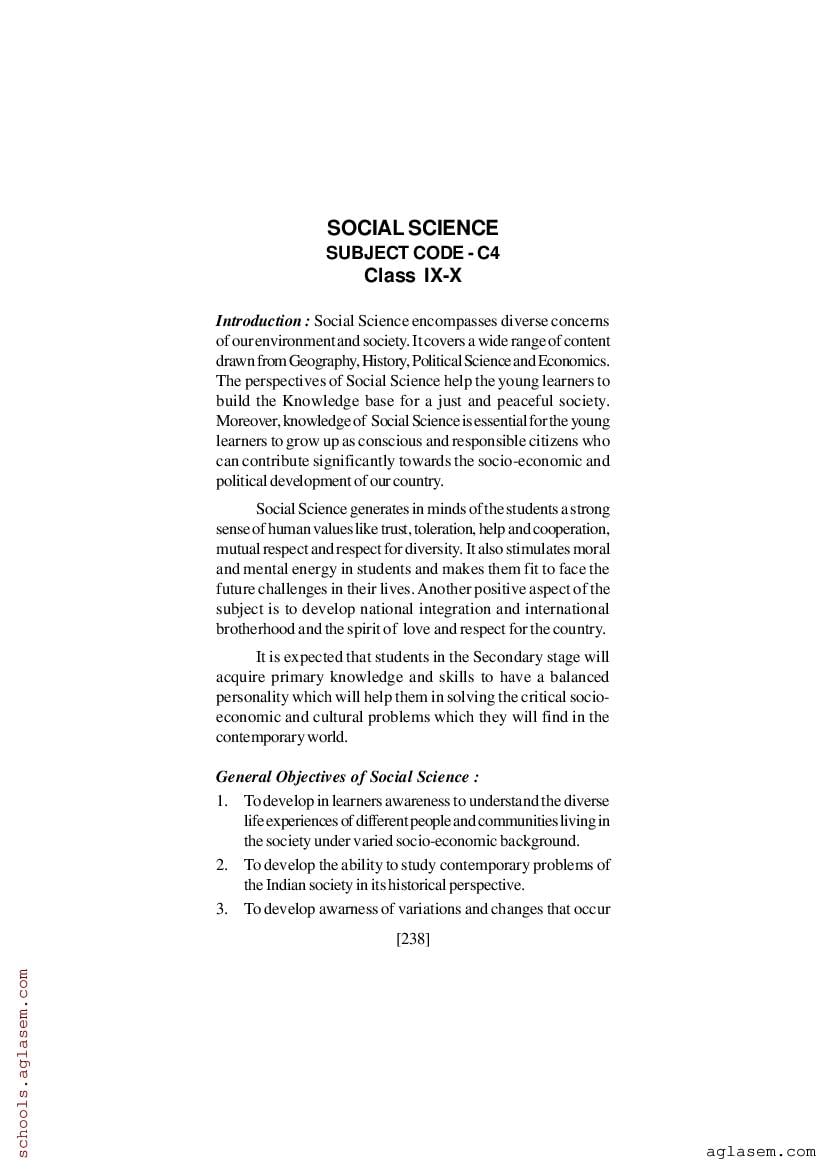
SUBJECT CODE - C4
Class IX-X
Introduction : Social Science encompasses diverse concerns
of our environment and society. It covers a wide range of content
drawn from Geography, History, Political Science and Economics.
The perspectives of Social Science help the young learners to
build the Knowledge base for a just and peaceful society.
Moreover, knowledge of Social Science is essential for the young
learners to grow up as conscious and responsible citizens who
can contribute significantly towards the socio-economic and
political development of our country.
Social Science generates in minds of the students a strong
sense of human values like trust, toleration, help and cooperation,
mutual respect and respect for diversity. It also stimulates moral
and mental energy in students and makes them fit to face the
future challenges in their lives. Another positive aspect of the
subject is to develop national integration and international
brotherhood and the spirit of love and respect for the country.
It is expected that students in the Secondary stage will
acquire primary knowledge and skills to have a balanced
personality which will help them in solving the critical socio-
economic and cultural problems which they will find in the
contemporary world.
General Objectives of Social Science :
1. To develop in learners awareness to understand the diverse
life experiences of different people and communities living in
the society under varied socio-economic background.
2. To develop the ability to study contemporary problems of
the Indian society in its historical perspective.
3. To develop awarness of variations and changes that occur
[238]
Page 2
4. To develop skills and attitude essential for good citizens so
that they can contribute in nation building as well as in social
development.
5. To strengthen national integration in its proper perspective
establishing linkages of regional History and Geography with
national History and Geography.
6. To develop understanding in learners that contribute to build
a society based on values of peace, love, equality and
secularism.
7. To appreciate that dignity of individuals and respect for
Human Rights constitute the basis of a democratic social life
and these are essential for the development of our society
and the nation.
8. To recognize the role of India for promoting peace and
international understanding and to develop the spirit of
international cooperation.
Special Objectives :
History :
1. To promote understanding in leaners about the political,
socio-economic and cultural life of the people of India since
the rule of the Mughals.
2. To develop the ability to study contemporary problems of
the Indian society in its historical perspective.
3. To acquaint the learners with the sources of acquiring
knowledge of History and to create awareness among them
to preserve historical monuments, archaeological sites,
artifacts, literary and oral sources.
4. To know about the political development of Assam, its
relationship with India and her contribution to India’s
Freedom Movement.
5. To develop appreciation on the growth of various
[239]
Page 3
achievements of Indian people in different parts of the
country.
6. To promote understanding about the cultural heritage of India
and the North East.
Geography :
1. To acquaint the learners with diverse natural and social
environment sequentially at local, regional and global levels.
2. To acquaint the learners with the interdependence of various
regions/states in terms of resource, population, transport and
communication etc.
3. To develop in learners the skill of map reading and map
drawing which will encorage them to draw maps, sketches
etc. as per requirement.
4. To help the learners in acquiring understanding about the
existing and emerging development of environment in their
natural and social settings.
5. To inculcate in the minds of the learners a sense of
belongingness to the elements of nature and man-made
environments and their conservation.
Political Science :
1. To foster an urge among learners for effective participation
in community affairs.
2. To acquaint the students with the functioning of various
political institutions at the Centre and the States.
3. To help the pupils in realising the importance of Human Right
and Consumers’ Rights.
4. To help the learners in appreciating the role and contribution
of India and the UNO in promoting world peace.
[240]
Page 4
1. To acquaint the students with those elementary concepts of
Economics which are related to the understanding of the
day-to-day ecnomic activities and current economic
problems.
2. To introduce the students with various economic activities
undertaken by the people in their geographical and social
environment.
3. To acquaint the learners with the preliminary knowledge of
Economic Planning in the context of the national as well as
state economy.
4. To enable the learners to understand the main economic
challenges faced by the people and the country and goverment
endeavours for their solution.
Distributions of marks and periods alloted to each of
the four components of History, Geography Political
Science and Economics :
Components Marks Periods
History 35% 70
Geography 35% 70
Political Science 10% 20
Economics 10% 20
Internal Assessment 10% --
(Environmental Project)
Total marks/periods 100 180
[241]
Page 5
Subject Code - C4, Class X
CHAPTER / CONTENTS COMPETENCY SUB-COMPETENCY SPECIAL
UNIT INSTRUCTIONS
1. A. India : Partition of To learn about the cirumstances leading to the To understand the motive of the British To provide MCQ, VSA,
Bengal swadeshi partition of Bengal. behind the partition of Bengal. SA, LA type of
Movement, its Knowledge about antipartition questions.
aftermath To know anti partition of Bengal and evolution Movment (leading to swadeshi
of the swadeshi movement. Movement) and its impact.
(6 marks)
to familiarize with the birth of Muslim
To know the emergence of Muslim league.
league.
[254]
2. Rise of Gandhi era To learn the causes and effects of Non- To understand the Gandhian policy of -Do-
and his role in cooperation, Civil Disobedience, Quit India Non-Violence and satyagraha.
freedom Movements and also the Indian National Army Emphasis and the concept of non-
(INA). violence.
(7 marks)
To get acquainted with the adverse effect of the To get acquainted with the causes and
first orld war on India as well as advent of impact of Non cooperation with
M.K. Gandhi to Indian politics. reference to Gandhi-Irwin Pact, civil
Disobedience and Quit India
Movement.
Page 6
CHAPTER / COMPETENCY SUB-COMPETENCY SPECIAL SPECIAL
UNIT INSTRUCTION INSTRUCTIONS
To know about the early-colonial (British) uprisings To understand the factors leading to -Do-
of 1828-30 A.D., the growth of the INA and its impact.
To understand the partition of India
(Indian Independence Act and Indo-
Pak boundary line)
3. B. Assam Anti-British To understand the circumstances -Do-
[255]
uprisings in Assam leading to the Anti-British Uprisings
in Assam and impacts.
rebellion of Maniram Dewan.
(7 marks)
British revenue administration and
its impact.
Raijmel, Peasant’s revolts, Tribal
revolts.
Page 7
CHAPTER / COMPETENCY SUB-COMPETENCY SPECIAL SPECIAL
UNIT INSTRUCTION INSTRUCTIONS
4. Role of various To create interest among the students about To understand the role of (Assamese
organisation and the role of different organisations and asso- Literary Society) (1872-1885), Asomiya
Associations to the ciations in the freedom Movement of Assam. Bhasha Unnati Sadhani Sabha (1888),
freedom Movement and Jonaki era (1889), Jorhat Sarbonanik
a brief reference to some Sabha (1884), Asom Association (1903),
post independence Asom Chatra Sanmilan (1916-1939),
avents in Assam. Ryot Sabha (1884), Ahom Sabha
(1893), Asom Provincial Congress
(8 marks) (1920)
[256]
To understand the participation of Assam
in the National Freedom Movement.
SAome post-indepence events like
Ministry of Gopinath Bordoloi,
establishment of Guwahati University
(1948), Assam
Page 8
CHAPTER / COMPETENCY SUB-COMPETENCY SPECIAL SPECIAL
UNIT INSTRUCTION INSTRUCTIONS
Medical college, Jorhat Agricultural
College, Guwahati Engineering college,
Veterinary College etc.
5. Cultural heritage of India To know about the racial diversity preva- To understand about contributions of Some Exercises like
and North East lent in India and N.E. and its composite various racial/cultural elements to the objective, short type,
nature and culture. growth of composite culture of India long questions in each
(7 Marks) and NE. chapter/unit
[257]
A brief out line of literature, paintings of India To understand the basic differences of A summary at the end
and NE. N.E. culture with rest of India. of each chapter.
To get acquainted with folk culture of NE Maps and pictures at
and India appropriate places.
Page 9
Subject Code - C4, Class X
CONTENTS SUB CONTENTS COMPETENCY SUB-COMPETENCY
1. Economic Definition and contents To provide the meaning scope and To introduce the meaning of Economic
Geography contents of Economic Geography Geography in the contemporary context. The
scope of the sub-discipline should be elaborated
(7 Marks) mentioning its major branches and contents of
the respective branches.
Resources and Classification To provide clear understanding of the to discuss the concept of resource and its
concept and types of resources. That change in course of time How the growing
[258]
the concept of resource is dynamic scarcity of resource on the one hand and the
should be elaborated. advancement of science and technology on
the other have influenced the concept of
resource should be indicated with suitable
examples.
Page 10
CONTENTS SUB CONTENTS COMPETENCY SUB-COMPETENCY
Resource use and conservation To provide idea on the diverse of The diversity of resource use should be
resource and the need of resource highlighted. Search for alternative resource
conservation. should be indicated. The need and means of
resource conservation should be elaborated.
Efforts of the gloabal and national organizations
in this regard should be highlighted.
2. Environment Understanding the meaning of To define the term ‘environment’ and To focus on the various components of
and environment from from to focus on its present relevance from environment and their inter-relationship. The
Environmental geographical perspectives. geographical perspectives. growing significance of environmental
[259]
Problems understanding to cope with the changing situation
should be focussed.
(6 marks) Defining environmental problem To clarify the meaning of environmental The meaning of evnironmental problem and how
and stating the major problem with examples and to mention it occurs should be clearly stated. Relevant
environmental problems the major environmental problems examples should be cited. The role of human in
confronted by the contemporary and associated areas. the occurrence of environmental problem should
society. be focussed.
Page 11
CONTENTS SUB CONTENTS COMPETENCY SUB-COMPETENCY
The major environmental problems like air, water
and land pollution, desertification, global warming,
etc should be mentioned along with their causes
and affected areas. Relenant examples from
Assam and North East India may be cited
wherever feasible.
3. Geography of Transport To present the distribution of continents A brief idea as to the formation of continents and
the World and oceans over the earth’s surface. oceans along with their areas should be provided
[260]
with the help of maps and diagrams. The major
(8 marks) physical features (mountains, plateaus, hills,
deserts, rivers and lakes) of the continents should
be mentioned.
To show the countries and their A list of the countries of the world along with their
capitals. location in the continents on maps should be
provided along with area and population.
Page 12
CONTENTS SUB CONTENTS COMPETENCY SUB-COMPETENCY
4. Geography of Population and Settlement To provide clear understanding of A brief outline of the relation between
Assam geography of population and settlement environment and settlement and details of
with respect to natural and socio- population growth (Since 1901), distribution and
(14 marks) cultural settings. density with respect to districts and regions
(Brahmapurta valley, Barak valley and hill
districts). the Ethnic and linguistic deversity of
the state should very briefly be focused. The
growth of settlements (rural and urban) and
settlement patterns in different regions of the state
should also be presented with necessary maps
[261]
and diagrams.
Transport To get an idea of the transport system A geographical outline of the transport networks
and related problems (road, railway, air and water transport) should
be presented with the help of relevent maps. the
problems of transport, mainly inaccessibility,
should be focused.
Page 13
CONTENTS SUB CONTENTS COMPETENCY SUB-COMPETENCY
Resource To provide clear understanding The importance of resource for economic development should
of the type and distribution of be highlighted briefly at the begining. The details of natural
resources along with brief and human resource distribution and the pattern of their uses
introduction of their uses should be discussed. The growing scarcity of natural
resources and its implications should be mentioned.
Economy To focus on the economy of The economic diversity of the state should be highlighted.
the state with respect to The major sectors of the state’s economy-agriculture, fishery
agriculture, fishery and industry and industry should be discussed in details. In agriculture,
[262]
in order to provide an major crops (rice, jute and mustard), their distribution and
understanding of the economic production, in fishery - distribution and importance of fishery
environment of the state. as an economic activity, and in industry major industries
(oil, tea and other agro-based industries) should be discussed
with necessary data and information, The problems and
prospects of economic development should be discussed
briefly at the end.
Page 14
Subject Code - C4, Class - X
CHAPTER THEMES SUB THEMES OBJECTIVE MARKS/PERIODS
1. Indian Democracy 13.01: Ideals of Indian To be acquainted with the preamble of the Constitution 5 marks/10 periods to
Constitution of India and its ideals. provide MCQ, VSA, SA,
LA type questions
13.02: Federal To give an idea about India as the biggest parlimentary
characteristics of Indian democracy of the world.
political system.
13.03: Parlimaentry To know about the objectives of formation of UNO
[263]
democracy in India. and its various organs.
2. International organiza- 14.01: The objectives of To provide the understanding of linkage between
tions-World peace and UNO and its organs. UNO and world peace.
Human rights.
14.02: UNO and world To give background information about the necessity 5 marks/10 periods
peace: of human rights and their implementation.
14.04: Other important Mention the role of other Important international
international organizations organizations acting towards peace.
Page 15
Subject Code - C4, Class - X
CONTENTS SUB-CONTENTS COMPETENCY SUB-COMPETENCY
1. Money and anking Exchange and importance of Money To know the basic difference between a To appreciate the role of money in a modern economy
(Marks-5) barter economy and money economy
(10 periods)
Definition, Types and To know the definition, major characteris- To understand the nature and the functions of money
Functions of Money tics, types and major functions of money
Bank and Banking System To know the basics about banking To know, (a) the definition of a commercial bank, (b) the difference between a bank
non-banking financial intermediary
[264]
Types of Bank To know the major functions of a commercial bank, central bank, regional rural bank,
Cooperative bank, special banks-IDBI, SIDBI, NABARD
2. Economic Develop- Meaning and Assessment of Eco- To understand the meaning of economic To be able to identify the defferences between economic growth, economic
ment (5 Marks) nomic Development development
development and human development.
(10 Periods)
Economic Development and Planning To understand the concept of planned eco- To know the meaning of planning in a democracy
nomic development
Planning in India To get an idea about planning in India To understand the distinguishing feature of planning in India in the Pre-19991 period
and the Post-1991 period.
To know the meaning of the terms mixed economy, liberalization, privatization and
globalization
To know the salient features of on-going Five Year Plan of Assam
Page 16
Subject Code : C4
Class - X Time : 3 hours
Total Marks : 100 Pass Marks : 30
Theory : 90
Internal Assessment : 10
Pass Marks in written examination : 27
Marks
Unit SUB-UNIT/LESSONS Half
Final
Yearly
Section I : History (35)
1. India: Partition of Bengal,
Swadeshi Movement 15 06
2. Rise of Gandhi Era and his role
in Freedom Movement 15 07
3. Assam: Anti-British Uprising in
Assam-Agrarian Revolutions 10 07
4. Role of Assam in Freedom 08
Movement
5. Cultural Heritage of India and 07
North-East
Section II : Geography (35)
1. Economic Geography 15 07
2. Evnironment and Environmental 15 06
Problems
3. Geography of the World 08
4. Geography of Assam 14
Section III : Political Science
and Economics
Part : Political Science (10)
1. Indian Democracy 10 05
[267]
Page 17
Unit SUB-UNIT/LESSONS Half
Final
Yearly
2. International Organisations-
World Peace and Human Rights 05
Part II : Economics (10)
1. Money and Banking 10 05
2. Economic Development 05
Theory Total 90 90
Internal Assessment 10 10
(Enviornmental Project)
Grand Total 100 100
Textbooks : 1. Social Science Part I-History (ITIHASH) for Class
X, Publisher-ASTPPC Ltd.
2. Social Science Part II- Geography (BHUGOL) for
Class X, Publisher- ASTPPC Ltd.
3. Social Science Part III- Political Science and
Economics (RAJNEETI and ARTHANEETI
BIGYAN) for Class X, Publisher- ASTPPC Ltd.
[268]
Page 18
Subject Code - 30
Class : X Time : 3 hours
Full Marks : 100 Pass Marks : 30
Marks
Unit LESSONS Half
Final
Yearly
1. Growth of Imperialism and 25 14
Nationalism
2. The First World War 25 14
3. World between 1919-1939 25 14
4. The Second World War 25 14
5. The United Nations Organisation 10
6. Emergence of Asia and Africa in
the post II World War period 14
7. Non-Alignment Movement 10
8. Foreign Policy of India 10
Total 100 100
Textbook : Adhunik Biswa Itihash (Class X) ASTPPC Ltd.
[310]
Page 19
Subject Code - 31
Class : X Time : 3 hours
Full Marks : 100 Pass Marks : 30
Theory : 90
Internal Assessment : 10
Pass marks in written examination : 27
Marks
Unit LESSONS Half
Final
Yearly
1 Physical Geography–
Geomorphic Processes 20 8
2 Environmental Geography 20 12
3 Regional Geography : Concept
of Region and Regional
Geography
Regional Geography of the World 25 24
4 Regional Geography of the U.S.A. 25 14
5 Regional Geography of Japan 12
6 Regional Geography of India 20
Total 90 90
7 Internal Assessment 10 10
Grand Total 100 100
Textbook : Adhunik Bhugol (Class X) ASTPPC Ltd.
[316]
Document Details
| Board / Org | Assam Board |
| Exam | Class 10 |
| Type | Syllabus |
| Pages | 19 |
| Updated | 22 Jul 2026 |